
Back to Journals » Clinical Ophthalmology » Volume 20
A Comprehensive Review of the Clinical Evidence Comparing Benzalkonium Chloride–Preserved and Benzalkonium Chloride–Free Latanoprost in the Treatment of Primary Open-Angle Glaucoma and Ocular Hypertension
Authors Kumar H, Parikh R, Chagani A, Bhojani KG, Jain P, Dharmadhikari S, Bhargave C, Mane A, Mehta S
Received 12 January 2026
Accepted for publication 27 March 2026
Published 28 May 2026 Volume 2026:20 595069
DOI https://doi.org/10.2147/OPTH.S595069
Checked for plagiarism Yes
Review by Single anonymous peer review
Peer reviewer comments 2
Editor who approved publication: Dr Sotiria Palioura
Harsh Kumar,1 Rajul Parikh,2 Amyn Chagani,3 KomelAbbas G Bhojani,4 Prachi Jain,5 Shruti Dharmadhikari,5 Chaitanya Bhargave,5 Amey Mane,5 Suyog Mehta5
1Glaucoma Services, Centre for Sight, New Delhi, India; 2Department of Ophthalmology, Shreeji Eye Institute and Research Centre, Palak’s Glaucoma Care Centre, Mumbai, Maharashtra, India; 3Department of Ophthalmology, Chagani Eye and Dental Care, Mumbai, Maharashtra, India; 4Medical Affairs and Clinical Research, Sun Pharmaceutical Industries Limited, Mumbai, Maharashtra, India; 5Medical Affairs and Clinical Research, Sun Pharma Laboratories Limited, Mumbai, Maharashtra, India
Correspondence: KomelAbbas G Bhojani, Medical Affairs and Clinical Research, Sun Pharmaceutical Industries Limited, Mumbai, Maharashtra, India, Email [email protected]
Purpose: This review aims to consolidate and evaluate the clinical evidence on the efficacy and safety of benzalkonium chloride (BAK)-preserved and BAK-free latanoprost in the treatment of primary open-angle glaucoma (POAG) and ocular hypertension (OHT). The primary research question addresses whether BAK-free formulations offer comparable efficacy with improved safety profiles compared to BAK-preserved formulations.
Methods: An extensive literature search was conducted using PubMed up to February 2025. Keywords included “latanoprost”, “primary open-angle glaucoma”, “ocular hypertension”, “efficacy”, and “safety”. Inclusion criteria were peer-reviewed clinical trials and meta-analyses comparing latanoprost with placebo or other treatments (eg. bimatoprost, travoprost, tafluprost, latanoprostene bunod). Exclusion criteria included observational studies, review articles, and studies comparing preservative-free prostaglandin analogues and omidenepag.
Results: Thirty-two studies (17 randomized clinical trials and 7 meta-analyses) were reviewed. Latanoprost, the first FDA-approved prostaglandin analogue, primarily increases uveoscleral outflow. Comparative studies indicate that latanoprost achieves a good balance between IOP reduction and tolerability compared to bimatoprost, travoprost, tafluprost, and unoprostone. Latanoprost also reduces visual field progression and maintains central corneal thickness (CCT). It improves ocular perfusion pressure (OPP), reducing the risk of glaucomatous optic neuropathy. Safety profiles show fewer side effects, such as conjunctival hyperemia, hypertrichosis, and periocular pigmentation, compared to other PGAs. BAK-free formulations demonstrate improved corneal health and patient compliance due to reduced ocular surface toxicity.
Conclusion: Latanoprost remains a first-line therapy for POAG and OHT due to its efficacy, safety, and patient adherence. The availability of BAK-free formulations enhances its therapeutic profile, with reduced corneal toxicity making it a preferred choice for long-term glaucoma management.
Keywords: latanoprost, BAK- free, primary open-angle glaucoma, ocular hypertension, benzalkonium chloride, intraocular pressure, prostaglandin analogues, efficacy, safety
Introduction
Glaucoma is a heterogeneous ocular disorder of multifactorial aetiology characterised by progressive optic neuropathy leading to visual field (VF) defects. It is one of the leading causes of irreversible blindness worldwide with projected prevalence up to 111.8 million by the year 2040.1,2. The prevalence of glaucoma varies based on ethnicity, region and race, with higher prevalence noted specifically among people of African descent (6.5%) and East Asian population (3.54%).3,4
Pathophysiology of glaucoma includes both modifiable and non-modifiable risk factors. Currently, intraocular pressure (IOP) is the only modifiable risk factor to prevent progressive ganglion cell loss in glaucoma.5,6 Hence modalities for management of glaucoma have been in the works ever since the description of glaucoma by Hippocrates as “glaykoseis”.7 The concept of medical management of glaucoma started with the use of anticholinergic physostigmine by Lacquer and pilocarpine by Weber in 1870’s, followed by beta blocker timolol in 1978 and topical carbonic anhydrase inhibitors in 1995.8–10
However, the pivotal change in medical management of glaucoma came with the discovery of prostaglandin analogues (PGAs) latanoprost, travoprost, bimatoprost and tafluprost. Prostaglandin analogues are currently considered as the first-choice drugs for management of primary open angle glaucoma (POAG) due to their proven efficacy, limited adverse effect profile and good compliance.11–13
Prostaglandins were isolated from prostate tissue as early as mid-1930’s and hence the misnomer. However, further research found that these chemical mediators were expressed in almost all nucleated tissues of the body producing wide range of actions.3 Ocular hypotensive effect of prostaglandin analogues like PGF2α was observed in preclinical experiments and the increased uveoscleral aqueous outflow mechanism of PGF2α in the eyes was described in cynomolgus monkeys in 1989.14,15
Prostaglandin analogues (PGAs) in addition to increasing the outflow of aqueous humor, decreases the outflow resistance mediated by matrix metalloproteinases (MMP’s).3,16 Outflow of aqueous is increased by binding to the prostaglandin E & F (EP and FP) receptors located in the ciliary muscle of the eyes leading to relaxation of ciliary muscles. The decreased resistance to outflow of aqueous is mediated by potentiating the remodelling of extracellular matrix by elevated levels of MMP’s and keeping a check on tissue inhibitors of MMP’s.12,16,17
Latanoprost 0.005% was the first topical PGF2α to be US–FDA (United States Food and Drug Administration) approved as an ocular hypotensive in primary open angle glaucoma (POAG) in humans in 1996.18 It acts majorly by increasing the uveoscleral outflow, although minor effect on the trabecular outflow system is also observed.18–20 Following the FDA approval of latanoprost, other topical PGAs were also subsequently endorsed for use in POAG and ocular hypertension. Bimatoprost 0.03% and travoprost 0.004% were approved in 2001, followed closely by tafluprost 0.0015% in 2008.8,19 Being the first PGA discovered, latanoprost is still one of the most commonly prescribed drugs used for lowering intraocular pressure in POAG.18
Latanoprost 0.005% is an esterified prodrug of PGF2α, which undergoes rapid hydrolysis to latanoprost acid. The esterification enhances the lipophilicity and improved corneal penetration of latanoprost.20 Peak concentration of latanoprost amounting to 15–30 ng/mL in the eye was observed at 1–2 hours after topical administration with elimination half-life of 2–3 hours and the maximal effect of therapy appreciated at 3–5 weeks after initiation of treatment. However, in systemic circulation, elimination half-life was 17 minutes, with a peak concentration of 53 pg/mL at 5 mins.14,20 Latanoprost undergoes rapid metabolism by the liver, and majority of it is excreted by the kidneys, in all age groups.20,21 The action of latanoprost after topical instillation starts by about 3 hours and has persistent action till 24 hours, with peak IOP lowering activity noticed at around 8–12 hours. However, the overall IOP lowering effect of latanoprost lasts up to 84 hours, with maximal efficacy noted at 3–5 weeks after initiation of treatment. Hence, once a day dosing is appropriate for latanoprost leading to significant IOP reduction, improved compliance and decreased systemic adverse effects.22–24 Latanoprost administered in the evening produced a greater reduction in IOP at 35% compared to 31% when instilled in the morning and causes less diurnal variation or fluctuation in the IOP in glaucoma patients which is a major risk factor for progression of glaucoma.25,26
Objective
Benzalkonium chloride (BAK), a commonly used preservative in ophthalmic solutions, has been associated with ocular surface toxicity and patient discomfort. BAK-free formulations, including those utilizing micelle technology, have demonstrated improvements in corneal health, reductions in ocular surface disease index (OSDI) scores, and enhanced tear break-up time (TBUT). This narrative review consolidates published clinical evidence comparing the efficacy and safety of benzalkonium chloride (BAK)-preserved and BAK-free latanoprost formulations, including potassium sorbate–preserved preparations, for the treatment of primary open-angle glaucoma and ocular hypertension up to February 2025.
Methodology
An extensive literature search was performed using PubMed from till February 2025 to evaluate existing clinical evidence on latanoprost in the management of POAG and OHT. Keywords including “latanoprost”, “primary open angle glaucoma”, “ocular hypertension”, “efficacy” and “safety” were used in the search terms. The goal of this search strategy was to gather evidence regarding the role of latanoprost in POAG and OHT management, especially concerning its efficacy and safety, and evidence related to BAK free and BAK preserved latanoprost.
Criteria for inclusion were peer-reviewed clinical trials and meta-analysis with full-text articles, which assessed latanoprost treatment either compared with placebo or other treatments ie., bimatoprost, travoprost, tafluprost, latanoprostene bunod and omindenepag in management of POAG and OHT. In addition, cross-referencing from identified studies ensured comprehensive coverage of relevant research.
Criteria for exclusion were studies that consisted of observational, review article and studies comparing preservative free prostaglandin analogues.
Results
Twenty-four research articles (17 randomized clinical trials and 7 metanalysis) that assessed latanoprost for the treatment of POAG and OHT identified. Details of the studies are outlined in Table 1.
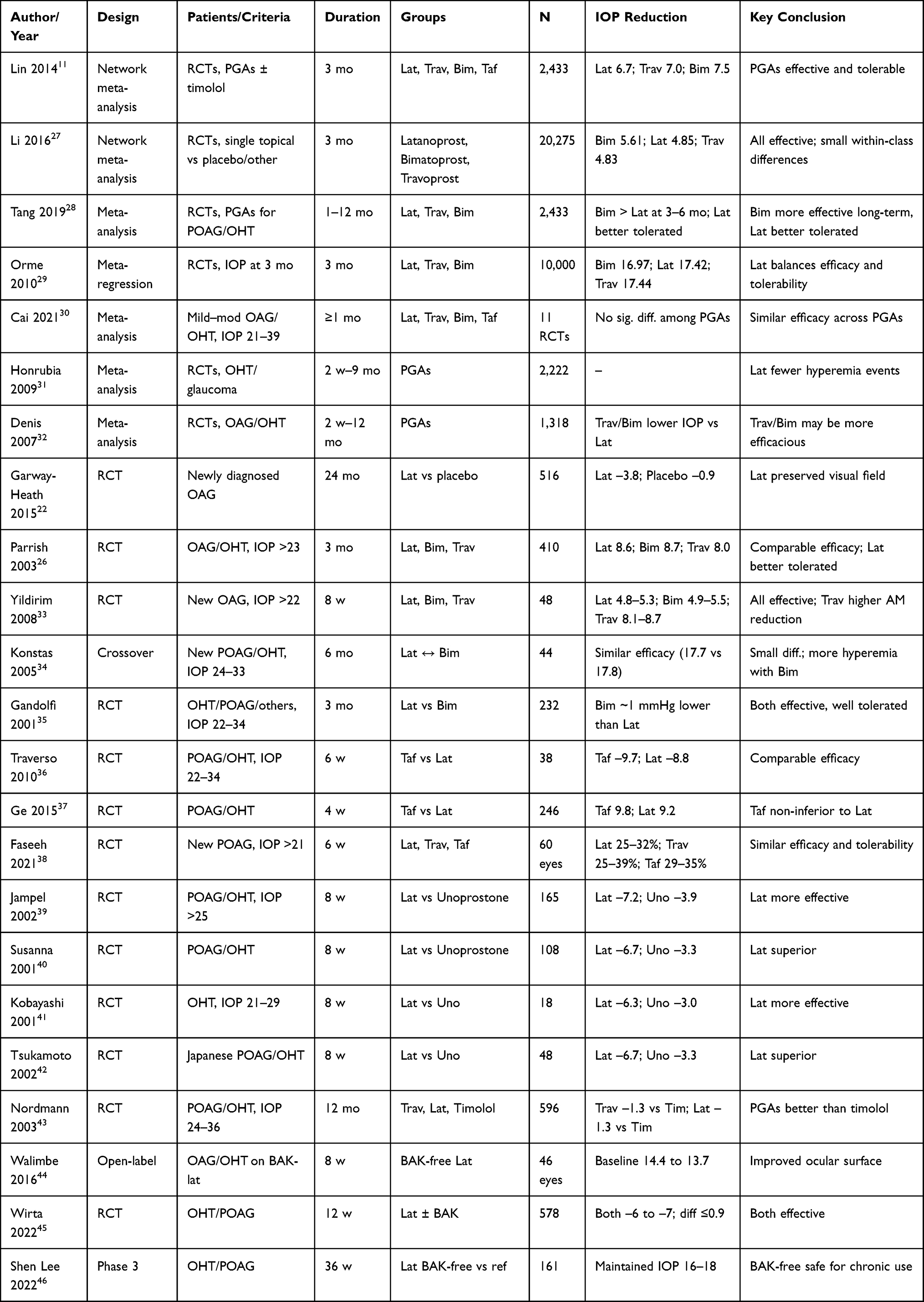 |
Table 1 Studies Evaluating the Efficacy of Latanoprost in POAG or OHT |
Efficacy
Effect on Intraocular Pressure
Following the discovery of latanoprost as a novel anti-glaucoma drug in 1996, bimatoprost, travoprost, tafluprost, unoprostone, latanoprostene bunod were discovered subsequently.9,20 Along the same lines many comparative studies evaluating the percentage of IOP reduction among different PGAs have yielded varied results.
Latanoprost versus Bimatoprost
A systematic meta-analysis of 114 RCT’s with 20,275 subjects by Li T et al, observed mean reduction (95% credible intervals) in IOP at 3 months of therapy was higher with bimatoprost 561 (4.94; 6.29) compared to latanoprost 4.85 (4.24; 5.46) and other PGAs. However, pairwise differences in IOP lowering at the end of 3 months of therapy was small and clinically not meaningful between bimatoprost and latanoprost.27 Another meta-analysis of 17 RCT’s observed higher efficacy of bimatoprost 0.03% compared to latanoprost 0.05% at 3- and 6-months post-treatment for IOP [(at 3 months WMD 0.75 mm Hg (95% CI 1.05, 0.45), P<0.00001 and at 6 months 0.81 mm Hg (95% CI 1.55, 0.09), P=0.03)]. However, there was no statistically significant difference between bimatoprost and latanoprost at 1 month post therapy [WMD 0.11 mm Hg (95% CI 0.97, 0.76), P=0.81].28 Similarly, a meta-analysis comparing the mixed treatment and meta regression of the efficacy and safety of PGAs and comparators observed both latanoprost and bimatoprost monotherapy produced significantly lower on-treatment IOP compared to its competitors, although the difference in on–treatment IOP between latanoprost and bimatoprost was not statistically significant.29 A multicentric study among 410 patients of POAG and ocular hypertension by Parrish RK et al comparing latanoprost with bimatoprost, observed similar mean baseline reduction in IOP at 86 ± 0.3 mm Hg and 8.7 ± 0.3 mm Hg respectively, at the end of 12 weeks of treatment, similar to other reported studies.26,33,47,48 A study on 44 patients over 7 weeks comparing IOP reduction between latanoprost versus bimatoprost observed a small difference which may not be clinically meaningful.34 Similar studies by Gandolfi S et al among 232 patients of POAG and OHT opined that bimatoprost produced greater reduction in IOP at noon and achieved lower target IOP more often than latanoprost at the end of 3 months of treatment although the between-group difference was not always statistically significant35 Thus, latanoprost achieves good balance between IOP reduction and tolerability compared to other Bimatoprost.
Latanoprost versus Travoprost
Parrish RK et al observed a slightly higher reduction in mean 8 am IOP at 86 ± 0.3 mm Hg with latanoprost compared to 8.0 ± 0.3 mm Hg with travoprost.26 Similarly, a hospital-based study wherein patients were switched from latanoprost therapy to travoprost therapy, no significant difference was observed between mean IOP at baseline, [16.4 ± 3.4 mm Hg, 95% confidence interval (CI) 15.6–17.2], at week 6 (15.9 ± 4.2 mm Hg, 95% CI 14.9–16.8) (P=0.2) and at 12 weeks of therapy (16.4 ± 5.7 mm Hg, 95% CI 15.1–17.7) (P=0.99).49 Another study on 24 POAG and 20 OHT patients showed a similar IOP reduction profile at all time points during the day with no statistically significant diurnal difference observed between latanoprost and travoprost group.47 Although long post dosing IOP reduction has also been observed with latanoprost, consistency of these findings compared to travoprost is lacking. To conclude, although some studies have reported slightly higher propensity to reach target IOP with travoprost, these studies are far and few. However, based on the vast data available, IOP reduction with latanoprost is as effective and comparable to travoprost.
Latanoprost versus Tafluprost
Tafluprost (0.0015%) is currently approved for use in POAG, and ocular hypertension. A multinational, and multicentre Phase II study on 38 patients comparing the efficacy of tafluprost and latanoprost, observed a maximum IOP reduction by day 7 and was sustained until day 42 in both groups (mean change from baseline −9.7 mm Hg for tafluprost and −8.8 mm Hg for latanoprost).36 A meta-analysis involving 11 studies containing 10 RCT’s, observed a similar IOP reducing efficacy of tafluprost compared with latanoprost, WMD = 0.534, 95% CI: −0.168–1.236, P=0.136).30 Another randomised study with 246 subjects (tafluprost group:122 subjects/122 eyes, latanoprost group:124 subjects/124 eyes) observed a similar IOP reduction at week 2 at 8.8 ± 3.8 mm Hg and 8.9 ± 4.4 mm Hg in tafluprost group and latanoprost group, respectively.37 A 24-month analysis showed a slightly higher reduction of IOP at 7.7 mm Hg with latanoprost compared to tafluprost at 7.1 mm Hg. The estimated overall treatment difference with repeated measurements (RM) (tafluprost – latanoprost, ITT-intention to treat population) observed during the study was 0.95 mm Hg with the upper 95% confidence limit of 1.38 (RMANOVA) and 1.20 mmHg with the upper 95% confidence limit of 1.52 (RMANCOVA) showing non-inferiority.37 Similarly, a 2021 study comparing latanoprost and tafluprost showed no significant difference in the mean IOP reduction and diurnal variation between the two groups.38 Based on the available limited data comparing latanoprost and tafluprost, latanoprost can be used as an effective substitute to tafluprost without compromising the efficacy.
Latanoprost versus Unoprostone
Although not many studies on direct comparison of the efficacy of latanoprost and unoprostone are available, a few studies do show a significantly better IOP reduction with latanoprost (28%) than compared to unoprostone (15%).39 A multicentric, parallel group, 8-week study among 165 subjects reported a higher mean percentage reduction of IOP −7.2 ± 3.2 mm Hg (28%) for latanoprost (25.3 ± 2.8 mm Hg at baseline to 18.2 ± 2.8 mm Hg at 8 weeks) and −3.9 ± 2.6 mm Hg (15%) for unoprostone (25.5 ± 3.3 mm Hg at baseline to 21.6 ± 4.0 mm Hg; P ≤.001).40 Similar findings were echoed in a study among 18 subjects, wherein a significantly higher baseline IOP reduction at 8 weeks in latanoprost group compared to unoprostone treated patients (16.7 ± 2.0 mm Hg and 19.0 ± 1.5 mm Hg; P < 0.0001).41 In another 8-week comparative analysis among 48 Japanese patients of POAG and ocular hypertension, greater IOP reduction from the baseline at 2, 4, and 8 weeks after treatment at 5.8 ± 2.4 mm Hg, 6.6 ± 2.5 mm Hg, and 6.7 ± 2.0 mm Hg was observed in the latanoprost group compared to 3.8 ± 2.0, 3.5 ± 2.3, and 3.3 ± 3.0 mm Hg in the unoprostone group. The IOP reduction observed in the latanoprost group at 8 weeks was higher compared to unoprostone group (P < 0.001, analysis of covariance).42 To summarize, based on the available literature latanoprost produces a greater and stable IOP lowering effect compared to unoprostone.
Effect on Visual Field Defects (VF)
Progression of visual field defects is one of the parameters used to prognosticate patients of glaucoma, as it provides an objective way to evaluate and set up the target IOP in these patients.50 Although a direct relation of IOP and progression of visual field defects have been observed in landmark trials like the Collaborative Initial Glaucoma Treatment study, earlier belief that IOP alone as an effective predictor of advancing glaucoma is skewed because many other (“non-IOP”) factors like visual field deterioration carries a higher significance to predict glaucoma susceptibility in patients.13,51,52
Direct comparative studies assessing the VF deterioration in glaucoma patients among PGAs are far and few. A placebo-controlled study observed a significantly lower mean IOP and longer preservation of VF with latanoprost compared to placebo, evidenced by hazard ratio=0.44.22 Another 12-month study estimating the long-term visual field consequences of average daily intraocular pressure and its variance in patients receiving either timolol or PGAs, propensity of developing a new visual field defect was 1.54 times higher in timolol treated patients compared to the PGA treated group over a 5-year period.43
Based on the available resources, charting and assessing the VF progression in glaucoma patients would yield better results when combined with IOP monitoring for prognostication and management of glaucoma patients. To summarise, it is safe to conclude that PGAs have lesser propensity for developing a new visual field defect compared to non-PGA drug therapy. However, intra group comparison studies between PGAs are lacking vis-à-vis VF deterioration, most available resources indicate similar effects on VF except for tafluprost which had a higher propensity for developing a new visual field defect probably due to lesser IOP reduction compared to other PGAs, although further prospective longitudinal studies in this regard are needed to come to a conclusion.
Central Corneal Thickness (CCT)
Recent studies have looked at progressive glaucomatous optic neuropathy and its relation to corneal biomechanics and also the notable effects of prostaglandin analogues on the cornea. CCT carries a strong predictive value for VF deterioration and glaucomatous optic neuropathy in ocular hypertensives and glaucoma patients, hence corrected IOP value carries more significance in evaluation.53 Several studies have observed that the CCT is decreased by PGAs.54,55 A study on 69 patients with a mean follow-up period of 18 months, CCT comparison between latanoprost, travoprost and bimatoprost was not statistically significant even after 6 months of therapy.56 In a similar study, CCT was decreased in both latanoprost and bimatoprost treated patients over a long follow-up period of 24 months, however no statistically significant difference was observed between the two groups.57 In an analysis of CCT of 897 patients in 8 RCT’s, least change in the CCT was observed in the latanoprost group compared to other PGAs bimatoprost and travoprost.58
Based on the available data, latanoprost can decrease the CCT; however, its effect is variable and does not significantly affect the treatment regime. Hence, regular pachymetric evaluation of patients on PGAs may help in better prognosticating and setting up target pressures, although other corneal parameters like corneal hysteresis and corneal resistance factor in addition to CCT should also be considered for coming to a conclusion.
Ocular Perfusion Pressure (OPP)
Ocular perfusion pressure is directly dependent on the blood pressure, IOP and resistive index (RI). A high OPP is observed when the BP is high or whenever there is a fall in IOP, likewise, conditions associated with low BP and high IOP is associated with low OPP. Because BP is significantly greater than IOP, OPP is more sensitive to changes in BP than to changes in IOP.59 Resistive Index (RI) is a measure of resistance to blood flow, used primarily to evaluate vascular damage in ophthalmologic diseases and is inversely related to OPP. Low ocular perfusion pressure and risk of glaucoma progression have been studied in many epidemiologic studies like the Baltimore eye survey, Proyecto VER study, wherein a 6-fold and 4-fold increased risk of glaucoma progression due to decreased ocular perfusion pressure was observed, respectively.59–61 Conventional treatment with beta blockers by reducing the systolic BP has shown to reduce OPP, especially during the night, leading to progressive optic neuropathy despite adequate IOP control.60 However, PGAs on the other hand have shown to increase the OPP.62–64 A meta-analysis by Rienne et al also concluded that PGAs increased the OPP compared to other conventional treatments among 147 patients, with a mean difference in OPP of 219 mmHg, 95% confidence interval 0.67–3.70, p = 0.005.65 On comparison of OPP among bimatoprost and latanoprost, a slightly higher OPP was observed with latanoprost in the Quaranta et al study wherein the mean 24-hour dOPP for latanoprost was increased from baseline (3%, p = 0031) but not for bimatoprost (2%, p = 0.21); however, no difference in dOPP was noted between treatments at any time point or over the 24 hour curve (p≥0.17) indicating that, even though latanoprost is associated with slightly improved ocular diastolic perfusion pressure over 24 hours, perfusion levels were similar when compared to bimatoprost.66 A similar study on comparison of OPP in PGAs (latanoprost, travoprost and bimatoprost), showed a statistically significant increase in OPP at the end of 6 months of therapy compared to baseline (baseline: 33.7±3.8 mm Hg, 33.5 ± 3.2 mm Hg, 33.9 ± 2.6 mm Hg, respectively; versus month 6: 40.2 ± 3.5 mm Hg, 39.9 ± 3.1 mm Hg, 41.7 ± 2.6 mm Hg, respectively; p<0.0001).67 To summarise, PGAs increase the OPP compared to other conventional anti-glaucoma drugs, however all PGAs were equally efficacious in increasing the OPP and act as a deterrent to progressive glaucomatous optic neuropathy.
Safety
Conjunctival hyperemia, foreign body sensation, iris hyperpigmentation, hypertrichosis, periocular skin pigmentation can be some of the ocular side effects side effects observed with PGAs. Although rare, adverse events like cystoid macular edema (CME), reactivation of herpes simplex and anterior uveitis have also been observed in a few studies as well.26,64,68
Conjunctival Hyperemia
Conjunctival hyperemia is one of the most common adverse effect observed with PGAs.26,40 A meta-analysis on ocular hyperemia among PGAs by Parrish RK et al, observed lesser incidence among patients on latanoprost (47%) compared to travoprost (58%) and bimatoprost (68%).26 A meta-analysis of 13 RCT’s among 2222 patients also reported higher ocular hyperemia with travoprost (33%) and bimatoprost (40.2%) compared to latanoprost (16.5%).31 Similar studies have also reported a lesser incidence of conjunctival hyperemia in latanoprost treated patients compared with bimatoprost.69,70 Another study on 390 subjects observed higher incidence of conjunctival hyperemia in the travoprost treated group (38.0%) compared to latanoprost treated subjects (27.6%).71 Similarly, in a meta-analysis of 5 RCT’s on 888 patients, conjunctival hyperemia was higher in the tafluprost group (RR=2.11, 95% CI 1.24 to 3.59, P=0.006) compared to latanoprost treated group.72 Based on the available literature, latanoprost causes the least conjunctival hyperemia among available PGAs and the hyperemia usually subsides by the end of 2 to 4 weeks with continued use of the drug, hence discontinuation of therapy is least with latanoprost compared to other PGAs.31,73
Hypertrichosis
Other features of orbitopathy following PGAs therapy like foreign body sensation, hypertrichosis and peri-ocular skin discoloration were least with latanoprost compared to bimatoprost and travoprost in a 12-week study by Parrish RK et al26 Similar findings of a higher incidence of hypertrichosis with bimatoprost compared to latanoprost was observed in a few more studies.35,69,71 RCT’s by Parrish et al and Yildirim et al reported over 3-fold increase in hypertrichosis with bimatoprost compared with latanoprost.26,33 PGAs cause hypertrichosis by both prolonging the anagen phase and inducing anagen (the growth phase) in telogen (resting) follicles while in the involved follicles.74
Peri-Ocular Pigmentation
Peri-ocular pigmentation Peri-ocular pigmentation is a common ocular adverse effect observed with PGAs due to PGA-induced increase in melanogenesis and melanocyte proliferation.64,75 A lesser incidence of peri-ocular skin pigmentation was observed with latanoprost compared to bimatoprost according to Parrish RK et al study.26 Similar findings were also observed by Wand M et al and Doshi M et al studies.76,77 Although the pigmentation develops much earlier with bimatoprost, as early as 1 month compared to latanoprost at 3 months, the pigmentation is usually reversible following cessation of therapy in both groups. However, early reversal is observed in latanoprost treated patients compared to bimatoprost group.64,75,77
Prostaglandin associated periorbitopathy
Prostaglandin associated periorbitopathy (PAP) is commonly observed adverse effect in patients on long term PGAs. PAP includes upper lid ptosis, deepening of the upper lid sulcus, involution of dermatochalasis, periorbital fat atrophy, mild enopththalmos, inferior scleral show, increased prominence of lid vessels and tight lids.78 A study among 13 patients who had prostaglandin associated periorbitopathy (PAP), a switch over from bimatoprost to latanoprost reversed the PAP in 11 out of 13 (85%) patients by 2 months.79,80 A direct comparative study assessing the PAP features like upper eyelid sulcus deepening found that these effects were higher in patients treated bimatoprost (60%) and travoprost (50%) compared to latanoprost (24%).81
Cystoid Macular Edema
Cystoid macular edema due to latanoprost without any ocular co-morbidity is very rare and many studies indicate the same.69–71 CME due to PGAs was observed in patients with other confounding factors like vitreous loss during cataract surgery, diabetics and among patients who underwent laser capsulotomy.82 A meta-analysis to assess the incidence of CME in patients with no history of trauma, ocular surgery or any chronic inflammation, did not show any difference in the incidence rates of CME in the PGAs treated group and the non-PGA treated group. Although a conclusive link between PGAs and CME in treatment naïve eyes is still lacking. However, in high-risk eyes, caution needs to be exercised.83,84
Anterior Uveitis
Anterior uveitis following PGAs use has not been conclusively proved in treatment naïve eyes with no history of trauma, ocular surgery and chronic ocular inflammation. No direct association in the incidence of anterior uveitis among PGAs therapy (latanoprost) and non-PGA therapy was noted in a study by Markomichelakis NN et al.85 However, a possible association between latanoprost and anterior uveitis was observed among 4 patients with complicated open-angle glaucoma who were treated with latanoprost, wherein the uveitis improved after cessation of latanoprost as reported by Fechtner RD et al study86 Topical prostaglandin analogues may be relatively contraindicated in patients with a history of uveitis or prior ocular surgery. Based on the data available, probability of latanoprost inducing anterior uveitis is very low, however no conclusive remarks can be made. Although longitudinal prospective analysis would provide better evidence regarding the same and aid us in arriving at a consensus.
Herpes Simplex Reactivation
Due to lack of prospective studies directly linking the possibility of reactivation of HSV following PGA treatment, a study on association of HSV infection following ocular hypotensive therapy based on claim records, showed a similar rate of ocular herpes simplex compared to that of the general population.87,88 Since most of the reports of herpetic keratitis were based on post-marketing surveillance reports, the exact frequency cannot be attributed. To summarise, the direct risk of PGAs inducing/reactivating HSV is very low and needs further large-scale studies to come to a consensus, however in patients with history of HSV caution needs to be exercised.
Compliance to Therapy
Non-compliance to therapy in glaucoma is as high as (50%), hence adherence to therapy is one of the major determinants in glaucoma management.89,90 Glaucoma Adherence and Persistence study (GAPS) which assessed the compliance to PGA monotherapy in 6271 patients, 4071 (11%) patients on latanoprost continuously refilled their prescriptions, compared to 9% of bimatoprost and 5% of travoprost patients.91 A 2019 study by Heo JH et al demonstrated a lower risk of discontinuing and increased adherence to first-line therapy in the latanoprost group (50.1%) than the travoprost (48.8%) and bimatoprost groups (43.0%). Latanoprost group (52.9%) also reported the highest percentage of patients continuing with the PGA index without needing a change in treatment due to switching, addition or surgery, compared with travoprost (39.0%) or bimatoprost users (42.1%; P < 0.001).92 Similarly, in a retrospective cohort study of 28741 patients, discontinuation of other IOP lowering therapy was as high as 37% to 72% compared to latanoprost-treated group. At the end of 12 months, latanoprost treated subjects had a higher persistency/continued usage at 33% compared to 19%, with other topical IOP lowering agents.93
BAK Free verses BAK Preserved Latanoprost
Conventional preparations of latanoprost 0.005% ophthalmic solution (Xalatan®, Pfizer & Upjohn Co, Puurs, Belgium) was stabilised by BAK and must be stored at a temperature of 2°–8°C and once a bottle is opened for use, it may be stored at room temperature up to 25°C (77°F) for 6 weeks.18 The BAK-free formulation of latanoprost 0.005% ophthalmic solution prepared using micelle formulation technology (e.g., Latoprost RT microemulsion, Sun Pharma, India) is stable at 40 °C for 6 months. The micelle formulation technology system is capable of solubilizing latanoprost in an ophthalmic formulation without the need for BAK and increased stability. The micelle is prepared using latanoprost, castor oil 0.15%, polyethylene glycol hydroxystearate (Solutol HS) and Propylene glycol. The non-active excipients in the formulation may have protective effect ocular surface integrity in glaucoma patients.94
A prospective, open-label, single-arm, multicenter, 8-week study was conducted in patients with primary open-angle glaucoma or ocular hypertension who had been using BAK-containing latanoprost for 12 months. Patients switched to BAK-free latanoprost 0.005% once daily, and their eyes were assessed after 28 and 56 days. At day 56, 40 eyes were evaluable. Mean TBUT increased significantly from baseline (3.67±1.60 seconds) to 5.03±2.64 seconds at 28 days and 6.06±3.39 seconds at 56 days (P<0.0001). The Ocular Surface Disease Index (OSDI) score also decreased significantly from baseline (18.09±18.61) to 12.06±13.40 at 28 days and 7.06±10.75 at 56 days (P<0.0001). Additionally, the inferior corneal staining score decreased significantly from baseline (0.85) to 0.53 at 56 days (P=0.0033), overall indicating better corneal health. The mean conjunctival hyperemia score was 0.48±0.75 at baseline, which decreased to 0.33±0.52 after 28 days of treatment and to 0.35±0.48 after 56 days of treatment with BAK-free latanoprost. The mean IOP was 14.43±3.55 mmHg at the baseline visit, 13.73±4.0 mmHg after 28 days of treatment, and 13.70±4.26 mmHg after 56 days of treatment, indicating that decrease in IOP was maintained with BAK free latanoprost. No treatment-related serious AEs were observed during the study. In total, 12 (26.08%) treatment-emergent AEs, including eight ocular and four nonocular, were reported in seven patients. The most frequently reported AE was eye pain experienced in three eyes (6.52%), followed by eye irritation in two eyes (4.34%). Results indicate that switching from BAK-containing latanoprost to BAK-free latanoprost resulted in significant improvements in TBUT, OSDI score, inferior corneal staining score, and measurable reductions in conjunctival hyperemia score. Furthermore, BAK-free latanoprost was well tolerated with only mild-to-moderate and self-limiting AEs.44
A phase 3, randomized, assessor-masked, actively controlled, parallel-group study aimed to evaluate whether latanoprost without benzalkonium chloride (BAK) is as effective as latanoprost with BAK in lowering intraocular pressure (IOP) for patients with open-angle glaucoma or ocular hypertension. A total of 578 patients were randomized to receive either latanoprost without BAK or with BAK once daily for 12 weeks. IOP was measured at various time points (days 0, 7, 28, 56, and 84 at 8 AM, 10 AM, and 4 PM). The study found that latanoprost without BAK met one of the three noninferiority criteria. Patients receiving latanoprost without BAK and latanoprost with BAK both achieved substantial and clinically meaningful reductions in IOP from baseline. The reduction from baseline at all timepoints for latanoprost without BAK was approximately 6 to 7 mm Hg; the mean (95% CI) difference in IOP reduction from baseline between latanoprost with BAK and latanoprost without BAK ranged from 0.29 (20.27, 0.85) to 0.91 (0.36, 1.47) mm Hg. AEs were mild and similarly distributed between groups. The most common ocular TEAEs were eye pain, reported in 185 (64.0%) and 136 (47.1%) patients in the latanoprost without BAK and latanoprost with BAK groups, respectively; and ocular hyperemia, reported in 135 (46.7%) and 143 (49.5%) patients in the latanoprost without BAK and latanoprost with BAK groups, respectively. The significant reduction in intraocular pressure (IOP), along with a favorable tolerability profile and the potential long-term risks linked to benzalkonium chloride (BAK) exposure, support the use of latanoprost 0.005% without BAK as a safe alternative to latanoprost 0.005% with BAK for managing patients with open-angle glaucoma (OAG) or ocular hypertension (OHT).45
A phase 3, multicenter, open-label, nonrandomized safety study aimed to evaluate the long-term safety of latanoprost without benzalkonium chloride (BAK) compared to the currently marketed latanoprost 0.005% solution with BAK for treating open-angle glaucoma (OAG) or ocular hypertension (OHT). The study included patients who had previously completed a phase 3 noninferiority study. Patients self-administered one drop of latanoprost without BAK nightly for 36 weeks. A total of 161 patients were enrolled, with 80 having previously received latanoprost without BAK and 81 having received the reference treatment. Latanoprost without BAK maintained lowered IOP throughout the study. Clinically significant retinal or optic nerve changes were identified in 5 patients, with no clinically important changes in VA, slit lamp biomicroscopy, or visual field measurements. Ocular AEs were reported in 66 patients (82.5%) who had previously received latanoprost without BAK and 74 patients (91.4%) who had received the reference treatment, with the most frequent being eye pain and ocular hyperemia. Ocular hyperemia was reported in 47.5% BAK-free formulations vs 54.3% in BAK containing Latanoprost formulation. Most AEs were mild. The study concluded that latanoprost without BAK was well tolerated, supporting its chronic use for treating OAG or OHT.46
Thus, BAK-free micellar formulation of latanoprost may also increase patient compliance due to extended stability at 40 °C, convenience of use, lesser corneal toxicity and decreased eye irritation vs formulations containing BAK.
Guidelines and Recommendations According to European Glaucoma Society
PGAs are currently the first-line therapeutic option in POAG and ocular hypertension due to their efficacy, once a day dosing and good safety profile. Efficacy wise, there is no clinically significant differences within the class of PGAs. They have synergistic actions when combined with different class of IOP lowering agents.13
Discussion
The findings from this comprehensive review highlight the significant role of latanoprost in the management of primary open-angle glaucoma (POAG) and ocular hypertension (OHT). Latanoprost, as the first FDA-approved prostaglandin analogue (PGA), has demonstrated consistent efficacy in reducing intraocular pressure (IOP), which is the only modifiable risk factor for glaucoma progression. This discussion will delve into the comparative efficacy, safety profiles, and the advantages of BAK-free formulations of latanoprost.
Latanoprost has been shown to effectively lower IOP by increasing uveoscleral outflow. Comparative studies indicate that latanoprost achieves a good balance between IOP reduction and tolerability when compared to other PGAs such as bimatoprost, travoprost, tafluprost, and unoprostone. Although bimatoprost has shown slightly higher IOP reduction in some studies, the differences are often not clinically significant. Latanoprost’s efficacy in maintaining IOP reduction over long periods, along with its once-daily dosing, contributes to better patient compliance and overall treatment success.
The safety profile of latanoprost is favorable compared to other PGAs. Common side effects such as conjunctival hyperemia, hypertrichosis, and periocular pigmentation are less frequent with latanoprost. This makes it a preferred option for long-term management of glaucoma. The incidence of more severe adverse effects like cystoid macular edema (CME) and anterior uveitis is rare, and no conclusive evidence links latanoprost to these conditions in treatment-naïve eyes. The lower incidence of side effects contributes to higher patient adherence and satisfaction with latanoprost therapy.
The development of BAK-free formulations of latanoprost represents a significant advancement in glaucoma therapy. Benzalkonium chloride (BAK) is a common preservative in ophthalmic solutions but is associated with ocular surface toxicity and discomfort. BAK-free formulations, such as those using micelle technology, have shown to improve corneal health, reduce ocular surface disease index (OSDI) scores, and enhance tear break-up time (TBUT). These formulations are stable at higher temperatures, making them more convenient for patients. The reduced ocular surface toxicity and improved patient comfort with BAK-free latanoprost formulations are likely to enhance long-term adherence to therapy.
The findings from this review underscore the importance of latanoprost as a first-line therapy for POAG and OHT. Its efficacy, safety, and patient-friendly dosing regimen make it an ideal choice for long-term management. The introduction of BAK-free formulations further enhances its therapeutic profile, offering a safer, ocular surface friendly and more comfortable option for patients.
Future research should focus on long-term comparative studies between BAK-free and BAK-preserved formulations to further elucidate the benefits of BAK-free options. Additionally, exploring the molecular mechanisms underlying the ocular hypotensive effects of latanoprost and other PGAs could lead to the development of even more effective and safer treatments for glaucoma.
Conclusions
In conclusion, Latanoprost remains a first-line therapy for POAG and OHT due to its efficacy, safety, and patient adherence. The availability of BAK-free formulations enhances its therapeutic profile, with reduced corneal toxicity positioning it as a preferred choice for long-term glaucoma management. These advantages have important clinical implications, as improved tolerability can support better patient adherence to long-term therapy, which is essential for effective glaucoma control.
Ethics Approval
Since this is a review article, ethics committee approval is not applicable.
Acknowledgments
Authors would like to thank Dr Abhilash B for publication support.
Author Contributions
All authors made a significant contribution to the work reported, whether that is in the conception, study design, execution, acquisition of data, analysis and interpretation, or in all these areas; took part in drafting, revising or critically reviewing the article; gave final approval of the version to be published; have agreed on the journal to which the article has been submitted; and agree to be accountable for all aspects of the work.
Funding
This review article was sponsored by Sun Pharma Laboratories Limited, Mumbai, India.
Disclosure
Authors, Dr Harsh Kumar, Dr Amyn Chagani, and Dr Rajul Parikh, declare no conflicts of interests. Authors, Dr KomelAbbas Bhojani, Shruti Dharmadhikari, Dr Amey Mane and Dr Suyog Mehta are full-time employees of Sun Pharma. Dr Chaitanya Bhargave and Dr Prach Jain were full-time employees of Sun Pharma Laboratories Limited when the review article was written. The authors report no other conflicts of interest in this work.
References
1. Tham Y-C, Li X, Wong TY, Quigley HA, Aung T, Cheng C-Y. Global prevalence of glaucoma and projections of glaucoma burden through 2040. Ophthalmology. 2014;121:2081–14. doi:10.1016/j.ophtha.2014.05.013
2. Zhang Y, Jin G, Fan M, et al. Time trends and heterogeneity in the disease burden of glaucoma, 1990-2017: a global analysis. J Glob Health. 2019;9:020436. doi:10.7189/jogh.09.020436
3. Cordeiro MF, Gandolfi S, Gugleta K, Normando EM, Oddone F. How latanoprost changed glaucoma management. Acta Ophthalmol. 2024;102. doi:10.1111/aos.15725
4. Ashaye A, Ashaolu O, Komolafe O, et al. Prevalence and types of glaucoma among an indigenous African population in Southwestern Nigeria. Invest Opthalmol Vis Sci. 2013;54:7410. doi:10.1167/iovs.13-12698
5. Matlach J, Bender S, König J, Binder H, Pfeiffer N, Hoffmann EM. Investigation of intraocular pressure fluctuation as a risk factor of glaucoma progression. Clin Ophthalmol. 2018;13:9–16. doi:10.2147/OPTH.S186526
6. Guo L, Moss SE, Alexander RA, Ali RR, Fitzke FW, Cordeiro MF. Retinal ganglion cell apoptosis in glaucoma is related to intraocular pressure and IOP-induced effects on extracellular matrix. Invest Opthalmol Vis Sci. 2005;46:175. doi:10.1167/iovs.04-0832
7. Krogmann F. 2000 years under pressure – the history of glaucoma research. Acta Ophthalmol. 2019;97:j.1755–3768.2019.8142. doi:10.1111/j.1755-3768.2019.8142
8. Realini T. A history of glaucoma pharmacology. Optom Vis Sci. 2011;88:36–38. doi:10.1097/OPX.0b013e3182058ead
9. Sambhara D, Aref AA. Glaucoma management: relative value and place in therapy of available drug treatments. Ther Adv Chronic Dis. 2014;5:30–43. doi:10.1177/2040622313511286
10. Pfeiffer N. Dorzolamide: development and clinical application of a topical carbonic anhydrase inhibitor. Surv Ophthalmol. 1997;42:137–151. doi:10.1016/S0039-6257(97)00053-2
11. Lin L, Zhao YJ, Chew PTK, et al. Comparative efficacy and tolerability of topical prostaglandin analogues for primary open-angle glaucoma and ocular hypertension. Ann Pharmacother. 2014;48:1585–1593. doi:10.1177/1060028014548569
12. Klimko PG, Sharif NA. Discovery, characterization and clinical utility of prostaglandin agonists for the treatment of glaucoma. Br J Pharmacol. 2019;176:1051–1058. doi:10.1111/bph.14327
13. European glaucoma society terminology and guidelines for glaucoma, 5th Edition. Br J Ophthalmol. 2021;(105):1–169. doi:10.1136/bjophthalmol-2021-egsguidelines
14. Camras CB, Alm A. Initial clinical studies with prostaglandins and their analogues. Surv Ophthalmol. 1997;41:S61–S68. doi:10.1016/S0039-6257(97)80009-4
15. Gabelt BT, Hennes EA, Bendel MA, Constant CE, Okka M, Kaufman PL. Prostaglandin subtype-selective and non-selective IOP-lowering comparison in monkeys. J Ocul Pharmacol Ther. 2009;25:1–8. doi:10.1089/jop.2008.0089
16. Lindsey JD, Kashiwagi K, Kashiwagi F, Weinreb RN. Prostaglandin action on ciliary smooth muscle extracellular matrix metabolism: implications for uveoscleral outflow. Surv Ophthalmol. 1997;41:S53–S59. doi:10.1016/S0039-6257(97)80008-2
17. Toris CB, Gabelt BT, Kaufman PL. Update on the mechanism of action of topical prostaglandins for intraocular pressure reduction. Surv Ophthalmol. 2008;53:S107–S120. doi:10.1016/j.survophthal.2008.08.010
18. U.S. Food and Drug Administration; Pfizer. XALATAN (latanoprost ophthalmic solution) 0.005% — prescribing information (Label: NDA 020597/S‑054); 2022.
19. Kandarakis SA, Togka KA, Doumazos L, et al. The multifarious effects of various glaucoma pharmacotherapy on corneal endothelium: a narrative review. Ophthalmol Ther. 2023;12:1457–1478. doi:10.1007/s40123-023-00699-9
20. Sjöquist B, Stjernschantz J. Ocular and systemic pharmacokinetics of latanoprost in humans. Surv Ophthalmol. 2002;47:S6–S12. doi:10.1016/S0039-6257(02)00302-8
21. Patel SS, Spencer CM. Latanoprost: a review of its pharmacological properties, clinical efficacy and tolerability in the management of primary open-angle glaucoma and ocular hypertension. Drugs Aging. 1996;9:363–378. doi:10.2165/00002512-199609050-00007
22. Garway-Heath DF, Crabb DP, Bunce C, et al. Latanoprost for open-angle glaucoma (UKGTS): a randomised, multicentre, placebo-controlled trial. Lancet. 2015;385:1295–1304. doi:10.1016/S0140-6736(14)62111-5
23. Mills. Efficacy and safety of prostaglandin analogues in patients with predominantly primary open-angle glaucoma or ocular hypertension: a meta-analysis. Clin Ophthalmol. 447;2009. doi:10.2147/OPTH.S6501
24. Cvenkel B, Kolko M. Current medical therapy and future trends in the management of glaucoma treatment. J Ophthalmol. 2020;2020:1–14. doi:10.1155/2020/6138132
25. Alm A, Camras CB, Watson PG. Phase III latanoprost studies in Scandinavia, the United Kingdom and the United States. Surv Ophthalmol. 1997;41:S105–S110. doi:10.1016/S0039-6257(97)80016-1
26. Parrish RK, Palmberg P, Sheu W-P. A comparison of latanoprost, bimatoprost, and travoprost in patients with elevated intraocular pressure. Am J Ophthalmol. 2003;135:688–703. doi:10.1016/S0002-9394(03)00098-9
27. Li T, Lindsley K, Rouse B, et al. Comparative effectiveness of first-line medications for primary open-angle glaucoma. Ophthalmology. 2016;123:129–140. doi:10.1016/j.ophtha.2015.09.005
28. Tang W, Zhang F, Liu K, Duan X. Efficacy and safety of prostaglandin analogues in primary open-angle glaucoma or ocular hypertension patients: a meta-analysis. Medicine. 2019;98e16597. doi:10.1097/MD.0000000000016597
29. Orme M, Collins S, Dakin H, Kelly S, Loftus J. Mixed treatment comparison and meta-regression of the efficacy and safety of prostaglandin analogues and comparators for primary open-angle glaucoma and ocular hypertension. Curr Med Res Opin. 2010;26:511–528. doi:10.1185/03007990903498786
30. Cai Z, Cao M, Liu K, Duan X. Analysis of the responsiveness of latanoprost, travoprost, bimatoprost, and tafluprost in the treatment of OAG/OHT patients. J Ophthalmol. 2021;2021:1–12. doi:10.1155/2021/5586719
31. Honrubia F, Garcia-Sanchez J, Polo V, De La Casa JMM, Soto J. Conjunctival hyperaemia with the use of latanoprost versus other prostaglandin analogues in patients with ocular hypertension or glaucoma: a meta-analysis of randomised clinical trials. Br J Ophthalmol. 2009;93:316–321. doi:10.1136/bjo.2007.135111
32. Denis PH, Lafuma A, Khoshnood B, Mimaud V, Berdeaux G. A meta-analysis of topical prostaglandin analogues intra-ocular pressure lowering in glaucoma therapy. Curr Med Res Opin. 2007;23:601–608. doi:10.1185/030079907X178720
33. Yildirim N, Sahin A, Gultekin S. The effect of latanoprost, bimatoprost, and travoprost on circadian variation of intraocular pressure in patients with open-angle glaucoma. J Glaucoma. 2008;17:36–39. doi:10.1097/IJG.0b013e318133fb70
34. Konstas AGP, Katsimbris JM, Lallos N, Boukaras GP, Jenkins JN, Stewart WC. Latanoprost 0.005% versus bimatoprost 0.03% in primary open-angle glaucoma patients. Ophthalmology. 2005;112:262–266. doi:10.1016/j.ophtha.2004.08.022
35. Gandolfi S, Simmons ST, Sturm R, Chen K, VanDenburgh AM. Three-month comparison of bimatoprost and latanoprost in patients with glaucoma and ocular hypertension. Adv Ther. 2001;18:110–121. doi:10.1007/BF02850299
36. Traverso CE, Ropo A, Papadia M, Uusitalo H. A phase II study on the duration and stability of the intraocular pressure-lowering effect and tolerability of tafluprost compared with latanoprost. J Ocul Pharmacol Ther. 2010;26:97–104. doi:10.1089/jop.2009.0066
37. Ge J, Li X, Sun X, He X, Zhang H. [Randomized parallel group study of 0.0015% tafluprost ophthalmic solution in patients with primary open-angle glaucoma or ocular hypertension (comparison with 0.005% latanoprost ophthalmic solution)]. Zhonghua Yan Ke Za Zhi Chin J Ophthalmol. 2015;51:95–102. [Chinese].
38. Faseeh AE, Allam RS, Shalash AB, Abd Elmohsen MN. Comparison between latanoprost, travoprost, and tafluprost in reducing intraocular pressure fluctuations in patients with glaucoma. Eur J Ophthalmol. 2021;31:3018–3026. doi:10.1177/1120672121990540
39. Jampel HD, Bacharach J, Sheu W, Wohl LG, Solish AM, Christie W. Randomized clinical trial of latanoprost and unoprostone in patients with elevated intraocular pressure. Am J Ophthalmol. 2002;134:863–871. doi:10.1016/S0002-9394(02)01820-2
40. Susanna R. A double-masked, randomized clinical trial comparing latanoprost with unoprostone in patients with open-angle glaucoma or ocular hypertension. Ophthalmology. 2001;108:259–263. doi:10.1016/S0161-6420(00)00495-4
41. Kobayashi H, Kobayashi K, Okinami S. A comparison of intraocular pressure-lowering effect of prostaglandin F2-α analogues, latanoprost, and unoprostone isopropyl. J Glaucoma. 2001;10:487–492. doi:10.1097/00061198-200112000-00009
42. Tsukamoto H, Mishima HK, Kitazawa Y, Araie M, Abe H, Negi A. A comparative clinical study of latanoprost and isopropyl unoprostone in japanese patients with primary open-angle glaucoma and ocular hypertension. J Glaucoma. 2002;11:497–501. doi:10.1097/00061198-200212000-00008
43. Nordmann JP, LePen C, Lilliu H, Berdeaux G. Estimating the long-term visual field consequences of average daily intraocular pressure and variance: a clinical trial comparing timolol, latanoprost and travoprost. Clin Drug Investig. 2003;23:431–438. doi:10.2165/00044011-200323070-00002
44. Markus C, Walimbe T, Chelerkar V, Bhagat P, Joshi A, Raut A. Effect of benzalkonium chloride-free latanoprost ophthalmic solution on ocular surface in patients with glaucoma. Clin Ophthalmol. 2016;821. doi:10.2147/OPTH.S102976
45. Wirta D, Malhotra R, Peace J, et al. Noninferiority study comparing latanoprost 0.005% without versus with benzalkonium chloride in open-angle glaucoma or ocular hypertension. Eye Contact Lens Sci Clin Pract. 2022;48:149–154. doi:10.1097/ICL.0000000000000860
46. Shen Lee B, Malhotra R, Sall K, Mitchell B, Peace J. Open-label extension study comparing latanoprost 0.005% without vs with benzalkonium chloride in open-angle glaucoma or ocular hypertension. Clin Ophthalmol. 2022;16:2285–2293. doi:10.2147/OPTH.S367756
47. Orzalesi N, Rossetti L, Bottoli A, Fogagnolo P. Comparison of the effects of latanoprost, travoprost, and bimatoprost on circadian intraocular pressure in patients with glaucoma or ocular hypertension. Ophthalmology. 2006;113:239–246. doi:10.1016/j.ophtha.2005.10.045
48. Hepsen IF, Ozkaya E. 24-h IOP control with latanoprost, travoprost, and bimatoprost in subjects with exfoliation syndrome and ocular hypertension. Eye. 2007;21:453–458. doi:10.1038/sj.eye.6702243
49. Kumar RS, Istiantoro VW, Hoh S-T, Ho C-L, Oen FT, Aung T. Efficacy and safety of a systematic switch from latanoprost to travoprost in patients with glaucoma. J Glaucoma. 2007;16:606–609. doi:10.1097/IJG.0b013e318050ab7a
50. Nitta K, Wajima R, Tachibana G, et al. Prediction of visual field progression in patients with primary open-angle glaucoma, mainly including normal tension glaucoma. Sci Rep. 2017;7:15048. doi:10.1038/s41598-017-15267-y
51. Musch DC, Gillespie BW, Palmberg PF, Spaeth G, Niziol LM, Lichter PR. Visual field improvement in the collaborative initial glaucoma treatment study. Am J Ophthalmol. 2014;158:96–104.e2. doi:10.1016/j.ajo.2014.04.003
52. Lee EJ, Kim T-W, Kim J-A, Lee SH, Kim H. Predictive modeling of long-term glaucoma progression based on initial ophthalmic data and optic nerve head characteristics. Transl Vis Sci Technol. 2022;11:24. doi:10.1167/tvst.11.10.24
53. Shen W, Huang B, Yang J. Ocular surface changes in prostaglandin analogue-treated patients. J Ophthalmol. 2019;1–7. doi:10.1155/2019/9798272
54. Gatzioufas Z, Labiris G, Stachs O, et al. Biomechanical profile of the cornea in primary congenital glaucoma. Acta Ophthalmol. 2013;91. doi:10.1111/j.1755-3768.2012.02519.x
55. Schlote T, Tzamalis A, Kynigopoulos M. Central corneal thickness during treatment with travoprost 0.004% in glaucoma patients. J Ocul Pharmacol Ther. 2009;25:459–462. doi:10.1089/jop.2009.0007
56. Zhong Y, Shen X, Yu J, Tan H, Cheng Y. The comparison of the effects of latanoprost, travoprost, and bimatoprost on central corneal thickness. Cornea. 2011;30:861–864. doi:10.1097/ICO.0b013e3182000c27
57. Sen E, Nalcacioglu P, Yazici A, et al. Comparison of the effects of latanoprost and bimatoprost on central corneal thickness. J Glaucoma. 2008;17:398–402. doi:10.1097/IJG.0b013e31815d784c
58. Kadri R, Shetty A, Parameshwar D, Kudva AA, Achar A, Shetty J. Effect of prostaglandin analogues on central corneal thickness in patients with glaucoma: a systematic review and meta-analysis with trial sequential analysis. Indian J Ophthalmol. 2022;70:1502–1512. doi:10.4103/ijo.IJO_1971_21
59. Topouzis F. The role of ocular perfusion pressure in glaucoma. Acta Ophthalmol. 2014;92. doi:10.1111/j.1755-3768.2014.2221.x
60. Tielsch JM. Hypertension, perfusion pressure, and primary open-angle glaucoma: a population-based assessment. Arch Ophthalmol. 1995;113:216. doi:10.1001/archopht.1995.01100020100038
61. Quigley HA. The prevalence of glaucoma in a population-based study of hispanic subjects: Proyecto VER. Arch Ophthalmol. 2001;119:1819. doi:10.1001/archopht.119.12.1819
62. Kolli A, Toris CB, Reed DM, et al. The effects of topical timolol and latanoprost on calculated ocular perfusion pressure in nonglaucomatous volunteers. J Ocul Pharmacol Ther. 2021;37:565–574. doi:10.1089/jop.2021.0068
63. Drance SM, Crichton A, Mills RP. Comparison of the effect of latanoprost 0.005% and timolol 0.5% on the calculated ocular perfusion pressure in patients with normal-tension glaucoma. Am J Ophthalmol. 1998;125:585–592. doi:10.1016/S0002-9394(98)00019-1
64. McCluskey. Clinical utility and differential effects of prostaglandin analogs in the management of raised intraocular pressure and ocular hypertension. Clin Ophthalmol. 741;2010. doi:10.2147/OPTH.S10441
65. Rennie G, Wilkinson A, White A, Ruospo M, Teixeira-Pinto A, Strippoli G. Topical medical therapy and ocular perfusion pressure in open angle glaucoma: a systematic review and meta-analysis. Curr Med Res Opin. 2019;35:1421–1431. doi:10.1080/03007995.2019.1595553
66. Quaranta L, Pizzolante T, Riva I, Haidich A-B, Konstas AGP, Stewart WC. Twenty-four-hour intraocular pressure and blood pressure levels with bimatoprost versus latanoprost in patients with normal-tension glaucoma. Br J Ophthalmol. 2008;92:1227–1231. doi:10.1136/bjo.2008.138024
67. Koz OG, Ozsoy A, Yarangumeli A, Kose SK, Kural G. Comparison of the effects of travoprost, latanoprost and bimatoprost on ocular circulation: a 6-month clinical trial. Acta Ophthalmol Scand. 2007;85:838–843. doi:10.1111/j.1600-0420.2007.00960.x
68. Higginbotham EJ. One-year, randomized study comparing bimatoprost and timolol in glaucoma and ocular hypertension. Arch Ophthalmol. 2002;120:1286. doi:10.1001/archopht.120.10.1286
69. Noecker RS, Dirks MS, Choplin NT, Bernstein P, Ba-toosingh AL, Whitcup SM. A six-month ran-domized clinical trial comparing the intraocular pressure-lowering efficacy of bimatoprost and lat-anoprost in patients with ocular hypertension or glaucoma. Am J Ophthalmol. 2003;135:55–63. doi:10.1016/S0002-9394(02)01827-5
70. Walters TR, DuBiner HB, Carpenter SP, Khan B, VanDenburgh AM. 24-Hour IOP control with once-daily bimatoprost, timolol gel-forming solu-tion, or latanoprost: a 1-month, randomized, compar-ative clinical trial. Surv Ophthalmol. 2004;49:S26–S35. doi:10.1016/j.survophthal.2003.12.017
71. Netland PA, Landry T, Sullivan EK, et al. Travoprost compared with latanoprost and timolol in patients with open-angle glaucoma or ocular hyper-tension. Am J Ophthalmol. 2001;132:472–484. doi:10.1016/S0002-9394(01)01177-1
72. Yang X-T. Efficacy and safety of 0.0015% tafluprost versus 0.005% latanoprost in primary open angle glaucoma, ocular hypertension: a meta-analysis. Int J Ophthalmol. 2020;13:474–480. doi:10.18240/ijo.2020.03.16
73. Shaya FT, Mullins CD, Wong W, Cho J. Dis-continuation rates of topical glaucoma medications in a managed care population. Am J Manag Care. 2002;8:S271–277.
74. Johnstone MA, Albert DM. Prostaglandin-induced hair growth. Surv Ophthalmol. 2002;47:S185–S202. doi:10.1016/S0039-6257(02)00307-7
75. Herndon LW, Williams RD, Wand M, Asrani S. Increased periocular pigmentation with ocular hypotensive lipid use in African Americans. Am J Ophthalmol. 2003;135:713–715. doi:10.1016/S0002-9394(02)02146-3
76. Wand M, Ritch R, Isbey EK, Zimmerman TJ. 2001 Latanoprost and periocular skin color changes. Arch Ophthalmol Chic Ill. 1960;119:614–615. doi:10.1001/archopht.119.4.614
77. Doshi M, Edward DP, Osmanovic S. Clinical course of bimatoprost-induced periocular skin changes in caucasians. Ophthalmology. 2006;113:1961–1967. doi:10.1016/j.ophtha.2006.05.041
78. Shrirao N, Khurana M, Mukherjee B. Prosta-glandin-associated periorbitopathy. Indian J Ophthalmol. 2016;64:459. doi:10.4103/0301-4738.187676
79. Sakata R, Shirato S, Miyata K, Aihara M. Re-covery from deepening of the upper eyelid sulcus af-ter switching from bimatoprost to latanoprost. Jpn J Ophthalmol. 2013;57:179–184. doi:10.1007/s10384-012-0219-3
80. Peplinski LS, Albiani Smith K. Deepening of lid sulcus from topical bimatoprost therapy. Optom Vis Sci. 2004;81:574–577. doi:10.1097/01.opx.0000141791.16683.4a
81. Inoue K, Shiokawa M, Wakakura M, Tomita G. Deepening of the upper eyelid sulcus caused by 5 types of prostaglandin analogs. J Glaucoma. 2013;22:626–631. doi:10.1097/IJG.0b013e31824d8d7c
82. Alm A, Grierson I, Shields MB. Side Effects Associated with Prostaglandin Analog Therapy. Surv Ophthalmol. 2008;53:S93–S105. doi:10.1016/j.survophthal.2008.08.004
83. Özyol E, Özyol P, Günel-Karadeniz P. The use of prostaglandin analogues and cystoid macular edema after uneventful cataract surgery: a systematic review and meta-analysis. Semin Ophthalmol. 2023;38:490–497. doi:10.1080/08820538.2023.2170716
84. Schumer RA, Camras CB, Mandahl AK. Lat-anoprost and cystoid macular edema: is there a caus-al relation? Curr Opin Ophthalmol. 2000;11:94–100. doi:10.1097/00055735-200004000-00005
85. Markomichelakis NN, Kostakou A, Halkiadakis I, Chalkidou S, Papakonstantinou D, Georgopoulos G. Efficacy and safety of latanoprost in eyes with uveitic glaucoma. Graefes Arch Clin Exp Ophthalmol. 2009;247:775–780. doi:10.1007/s00417-009-1036-3
86. Fechtner RD, Khouri AS, Zimmerman TJ, et al. Anterior uveitis associated with latanoprost. Am J Ophthalmol. 1998;126:37–41. doi:10.1016/S0002-9394(98)00071-3
87. Kroll DM, Schuman JS. Reactivation of herpes simplex virus keratitis after initiating bimatoprost treatment for glaucoma. Am J Ophthalmol. 2002;133:401–403. doi:10.1016/S0002-9394(01)01360-5
88. Bean G, Reardon G, Zimmerman TJ. Associa-tion between ocular herpes simplex virus and topical ocular hypotensive therapy. J Glaucoma. 2004;13:361–364. doi:10.1097/01.ijg.0000133146.52310.3d
89. Weinreb RN. Compliance with medical treatment of glaucoma. J Glaucoma. 1992;1:134–136. doi:10.1097/00061198-199201020-00012
90. Zimmerman TJ, Hahn SR, Gelb L, Tan H, Kim EE. The impact of ocular adverse effects in patients treated with topical prostaglandin analogs: changes in prescription patterns and patient persistence. J Ocul Pharmacol Ther. 2009;25:145–152. doi:10.1089/jop.2008.0072
91. Quaranta L, Novella A, Tettamanti M, Pasina L, Weinreb RN, Nobili A. Adherence and persistence to medical therapy in glaucoma: an over-view. Ophthalmol Ther. 2023;12:2227–2240. doi:10.1007/s40123-023-00730-z
92. Heo JH, Rascati KL, Wilson JP, Lawson KA, Rich-ards KM, Nair R. Comparison of prostaglandin analog treatment patterns in glaucoma and ocular hypertension. J Manag Care Spec Pharm. 2019;25:1001–1010. doi:10.18553/jmcp.2019.25.9.1001
93. Reardon G, Schwartz GF, Mozaffari E. Patient persistency with topical ocular hypotensive therapy in a managed care population. Am J Ophthalmol. 2004;137:S3–S12. doi:10.1016/j.ajo.2003.10.035
94. Halder A, Khopade AJ. Physiochemical properties and cytotoxicity of a benzalkonium chloride-free, micellar emulsion ophthalmic formulation of latanoprost. Clin Ophthalmol. 2020;14:3057–3064. doi:10.2147/OPTH.S266453
 © 2026 The Author(s). This work is published and licensed by Dove Medical Press Limited. The
full terms of this license are available at https://www.dovepress.com/terms
and incorporate the Creative Commons Attribution
- Non Commercial (unported, 4.0) License.
By accessing the work you hereby accept the Terms. Non-commercial uses of the work are permitted
without any further permission from Dove Medical Press Limited, provided the work is properly
attributed. For permission for commercial use of this work, please see paragraphs 4.2 and 5 of our Terms.
© 2026 The Author(s). This work is published and licensed by Dove Medical Press Limited. The
full terms of this license are available at https://www.dovepress.com/terms
and incorporate the Creative Commons Attribution
- Non Commercial (unported, 4.0) License.
By accessing the work you hereby accept the Terms. Non-commercial uses of the work are permitted
without any further permission from Dove Medical Press Limited, provided the work is properly
attributed. For permission for commercial use of this work, please see paragraphs 4.2 and 5 of our Terms.
Recommended articles

The Efficacy and Safety of Anlotinib in Extensive-Stage Small Cell Lung Cancer: A Multicenter Real-World Study
Zheng HR, Jiang AM, Gao H, Liu N, Zheng XQ, Fu X, Zhang R, Ruan ZP, Tian T, Liang X, Yao Y
Cancer Management and Research 2022, 14:2273-2287
Published Date: 2 August 2022
Relative Safety and Efficacy of Two Doses of Tandospirone Citrate for Generalized Anxiety Disorder: A Multicenter Randomized Controlled Trial
Li Q, Zhang H, Lin G, Shi S, Zhang Y, Ji J, Yang L, Yao J, Wu W
Neuropsychiatric Disease and Treatment 2022, 18:1653-1664
Published Date: 8 August 2022
Biosimilars: Science, Implications, and Potential Outlooks in the Middle East and Africa
Batran RA, Elmoshneb M, Hussein AS, Hussien OM, Adel F, Elgarhy R, Morsi MI
Biologics: Targets and Therapy 2022, 16:161-171
Published Date: 6 October 2022
Efficacy and Safety of Empagliflozin in Patients with Type 2 Diabetes Mellitus Fasting During Ramadan: A Real-World Study from Bangladesh
Pathan MF, Akter N, Selim S, Saifuddin M, Qureshi NK, Kamrul-Hasan ABM, Hannan MA, Ahmed MAU, Mustari M, Chakraborty AK
Diabetes, Metabolic Syndrome and Obesity 2022, 15:4011-4021
Published Date: 22 December 2022
Clinical Evaluation of Risankizumab in the Treatment of Adults with Moderately to Severely Active Crohn’s Disease: Patient Selection and Reported Outcomes
Horst S, Cross RK
Drug Design, Development and Therapy 2023, 17:273-282
Published Date: 31 January 2023