
Back to Journals » Drug Design, Development and Therapy » Volume 19
Real-World Efficacy of Cadonilimab Plus Chemotherapy as Second-Line Therapy in Immunotherapy-Pretreated Advanced HER2 Negative Gastric or Gastroesophageal Junction Cancer
Authors Liu Z, Lu Y, Li M, Xiang J  , Sun P, Liu A
Received 9 July 2025
Accepted for publication 16 October 2025
Published 25 October 2025 Volume 2025:19 Pages 9559—9569
DOI https://doi.org/10.2147/DDDT.S548735
Checked for plagiarism Yes
Review by Single anonymous peer review
Peer reviewer comments 2
Editor who approved publication: Professor Anastasios Lymperopoulos
Zeyu Liu,* Yuxiao Lu,* Ming Li, Jinyu Xiang, Ping Sun, Aina Liu
Department of Oncology, The Affiliated Yantai Yuhuangding Hospital of Qingdao University, Yantai, 264000, People’s Republic of China
*These authors contributed equally to this work
Correspondence: Ping Sun, Department of Oncology, The Affiliated Yantai Yuhuangding Hospital of Qingdao University, Yantai, 264000, People’s Republic of China, Email [email protected] Aina Liu, Department of Oncology, The Affiliated Yantai Yuhuangding Hospital of Qingdao University, Yantai, 264000, People’s Republic of China, Email [email protected]
Background: Immunotherapy is now a cornerstone of first-line treatment for advanced gastric or gastroesophageal junction cancer (G/GEJC). However, optimal second-line options after progression on first-line immunotherapy are undefined. Given the established efficacy of cadonilimab in the first-line setting, this real-world study evaluated its combination with chemotherapy as a second-line treatment.
Methods: We conducted a single-center retrospective study of patients with advanced G/GEJC progressing after first-line immunotherapy. Patients received either cadonilimab plus chemotherapy (Cohort A, n=50) or chemotherapy alone (Cohort B, n=62) as second-line therapy between October 2022 and April 2025. The primary endpoint was overall survival (OS); secondary endpoints included progression-free survival (PFS), objective response rate (ORR), disease control rate (DCR), and safety.
Results: Cohort A showed significantly improved outcomes. Median PFS was 4.9 months (95% CI: 3.9– 6.0) in Cohort A vs 3.8 months (95% CI: 2.8– 4.8) in Cohort B (p=0.024). Median OS was 10.3 months (95% CI: 8.8– 11.8) vs 7.4 months (95% CI: 6.9– 7.9), respectively (p=0.046). ORR was 34.0% vs 17.7% (p=0.048), and DCR was 74.0% vs 54.8% (p=0.036). Safety was comparable between cohorts, with no treatment-related deaths.
Conclusion: Cadonilimab plus chemotherapy significantly improved efficacy outcomes versus chemotherapy alone in patients with advanced G/GEJC after first-line immunotherapy progression, with a manageable safety profile. This suggests cadonilimab based therapy is a promising second-line strategy. Further prospective randomized studies are needed to confirm these findings.
Keywords: PD-1/CTLA-4 bispecific, cadonilimab, advanced gastroesophageal junction cancer, second-line treatment, efficacy, safety
Introduction
Gastric or gastroesophageal junction cancer (G/GEJC) ranks fifth in global tumor incidence and represents the fifth leading cause of cancer-related mortality, imposing a significant health burden worldwide.1 In China, G/GEJC remains the third leading cause of cancer-related deaths, accounting for approximately 44% of global cases. Among these, only approximately 20% are diagnosed at an early stage.2–4 Patients with G/GEJC still require more effective treatment options.
In recent years, immunotherapy has emerged as a promising therapeutic approach for various cancers, including G/GEJC. Phase III clinical trials including CheckMate-649,5 RATIONALE-3056 and KEYNOTE-8597 have established immunotherapy combined with chemotherapy as the standard first-line treatment for advanced HER2-negative gastric cancer. However, existing second-line standards (eg, REGARD8 and RAINBOW9 studies), which enrolled patients progressing after first-line chemotherapy, demonstrate limited efficacy. Crucially, there remains no established standard treatment for patients progressing after first-line immunotherapy - a critical unmet clinical need requiring urgent resolution.
Cadonilimab (AK104), developed by Akeso Biopharma, is a bispecific antibody targeting both PD-1 and CTLA-4. It is designed to maintain potent antitumor activity while reducing adverse events (AEs) related to autoimmunity and inflammation. The agent has demonstrated clinically meaningful benefits in cervical cancer and hepatocellular carcinoma.10,11 In previous studies, cadonilimab combined with chemotherapy has demonstrated promising efficacy as first-line treatment for advanced G/GEJC.12,13 Based on the positive results from the COMPASSION-15 study, cadonilimab has been approved in China for the first-line treatment of advanced G/GEJC.13 The AK109-201 study demonstrated that cadonilimab combined with pulocimab (an anti-VEGFR-2 mAb), and paclitaxel as second-line therapy provided significant survival benefits for patients who had progressed on prior immunotherapy, highlighting its substantial clinical potential. A phase III trial is currently underway to validate these findings.14 The biological rationale for evaluating cadonilimab after prior immunotherapy failure hinges on the potential for compensatory upregulation of alternative checkpoints like CTLA-4, leading to a multi-faceted T-cell exhaustion. We hypothesized that simultaneously targeting both PD-1 and CTLA-4, two inhibitory receptors on T cells, could more effectively reverse this exhaustion and overcome adaptive resistance, providing a strong rationale for immune rechallenge in the secondline setting.15,16 Therefore, in this study, we retrospectively investigated the efficacy and safety of cadonilimab combined with chemotherapy as a second-line treatment for advanced G/GEJC patients previously treated with immunotherapy. Additionally, we analyzed potential factors influencing the efficacy of cadonilimab in the second-line setting after prior immunotherapy failure.
Methods
Patients
This retrospective study included patients with advanced G/GEJC who experienced disease progression after first-line immunotherapy at the Affiliated Yantai Yuhuangding Hospital of Qingdao University between October 2022 and April 2025. This study was approved by the Clinical Research Ethics Committee of the Affiliated Yantai Yuhuangding Hospital of Qingdao University and conducted in accordance with the Declaration of Helsinki (YYYIRB-IIT [2025]014). As this was a retrospective study, the requirement for informed consent was waived.
A total of 112 patients were enrolled in this study. Among them, 50 patients received second-line treatment with cadonilimab combined with albumin-bound paclitaxel/irinotecan (Cohort A), while 62 patients received albumin-bound paclitaxel/irinotecan as monotherapy (Cohort B). The inclusion criteria were as follows: age ≥ 18 years, Eastern Cooperative Oncology Group (ECOG) performance status ≤ 2, prior treatment with immune checkpoint inhibitors, prior progression on first-line immunotherapy, HER2 negative and measurable lesions according to the Response Evaluation Criteria in Solid Tumors (RECIST) version 1.1. The exclusion criteria included prior receipt of any anti-tumor therapy other than neoadjuvant, adjuvant, or first-line treatment, as well as the presence of serious or uncontrolled systemic diseases.
Treatments
Patients who met the inclusion criteria and had received either chemotherapy alone or chemotherapy combined with cadonilimab (10 mg/kg, every three weeks (Q3W)) were enrolled in this study. Chemotherapeutic agents included nab-paclitaxel (260 mg/m², Q3W), paclitaxel (175 mg/m², Q3W), and docetaxel (75 mg/m², Q3W). After six to eight treatment cycles, patients underwent cadonilimab monotherapy as maintenance treatment until either disease progression or unacceptable toxicity occurred.
Assessments
The clinical response was assessed every two cycles according to RECIST 1.1. Treatment responses were categorized as complete response (CR), partial response (PR), stable disease (SD), or progressive disease (PD). The primary endpoints were progression-free survival (PFS) and overall survival (OS). PFS was defined as the time from the initiation of second-line treatment to disease progression or patient death, while OS was defined as the time from the initiation of second-line treatment to death from any cause. The secondary endpoints included objective response rate (ORR), disease control rate (DCR), and safety. ORR was defined as the proportion of patients assessed as PR or CR, and DCR was defined as the proportion of patients assessed as PR, CR, or SD. AEs were evaluated according to the Common Terminology Criteria for Adverse Events (CTCAE) version 4.0.
Statistical Analysis
All data were analyzed using SPSS version 27.0 (IBM, New York, USA). All tests were two-sided, with a significance level set at p < 0.05. Categorical variables were compared using the Chi-square test or Fisher’s exact test, as appropriate. The Fisher’s exact test was used if the expected frequency in any cross-tabulation cell was below 5. PFS and OS for Cohort A and Cohort B were calculated using the Kaplan-Meier method, with results expressed as medians and 95% confidence intervals (CIs). To identify factors influencing efficacy, survival analysis between subgroups of the two cohorts was performed using the Log rank test. Hazard ratios (HRs) were calculated through univariate Cox proportional hazards regression. Multivariate Cox regression analysis was performed to adjust for potential confounders and evaluate the impact of clinical factors on survival outcomes.
Result
Patient Characteristics
From October 2022 to April 2025, a total of 112 patients were enrolled in this study. Among them, 50 patients received cadonilimab combined with chemotherapy, designated as Cohort A, while 62 patients received chemotherapy alone, designated as Cohort B. The median follow-up durations for Cohort A and Cohort B were 8.7 months and 7.3 months, respectively. Patients in both cohorts were comparable in terms of age, sex, ECOG performance status, and other baseline characteristics (Table 1). The prior first-line immunotherapy regimens included sintilimab (100/112, 89.3%), nivolumab (5/112, 4.5%), tislelizumab (5/112, 4.5%), and pembrolizumab (2/112, 1.8%). The recruitment process for our study is illustrated in Figure 1. A total of 18 patients (10 in Cohort A and 8 in Cohort B) discontinued second-line treatment due to AEs, poor health conditions, or personal reasons. The median number of treatment cycles was 6.
 |
Table 1 Baseline Characteristics of Patients |
 |
Figure 1 Flowchart of the recruitment process. |
Efficacy and Prognostic Factors
As of the follow-up cutoff date (April 30, 2025), the mPFS was 4.9 months (95% CI: 3.9–6.0) in Cohort A compared with 3.8 months (95% CI: 2.8–4.8) in Cohort B (Figure 2A). For overall survival, Cohort A demonstrated a mOS of 10.3 months (95% CI: 8.8–11.8), while Cohort B showed an mOS of 7.4 months (95% CI: 6.9–7.9) (Figure 2B). Among the 50 patients in Cohort A, 17 (34.0%) achieved partial response (PR), 20 (40.0%) had stable disease (SD), and 13 (26.0%) experienced progressive disease (PD). In Cohort B, which included 62 patients, 11 (17.7%) achieved PR, 23 (37.1%) had SD, and 28 (45.2%) showed PD. The overall response rate (ORR) in Cohort A was 34.0%, significantly higher than that in Cohort B (17.7%; P = 0.048). Similarly, the disease control rate (DCR) in Cohort A was 74.0%, which was also significantly higher than that in Cohort B (54.8%; P = 0.036) (Table 2).
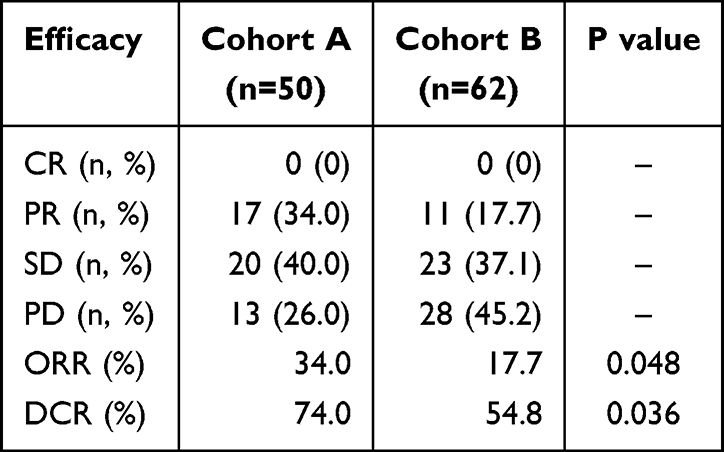 |
Table 2 Treatment Response Outcome |
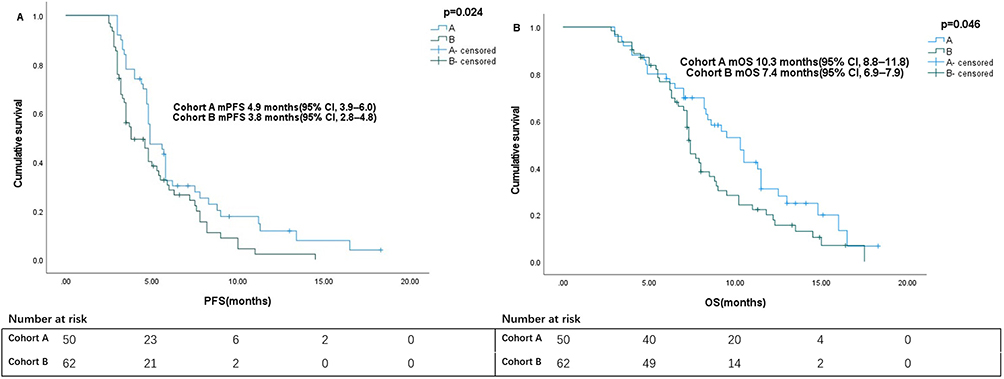 |
Figure 2 (A) PFS in cohort A versus cohort B, (B) OS in cohort A versus cohort B. |
Subgroup analyses were performed to identify factors associated with survival outcomes. Initial univariate analysis using Kaplan-Meier method and Log rank test revealed that neither age, sex, Ki-67, nor histological grade were significantly associated with patient survival. Notably, significant benefits in PFS and/or OS were observed in several key subgroups treated with cadonilimab combination therapy. Specifically, patients with fewer than 3 metastatic sites showed significantly improved PFS (5.8 vs 4.8 months; HR=2.0, 95% CI: 1.1–3.6, p=0.015), while patients with liver metastases demonstrated superior OS (10.3 vs 7.2 months; HR=2.7, 95% CI: 1.4–4.3, p=0.011). The most pronounced benefit was observed in patients with PD-L1 CPS ≥1, who achieved significantly longer PFS (5.8 vs 3.8 months; HR=2.4, 95% CI: 1.4–4.3, p=0.001) and OS (11.5 vs 7.4 months; HR=2.9, 95% CI: 1.5–5.4, p<0.001) (Table 3, Figures 3 and 4).
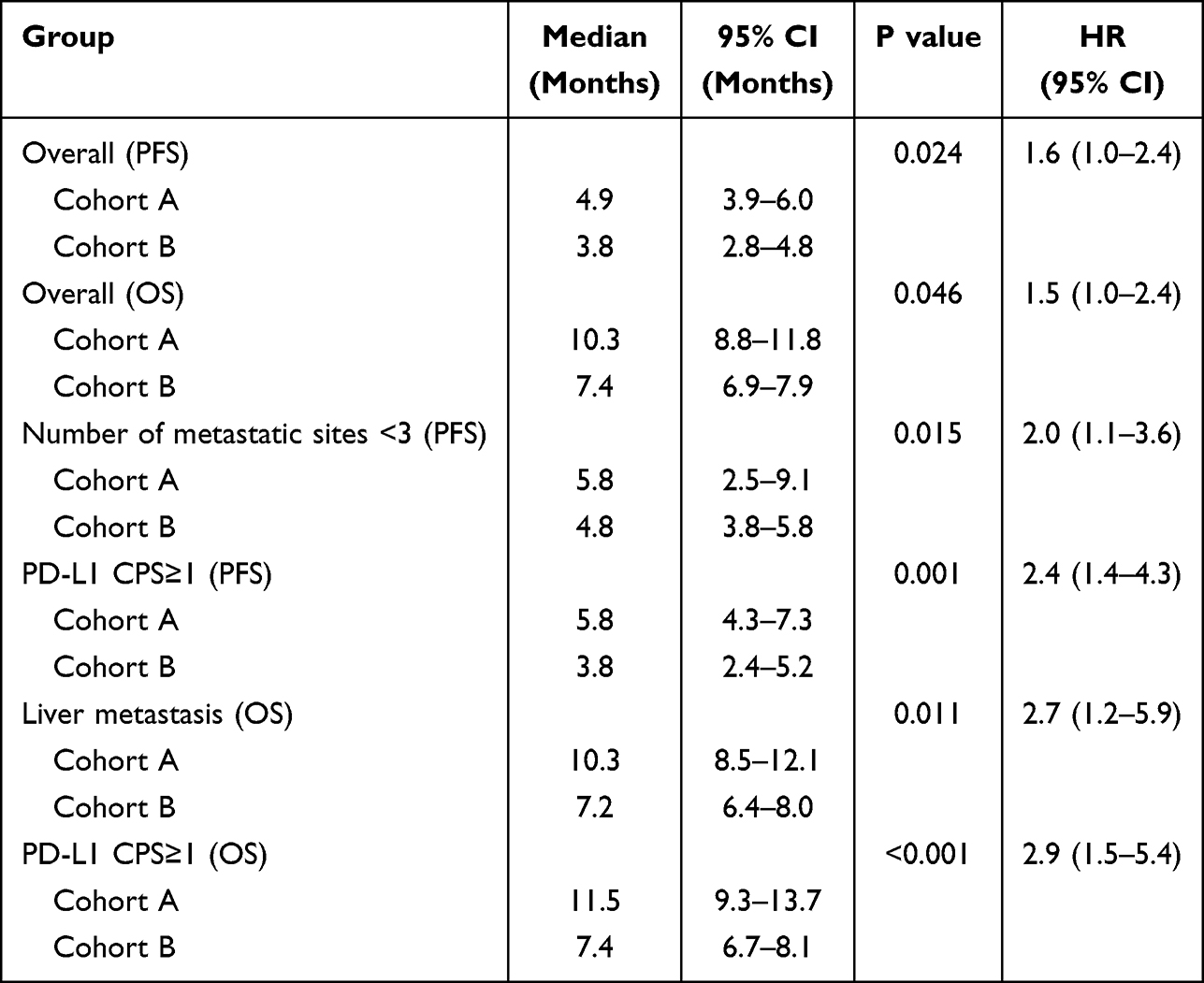 |
Table 3 Summary of mPFS, mOS, and HRs for Cohorts A and B |
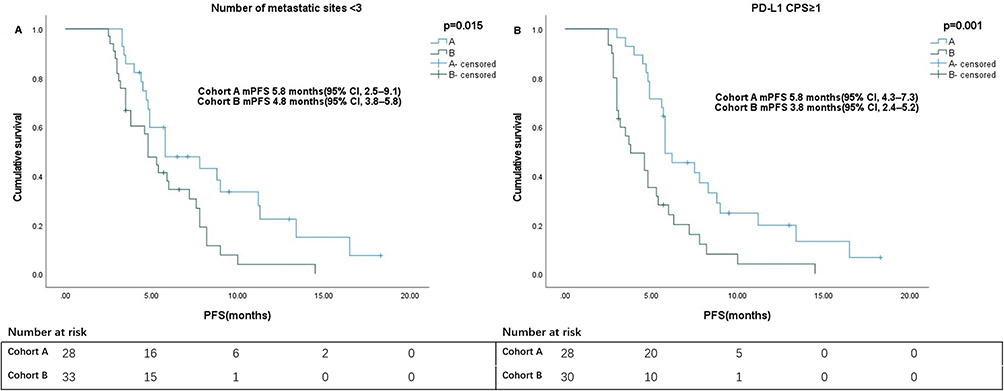 |
Figure 3 Subgroup analysis of PFS. (A) Number of metastatic sites <3, (B) PD-L1 CPS≥1. |
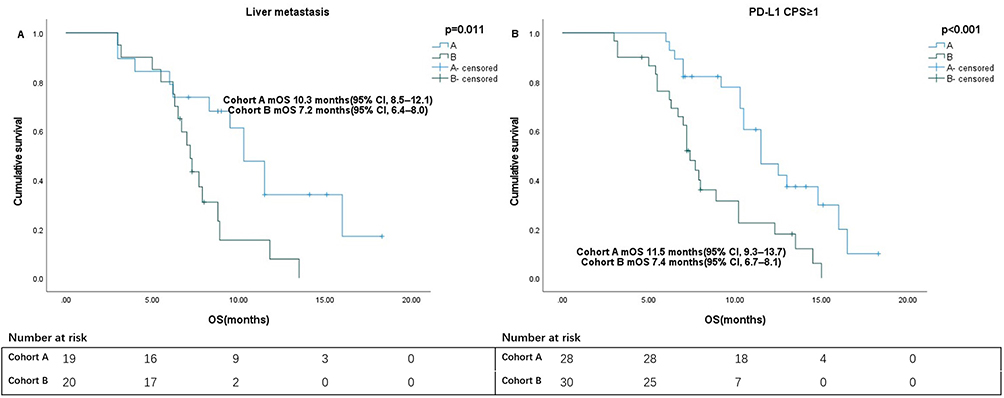 |
Figure 4 Subgroup analysis of OS. (A) Liver metastasis, (B) PD-L1 CPS≥1. |
To adjust for potential confounders, these significant variables were subsequently included in a multivariate Cox regression model. The results confirmed that the number of metastatic sites, the presence of liver metastases, and PD-L1 CPS status remained independent prognostic factors for survival, retaining their statistical significance after multivariate adjustment (Table 4 and 5). Subgroups for ECOG performance status and primary tumor location were not analyzed due to insufficient sample size in certain categories.
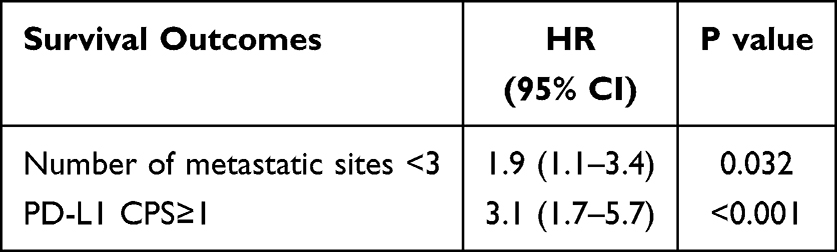 |
Table 4 Multivariable Cox Regression Analysis for PFS |
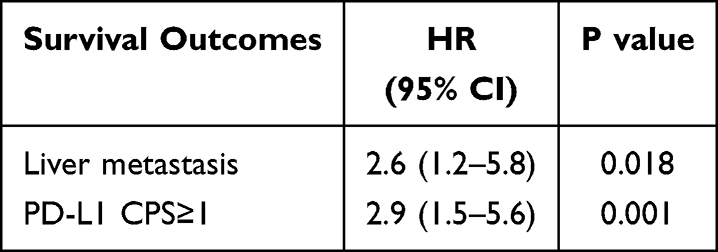 |
Table 5 Multivariable Cox Regression Analysis for OS |
Safety
Table 6 summarizes the treatment-related AEs and immune-related AEs observed during the study period. In Cohort A, the most common treatment-related AEs were decreased neutrophil count (20/50, 40%) and anemia (18/50, 36.0%). The most frequent grade 3–4 AEs were abnormal liver function (6/50, 12.0%) and decreased neutrophil count (5/50, 10.0%). In Cohort B, the most common treatment-related AEs were anemia (18/62, 29.0%) and decreased neutrophil count (16/62, 25.8%). The most frequent grade 3–4 AEs in this cohort were decreased neutrophil count (4/62, 6.5%) and anemia (4/62, 6.5%). The p-values presented in Table 6 are used to indicate whether there were statistically significant differences in the incidence of each treatment-related AE between the two cohorts. There were no statistically significant differences in the incidence of treatment-related AEs between the two cohorts, and no treatment-related deaths were observed.
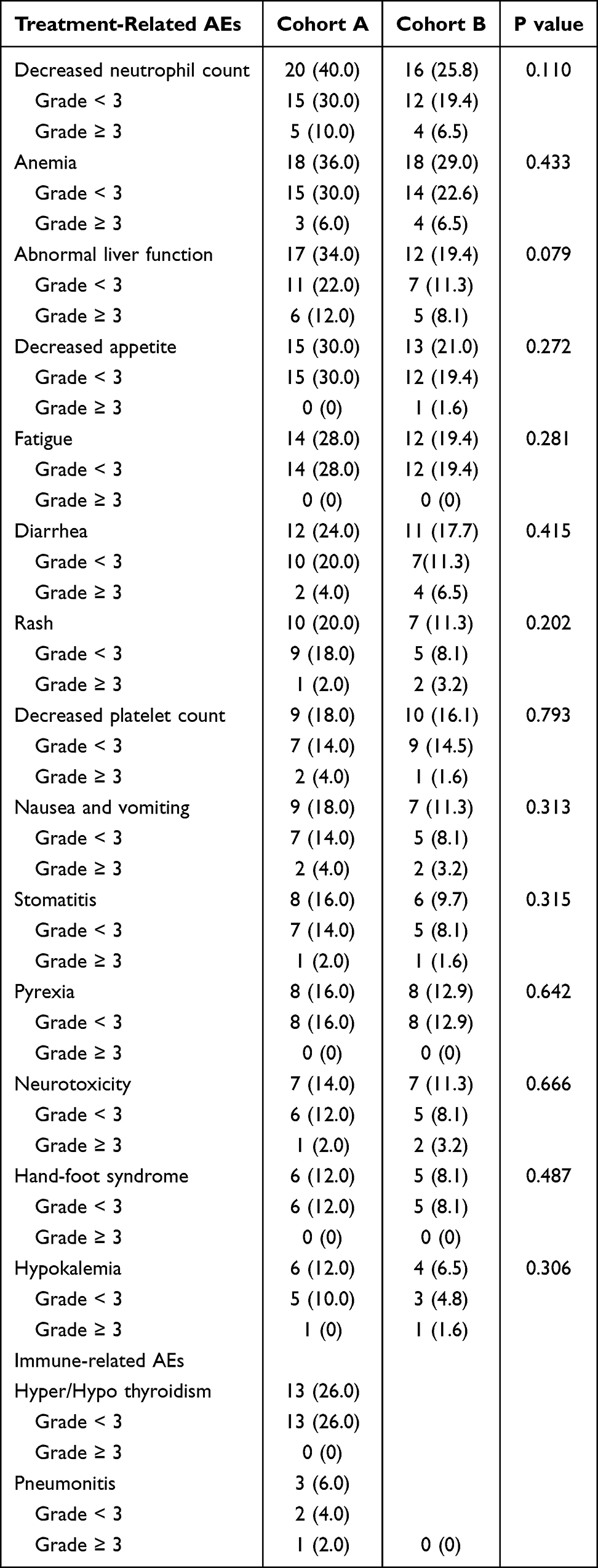 |
Table 6 Treatment-Related AEs Occurred During treatments |
Discussion
Our study demonstrated statistically significant differences in PFS and OS between the two treatment cohorts in the overall population (PFS: 4.9 months vs 3.8 months, HR = 1.6, 95% CI 1.0–2.4, p = 0.024; OS: 10.3 months vs 7.4 months, HR = 1.5, 95% CI 1.0–2.4, p = 0.046). Additionally, notable differences were found in ORR (34.0% vs 17.7%, p = 0.048) and DCR (74.0% vs 54.8%, p = 0.036), demonstrating that cadonilimab exhibited meaningful efficacy with an acceptable safety profile in immunotherapy-pretreated advanced G/GEJC patients.
The standard second-line treatment for advanced G/GEJC consists of chemotherapy alone or ramucirumab (an anti-VEGFR-2 monoclonal antibody) combined with chemotherapy.17,18 The RAINBOW trial established ramucirumab as the standard second-line therapy in 2014;9 however, current clinical accessibility remains limited. In recent years, the rapid advancement of immunotherapy has made it a cornerstone in the treatment of advanced G/GEJC. Immune checkpoint inhibitors such as pembrolizumab, cadonilimab, tislelizumab, nivolumab, and sintilimab have demonstrated robust efficacy in first-line settings,5–7,13,19,20 transforming the second-line patient population from previously “chemotherapy-pretreated” to “immunotherapy plus chemotherapy-pretreated.” The optimal therapeutic strategy for immunotherapy-experienced patients following resistance to first-line immunotherapy remains a critical unmet clinical challenge that warrants further investigation. The bispecific antibody cadonilimab, targeting both PD-1 and CTLA-4, offers a novel therapeutic option. Our study evaluated the efficacy and safety of cadonilimab combined with chemotherapy as an immunotherapy rechallenge strategy for second-line G/GEJC patients.
In the RAINBOW trial,9 ramucirumab plus paclitaxel demonstrated statistically significant improvements in both PFS (4.4 vs 2.9 months; HR=0.635, 95% CI: 0.536–0.752, p<0.0001) and OS (9.6 vs 7.4 months; HR=0.807, 95% CI: 0.678–0.962, p=0.0169) compared to placebo plus paclitaxel. The FRUTIGA study21 showed fruquintinib combined with paclitaxel significantly enhanced PFS (5.6 vs 2.7 months; HR=0.57, p<0.0001), ORR (42.5% vs 22.4%, p<0.0001), and DCR (77.2% vs 56.3%, p<0.0001) versus placebo-paclitaxel in the second-line setting, although no OS benefit was observed. Notably, in the immunotherapy-pretreated subgroup of FRUTIGA, fruquintinib achieved markedly prolonged PFS (6.4 vs 1.8 months; HR=0.38, p=0.0003) without reaching statistical significance in OS. While the RAINBOW study demonstrated favorable outcomes, its study population was limited to patients who had failed first-line chemotherapy. Similarly, the FRUTIGA trial showed PFS benefits but no OS advantage in immunotherapy-pretreated patients. In contrast, our study specifically enrolled patients with progression after first-line immunotherapy and revealed that second-line cadonilimab combined with chemotherapy achieved statistically significant improvements in both PFS and OS compared to chemotherapy alone.
Our findings are further corroborated by emerging evidence on dual-checkpoint inhibition in this challenging setting. AK109-201 study evaluated cadonilimab combined with pulocimab and paclitaxel in G/GEJC patients who failed prior immunotherapy. The regimen demonstrated promising efficacy, including an ORR of 48.0%, DCR of 96.0%, and a mPFS of 6.8 months. Together, these data solidify the role of cadonilimab based therapy as a potent strategy for immunotherapy rechallenge.14
In the PD-L1 CPS ≥1 subgroup, patients treated with cadonilimab demonstrated significantly superior PFS and OS compared to chemotherapy alone, suggesting that cadonilimab effectively overcomes immunotherapy resistance in previously treated patients and exhibits robust efficacy in PD-L1 CPS ≥1 advanced G/GEJC. Our findings suggest that the efficacy of cadonilimab in this immunotherapy-pretreated population may be attributed to its ability to overcome resistance via dual-blockade of the compensatory PD-1 and CTLA-4 pathways. In gastric cancer, high expression of PD-L1 and CTLA-4 is associated with poor prognosis.22 Tumor cells evade immune surveillance by upregulating CTLA-4 and PD-1 on T lymphocytes.23,24 Anti-PD-1 antibodies promote the proliferation and activation of activated and exhausted T cells, enhancing T cell-mediated cytotoxicity. Anti-CTLA-4 antibodies enhance the priming and activation of naïve T cells, driving early expansion of the T cell receptor repertoire, though this may disrupt immune tolerance in normal tissues.15 The synergistic action of these two mechanisms is postulated to effectively reverse T cell exhaustion and overcome immune resistance. While the two mechanisms can synergize for enhanced efficacy, they may also increase toxicity. Cadonilimab is a tetravalent PD-1/CTLA-4 bispecific antibody that overcomes resistance to PD-1 or CTLA-4 monotherapy through dual-pathway blockade, effectively reactivating exhausted T cells co-expressing PD-1 and CTLA-4. This agent enhances CD8+ T cell activation capability even in low-antigen-density microenvironments. Its Fc-null design eliminates Fc-mediated effector functions: antibody-dependent cellular cytotoxicity (ADCC), antibody-dependent cellular phagocytosis (ADCP), and complement-dependent cytotoxicity (CDC), thereby significantly reducing the incidence of severe adverse events. Cadonilimab exhibits enhanced binding avidity in PD-1/CTLA-4 high-density regions, enabling preferential enrichment within the tumor microenvironment—thereby maintaining therapeutic efficacy while reducing systemic toxicity.25 In PD-L1 CPS<1 patients, neither PFS nor OS demonstrated significant improvement, highlighting the unmet need for novel therapeutic approaches in this PD-L1-negative population as second-line treatment.
Notably, cadonilimab-pretreated patients with fewer than 3 metastatic sites showed superior PFS compared to controls (5.8 vs 4.8 months; HR=2.0, 95% CI: 1.1–3.6, p=0.015). This finding suggests that patients with fewer metastatic lesions may benefit from enhanced immunotherapeutic efficacy of cadonilimab, potentially attributable to lower tumor burden and more complete immune function. This observation aligns with the report by Wei et al, which demonstrated improved immunotherapy outcomes in patients with fewer tumor lesions and lower disease burden.26 Particularly striking benefits were observed in liver metastasis patients, where cadonilimab significantly improved OS (10.3 vs 7.2 months; HR=2.7, 95% CI: 1.4–4.3, p=0.011). Liver metastasis typically indicates poorer prognosis and diminished response to immunotherapy, likely attributable to the enrichment of immunosuppressive cells within hepatic metastatic lesions.27,28 The cancer cells invading the liver may activate liver-specific immune tolerance mechanisms, thereby compromising systemic antitumor immune responses and reducing the efficacy of immunotherapy.29 Research evidence indicates that CTLA-4/PD-1 bispecific antibodies may potentially enhance immunotherapeutic efficacy in liver metastasis patients more effectively than PD-1 monotherapy through coordinated modulation of Tregs, MDSCs, and effector T cells.29 Besides, the COMPASSION-15 study similarly demonstrated enhanced clinical benefits in the liver metastases subgroup.13 Cadonilimab’s dual immune checkpoint inhibition may represent a promising therapeutic strategy to overcome treatment resistance in this traditionally refractory patient population.
Looking forward, our results, alongside the AK109-201 trial, support cadonilimab as a viable option for immunotherapy pretreated patients. Future efforts should focus on validating these findings in larger trials and identifying predictive biomarkers beyond PD-L1. Given drug accessibility constraints in some regions, exploring combinations of cadonilimab with locally available agents like ramucirumab or fruquintinib, alongside chemotherapy, represents a critical and practical research direction.
Our study has several limitations. First, as a single-center retrospective analysis, the limited sample size may not fully represent treatment outcomes in patients from other institutions. Other variables such as tumor mutational burden could influence survival outcomes; however, our retrospective design precluded comprehensive data acquisition for such analyses. The limited sample sizes in certain subgroups may also compromise the statistical reliability of our findings. These constraints prompt us to consider conducting a prospective multicenter study to obtain larger and more comprehensive sample data, thereby further validating our conclusions. Furthermore, the precise mechanisms by which cadonilimab overcomes immunotherapy resistance remain to be fully elucidated and warrant further investigation.
Conclusion
In the second-line treatment for immunotherapy-pretreated G/GEJC patients, the combination of cadonilimab and chemotherapy has been shown to achieve significantly better outcomes in terms of PFS, OS, ORR, and DCR compared to chemotherapy alone in the overall population. In particular, patients with PD-L1 CPS ≥1 demonstrated superior survival outcomes, achieving statistically significant improvements in both PFS and OS, whereas no benefit was seen in patients with CPS <1. Notably, cadonilimab demonstrated differential clinical benefits based on metastatic patterns: patients with fewer than 3 metastatic sites achieved superior PFS, while those with liver metastases exhibited particularly enhanced OS outcomes. These results suggest that cadonilimab plus chemotherapy may represent a promising therapeutic option for immunotherapy rechallenge in second-line G/GEJC.
Ethics Statement
The study was reviewed and approved by the Clinical Research Ethics Committee of The Affiliated Yantai Yuhuangding Hospital of Qingdao University (YYYIRB-IIT[2025]014). Due to the retrospective nature of the study, the ethics committee waived the requirement for informed consent. Patient data were de-identified, and data confidentiality was maintained in accordance with the ethical standards of the Clinical Research Ethics Committee.
Funding
This research was supported by the Special Fund for Clinical Research on Dynamic Monitoring of Lymphocyte Subsets by Flow Cytometry of Shandong Medical Association (No. YXH2022ZX03218).
Disclosure
The authors report no conflicts of interest in this work.
References
1. Bray F, Laversanne M, Sung H, et al. Global cancer statistics 2022: GLOBOCAN estimates of incidence and mortality worldwide for 36 cancers in 185 countries. CA: A Cancer J Clin. 2024;74(3):229–263. doi:10.3322/caac.21834
2. He F, Wang S, Zheng R, et al. Trends of gastric cancer burdens attributable to risk factors in China from 2000 to 2050. Lancet Reg Health West Pac. 2024;44:101003 doi:10.1016/j.lanwpc.2023.101003.
3. Han B, Zheng R, Zeng H, et al. Cancer incidence and mortality in China, 2022. J National Cancer Center. 2024;4(1):47–53. doi:10.1016/j.jncc.2024.01.006
4. Fan X, Qin X, Zhang Y, et al. Screening for gastric cancer in China: advances, challenges and visions. Chin J Cancer Res. 2021;33(2):168–180. doi:10.21147/j.issn.1000-9604.2021.02.05
5. Janjigian YY, Shitara K, Moehler M, et al. First-line nivolumab plus chemotherapy versus chemotherapy alone for advanced gastric, gastro-oesophageal junction, and oesophageal adenocarcinoma (CheckMate 649): a randomised, open-label, Phase 3 trial. Lancet. 2021;398(10294):27–40. doi:10.1016/S0140-6736(21)00797-2
6. Qiu M-Z, Oh D-Y, Kato K, et al. Tislelizumab plus chemotherapy versus placebo plus chemotherapy as first line treatment for advanced gastric or gastro-oesophageal junction adenocarcinoma: RATIONALE-305 randomised, double blind, phase 3 trial. BMJ.2024;385: e078876. 10.1136/bmj-2023-078876
7. Rha SY, Oh D-Y, Yañez P, et al. Pembrolizumab plus chemotherapy versus placebo plus chemotherapy for HER2-negative advanced gastric cancer (KEYNOTE-859): a multicentre, randomised, double-blind, phase 3 trial. Lancet Oncol. 2023;24(11):1181–1195. doi:10.1016/S1470-2045(23)00515-6
8. Fuchs CS, Tomasek J, Yong CJ, et al. Ramucirumab monotherapy for previously treated advanced gastric or gastro-oesophageal junction adenocarcinoma (REGARD): an international, randomised, multicentre, placebo-controlled, phase 3 trial. Lancet. 2014;383(9911):31–39. doi:10.1016/S0140-6736(13)61719-5
9. Wilke H, Muro K, Van Cutsem E, et al. Ramucirumab plus paclitaxel versus placebo plus paclitaxel in patients with previously treated advanced gastric or gastro-oesophageal junction adenocarcinoma (RAINBOW): a double-blind, randomised phase 3 trial. Lancet Oncol. 2014;15(11):1224–1235. doi:10.1016/S1470-2045(14)70420-6
10. Wu X, Sun Y, Yang H, et al. Cadonilimab plus platinum-based chemotherapy with or without bevacizumab as first-line treatment for persistent, recurrent, or metastatic cervical cancer (COMPASSION-16): a randomised, double-blind, placebo-controlled phase 3 trial in China. Lancet. 2024;404(10463):1668–1676. doi:10.1016/S0140-6736(24)02135-4
11. Wang Y, Pan S, Tian J, et al. Cadonilimab, a PD-1/CTLA-4 bispecific antibody in unresectable hepatocellular carcinoma: a real-world study. Cancer Immunol Immunother. 2025;74(6)186. doi:10.1007/s00262-025-04038-8.
12. Gao X, Ji K, Jia Y, et al. Cadonilimab with chemotherapy in HER2-negative gastric or gastroesophageal junction adenocarcinoma: the phase 1b/2 COMPASSION-04 trial. Nature Med. 2024;30(7):1943–1951. doi:10.1038/s41591-024-03007-5
13. Shen L, Zhang Y, Li Z, et al. First-line cadonilimab plus chemotherapy in HER2-negative advanced gastric or gastroesophageal junction adenocarcinoma: a randomized, double-blind, phase 3 trial. Nature Med. 2025;31(4):1163–1170. doi:10.1038/s41591-024-03450-4.
14. Zhang X, Wang Y, Xiang X, et al. Efficacy and safety of cadonilimab in combination with pulocimab and paclitaxel as second-line therapy in patients with advanced gastric or gastroesophageal junction (G/GEJ) cancer who failed immunochemotherapy: a multicenter, double-blind, randomized trial. J Clin Oncol. 2024;42(16_suppl):4012. doi:10.1200/JCO.2024.42.16_suppl.4012
15. Burton EM, Tawbi HA. Bispecific antibodies to PD-1 and CTLA4: doubling down on T cells to decouple efficacy from toxicity. Cancer Discov. 2021;11(5):1008–1010. doi:10.1158/2159-8290.CD-21-0257
16. Keam SJ. Cadonilimab: first approval. Drugs. 2022;82(12):1333–1339. doi:10.1007/s40265-022-01761-9
17. Kim CG, Jung M, Kim HS, et al. Trastuzumab combined with ramucirumab and paclitaxel in patients with previously treated human epidermal growth factor receptor 2–positive advanced gastric or gastroesophageal junction cancer. J Clin Oncol. 2023;41(27):4394–4405. doi:10.1200/JCO.22.02122
18. Xu R-H, Zhang Y, Pan H, et al. Efficacy and safety of weekly paclitaxel with or without ramucirumab as second-line therapy for the treatment of advanced gastric or gastroesophageal junction adenocarcinoma (RAINBOW-Asia): a randomised, multicentre, double-blind, phase 3 trial. Lancet Gastroenterol Hepatol. 2021;6(12):1015–1024. doi:10.1016/S2468-1253(21)00313-7
19. Xu J, Jiang H, Pan Y, et al. Sintilimab plus chemotherapy for unresectable gastric or gastroesophageal junction cancer: the ORIENT-16 randomized clinical trial. JAMA. 2023;330(21):2064–2074. doi:10.1001/jama.2023.19918
20. Liu Z, Liu A, Li M et al. Efficacy and safety of sintilimab combined with trastuzumab and chemotherapy in HER2-positive advanced gastric or gastroesophageal junction cancer. Front Immunol. 2025;16:1545304. doi:10.3389/fimmu.2025.1545304.
21. Wang F, Shen L, Guo W, et al. Fruquintinib plus paclitaxel versus placebo plus paclitaxel for gastric or gastroesophageal junction adenocarcinoma: the randomized phase 3 FRUTIGA trial. Nature Med. 2024;30(8):2189–2198. doi:10.1038/s41591-024-02989-6
22. Chen Y, Jia K, Chong X, et al. Implications of PD-L1 expression on the immune microenvironment in HER2-positive gastric cancer. Mol Cancer. 2024;23(1):169. doi:10.1186/s12943-024-02085-w.
23. Dovedi SJ, Elder MJ, Yang C, et al. Design and efficacy of a monovalent bispecific PD-1/CTLA4 antibody that enhances CTLA4 blockade on PD-1+ activated T cells. Cancer Discov. 2021;11(5):1100–1117. doi:10.1158/2159-8290.CD-20-1445
24. Cousin S, Guégan J-P, Shitara K, et al. Identification of microenvironment features associated with primary resistance to anti-PD-1/PD-L1 + antiangiogenesis in gastric cancer through spatial transcriptomics and plasma proteomics. Mol Cancer. 2024;23(1):197. doi:10.1186/s12943-024-02092-x.
25. Pang X, Huang Z, Zhong T, et al. Cadonilimab, a tetravalent PD-1/CTLA-4 bispecific antibody with trans-binding and enhanced target binding avidity. mAbs. 2023;15(1):2180794. doi:10.1080/19420862.2023.2180794.
26. Wei X, Xu J, Wang D, et al. Baseline lesion number as an efficacy predictive and independent prognostic factor and its joint utility with TMB for PD-1 inhibitor treatment in advanced gastric cancer. Ther Advanc Med Oncol. 2021;13:1758835921988996 doi:10.1177/1758835921988996.
27. Yu J, Green MD, Li S, et al. Liver metastasis restrains immunotherapy efficacy via macrophage-mediated T cell elimination. Nature Med. 2021;27(1):152–164. doi:10.1038/s41591-020-1131-x
28. Yukami H, Kawazoe A, Lin Y-T, et al. Updated efficacy outcomes of Anti-PD-1 antibodies plus multikinase inhibitors for patients with advanced gastric cancer with or without liver metastases in clinical trials. Clin Cancer Res. 2022;28(16):3480–3488. doi:10.1158/1078-0432.CCR-22-0630
29. Lee JC, Mehdizadeh S, Smith J, et al. Regulatory T cell control of systemic immunity and immunotherapy response in liver metastasis. Sci Immunol. 2020;5(52):eaba0759. doi:10.1126/sciimmunol.aba0759.
 © 2025 The Author(s). This work is published and licensed by Dove Medical Press Limited. The
full terms of this license are available at https://www.dovepress.com/terms
and incorporate the Creative Commons Attribution
- Non Commercial (unported, 4.0) License.
By accessing the work you hereby accept the Terms. Non-commercial uses of the work are permitted
without any further permission from Dove Medical Press Limited, provided the work is properly
attributed. For permission for commercial use of this work, please see paragraphs 4.2 and 5 of our Terms.
© 2025 The Author(s). This work is published and licensed by Dove Medical Press Limited. The
full terms of this license are available at https://www.dovepress.com/terms
and incorporate the Creative Commons Attribution
- Non Commercial (unported, 4.0) License.
By accessing the work you hereby accept the Terms. Non-commercial uses of the work are permitted
without any further permission from Dove Medical Press Limited, provided the work is properly
attributed. For permission for commercial use of this work, please see paragraphs 4.2 and 5 of our Terms.
Recommended articles

The Efficacy and Safety of Anlotinib in Extensive-Stage Small Cell Lung Cancer: A Multicenter Real-World Study
Zheng HR, Jiang AM, Gao H, Liu N, Zheng XQ, Fu X, Zhang R, Ruan ZP, Tian T, Liang X, Yao Y
Cancer Management and Research 2022, 14:2273-2287
Published Date: 2 August 2022
Relative Safety and Efficacy of Two Doses of Tandospirone Citrate for Generalized Anxiety Disorder: A Multicenter Randomized Controlled Trial
Li Q, Zhang H, Lin G, Shi S, Zhang Y, Ji J, Yang L, Yao J, Wu W
Neuropsychiatric Disease and Treatment 2022, 18:1653-1664
Published Date: 8 August 2022
Biosimilars: Science, Implications, and Potential Outlooks in the Middle East and Africa
Batran RA, Elmoshneb M, Hussein AS, Hussien OM, Adel F, Elgarhy R, Morsi MI
Biologics: Targets and Therapy 2022, 16:161-171
Published Date: 6 October 2022
Efficacy and Safety of Empagliflozin in Patients with Type 2 Diabetes Mellitus Fasting During Ramadan: A Real-World Study from Bangladesh
Pathan MF, Akter N, Selim S, Saifuddin M, Qureshi NK, Kamrul-Hasan ABM, Hannan MA, Ahmed MAU, Mustari M, Chakraborty AK
Diabetes, Metabolic Syndrome and Obesity 2022, 15:4011-4021
Published Date: 22 December 2022
Clinical Evaluation of Risankizumab in the Treatment of Adults with Moderately to Severely Active Crohn’s Disease: Patient Selection and Reported Outcomes
Horst S, Cross RK
Drug Design, Development and Therapy 2023, 17:273-282
Published Date: 31 January 2023