
Back to Journals » Infection and Drug Resistance » Volume 19

Risk Stratification for Vancomycin-Associated Acute Kidney Injury in Chinese Adult Inpatients: A Multicenter Retrospective Cohort Study
Authors Chen S  , Zhang Y, Hou X, Wang Y , Zuo C, Huang C, Xia X, Cao C, Lv Q, Li X, Pan K
Received 21 April 2026
Accepted for publication 25 June 2026
Published 22 July 2026 Volume 2026:19 618586
DOI https://doi.org/10.2147/IDR.S618586
Checked for plagiarism Yes
Review by Single anonymous peer review
Peer reviewer comments 3
Editor who approved publication: Dr Hazrat Bilal
Shu Chen,1,* Ying Zhang,2,* Xingyun Hou,3 Yuzhu Wang,2 Chengchun Zuo,2 Chengwei Huang,4 Xiaotong Xia,1 Chang Cao,1 Qianzhou Lv,1,2 Xiaoyu Li,1,2 Kunming Pan1,2
1Department of Pharmacy, Zhongshan Hospital (Xiamen), Fudan University, Xiamen, People’s Republic of China; 2Department of Pharmacy, Zhongshan Hospital, Fudan University, Shanghai, People’s Republic of China; 3Department of Pharmacy, Second Affiliated Hospital of Naval Medical University, Shanghai, People’s Republic of China; 4Department of Medical Informatics, Zhongshan Hospital (Xiamen), Fudan University, Xiamen, People’s Republic of China
*These authors contributed equally to this work
Correspondence: Kunming Pan; Xiaoyu Li, Department of Pharmacy, Zhongshan Hospital (Xiamen), Fudan University, Xiamen, People’s Republic of China, Email [email protected]; [email protected]
Purpose: Vancomycin-associated acute kidney injury (VA-AKI) remains a major safety concern during treatment of serious infections. We aimed to identify a clinically relevant vancomycin trough threshold associated with VA-AKI and to define factors associated with renal injury in Chinese adult inpatients.
Patients and Methods: We conducted a multicenter retrospective cohort study of 2230 Chinese adult inpatients treated with intravenous vancomycin between 2016 and 2025. VA-AKI was defined according to Kidney Disease: Improving Global Outcomes criteria. Receiver operating characteristic analysis was used to identify the trough threshold associated with VA-AKI, and multivariable logistic regression was performed to assess factors independently associated with VA-AKI.
Results: VA-AKI occurred in 493/2230 patients (22.1%). The trough concentration most closely associated with VA-AKI was 15.9 mg/L (AUC 0.64). Compared with troughs < 10 mg/L, concentrations of 10– 20 mg/L and > 20 mg/L were associated with progressively higher AKI risk. Factors independently associated with VA-AKI included contrast exposure, concomitant piperacillin-tazobactam or cephalosporin therapy, critical illness, treatment duration ≥ 14 days, cardiac dysfunction, and baseline renal impairment. VA-AKI was also associated with worse outcomes, including higher 60-day mortality (16% vs 4%) and greater dialysis requirement (6% vs 2%).
Conclusion: In this large multicenter cohort, VA-AKI occurred in approximately one in five Chinese adult inpatients receiving vancomycin. A vancomycin trough concentration of approximately 15.9 mg/L may serve as a practical threshold for early AKI risk stratification, particularly in clinical settings where AUC-guided monitoring is not routinely available. Closer renal surveillance may be warranted in patients with additional treatment-related or clinical risk factors.
Keywords: vancomycin, acute kidney injury, therapeutic drug monitoring, risk factors, multicenter cohort study
Introduction
Vancomycin, a glycopeptide antibiotic introduced in the mid-20th century, remains the mainstay treatment for severe infections caused by Gram-positive bacteria, especially methicillin-resistant Staphylococcus aureus.1 It is widely used in hospitalized patients with sepsis, pneumonia, and osteomyelitis.2,3 The global rise of multidrug-resistant Gram-positive bacteria has further increased the reliance on vancomycin, heightening concerns regarding its safety profile, particularly in hospitalized patients in China, where vancomycin is commonly prescribed in tertiary care settings for severe and complicated infections.
Acute kidney injury (AKI) is a major adverse effect of vancomycin, with reported incidence ranging from 5% to 43%.4 Vancomycin-associated AKI (VA-AKI) is linked to prolonged hospitalization, increased medical costs, and a higher risk of in-hospital mortality, dialysis requirement, and progression to chronic kidney disease.5,6 Given these unfavorable outcomes, VA-AKI represents an important clinical issue in hospitalized Chinese patients receiving vancomycin therapy. Its development is multifactorial, involving drug exposure, baseline renal function, concomitant nephrotoxic drugs, and underlying comorbidities.7,8 Among these factors, drug exposure is one of the few potentially modifiable components and therefore remains central to therapeutic drug monitoring (TDM)-guided risk reduction strategies.9
In recent years, efforts to optimize vancomycin therapy have increasingly focused on balancing efficacy and nephrotoxicity. Earlier practice commonly relied on trough concentration monitoring, with target trough levels often used as a surrogate for adequate exposure.10,11 However, concerns regarding nephrotoxicity at higher trough concentrations and the imperfect correlation between trough levels and total drug exposure have led to a shift in monitoring strategies. Although current international guidelines increasingly recommend AUC/MIC-guided monitoring as the preferred strategy for vancomycin dosing,12 the implementation of AUC-based monitoring in routine clinical practice remains challenging. Reliable AUC estimation often depends on Bayesian software or validated pharmacokinetic tools, standardized sampling workflows, timely laboratory support, and adequate pharmacist expertise, which may not be uniformly available across hospitals.13,14 Consequently, trough concentration monitoring remains the most accessible and operationally feasible strategy in many real-world settings. Therefore, in a multicenter inpatient setting in China, identifying a pragmatic trough threshold associated with nephrotoxicity remains clinically relevant, particularly for early risk stratification in institutions where AUC-guided monitoring has not yet been routinely implemented.
Despite the clinical importance of VA-AKI, several important knowledge gaps remain. Most existing studies on VA-AKI are single-center retrospective analyses, limiting generalizability and increasing susceptibility to selection bias.6,15 Moreover, multicenter data from Chinese patients remain limited. Additionally, clinically relevant serum concentration warning thresholds for predicting VA-AKI remain inadequately defined in a large, multicenter population. Therefore, we conducted a multicenter retrospective cohort study in Chinese adult inpatients receiving vancomycin to (1) evaluate the association between vancomycin exposure and VA-AKI, (2) identify a clinically relevant trough concentration threshold for AKI risk stratification using receiver operating characteristic (ROC) analysis, and (3) determine independent modifiable and non-modifiable risk factors after adjustment for major confounders. Our goal was to provide practical evidence to support vancomycin TDM and early prevention of VA-AKI, particularly in settings where AUC-guided monitoring is not routinely available.
Material and Methods
Study Design and Setting
We conducted a multicenter retrospective cohort study across three tertiary hospitals in China. Eligible patients who received vancomycin between January 2016 and June 2025 were identified, and the data were retrospectively collected and analysed in December 2025. The protocol was approved by the Medical Ethics Committee of Zhongshan Hospital, Fudan University (B2024-451), the Ethics Committee of Zhongshan Hospital (Xiamen), Fudan University (B2025-051), and the Ethics Committee of the Second Affiliated Hospital of Naval Medical University (2025SL058). The requirement for informed consent was waived due to the retrospective design of this multicenter cohort study based on electronic medical record review. Patient confidentiality was strictly maintained, all data were analyzed in a de-identified manner, and no individually identifiable patient information is disclosed in this manuscript. Reporting follows the STROBE guidelines.16
Study Population
Adult patients (≥ 18 years) receiving intravenous vancomycin with trough concentration monitoring were eligible. Of 3092 patients initially screened, 862 were excluded for the following: non-intravenous administration (n = 17), chronic kidney disease (CKD) stage 5 or dialysis during treatment (n = 70), nephrectomy/transplantation/solitary kidney (n = 1), pre-existing AKI at admission (n = 275), baseline creatinine ≥ 354 μmol/L (n = 117), incomplete creatinine data (n = 352), or insufficient vancomycin dosage or non-steady-state trough levels (n = 30). The final cohort included 2230 patients. Sample size justification: The sample size was determined by the availability of eligible patients (convenience sampling). Post-hoc power analysis, using the observed AKI incidence (22.1%) and the primary exposure variable (trough concentration ≥ 15.935 mg/L; odds ratio [OR] = 2.127), demonstrated > 95% statistical power (α = 0.05, two-sided) to detect clinically meaningful associations. With 2230 patients, the study could accommodate up to 20 covariates in multivariate regression following the rule of ≥ 10 events per variable (493 AKI events/10 = 49 maximum variables). The patient selection process and reasons for exclusion are illustrated in Figure 1.
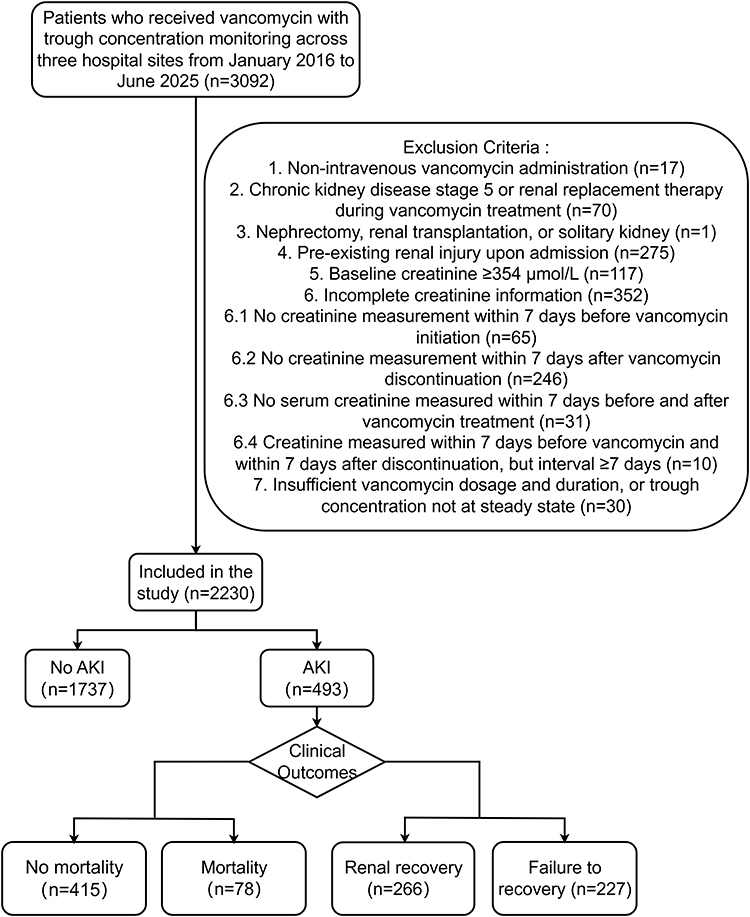 |
Figure 1 Patient Selection Flowchart. |
Data Collection
Data were extracted from the electronic medical record. Variables collected included the following: Demographic data: age, gender, body mass index (BMI); comorbidities: hypertension, diabetes, CKD (staged by eGFR using the CKD-EPI equation), cardiac dysfunction, hyperuricemia, malignancies, and other underlying diseases; severity markers: critical illness, cardiac surgery, multiple organ failure; laboratory parameters: baseline and serial serum creatinine, eGFR, and serum albumin; vancomycin exposure: therapy duration, mean daily dose, cumulative dose, steady-state trough concentrations (measured before the next dose after 3–4 doses), time to first TDM, number of TDM sessions, and compliance with therapeutic range (10–20 mg/L); concomitant medications: nephrotoxic agents (loop diuretics, aminoglycosides, cephalosporins, carbapenems, piperacillin-tazobactam, contrast agents, NSAIDs, and vasopressors), immunosuppressants (tacrolimus and cyclosporine), and renal protective agents. Because the primary objective of this study was to evaluate vancomycin-associated nephrotoxicity rather than antimicrobial efficacy, microbiological variables such as causative pathogens, vancomycin susceptibility testing, minimum inhibitory concentration (MIC) values, and resistance detection were not systematically collected for the present analysis. For the primary exposure analysis, the first available steady-state trough concentration was used.
Outcome Definitions
Primary Outcome: VA-AKI, defined per Kidney Disease: Improving Global Outcomes (KDIGO) 2012 criteria as AKI occurring during vancomycin therapy or within 48 h of discontinuation:17 Stage 1 (creatinine increase ≥ 26.5 μmol/L within 48 h or 1.5–1.9× baseline within 7 days), Stage 2 (2.0–2.9× baseline), Stage 3 (≥ 3.0× baseline, ≥ 353.6 μmol/L, or renal replacement therapy (RRT) initiation). Baseline creatinine was defined as the most recent value within 7 days before vancomycin initiation. Urine output criteria were not applied due to incomplete data.
Secondary Outcomes: Need for RRT, 60-day all-cause mortality, length of hospital stay, and renal recovery status at hospital discharge (full recovery: return to baseline ± 26.5 μmol/L; partial recovery: ≥ 25% decrease from peak creatinine but remaining above baseline; failure to recover: dialysis-dependent or < 25% decrease from peak creatinine).
Statistical Analysis
The Statistical Package for the Social Sciences (version 26.0), R (version 4.4.1), and GraphPad Prism (version 9) software were used for data analyses. Continuous variables were tested for normality using the Kolmogorov–Smirnov test and presented as mean ± standard deviation or median (interquartile range; IQR) as appropriate. Categorical variables are expressed as frequencies (percentages). Between-group comparisons were conducted using independent t-tests or Mann–Whitney U-tests for continuous variables, and chi-squared or Fisher’s exact tests for categorical variables. ROC curve analysis was used to determine optimal vancomycin trough cutoff concentrations based on Youden’s index. Kaplan–Meier curves with Log rank tests were used to assess AKI-free survival, stratified by concentration thresholds. Cox regression was used to calculate hazard ratios. Univariate logistic regression was employed to identify potential risk factors (P ≤ 0.1). Multivariate logistic regression with backward stepwise elimination (elimination criterion P > 0.1) was applied to identify independent predictors. Covariates included demographics, comorbidities, severity markers, vancomycin exposure parameters, and concomitant medications. Model fit was assessed using the Hosmer–Lemeshow test and multicollinearity by variance inflation factors. Variance inflation factors (VIF < 5 was considered acceptable) were used to determine multicollinearity. Model goodness-of-fit was evaluated using the Hosmer–Lemeshow test (P > 0.05 indicates adequate fit). Supplementary LASSO regression was utilized to validate variable selection using 10-fold cross-validation. Missing data were handled using complete-case analysis for variables with < 10% missingness. Variables with higher missingness (BMI) were analyzed using available cases only, with missing data reported in table footnotes and figure legends. Little’s missing completely at random (MCAR) test and chi-square analyses indicated that missingness was not significantly associated with AKI (BMI: P = 0.546), supporting MCAR. Multiple imputation was not performed, given the descriptive nature of these variables.
Results
Patient Characteristics
Of 3092 patients screened across three medical centers between January 2016 and June 2025, 2230 were included in the final analysis, of whom 493 (22.1%) developed VA-AKI (Figure 1).
AKI and non-AKI groups exhibited comparable age (62.0 versus 61.0 years, P = 0.633), gender (65.3% versus 69.5% male, P = 0.078), and BMI (22.5 versus 23.4 kg/m2, P = 0.154). Patients who developed AKI exhibited higher rates of critical illness (41.6% versus 29.6%, P < 0.001), cardiac dysfunction (24.5% versus 17.0%, P < 0.001), and hyperuricemia (15.2% versus 11.5%, P = 0.025). CKD stage distribution differed significantly (P = 0.020), with more stage 2–3 patients in the AKI group. Baseline creatinine was higher (79 versus 72 µmol/L, P = 0.007) and eGFR lower (83.1 versus 90.4 mL/min/1.73 m2, P < 0.001) among patients with AKI (Table 1).
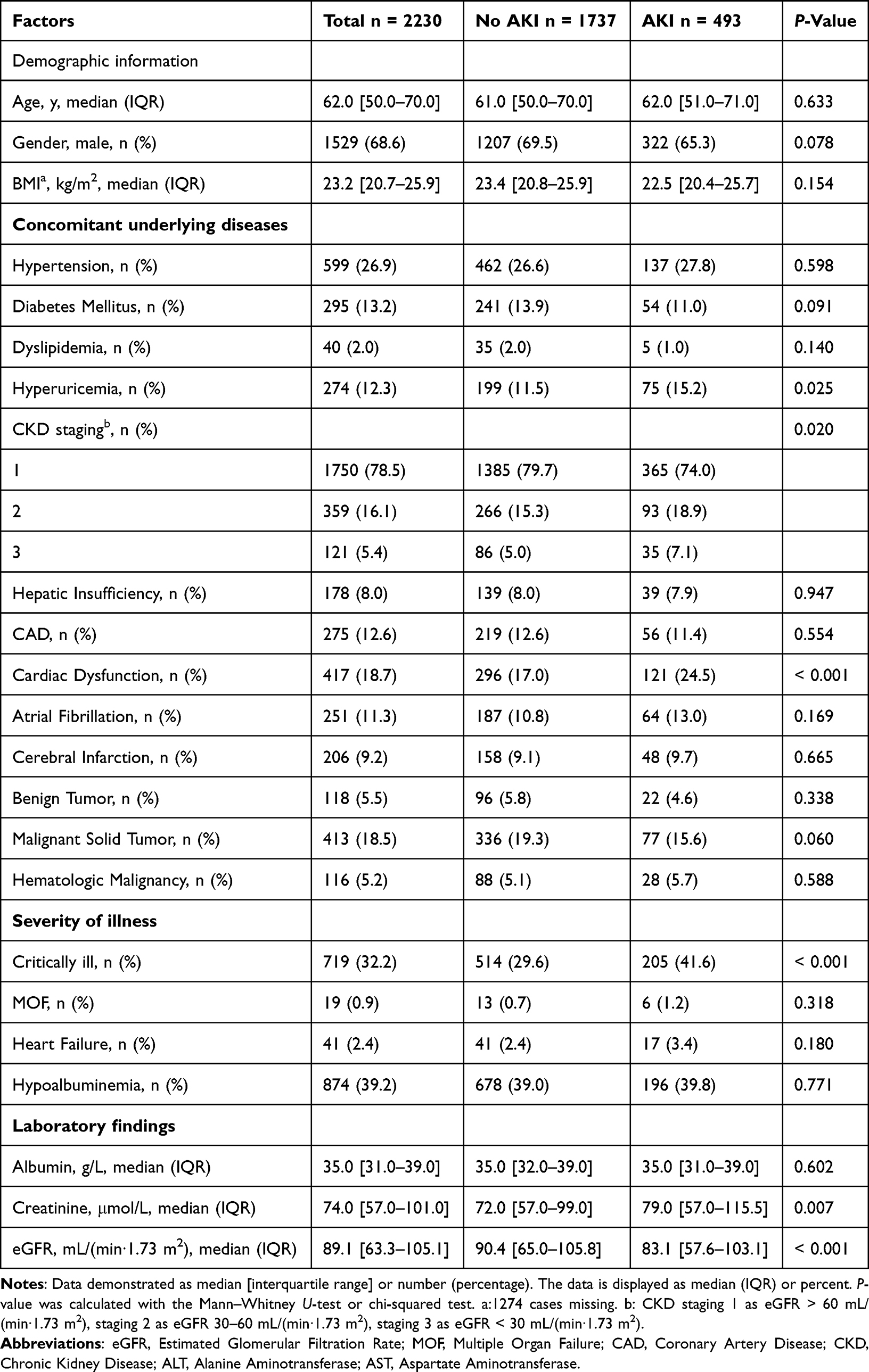 |
Table 1 Comparison of Patients’ Characteristics Between Those with AKI and Those Without |
Vancomycin Exposure and Concomitant Medications
Median vancomycin therapy duration was similar between groups (8.0 versus 7.0 days, P = 0.184), though therapy ≥ 14 days was more frequent in patients with AKI (24.5% versus 18.9%, P = 0.008). Median trough concentration was significantly higher in the AKI group (16.0 versus 12.1 mg/L, P < 0.001). Stratification indicated fewer patients with AKI with < 10 mg/L (16.0% versus 32.5%) and more with troughs > 20 mg/L (33.3% versus 16.7%, P < 0.001). Patients with AKI underwent more TDM sessions (2.0 versus 1.0, P < 0.001).
Significant associations with concomitant medication included vasopressors (14.6% versus 9.8%, P = 0.002), loop diuretics (43.8% versus 36.9%, P = 0.005), contrast media (3.7% versus 1.3%, P < 0.001), cephalosporins (27.4% versus 19.2%, P < 0.001), piperacillin-tazobactam (6.7% versus 4.5%, P = 0.047), and tacrolimus (4.5% versus 2.2%, P = 0.006) (Table 2).
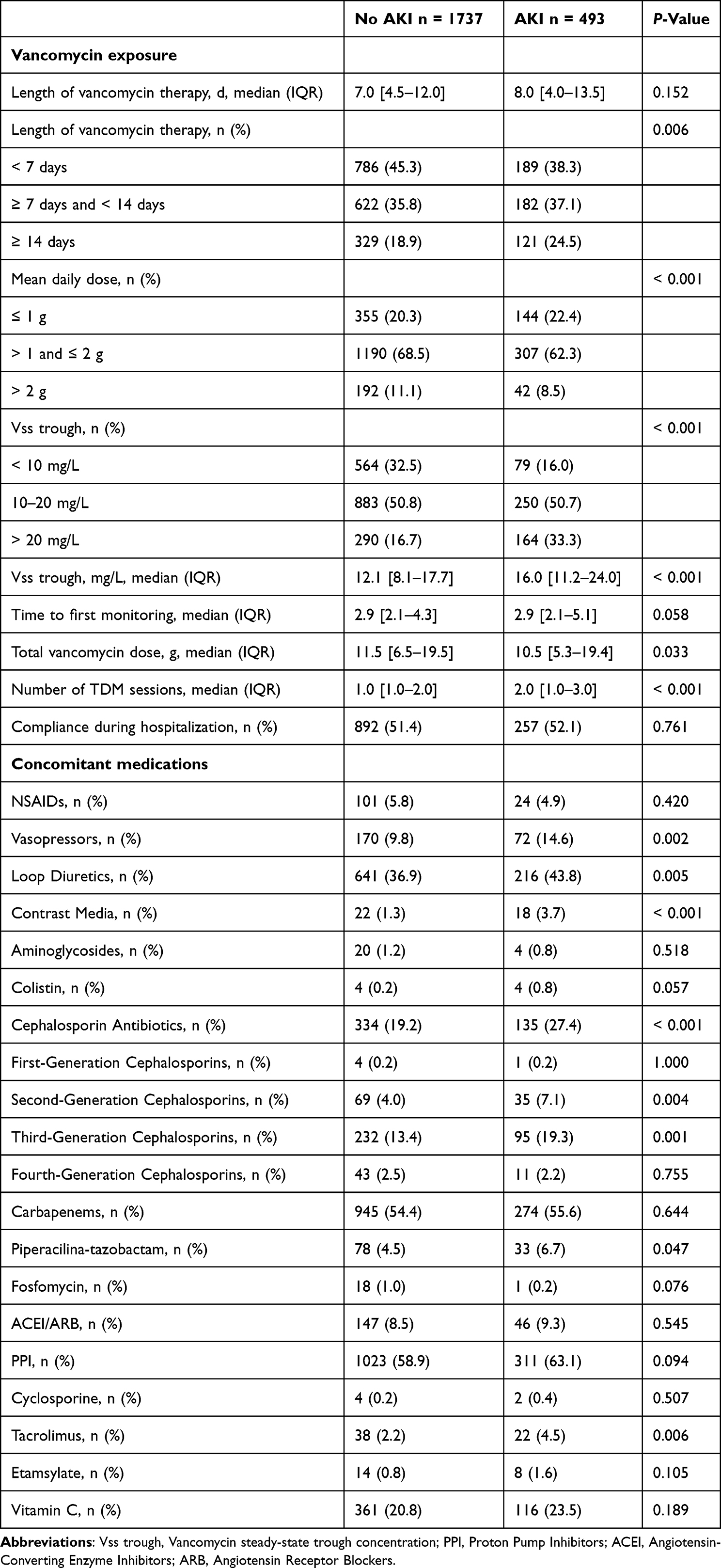 |
Table 2 Vancomycin Exposure and Concomitant Drugs in Patients with and without VA-AKI |
Notably, mean daily dose distribution differed significantly between groups (P < 0.001). The AKI group exhibited a lower proportion of patients receiving high doses (> 2 g/day; 8.5% versus 11.1%) and a higher proportion receiving low doses (≤ 1 g/day; 22.4% versus 20.3%). The AKI group exhibited a lower cumulative vancomycin dose (median 10.5 versus 11.5 g, P = 0.033). This apparently paradoxical finding may reflect dose reduction in response to evolving renal dysfunction and is discussed further below.
Vancomycin Concentration Threshold
ROC analysis identified an optimal AUC of 0.643 (95% confidence interval [CI]: 0.615–0.670, P < 0.001) with an optimal cutoff of 15.935 mg/L (Supplementary Figure 1). Kaplan–Meier analysis revealed that patients with a trough ≥ 15.935 mg/L exhibited significantly higher AKI risk (hazard ratio [HR] 2.117, 95% CI: 1.759–2.547, P < 0.001) (Figure 2A). Differences in survival curves were apparent within the first week of therapy and persisted throughout follow-up, indicating that elevated initial concentrations pose an early and sustained risk of kidney injury. Concentration-based stratification demonstrated dose-dependent risk: compared to those with trough concentrations < 10 mg/L (reference), patients with levels between 10 and 20 mg/L exhibited significantly elevated AKI risk (HR 1.827, 95% CI: 1.460–2.287, P < 0.001), whereas those with concentrations > 20 mg/L exhibited a more than threefold higher risk (HR 3.334, 95% CI: 2.574–4.317, P < 0.001). Direct comparison between 10–20 mg/L and > 20 mg/L groups confirmed a substantial risk gradient (HR 1.824, 95% CI: 1.466–2.269, P < 0.001), supporting a concentration-dependent correlation between vancomycin exposure and nephrotoxicity (Figure 2B).
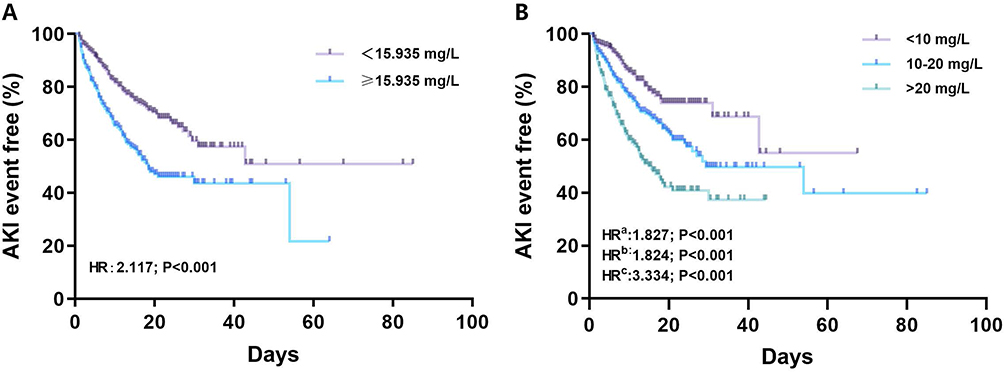 |
Figure 2 Kaplan–Meier Curve for AKI-Free Survival Stratified by Vancomycin Trough Concentration. Notes: (A) Kaplan–Meier survival analysis comparing AKI-free survival between patients with vancomycin trough concentrations < 15.935 mg/L and ≥ 15.935 mg/L. Patients with concentrations ≥ 15.935 mg/L had a significantly higher risk of developing AKI (HR 2.117, 95% CI: 1.759–2.547, P < 0.001). The x-axis represents time in days, and the y-axis represents the percentage of patients remaining AKI-free. (B) Kaplan–Meier survival analysis demonstrating a dose-dependent relationship between vancomycin trough concentration and AKI risk. Patients were stratified into three groups: < 10 mg/L (reference), 10–20 mg/L, and > 20 mg/L. Compared with the < 10 mg/L group, the 10–20 mg/L group had an increased risk (HRa 1.827, P < 0.001), while the > 20 mg/L group had the highest risk (HRb 3.334, P < 0.001). A direct comparison between 10–20 mg/L and > 20 mg/L groups also revealed a significant difference (HRc = 1.824, P < 0.001). |
Clinical Outcomes
Patients with AKI exhibited higher dialysis requirements (6.1% versus 1.6%, P < 0.001) and 60-day mortality (15.8% versus 3.5%, P < 0.001) (Table 3). Among patients with AKI, outcomes worsened with KDIGO stage (Stage 1: 62.9%; Stage 2: 22.7%; Stage 3: 14.4%). Stage 3 patients exhibited the highest mortality (29.6%) and dialysis rates (23.9%). Overall, 54.0% achieved renal recovery; however, 46.0% failed to recover, with failure rates increasing by stage (41.6% Stage 1, 51.8% Stage 2, and 56.3% Stage 3) (Table 4).
 |
Table 3 Outcomes of Patients with and without VA-AKI |
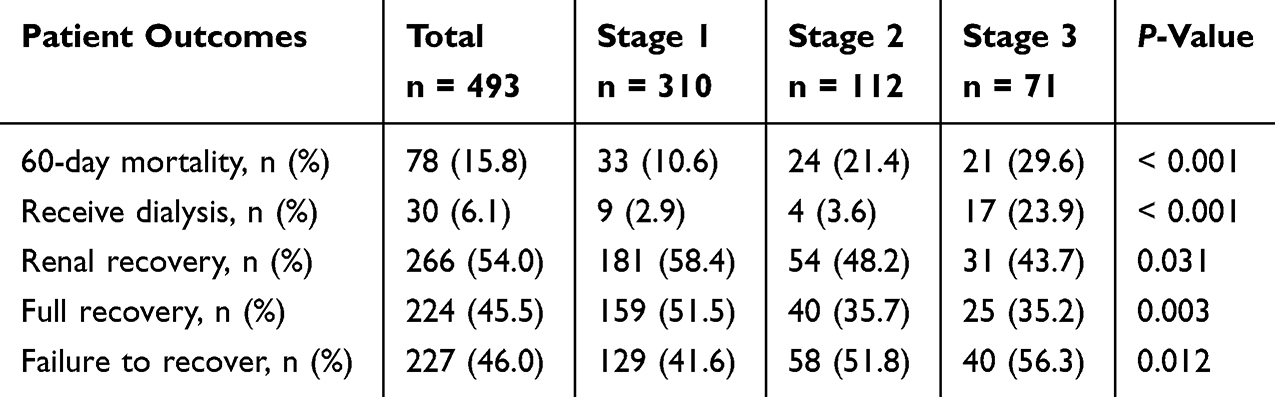 |
Table 4 Clinical Outcomes of Patients Classified by Different Renal Function Stages |
Risk Factor Analysis
Multivariate logistic regression with backward elimination methodology was performed to identify independent predictors of VA-AKI while controlling for potential confounders. Multivariate logistic regression identified independent VA-AKI predictors: trough concentration ≥ 15.935 mg/L (odds ratio [OR] 2.127, 95% CI: 1.704–2.656, P < 0.001), contrast media (OR 2.459, 95% CI: 1.250–4.838, P = 0.009), piperacillin-tazobactam (OR 1.837, 95% CI: 1.177–2.869, P = 0.007), cephalosporins (OR 1.620, 95% CI: 1.257–2.086, P < 0.001), critical illness (OR 1.712, 95% CI: 1.366–2.144, P < 0.001), therapy ≥14 days (OR 1.460, 95% CI: 1.090–1.954, P = 0.011), cardiac dysfunction (OR 1.556, 95% CI: 1.183–2.048, P = 0.002), and eGFR < 90 mL/min/1.73 m2 (OR 1.299, 95% CI: 1.028–1.642, P = 0.029). Male gender was protective (OR 0.789, 95% CI: 0.627–0.992, P = 0.042) (Table 5).
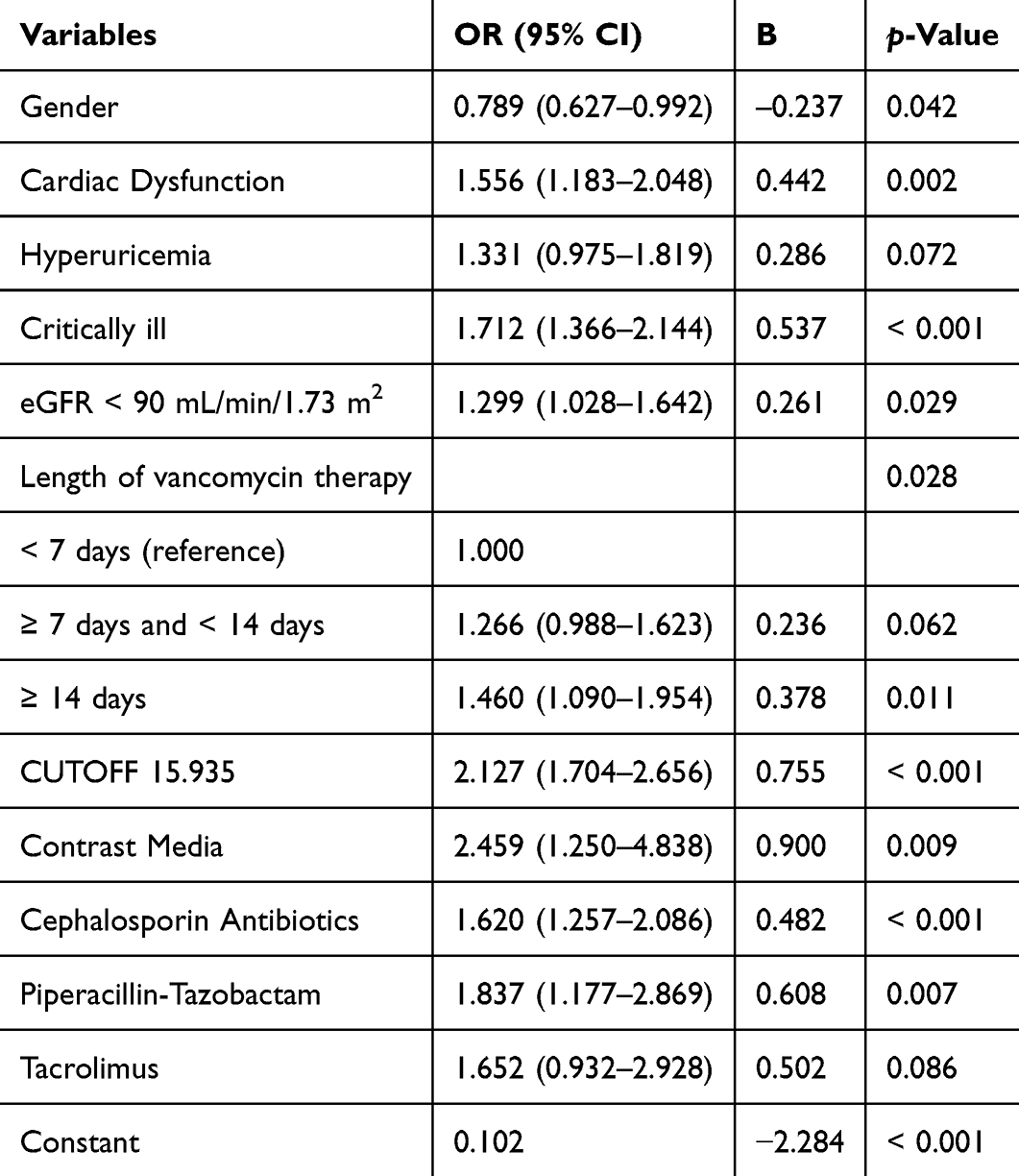 |
Table 5 Independent Risk Factors for VA-AKI Identified by Multivariate Logistic Regression Using Backward Elimination |
Notably, vasopressors and loop diuretics, which were significant in univariate analysis (Supplementary Table 1), did not remain independent predictors in the multivariate model. This suggests that their apparent associations with VA-AKI may be mediated by the overall severity of illness rather than direct nephrotoxic effects.
We performed supplementary Least Absolute Shrinkage and Selection Operator (LASSO) regression analysis to validate our variable selection and address potential multicollinearity (Supplementary Figure 2). The LASSO coefficient paths confirmed the robustness of variables identified through backward elimination, with vancomycin trough concentration, treatment duration, critical illness, cardiac dysfunction, and nephrotoxic medication combinations consistently exhibiting non-zero coefficients across a range of regularization parameters.
Clinical Risk Profile for Intensified Monitoring
Patients with trough concentrations around or above 15.9 mg/L, concomitant exposure to contrast media or piperacillin-tazobactam, and treatment duration ≥14 days represented a subgroup with potentially modifiable treatment-related risk. In contrast, critically ill patients and those with baseline renal impairment or cardiac dysfunction appeared to have heightened intrinsic vulnerability and may warrant closer renal surveillance from the outset of therapy (Supplementary Table 2).
Discussion
This multicenter retrospective cohort study enrolled 2,230 patients receiving vancomycin therapy across multiple medical institutions in China. We systematically evaluated the incidence, risk factors, and clinical outcomes of VA-AKI. The overall incidence of VA-AKI was 22.1% (493/2230), with KDIGO Stage 1 accounting for 62.9%, Stage 2 for 22.7%, and Stage 3 for 14.4%. Patients who developed AKI exhibited significantly elevated 60-day mortality (15.7% versus 3.5%, P < 0.001), nearly quadrupled dialysis requirements (6.1% versus 1.6%, P < 0.001), and nearly half of the patients (46.0%) failed to achieve renal recovery. These findings highlight the significant clinical impact of VA-AKI on patient prognosis and emphasize the need for optimizing vancomycin TDM strategies and early identification of high-risk populations. Through ROC curve analysis, we identified an optimal vancomycin trough threshold of 15.935 mg/L, and Kaplan–Meier survival analysis confirmed a concentration-dependent nephrotoxicity risk. Multiple independent risk factors, including baseline renal impairment, concomitant cardiac dysfunction, critical illness, concomitant nephrotoxic drugs (notably piperacillin/tazobactam and contrast media), and prolonged therapy duration. These results provide evidence-based medical guidance for early prevention and intervention of VA-AKI in clinical practice.
The observed VA-AKI incidence (22.1%) is consistent with the range reported in previous literature (5%–43%),4 but significantly higher than some single-center studies.18 Heterogeneity in study populations, underlying disease severity, TDM implementation practices, and AKI definition criteria differences contribute to this variability. In our cohort, 32.2% of patients were critically ill, a higher proportion than many previous studies, which may partially explain the relatively higher AKI incidence. Notably, this study represents the first large-sample, multicenter retrospective analysis of VA-AKI in China. Additionally, this study provides detailed descriptions of the clinical characteristics of VA-AKI in the Chinese population. We found that patients in the AKI group exhibited higher baseline creatinine levels (median 79 versus 72 μmol/L) and lower eGFR (median 83.1 versus 90.4 mL/min/1.73 m2), with significantly elevated proportions of CKD Stages 2 and 3, consistent with international literature reports.7 Notably, patients with concomitant hyperuricemia (15.2% versus 11.5%, P = 0.025) and cardiac dysfunction (24.5% versus 17.0%, P < 0.001) exhibited significantly increased AKI risk, a finding that has been less systematically reported in previous studies and may provide potential new markers for risk stratification.
The identified optimal warning threshold for vancomycin trough concentration of 15.935 mg/L (AUC = 0.643, 95% CI: 0.615–0.670, P < 0.001) has important clinical implications. Patients with trough concentrations ≥15.935 mg/L exhibited a 2.117-fold higher risk of developing AKI compared to those below this threshold (95% CI: 1.759–2.547; P < 0.001), supporting its role as a practical early warning signal during TDM. This threshold is broadly consistent with prior international studies reporting nephrotoxicity thresholds in the range of approximately 15–17.5 mg/L.10,19,20 Although the 2020 IDSA guideline favors AUC/MIC-based monitoring over trough-based targets alone,21 trough monitoring remains the most operationally feasible approach in many real-world settings, particularly where rapid AUC estimation is not routinely available. Our concentration-stratified analysis revealed a clear dose-response relationship. Compared with patients with trough concentrations < 10 mg/L, the 10–20 mg/L group exhibited an 82.7% increased AKI risk (HR 1.827, P < 0.001), whereas the > 20 mg/L group exhibited increased risk as high as 233.4% (HR 3.334, P < 0.001). This gradient relationship provides strong evidence for the “higher is more dangerous” hypothesis, supporting clinicians in achieving therapeutic goals and preventing excessive trough concentration exposure as much as possible. Additionally, this study observed a notable phenomenon: the average daily dose in the AKI group was lower than the non-AKI group (> 2 g/day: 8.5% versus 11.1%), and the cumulative dose was also lower (median 10.5 g versus 11.5 g). This seemingly contradictory finding likely reflects “reverse causality” in clinical practice—physicians tend to proactively reduce doses upon detecting renal function deterioration, rather than lower doses themselves causing AKI.
Baseline renal impairment is a major predictor of VA-AKI. Baseline median eGFR was significantly lower in the AKI group than in the non-AKI group (83.1 versus 90.4 mL/min/1.73 m2, P < 0.001), with significantly elevated proportions of CKD stages 2 and 3 (P = 0.020). Univariate logistic regression analysis revealed that for every 1 mL/min/1.73 m2 decrease in eGFR, AKI risk increased by 0.6% (OR 0.994, 95% CI: 0.991–0.998, P = 0.001). This finding is consistent with those of multiple previous studies.22,23 Patients with impaired baseline renal function may be more susceptible to VA-AKI because of reduced vancomycin clearance, greater drug accumulation, and diminished renal reserve.24–26 Beyond renal function, comorbidities significantly affect VA-AKI risk. This study also demonstrated that cardiac dysfunction increased AKI risk by 58.3% (OR 1.583, P < 0.001), attributable to insufficient renal perfusion from reduced cardiac output, neuroendocrine activation of the renin–angiotensin–aldosterone system and sympathetic nervous system, and venous congestion impairing tubular function.27–29 Hyperuricemia was an independent risk factor (OR 1.387, P = 0.025), promoting tubular injury through crystal deposition, oxidative stress, and inflammation that amplify vancomycin nephrotoxicity.30 Critical illness status (OR 1.694, P < 0.001) reflects reduced physiological reserve, with hemodynamic instability, multiple organ dysfunction, and cytokine storms exacerbating drug-induced nephrotoxicity.31
Although median vancomycin treatment duration exhibited no significant difference between the AKI and non-AKI groups (8.0 versus 7.0 days, P = 0.152), a significantly higher proportion of patients in the AKI group received treatment for ≥ 14 days (24.5% versus 18.9%, P = 0.006). Univariate logistic regression revealed that each additional 7 days of treatment increased the risk of AKI by 23.5% (OR 1.235, P = 0.001). This aligns with the findings of previous studies, which demonstrated prolonged duration as a recognized VA-AKI risk factor.32–34 However, extended treatment duration may reflect disease severity, as patients with more severe infections and complex comorbidities are more likely to require longer therapy, thereby increasing AKI risk. Consequently, rather than simply shortening treatment, intensive monitoring and prevention strategies are implemented for patients requiring prolonged therapy (≥ 14 days).
Combining piperacillin/tazobactam (PTZ) and vancomycin significantly increases the risk of nephrotoxicity, a recent research focus in anti-infective therapy. This study found higher AKI incidence among patients receiving PTZ combined with vancomycin (6.7% versus 4.5%, P = 0.047, OR 1.526), with enhanced effect size after multivariate regression controlling for confounders. This finding is consistent with previous observational studies and meta-analytic evidence suggesting that vancomycin plus PTZ is associated with a higher AKI risk than vancomycin combined with other β-lactam antibiotics,35–38 although the exact mechanism remains incompletely understood.39–42 Clinically, this combination should be used cautiously, particularly in patients with additional renal risk factors, and de-escalation or alternative regimens should be considered when appropriate. This study also identified synergistic nephrotoxicity with other agents, particularly contrast media (OR 2.954, P < 0.001), as well as second- and third-generation cephalosporins and tacrolimus, warranting careful monitoring in high-risk settings.43,44
This study represents the first large-scale VA-AKI cohort in China (n = 2230), substantially surpassing previous single-center investigations and enhancing generalizability. Key strengths include the following: (1) standardized data collection utilizing uniform AKI diagnostic criteria (KDIGO 2012) across centers, thereby minimizing heterogeneity; (2) comprehensive assessment of demographics, comorbidities, laboratory parameters, vancomycin exposure, and concomitant medications, enabling identification of synergistic nephrotoxic agents (PTZ, cephalosporins, and contrast media); (3) precise determination of the optimal trough concentration threshold (15.935 mg/L) using ROC curve analysis with Kaplan–Meier confirmation; (4) long-term outcome assessment including 60-day mortality, dialysis requirements, and renal function recovery, enhancing clinical relevance. These strengths improve the robustness of our findings and support their relevance to routine inpatient care. Beyond the mechanistic interpretation of these associations, the present findings may also have practical implications for risk stratification and monitoring during vancomycin therapy.
Clinical Implications
The present findings may help clinicians identify patients at increased risk of VA-AKI earlier in the course of vancomycin therapy. A trough concentration around or above 15.9 mg/L, concomitant exposure to contrast media or nephrotoxic co-therapies, and treatment duration ≥14 days may define treatment-related contexts in which renal risk is potentially modifiable and closer surveillance may be warranted. In contrast, critical illness, baseline renal impairment, and cardiac dysfunction may be interpreted as baseline vulnerability markers that support earlier initiation of intensified monitoring. Rather than supporting a uniform intervention strategy, these findings offer a pragmatic framework for integrating trough-based risk assessment into real-world inpatient decision-making, particularly where AUC-guided monitoring is not routinely available. Given the retrospective design of this study, these implications should be interpreted cautiously and require prospective validation.
Limitations
Several limitations should be acknowledged. First, the retrospective observational design introduces the possibility of incomplete data and residual confounding, and thus precludes causal inference. Some observed associations may partly reflect underlying illness severity or treatment complexity rather than direct drug effects alone. Second, TDM timing and frequency were not standardized across centers, and initial steady-state trough concentrations were often obtained after the third or fourth dose, which may have overlapped with AKI onset and thereby introduced potential reverse causality, particularly in the interpretation of dose-related exposure variables. Third, the absence of AUC-guided monitoring limited direct comparison with current guideline-preferred exposure targets, although trough monitoring remains the most operationally feasible approach in many real-world settings.21,45,46 In addition, microbiological data, including causative organisms, susceptibility profiles, MIC values, and resistance detection results, were not systematically analyzed because the study focused on nephrotoxicity risk rather than antimicrobial efficacy. Fourth, because the cohort was derived primarily from tertiary hospitals and included a substantial proportion of critically ill patients, the generalizability of our findings to lower-acuity settings may be limited. Finally, the proposed trough threshold and risk-stratification framework require prospective validation before being used to support broader monitoring recommendations.
Conclusions
In this multicenter cohort of Chinese adult inpatients, vancomycin-associated acute kidney injury was common and was associated with worse short-term outcomes. A vancomycin trough concentration around 15.9 mg/L may serve as a pragmatic risk reference in routine practice, particularly in settings where AUC-guided monitoring is not yet widely implemented. When interpreted together with potentially modifiable treatment-related exposures and baseline vulnerability markers, these findings may help clinicians identify high-risk patients earlier and prioritize intensified therapeutic drug monitoring and renal surveillance. Its clinical implementation, however, may require consistent therapeutic drug monitoring workflows and timely renal monitoring. Prospective studies are needed to validate this risk-stratification approach and to determine how it can be integrated with contemporary vancomycin monitoring strategies.
Data Sharing Statement
All data extraction forms, statistical analytic codes, and other materials used in this study are available from the corresponding author, Kunming Pan, upon reasonable request.
Ethics Statement
This study was conducted in accordance with the Declaration of Helsinki. The protocol was approved by the Medical Ethics Committee of Zhongshan Hospital, Fudan University (B2024-451), the Ethics Committee of Zhongshan Hospital (Xiamen), Fudan University (B2025-051), and the Ethics Committee of the Second Affiliated Hospital of Naval Medical University (2025SL058). The requirement for informed consent was waived due to the retrospective design of this multicenter cohort study based on electronic medical record review. Patient confidentiality was strictly maintained, all data were analyzed in a de-identified manner, and no individually identifiable patient information is disclosed in this manuscript.
Author Contributions
All authors made a significant contribution to the work reported, whether that is in the conception, study design, execution, acquisition of data, analysis and interpretation, or in all these areas; took part in drafting, revising or critically reviewing the article; gave final approval of the version to be published; have agreed on the journal to which the article has been submitted; and agree to be accountable for all aspects of the work.
Funding
This study was supported by the National Natural Science Foundation of China (NO.82204520), Natural Science Foundation Program of Fujian Province (2026J0011894), Shanghai Municipal Health Commission (No.20244Y0101), Shanghai “Rising Stars of Medical Talent” Youth Development Program Youth Medical Talents – Clinical Pharmacist Program (SHWSRS (2023) 106).
Disclosure
The authors report no conflicts of interest in this work.
References
1. Tong SYC, Fowler VG, Skalla L, Holland TL. Management of Staphylococcus aureus Bacteremia. JAMA. 2025;334(9):798–15. doi:10.1001/jama.2025.4288
2. Zhang G, Zhang N, Xu J, Yang T, Yin H, Cai Y. Efficacy and safety of vancomycin for the treatment of Staphylococcus aureus bacteraemia: a systematic review and meta-analysis. Int J Antimicrob Agents. 2023;62(4):106946. doi:10.1016/j.ijantimicag.2023.106946
3. Jeon YL, Kim MH, Yang H-S, Kang SY, Lee WI. Optimum initial loading dose of vancomycin for pneumonia caused by methicillin-resistant Staphylococcus aureus. J Infect. 2015;72(1):115–118. doi:10.1016/j.jinf.2015.09.010
4. Kim JY, Yee J, Yoon HY, Han JM, Gwak HS. Risk factors for vancomycin-associated acute kidney injury: a systematic review and meta-analysis. Br J Clin Pharmacol. 2022;88(9):3977–3989. doi:10.1111/bcp.15429
5. Kunming P, Can C, Zhangzhang C, et al. Vancomycin Associated Acute Kidney Injury: a Longitudinal Study in China. Front Pharmacol. 2021;12:632107. doi:10.3389/fphar.2021.632107
6. Pan K, Ma L, Xiang Q, et al. Vancomycin-associated acute kidney injury: a cross-sectional study from a single center in China. PLoS One. 2017;12:e0175688. doi:10.1371/journal.pone.0175688
7. Hammoud K, Brimacombe M, Yu A, Goodloe N, Haidar W, El Atrouni W. Vancomycin Trough and Acute Kidney Injury: a Large Retrospective, Cohort Study. Am J Nephrol. 2016;44(6):456–461. doi:10.1159/000452427
8. Alosaimy S, Lagnf AM, Hobbs ALV, et al. Nephrotoxicity of vancomycin in combination with beta-lactam agents: ceftolozane-tazobactam vs piperacillin-tazobactam. Clin Infect Dis. 2023;76(3):e1444–e1455. doi:10.1093/cid/ciac670
9. Al-Maqbali JS, Shukri ZA, Sabahi NA, Al-Riyami I, Al Alawi AM. Vancomycin Therapeutic Drug Monitoring (TDM) and Its association with clinical outcomes: a retrospective cohort. J Infect Public Health. 2022;15(5):589–593. doi:10.1016/j.jiph.2022.04.007
10. van Hal SJ, Paterson DL, Lodise TP. Systematic review and meta-analysis of vancomycin-induced nephrotoxicity associated with dosing schedules that maintain troughs between 15 and 20 milligrams per liter. Antimicrob Agents Chemother. 2012;57(2):734–744. doi:10.1128/AAC.01568-12
11. Bellos I, Daskalakis G, Pergialiotis V. Relationship of vancomycin trough levels with acute kidney injury risk: an exposure-toxicity meta-analysis. J Antimicrob Chemother. 2020;75(10):2725–2734. doi:10.1093/jac/dkaa184
12. Rybak MJ, Le J, Lodise TP, et al. Therapeutic monitoring of vancomycin for serious methicillin-resistant Staphylococcus aureus infections: a revised consensus guideline and review by the American Society of Health-System Pharmacists, the Infectious Diseases Society of America, the Pediatric Infectious Diseases Society, and the Society of Infectious Diseases Pharmacists. Am J Health Syst Pharm. 2020;77:835–864. doi:10.1093/ajhp/zxaa036
13. Reuter SE, Stocker SL, Alffenaar J-WC, et al. Optimal Practice for Vancomycin Therapeutic Drug Monitoring: position Statement From the Anti-infectives Committee of the International Association of Therapeutic Drug Monitoring and Clinical Toxicology. Therap Drug Monitoring. 2022;44(1):121–132. doi:10.1097/FTD.0000000000000944
14. Liu J, Zhang X, Liang G, et al. Is it time to recommend AUC-based vancomycin therapeutic drug monitoring only? A cross-sectional survey in China. Front Pharmacol. 2024;15:1370040. doi:10.3389/fphar.2024.1370040
15. Pan K-M, Wu Y, Chen C, et al. Vancomycin-induced acute kidney injury in elderly Chinese patients: a single-centre cross-sectional study. Br J Clin Pharmacol. 2018;84(8):1706–1718. doi:10.1111/bcp.13594
16. von Elm E, Altman DG, Egger M, Pocock SJ, Gøtzsche PC, Vandenbroucke JP. The Strengthening the Reporting of Observational Studies in Epidemiology (STROBE) statement: guidelines for reporting observational studies. Lancet. 2007;370(9596):1453–1457. doi:10.1016/S0140-6736(07)61602-X
17. Stevens PE, Levin A. Evaluation and management of chronic kidney disease: synopsis of the kidney disease: improving global outcomes 2012 clinical practice guideline. Ann Intern Med. 2013;158(11):825–830. doi:10.7326/0003-4819-158-11-201306040-00007
18. Lu R, Ren J, Zhou X, Zheng B, Peng F. Risk factors for acute kidney injury associated with intravenous vancomycin in neurosurgical inpatients: a retrospective study. Eur J Clin Pharmacol. 2023;80(1):65–73. doi:10.1007/s00228-023-03581-6
19. Hanrahan TP, Kotapati C, Roberts MJ, et al. Factors associated with vancomycin nephrotoxicity in the critically ill. Anaesth Intensive Care. 2015;43(5):594–599. doi:10.1177/0310057X1504300507
20. Ghasemiyeh P, Vazin A, Zand F, et al. Pharmacokinetic assessment of vancomycin in critically ill patients and nephrotoxicity prediction using individualized pharmacokinetic parameters. Front Pharmacol. 2022;13:912202. doi:10.3389/fphar.2022.912202
21. Rybak MJ, Le J, Lodise TP, et al. Therapeutic Monitoring of Vancomycin for Serious Methicillin-resistant Staphylococcus aureus Infections: a Revised Consensus Guideline and Review by the American Society of Health-system Pharmacists, the Infectious Diseases Society of America, the Pediatric Infectious Diseases Society, and the Society of Infectious Diseases Pharmacists. Clin Infect Dis. 2020;71(6):1361–1364. doi:10.1093/cid/ciaa303
22. Kim JY, Kim KY, Yee J, Gwak HS. Risk Scoring System for Vancomycin-Associated Acute Kidney Injury. Front Pharmacol. 2022;13:815188. doi:10.3389/fphar.2022.815188
23. de Souza Garms D S, Cardoso Eid KZ, Burdmann EA, et al. The Role of Urinary Biomarkers as Diagnostic and Prognostic Predictors of Acute Kidney Injury Associated With Vancomycin. Front Pharmacol. 2021;12:705636. doi:10.3389/fphar.2021.705636
24. Edwina AE, Dreesen E, Gijsen M, et al. Decreased Kidney Function Explains Higher Vancomycin Exposure in Older Adults. Drugs Aging. 2024;41(9):753–762. doi:10.1007/s40266-024-01140-x
25. Bellomo R, Kellum JA, Ronco C. Acute kidney injury. Lancet. 2012;380(9843):756–766. doi:10.1016/S0140-6736(11)61454-2
26. Coca SG, Singanamala S, Parikh CR. Chronic kidney disease after acute kidney injury: a systematic review and meta-analysis. Kidney Int. 2011;81(5):442–448. doi:10.1038/ki.2011.379
27. Ronco C, Haapio M, House AA, Anavekar N, Bellomo R. Cardiorenal syndrome. J Am Coll Cardiol. 2008;52(19):1527–1539. doi:10.1016/j.jacc.2008.07.051
28. Damman K, Testani JM. The kidney in heart failure: an update. Eur Heart J. 2015;36(23):1437–1444. doi:10.1093/eurheartj/ehv010
29. Mullens W, Abrahams Z, Francis GS, et al. Importance of venous congestion for worsening of renal function in advanced decompensated heart failure. J Am Coll Cardiol. 2009;53(7):589–596. doi:10.1016/j.jacc.2008.05.068
30. Wu N, Xia J, Chen S, et al. Serum uric acid and risk of incident chronic kidney disease: a national cohort study and updated meta-analysis. Nutr Metab. 2021;18(1):94. doi:10.1186/s12986-021-00618-4
31. Hoste EAJ, Bagshaw SM, Bellomo R, et al. Epidemiology of acute kidney injury in critically ill patients: the multinational AKI-EPI study. Intensive Care Med. 2015;41(8):1411–1423. doi:10.1007/s00134-015-3934-7
32. Elyasi S, Khalili H, Dashti-Khavidaki S, Mohammadpour A. Vancomycin-induced nephrotoxicity: mechanism, incidence, risk factors and special populations. A literature review. Eur J Clin Pharmacol. 2012;68(9):1243–1255. doi:10.1007/s00228-012-1259-9
33. Wong-Beringer A, Joo J, Tse E, Beringer P. Vancomycin-associated nephrotoxicity: a critical appraisal of risk with high-dose therapy. Int J Antimicrob Agents. 2010;37(2):95–101. doi:10.1016/j.ijantimicag.2010.10.013
34. Wang Y, Dai N, Wei W, Jiang C. Outcomes and Nephrotoxicity Associated with Vancomycin Treatment in Patients 80 Years and Older. Clin Interv Aging. 2021;16:1023–1035. doi:10.2147/CIA.S308878
35. Kim T, Kandiah S, Patel M, et al. Risk factors for kidney injury during vancomycin and piperacillin/tazobactam administration, including increased odds of injury with combination therapy. BMC Res Notes. 2015;8(1):579. doi:10.1186/s13104-015-1518-9
36. Rutter WC, Cox JN, Martin CA, Burgess DR, Burgess DS. Nephrotoxicity during Vancomycin Therapy in Combination with Piperacillin-Tazobactam or Cefepime. Antimicrob Agents Chemother. 2017;61:e02089.
37. Mullins BP, Kramer CJ, Bartel BJ, Catlin JS, Gilder RE. Comparison of the Nephrotoxicity of Vancomycin in Combination With Cefepime, Meropenem, or Piperacillin/Tazobactam: a Prospective, Multicenter Study. Ann Pharmacother. 2018;52(7):639–644. doi:10.1177/1060028018757497
38. Pan K, Li R, Li Y, Ding X, Li X, Lv Q. Vancomycin combined with piperacillin/tazobactam increases the risk of acute kidney injury compared with vancomycin plus other anti-pseudomonal beta-lactams: a systematic review and network meta-analysis. J Antimicrob Chemother. 2025;80(1):47–58. doi:10.1093/jac/dkae410
39. Luque Y, Louis K, Jouanneau C, et al. Vancomycin-Associated Cast Nephropathy. J Am Soc Nephrol. 2017;28(6):1723–1728. doi:10.1681/ASN.2016080867
40. Kan W-C, Chen Y-C, Wu V-C, Shiao -C-C. Vancomycin-Associated Acute Kidney Injury: a Narrative Review from Pathophysiology to Clinical Application. Int J Mol Sci. 2022;23(4):2052. doi:10.3390/ijms23042052
41. Pais GM, Liu J, Avedissian SN, et al. Lack of synergistic nephrotoxicity between vancomycin and piperacillin/tazobactam in a rat model and a confirmatory cellular model. J Antimicrob Chemother. 2020;75(5):1228–1236. doi:10.1093/jac/dkz563
42. Watkins RR, Deresinski S. Increasing Evidence of the Nephrotoxicity of Piperacillin/Tazobactam and Vancomycin Combination Therapy-What Is the Clinician to Do? Clin Infect Dis. 2017;65(12):2137–2143. doi:10.1093/cid/cix675
43. Kusirisin P, Chattipakorn SC, Chattipakorn N. Contrast-induced nephropathy and oxidative stress: mechanistic insights for better interventional approaches. J Transl Med. 2020;18(1):400. doi:10.1186/s12967-020-02574-8
44. Naesens M, Kuypers DRJ, Sarwal M. Calcineurin inhibitor nephrotoxicity. Clin J Am Soc Nephrol. 2009;4(2):481–508. doi:10.2215/CJN.04800908
45. Aljefri DM, Avedissian SN, Rhodes NJ, Postelnick MJ, Nguyen K, Scheetz MH. Vancomycin Area Under the Curve and Acute Kidney Injury: a Meta-analysis. Clin Infect Dis. 2019;69(11):1881–1887. doi:10.1093/cid/ciz051
46. Ishigo T, Matsumoto K, Yoshida H, et al. Relationship between nephrotoxicity and area under the concentration-time curve of vancomycin in critically ill patients: a multicenter retrospective study. Microbiol Spectr. 2024;12:e0373923.
 © 2026 The Author(s). This work is published and licensed by Dove Medical Press Limited. The
full terms of this license are available at https://www.dovepress.com/terms
and incorporate the Creative Commons Attribution
- Non Commercial (unported, 4.0) License.
By accessing the work you hereby accept the Terms. Non-commercial uses of the work are permitted
without any further permission from Dove Medical Press Limited, provided the work is properly
attributed. For permission for commercial use of this work, please see paragraphs 4.2 and 5 of our Terms.
© 2026 The Author(s). This work is published and licensed by Dove Medical Press Limited. The
full terms of this license are available at https://www.dovepress.com/terms
and incorporate the Creative Commons Attribution
- Non Commercial (unported, 4.0) License.
By accessing the work you hereby accept the Terms. Non-commercial uses of the work are permitted
without any further permission from Dove Medical Press Limited, provided the work is properly
attributed. For permission for commercial use of this work, please see paragraphs 4.2 and 5 of our Terms.
Recommended articles

Continuous Vancomycin Infusion versus Intermittent Infusion in Critically Ill Patients
Maluangnon C, Tongyoo S, Permpikul C
Infection and Drug Resistance 2022, 15:7751-7760
Published Date: 28 December 2022
Analysis of Risk Factors and Intervention Strategies for Acute Kidney Injury After Cardiac Valve Replacement
Jiang Y, Song Y
Journal of Inflammation Research 2023, 16:3523-3529
Published Date: 18 August 2023
One-Year Survival for Developing Acute Kidney Injury in Adult Patients with AMI Cardiogenic Shock Receiving Venoarterial Extracorporeal Membrane Oxygenation
Chen W, Pei M, Chen C, Wang B, Shi L, Qiu G, Duan W, Chen S, Wei Q, Zeng X, Pang H, Wei Y, Wu R, Zhu R, Ji Q, Lyu L
International Journal of General Medicine 2023, 16:4537-4548
Published Date: 5 October 2023
Clinical Characteristics and Analysis of Risk Factors Associated with Rhabdomyolysis in Snakebite Victims
Wang FZ, Xiang SH, Lin SQ, Qian FQ, Zhang QX, Geng MH, Deng JX, Wu SC
International Journal of General Medicine 2024, 17:5535-5546
Published Date: 26 November 2024
Impact of Prior Chronic Kidney Disease and Newly Detected eGFR Impairment at Admission on Outcomes and Prognosis of Hospitalized COVID-19 Patients – A Single-Center Cohort Study
Kania M, Terlecki M, Batko K, Rajzer M, Malecki MT, Krzanowski M
International Journal of General Medicine 2025, 18:593-602
Published Date: 5 February 2025