
Back to Journals » International Journal of Women's Health » Volume 17
Knowledge, Attitudes, and Practices Towards Hormone Replacement Therapy Among Women with Perimenopausal Syndrome: A Cross-Sectional Analysis in Quzhou, Zhejiang Province, China
Authors Wang J, Xia X, Lin X, Xu X
Received 24 January 2025
Accepted for publication 5 July 2025
Published 22 July 2025 Volume 2025:17 Pages 2265—2276
DOI https://doi.org/10.2147/IJWH.S513067
Checked for plagiarism Yes
Review by Single anonymous peer review
Peer reviewer comments 2
Editor who approved publication: Dr Matteo Frigerio
Jing Wang,* Xinglu Xia,* Xi Lin, Xiaomin Xu
Department of Gynecology, The Quzhou Affiliated Hospital of Wenzhou Medical University, Quzhou People’s Hospital, Quzhou, Zhejiang, 324000, People’s Republic of China
*These authors contributed equally to this work
Correspondence: Xiaomin Xu, Department of Gynecology, The Quzhou Affiliated Hospital of Wenzhou Medical University, Quzhou People’s Hospital, No. 100 Minjiang Avenue, Kecheng District, Quzhou, Zhejiang, 324000, People’s Republic of China, Tel +86 15657001213, Email [email protected]
Background: Hormone replacement therapy (HRT) plays a critical role in managing perimenopausal syndrome, yet patients’ knowledge, attitudes, and practices (KAP) toward HRT remain insufficiently understood. This study aimed to assess KAP toward HRT among patients with perimenopausal syndrome.
Patients and Methods: This cross-sectional study conducted in Quzhou, Zhejiang Province, China, in February 2024 used a validated self-designed questionnaire to assess demographic characteristics and knowledge, attitudes, and practices (KAP) toward hormone replacement therapy (HRT). Structural equation modeling (SEM) was applied to examine the pathways among KAP dimensions.
Results: Among the 520 participants analyzed, 73.3% resided in urban areas, and 37.9% had used HRT for less than one year. The knowledge, attitude, and practice scores were 18.01± 6.05 (possible range: 0– 26), 37.56± 5.07 (possible range: 10– 50), and 6.07± 1.70 (possible range: 0– 8), respectively. There were significant positive correlations among knowledge, attitudes, and practices (all P < 0.001). SEM results showed that knowledge directly influenced attitudes (β = 0.499, P < 0.001) and practices (β = 0.125, P = 0.007), and that attitudes also directly influenced practices (β = 0.175, P = 0.005).
Conclusion: Patients exhibited moderate knowledge and relatively positive practices, though their attitudes toward HRT were suboptimal. The findings highlight the interrelationships among knowledge, attitudes, and practices regarding HRT, suggesting that educational efforts may play a key role in improving patient understanding and engagement.
Keywords: perimenopause, hormone replacement therapy, cross-sectional study, health knowledge, attitude, practice, patient education
Introduction
The perimenopausal syndrome is characterized by symptoms such as urogenital atrophy, reduced sexual activity, psychological depression, osteoporosis, and vasomotor alterations. The perimenopausal syndrome is a consequence of the significant decline in estrogen production in women, typically occurring between ages 40 and 59.1 A study involving 82,340 Chinese women aged 40–65 reported a perimenopausal syndrome incidence of 61.0%.2 A majority of women endure symptoms such as irregular menstruation, hot flashes, chills, headaches, palpitations, mood fluctuations, memory decline, and sleep disturbances.2–4 The perimenopausal syndrome has a profound impact on the women’s quality of life,5,6 and may increase the risk of reduced bone density, cardiovascular diseases, and depression.7–9 Dysmenorrhea and premenstrual syndrome are key aspects affecting perimenopausal syndrome.10,11
Hormone replacement therapy (HRT) has emerged as a prevalent therapeutic option. HRT involves the supplementation of estrogen and progestogen to regulate hormonal levels.12 This therapy, which includes either estrogen therapy or a combination of estrogen and progesterone therapy, plays a pivotal role in managing the complexities associated with perimenopausal symptoms.13 Properly administered, HRT can relieve symptoms, enhance well-being, and prevent long-term complications.
In China, the introduction of HRT has been recent and has not yet fully penetrated public awareness, largely due to traditional beliefs and varying education levels. Many menopausal women, as a result, tend to neglect the importance of addressing menopause and its symptoms. Notably, long-term hormone-based treatments continue to face resistance. This resistance is evident in a survey where approximately 35.9% of patients discontinued HRT within a year, citing fears of cancer, reduced symptoms, and the inconvenience of ongoing medication or doctor visits as their main reasons.14 A study of 3619 women aged 40–65 years highlighted a lack of awareness and willingness to treat menopausal symptoms, influenced by the women’s menopausal, employment, and marital statuses.15 It underscores the critical role of healthcare professionals in educating the public about menopause, promoting effective management, and guiding suitable candidates through menopause hormone therapy (MHT) under professional supervision, aiming to improve the quality of life for menopausal women and foster broader acceptance of HRT.
Given the distinctive nature of perimenopausal syndrome and its associated therapeutic approaches, there is a significant imperative for a systematic exploration of the knowledge, attitudes, and practices (KAP) of the patients and healthcare professionals toward HRT and MHT. The KAP theory is a critical framework influencing human health behaviors16 and is frequently evaluated using a KAP questionnaire. This approach offers a comprehensive evaluation of the knowledge, attitude, and practices within the healthcare domain, providing insights into the existing awareness and the practical implementation of healthcare-related information.17 It also helps identify factors such as treatment adherence and concerns about potential adverse effects, offering insights into patient experiences.
However, it is crucial to underscore that, as far as our knowledge extends, there is a noticeable scarcity of KAP studies addressing specifically the perimenopausal syndrome and HRT. The predominant focus of current research often revolves around general menopausal health, occasionally overlooking a comprehensive exploration of the KAP aspects specific to perimenopausal syndrome and its associated treatment options.18,19 One previous study in India showed poor KAP toward HRT in 150 women.20
Therefore, considering the lack of data about the KAP toward HRT, this study aimed to assess the KAP toward HRT among patients with perimenopausal syndrome. Identifying the gaps in KAP is necessary to design interventions to improve the practice and use of HRT.
Materials and Methods
Study Design and Participants
This cross-sectional study was conducted in Quzhou, Zhejiang Province, China, in February 2024. The participants were women diagnosed with perimenopausal syndrome, ie, a woman with irregular menstruation, hot flashes, chills, headaches, palpitations, mood fluctuations, memory decline, and sleep disturbances can be diagnosed with perimenopausal syndrome once pregnancy and other related diseases have been excluded.1 This study was approved by the Ethics Committee of Quzhou People’s Hospital (approval #2024-Y-022). All participants provided written informed consent. This study adhered to the tenets of the Declaration of Helsinki and later amendments. The inclusion criterion was patients who received HRT for at least 3 months. Those who refused to participate or provided an invalid questionnaire were excluded.
Questionnaire Design
The questionnaire was designed with reference to relevant studies.15,21 Content validity was examined based on the comments from three in perimenopause and menopause. A pilot test with a small sample (n=35) showed a Cronbach’s α of 0.9200, indicating good internal consistency. The pilot study participants were asked to report any unclear statements or items (face value). A post hoc confirmatory factor analysis (CFA) in all participants revealed a discrepancy divided by degree of freedom (CMIN/DF) of 3.639 (3–5 is good), root mean square error of approximation (RMSEA) of 0.071 (< 0.08 is good), incremental fit index (IFI) of 0.847 (> 0.8 is good), Tucker-Lewis index (TLI) of 0.833 (> 0.8 is good), and comparative fit index (CFI) of 0.846 (> 0.8 is good), supporting the construct validity of the questionnaire (Figure S1 and Table S1). The Kaiser-Meyer Olkin (KMO) index was 0.916 (P<0.001) in all participants, also supporting construct validity.
Questionnaire
The final questionnaire, administered in Chinese, comprised four sections: demographic characteristics, knowledge dimension, attitude dimension, and practice dimension. The knowledge dimension featured 13 questions, each scoring 2 points for “well-known”, 1 point for “partially known”, and 0 points for “unknown”. The attitude dimension included 10 questions, with reverse scoring applied to the 6th and 7th questions. The remaining questions were scored on a 5-point Likert scale, ranging from “strongly agree” (5 points) to “strongly disagree” (1 point), resulting in a total score range of 10–50. The practice dimension evaluated patients’ treatment adherence using a medication adherence scale. The total score for each dimension was calculated by adding the score of each item in the dimension. Overall knowledge and attitude scores were categorized based on a modified Bloom’s criteria cutoff point: respondents scoring between 80–100% were considered to possess good knowledge and a positive attitude, 60–79% were categorized as moderate, while scores < 60% indicated poor knowledge and a negative attitude.22 A practice score of ≥ 6 points indicated good practice. The complete version of the questionnaire can be obtained in Figure S3. It should be noted that all responses were self-reported, which may introduce recall or social desirability bias.
Data Collection
The participants were recruited through convenience sampling. The questionnaire was completed and collected online or onsite. The online questionnaire was created using the Wenjuanxing platform. It provides a professional online questionnaire survey, voting, testing, and comments. It provides a series of services, such as online questionnaire design, data collection, customized forms, and survey results analysis. A QR code, along with an electronic link, was generated. These QR code and link were sent to the doctor-patient communication group, where participants could complete the questionnaire by scanning the QR code or clicking the link. The onsite questionnaire was collected from the participants who visited the obstetrics and gynecology department. Given the voluntary nature of participation, there may be a selection bias, as women who are more health-conscious or already knowledgeable about HRT may have been more likely to participate.
Quality Control
Questionnaires completed in < 45s, with obvious logical errors (eg, impossible age), or with missing responses, were considered invalid and excluded from the analysis.
Sample Size
The formula  can be used to calculate the sample size of cross-sectional surveys. In the formula, n represents the sample size for each group, α represents the type I error (which is typically set at 0.05), Z1-α/2=1.96, δ represents the allowable error (typically set at 0.05), and p is set at 0.5 (as setting it at 0.5 maximizes the value and ensures a sufficiently large sample size). Hence, the calculated sample size was 384. Considering an estimated validity rate of 80%, a minimum of 480 valid questionnaires were needed. It was added to the manuscript.
Statistical Analysis
Statistical analysis was conducted using SPSS 26.0 (IBM, Armonk, NY, USA). Continuous variables were presented as means ± standard deviations, while categorical variables were presented as n (%). Disparities in knowledge and attitude scores among participants with distinct demographic characteristics were analyzed using the independent sample t-test, the Mann–Whitney U-test, or the Kruskal–Wallis H-test, as appropriate. Spearman correlation analysis was used to analyze the correlation among KAP scores. Structural equation modeling (SEM) was used to investigate the relationships among the KAP dimensions. In addition, logistic regression analysis was conducted to explore factors associated with good practice (treatment adherence), controlling for potential confounders such as education and residence. While some confounding variables were adjusted for, it should be acknowledged that not all possible confounders were collected. Furthermore, subgroup comparisons were performed based on duration of HRT use. Specifically, the KAP scores were compared among patients with different durations of HRT use, and effect sizes were calculated for those with significant differences. In addition, the influence of knowledge on both attitude and practice was examined through correlation analysis and SEM. A comparison of each practice item between patients using HRT for >3 years and ≤3 years was also added. Two-sided P-values < 0.05 were considered statistically significant.
Results
In this study, 622 potential participants, one refused to participate, five had too short a response time, 85 had logical errors or missing responses, and 11 were duplicates, leaving 520 valid questionnaires. Among these participants, 285 (54.81%) were > 50 years of age, 381 (73.27%) lived in urban areas, and 197 (37.88%) had a monthly income of 5000–10,000 yuan. In addition, 153 (29.42%) had comorbidities, 205 (39.42%) had been suffering from the perimenopausal syndrome for 1–3 years, and 197 (37.88%) had received HRT for < 1 year and 182 (35.00%) for 1–3 years. In total, 141 participants (27.12%) had used HRT for more than 3 years. Their mean knowledge, attitude, and practice scores were 18.01±6.05 (possible range: 0–26), 37.56±5.07 (possible range: 10–50), and 6.07±1.70 (possible range: 0–8).
Table 1 presents the subgroup analysis of KAP scores, including effect sizes for variables with significant differences. Participants with different ages, residence, education, employment, monthly income, disease duration, and HRT duration exhibited statistically significant differences in at least one of the KAP dimensions (all P < 0.05). Specifically, participants who had used HRT for more than 3 years demonstrated significantly higher practice scores than those using it for 3 years or less.
 |
Table 1 Participants’ KAP Scores |
To visualize the subgroup trends, we added box plots comparing knowledge, attitude, and practice scores between participants using HRT for more than 3 years and those using it for ≤3 years (Figure 1). The median practice score was notably higher in the >3 years group, while knowledge and attitude scores showed less pronounced variation. In addition, the distribution of item-level practice responses between the two groups was compared. Several items, including P2, P4, P5, P6, P7, and P8, showed higher mean scores in the >3 years group, indicating more consistent medication-taking behaviors and better practice adherence in these areas. In contrast, P1 and P3 scores were slightly higher among those with ≤3 years of HRT use (Figure S2).
 |
Figure 1 Comparison of KAP scores between patients using hormone replacement therapy (HRT) for ≤3 years and >3 years. This figure presents the mean scores (± standard deviation) of knowledge, attitude, and practice among participants stratified by duration of HRT use. Patients using HRT for more than 3 years demonstrated slightly higher scores across all dimensions, particularly in attitude and practice. |
Figure 2 shows the three lowest-scoring items in each KAP dimension. The two questions with the highest number of participants choosing the “Unknown” option were “Do you understand that HRT may lead to weight gain?” (K12) with 25.38% and “Do you understand that HRT may potentially lead to side effects such as uterine bleeding, breast tenderness, and blood clots?” (K11) with 24.04% (Table S2). It should be noted that 30.19% and 30.00% reported their concerns about the risks of the therapy (A6) and hormone addiction (A7) (Table S3). Regarding medication-related practices, 51.35% of the participants stated that they sometimes forgot to take their medication (P1), and it happened to 23.46% of them in the last 2 weeks (P2). In addition, 22.69% reduced or stopped their medication without informing their physician (P3). Even more risky, 24.42% sometimes forgot to bring their medication when they were traveling or going out of town (P4). Regarding the timing and dosage of medication, 44.23% of the patients said that it was not difficult at all to remember it (P8) (Table S4).
 |
Figure 2 The three items with the lowest scores in each dimension. K11: “Do you understand that HRT may potentially lead to side effects such as uterine bleeding, breast tenderness, and blood clots?”. K12: “Do you understand that HRT may lead to weight gain?”. K10: “Do you understand that HRT may help prevent endometrial hyperplasia or carcinoma?”. A6: “The potential risks of HRT make me feel concerned.”. A7: “I am concerned that HRT may have addictive properties.”. A9: “I believe HRT is safer than non-hormonal drug treatments.”. P1: “Do you sometimes forget to take your medication?”. P4: “When you go on a trip or are away from home for an extended period, do you sometimes forget to carry your medication with you?”. P2: “In the past two weeks, have you forgotten to take your medication for one or more days?”. |
Correlation analysis revealed significant positive associations among knowledge, attitudes, and practices (all P < 0.001; Table 2). Structural equation modeling (SEM) showed that knowledge directly affected attitudes (β = 0.54) and practices (β = 0.12), and attitudes in turn directly influenced practices (β = 0.22) (Table 3 and Figure 3). The model fit indices indicated an acceptable model fit (Table 4), although slightly below the ideal threshold (CMIN/DF = 4.610, RMSEA = 0.083, IFI = 0.789, TLI = 0.771, CFI = 0.788).
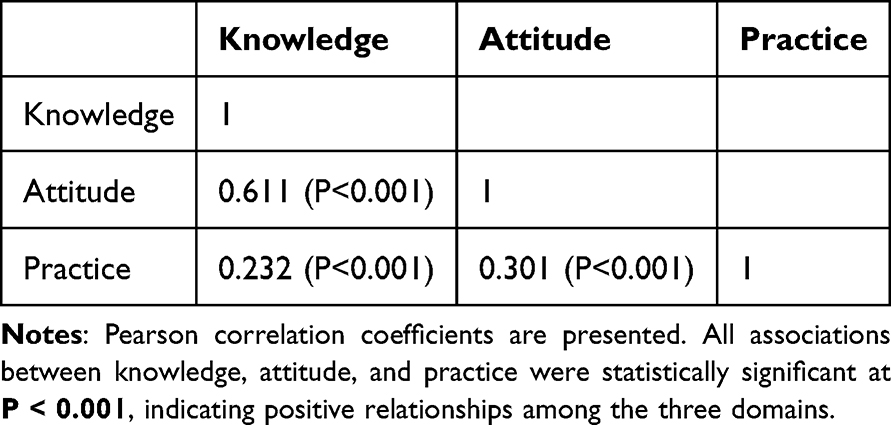 |
Table 2 Correlation Analysis Among Participants’ KAP |
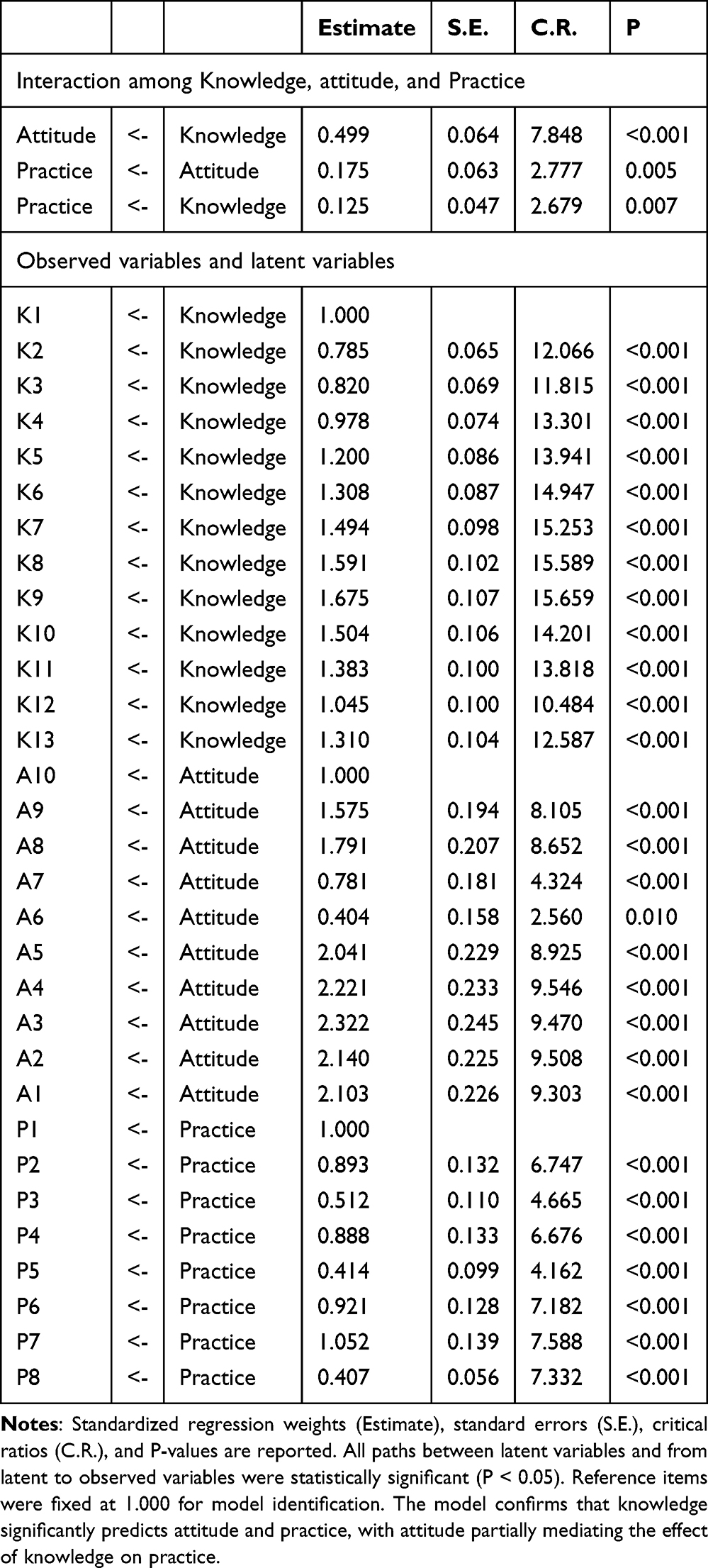 |
Table 3 Structural Equation Modelling |
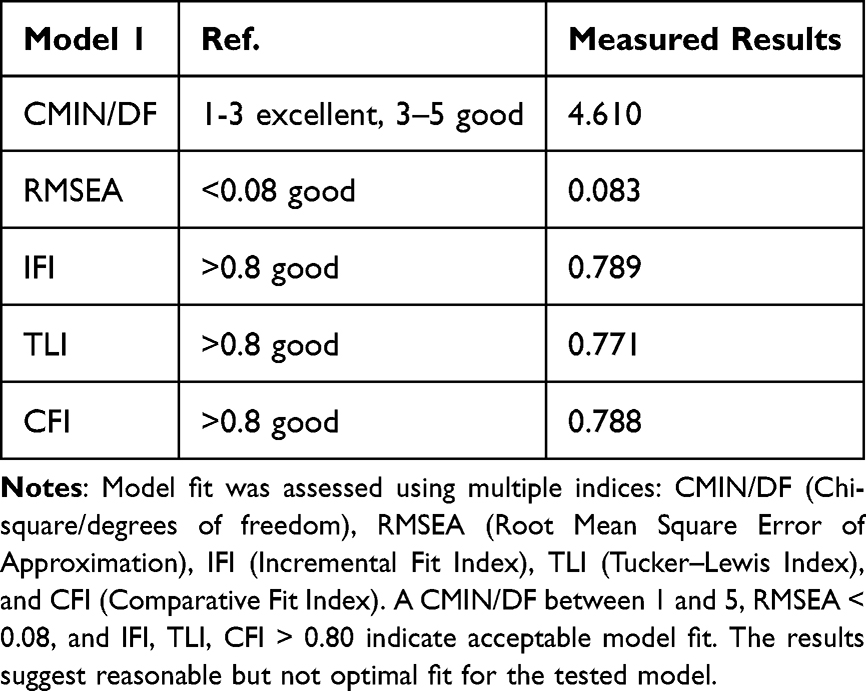 |
Table 4 SEM Model Evaluation |
 |
Figure 3 The structural equation modelling. This model shows the direct and mediated pathways among the three latent variables. Knowledge has a direct effect on both attitude and practice, while attitude mediates the association between knowledge and practice. Standardized path coefficients are presented. |
To further explore influencing factors on good practice, univariate and multivariate logistic regression analyses were performed (Table S5). In multivariate analysis, attitude remained a significant predictor of good practice (OR = 1.105, 95% CI: 1.055–1.158, P < 0.001), while knowledge was no longer significant. Sociodemographic variables including education, residence, income, and HRT duration were not independently associated with good practice.
Discussion
The findings of this study provide valuable insights into the KAP scores of patients with perimenopausal syndrome. In the following discussion, we first examine the associations between key demographic and clinical variables and KAP dimensions, followed by an interpretation of the interrelationships among knowledge, attitudes, and practices. These results are consistent with prior studies indicating that perimenopausal women face challenges in understanding their condition and may hold attitudes toward HRT that diverge from clinical recommendations.23 Perimenopausal syndrome patients demonstrated moderate knowledge, less-than-optimal attitude, and commendable adherence to HRT. A previous study of 150 Indian women showed poor knowledge and attitudes toward HRT, but it did not examine practice.20
Age-related differences in KAP scores are consistent with previous findings, underscoring the influence of age on health-seeking behaviors during the perimenopausal period.24 Moreover, the impact of residence was also evident, particularly in knowledge and attitude scores, echoing urban-rural disparities in healthcare access and information dissemination.25 Educational level also played an important role, with higher education correlating positively with all three KAP dimensions. Given the combined effects of age, residence, and education, healthcare interventions should be stratified accordingly to improve HRT-related knowledge and behaviors. Tailored interventions for urban and rural populations may help reduce disparities in access and comprehension of perimenopausal care.
The influence of employment status was also evident, particularly in relation to knowledge scores, highlighting the role of occupational factors in shaping health awareness, as supported by a previous study.26 Income levels showed significant variation across KAP scores, further emphasizing the role of the socioeconomic status in influencing health-related behaviors, as documented in studies addressing health disparities.27,28 In addition to sociodemographic factors, clinical variables such as disease duration and HRT exposure also contributed to variability in KAP. The duration since disease diagnosis and HRT further demonstrated significant associations, indicating evolving awareness and adherence patterns over time. Workplace health promotion programs tailored to perimenopausal women may enhance their health awareness and practices, considering the observed influence of employment status on knowledge levels.
The correlation analysis revealed positive relationships between the knowledge, attitude, and practice scores, reinforcing the interconnected nature of these domains in perimenopausal syndrome management. It aligns with existing research emphasizing the importance of addressing knowledge gaps to improve attitudes and practices in healthcare.29 The SEM supported this relationship, revealing that knowledge directly influenced both attitudes and practices, and that attitudes further mediated the effect of knowledge on practice. This highlights the mediating role of attitude and the importance of comprehensive interventions that address both cognitive and behavioral aspects. Interventions should focus on holistic approaches that simultaneously address knowledge, attitudes, and practices to maximize their impact on perimenopausal syndrome management. Healthcare providers should consider incorporating structural interventions that enhance the overall understanding of patients, emphasizing the crucial role of knowledge in shaping attitudes and practices.
The study of knowledge regarding perimenopausal syndrome and HRT among participants yielded insightful findings. A significant proportion of the participants demonstrated a well-founded understanding of the physiological bases of the perimenopausal syndrome, its typical age range, and its association with declining ovarian function. However, knowledge gaps were identified regarding specific symptoms and HRT administration methods. These results align with previous studies highlighting the need for comprehensive education on menopausal-related knowledge.30,31 Educational interventions should address specific knowledge gaps identified in the study, emphasizing the symptoms of perimenopausal syndrome and elucidating the various modes of HRT administration.
Moving to the attitudes, the participants generally exhibited positive attitudes toward HRT, with a substantial proportion acknowledging its benefits. However, many participants expressed concerns about the risks of HRT, addiction, and its comparative effectiveness with non-hormonal alternatives. These findings echo the existing literature, underscoring the importance of addressing concerns and fostering informed attitudes to promote treatment adherence.32 Addressing concerns about the perceived risks and addictive properties of HRT is crucial. Healthcare providers should prioritize open communication, providing evidence-based information to alleviate concerns and foster a more informed and positive attitude towards HRT. Incorporating patient education materials and counseling sessions may contribute to improved attitudes.
The analysis of the participants’ practices revealed varying medication adherence levels and instances of forgetting or altering dosage without consulting healthcare professionals. Such practices could compromise treatment efficacy. Comparable challenges in medication adherence have been documented in related studies.33 The difficulty in remembering to take medication on time and in the correct dosage further emphasizes the need for targeted interventions. Practical strategies to enhance medication adherence are warranted. Implementation of reminder systems, such as mobile applications or medication organizers, may prove beneficial.34–36 Moreover, fostering open communication between healthcare providers and patients regarding potential challenges in adherence can lead to more effective collaborative care. To further explore potential influencing factors of good practice, we conducted univariate and multivariate logistic regression analyses. The results showed that attitude was a significant predictor of good practice, whereas knowledge was not, after adjusting for covariates. These findings indicate that patients’ behavioral engagement with HRT may be more closely related to their attitudinal disposition than to factual knowledge alone. This suggests that interventions aimed at promoting HRT adherence should emphasize both information delivery and attitude shaping. In addition, patients who had used HRT for more than three years tended to report more favorable medication-related practices, such as better adherence and fewer disruptions during travel or daily routines. This suggests that longer treatment duration may be associated with improved familiarity and acceptance of HRT, which could positively influence long-term adherence.
In order to improve clinical practice and patient outcomes, healthcare providers could implement targeted educational interventions with a specific focus on enhancing KAP toward HRT. Furthermore, fostering open communication between healthcare professionals and perimenopausal patients is crucial, eg, using motivational interviewing, personalized counseling, or the use of digital health tools. This collaborative approach not only facilitates informed decision-making but also contributes to cultivating a more positive and informed perspective on HRT. Addressing knowledge gaps, alleviating concerns, and supporting medication adherence collectively may lead to better clinical outcomes and improved quality of life.
A strength of the study was the enrollment of a relatively large number of participants from the same geographical area. Studying perimenopausal women allows for a more targeted analysis of KAP regarding HRT use, and assessing knowledge, attitude, and practice provides a more comprehensive picture. Still, it is essential to acknowledge the limitations of this study. Firstly, its cross-sectional design limits causal inference between knowledge, attitudes, and practices, and longitudinal research is needed to explore these dynamics over time. Secondly, reliance on self-reported data, particularly for attitudes and practices, may have introduced recall bias and social desirability bias. Thirdly, the use of structured questionnaires without interviews or clinical assessments may have reduced data depth and accuracy. Additionally, potential selection bias cannot be excluded, as more health-conscious individuals may have been more likely to participate. Finally, the lack of information on participants’ actual experiences with HRT-related side effects limited the ability to assess how such experiences influenced their perceptions and behaviors. Future research could benefit from incorporating objective assessments, observational methods, or multimodal data collection to enhance reliability and reduce potential biases. Despite these limitations, the findings underscore the need for targeted interventions to enhance attitudes toward HRT in this population and provide a solid foundation for future research and clinical improvements.
In conclusion, patients with perimenopausal syndrome exhibited moderate knowledge, suboptimal attitudes, and relatively proactive practices toward HRT. Attitudes played a mediating role between knowledge and practice, highlighting the need for interventions that address both cognitive and emotional aspects. Based on this, future strategies should prioritize integrated educational interventions that simultaneously improve knowledge and shape positive attitudes, thereby supporting consistent HRT adherence and improving clinical outcomes.
Data Sharing Statement
All data generated or analyzed during this study would be available by contacting the first author upon reasonable request.
Ethics Approval and Consent to Participate
This work has been carried out in accordance with the Declaration of Helsinki (2000) of the World Medical Association. This study was approved by the Ethics Committee of Quzhou People’s Hospital (2024-Y-022), and all participants provided written informed consent.
Author Contributions
All authors contributed substantially to the study, including its conception, design, data collection, analysis, and interpretation. They were all involved in drafting and revising the manuscript, approved the final version for submission, and agreed to be accountable for all aspects of the work.
Funding
There is no funding to report.
Disclosure
The authors declare that they have no competing interests in this work.
References
1. Chen W, Chen M, Tang H, et al. Advances in diagnosis and treatment of perimenopausal syndrome. Open Life Sci. 2023;18(1):20220754. doi:10.1515/biol-2022-0754
2. Jia Y, Zhou Z, Cao X, et al. Incidence of Perimenopausal Syndrome in Chinese women aged 40 to 65 years: a meta-analysis. Chin Gen Pract. 2023;26(32):
3. Wang X, Wang L, Di J, Zhang X, Zhao G. Prevalence and risk factors for menopausal symptoms in middle-aged Chinese women: a community-based cross-sectional study. Menopause. 2021;28(11):1271–1278. doi:10.1097/GME.0000000000001850
4. Rautenberg TA, Ng SKA, Downes M. A cross-sectional study of symptoms and health-related quality of life in menopausal-aged women in China. BMC Women's Health. 2023;23(1):563. doi:10.1186/s12905-023-02728-y
5. Whiteley J, DiBonaventura M, Wagner JS, Alvir J, Shah S. The impact of menopausal symptoms on quality of life, productivity, and economic outcomes. J Women's Health. 2013;22(11):983–990. doi:10.1089/jwh.2012.3719
6. Rathnayake N, Lenora J, Alwis G, Lekamwasam S. Prevalence and severity of menopausal symptoms and the quality of life in middle-aged women: a study from Sri Lanka. Nurs Res Pract. 2019;2019:2081507. doi:10.1155/2019/2081507
7. Liu Z, Sun S, Sun X, Wu Y, Huang Y. Differences of anxiety and depression in dry eye disease patients according to age groups. Front Psychiatry. 2022;13:930714. doi:10.3389/fpsyt.2022.930714
8. Yuan J, Chen T, Lei Y, et al. Association analysis between vitamin D level and depression in women perimenopause: a protocol of systematic review and meta-analysis. Medicine. 2020;99(21):e20416. doi:10.1097/MD.0000000000020416
9. Zeng M, Li M, Li M, et al. 2-phenylacetamide isolated from the seeds of Lepidium Apetalum and its estrogen-like effects in vitro and in vivo. Molecules. 2018;23(9):2293. doi:10.3390/molecules23092293
10. Ghasemzadeh A, Saadat M. The effectiveness of cognitive-behavioral therapy on reducing the depression as a Dysmenorrhea symptom in Iranian girls based on Randomized Control Trial (RCT). J Assess Res Appl Couns. 2023;5(5):23–28. doi:10.61838/kman.jarac.5.5.3
11. Alijani M, Roshan Chesli R, Isamorad Roodboneh A, Mehrinejad S. Modeling premenstrual syndrome based on quality of life with the mediating role of early maladaptive schemas. J Assess Res Appl Couns. 2023;5(3):44–50. doi:10.61838/kman.jarac.5.3.7
12. Zhao FY, Fu QQ, Kennedy GA, Conduit R, Zhang WJ, Zheng Z. Acupuncture as an independent or adjuvant management to standard care for perimenopausal depression: a systematic review and meta-analysis. Front Psychiatry. 2021;12:666988. doi:10.3389/fpsyt.2021.666988
13. Lin RJ, Wang T. Comparison of fundamental frequency in postmenopausal women who are treated with hormone replacement therapy vs those who are not: a systematic review and meta-analysis. JAMA Otolaryngol Head Neck Surg. 2020;146(11):1045–1053. doi:10.1001/jamaoto.2020.2174
14. Chu K, Song Y, Chatooah ND, et al. The use and discontinuation of hormone replacement therapy in women in South China. Climacteric. 2018;21(1):47–52. doi:10.1080/13697137.2017.1397622
15. Jin F, Tao M, Teng Y, Shao H, Li C, Mills E. Knowledge and attitude towards menopause and hormone replacement therapy in Chinese women. Gynecol Obstet Invest. 2015;79(1):40–45. doi:10.1159/000365172
16. Tan J, Luo L, Zhang M, et al. A Chinese and Western medication adherence scale in patients with chronic kidney disease. Patient Prefer Adherence. 2019;13:1487–1495. doi:10.2147/PPA.S207693
17. Chen MH, Raffield LM, Mousas A, et al. Trans-ethnic and ancestry-specific blood-cell genetics in 746,667 individuals from 5 global populations. Cell. 2020;182(5):1198–1213.e1114. doi:10.1016/j.cell.2020.06.045
18. Gebretatyos H, Ghirmai L, Amanuel S, Gebreyohannes G, Tsighe Z, Tesfamariam EH. Effect of health education on knowledge and attitude of menopause among middle-age teachers. BMC Women's Health. 2020;20(1):232. doi:10.1186/s12905-020-01095-2
19. Lin L, Feng P, Yu Q. Attitude and knowledge for menopause management among health professionals in mainland China. Climacteric. 2020;23(6):614–621. doi:10.1080/13697137.2020.1775809
20. John NN, Juan R, Danam MS. An epidemiological study on knowledge, attitude and practice of married women about menopause and hormone replacement therapy. Int J Community Med Public Health. 2021;8(5):2299–2303. doi:10.18203/2394-6040.ijcmph20211749
21. Malik HS. Knowledge and attitude towards menopause and hormone replacement therapy (HRT) among postmenopausal women. J Pak Med Assoc. 2008;58(4):164–167.
22. Bloom BS. Learning for mastery. instruction and curriculum. Regional education laboratory for the Carolinas and Virginia, topical papers and reprints, number 1. Eval Comment. 1968;1(2):n2.
23. Pershad A, Morris JM, Shearer K, Pace D, Khanna P. Influencing factors on women’s attitudes toward hormone therapy acceptance for menopause treatment: a systematic review. Menopause. 2023;30(10):1061–1069. doi:10.1097/GME.0000000000002243
24. Weidner K, Bittner A, Beutel M, Goeckenjan M, Brähler E, Garthus-Niegel S. The role of stress and self-efficacy in somatic and psychological symptoms during the climacteric period - Is there a specific association? Maturitas. 2020;136:1–6. doi:10.1016/j.maturitas.2020.03.004
25. Chen X, Orom H, Hay JL, et al. Differences in rural and urban health information access and use. J Rural Health. 2019;35(3):405–417. doi:10.1111/jrh.12335
26. Wu Y, Wang S, Shi M, et al. Awareness of nutrition and health knowledge and its influencing factors among Wuhan residents. Front Public Health. 2022;10:987755. doi:10.3389/fpubh.2022.987755
27. Schultz WM, Kelli HM, Lisko JC, et al. Socioeconomic status and cardiovascular outcomes: challenges and interventions. Circulation. 2018;137(20):2166–2178. doi:10.1161/CIRCULATIONAHA.117.029652
28. Stormacq C, Van den Broucke S, Wosinski J. Does health literacy mediate the relationship between socioeconomic status and health disparities? Integrative review. Health Promot Int. 2019;34(5):e1–e17. doi:10.1093/heapro/day062
29. Zgliczyński WS, Rostkowska OM, Sarecka-Hujar B. Vitamin D knowledge, attitudes and practices of polish medical doctors. Nutrients. 2021;13(7):2443. doi:10.3390/nu13072443
30. Macpherson BE, Quinton ND. Menopause and healthcare professional education: a scoping review. Maturitas. 2022;166:89–95. doi:10.1016/j.maturitas.2022.08.009
31. Namazi M, Sadeghi R, Behboodi Moghadam Z. Social determinants of health in menopause: an integrative review. Int J Women's Health. 2019;11:637–647. doi:10.2147/IJWH.S228594
32. Matsuzawa Y, Lee YSC, Fraser F, et al. Barriers to behavioral treatment adherence for headache: an examination of attitudes, beliefs, and psychiatric factors. Headache. 2019;59(1):19–31. doi:10.1111/head.13429
33. While A. Medication adherence: understanding the issues and finding solutions. Br J Community Nurs. 2020;25(10):474–479. doi:10.12968/bjcn.2020.25.10.474
34. Ge YF, Wei CH, Wang WH, Cao LK. The effect of sorghum resistance resistant starch-mediated equol on the histological morphology of the uterus and ovaries of postmenopausal rats. Food Sci Nutr. 2020;8(8):4055–4065. doi:10.1002/fsn3.1670
35. He Q, Ren Y, Wang Y, Zhang F, Zhang S. The efficacy and safety of acupuncture for perimenopause symptom compared with different sham acupuncture control groups: a protocol of systematic review and meta-analysis. Medicine. 2020;99(10):e19366. doi:10.1097/MD.0000000000019366
36. Hong B, Hong S, Hu X, et al. Evaluation of Zuo-Gui Yin decoction effects on six CYP450 enzymes in rats using a cocktail method by UPLC-MS/MS. Biomed Res Int. 2022;2022:4293062. doi:10.1155/2022/4293062
 © 2025 The Author(s). This work is published and licensed by Dove Medical Press Limited. The
full terms of this license are available at https://www.dovepress.com/terms
and incorporate the Creative Commons Attribution
- Non Commercial (unported, 4.0) License.
By accessing the work you hereby accept the Terms. Non-commercial uses of the work are permitted
without any further permission from Dove Medical Press Limited, provided the work is properly
attributed. For permission for commercial use of this work, please see paragraphs 4.2 and 5 of our Terms.
© 2025 The Author(s). This work is published and licensed by Dove Medical Press Limited. The
full terms of this license are available at https://www.dovepress.com/terms
and incorporate the Creative Commons Attribution
- Non Commercial (unported, 4.0) License.
By accessing the work you hereby accept the Terms. Non-commercial uses of the work are permitted
without any further permission from Dove Medical Press Limited, provided the work is properly
attributed. For permission for commercial use of this work, please see paragraphs 4.2 and 5 of our Terms.
Recommended articles


Dynamics of Patient-Based Benefit-Risk Assessment of Medicines in Chronic Diseases: A Systematic Review
EL Masri H, McGuire TM, van Driel ML, Benham H, Hollingworth SA
Patient Preference and Adherence 2022, 16:2609-2637
Published Date: 20 September 2022
Family Members’ Perspectives on Integrative Chinese-Western Medicine in Cancer Care
Sun T, Wang T, Xia F, Xia L, Sun X, Jiang H, Xu P, Li P
Journal of Multidisciplinary Healthcare 2025, 18:2361-2373
Published Date: 28 April 2025
Parental Knowledge, Attitudes, and Practices Regarding Low-Temperature Plasma Adenotonsillectomy for Pediatric Obstructive Sleep Apnea Syndrome: A Structural Equation Modeling Analysis
Shi B, Mao R, Fang J, Wu Y, Liu F, Xiang S, Xia S
Journal of Multidisciplinary Healthcare 2026, 19:576607
Published Date: 28 March 2026
Knowledge, Attitude, and Practice of Chronic Prostatitis Patients Regarding Electrophysiological Therapy in a Chinese Tertiary Hospital: A Cross-Sectional SEM Study
Chi Z, Wan Q, Zhang Y, Zhu T, Liu G, Lin W, Hong X, Zhang Y
Patient Preference and Adherence 2026, 20:590096
Published Date: 31 March 2026
Educational Gaps in Epigenetics: A Cross-Sectional Study of Health Sciences Students’ Knowledge and Perceptions in Saudi Arabia
Mawlawi AH, Alzahrani BM, Alharthi RS, Khan MA, Minhas M, Kumar RS
Advances in Medical Education and Practice 2026, 17:549928
Published Date: 30 June 2026