
Back to Journals » Open Access Emergency Medicine » Volume 17
Hidden Risk Factors Overlooked by qSOFA in Emergency Department Sepsis Patients: A Multicenter Retrospective Cohort
Authors Althunayyan S 
Received 10 June 2025
Accepted for publication 1 November 2025
Published 28 November 2025 Volume 2025:17 Pages 361—369
DOI https://doi.org/10.2147/OAEM.S546101
Checked for plagiarism Yes
Review by Single anonymous peer review
Peer reviewer comments 2
Editor who approved publication: Professor Amit Agrawal
Saqer Althunayyan
Accidents and Trauma Department, Prince Sultan bin Abdulaziz College for Emergency Medical Services, King Saud University, Riyadh, Saudi Arabia
Correspondence: Saqer Althunayyan, Email [email protected]
Objective: Despite the numerous studies critiquing the Quick Sequential Organ Failure Assessment (qSOFA) score for sepsis prognosis in the emergency department (ED), there are limited known risk factors that can be missed by qSOFA.
Methods: This is a multicenter retrospective cohort study using ED data from Dr Sulaiman AL-Habib Medical Group Hospitals in Riyadh, Saudi Arabia. We assessed all suspected septic patients who came through the EDs from 1st May 2022 to 30th April 2023 with the qSOFA < 2. Among these patients, we identify those who develop critical outcomes (the requirement for vasopressors/inotropes or mortality) within 72 hours of triage. Additionally, we analyzed the potential risk factors of critical outcomes using a multivariable logistic regression model.
Results: We identified 1011 patients who presented with suspected sepsis and qSOFA < 2. Among them, 70 patients developed critical outcomes within 72 hours. In the multivariable logistic regression model, the potential risk factors for critical outcomes were age ≥ 65 years (adjusted OR, 3.87 [1.25, 14.9]), lactate ≥ 2.5 mmol/L with adjusted OR 2.04 [1.16, 3.54], and shock index > 1 with adjusted OR 3.27 [1.13, 10.3]. There are no specific comorbidities that were independently associated with the critical outcomes.
Conclusion: The study identified potential risk factors for sepsis outcomes that qSOFA overlooks. Integration of risk factors (lactate, shock index, age) with qSOFA could enhance early sepsis recognition and improve patient outcomes. We recommend further studies to validate these risk factors.
Keywords: diagnostic reliability, risk factors, qSOFA, sepsis, prognostic
Introduction
Sepsis remains a significant global health concern, characterized by life-threatening organ dysfunction due to a dysregulated host response to infection. Early recognition and prompt management of sepsis are crucial for improving patient outcomes.1,2 The Quick Sequential Organ Failure Assessment (qSOFA) has gained prominence as an emergency triage tool to facilitate rapid identification of septic patients. It is a simplified tool calculated based on level of consciousness, blood pressure, and respiratory rate.
Numerous studies have critiqued the performance of qSOFA in emergency departments (EDs) as they found it to have poor sensitivity.3–6 The low sensitivity raises concerns about potentially missing high-risk patients of preventable, time-sensitive diseases. Therefore, the most recent update of the surviving sepsis campaign guidelines recommends against qSOFA as a solo screening tool for sepsis.7 Regional data suggest that qSOFA’s poor sensitivity (around 44%) in Middle Eastern emergency departments may result in delayed recognition of sepsis, particularly concerning given the high patient volumes and resource constraints in this healthcare setting.8,9 Understanding risk factors in qSOFA-negative patients is essential for developing region-specific improvement strategies.
However, limited research has aimed to analyze the causes of poor sensitivity and to identify the risk factors for poor outcomes among sepsis patients with a qSOFA score of less than 2. Addressing this problem will contribute to identifying areas for improvement of qSOFA and guide the development to enhance its accuracy.
Taylor et al evaluated the performance of qSOFA in the ED for patients with varying comorbidity burdens and observed a linear decrease in the area under the receiver operating characteristic curve (AUROC) for qSOFA to predict mortality as the Charlson Comorbidity Index increased.10 This suggests that patients with multiple comorbid conditions may have baseline abnormalities in vital signs that reduce the discriminative power of qSOFA.
More Specific studies to target certain comorbidities raised the same concerns. In patients with liver cirrhosis, a study at one hospital found that qSOFA was not very advantageous in predicting adverse outcomes for patients with sepsis.11 In a similar way, Nishiwaki et al found that qSOFA was not optimal at predicting death in the hospital and blood infections in patients on hemodialysis.12 A prospective observational study at the emergency department reported qSOFA sensitivity around 25% to predict in-hospital mortality in immunocompromised patients.13
A single-center retrospective cohort study investigated risk factors for sepsis among emergency patients suspected of infection who had qSOFA scores less than 2.14 They found that age, requirement of oxygen, and certain comorbidities, such as diabetes mellitus, ischemic heart disease, and chronic kidney disease, were potential risk factors for sepsis, despite a negative qSOFA. The study concludes that the identified risk factors could assist clinicians in more efficiently recognizing patients at risk of developing sepsis, even among those with negative qSOFA scores, and it recommends conducting larger multicenter population-based studies to verify these findings.
Given these considerations, there is a clear need for further research to address the limitations of qSOFA and improve our ability to identify high-risk patients in the ED setting. Specifically, analyzing all risk factors of patients with qSOFA < 2 who develop poor outcomes could provide valuable insights for refining septic patients at risk of deterioration.
Material and Methods
This secondary analysis of previously published retrospective research, which was approved by the Institutional Review Board (IRB) committee at Dr Sulaiman AL-Habib Medical Group Hospitals.15 The Institutional Review Board at Dr Sulaiman Al-Habib Medical Group Hospitals (RC23.05.02) granted a waiver of informed consent for this retrospective chart review because it did not require additional data or involve direct patient contact. All patient data were handled strictly to maintain confidentiality and the study was conducted in compliance with the principles of the Declaration of Helsinki. This cohort study includes all emergency patients with suspected sepsis across four branches of the medical group in Riyadh, Saudi Arabia (Al Rayyan, Olaya, Altakhasosi, and Al Swedi). The study excluded patients under 18 years of age, pregnant individuals, those with pacemakers, patients with trauma, individuals discharged against medical advice (DAMA), and patients who did not receive antibiotics. Our definition of suspected sepsis is that any patient who comes to emergency, has cultures taken from him, and receives IV antibiotics. The study period spanned from 1st May 2022 to 30th April 2023.
By the assistant from the Information Technology department to retrieve all the emergency patients with the study period who take cultures and list it with the date and time of visit, gender, age, and medical record number. From the list, our data collector fills out a standardized online data collection form (Google Sheets). All the data collectors were physicians who knew clearly the objective of the study and were trained to access the data and fill out the form. All data remained confidential, and no information was disclosed to third parties. The principal investigator monitored the data collection process to alert the collector about discrepancies or missing crucial data or to double-check extreme results.
This secondary analysis of previously published retrospective research was approved by the Institutional Review Board (IRB) at Dr Sulaiman Al-Habib Medical Group Hospitals.15 The IRB (RC23.05.02) granted a waiver of informed consent for this retrospective chart review, as it did not require additional data or direct patient contact. This cohort study includes all emergency patients with suspected sepsis across four branches of the medical group in Riyadh, Saudi Arabia (Al Rayyan, Olaya, Altakhasosi, and Al Swedi). The study excluded patients under 18 years of age, pregnant individuals, those with pacemakers, patients with trauma, individuals discharged against medical advice (DAMA), and patients who did not receive antibiotics. Our definition of suspected sepsis is that any patient who presents to the emergency department, has cultures taken, and receives IV antibiotics. The study period spanned from May 1, 2022, to April 30, 2023.
An assistant from the Information Technology department was tasked with retrieving all emergency patients from the study period who had cultures taken, along with their date and time of visit, gender, age, and medical record number. From this list, our data collector completed a standardized online data collection form using Google Sheets. All data collectors were physicians who understood the study’s objectives and were trained to access the data and fill out the form. All data remained confidential, with no information disclosed to third parties. The principal investigator monitored the data collection process to address discrepancies, missing crucial data, and extreme results.
The following data were retrieved from the electronic registration system: demographic characteristics, triage vital signs, triage score according to the Canadian Triage and Acuity Scale, comorbidity, and the suspected source of infection from the emergency documentation. In addition, the emergency lab results of the WBC count, initial lactate, and culture result were obtained from the emergency orders. Initial lactate was defined as the first value measured within 1 hour of emergency department triage as recommended by the hospital policy. We also filled out the outcome of the patient up to 72 hours, including ICU admission, inotrope or vasopressor requirement, and mortality.
The qSOFA score was calculated based on the emergency triage notes. If a patient has two out of the three conditions considered positive—namely, a Glasgow Coma Scale (GCS) < 15, a systolic blood pressure ≤ 100 mmHg, or a respiratory rate ≥ 22/min.—in our analysis, we include only patients with negative results, which means less than 2 points.
We selected suspected risk factors to include age, gender, certain comorbidities such as diabetes mellitus, hypertension, chronic renal disease, liver cirrhosis, ischemic heart disease, heart failure, previous cerebrovascular accident, dementia, malignancy, lactate level, WBC count, temperature, and pCO2 level. The WBC count cutoff was 12,000/µL or less than 4,000/µL, and the PCO2 level was < 32 mmHg, according to Systemic Inflammatory Response Syndrome (SIRS) criteria. The level of lactate will be included for the study to assess risk factors ≥ 2.5 mmol/L based on the previous report.13 The comorbidities were identified through the electronic health record supplemented by ED physician documentation review or consultation forms.
The targeted critical outcome is any requirement of a vasopressor/inotrope (the requirement of any amount of epinephrine, norepinephrine, dopamine, dobutamine, or vasopressin) or mortality within 72 hours from the triage time.
Data were analyzed using the RStudio V.4.3.3. Descriptive statistics were performed, and results were reported as means, medians, and standard deviations for continuous variables, along with numbers and percentages for categorical data. Then, we used summary statistics to delineate the characteristics of patients presenting to the ED with suspected infection and qSOFA < 2 and compared each variable between patients who had a critical outcome and those who did not. The association between patients with/without critical outcomes and all clinical risk factors was assessed using the Mann–Whitney test for continuous variables and Pearson’s chi-squared test and Fisher’s exact test for categorical variables. We developed a multivariable logistic regression model using the following candidate risk factors: patient demographics (age and sex), initial triage vital signs, and certain comorbidities (hypertension, diabetes mellitus, malignancy, stroke, heart failure, ischemic heart disease, chronic liver disease, and chronic kidney disease). In the logistic regression, we divided the age group into three categories (young [18–39 years], middle-aged [40–64 years], and older adult patients [≥65 years]), and we dichotomized most clinical variables by applying commonly used cutoffs. All clinically relevant candidates for ED patients with sepsis with qSOFA < 2 were enforced as risk factors in developing the logistic regression model to predict the critical outcome. The Hosmer–Lemeshow goodness-of-fit test was utilized to test model fit, with a p-value greater than 0.05 indicating good fit. Missing data were not imputed. A p-value < 0.05 was considered statistically significant.
Result
We identified 1274 adult suspected sepsis patients; 79% of them (n=1011) presented with qSOFA < 2 in the ED during the study period. The median (IQR) age was 72 (59–81) years, and 581 (57%) were male. The most common source of infection was respiratory tract infection in 416 cases (41%), followed by urinary tract infection in 257 cases (25%). At ED, 71% (n = 718) were classified as having a ≥3 triage level; 7.4% had a systolic blood pressure <= 100; and 14% had a respiratory rate ≥ 22. At the end of the follow-up, 43% (n=439) received an ICU admission, 6.9% (n=70) needed vasopressors, and 0.5% (n=5) passed away. Table 1 presents the characteristics of all patients with qSOFA < 2, comparing those who developed critical outcomes to those who did not.
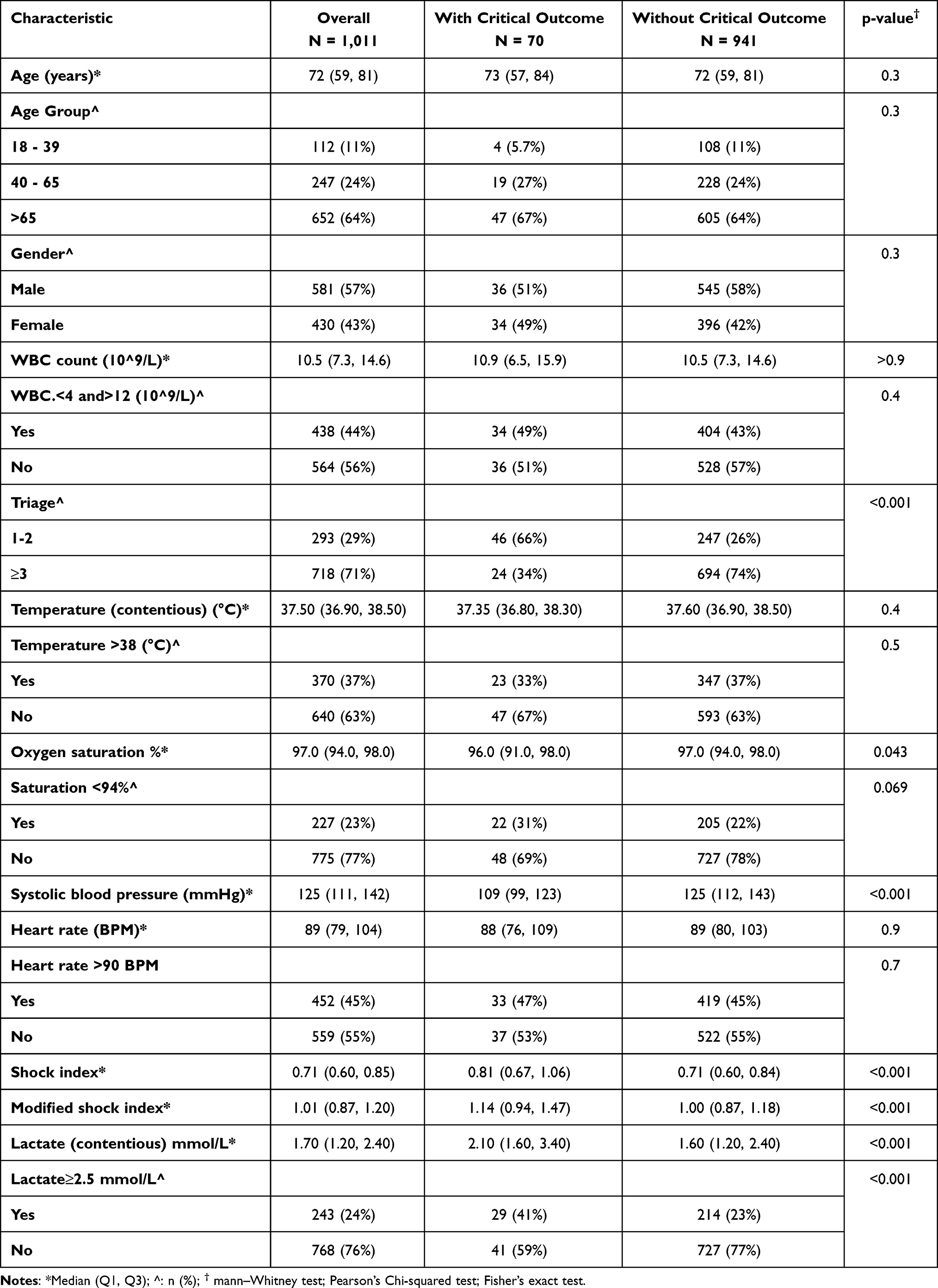 |
Table 1 Characteristics of All Patients with qSOFA<2 Who Did or Did Not Develop Critical Outcomes |
Table 2 shows that hypertension (637 patients, 63%) and diabetes (612 patients, 61%) accounted for more than half of the participants’ diagnoses. Patients with qSOFA < 2 who developed critical outcomes (vasopressor use or mortality) were likely to be older and triaged as level 1–2 compared to those who did not develop critical outcomes. As for vital signs, patients who developed critical outcomes tended to have lower oxygen saturation (96% vs 97%), lower systolic blood pressure (109 vs 125), higher MSI (1.14 vs 1.00), higher shock index (0.81 vs 0.71), and higher initial lactate (1.70 vs 2.10). In addition, epilepsy patients with qSOFA < 2 were more likely to develop critical outcomes (5.7% vs 1.2%) compared to patients who did not.
 |
Table 2 Comorbidity of All Suspected Septic Patient with qSOFA<2 |
We constructed a multivariable logistic regression model, adjusting for gender, age, vital signs, and comorbidities to assess the potential risk factors for critical outcomes among patients with qSOFA < 2. Table 3 revealed that older people compared to younger people were more likely to develop critical outcomes, with an adjusted OR of 3.78 [95% CI: 1.24–14.4] for the age group 40–65 years old and 3.87 [95% CI: 1.25–14.9] for the age group older than 65 years old. Patients who developed critical outcomes were more likely to be in level 1–2 triage OR 5.2 [95% CI: 2.93–9.45] and had a higher lactate ≥ 2.5 mmol/L with adjusted OR 2.04 [95% CI: 1.16–3.54] and a higher shock index with adjusted OR 3.27 [95% CI: 1.13–10.3]. None of the comorbidities remained significant in the model (see Table 2). The pseudo-R-squared indicates that about 18% of the variability in the critical outcome is explained by the included variables, compared to the null model. The Hosmer–Lemeshow statistic is 0.8, indicating a good fit of the model. As well, the sensitivity analysis of the logistic regression model with clinical candidate factors but excluding comorbidities showed results that were consistent with the primary analysis.
 |
Table 3 Risk Factors of Critical Outcome with Patients <2 qSOFA Score (Binary Variables) |
Discussion
In this multicenter retrospective study, we identify 1274 adult patients with suspected sepsis; 79% of them (n=1011) had qSOFA < 2 in the ED triage. Among them, the potential risk factors are age, lactate, and shock index.
Considering vital signs as the cornerstone of ED triage, we did not identify heart rate to be a risk factor for critical outcomes, either as a continuous variable or when it was ≥90, which is the cutoff value for SIRS. The heart rate may rise from variable causes, including pain or fever or any discomfort that activates the sympathetic system. On the other hand, many cardiac medications can blunt the tachycardic sepsis response. This finding confirms that correlating heart rate to blood pressure is more valuable.16,17 Remarkably, the Shock Index (SI) was associated with critical outcomes, showing an adjusted Odds Ratio (OR) of 3.27. Two cohort studies incorporate shock indexes into the qSOFA and reveal promising results.18,19 Other vital signs, such as temperature and oxygen saturation, were not linked with the critical outcome independently.
Reports indicate that age marginally improves the qSOFA accuracy in predicting sepsis mortality.20,21 Clinically, this was an expected finding, as age is associated with worse sepsis outcomes.22 Our findings revealed that the adjusted odds ratio (OR) for predicting critical outcomes is 3.79 for individuals aged 40–64, while those aged 65 and older had an OR of 3.87. A previous study from Japan reported an odds ratio of 1.9 for predicting sepsis diagnosis among ED patients aged 40–64 and 2.8 for those aged 65 and older, who were suspected of infection with qSOFA < 2.14 Age is a simple and valuable parameter that can be easily incorporated into qSOFA in a triage or pre-hospital setting.
Lactate is a well-known risk factor for worse sepsis outcomes. Multiple studies recommend the incorporation of lactate to qSOFA.15,23–25 We found the adjusted odds ratio for lactate ≥ 2.5 mmol/L to be 2.04. Regarding the incorporation of lab results, we also found lactate more valuable than WBC in predicting critical outcomes. Therefore, we concur with the sepsis guidelines to utilize lactate as an adjunct sepsis test.
Remarkably, there was no specific comorbidity linked to a critical outcome independently. Therefore, we did find that adding a specific comorbidity disease can improve the qSOFA prognostic accuracy. The lack of significance of comorbidity might be due to poor documentation of retrospective data. Epilepsy might be an indicator for critical outcome at the univariate level; however, epilepsy lost its significance in multivariable analysis, which indicates that other variables like age, lactate, and shock index ended up with higher value in the overall effect for critical outcome. This might be also explained by the limited cases of epilepsy in our cohort (1.5% for the whole cohort).
Shibata et al (2021) conducted a single-center cohort study that investigated risk factors for sepsis among emergency patients suspected of infection who had negative qSOFA.14 They found diabetes mellitus, ischemic heart disease, and chronic kidney disease were potential risk factors for sepsis. This contradicts our finding, which could be attributed to the different population and targeted outcome in which they aimed to detect sepsis diagnosis, while we aim to prognosticate it with the critical outcomes. However, we recommend further studies in this area.
The current study revealed potential risk factors for sepsis outcomes that the qSOFA overlooked. The findings from the study provide critical insights into the limitations of the qSOFA score as a standalone triage tool for sepsis and highlight actionable strategies to improve the qSOFA detection by incorporating these risk factors. Future research should prioritize prospective, multicenter cohorts to validate these risk factors across diverse healthcare settings. Additionally, machine learning models incorporating the lactate, SI, MSI, and age could optimize predictive accuracy while minimizing reliance on subjective assessments. Practical implementation challenges include lactate turnaround times (typically 15–30 minutes) and training requirements for shock index calculation, though electronic health record integration could facilitate real-time risk stratification.
This study has several limitations that should be considered when interpreting the findings. First, its retrospective design introduces the potential for bias of many factors, especially related to the ED management. Second, the study took place within a single private healthcare group in Riyadh, Saudi Arabia, potentially compromising its generalizability. Third, the reliance on the ED electronic health records for data extraction may have resulted in incomplete or inaccurate documentation of clinical variables, such as comorbidity. Fourth, the definition of suspected sepsis was based on the administration of IV antibiotics and the collection of cultures, which may not capture all true cases of sepsis or may include patients treated empirically without confirmed infection. The discrepancies in defining sepsis patients are common among ED studies, along with targeted endpoints. Finally, unmeasured confounding variables, such as variations in ED management or provider experience, could have influenced patient outcomes but were not accounted for in the analysis.
Conclusion
The current study exposed the potential risk factors of sepsis critical outcomes that were missed by the qSOFA and highlighted actionable strategies to improve the qSOFA detection by incorporating these risk factors. Further prognostic studies are recommended to validate these risk factors across diverse healthcare settings.
Abbreviations
qSOFA, Quick Sequential Organ Failure Assessment; ED, Emergency Department; ICU, Intensive Care Unit; OR, Odds Ratio); CI, Confidence Interval),; SI, Shock Index) and MSI, Modified Shock Index; WBC, White Blood Cell; DAMA, Discharged Against Medical Advice; SIRS, Systemic Inflammatory Response Syndrome; SPSS, Statistical Package for the Social Sciences.
Ethics Approval and Consent to Participate
This study did not involve any experiments on human or animal participants. This is a multicenter, retrospective cohort, observation study of the four branches of Dr Suleiman Alhabib Medical Group Hospitals (Alrayan, Altahkasossi, Alsawidi, and Al-Olaya) in Riyadh, Saudi Arabia. The Institutional Review Board of Alhabib Medical Group approved this study with the approval number (RC23.05.02).
Funding
The research did not receive any grant from funding agencies in the public, commercial, or not-for-profit sectors.
Disclosure
The author reports no conflicts of interest in this work.
References
1. Dugani S, Veillard J, Kissoon N. “Reducing the global burden of sepsis”. Cmaj. 2017;E2–E3. doi:10.1503/cmaj.160798
2. Rudd Kristina E, Johnson SC, Agesa KM, et al. “Global, regional, and national sepsis incidence and mortality, 1990-2017: analysis for the global burden of disease study”. Lancet. 2020;395(10219):200–211. doi:10.1016/S0140-6736(19)32989-7
3. Tusgul S, Carron P, Yersin B, Calandra T, Dami F. Low sensitivity of qSOFA, SIRS criteria and sepsis definition to identify infected patients at risk of complication in the prehospital setting and at the emergency department triage. Scandinavian J Trauma Resuscitation Emerg Med. 2017;25(1). doi:10.1186/s13049-017-0449-y
4. Brabrand M, Havshøj U, Graham C. Validation of the qSOFA score for identification of septic patients: a retrospective study. Eur J Internal Med. 2016;36:e35–e36. doi:10.1016/j.ejim.2016.09.004
5. Gunn N, Haigh C, Thomson J. Triage of sepsis patients: SIRS or QSOFA – which is best? Emer Med J. 2016;33(12):909.2–910. doi:10.1136/emermed-2016-206402.23
6. Hwang S, Jo I, Lee S, et al. Low accuracy of positive qSOFA criteria for predicting 28-day mortality in critically Ill septic patients during the early period after emergency department presentation. Ann Emergency Med. 2018;71(1):1–9.e2. doi:10.1016/j.annemergmed.2017.05.022
7. Evans L, Rhodes A, Alhazzani W, et al. Surviving sepsis campaign: international guidelines for management of sepsis and septic shock 2021. Intensive Care Med. 2021;47(11):1181–1247. doi:10.1007/s00134-021-06506-y
8. Al Ghozy AR, El Hallage M, Khalid M, Abdalla K. The quick sequential organ failure assessment score for predicting outcome in patients with sepsis and evidence of multiorgan failure at the time of emergency department presentation. Crit Care Shock. 2022;25(3):143–156.
9. Mosavi M, Mahfoozi L. Comparison of qSOFA score and SIRS criteria for the prediction of sepsis outcome in patients with a suspected bacterial infection outside the intensive care unit in the north of Iran. IEM Modares. 2021;7(3):245. doi:10.52547/iem.7.3.245
10. Taylor S, Schmidt M, Hetherington T, et al. QSOFA performance in infected patients varies across comorbidity burden. Critic Care Med. 2018;46(1):1. doi:10.1097/01.ccm.0000528058.92232.f1
11. Son J, Choi S, Huh JW, et al. The quick sepsis-related organ failure score has limited value for predicting adverse outcomes in sepsis patients with liver cirrhosis. Korean J Internal Med. 2020;35(4):861–872. doi:10.3904/kjim.2018.229
12. Nishiwaki H, Sasaki S, Hasegawa T, et al. External validation of the quick sequential organ failure assessment score for mortality and bacteraemia risk evaluation in Japanese patients undergoing haemodialysis: a retrospective multicentre cohort study. BMJ Open. 2019;9(7):e028856. doi:10.1136/bmjopen-2018-028856
13. Boekhoud L, Schaap HMEA, Huizinga RL. “Predictive performance of NEWS and qSOFA in immunocompromised sepsis patients at the emergency department”. Infection. 2024;52(5):1863–1873. doi:10.1007/s15010-024-02247-4
14. Shibata J, Osawa I, Ito H, et al. Risk factors of sepsis among patients with qSOFA <2 in the emergency department. Am J Emerg Med. 2021;50:739–744. doi:10.1016/j.ajem.2021.09.063
15. Althunayyan SM, Aledeny AA, Malabarey MA. The utility of initial lactate for the quick sequential organ failure assessment (LqSOFA) for emergency septic patients. Am J Emergency Med. 2025;91:118–122. doi:10.1016/j.ajem.2025.02.042
16. Gupta A, Stead TS, Ganti L. Determining a meaningful R-squared value in clinical medicine. Academic Med Surg. 2024.
17. Gupta S, Alam A. Shock index is better than conventional vital signs for assessing higher level of care and mortality in severe sepsis or shock. Am J Emergency Med. 2021;46:545–549. doi:10.1016/j.ajem.2020.11.014
18. Kamikawa Y, Hayashi H, Bone JN, et al. Characteristics of a revised quick sequential organ failure assessment score (RqSOFA) to predict in-hospital mortality of patients visiting the emergency department via ambulance: an observational cohort study. Intern Emerg Med. 2024;20(7):2185–2192. doi:10.1007/s11739-024-03833-y
19. Wei CH, Qifang SH, Song CH, et al. Evaluation of the prognostic value of qSOFA score combined with shock index in patients with sepsis. J Clin Emerg. 2023;24(3):126–130. doi:10.13201/j.issn.1009-5918.2023.03.004
20. Ward A. Maia I, Oliveira J. e Silva L, Herpich H. Prognostic accuracy of qSOFA at triage in patients with suspected infection in a Brazilian emergency department. Am J Emergency Med. 2021;50:41–45. doi:10.1016/j.ajem.2021.06.079
21. Ueno R, Masubuchi T, Shiraishi A, et al. Quick sequential organ failure assessment score combined with other sepsis-related risk factors to predict in-hospital mortality: post-hoc analysis of prospective multicenter study data. PLoS One. 2021;16(7):e0254343. doi:10.1371/journal.pone.0254343
22. Wardi G, Tainter CR, Ramnath VR, et al. Age-related incidence and outcomes of sepsis in California, 2008-2015. J Crit Care. 2021;62:212–217. PMID: 33429114; PMCID: PMC8898199. doi:10.1016/j.jcrc.2020.12.015
23. Liu S, He C, He W, Jiang T. Lactate-enhanced-qSOFA (LqSOFA) score is superior to the other four rapid scoring tools in predicting in-hospital mortality rate of the sepsis patients. Ann Translat Med. 2020;8(16):1013. doi:10.21037/atm-20-5410
24. Shetty A, MacDonald SP, Williams JM, et al. Lactate ≥2 mmol/L plus qSOFA improves utility over qSOFA alone in emergency department patients presenting with suspected sepsis. Emergency Med Australasia. 2017;29(6):626–634. doi:10.1111/1742-6723.12894
25. Gill A, Ackermann K, Hughes C, Lam V, Li L. Does lactate enhance the prognostic accuracy of the quick sequential organ failure assessment for adult patients with sepsis? A systematic review. BMJ Open. 2022;12(10):e060455. doi:10.1136/bmjopen-2021-060455
 © 2025 The Author(s). This work is published and licensed by Dove Medical Press Limited. The
full terms of this license are available at https://www.dovepress.com/terms
and incorporate the Creative Commons Attribution
- Non Commercial (unported, 4.0) License.
By accessing the work you hereby accept the Terms. Non-commercial uses of the work are permitted
without any further permission from Dove Medical Press Limited, provided the work is properly
attributed. For permission for commercial use of this work, please see paragraphs 4.2 and 5 of our Terms.
© 2025 The Author(s). This work is published and licensed by Dove Medical Press Limited. The
full terms of this license are available at https://www.dovepress.com/terms
and incorporate the Creative Commons Attribution
- Non Commercial (unported, 4.0) License.
By accessing the work you hereby accept the Terms. Non-commercial uses of the work are permitted
without any further permission from Dove Medical Press Limited, provided the work is properly
attributed. For permission for commercial use of this work, please see paragraphs 4.2 and 5 of our Terms.
Recommended articles

Multidrug-Resistant Bacteria on Critically Ill Patients with Sepsis at Hospital Admission: Risk Factors and Effects on Hospital Mortality
Maia MDO, da Silveira CDG, Gomes M, Fernandes SES, Bezerra de Santana R, de Oliveira DQ, Amorim FFP, Neves FDAR, Amorim FF
Infection and Drug Resistance 2023, 16:1693-1704
Published Date: 23 March 2023
Pathogenic Profile Characteristics and Clinical Risk Factor Analysis of Patients Who Died from Sepsis Combined with Pulmonary Infection by Metagenomic Next-Generation Sequencing
Chen SX, Lin R, Shi JL, Lin W, Yu XF, Chen JY
Infection and Drug Resistance 2023, 16:7695-7705
Published Date: 19 December 2023
Development and Validation of a Nomogram for Predicting Sepsis-Associated Acute Respiratory Distress Syndrome
Yan C, Cai Y, Cai W, Wang Q, Li W, Geng Q
International Journal of General Medicine 2025, 18:5917-5925
Published Date: 29 September 2025
Risk Factors for Sepsis in Pediatric All During Induction Chemotherapy-Induced Neutropenia: A Single-Center Retrospective Study
Zhao C, Yan M, Yue Y, Zhao L, Liu Y
Infection and Drug Resistance 2026, 19:584439
Published Date: 7 February 2026
A Novel Composite Bioscore Integrating Biomarkers, Clinical Scores, and Comorbidity Indices for Prognostic Stratification in Sepsis
Țocu G, Mihailov R, Luțenco V, Dimofte F, Ștefănescu BI, Niculeț E, Mihailov OM, Țocu L, Stavăr Matei L
Journal of Inflammation Research 2026, 19:579172
Published Date: 23 February 2026