
Back to Journals » Journal of Inflammation Research » Volume 19
Biomarkers in Chronic Nonbacterial Osteomyelitis: Bridging Autoinflammation and Classical Inflammatory Diseases
Authors Margoni A, Fotis L, Papavassiliou KA, Papavassiliou AG 
Received 10 May 2026
Accepted for publication 5 July 2026
Published 23 July 2026 Volume 2026:19 623583
DOI https://doi.org/10.2147/JIR.S623583
Checked for plagiarism Yes
Review by Single anonymous peer review
Peer reviewer comments 2
Editor who approved publication: Dr Ujjwol Risal
Angeliki Margoni,1,* Lampros Fotis,2,* Kostas A Papavassiliou,3 Athanasios G Papavassiliou1
1Department of Biological Chemistry, Medical School, National and Kapodistrian University of Athens, Athens, Greece; 2Division of Pediatric Rheumatology, 3rd Department of Pediatrics, "attikon” General Hospital, National and Kapodistrian University of Athens, Athens, Greece; 3First University Department of Respiratory Medicine, "sotiria” Chest Hospital, Medical School, National and Kapodistrian University of Athens, Athens, Greece
*These authors contributed equally to this work
Correspondence: Athanasios G Papavassiliou, Department of Biological Chemistry, Medical School, National and Kapodistrian University of Athens, 75 Mikras Asias Street, Athens, 11527, Greece, Tel +30-210-7462508, Email [email protected]
Abstract: Chronic nonbacterial osteomyelitis (CNO) is a rare autoinflammatory bone disorder characterized by sterile bone lesions, heterogeneous clinical presentation, and the absence of validated diagnostic or prognostic biomarkers. Traditionally considered a distinct disease entity, emerging genetic, mechanistic, and translational evidence challenges this view. Emerging genetic, mechanistic, and translational evidence suggests that CNO may represent a convergent clinical phenotype of sterile bone inflammation arising from diverse disturbances in innate immunity. Central to its pathogenesis is the inflammasome–interleukin-1 beta (IL-1β) axis, which integrates upstream signals from genetic variants, cytokine imbalance, and environmental factors, ultimately driving osteoclast activation and bone remodeling. Recent advances highlight the role of biomarkers as translational tools linking molecular mechanisms to clinical phenotypes. Although whole-body MRI remains central to disease assessment, integration of imaging with molecular biomarkers may provide more comprehensive disease stratification. Conventional markers such as C-reactive protein (CRP) and erythrocyte sedimentation rate (ESR) show limited utility, whereas pathway-relevant biomarkers, including cytokine profiles, P2X purinoceptor 7 (P2X7R) signaling, and the receptor activator of nuclear factor kappa-B ligand (RANKL)/osteoprotegerin (OPG) ratio provide deeper insight into disease biology. These biomarkers may ultimately enable biologically driven patient stratification and inform future targeted therapeutic approaches, although prospective validation remains necessary. Reframing CNO as a convergent phenotype supports a mechanism-based classification and offers a framework for precision medicine approaches, with implications extending beyond pediatric rheumatology to inflammatory bone diseases more broadly.
Keywords: autoinflammatory diseases, biomarkers, cytokines, inflammasome, chronic nonbacterial osteomyelitis osteomyelitis
Introduction
Chronic nonbacterial osteomyelitis (CNO) represents one of the most challenging conditions in pediatric rheumatology, positioned at the nexus of autoinflammation, osteoimmunology, and systemic inflammatory disease. Despite increasing recognition, CNO remains a diagnosis of exclusion, characterized by heterogeneous clinical manifestations, fluctuating disease course, and most critically the absence of validated diagnostic or prognostic biomarkers.1,2 This gap persists even in the era of advanced imaging, where whole-body magnetic resonance imaging (WBMRI) has improved lesion detection but has not fundamentally altered disease stratification or prediction of outcomes.1,3,4
Although CNO has traditionally been classified as a primary autoinflammatory bone disorder and approached as a distinct nosological entity, accumulating mechanistic, genetic, and translational evidence challenges this notion. Instead, it supports a broader conceptual framework in which CNO may represent a convergent clinical phenotype of sterile bone inflammation arising from diverse autoinflammatory pathways, rather than a single disease.5 In this context, CNO shares molecular and clinical features with conditions such as familial Mediterranean fever (FMF), inflammatory bowel disease (IBD), and psoriasis.6 Biomarkers, therefore, assume a dual role, serving not only as tools for disease monitoring, but also as windows into shared pathophysiological pathways.
For this narrative commentary, relevant literature was identified through targeted searches of PubMed/MEDLINE and Google Scholar, supplemented by manual screening of reference lists from key reviews and original studies. We prioritized English-language articles addressing chronic nonbacterial osteomyelitis, chronic recurrent multifocal osteomyelitis, autoinflammatory bone disorders, inflammasome biology, IL-1β signaling, and candidate biomarkers. This approach was intended to provide a conceptual synthesis rather than a systematic review.
CNO Within the Spectrum of Autoinflammatory Bone Disorders
The integration of recent literature on autoinflammatory bone disease supports a shift away from viewing CNO as a discrete entity. Instead, it aligns with a wider spectrum of disorders characterized by sterile osteomyelitis driven by innate immune dysregulation, inflammasome activation, and cytokine imbalance, particularly involving interleukin-1 beta (IL-1β)-mediated osteoclastogenesis (Figure 1). This concept is reinforced by monogenic autoinflammatory syndromes such as cryopyrin-associated periodic syndromes (CAPS), deficiency of the IL-1 receptor antagonist (DIRA), Majeed syndrome, and FMF, all of which demonstrate that bone inflammation can arise from distinct genetic defects converging on shared inflammatory pathways.7–9 In FMF, MEditerranean FeVer (MEFV) mutations lead to dysfunction of the pyrin inflammasome, resulting in enhanced IL-1β production and a persistent pro-inflammatory state. This mechanism is not restricted to overt FMF, as even asymptomatic carriers may exhibit subclinical inflammation and increased cytokine activity. Emerging data suggest that this inflammasome-driven pathway may also influence the phenotype of CNO, with MEFV mutations being associated with earlier disease onset, higher inflammatory burden, and a more persistent clinical course (Table 1). These observations support the notion that pyrin-mediated IL-1β signaling represents a shared pathogenic axis, contributing to more severe or refractory CNO phenotypes.7,8
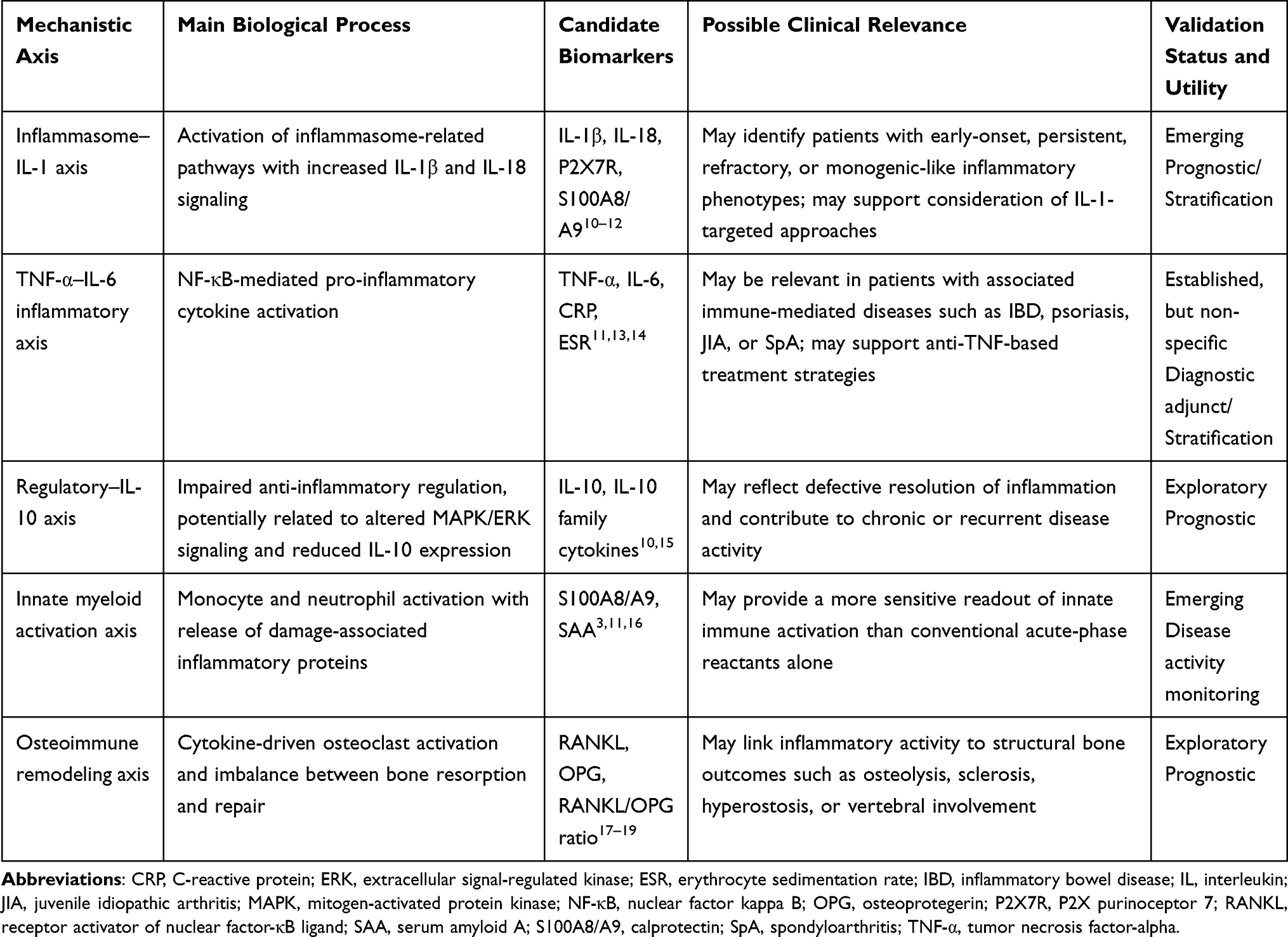 |
Table 1 Mechanism-Based Biomarker Axes in Chronic Nonbacterial Osteomyelitis |
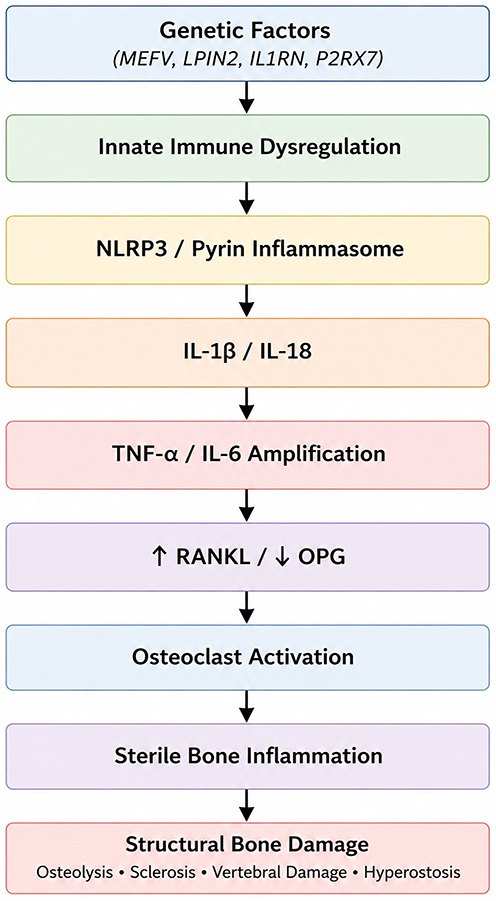 |
Figure 1 Proposed convergent pathogenic pathway in chronic nonbacterial osteomyelitis (CNO). Distinct genetic and molecular disturbances converge on innate immune dysregulation and inflammasome activation, leading to IL-1β and IL-18 release, amplification of inflammatory cytokine signaling, increased osteoclastogenesis through RANKL/OPG imbalance, sterile bone inflammation, and ultimately structural bone damage. The figure illustrates the concept of CNO as a convergent clinical phenotype arising from multiple upstream inflammatory pathways. |
Beyond these inherited conditions, clinical observations further highlight the non-specific nature of bone involvement. CNO frequently coexists with immune-mediated diseases such as IBD, juvenile idiopathic arthritis (JIA), spondyloarthropathies, and psoriasis suggesting overlapping pathogenic networks rather than disease-specific mechanisms.6,20 Notably, CNO may precede, coincide with, or follow IBD diagnosis, and may occur independently of intestinal disease activity, underscoring the partial dissociation between systemic inflammation and skeletal manifestations.21,22 The broad spectrum of skeletal phenotypes observed across these conditions, from osteolytic lesions to hyperostosis and vertebral collapse, supports the interpretation of bone inflammation as a shared downstream consequence of immune aberration. In this regard, sporadic CNO, lacking a single causative mutation, is best understood as the result of multifactorial interactions between genetic susceptibility, innate immune imbalance, and environmental triggers. Accordingly, CNO may be more appropriately positioned within a continuum of autoinflammatory and immune-mediated diseases, representing a convergent clinical phenotype rather than a distinct nosological entity.
Additionally, while monogenic forms are associated with mutations in genes such as IL-1 receptor antagonist (IL1RN), lipin 2 (LPIN2), and proline-serine-threonine phosphatase-interacting protein 1 (PSTPIP1), sporadic CNO appears to involve a more complex genetic architecture (Table 1). Variants in genes regulating inflammasome activation, mitogen-activated protein kinase (MAPK) signaling, and osteoclast differentiation have been implicated, suggesting a polygenic predisposition.9 Transcriptomic analyses provide additional insight into this complexity. Machine learning-based studies have identified gene expression signatures enriched in pathways related to immune activation, cytoskeletal organization, and systemic inflammation, highlighting the involvement of autoinflammatory gene networks rather than disease-specific markers.23 These findings support a model in which multiple genetic and molecular perturbations converge on a limited number of inflammatory pathways, ultimately producing a shared clinical phenotype.
The Central Role of the Inflammasome and IL-1β
A unifying mechanistic theme across both monogenic and sporadic forms of sterile osteomyelitis is the central role of the inflammasome–IL-1β axis (Table 1). The nucleotide-binding domain, leucine-rich-containing family, pyrin domain-containing-3 (NLRP3) inflammasome functions as a key intracellular sensor of danger-associated signals, promoting caspase-1 activation and the proteolytic cleavage of pro-IL-1β into its active form. Dysregulation of this pathway leads to sustained IL-1β secretion and chronic inflammation.9 Multiple lines of evidence underscore IL-1β as a pivotal effector in bone inflammation such as in DIRA (loss of IL-1 receptor antagonism results in unopposed IL-1 signaling and severe multifocal osteomyelitis) and in Majeed syndrome, where mutations in LPIN2 promote inflammasome activation and IL-1β overproduction.9 In murine models (PSTPIP2cmo), disease development is strictly dependent on IL-1β signaling, with genetic ablation of IL-1β or its receptor preventing osteomyelitis.9,24 Notably, IL-1β-driven osteomyelitis may occur independently of canonical inflammasome pathways, as suggested by neutrophil-derived IL-1β production and alternative processing mechanisms involving caspase-8, implying that IL-1β represents a final common effector downstream of diverse upstream signaling networks. Furthermore, clinical observations of persistent or paradoxical inflammatory manifestations despite TNF-targeted therapy further suggest that TNF-independent pathways may contribute to disease activity.25 Building on the concept of IL-1β as a final common downstream effector, the importance of upstream signaling regulators is further illustrated by the role of protein tyrosine phosphatase receptor type C (PTPRC; also known as CD45) and Src-family kinases (SFKs), as CD45 deficiency in PSTPIP2 mutant mice leads to reduced SFK activity, attenuated pro-IL-1β production, and decreased disease severity, thereby identifying SFK-dependent pathways as critical upstream modulators of IL-1β-driven bone inflammation.24 Collectively, these findings expand the mechanistic landscape beyond the inflammasome itself and support a model in which multiple converging signaling pathways regulate IL-1β production in sterile bone inflammation (Table 1).
Cytokine Imbalance and Osteoimmunology
While IL-1β is central, it operates within a broader network of cytokine dysregulation that defines disease expression. Patients with CNO exhibit an imbalance between pro-inflammatory mediators, including IL-1β, IL-6, and tumor necrosis factor-alpha (TNF-α) and anti-inflammatory cytokines such as IL-10, with reduced IL-10 expression contributing to sustained inflammatory responses and impaired immune regulation.15 Impaired IL-10 production has been mechanistically linked to defective activation of MAPK signaling pathways, particularly extracellular signal-regulated kinases 1 and 2 (ERK1/2), resulting in altered transcriptional control and reduced expression of immune-regulatory cytokines.10 This inflammatory milieu directly impacts bone homeostasis through osteoimmunological mechanisms (Table 1). Imbalanced cytokine expression fosters osteoclast differentiation and activation through increased interactions between receptor activator of nuclear factor kappa-B (RANK) and its ligand (RANKL), leading to pathological bone resorption and remodeling.17 At the same time, persistent inflammatory signaling contributes to aberrant bone remodeling processes, explaining the coexistence of osteolytic and sclerotic lesions within the same disease spectrum.26 These observations underscore that CNO is fundamentally a disorder of osteoimmune imbalance, in which immune signaling and bone remodeling are tightly interconnected. Importantly, similar cytokine-driven mechanisms of osteoclast activation and inflammatory bone loss have been described in other inflammatory conditions, supporting the concept of shared pathogenic pathways.13
Biomarkers as Translational Bridges Between Pathogenesis and Clinical Stratification
Within this framework, biomarkers have a critical dual role, not only as indicators of disease activity, but also as measurable surrogates of underlying molecular pathways (Table 1). Conventional inflammatory markers, including C-reactive protein (CRP) and erythrocyte sedimentation rate (ESR), remain widely used in clinical practice. However, their limitations are increasingly evident, as they lack both sensitivity and specificity and frequently fail to correlate with disease activity or discriminate CNO from other inflammatory conditions.13,27 This discrepancy reflects the fundamental issue that systemic acute-phase reactants do not adequately capture compartmentalized, tissue-specific inflammation within the bone. More pathway-relevant biomarkers have therefore gained attention. Serum amyloid A (SAA), an acute-phase reactant and calprotectin (S100A8/A9), both reflecting innate immune potentiation and neutrophil–monocyte dynamics, provide a closer approximation to the autoinflammatory nature of CNO.3,16,28 Notably, S100A8/A9 has been shown to correlate with pro-inflammatory cytokines such as TNF-α, reflecting activation of the broader inflammatory cascade and supporting its role as a biomarker of innate immune activation.11 Cytokine profiling offers a more mechanistic perspective. Elevated levels of IL-1β, IL-6, IL-18, and TNF-α have been consistently demonstrated in patients with CNO compared to healthy controls, confirming the presence of a systemic pro-inflammatory cytokine signature driven by monocyte-mediated inflammation.14 However, their individual measurement has limited clinical utility due to redundancy and overlap across inflammatory conditions. In contrast, emerging biomarkers such as IL-18, a member of the IL-1 cytokine family co-processed with IL-1β, may provide a more stable readout of inflammasome activation.11 A budding biomarker with strong mechanistic relevance is the P2X purinoceptor 7 (P2X7R), encoded by the P2X7R gene. P2X7R is an ATP-gated transmembrane ion channel that plays a vital role in inflammasome activation through potassium efflux, a key trigger of NLRP3 assembly and downstream IL-1β and IL-18 release.10 Recent genetic and functional studies have identified rare and low-penetrance P2X7R variants in patients with CNO, which are associated with enhanced inflammasome activation, increased pro-inflammatory cytokine release, and prolonged monocyte survival. Remarkably, these variants have been linked to more severe disease phenotypes, including extraskeletal manifestations and increased need for second-line therapies, indicating a potential role in disease stratification.12 Beyond its role as a genetic modifier, P2X7R represents a functional biomarker of upstream inflammasome regulation, bridging extracellular danger signaling with intracellular inflammatory responses.10 As such, P2X7R may serve not only as a marker of disease susceptibility and severity but also as a potential therapeutic target. However, current evidence is primarily derived from a single genetic and functional study, and the therapeutic relevance of P2X7R modulation in CNO should therefore be considered preliminary and hypothesis-generating. Also, a particularly promising approach involves the integration of immune and skeletal biomarkers. The RANKL/osteoprotegerin (OPG) ratio represents a functional marker of osteoimmune imbalance, linking inflammatory cytokine signaling to osteoclast differentiation, activation, and bone resorption.18 Given the central role of IL-1β and TNF-α in upregulating RANKL expression and disrupting the RANKL/OPG balance, this ratio may serve as an integrated readout of both upstream inflammatory activity and its downstream structural consequences on bone.19 However, despite increasing interest in cytokine- and pathway-based biomarkers, none has yet achieved sufficient validation for routine clinical implementation.2 Most candidate biomarkers have been evaluated in relatively small cohorts using heterogeneous methodologies and non-standardized assays, while clinically meaningful cut-off values for disease activity, prognosis, and treatment response remain undefined. Consequently, larger prospective multicenter studies and external validation across diverse patient populations will be required before biomarker-driven stratification can be reliably incorporated into routine clinical practice.
Although this commentary focuses primarily on circulating and molecular biomarkers, WBMRI remains a cornerstone of disease assessment in CNO. Beyond its diagnostic value, WBMRI provides objective information regarding lesion burden, anatomical distribution, subclinical disease activity, and treatment response. The development of standardized imaging tools such as the Chronic Nonbacterial Osteomyelitis MRI Scoring (CROMRIS) system and its radiological activity index (RAI-CROMRIS) further supports quantitative assessment of disease burden.29,30 Future stratification approaches may benefit from integrating imaging-derived measures with molecular biomarkers, allowing a more comprehensive characterization of disease heterogeneity and inflammatory burden.
Towards a Mechanism-Based Classification of CNO
The ultimate goal of biomarker research in CNO is patient stratification. Rather than treating CNO as a uniform condition, biomarker profiling could identify distinct subgroups characterized by specific inflammatory signatures, genetic backgrounds, and clinical trajectories. Such stratification has direct therapeutic implications (Table 1). Patients with predominant IL-1-driven disease may benefit from IL-1 inhibitors, while those with TNF-mediated pathways may respond better to anti-TNF agents (Table 1). Similarly, identification of high-risk patients could inform early escalation of therapy, potentially preventing structural damage. Recent reviews of pediatric CNO have further emphasized the potential value of biomarker-guided therapeutic selection, particularly as an expanding range of targeted interventions, including IL-1, IL-6, TNF, and JAK-directed therapies, becomes available for refractory disease.2 Furthermore, recent clinical observations support the concept of cytokine-axis heterogeneity within autoinflammatory bone disease. For example, CNO-like sterile osteitis has been described in association with mevalonate kinase deficiency, where disease activity persisted despite sequential IL-1 blockade but achieved sustained remission following IL-6 inhibition with tocilizumab.31 Such findings suggest that distinct inflammatory pathways may predominate in different patients despite a shared clinical phenotype, reinforcing the rationale for mechanism-based therapeutic stratification. However, these approaches remain investigational and require prospective validation before biomarker-guided treatment selection can be incorporated into routine clinical practice.
Limitations and Alternative Perceptions
Despite the growing body of evidence supporting a convergent phenotype model of CNO, several limitations should be acknowledged. First, much of the available evidence derives from small cohorts, observational studies, and translational investigations, limiting the ability to establish causal relationships. Second, although multiple genetic variants and inflammatory pathways have been associated with CNO, no single molecular signature has been consistently validated across independent populations. It therefore remains possible that CNO encompasses several biologically distinct disease subsets rather than representing a unified downstream phenotype. Furthermore, proposed biomarkers, including cytokine profiles and P2X7R-related pathways, require external validation before routine clinical implementation. It should also be noted that much of the currently available evidence regarding biomarkers, genetic associations, and inflammatory pathways in CNO has been generated in pediatric cohorts. Although emerging studies suggest substantial overlap between pediatric- and adult-onset disease, the generalization of these findings to adult populations remains incompletely established and warrants further investigation. Finally, the extent to which molecular stratification will translate into improved therapeutic decision-making remains uncertain and should be evaluated in prospective studies. Consequently, the convergent phenotype framework should currently be viewed as a hypothesis-driven model that provides a useful basis for future investigation rather than a definitive classification paradigm.
Conclusion
Taken together, the available evidence supports a fundamental shift in the conceptualization of CNO. Rather than representing a single disease with a uniform pathogenesis, CNO is more appropriately understood as a convergent clinical phenotype of sterile bone inflammation arising from multiple upstream disturbances in innate immunity. Chief among these is IL-1β overproduction, enhanced osteoclast activation, and the development of sterile bone inflammation. This model provides a unifying explanation for the marked clinical and molecular heterogeneity observed in CNO and helps to clarify why traditional biomarkers and classification systems have been insufficient to fully capture disease complexity. Importantly, the implications of this framework extend beyond pediatric rheumatology. CNO represents a valuable model of inflammation-driven bone disease in which immune dysfunction is directly translated into structural bone damage. The key pathways involved, particularly IL-1β signaling, TNF activation, and RANKL-mediated osteoclastogenesis, are shared across a broad spectrum of conditions, including rheumatoid arthritis, IBD, and osteoporosis.32 Consequently, insights derived from the study of CNO may have wider relevance for understanding the mechanisms underlying inflammatory bone loss and for guiding the development of targeted therapeutic strategies in diverse clinical contexts.
Although further validation of proposed biomarkers and molecular classifications is required, this framework provides a rationale for biologically driven patient stratification and future precision medicine approaches in CNO and related inflammatory bone disorders. However, such strategies remain investigational and will require prospective validation before they can be incorporated into routine clinical practice.
Data Sharing Statement
Data sharing is not applicable to this article as no new data were created or analyzed in this study.
Author Contributions
Conceptualization: A.M., L.F., and A.G.P.; Investigation: A.M., L.F., K.A.P, and A.G.P.; Writing—original draft preparation: A.M., L.F., and K.A.P.; Writing—review and editing: A.M., L.F., K.A.P., and A.G.P.; Supervision: A.G.P.; Project administration: A.G.P. All authors took part in drafting, revising or critically reviewing the article; gave final approval of the version to be published; have agreed on the journal to which the article has been submitted; and agree to be accountable for all aspects of the work.
Funding
This research received no external funding.
Disclosure
Lampros Fotis reports Consulting fees from Pfizer; Honoraria from PFIZER; Meeting/travel support from RAFARM Greece, FARAN GREECE, outside the submitted work. Angeliki Margoni, Kostas A. Papavassiliou, and Athanasios G. Papavassiliou report no conflicts of interest in this work.
References
1. Zhao Y, Oliver MS, Schnabel A, et al. EULAR/ACR classification criteria for paediatric chronic nonbacterial osteomyelitis (CNO). Ann Rheum Dis. 2025;84(9):1458–8. doi:10.1016/J.ARD.2024.11.006
2. Başaran Ö, Yıldız AE, Bilginer Y, Özen S. Chronic nonbacterial osteomyelitis: current perspectives in pediatric practice. Turk J Pediatr. 2026;68(1):1–17. doi:10.24953/TURKJPEDIATR.2026.7367
3. Hofmann SR, Kubasch AS, Range U, et al. Serum biomarkers for the diagnosis and monitoring of chronic recurrent multifocal osteomyelitis (CRMO). Rheumatol Int. 2016;36(6):769–779. doi:10.1007/S00296-016-3466-7
4. Hofmann SR, Kapplusch F, Girschick HJ, et al. Chronic Recurrent Multifocal Osteomyelitis (CRMO): presentation, pathogenesis, and treatment. Curr Osteoporos Rep. 2017;15(6):542–554. doi:10.1007/S11914-017-0405-9
5. Bader-Meunier B, Van Nieuwenhove E, Breton S, Wouters C. Bone involvement in monogenic autoinflammatory syndromes. Rheumatology. 2018;57(4):606–618. doi:10.1093/RHEUMATOLOGY/KEX306
6. Aydın B Ö, Aydın F, Ö T, Bahçeci O, Özçakar ZB. Associated diseases and their effects on disease course in patients with chronic non-bacterial osteomyelitis: retrospective experience from a single center. Clin Rheumatol. 2025;44(2):855–862. doi:10.1007/S10067-025-07306-1
7. Avar-Aydin PO, Ozcakar ZB, Cakar N, Fitoz S, Yalcinkaya F. Chronic non-bacterial osteomyelitis: another disease associated with MEFV gene mutations. Clin Exp Rheumatol. 2020;38(5):112–117.
8. Karaçayir N, Tunçez Ş, Öner N, et al. Chronic nonbacterial osteomyelitis associated with familial mediterranean fever in children. J Clin Rheumatol. 2024;30(3):89–93. doi:10.1097/RHU.0000000000002061
9. Hetrick R, Oliver M. Pediatric autoinflammatory bone disorders-a mini review with special focus on pathogenesis and inborn errors of immunity. Front Pediatr. 2023;11. doi:10.3389/FPED.2023.1169659
10. Roberts E, Charras A, Hahn G, Hedrich CM. An improved understanding of pediatric chronic nonbacterial osteomyelitis pathophysiology informs current and future treatment. J Bone Miner Res. 2024;39(11):1523. doi:10.1093/JBMR/ZJAE141
11. Kostik MM, Makhova MA, Maletin AS, et al. Cytokine profile in patients with chronic non-bacterial osteomyelitis, juvenile idiopathic arthritis, and insulin-dependent diabetes mellitus. Cytokine. 2021:143. doi:10.1016/J.CYTO.2021.155521
12. Charras A, Hofmann SR, Cox A, et al. P2RX7 gene variants associate with altered inflammasome assembly and reduced pyroptosis in chronic nonbacterial osteomyelitis (CNO). J Autoimmun. 2024:144. doi:10.1016/J.JAUT.2024.103183
13. Zhao DY, McCann L, Hahn G, Hedrich CM. Chronic nonbacterial osteomyelitis (CNO) and chronic recurrent multifocal osteomyelitis (CRMO). J Transl Autoimmun. 2021;4. doi:10.1016/J.JTAUTO.2021.100095
14. Leerling AT, Andeweg EH, Faber J, et al. Immunological Characterization of Chronic Nonbacterial Osteomyelitis (CNO) in adults: a cross‐sectional exploratory study. JBMR Plus. 2023;7(12):e10818. doi:10.1002/JBM4.10818
15. Hofmann SR, Kubasch AS, Ioannidis C, et al. Altered expression of IL-10 family cytokines in monocytes from CRMO patients result in enhanced IL-1β expression and release. Clin Immunol. 2015;161(2):300–307. doi:10.1016/J.CLIM.2015.09.013
16. Sundqvist M, Christenson K, Wekell P, et al. Severe chronic non-bacterial osteomyelitis in combination with total MPO deficiency and responsiveness to TNFα inhibition. Front Immunol. 2023;14:1233101. doi:10.3389/FIMMU.2023.1233101/TEXT
17. D DL-O, Barrena-Blázquez S, Jiménez-álvarez L, et al. The RANK–RANKL–OPG system: a multifaceted regulator of homeostasis, immunity, and cancer. Medicina. 2023;59(10):1752. doi:10.3390/MEDICINA59101752
18. Zhu S, Yan MQ, Masson A, Chen W, Li YP. Cell signaling and transcriptional regulation of osteoclast lineage commitment, differentiation, bone resorption and diseases. Cell Discov. 2026;12(1). doi:10.1038/S41421-025-00853-6
19. Zhang S, Li C, Zhang S, et al. Serum levels of proinflammatory, anti-inflammatory cytokines, and RANKL/OPG in synovitis, acne, pustulosis, hyperostosis, and osteitis (SAPHO) syndrome. Mod Rheumatol. 2019;29(3):523–530. doi:10.1080/14397595.2018.1469580
20. Koné-Paut I, Mannes I, Dusser P. Chronic Recurrent Multifocal Osteomyelitis (CRMO) and Juvenile Spondyloarthritis (JSpA): to what extent are they related? J Clin Med. 2023;12(2):453. doi:10.3390/JCM12020453
21. Matar M, Cebecauerova D, Kolho KL, et al. Chronic nonbacterial osteomyelitis associated with pediatric inflammatory bowel disease: a multicenter retrospective study from the paediatric inflammatory bowel disease Porto Group of ESPGHAN. J Pediatr Gastroenterol Nutr. 2026;82(2):487–494. doi:10.1002/JPN3.70243
22. Tzaneti A, Athanasopoulou E, Fessatou S, Fotis L. Chronic Nonbacterial Osteomyelitis in Inflammatory Bowel Disease. Life. 2023;13(12). doi:10.3390/life13122347
23. Fu Z, Wang X, Zou L, et al. Transcriptome analysis based on machine learning reveals a role for autoinflammatory genes of chronic nonbacterial osteomyelitis (CNO). Sci Rep. 2023;13(1). doi:10.1038/S41598-023-33759-Y
24. Kralova J, Pavliuchenko N, Fabisik M, et al. The receptor-type protein tyrosine phosphatase CD45 promotes onset and severity of IL-1β-mediated autoinflammatory osteomyelitis. J Biol Chem. 2021;297(4):101131. doi:10.1016/J.JBC.2021.101131
25. Romagnuolo M, Moltrasio C, Iannone C, Gattinara M, Cambiaghi S, Marzano AV. Pyoderma gangrenosum following anti-TNF therapy in chronic recurrent multifocal osteomyelitis: drug reaction or cutaneous manifestation of the disease? A critical review on the topic with an emblematic case report. Front Med Lausanne. 2023;10. doi:10.3389/FMED.2023.1197273
26. Torres HM, Arnold KM, Oviedo M, Westendorf JJ, Weaver SR. Inflammatory processes affecting bone health and repair. Curr Osteoporos Rep. 2023;21(6):842. doi:10.1007/S11914-023-00824-4
27. Oliver M, Lee TC, Halpern-Felsher B, Murray E, Schwartz R, Zhao Y. Disease burden and social impact of pediatric chronic nonbacterial osteomyelitis from the patient and family perspective. Pediatr Rheumatol Online J. 2018;16(1):78. doi:10.1186/S12969-018-0294-1
28. Brunner J. P03-022 - Calprotec in chronic nonbacterial osteomyelitis. Pediatr Rheumatol Online J. 2013;11(Suppl 1):A220. doi:10.1186/1546-0096-11-S1-A220
29. Zhao Y, Sato TS, Nielsen SM, et al. Development of a scoring tool for chronic nonbacterial osteomyelitis magnetic resonance imaging and evaluation of its interrater reliability. J Rheumatol. 2020;47(5):739–747. doi:10.3899/JRHEUM.190186
30. Capponi M, Pires Marafon D, Rivosecchi F, et al. Assessment of disease activity using a whole-body MRI derived radiological activity index in chronic nonbacterial osteomyelitis. Pediatr Rheumatol Online J. 2021;19(1). doi:10.1186/S12969-021-00620-3
31. Tunce E, Uçar SA, Taşar S, Eser M, Sözeri B. Effective interleukin-6 inhibition in a pediatric patient with mevalonate kinase deficiency and chronic nonbacterial osteomyelitis-like bone lesions under interleukin-1 blockade. Turk J Pediatr. 2026;68(2):358–363. doi:10.24953/TURKJPEDIATR.2026.7588
32. Terkawi MA, Matsumae G, Shimizu T, Takahashi D, Kadoya K, Iwasaki N. Interplay between inflammation and pathological bone resorption: insights into recent mechanisms and pathways in related diseases for future perspectives. Int J Mol Sci. 2022;23(3):1786. doi:10.3390/IJMS23031786
 © 2026 The Author(s). This work is published and licensed by Dove Medical Press Limited. The
full terms of this license are available at https://www.dovepress.com/terms
and incorporate the Creative Commons Attribution
- Non Commercial (unported, 4.0) License.
By accessing the work you hereby accept the Terms. Non-commercial uses of the work are permitted
without any further permission from Dove Medical Press Limited, provided the work is properly
attributed. For permission for commercial use of this work, please see paragraphs 4.2 and 5 of our Terms.
© 2026 The Author(s). This work is published and licensed by Dove Medical Press Limited. The
full terms of this license are available at https://www.dovepress.com/terms
and incorporate the Creative Commons Attribution
- Non Commercial (unported, 4.0) License.
By accessing the work you hereby accept the Terms. Non-commercial uses of the work are permitted
without any further permission from Dove Medical Press Limited, provided the work is properly
attributed. For permission for commercial use of this work, please see paragraphs 4.2 and 5 of our Terms.
Recommended articles
Detection of sFas, sCD137, and IL-27 Cytokines as Potential Biomarkers for Hepatocellular Carcinoma Diagnosis
Do XH, Le MT, Nguyen TH, Le TT, Nguyen XH, Mai TB, Hoang TMN, Than UTT
Journal of Hepatocellular Carcinoma 2023, 10:783-793
Published Date: 26 May 2023
Variability of Replicates of Intraocular Inflammatory Biomarkers in Ocular Fluid Samples Analyzed with Multiplex Assays
Lamoureux D, Wong DT, Felfeli T
Clinical Ophthalmology 2023, 17:2653-2663
Published Date: 8 September 2023
Circulating Inflammatory Factor Levels in the Early Phase of COVID-19 are Associated with the Progression of Respiratory Failure: A Single-Center Retrospective Study
Xiang X, Zhang Z, Liu Y, Xu W, Gong J, Yu S, Zhang L, Jiang T
Journal of Inflammation Research 2023, 16:5249-5260
Published Date: 14 November 2023


Sputum Biomarkers in Wood and Tobacco Smoke Etiotypes of Chronic Obstructive Pulmonary Disease
Giraldo-Montoya ÁM, Torres-Duque CA, Giraldo-Cadavid LF, Laucho-Contreras ME, González-Flórez A, Santos AM, Tuta-Quintero EA, Celli BR, González-García M
International Journal of Chronic Obstructive Pulmonary Disease 2024, 19:1-10
Published Date: 30 December 2023

Early Detection of Asthma: Exploring Inflammatory Biomarkers in Symptomatic Adults with Normal Spirometry
Laroche J, Boulay MÈ, Lechasseur A, Guertin J, Boulet LP, Bergeron C, Lemière C, Lougheed MD, Vandemheen KL, Morissette MC, Aaron SD, Côté A
Journal of Asthma and Allergy 2025, 18:1675-1688
Published Date: 3 December 2025