
Back to Journals » International Journal of Women's Health » Volume 17
Integrative Management of Acupuncture for Diminished Ovarian Reserve with Insomnia: Study Protocol for a Prospective Randomized Controlled Trial
Authors Lai Y  , Chen D, Tian C, Huang Y , Gan D, Liu L, Yang J
Received 13 July 2025
Accepted for publication 3 November 2025
Published 11 November 2025 Volume 2025:17 Pages 4369—4378
DOI https://doi.org/10.2147/IJWH.S553524
Checked for plagiarism Yes
Review by Single anonymous peer review
Peer reviewer comments 2
Editor who approved publication: Dr Vinay Kumar
Yuanyuan Lai,1,* Dan Chen,1,* Chunhui Tian,1 Yufei Huang,1 Di Gan,1,2 Liying Liu,1 Jie Yang1,3
1Acupuncture and Tuina School, Chengdu University of Traditional Chinese Medicine, Chengdu, People’s Republic of China; 2Department of Traditional Chinese Medicine, Sichuan Jinxin Xinnan Women and Children’s Hospital, Chengdu, People’s Republic of China; 3Department of Traditional Chinese Medicine, West China Second University Hospital/West China Women’s and Children’s Hospital, Chengdu, People’s Republic of China
*These authors contributed equally to this work
Correspondence: Jie Yang, Acupuncture and Tuina School, Chengdu University of Traditional Chinese Medicine, No. 37 Shi’er Qiao Road, Chengdu, Sichuan, 610075, People’s Republic of China, Tel +86 13882296714, Email [email protected] Liying Liu, Acupuncture and Tuina School, Chengdu University of Traditional Chinese Medicine, No. 37 Shi’er Qiao Road, Chengdu, Sichuan, 610075, People’s Republic of China, Tel +86 18628115041, Email [email protected]
Background: Insomnia, a prevalent but often overlooked comorbidity in women with diminished ovarian reserve (DOR), remains underaddressed in reproductive care. This study explores the novel integration of acupuncture as a dual-benefit intervention, aiming to simultaneously address insomnia and potentially improve fertility in DOR patients.
Methods: This single-blind randomized controlled trial (RCT) will recruit 128 DOR patients with insomnia. They will be randomly allocated to receive either verum acupuncture or sham acupuncture. The acupuncture course lasts for 12 weeks, with three sessions per week, each lasting 30 minutes, and is carried out continuously during menstruation. The primary outcome is the change in sleep quality, assessed by the Pittsburgh Sleep Quality Index (PSQI) scores. Secondary outcomes include the assessment of sleep dysfunction, anxiety and depression status, and ovarian function in DOR patients. Sleep dysfunction will be profiled using the Insomnia Severity Index (ISI) to quantify insomnia severity, whereas daytime somnolence will be assessed using the Epworth Sleepiness Scale (ESS), and daytime fatigue will be evaluated with Flinders Fatigue Scale (FFS). Circadian rhythm will be characterized using both Morningness-Eveningness Questionnaire (MEQ) and Munich Chronotype Questionnaire (MCTQ). Anxiety fluctuations will be tracked with the State-Trait Anxiety Inventory (STAI), and depressive symptomatology will be indexed using the Beck Depression Inventory (BDI). In parallel, ovarian reserve parameters will also be assessed. Safety outcomes will be systematically recorded and reported following the STRICTA-recommended framework.
Expected Results and Conclusion: This study develops an acupuncture protocol for DOR patients with insomnia, and aims to generate robust clinical evidence to support the integration of acupuncture into reproductive medicine practice.
Trial Registration Number: ITMCTR2025001081.
Keywords: acupuncture, diminished ovarian reserve, insomnia, Pittsburgh Sleep Quality Index
Introduction
Insomnia is a widespread public health concern across the globe, impacting roughly 30% of the population.1 Recent studies have emphasized the bidirectional pathological link between insomnia and reproductive endocrine disorders.2 This vicious cycle may be driven by a misalignment of endogenous circadian rhythms, where sleep loss disrupts the rhythmic secretion of key reproductive hormones like FSH and estradiol, thereby potentially accelerating ovarian reserve decline. Conversely, the hypoestrogenic state in DOR can further exacerbate insomnia by impairing the circadian regulation of core body temperature and neuroendocrine pathways.3 Specifically, a recent cross-sectional study confirmed that insomnia leads to diminished ovarian reserve (DOR) in women of childbearing age. Notably, the study also revealed that each one-point increase in the Pittsburgh Sleep Quality Index (PSQI) score corresponded to a 17% increased risk of DOR, this association was particularly pronounced in younger individuals and those with low body weight.4 Epidemiological data indicate that the prevalence of DOR among women of reproductive age ranges from 10% to 35%,5,6 compared to 33.3% in those with chronic insomnia.7 However, the current clinical management of DOR patients with insomnia often suffers from a “Island Effect”. This fragmented therapeutic strategy targets ovarian dysfunction and sleep disturbances separately, failing to adequately consider and intervene in the potential psychophysiological interactions and shared pathophysiological mechanisms between the two conditions. A meta-analysis reveals that existing research on the impact of sleep duration and quality on fertility remains remarkably limited.8 This comorbidity not only severely impairs women’s physical and mental health and quality of life, but also significantly accelerates the pathological progression of DOR.9 Therefore, developing integrated treatment protocols is urgently needed for DOR patients with insomnia.
The treatment of insomnia primarily involves cognitive therapy and pharmacotherapy.10,11 However, their efficacy is often limited in patients with diminished ovarian reserve (DOR), owing to the complex and intertwined nature of the comorbid symptomatology. This complexity, characterized by the co-occurrence of endocrine dysfunction, impaired fertility, and sleep disturbances, poses a significant clinical challenge that necessitates a dual-target therapeutic approach.8,12,13 Acupuncture, as a treasure of Traditional Chinese Medicine (TCM), has a long history in treating insomnia and infertility. Growing evidence suggests that acupuncture can not only safely ameliorate insomnia symptoms14 by modulating neurotransmitters,15,16 circadian rhythms,17 and regulating related hormone levels18,19 but also benefit DOR by improving ovarian blood flow and regulating the hypothalamic-pituitary-ovarian axis.20–22 This dual-action mechanism positions acupuncture as a distinctive therapeutic option for DOR patients with insomnia, capable of concurrently addressing both sleep disturbance and ovarian dysfunction.
In conclusion, although acupuncture research on DOR or insomnia as separate entities has advanced, its application for comorbid DOR and insomnia is underexplored. This study aims to delineate the therapeutic efficacy of acupuncture in DOR patients with insomnia. Concurrently, symptomatology network analysis will characterize critical pathological nodes and symptom clusters within this dual-diagnosis population, to provide evidence-based medical evidence for acupuncture treatment of DOR patients with insomnia.
Methods
Study Design
This prospective randomized controlled trial (RCT) compares the effects of verum and sham acupuncture on sleep quality and ovarian function in 128 DOR patients with insomnia. The protocol adheres to the Standards for Reporting Interventions in Clinical Trials of Acupuncture (STRICTA) checklist (See Appendix 1). Patients can choose to join or leave the study and must sign an informed consent form before randomization after fully understanding the study design. The study has been reviewed by the ethics committee of Sichuan Jinxin Xinnan Women and Children’s Hospital and was registered on the International Traditional Medicine Clinical Trial Registration Platform (ITMCTR, http://itmctr.ccebtcm.org.cn/) on May 30, 2025 (Registration No. ITMCTR202500 1081). Figure 1 shows the study process, and Table 1 details the schedule.
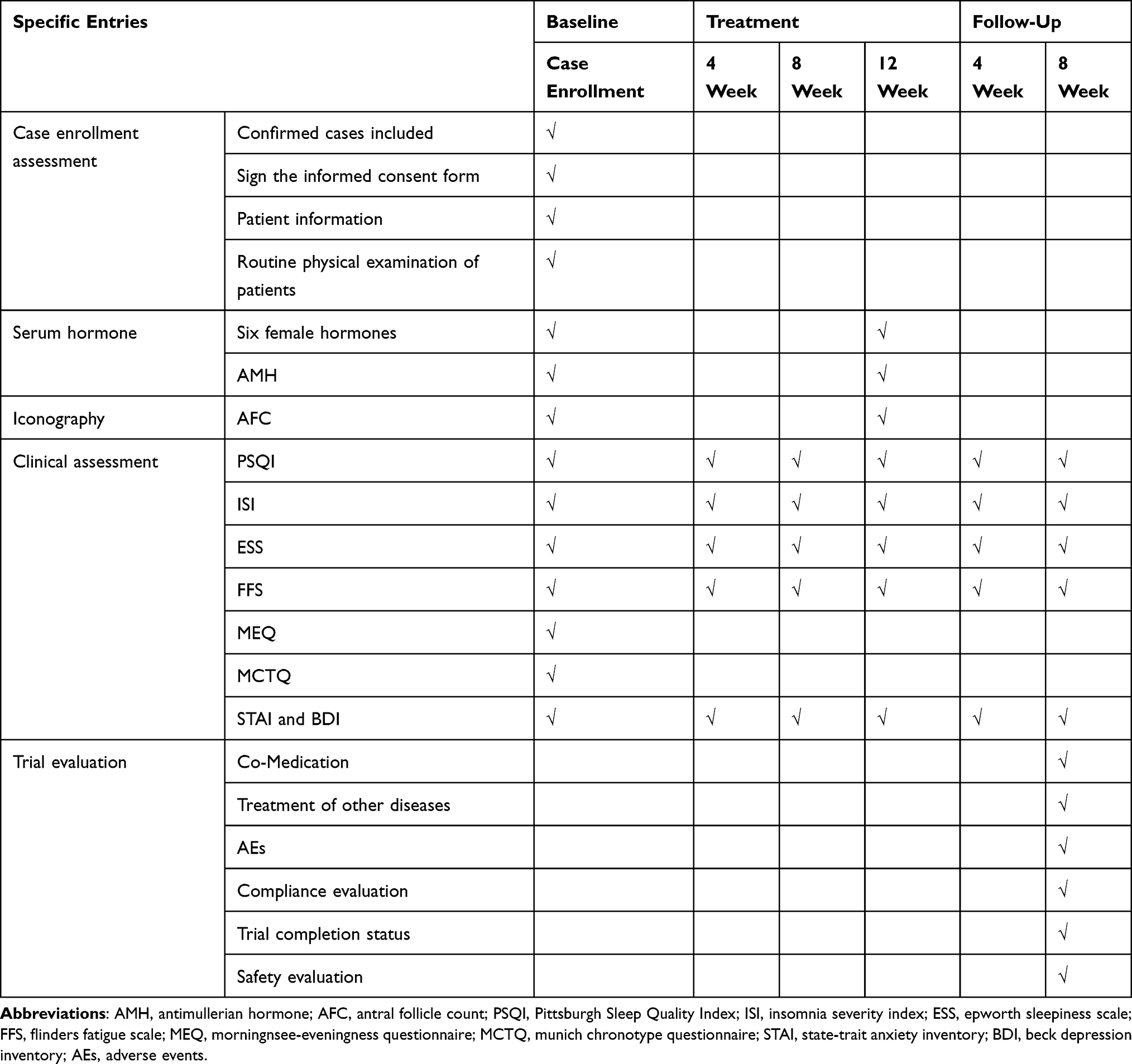 |
Table 1 Schedule of the Trial Process |
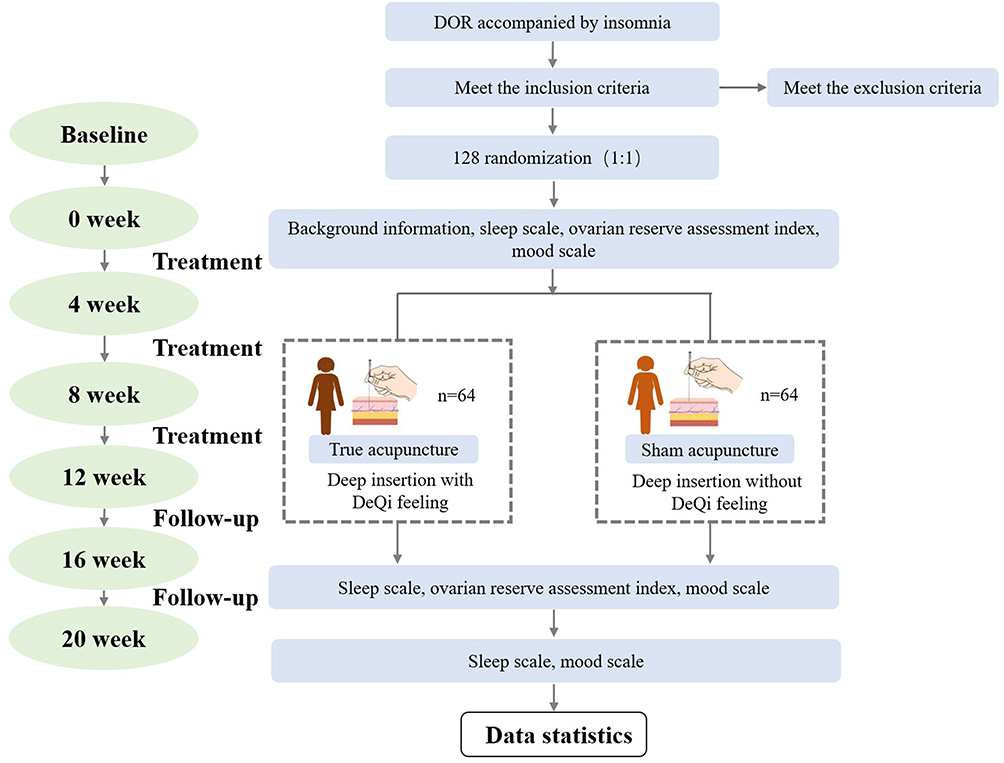 |
Figure 1 The research flowchart. |
Study Population
Diagnostic Criteria
We will recruit patients diagnosed with DOR and insomnia. DOR diagnosis is based on the guidelines in the 2022 expert consensus document from the Clinical Diagnosis and Management of Diminished Ovarian Reserve Expert Consensus Group.23 Insomnia diagnosis uses the International Classification of Sleep Disorders-3 (ICSD-3).24 All researchers will screen and select patients per these standards.
Diagnostic Criteria for DOR
Diagnostic Criteria for Insomnia
Note: Symptoms occur ≥3 times/week. Chronic insomnia lasts ≥3months, while short-term insomnia lasts <3 months.
Inclusion Criteria
Patients must meet all six criteria are eligible for the study.
Exclusion Criteria
Patients meeting any of the above criteria will be excluded.
Blinding and Randomization
Patients will be randomly assigned using SAS 9.4. The random sequence will be in sealed, opaque envelopes with two sets of random numbers, opened by an independent research assistant separate from the study team. This assistant will allocate patients in a 1:1 ratio to the verum or sham acupuncture group.
Sample Size Calculation
This RCT involves verum acupuncture and sham acupuncture groups for DOR patients with insomnia, with the primary outcome being the PSQI score. As no prior cross- sectional studies on DOR with insomnia exist, sample size calculations referenced trials on perimenopausal women with insomnia. Based on a study by Fei-Yi Zhao,25 the verum acupuncture group showed a significant PSQI reduction (from 11.00±0.34 to 8.23±0.44) versus the sham group (from 10.23±0.29 to 9.45±0.37) after two months, with a Cohen’s d of 0.51. Assuming a Cohen’s d of 0.65 to this study, two tailed α = 0.05, and 1-β = 90%, PASS 2021 calculated 51 patients per group. Accounting for a 20% dropout rate, the study will recruit 64 per group, totaling 128 patients.
Study Protocol
Verum Acupuncture Group
Acupoint location refers to the Names and locations of acupoints in 2021 (GB/T 12346–2021).26 Two sets of acupoints are alternately used during treatment. The first set will be used as the treatment starting point group, and the patients will be treated in the prone position, including Shenting (GV24), Baihui (DU20), Benshen (GB13), Zhongwan (CV12), Huangshu (KI16), Dai Mai (GB26), Qihai (CV6), Guanyuan (CV4), Dahe (KI12), Zigong (EX-CA1), Zusanli (ST36), Sanyinjiao (SP6), Taichong (LR3), Shenmen (HT7), and Shenmai (BL62). The second set is supine, including Anmian (EX-HN22), Shenshu (BL23), Dachangshu (BL25), Ciliao (BL32), and Taixi (KI3). Details are in Figure 2 and Appendix 2.
 |
Figure 2 Schematic Representation of Acupoint Localization. (A) Location of head acupoints in the acupuncture group; (B) Location of front acupoints in the acupuncture group; (C) Location of lateral acupoints in the acupuncture group; (D) Location of back acupoints in the acupuncture group. |
Acupuncture is performed by licensed acupuncturists with over five years of experience. The skin at the acupoint is disinfected with 75% ethanol. Sterile, single-use needles (0.25 mm in diameter, lengths of 25 mm, 40 mm, or 75 mm, Hua Tuo, Suzhou, China) are inserted to induce a sense of de qi, such as soreness, numbness, heaviness, fullness, and pain. Needles are retained for 30 minutes without manipulation. Treatment is thrice weekly on alternate days for 12 weeks (36 sessions total), starting from the second day of the menstrual cycle and continuing throughout menstruation.27
Sham Acupuncture Group
The sham acupuncture group will follow the SHARE guidelines for sham reporting.28 Short, shallow needles (0.25 mm in diameter, 25 mm in length, Hua Tuo, Suzhou, China) will be used at non overlapping control points (see Figure 3 and Appendix 2). Needling is superficial to avoid a sense of de qi. The sham procedure, treatment duration, and timing mirrored the verum acupuncture group. The sham acupuncture procedure strictly followed the STRICTA reporting guidelines for sham acupuncture, see Appendix 3 for details.
 |
Figure 3 Schematic Representation of Sham Acupoint Localization. (A) Location of non-acupoints in the head area of the sham acupuncture group; (B) Location of non-acupoints in the front area of the sham acupuncture group; (C) Location of non-acupoints in the lateral area of the sham acupuncture group; (D) Location of non-acupoints in the back area of the sham acupuncture group. Abbreviation: RP, Reference point. |
Outcome Measurement
Primary Outcomes
The primary outcome will be evaluated through the PSQI, a psychometrically validated instrument assessing sleep quality over the preceding month. Comprising 19 validated items, this multidimensional tool generates seven component scores via algorithmic synthesis: sleep quality, latency, duration, efficiency, disturbances, hypnotic medication usage, and daytime dysfunction, whereas the composite score spans a continuum from 0 to 21. A threshold exceeding 7 points demarcates clinically significant sleep impairment. The higher the score is, the worse the sleep quality is indicated.29 A 4-point reduction in PSQI scores from baseline operationalize as the minimal important change (MIC), whereas a between-group differential of 2.5 points constitutes the minimal clinically important difference (MCID) threshold.30 Concurrently, treatment responders are defined a priori as participants demonstrating ≥50% PSQI score reduction relative to baseline.31 The evaluation time points are baseline, therapeutic intervals (4, 8 and 12 weeks), and follow-up period (16 and 20 weeks).
Secondary Outcomes
Sleep and psychological outcomes will be dynamically assessed at baseline, during treatment (4, 8, and 12 weeks), and at follow-up (16 and 20 weeks). Specifically, the Insomnia Severity Index (ISI) will gauge overall insomnia severity, the Epworth Sleepiness Scale (ESS) daytime sleepiness, and the Flinders Fatigue Scale (FFS) subjective fatigue levels. Concurrently, psychological status will be evaluated using the State-Trait Anxiety Inventory (STAI) for anxiety and the Beck Depression Inventory (BDI) for depressive symptoms. Furthermore, sleep-wake patterns and circadian rhythm characteristics will be captured at baseline and 12 weeks using the Morningness-Eveningness Questionnaire (MEQ) for chronotype preference and the Munich Chronotype Questionnaire (MCTQ) for sleep timing and chronotype based on actual behavior. In parallel with these assessments, AMH, sex hormone levels, and AFC will be conducted at baseline and on 2–3 days of the menstrual period at 12 weeks of treatment to evaluate the ovarian reserve function of DOR patients with insomnia.
Safety Outcomes
At each visit, researchers identify adverse events (AEs) through questioning or patient reports. Common acupuncture related AEs include intolerable needle pain, local hematoma, or infection. The case report form documents the name, dates, severity, relation to the intervention, impact on treatment, and outcome of AEs.
Statistical Analysis
Baseline demographic data will be reported descriptively using the intent-to-treat (ITT) population. All efficacy analyses will be conducted using the ITT dataset and the per-protocol (PP) set, which is defined as all randomized patients who received at least 29 (80% of the total number of treatments) interventions. The primary outcome, operationalized as PSQI scores, will be analyzed through a mixed-model repeated measures (MMRM) framework incorporating to estimate efficacy, with time as a within-group factor and intervention as a between-group factor. To evaluate the robustness of the primary findings, sensitivity analyses will be performed using multiple imputation and last observation carried forward methods to handle missing data. This analytical paradigm is generated least squares mean (LSM) changes from baseline to 20 weeks, between-group LSM differentials, and associated 95% confidence intervals with two-tailed probability values. The percentage of effective responders to the PSQI during therapeutic intervals (4, 8 and 12 weeks), and follow-up period (16 and 20 weeks) will be calculated and summarized by groups. The percentage of PSQI effective responders is compared between groups using chi-square tests. Secondary outcomes will be analyzed in the same way. Cohen’d effect sizes are calculated by dividing the absolute value of the least squares mean difference in scores between groups from baseline to 20 weeks by the combined standard deviation of the MMRM estimates. AEs are categorized by severity and assessed for their relationship to study treatment. Fisher’s exact test is used to compare the incidence of AEs between groups. Statistical analysis is performed using SPSS version V26.0, and a two-sided P<0.05 is considered statistically significant.
To delineate the potential mediation effect of insomnia amelioration on acupuncture-mediated modulation of DOR, structural equation modeling will be employed to systematically characterize causal effects. The model included patients with baseline and post-intervention data, using baseline PSQI scores as the independent variable, post-intervention AMH as the dependent variable, and PSQI scores at 4, 8 and 12 weeks as mediators (M1, M2, M3). Adjustments PSQI scores and AMH at these time points. Mediating effects are calculated via 10,000 bootstrap samples, producing bias-corrected confidence intervals.
We will build a network visualization model for the PSQI, ISI, MEQ, MCTQ, and ESS scales to explore the complex relationships among insomnia symptoms in DOR patients. All data will be analyzed using R software. The qgraph package will be used to estimate and visualize sleep symptom networks. For continuous data, a gaussian graphical model (GGM) will be used to construct a partial correlation network; for mixed data types, mixed graphical models (MGM) will be applied. The bootnet package will assess network accuracy and stability. Centrality metrics will identify core scale items, and node predictability will be calculated with the mgm package. The NetworkComparisonTest package will generate and compare network graphs for the acupuncture and sham groups across time points, analyzing network structure and dynamics to identify key node changes and acupuncture targets.
Discussion
To the best of our knowledge, this is the first prospective study to comprehensively investigate the efficacy and safety of acupuncture for DOR patients with insomnia. By leveraging mediation analysis and scales network analysis, this research will thoroughly evaluate acupuncture’s effects, identify core symptoms and intervention targets, and explore the interrelationship between DOR and insomnia. These findings are expected to provide novel insights and therapeutic targets for this complex comorbidity, which often presents as a vicious cycle. Last but not least, the study aims to alleviate symptoms and improve the life quality of patients.
Sleep, as an indispensable physiological activity in human life,32,33 exerts extensive and profound effects on reproductive health.34–36 Therefore, while focusing on the improvement of ovarian function in DOR patients by acupuncture, this study places particular emphasis on the impacts of acupuncture on their sleep quality and physical-mental health. Multiple sleep and emotion-related scales will be employed to comprehensively and accurately evaluate sleep quality, insomnia severity, daytime somnolence, daytime fatigue, circadian rhythm disorder, anxiety, and depression status in DOR patients. Additionally, this study employs mediation analysis to go beyond the limitations of previous research that only observed correlations, aiming to test the internal causal pathways through which acupuncture improves ovarian function and sleep quality. Specifically, it intends to clarify whether sleep improvement acts as a mediator in acupuncture-promoted ovarian function recovery.37 Meanwhile, scale network analysis will be used to identify core nodes within the symptom clusters of DOR patients with insomnia and observe changes in these core nodes before and after acupuncture.38 This approach helps avoid the shortcomings of relying solely on total score assessments of outcomes and provides a basis for accurately locating core intervention targets for acupuncture in the future.
Limitations
This study has several limitations. Firstly, the use of standardized scales as assessment tools introduces the potential for measurement bias due to subjective patient factors such as self-perception, recall, emotional fluctuations, or environmental influences. Secondly, the single-center design within China limits the generalizability of the findings. Furthermore, the study did not track pregnancy outcomes in DOR patients, potentially limiting its relevance for reproductive outcome-focused clinical decision-making.
Declaration of Generative AI Use
During the preparation of this work, we used Deepseek in order to improve readability and language fluency of initial drafts of specific sections and check grammar and spelling in the final draft.
Abbreviations
DOR, diminished ovarian reserve; PSQI, Pittsburgh Sleep Quality Index; TCM, Traditional Chinese Medicine; RCT, randomized controlled trial; STRICTA, standards for reporting interventions in clinical trials of acupuncture; ITMCTR, international traditional medicine clinical trial registration platform; AMH, antimullerian hormone; AFC, antral follicle count; FSH, follicle-stimulating hormone; MIC, minimal important change; MCID, minimal clinically important difference; ISI, insomnia severity index; ESS, epworth sleepiness scale; FFS, flinders fatigue scale; STAI, state-trait anxiety inventory; BDI, beck depression inventory; MEQ, morningnsee-evening ness questionnaire; MCTQ, munich chronotype questionnaire; AEs, adverse events; ITT, intent-to-treat; PP, per-protocol; MMRM, mixed model repeated measures; LSM, least squares mean; GGM, gaussian graphical mo MGM, mixed graphical models.
Ethics and Dissemination
This trial is conducted in accordance with the Declaration of Helsinki. The protocol has been approved by the Medical Ethics Committee of Sichuan Jinxin Xinnan Women and Children’s Hospital (No. (2024) Ethics Committee for Reproductive Ethics (039)). The trial was registered on the International Traditional Medicine Clinical Trial Registration Platform (ITMCTR, http://itmctr.ccebtcm.org.cn/) on May 30, 2025 (Registration No. ITMCTR2025001081). Informed consent will be obtained from all participants. The results will be published in a peer-reviewed academic journal.
Author Contributions
All authors made a significant contribution to the work reported, whether that is in the conception, study design, execution, acquisition of data, analysis and interpretation, or in all these areas; took part in drafting, revising or critically reviewing the article; gave final approval of the version to be published; have agreed on the journal to which the article has been submitted; and agree to be accountable for all aspects of the work.
Funding
This study was supported by the National Natural Science Foundation of China (NO. 82174517, NO. 82575219, NO. 82505759) and Scientific Research Project of Guangdong Provincial Administration of Traditional Chinese Medicine (Grant No. 20261243). The funding body did not play a role in the data collection, analysis, or interpretation, nor in the writing of the manuscript or the decision to submit it for publication.
Disclosure
The authors declare that there are no potential conflicts of interest or financial relationships in this study.
References
1. Jing-Jue L, Wen-Jie X. Guidelines for Chronic Insomnia in the Elderly. Res Integrat Trad Chinese Western Med. 2023;15(05):311–324.
2. Beroukhim G, Esencan E, Seifer DB. Impact of sleep patterns upon female neuroendocrinology and reproductive outcomes: a comprehensive review. Reprod Biol Endocrinol. 2022;20(1):16. doi:10.1186/s12958-022-00889-3
3. Rahman SA, Grant LK, Gooley JJ, Rajaratnam SMW, Czeisler CA, Lockley SW. Endogenous Circadian regulation of female reproductive hormones. J Clin Endocrinol Metab. 2019;104(12):6049–6059. doi:10.1210/jc.2019-00803
4. Lin Y, Chen Y, Lin Y, et al. Association between sleep quality and ovarian reserve in women of reproductive age: a cross-sectional study. Fertil Steril. 2025;123(3):520–528. doi:10.1016/j.fertnstert.2024.09.018
5. Jiao Z, Bukulmez O. Potential roles of experimental reproductive technologies in infertile women with diminished ovarian reserve. J Assist Reprod Genet. 2021;38(10):2507–2517. doi:10.1007/s10815-021-02246-6
6. Diagnosis EGoCoC, Reserve Mo DO, Endocrinology R, Association FPSoCSoFPuCPM. Expert consensus on clinical diagnosis and treatment of decreased ovarian reserve function. J Reprod Med. 2022;31(04):425–434.
7. Gong M, Gao Y, Wang Z, Lu F, Dong H. The impact of chronic insomnia disorder on menstruation and ovarian reserve in childbearing-age women: a cross-sectional study. Clin Exp Reprod Med. 2024;51(2):142–150. doi:10.5653/cerm.2023.06513
8. Caetano G, Bozinovic I, Dupont C, Léger D, Lévy R, Sermondade N. Impact of sleep on female and male reproductive functions: a systematic review. Fertil Steril. 2021;115(3):715–731. doi:10.1016/j.fertnstert.2020.08.1429
9. Min L, Min-Jie T, Qiao-Hong Q, Cai-Ping A, Cui-Fang C. Research progress of sleep disorders and decreased ovarian reserve function in both Traditional Chinese and Western Medicine. Fudan J. 2024;51(05):831–836.
10. Benz F, Knoop T, Ballesio A, et al. The efficacy of cognitive and behavior therapies for insomnia on daytime symptoms: a systematic review and network meta-analysis. Clin Psychol Rev. 2020;80:101873. doi:10.1016/j.cpr.2020.101873
11. Colin O, Labreuche J, Deguil J, et al. Preadmission use of benzodiazepines and stroke outcomes: the Biostroke prospective cohort study. BMJ Open. 2019;9(1):e022720. doi:10.1136/bmjopen-2018-022720
12. Auger N, Healy-Profitós J, Wei SQ. In the arms of Morpheus: meta-analysis of sleep and fertility. Fertil Steril. 2021;115(3):596–598. doi:10.1016/j.fertnstert.2020.12.030
13. Benetti-Pinto CL, Menezes C, Yela DA, Cardoso TM. Sleep quality and fatigue in women with premature ovarian insufficiency receiving hormone therapy: a comparative study. Menopause. 2019;26(10):1141–1145. doi:10.1097/GME.0000000000001379
14. Zhao FY, Spencer SJ, Kennedy GA, et al. Acupuncture for primary insomnia: effectiveness, safety, mechanisms and recommendations for clinical practice. Sleep Med Rev. 2024;74:101892. doi:10.1016/j.smrv.2023.101892
15. Zhong P, Zhang Z, Barger Z, et al. Control of non-REM sleep by midbrain neurotensinergic neurons. Neuron. 2019;104(4):795–809.e6. doi:10.1016/j.neuron.2019.08.026
16. Oishi Y, Saito YC, Sakurai T. GABAergic modulation of sleep-wake states. Pharmacol Ther. 2023;249:108505. doi:10.1016/j.pharmthera.2023.108505
17. Wei XR, Wei GW, Zheng XN, et al. Effect of acupuncture with different Meridian point combinations on expression of hypothalamic clock genes Clock and Bmal1 in insomnia rats. Acupuncture Res. 2017;42(05):429–433.
18. Liu Z, Zhao N, Xie C, Yang WJ, Yu XT, Chen YF. Effects of electroacupuncture on sleep-wake circadian rhythm and melatonin rhythm in insomnia rats. China Journal of Traditional Chinese Medicine. 2016;31(09):3695–3699.
19. Xu XJ, Wang XQ, Wu WZ, et al. Effects of electroacupuncture on sleep quality and serum melatonin in elderly patients with insomnia. Shanghai J Acupuncture Moxibustion. 2022;41(01):1–4.20.
20. Lin G, Liu X, Cong C, Chen S, Xu L. Clinical efficacy of acupuncture for diminished ovarian reserve: a systematic review and meta-analysis of randomized controlled trials. Front Endocrinol. 2023;14(14):1136121. doi:10.3389/fendo.2023.1136121
21. Qu F, Li R, Sun W, et al. Use of electroacupuncture and transcutaneous electrical acupoint stimulation in reproductive medicine: a group consensus. J Zhejiang Univ Sci B. 2017;18(3):186–193. doi:10.1631/jzus.B1600437
22. Qiu-Ping L, Zhi-Hong Y, Ling-Min J, et al. Electroacupuncture on Liver Meridian acupoints for the treatment of decreased ovarian reserve function due to liver depression: a randomized controlled trial. Zhongguo Zhengjiu. 2024;44(11):1261–1266.
23. Feng J, He H, Wang Y, et al. The efficacy and mechanism of acupuncture in the treatment of male infertility: a literature review. Front Endocrinol. 2022;13:1009537. doi:10.3389/fendo.2022.1009537
24. Sateia MJ. International classification of sleep disorders-third edition: highlights and modifications. Chest. 2014;146(5):1387–1394. doi:10.1378/chest.14-0970
25. Zhao FY, Zheng Z, Fu QQ, et al. Acupuncture for comorbid depression and insomnia in perimenopause: a feasibility patient-assessor-blinded, randomized, and sham-controlled clinical trial. Front Public Health. 2023;11:1120567. doi:10.3389/fpubh.2023.1120567
26. Wu XD, Huang LX, Zhao JS. Interpretation of China national standard nomenclature and location of Meridian Points (GB/T 12346-2021). Zhongguo Zhen Jiu. 2022;42(5):579–582. doi:10.13703/j.0255-2930.20220117-k0001
27. MacPherson H, White A, Cummings M, Jobst K, Rose K, Niemtzow R. Standards for reporting interventions in controlled trials of acupuncture: the STRICTA recommendations. STandards for Reporting Interventions in Controlled Trails of Acupuncture. Acupunct Med. 2002;20(1):22–25. doi:10.1136/aim.20.1.22
28. Ma P, Liu X, Liu Z, et al. The SHARE: SHam Acupuncture REporting guidelines and a checklist in clinical trials. J Evid Based Med. 2023;16(4):428–431. doi:10.1111/jebm.12560
29. Buysse DJ, Reynolds CF, Monk TH, Berman SR, Kupfer DJ. The Pittsburgh Sleep Quality Index: a new instrument for psychiatric practice and research. Psychiatry Res. 1989;28(2):193–213. doi:10.1016/0165-1781(89)90047-4
30. Qin Z, Zhu Y, Shi DD, Chen R, Li S, Wu J. The gap between statistical and clinical significance: time to pay attention to clinical relevance in patient-reported outcome measures of insomnia. BMC Med Res Methodol. 2024;24(1):177. doi:10.1186/s12874-024-02297-0
31. Zhang S, Zhao Y, Qin Z, et al. Transcutaneous auricular vagus nerve stimulation for chronic insomnia disorder: a randomized clinical trial. JAMA Network Open. 2024;7(12):e2451217. doi:10.1001/jamanetworkopen.2024.51217
32. Steiger A, Dresler M, Kluge M, Schüssler P. Pathology of sleep, hormones and depression. Pharmacopsychiatry. 2013;46(Suppl 1):S30–5. doi:10.1055/s-0033-1337921
33. Dinges DF. The growth of sleep science and the role of SLEEP. Sleep. 2014;37(1):7–8. doi:10.5665/sleep.3296
34. Cai XF, Wang BY, Zhao JM, Nian MX, Lin QC, Huang JF. Association of sleep disturbances with diminished ovarian reserve in women undergoing infertility treatment. Sci Rep. 2024;14(1):26279. doi:10.1038/s41598-024-78123-w
35. Eisenberg E, Legro RS, Diamond MP, et al. Sleep habits of women with infertility. J Clin Endocrinol Metab. 2021;106(11):e4414–e26. doi:10.1210/clinem/dgab474
36. Kloss JD, Perlis ML, Zamzow JA, Culnan EJ, Gracia CR. Sleep, sleep disturbance, and fertility in women. Sleep Med Rev. 2015;22:78–87. doi:10.1016/j.smrv.2014.10.005
37. Werner-Seidler A, Li SH, Spanos S, et al. The effects of a sleep-focused smartphone application on insomnia and depressive symptoms: a randomised controlled trial and mediation analysis. J Child Psychol Psychiatr. 2023;64(9):1324–1335. doi:10.1111/jcpp.13795
38. Lancee J, Harvey AG, Morin CM, Ivers H, van der Zweerde T, Blanken TF. Network intervention analyses of cognitive therapy and behavior therapy for insomnia: symptom specific effects and process measures. Behav Res Ther. 2022;153:104100. doi:10.1016/j.brat.2022.104100
 © 2025 The Author(s). This work is published and licensed by Dove Medical Press Limited. The
full terms of this license are available at https://www.dovepress.com/terms
and incorporate the Creative Commons Attribution
- Non Commercial (unported, 4.0) License.
By accessing the work you hereby accept the Terms. Non-commercial uses of the work are permitted
without any further permission from Dove Medical Press Limited, provided the work is properly
attributed. For permission for commercial use of this work, please see paragraphs 4.2 and 5 of our Terms.
© 2025 The Author(s). This work is published and licensed by Dove Medical Press Limited. The
full terms of this license are available at https://www.dovepress.com/terms
and incorporate the Creative Commons Attribution
- Non Commercial (unported, 4.0) License.
By accessing the work you hereby accept the Terms. Non-commercial uses of the work are permitted
without any further permission from Dove Medical Press Limited, provided the work is properly
attributed. For permission for commercial use of this work, please see paragraphs 4.2 and 5 of our Terms.
Recommended articles

The Efficacy and Safety of Acupuncture for Depression-Related Insomnia: Protocol for a Systematic Review and Meta-Analysis
Hu H, Li Z, Cheng Y, Gao H
Journal of Pain Research 2022, 15:1939-1947
Published Date: 13 July 2022
The Efficacy and Safety of Acupuncture for Tinnitus-Associated Insomnia: A Protocol for a Systematic Review and Meta-Analysis
Fan L, Gao Y, Zhou J, Hu H, Gao H
Journal of Pain Research 2022, 15:2957-2965
Published Date: 21 September 2022
Electro-Acupuncture for Diminished Ovarian Reserve: Protocol for a Randomized, Placebo-Controlled Trial
Tang H, Wang JX, Zheng SZ, Jia YF, Yu X, Zhao NN, Yang YH, Lin LP, Li SY, Zhao H
Journal of Multidisciplinary Healthcare 2025, 18:4341-4352
Published Date: 30 July 2025
Insomnia Pathogenesis and Multidimensional Mechanisms of Acupuncture: A Narrative Review
Xue L, Jiang H, Zhou M, Zhu M, Wang W, Su W
International Journal of General Medicine 2026, 19:591463
Published Date: 25 April 2026