
Back to Journals » Journal of Pain Research » Volume 19
Genomic Research for Abdominal Pain in Patients with Irritable Bowel Syndrome or Inflammatory Bowel Disease Before and After Mind-Body Intervention
Authors Lin Z, Mo G, Wang Y, Lin S, Guo Q
Received 25 February 2026
Accepted for publication 5 June 2026
Published 10 June 2026 Volume 2026:19 605236
DOI https://doi.org/10.2147/JPR.S605236
Checked for plagiarism Yes
Review by Single anonymous peer review
Peer reviewer comments 3
Editor who approved publication: Dr Rocío de la Vega
Zhongyuan Lin,1,* Guohui Mo,1,* Yimin Wang,2 Shiqing Lin,1 Qianqian Guo1
1Department of Anesthesiology, The First Affiliated Hospital of Sun Yat-Sen University, Guangzhou, Guangdong, 510080, People’s Republic of China; 2Department of Anesthesiology, Guangdong Second Provincial General Hospital, Guangzhou, Guangdong, 510317, People’s Republic of China
*These authors contributed equally to this work
Correspondence: Qianqian Guo, Department of Anesthesiology, The First Affiliated Hospital of Sun Yat-sen University, Guangzhou, Guangdong, 510080, People’s Republic of China, Email [email protected]
Purpose: Abdominal pain is a hallmark symptom of both inflammatory bowel disease (IBD) and irritable bowel syndrome (IBS) and substantially impairs patients’ quality of life. Relaxation response–based mind–body intervention (RR-MBI) has been reported to improve disease-specific outcomes and pain catastrophizing in both disorders, accompanied by whole-blood transcriptomic changes. However, the transcriptional features potentially relevant to abdominal pain before and after RR-MBI in IBS and IBD remain insufficiently explored. In this context, this study aimed to analyze these transcriptional changes and prioritize putative abdominal pain-relevant candidate genes from exploratory differentially expressed gene (DEG) sets.
Patients and Methods: Gene expression data (GSE66824) were obtained from the Gene Expression Omnibus (GEO). Whole-blood gene expression profiles were analyzed from 14 IBS and 19 IBD patients, with samples collected before and after a 9-week RR-MBI. Exploratory DEG sets were identified using GEO2R outputs with nominal P < 0.05 and absolute fold-change magnitude (AFC) ≥ 1.2. Functional enrichment analyses were performed using DAVID. Protein–protein interaction (PPI) networks were constructed using STRING and visualized in Cytoscape. Putative abdominal pain-relevant candidate genes were prioritized from exploratory DEG sets within PPI/MCODE modules based on network position, matching module genes to the DisGeNET disease entry “pain”, and targeted pain-related literature annotation.
Results: (1) In IBD post-MBI, 649 exploratory DEGs were identified, with enrichment of neurotrophin and TGF-β signaling pathways; MAP3K7, SLC12A2, and FKBP5 were prioritized as candidate genes. (2) In IBS post-MBI, 175 exploratory DEGs were identified, with enrichment of glutamatergic synapse and calcium signaling pathways; network analysis highlighted NTRK2, FKBP5, and AR as candidate genes. (3) At baseline, 836 exploratory DEGs were identified, with enrichment in pathways including p53 signaling and NOD-like receptor signaling; notable prioritized candidate genes included TRAF6 and TNFSF11.
Conclusion: Prioritized genes after RR-MBI and in the baseline comparison may represent putative abdominal pain-relevant candidate transcriptional signals in IBS and IBD. These exploratory findings require validation in independent cohorts with matched individual-level pain-related outcomes and functional studies.
Keywords: abdominal pain, stress, irritable bowel syndrome, inflammatory bowel disease, bioinformatic analysis
Introduction
Chronic abdominal pain in disorders such as irritable bowel syndrome (IBS) and inflammatory bowel disease (IBD) substantially impairs patients’ quality of life, largely due to its persistent and refractory nature.1,2 IBS is a functional gastrointestinal disorder characterized by chronic abdominal pain and altered bowel habits without identifiable structural pathology, whereas IBD is an organic inflammatory condition involving intestinal tissue damage that manifests clinically with abdominal pain, diarrhea, and rectal bleeding.3,4 Although IBS and IBD arise from distinct pathophysiological mechanisms, both conditions impose a substantial abdominal pain burden. This clinical overlap provided the basis for parallel analysis, while transcriptomic findings were interpreted within each disease context. In IBD, abdominal pain may involve immune-inflammatory activation and tissue injury; in IBS, abdominal pain is commonly linked to visceral hypersensitivity, stress regulation, and brain–gut axis dysfunction. The brain–gut axis provides a framework linking psychological stress, autonomic and endocrine regulation, immune signaling, gastrointestinal function, and pain perception.5,6 Dysregulation of this axis has been implicated in visceral hypersensitivity, stress-induced symptom exacerbation, and altered pain processing across gastrointestinal disorders.7
Stress-reduction interventions have shown benefits for gastrointestinal symptoms and pain-related psychological outcomes. A 9-week relaxation response–based mind–body intervention (RR-MBI) has been reported to improve disease-specific outcomes and pain catastrophizing in both IBS and IBD patients, with accompanying whole-blood transcriptomic changes.8 However, features potentially relevant to abdominal pain in whole-blood transcriptional changes before and after RR-MBI in IBS and IBD remain insufficiently explored. Bioinformatic analysis can provide a broader view of intervention-associated changes in gene expression and signaling pathways. Whole-blood transcriptomic data provide an accessible systemic readout of circulating immune, inflammatory, stress-related, and neuroendocrine transcriptional states relevant to RR-MBI responses. GSE66824 contains paired pre- and post-RR-MBI whole-blood expression profiles from IBS and IBD patients generated using the same platform and intervention protocol. Using this dataset, the present study analyzed transcriptional changes before and after RR-MBI in IBS and IBD and prioritized putative abdominal pain-relevant candidate genes from exploratory DEG sets.
Materials and Methods
Microarray Data Search and Selection of Eligible Data Set
The microarray dataset GSE66824 was downloaded from the Gene Expression Omnibus (GEO) database (https://www.ncbi.nlm.nih.gov/geo/) on platform GPL13158 ([HT_HG-U133_Plus_PM] Affymetrix HT HG-U133+ PM Array Plate). In this dataset, whole blood samples and gene expression profiles were obtained and analyzed from 14 IBS patients and 19 IBD patients, with samples collected before and after a 9-week relaxation response–based mind–body intervention (RR-MBI).
Patients diagnosed with IBS (confirmed according to Rome III diagnostic criteria for at least 6 months) or IBD (upper limit for Harvey–Bradshaw Index [HBI] = 20; upper limit for Simple Clinical Colitis Activity Index [SCCAI] = 18) by their primary care provider or gastroenterologist were eligible for inclusion. All subjects completed the Pain Catastrophizing Scale (PCS), Brief Pain Inventory (BPI), and State–Trait Anxiety Inventory (STAI-Y) to assess symptoms before and after treatment. In addition, disease-specific assessments were performed: IBS patients completed the IBS Symptom Severity Index (IBS-SSI) and IBS Quality of Life (IBS-QOL), whereas IBD patients completed the Inflammatory Bowel Disease Questionnaire (IBD-Q). Detailed information regarding ethics approval, clinical data collection, RNA extraction, and microarray processing is available in the original GSE66824 dataset record. The public GEO accession does not provide individual-level clinical outcome data that can be directly matched to each expression sample. Therefore, expression–outcome correlation analyses between gene expression changes and PCS, BPI, STAI-Y, IBS-SSI, IBS-QOL, or IBD-Q changes could not be performed in this re-analysis.
Screening of Exploratory DEG Sets
Gene expression changes were represented as fold change (FC) values. Exploratory differentially expressed gene (DEG) sets were identified using the GEO2R tool, which was based on limma (Linear Models for Microarray Analysis) R package 3.26.8 (https://www.ncbi.nlm.nih.gov/geo/info/geo2r.html).9 For exploratory candidate gene screening, nominal P < 0.05 was used as an initial statistical filter, and absolute fold-change magnitude (AFC) ≥ 1.2 was used as an effect-size filter. AFC was defined as FC for upregulated records and 1/FC for downregulated records. The AFC threshold was selected after examining the AFC distribution and gene yield across candidate cutoffs, with the aim of retaining sufficient input genes for enrichment analysis, PPI/MCODE analysis, and candidate gene prioritization. The resulting exploratory DEG sets were used as inputs for downstream analyses.
Functional Enrichment Analysis
The exploratory DEG sets were submitted to the Database for Annotation, Visualization, and Integrated Discovery (DAVID, Version 2021) for functional annotation (https://davidbioinformatics.nih.gov/summary_new.jsp). Gene Ontology (GO) biological processes and Kyoto Encyclopedia of Genes and Genomes (KEGG) pathway enrichment analyses were performed to interpret the biological significance of exploratory DEGs and their potential relevance to IBS and IBD. Functional enrichment analysis was conducted using a two-sided hypergeometric test, and multiple testing correction was performed using the Benjamini–Hochberg method. A minimum gene count ≥ 2 and P < 0.05 were set as thresholds for statistical significance.
Protein–Protein Interaction (PPI) Analysis
Protein–protein interaction (PPI) networks of exploratory DEGs were constructed using the STRING database (http://string-db.org/).10 STRING is a publicly available resource for known and predicted protein–protein interactions. In this study, a confidence score > 0.4 was used as the threshold for network construction. The combined interaction score integrates probabilities from multiple evidence channels, including experimental data and curated literature, and is corrected for random associations. The resulting interaction pairs were downloaded for subsequent analysis. Module clustering analysis was performed to identify potential functional modules using the Molecular Complex Detection (MCODE 1.6.1) plugin in Cytoscape3.8.0.11 The parameters were set as follows: degree cutoff = 2 and node score cutoff = 0.2.
Within the PPI/MCODE networks, genes within MCODE modules were cross-referenced with the DisGeNET database (https://www.disgenet.org/search) using the broad disease term “pain”.12 This step was used to identify module genes with database-level pain-related annotation. Candidate genes were then annotated according to abdominal pain-relevant biological evidence domains, including abdominal/visceral pain phenotypes, nociceptive or excitability-related pathways, stress and neuroendocrine regulation, and immune-inflammatory or neuroimmune signaling in IBS or IBD. This annotation step was used to provide structured biological context for candidate prioritization. Genes meeting these criteria were prioritized as putative abdominal pain-relevant candidate genes.
Results
Screening of Exploratory DEG Sets
Exploratory DEG sets were identified across three predefined comparisons: (i) IBD post- versus pre-RR-MBI; (ii) IBS post- versus pre-RR-MBI; and (iii) IBD versus IBS at baseline. Using the exploratory thresholds of nominal P < 0.05 and AFC ≥ 1.2, 649, 175, and 836 exploratory DEGs were identified in the IBD post- versus pre-RR-MBI, IBS post- versus pre-RR-MBI, and baseline IBD-versus-IBS comparisons, respectively.
Functional Enrichment Analysis
Functional enrichment analysis using GO biological processes and KEGG pathway databases was performed to characterize the biological functions of the exploratory DEG sets. KEGG pathway results showed that in IBD patients, neurotrophin signaling and TGF-β signaling pathways were significantly enriched after RR-MBI (Figure 1A). In IBS patients, enrichment analysis suggested involvement of calcium signaling in KEGG analysis (Figure 1B) and glutamatergic synaptic transmission-related processes in GO analysis (Supplementary Figure S1). In the baseline comparison, p53 signaling and NOD-like receptor signaling pathways were enriched (Figure 1C).
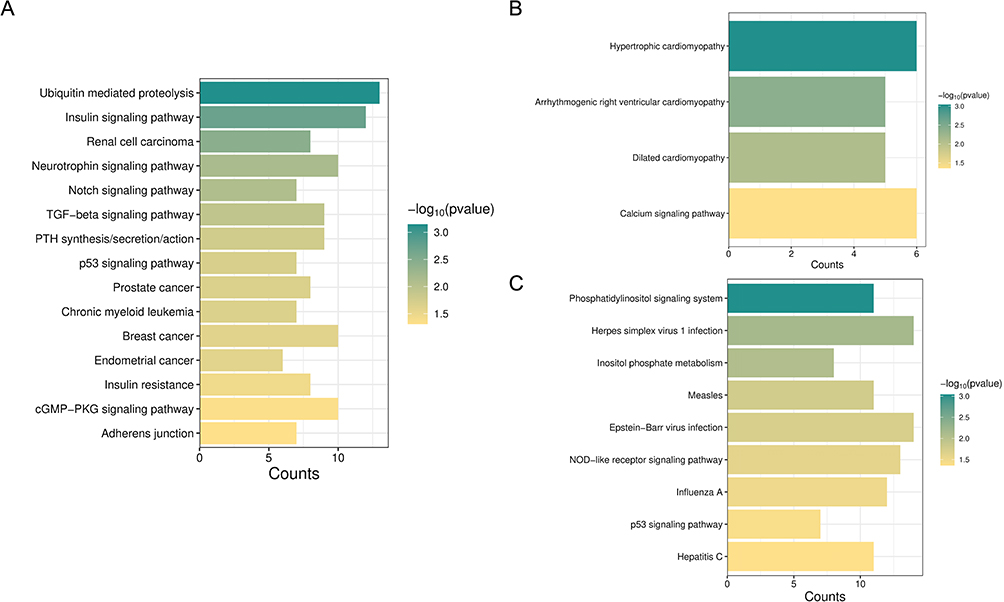 |
Figure 1 Kyoto Encyclopedia of Genes and Genomes (KEGG) pathway enrichment analysis of exploratory DEG sets across comparisons. (A) KEGG pathway enrichment of exploratory DEGs in IBD patients after RR-MBI compared with before intervention. (B) KEGG pathway enrichment of exploratory DEGs in IBS patients after RR-MBI compared with before intervention. (C) KEGG pathway enrichment of exploratory DEGs between IBD and IBS at baseline. Abbreviations: AFC, absolute fold-change magnitude; DEG, differentially expressed gene; KEGG, Kyoto Encyclopedia of Genes and Genomes; RR-MBI, relaxation response–based mind–body intervention. Notes: Bars represent enriched pathways, and color intensity corresponds to statistical significance (−log10 P value). Only pathways with P < 0.05 are shown. Exploratory DEG sets were defined using nominal P < 0.05 and AFC ≥ 1.2. |
Consistent with these pathway findings, GO enrichment analysis further showed distinct functional themes across comparisons, with immune-related and regulatory processes enriched in IBD and neural signaling–related processes enriched in IBS. Additional GO results are shown in Supplementary Figure S1.
Protein–Protein Interaction (PPI) Analysis and Candidate Gene Prioritization.
PPI networks were constructed from exploratory DEG sets using STRING and analyzed for functional modules with MCODE (Figure 2). In Figure 2, genes matched to the DisGeNET disease entry “pain” are shown as yellow hexagons, whereas prioritized putative abdominal pain-relevant candidate genes are shown as red diamonds.
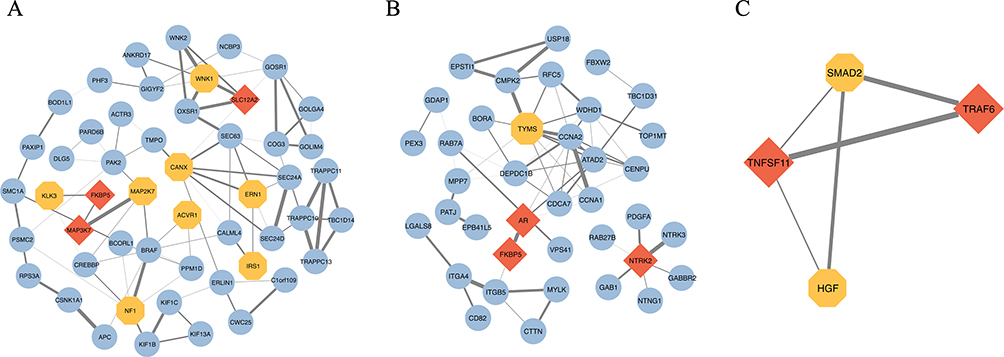 |
Figure 2 Representative MCODE modules extracted from PPI networks constructed from exploratory DEG sets. (A) Top module identified from exploratory DEGs in IBD after RR-MBI. (B) Top module identified from exploratory DEGs in IBS after RR-MBI. (C) Top module identified from baseline comparison (IBD vs IBS). Abbreviations: AFC, absolute fold-change magnitude; DEG, differentially expressed gene; MCODE, Molecular Complex Detection; PPI, protein–protein interaction; RR-MBI, relaxation response–based mind–body intervention. Notes: Nodes represent proteins encoded by exploratory DEGs and edges indicate predicted interactions. Edge thickness reflects the STRING combined interaction score. Light-blue circles indicate other exploratory DEGs within the MCODE modules. Yellow hexagons indicate genes matched to the DisGeNET disease entry “pain”. Red diamonds indicate prioritized putative abdominal pain-relevant candidate genes selected based on network position and targeted pain-related literature annotation. Exploratory DEG sets were defined using nominal P < 0.05 and AFC ≥ 1.2. |
Within IBD-derived modules, MAP3K7, SLC12A2, and FKBP5 were prioritized as putative candidates (Figure 2A). Within IBS-derived modules, NTRK2, FKBP5, and AR were prioritized as putative candidates (Figure 2B). In the baseline comparison, TRAF6 and TNFSF11 were highlighted as putative candidates within the baseline transcriptional context (Figure 2C). Quantitative statistics for these prioritized genes are provided in Table 1. Additional representative clusters derived from PPI networks are provided in Supplementary Figure S2 to illustrate the broader module architecture observed across comparisons.
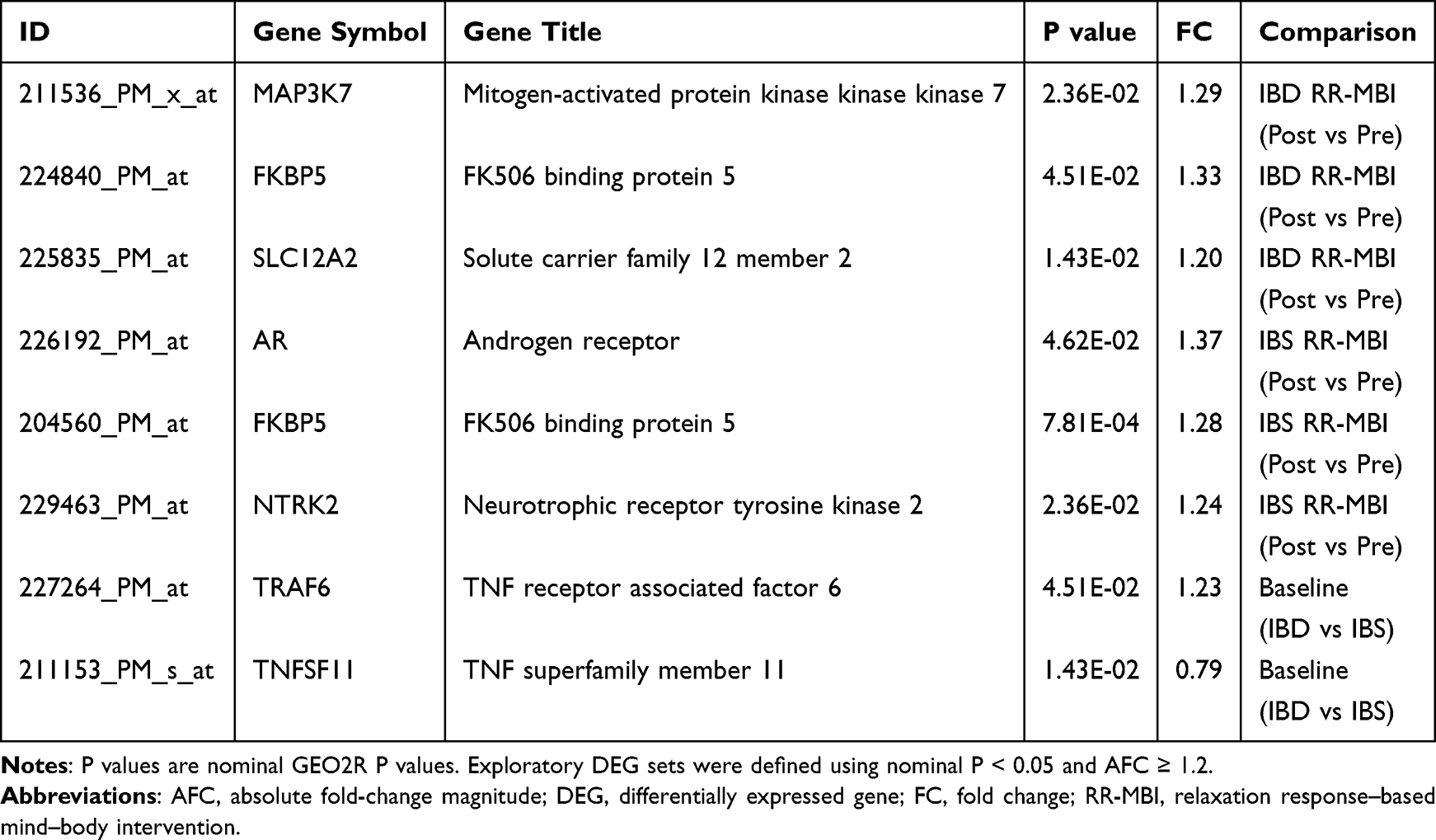 |
Table 1 Prioritized Putative Abdominal Pain-Relevant Candidate Genes Across Comparisons in IBS and IBD |
Discussion
Bhasin et al generated the GSE66824 dataset by profiling whole-blood mRNA expression in IBS and IBD patients before and after a 9-week RR-MBI.8 The parent study reported improvements in disease-specific outcomes and reductions in pain catastrophizing in both patient groups, with transcriptomic changes primarily involving inflammatory, proliferative, and oxidative stress–related pathways. However, the parent study primarily described the overall clinical and transcriptomic effects of RR-MBI and did not specifically examine the transcriptional features potentially relevant to abdominal pain within these changes. Given the major clinical burden of abdominal pain in both IBS and IBD, and its importance as a target for symptom management, these features warranted focused analysis. Building on this clinical and transcriptomic context, the present analysis further prioritized putative abdominal pain-relevant candidate genes.
In the IBD post- versus pre-RR-MBI comparison, the exploratory DEG set suggested whole-blood transcriptional patterns involving inflammatory and neuroregulatory pathways. Enrichment of neurotrophin and TGF-β signaling pathways, together with prioritized candidate genes including FKBP5, MAP3K7, and SLC12A2, suggests that these systemic transcriptional patterns may intersect with biological pathways relevant to inflammation-associated abdominal pain. MAP3K7 encodes TAK1, a central kinase linking receptor-proximal immune signals to downstream NF-κB and MAPK activation.13 Given the established contribution of TAK1-mediated inflammatory signaling to nociceptor and spinal sensitization in inflammatory and neuropathic pain models,14 prioritization of MAP3K7 in this comparison may indicate possible involvement of inflammatory signaling pathways relevant to chronic pain biology.
The SLC12A2 (NKCC1) finding may also point to excitability-related pathways. NKCC1 regulates intracellular chloride concentration in dorsal horn neurons, and increased NKCC1 activity can weaken GABAergic inhibition and promote central sensitization.15 Given the established role of NKCC1 in chloride regulation and neuronal excitability, the prioritization of SLC12A2 provides a biologically plausible link to excitability-related pathways relevant to pain modulation.15,16 In addition, FKBP5 serves as a stress-response regulator that modulates glucocorticoid receptor sensitivity and hypothalamic–pituitary–adrenal (HPA) axis feedback.17,18 The FKBP5 finding in this comparison may reflect engagement of stress-axis feedback pathways, which may intersect with inflammatory and pain-relevant signaling. Collectively, these exploratory findings suggest that RR-MBI was associated with systemic transcriptional patterns involving inflammatory signaling, stress-axis regulation, and excitability-related pathways in IBD.
In IBS, the RR-MBI-associated exploratory transcriptional response was more closely aligned with neuroplasticity- and stress-related pathways. Enrichment of glutamatergic synapse and calcium signaling pathways, together with candidate genes including NTRK2, FKBP5, and AR, suggests possible involvement of synaptic signaling, stress-axis regulation, and hormonal modulation. NTRK2 encodes TrkB, a receptor in the BDNF–TrkB pathway that has been linked to visceral hypersensitivity and central pain processing.19 The presence of FKBP5 among prioritized genes in both IBS and IBD suggests that stress-axis regulation may represent an overlapping regulatory domain across the two conditions. Finally, inclusion of AR (androgen receptor) among upregulated candidate genes is consistent with emerging evidence that androgens may exert protective effects on bowel function and visceral pain; lower circulating androgens have been linked to IBS, and androgen manipulation altered bowel dysfunction phenotypes in mice.20 These findings are consistent with a hypothesis that stress reduction may interact with endocrine pathways relevant to sex differences and pain vulnerability in IBS.
We further compared baseline gene expression profiles between IBS and IBD and observed distinct baseline transcriptional patterns between the two conditions. In IBD, TRAF6 and TNFSF11 were highlighted as prioritized candidate genes within an immune-inflammatory transcriptional context, together with enrichment of pathways including p53 signaling and NOD-like receptor signaling. TRAF6, for example, is a key adaptor protein in inflammatory cascades that can amplify NF-κB and MAPK signaling.21,22 This pattern is consistent with the inflammatory pathology of IBD and may be relevant to IBD-associated abdominal pain.
Compared with IBD, the IBS baseline pattern appeared less dominated by inflammatory activation and showed relatively greater involvement of neuroendocrine- and synaptic signaling–related pathways. This pattern is compatible with the current understanding that IBS-related abdominal pain is commonly associated with brain–gut axis dysregulation and visceral hypersensitivity. These baseline differences support a disease-specific interpretation of the prioritized candidate genes across the two disorders.
Taken together, these exploratory findings support a condition-specific interpretation of RR-MBI-associated systemic transcriptional patterns in IBS and IBD. The results suggest overlap in stress-, immune-, neuroendocrine-, and neuroplasticity-related domains, with disease-specific patterns in each disorder. The gut–brain axis provides a conceptual framework for linking these systemic transcriptional patterns with stress regulation, immune signaling, gastrointestinal function, and pain perception.
The present study has several limitations related to the use of a single public dataset. The sample size was modest, no independent validation cohort or functional experiments were available, and matched individual-level pain-related outcomes were not available from the public GEO record. Therefore, expression–pain outcome correlation analyses could not be performed. Exploratory DEG-set screening used nominal P values combined with an AFC threshold, rather than multiple-testing-adjusted significance; therefore, false-positive findings remain possible. Candidate gene prioritization relied on PPI/MCODE modules, DisGeNET broad “pain” annotation, and targeted literature annotation, which may be affected by database coverage and publication bias. Whole-blood transcriptomic data reflect systemic transcriptional states but cannot localize candidate signals to specific tissues, cell types, or pain-processing circuits. Accordingly, these findings should be interpreted as putative abdominal pain-relevant candidate transcriptional signals rather than validated biomarkers or direct individual-level expression correlates of pain outcomes. Further validation will require larger cohorts with matched pain-related outcomes, disease-activity measures, tissue- or cell-type-specific transcriptomic data, and functional experiments.
Conclusion
This exploratory transcriptomic analysis characterized RR-MBI-associated whole-blood transcriptional changes in IBS and IBD, as well as baseline transcriptional differences between the two conditions. MAP3K7, SLC12A2, and FKBP5 were prioritized in the IBD post- versus pre-RR-MBI comparison, whereas NTRK2, FKBP5, and AR were prioritized in the IBS post- versus pre-RR-MBI comparison. TRAF6 and TNFSF11 were highlighted in the baseline IBD-versus-IBS comparison. These genes may represent putative abdominal pain-relevant candidate transcriptional signals. Further validation in independent cohorts with matched individual-level pain-related outcomes and functional studies is required.
Data Sharing Statement
The raw microarray data were downloaded from the Gene Expression Omnibus (GEO) repository under accession number GSE66824. (https://www.ncbi.nlm.nih.gov/geo/). All data are publicly accessible. All data generated or analyzed during this study are included in this article.
Ethics Approval and Consent to Participate
This study was reviewed and approved by the IEC for Clinical Research and Animal Trials of the First Affiliated Hospital of Sun Yat-sen University (Ethical Approval No.[2026]275). The present analysis used de-identified, publicly available transcriptomic data from GEO accession GSE66824. The original research ethics information can be accessed in GEO database (https://www.ncbi.nlm.nih.gov/geo/).
Funding
There is no funding to report.
Disclosure
The authors report no conflicts of interest in this work.
References
1. Oka P, Parr H, Barberio B, Black CJ, Savarino EV, Ford AC. Global prevalence of irritable bowel syndrome according to Rome III or IV criteria: a systematic review and meta-analysis. Lancet Gastroenterol Hepatol. 2020;5(10):908–8. doi:10.1016/S2468-1253(20)30217-X
2. GBDIBD C, Sepanlou SG, Ikuta K. The global, regional, and national burden of inflammatory bowel disease in 195 countries and territories, 1990-2017: a systematic analysis for the Global Burden of Disease Study 2017. Lancet Gastroenterol Hepatol. 2020;5(1):17–30. doi:10.1016/S2468-1253(19)30333-4
3. Lacy BE, Pimentel M, Brenner DM, et al. ACG clinical guideline: management of irritable bowel syndrome. Am J Gastroenterol. 2021;116(1):17–44. doi:10.14309/ajg.0000000000001036
4. Raine T, Bonovas S, Burisch J, et al. ECCO guidelines on therapeutics in ulcerative colitis: medical treatment. J Crohn’s Colitis. 2022;16(1):2–17. doi:10.1093/ecco-jcc/jjab178
5. Labanski A, Langhorst J, Engler H, Elsenbruch S. Stress and the brain-gut axis in functional and chronic-inflammatory gastrointestinal diseases: a transdisciplinary challenge. Psychoneuroendocrinology. 2020;111:104501. doi:10.1016/j.psyneuen.2019.104501
6. Leigh SJ, Uhlig F, Wilmes L, et al. The impact of acute and chronic stress on gastrointestinal physiology and function: a microbiota-gut-brain axis perspective. J Physiol. 2023;601(20):4491–4538. doi:10.1113/JP281951
7. Cryan JF, O’Riordan KJ, Cowan CSM, et al. The microbiota-gut-brain axis. Physiol Rev. 2019;99(4):1877–2013. doi:10.1152/physrev.00018.2018
8. Kuo B, Bhasin M, Jacquart J, et al. Genomic and clinical effects associated with a relaxation response mind-body intervention in patients with irritable bowel syndrome and inflammatory bowel disease. PLoS One. 2015;10(4):e0123861. doi:10.1371/journal.pone.0123861
9. Ritchie ME, Phipson B, Wu D, et al. limma powers differential expression analyses for RNA-sequencing and microarray studies. Nucleic Acids Res. 2015;43(7):e47. doi:10.1093/nar/gkv007
10. Szklarczyk D, Gable AL, Nastou KC, et al. The STRING database in 2021: customizable protein-protein networks, and functional characterization of user-uploaded gene/measurement sets. Nucleic Acids Res. 2021;49(D1):D605–d612. doi:10.1093/nar/gkaa1074
11. Shannon P, Markiel A, Ozier O, et al. Cytoscape: a software environment for integrated models of biomolecular interaction networks. Genome Res. 2003;13(11):2498–2504. doi:10.1101/gr.1239303
12. Piñero J, Ramírez-Anguita JM, Saüch-Pitarch J, et al. The DisGeNET knowledge platform for disease genomics: 2019 update. Nucleic Acids Res. 2020;48(D1):D845–d855. doi:10.1093/nar/gkz1021
13. Sakurai H. Targeting of TAK1 in inflammatory disorders and cancer. Trends Pharmacol Sci. 2012;33(10):522–530. doi:10.1016/j.tips.2012.06.007
14. Sun X, Li X, Zhou Y, Wang Y, Liu X. Exogenous TIPE2 Inhibit TAK1 to Improve Inflammation and Neuropathic Pain Induced by Sciatic Nerve Injury Through Inactivating NF-κB and JNK. Neurochem Res. 2022;47(10):3167–3177. doi:10.1007/s11064-022-03671-4
15. Price TJ, Cervero F, Gold MS, Hammond DL, Prescott SA. Chloride regulation in the pain pathway. Brain Res Rev. 2009;60(1):149–170. doi:10.1016/j.brainresrev.2008.12.015
16. Wu Y, Wang F. Inhibition of NKCC1 in spinal dorsal horn and dorsal root ganglion results in alleviation of neuropathic pain in rats with spinal cord contusion. Mol Pain. 2023;19:17448069231159855. doi:10.1177/17448069231159855
17. Häusl AS, Brix LM, Hartmann J, et al. The co-chaperone Fkbp5 shapes the acute stress response in the paraventricular nucleus of the hypothalamus of male mice. Mol Psychiatry. 2021;26(7):3060a–3076. doi:10.1038/s41380-021-01044-x
18. Zannas AS, Wiechmann T, Gassen NC, Binder EB. Gene-stress-epigenetic regulation of fkbp5: clinical and translational implications. Neuropsychopharmacology. 2016;41(1):261–274. doi:10.1038/npp.2015.235
19. Mayer EA, Ryu HJ, Bhatt RR. The neurobiology of irritable bowel syndrome. Mol Psychiatry. 2023;28(4):1451–1465. doi:10.1038/s41380-023-01972-w
20. Rastelli D, Robinson A, Lagomarsino VN, et al. Diminished androgen levels are linked to irritable bowel syndrome and cause bowel dysfunction in mice. J Clin Invest. 2022;132(2). doi:10.1172/JCI150789.
21. Mukherjee T, Kumar N, Chawla M, Philpott DJ, Basak S. The NF-κB signaling system in the immunopathogenesis of inflammatory bowel disease. Sci Signal. 2024;17(818):eadh1641. doi:10.1126/scisignal.adh1641
22. Guo Q, Jin Y, Chen X, et al. NF-κB in biology and targeted therapy: new insights and translational implications. Signal Transduct Target Ther. 2024;9(1):53. doi:10.1038/s41392-024-01757-9
 © 2026 The Author(s). This work is published and licensed by Dove Medical Press Limited. The
full terms of this license are available at https://www.dovepress.com/terms
and incorporate the Creative Commons Attribution
- Non Commercial (unported, 4.0) License.
By accessing the work you hereby accept the Terms. Non-commercial uses of the work are permitted
without any further permission from Dove Medical Press Limited, provided the work is properly
attributed. For permission for commercial use of this work, please see paragraphs 4.2 and 5 of our Terms.
© 2026 The Author(s). This work is published and licensed by Dove Medical Press Limited. The
full terms of this license are available at https://www.dovepress.com/terms
and incorporate the Creative Commons Attribution
- Non Commercial (unported, 4.0) License.
By accessing the work you hereby accept the Terms. Non-commercial uses of the work are permitted
without any further permission from Dove Medical Press Limited, provided the work is properly
attributed. For permission for commercial use of this work, please see paragraphs 4.2 and 5 of our Terms.
Recommended articles
Plecanatide Improves Symptoms of Irritable Bowel Syndrome with Constipation: Results of an Integrated Efficacy and Safety Analysis of Two Phase 3 Trials
Brenner DM, Dorn SD, Fogel RP, Christie J, Laitman AP, Rosenberg J
International Journal of General Medicine 2023, 16:3769-3777
Published Date: 25 August 2023

What’s New and What’s Next in Fecal Microbiota Transplantation?
Baydoun H, Hussain N, Wu KO, Kelly CR, Fischer M
Biologics: Targets and Therapy 2025, 19:481-496
Published Date: 21 August 2025