
Back to Journals » Infection and Drug Resistance » Volume 19

Effect of Remdesivir on Mortality in Mechanically Ventilated COVID-19 Patients: A Target Trial Emulation Using Inverse Probability of Treatment Weighting
Authors Wang YR, Jhou HJ  , Chen PH , Lin TY
Received 26 April 2026
Accepted for publication 23 June 2026
Published 9 July 2026 Volume 2026:19 620121
DOI https://doi.org/10.2147/IDR.S620121
Checked for plagiarism Yes
Review by Single anonymous peer review
Peer reviewer comments 2
Editor who approved publication: Dr Alberto Ospina Stella
Yan-Ru Wang,1,2 Hong-Jie Jhou,3 Po-Huang Chen,2,4,* Te-Yu Lin1,2,5,*
1Division of Infectious Diseases and Tropical Medicine, Department of Internal Medicine, Tri-Service General Hospital, National Defense Medical University, Taipei, Taiwan; 2School of Medicine, College of Medicine, National Defense Medical University, Taipei, Taiwan; 3Neurological Institute, Changhua Christian Hospital, Changhua City, Taiwan; 4Division of Hematology and Oncology, Department of Internal Medicine, Tri-Service General Hospital, National Defense Medical University, Taipei, Taiwan; 5Department of Critical Care Medicine, Tri-Service General Hospital, National Defense Medical University, Taipei, Taiwan
*These authors contributed equally to this work
Correspondence: Te-Yu Lin, Division of Infectious Diseases and Tropical Medicine, Department of Internal Medicine, Tri-Service General Hospital, National Defense Medical Center, No. 325, Section 2, Chenggong Road, Neihu District, Taipei, 114, Taiwan, Tel +886-2-87923311 # 12421, Fax +886-2-87927248, Email [email protected] Po-Huang Chen, Division of Hematology and Oncology, Department of Internal Medicine, Tri-Service General Hospital, National Defense Medical University, No. 325, Section 2, Chenggong Road, Neihu District, Taipei, 114, Taiwan, Tel +886-2-87923311 # 13872, Fax +886-2-87927248, Email [email protected]
Background: The efficacy of remdesivir in critically ill COVID-19 patients requiring mechanical ventilation remains controversial. Although current guidelines recommend against routine use in this population, clinical practice varies. We evaluated the association between remdesivir and mortality using a target trial emulation framework.
Methods: This retrospective cohort study included adult COVID-19 patients requiring endotracheal intubation within 7 days of diagnosis at a tertiary medical center in Taiwan (January 2021–March 2024). Remdesivir exposure was defined as in-hospital initiation of standard-dose remdesivir within 3 days of COVID-19 diagnosis (the grace period; diagnosis date defined as time zero), continued for at least 3 consecutive days. Stabilized inverse probability of treatment weighting (S-IPTW) using 15 baseline covariates was applied. Primary outcomes were overall and 90-day mortality; secondary outcome was mechanical ventilation duration.
Results: Among 163 eligible patients, 117 (71.8%) received remdesivir. After S-IPTW weighting, covariates were well balanced (maximum |SMD|=0.148). Remdesivir was associated with increased overall mortality (HR 2.52; 95% CI 1.24– 5.15; p=0.011) and prolonged mechanical ventilation (HR 2.79; 95% CI 1.37– 5.68; p=0.005). A similar trend was observed for 90-day mortality (HR 2.09; 95% CI 0.97– 4.48; p=0.060). Findings were consistent after excluding ECMO users (overall mortality HR 2.68; 95% CI 1.27– 5.62; p=0.009). E-values suggested moderate robustness to unmeasured confounding.
Conclusion: In mechanically ventilated COVID-19 patients, remdesivir use was associated with, but not proven to cause, increased mortality and longer ventilation duration; these observational findings align with guideline recommendations against routine initiation in this setting.
Keywords: COVID-19, remdesivir, mortality, inverse probability of treatment weighting, target trial emulation
Introduction
The global COVID-19 pandemic imposed unprecedented challenges on healthcare systems worldwide, with mechanically ventilated patients facing mortality rates exceeding 40% despite advanced critical care interventions.1,2 The optimal management of these critically ill patients became a major focus of intensive research efforts, particularly regarding the role of antiviral therapies in improving clinical outcomes.
Remdesivir, a nucleotide analog originally developed for Ebola virus disease,3 inhibits viral RNA-dependent RNA polymerase and has since been recognized as a therapeutic option for COVID-19, being incorporated into treatment guidelines. Early clinical studies suggested that remdesivir might shorten recovery time in hospitalized patients with severe disease.4 A subsequent meta-analysis reported a modest mortality benefit among non-ventilated patients receiving supplemental oxygen (risk ratio [RR], 0.89; 95% CI, 0.79–0.99).5 However, the clinical benefit of remdesivir in the most critically ill patients remains controversial and poorly defined.
Despite this evidence supporting remdesivir in less severe cases, patients requiring invasive mechanical ventilation due to COVID-19 represent a particularly vulnerable subgroup, with consistently high mortality rates reported across studies.6–8 Paradoxically, despite widespread use in critically ill patients, a landmark randomized controlled trial reported numerically higher mortality in the remdesivir group (42.1% vs 38.6%), raising alarming questions about potential harm rather than benefit.9 These findings have raised concerns regarding the efficacy of remdesivir in critically ill patients.
Reflecting this uncertainty, the Infectious Diseases Society of America (IDSA) currently recommends against routine initiation of remdesivir in patients already receiving invasive mechanical ventilation and/or extracorporeal membrane oxygenation (ECMO), emphasizing a cautious, evidence-based approach.10 In contrast, the Taiwan Centers for Disease Control suggests that remdesivir may still be considered in selected patients, particularly those with high viral loads, providing more operational clinical guidance.11 This difference in emphasis, together with persistent uncertainty in the available evidence, has contributed to substantial variability in real-world practice. As a result, many physicians in Taiwan continue to administer this expensive antiviral agent12 to mechanically ventilated patients, despite the absence of high-quality evidence demonstrating clinical benefit in this population. This practice may potentially contribute to the high mortality rates observed among critically ill COVID-19 patients in Taiwan.13,14 The fundamental question remains unanswered: does remdesivir provide meaningful clinical benefit in mechanically ventilated patients, or might it contribute to the poor outcomes observed in this vulnerable population?
To address this evidence gap and answer this essential question, we conducted a retrospective cohort study utilizing inverse probability of treatment weighting (IPTW) and target trial emulation to rigorously assess the effectiveness of remdesivir among patients with severe COVID-19 requiring mechanical ventilation.
Materials and Methods
Study Design and Population
This retrospective cohort study was conducted at a tertiary academic medical center in Taiwan and was approved by the institutional review board (IRB No. A202405134). The requirement for informed consent was waived given the retrospective nature of the study. We aimed to evaluate the impact of remdesivir administration on survival outcomes in critically ill adult patients with COVID-19 who required endotracheal intubation. Eligible patients were identified from the hospital’s comprehensive, patient-level electronic health records between January 1, 2021, and March 30, 2024. Patient selection and exclusion criteria are illustrated in Figure 1. In brief, adults (≥18 years) with laboratory-confirmed COVID-19 who underwent endotracheal intubation within seven days of diagnosis were included. Patients were excluded if intubation was performed for non-COVID-19 indications (such as surgery, airway protection, heart failure, or bacterial sepsis), if there was chronic respiratory failure requiring long-term mechanical ventilation, death within two days of admission, out-of-hospital cardiac arrest, delayed remdesivir administration (>3 days after diagnosis), absence of mechanical ventilation, co-administration of two antiviral agents, age below 18 years, co-infection with influenza virus, or missing essential baseline or outcome data. To ensure analytic rigor, only patients with complete clinical, laboratory, and outcome data were included in the analysis.
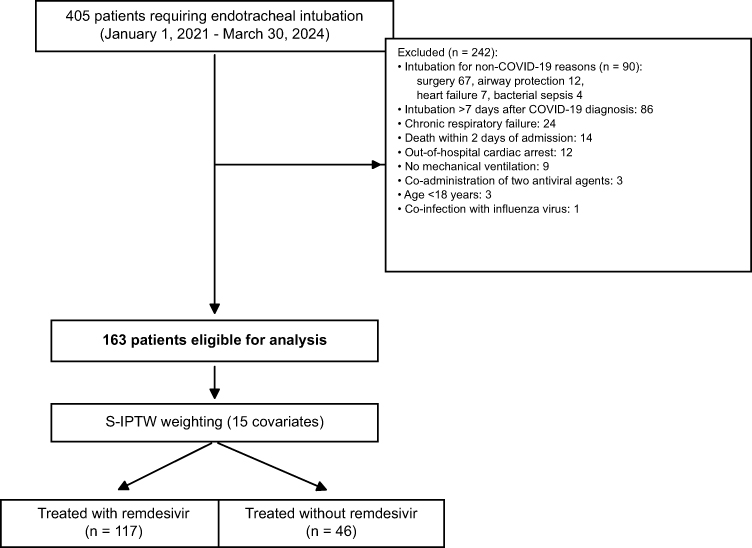 |
Figure 1 Patient Selection Flowchart. Abbreviation: S-IPTW, stabilized inverse probability of treatment weighting. |
Target Trial Emulation
The analytic approach was structured according to a target trial emulation (TTE) framework (Figure S1), which approximates the design elements of a hypothetical randomized controlled trial using real-world data.15 Time zero was defined as the date of COVID-19 diagnosis, with both treatment arms aligned at the same starting point to avoid immortal time bias. The treatment assignment window (grace period) was set at Day 0–3 from diagnosis, during which remdesivir must be initiated for patients in the treatment group. The control group was defined as patients who did not receive remdesivir during their entire hospitalization, not merely those with delayed treatment. These key design features ensured proper emulation of a randomized trial and avoidance of immortal time bias. This framework specified the eligibility criteria, treatment strategies, assignment procedures, follow-up period, outcomes, and analytic methods, with further details provided in Table S1.
Data Collection and Baseline Characteristics
Remdesivir exposure was defined as administration of the standard recommended dose for at least three consecutive days during hospitalization; patients who received fewer than three days were excluded. All clinical and laboratory data were extracted directly from the hospital’s integrated, patient-level electronic health record system, which is automatically linked to the National Health Insurance death registry for ascertainment of vital status; no separate study-specific data-collection software was used. Baseline demographic and clinical characteristics, including age, sex, Charlson Comorbidity Index (CCI), relevant comorbidities (stroke, coronary artery disease, heart failure, diabetes mellitus, hypertension, chronic kidney disease, hyperlipidemia, and chronic obstructive pulmonary disease), and laboratory values (including white blood cell count, hemoglobin, platelet count, absolute neutrophil count, absolute lymphocyte count, blood urea nitrogen, creatinine, aspartate aminotransferase, alanine aminotransferase, total bilirubin, C-reactive protein, and pro-B-type natriuretic peptide) were obtained for all eligible patients. Comparisons of these variables between the remdesivir and control groups were performed both before and after IPTW weighting.
Inverse Probability of Treatment Weighting
To address potential confounding, IPTW was performed using propensity scores estimated via logistic regression. The propensity score model included 15 baseline covariates: age, sex, Charlson Comorbidity Index, individual comorbidities (heart failure, diabetes mellitus, hypertension, chronic kidney disease, and hyperlipidemia), complete blood count parameters (hemoglobin, platelet count, absolute neutrophil count, and absolute lymphocyte count), renal function markers (blood urea nitrogen and creatinine), and C-reactive protein as an inflammatory marker (Table S2). These variables were selected based on their clinical relevance to both remdesivir treatment decisions and mortality outcomes in critically ill COVID-19 patients.
Stabilized IPTW (S-IPTW) weights were calculated to improve estimation efficiency and reduce the influence of extreme weights. For treated patients, the stabilized weight was calculated as P(A=1)/PS, and for control patients as P(A=0)/(1-PS), where P(A=1) represents the marginal probability of treatment and PS represents the individual propensity score. Weights were truncated at the 1st and 99th percentiles to minimize the impact of extreme values. Covariate balance between groups after weighting was assessed using standardized mean differences (SMD), with values <0.1 considered indicative of optimal balance and <0.2 considered acceptable The distribution of propensity scores and weights was examined to ensure adequate overlap between treatment groups (Figure S2). The quality of covariate balance was evaluated through visual inspection of the Love plot (Figure S3) and comparison of baseline characteristics before and after weighting.
Definition of Exposure and Outcomes
Remdesivir exposure was defined as receipt of the standard recommended regimen for at least three consecutive days, initiated within three days of COVID-19 diagnosis. The primary outcomes were overall mortality (all-cause mortality from COVID-19 diagnosis to end of follow-up) and 90-day mortality (death within 90 days of COVID-19 diagnosis). The secondary outcome was mechanical ventilation (MV) duration, defined as time on mechanical ventilation with death during MV as the event and successful extubation treated as a competing event. All mortality events, including deaths after hospital discharge, were ascertained from systematic review of the longitudinal electronic medical record and from linkage to the National Health Insurance death registry, providing dual confirmation of vital status. Survival time was measured from the date of COVID-19 diagnosis (time zero) to the occurrence of the event of interest or the end of follow-up (May 1, 2025), whichever occurred first.
Statistical Analysis
Kaplan-Meier survival curves were generated for each outcome using S-IPTW weights, and differences between groups were compared using the weighted Log rank test. S-IPTW weighted Cox proportional hazards regression models with robust standard errors were constructed to estimate hazard ratios (HRs) and 95% confidence intervals (CIs) for remdesivir use. The proportional hazards assumption was assessed using Schoenfeld residuals.
Sensitivity analyses were performed to assess the robustness of findings. First, we repeated the main analysis excluding patients who received ECMO to evaluate whether results were influenced by this subgroup with extreme illness severity. Second, E-values were calculated to quantify the minimum strength of association that an unmeasured confounder would need to have with both treatment and outcome to fully explain away the observed effect.16 For the MV duration outcome, cumulative incidence functions were estimated accounting for the competing risk of successful extubation (Figure S4). All statistical analyses were conducted using Python version 3.10 with the lifelines and statsmodels packages, with a two-sided p-value <0.05 considered statistically significant.
Results
A total of 405 COVID-19 patients who required endotracheal intubation and mechanical ventilation were identified between January 1, 2021, and March 30, 2024. Of these, 242 patients were excluded: 90 for non-COVID-19 intubation indications (67 surgery, 12 airway protection, 7 heart failure, 4 sepsis), 86 for intubation more than 7 days after diagnosis, 24 for chronic respiratory failure, 14 for death within 2 days, 12 for out-of-hospital cardiac arrest, 9 for absence of mechanical ventilation, 3 for co-administration of two antivirals, 3 for age below 18 years, and 1 for influenza co-infection (Figure 1). The final analytic cohort comprised 163 patients meeting the predefined eligibility criteria, including 117 (71.8%) who received remdesivir and 46 (28.2%) who did not.
Table 1 summarizes the baseline demographic and clinical characteristics before and after S-IPTW weighting. Before weighting, several baseline imbalances were observed between the remdesivir and control groups. Patients in the control group were older (mean age 76.1 vs 72.7 years), had higher Charlson Comorbidity Index scores (8.8 vs 6.8), and had higher prevalence of chronic kidney disease (50.0% vs 22.2%), diabetes mellitus (60.9% vs 45.3%), and hypertension (67.4% vs 58.1%). Laboratory values also differed substantially, with control patients having higher blood urea nitrogen (51.1 vs 33.1 mg/dL), creatinine (2.6 vs 1.6 mg/dL), and pro-BNP levels (8922.6 vs 4394.6 pg/mL). These differences resulted in large standardized mean differences, with the maximum |SMD| of 0.716 observed for blood urea nitrogen.
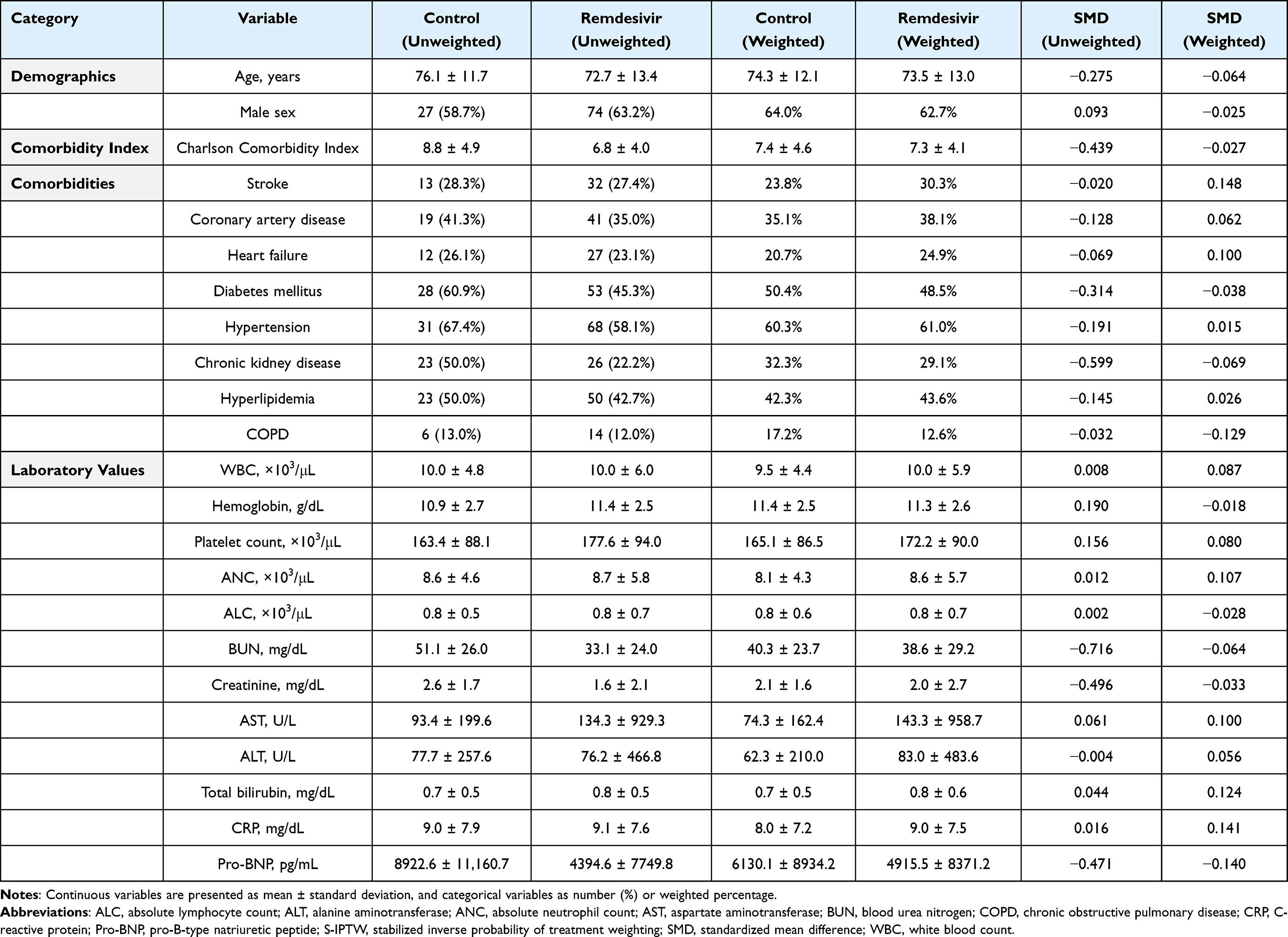 |
Table 1 Baseline Characteristics Before and After S-IPTW Weighting |
After S-IPTW weighting, substantial improvement in covariate balance was achieved. The weighted baseline characteristics showed comparable mean ages (74.3 vs 73.5 years), similar CCI scores (7.4 vs 7.3), and balanced prevalence of major comorbidities including diabetes mellitus (50.4% vs 48.5%), chronic kidney disease (32.3% vs 29.1%), and hypertension (60.3% vs 61.0%). Laboratory values were also well-balanced after weighting, including blood urea nitrogen (40.3 vs 38.6 mg/dL) and creatinine (2.1 vs 2.0 mg/dL). After weighting, all SMD values were less than 0.2, with the maximum |SMD| of 0.148 observed for stroke. Nine covariates had |SMD| between 0.1 and 0.2 after weighting, while the remaining variables achieved optimal balance with |SMD| less than 0.1 (Table S3). The distribution of propensity scores showed adequate overlap between treatment groups, with the overlap region ranging from 0.290 to 0.869 (Figure S2). The mean S-IPTW weight was 0.98, close to the expected value of 1.0, indicating good stabilization (Table S4).
Primary Outcomes
Kaplan-Meier survival curves for the S-IPTW weighted cohort are shown in Figure 2. For overall mortality, 53 death events occurred: 41 (35.0%) in the remdesivir group and 12 (26.1%) in the control group. In the unweighted analysis, remdesivir use was not significantly associated with overall mortality (HR 1.38; 95% CI 0.72–2.64; p=0.335). However, after S-IPTW weighting, remdesivir use was significantly associated with increased overall mortality (HR 2.52; 95% CI 1.24–5.15; p=0.011) (Figure 3A and Table 2).
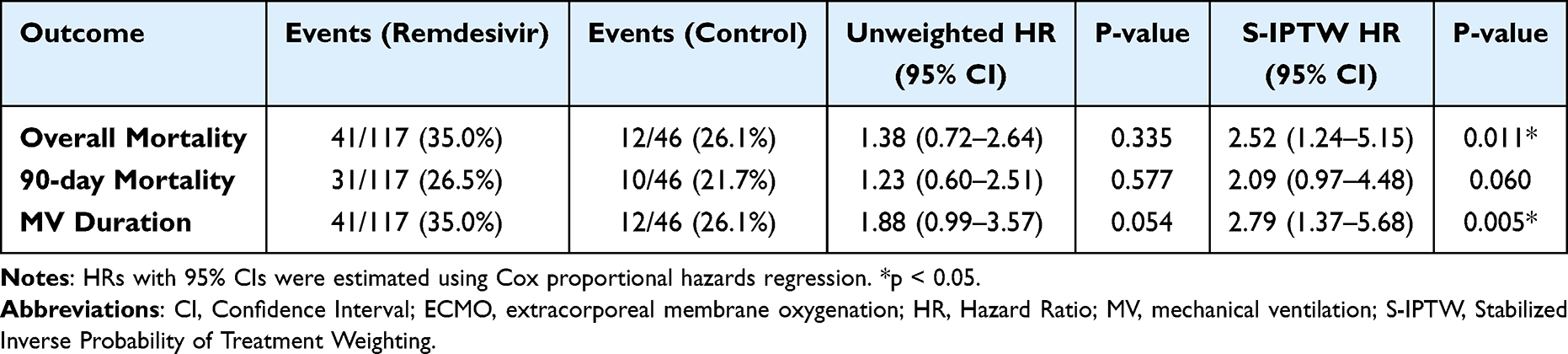 |
Table 2 Primary and Secondary Outcome Results |
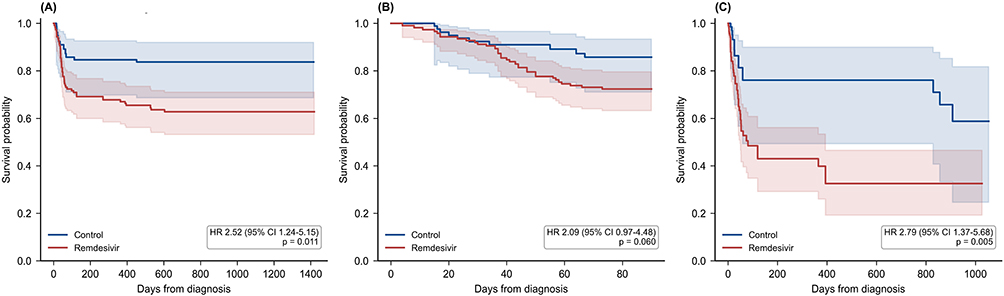 |
Figure 2 Kaplan-Meier Survival Curves Comparing Remdesivir versus Control Groups (S-IPTW Weighted). (A) Overall Mortality. (B) 90-day Mortality. (C) Mechanical Ventilation Duration. Abbreviations: CI, confidence interval; HR, hazard ratio; S-IPTW, stabilized inverse probability of treatment weighting. |
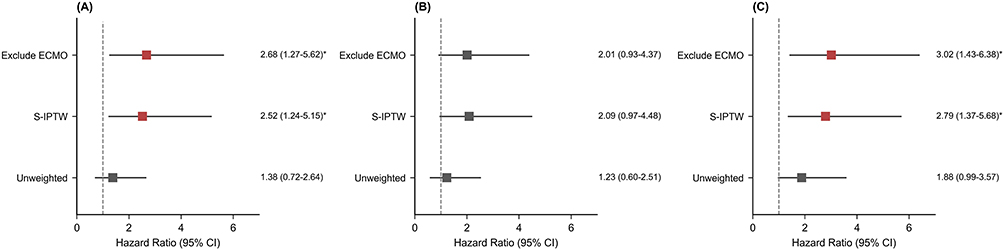 |
Figure 3 Forest Plot of Hazard Ratios for Primary and Secondary Outcomes. (A) Overall Mortality. (B) 90-day Mortality. (C) Mechanical Ventilation Duration. Results shown for unweighted analysis, S-IPTW weighted analysis, and sensitivity analysis excluding ECMO users. * p < 0.05. Abbreviations: CI, confidence interval; ECMO, extracorporeal membrane oxygenation; S-IPTW, stabilized inverse probability of treatment weighting. |
For 90-day mortality, 41 death events occurred: 31 (26.5%) in the remdesivir group and 10 (21.7%) in the control group. The unweighted analysis showed no significant association (HR 1.23; 95% CI 0.60–2.51; p=0.577). After S-IPTW weighting, a trend toward increased 90-day mortality was observed with remdesivir use, though not reaching statistical significance (HR 2.09; 95% CI 0.97–4.48; p=0.060) (Figure 3B and Table 2).
Secondary Outcome
Regarding mechanical ventilation duration, 53 death events occurred during MV. In the unweighted analysis, remdesivir use showed a borderline association with increased death during MV (HR 1.88; 95% CI 0.99–3.57; p=0.054). After S-IPTW weighting, remdesivir use was significantly associated with prolonged mechanical ventilation duration and increased death during MV (HR 2.79; 95% CI 1.37–5.68; p=0.005) (Figures 2C, 3C and Table 2). Competing risk analysis accounting for successful extubation as a competing event showed consistent findings (Figure S4).
Sensitivity Analyses
Results were consistent in sensitivity analyses excluding ECMO users (n=154). The association between remdesivir use and overall mortality remained significant (HR 2.68; 95% CI 1.27–5.62; p=0.009), with similar findings for MV duration (HR 3.02; 95% CI 1.43–6.38; p=0.004). The 90-day mortality showed a consistent trend (HR 2.01; 95% CI 0.93–4.37; p=0.076) (Table 3).
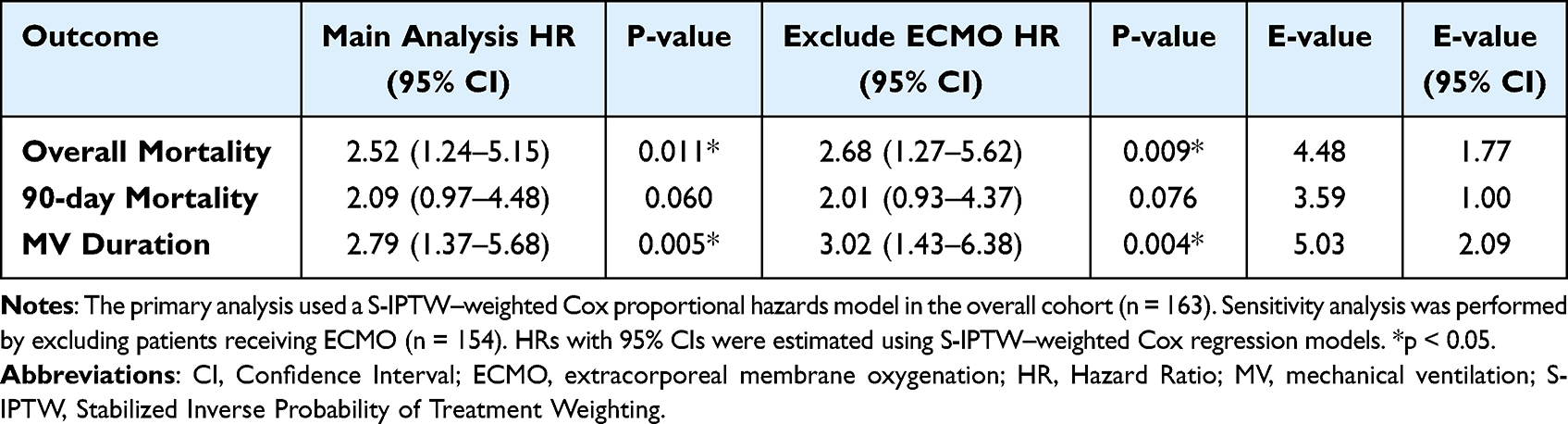 |
Table 3 Sensitivity Analyses |
E-values were calculated to assess sensitivity to unmeasured confounding. For overall mortality, the E-value was 4.48 (95% CI lower bound: 1.77), indicating that an unmeasured confounder would need to be associated with both remdesivir treatment and mortality by a risk ratio of at least 4.48 to fully explain away the observed effect, or 1.77 to move the confidence interval to include the null. For MV duration, the E-value was 5.03 (95% CI lower bound: 2.09), suggesting moderate robustness to unmeasured confounding (Table 3).
To address whether differences in concomitant supportive care or infectious complications contributed to the observed association, we compared the frequency of major co-interventions and complications between groups before and after S-IPTW weighting (Table S5). Corticosteroid therapy was nearly universal and comparable between groups (weighted 98.2% vs 98.9%; SMD −0.058). Secondary bacterial infection, defined by the concurrent presence of symptoms, radiographic change, and microbiological evidence, was similar between groups (weighted 86.2% vs 84.3%; SMD 0.053), as was invasive fungal infection (predominantly aspergillosis, with two cases of candidemia; weighted 28.2% vs 33.0%; SMD −0.104). Notably, patients in the remdesivir group received more, not less, intensive supportive and immunomodulatory care, including tocilizumab (weighted 51.5% vs 32.7%), vasopressors (80.0% vs 65.0%), and ECMO (6.4% vs 1.1%); thus the higher mortality cannot be attributed to inferior standards of care or to a higher burden of secondary infection. Because these interventions were administered after time zero and may lie on the causal pathway between treatment and outcome, they were not included in the propensity score model and are presented descriptively. Admission co-infection, the only factor present at baseline, was additionally examined in sensitivity analyses (Table S6).
In sensitivity analyses, the association remained robust. Additionally adjusting the propensity score model for admission co-infection and recent prior hospitalization yielded consistent estimates (overall mortality HR 2.62; 95% CI 1.28–5.37; p=0.009), as did excluding patients with admission co-infection (HR 2.71; 95% CI 1.24–5.88; p=0.012). Furthermore, when vital status was re-verified through linkage to the National Health Insurance death registry and chart review, reclassifying four patients, the association was strengthened (overall mortality HR 2.98; 95% CI 1.44–6.16; p=0.003) (Table S6).
Discussion
To the best of our knowledge, this is one of the first real-world studies using rigorous causal inference methodology to report a significant association between remdesivir use and increased mortality among mechanically ventilated COVID-19 patients. Our S-IPTW analysis revealed that remdesivir use was associated with significantly increased overall mortality (HR 2.52) and prolonged mechanical ventilation duration (HR 2.79), with consistent numerical trends toward harm across all mortality endpoints. These findings provide real-world evidence supporting current guideline recommendations against routine remdesivir initiation in patients already requiring invasive mechanical ventilation.
COVID-19 pathogenesis follows a distinct temporal pattern that has critical implications for antiviral therapy timing. As a direct-acting antiviral targeting RNA polymerase, remdesivir demonstrated greatest efficacy during early infection when viral replication predominates, particularly in patients requiring supplemental oxygen but not mechanical ventilation.4 However, by the time intubation becomes necessary, patients have typically transitioned into the hyperinflammatory phase characterized by cytokine storm and immune-mediated tissue damage rather than ongoing viral replication.17 Recent evidence from high-mortality ICU cohorts demonstrates that serum cytokine dysregulation signatures, rather than viral burden, become the predominant drivers of adverse outcomes in critically ill patients.18 During this advanced phase, pathophysiology shifts from viral cytopathic effects to host-mediated inflammatory cascades involving elevated pro-inflammatory mediators that directly contribute to organ failure. This temporal evolution explains why remdesivir may offer limited benefit in mechanically ventilated patients, as suppressing residual viral replication is unlikely to reverse established immune-mediated organ damage. Our findings strongly align with this pathophysiological rationale, suggesting continued remdesivir use in this population may be futile or potentially harmful.
Notably, baseline imbalances in the unweighted cohort, particularly higher CCI, blood urea nitrogen, and pro-BNP in the control group, suggest potential confounding by indication. During the early phase of the pandemic, remdesivir was not recommended for patients with advanced renal impairment (eg, creatinine clearance <30 mL/min or those on dialysis),19 likely resulting in the preferential exclusion of these patients from the remdesivir group. Given the known association between BNP elevation and chronic kidney disease, these differences likely reflect underlying comorbidity clustering rather than clinical equipoise. The S-IPTW method effectively balanced these confounders, reducing the maximum |SMD| from 0.716 to 0.148. Although residual confounding cannot be entirely excluded, the E-value analysis suggests that an unmeasured confounder would need to have a substantial association with both treatment and outcome (RR ≥4.48) to fully explain away the observed effect.
Despite international guidelines recommending against remdesivir use in mechanically ventilated COVID-19 patients, a substantial proportion of such patients in Taiwan still received the drug, as evidenced by its administration in 71.8% of patients in our cohort. Only a small proportion (28.2%) did not receive remdesivir, and among them, some were excluded not by clinical discretion but due to impaired renal function. Several factors may contribute to this practice pattern. Taiwan’s healthcare system is built on a universal social insurance model, which allows patients to access high-quality medical care at a relatively low cost.20 While this system brings many benefits, it also introduces certain challenges.21 One such consequence is that expensive medications such as remdesivir impose minimal financial burden on individual patients.22 Moreover, there is a widespread perception among the public that receiving antiviral treatment, regardless of the strength of supporting evidence, is preferable to receiving no treatment at all, reflecting a “better-than-nothing” mindset. Paradoxically, this pattern of use may have increased patients’ risk of harmful clinical consequences, including mortality9 and drug-related side effects.23
Our findings carry important clinical implications. The significant association between remdesivir use and increased mortality in mechanically ventilated patients reinforces the IDSA recommendation against routine remdesivir initiation in this population. Clinicians should adhere to the package insert and guideline recommendations, which advise against initiating remdesivir in patients already receiving invasive mechanical ventilation. The practice of administering remdesivir to ventilated patients, despite limited supporting evidence, exemplifies the broader challenge of evidence-based prescribing in critical care settings. Just as antibiotic overuse worsens patient outcomes,24 our study demonstrates that antiviral drug misuse may pose similar risks to patient safety, serving as a cautionary reminder to healthcare providers worldwide.
Several limitations should be acknowledged. First, as with any retrospective cohort study, residual confounding and unmeasured biases cannot be fully excluded, although IPTW and target trial emulation were applied to minimize these effects. Second, the control group was smaller (n=46) than the remdesivir group (n=117), reflecting the widespread use of remdesivir in clinical practice. While S-IPTW can accommodate unbalanced groups, confidence intervals remain wider than would be expected with larger samples. Third, the single-center design may limit generalizability, though the tertiary academic setting and standardized treatment protocols may enhance internal validity. Fourth, we could not assess viral load or cytokine data (eg, interleukin-6), which may influence treatment decisions and outcomes; available inflammatory markers (C-reactive protein, neutrophil and lymphocyte counts) were, however, included in the propensity score model and balanced after weighting. In addition, viral genotyping was not performed; based on national genomic surveillance, the study period spanned the pre-Omicron and Omicron-dominant eras (Omicron predominating from 2022 onward in Taiwan), and variant-specific effects could not be assessed.14,25,26 Finally, the observational nature of this study precludes definitive causal conclusions, though our target trial emulation framework and sensitivity analyses strengthen the validity of our findings.
Conclusion
In this single-center observational study, remdesivir use in mechanically ventilated COVID-19 patients was associated with higher mortality and longer mechanical ventilation duration. Because of the observational design, these findings indicate association rather than causation, and residual confounding cannot be excluded. Nonetheless, their consistency across endpoints and multiple sensitivity analyses, including re-verification of vital status against the national death registry, provides real-world evidence aligning with current guideline recommendations against routine remdesivir initiation in this population. Taiwan’s universal health insurance, by minimizing the financial barrier to high-cost therapies, offered a distinctive real-world opportunity to evaluate this practice; larger multicenter Taiwanese studies are warranted to confirm and refine these findings.
Use of Artificial Intelligence
The authors used ChatGPT (OpenAI, GPT-5.3) to assist with language editing. All content was reviewed and verified by the authors, who take full responsibility for the final manuscript.
Data Sharing Statement
The datasets used and/or analyzed during the current study are available from the corresponding author, Te-Yu Lin ([email protected]), on reasonable request.
Ethics/Ethical Approval
The Institutional Review Board at Tri-Service General Hospital approved this study (IRB No. A202405134), which complied with the ethical principles enshrined in the Declaration of Helsinki (2013 amendment). The requirement for informed consent was waived due to the retrospective design. All patient records were fully anonymized before analysis, and patient confidentiality was maintained throughout in accordance with institutional data-protection policy.
Author Contributions
All authors made a significant contribution to the work reported, whether that is in the conception, study design, execution, acquisition of data, analysis and interpretation, or in all these areas; took part in drafting, revising or critically reviewing the article; gave final approval of the version to be published; have agreed on the journal to which the article has been submitted; and agree to be accountable for all aspects of the work. Yan-Ru Wang: Conceptualization, Visualization, Investigation, Resources, Formal analysis, Writing – Original Draft. Hong-Jie Jhou: Validation, Resources, Methodology. Po-Huang Chen: Conceptualization, Software, Formal analysis, Data Curation, Writing – Review & Editing. Te-Yu Lin: Conceptualization, Supervision, Project administration, Writing – Review & Editing.
Funding
This study was supported by the Tri-Service General Hospital (TSGH_E_115279) (Yan-Ru Wang).
Disclosure
The authors declare that they have no known competing financial interests or personal relationships that could have appeared to influence the work reported in this paper.
References
1. Du Y, Tu L, Zhu P, et al. Clinical features of 85 fatal cases of COVID-19 from Wuhan: a retrospective observational study. Am J Respir Crit Care Med. 2020;201(11):1372–11. doi:10.1164/rccm.202003-0543OC
2. Tzotzos SJ, Fischer B, Fischer H, Zeitlinger M. Incidence of ARDS and outcomes in hospitalized patients with COVID-19: a global literature survey. Crit Care. 2020;24(1):516. doi:10.1186/s13054-020-03240-7
3. Hoenen T, Groseth A, Feldmann H. Therapeutic strategies to target the Ebola virus life cycle. Nat Rev Microbiol. 2019;17(10):593–606. doi:10.1038/s41579-019-0233-2
4. Beigel JH, Tomashek KM, Dodd LE, et al. Remdesivir for the treatment of Covid-19 - final report. N Engl J Med. 2020;383(19):1813–1826. doi:10.1056/NEJMoa2007764
5. Lee TC, Murthy S, Del Corpo O, et al. Remdesivir for the treatment of COVID-19: a systematic review and meta-analysis. Clin Microbiol Infect. 2022;28(9):1203–1210. doi:10.1016/j.cmi.2022.04.018
6. Quah P, Li A, Phua J. Mortality rates of patients with COVID-19 in the intensive care unit: a systematic review of the emerging literature. Crit Care. 2020;24(1):285. doi:10.1186/s13054-020-03006-1
7. Richardson S, Hirsch JS, Narasimhan M, et al. Presenting characteristics, comorbidities, and outcomes among 5700 patients hospitalized with COVID-19 in the New York City area. JAMA. 2020;323(20):2052–2059. doi:10.1001/jama.2020.6775
8. Lavrentieva A, Kaimakamis E, Voutsas V, et al. An observational study on factors associated with ICU mortality in Covid-19 patients and critical review of the literature. Sci Rep. 2023;13(1):7804. doi:10.1038/s41598-023-34613-x
9. WHO Solidarity Trial Consortium. Remdesivir and three other drugs for hospitalised patients with COVID-19: final results of the WHO Solidarity randomised trial and updated meta-analyses. Lancet. 2022;399(10339):1941–1953. doi:10.1016/S0140-6736(22)00519-0
10. Infectious Diseases Society of America. IDSA guidelines on the treatment and management of patients with COVID-19. Available from: https://www.idsociety.org/practice-guideline/covid-19-guideline-treatment-and-management/.
11. Taiwan Centers for Disease Control. The 29th edition of the clinical management guidelines for SARS-CoV-2 (COVID-19) infection. Available from: https://www.cdc.gov.tw/File/Get/enl8hx3WmplAijO0ElAyeA.
12. Whittington MD, Pearson SD, Rind DM, Campbell JD. The cost-effectiveness of remdesivir for hospitalized patients with COVID-19. Value Health. 2022;25(5):744–750. doi:10.1016/j.jval.2021.11.1378
13. Wu CW, Pham BT, Wang JC, et al. The COVIDTW study: clinical predictors of COVID-19 mortality and a novel AI prognostic model using chest X-ray. J Formos Med Assoc. 2023;122(3):267–275. doi:10.1016/j.jfma.2022.09.014
14. Cheng HI, Chang KW, Wu BC, et al. Comparison of clinical characteristics and mortality outcome in critical COVID-19 patients infected with Alpha and Omicron variants. Infect Drug Resist. 2025;18:151–160. doi:10.2147/IDR.S479896
15. Hernán MA, Wang W, Leaf DE. Target trial emulation: a framework for causal inference from observational data. JAMA. 2022;328(24):2446–2447. doi:10.1001/jama.2022.21383
16. VanderWeele TJ, Ding P. Sensitivity analysis in observational research: introducing the E-value. Ann Intern Med. 2017;167(4):268–274. doi:10.7326/M16-2607
17. Gandhi RT, Lynch JB, Del Rio C. Mild or moderate Covid-19. N Engl J Med. 2020;383(18):1757–1766. doi:10.1056/NEJMcp2009249
18. Maaß H, Ynga-Durand M, Milošević M, et al. Serum cytokine dysregulation signatures associated with COVID-19 outcomes in high mortality intensive care unit cohorts across pandemic waves and variants. Sci Rep. 2024;14(1):13605. doi:10.1038/s41598-024-64384-y
19. US Food and Drug Administration. Emergency use authorization (EUA) of Veklury (remdesivir) for the treatment of COVID-19. Available from: https://www.fda.gov/media/155772/download.
20. Yeh MJ, Chang HH. National health insurance in Taiwan. Health Aff (Millwood). 2015;34(6):1067. doi:10.1377/hlthaff.2015.0447
21. Lin PY, Kaplan W, Lin CH, et al. Taiwan’s National Health Insurance at the emergency department following the COVID-19 outbreak. Public Health Nurs. 2023;40(4):517–527. doi:10.1111/phn.13186
22. Hsu JC, Lu CY. The evolution of Taiwan’s National Health Insurance drug reimbursement scheme. Daru. 2015;23(1):15. doi:10.1186/s40199-014-0080-7
23. Izcovich A, Siemieniuk RA, Bartoszko JJ, et al. Adverse effects of remdesivir, hydroxychloroquine and lopinavir/ritonavir when used for COVID-19: systematic review and meta-analysis of randomised trials. BMJ Open. 2022;12(3):e048502. doi:10.1136/bmjopen-2020-048502
24. Jones BE, Ying J, Stevens V, et al. Empirical anti-MRSA vs standard antibiotic therapy and risk of 30-day mortality in patients hospitalized for pneumonia. JAMA Intern Med. 2020;180(4):552–560. doi:10.1001/jamainternmed.2019.7495
25. Gong YN, Kuo NY, Yeh TS, Shih SR, Chen GW. Genomic surveillance of SARS-CoV-2 in Taiwan: a perspective on evolutionary data interpretation and sequencing issues. Biomed J. 2025;48(4):100820. doi:10.1016/j.bj.2024.100820
26. Tsai JJ, Chiou SS, Chen PC, et al. The epidemiology and phylogenetic trends of Omicron subvariants from BA.5 to XBB.1 in Taiwan. J Infect Public Health. 2024;17(11):102556. doi:10.1016/j.jiph.2024.102556
 © 2026 The Author(s). This work is published and licensed by Dove Medical Press Limited. The
full terms of this license are available at https://www.dovepress.com/terms
and incorporate the Creative Commons Attribution
- Non Commercial (unported, 4.0) License.
By accessing the work you hereby accept the Terms. Non-commercial uses of the work are permitted
without any further permission from Dove Medical Press Limited, provided the work is properly
attributed. For permission for commercial use of this work, please see paragraphs 4.2 and 5 of our Terms.
© 2026 The Author(s). This work is published and licensed by Dove Medical Press Limited. The
full terms of this license are available at https://www.dovepress.com/terms
and incorporate the Creative Commons Attribution
- Non Commercial (unported, 4.0) License.
By accessing the work you hereby accept the Terms. Non-commercial uses of the work are permitted
without any further permission from Dove Medical Press Limited, provided the work is properly
attributed. For permission for commercial use of this work, please see paragraphs 4.2 and 5 of our Terms.
Recommended articles

COVID-19 Case Fatality Rate and Factors Contributing to Mortality in Ethiopia: A Systematic Review of Current Evidence
Girma D, Dejene H, Adugna L, Tesema M, Awol M
Infection and Drug Resistance 2022, 15:3491-3501
Published Date: 4 July 2022
Remdesivir Reduces Mortality in Hemato-Oncology Patients with COVID-19
Aksak-Wąs BJ, Chober D, Serwin K, Scheibe K, Niścigorska-Olsen J, Niedźwiedź A, Dobrowolska M, Żybul K, Kubacka M, Zimoń A, Hołda E, Mieżyńska-Kurtycz J, Gryczman M, Jamro G, Szakoła P, Parczewski M
Journal of Inflammation Research 2022, 15:4907-4920
Published Date: 25 August 2022
Mortality Risk Factors of Early Neonatal Sepsis During COVID-19 Pandemic
Kolesnichenko SI, Kadyrova IA, Lavrinenko AV, Zhumadilova ZA, Avdienko OV, Vinogradskaya YV, Fominykh YA, Panibratec LG, Akhmaltdinova LL
Infection and Drug Resistance 2022, 15:6307-6316
Published Date: 31 October 2022
Platelet-to-White Blood Cell Ratio as a Predictor of Mortality in Patients with Severe COVID-19 Pneumonia: A Retrospective Cohort Study
Thungthienthong M, Vattanavanit V
Infection and Drug Resistance 2023, 16:445-455
Published Date: 24 January 2023
Neutrophil/Lymphocyte Ratio (NLR) and Lymphocyte/Monocyte Ratio (LMR) – Risk of Death Inflammatory Biomarkers in Patients with COVID-19
Dymicka-Piekarska V, Dorf J, Milewska A, Łukaszyk M, Kosidło JW, Kamińska J, Wolszczak-Biedrzycka B, Naumnik W
Journal of Inflammation Research 2023, 16:2209-2222
Published Date: 23 May 2023