
Back to Journals » Clinical, Cosmetic and Investigational Dermatology » Volume 19
A Nomogram Predicting Decreased Quality of Life in Patients with Keloids
Authors Xu S, Huang Y, Zhang L, Wu Y, Zhang H, Wu J, Gu Z, Dong C 
Received 2 September 2025
Accepted for publication 9 December 2025
Published 6 January 2026 Volume 2026:19 564610
DOI https://doi.org/10.2147/CCID.S564610
Checked for plagiarism Yes
Review by Single anonymous peer review
Peer reviewer comments 3
Editor who approved publication: Prof. Dr. Rungsima Wanitphakdeedecha
Shu Xu,1,* Yuting Huang,1,* Li Zhang,1,* Yuqi Wu,1 Hao Zhang,1 Jiawen Wu,1 Zhifeng Gu,2 Chen Dong2
1Department of Dermatology, Affiliated Hospital of Nantong University, Nantong University, Nantong, People’s Republic of China; 2Research Center of Clinical Medicine, Affiliated Hospital of Nantong University, Nantong University, Nantong, People’s Republic of China
*These authors contributed equally to this work
Correspondence: Zhifeng Gu, Research Center of Clinical Medicine, Affiliated Hospital of Nantong University, Nantong University, Nantong, 226000, People’s Republic of China, Email [email protected] Chen Dong, Research Center of Clinical Medicine, Affiliated Hospital of Nantong University, Nantong University, Nantong, 226000, People’s Republic of China, Email [email protected]
Purpose: Most keloid patients have a low quality of life (QoL), which affects their prognosis. Our aim was to identify risk factors for a decreased QoL in patients with keloids and to create a predictive nomogram for this condition.
Patients and Methods: The Dermatology Life Quality Index (DLQI) is used to assess patients’ QoL, with a DLQI score > 10 indicated a decreased QoL. We used multivariate logistic regression to assess QoL in patients with keloids for predictive modeling. We assessed the predictive and clinical value of the nomograms using the consistency index (C-index), area under the curve (AUC), and decision curve analysis (DCA).
Results: The risk factors that associated with a decreased QoL in patients with keloids are smoking (OR = 2.463, 95% CI = 1.031– 5.880, P = 0.042), pain with pruritus (OR = 2.647, 95% CI = 1.232– 5.684, P = 0.013), and anxiety (OR = 5.294, 95% CI = 2.158– 12.987, P < 0.001). The C-index of the nomogram was 0.704 (95% CI = 0.675– 0.733), with the AUC of 0.714 (95% CI = 0.634– 0.792). The results of the DCA suggest that the model is clinically beneficial when the risk threshold is between 0% and 79%. Internal validation indicates that nomograms could be more effectively utilized in clinical practice.
Conclusion: Our study found that people with keloids currently experience a poor QoL, and that nomograms can assist dermatologists in predicting which patients are at higher risk for a further decline in QoL.
Keywords: keloids, quality of life, nomogram, anxiety
Introduction
Keloids are abnormal scars that form when collagen grows excessively during the healing process after a skin injury.1 They appear as raised, hard nodules that extend beyond the original wound.2 Keloids may originate from wounds where inflammatory mediators (eg TGF-β) activate fibroblasts excessively during the healing process.3 This leads to the deposition of excessive collagen, causing the healed border of the original wound to expand and grow into the surrounding normal skin.4 Keloids do not go away on their own. Common clinical treatments for keloids currently include surgery, hormone therapy, radiation therapy, cryotherapy, local pressure, intralesional corticosteroids, and intralesional fluorouracil.5 However, there is a lack of specific and effective treatments.6 Keloids tend to be pink, purple or dark brown in color and are often accompanied by pruritus or pain and local skin sensitivity.7 The limited treatment options, the nature of the tissue damage that is prone to recurrence and the severity of the clinical presentation may affect the patient’s appearance and body image.8 This can lead to negative emotions that have a detrimental effect on social interaction and quality of life (QoL).9
However, few studies have explored the QoL among patients with keloids, and there is a lack of relevant clinical risk prediction models. Studies from India and Germany have reported a lower QoL in patients with keloids, which is associated with clinical symptoms such as pruritus, pain and hyperpigmentation.10,11 The psychological QoL of patients with keloids was significantly decreased, but no influence of physiological factors on this decrease was found. In a study from the Netherlands, the QoL of patients with keloids was assessed using the Short Form 36 Health Survey (SF-36) scale, and it was found that psychologically related QoL was significantly decreased in patients with keloids compared to controls, but no influence of physiologically related factors on the decreased QoL was found.12 At the same time, the aforementioned study in the Netherlands found that pruritus symptoms greatly affected patients’ emotional health and QoL.12 This study suggests that it is extremely important to pay attention to the emotional problems experienced by patients with keloids in terms of their effect on QoL.
Among studies of Chinese populations, Lu et al were the first to assess the QoL of Chinese patients with keloids using the Dermatology Life Quality Index (DLQI) scale.13 Their findings revealed that QoL was poorer among patients with visible keloid tissue, pruritus and bigger keloid.13 Meanwhile, patients with visible keloid tissue were more likely to experience self-perceived symptoms such as depression. However, as this is a retrospective study, it does not adequately reflect the QoL experienced by patients with keloids during clinical consultations or flare-ups of the disease. Moreover, the impact of lifestyle habits on the QoL of patients with keloids has yet to be explored by existing studies, leaving many factors unclear.
Although researchers have acknowledged the importance of evaluating QoL in patients with keloids, standardized QoL instruments fail to adequately capture their lived experience. The Keloid Intervention Benefit Inventory 21 (KIBI-21), developed by German scholar Daniel, was designed specifically for ear keloids.14 However, its site-specific nature and considerable completion time impose a significant burden on dermatologists by increasing their workload and time commitment. In contrast, a nomogram serves as a predictive model that systematically integrates multiple predictors, such as clinical characteristics and laboratory indicators, thereby enabling clinicians to efficiently estimate an individual’s risk of specific clinical outcomes.
Based on this, the present study was conducted to investigate the factors affecting the decreased QoL experienced by patients with keloids and to construct a nomogram model. As a visual multifactorial predictive tool, nomograms can integrate multiple risk factors into individualized risk probabilities. We hope that this will provide dermatologists with a reliable tool with which to develop personalized treatments and improve patients’ QoL.
Method
Participants
The study was conducted in the dermatology outpatient clinic and hospitalization department of a hospital in Nantong, China. Rigorous inclusion and exclusion guidelines were adopted to make the results of the study more accurate. Inclusion criteria were as follows: (1) Patients over 18 years of age who have been diagnosed with keloids by a dermatologist through a clinical diagnosis, considering their medical history and conducting a physical examination. (2) Voluntary participation in this study. Exclusion criteria: (1) There have been major life changes in the last 6 months, such as divorce or death of a relative. (2) Patients with remaining skin injuries. (3) Unwilling to participate in this study. Our healthy control group came from a hospital in Nantong without skin diseases, and the inclusion criteria were the same as those of keloids patients. The main aim of our study was to investigate the QoL of patients with keloids. Therefore, we primarily compared the differences between the various dimensions of QoL. All participants voluntarily participated in this study and signed the informed consent form.
Patient Reported Outcome Questionnaires
The DLQI was originally developed by Khan and Finlay in 1994 and has since become a commonly used scale for evaluating QoL in patients with dermatological conditions.15,16 The 10-item scale has a score range of 0–3 for each item and a total score range of 0–30. The total score reflects the extent to which skin diseases affect QoL: 0–1: no effect; 2–5: mild effect; 6–10: moderate effect; 11–20: severe effect; and 21–30: extreme effect. We defined a DLQI score of over 10 as indicating a decline in QoL, suggesting that keloids have a severe or very severe impact on patients’ QoL.17 The Cronbach’s alpha for the scale in this study was 0.886. This study was approved by the Ethics Committee of Affiliated Hospital of Nantong University (NO. 2021-K132-01), and the study procedures adhere to the principles of the Declaration of Helsinki.
The Vancouver Scar Scale (VSS) provides a comprehensive and accurate evaluation of keloids color, thickness, vascular distribution and softness from multiple dimensions.18 The scale ranges from 0 to 15 points, with higher scores indicating more serious keloids hyperplasia. In our study, the scale had a Cronbach’s α of 0.666 and was evaluated by a specialized dermatologist. In addition, dermatologists further assessed keloid characteristics using the VSS questionnaire. Thickness was defined with a cutoff of 2 millimeters; keloids with measured thickness greater than 2 millimeters were categorized as having thickness-related features. Similarly, for the blood supply dimension, scores exceeding 2 on the VSS indicated abundant blood supply at the keloid injury site.
Hospital Anxiety and Depression Scale (HADS), this scale is specifically used to assess the level of anxiety and depression in hospitalized patients.19 Anxiety and depression consist of 7 items respectively, and the score range of both is 0–21 points. If the score is ≥ 8, the patient can be considered to have anxiety or depression. The higher the score, the higher the degree. The Cronbach’s α of the scale in this study was 0.907.
Clinical Characteristics of Disease
Dermatologists assess the clinical characteristics of keloids. The diameter of the largest keloid present was calculated, and keloids that were more than 2 cm in diameter were defined as big keloids. Following the BIJLARD literature’s criterion of “wearing ordinary clothin” to determine visible keloid areas, we categorize the head, ears, neck and hands as such.12 The color of keloids is recorded following a visual assessment by dermatologists who have all undergone standardized training prior to participating in this study.
Data Analysis
All statistical analyses were performed using SPSS (version 27.0) and RStudio (version 2024). Quantitative data were described using the mean and standard deviation (M ± SD), while categorical variables were described using frequencies and percentages (%), which were then analyzed using independent samples t-tests and chi-square tests. Factors contributing to a decreased QoL, as identified in univariate analyses (P < 0.05), were included in a multivariate logistic regression model.20 This identified independent risk factors for decreased QoL in patients with keloids. These risk factors were then constructed into a nomogram model. The construction and validation of the nomograms was mainly carried out using the “rms”, “pROC” and “rmda” functions from the R package, while the “ggplot2” package was used for plotting. The predictive ability of the nomogram was evaluated using the area under the curve (AUC) of the receiver operating characteristic curve (ROC). Calibration curves were used to show how consistent the predicted probabilities were with the observed outcomes. This was complemented by statistical validation via the Hosmer–Lemeshow test. A decision curve analysis (DCA) was conducted to calculate the net benefit for everyone across different threshold probabilities, to evaluate the practical value of the predictive model for clinical decision-making.21
Results
The QoL for Patients with Keloids Face Serious Challenges
A total of 262 people were finally included in this study, including 202 keloid patients and 60 healthy people. As shown in Figure 1, the bar chart revealed a significant difference in total DLQI scores between patients with keloids and the control group (P < 0.001). This difference was reflected not only in the total score, but also in the radar chart (Figure 2), which showed that the scores for the six dimensions of the DLQI were much higher in patients with keloids than in the healthy control group.
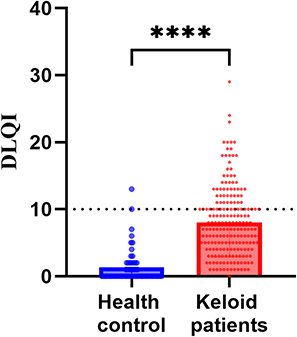 |
Figure 1 The bar chart showed a significant difference in the total the Dermatology Life Quality Index (DLQI) score between keloid patients and healthy controls (P < 0.001). When a DLQI score greater than 10 was used as the critical value for determining quality of life impairment, the number of patients meeting this criterion in the keloid group was significantly higher than that in the healthy control group. Note: ****P < 0.001. |
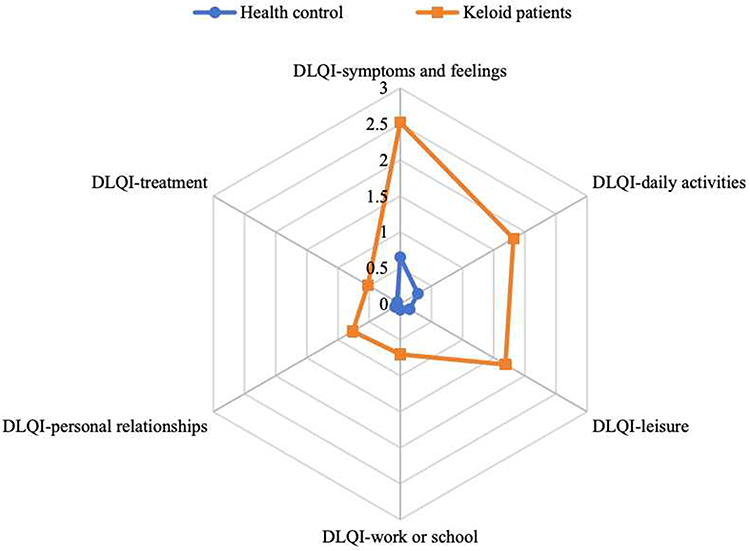 |
Figure 2 The radar chart results demonstrate that keloid patients scored significantly higher than healthy control across all six dimensions of the Dermatology Life Quality Index (DLQI), indicating a severely worrisome status of quality of life (QoL) in these patients. |
Independent Risk Factors Seriously Impairing the QoL of Patients with Keloids
As shown in Table 1, a total of 202 patients with keloids participated in the study. The mean age of these patients was 32.87 ± 11.21, 102 were males and 100 were females. According to the DLQI scoring guidelines, the 202 keloids were divided into two groups using a DLQI score of 10 as the cut-off value. Those with a DLQI score greater than 10 were in the decreased QoL group, while those with a DLQI score of 10 or less were in the group with a basically unaffected QoL. Data on sociodemographic characteristics, clinical characteristics and psychological status were compared between the two groups of patients. Univariate analyses showed that patients with keloids with decreased QoL had higher rates of smoking (25.0% VS 12.7%, P = 0.036), infection (40.4% VS 24.7%, P = 0.031), pain (76.9% VS 52.7%, P = 0.002), pain with pruritus (76.9% VS 51.3%, P = 0.001), anxiety (32.7% VS 6.7%, P < 0.001) and depression (21.2% VS 6.7%, P = 0.003) compared to patients with basically unaffected QoL. Multifactorial logistic regression analysis showed that smoking (OR = 2.463, 95% CI = 1.031–5.880, P = 0.042), pain with pruritus (OR = 2.647, 95% CI = 1.232–5.684, P = 0.013) and anxiety (OR = 5.294, 95% CI = 2.158–12.987, P < 0.001) were independent risk factors for decreased QoL in patients with keloids (Table 2).
 |
Table 1 Baseline Characteristics of Patients with Keloids with Decreased QoL |
 |
Table 2 Multivariate Analysis of Independent Risk Factors for Decreased QoL in Patients with Keloids |
Construction and Validation of the Nomogram Model
The above independent risk factors were further modelled in a nomogram (Figure 3). We assessed the calibration of the model using the Hosmer–Lemeshow goodness-of-fit test and calibration curve (Bootstrap method, n = 1000). The results showed x2 = 0.25, P = 0.88 (P > 0.05), a mean absolute error of 0.042 and the consistency index (C-index) was 0.704 (95% CI = 0.675–0.733), indicating that the predictive model has a high discrimination ability (Figure 4). The nomogram model’s ability to discriminate was evaluated using the ROC curve. The nomogram model’s AUC was 0.714 (95% CI = 0.634–0.792). The respective specificity and sensitivity were 40.7% and 88.5%, and the optimal cut-off value was 0. 166 (Figure 5). In addition, DCA was used to evaluate the model’s clinical utility, and the results indicated that its predictive power exceeded that of the two extreme reference curves (All and None) for risk thresholds ranging from 0% to 79% (Figure 6). This strongly suggests that the model has significant potential for application in clinical practice.
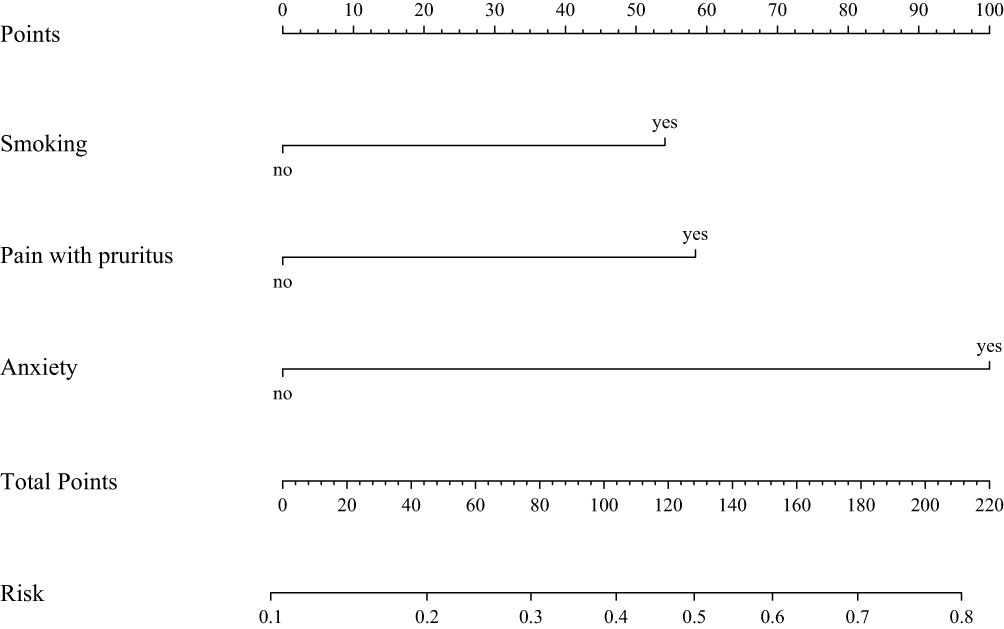 |
Figure 3 The nomogram predicts the risk of severe impact on quality of life (QoL) in patients with keloids. Each variable is assigned a score on the point scale axis. The total score is easily calculated by adding up the individual scores. By projecting the total score onto the lower total point scale, the probability of a severe impact on the QoL of keloid patients can be estimated. |
 |
Figure 4 This is the calibration curve for the nomogram. The x-axis shows the predicted probability according to the nomogram, and the y-axis shows the actual probability that the quality of life of a patient with keloids is severely affected. A perfect prediction would correspond to the solid blue line. The green solid line represents the entire cohort (n = 202), while the red solid line is biascorrected using bootstrapping with 1000 replicates. |
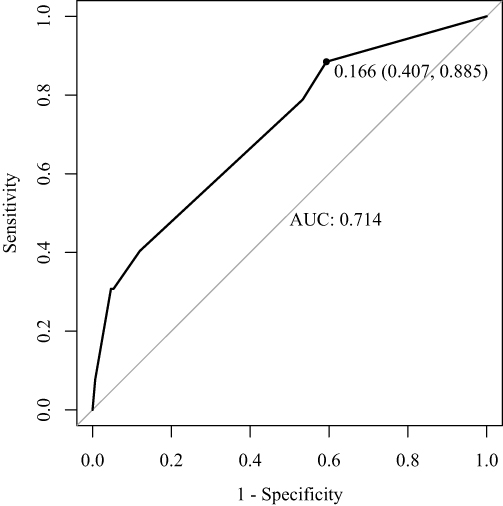 |
Figure 5 The discrimination ability of the nomogram model was evaluated using the receiver operating characteristic (ROC) curve. The area under the curve (AUC) of the nomogram model was 0.714 (95% CI = 0.675–0.733). The specificity and sensitivity were 40.7% and 88.5% respectively, and the optimal cutoff value was 0.166. |
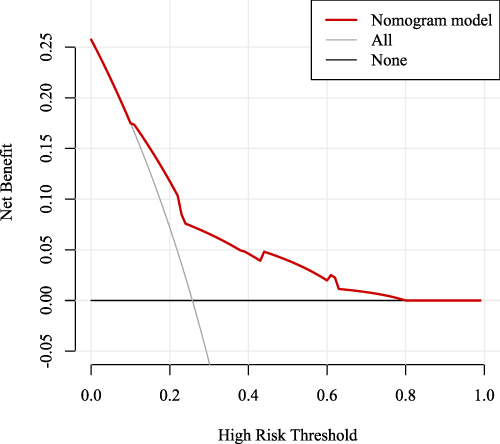 |
Figure 6 The decision curve analysis (DCA) was used to evaluate the clinical utility of the model. The results showed that the predictive ability of this model exceeded that of the two extreme reference curves. This finding strongly implies that the model has significant application potential in clinical practice. |
Discussion
The DLQI was used to assess the QoL of Chinese patients with keloids in this article, while exploring the impact of factors such as anxiety, depression, and clinical symptoms on patients’ decreased QoL. The results of this study revealed that the QoL of Chinese patients with keloids was significantly lower than that of healthy controls, as reflected in the dimensions of the DLQI. In terms of lifestyle, smoking is associated with risk factors for decreased QoL in patients with keloids. In terms of clinical symptoms, keloids size, infection, pain with pruritus were associated with decreased QoL. In terms of emotional psychology, anxiety and depression were found to be associated with decreased QoL.
In terms of lifestyle, this study revealed that patients who smoked experienced a lower QoL. Smoking can induce pulmonary fibrosis in respiratory diseases by causing SIRT1 inactivation and promoting the autophagy-dependent senescence of alveolar epithelial type 2 cells.22 Keloids are also associated with benign fibroproliferative properties. Previous studies have reported that smoking can accelerate the progression of dermal fibrosis, which can indirectly impact the rate of pathological scar formation and lead to a poor prognosis, such as the development of a pathological keloid.23,24 This study illustrates that smoking may promote the progression of keloids, leading to a poor prognosis and decreased QoL in patients. Healthcare professionals should advise patients on the dangers of smoking regarding disease progression and encourage them to quit through health education.
In this study, the clinical symptoms of big keloids, infection, pain, and pain with pruritus were found to be associated with decreased QoL in Chinese patients with keloids, and pain with pruritus were independent risk factors for decreased QoL. A study in Beijing suggests that infections cause a decreased QoL.25 An African study suggests that pruritus, pain with pruritus and hyperpigmentation can lead to decreased QoL in patients with keloids and highlights that patients with keloids in which pain with pruritus are the predominant clinical symptoms can have a severely decreased QoL.26 The German study demonstrated that the symptoms had been successfully treated, which resulted in an enhancement in the patients’ QoL.11 These studies suggest that clinical symptoms have an adverse impact on the QoL of patients with keloids, and this issue needs to be brought to the attention of dermatological healthcare providers. Clinical dermatologists should encourage patients to change dressings frequently to prevent infection. They should also work closely with patients to formulate personalized treatment plans based on the size of keloids, symptoms such as pain with pruritus, and hormone tolerance. Combined treatment plans should be chosen to reduce recurrence rates and improve patients’ QoL by achieving clinical remission of the disease.
In terms of psychological disorders, we report that anxiety and depression influence the decreased QoL of Chinese patients with keloids and play an important role in the QoL of Chinese patients with skin injuries. The presence of psychological disorders such as anxiety and depression has been reported by our project group in patients with ankylosing spondylitis who develop skeletal deformity changes, as well as in patients with systemic lupus erythematosus who have facial rashes. This has resulted in decreased QoL for the patients.27–29 In fact, psychological disorders are highly prevalent in patients with psoriasis and other skin lesions. This significantly and negatively affects patients’ QoL.30 Psychological disorders significantly impact QoL and are key areas for intervention.31 At the same time, psychological disorders interact with other risk factors to cause a persistent decline in patients’ QoL. For example, nicotine, a key component of tobacco smoke, increases anxiety-related behaviors in female mice when administered over a prolonged period. Furthermore, reducing the activity of the enzyme acetylcholinesterase (AChE) locally enhances acetylcholine signaling in the hippocampus, leading to increased avoidance of environments that induce anxiety.32 Therefore, effectively managing psychological disorders, such as anxiety and depression, should be an integral part of a comprehensive clinical treatment plan for keloids, aiming to enhance patients’ QoL and long-term prognosis.
The nomogram model, which was derived from the aforementioned research findings, enables clinicians to quickly evaluate the likelihood of a patient’s declining QoL. During follow-up appointments and upon completion of all medical consultations, the dermatologist presents a pre-prepared nomogram chart. The patient is asked about their smoking status, whether the pain with pruritus and their anxiety levels. Individual scores for these predictive factors are totaled and the overall risk probability of declining QoL is determined based on the final score.
Conclusion
In summary, we constructed a nomogram prediction model for decreased QoL in dermatological patients with keloids. The QoL of keloid patients was significantly lower than that of healthy controls. Adverse lifestyle behaviors such as smoking, clinical symptoms such as pain with pruritus, and psychological disorders such as anxiety and depression are important risk factors for reduced QoL in patients with keloids. In future clinical diagnosis and treatment, healthcare professionals need to focus on the comprehensive management of lifestyle and mental health while paying attention to clinical symptoms to improve the QoL and prognosis of keloid patients. Our study also has limitations. This research primarily investigated the factors affecting the decline in QoL among Chinese keloid patients, using a single subject group. Furthermore, the sample size was significantly different between the healthy control group and the keloid group. This imbalance may reduce the statistical power of the tests. We will subsequently expand our multicenter studies, carefully controlling the number of intergroup comparisons.
Acknowledgments
The authors express their sincere gratitude to all individuals who participated in this study.
Author Contributions
Shu Xu, Yuting Huang and Li Zhang are first authors and contributed equally to this work. All authors made a significant contribution to the work reported, whether that is in the conception, study design, execution, acquisition of data, analysis and interpretation, or in all these areas; took part in drafting, revising or critically reviewing the article; gave final approval of the version to be published; have agreed on the journal to which the article has been submitted; and agree to be accountable for all aspects of the work.
Funding
This work was supported by Jiangsu Funding Program for Excellent Postdoctoral Talent, Postgraduate Research & Practice Innovation Program of Jiangsu Province (SICX24_2044, KYCX24_3592); Jiangsu Provincial Medical Key Discipline Cultivation Unit (No. JSDW202205).
Disclosure
The authors declare no conflict of interest.
References
1. Xu H, Zhu Z, Hu J, et al. Downregulated cytotoxic CD8+ T-cell identifies with the NKG2A-soluble HLA-E axis as a predictive biomarker and potential therapeutic target in keloids. Cell Mol Immunol. 2022;19(4):527–10. doi:10.1038/s41423-021-00834-1
2. Dirand Z, Maraux M, Tissot M, et al. Macrophage phenotype is determinant for fibrosis development in keloid disease. Matrix Biol. 2024;128:79–92. doi:10.1016/j.matbio.2024.03.001
3. Shim J, Oh SJ, Yeo E, et al. Integrated analysis of single-cell and spatial transcriptomics in keloids: highlights on fibrovascular interactions in keloid pathogenesis. J Invest Dermatol. 2022;142(8):2128–39.e11. doi:10.1016/j.jid.2022.01.017
4. Delaleu J, Charvet E, Petit A. Keloid disease: review with clinical atlas. Part I: definitions, history, epidemiology, clinics and diagnosis. Ann Dermatol Venereol. 2022;150:3–15. doi:10.1016/j.annder.2022.08.010
5. Cohen AJ, Nikbakht N, Uitto J. Keloid disorder: genetic basis, gene expression profiles, and immunological modulation of the fibrotic processes in the skin. Cold Spring Harb Perspect Biol. 2023;15(7):a041245. doi:10.1101/cshperspect.a041245
6. Xiao K, Wang S, Chen W, et al. Identification of novel immune-related signatures for keloid diagnosis and treatment: insights from integrated bulk RNA-seq and scRNA-seq analysis. Hum Genomics. 2024;18(1):80. doi:10.1186/s40246-024-00647-z
7. Santiago S, Brown R, Shao K, Hooper J, Perez M. Modified fitzpatrick scale-skin color and reactivity. J Drugs Dermatol. 2023;22(7):641–646. doi:10.36849/JDD.6859
8. Har-Shai Y, Har-Shai L, Zouboulis VA, Zouboulis CC. Different types of auricular keloids and treatment by intralesional cryosurgery: best practice for obtaining long-lasting clinical results. Dermatology. 2022;238(1):170–179. doi:10.1159/000514954
9. Jiang Z, Chen Z, Xu Y, et al. Low-frequency ultrasound sensitive Piezo1 channels regulate keloid-related characteristics of fibroblasts. Adv Sci. 2024;11(14):e2305489. doi:10.1002/advs.202305489
10. Sitaniya S, Subramani D, Jadhav A, Sharma YK, Deora MS, Gupta A. Quality-of-life of people with keloids and its correlation with clinical severity and demographic profiles. Wound Repair Regen. 2022;30(3):409–416. doi:10.1111/wrr.13015
11. Poetschke J, Reinholz M, Schwaiger H, Epple A, Gauglitz GG. DLQI and POSAS scores in keloid patients. Facial Plast Surg. 2016;32(3):289–295. doi:10.1055/s-0036-1583851
12. Bijlard E, Kouwenberg CA, Timman R, Hovius SE, Busschbach JJ, Mureau MA. Burden of keloid disease: a cross-sectional health-related quality of life assessment. Acta Derm Venereol. 2017;97(2):225–229. doi:10.2340/00015555-2498
13. Lu W, Chu H, Zheng X. Effects on quality of life and psychosocial wellbeing in Chinese patients with keloids. Am J Transl Res. 2021;13(3):1636–1642.
14. Häussler D, Hüttemann S, Weiß C, Rotter NK, Sadick H. The keloid intervention benefit inventory 21: a new assessment tool for the quality of life of patients with auricular keloids. Facial Plast Surg. 2021;37(3):370–375. doi:10.1055/s-0041-1722913
15. Finlay AY, Khan GK. Dermatology life quality index (DLQI)--a simple practical measure for routine clinical use. Clin Exp Dermatol. 1994;19(3):210–216. doi:10.1111/j.1365-2230.1994.tb01167.x
16. Vyas J, Johns JR, Abdelrazik Y, et al. The Dermatology Life Quality Index (DLQI) used as the benchmark in validation of 101 quality-of-life instruments: a systematic review. J Eur Acad Dermatol Venereol. 2024;104:adv41120. doi:10.2340/actadv.v104.41120
17. Yang J, Hu K, Li X, et al. Psoriatic foot involvement is the most significant contributor to the inconsistency between PASI and DLQI: a retrospective study from China. Clin Cosmet Investig Dermatol. 2023;16:443–451. doi:10.2147/CCID.S396997
18. Bagheri M, von Kohout M, Fuchs PC, et al. How to evaluate scar colour after burn injuries - A clinical comparison of the Mexameter® and the subjective scar assessment (POSAS/VSS). Burns. 2023;50(3):691–701.
19. Philippot A, Dubois V, Lambrechts K, et al. Impact of physical exercise on depression and anxiety in adolescent inpatients: a randomized controlled trial. J Affect Disord. 2022;301:145–153. doi:10.1016/j.jad.2022.01.011
20. Zhang F, Han Y, Mao Y, Zheng G, Liu L, Li W. Non-invasive prediction nomogram for predicting significant fibrosis in patients with metabolic-associated fatty liver disease: a cross-sectional study. Ann Med. 2024;56(1):2337739. doi:10.1080/07853890.2024.2337739
21. Cai Z, Lin H, Li Z, et al. A prediction nomogram for postoperative gastroparesis syndrome in right colon cancer: a retrospective study. Langenbecks Arch Surg. 2023;408(1):148. doi:10.1007/s00423-023-02885-6
22. Zhang Y, Huang W, Zheng Z, et al. Cigarette smoke-inactivated SIRT1 promotes autophagy-dependent senescence of alveolar epithelial type 2 cells to induce pulmonary fibrosis. Free Radic Biol Med. 2021;166:116–127. doi:10.1016/j.freeradbiomed.2021.02.013
23. Jo T, Jeong W, Ryu JY. Risk of myocardial infarction and stroke in patients with keloids: a nationwide population-based cohort study. J Plast Reconstr Aesthet Surg. 2025;105:65–74. doi:10.1016/j.bjps.2025.03.034
24. Huang C, Ogawa R. Systemic factors that shape cutaneous pathological scarring. FASEB J. 2020;34(10):13171–13184. doi:10.1096/fj.202001157R
25. Liang Z, Zhang M, Hao Y, et al. Risk factors associated with keloid infections: a five-year retrospective study. Int Wound J. 2023;20(6):2215–2223. doi:10.1111/iwj.14099
26. Hawash AA, Ingrasci G, Nouri K, Yosipovitch G. Pruritus in Keloid Scars: mechanisms and Treatments. Acta Derm Venereol. 2021;101(10):adv00582. doi:10.2340/00015555-3923
27. Xu X, Shen B, Zhang A, et al. Anxiety and depression correlate with disease and quality-of-life parameters in Chinese patients with ankylosing spondylitis. Patient Prefer Adherence. 2016;10:879–885. doi:10.2147/PPA.S86612
28. Shen B, Tan W, Feng G, et al. The correlations of disease activity, socioeconomic status, quality of life, and depression/anxiety in Chinese patients with systemic lupus erythematosus. Clin Dev Immunol. 2013;2013:270878. doi:10.1155/2013/270878
29. Shen B, Feng G, Tang W, et al. The quality of life in Chinese patients with systemic lupus erythematosus is associated with disease activity and psychiatric disorders: a path analysis. Clin Exp Rheumatol. 2014;32(1):101–107.
30. Cortés H, Rojas-Márquez M, Del Prado-Audelo ML, Reyes-Hernández OD, González-Del Carmen M, Leyva-Gómez G. Alterations in mental health and quality of life in patients with skin disorders: a narrative review. Int J Dermatol. 2022;61(7):783–791. doi:10.1111/ijd.15852
31. Kassi K, Kouame K, Allou A, et al. Quality of life in black African patients with keloid scars. Dermatol Reports. 2020;12(2):8312. doi:10.4081/dr.2020.8312
32. Picciotto MR, Kenny PJ. Mechanisms of Nicotine Addiction. Cold Spring Harb Perspect Med. 2021;11(5):a039610. doi:10.1101/cshperspect.a039610
 © 2026 The Author(s). This work is published and licensed by Dove Medical Press Limited. The
full terms of this license are available at https://www.dovepress.com/terms
and incorporate the Creative Commons Attribution
- Non Commercial (unported, 4.0) License.
By accessing the work you hereby accept the Terms. Non-commercial uses of the work are permitted
without any further permission from Dove Medical Press Limited, provided the work is properly
attributed. For permission for commercial use of this work, please see paragraphs 4.2 and 5 of our Terms.
© 2026 The Author(s). This work is published and licensed by Dove Medical Press Limited. The
full terms of this license are available at https://www.dovepress.com/terms
and incorporate the Creative Commons Attribution
- Non Commercial (unported, 4.0) License.
By accessing the work you hereby accept the Terms. Non-commercial uses of the work are permitted
without any further permission from Dove Medical Press Limited, provided the work is properly
attributed. For permission for commercial use of this work, please see paragraphs 4.2 and 5 of our Terms.
Recommended articles

Relation Among Anxiety, Depression, Sleep Quality and Health-Related Quality of Life Among Patients with Systemic Lupus Erythematosus: Path Analysis
Chen HJ, Wang H, Qiu LJ, Ling HY, Wu LL, Wang TR, Zhou Y, Xue Y, Ye DQ, Wang B
Patient Preference and Adherence 2022, 16:1351-1358
Published Date: 25 May 2022
A Cross-Sectional Study on the Relationship Between Rosacea Severity and Quality of Life or Psychological State
Yang F, Zhang Q, Song D, Liu X, Wang L, Jiang X
Clinical, Cosmetic and Investigational Dermatology 2022, 15:2807-2816
Published Date: 20 December 2022
Impact of Cardiovascular and Metabolic Comorbidities on Long-term Outcomes of Home-based Pulmonary Rehabilitation in COPD
Grosbois JM, Détrée A, Pierache A, Bautin N, Pérez T, Wallaert B, Chenivesse C, Le Rouzic O
International Journal of Chronic Obstructive Pulmonary Disease 2023, 18:155-167
Published Date: 23 February 2023
Correlation Analysis Between Disease Activity and Anxiety, Depression, Sleep Disturbance, and Quality of Life in Patients with Inflammatory Bowel Disease
Yu R, Liu C, Zhang J, Li J, Tian S, Ding F, Liu Z, Wang T, Liu Z, Jiang C, Shi J, Wu K, Dong W
Nature and Science of Sleep 2023, 15:407-421
Published Date: 26 May 2023
Analyzing Role Overload, Mental Health, and Quality of Life Among Jordanian Female Healthcare Professionals: A Cross-Sectional Study
Alnazly EK, Allari R, Alshareef BE, Abu Al-khair F
International Journal of Women's Health 2023, 15:1917-1930
Published Date: 4 December 2023