
Back to Journals » Journal of Inflammation Research » Volume 19
The Evolving Research Landscape of Radiation Enteritis Prevention and Management: A Data-Driven Analysis

Received 14 November 2025
Accepted for publication 23 January 2026
Published 4 February 2026 Volume 2026:19 581527
DOI https://doi.org/10.2147/JIR.S581527
Checked for plagiarism Yes
Review by Single anonymous peer review
Peer reviewer comments 2
Editor who approved publication: Dr Nadia Andrea Andreani
Hang Li, Xiping Shen, Hua Lu
Department of General Surgery, Suzhou Ninth Hospital Affiliated to Soochow University, Suzhou, Jiangsu, People’s Republic of China
Correspondence: Hua Lu, Department of General Surgery, Suzhou Ninth Hospital Affiliated to Soochow University, Suzhou, Jiangsu, 215000, People’s Republic of China, Tel +86-512-82881248, Email [email protected]
Objective: Radiation enteritis (RE) is a common complication following radiotherapy, adversely affecting patient prognosis and quality of life. This study aims to analyze the evolving research landscape of RE prevention and management through a data-driven approach, aiming to delineate the developmental trajectory, identify research hotspots and emerging frontiers, and forecast future trends in RE prevention and management.
Methods: We conducted a data-driven analysis of relevant publications retrieved from the Web of Science Core Collection (2005– 2024). Visualization tool was employed to examine collaboration networks, research hotspots, and trends. A supplementary search in PubMed was conducted to identify related clinical trials.
Results: A total of 594 publications indexed in the Web of Science Core Collection were subjected to a data-driven visual analysis, while a supplementary search in PubMed identified 51 clinical trials to further clarify clinical research status. In this field, the main research topics include prostate cancer, rectal cancer, and cervical cancer, and the main research hotspots include studies on the pathological mechanism of RE, as well as research on the application of conformal radiotherapy, argon plasma coagulation, hyperbaric oxygen therapy, and microbiota transplantation in the prevention and management of RE. Early burst keywords mainly include “conformal radiotherapy”, “sucralfate”, “home parenteral nutrition”, “intensity modulated radiotherapy”, and “hyperbaric oxygen therapy”. In the past three years, the burst keywords in the outbreak period mainly include “efficacy”, “chemoradiation”, “stem cells”, and “transplantation”.
Conclusion: This study reveals that the field has gradually shifted over the past two decades from an initial focus on pathological mechanisms and symptom management toward etiological therapy, with current research frontiers centered on therapies such as mesenchymal stem cell therapy and fecal microbiota transplantation. Future efforts should be guided by this paradigm shift, prioritizing the resolution of specific translational challenges inherent to these emerging treatments, fostering the multidisciplinary collaboration essential in clinical practice, and advancing toward more predictive, preventive, and personalized management strategies for RE. These findings provide valuable insights and guidance for future clinical research and innovation in this field.
Keywords: radiation enteritis, prevention, management, knowledge landscape
Introduction
Radiation therapy is an important treatment modality in the comprehensive management of malignancies.1 While ionizing radiation effectively eliminates malignant cells, it often damages the highly sensitive intestinal tissues, thereby inducing radiation enteritis (RE).2 RE represents a common and severe complication following radiotherapy for abdominal and pelvic malignancies, with approximately 80% of treated patients experiencing varying degrees of acute RE symptoms. In severe cases, it can lead to treatment interruption, directly affecting the efficacy of tumor treatment and patient prognosis.3 In addition, approximately 20% of patients develop chronic RE, typically 6–24 months post-radiotherapy,4 characterized by obliterative arteritis and intestinal fibrosis.5 Consequently, the prevention and management of RE are of great clinical significance for ensuring the continuity of tumor treatment, improving patients’ quality of life, and enhancing their prognosis.
The intestine serves as the primary dose-limiting organ in the radiotherapy of abdominal and pelvic malignancies, as it is one of the least radiation-tolerant tissues.6 The risk of RE is significantly associated with factors such as radiation dose, delivery techniques, and irradiated volume.7 Prior research indicated that the incidence of RE increases significantly when the radiation dose to the abdominopelvic region exceeds 45 Gy.8 With advancements in radiotherapy technology, precision techniques such as intensity-modulated radiotherapy (IMRT), image-guided radiotherapy (IGRT), and stereotactic body radiotherapy (SBRT) have gained widespread application in treating abdominal and pelvic malignancies.9 Despite the fact that precision radiotherapy techniques can play a certain role in preventing the occurrence of RE, RE incidence remains a substantial clinical burden.
Currently, the prevention and treatment methods for RE are characterized by diversity, and a unified standardized protocol has not yet been established.10 In recent years, the treatment of RE has been shifting from symptomatic support to etiological intervention. Emerging therapeutic approaches such as mesenchymal stem cell (MSC) therapy, fecal microbiota transplantation (FMT), and microbial metabolite regulation have been progressively applied in clinical practice, but their efficacy and safety still require further research for verification.11,12 The research on the prevention and management of RE involves a complex knowledge system across multiple fields, including radiation oncology, gastroenterology, pharmacotherapy, and nutritional support. Therefore, it is necessary to systematically sort out and analyze the fragmented knowledge in this research field, so as to achieve a comprehensive understanding of the field.
However, there is still a lack of studies that adopt a data-driven approach to systematically examine how this research field has evolved over the past decades. To fill this gap, our study analyzes the scientific literature on RE prevention and management published in the past twenty years. Using data analysis and visualization tools, we aim to clarify the developmental trajectory, research hotspots, emerging frontiers and future research trends in this field. We hope this work will offer a clear, evidence-based summary and provide guidance for future research endeavors.
Methods
Literature Retrieval and Screening
We conducted a systematic search of the Web of Science Core Collection (WoSCC) database for publications on the prevention and management of RE between 2005 and 2024. Only English-language “reviews” and “articles” were included in this study. The search strategy was designed to be inclusive, aiming to capture the overall landscape of the RE research domain. It was intentionally broad to support a holistic analysis of the field’s overall development. The search strategy employed the following terms: TS/MeSH Terms = (“radiation enteritis” OR “radiation enteropathy” OR “radiation-induced enteritis” OR “radiotherapy-induced enteritis” OR “radiation proctitis” OR “radiation colitis”) AND (“prevention” OR “prevent” OR “management” OR “manage” OR “treatment” OR “treat”). A complementary search was conducted in PubMed database using the same terms, restricted to the publication type “Clinical Trial”. All data were extracted and downloaded on June 19, 2025. Two authors (Hang Li and Xiping Shen) independently screened the retrieved records. Any disputes were resolved through discussion to reach a consensus on the final included publications. Supplementary Figure S1 shows the process of literature retrieval and screening.
Research Methods and Tools
Visualization analysis in this study was conducted using CiteSpace (version 6.4.R1 Advanced) as part of a data-driven, exploratory approach to map the research landscape. To ensure a robust and interpretable analysis, key parameters were set with the following rationale: a 1-year time slicing interval was employed to trace annual developmental dynamics; the Top N was set to 50 per slice to balance the richness of information with visual clarity for network analysis; and other critical thresholds adhered to the software’s established defaults to maintain methodological consistency. Using this framework, we analyzed collaboration networks among countries/regions, institutions, and authors, alongside co-citation analysis of cited authors and references. Furthermore, keyword co-occurrence, cluster, burst detection, and timeline analyses were performed to identify research hotspots, emerging frontiers, and future trends in preventing and managing RE.
Results
Overview Information and Annual Growth Trend of Publications and Citations
Through systematic literature search and screening, 594 publications indexed in the WoSCC were subjected to a data-driven visual analysis, consisting of 494 research articles and 100 review articles. These papers were authored by 3512 researchers from 1089 institutions across 54 countries/regions and published in 291 academic journals. After excluding self-citations, the total citation count for these publications reached 14396. Figure 1 illustrates the annual trend in publications and citations on the prevention and management of RE. Over the past 20 years, the number of publications exceeded 20 in all years except 2010, when there were 17 publications. Moreover, the number of annual publications has surpassed 30 in the recent five years. In addition, the citation counts of the papers have shown a continuous upward trend. The above results indicate that the prevention and management of RE have been continuously attracting global research attention. Additionally, to further clarify clinical research progress, a supplementary search in PubMed identified 51 clinical trials related to the prevention and management of RE.
 |
Figure 1 Annual trend in publications and citations on the prevention and management of radiation enteritis. |
Analysis Of Countries/Regions
Supplementary Table S1 shows the top 10 countries/regions with the most publications on the prevention and management of RE. China (159 literature) and USA (130 literature) have significantly more publications than other countries/regions. The top three countries in terms of total citations of their papers are USA (5529 citations), England (2927 citations), and France (2237 citations). It is worth noting that although China leads in the total number of publications, the average number of citations per paper is relatively low (12.26), indicating that China still needs to improve the quality of its research and its academic influence. Figure 2A presents the cooperation network among countries/regions, which includes 54 nodes and 161 connections, with a network density of 0.1125, suggesting that inter-country cooperation needs to be further strengthened. The centrality value shows that USA (0.35) occupies a core position in the global cooperation network.
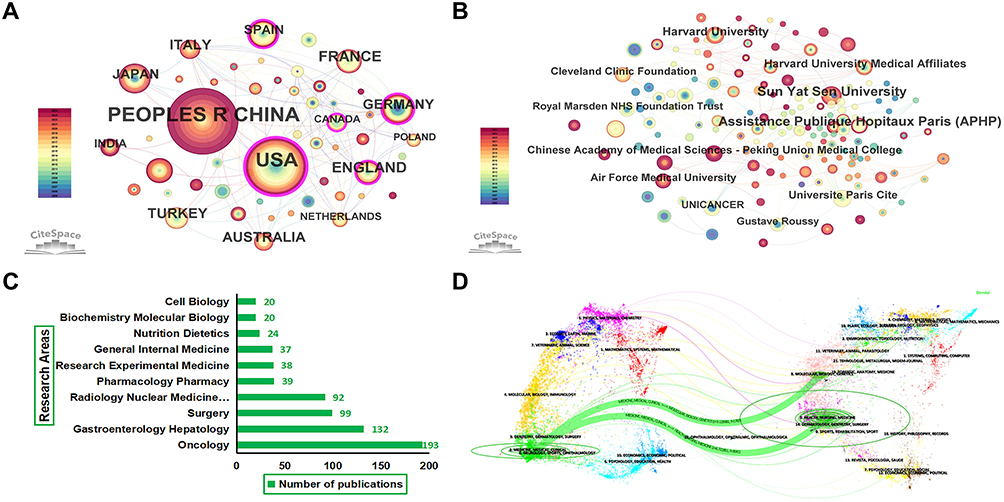 |
Figure 2 (A) Map of collaborative network among countries/regions; (B) Map of collaborative network among institutions; (C) The distribution of publications across disciplines; (D) The dual-map overlay of journals based on CiteSpace. |
Analysis of Institutions
Supplementary Table S2 summarizes the top 10 institutions with the most publications on the prevention and management of RE. The top three institutions with the most publications are Universite Paris Cite (18 literature), Assistance Publique Hopitaux Paris (17 literature), and Sun Yat Sen University (17 literature). The top three institutions with the highest total citations are Universite Paris Cite (1475 citations), Royal Marsden NHS Foundation Trust (1425 citations), and Assistance Publique Hopitaux Paris (1415 citations). In addition, Royal Marsden NHS Foundation Trust has the highest average number of citations per article. Figure 2B presents the cooperation network among institutions, with a network density of 0.0073, suggesting that a low level of collaboration among institutions.
Analysis of Disciplines and Clinical Trials
Figure 2C shows the top 10 disciplinary categories ranked by the number of papers on the prevention and management of RE. The top three disciplinary categories are Oncology, Gastroenterology and Hepatology, and Surgery, accounting for approximately 71.38% of the total publications. A total of 51 clinical trials related to the prevention and management of RE were identified through a search in the PubMed database. The data shows fluctuating annual publication counts, with the highest number of clinical trial articles in this field published in 2020 (8 articles), followed by 2014 (6 articles). While annual output has varied over time, the consistent presence of published clinical trials across the years indicates sustained research activity and ongoing attention to this area.
Analysis Of journals
Supplementary Table S3 lists the top 10 journals that have published the most articles regarding the prevention and management of RE. The top three journals with the highest number of published papers are International Journal of Radiation Oncology Biology Physics (30 literature), World Journal of Gastroenterology (24 literature), Colorectal Disease (13 literature). The top three journals ranked by H-index are International Journal of Radiation Oncology Biology Physics (H-index=20), World Journal of Gastroenterology (H-index=13), and Radiotherapy and Oncology (H-index=10). International Journal of Radiation Oncology Biology Physics ranks first in both the number of published papers and H-index, while World Journal of Gastroenterology has the highest total citations and average citations per paper, indicating that they have high academic influence in this field.
The dual-map overlay of journals in Figure 2D illustrates the association between citing journals and cited journals in the field of prevention and management of RE, showing the knowledge flow in this research area. The left and right sides represent the disciplinary fields involved in citing journals and cited journals, respectively. The colored curves indicate different citation paths, and two green citation paths are identified in this figure Studies from journals in the fields of Medicine/Medical/Clinical are mainly cited by studies from journals of Molecular/Biological/Genetic fields and journals of Health/Nursing/Medicine fields.
Analysis of Authors and Co-Cited Authors
Table 1 lists the top 10 most productive authors and the top 10 most frequently co-cited authors in the field of RE prevention and management. Andreyev HJN from England ranks first in both the publication count (12 publications) and citation count (1149 citations), indicating that he holds a leading position in the field of prevention and management of RE and has made important contributions to the development of this field. Supplementary Figure S2A depicts the author collaboration network based on CiteSpace, with a network density of 0.0039, suggesting that there is a lack of collaboration among authors in this research field.
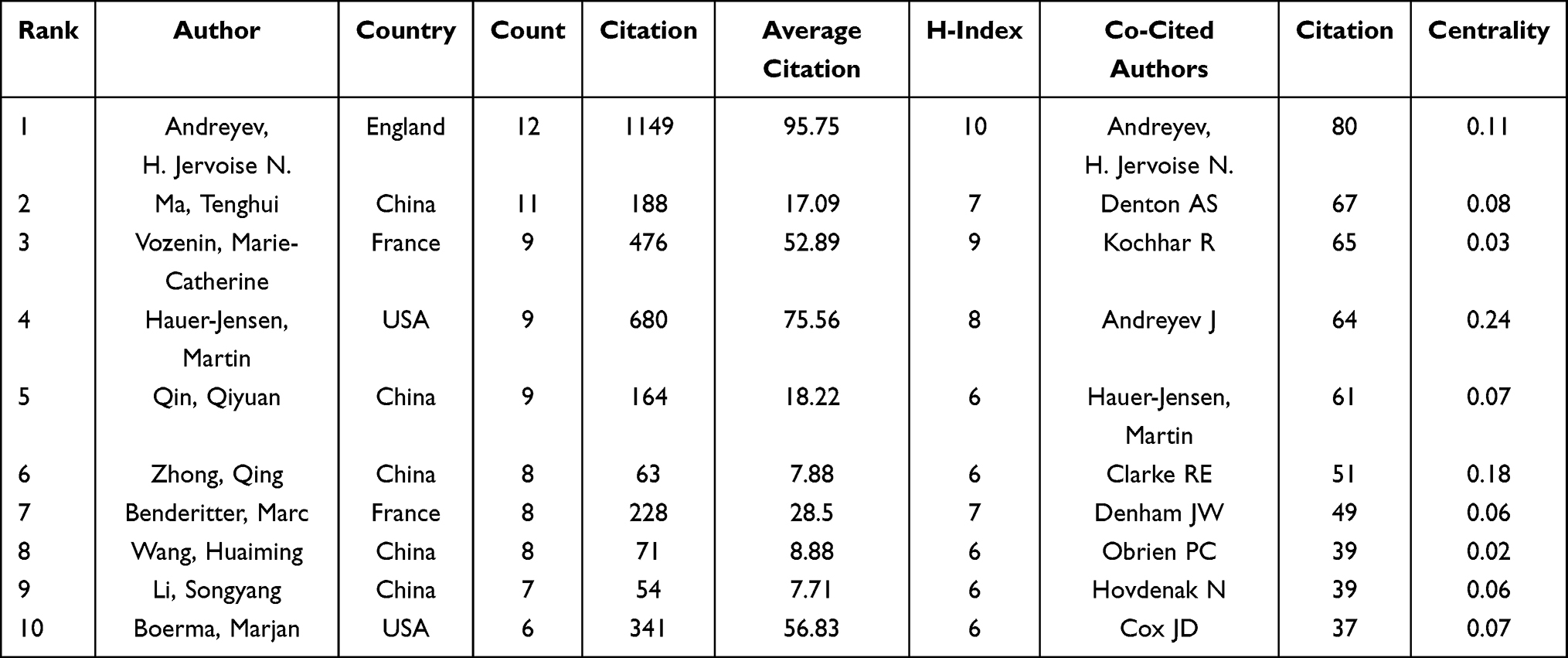 |
Table 1 The Top 10 Most Productive Authors and the Top 10 Most Frequently Co-Cited Authors in the Field of Radiation Enteritis Prevention and Management |
Co-cited author analysis can reveal the core author groups and their academic influence in a disciplinary field. Supplementary Figure S2B shows the co-cited author network based on CiteSpace. The top three authors with the highest co-citation counts are Andreyev HJN (80 times), Denton AS (67 times), and Kochhar R (65 times), indicating that these three scholars have high influence in the field of prevention and management of RE. In addition, the centrality values show that Andreyev J (0.24), Clarke RE (0.18), and Andreyev HJN (0.11) occupy core positions in the author co-citation network.
Analysis of High-Cited Studies, Co-Cited References and References Bursts
Table 2 presents the top 10 most cited studies on the prevention and management of RE. The literature entitled “ESPEN guidelines on chronic intestinal failure in adults” published in Clinical Nutrition in 2016 is the most cited literature, with the highest total citations (531 citations) and average annual citations (53.1 citations per year). This literature is a diagnostic and therapeutic guideline for chronic intestinal failure in adults, which includes recommendations for the diagnosis and treatment of RE.13
 |
Table 2 The Top 10 Most Cited Studies on the Prevention and Management of Radiation Enteritis |
Analysis of co-cited references can identify core references and research hotspots in a research field, as well as reflect the research foundation and knowledge structure of the field. Supplementary Figure S2C shows the co-cited reference network based on CiteSpace, which includes 737 nodes and 1799 connections, with a network density of 0.0066. In addition, the centrality values indicate that “Gastrointestinal complications of pelvic radiotherapy: are they of any importance?” published in 2005 and “Gastrointestinal radiation injury: symptoms, risk factors and mechanisms” published in 2013 have the highest centrality (0.14), suggesting that these two references occupy core positions in the co-cited reference network.14,15 Supplementary Table S4 lists the top 10 most frequently co-cited references regarding the prevention and management of RE. Among them, “Chronic radiation enteritis” published in 2010 ranks first in terms of co-citation count (19 times),16 followed by “Gut microbial dysbiosis is associated with development and progression of radiation enteritis during pelvic radiotherapy” published in 2019 (18 times) and “Hyperbaric oxygen treatment of chronic refractory radiation proctitis: a randomized and controlled double-blind crossover trial with long-term follow-up” published in 2008 (18 times).17,18
Burst citation analysis of references can identify literatures that are frequently cited within a certain period, thereby identifying changes in research hotspots and development trends in the field. Figure 3 shows the top 25 references with the strongest citation bursts. Among them, the one with the highest burst strength is “Hyperbaric oxygen treatment of chronic refractory radiation proctitis: a randomized and controlled double-blind crossover trial with long-term follow-up” by Clarke RE et al, published in International Journal of Radiation Oncology Biology Physics in 2008 (strength=9.5, from 2010 to 2013).18 The reference with the longest duration of citation burst (6 years) is “Radiation induces proinflammatory dysbiosis: transmission of inflammatory susceptibility by host cytokine induction” by Gerassy-Vainberg S et al, published in Gut in 2018.19
 |
Figure 3 Map of top 25 references with the strongest citation bursts. |
Analysis of Keywords
Analysis of keywords can reveal research hotspots, frontiers, and development trends in a research field. Supplementary Table S5 lists the top 10 keywords with the most occurrences in the field of prevention and management of RE. In addition to core search terms such as radiotherapy, radiation proctitis, radiation enteritis, management, and prevention, other high-frequency keywords include prostate cancer, double blind, injury, therapy, and argon plasma coagulation. Furthermore, a total of 10 keyword clusters were generated in this study using the log-likelihood ratio (LLR) algorithm (Supplementary Figure S2D). In this study, the keyword clustering yielded a Q value of 0.4816 and an S value of 0.7945, demonstrating high quality of the obtained keyword clusters. Supplementary Table S6 lists the keyword clusters and their main elements in the field of prevention and management of RE. Through further inductive analysis of high-frequency keywords and keyword clusters, this study identified that in the field of research on the prevention and management of RE, the main research topics include prostate cancer, rectal cancer, and cervical cancer; the main research method is double-blind clinical trials; and the main research hotspots include studies on the pathological mechanism of RE, as well as research on the application of conformal radiotherapy (CRT), argon plasma coagulation, hyperbaric oxygen therapy, microbiota transplantation, and probiotics in the prevention and management of RE.
Keyword burst analysis and keyword timeline analysis can clearly demonstrate the development process and changes in research hotspots of the research field, and help reveal the research frontiers and development trends. Figure 4A shows the map of top 19 keywords with the strongest citation bursts. Among them, the top three keywords with the strongest burst strength are “trial” (strength=6.48), “randomized trial” (strength=5.57), and “carcinoma” (strength=5.15). The keyword with the longest burst duration is “efficacy” (2016–2022). Early burst keywords mainly include “conformal radiotherapy”, “randomized trial”, “sucralfate”, “home parenteral nutrition”, “intensity modulated radiotherapy”, and “hyperbaric oxygen therapy”. In the past three years, the burst keywords in the outbreak period mainly include “efficacy”, “chemoradiation”, “stem cells”, and “transplantation”, which reflect the current research hotspots and frontiers in this field. The timeline map of keywords in this field is shown in Figure 4B. In the early stage of this field, research mainly focused on pathological mechanisms, preventive methods, and traditional treatment methods, while in recent years, research has mainly concentrated on emerging therapies such as MSC therapy, FMT, and microbial metabolite regulation.
 |
Figure 4 (A) Map of top 19 keywords with the strongest citation bursts; (B) Timeline diagram of keywords. |
Discussion
General Information
This study indicates that research activity focused on the prevention and management of RE has maintained a steady academic momentum over the past two decades. The consistent annual publication output exceeding 30 papers in the most recent five years underscores the sustained academic influence and clinical significance of this field. In terms of countries/regions distribution, despite global participation, significant geographical disparity is evident within the research landscape. While China leads in the number of published papers, the USA dominates in academic influence and occupies a central position in the collaborative network, highlighting its role as a key knowledge hub. This contrast necessitates further enhancement of research quality in China. The low density of collaborative networks among countries, institutions, and authors highlights the inadequacy of global collaboration, which may hinder the development of this field. Furthermore, this research field features interdisciplinary integration, covering oncology, gastroenterology, surgery, radiology, and other disciplines.
Research Hotspots and Frontiers
In the early stage of research in the field of prevention and management of RE, studies mainly focused on pathological mechanisms, preventive methods, and traditional treatment approaches. The pathogenesis of RE is driven by a combination of multiple factors, including oxidative stress, apoptosis, inflammatory cascades, impaired tissue repair, and gut dysbiosis.20 Ionizing radiation can hydrolyze water molecules to generate reactive oxygen species (ROS), which overwhelm the endogenous antioxidant defense system, leading to DNA damage and lipid peroxidation in intestinal epithelial cells, thereby disrupting the intestinal epithelial barrier and triggering acute inflammation.21 Additionally, ROS can initiate the mitochondrial apoptosis pathway by upregulating pro-apoptotic proteins and activating caspase proteins, causing damage to intestinal stem cells in the crypt and impairing the regenerative capacity of the intestinal mucosa.22 Furthermore, ROS can activate a variety of inflammatory pathways to promote the production of inflammatory factors such as TNF-α, IL-1β, and IL-6, further exacerbating the inflammatory response.23 A study by Zhou et al demonstrated that ionizing radiation can promote the expression of nuclear receptor coactivator 4, which mediates the autophagic release of cytoplasmic ferritin to free iron. Cytoplasmic free iron is transported into mitochondria via mitochondrial iron transporter 2, triggering lipid peroxidation and ferroptosis in intestinal epithelial cells.24 Recent study has revealed that oxidative stress and inflammation can induce gut dysbiosis, which in turn promotes the expression of inflammatory cytokines and disrupts tight junctions in the intestinal epithelium, further impairing barrier function and exacerbating RE.25 In addition, radiation-induced damage causes capillary endothelial dysfunction, increased vascular permeability, and microthrombosis, leading to intestinal microcirculatory disorders, which result in tissue hypoxia and ischemia.26 Moreover, persistent chronic inflammation drives intestinal epithelial cells toward a pro-fibrotic phenotype, accompanied by elevated levels of TGF-β and platelet-derived growth factor (PDGF), ultimately resulting in intestinal fibrosis, stricture, and even obstruction.27
The prevention of RE is a crucial aspect in reducing the morbidity associated with radiotherapy for abdominal and pelvic malignancies. One significant preventive measure lies in the advancement of radiotherapy techniques. For instance, IMRT, as a more precise radiotherapy technology developed on the basis of 3D-CRT, can more accurately conform the radiation dose to the shape of the target tumor while minimizing the dose delivered to the surrounding normal intestinal tissues, thereby reducing the risk of RE.28 Another important preventive strategy is the use of radioprotective agents, and amifostine is the first radioprotective agent approved by the United States Food and Drug Administration (FDA) for use in cancer patients. It protects normal tissues from radiation-induced damage by scavenging ROS generated during radiotherapy.29 A Phase II multicenter randomized study demonstrated that amifostine administration prior to radiotherapy significantly reduces the incidence of acute RE and is associated with alleviating the severity of acute radiation enteritis symptoms. However, its clinical application is sometimes limited by toxic side effects such as hypotension and gastrointestinal reactions.30 In recent years, the significant role of ionizing radiation-induced gut microbiota dysbiosis in the pathogenesis and progression of RE has been increasingly recognized. Studies have indicated that the use of probiotics during radiotherapy can maintain the balance of intestinal flora, inhibit intestinal inflammatory responses, and the short-chain fatty acids produced by probiotics can provide energy for intestinal epithelial cells and enhance intestinal barrier function, thereby helping to reduce the incidence of radiation enteritis.31,32
Traditional treatment approaches for RE primarily focus on alleviating symptoms and managing complications. Sucralfate, an intestinal mucosal protective agent, has been shown in studies to form a protective coating over damaged intestinal mucosa and facilitate mucosal healing when administered as an enema, thereby reducing symptoms of hematochezia and abdominal pain in radiation proctitis.33 Furthermore, previous research indicates that sulfasalazine can mitigate intestinal inflammation through its breakdown into 5-aminosalicylic acid, effectively alleviating symptoms such as diarrhea and hematochezia in RE.34 Hyperbaric oxygen therapy (HBOT) holds significant value in the treatment of chronic RE. It can not only promote angiogenesis in damaged intestinal tissues, improve tissue ischemia and hypoxia, and facilitate tissue repair, but also exert anti-inflammatory effects by reducing the production of pro-inflammatory cytokines.35 A randomized controlled trial demonstrated that HBOT significantly improves outcomes and bowel-specific quality of life in patients with chronic refractory RE.18 For patients experiencing bleeding due to RE, argon plasma coagulation (APC) is a commonly employed endoscopic treatment modality with a favorable safety profile. A clinical trial demonstrated that APC effectively achieved hemostasis in all patients with mild radiation proctitis and in 79% of patients with severe cases, and could provide long-lasting clinical remission.36
In recent years, the therapeutic concept for RE has shifted from symptom control towards etiological therapy, with research mainly concentrating on emerging therapies such as MSC therapy, FMT, and microbial metabolite regulation therapy. MSC therapy demonstrates considerable potential in RE treatment, as MSCs secrete cytokines and growth factors to promote tissue repair, inhibit apoptosis, reduce inflammation, and modulate immune responses.37 A preclinical study indicated that transplantation of MSCs into a mouse model of radiation-induced intestinal injury could promote intestinal mucosal repair, improve intestinal function, and increase the survival rate of mice, and the mechanism was found to be related to the increased activation of the Wnt/β-catenin signaling pathway.38 Another study discovered that the injection of MSC-derived exosomes into a mouse model of RE could inhibit inflammatory responses, increase the expression of stem cell markers LGR5 and OCT4, and maintain intestinal epithelial integrity, thereby effectively treating RE in mice.39 FMT is an emerging therapeutic approach aimed at restoring the balance of intestinal flora and intestinal function disrupted by radiation by transplanting the fecal microbiota from healthy donors into the intestines of patients with RE. The results of a preliminary clinical trial showed that FMT could safely and effectively improve intestinal symptoms, mucosal damage, and overall quality of life in patients with chronic RE.40 Microbial metabolite therapy represents an emerging direction for RE treatment. Notably, gut microbiota-derived short-chain fatty acids (SCFAs), such as propionic acid and valeric acid, promote intestinal epithelial repair, enhance barrier function, and exert anti-inflammatory effects via immune regulation.41 An animal study conducted by Li et al pointed out that valeric acid has an excellent radioprotective effect on irradiated mice, in which keratin 1 plays a key role. Oral administration of valeric acid can reduce intestinal damage, improve gastrointestinal function, and restore the balance of intestinal flora in irradiated mice.42
Future Research Trends
Looking ahead, continuous research into the underlying mechanisms of RE remains crucial. Our analysis identifies therapies like MSC therapy and FMT as current research frontiers. A key future direction is to address their specific translational bottlenecks, such as standardizing protocols, ensuring long-term safety, and elucidating precise mechanisms of action. Understanding how radiation interacts with the intestinal microbiota, immune system, and intestinal epithelial cells at the molecular level will help identify new targets to overcome these challenges. For instance, selective inhibition of PDGF-C signaling has been found to reduce the risk of radiation-induced proctitis in irradiated mice and holds therapeutic value.43 Future work should build upon such mechanistic insights to develop more effective etiology-targeted strategies. Furthermore, the field’s clear shift towards targeting disease etiology, as revealed by our keyword and evolution analysis, logically extends to developing personalized and multimodal approaches. With the advancement of precision medicine, it will be possible to predict RE risk based on factors like genetic profiles and gut microbiota composition, enabling more targeted prevention and treatment strategies tailored to individual patient characteristics and radiotherapy regimens. Future research should focus on integrating these predictive models with the evolving etiological therapies to improve clinical outcomes and patient quality of life.
Limitations
There are several limitations to this study that need to be pointed out. First, our search strategy utilized a broad set of keywords to cover the field of RE research and did not employ restrictive anatomical or disease-specific terms, which may have led to the inclusion of a small number of less relevant studies. Second, while our analysis mapped research stages and evolution using annual publication trends and keyword bursts, it does not represent a formal periodization of the field based on major clinical milestones. Third, while the interdisciplinary patterns described in this study are derived from publication co-authorship networks, this research landscape may not fully capture the current state of clinical multidisciplinary collaboration, as some relevant disciplines are often integrated into broader research categories. Four, this study mainly included literature indexed in the WoSCC database, which may result in the exclusion of relevant literature from other databases. Finally, this study focused on quantitative patterns like publication counts and citations and did not deeply evaluate the quality or clinical strength of the evidence in individual studies.
Conclusion
This study reveals the evolving research landscape of RE prevention and management over the past two decades. The field has progressed from an initial focus on pathological mechanisms and symptom management towards etiological therapy, with current research frontiers centered on therapies such as MSC therapy and FMT. Future efforts should be guided by this paradigm shift, prioritizing the resolution of specific translational challenges inherent to these emerging treatments, fostering the multidisciplinary collaboration essential in clinical practice, and advancing toward more predictive, preventive, and personalized management strategies for RE. These findings provide valuable insights and guidance for future clinical research and innovation in this field.
Abbreviations
RE, Radiation enteritisWoSCC, Web of Science Core Collection; IMRT, Intensity-modulated radiotherapy; IGRT. Image-guided radiotherapy; SBRT, Stereotactic body radiotherapy; MSC, Mesenchymal stem cell; FMT, Fecal microbiota transplantation; ROS, Reactive oxygen species; HBOT, Hyperbaric oxygen therapy; APC, argon plasma coagulation; SCFAs, Short-chain fatty acids; PDGF, platelet-derived growth factor.
Data Sharing Statement
The authors confirm that the data supporting the findings of this study are available within the article and its supplementary materials.
Author Contributions
Hang Li: Writing-original draft and Data Curation; Xiping Shen: Data Curation, Software, Formal analysis, Visualization, Writing-review and editing; Hua Lu: Conceptualization, Methodology, Supervision, Validation, Writing-review and editing. All authors gave final approval of the version to be published; have agreed on the journal to which the article has been submitted; and agree to be accountable for all aspects of the work.
Acknowledgments
This work was supported by grants from the Medical Innovation Project of Suzhou Science and Technology Bureau (No. SYW2024159) and the Scientific Research Foundation of Suzhou Ninth People’s Hospital (No. YK202409).
Disclosure
The authors reports no conflicts of interest in this work.
References
1. Dohm A, Sanchez J, Stotsky-Himelfarb E, Willingham FF, Hoffe S. Strategies to minimize late effects from pelvic radiotherapy. Am Soc Clin Oncol Educ Book. 2021;41:158–13. doi:10.1200/EDBK_320999
2. Wang K, Tepper JE. Radiation therapy-associated toxicity: etiology, management, and prevention. CA Cancer J Clin. 2021;71(5):437–454. doi:10.3322/caac.21689
3. Wang Q, Xu G, Yan O, Wang S, Wang X. Radiation-induced injury and the gut microbiota: insights from a microbial perspective. Ther Adv Gastroenterol. 2025;18(1128530323). doi:10.1177/17562848251347347
4. Loge L, Florescu C, Alves A, Menahem B. Radiation enteritis: diagnostic and therapeutic issues. J Visc Surg. 2020;157(6):475–485. doi:10.1016/j.jviscsurg.2020.08.012
5. Cai Z, Cai D, Yao D, Chen Y, Wang J, Li Y. Associations between body composition and nutritional assessments and biochemical markers in patients with chronic radiation enteritis: a case-control study. Nutr J. 2016;15(1):57. doi:10.1186/s12937-016-0177-6
6. Yan H, Wu M, Wang W, et al. Dosimetry and acute radiation enteritis comparison between prone and supine position in imrt for gynecological cancers. J Appl Clin Med Phys. 2023;24(12):e14135. doi:10.1002/acm2.14135
7. Newhauser WD, Berrington De Gonzalez A, Schulte R, Lee C. A review of radiotherapy-induced late effects research after advanced technology treatments. Front Oncol. 2016;6(13). doi:10.3389/fonc.2016.00013
8. Dahiya DS, Kichloo A, Tuma F, Albosta M, Wani F. Radiation proctitis and management strategies. Clin Endosc. 2022;55(1):22–32. doi:10.5946/ce.2020.288
9. Baumann M, Krause M, Overgaard J, et al. Radiation oncology in the era of precision medicine. Nat Rev Cancer. 2016;16(4):234–249. doi:10.1038/nrc.2016.18
10. Paquette IM, Vogel JD, Abbas MA, Feingold DL, Steele SR. The American society of colon and rectal surgeons clinical practice guidelines for the treatment of chronic radiation proctitis. Dis Colon Rectum. 2018;61(10):1135–1140. doi:10.1097/DCR.0000000000001209
11. Fan W, Chang L, Pan X, Zhu X. Advances in stem cell therapy for intestinal diseases: mechanisms, perspectives regarding clinical applications, and challenges. Curr Stem Cell Res Ther. 2023;18(4):499–512. doi:10.2174/1574888X17666220629094253
12. Yang Q, Qin B, Hou W, Qin H, Yin F. Pathogenesis and therapy of radiation enteritis with gut microbiota. Front Pharmacol. 2023;14(1116558). doi:10.3389/fphar.2023.1116558
13. Pironi L, Arends J, Bozzetti F, et al. Espen guidelines on chronic intestinal failure in adults. Clin Nutr. 2016;35(2):247–307. doi:10.1016/j.clnu.2016.01.020
14. Andreyev J. Gastrointestinal complications of pelvic radiotherapy: are they of any importance? Gut. 2005;54(8):1051–1054. doi:10.1136/gut.2004.062596
15. Shadad AK, Sullivan FJ, Martin JD, Egan LJ. Gastrointestinal radiation injury: symptoms, risk factors and mechanisms. World J Gastroenterol. 2013;19(2):185–198. doi:10.3748/wjg.v19.i2.185
16. Theis VS, Sripadam R, Ramani V, Lal S. Chronic radiation enteritis Radiol) RC. Clin Oncol. 2010;22(1):70–83. doi:10.1016/j.clon.2009.10.003
17. Wang Z, Wang Q, Wang X, et al. Gut microbial dysbiosis is associated with development and progression of radiation enteritis during pelvic radiotherapy. J Cell Mol Med. 2019;23(5):3747–3756. doi:10.1111/jcmm.14289
18. Clarke RE, Tenorio LMC, Hussey JR, et al. Hyperbaric oxygen treatment of chronic refractory radiation proctitis: a randomized and controlled double-blind crossover trial with long-term follow-up. Int J Radiat Oncol Biol Phys. 2008;72(1):134–143. doi:10.1016/j.ijrobp.2007.12.048
19. Gerassy-Vainberg S, Blatt A, Danin-Poleg Y, et al. Radiation induces proinflammatory dysbiosis: transmission of inflammatory susceptibility by host cytokine induction. Gut. 2018;67(1):97–107. doi:10.1136/gutjnl-2017-313789
20. Fan J, Lin B, Fan M, et al. Research progress on the mechanism of radiation enteritis. Front Oncol. 2022;12(888962). doi:10.3389/fonc.2022.888962
21. AbdulSalam SF, Thowfeik FS, Merino EJ. Excessive reactive oxygen species and exotic dna lesions as an exploitable liability. Biochemistry. 2016;55(38):5341–5352. doi:10.1021/acs.biochem.6b00703
22. Meena SK, Joriya PR, Yadav SM, Kumar R, Meena P, Patel DD. Modulation of radiation-induced intestinal injury by radioprotective agents: a cellular and molecular perspectives. Rev Environ Health. 2023;38(2):295–311. doi:10.1515/reveh-2021-0108
23. Pandey V, Pandey T. A mechanistic understanding of reactive oxygen species (ros)-responsive bio-polymeric nanoparticles: current state, challenges and future toward precision therapeutics. Biopolymers. 2025;116(3):e70027. doi:10.1002/bip.70027
24. Zhou H, Zhou Y, Mao J, et al. Ncoa4-mediated ferritinophagy is involved in ionizing radiation-induced ferroptosis of intestinal epithelial cells. Redox Biol. 2022;55(102413):102413. doi:10.1016/j.redox.2022.102413
25. Li Y, Zhang Y, Wei K, et al. Review: effect of gut microbiota and its metabolite SCFAs on radiation-induced intestinal injury. Front Cell Infect Microbiol. 2021;11(577236). doi:10.3389/fcimb.2021.577236
26. Yan T, Guo S, Zhang T, et al. Ligustilide prevents radiation enteritis by targeting gch1/bh(4)/enos to improve intestinal ischemia. Front Pharmacol. 2021;12(629125). doi:10.3389/fphar.2021.629125
27. Lenti MV, Di Sabatino A. Intestinal fibrosis. Mol Aspects Med. 2019;65:100–109. doi:10.1016/j.mam.2018.10.003
28. Yang B, Zhu L, Cheng H, Li Q, Zhang Y, Zhao Y. Dosimetric comparison of intensity modulated radiotherapy and three-dimensional conformal radiotherapy in patients with gynecologic malignancies: a systematic review and meta-analysis. Radiat Oncol. 2012;7(197). doi:10.1186/1748-717X-7-197
29. Molkentine JM, Fujimoto TN, Horvath TD, et al. Enteral activation of wr-2721 mediates radioprotection and improved survival from lethal fractionated radiation. Sci Rep. 2019;9(1):1949. doi:10.1038/s41598-018-37147-9
30. Kouloulias VE, Kouvaris JR, Pissakas G, et al. Phase ii multicenter randomized study of amifostine for prevention of acute radiation rectal toxicity: topical intrarectal versus subcutaneous application. Int J Radiat Oncol Biol Phys. 2005;62(2):486–493. doi:10.1016/j.ijrobp.2004.10.043
31. Ren H, Wu Q, Sun Z, Fang M, Liu J, Luo J. Research progress and treatment of radiation enteritis and gut microbiota. Radiat Oncol J. 2023;41(2):61–68. doi:10.3857/roj.2023.00346
32. He K, Lei X, Wu D, et al. Akkermansia muciniphila protects the intestine from irradiation-induced injury by secretion of propionic acid. Gut Microbes. 2023;15(2):2293312. doi:10.1080/19490976.2023.2293312
33. McElvanna K, Wilson A, Irwin T. Sucralfate paste enema: a new method of topical treatment for haemorrhagic radiation proctitis. Colorectal Dis. 2014;16(4):281–284. doi:10.1111/codi.12507
34. Wu Z, Ni C, Ye Z, et al. The efficacy of aminosalicylates in acute radiation enteritis: a systematic review and meta-analysis. Front Pharmacol. 2025;16(1544981). doi:10.3389/fphar.2025.1544981
35. Gaio-Lima C, Castedo J, Cruz M, Candeias M, Camacho O. The role of hyperbaric oxygen therapy in the treatment of radiation lesions. Clin Transl Oncol. 2022;24(12):2466–2474. doi:10.1007/s12094-022-02892-x
36. Karamanolis G, Triantafyllou K, Tsiamoulos Z, et al. Argon plasma coagulation has a long-lasting therapeutic effect in patients with chronic radiation proctitis. Endoscopy. 2009;41(6):529–531. doi:10.1055/s-0029-1214726
37. Lou S, Duan Y, Nie H, Cui X, Du J, Yao Y. Mesenchymal stem cells: biological characteristics and application in disease therapy. Biochimie. 2021;185:9–21. doi:10.1016/j.biochi.2021.03.003
38. Gong W, Guo M, Han Z, et al. Mesenchymal stem cells stimulate intestinal stem cells to repair radiation-induced intestinal injury. Cell Death Dis. 2016;7(9):e2387. doi:10.1038/cddis.2016.276
39. Yang L, Fang C, Song C, Zhang Y, Zhang R, Zhou S. Mesenchymal stem cell-derived exosomes are effective for radiation enteritis and essential for the proliferation and differentiation of lgr5(+) intestinal epithelial stem cells by regulating mir-195/akt/beta-catenin pathway. Tissue Eng Regen Med. 2023;20(5):739–751. doi:10.1007/s13770-023-00541-0
40. Ding X, Li Q, Li P, et al. Fecal microbiota transplantation: a promising treatment for radiation enteritis? Radiother Oncol. 2020;143:12–18. doi:10.1016/j.radonc.2020.01.011
41. Moraitis I, Guiu J, Rubert J. Gut microbiota controlling radiation-induced enteritis and intestinal regeneration. Trends Endocrinol Metab. 2023;34(8):489–501. doi:10.1016/j.tem.2023.05.006
42. Li Y, Dong J, Xiao H, et al. Gut commensal derived-valeric acid protects against radiation injuries. Gut Microbes. 2020;11(4):789–806. doi:10.1080/19490976.2019.1709387
43. Lu W, Xie Y, Huang B, et al. Platelet-derived growth factor c signaling is a potential therapeutic target for radiation proctopathy. Sci Transl Med. 2021;13(582). doi:10.1126/scitranslmed.abc2344
 © 2026 The Author(s). This work is published and licensed by Dove Medical Press Limited. The
full terms of this license are available at https://www.dovepress.com/terms
and incorporate the Creative Commons Attribution
- Non Commercial (unported, 4.0) License.
By accessing the work you hereby accept the Terms. Non-commercial uses of the work are permitted
without any further permission from Dove Medical Press Limited, provided the work is properly
attributed. For permission for commercial use of this work, please see paragraphs 4.2 and 5 of our Terms.
© 2026 The Author(s). This work is published and licensed by Dove Medical Press Limited. The
full terms of this license are available at https://www.dovepress.com/terms
and incorporate the Creative Commons Attribution
- Non Commercial (unported, 4.0) License.
By accessing the work you hereby accept the Terms. Non-commercial uses of the work are permitted
without any further permission from Dove Medical Press Limited, provided the work is properly
attributed. For permission for commercial use of this work, please see paragraphs 4.2 and 5 of our Terms.
Recommended articles

Incidence, Pathophysiology, Complications, and Management of Positive Vitreous Pressure During Penetrating Keratoplasty: A Literature Review
Alkharashi M, AlAbdulhadi HA, Otaif W, Alahmadi AS, Alanazi B, Al Habash A, Aldayel A, Aljindan M, Almulhim A, Bin Helayel H
Clinical Ophthalmology 2023, 17:583-590
Published Date: 14 February 2023
Analysis of the Current Status of Nurses’ Knowledge of Pressure Injuries and Factors Influencing It in Shaanxi Province, China: A Cross-Sectional Study
Luo L, Wen X, Wang J, Xiao Q, Su L, Zhou M
Risk Management and Healthcare Policy 2024, 17:1451-1462
Published Date: 31 May 2024
Nurses’ Knowledge in the Prevention and Management of Nasointestinal Tube Obstruction: A Cross Sectional Study
Wang L, Hou W, Liu Z, Chen L, Lin R, Huang Y
Risk Management and Healthcare Policy 2025, 18:309-317
Published Date: 31 January 2025
Knowledge and Practice of Nurses on Prevention and Management of Intradialytic Hypotension at Kiruddu and Mulago National Referral Hospitals
Nakabugo S, Twinamatsiko J, Kyarikunda L, Chelimo P, Asaasira D, Niyonzima V
International Journal of Nephrology and Renovascular Disease 2025, 18:255-268
Published Date: 29 August 2025
Summary of Best Evidence for the Management and Recurrence Prevention of Febrile Seizures in Children
Tang R, Wang M, He X, He Q, Chen L, Liu D
Journal of Multidisciplinary Healthcare 2026, 19:578796
Published Date: 4 March 2026