
Back to Journals » Journal of Multidisciplinary Healthcare » Volume 19

The Association Between Childhood Trauma and Prodromal Psychotic Symptoms in Nursing Undergraduates: Mediating Roles of Depression and Anxiety
Authors Wang Y  , Cai Q, Xu X, Gu J
Received 17 April 2026
Accepted for publication 29 May 2026
Published 3 June 2026 Volume 2026:19 617713
DOI https://doi.org/10.2147/JMDH.S617713
Checked for plagiarism Yes
Review by Single anonymous peer review
Peer reviewer comments 2
Editor who approved publication: Professor Veronica Swallow
Yanchi Wang,1– 3,* Qiuhua Cai,2,* Xujuan Xu,3 Jian Gu2
1Department of Nursing, Affiliated Nantong Hospital of Shanghai University (The Sixth People’s Hospital of Nantong), Nantong, Jiangsu, People’s Republic of China; 2School of Continuing Education, Nantong University, Nantong, Jiangsu, People’s Republic of China; 3Department of Nursing, Affiliated Hospital of Nantong University, Nantong, Jiangsu, People’s Republic of China
*These authors contributed equally to this work
Correspondence: Xujuan Xu, Department of Nursing, Affiliated Hospital of Nantong University, Nantong, Jiangsu, 226007, People’s Republic of China, Email [email protected] Jian Gu, School of Continuing Education, Nantong University, Nantong, Jiangsu, 226001, People’s Republic of China, Email [email protected]
Background: Childhood trauma is associated with mental health, and nursing undergraduates who exhibit prodromal psychotic symptoms may be more vulnerable to the effects of childhood trauma. This study aims to investigate the mediating role of depression and anxiety in the relationship between childhood trauma and prodromal psychotic symptoms among undergraduate nursing students.
Methods: We conducted a questionnaire survey among nursing undergraduates at Nantong University, China from December 25 to 29, 2024. General information, Childhood trauma questionnaire-short form (CTQ-SF), Prodromal questionnaire-brief version (PQ-B), Depression, anxiety, and stress scales (DASS-21) were used for survey. Pearson correlation analysis and mediation effect test were used to analyze the correlation and effect.
Results: A total of 271 valid questionnaires were collected. The prevalence of prodromal psychotic symptoms in nursing undergraduates was 26.6%. The overall score of prodromal psychotic symptoms showed a positive correlation with both the total score and dimensions of CTQ-SF and DASS-21 (P< 0.05). Only physical abuse and sexual abuse showed significant mediating pathways. Specifically, depression and anxiety mediated the association between physical abuse and prodromal psychotic symptoms, the indirect pathway accounted for 49.53% of the total association. Depression and anxiety mediated the association between sexual abuse and prodromal psychotic symptoms, the indirect pathway accounted for 49.01% of the total association.
Conclusion: Our findings suggest potential pathways that may inform future intervention strategies to reduce prodromal psychotic symptoms and improve negative emotions in nursing undergraduates, especially those with childhood traumatic experiences. However, causal inferences cannot be drawn due to the cross-sectional design. Limitations include the single-institution sample and reliance on self-report measures.
Plain Language Summary: Why was the study done? Nursing students often face high levels of stress during their training. Some may have experienced difficult or traumatic events in childhood. This study wanted to understand whether childhood trauma is associated with early signs of psychosis in nursing students, and whether feeling depressed or anxious helps explain this association.
What did the researchers do and find? The researchers surveyed 271 nursing students in China. Students who had experienced physical or sexual abuse in childhood were more likely to report early signs of psychosis. Students who felt depressed or anxious were also more likely to report these signs.
What do these results mean? The findings suggest that supporting nursing students who feel depressed or anxious may help reduce the impact of childhood trauma on their mental health. Nursing schools should consider regular mental health check-ins and provide support for students who have experienced trauma.
Keywords: childhood trauma, prodromal psychotic symptoms, nursing undergraduate, depression, anxiety
Introduction
Prodromal psychotic symptoms are early indicators of schizophrenia.1 A systematic review highlighted that majority of patients (78.3%) exhibited prodromal psychotic symptoms prior to the onset of psychosis.2 In the prodromal phase,3,4 often referred to as the “ultra-high risk” period for psychosis, many patients experienced the emergence of sub-clinical psychotic symptoms and a gradual decline in functioning, leading to significant distress. Individuals experiencing prodromal symptoms often feel distressed and are aware of their mental condition, frequently seeking assistance.1,5 Research has found an association between prodromal psychotic symptoms and a variety of non-psychotic disorders, as well as an increased risk of developing clinical mental illness.6,7 Identifying prodromal psychosis is crucial for preventing or delaying mental disorders and reducing the duration of untreated psychosis.8 Most mental disorders manifest before age 24,9 yet the mechanisms behind psychosis development remain unclear.10–13
Childhood trauma encompasses various forms, such as physical, emotional, and sexual abuse, and neglect.14 Childhood trauma affects 4–16% of children in high-income countries,15–17 and may be even more prevalent among nursing students. While the general population shows a prevalence of 12.5–13.3% for four or more adverse childhood experiences, this rate exceeds 40% among nursing students.18 Childhood adversity has been linked to an increased risk of prodromal psychotic symptoms.19–21
Childhood trauma is associated with higher levels of psychological distress and impairment.22 Nursing undergraduates face elevated risks of depression and anxiety due to demanding academic and clinical expectations,23–25 with depressive symptom prevalence reported as high as 32.6–38.7%.26,27 Childhood trauma can lead to depression28 and negatively impacts nursing students’ learning, work efficiency, career development, and quality of life.17,29,30 Research suggests that childhood trauma is linked to a 2–3 times higher risk of depression, and over half of global cases of anxiety with depression may stem from childhood traumatic experiences.31 Therefore, we suspect that childhood trauma may increase depression and anxiety in nursing undergraduates.
A systematic review revealed that psychotic symptoms, depressive symptoms, and anxiety are common precursors to psychotic episodes.32 Depressive and psychotic symptoms frequently co-occur in both subclinical and clinical populations.33 For instance, a community study found that 27% of adolescents and young adults with anxiety or depression symptoms also experienced psychotic symptoms.34 Additionally, a significant percentage of individuals with depression (14–18.5%) reported experiencing psychotic symptoms at some point in their lives.35,36 The study also found that the appearance of one symptom may predict the development of other symptoms.37 For example, if depressive symptoms become more severe, psychotic symptoms may progress.38 Although depression co-exists with prodromal symptoms, depression may worsen prodromal symptoms. It has also been reported that anxiety is a risk factor for psychotic experiences.39 Therefore, we hypothesize that depression and anxiety are positive predictors of psychotic prodromal symptoms.
Certain mental health issues may emerge during early adulthood, with research suggesting that approximately 12–50% of college students globally meet the criteria for at least one mental disorder.40 Hence, college students represent a unique demographic for exploring the impact of childhood trauma on mental health outcomes in adulthood.41 Early screening and intervention for college students may also help improve outcomes for affected individuals, thereby significantly reducing the economic burden on society. While previous studies have established associations between childhood trauma and psychotic symptoms, two key gaps remain. First, it is unclear whether these associations hold specifically in nursing undergraduates—a high-stress population facing unique academic and clinical stressors, including intensive coursework, clinical rotations with exposure to suffering and death, and high-stakes professional examinations. Second, no study to date has explicitly tested whether depression and anxiety simultaneously mediate the trauma-psychosis link in this population. Therefore, the novelty of this study lies in (1) focusing on nursing undergraduates in China, and (2) testing a dual mediation model in this understudied population. In summary, this study proposes the following research hypotheses:
1. Childhood trauma is significantly associated with prodromal psychotic symptoms in undergraduate nursing students.
2. Anxiety and depression play a mediating role in the association between childhood trauma and prodromal psychotic symptoms in undergraduate nursing students.
Based on these theoretical assumptions, a hypothetical model has been developed and is presented in Figure 1.
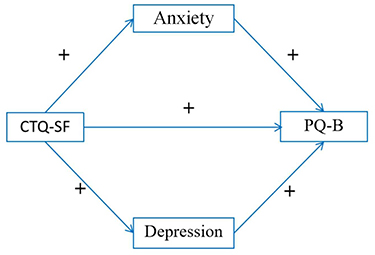 |
Figure 1 Hypothetical model of this study. The + sign indicates a positive hypothesized pathway; the - sign indicates a negative hypothesized pathway. |
Methods
Participants
A cross-sectional survey was carried out among undergraduate nursing students at Nantong University in China from December 25 to 29, 2024. The inclusion criteria were: (1) age ≥18 years; (2) Current full-time undergraduate nursing students. Exclusion criteria are: (1) Nursing undergraduates in their fourth year engaged in clinical practice; (2) Individuals who are receiving psychological treatment. The sample size was calculated using PASS software. This study utilized the unconditional power calculation method, with a sample size of 155 achieving 90% power to detect a ρ2 of at least 0.2 from 20 independent variables, at a significance level (alpha) of 0.05, with an actual ρ2 value of 0.4. Considering a 20% dropout Rate, at least 194 cases would ultimately be needed. 287 undergraduate nursing students were invited to participate, and 271 completed the questionnaire, resulting in a total effective rate of 94.4%.
The questionnaires were distributed using the “Questionnaire Star” system (an online platform for collecting questionnaires: www.wjx.cn), with counselors explaining the purpose, methods, and significance of the study before distributing the questionnaires. Participants were notified that their participation was voluntary and ensured that their responses were anonymous. Students who agreed to participate completed the questionnaire using a smartphone scan code. The survey was estimated to take around 10 minutes to complete. To maintain survey quality, the online interface was designed to permit only one response per unique internet protocol address. Additionally, incomplete questionnaires could not be submitted.
Measures
General Information Questionnaire
We designed a general information questionnaire for nursing undergraduates, included grade, gender, academic performance, residence, monthly living expenses, whether the student was an only child, family structure (eg., single-parent family), personality, number of friends, emotional state, non-suicidal self-injury, and weekly exercise frequency.
The Prodromal Questionnaire-Brief Version (PQ-B)
The PQ-B42 is a self-report questionnaire designed to identify individuals at risk for mental illness, consisting of 21 items. Participants respond to their experiences from one month ago with a “yes/no” format, and those who answer “yes” rate the distress level of their symptoms using a 5-point Likert scale. The total score is the sum of all item scores. Zhang et al43 and Xu et al8 translated the PQ-B into Chinese and demonstrated its good reliability and validity among Chinese outpatient populations. They established the cutoff criteria for the Chinese version as follows: total score ≥7 (and distress score ≥24) for identifying individuals at risk. In this study, the prevalence of positive screening was determined using the total score cutoff of ≥7.
Childhood Trauma Questionnaire-Short Form (CTQ-SF)
The CTQ-SF44 is a widely used self-reported questionnaire for assessing childhood trauma and abuse experiences. The scale consists of 28 items divided into five dimensions: emotional neglect, physical neglect, emotional abuse, physical abuse, and sexual abuse. Each item is rated on a 5-point Likert scale, with higher scores indicating greater severity of childhood trauma exposure. A score exceeding the cutoff value in any dimension (emotional neglect ≥ 15, physical neglect ≥ 10, emotional abuse ≥ 13, physical abuse ≥ 10, sexual abuse ≥ 8) is considered to have a history of childhood trauma. The Chinese version of the childhood trauma scale has shown good psychometric properties in Chinese adolescents.45
Depression, Anxiety, and Stress Scales (DASS-21)
The DASS-21 is a self-report tool designed to assess levels of depression, anxiety, and stress.46 Each subscale—depression, anxiety, and stress—consists of seven items rated on a 4-point Likert scale from 0 (not at all) to 3 (very much or most of the time). The total scale ranges from 0 to 42 points, with depression scores ≥10 points, anxiety scores ≥8 points, and stress scores ≥15 points considered clinically significant. Higher scores indicate greater levels of depression, anxiety, and stress.
Ethics
This study received approval from the ethics committee of the affiliated hospital. All participants were informed about the study’s purpose at the start of the questionnaire. Participation in the survey was voluntary, with participants being guaranteed confidentiality, privacy, and anonymity. They were also informed of their right to withdraw from the study at any time without facing any consequences. Researchers ensured that all collected data were treated confidentially and used exclusively for research purposes.
Participants who scored above the cutoff on the PQ-B (≥7) or on the DASS-21 subscales (depression ≥10, anxiety ≥8), or who reported a history of childhood trauma (any CTQ-SF dimension exceeding cutoff) or non-suicidal self-injury (NSSI), were considered at potential risk. These participants were provided with written information about university counseling services and encouraged to seek support. Contact information for the study team was also provided for those wishing to discuss their responses further.
Statistical Analysis
Data were analyzed using SPSS 25.0. Normally distributed continuous data were presented as mean ± standard deviation. Independent sample t-tests were used for comparing two groups, while one-way analysis of variance was used for multiple group comparisons. Pearson correlation analysis was conducted for correlation assessment. Additionally, a theoretically driven hierarchical multiple linear regression was performed. The model was built in three blocks: Block 1 included demographic variables; Block 2 added the five CTQ-SF subscales (emotional abuse, physical abuse, sexual abuse, emotional neglect, physical neglect); Block 3 added the DASS-21 subscales (depression, anxiety, stress). This forced-entry approach avoids the bias associated with stepwise selection. Multicollinearity was examined via variance inflation factor (VIF). Statistical significance was determined using a significance level of P<0.05. For mediation analysis using the PROCESS macro, simulation studies indicate that a sample size of 200–300 provides adequate statistical power (≥0.80) to detect small-to-medium indirect effects with 5,000 bootstrap resamples. A pathway relationship model was established. The significance test of regression coefficient was conducted using Bootstrap method (repeated sampling 5,000 times), and standard error and 95% confidence interval (CI) were obtained. If the 95% confidence interval did not contain 0, it indicated a significant mediating effect.
Results
The Information of the Participants
There were 56 males (20.7%) and 215 females (79.3%). There were 126 freshmen (46.5%), 98 sophomores (36.2%), and 47 juniors (17.3%). Residence, personality, and non-suicidal self-injury had statistical significance (P<0.05). Nursing undergraduates who lived in towns and villages had higher scores for prodromic psychotic symptoms than those who lived in downtown, introverted nursing students had higher scores than extroverted nursing students, and the scores of those who had experienced non-suicidal self-injury were higher than those who did not. The participant information is shown in Table 1.
 |
Table 1 Demographic Variables for the Study Sample (N= 271) |
Hierarchical Multiple Linear Regression Analysis
The prevalence of prodromal psychotic symptoms in nursing undergraduates was 26.6%. A hierarchical multiple regression analysis was performed with PQ-B total score as the dependent variable. In Block 1, demographic variables (residence, personality, and NSSI) explained 5.9% of the variance (R2 = 0.059, adjusted R2 = 0.049, P < 0.001). In Block 2, adding the five CTQ-SF subscales significantly improved the model (ΔR2 = 0.157, P < 0.001), with physical abuse (β = 1.596, P = 0.025) and sexual abuse (β = 2.124, P = 0.002) emerging as significant predictors. In Block 3, the inclusion of DASS-21 subscales further substantially increased explained variance (ΔR2 = 0.231, P < 0.001), bringing the total adjusted R2 to 0.423. In the final model (Table 2), anxiety (β = 0.605, 95% CI: 0.118–1.092, P = 0.015) and depression (β = 0.685, 95% CI: 0.231–1.139, P = 0.003) remained significant independent predictors, whereas stress was not significant (β = 0.226, P = 0.305). Sexual abuse retained significance (β = 1.301, 95% CI: 0.175–2.427, P = 0.024), while physical abuse became marginally non-significant (β = 1.041, P = 0.094) after controlling for emotional distress, suggesting the presence of a mediating effect of emotional distress. All VIF values in the final model were below 4.2 (range: 1.045–4.146), indicating no severe multicollinearity.
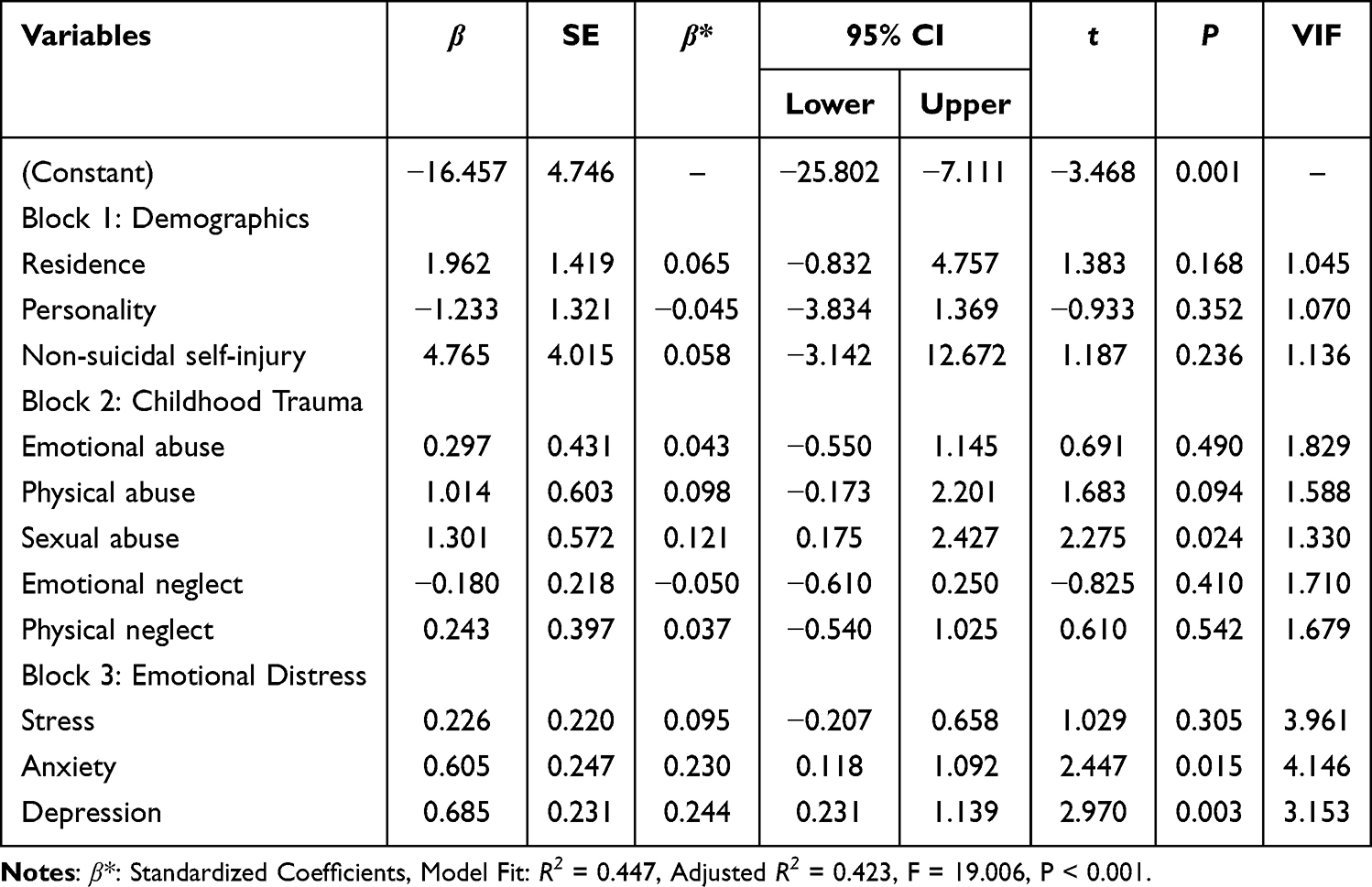 |
Table 2 Hierarchical Multiple Linear Regression Analysis of Factors Associated with Prodromal Psychotic Symptoms (Final Model) |
Common Method Bias Test
Harman’s single-factor test was conducted to assess common method bias. The unrotated factor analysis yielded 4 factors with eigenvalues >1, and the first factor explained 32.69% of the variance (<40%), suggesting that common method bias was not a major concern.
Descriptive Statistics and Correlation Analysis
The relevant analysis results are shown in Table 3. Prodromal psychotic symptoms were positively correlated with the total score of DASS-21 (r=0.623, P < 0.001) and CTQ-SF (r=0. 339, P< 0.001). Prodromal psychotic symptoms are also associated with the three dimensions of DASS-21: depression (r =0.590, P < 0.001), anxiety (r =0.596, P < 0.001), stress (r =0.559, P < 0.001) and five dimensions of CTQ-SF: emotional abuse (r= 0.345, P < 0.001), physical abuse (r= 0.332, P < 0.001), sexual abuse (r=0.331, P < 0.001), emotional neglect (r=0.164, P = 0.007), and physical neglect (r =0.206, P < 0.001) were also positively correlated. There is a positive correlation between CTQ-SF and DASS-21 and between all dimensions (P < 0.001).
 |
Table 3 Results of Correlation Analysis of CTQ-SF, DASS-21, and PQ-B Among Nursing Undergraduates |
Testing for Mediating Effect
It is important to note that the following mediation results are based on cross-sectional data. While statistically feasible, this approach cannot establish temporal sequence or causality. Therefore, these results should be interpreted as exploratory and hypothesis-generating, not as confirmatory evidence of causal mechanisms. In the mediation models, demographic covariates identified as significant in univariate analyses (residence, personality, and NSSI) were entered as control variables in the PROCESS covariate box to ensure consistency with the hierarchical regression framework. The study utilized the bias corrected percentile bootstrap method with 5000 sampling samples to estimate the 95% confidence interval (CI) of the mediation and moderation effects. Results indicate statistical significance when the CI does not encompass the value of 0. The mediating roles of depression and anxiety in physical abuse and psychiatric prodromal symptoms (Figure 2) and the mediating roles of depression and anxiety in sexual abuse and psychiatric prodromal symptoms (Figure 3) were examined respectively. Stress was not included as a mediator because it did not demonstrate an independent contribution in the hierarchical regression when depression and anxiety were simultaneously controlled.
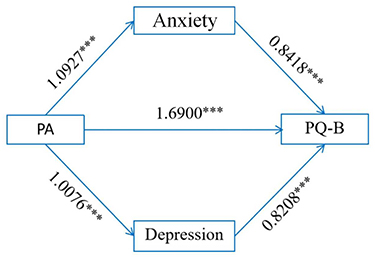 |
Figure 2 Mediating role of depression and anxiety between physical abuse and prodromal psychotic symptoms. *** P <0.001. |
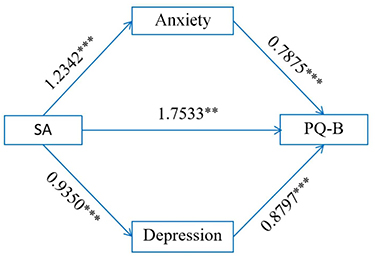 |
Figure 3 Mediating role of depression and anxiety between sexual abuse and prodromal psychotic symptoms. *** P <0.001, ** P <0.05. |
As shown in Table 4, A indicates that physical abuse was directly associated with prodromal psychotic symptoms, with a direct pathway of 1.6400 (95% CI: 0.6397–2.6404, P=0.001), accounting for 50.47% of the total effect. The indirect pathways through anxiety and depression were also statistically significantly associated with prodromal psychotic symptoms of nursing undergraduates. The indirect effects were 0.8888 (95% CI: 0.3430–1.5287, P<0.05) and 0.7208 (95% CI: 0.1588–1.4816, P<0.05), respectively, accounting for 27.35% and 22.18% of the total effects. B indicates that sexual abuse was directly associated with prodromal psychotic symptoms of nursing undergraduates, with a direct pathway of 1.7241 (95% CI: 0.6939–2.7543, P=0.001), accounting for 50.99% of the total association. The indirect pathways through anxiety and depression were also significantly associated with prodromal psychotic symptoms of nursing undergraduates. The indirect effects were 0.9419 (95% CI: 0.3099–1.6912, P<0.05) and 0.7150 (95% CI: 0.1407–1.5272, P<0.05), accounting for 27.86% and21.15% of the total effects, respectively.
 |
Table 4 Analysis of Mediating Effects of Childhood Trauma, Depression, Anxiety and Prodromal Psychotic Symptoms |
Discussion
In this study, we explored the associations among childhood trauma, depression, anxiety, and prodromal psychotic symptoms in nursing undergraduates. Physical and sexual abuse were directly associated with prodromal psychotic symptoms, and were also indirectly associated with prodromal psychotic symptoms through depression and anxiety. However, given the cross-sectional design, causal relationships cannot be inferred, and the mediation findings should be interpreted as exploratory rather than confirmatory.
Nursing undergraduates living in urban and rural areas had higher scores for prodromal psychotic symptoms than those living in urban centers, which may be related to social support, stress levels, and access to health resources provided by different living environments.47 Urban and rural areas may have lower feelings of community connection and more limited access to medical and mental health services than urban center, which can lead to a lack of appropriate support and intervention in the face of stress, increasing the risk of mental health problems. The higher scores for prodromal psychotic symptoms among introverted nursing students than extroverted nursing students may reflect differences in social and emotional processing among introverts. Introverted individuals may engage less socially, which reduces the support they receive from relationships and increases feelings of loneliness.48 In addition, introverts may also be more prone to self-reflection in the face of stress, which can further exacerbate feelings of anxiety and depression, thereby increasing the risk of prodromal psychotic symptoms. Nursing undergraduates with non-suicidal self-injury experience had higher scores for prodromal psychotic symptoms than those without such experience. Non-suicidal self-injury (NSSI) is often an unhealthy mechanism used to cope with feelings of stress, anxiety, or depression.49 The presence of this behavior indicates that the individual may not have developed healthier strategies for emotional regulation, and therefore such students may have been more vulnerable in terms of mental health and precursors to psychotic symptoms.
Childhood trauma has been associated with long-term alterations in stress regulation systems, which may increase the risk of subsequent mental health problems.50–53 Traumatic childhood experiences are associated with unhealthy emotion-regulation strategies, such as repressing emotions, over-dependence, or avoidance. These strategies may help relieve distress in the short term, but in the long term, they may be linked to impaired ability to deal with stress and emotions, which is associated with an increased risk of later mental illness.54 Childhood trauma may also affect an individual’s social skills and cognitive functioning,55 leading to difficulties in establishing and maintaining healthy relationships among peers, and difficulties in handling complex tasks and decision-making. This lack of social and cognitive functioning, in turn, may increase loneliness, social isolation and academic and occupational difficulties,56 further contributing to mental health problems. Traumatic childhood experiences can also affect how individuals perceive the world, themselves, and others.57 For example, a child who has experienced abuse may develop a cognitive pattern that sees the world as dangerous and himself as worthless. Such mental patterns can lead to negative feelings of self, poor relationships, and maladaptive coping behaviors, further deepening psychological trauma and possibly contributing to the development of prodromal psychotic symptoms.21
As a violent traumatic experience, physical abuse is associated with adverse psychological development in children and adolescents, including chronic stress response.58 Long-term chronic stress is associated with the occurrence of depressive symptoms, such as low mood, loss of interest and so on. At the same time, constant uncertainty and fear are associated with anxiety symptoms. These two emotional states not only affect an individual’s daily functioning, but can further deteriorate into more serious psychological problems.59 Individuals with symptoms of depression and anxiety are more likely to report precursor psychotic symptoms, which may partly reflect an abnormal response of the brain to extreme stress.60
Because of its aggressive and shameful nature, sexual abuse is associated with deep psychological trauma. This trauma is related to an individual’s sense of self-worth and trust. Victims may report depressive symptoms related to guilt and shame,61 and anxiety symptoms related to fear of re-victimization.62 These two emotional responses may work together as a cycle of negative emotions that are associated with daily life and social functioning. Depression and anxiety, as mediating variables, may be associated with reduced ability to deal with stress and may be related to psychotic symptoms,63 as these mental states are associated with neurochemical imbalances that are linked to psychotic disorders such as schizophrenia.
Childhood trauma is associated with an increased risk of prodromal psychotic symptoms, and this association may be partly explained by states of depression and anxiety. This highlights the importance of psychological intervention and support for nursing students who have experienced trauma.64 Specifically, this means that the College of Nursing should implement targeted screening procedures to identify students affected by trauma, and provide appropriate mental health resources and support to mitigate the effects of depression and anxiety, and prevent the exacerbation of mental health problems.
The findings of this study have important implications for nursing education practice and strategies. Educators and school administrators should recognize that providing a supportive learning environment is critical to students’ mental health. Further, this highlights the need to include mental health and well-being education in the nursing curriculum.65 In this way, students can gain a better understanding of mental health issues, including how to recognize and respond to symptoms of depression and anxiety in themselves or their classmates.66 Developing specific intervention strategies for nursing students who have already experienced childhood trauma is another important direction for future research. These strategies may include customized mental health intervention programs,67 enhanced social support networks, and training for educators to improve their ability to identify and intervene with students’ mental health issues.
Implication
The findings suggest that nursing schools may benefit from implementing trauma-informed mental health screening, tailored psychological interventions, and clear referral pathways for at-risk students.
It is also important to acknowledge the limitations of this study. First, the cross-sectional design precludes causal inferences. The mediation analysis, while statistically feasible, cannot establish temporal precedence; the indirect pathways identified represent statistical decompositions of covariance rather than causal mechanisms. Longitudinal or interventional designs are needed to confirm whether depression and anxiety truly mediate the pathway from childhood trauma to prodromal symptoms. Second, the single-institution sample may limit generalizability. Third, reliance on self-report measures represents another constraint. Future research should adopt longitudinal designs, expand sampling across multiple institutions, and incorporate objective measures such as physiological indicators or neuroimaging data. Further investigation into protective factors—such as psychological resilience, social support, and self-compassion—could inform the development of more strengths-based and effective intervention strategies.
Conclusion
Given the cross-sectional design, causal inferences cannot be drawn from this study, and the findings should be interpreted as exploratory. The findings suggest a potential mediating pathway of depression and anxiety in the association between childhood trauma (physical abuse and sexual abuse) and prodromal psychotic symptoms. These results suggest that addressing negative emotions, such as depression and anxiety, may be associated with lower levels of prodromal symptoms. However, longitudinal or interventional studies are needed to determine whether reducing depression and anxiety leads to decreased prodromal symptoms. If confirmed, tailored psychological interventions for nursing students with a history of childhood trauma could be considered in future practice.
Relevance to Clinical Practice
This study suggests that depression and anxiety may mediate the association between childhood trauma and prodromal psychotic symptoms in nursing undergraduates. These findings underscore the importance of implementing trauma-informed mental health screening and intervention programs within nursing education. Early identification and management of negative emotions may be associated with lower risk of psychosis prodrome, supporting the development of targeted psychological support strategies for at-risk students.
Abbreviations
CTQ-SF, Childhood Trauma Questionnaire-Short Form; DASS-21, Depression, Anxiety, and Stress Scales-21; PQ-B, Prodromal Questionnaire-Brief Version; NSSI, Non-suicidal self-injury; HPA, Hypothalamic-pituitary-adrenal.
Data Sharing Statement
The raw data supporting the conclusions of this article are available from the corresponding author, Jian Gu (e-mail: [email protected]), upon reasonable request.
Ethics Approval and Consent to Participate
This study was conducted in accordance with the Declaration of Helsinki. Approval was obtained from the Ethics Committee of The Sixth People’s Hospital of Nantong (Ethics approval number: NTLYLL2023016). All participants were informed about the study’s purpose, methods, and their rights prior to enrollment. Participation was entirely voluntary, and written informed consent was obtained from all participants before data collection.
Consent for Publication
Not applicable. This manuscript does not contain any individual person’s data in any form (including individual details, images, or videos). All participants consented to the publication of anonymized data through signed informed consent forms.
Acknowledgments
The authors are grateful to all participants who volunteered to contribute to this research.
Author Contributions
All authors made a significant contribution to the work reported, whether that is in the conception, study design, execution, acquisition of data, analysis and interpretation, or in all these areas; took part in drafting, revising or critically reviewing the article; gave final approval of the version to be published; have agreed on the journal to which the article has been submitted; and agree to be accountable for all aspects of the work.
Funding
This research received no specific grant from any funding agency in the public, commercial, or not-for-profit sectors.
Disclosure
The authors declare that they have no competing interests.
References
1. Fusar-Poli P, Borgwardt S, Bechdolf A, et al. The psychosis high-risk state: a comprehensive state-of-the-art review. JAMA Psychiatry. 2013;70:107–13. doi:10.1001/jamapsychiatry.2013.269
2. Benrimoh D, Dlugunovych V, Wright AC, et al. On the proportion of patients who experience a prodrome prior to psychosis onset: a systematic review and meta-analysis. Mol Psychiatry. 2024. doi:10.1038/s41380-024-02415-w
3. Yung AR, McGorry PD, McFarlane CA, et al. Monitoring and care of young people at incipient risk of psychosis. Schizophr Bull. 1996;22:283–303. doi:10.1093/schbul/22.2.283
4. Yung AR, McGorry PD. The prodromal phase of first-episode psychosis: past and current conceptualizations. Schizophr Bull. 1996;22(2):353–370. doi:10.1093/schbul/22.2.353
5. Solis M. Prevention: before the break. Nature. 2014;508(7494):S12–13. doi:10.1038/508S12a
6. Bartels-Velthuis AA, van de Willige G, Jenner JA, van Os J, Wiersma D. Course of auditory vocal hallucinations in childhood: 5-year follow-up study. Br J Psychiatry. 2011;199(4):296–302. doi:10.1192/bjp.bp.110.086918
7. Kelleher I, Connor D, Clarke MC, et al. Prevalence of psychotic symptoms in childhood and adolescence: a systematic review and meta-analysis of population-based studies. Psychol Med. 2012;42:1857–1863. doi:10.1017/S0033291711002960
8. Xu L, Zhang T, Zheng L, et al. Psychometric properties of prodromal questionnaire-brief version among chinese help-seeking individuals. PLoS One. 2016;11:e0148935. doi:10.1371/journal.pone.0148935
9. Kessler RC, Berglund P, Demler O, et al. Lifetime prevalence and age-of-onset distributions of DSM-IV disorders in the national comorbidity survey replication. Arch Gen Psychiatry. 2005;62:593–602. doi:10.1001/archpsyc.62.6.593
10. Merikangas KR, Nakamura EF, Kessler RC. Epidemiology of mental disorders in children and adolescents. Dialogues Clin Neurosci. 2009;11(1):7–20. doi:10.31887/DCNS.2009.11.1/krmerikangas
11. Erskine HE, Moffitt TE, Copeland WE, et al. A heavy burden on young minds: the global burden of mental and substance use disorders in children and youth. Psychol Med. 2015;45:1551–1563. doi:10.1017/S0033291714002888
12. Novak D, Kawachi I. Influence of different domains of social capital on psychological distress among Croatian high school students. Int J Mental Health Syst. 2015;9(1):18. doi:10.1186/s13033-015-0010-1
13. Reininghaus U, Depp CA, Myin-Germeys I. Ecological interventionist causal models in psychosis: targeting psychological mechanisms in daily life. Schizophr Bull. 2016;42(2):264–269. doi:10.1093/schbul/sbv193
14. Bosse S, Stalder T, D’Antono B. Childhood trauma, perceived stress, and hair cortisol in adults with and without cardiovascular disease. Psychosom Med. 2018;80(4):393–402. doi:10.1097/PSY.0000000000000569
15. Gilbert R, Widom CS, Browne K, et al. Burden and consequences of child maltreatment in high-income countries. Lancet. 2009;373:68–81. doi:10.1016/S0140-6736(08)61706-7
16. Girouard S, Bailey N. ACEs implications for nurses, nursing education, and nursing practice. Acad Pediatr. 2017;17(7):S16–S17. doi:10.1016/j.acap.2016.09.008
17. Dong C, Xu R, Xu L. Relationship of childhood trauma, psychological resilience, and family resilience among undergraduate nursing students: a cross-sectional study. Perspectives Psychiatric Care. 2021;57(2):852–859. doi:10.1111/ppc.12626
18. Clark CS, Aboueissa AE-M. Nursing students’ adverse childhood experience scores: a national survey. Int J Nurs Educ Scholarship. 2021;18(1). doi:10.1515/ijnes-2021-0013
19. Norman RE, Byambaa M, De R, et al. The long-term health consequences of child physical abuse, emotional abuse, and neglect: a systematic review and meta-analysis. PLoS Med. 2012;9:e1001349. doi:10.1371/journal.pmed.1001349
20. Okewole AO, Awhangansi SS, Fasokun M, et al. Prodromal psychotic symptoms and psychological distress among secondary school students in Abeokuta, Nigeria. J Child Adolesc Ment Health. 2015;27:215–225. doi:10.2989/17280583.2015.1125906
21. Paetzold I, Gugel J, Schick A, et al. The role of threat anticipation in the development of psychopathology in adolescence: findings from the SIGMA study. Eur Child Adolesc Psychiatry. 2023;32:2119–2127. doi:10.1007/s00787-022-02048-w
22. Ustuner Top F, Cam HH. Childhood maltreatment among university students in Turkey: prevalence, demographic factors, and health-related quality of life consequences. Psychol Health Med. 2021;26(5):543–554. doi:10.1080/13548506.2020.1768274
23. Chernomas WM, Shapiro C. Stress, depression, and anxiety among undergraduate nursing students. Int J Nurs Educ Scholarship. 2013;10(1):255–266. doi:10.1515/ijnes-2012-0032
24. Xu Y, Chi X, Chen S, et al. Prevalence and correlates of depression among college nursing students in China. Nurse Educ Today. 2014;34:e7–12. doi:10.1016/j.nedt.2013.10.017
25. Zhang Y, Peters A, Chen G. Perceived stress mediates the associations between sleep quality and symptoms of anxiety and depression among college nursing students. Int J Nurs Educ Scholarship. 2018;15(1). doi:10.1515/ijnes-2017-0020
26. Chen CJ, Chen Y-C, Sung H-C, et al. The prevalence and related factors of depressive symptoms among junior college nursing students: a cross-sectional study. J Psychiatr Ment Health Nurs. 2015;22:590–598. doi:10.1111/jpm.12252
27. Rezayat F, Dehghan Nayeri N. The level of depression and assertiveness among nursing students. Int J Commun Based Nurs Midwifery. 2014;2(3):177–184.
28. Mall S, Mortier P, Taljaard L, et al. The relationship between childhood adversity, recent stressors, and depression in college students attending a South African university. BMC Psychiatry. 2018;18:63. doi:10.1186/s12888-017-1583-9
29. Soyunmez S, Seki Oz H. Childhood traumatic experiences and happiness of nursing students: a mixed methods study. Child Maltreat. 2024;29(2):322–339. doi:10.1177/10775595221143530
30. Karakas M, Cingol N. The relationship of childhood trauma experiences with cognitive distortions and sense of coherence in nursing students. Perspectives Psychiatric Care. 2022;58(4):1546–1553. doi:10.1111/ppc.12962
31. Li M, D’Arcy C, Meng X. Maltreatment in childhood substantially increases the risk of adult depression and anxiety in prospective cohort studies: systematic review, meta-analysis, and proportional attributable fractions. Psychol Med. 2016;46(4):717–730. doi:10.1017/S0033291715002743
32. Uher R, Pavlova B, Najafi S, et al. Antecedents of major depressive, bipolar, and psychotic disorders: a systematic review and meta-analysis of prospective studies. Neurosci Biobehav Rev. 2024;160:105625. doi:10.1016/j.neubiorev.2024.105625
33. Gaudiano BA, Zimmerman M. Prevalence of attenuated psychotic symptoms and their relationship with DSM-IV diagnoses in a general psychiatric outpatient clinic. J Clin Psychiatry. 2013;74(02):149–155. doi:10.4088/JCP.12m07788
34. Wigman JT, van Nierop M, Vollebergh WAM, et al. Evidence that psychotic symptoms are prevalent in disorders of anxiety and depression, impacting on illness onset, risk, and severity--implications for diagnosis and ultra-high risk research. Schizophr Bull. 2012;38:247–257. doi:10.1093/schbul/sbr196
35. Johnson J. The validity of major depression with psychotic features based on a community study. Arch Gen Psychiatry. 1991;48(12):1075–1081. doi:10.1001/archpsyc.1991.01810360039006
36. Ohayon MM, Schatzberg AF. Prevalence of depressive episodes with psychotic features in the general population. Am J Psychiatry. 2002;159(11):1855–1861. doi:10.1176/appi.ajp.159.11.1855
37. B NS, Grover S. Depression in schizophrenia: prevalence and its impact on quality of life, disability, and functioning. Asian J Psychiatr. 2020;54:102425. doi:10.1016/j.ajp.2020.102425
38. van Rossum I, Dominguez M-D-G, Lieb R, Wittchen H-U, van Os J. Affective dysregulation and reality distortion: a 10-year prospective study of their association and clinical relevance. Schizophr Bull. 2011;37(3):561–571. doi:10.1093/schbul/sbp101
39. Saha S, Scott J, Varghese D, McGrath J. Anxiety and depressive disorders are associated with delusional-like experiences: a replication study based on a national survey of mental health and wellbeing. BMJ Open. 2012;2:e001001. doi:10.1136/bmjopen-2012-001001
40. Sarokhani D, Delpisheh A, Veisani Y, et al. Prevalence of depression among university students: a systematic review and meta-analysis study. Depress Res Treat. 2013;2013:373857. doi:10.1155/2013/373857
41. Bruffaerts R, Mortier P, Kiekens G, et al. Mental health problems in college freshmen: prevalence and academic functioning. J Affect Disord. 2018;225:97–103. doi:10.1016/j.jad.2017.07.044
42. Loewy RL, Pearson R, Vinogradov S, Bearden CE, Cannon TD. Psychosis risk screening with the Prodromal Questionnaire — brief version (PQ-B). Schizophr Res. 2011;129(1):42–46. doi:10.1016/j.schres.2011.03.029
43. Zhang T, Li H, Woodberry KA, et al. Prodromal psychosis detection in a counseling center population in China: an epidemiological and clinical study. Schizophr Res. 2014;152:391–399. doi:10.1016/j.schres.2013.11.039
44. Bernstein DP, Stein JA, Newcomb MD, et al. Development and validation of a brief screening version of the Childhood Trauma Questionnaire. Child Abuse Negl. 2003;27:169–190. doi:10.1016/s0145-2134(02)00541-0
45. Peng C, Cheng J, Rong F, Wang Y, Yu Y. Psychometric properties and normative data of the childhood trauma questionnaire-short form in Chinese adolescents. Front Psychol. 2023;14:1130683. doi:10.3389/fpsyg.2023.1130683
46. Lovibond PF, Lovibond SH. The structure of negative emotional states: comparison of the Depression Anxiety Stress Scales (DASS) with the beck depression and anxiety inventories. Behav Res Ther. 1995;33(3):335–343. doi:10.1016/0005-7967(94)00075-U
47. Radovanovic J, Selakovic V, Mihaljevic O, et al. Mental health status and coping strategies during COVID-19 pandemic among university students in Central Serbia. Front Psychiatry. 2023;14:1226836. doi:10.3389/fpsyt.2023.1226836
48. Ahn UK, Kwak HJ, Lim MH. Minnesota multiphasic personality inventory of school sandplay group therapy with maladjustment behavior in Korean adolescent. Medicine. 2020;99(50):e23272. doi:10.1097/MD.0000000000023272
49. Lee JY, Kim H, Kim S-Y, et al. Non-suicidal self-injury is associated with psychotic like experiences, depression, and bullying in Korean adolescents. Early Interv Psychiatry. 2021;15:1696–1704. doi:10.1111/eip.13115
50. Lee SW, Kim S, Lee SJ, et al. Effects of emotional maltreatment on semantic network activity during cognitive reappraisal. Brain Imaging Behav. 2021;15:1181–1190. doi:10.1007/s11682-020-00318-2
51. Buchanan TW, Driscoll D, Mowrer SM, et al. Medial prefrontal cortex damage affects physiological and psychological stress responses differently in men and women. Psychoneuroendocrinology. 2010;35:56–66. doi:10.1016/j.psyneuen.2009.09.006
52. Kanes SJ, Dennie L, Perera P. Targeting the arginine vasopressin V1b receptor system and stress response in depression and other neuropsychiatric disorders. Neuropsychiatr Dis Treat. 2023;19:811–828. doi:10.2147/NDT.S402831
53. Ferrer A, Costas J, Labad J, et al. FKBP5 polymorphisms and hypothalamic-pituitary-adrenal axis negative feedback in major depression and obsessive-compulsive disorder. J Psychiatr Res. 2018;104:227–234. doi:10.1016/j.jpsychires.2018.08.003
54. McGrath JJ, McLaughlin KA, Saha S, et al. The association between childhood adversities and subsequent first onset of psychotic experiences: a cross-national analysis of 23 998 respondents from 17 countries. Psychol Med. 2017;47:1230–1245. doi:10.1017/S0033291716003263
55. Yang M, Li J, Fu Y, et al. Association of childhood trauma, social support, cognition, and suicidality in females with bipolar disorder. BMC Psychiatry. 2024;24:243. doi:10.1186/s12888-024-05672-9
56. Nenov-Matt T, Barton BB, Dewald-Kaufmann J, et al. Loneliness, social isolation and their difference: a cross-diagnostic study in persistent depressive disorder and borderline personality disorder. Front Psychiatry. 2020;11:608476. doi:10.3389/fpsyt.2020.608476
57. Hughes K, Bellis MA, Cresswell K, et al. Examining relationships between adverse childhood experiences and coping during the cost-of-living crisis using a national cross-sectional survey in Wales, UK. BMJ Open. 2024;14:e081924. doi:10.1136/bmjopen-2023-081924
58. Glaser D. Child Abuse and Neglect and the Brain—A Review. J Child Psychol Psychiatr. 2000;41(1):97–116. doi:10.1111/1469-7610.00551
59. Paquin V, Malla AK, Iyer SN, et al. Combinations and temporal associations among precursor symptoms before a first episode of psychosis. Schizophr Bull. 2023. doi:10.1093/schbul/sbad152
60. Koyanagi A, Stubbs B, Lara E, et al. Psychotic experiences and subjective cognitive complaints among 224 842 people in 48 low- and middle-income countries. Epidemiol Psychiatr Sci. 2018;29:e11. doi:10.1017/S2045796018000744
61. Zheng H, Cai Y, Liu L, Peng B. The effect of childhood sexual abuse on depressive symptoms in female college students: a serial mediation model. Front Psychol. 2024;15:1306122. doi:10.3389/fpsyg.2024.1306122
62. Li J, Jin Y, Xu S, et al. Anxiety and depression symptoms among youth survivors of childhood sexual abuse: a network analysis. BMC Psychol. 2023;11:278. doi:10.1186/s40359-023-01275-3
63. Fekih-Romdhane F, Tira S, Cheour M. Childhood sexual abuse as a potential predictor of psychotic like experiences in Tunisian college students. Psychiatry Res. 2019;275:181–188. doi:10.1016/j.psychres.2019.03.034
64. Quan L, Lu B, Sun J, Zhao X, Sang Q. The relationship between childhood trauma and post-traumatic growth among college students: the role of acceptance and positive reappraisal. Front Psychol. 2022;13:921362. doi:10.3389/fpsyg.2022.921362
65. Lakeman R, Foster K, Happell B, et al. Informing the development of a fit-for-purpose mental health nursing curriculum: a survey of mental health nurse academics in Australia. Int J Ment Health Nurs. 2024;33:93–103. doi:10.1111/inm.13226
66. Evans JMM, Andreis F, Cameron DM, Eades CE. How does the self-reported health of undergraduate nursing students change during their degree programme? Survey results from a Scottish University. BMC Nurs. 2021;20(1):44. doi:10.1186/s12912-021-00563-w
67. Singh N, Minaie MG, Skvarc DR, Toumbourou JW. Impact of a secondary school depression prevention curriculum on adolescent social-emotional skills: evaluation of the resilient families program. J Youth Adolesc. 2019;48(6):1100–1115. doi:10.1007/s10964-019-00992-6
 © 2026 The Author(s). This work is published and licensed by Dove Medical Press Limited. The
full terms of this license are available at https://www.dovepress.com/terms
and incorporate the Creative Commons Attribution
- Non Commercial (unported, 4.0) License.
By accessing the work you hereby accept the Terms. Non-commercial uses of the work are permitted
without any further permission from Dove Medical Press Limited, provided the work is properly
attributed. For permission for commercial use of this work, please see paragraphs 4.2 and 5 of our Terms.
© 2026 The Author(s). This work is published and licensed by Dove Medical Press Limited. The
full terms of this license are available at https://www.dovepress.com/terms
and incorporate the Creative Commons Attribution
- Non Commercial (unported, 4.0) License.
By accessing the work you hereby accept the Terms. Non-commercial uses of the work are permitted
without any further permission from Dove Medical Press Limited, provided the work is properly
attributed. For permission for commercial use of this work, please see paragraphs 4.2 and 5 of our Terms.
Recommended articles

Subjective Sleep Disruption and Mood Disorders are Associated with the Risk of Chronic Pain in Patients with Obstructive Sleep Apnea
Liu L, Li X, Xue P, Wu M, Zeng S, Dai Y, Zhou J
Nature and Science of Sleep 2022, 14:2023-2032
Published Date: 7 November 2022
Vitamin B12, Folate, Homocysteine, Inflammatory Mediators (Interleukin-6, Tumor Necrosis Factor-α and C-Reactive Protein) Levels in Adolescents with Anxiety or Depressive Symptoms
Tan Y, Zhou L, Huang J, Chen X, Wu Y, Song X, Wang J, Hu H, Yang Q
Neuropsychiatric Disease and Treatment 2023, 19:785-800
Published Date: 7 April 2023
AI Technology panic—is AI Dependence Bad for Mental Health? A Cross-Lagged Panel Model and the Mediating Roles of Motivations for AI Use Among Adolescents
Huang S, Lai X, Ke L, Li Y, Wang H, Zhao X, Dai X, Wang Y
Psychology Research and Behavior Management 2024, 17:1087-1102
Published Date: 12 March 2024

Longitudinal Problematic Social Media Use in Students and Its Association with Negative Mental Health Outcomes
Shannon H, Bush K, Shvetz C, Paquin V, Morency J, Hellemans KGC, Guimond S
Psychology Research and Behavior Management 2024, 17:1551-1560
Published Date: 8 April 2024
Mushrooms, Microdosing, and Mental Illness: The Effect of Psilocybin on Neurotransmitters, Neuroinflammation, and Neuroplasticity
Kinderlehrer DA
Neuropsychiatric Disease and Treatment 2025, 21:141-155
Published Date: 29 January 2025