
Back to Journals » International Journal of General Medicine » Volume 19
Retrospective Analysis of Inflammatory Biomarker Patterns and Platelet Dynamics in Hospitalized Adults
Received 22 March 2026
Accepted for publication 18 June 2026
Published 25 June 2026 Volume 2026:19 604908
DOI https://doi.org/10.2147/IJGM.S604908
Checked for plagiarism Yes
Review by Single anonymous peer review
Peer reviewer comments 3
Editor who approved publication: Dr Woon-Man Kung
Libin Chen,1 Shubao Huang2
1Department of Laboratory Medicine, Zhangpu County Hospital, Zhangzhou, People’s Republic of China; 2Department of Critical Care Medicine, Zhangpu County Hospital, Zhangzhou, People’s Republic of China
Correspondence: Shubao Huang, Department of Critical Care Medicine, Zhangpu County Hospital, Zhonghua Road 2, Zhangpu County, Zhangzhou, Fujian, 363200, People’s Republic of China, Email [email protected]
Background: Systemic inflammation is common in hospitalized adults and may arise from infectious or non-infectious conditions. Several biomarkers, including WBC, neutrophil count, CRP, PCT, IL-6, and NLR, are widely used in clinical practice but may provide non-equivalent clinical information. Platelets are active participants in inflammatory responses, yet relationships between inflammatory biomarkers and platelet dynamics in hospitalized populations remain incompletely characterized.
Methods: This single-center retrospective study included 321 hospitalized adults between December 2024 and December 2025. Baseline biomarkers included WBC, absolute neutrophil count, platelet count, CRP, PCT, IL-6, and dNLR, analyzed according to availability. Spearman correlation assessed biomarker relationships. Infection-related and non-infectious diagnoses, classified using primary clinical diagnoses and available clinical documentation, were compared using the Mann–Whitney U-test. Longitudinal associations between inflammatory changes and platelet dynamics were evaluated using changes during hospitalization.
Results: WBC and neutrophil count were strongly correlated (r = 0.95, p < 0.0001). CRP was moderately correlated with PCT (r = 0.34, p = 0.002), and PCT was positively correlated with IL-6 (r = 0.55, p < 0.001). Age was not significantly associated with CRP (r = − 0.12, p = 0.153) but showed a modest correlation with dNLR (r = 0.165, p = 0.003). CRP, PCT, and IL-6 were higher in infection-related diagnoses than in non-infectious conditions (all p < 0.05). In longitudinal analyses, increases in PCT were associated with decreases in platelet counts (r = − 0.45, p < 0.0001), while CRP showed a weaker inverse association with platelet changes (r = − 0.21, p = 0.034).
Conclusion: Inflammatory biomarkers in hospitalized adults demonstrated heterogeneous correlation patterns consistent with partially distinct inflammatory responses rather than a single uniform inflammatory signal. Leukocyte-based markers and cytokine-associated biomarkers represented partially independent components of systemic inflammation. Dynamic increases in inflammatory activity were associated with platelet decline during hospitalization.
Keywords: inflammatory markers, infection, procalcitonin, C-reactive protein, derived neutrophil-to-lymphocyte ratio, platelet count
Introduction
Systemic inflammation is a frequent feature of acute illness in hospitalized patients and can be triggered by a wide range of infectious and non-infectious conditions.1 Laboratory biomarkers play a central role in supporting clinical decision-making, particularly when infection is suspected.2 Commonly measured markers include leukocyte-based indices (eg, white blood cell count [WBC] and absolute neutrophil count), cytokine-associated and acute-phase markers (eg, C-reactive protein [CRP], procalcitonin [PCT], and interleukin-6 [IL-6]), as well as platelet counts that often change in parallel with systemic inflammation.3–5
Leukocyte-based markers such as WBC and neutrophil count primarily reflect bone marrow stimulation and redistribution of circulating leukocytes during stress and inflammation.6 NLR integrates neutrophil predominance and relative lymphocyte suppression and has been proposed as an indicator of systemic inflammatory stress.7,8 In contrast, cytokine-associated markers such as IL-6 represent upstream inflammatory signaling,9 while CRP and PCT reflect downstream acute-phase responses.10,11 However, interpretation of these biomarkers in infection diagnosis remains challenging because CRP and IL-6 are not infection-specific, and PCT may also increase in some non-infectious inflammatory conditions, including major tissue injury, surgery, trauma, organ dysfunction, autoimmune disease, and malignancy.12
Despite these biological differences, inflammatory biomarkers are often interpreted together at the bedside as interchangeable indicators of “inflammation.” Most prior biomarker studies have focused on selected populations, such as patients with sepsis, critical illness, or specific infectious syndromes.13 In contrast, less is known about how these biomarkers relate to one another in broader hospitalized populations, where infectious and non-infectious conditions frequently coexist and biomarker testing is performed under routine clinical conditions. Studying a heterogeneous hospitalized cohort is therefore clinically relevant because it reflects real-world biomarker interpretation, although such heterogeneity also introduces potential confounding. Prior studies have shown that commonly used inflammatory markers may display discordant patterns in hospitalized patients, reflecting heterogeneity in the inflammatory response.14 These observations suggest that systemic inflammation may involve multiple partially independent inflammatory domains rather than a single linear biomarker axis.
In addition to leukocyte and cytokine responses, platelets are increasingly recognized as active participants in inflammatory and immune processes. Beyond their traditional role in hemostasis, platelets interact with leukocytes and endothelial cells and contribute to thromboinflammatory responses during systemic inflammation.15,16 Thrombocytopenia during hospitalization may also reflect multiple mechanisms, including coagulation activation, medication exposure, liver disease, renal dysfunction, bleeding, hemodilution, and overall illness severity.17 Platelet counts frequently decline during severe inflammatory conditions such as sepsis, suggesting a potential link between inflammatory activation and platelet dynamics.18 However, the relationship between routine inflammatory biomarkers and platelet changes in general hospitalized populations remains incompletely understood.
Therefore, the present study aimed to systematically evaluate inflammatory biomarker patterns in hospitalized patients. Specifically, we sought to (1) examine the structural relationships among commonly measured inflammatory biomarkers, (2) compare biomarker levels between infection-related and non-infectious diagnoses, and (3) investigate longitudinal associations between inflammatory changes and platelet dynamics during hospitalization.
Methods
Study Design and Study Subjects
This retrospective observational study was conducted at Zhangpu County Hospital. Medical records of consecutively hospitalized adult patients admitted between December 1, 2024 and December 31, 2025 were reviewed through the electronic medical record system. Patients were eligible for inclusion if they met the following criteria: (1) age ≥18 years at the time of hospitalization with at least one elevated inflammatory biomarker based on the institutional laboratory reference range; (2) availability of laboratory measurements for white blood cell count (WBC) and platelet count; (3) availability of at least one inflammatory biomarker measurement, including C-reactive protein (CRP), procalcitonin (PCT), or interleukin-6 (IL-6); and (4) sufficient clinical documentation allowing identification of the primary clinical diagnosis. Patients were excluded if they had hematologic malignancies, bone marrow disorders, chronic thrombocytopenia unrelated to acute illness, or ongoing chemotherapy or immunosuppressive therapy that could substantially alter leukocyte or platelet counts. During the study period, 321 hospitalized adults met the inclusion criteria and were included in the final analysis cohort. To avoid repeated observations, only the first hospitalization episode for each patient during the study period was included.
This study was designed as an exploratory retrospective analysis of routinely collected clinical laboratory data. Laboratory testing was performed according to clinical need rather than a prespecified research protocol.
This study was conducted in accordance with the Declaration of Helsinki. The study was reviewed and approved by the ethics committee of Zhangpu County Hospital (Approval No: 2026KY003). Because the study involved retrospective analysis of anonymized clinical data and posed minimal risk to participants, the requirement for written informed consent was waived. All patient identifiers were removed prior to analysis to ensure confidentiality.
Data Collection
Clinical and laboratory data were extracted from electronic medical records by trained investigators. The collected variables included demographic characteristics (age and sex), the primary clinical diagnosis, and laboratory measurements of inflammatory biomarkers. Laboratory parameters analyzed in this study included: WBC; absolute neutrophil count; platelet count; CRP; PCT and IL-6. For patients with multiple measurements during hospitalization, the first available measurement was defined as the baseline value for cross-sectional analyses. When repeated measurements were available, the first and last recorded values during hospitalization were used for exploratory longitudinal change analyses.
CRP, PCT, and IL-6 were measured as part of routine clinical care and were not available for all patients. Therefore, analyses involving these biomarkers were performed using available cases for each biomarker or biomarker pair. For correlation analyses, only patients with both variables available were included. No imputation was performed for missing biomarker values. Sample sizes for each analysis are reported in the relevant tables and figure legends.
Because biomarker testing was ordered according to clinical judgment rather than a standardized study protocol, missing biomarker data may not have been random. Patients who underwent CRP, PCT, or IL-6 testing may have differed clinically from those without these measurements, particularly with respect to suspected infection or illness severity.
Calculation of Inflammatory Indices
Because absolute lymphocyte counts were not directly available in the dataset, conventional neutrophil-to-lymphocyte ratio (NLR) could not be calculated. Therefore, the derived neutrophil-to-lymphocyte ratio (dNLR) was calculated using the previously described formula: dNLR = absolute neutrophil count/(WBC − absolute neutrophil count). In this formula, WBC − absolute neutrophil count represents the non-neutrophil leukocyte fraction rather than lymphocytes alone. Therefore, dNLR was interpreted as an approximate leukocyte-derived inflammatory index rather than as a direct substitute for conventional NLR.19,20
Classification of Infection-Related and Non-Infectious Diagnoses
Patients were categorized into infection-related and non-infectious diagnostic groups based on the primary clinical diagnosis and available clinical documentation recorded in the medical record. Diagnoses suggestive of infection, including infection, pneumonia, sepsis, cholangitis, and fever with documentation suggesting suspected infection, were classified as infection-related diagnoses. Fever alone was not considered equivalent to confirmed infection; however, in this retrospective analysis, fever documented as the primary clinical diagnosis was included in the infection-related diagnostic group because it commonly reflected clinical suspicion of infection. All remaining diagnoses were categorized as non-infectious conditions. This classification was used for exploratory comparison of inflammatory biomarker levels between infection-related and non-infectious clinical presentations. Because standardized physician adjudication, microbiologic confirmation, imaging criteria, and antibiotic exposure data were not uniformly available for all patients, this classification should be interpreted as an infection-related diagnostic grouping rather than definitive infection status.
Longitudinal Analysis of Inflammatory Changes
For patients with multiple laboratory measurements during hospitalization, longitudinal changes in inflammatory markers were evaluated. The change in each parameter was calculated as: Δvalue = last recorded value – first recorded value. These changes were used to explore relationships between inflammatory biomarker changes and platelet changes during hospitalization. Longitudinal analyses focused on the associations between changes in inflammatory biomarkers (ΔCRP, ΔPCT, ΔIL-6 and ΔdNLR) and corresponding changes in platelet counts. Because the timing and frequency of laboratory testing were determined by clinical care, repeated measurements were not obtained at standardized intervals. Therefore, the longitudinal analyses were considered exploratory and were not intended to model full biomarker trajectories or treatment effects over time.
Statistical Analysis
Continuous variables were assessed for distribution using visual inspection of histograms and the Shapiro–Wilk test. Because most inflammatory markers showed non-normal distributions, non-parametric statistical methods were applied. Age was reported as mean ± standard deviation (SD). Laboratory biomarkers demonstrated skewed distributions and were therefore summarized as medians with interquartile ranges (Q1–Q3). Categorical variables are presented as counts and percentages. Associations between continuous variables were evaluated using Spearman’s rank correlation coefficient (r). Comparisons between infection-related and non-infectious diagnostic groups were performed using the Mann–Whitney U-test. For patients with repeated laboratory measurements, associations between longitudinal inflammatory changes and platelet dynamics were evaluated using Spearman correlation analysis. All analyses were conducted as exploratory available-case analyses. Exact sample sizes were reported for each analysis because biomarker availability varied across patients. All statistical tests were two-sided, and p < 0.05 was considered statistically significant. Statistical analyses were performed using GraphPad Prism version 10.0.
Results
Baseline Patient Characteristics
A total of 321 hospitalized adults were included in the study cohort. The mean age of the population was 67.31 ± 18.72 years, and 195 patients (60.7%) were male, while 126 patients (39.3%) were female. Baseline laboratory measurements demonstrated substantial variability across the cohort. The median white blood cell (WBC) count was 6.99 ×10⁹/L (Q1–Q3: 4.30–11.30; n = 320), and the median absolute neutrophil count was 5.06 ×10⁹/L (Q1–Q3: 2.75–9.42; n = 317). The median platelet count was 75 ×109/L (Q1–Q3: 51–130; n = 321). Inflammatory biomarkers showed markedly skewed distributions. The median C-reactive protein (CRP) level was 41.21 mg/L (Q1–Q3: 7.20–114.71; n = 149). The median procalcitonin (PCT) level was 0.62 ng/mL (Q1–Q3: 0.19–6.83; n = 162), and the median interleukin-6 (IL-6) level was 181.85 pg/mL (Q1–Q3: 36.92–1176.12; n = 145). The derived neutrophil-to-lymphocyte ratio (dNLR) had a median value of 3.45 (Q1–Q3: 1.72–7.88; n = 317). Detailed baseline characteristics are presented in Table 1.
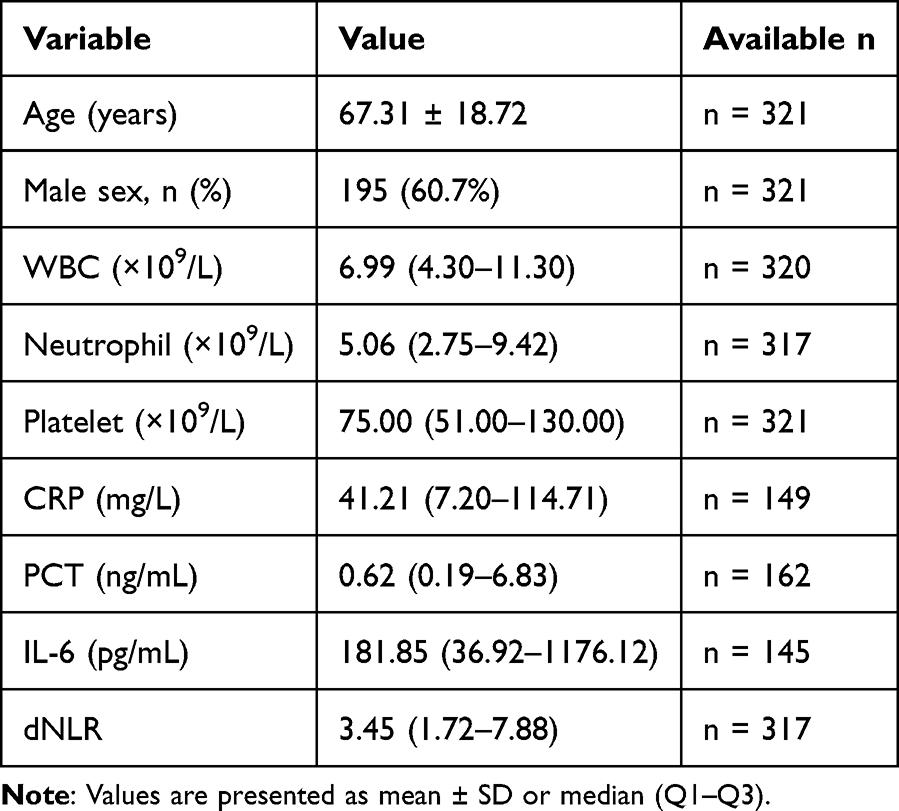 |
Table 1 Baseline Characteristics of the Study Population |
Correlation Structure of Inflammatory Biomarkers
Spearman correlation analysis revealed distinct relationships among inflammatory biomarkers. A very strong positive correlation was observed between WBC count and absolute neutrophil count (r = 0.95, p < 0.0001, n = 317), indicating that neutrophil counts closely track overall leukocyte levels (Figure 1A). Among cytokine-associated biomarkers, CRP showed a moderate positive correlation with PCT (r = 0.34, p = 0.002, n = 77) (Figure 1B). The strongest association among cytokine markers was observed between PCT and IL-6 (r = 0.55, p < 0.001, n = 134) (Figure 1C). A modest association was observed between dNLR and platelet counts (r = 0.18, p = 0.001, n = 317) (Figure 1D). The overall correlation structure among inflammatory biomarkers is summarized in Table 2.
 |
Table 2 Spearman Correlation Matrix of Inflammatory Biomarkers |
 |
Figure 1 Correlation structure among inflammatory biomarkers. (A) Relationship between total white blood cell count (WBC) and absolute neutrophil count showing a strong positive correlation (Spearman r = 0.95, p < 0.0001, n = 317). (B) Relationship between C-reactive protein (CRP) and procalcitonin (PCT) demonstrating a moderate positive correlation (r = 0.34, p = 0.002, n = 77). (C) Relationship between procalcitonin (PCT) and interleukin-6 (IL-6) showing a significant positive association (r = 0.55, p < 0.001, n = 134). (D) Relationship between derived neutrophil-to-lymphocyte ratio (dNLR) and platelet count demonstrating a modest correlation (r = 0.18, p = 0.001, n = 317). Each point represents an individual. Correlations were evaluated using Spearman correlation analysis. |
Association Between Age and Inflammatory Biomarkers
The relationships between age and inflammatory biomarkers were evaluated using Spearman correlation analysis (Table 3). Age showed no significant correlation with several inflammatory biomarkers, including WBC (r = 0.000, p = 0.995), neutrophil count (r = 0.083, p = 0.144), CRP (r = −0.118, p = 0.153), PCT (r = −0.080, p = 0.313), and IL-6 (r = −0.046, p = 0.585). In contrast, age demonstrated a weak but statistically significant positive correlation with platelet counts (r = 0.233, p < 0.001) and with dNLR (r = 0.165, p = 0.003) (Figure 2). These findings suggest that age had limited influence on most inflammatory biomarkers in this cohort.
 |
Table 3 Correlation Between Age and Inflammatory Biomarkers |
 |
Figure 2 Associations between age and inflammatory biomarkers. (A) Relationship between age and platelet count, showing a weak but statistically significant positive correlation (Spearman r = 0.233, p < 0.001, n = 321). (B) Relationship between age and derived neutrophil-to-lymphocyte ratio (dNLR) demonstrating a modest positive correlation (r = 0.165, p = 0.003, n = 317). Each point represents an individual. |
Comparison Between Infection-Related and Non-Infectious Diagnoses
Patients were categorized according to infection-related diagnoses. Cytokine-associated inflammatory biomarkers were significantly higher in the infection-related group. Specifically, CRP, PCT, and IL-6 levels were all elevated in patients with infection-related diagnoses compared with those with non-infectious conditions (all p < 0.05) (Figure 3 and Table 4). In contrast, leukocyte-based markers showed weaker discrimination between the two groups. WBC count, neutrophil count, and platelet count did not differ significantly between infection-related and non-infectious diagnoses, whereas dNLR showed a modest but statistically significant increase in the infection group. Overall, these findings suggest that cytokine-associated biomarkers, particularly CRP and PCT, demonstrated stronger differentiation between infection-related and non-infectious clinical presentations than total leukocyte counts.
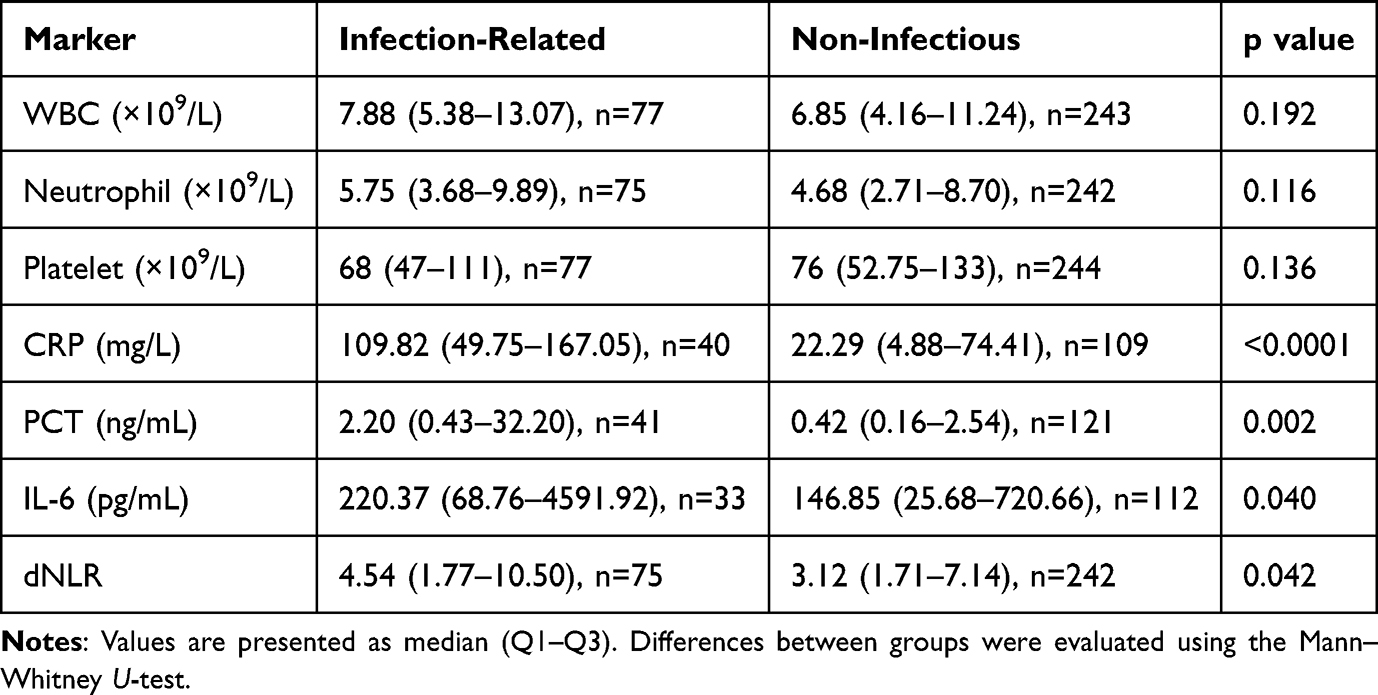 |
Table 4 Comparison of Inflammatory Biomarkers Between Infection-Related and Non-Infectious Diagnoses |
 |
Figure 3 Comparison of inflammatory biomarkers between infection-related and non-infectious diagnoses. (A) CRP levels were significantly higher in infection-related diagnoses (p < 0.0001). (B) PCT levels were significantly elevated in infection-related diagnoses (p = 0.002). (C) IL-6 concentrations were also higher in infection-related diagnoses (p = 0.040). (D) The derived neutrophil-to-lymphocyte ratio (dNLR) was modestly increased in infection-related diagnoses (p = 0.042). Bars indicate mean ± SD, and individual points represent individual patients. *p < 0.05, **p < 0.01, ****p < 0.0001. Group comparisons were performed using the Mann–Whitney U-test. |
Longitudinal Associations Between Inflammatory Changes and Platelet Dynamics
Among patients with repeated laboratory measurements during hospitalization, longitudinal changes in inflammatory biomarkers were evaluated to explore their relationship with platelet dynamics (Table 5). Spearman correlation analysis showed that changes in PCT levels were significantly associated with changes in platelet counts (r = −0.45, p < 0.0001) (Figure 4A), indicating that increases in inflammatory activity were accompanied by decreases in platelet counts. Changes in CRP demonstrated a weaker but statistically significant inverse association with platelet dynamics (r = −0.21, p = 0.034) (Figure 4B). In contrast, changes in IL-6 and dNLR showed no significant relationship with platelet changes. Overall, these results suggest that PCT dynamics showed the strongest association with platelet changes during hospitalization.
 |
Table 5 Longitudinal Association Between Inflammatory Changes and Platelet Dynamics |
 |
Figure 4 Longitudinal associations between inflammatory changes and platelet dynamics. (A) Changes in procalcitonin (ΔPCT, ng/ml) were strongly associated with decreases in platelet counts (×109/L) (Spearman r = −0.45, p < 0.0001, n = 162). (B) Changes in C-reactive protein (ΔCRP, mg/L) demonstrated a weaker but statistically significant inverse association with platelet changes (r = −0.21, p = 0.034, n = 149). Each point represents an individual with repeated laboratory measurements. Because laboratory testing was performed according to clinical need, the timing between first and last measurements was not standardized. Δ indicates the last recorded value minus the first recorded value during hospitalization. |
Discussion
In this retrospective study of hospitalized adult patients, we examined the relationships among commonly used inflammatory biomarkers and explored their association with infection-related diagnoses and platelet dynamics. Several important findings emerged. First, leukocyte-based markers demonstrated a strong internal correlation, with WBC closely tracking neutrophil counts. Second, cytokine-associated inflammatory biomarkers—including CRP, PCT, and IL-6—showed moderate interrelationships but were not strongly correlated with leukocyte counts. Third, infection-related diagnoses were associated with higher CRP, PCT, IL-6, and dNLR values, whereas total leukocyte counts showed weaker discrimination between infectious and non-infectious conditions. Finally, longitudinal analyses showed that increases in inflammatory activity, particularly reflected by PCT dynamics, were associated with reductions in platelet counts during hospitalization. Together, these findings support the concept that routinely measured inflammatory biomarkers capture related but non-equivalent aspects of systemic inflammation in hospitalized adults.
Our correlation analyses revealed a strong association between WBC and neutrophil counts, which is consistent with the biological role of neutrophils as the predominant circulating leukocyte population during acute inflammatory responses. Neutrophil mobilization from bone marrow and peripheral pools represents a central component of the host response to infection and systemic stress.6 Previous studies have shown that neutrophil counts rise rapidly during inflammatory activation and often account for the majority of changes in total leukocyte counts during acute illness.21 In this context, the strong correlation between WBC and neutrophil count observed in our study likely reflects the physiological dominance of neutrophil responses in systemic inflammatory states.
In contrast, cytokine-associated biomarkers demonstrated a different pattern of relationships. CRP, PCT, and IL-6 showed moderate correlations with one another but were less closely related to leukocyte counts. This observation is consistent with the biological cascade underlying acute inflammatory responses. Interleukin-6 functions as an upstream pro-inflammatory cytokine produced by activated immune and stromal cells during infection and tissue injury. IL-6 stimulates hepatic synthesis of acute-phase proteins, including CRP, which is widely used as a biomarker of systemic inflammation and has been associated with clinical outcomes in hospitalized patients.22,23 PCT represents another inflammation-related biomarker, particularly associated with bacterial infection, and is thought to be induced through cytokine-mediated pathways during systemic inflammatory activation.24 The moderate correlations observed among these biomarkers in our cohort therefore align with their shared—but not identical—biological regulation. These patterns are clinically relevant because CRP, PCT, and IL-6 are influenced by overlapping but distinct biological and clinical factors, including infection, tissue injury, organ dysfunction, and overall illness severity. Therefore, discordance among CRP, PCT, IL-6, and leukocyte-based markers is not unexpected in a heterogeneous hospitalized population and may help explain why individual biomarkers can be difficult to interpret when used in isolation.
Another notable finding of our study was the difference in biomarker profiles between infection-related and non-infectious clinical presentations. Patients with infection-related diagnoses demonstrated significantly higher CRP, PCT, IL-6, and dNLR values, whereas WBC and neutrophil counts did not significantly differ between groups. These findings suggest that cytokine-associated inflammatory markers may provide stronger discrimination between infectious and non-infectious conditions than total leukocyte counts in hospitalized populations. At the same time, this comparison should be interpreted in the context of the study design. Infection-related grouping was based on clinical documentation rather than standardized adjudication using microbiologic confirmation, imaging criteria, antibiotic exposure, or independent physician review. In addition, CRP, PCT, and IL-6 were ordered according to clinical need. As a result, biomarker availability and levels may have been influenced by clinician concern, suspected infection severity, or overall disease severity. These factors may contribute to the observed group differences, but they also reflect the real-world clinical setting in which these biomarkers are commonly used. However, substantial overlap between groups was also observed, indicating that inflammatory biomarkers primarily reflect host inflammatory activation rather than disease-specific processes alone. This observation is consistent with previous reports demonstrating that markers such as CRP and PCT can be elevated in a variety of inflammatory states beyond infection.14
Age-related analyses in our cohort revealed limited associations between age and most inflammatory biomarkers. Specifically, age was not significantly correlated with WBC, neutrophil count, CRP, PCT, or IL-6 levels. However, modest positive associations were observed between age and both platelet count and dNLR. These findings suggest that acute disease-related inflammatory processes may outweigh baseline age-related variation in inflammatory biomarkers within hospitalized populations. Although aging has been associated with chronic low-grade inflammatory activation25—often referred to as “inflammaging”—the acute inflammatory responses associated with hospitalization may dominate biomarker patterns in this clinical setting. Because comorbidities, diagnosis mix, and illness severity were not adjusted for in this exploratory analysis, the age-related findings should be interpreted as descriptive.
An additional observation of interest was the relationship between inflammatory changes and platelet dynamics during hospitalization. Longitudinal analyses demonstrated that increases in PCT were associated with decreases in platelet counts, while CRP changes showed a weaker inverse association with platelet dynamics. Platelets are increasingly recognized as active participants in immune and inflammatory processes, interacting with leukocytes and endothelial cells during infection and systemic inflammatory responses.26 In conditions such as sepsis, platelet activation and consumption may contribute to reductions in circulating platelet counts. The inverse association observed between inflammatory escalation and platelet levels in our study is therefore consistent with the emerging concept of “immunothrombosis,” in which inflammatory and coagulation pathways interact during systemic inflammatory activation.27 The observed relationship between rising PCT and falling platelet counts therefore highlights a potentially important connection between inflammatory escalation and platelet dynamics. However, platelet decline during hospitalization is multifactorial. It may reflect sepsis severity, coagulation activation, disseminated intravascular coagulation, medication exposure, liver disease, renal dysfunction, bleeding, hemodilution, procedures, or ICU-level illness. Therefore, this association should be viewed as a clinically relevant signal that requires further evaluation rather than as evidence of a direct causal pathway.
Taken together, our findings suggest that inflammatory biomarkers commonly used in clinical practice may reflect partially distinct domains of the host inflammatory response. Leukocyte-based markers appear to represent cellular mobilization of the innate immune system, whereas cytokine-associated markers more directly reflect inflammatory signaling and acute-phase responses. Platelet dynamics may represent an additional component of this integrated inflammatory network. Understanding these distinct but interacting components of systemic inflammation may help improve interpretation of inflammatory biomarkers in hospitalized patients. From a clinical perspective, these results support the importance of interpreting inflammatory biomarkers as complementary rather than interchangeable measures. Discordance among WBC, neutrophil count, CRP, PCT, IL-6, dNLR, and platelet trends may provide useful context during assessment of hospitalized adults, particularly when infection-related and non-infectious inflammatory conditions overlap. Nevertheless, this study was not designed to establish diagnostic thresholds, prognostic cutoffs, treatment-response algorithms, or outcome prediction models.
Several limitations should be acknowledged. First, this study was retrospective and conducted at a single center, which may limit generalizability. Second, not all inflammatory biomarkers were available for every patient, and some analyses therefore included smaller subsets of the cohort. Because biomarker testing was ordered according to clinical need, missingness may have reflected suspected infection, illness severity, or clinician concern. Third, lymphocyte counts were not directly available in the dataset; therefore, conventional NLR could not be calculated. Although dNLR has been used in previous studies when differential leukocyte counts are incomplete, dNLR should be interpreted as an approximate leukocyte-derived inflammatory index rather than a direct substitute for conventional NLR. Fourth, infection-related diagnoses were classified using clinical documentation rather than standardized adjudication, microbiologic confirmation, imaging criteria, or antibiotic exposure data. Fifth, the longitudinal analyses used the last recorded value minus the first recorded value during hospitalization, and laboratory timing was not standardized. Therefore, these analyses do not capture full biomarker trajectories, hospitalization duration, treatment effects, or changes in clinical severity over time. Clinical outcomes, including length of hospital stay, ICU admission, and mortality, were not consistently available in the anonymized dataset and therefore could not be evaluated in relation to biomarker patterns. Finally, the observational design of this study precludes causal inference regarding relationships between inflammatory biomarkers and platelet dynamics.
In conclusion, this exploratory retrospective study provides a systematic evaluation of relationships among commonly used inflammatory biomarkers in hospitalized adults. Our findings suggest that leukocyte-based and cytokine-associated inflammatory markers represent partially distinct components of the host inflammatory response. In addition, dynamic increases in inflammatory activity—particularly reflected by PCT—were associated with reductions in platelet counts during hospitalization. These observations highlight the complex and multidimensional nature of systemic inflammatory responses in clinical settings. The association between increasing PCT and declining platelet counts highlights a potentially important relationship between inflammatory escalation and platelet dynamics during hospitalization. Future prospective studies with standardized biomarker testing, adjudicated diagnostic classification, clinical outcome data, and multivariable adjustment are needed to validate these findings and determine their clinical significance.
Disclosure
No potential conflict of interest was reported by the authors.
References
1. Medzhitov R. Origin and physiological roles of inflammation. Nature. 2008;454(7203):428–11. doi:10.1038/nature07201
2. Singer M, Deutschman CS, Seymour CW, et al. The third international consensus definitions for sepsis and septic shock (Sepsis-3). JAMA. 2016;315(8):801–810. doi:10.1001/jama.2016.0287
3. Nicolai L, Pekayvaz K, Massberg S. Platelets: orchestrators of immunity in host defense and beyond. Immunity. 2024;57(5):957–972. doi:10.1016/j.immuni.2024.04.008
4. Zhou HH, Tang YL, Xu TH, Cheng B. C-reactive protein: structure, function, regulation, and role in clinical diseases. Front Immunol. 2024;15:1425168. doi:10.3389/fimmu.2024.1425168
5. Hamade B, Huang DT. Procalcitonin: where are we now? Crit Care Clin. 2020;36(1):23–40. doi:10.1016/j.ccc.2019.08.003
6. Summers C, Rankin SM, Condliffe AM, Singh N, Peters AM, Chilvers ER. Neutrophil kinetics in health and disease. Trends Immunol. 2010;31(8):318–324. doi:10.1016/j.it.2010.05.006
7. Zahorec R. Ratio of neutrophil to lymphocyte counts--rapid and simple parameter of systemic inflammation and stress in critically ill. Bratisl Lek Listy. 2001;102(1):5–14.
8. Chen Y, Wang W, Zeng L, et al. Association between neutrophil-lymphocyte ratio and all-cause mortality and cause-specific mortality in US adults, 1999-2014. Int J Gen Med. 2021;14:10203–10211. doi:10.2147/IJGM.S339378
9. Tanaka T, Narazaki M, Kishimoto T. IL-6 in inflammation, immunity, and disease. Cold Spring Harb Perspect Biol. 2014;6(10):a016295. doi:10.1101/cshperspect.a016295
10. Gabay C, Kushner I. Acute-phase proteins and other systemic responses to inflammation. N Engl J Med. 1999;340(6):448–454. doi:10.1056/NEJM199902113400607
11. Becker KL, Nylen ES, White JC, Muller B, Snider RH Jr. Clinical review 167: procalcitonin and the calcitonin gene family of peptides in inflammation, infection, and sepsis: a journey from calcitonin back to its precursors. J Clin Endocrinol Metab. 2004;89(4):1512–1525. doi:10.1210/jc.2002-021444
12. Mucka S, Jakubiak GK, Pawlas N. Procalcitonin: infection or maybe something more? Noninfectious causes of increased serum procalcitonin concentration: updated knowledge. Life. 2025;15(3). doi:10.3390/life15030446
13. Molano-Franco D, Arevalo-Rodriguez I, Muriel A, et al. Basal procalcitonin, C-reactive protein, interleukin-6, and presepsin for prediction of mortality in critically ill septic patients: a systematic review and meta-analysis. Diagn Progn Res. 2023;7(1):15. doi:10.1186/s41512-023-00152-2
14. Lee EH, Lee KH, Song YG, Han SH. Discrepancy of C-Reactive protein, procalcitonin and interleukin-6 at hospitalization: infection in patients with normal c-reactive protein, procalcitonin and high interleukin-6 values. J Clin Med. 2022;11(24). doi:10.3390/jcm11247324
15. Scherlinger M, Richez C, Tsokos GC, Boilard E, Blanco P. The role of platelets in immune-mediated inflammatory diseases. Nat Rev Immunol. 2023;23(8):495–510. PMID: 36707719. doi:10.1038/s41577-023-00834-4
16. Mack A, Vanden Hoek T, Du X. Thromboinflammation and the role of platelets. Arterioscler Thromb Vasc Biol. 2024;44(6):1175–1180. doi:10.1161/ATVBAHA.124.320149
17. Ali N, Auerbach HE. New-onset acute thrombocytopenia in hospitalized patients: pathophysiology and diagnostic approach. J Community Hosp Intern Med Perspect. 2017;7(3):157–167. doi:10.1080/20009666.2017.1335156
18. Shannon O. The role of platelets in sepsis. Res Pract Thromb Haemost. 2021;5(1):27–37. doi:10.1002/rth2.12465
19. Proctor MJ, McMillan DC, Morrison DS, Fletcher CD, Horgan PG, Clarke SJ. A derived neutrophil to lymphocyte ratio predicts survival in patients with cancer. Br J Cancer. 2012;107(4):695–699. doi:10.1038/bjc.2012.292
20. Longueville E, Dewolf M, Dalstein V, et al. Comparing neutrophil-to-lymphocyte ratio (NLR), absolute neutrophil count (ANC) and derived NLR as predictive biomarkers in first-line immunotherapy for non-small cell lung cancer: a retrospective study. Transl Lung Cancer Res. 2025;14(4):1212–1230. doi:10.21037/tlcr-24-808
21. Zhang F, Xia Y, Su J, et al. Neutrophil diversity and function in health and disease. Signal Transduct Target Ther. 2024;9(1):343. doi:10.1038/s41392-024-02049-y
22. Sproston NR, Ashworth JJ. Role of C-Reactive protein at sites of inflammation and infection. Front Immunol. 2018;9:754. doi:10.3389/fimmu.2018.00754
23. Cavusoglu Turker B, Ahbab S, Turker F, et al. Systemic immune-inflammation and systemic inflammation response indices are predictive markers of mortality in inpatients internal medicine services. Int J Gen Med. 2023;16:3163–3170. doi:10.2147/IJGM.S420332
24. Samsudin I, Vasikaran SD. Clinical utility and measurement of procalcitonin. Clin Biochem Rev. 2017;38(2):59–68.
25. Ferrucci L, Fabbri E. Inflammageing: chronic inflammation in ageing, cardiovascular disease, and frailty. Nat Rev Cardiol. 2018;15(9):505–522. doi:10.1038/s41569-018-0064-2
26. Koupenova M, Clancy L, Corkrey HA, Freedman JE. Circulating platelets as mediators of immunity, inflammation, and thrombosis. Circ Res. 2018;122(2):337–351. doi:10.1161/CIRCRESAHA.117.310795
27. Iba T, Levi M, Levy JH. Intracellular communication and immunothrombosis in sepsis. J Thromb Haemost. 2022;20(11):2475–2484. doi:10.1111/jth.15852
 © 2026 The Author(s). This work is published and licensed by Dove Medical Press Limited. The
full terms of this license are available at https://www.dovepress.com/terms
and incorporate the Creative Commons Attribution
- Non Commercial (unported, 4.0) License.
By accessing the work you hereby accept the Terms. Non-commercial uses of the work are permitted
without any further permission from Dove Medical Press Limited, provided the work is properly
attributed. For permission for commercial use of this work, please see paragraphs 4.2 and 5 of our Terms.
© 2026 The Author(s). This work is published and licensed by Dove Medical Press Limited. The
full terms of this license are available at https://www.dovepress.com/terms
and incorporate the Creative Commons Attribution
- Non Commercial (unported, 4.0) License.
By accessing the work you hereby accept the Terms. Non-commercial uses of the work are permitted
without any further permission from Dove Medical Press Limited, provided the work is properly
attributed. For permission for commercial use of this work, please see paragraphs 4.2 and 5 of our Terms.
Recommended articles

The Role of Albumin in the Diagnosis of Neonatal Sepsis Over the Last 11 Years: A Retrospective Study
Shi J, Lu ZQ, Lin QM, Zeng W, Gu PJ, Yu Q, Long J, Huang DG, Dai YH
Journal of Inflammation Research 2023, 16:2855-2863
Published Date: 19 July 2023
Diagnostic Utility of Pleural C-Reactive Protein and Procalcitonin for Parapneumonic Pleural Effusion: A Head-to-Head Comparison Study
Yang Q, Cha SN, Niu Y, Wen JX, Yan L, Hai L, Wang YJ, Gao WH, Zhou F, Zhou Q, Hu ZD, Zheng WQ
Infection and Drug Resistance 2025, 18:919-927
Published Date: 17 February 2025
Exploring the Relationship Between Inflammatory Biomarkers and Anthropometric Measures of Obesity in Healthy Adults: A Case Control Study
El-Aghbary DA, Thabet RA, Almorish MA, AlSayaghi KM, Elkhalifa AME
Diabetes, Metabolic Syndrome and Obesity 2025, 18:3403-3414
Published Date: 9 September 2025
Prognostic Value of C-Reactive Protein, Procalcitonin, and Interferon-Alpha in COVID-19 and Their Association with PANoptosis: A Cohort Study in Guangxi, China
Ning LJ, Liu MQ, Jiang ZS, Wu XQ, Wang XY, Qin XJ, Gan T, Tang SF, Lv GY, Wu Y
Journal of Inflammation Research 2025, 18:15527-15542
Published Date: 6 November 2025
Marked Non-Infectious Elevation of Procalcitonin in a Hemodialysis Patient with Bladder Cancer: A Case Report
Yan YC, Guo Q, Xu J, Wei Z, Li J
Infection and Drug Resistance 2026, 19:569356
Published Date: 17 January 2026