
Back to Journals » Vascular Health and Risk Management » Volume 22
Post-Stroke Aspiration Pneumonia in Riyadh, Saudi Arabia: A Retrospective Cohort Study
Authors Alotaibi N, Aldriweesh MA  , Aldohayan L, Almutairi M, Aldhalaan SM, Bin Khashman BH, AlJerayed JK, Alsaaran ZF, Taher NY, Alaklabi A, Bin Salih SA
Received 30 January 2026
Accepted for publication 2 June 2026
Published 12 June 2026 Volume 2026:22 600102
DOI https://doi.org/10.2147/VHRM.S600102
Checked for plagiarism Yes
Review by Single anonymous peer review
Peer reviewer comments 3
Editor who approved publication: Dr Daniel Duprez
Naser Alotaibi,1– 3 Mohammed A Aldriweesh,1,2 Latifah Aldohayan,2,3 Malak Almutairi,2,3 Shadin Mansour Aldhalaan,2,3 Badr Hamed Bin Khashman,2,3 Jerayed Khalid AlJerayed,2,3 Zaid Fahad Alsaaran,1,2 Nouran Y Taher,1– 3 Ali Alaklabi,2– 4 Salih A Bin Salih2– 4
1Department of Neurology, King Abdulaziz Medical City, National Guard Health Affairs, Riyadh, Kingdom of Saudi Arabia; 2College of Medicine, King Saud bin Abdulaziz University for Health Sciences, Riyadh, Kingdom of Saudi Arabia; 3King Abdullah International Medical Research Center, Riyadh, Kingdom of Saudi Arabia; 4Department of Medicine, King Abdulaziz Medical City, National Guard Health Affairs, Riyadh, Kingdom of Saudi Arabia
Correspondence: Mohammed A Aldriweesh, Email [email protected]
Purpose: Stroke is a leading cause of morbidity among patients with neurological disorders. Post-stroke aspiration pneumonia (AP) represents a serious complication associated with high mortality. This study investigated the incidence and outcomes of AP at a tertiary care center.
Patients and methods: Retrospectively, among 5921 adult patients admitted with ischemic or hemorrhagic stroke between February 2016 and January 2024, 118 who developed post-stroke aspiration pneumonia within the same admission or at a 90-day period were identified and analyzed. Univariate and multivariate analyses were done.
Results: Among 5921 stroke patients, 118 developed post-stroke AP. The mean age was 69.5 ± 12.5 years, and 71 (60.2%) were male. Hypertension (72.9%) and diabetes mellitus (63.6%) were the most prevalent comorbidities. Ischemic stroke accounted for 79.7%, and the median NIHSS was 9 (IQR 4– 15). The median pre-morbid mRS was 2 (IQR 0– 5). Dysphagia was diagnosed in 54.2%, and a swallowing assessment was performed and documented in 73.5%. Common presenting features included fever (55.9%), altered consciousness (47.5%), and cough (43.2%). Median time from stroke to AP was 6 days (IQR 2– 22). ICU admission was required in 46.6%, mechanical ventilation in 24.1%, and 58.5% were bedridden. In-hospital mortality was 22.0%. On multivariate logistic regression, lower GCS score was the only independent predictor of mortality (OR 0.777, 95% CI 0.629– 0.959, p = 0.019).
Conclusion: Post-stroke AP remains a significant complication, with a notable mortality rate. A lower GCS score independently predicted mortality, whereas ICU admission was significant only in the univariate analysis. The overall incidence of AP in our study was lower than rates reported in other populations, possibly reflecting differences in clinical practices, patient characteristics, or variability in diagnostic ascertainment rather than a true reduction in incidence.
Keywords: stroke, pneumonia, in-hospital complications, aspiration pneumonia, outcomes
Introduction
Stroke is a serious medical condition that can lead to significant complications and disabilities. It is caused by either bleeding in brain tissue (hemorrhagic stroke) or blockage of the blood supply to brain tissues (ischemic stroke).1,2 An epidemiological model predicting first-time stroke in Saudi Arabia estimated an incidence of 57.64 per 100,000 persons per year.3
The prognosis of stroke is influenced by multiple factors, including the type of stroke, with ischemic stroke having an increasing incidence compared to hemorrhagic stroke.4 Previous research has suggested that the mortality rate within 30 days of a first stroke episode is 37%, which is a significant.5 Furthermore, the development of complications not only lengthens the hospital stay but also increases the risk of mortality and morbidity among patients, even after they are discharged.6 One such complication is aspiration pneumonia (AP), which has an incidence rate of 5.1% and is a cause of death in stroke patients.6 The location of the stroke affects the muscles involved in swallowing, resulting in swallowing difficulties and an increased risk of AP7,8. AP increases hospital morbidity and mortality.9,10
Several factors contribute to the development of post-stroke AP, including age, sex, comorbidities, and stroke subtype.8 Elderly individuals are more likely to develop AP owing to reduced muscle strength, which leads to dysphagia in patients with an impaired cough reflex.8 Swallowing is a complex neuromuscular process that involves more than 25 pairs of muscles distributed across the jaw, lips, tongue, soft palate, larynx, pharynx, and esophagus.11 This process occurs in three sequential stages: oral, pharyngeal, and esophageal, which together ensure the safe transport of ingested material from the oral cavity to the stomach.11 The swallowing central pattern generator, located within the nucleus tractus solitarii and ventrolateral medulla of the brainstem, mediates this process by integrating peripheral afferent inputs and descending cortical signals to coordinate the motor sequence of swallowing.11,12 Disruption of these neural pathways is common after stroke, with post-stroke dysphagia occurring in up to 50% of patients.13 This condition is strongly associated with aspiration pneumonia and adverse clinical outcomes, including increased mortality and prolonged hospitalization.11,14
In a study conducted in Switzerland, stroke patients with dysphagia were more likely to develop pneumonia (23.1%) and experience a longer hospital stay (19%) compared to stroke patients without dysphagia.15 Other factors that contribute to the development of post-stroke aspiration include levels of consciousness and patient positioning, which can expose the patient to aspiration and thus to AP.8,16 The presence of other comorbidities, including diabetes mellitus, hypertension, and dementia, also increases the likelihood of developing AP.8
A study by Lidetu et al reported an estimated 23% incidence of AP in stroke patients.8 A systematic review revealed that patients diagnosed with dysphagia secondary to stroke had a threefold increased risk of developing pneumonia, accounting for 35% of post-stroke deaths.17 Furthermore, no prior study examined the incidence of post-stroke AP in Saudi Arabia. A Qatari study done in 2025 revealed an incidence of post-stroke AP 4.1% (380 patients out of 9197).18 Moreover, an Austrian registry-based study found that 5.2%.19
Dysphagia, a complication of stroke, was a common cause of PEG in this patient group.20 The current practices focusing on early dysphagia screening contribute to decreasing the risk of pneumonia, mortality, and length of hospital stay. The American Heart Association/American Stroke Association guidelines for acute ischemic stroke early management mandate a bedside swallowing assessment before any oral feeding initiation.21 Importantly, early screening helps to detect patients at high risk for aspiration and pneumonia, but does not prevent them. A secondary analysis of an international multi-center prospective study involving 10,000 patients found that screening and assessment for dysphagia were significantly associated with a decreased risk of pneumonia.14 Lastly, a meta-analysis of 30 studies evaluating the impact of dysphagia screening in stroke patients found that early screening was associated with significantly reduced risks of pneumonia, mortality, dependency, and shorter hospital length of stay.22
Despite extensive documentation of post-stroke AP as a complication, its incidence and outcomes in Saudi Arabia remain understudied. Accordingly, this study was designed to investigate the incidence and outcomes of post-stroke AP at the study center, as detailed in the methods section.
Methods
Study Setting and Geographic Area
This retrospective observational cohort study was conducted in King Abdulaziz Medical City, Riyadh, Saudi Arabia (KAMC-RYD), where stroke patients were admitted to the stroke unit between February 2016 and January 2024. The single case recorded in 2024 reflects partial-year data, as the study inclusion period ended in January 2024.
Study Population
All patients who met the following criteria were included: (1) age over 18 years and diagnosis of stroke; (2) presentation with respiratory symptoms suggestive of AP or diagnosis of AP during the same hospital admission as the stroke diagnosis or within 3 months after stroke onset. Patients positive for coronavirus disease 2019 (COVID-19) were excluded. Post-stroke aspiration pneumonia was defined as the presence of three or more of the following features: new or worsening cough, increased respiratory rate, oxygen desaturation, fever >38°C, leukocytosis or leukopenia, purulent secretions, rales or bronchial breath sounds, and positive radiological abnormalities.
The primary outcome was in-hospital mortality. Secondary outcomes included ICU admission, length of hospital stay, and need for mechanical ventilation.
As part of the stroke protocol at our center, all patients presented with acute stroke need a bedside swallowing assessment by the treating physician, as shown in the Supplementary Table 1.
Data Collection
Patient data were retrieved from electronic medical records. A data collection sheet was used to gather information regarding various variables, including age, sex, type of stroke, location, if applicable, TOAST (Trial of Org 10172 in Acute Stroke Treatment), stroke-related complications, Glasgow Coma Scale (GCS) score, computed tomography (CT) reports, mortality rate, intensive care unit (ICU) admission, and length of hospital stay.
Statistical Analysis
Data were analyzed using IBM SPSS Statistics (version 29.0.0; IBM Corp., Armonk, NY, USA). Continuous variables were assessed for normality using the Shapiro–Wilk test and are presented as mean ± standard deviation (SD) or median (IQR), as appropriate. Categorical variables are presented as frequencies and percentages.
For univariate analysis, continuous variables were compared between survivors and non-survivors using the Mann–Whitney U-test, given the non-normal distribution of most variables. Categorical variables were compared using the Chi-square test or Fisher’s exact test, as appropriate, based on expected cell frequencies.
Multivariate logistic regression was performed to identify independent predictors of in-hospital mortality. Variables with p < 0.2 on univariate analysis were entered as candidate predictors into a full model, which included eight variables: age, sex, GCS score, bedridden status, ICU admission, mechanical ventilation, dysphagia, and cough. A parsimonious model was subsequently constructed, retaining three predictors based on statistical and clinical relevance. Given that 26 in-hospital deaths were recorded, the full model yields approximately 3 events per variable (EPV), while the parsimonious model yields approximately 8 EPV, which is more statistically appropriate. Results are reported as odds ratios (OR) with 95% confidence intervals (CI) and p-values. Model fit was assessed using the Hosmer-Lemeshow test, Nagelkerke Pseudo R2, and the area under the receiver operating characteristic curve (AUC). A p-value of less than 0.05 was considered statistically significant for all analyses.
Results
Our study included 118 patients with post-stroke AP. Most participants were male (n=71, 60.2%), and 47 were female (39.8%). Comorbidities were common among the cohort. The most frequent were hypertension (n=86, 72.9%), diabetes mellitus (n=75, 63.6%), and hyperlipidemia (n=47, 39.8%). In terms of stroke subtype, ischemic strokes predominated (n=94, 79.7%), whereas hemorrhagic strokes were identified in 24 patients (20.3%). According to the TOAST classification, large-artery atherosclerosis was the most common subtype (n=45, 47.9%), followed by small-vessel disease (n=23, 24.5%) and cardioembolic (n=19, 20.2%). The median NIHSS score was 9 (IQR 4–15), and the median pre-morbid mRS was 2 (IQR 0–5). Patient demographics and baseline characteristics are presented in Table 1.
 |
Table 1 Demographics and Baseline Characteristics (N = 118) |
Table 2 presents the clinical outcomes and management of the 118 AP patients. The median time from stroke to AP diagnosis was 6 days (IQR 2–22). The mean length of hospital stay was 38.2 ± 64.6 days (median 12 days, IQR 5–41). Dysphagia was diagnosed in 64 patients (54.2%), and a formal swallowing assessment was performed in 86 (73.5%). The majority of patients were bedridden (n=69, 58.5%). The most common presenting features were fever (n=66, 55.9%), altered level of consciousness (n=56, 47.5%), and cough (n=51, 43.2%). The median post-AP GCS score was 10 [8–13]. ICU admission was required in 55 patients (46.6%), mechanical ventilation in 28 (24.1%), and in-hospital mortality in 26 (22.0%).
 |
Table 2 Clinical Outcomes and Management |
On univariate analysis, patients who died had significantly lower GCS scores than survivors (median 8 [IQR 6–11] vs. 11 [IQR 9–14]; p = 0.001). Bedridden status (76.9% vs. 53.3%; p = 0.053), ICU admission (65.4% vs. 41.3%; p = 0.051), and mechanical ventilation (40.0% vs. 19.8%; p = 0.067) showed trends toward significance. No significant differences were observed in age, NIHSS, length of stay, sex, comorbidities, stroke type, or dysphagia between survivors and non-survivors. Univariate logistic regression analysis is presented in Table 3.
 |
Table 3 Univariate Predictors of Mortality |
On multivariate logistic regression incorporating eight candidate predictors, GCS score was the only independently significant predictor of in-hospital mortality (OR 0.777, 95% CI 0.629–0.959; p = 0.019), indicating that each one-point decrease in GCS was associated with approximately 29% higher odds of death (AUC = 0.781; LLR p = 0.007). A parsimonious model retaining GCS, bedridden status, and mechanical ventilation confirmed GCS as the dominant predictor (OR 0.784, 95% CI 0.651–0.944; p = 0.010; AUC = 0.747; Hosmer-Lemeshow p = 0.229). Multivariate logistic regression analysis is presented in Table 4.
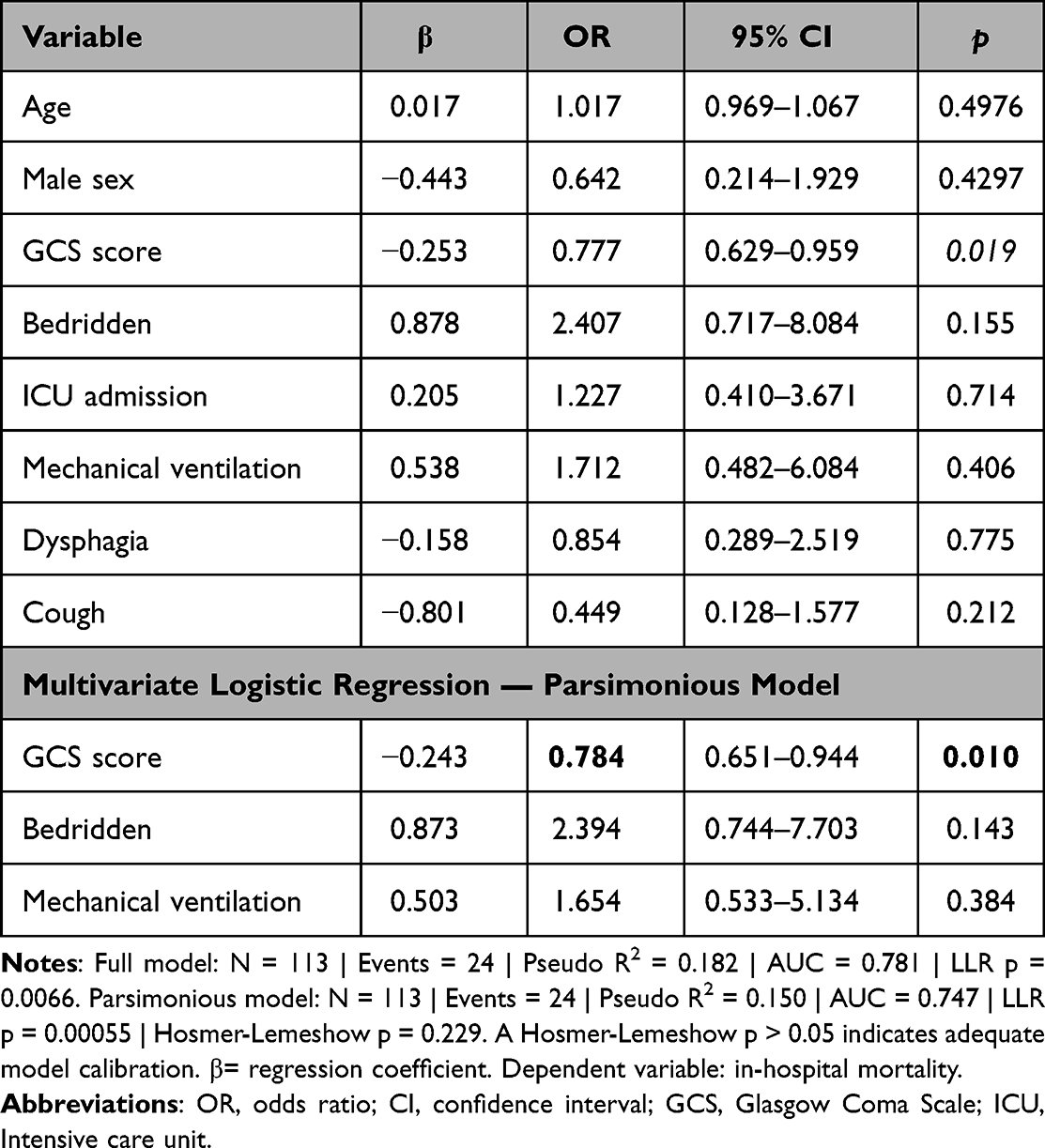 |
Table 4 Multivariate Logistic Regression–Full Model |
Discussion
To evaluate the incidence and mortality associated with post-stroke AP in a tertiary hospital in Saudi Arabia, a cohort study of patients with 5921 stroke cases was conducted.
Our study included a high proportion of older men, who accounted for 60.2% of participants. This finding is consistent with earlier findings indicating that male sex and advanced age increased the risk of aspiration pneumonia following stroke.23 This risk is likely caused by the stroke itself, as well as its effects on coughing and swallowing reflexes.23 The high prevalence of comorbidities was remarkable, with 72.9% of patients having hypertension, 63.6% having diabetes, and 39.8% having hyperlipidemia. These long-term illnesses likely not only increase the risk of stroke but also hinder the immunological response and recuperation of patients, increasing the likelihood of pneumonia and the difficulty of treatment.24
The study revealed that the cumulative incidence in this cohort of patients with post-stroke AP between 2016 and one month of 2024 was 1.99%, which is lower than rates reported in comparable studies. (7.12% in the United Kingdom, 4.1% in Qatar, 5.2% in Austria, and 5.1% attributable mortality in the United States.7,18,19,25 These differences likely reflect variations in AP definitions, screening protocols, and study populations rather than a true reduction in incidence. The relatively low rate observed at our center may be influenced by institutional stroke unit protocols; however, this remains a hypothesis, and our single-center design limits generalizability to the broader Riyadh stroke population.
Altered consciousness was present in 47.5% of patients, consistent with reports by Martino et al demonstrating that impaired neurological function increases the risk of aspiration.24 Nearly half of patients (46.6%) required ICU admission, underscoring the clinical severity of post-stroke AP and the importance of close neurological monitoring in this population.
Limitations of this study include its retrospective design and single-center nature, which may limit the generalizability of the findings. Moreover, the relatively small sample size of AP patients (n = 118) affected the statistical power of the logistic regression model. Potential biases from incomplete records may have been introduced by the retrospective nature of the data. Several confounding variables, including nutritional status and rehabilitation progress, were not analyzed, potentially providing additional insights into mortality risk. Furthermore, this study focused on characterizing the AP cohort and did not compare AP patients against the 5803 stroke patients who did not develop AP; such a comparison would require a different study design and is beyond the current scope. The lack of long-term follow-up additionally limits insights into prognosis. These limitations suggest the need for larger, multicenter prospective studies to validate and expand our findings.
Conclusion
Post-stroke aspiration pneumonia remained a serious complication, accounting for 1.99% of cases during the study period. Additionally, post-stroke AP was associated with a high mortality rate of 22%, and low GCS was identified as the only independent predictor of mortality. The low incidence should be interpreted with caution, as multiple factors could explain this difference, including the clinical definition used, population characteristics, and study periods. Larger multicenter prospective studies across the Kingdom are required to better identify risk factors and optimize preventive measures.
Ethical Approval
This study was approved by the Institutional Review Board (IRB) of the King Abdullah International Medical Research Center, Riyadh, Saudi Arabia (Approval Number: 0603/24). Due to the study’s retrospective nature, the IRB of the King Abdullah International Medical Research Center waived the requirement for informed consent (Approval Number: 0603/24). This study was conducted in accordance with the Declaration of Helsinki.
Funding
None required
Disclosure
The authors report no conflicts of interest in this work.
References
1. Grossmann I, Rodriguez K, Soni M, et al. Stroke and pneumonia: mechanisms, risk factors, management, and prevention. Cureus. 2021. doi:10.7759/cureus.19912
2. Banda KJ, Chu H, Kang XL, et al. Prevalence of dysphagia and risk of pneumonia and mortality in acute stroke patients: a meta-analysis. BMC Geriatr. 2022;22(1):420. doi:10.1186/s12877-022-02960-5
3. Al-Senani F, Al-Johani M, Salawati M, et al. An epidemiological model for first stroke in Saudi Arabia. J Stroke Cerebrovasc Dis. 2020;29(1):104465. doi:10.1016/j.jstrokecerebrovasdis.2019.104465
4. Feigin VL, Abate MD, Abate YH, et al. Global, regional, and national burden of stroke and its risk factors, 1990–2021: a systematic analysis for the global burden of disease study 2021. Lancet Neurol. 2024;23(10):973–9. doi:10.1016/S1474-4422(24)00369-7
5. Matuja SS, Mlay G, Kalokola F, et al. Predictors of 30-day mortality among patients with stroke admitted at a tertiary teaching hospital in Northwestern Tanzania: a prospective cohort study. Front Neurol. 2023:13. doi:10.3389/fneur.2022.1100477.
6. Bijani B, Mozhdehipanah H, Jahanihashemi H, Azizi S. The impact of pneumonia on hospital stay among patients hospitalized for acute stroke. Neurosciences. 2014;19(2):118–123.
7. Chang CY, Cheng TJ, Lin CY, Chen JY, Lu TH, Kawachi I. Reporting of aspiration pneumonia or choking as a cause of death in patients who died with stroke. Stroke. 2013;44(4):1182–1185. doi:10.1161/STROKEAHA.111.000663
8. Lidetu T, Muluneh EK, Wassie GT. Incidence and predictors of aspiration pneumonia among stroke patients in Western Amhara Region, North-West Ethiopia: a retrospective follow up study. Int J Gen Med. 2023;16:1303–1315. doi:10.2147/IJGM.S400420
9. Komiya K, Rubin BK, Ichi KJ, et al. Prognostic implications of aspiration pneumonia in patients with community acquired pneumonia: a systematic review with meta-analysis. Sci Rep. 2016;6(1):38097. doi:10.1038/srep38097
10. Vahdati SS. Factors affecting complications and mortality of stroke patients in stroke care unit. Erciyes Med J. 2021. doi:10.14744/etd.2021.71430
11. Sasegbon A, Cheng I, Hamdy S. The neurorehabilitation of post-stroke dysphagia: physiology and pathophysiology. J Physiol. 2025;603:617–634. doi:10.1113/JP285564#support-information-section
12. Watts AG, Kanoski SE, Sanchez-Watts G, Langhans W. The physiological control of eating: signals, neurons, and networks. Physiol Rev. 2022;102(2):689–813. doi:10.1152/physrev.00028.2020
13. Dziewas R, Michou E, Trapl-Grundschober M, et al. European Stroke Organisation and European Society for Swallowing Disorders guideline for the diagnosis and treatment of post-stroke dysphagia. Eur Stroke J. 2021;6(3):LXXXIX–CXV. doi:10.1177/23969873211039721
14. Ouyang M, Boaden E, Arima H, et al. Dysphagia screening and risks of pneumonia and adverse outcomes after acute stroke: an international multicenter study. Int J Stroke. 2020;15(2):206–215. doi:10.1177/1747493019858778
15. Arnold M, Liesirova K, Broeg-Morvay A, et al. Dysphagia in acute stroke: incidence, burden and impact on clinical outcome. PLoS One. 2016;11(2):e0148424. doi:10.1371/journal.pone.0148424
16. Metheny NA. Risk factors for aspiration. J Parenteral Enteral Nutr. 2002;26(6S). doi:10.1177/014860710202600605
17. Crary M, Sura L, Madhavan A, Carnaby-Mann G. Dysphagia in the elderly: management and nutritional considerations. Clin Interv Aging. 2012;287. doi:10.2147/CIA.S23404
18. Tran KH, Akhtar N, Ali A, et al. Impact of stroke severity on aspiration pneumonia risks in the medical ward versus the stroke unit: a 10-year retrospective cohort study. BMJ Open. 2025;15(3). doi:10.1136/bmjopen-2024-093328
19. Matz K, Seyfang L, Dachenhausen A, Teuschl Y, Tuomilehto J, Brainin M. Post-stroke pneumonia at the stroke unit - a registry based analysis of contributing and protective factors. BMC Neurol. 2016;16(1). doi:10.1186/s12883-016-0627-y
20. Albugami M, Al Twaijri Y, Bassil H, et al. Impact of long-term enteral feeding tubes on aspiration pneumonia in a tertiary care centre in Saudi Arabia. Am J Internal Med. 2015;3(3):95. doi:10.11648/j.ajim.20150303.13
21. Prabhakaran S, Gonzalez NR, Zachrison KS, et al. Guideline for the early management of patients with acute ischemic stroke: a guideline from the American Heart Association/American Stroke Association. Stroke. 2026. doi:10.1161/STR.0000000000000513
22. Sherman V, Greco E, Martino R. The benefit of dysphagia screening in adult patients with stroke: a meta-analysis. J Am Heart Assoc. 2021;10(12). doi:10.1161/JAHA.120.018753
23. Mandell LA, Niederman MS. Aspiration pneumonia. New Engl J Med. 2019;380(7):651–663. doi:10.1056/NEJMra1714562
24. Martino R, Foley N, Bhogal S, Diamant N, Speechley M, Teasell R. Dysphagia after stroke. Stroke. 2005;36(12):2756–2763. doi:10.1161/01.STR.0000190056.76543.eb
25. Teh WH, Smith CJ, Barlas RS, et al. Impact of stroke-associated pneumonia on mortality, length of hospitalization, and functional outcome. Acta Neurol Scand. 2018;138(4):293–300. doi:10.1111/ane.12956
 © 2026 The Author(s). This work is published and licensed by Dove Medical Press Limited. The
full terms of this license are available at https://www.dovepress.com/terms
and incorporate the Creative Commons Attribution
- Non Commercial (unported, 4.0) License.
By accessing the work you hereby accept the Terms. Non-commercial uses of the work are permitted
without any further permission from Dove Medical Press Limited, provided the work is properly
attributed. For permission for commercial use of this work, please see paragraphs 4.2 and 5 of our Terms.
© 2026 The Author(s). This work is published and licensed by Dove Medical Press Limited. The
full terms of this license are available at https://www.dovepress.com/terms
and incorporate the Creative Commons Attribution
- Non Commercial (unported, 4.0) License.
By accessing the work you hereby accept the Terms. Non-commercial uses of the work are permitted
without any further permission from Dove Medical Press Limited, provided the work is properly
attributed. For permission for commercial use of this work, please see paragraphs 4.2 and 5 of our Terms.
Recommended articles

The Influence of Influenza Virus Infections in Patients with Chronic Obstructive Pulmonary Disease
Liao KM, Chen YJ, Shen CW, Ou SK, Chen CY
International Journal of Chronic Obstructive Pulmonary Disease 2022, 17:2253-2261
Published Date: 14 September 2022
Association Between Serum Uric Acid to High-Density Lipoprotein Cholesterol Ratio and Pneumonia After Endovascular Treatment of Vertebrobasilar Artery Occlusion
Lan W, Yuan K, Xiao L, Qiu F, Sun W, Xu L, Cao H, Zhu W, Du M, Liu X
Journal of Inflammation Research 2025, 18:2899-2908
Published Date: 26 February 2025