
Back to Journals » International Journal of General Medicine » Volume 19
Identification of Bioactive Compounds and Molecular Targets of Compound Herbs Against Stomach Adenocarcinoma: A Network Pharmacology Approach

Received 26 June 2025
Accepted for publication 21 January 2026
Published 29 January 2026 Volume 2026:19 549743
DOI https://doi.org/10.2147/IJGM.S549743
Checked for plagiarism Yes
Review by Single anonymous peer review
Peer reviewer comments 2
Editor who approved publication: Dr Ching-Hsien Chen
Lei Liu,1 Yi Liu,2 Min Wu1
1Central Laboratory, Shaanxi Provincial People’s Hospital, Xi’an, Shaanxi, People’s Republic of China; 2Department of Oncology, Shaanxi Provincial People’s Hospital, Xi’an, Shaanxi, People’s Republic of China
Correspondence: Min Wu, Central Laboratory, Shaanxi Provincial People’s Hospital, 256 West Friendship Road, Xi’an, Shaanxi, 710068, People’s Republic of China, Tel +86029-85251331-2610, Email [email protected] Yi Liu, Department of Oncology, Shaanxi Provincial People’s Hospital, 256 West Friendship Road, Xi’an, Shaanxi, 710068, People’s Republic of China, Tel +86029-85251331, Email [email protected]
Background: The therapeutic effects of compound herbs (Radix Paeoniae Rubra, Radix Cirsii Japonici, Gentianae Radix Et Rhizoma, and Cardeniae Fructus) on stomach adenocarcinoma (STAD) remain unclear.
Methods: Active ingredients and their targets from the herbal combination were obtained using the Traditional Chinese Medicine Systems Pharmacology (TCMSP) database. STAD-related targets were collected from the GeneCards database, and the TCGA-STAD dataset was downloaded from The Cancer Genome Atlas (TCGA) database. Differentially expressed genes (DEGs) between STAD and normal tissues were screened. The intersection of DEGs, drug targets, and STAD-related targets was taken to determine key targets. A protein–protein interaction (PPI) network was built and hub genes were identified. Functional enrichment analysis and molecular docking of the hub genes were performed. The Cell Counting Kit-8 (CCK8) assay was used to evaluate the effects of the active ingredients on the proliferation of Stomach Gastric Carcinoma cell line 7901 (SGC-7901) and MaKuNo cell line 45 (MKN-45) cells. The Transwell assay was used to evaluate the effect of quercetin on the migration ability of SGC-7901 and MKN-45 cells.
Results: A total of 67 key targets were obtained, among which five hub genes—ESR1 (Estrogen receptor 1), FOS (FBJ murine osteosarcoma viral oncogene homolog), HSP90AA199 (Heat shock protein 90 alpha family class A member 1), JUN (Avian sarcoma virus 17 oncogene homolog), and MMP9 (Matrix Metallopeptidase 9)—were identified. Kyoto Encyclopedia of Genes and Genomes (KEGG) enrichment analysis indicated that these hub genes were significantly associated with the T Helper 17 (Th17) Cell differentiation pathway. Molecular docking predictions suggested that active ingredients such as quercetin could bind effectively to the hub genes, with quercetin showing the strongest binding affinity to FOS. Cell experiments further confirmed that quercetin exhibited the most potent inhibitory effect on the proliferation of STAD cells, with a half-maximal inhibitory concentration (IC50) value of 4 μM. Furthermore, quercetin can significantly inhibit the migration of SGC-7901 and MKN-45 cells.
Conclusion: This study identified five key targets and active compounds in herbal compounds for STAD treatment. These results suggest that quercetin may inhibit STAD progression by targeting FOS, and may have therapeutic potential.
Keywords: stomach adenocarcinoma, compound herbs, molecular docking, bioinformatics, quercetin
Introduction
Gastric adenocarcinoma (STAD) presents a significant global public health challenge, ranking as the fourth most common malignancy in terms of incidence and the third leading cause of cancer-related mortality worldwide.1–3 Notably, the disease burden is particularly heavy in Asia, especially among East Asian countries.4 In recent years, a notable trend has been the rising incidence of gastric cancer among younger populations under the age of 50, posing new challenges to public health prevention and control systems.1 Current clinical management of gastric cancer primarily relies on comprehensive approaches such as surgical resection, systemic chemotherapy, targeted therapy, and immunotherapy. However, due to the atypical early symptoms and limited screening methods, most patients are diagnosed at an advanced stage, missing the optimal opportunity for curative surgery.3,5 In addition, the emergence of drug resistance has also restricted the long-term efficacy of chemotherapy and targeted therapy.6–8 Immunotherapy has provided new hope for patients with advanced gastric cancer, but its response rate is limited and it may induce immune-related adverse events. These issues are closely associated with immune tolerance induced by the tumor microenvironment.9,10
Natural products offer new solutions for overcoming the therapeutic dilemmas associated with STAD. Chinese herbal medicines and their active ingredients have attracted increasing attention because of their low toxicity, high efficiency, multi-target action and multi-pathway regulation,11–13 and can serve as an adjunct approach to cancer therapy by targeting key regulatory nodes of immune tolerance in the tumor microenvironment.14 Wang et al verified through network pharmacology and in vitro experiments that erianin, the main effective ingredient in Dendrobium drumstick, causes precancerous lesions in gastric cancer (PLGC) by inhibiting the HRAS-PI3K-AKT signaling pathway.15 Qian et al demonstrated that Tanshinone IIA (TanIIA) functions as an antitumor agent through regulating the expression of multiple targets (eg, ALB, SRC, and ESR1) and inhibiting the SRC/MAPK/ERK pathway.16 Zhou et al found that Yiqi Huayu Jiedu Decoction (YHJD) may suppress hepatic metastasis of colorectal cancer by modulating neutrophil chemotaxis and influencing the tumor microenvironment through mechanisms in regulating cell adhesion molecule binding, adhesion protein binding, and metabolic pathways.14 However, the mechanism of action of the active ingredients of traditional medicines in STAD remains unclear. Therefore, exploration of potential therapeutic targets and molecular mechanisms of STAD is of great significance for the prevention and treatment of STAD.
In Traditional Chinese Medicine (TCM) theory, the core pathogenesis of gastric adenocarcinoma is characterized by “stasis-toxin obstruction internally and damp-heat accumulation in the stomach”,17 the treatment strategy follows three fundamental principles: tonifying vitality, resolving phlegm and knots, and clearing heat and detoxifying.7 Building on this foundation and incorporating the theoretical concept of “clearing the liver and harmonizing the stomach”,18 this study evolved from the classic formula “Longdan Xiegan Decoction” to develop an optimized compound herbs targeting gastric adenocarcinoma. This optimized prescription retains the core herbs from the original formula that clear fire, cool the blood, and activate blood circulation—Radix Paeoniae Rubra (Chi-shao), Gentianae Radix Et Rhizoma (Long-dan), and Cardeniae Fructus (Zhi-zi).19,20 In response to the key pathological feature of “blood stasis” in gastric cancer,21 Radix Cirsii Japonici (Da-ji),22 which is particularly effective in cooling the blood, stopping bleeding, dispersing stasis, and reducing swelling, was innovatively added to enhance synergistic effects. The resulting evolved formula not only inherits the primary aim of Longdan Xiegan Decoction in clearing liver fire but also further strengthens its ability to cool the blood, disperse stasis, remove toxins, and resolve masses. This forms a pathogenesis-driven innovative compatibility that better aligns with the TCM therapeutic requirements for gastric cancer.
Modern pharmacological research provides substantial evidence supporting the rationality of this formula composition. Specifically, paeoniflorin from Chi-shao can induce tumor cell apoptosis and inhibit proliferation and metastasis;23–25 flavonoids in Da-ji induce tumor cell apoptosis in a dose-dependent manner;26 gentiopicroside from Long-dan suppresses gastric adenocarcinoma cell growth and induces cell cycle arrest;27,28 and geniposide from Zhi-zi promotes apoptosis by increasing intracellular reactive oxygen species (ROS) levels in tumor cells.29 The synergistic actions of these components across multiple targets and pathways collectively constitute the pharmacological basis of this compound herbs against gastric adenocarcinoma. Therefore, the combination of these herbs may constitute a TCM compound herbs with anti‑gastric adenocarcinoma effects supported by both theoretical and modern pharmacological perspectives.
Although network pharmacology has been widely applied to analyze the mechanisms of TCM compound herbs, systematic research on the evolved formula of Longdan Xiegan Decoction for the treatment of STAD remains scarce. Therefore, we propose a hypothesis: the active components in this compound herbs can exert anti-STAD effects by regulating key molecular pathways. Based on this hypothesis, this study adopts an integrated research strategy combining network pharmacology prediction, molecular docking-based virtual screening, and in vitro experimental validation, aiming to systematically reveal the multi-component, multi-target, and multi-pathway mechanisms of action of this compound herbs. This study is dedicated to elucidating the modern scientific mechanisms of action of this evolved formula, with the expectation of providing new theoretical clues and experimental evidence for the application of TCM compound herbs in STAD treatment.
Materials and Methods
Data Sources
The active ingredients and drug targets corresponding to the active ingredients of Radix Paeoniae Rubra (Chi-shao in Chinese, RPR), Radix Cirsii Japonici (Da-ji in Chinese), Gentianae Radix Et Rhizoma (Long-dan in Chinese, GRR), and Cardeniae Fructus (Zhi-zi in Chinese) were obtained from the TCMSP database (http://tcmspw.com/tcmsp.php) (Visit time: November 4, 2022). When the keyword was entered as “Radix Paeoniae Rubra”, 119 active ingredients were identified. 63 active ingredients were gained when keywored was “Gentianae Radix Et Rhizoma.” When the keyword “Radix Cirsii Japonici” was used, 42 active ingredients were identified. When the keyword was “Cardeniae Fructus”, 98 active ingredients were identified. Finally, 34 active ingredients with oral bioavailability (OB) >30% and drug-likeness (DL) > 0.1830,31 (Table 1). There were 214 drug targets corresponding to 34 active ingredients. In total, 9796 STAD targets were acquired through the GeneCards database (Visit time: November 4, 2022) with catalog = protein coding and a relevance score ≥ 1. The TCGA-STAD cohort was obtained from TCGA database (Visit time: November 4, 2022), which contained 415 STAD samples and 10 normal samples.
 |
Table 1 TCMSP Active Pharmaceutical Ingredients |
Cells
MKN-45 (human gastric cancer cell line) and SGC-7901 (Human Gastric Adenocarcinoma Cell line) cells were obtained from the Shaanxi Provincial Key Laboratory of Infection and Immune Diseases, MKN-45 Cells between passage 5 and 15 (derived from the master cell bank, passage 3), SGC-7901 Cells between passage 8 and 10 (derived from the master cell bank, passage 3).MKN-45 and SGC-7901 cells were cultured in Roswell Park Memorial Institute 1640 medium (RPMI 1640; Procell, Wuhan, China) containing 10% fetal bovine serum (FBS; ExCell Bio, Suzhou, China). The MKN-45 and SGC-7901 cell lines used in this study were authenticated by STR profiling. Their STR profiles demonstrated ≥85% match rate at core STR loci compared to the reference lineages of MKN-45 and SGC-7901 documented in the ATCC Standard Database (ANSI/ATCC ASN-0002-2021), thereby complying with the requirements of the ANSI/ATCC ASN-0002-2021 standard.
Identification and Enrichment Analysis of Key Targets for STAD
Firstly, to obtain the differentially expressed genes between the STAD and normal groups,the mRNA expression levels were compared between STAD and normal groups via “limma” R package (version 3.46.0)32 with P < 0.05 and |log2FC| > 1.32 The ggplot2 package (version 3.3.4)33 was used to draw a volcano plot to display the differential expression of genes, and the expression trends of the top 50 genes were visualized using the pheatmap package (version 1.0.12).34 Key targets were obtained by taking the intersection of drug targets, STAD targets, and differentially expressed genes (DEGs) between the STAD and normal groups using the Venn tool (version 1.11). Furthermore, we performed the enrichment analysis of key targets through “clusterProfiler” R package (version 4.4.4) (adj P < 0.05 and counts ≥1).35 In addition, the bar plots and bubble plots were drawn using the “enrichplot” package (version 1.10.2)36 in R language to display the enrichment results of the top 10 major categories of GO functions and the results of the top 20 pathways of KEGG. The targeted compounds in the Gene Ontology (GO) items and Kyoto Encyclopedia of Genes and Genomes (KEGG) pathways of key targets were extracted (Visit time: November 10, 2022), and cytoscape (version 3.8.2)37 was used to construct the key target - function regulatory network. Finally, based on the key targets obtained above, Cytoscape (version 3.8.2) was used to construct a traditional Chinese medicine - active ingredient - drug therapeutic target network.
Screening and Enrichment Analysis of Hub Genes
In order to explore whether there were interaction relationships among the key target points. STRING was used to explore the protein-protein interactions (PPI) network of key targets (confidence score = 0.40) (Visit time: November 10, 2022). The Cytoscape software (version 3.8.2) was used to visualize the PPI network.38 The topological properties of the PPI network were analyzed using the CytoHubba tool in Cytoscape to determine the degree of node genes and sort the degree. The top5 genes were identified as hub genes. Subsequently, we performed enrichment analysis for hub genes to explore potential biological functions using the “clusterProfiler” R package (version 4.4.4) and org.Hs.eg.db (version 3.12.0) (adj P < 0.05, counts ≥ 1).35
CCK8 Assay
Cell proliferation was measured using the CCK-8 assay kit (APExBIO, Houston, United States). MKN-45 and SGC-7901 cells were inoculated into 96-well cell culture plates at a density of 3×10³/well and cultured overnight at 37°C in a 5% CO2 incubator. The cells were then treated with quercetin (MCE, New Jersey, United States, Catalog Number HY-18085, Purity: 99.80%) at 0, 1, 2, 4, 8, 16, 32 μM, ellagic acid (MCE, New Jersey, United States,Catalog Number HY-B0183, Purity:99.75%) at 0, 2, 4, 8, 10, 20, 40 μM, beta-sitosterol (MCE, New Jersey, United States, Catalog Number HY-N0171A, purity>98%) at 0, 0, 5000, 10,000, 40,000, 80,000, 160,000, 320000 μM, 3-Methylkempferol (Macklin, Shanghai, China, Catalog Number I881892, Purity:98%) at 0, 10, 20, 40, 80, 160, 320 µM for 48 hours (n=3, three independent technical replicates).This study selected a 48-hour drug exposure time, primarily based on the conventional practice of cell proliferation assays.39,40 10ul of CCK8 was added to each well and cultured at 37°C for 2h, the enzyme marker (BioTek, Shanghai, China) was used to determine the absorbance (A450nm) values. Cell viability (%) was calculated using the formula: 100×(experimental absorbance)/(control absorbance). The IC50 value was subsequently determined with GraphPad Prism 8.0 software. Statistical analysis was performed using GraphPad Prism 25.0, with intergroup differences evaluated by Student’s t-test and one-way ANOVA. All data were expressed as mean±SD, where *P < 0.05, **P < 0.01, ***P < 0.001, and ****P < 0.0001 were considered statistically significant.
Transwell Assay
Cell migration was measured using the Transwell assay kit (FALCON, New Jersey, United States,Catalog Number 353097). MKN-45 and SGC-7901 cells were inoculated into 96-well cell culture plates at a density of 5×10⁵/well and cultured overnight at 37°C in a 5% CO2 incubator. The cells were then treated with quercetin at 4 μM for 48 hours (n=3, three independent technical replicates). After trypsin digestion, cells were adjusted to a concentration of 3×10⁵ cells/mL. Subsequently, the cell suspension was added to Transwell inserts and cultured in a 37°C, 5% CO2 incubator for 24 h. Following incubation, cells were fixed with 70% ice-cold ethanol for 1 h, then stained with 0.5% crystal violet staining solution at room temperature. Finally, cells were observed and photographed under a microscope, and the number of migrated cells was counted.
Molecular Docking Analysis
This study searched for the targeted active ingredients of hub genes in the pharmacological network of Chinese medicine, and preferentially selected drugs with active ingredients in the TCMSP database for molecular docking. The active molecules of the drugs in the database contained multiple key targets, and the molecules for docking were comprehensively screened based on OB and DL. The main protein structures of the hub genes were downloaded from The Protein Data Bank (PDB, http://www.rcsb.org) database (Visit time: November 11, 2022), and water molecules and small-molecule ligands were removed. The structures of the active ingredients were downloaded from PubChem (https://pubchem.ncbi.nlm.nih.gov/) (Visit time: November 11, 2022), and the charge balance and rotatable bonds of the small molecules were checked using AutoDock Tools. The AutoDock Vina (version 1.1.2)41 software molecularly docks key targets with active ingredients. Specifically, the docking of the receptor and the ligand was calculated, and the structure with the lowest binding free energy was selected from the output results.The PyMol software (version 2.5)42 was used to visualize the docking results. In addition, we conducted molecular docking between the highly active compounds reported in the literature43–46 and hub genes to validate the docking results. The CB-Dock2 website (https://cadd.labshare.cn/cb-dock2/php/index.php) was used to perform docking between key drugs and key genes. First, the drugs were imported into the PubChem database (https://pubchem.ncbi.nlm.nih.gov/) to obtain their three-dimensional structures. Second, the key genes were imported into the Universal Protein Resource (UniProt) (https://www.uniprot.org/) and the Protein Data Bank (PDB) (https://www.rcsb.org/) to obtain the receptor structure with the highest resolution. Then the CB-Dock2 website was used for molecular docking. A docking score of ≤ −5 kcal/mol was considered to indicate good binding affinity.
Results
Acquisition and Enrichment Analysis of Key Targets
The results of the differential analysis showed that, there were 3489 DEGs between the STAD and control groups, and the expression of 1,587 genes was upregulated, and the expression of 1,902 genes was downregulated (Figure 1A and B). In total, 67 key targets were identified by considering the intersection of DEGs, drug targets, and STAD targets (Figure 1C). A functional enrichment analysis was performed on the key target genes, and the results showed that, the key targets were enriched in 737 GO BP (biological process), 77 GO MF (molecular functions), and 24 GO CC (cellular components), and the top 10 items were shown Figure 1D,including reactive oxygen species metabolic process, steroid binding, and cyclin-dependent protein kinase holoenzyme complex. The key targets were enriched in 89 KEGG related pathways. And top20 pathways were, including chemical carcinogenesis-receptor activation, hepatitis B, fluid shear stress, and atherosclerosis (Figure 1E). These results indicated that the key target genes were significantly associated with the disease-related pathways.
 |
Figure 1 Acquisition and Enrichment Analysis of Key Targets. (A) Volcanic map of gene differential expression between stomach adenocarcinoma and normal samples. Yellow indicates genes that are up-regulated in stomach adenocarcinoma samples, and blue indicates genes that are down-regulated in stomach adenocarcinoma samples. (B) Heat map of expression trends of the TOP50 genes that differ between the stomach adenocarcinoma/normal samples. Yellow indicates high expression, and blue indicates low expression.The abbreviation “STAD” in the figure is for Stomach Adenocarcinoma. (C)Venn diagram of intersection of differential genes, drug targets, and disease targets. Pink represents the drug target of the compound, green represents the differential gene, and blue represents the disease target. (D) GO functional enrichment of key target genes. The length of the bars indicates the number of the GO Term enriched to key targets. (E) KEGG pathway enrichment of key target genes. The length of the bars indicates the number of pathway genes. |
The regulated networks of key targets-top20 GO items/KEGG pathways (Supplementary Tables 1 and 2) are shown in Figure 2A–D. The key targets-GO BP-regulated network contained 20 items, 45 key targets, and 211 key targets-GO BP pairs, such as ESR1-GO:0048545 (response to steroid hormones) (Figure 2A). There were 35 key targets, 20 items, and 96 key targets-GO MF pairs, for instance, JUN-GO:0044389 (ubiquitin-like protein ligase binding) (Figure 2B). In total, 74 key target-GO CC pairs were obtained, including JUN-GO:0090575 (RNA polymerase II transcription regulator complex) and COL3A1-GO:0098643 (banded collagen fibril) (Figure 2C). In the key targets-KEGG pathway regulated network, 50 key targets and 185 key targets-KEGG pathway pairs were obtained, such as Plasminogen Activator (PLAU)-has05215 (prostate cancer), MMP9 (matrix metalloproteinase-9, MMP9)- has05418 (fluid shear stress and atherosclerosis) (Figure 2D). Finally, the herbs-active ingredients-key targets networks were created, containing 4 herbs, 29 active ingredients, 67 key targets, and 206 herbs-active ingredients-key targets pairs, such as Zhizi-quercetin (MOL000098)-CYP1B1 (Cytochrome P450 family 1 subfamily B member 1), Chishao-beta-sitosterol (MOL000358)-CHRM1 (Cholinergic Receptor Muscarinic 1), Longdan-sitosterol (MOL000359)-PGR (Progesterone Receptor), and so on (Figure 2E). The above results revealed that these herbs might have affected STAD by acting on the key target genes through their active ingredients.
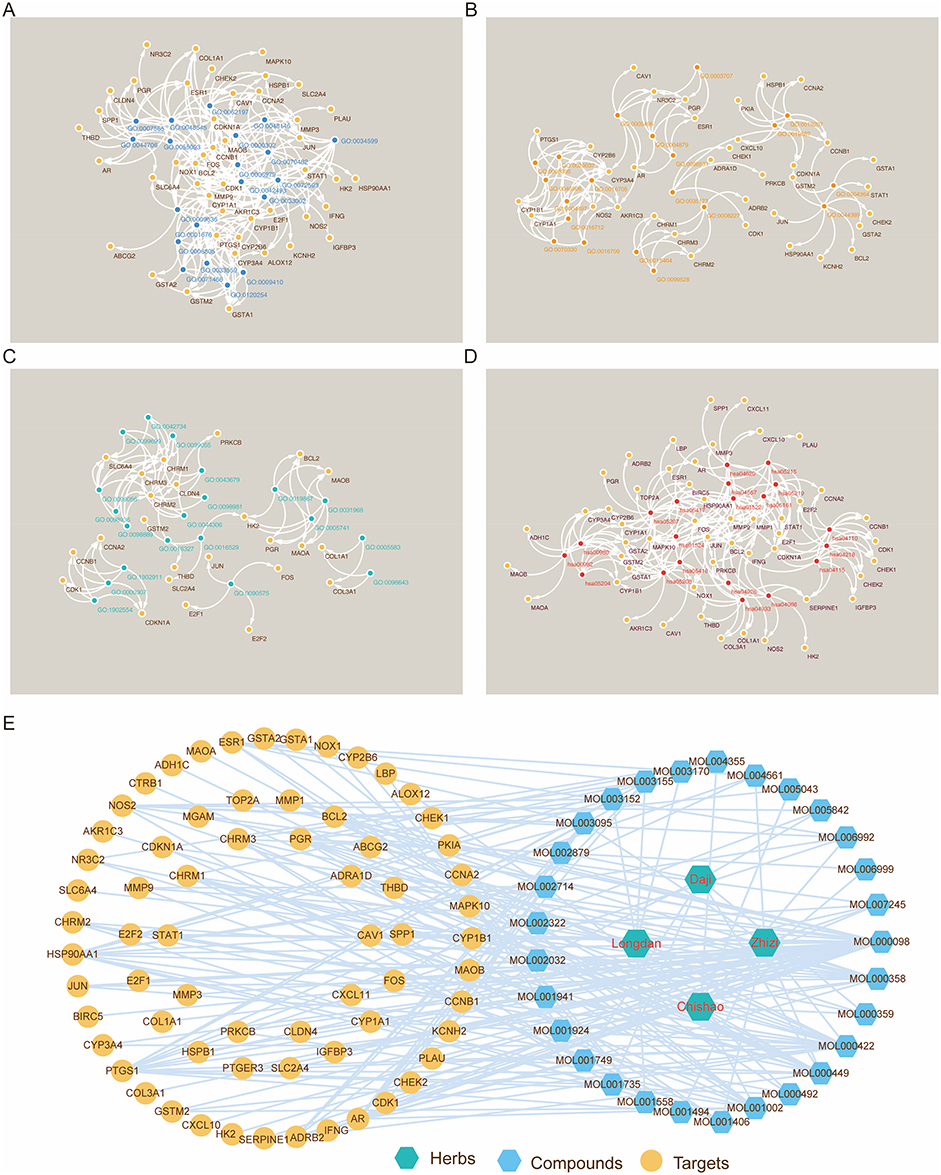 |
Figure 2 The regulated networks of key targets-top20 GO items/KEGG pathways. (A) The top 20 items of key targets-GO BP regulated network.Small blue circles represent GO_BP Terms, and small yellow circles represent key target sites. The abbreviation “GO” in the figure is for Gene Ontology, the abbreviation “BP” in the figure is for Biological Process. (B) The top 20 items of key targets-GO MF regulated network. The small Orange circle represents the GO MF term and small yellow circles represent key target sites.The abbreviation “MF” in the figure is for Molecular Functions. (C) The top 20 items of key targets-GO CC regulated network. The small green circle represents the GO CC term and small yellow circles represent key target sites. The abbreviation “CC” in the figure is for Cellular Components. (D) The top 20 items of key targets-KEGG pathways regulated network. The small red circle represents the KEGG term and small yellow circles represent key target sites.The abbreviation “KEGG” in the figure is for Kyoto Encyclopedia of Genes and Genomes. (E) Herbs-active ingredients-key targets networks. Green represents herbs, blue represents ingredients, and yellow represents targets. |
Acquisition and Enrichment Analysis of Hub Genes
The PPI network for key targets contained 65 notes and 343 edges, we could see that ABCG2 protein interacted with multiple proteins, such as AR (Androgen Receptor), PGR, CYP1B1, etc. (Figure 3A). Sorted according to the Degree and selected the top 5 genes as hub genes. The five hub genes were ESR1, JUN, HSP90AA1 (Heat Shock Protein 90 alpha family class A member 1), MMP9, and FOS (Figure 3B). The hub genes were involved in 282 GO items, including 227 GO BP, 16 GO CC, and 39 GO MF, such as cellular responses to Cd ions, euchromatin, and R-SMAD binding (Figure 3C). Additionally, the hub genes were enriched in 43 KEGG pathways, including the estrogen signaling pathway, endocrine resistance, IL-17 signaling pathway, and Th17 cell differentiation (Figure 3D). The PPI network for hub genes showed that the FOS protein interacted with multiple proteins, such as ESR1, JUN, HSP90AA1, and MMP9 (Figure 3E).
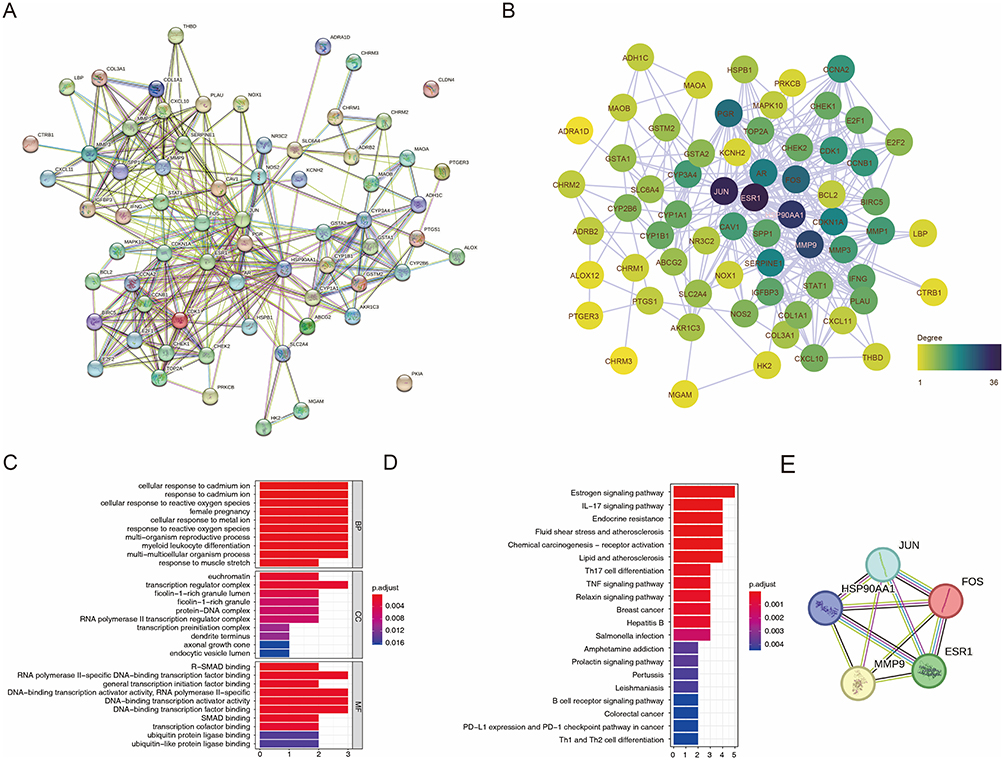 |
Figure 3 Acquisition and Enrichment Analysis of Hub Genes. (A) The PPI network of key targets.Lines represent their interactions, colors represent their degree value, and the darker the color, the higher the degree value, the higher the core position. (B) Obtainment of the 5 hub genes. The darker the color, the more important it is. (C) GO functional enrichment of hub genes. (D) KEGG pathway enrichment of hub genes. (E)The PPI network of hub genes. |
Molecular docking Analysis
Molecular docking was conducted to explore the binding modes and affinities between the proteins encoded by the hub genes and the relevant small molecules. The compounds docked to the hub genes are listed in Table 2. ESR1, FOS, HSP90AA1, JUN, and MMP9 were docked with Sudan III, quercetin, 3-Methylkempferol, beta-sitosterol, and ellagic acid, respectively (Figure 4A–E). And the docking affinity score was −8.6 kcal/mol, −8.8 kcal/mol, −6.9 kcal/mol, −5.9 kcal/mol, −7.4 kcal/mol, separately, suggesting that the compounds had good binding effect with the target proteins (Table 2). In addition, the molecular docking validation experiments of the reported highly active compounds with genes had shown that, the hub genes exhibited comparable binding stability with these high-activity compounds, which aligned with our experimental observations (Supplementary Figure 1 and Supplementary Table 3). These results might have provided some theoretical basis for understanding the potential molecular mechanisms of disease occurrence and development.
 |
Table 2 The Docking Affinity of Hub Genes with Active Ingredients |
 |
Figure 4 Docking diagram of hub genes and active ingredients of formula. (A) Docking diagram of ESR1 and Sudan III. (B) Docking diagram of FOS and quercetin. (C) Docking diagram of HSP90AA1 and 3-Methylkempferol. (D) Docking diagram of JUN and beta-sitosterol. (E) Docking diagram of MMP9 and ellagic acid. |
Effects of different concentrations of active ingredients on the proliferation rate of SGC-7901 and MKN-45 cells
We used four selected active ingredients and set different concentration gradients to detect the proliferation of MKN-45 and SGC-7901 cells (Figure 5A–H). The concentration gradient of each cell was set, and the cell proliferation rate decreased as the concentration increased and the IC50 (half maximal inhibitory concentration) of quercetin for stomach adenocarcinoma was 4 μM (Figure 5A and B), which was lower than that of other active ingredients. Hsi-Lung Hsieh et al demonstrated that treating non-cancerous gastric epithelial cells (GES-1 cells) with quercetin at concentrations of 0, 0.01, 0.1, 1, or 10 mM for 24 to 48 hours had little effect on cell viability,47 indicating that the inhibitory effect of quercetin on gastric cancer cells is not general cytotoxicity but exhibits certain tumor specificity. Meanwhile, after treating gastric cancer cells with 4 μM quercetin for 48 hours, the migration ability of gastric cancer cells was significantly reduced (Supplementary Figure 2A and B). Additionally, we performed transcriptome sequencing on quercetin-treated cells, and the results showed that the expression of FOSL1 (a member of the FOS/AP-1 family, also known as Fra-1) was significantly downregulated (Supplementary Figure 3). These results indicated that quercetin could effectively inhibit the development of gastric adenocarcinoma at relatively low concentrations, and provided some clues for further research on its anti-cancer mechanism and potential pharmaceutical development.
 |
Figure 5 Proliferation efficiency of active ingredients at different concentration in SGC-7901 and MKN-45. (A and B) are CCK8 experimental results for quercetin; (C and D) are CCK8 experimental results for ellagic acid; (E and F) are CCK8 experimental results for beta-sitosterol; (G and H) are CCK8 experimental results for 3-Methylkempferol (*P < 0.05, **p < 0.01, ***p < 0.001, and ****p < 0.0001 vs control group).The colored symbols represent the cell viability values from each of the three technical replicates. |
Discussion
STAD is one of the most common malignancies and is a significant cause of mortality worldwide.48 However, the treatment of stomach adenocarcinomas is limited. In addition to traditional surgical resection and chemoradiotherapy for patients with early stomach adenocarcinoma, targeted therapy and immunotherapy have greatly improved the survival rate of patients with stomach adenocarcinoma; however, the overall survival rate of stomach adenocarcinoma is still around 25%, and the survival rate of patients with advanced stomach adenocarcinoma is less than 5%.48 The chemotherapy regimen combining cisplatin and fluorouracil achieves an overall response rate of approximately 50%, yet the 5-year survival rate remains below 20%. Long-term use of this regimen readily induces drug resistance and neurotoxicity, resulting in a significant decline in patients’ quality of life.49
In recent years, targeted therapy and immunotherapy have brought new breakthroughs in gastric cancer (GC) treatment, including human epidermal growth factor receptor 2 (HER-2) monoclonal antibodies, programmed death-1 (PD-1) inhibitors, and programmed death-ligand 1 (PD-L1) inhibitors. However, HER-2-positive patients account for only 15–30%, and their clinical benefits remain relatively limited. Although PD-1/PD-L1 inhibitors have shown superior efficacy to chemotherapy alone in first-line treatment, they can only extend the median overall survival of patients by approximately two months, with their effectiveness severely constrained by tumor immune tolerance mechanisms.10 Recent studies have further revealed the mechanisms of immune resistance. For instance, FAP+ cancer-associated fibroblasts (CAFs) promote the polarization of Th2 cells through the IL-31/STAT6 signaling pathway, thereby driving acquired resistance to PD-1 immunotherapy in gastric cancer.50 This mechanism deepens our understanding of the dilemmas in PD-1/PD-L1 treatment and highlights the clinical urgency of overcoming challenges in cancer therapy. Therefore, exploring new strategies that can prolong the survival of patients with advanced gastric adenocarcinoma while improving their quality of life is crucial.
In this context, natural products, characterized by their multi-component and multi-targeted properties, have emerged as an important source for screening novel therapeutic agents due to their extensive therapeutic potential in gastric adenocarcinoma.51,52 The Shen Qing Wei Chang Formula (SQWCF) demonstrates significant tumor suppression in vivo with no apparent toxicity. It induces apoptosis in GC cells by inhibiting the activation of PI3K-AKT and MAPK signaling pathways, and exhibits synergistic effects with paclitaxel (PTX).53 Network pharmacology, integrating systems biology and bioinformatics, serves as a novel approach to elucidate complex drug mechanisms.Both network pharmacology and in vitro studies indicate that aloin suppresses cell proliferation and promotes GC cell apoptosis via inhibition of the PI3K-AKT pathway.54
Against this backdrop, based on the TCM (Traditional Chinese Medicine) theory of “clearing the liver and resolving stomach stagnation”, this study optimized the classic TCM formula “Longdan Xiegan Decoction” and constructed a therapeutic compound herbs composed of Radix Paeoniae Rubra (Chi-shao), Gentianae Radix Et Rhizoma (Long-dan), Cardeniae Fructus (Zhi-zi) and Radix Cirsii Japonici (Da-ji).19,20 Methodologically, this study adopted a target screening strategy with higher disease relevance: different from the conventional approach that only relies on literature-mining databases such as CTD (Comparative Toxicogenomics Database) and GeneCards,55,56 we further integrated transcriptomic data from the TCGA-STAD cohort. By analyzing differentially expressed genes between gastric cancer tissues and normal tissues, we screened a set of targets that are more consistent with the real pathological state of human diseases. This strategy, based on high-throughput real-world omics data, improved the reliability of subsequent network pharmacology analysis results to a certain extent.Ultimately, through an integrated systematic research strategy combining network pharmacology, molecular docking, and cell experiments, we screened 67 anti-stomach adenocarcinoma (STAD) targets from the TCMSP (Traditional Chinese Medicine Systems Pharmacology Database and Analysis Platform), TCGA-STAD, and GeneCards databases, and further identified five core genes: ESR1, JUN, FOS, HSP90AA1, and MMP9. This study not only constructed a multi-level research framework for analyzing the complex mechanisms of TCM compound herbs but also systematically revealed the action network of this optimized compound herbs for the first time, providing a significant methodological advancement for the modernization research of TCM.
ESR1 (Estrogen receptor 1) gene encodes estrogen receptor α,57 which regulates the transcription of many estrogen-inducing genes and plays a role in growth, metabolism, sexual development, pregnancy, and other reproductive functions. JUN (Avian sarcoma virus 17 (ASV17) oncogene homolog) and FOS (FBJ murine osteosarcoma viral oncogene homolog) protein both belong to the AP-1 (Activator Protein 1) family of transcriptionally active factors.58 The function of the proto-oncogene JUN is mainly involved in the composition of AP-1 with the FOS protein and activates AP-1 under the stimulation of stress factors such as hypoxia and inflammatory factors. In addition, activated AP-1 can regulate IL-1β (Interleukin 1 beta), IL-6 (Interleukin 6) and Tumor Necrosis Factor alpha (TNF-α) genes, participating in various pathological processes, such as stress, inflammatory tumor or cancer, and all aspects of life by intervening in cell proliferation, transformation, differentiation or apoptosis.59 MMP9 (Matrix Metallopeptidase 9), a member of the most complex MMP belonging to the gelatinase B family.60 It mainly consists of the hippocampus, cerebellum, and cerebral cortex.61 MMP9 plays a key role in tumorigenesis by regulating cancer cell survival, migration, stimulation of immune response, and production of the cancer microenvironment. Studies have shown that invasion and migration of stomach adenocarcinoma cells are promoted through the ERK pathway after MMP9 is activated by neurotensin.62 HSP90AA1 (heat shock protein 90 alpha family class A member 1) is an isomer of chaperone HSP90 (Heat shock protein 90) and a member of the heat shock gene family.63 HSP90 is an important, evolutionarily conserved chaperone64 that encodes proteins that aid in the correct folding of specific target proteins using ATPase regulated by co-molecular chaperons.65 Previous studies have shown that ESR1, JUN, and FOS are transcription factors or regulators that regulate cell behavior by influencing the expression of other genes. HSP9OAA1 acts as a molecular chaperone, stabilizing the structure and function of JUN, FOS, and other transcription factors and influencing their activity and role in cells.66 ESR1 regulates MMP9 expression by activating JUN and FOS, a mechanism important for tumorigenesis and development.67 This suggests that these transcription factors may be involved in cell migration and tissue remodeling by regulating MMP9 expression.These hub genes are interconnected in a variety of cell signaling pathways and biological processes, which is consistent with the PPI results of the five hub genes. On the other hand, the HER2-MAPK-mediated phosphorylation of ERα and activation of AP-1 lead to dual resistance to endocrine therapies (eg, aromatase inhibitors) and HER2-targeted therapies.68–70 This suggests that the Chinese herbal formula may reduce tumor cell resistance to HER2-targeted drugs (such as trastuzumab) and significantly enhance treatment sensitivity by regulating five key hub genes to influence the MAPK signaling pathway. These findings provide new avenues for future combined therapy using this herbal formula alongside targeted anticancer agents.
KEGG results showed that the five hub genes were significantly associated with the Th17 cell differentiation pathway. STAD progression is associated with various signaling pathways. Th17 cell differentiation is an important subpopulation of immune cells involved in inflammatory responses and immunomodulation, mainly through the secretion of cytokines, such as IL-17.71 Gan72 et al found that the interleukin (IL)-17 signaling pathway and Th17 cell differentiation were significantly upregulated in immune cell subsets during STAD progression. Biphasic ER-α36-mediated estrogen signalling has been shown to regulate the growth of gastric cancer cells. ER-α36 plays an important role in regulating Th17 cell differentiation in the tumor microenvironment.73 The above study reported that Th17 cell differentiation and STAD development of STAD were significantly correlated. This further suggests that the five hub genes identified in this study play important roles in STAD and may be potential drug targets for STAD.
Of particular note, this study found via molecular docking that the binding affinity between quercetin (an active component of the compound herbs) and the FOS protein was as high as −8.8 kcal/mol. Cell experiments further confirmed that quercetin exhibited the strongest proliferation-inhibitory activity against STAD cells (IC50 = 4 μM). Additionally, after treating gastric cancer cells with 4 μM quercetin for 48 hours, the migration of gastric cancer cells was significantly inhibited; moreover, sequencing results showed that the expression of FOSL1 (a member of the FOS/AP-1 family, also known as Fra-1) was significantly downregulated. These results suggest that the interaction between quercetin and FOS may be one of the central links through which the compound herbs exerts its effects.
This finding holds potential clinical value. Combined with the latest research results: Fra-1 can induce chemoresistance in gastric cancer by activating the pentose phosphate pathway,74 and AP-1 activation mediated by the HER2-MAPK signaling pathway is also a key mechanism underlying targeted therapy resistance.68–70 From this, we hypothesize that this compound herbs or its active component quercetin may, in the future, intervene in the aforementioned signaling axes by targeting FOS, thereby providing a new adjuvant therapeutic strategy for reversing targeted therapy resistance in STAD. Thus, we propose a new clinical translation strategy: using quercetin or its optimized compound herbs as a FOS/AP-1 signaling inhibitor in combination with conventional chemotherapy (eg cisplatin/fluorouracil) or targeted drugs (eg trastuzumab). This approach aims to intervene in drug-resistant signaling pathways at the source and reverse treatment resistance.
However, as a common dietary flavonoid, quercetin is known to have low oral bioavailability,59 which may reduce its achievable plasma concentration and limit its efficacy when used directly as a single agent. Nevertheless, this is not an insurmountable barrier. Future translational research could explore advanced drug delivery systems (eg, nanoformulations) or consider using the compound herbs as a whole as an adjuvant therapy in combination with conventional chemotherapy, targeted drugs, or immunosuppressants. This combination strategy may, through multi-target synergy, reduce the dose of conventional drugs (thereby minimizing toxic side effects) while reversing metastatic drug resistance and immune tolerance, ultimately improving overall efficacy. This may be more feasible and clinically valuable than the development of a single component. Similarly, studies on corosolic acid (a natural product) enhancing chemotherapy sensitivity by regulating ferroptosis75 also provide evidence for the application of natural medicines in combination therapy. Future research can focus on verifying this strategy in a broader range of gastric cancer subtypes and drug-resistant models, and systematically evaluating differences in its efficacy across different patient populations to promote its translation into personalized adjuvant therapy.
However, this study had certain limitations. First, this study primarily relies on bioinformatics analysis and short-term (48-hour) in vitro proliferation and invasion assays, which makes it difficult to comprehensively evaluate key phenotypes during long-term tumor progression and fails to truly reflect in vivo pharmacokinetic processes and the complexity of the tumor microenvironment. In particular, the lack of assessment of quercetin’s plasma concentration and pharmacokinetic characteristics affects the judgment of its translational potential. Second, although molecular docking shows that quercetin binds well to FOS, and sequencing results reveal downregulated FOSL1 gene expression in gastric cancer cells after quercetin treatment, its multi-target property means we cannot yet confirm whether its anti-tumor effect is specifically mediated by FOS. Furthermore, the study only used cell proliferation assays, invasion assays, and a limited number of cell lines, so the strength of evidence needs to be further enhanced. Based on the above considerations, we plan to conduct more in-depth work in subsequent studies: setting non-cancerous gastric epithelial cells as controls, using Annexin V-FITC/PI double staining to analyze quercetin’s regulatory effect on cell apoptosis, and increasing replicate samples to improve statistical power; meanwhile, adopting gene manipulation techniques to directly verify the function of FOS in the action of quercetin, advancing in vivo animal experiments to systematically evaluate the overall efficacy and safety, and further exploring whether quercetin can reverse HER2-targeted therapy resistance and its underlying mechanism. These systematic follow-up studies will provide more solid experimental evidence for the clinical application of this active component and its compound herbs.
Conclusion
In this study, 67 anti-STAD targets in a Chinese herbal formula (composed of Chi-shao, Da-ji, Long-dan, and Zhi-zi) were screened using TCMSP, TCGA-STAD, and GeneCards databases. In the protein interaction network analyzed and plotted using the STRING database, we identified ESR1, JUN, FOS, HSP90AA1, and MMP9 as five core genes, indicating that these genes are key genes in the treatment of stomach adenocarcinoma. KEGG results showed that the five hub genes were significantly associated with the Th17 cell differentiation pathway. Molecular docking showed that quercetin was the main active ingredient and FOS was the key drug target. These results were further verified using cell proliferation and Transwell experiments. This provides an important reference for improving STAD treatment and patient prognosis.However, translating these findings into clinical practice still faces challenges. Subsequently, more in-depth animal experiments and human clinical trials need to be conducted to comprehensively evaluate quercetin’s potential in terms of efficacy, safety, and long-term application, so as to clarify its mechanism of action against gastric adenocarcinoma. Ultimately, this will enable the translation from basic research to clinical treatment, thereby bringing tangible clinical benefits to patients.
Data Sharing Statement
The original contributions presented in the study are included in the Supplementary Materials. Further inquiries can be directed to the corresponding author.
Ethics Approval and Informed Consent
This study utilized only publicly available data from [TCGA-STAD], which were de-identified and complied with all relevant data use policies. Ethical approval was waived as no new human or animal experiments were conducted by Shaanxi Provincial People’s Hospital, according to item 1 and 2 of Article 32 of the Measures for Ethical Review of Life Science and Medical Research Involving Human Subjects dated February 18, 2023.
Acknowledgments
We would like to express our sincere gratitude to all individuals and organizations who supported and assisted us throughout this research. In conclusion, we extend our thanks to everyone who supported and assisted us in this manner. Without your support, this study would not have been feasible.
Author Contributions
All authors made a significant contribution to the work reported, whether that is in the conception, study design, execution, acquisition of data, analysis and interpretation, or in all these areas; took part in drafting, revising or critically reviewing the article; gave final approval of the version to be published; have agreed on the journal to which the article has been submitted; and agree to be accountable for all aspects of the work.
Funding
This study was funded by Shaanxi Provincial People’s Hospital talent special fund (Program No.2022-JY-14), Shaanxi Provincial Health Commission’s Research and Innovation Team on Cardiac Injury Associated with Tumor Immunity (Program No.2025-TD-21), Key Research and Development of National Health Commission of Shaanxi: (Program No.2022A016), Science and technology Program of Xi ‘an (Program No.23YXYJ0109), Beijing Science and Technology innovation medical development foundation (Program No.KC2021-JX-0186-86), Science and Technology Development Incubation Fund of Shaanxi Provincial People’s Hospital (Program No.2021YJY-11), “Research on Cutting-edge Tumor Support Treatment” Public Welfare Program (Program No.FB2023032397), Regional Fund Program of National Natural Science Foundation Committee (Program No.82260545).
Disclosure
The authors declare that this research was conducted in the absence of any commercial or financial relationships that could be construed as potential conflicts of interest.
References
1. Guan W-L, He Y, Xu R-H. Gastric cancer treatment: recent progress and future perspectives. J Hematol Oncol. 2023;16(1):57. doi:10.1186/s13045-023-01451-3
2. Xia C, Dong X, Li H, et al. Cancer statistics in China and United States, 2022: profiles, trends, and determinants. Chinese Med J. 2022;135(5):584–18. doi:10.1097/CM9.0000000000002108
3. Liu Q, Tang J, Chen S, et al. Berberine for gastric cancer prevention and treatment: multi-step actions on the Correa’s cascade underlie its therapeutic effects. Pharmacolog Res. 2022;184:106440.
4. Ko K-P, Shin A, Cho S, Park SK, Yoo K-Y. Environmental contributions to gastrointestinal and liver cancer in the Asia–Pacific region. J gastroenterol hepatol. 2018;33(1):111–120. doi:10.1111/jgh.14005
5. He Z, Yang H, Chen Q, et al. Role of TAP1 in the identification of immune-hot tumor microenvironment and its prognostic significance for immunotherapeutic efficacy in gastric carcinoma. J Gastrointest Oncol. 2024;15(3):890–907. doi:10.21037/jgo-24-28
6. Zhou L, Lin J, Wu G, Chen J, Huang X, Zhang S. Safety and feasibility of low-dose apatinib combined with S-1 as the second-line therapy or beyond in Chinese patients with pulmonary and hepatic metastasis of nasopharyngeal carcinoma. drug design, development and therapy. Drug Design Develop Therapy. 2020;14:1257–1262. doi:10.2147/DDDT.S244102
7. Quek L, David MD, Kennedy A, et al. Clonal heterogeneity of acute myeloid leukemia treated with the IDH2 inhibitor enasidenib. Nat med. 2018;24(8):1167–1177.
8. Liang W, He X, Bi J, Hu T, Sun Y. Role of reactive oxygen species in tumors based on the ‘seed and soil’ theory: a complex interaction. Oncol Rep. 2021;46(3).
9. Yuan H, Bao M, Chen M, Fu J, Yu S. Advances in Immunotherapy and targeted therapy for gastric cancer: a comprehensive review. Br J Hosp Med. 2025;86(3):1–24. doi:10.12968/hmed.2024.0759
10. Liu Y, Li C, Lu Y, Liu C, Yang W. Tumor microenvironment-mediated immune tolerance in development and treatment of gastric cancer. Front Immunol. 2022;13:1016817. doi:10.3389/fimmu.2022.1016817
11. Adnan M, Rasul A, Hussain G, et al. Ginkgetin: a natural biflavone with versatile pharmacological activities. Food Chem Toxicol. 2020;145:111642. doi:10.1016/j.fct.2020.111642
12. Kanwal N, Rasul A, Hussain G, et al. Oleandrin: a bioactive phytochemical and potential cancer killer via multiple cellular signaling pathways. Food Chem Toxicol. 2020;143:111570. doi:10.1016/j.fct.2020.111570
13. Sarfraz A, Rasul A, Sarfraz I, et al. Hispolon: a natural polyphenol and emerging cancer killer by multiple cellular signaling pathways. Environ Res. 2020;190:110017.
14. Zhou H-J, Mu B-X, Wen M-C, et al. Yiqi Huayu Jiedu decoction reduces colorectal cancer liver metastasis by promoting N1 neutrophil chemotaxis. Front Immunol. 2025;16:1530053. doi:10.3389/fimmu.2025.1530053
15. Wang Y, Chu F, Lin J, et al. Erianin, the main active ingredient of Dendrobium chrysotoxum Lindl, inhibits precancerous lesions of gastric cancer (PLGC) through suppression of the HRAS-PI3K-AKT signaling pathway as revealed by network pharmacology and in vitro experimental verification. J Ethnopharmacol. 2021;279:114399.
16. Qian L, Xu Z, Luo T, et al. In silico identification and verification of Tanshinone IIA-related prognostic genes in hepatocellular carcinoma. Front Immunol. 2024;15:1482914. doi:10.3389/fimmu.2024.1482914
17. Xuan YX, Gao Y, Zhang ZL, et al. Experience of nation’s distinguished TCM Master Li Diangui in treating postoperative complications of early gastric cancer after endoscopic submucosal dissection based on the “turbid toxin theory”. J Trad Chinese Med. 2025;31(07):
18. Bi S, Liu Y, Lv T, et al. Preliminary exploration of method for screening efficacy markers compatibility in TCM prescriptions based on Q-markers: anti-inflammatory activity of Dachaihu decoction as an example. J Ethnopharmacol. 2023;312:116539. doi:10.1016/j.jep.2023.116539
19. Zheng YJ. Clinical value of modified Longdan Xiegan decoction in the treatment of eczema. Inner Mongolia J Trad Chinese Med. 2016;35(17):46.
20. Zheng Y-X, Wang K-X, Chen S-J, et al. Decoding the key functional combined components group and uncovering the molecular mechanism of longdan xiegan decoction in treating uveitis. Drug Design Develop Therapy. 16;2022:3991–4011. doi:10.2147/DDDT.S385136
21. Wu CE, Xue WW, Zhuang YW, et al. A clinical study on the efficacy of Yiqi Huayu Jiedu decoction for reducing the risk of postoperative recurrence and metastasis of gastric cancer: protocol for a multicenter, randomized, double-blind, placebo-controlled trial. Medicine. 2020;99(48):e23417.
22. Liu P, Li Q, Zhu G, et al. Characterization of the glucuronidating pathway of pectolinarigenin, the major active constituent of the Chinese medicine Daji, in humans and its influence on biological activities. J Ethnopharmacol. 2024;319(Pt 1):117280. doi:10.1016/j.jep.2023.117280
23. Wang XZ, Xia L, Zhang XY, et al. The multifaceted mechanisms of Paeoniflorin in the treatment of tumors: state-of-the-art. Biomed Pharmacotherapy. 2022;149:112800. doi:10.1016/j.biopha.2022.112800
24. Xu H-Y, Chen Z-W, Wu Y-M. Antitumor activity of total paeony glycoside against human chronic myelocytic leukemia K562 cell lines in vitro and in vivo. Med Oncol. 2012;29(2):1137–1147. doi:10.1007/s12032-011-9909-9
25. Zheng Y-B, Xiao G-C, Tong S-L, et al. Paeoniflorin inhibits human gastric carcinoma cell proliferation through up-regulation of microRNA-124 and suppression of PI3K/Akt and STAT3 signaling. World J Gastroenterol. 2015;21(23):7197–7207. doi:10.3748/wjg.v21.i23.7197
26. Fang S, Zhu W, Zhang Y, Shu Y, Liu P. Paeoniflorin modulates multidrug resistance of a human gastric cancer cell line via the inhibition of NF-κB activation. Mole Med Rep. 2012;5(2):351–356.
27. Liu S, Luo X, Li D, et al. Tumor inhibition and improved immunity in mice treated with flavone from Cirsium japonicum DC. Int Immunopharmacol. 2006;6(9):1387–1393. doi:10.1016/j.intimp.2006.02.002
28. Jiang LL, Ren PY, Wang YZ, Ma YT. Research progress on pharmacological action of Gentian. Innov Sci Technol. 2019;36:43–44.
29. Xiao W, Li S, Wang S, Ho C-T. Chemistry and bioactivity of Gardenia jasminoides. J Food Drug Analys. 2017;25(1):43–61. doi:10.1016/j.jfda.2016.11.005
30. Du H, Zhang L, Sun H, et al. Exploring the underlying mechanisms of Qingxing granules treating H1N1 influenza based on network pharmacology and experimental validation. Pharmaceuticals. 2024;17(6):731. doi:10.3390/ph17060731
31. Zhou X, Tan F, Zhang S, Wang A, Zhang T. A strategy based on bioinformatics and machine learning algorithms reveals potential mechanisms of shelian capsule against hepatocellular carcinoma. Curr Pharmaceu Design. 2024;30(5):377–405. doi:10.2174/0113816128284465240108071554
32. Ritchie ME, Phipson B, Wu D, et al. limma powers differential expression analyses for RNA-sequencing and microarray studies. Nucleic Acids Res. 2015;43(7):e47. doi:10.1093/nar/gkv007
33. Wang J, Wu N, Feng X, et al. PROS1 shapes the immune-suppressive tumor microenvironment and predicts poor prognosis in glioma. Front Immunol. 2023;13:1052692. doi:10.3389/fimmu.2022.1052692
34. Zhang X, Chao P, Zhang L, et al. Single-cell RNA and transcriptome sequencing profiles identify immune-associated key genes in the development of diabetic kidney disease. Front Immunol. 2023;14:1030198. doi:10.3389/fimmu.2023.1030198
35. Wu T, Hu E, Xu S, et al. clusterProfiler 4.0: a universal enrichment tool for interpreting omics data. Innovation. 2021;2(3):100141. doi:10.1016/j.xinn.2021.100141
36. Li H, Gao L, Du J, Ma T, Ye Z, Li Z. Differentially expressed gene profiles and associated ceRNA network in ATG7-Deficient lens epithelial cells under oxidative stress. Front Gene. 2022;13:1088943. doi:10.3389/fgene.2022.1088943
37. Shannon P, Markiel A, Ozier O, et al. Cytoscape: a software environment for integrated models of biomolecular interaction networks. Genome Res. 2003;13(11):2498–2504. doi:10.1101/gr.1239303
38. Otasek D, Morris JH, Bouças J, Pico AR, Demchak B. Cytoscape automation: empowering workflow-based network analysis. Genome Biol. 2019;20(1):185. doi:10.1186/s13059-019-1758-4
39. Li K, Liu H, Lin Y, Gu L, Xiang X, Zhu X. Discovery of therapeutic targets of quercetin for endometrial carcinoma patients infected with COVID-19 through network pharmacology. Front Oncol. 2023;13:1151434. doi:10.3389/fonc.2023.1151434
40. Li N, Sun C, Zhou B, et al. Low concentration of quercetin antagonizes the cytotoxic effects of anti-neoplastic drugs in ovarian cancer. PloS one. 2014;9(7):e100314. doi:10.1371/journal.pone.0100314
41. Trott O, Olson AJ. AutoDock Vina: improving the speed and accuracy of docking with a new scoring function, efficient optimization, and multithreading. J Computat Chem. 2010;31(2):455–461. doi:10.1002/jcc.21334
42. Seeliger D, de Groot BL. Ligand docking and binding site analysis with PyMOL and Autodock/Vina. J Comp Aided Mole Design. 2010;24(5):417–422. doi:10.1007/s10822-010-9352-6
43. Lotito SB, Fraga CG. (+)-Catechin as antioxidant: mechanisms preventing human plasma oxidation and activity in red wines. BioFactors. 1999;10(2–3):125–130. doi:10.1002/biof.5520100207
44. Hu Z, Guan Y, Hu W, Xu Z, Ishfaq M. An overview of pharmacological activities of baicalin and its aglycone baicalein: new insights into molecular mechanisms and signaling pathways. Iranian J Basic Med Sci. 2022;25(1):14–26.
45. Joshi R, Gangabhagirathi R, Venu S, Adhikari S, Mukherjee T. Antioxidant activity and free radical scavenging reactions of gentisic acid: in-vitro and pulse radiolysis studies. Free Radical Res. 2012;46(1):11–20. doi:10.3109/10715762.2011.633518
46. Rather RA, Bhagat M. Quercetin as an innovative therapeutic tool for cancer chemoprevention: molecular mechanisms and implications in human health. Cancer Med. 2020;9(24):9181–9192. doi:10.1002/cam4.1411
47. Hsieh H-L, Yu M-C, Cheng L-C, et al. Quercetin exerts anti-inflammatory effects via inhibiting tumor necrosis factor-α-induced matrix metalloproteinase-9 expression in normal human gastric epithelial cells. World J Gastroenterol. 2022;28(11):1139–1158. doi:10.3748/wjg.v28.i11.1139
48. Tu Y, Wu Q, He J, et al. Exploring the potential molecular mechanism of scutellaria baicalensis georgi in the treatment of gastric cancer based on network pharmacological analysis and molecular docking technology. Front Pharmacol. 2021;12:697704. doi:10.3389/fphar.2021.697704
49. Liu Y-P, Zheng -C-C, Huang Y-N, He M-L, Xu WW, Li B. Molecular mechanisms of chemo- and radiotherapy resistance and the potential implications for cancer treatment. Medcomm. 2021;2(3):315–340. doi:10.1002/mco2.55
50. Wu J, Zhang P-F, Zeng Y, et al. Effects of FAP+ cancer-associated fibroblasts on anti-PD-1 immunotherapy and CD4+ T cell polarization in gastric cancer. Cancer Drug Resistance. 2025;8:38. doi:10.20517/cdr.2025.97
51. Pan X, Tao H, Nie M, et al. A clinical study of traditional Chinese medicine prolonging the survival of advanced gastric cancer patients by regulating the immunosuppressive cell population: a study protocol for a multicenter, randomized controlled trail. Medicine. 2020;99(16):e19757.
52. Wang K, Chen Q, Shao Y, et al. Anticancer activities of TCM and their active components against tumor metastasis. Biomed Pharmacotherapy. 2021;133:111044. doi:10.1016/j.biopha.2020.111044
53. Wang Y, Sun X, Ren M, et al. Integrative network pharmacology, transcriptomics, and proteomics reveal the material basis and mechanism of the Shen Qing Weichang formula against gastric cancer. Chinese Med. 2025;20(1):42. doi:10.1186/s13020-025-01091-4
54. Gao J, Yang S, Xie G, Pan J, Zhu F. Integrating network pharmacology and experimental verification to explore the pharmacological mechanisms of aloin against gastric cancer. drug design, development and therapy. Drug Design Develop Therapy. 2022;16:1947–1961. doi:10.2147/DDDT.S360790
55. Gao P, Chang K, Yuan S, et al. Exploring the mechanism of hepatotoxicity induced by dictamnus dasycarpus based on network pharmacology, molecular docking and experimental pharmacology. Molecules. 2023;28(13):5045. doi:10.3390/molecules28135045
56. Dai G, Liu D, Wang Y, et al. Integrated serum pharmacochemistry and network pharmacology used to explore potential antidepressant mechanisms of the Kaixin San. Biomed Chromatography. 2025;39(4):e70041. doi:10.1002/bmc.70041
57. Button B, Park BH. ESR1 mutations: pièce de résistance. Genes Dis. 2016;3(2):124–129. doi:10.1016/j.gendis.2016.03.005
58. Angel P, Allegretto EA, Okino ST, et al. Oncogene jun encodes a sequence-specific trans-activator similar to AP-1. Nature. 1988;332(6160):166–171. doi:10.1038/332166a0
59. Brennan A, Leech JT, Kad NM, Mason JM. Selective antagonism of cJun for cancer therapy. J Experim Clin Cancer Res. 2020;39(1):184. doi:10.1186/s13046-020-01686-9
60. Augoff K, Hryniewicz-Jankowska A, Tabola R, Stach K. MMP9: a tough target for targeted therapy for cancer. Cancers. 2022;14(7).
61. Kalali D. The role of the matrix metalloproteinase-9 gene in tumor development and metastasis: a narrative review. Global Med Gene. 2023;10(2):48–53. doi:10.1055/s-0043-1768166
62. Akter H, Park M, Kwon OS, Song EJ, Park WS, Kang MJ. Activation of matrix metalloproteinase-9 (MMP-9) by neurotensin promotes cell invasion and migration through ERK pathway in gastric cancer. Tumour Biol. 2015;36(8):6053–6062. doi:10.1007/s13277-015-3282-9
63. Grimstad T, Kvivik I, Kvaløy JT, Aabakken L, Omdal R. Heat shock protein 90 and inflammatory activity in newly onset Crohn’s disease. Scandinavian J Gastroenterol. 2018;53(12):1453–1458. doi:10.1080/00365521.2018.1533582
64. Wang B, Chen Z, Yu F, et al. Hsp90 regulates autophagy and plays a role in cancer therapy. Tumour Biol. 2016;37(1):1–6. doi:10.1007/s13277-015-4142-3
65. van Oosten-Hawle P. Organismal roles of Hsp90. Biomolecules. 2023;13(2).
66. Vydra N, Janus P, Kus P, et al. Heat shock factor 1 (HSF1) cooperates with estrogen receptor α (ERα) in the regulation of estrogen action in breast cancer cells. eLife. 2021;10.
67. Stevens TA, Meech R. BARX2 and estrogen receptor-alpha (ESR1) coordinately regulate the production of alternatively spliced ESR1 isoforms and control breast cancer cell growth and invasion. Oncogene. 2006;25(39):5426–5435. doi:10.1038/sj.onc.1209529
68. Blangé D, Stroes CI, Derks S, Bijlsma MF, van Laarhoven HWM. Resistance mechanisms to HER2-targeted therapy in gastroesophageal adenocarcinoma: a systematic review. Cancer Treatment Rev. 2022;108:102418. doi:10.1016/j.ctrv.2022.102418
69. Lei ZN, Teng QX, Tian Q, et al. Signaling pathways and therapeutic interventions in gastric cancer. Signal transduction and targeted therapy. Signal Transduction Targeted Therapy. 2022;7(1):358. doi:10.1038/s41392-022-01190-w
70. Wu M, Yuan S, Liu K, Wang C, Wen F. Gastric cancer signaling pathways and therapeutic applications. Technol Cancer Res. 2024;23:15330338241271935. doi:10.1177/15330338241271935
71. Iida T, Iwahashi M, Katsuda M, et al. Tumor-infiltrating CD4+ Th17 cells produce IL-17 in tumor microenvironment and promote tumor progression in human gastric cancer. Oncol Rep. 2011;25(5):1271–1277.
72. Gan S, Li C, Hou R, et al. Dynamic changes of the immune microenvironment in the development of gastric cancer caused by inflammation. Mole Therapy Oncol. 2024;32(3):200849. doi:10.1016/j.omton.2024.200849
73. Wang X, Huang X, Fu Z, et al. Biphasic ER-α36-mediated estrogen signaling regulates growth of gastric cancer cells. Int J Oncol. 2014;45(6):2325–2330. doi:10.3892/ijo.2014.2660
74. Zeng F, Cao J, Chen Y, et al. Fra-1 affects chemotherapy sensitivity by inhibiting ferroptosis in gastric cancer cells. Cancer Drug Resist. 2024;7:44. doi:10.20517/cdr.2024.101
75. Lin L, Wang J, Sheng S, et al. Corosolic acid increases the therapeutic effect of cisplatin on gastric cancer by regulating Gpx4-dependent ferroptosis. Cancer Drug Resistance. 2025;8:40.
 © 2026 The Author(s). This work is published and licensed by Dove Medical Press Limited. The
full terms of this license are available at https://www.dovepress.com/terms
and incorporate the Creative Commons Attribution
- Non Commercial (unported, 4.0) License.
By accessing the work you hereby accept the Terms. Non-commercial uses of the work are permitted
without any further permission from Dove Medical Press Limited, provided the work is properly
attributed. For permission for commercial use of this work, please see paragraphs 4.2 and 5 of our Terms.
© 2026 The Author(s). This work is published and licensed by Dove Medical Press Limited. The
full terms of this license are available at https://www.dovepress.com/terms
and incorporate the Creative Commons Attribution
- Non Commercial (unported, 4.0) License.
By accessing the work you hereby accept the Terms. Non-commercial uses of the work are permitted
without any further permission from Dove Medical Press Limited, provided the work is properly
attributed. For permission for commercial use of this work, please see paragraphs 4.2 and 5 of our Terms.
Recommended articles

DOCK4 as a Potential Biomarker Associated with Immune Infiltration in Stomach Adenocarcinoma: A Database Analysis
Lu Y, Yu J, Dong Q, Du Y, Liang Z
International Journal of General Medicine 2022, 15:6127-6143
Published Date: 11 July 2022
Identification of Critical Biomarkers and Mechanisms of Fructus Ligustri Lucidi on Vitiligo Using Integrated Bioinformatics Analysis

Liang TS, Tang N, Xian MH, Wen WL, Huang CJ, Cai LH, Li QL, Wu YH
Clinical, Cosmetic and Investigational Dermatology 2023, 16:2061-2071
Published Date: 7 August 2023
Network Analysis of Osteoarthritis Progression Using a Steiner Minimal Tree Algorithm
Xie Y, Shao F, Ji Y, Feng D, Wang L, Huang Z, Wu S, Sun F, Jiang H, Miyamoto A, Wang H, Zhang C
Journal of Inflammation Research 2024, 17:3201-3209
Published Date: 18 May 2024
ITGA4 Contributes to 5-Fluorouracil Resistance by Up-Regulating PI3K/AKT Signaling: Evidence from Network Pharmacology, Molecular Docking and Experimental Verification

Yan S, Hu X, Wu Y, Ye W, Zhu Y, He Y, Zhan F, Wu W, Ma Z
Drug Design, Development and Therapy 2025, 19:4105-4122
Published Date: 20 May 2025
Integrated Machine Learning and Multi-Omics Analysis Identifies Mitophagy-Related Core Genes and Mechanisms in Non-Alcoholic Fatty Liver Disease
Yuan Y, Zhang T, Song C, Lin C, Sun Y, Tang H
Journal of Inflammation Research 2026, 19:575586
Published Date: 24 March 2026