
Back to Journals » OncoTargets and Therapy » Volume 19
Efficacy and Safety of Regorafenib with or without Immune Checkpoint Inhibitors as Second-Line Treatment for Advanced Hepatocellular Carcinoma: A Systematic Review and Arm-Level Synthesis of Real-World Comparative Cohorts
Authors Yu X, Zan H, Deng W, He R
Received 2 March 2026
Accepted for publication 8 May 2026
Published 19 May 2026 Volume 2026:19 606160
DOI https://doi.org/10.2147/OTT.S606160
Checked for plagiarism Yes
Review by Single anonymous peer review
Peer reviewer comments 2
Editor who approved publication: Prof. Dr. Gaetano Romano
Xinlin Yu,1 Haifeng Zan,2 Wei Deng,3 Ran He4
1Department of Oncology, Affiliated Hospital of Southwest Medical University, Luzhou, Sichuan, 646000, People’s Republic of China; 2Department of Respiratory and Critical Care Medicine, Affiliated Hospital of Chengdu University, Chengdu, Sichuan, 610000, People’s Republic of China; 3Department of Gastroenterology, Affiliated Hospital of Chengdu University, Chengdu, Sichuan, 610000, People’s Republic of China; 4Department of Oncology, Zhongjiang County People’s Hospital, Deyang, Sichuan, 618199, People’s Republic of China
Correspondence: Ran He, Department of Oncology, Zhongjiang County People’s Hospital, Dabei Street, Deyang, Sichuan, People’s Republic of China, Email [email protected]
Background: Regorafenib is a standard second-line therapy for advanced hepatocellular carcinoma (HCC), but its efficacy as a monotherapy is limited. Combining regorafenib with immune checkpoint inhibitors (ICIs) may enhance antitumor activity through synergistic modulation of the tumor microenvironment. This study synthesizes real-world evidence from comparative cohorts by summarizing arm-level efficacy and safety outcomes reported for regorafenib plus ICIs and for regorafenib monotherapy.
Methods: A systematic search of PubMed, Embase, The Cochrane Library, and Web of Science was conducted up to January 10, 2026, to identify comparative real-world studies. Outcomes were synthesized primarily at the arm level: ORR was pooled as a single-arm proportion, and mPFS/mOS were summarized using reported medians. Random-effects models and exploratory meta-regression were used to examine differences in pooled arm-level summaries across cohort types rather than within-study head-to-head comparative effect estimates.
Results: Six studies involving 921 patients were included. Because adjusted within-study comparative estimates were inconsistently reported, findings should be interpreted as non-comparative arm-level summaries. In arm-level pooling, cohorts receiving regorafenib plus ICIs had a higher pooled ORR (0.28, 95% CI: 0.23– 0.32) than cohorts receiving regorafenib monotherapy (0.10, 95% CI: 0.06– 0.14). The pooled mPFS summary was longer in the combination cohorts (7.34 months; 95% CI: 6.09– 8.59) than in the monotherapy cohorts (3.97 months; 95% CI: 3.16– 4.77). The pooled mOS summary was numerically longer with the combination (16.87 months) versus monotherapy (11.07 months). The incidence of grade ≥ 3 adverse events was broadly similar between cohort types.
Conclusion: In this arm-level synthesis of real-world comparative cohorts, regorafenib plus ICIs was associated with numerically higher pooled response and longer pooled mPFS summaries than regorafenib monotherapy, while severe adverse event incidence appeared broadly similar across cohort types. Because these results are based on non-comparative pooled arm-level estimates and heterogeneous observational cohorts, they should be considered hypothesis-generating rather than definitive evidence of superiority. Prospective comparative trials and well-adjusted real-world analyses are needed to clarify comparative effectiveness and identify patients most likely to benefit.
Registration: PROSPERO CRD 420261290236.
Keywords: regorafenib, immune checkpoint inhibitors, hepatocellular carcinoma, tumor microenvironment, combination therapy, real-world study
Introduction
Primary liver cancer ranks among the most common malignancies and is a leading cause of cancer-related mortality worldwide, imposing a substantial global health burden.1 Hepatocellular carcinoma (HCC) accounts for the majority of primary liver cancer cases. Due to its characteristically insidious onset, a substantial proportion of patients present at an advanced stage, precluding potentially curative interventions such as surgical resection or liver transplantation.2 For these patients, systemic therapy remains central to disease management.3
After progression on first-line systemic therapy, the oral multikinase inhibitor regorafenib is a guideline-endorsed and widely used second-line option, particularly for patients who progressed on sorafenib and tolerated prior sorafenib.4 Its approval was supported by the Phase III RESORCE trial, which demonstrated a statistically significant improvement in median overall survival (mOS) with regorafenib compared with placebo (10.6 vs 7.8 months).4 However, regorafenib monotherapy yields modest tumor shrinkage in many patients, as reflected by relatively low objective response rates (ORR), underscoring an unmet need for strategies capable of achieving deeper and more durable responses.4,5
In recent years, the treatment landscape of HCC has been reshaped by immune checkpoint inhibitors (ICIs). In the first-line setting, combinations of anti-angiogenic agents and ICIs—such as atezolizumab plus bevacizumab (IMbrave150) and camrelizumab plus rivoceranib (CARES-310)—have demonstrated improved efficacy compared with sorafenib, supporting the clinical relevance of immunotherapy–antiangiogenic synergy.6,7 Meanwhile, the biological heterogeneity of HCC and the continual identification of prognostic and potentially actionable molecular features underscore the need to optimize systemic strategies across different patient subsets.8–10 Mechanistically, regorafenib has been proposed to exert immunomodulatory effects through the inhibition of angiogenic and immune-related signaling pathways, such as vascular endothelial growth factor receptor (VEGFR) and colony-stimulating factor 1 receptor (CSF1R). This inhibition may help alleviate an immunosuppressive tumor microenvironment and potentially enhance the activity of programmed cell death-1 (PD-1) blockade.11 On this basis, regorafenib combined with ICIs has been increasingly explored and adopted in real-world practice.
Nevertheless, the premise that adding ICIs to tyrosine kinase inhibitors (TKIs) consistently translates into a survival benefit has been questioned by high-level evidence. Notably, the phase III LEAP-002 trial evaluating lenvatinib plus pembrolizumab versus lenvatinib alone in the first-line setting did not meet its primary endpoints for overall survival, despite a strong biological rationale for combination therapy.12 Although LEAP-002 involved a different TKI and treatment line than regorafenib-based second-line therapy, it highlights that a strong mechanistic rationale for combination therapy may not necessarily translate into incremental survival gains in unselected populations.12 Therefore, synthesizing real-world comparative evidence is crucial to characterize whether cohorts treated with regorafenib plus PD-1 inhibitors show more favorable outcomes than cohorts treated with regorafenib alone in later-line HCC, and to describe any differences in toxicity; however, causal inference may be limited when adjusted within-study comparative effect estimates are not consistently reported.
To date, definitive evidence from large-scale randomized controlled trials (RCTs) directly comparing regorafenib plus ICIs versus regorafenib monotherapy is lacking. While several real-world comparative studies have addressed this clinical question, individual reports are often limited by small sample sizes and fragmentation. Accordingly, we conducted a systematic review and arm-level meta-analysis of real-world comparative studies to synthesize evidence on efficacy and safety outcomes in cohorts treated with regorafenib plus ICIs versus regorafenib monotherapy in advanced HCC, with the aim of informing second-line treatment strategies and identifying priorities for future prospective research.
Methods
Protocol and Registration
This systematic review and meta-analysis was conducted in accordance with the Preferred Reporting Items for Systematic Reviews and Meta-Analyses (PRISMA) 2020 statement. The protocol was registered in PROSPERO (CRD 420261290236).
Search Strategy
To identify relevant studies, we conducted a comprehensive search of PubMed, Embase, the Cochrane Library, and Web of Science from database inception to January 10, 2026. The search strategy combined Medical Subject Headings (MeSH) terms and free-text keywords and was built around the following core concepts: (“Liver Neoplasms” OR “Hepatocellular Carcinoma” OR “HCC” OR “Liver Cancer”) AND (“Regorafenib”) AND (“Immune Checkpoint Inhibitors” OR “Immunotherapy” OR “PD-1” OR “PD-L1” OR “Programmed Cell Death 1 Receptor” OR “Nivolumab” OR “Pembrolizumab” OR “Camrelizumab” OR “Sintilimab” OR “Tislelizumab” OR “Toripalimab” OR “Atezolizumab”). Reference lists of included studies and relevant reviews were also screened. Only publications written in English were considered. Full electronic search strategies for all databases are provided in the Supplementary Appendix.
Eligibility Criteria
Study inclusion criteria were established based on the PICOS framework. Population (P): adult patients (≥18 years) with histologically or radiologically confirmed advanced HCC who had progressed on or were intolerant to first-line systemic therapy. Intervention (I): regorafenib combined with ICIs as second-line treatment. Comparator (C): regorafenib monotherapy as second-line treatment. Outcomes (O): the study reported at least one of the following efficacy or safety outcomes for each treatment cohort: mOS, median progression-free survival (mPFS), ORR, and/or adverse events (AEs). Because real-world comparative studies frequently differ in follow-up duration and do not uniformly report time-to-event effect measures, we did not require identical follow-up lengths or complete reporting of all endpoints as eligibility criteria. From a statistical standpoint, excluding studies solely on the basis of varying follow-up duration would introduce selection bias by systematically omitting shorter-duration or earlier-published cohorts, thereby reducing sample size and potentially distorting pooled estimates. Instead, studies were included if arm-level outcome data were available for both cohorts for at least one prespecified endpoint, and each endpoint was synthesized using only studies that reported that endpoint for both cohorts. This endpoint-specific inclusion strategy preserves statistical power for each outcome while maintaining transparency; between-study variability in follow-up is addressed through random-effects models and reported as part of the heterogeneity assessment.
Exclusion criteria included: (1) studies with insufficient data to extract outcomes at the cohort/arm level for both treatment strategies (ie, data were unavailable for one cohort); (2) single-arm studies lacking a control group; (3) reviews, meta-analyses, case reports, editorials, letters, and conference abstracts without full text; and (4) animal or in vitro studies.
Study Selection
Two reviewers independently screened titles and abstracts and then assessed full texts for eligibility. Discrepancies were resolved by discussion; if consensus could not be reached, a third reviewer adjudicated. The study selection process was documented using a PRISMA flow diagram.
Data Extraction
Data extraction was independently performed by two reviewers using a standardized electronic form. Extracted variables included first author, publication year, region, study design, sample size, baseline patient characteristics, follow-up information (eg, median follow-up time and/or data cutoff when reported), and outcomes of interest. Outcome data were extracted separately for each treatment cohort/arm (regorafenib plus ICIs and regorafenib monotherapy), including ORR (events/total), reported mPFS/mOS (and 95% CIs when available), and AEs incidence. When follow-up duration was reported, it was recorded to support interpretation of time-to-event summaries and between-study heterogeneity rather than used as an exclusion criterion. For safety outcomes, the incidence of all-grade and grade ≥3 AEs was extracted; when available, we recorded whether AEs were reported as treatment-related or all-cause and used the definitions provided by the original studies.
Risk of Bias (Quality) Assessment
The methodological quality of included observational studies was assessed using the Newcastle–Ottawa Scale (NOS). Two reviewers independently performed the assessment, and disagreements were resolved by consensus or third-reviewer adjudication. Studies were categorized a priori as higher quality (7–9), moderate quality (4–6), or lower quality (0–3) according to NOS scores.
Statistical Analysis
All statistical analyses were conducted primarily using STATA version 14.0 (StataCorp LP, College Station, TX, USA), with sensitivity analyses performed in R version 4.5.0 (R Foundation for Statistical Computing, Vienna, Austria) using the “meta” package (version 8.2.1). Because most included real-world comparative studies did not report adjusted within-study comparative effect estimates, the primary quantitative synthesis was conducted at the arm level. Specifically, ORR and AEs incidence were pooled as single-arm proportions using random-effects models, and mPFS/mOS were summarized using reported medians with corresponding 95% CIs where available, separately by treatment strategy. Time-to-event endpoints were not synthesized as comparative effect sizes (eg, hazard ratios) because such measures were inconsistently reported and could not be derived reliably from published arm-level medians. We anticipated variability in follow-up duration across real-world cohorts; therefore, each endpoint was analyzed using an endpoint-specific set of studies that reported that endpoint for both cohorts, rather than excluding studies solely due to differences in follow-up. This approach prioritizes transparency and minimizes selective exclusion, but it also requires cautious interpretation because pooled medians do not account for censoring patterns, maturity of follow-up, or differences in assessment schedules across studies. Differences between strategies were explored using random-effects meta-regression with treatment strategy as a moderator; these exploratory analyses evaluate differences in pooled arm-level summaries across cohorts and do not constitute within-study head-to-head effect estimates. Heterogeneity was assessed using Cochran’s Q test and the I2 statistic (substantial heterogeneity defined as I2 > 50% or P < 0.10). Random-effects models were used to account for between-study clinical and methodological variability in real-world data. Sensitivity analyses were conducted using leave-one-out influence analyses by sequentially omitting one study at a time (R, “meta”: metainf). For endpoints where a summary estimate and 95% CI were available, standard errors were approximated from the reported 95% CI using (U−L)/(2×1.96), and random-effects models were refitted as a robustness check. The possibility of publication bias was assessed using Begg’s and Egger’s tests.
Results
Study Selection
A systematic search of four databases yielded 2126 records (PubMed, n = 257; Embase, n = 1457; Cochrane Library, n = 40; Web of Science, n = 372). After removing 246 duplicates, 1880 records underwent title/abstract screening, and 35 articles were assessed in full text. Six real-world comparative studies involving 921 patients met the eligibility criteria and were included in the quantitative synthesis.5,13–17 The study selection process is presented in Figure 1, and the main characteristics of included studies are summarized in Table 1.
 |
Table 1 The Baseline Characteristics of the Studies Included in the Meta-Analysis |
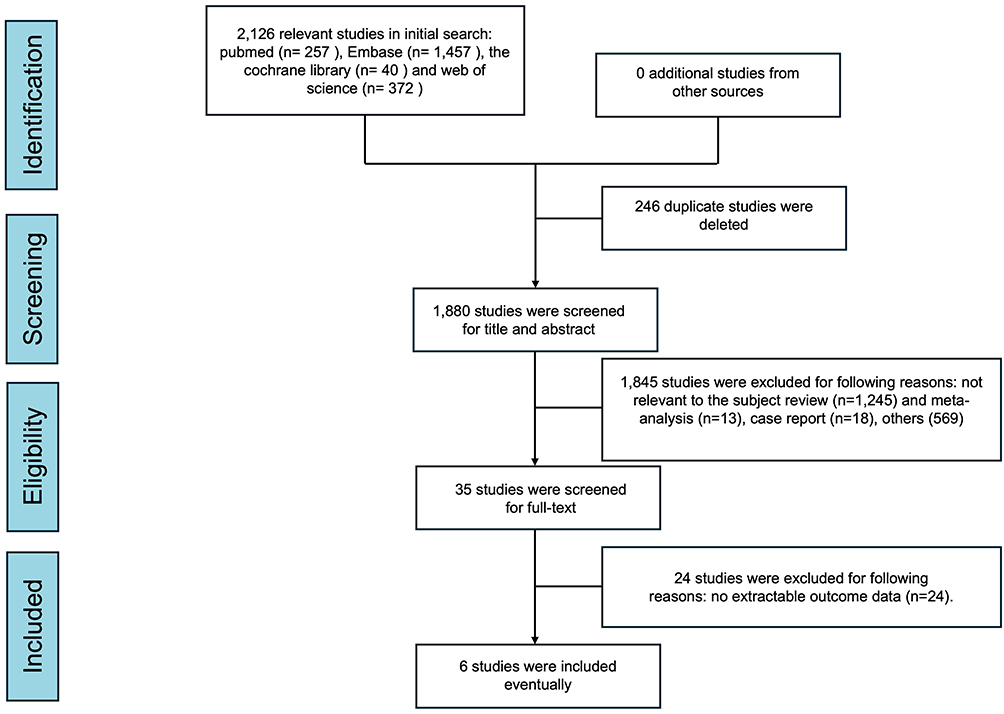 |
Figure 1 PRISMA 2020 flow diagram of study identification, screening, eligibility assessment, and inclusion for the systematic review and meta-analysis. |
Quality Assessment
Methodological quality was assessed using the Newcastle–Ottawa Scale (NOS). Overall, the included studies were of moderate quality, with typical limitations inherent to observational designs. Detailed NOS scores are provided in Table 2.
 |
Table 2 Quality Assessment of the Studies Included in the Meta-Analysis (Newcastle–Ottawa Scale) |
Tumor Response
Tumor response was assessed using mRECIST, in accordance with the eligibility criteria. In the arm-level pooled analysis, cohorts receiving the combination strategy reported a higher ORR than cohorts receiving regorafenib monotherapy. The pooled ORR was 0.28 (95% CI: 0.23–0.32; I2 = 6.4%) for regorafenib plus ICIs, versus 0.10 (95% CI: 0.06–0.14; I2 = 41.6%) for regorafenib monotherapy (Figure 2). In arm-level random-effects meta-regression, treatment strategy was a significant moderator of the pooled arm-level ORR summaries across cohorts (P = 0.001). This finding indicates a difference in aggregated arm-level response summaries between cohort types, but it does not represent a within-study head-to-head treatment effect and may be confounded by between-study differences in patient selection and baseline characteristics.
 |
Figure 2 Forest plot of objective response rate (ORR) synthesized via arm-level pooling of single-arm proportions. The plot displays pooled estimates for (A) regorafenib plus immune checkpoint inhibitors (ICIs) and (B) regorafenib monotherapy. |
Survival Outcomes
Survival outcomes were summarized using the pooled mPFS and mOS. Regarding mPFS, the pooled median was 7.34 months (95% CI: 6.09–8.59; I2 = 79.6%) in the combination cohorts, versus 3.97 months (95% CI: 3.16–4.77; I2 = 87.0%) in the monotherapy cohorts (Figure 3). Meta-regression suggested that treatment strategy was associated with differences in pooled arm-level mPFS summaries across cohorts (P = 0.030), which should be interpreted cautiously because this is not a within-study comparative estimate and may reflect between-study and between-cohort confounding.
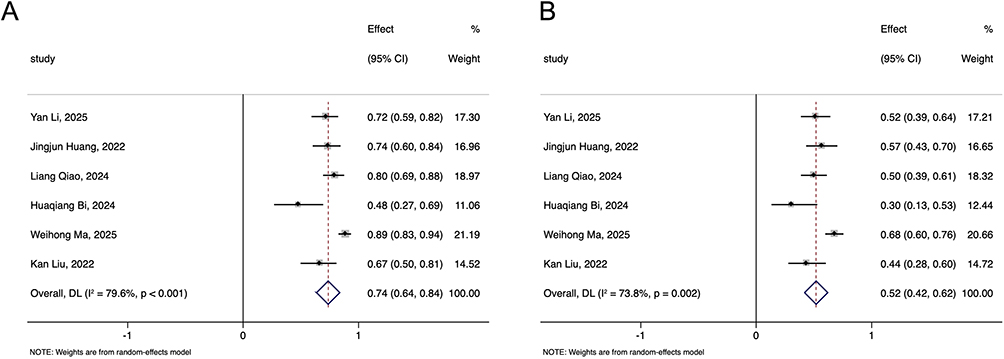 |
Figure 3 Forest plot summarizing median progression-free survival (mPFS) reported in included real-world studies for (A) regorafenib plus ICIs and (B) regorafenib monotherapy. |
For mOS, the pooled median was 16.87 months (95% CI: 14.70–19.03) in the combination cohorts and 11.07 months (95% CI: 10.01–12.13) in the monotherapy cohorts (Figure 4). In meta-regression, the difference in pooled mOS summaries was not statistically significant (P = 0.524). The interpretation of pooled medians is limited by substantial heterogeneity, potential confounding (including post-progression therapies), and reduced statistical power relative to analyses based on time-to-event comparative measures.
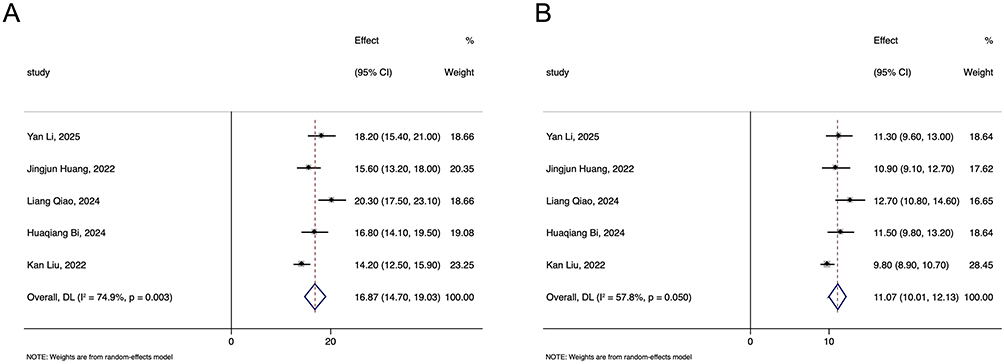 |
Figure 4 Forest plot summarizing median overall survival (mOS) reported in included real-world studies for (A) regorafenib plus ICIs and (B) regorafenib monotherapy. |
Safety Outcomes
For all-grade AEs, the pooled incidence was 0.83 (95% CI: 0.79–0.87) in the combination cohorts and 0.82 (95% CI: 0.78–0.86) in the monotherapy cohorts (Figure 5), with low heterogeneity. Meta-regression did not identify a statistically significant difference in pooled all-grade AEs incidence between strategies (P = 0.571).
 |
Figure 5 Forest plot of all-grade adverse events (AEs) pooled as single-arm proportions for (A) regorafenib plus ICIs and (B) regorafenib monotherapy. |
For grade ≥3 AEs, the pooled incidence was 0.23 (95% CI: 0.15–0.30; I2 = 30.0%) in the combination cohorts and 0.19 (95% CI: 0.14–0.24) in the monotherapy cohorts (Figure 6). Meta-regression did not identify a statistically significant difference in pooled grade ≥3 AEs incidence (P = 0.637). These results suggest that, at the level of pooled arm-level summaries, severe AEs incidence was broadly similar between cohort types.
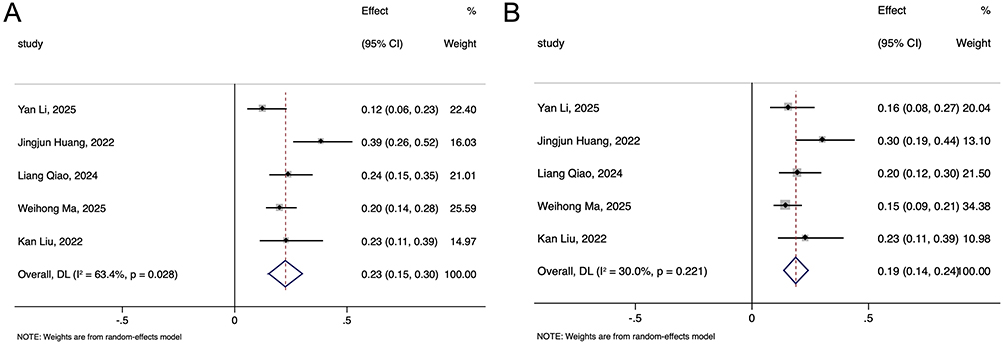 |
Figure 6 Forest plot of grade ≥3 adverse events (AEs) pooled as single-arm proportions for (A) regorafenib plus ICIs and (B) regorafenib monotherapy. |
Sensitivity Analysis
Leave-one-out influence analyses suggested that the pooled arm-level summaries for ORR, mPFS, mOS, and AEs incidence were not materially altered by sequential omission of any single study (Supplemental Figure 1), indicating that the overall pooled patterns were not driven by one individual study.
Publication Bias
Publication bias and small-study effects were assessed using Begg’s rank correlation test and Egger’s linear regression test. For ORR, no evidence of small-study effects was observed (Begg’s P = 0.45; Egger’s P = 0.17). For mPFS, Begg’s test was not significant (Begg’s P = 1.00), whereas Egger’s test suggested potential small-study effects (Egger’s P = 0.03). Given the limited number of included studies and the substantial clinical and methodological heterogeneity inherent to real-world cohorts, these tests should be interpreted cautiously and do not necessarily indicate true publication bias. For mOS, no significant asymmetry was detected (Begg’s P = 1.00; Egger’s P = 0.47). For safety outcomes, no evidence of publication bias was found for all-grade AEs (Begg’s P = 1.00; Egger’s P = 0.94) or grade ≥3 AEs (Begg’s P = 1.00; Egger’s P = 0.94).
Discussion
Regorafenib is a guideline-endorsed second-line option for advanced HCC after failure of first-line systemic therapy, supported by the phase III RESORCE trial demonstrating a survival benefit versus placebo in sorafenib-experienced patients.4 However, objective responses to regorafenib monotherapy are generally infrequent, and the depth of tumor shrinkage is often modest, providing the clinical rationale for evaluating combination approaches in the second-line setting. Although antiangiogenic TKI–ICI combinations have reshaped first-line therapy,6,18 randomized evidence also indicates that increased early antitumor activity does not invariably translate into improved OS. For example, LEAP-002 showed that lenvatinib plus pembrolizumab did not significantly improve OS compared with lenvatinib alone despite promising earlier-phase signals.12 In the context of increasing heterogeneity in first-line regimens and subsequent treatment pathways, clarifying how regorafenib combined with PD-1/PD-L1 blockade performs relative to regorafenib alone in routine practice remains clinically relevant. Real-world comparative cohorts have emerged, but they are heterogeneous in design, patient selection, and outcome reporting; therefore, synthesizing available evidence may help contextualize expected cohort-level outcomes while awaiting more definitive prospective data.
Across six real-world comparative studies, our arm-level pooled summaries revealed a consistent pattern of numerically higher pooled ORR and longer pooled mPFS summaries in cohorts treated with regorafenib plus ICIs compared with those treated with regorafenib monotherapy. These findings, however, are non-comparative arm-level estimates and should not be interpreted as definitive evidence of superiority. The direction of these aggregated patterns is nonetheless broadly consistent with individual observational reports suggesting improved response and PFS with regorafenib–ICI combinations in certain settings. Response assessment in advanced HCC is sensitive to the choice of criteria and imaging schedules; the use of mRECIST—which emphasizes changes in viable tumor following antiangiogenic therapy—is therefore relevant when interpreting ORR and disease control patterns across cohorts. Notably, heterogeneity for ORR in the combination cohorts was low, suggesting that the response signal in aggregated real-world cohorts may be comparatively consistent across settings despite variation in ICI agents, regorafenib starting doses, and local practice patterns.
The observed ORR and PFS patterns are biologically plausible. Regorafenib has immunomodulatory properties and may influence the tumor microenvironment through vascular normalization and immune regulation.19 Inhibition of VEGFR signaling may reduce hypoxia and improve immune cell trafficking, potentially facilitating CD8+ T-cell infiltration and responsiveness to PD-1 blockade.19,20 Regorafenib has also been reported to modulate tumor-associated macrophages via inhibition of the p38 kinase/Creb1/Klf4 axis, shifting polarization from an M2-like immunosuppressive phenotype toward an M1-like antitumor phenotype.21 These mechanisms provide a biological rationale for why regorafenib combined with PD-1/PD-L1 blockade could be associated with improved tumor control in observational cohorts; however, arm-level pooled estimates cannot establish a causal treatment effect.
Despite more favorable pooled ORR and pooled mPFS summaries, a statistically significant difference in pooled mOS summaries was not observed, although mOS was numerically longer in the combination cohorts. Several factors may explain this divergence. First, OS in advanced HCC is strongly influenced by post-progression therapies, liver function deterioration, and competing risks related to cirrhosis, as illustrated by trials such as LEAP-00212 and COSMIC-312.22 Second, pooling reported medians does not account for censoring patterns and follow-up duration in the way time-to-event comparative measures (eg, hazard ratios) do, limiting sensitivity for detecting OS differences. Third, baseline differences across cohorts—such as liver function, tumor burden, and first-line treatment history—may confound both PFS and OS.23 In addition, the evolving landscape of HCC treatment has introduced multiple second-line therapeutic regimens. Given the relatively low ORR of regorafenib monotherapy, many clinicians in real-world practice combine regorafenib with ICI therapy in the second-line setting to improve efficacy.24 Furthermore, as alternative options expand, some clinicians utilize ICI rechallenge in combination with other TKIs, such as lenvatinib. A recent comprehensive narrative review highlighted that ICI rechallenge represents a rational and feasible therapeutic strategy, demonstrating notable antitumor activity and an acceptable safety profile for selected HCC patients, particularly those with preserved liver function and lower tumor burden.25 Emerging observational data also suggest that the incremental value of adding (or reintroducing) PD-1 blockade in the second line with regorafenib may depend heavily on prior ICI exposure. In Ma et al,16 regorafenib plus PD-1 was associated with more favorable outcomes after failure of first-line TKI monotherapy, whereas no clear benefit was observed among patients progressing after first-line TKI plus PD-1 therapy. This pattern underscores the importance of stratifying or adjusting for prior immunotherapy exposure when interpreting second-line outcomes and is consistent with concepts such as primary resistance and T-cell dysfunction/exhaustion in some contexts.26 Accordingly, patient selection based on prior therapy, and the careful weighing of regorafenib-based combinations versus ICI rechallenge strategies, remains central when interpreting real-world survival summaries.
From a safety perspective, pooled arm-level summaries suggested broadly similar incidences of grade ≥3 AEs between combination and monotherapy cohorts. Regorafenib-related toxicities, including hand–foot skin reaction, hypertension, and fatigue, are well characterized.4 While immune-related adverse events (irAEs) such as rash, thyroid dysfunction, and hepatitis may occur with ICIs, they are often manageable with established monitoring and treatment algorithms; however, retrospective datasets may under-ascertain low-grade events and may inconsistently report attribution (treatment-related vs all-cause). Moreover, the safety implications of sequential or repeated ICI exposure in later-line settings warrant continued monitoring in real-world practice.27,28 Overall, our findings suggest that, in the included cohorts, combining ICIs with regorafenib did not appear to be associated with a marked increase in severe toxicity at the level of aggregated incidence estimates, although causal inferences cannot be made.
Limitations
Several limitations should be acknowledged. First, the quantitative synthesis was conducted at the arm level because comparative within-study effect estimates were inconsistently reported. Consequently, the pooled results and meta-regression findings should be interpreted as comparisons of aggregated cohort-level outcome summaries rather than as definitive within-study comparative treatment effects. Second, the observational design of the included studies introduces selection bias and residual confounding that may not be fully addressed even in studies using matching or multivariable adjustment. Third, there was substantial clinical heterogeneity, including variation in the specific PD-1 inhibitors used, regorafenib starting doses and dose modifications, and use of concomitant or sequential locoregional therapies in some cohorts; these factors reflect real-world complexity but limit attribution of outcomes to a single standardized regimen. In addition, follow-up duration and outcome reporting were not uniform across studies; for time-to-event endpoints, pooled medians may be influenced by censoring patterns and the maturity of follow-up, which may contribute to heterogeneity and limit cross-cohort interpretability. Finally, all included studies were conducted in China, where HBV is a predominant etiology. As etiologic differences may influence tumor biology and immune contexture, generalizability to non-Asian populations and to non-viral or MASLD-related HCC should be considered cautiously.
Conclusions
In this arm-level synthesis of real-world comparative cohorts, regorafenib plus ICIs was associated with numerically higher pooled ORR and longer pooled mPFS summaries than regorafenib monotherapy, while pooled mOS summaries did not differ significantly and severe AEs incidence was broadly similar between cohort types. These estimates are non-comparative and reflect aggregated arm-level data from heterogeneous observational studies; they should be regarded as hypothesis-generating rather than evidence of superiority. Comparative effectiveness conclusions are further limited by residual confounding, variable follow-up, and inconsistent within-study effect reporting.
Abbreviations
HCC, Hepatocellular Carcinoma; ICIs, Immune Checkpoint Inhibitors; TKIs, Tyrosine Kinase Inhibitors; PD-1, Programmed Cell Death-1; PD-L1, Programmed Cell Death-Ligand 1; VEGFR, Vascular Endothelial Growth Factor Receptor; CSF1R, Colony-Stimulating Factor 1 Receptor; TACE, Transarterial Chemoembolization; ORR, Objective Response Rate; DCR, Disease Control Rate; mPFS, Median Progression-Free Survival; mOS, Median Overall Survival; AEs, Adverse Events; mRECIST, Modified Response Evaluation Criteria in Solid Tumors; CTCAE, Common Terminology Criteria for Adverse Events; NOS, Newcastle-Ottawa Scale; PSM, Propensity Score Matching; PRISMA, Preferred Reporting Items for Systematic Reviews and Meta-Analyses; CI, Confidence Interval; HBV, Hepatitis B Virus; MASLD, Metabolic Dysfunction-Associated Steatotic Liver Disease.
Data Sharing Statement
All data analyzed in this study were extracted from published articles and are available within the article and its Supplementary Appendix.
Author Contributions
All authors made a significant contribution to the work reported, whether that is in the conception, study design, execution, acquisition of data, analysis and interpretation, or in all these areas; took part in drafting, revising or critically reviewing the article; gave final approval of the version to be published; have agreed on the journal to which the article has been submitted; and agree to be accountable for all aspects of the work.
Disclosure
The authors declare no competing interests in this work.
References
1. Bray F, Laversanne M, Sung H, et al. Global cancer statistics 2022: GLOBOCAN estimates of incidence and mortality worldwide for 36 cancers in 185 countries. CA Cancer J Clin. 2024;74(3):229–12. doi:10.3322/caac.21834
2. Llovet JM, Kelley RK, Villanueva A, et al. Hepatocellular carcinoma. Nat Rev Dis Primers. 2021;7(1):6. doi:10.1038/s41572-020-00240-3
3. Yang X, Yang C, Zhang S, et al. Precision treatment in advanced hepatocellular carcinoma. Cancer Cell. 2024;42(2):180–197. doi:10.1016/j.ccell.2024.01.007
4. Bruix J, Qin S, Merle P, et al. Regorafenib for patients with hepatocellular carcinoma who progressed on sorafenib treatment (RESORCE): a randomised, double-blind, placebo-controlled, Phase 3 trial. Lancet. 2017;389(10064):56–66. doi:10.1016/s0140-6736(16)32453-9
5. Huang J, Guo Y, Huang W, et al. Regorafenib combined with PD-1 blockade immunotherapy versus regorafenib as second-line treatment for advanced hepatocellular carcinoma: a multicenter retrospective study. J Hepatocell Carcinoma. 2022;9:157–170. doi:10.2147/jhc.S353956
6. Cheng AL, Qin S, Ikeda M, et al. Updated efficacy and safety data from IMbrave150: atezolizumab plus bevacizumab vs. sorafenib for unresectable hepatocellular carcinoma. J Hepatol. 2022;76(4):862–873. doi:10.1016/j.jhep.2021.11.030
7. Qin S, Chan SL, Gu S, et al. Camrelizumab plus rivoceranib versus sorafenib as first-line therapy for unresectable hepatocellular carcinoma (CARES-310): a randomised, open-label, international phase 3 study. Lancet. 2023;402(10408):1133–1146. doi:10.1016/s0140-6736(23)00961-3
8. Gudivada IP, Amajala KC. Integrative bioinformatics analysis for targeting hub genes in hepatocellular carcinoma treatment. Curr Genomics. 2025;26(1):48–80. doi:10.2174/0113892029308243240709073945
9. Xu W, Liao S, Hu Y, Huang Y, Zhou J. Upregulation of miR-3130-5p enhances hepatocellular carcinoma growth by suppressing ferredoxin 1: miR-3130-5p enhances HCC growth via inhibiting FDX1. Curr Mol Pharmacol. 2024;17:e18761429358008. doi:10.2174/0118761429358008250305070518
10. Ye W, Wang J, Zheng J, Jiang M, Zhou Y, Wu Z. Association between higher expression of Vav1 in hepatocellular carcinoma and unfavourable clinicopathological features and prognosis. Protein Pept Lett. 2024;31(9):706–713. doi:10.2174/0109298665330781240830042601
11. Granito A, Marinelli S, Forgione A, et al. Regorafenib combined with other systemic therapies: exploring promising therapeutic combinations in HCC. J Hepatocell Carcinoma. 2021;8:477–492. doi:10.2147/jhc.S251729
12. Llovet JM, Kudo M, Merle P, et al. Lenvatinib plus pembrolizumab versus lenvatinib plus placebo for advanced hepatocellular carcinoma (LEAP-002): a randomised, double-blind, phase 3 trial. Lancet Oncol. 2023;24(12):1399–1410. doi:10.1016/s1470-2045(23)00469-2
13. Bi H, Pei J, Ma K, et al. Regorafenib combined with a PD-1 inhibitor in the second-line setting for unresectable hepatocellular carcinoma in real-world practice. J Gastrointest Oncol. 2024;15(1):368–376. doi:10.21037/jgo-23-618
14. Li Y, Yuan H, Yao QJ, et al. TACE combined with regorafenib with or without anti-PD-1 therapy for advanced HCC after targeted therapy failure: a multicenter real-world study. Front Oncol. 2025;15:1652319. doi:10.3389/fonc.2025.1652319
15. Liu K, Wu J, Xu Y, Li D, Huang S, Mao Y. Efficacy and safety of regorafenib with or without PD-1 inhibitors as second-line therapy for advanced hepatocellular carcinoma in real-world clinical practice. Onco Targets Ther. 2022;15:1079–1094. doi:10.2147/ott.S383685
16. Ma W, Li Y, Lu Y, et al. A multicenter retrospective study: impact of first-line treatment strategies on second-line efficacy and safety of regorafenib with or without PD-1 inhibitors in unresectable hepatocellular carcinoma. J Hepatocell Carcinoma. 2025;12:2123–2137. doi:10.2147/jhc.S456712
17. Qiao L, He W, Wang G, et al. Regorafenib with immunotherapy versus regorafenib alone as second-line treatment for hepatocellular carcinoma: a multicenter real-world study. Cancer Med. 2024;13(9):e7236. doi:10.1002/cam4.7236
18. Finn RS, Qin S, Ikeda M, et al. Atezolizumab plus bevacizumab in unresectable hepatocellular carcinoma. N Engl J Med. 2020;382(20):1894–1905. doi:10.1056/NEJMoa1915745
19. Shigeta K, Matsui A, Kikuchi H, et al. Regorafenib combined with PD1 blockade increases CD8 T-cell infiltration by inducing CXCL10 expression in hepatocellular carcinoma. J Immunother Cancer. 2020;8(2):e001435. doi:10.1136/jitc-2020-001435
20. Jain RK. Antiangiogenesis strategies revisited: from starving tumors to alleviating hypoxia. Cancer Cell. 2014;26(5):605–622. doi:10.1016/j.ccell.2014.10.006
21. Ou DL, Chen CW, Hsu CL, et al. Regorafenib enhances antitumor immunity via inhibition of p38 kinase/Creb1/Klf4 axis in tumor-associated macrophages. J Immunother Cancer. 2021;9(3):e001657. doi:10.1136/jitc-2020-001657
22. Yau T, Kaseb A, Cheng AL, et al. Cabozantinib plus atezolizumab versus sorafenib for advanced hepatocellular carcinoma (COSMIC-312): final results of a randomised phase 3 study. Lancet Gastroenterol Hepatol. 2024;9(4):310–322. doi:10.1016/s2468-1253(23)00454-5
23. Johnson PJ, Berhane S, Kagebayashi C, et al. Assessment of liver function in patients with hepatocellular carcinoma: a new evidence-based approach-the ALBI grade. J Clin Oncol. 2015;33(6):550–558. doi:10.1200/jco.2014.57.9151
24. Li L, Liu HT, Teng YX, et al. Second-line treatment options for hepatocellular carcinoma: current state and challenges for the future. Expert Opin Investig Drugs. 2022;31(11):1151–1167. doi:10.1080/13543784.2022.2151891
25. Li J, Liang YB, Wang QB, et al. Rechallenge with immune checkpoint inhibitors in patients with hepatocellular carcinoma: a narrative review. Liver Cancer. 2025:1–20. doi:10.1159/000549355
26. Pinter M, Scheiner B, Peck-Radosavljevic M. Immunotherapy for advanced hepatocellular carcinoma: a focus on special subgroups. Gut. 2021;70(1):204–214. doi:10.1136/gutjnl-2020-321702
27. Sangro B, Chan SL, Meyer T, Reig M, El-Khoueiry A, Galle PR. Diagnosis and management of toxicities of immune checkpoint inhibitors in hepatocellular carcinoma. J Hepatol. 2020;72(2):320–341. doi:10.1016/j.jhep.2019.10.021
28. Sensi B, Angelico R, Toti L, et al. Mechanism, potential, and concerns of immunotherapy for hepatocellular carcinoma and liver transplantation. Curr Mol Pharmacol. 2024;17:e18761429310703. doi:10.2174/0118761429310703240823045808
 © 2026 The Author(s). This work is published and licensed by Dove Medical Press Limited. The
full terms of this license are available at https://www.dovepress.com/terms
and incorporate the Creative Commons Attribution
- Non Commercial (unported, 4.0) License.
By accessing the work you hereby accept the Terms. Non-commercial uses of the work are permitted
without any further permission from Dove Medical Press Limited, provided the work is properly
attributed. For permission for commercial use of this work, please see paragraphs 4.2 and 5 of our Terms.
© 2026 The Author(s). This work is published and licensed by Dove Medical Press Limited. The
full terms of this license are available at https://www.dovepress.com/terms
and incorporate the Creative Commons Attribution
- Non Commercial (unported, 4.0) License.
By accessing the work you hereby accept the Terms. Non-commercial uses of the work are permitted
without any further permission from Dove Medical Press Limited, provided the work is properly
attributed. For permission for commercial use of this work, please see paragraphs 4.2 and 5 of our Terms.
Recommended articles

Mechanisms of Resistance to Immunotherapy in Hepatocellular Carcinoma
Manfredi GF, Celsa C, John C, Jones C, Acuti N, Scheiner B, Fulgenzi CAM, Korolewicz J, Pinter M, Gennari A, Mauri FA, Pirisi M, Minisini R, Vincenzi F, Burlone M, Rigamonti C, Donadon M, Cabibbo G, D'Alessio A, Pinato DJ
Journal of Hepatocellular Carcinoma 2023, 10:1955-1971
Published Date: 3 November 2023

Advances in the Use of Immune Checkpoint Inhibitors for Colorectal Cancer Treatment
Li J, Fu T, Wen Z, Liang J, Qiu Y, Li K, Yang J, Tong Y, Cai H
OncoTargets and Therapy 2025, 18:1159-1168
Published Date: 15 October 2025
Prognostic Impact of the Systemic Immune-Inflammation Index in Unresectable Hepatocellular Carcinoma Undergoing Second-Line Combination Therapy: A Multicenter Study
Chen X, Li X, Jiang Y, Xie Q, Zhang P, Zhou X, Wei C, Xie P, Cao L
Cancer Management and Research 2026, 18:613658
Published Date: 3 June 2026
Mechanisms and Emerging Strategies to Overcome Immunotherapy Resistance in Cold Tumours of Colorectal Cancer
Zhu X, Ge B, Wen L
OncoTargets and Therapy 2026, 19:621109
Published Date: 15 June 2026
Reprogramming Metabolism and Immunity: Nanotechnology’s Promise for Hepatocellular Carcinoma Precision Therapy
Cheng M, Ni Y, Zhang W, Wu Q
International Journal of Nanomedicine 2026, 21:587514
Published Date: 18 June 2026