
Back to Journals » Clinical, Cosmetic and Investigational Dentistry » Volume 17
Comparison Between Game-Based Learning and Traditional Learning Methods in Traumatic Dental Management Among Dental Interns at KAUFD
Authors Dardeer FM  , Areesh RM, Alnafisi AA, Alzain I , Andijani BM , Abudawood SN , Abdullah AM, Ainousa AM, Alulaiyan M
Received 6 May 2025
Accepted for publication 8 August 2025
Published 25 August 2025 Volume 2025:17 Pages 381—390
DOI https://doi.org/10.2147/CCIDE.S538541
Checked for plagiarism Yes
Review by Single anonymous peer review
Peer reviewer comments 4
Editor who approved publication: Professor Christopher E. Okunseri
Faisal M Dardeer, Reem M Areesh, Aasaiel Ahmed Alnafisi, Ibtesam Alzain, Basil M Andijani, Shahad N Abudawood, Abeer M Abdullah, Abdalrahman M Ainousa, Mohammed Alulaiyan
Department of Pediatric Dentistry, King Abdulaziz University, Jeddah, Saudi Arabia
Correspondence: Faisal M Dardeer, Department of Pediatric Dentistry, King Abdulaziz University, PO Box 80209, Jeddah, 21589, Saudi Arabia, Email [email protected]
Introduction: Many dental students lack sufficient knowledge to manage dental trauma. Traditional lectures usually involve one-way communication from the instructor to the students. Game-based learning strategies can increase student engagement, offer hands-on experiences, and promote a deeper interest in learning.
Objective: To compare the knowledge and satisfaction of dental interns participating in game-based learning versus traditional learning method on traumatic dental management at KAUFD.
Methods: An experimental study conducted at the Faculty of Dentistry at King Abdulaziz University involved a sample size of 88 dental interns. The interns were divided into a game-based learning group (game group) and a traditional lecture group (lecture group). The game group participated in a game-based learning session, engaging in an educational game focused on managing permanent teeth trauma. Meanwhile, the lecture group attended a traditional lecture covering the same topic. Both groups took part in pre- and post-quizzes before and after the sessions and completed a satisfaction survey distributed after the sessions.
Results: Both lecture formats significantly enhanced knowledge retention. Post-intervention scores were comparable between the groups (p = 0.393), The mean post-intervention correct score for the lecture group was 12.72 (SD = 1.33; 95% CI: 12.32– 13.13), while the mean score for the game group was 12.62 (SD = 1.56; 95% CI: 12.15– 13.09). showing no significant difference in score improvements (p = 0.315). The post-intervention satisfaction survey indicated positive responses in both groups, with no significant differences in satisfaction levels.
Conclusion: The findings indicate that both game-based learning and traditional lectures are equally effective in enhancing knowledge and ensuring high satisfaction among dental interns. Given the similar results, it is recommended to incorporate both approaches in educational settings. Future research should investigate the impact of new content and more complex game designs to understand their potential benefits better.
Keywords: dentistry, trauma, education, Knowledge, lecture, survey, satisfaction
Introduction
Dental trauma refers to injuries that affect the teeth and surrounding hard and soft tissues, including gingival tissues, lips, and tongue.1 This issue is common among children and adolescents.2 In deciduous dentition, the occurrence of traumatic dental injuries (TDI) reaches its peak at around 2 to 3 years old, while for permanent dentition, boys are more prone to TDI at around 9 to 10 years old.3 In Saudi Arabia, a study was conducted in Jeddah among children from the age of 1 to 17, also found that the frequency of traumatic dental injuries peaks around the age of 9 to 11, with the boys being more prone to TDI among all the age groups included in the study.4 The main causes of traumatic dental injuries include falls, which account for approximately 68% of cases and often result from a loss of balance while engaging in activities such as riding, running, walking, or playing. Additionally, trauma can also occur due to fighting or road traffic accidents.4,5 The management of TDI can be challenging and time sensitive, it can vary according to the type of trauma, the location and number of teeth involved, the involvement of surrounding oral structures such as the lips and the tongue, and the time and place where the trauma occurred.3–5
Numerous studies have highlighted the issue of inadequate knowledge among dental students regarding managing dental trauma, attributing it to the overwhelming volume of information, the similarities in the subject matter, and low clinical exposure during training.2,6 Although recent educational research provides little evidence that adapting teaching methods to individual learning styles leads to significant improvements in learning outcomes, the presence of varying learning styles among individuals can contribute to the occurrence of this issue, as it impacts the ability to retain information. Everyone has a unique learning style that aids in comprehending and retaining information.7,8 Keefe describes learning types as a combination of cognitive, physiological, and emotional characteristics that guide how students behave and interact in the learning environment.9
Identifying and understanding learning styles can enhance the educational process and optimize teaching effectiveness. This challenge can be addressed by shifting from traditional teaching methods to more engaging approaches such as flipped classrooms, game-based learning, interactive workshops, or a combination of these strategies to tackle the issue of insufficient information on complex subjects like dental health trauma.7
Conventional lectures are typically characterized by a teacher-centered approach, with students playing a passive role in the learning process. This format often limits the development of higher-order cognitive skills such as analysis, reasoning, and critical thinking. In contrast, game-based learning (GBL) offers a more interactive and student-centered experience. By promoting active participation, providing simulated hands-on opportunities, and stimulating intrinsic motivation, GBL supports deeper engagement and enhances the development of problem-solving skills abilities.10,11
GBL refers to using games in non-gaming activities within the educational context to enhance student engagement and motivation. It is also known by various synonymous terms, including “educational games”, “gamification”, and “serious games.” Numerous examples of GBL implementation can be observed, such as the incorporation of escape rooms, software applications, quiz-based games, and real-life scenario simulations.12,13 Recently, there has been a growing interest in game-based learning as an effective teaching method focused on stimulating learning through hands-on experiences while enriching students’ comprehension and learning processes, encourages student engagement in educational activities, fosters the development of problem-solving abilities, and cultivates critical thinking skills.10,14,15
A randomized clinical trial assessed the impact of using an electronic game-based learning approach versus the conventional lecture method. It stated that the use of GBL integrates a simulated learning environment with a teaching strategy centered on games. The study indicated that employing the electronic game-based learning method offers significantly higher participants’ test scores than traditional teaching. Additionally, students reported having a more enjoyable and engaging learning experience.16 Another investigation was conducted to assess the impact of integrating serious games- interactive computer applications- with traditional lectures. Numerous studies have shown that utilizing serious games leads to improved knowledge retention.17 The research was a randomized clinical trial involving 27 undergraduate medical students. The findings indicated that the serious games method was successful in improving the scores of participating subjects.17 Building upon these findings, further investigations have explored the integration of serious games with conventional lectures, highlighting their potential to reinforce learning outcomes and complement traditional instructional methods. A pilot randomized controlled trial investigated the efficacy of GBL in enhancing diagnostic accuracy among medical professionals. A total of 90 participants were enrolled in the study. The results indicated that GBL is an effective approach for improving diagnostic accuracy in both medical trainees and practicing clinicians, with benefits sustained over time.18 Furthermore, a notable advantage of game-based learning is its capacity to enhance frontal brain activity. A comparative analysis of frontal activation patterns between non-game-based and game-based approaches to the same task revealed that the game-based method elicited significantly greater activation in the brain’s frontal regions.19
Existing evidence highlights a gap in research that directly compares game-based learning (GBL) to conventional lecture methods among learners, particularly with respect to complex and clinically relevant topics in dentistry. Therefore, this study aims to evaluate and compare knowledge acquisition and learner satisfaction among dental interns at King Abdulaziz University, Faculty of Dentistry (KAUFD), participating in a game-based learning session versus a traditional lecture on managing traumatic dental injuries.
Material and Methods
Ethical Approval
Ethical approval for this study was obtained from the Research Ethics Committee of the Faculty of Dentistry at King Abdulaziz University, Jeddah, Saudi Arabia (proposal number: 010–01-22). All procedures were conducted following the ethical standards of the institutional research committee and the Helsinki Declaration.
Study Design and Participants
A cross-sectional comparative study was conducted. Dental interns enrolled at the Faculty of Dentistry at King Abdulaziz University, Jeddah, Saudi Arabia, during the academic year 2023–2024 who provided informed consent to participate were included. Exclusion criteria included undergraduate dental students, postgraduate students, interns enrolled in academic years other than 2023–2024, and dental interns who did not wish to participate. An invitation Email was distributed to all 173 dental interns one week before the scheduled lectures. A total of 88 interns responded and registered for participation. These interns were randomly and blindly assigned to two groups: the game-based learning group (GBL) and the traditional lecture group (Lecture Group) (Figure 1).
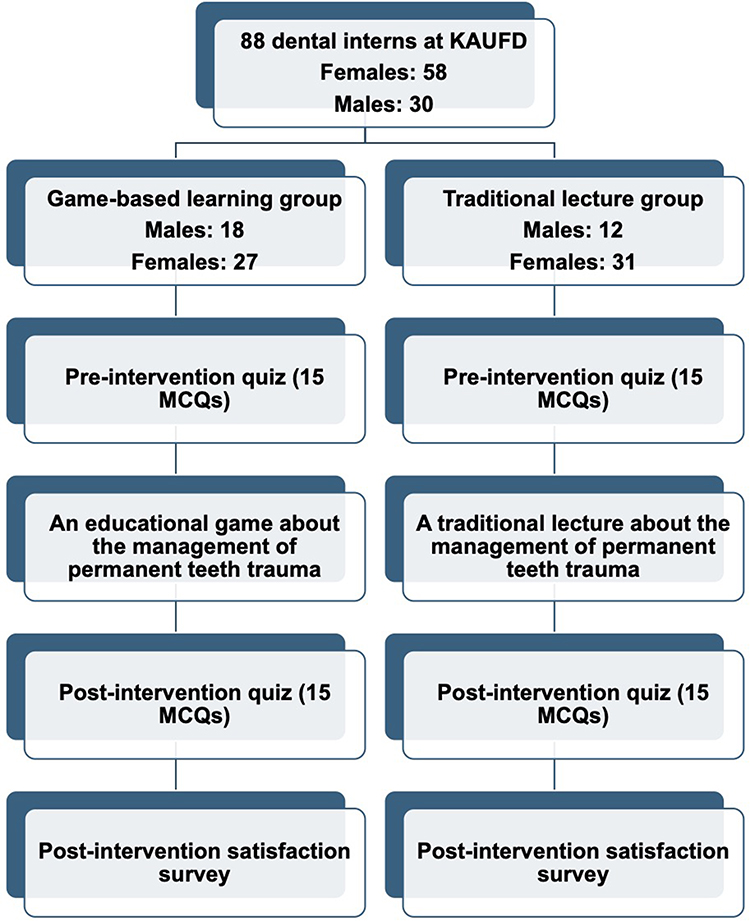 |
Figure 1 Shows the grouping and the process of the project. |
Development of Learning Outcomes and Case Scenarios
Two authors, expert in the field, collaboratively agreed upon the learning outcomes and topics to be covered in the traditional lecture format (a slideshow-based lecture). Given that the lecture targeted dental interns who had already acquired foundational knowledge of the subject matter, an interactive, case-based learning approach was adopted. This method emphasized higher-order cognitive skills by presenting clinical scenarios followed by questions that required participants to discuss the management of each case. The same clinical scenarios and questions were subsequently adapted for use in the GBL group to ensure content consistency between groups. These materials were reviewed and discussed among all authors, who provided feedback to enhance the clarity and relevance of the questions for the GBL intervention.
Development of the Game-Based Learning (GBL) Tool
For the GBL tool development, the clinical case scenarios originally used in the conventional lecture were modified into an interactive format. A volunteer undergraduate student from the Department of Computer Science at King Abdulaziz University assisted in developing the GBL platform by designing customized visual elements to accompany each case. Two co-authors created hand-drawn illustrations depicting various treatment options for traumatic dental injuries, which were then digitized and incorporated into an interactive drag-and-drop web-based interface. The game was developed using Visual Studio Code, with HTML, CSS, and JavaScript programming (Figure 2). Several treatment options were visually presented for each clinical case, and participants were required to drag and drop their selected option into a designated answer box. The system automatically advanced the participant to the next case scenario after selecting the correct answer, if not, the system will indicate a wrong input to the participant and will require a correct re-entry to advance. The process continued until all clinical cases were completed. Following the game’s development, content validation was conducted by consulting with 10 faculty members, who tested the game and assessed the tool for ease of use, clarity of instructions, and overall user experience. The feedback was incorporated into the subsequent version of the game. After that, face validation was conducted by a pilot test in which 10 undergraduate students also assessed the tool for ease of use, clarity of instructions, and overall user experience. Their feedback was included in the final version of the game.
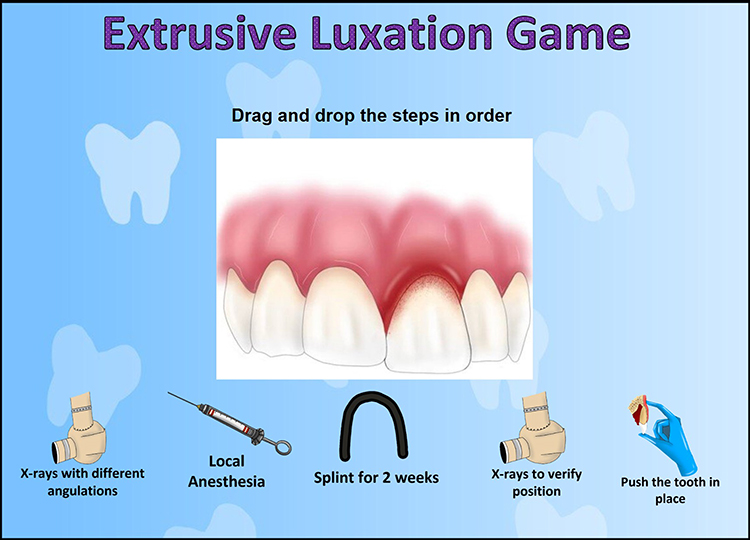 |
Figure 2 A screenshot from the game that shows one of the drag-and-drop interactive parts. |
Intervention Procedure
One week before the lectures, an initial announcement Email was sent to all dental interns at KAUFD, providing information about the study and the time and location of the continuing education lectures on the management of traumatic injuries to permanent teeth. Subsequently, two follow-up reminder emails were sent to encourage attendance and participation.
On the day of the intervention, dental interns were randomly assigned to two groups using a computer-generated randomization tool (random.org): the traditional lecture group and the GBL group. All participants provided written informed consent before participation. Interns in the GBL Group were instructed to bring their preferred electronic devices, such as laptops, tablets, or smartphones, to facilitate engagement with the web-based educational game. In the traditional lecture group, author I.A., a faculty member from the Department of Pediatric Dentistry at King Abdulaziz University, delivered the lecture in-person. In the GBL group, they participated in a one-hour game-based learning session in which they completed interactive clinical case scenarios followed by a brief discussion held with a faculty member (author F.D.) to address any questions and reinforce the learning material. The duration was one hour for both sessions, and the same facilitators were involved in both groups to control for instructor-related variability.
Assessment of Outcomes
All participants completed a validated 15-item multiple-choice knowledge quiz immediately before and after their respective sessions to assess knowledge acquisition. In addition, a nine-item satisfaction survey was administered post-intervention to evaluate participants’ perceptions of the educational method. The content validity of both the quiz and the survey was established through expert review, during which specialists assessed each item for clarity, relevance, and alignment with the study’s learning objectives. The experts were selected based on their academic qualifications and professional experience in dental education, with a minimum of five years of teaching or curriculum development experience in the field.
Statistical Analysis
Data analysis was conducted using descriptive and inferential statistical methods. Means and standard deviations were calculated for continuous variables, while proportions and counts were reported for categorical variables. For each question, the correct answer received a score of 1, and the wrong answer received a score of 0. The total scores were compared for each group. The Shapiro–Wilk test was performed to assess the normality of data distribution, and Levene’s test was used to evaluate the homogeneity of variances. To compare pre- and post-intervention quiz scores within both the lecture (control) and game-based learning (test) groups, a paired t-test was employed. An independent t-test was used to compare the overall post-intervention quiz scores between the lecture and game groups. Additionally, the Mann–Whitney U-test was applied to analyze differences in quiz scores between the two groups when appropriate. Fisher’s exact test was conducted for the post-intervention satisfaction survey to determine the statistical significance of differences between the groups. All statistical analyses were performed using Stata/SE 16.1 (StataCorp, College Station, TX, USA). A significance level of p < 0.05 was set for all statistical tests.
Results
Eighty-eight interns agreed to participate in this study. The participants were divided into two groups: 43 (48.86%) in the lecture (control) group and 45 (51.14%) in the game (test) group. The lecture group consisted of 12 males and 31 females, while the game group consisted of 18 males and 27 females. The mean age of the participants was 24 (SD = 0.64).
Table 1 presents the within-group comparison of overall scores before and after the intervention, evaluating the changes from pre- to post-exposure for both the lecture (control) and game (test) groups individually. The pre-intervention mean correct score for the lecture group was 10.6 out of 15 (SD = 2.34), with a 95% confidence interval ranging from 9.88 to 11.33. After the intervention, the mean correct score increased to 12.72 (SD = 1.33. The paired t-test revealed that this improvement was statistically significant, with a p-value of less than 0.001. The pre-intervention mean correct score in the game group was 11 out of 15 (SD = 2.07). Following the intervention, the mean correct answer score rose to 12.62 (SD = 1.56). The paired t-test indicated that the increase in correct scores was statistically significant, with a p-value of less than 0.001.
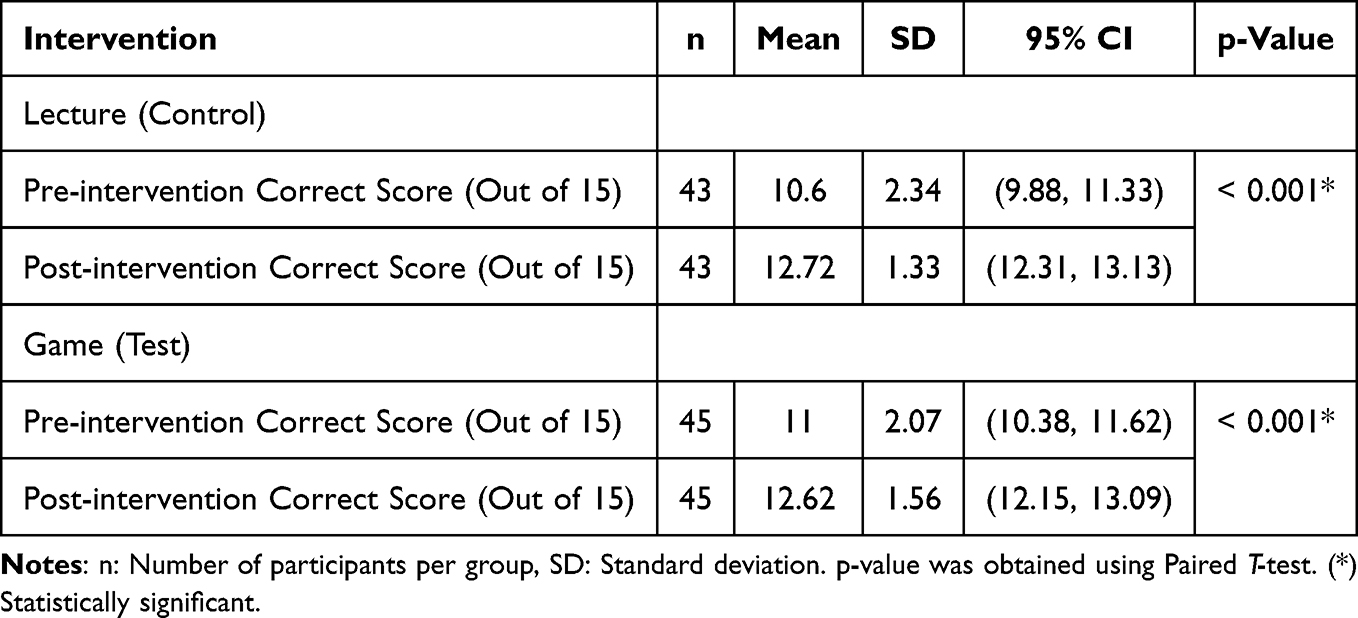 |
Table 1 The Comparison Between Overall Pre-Intervention Scores and Overall Post-Intervention Scores for Both Groups (N=88) |
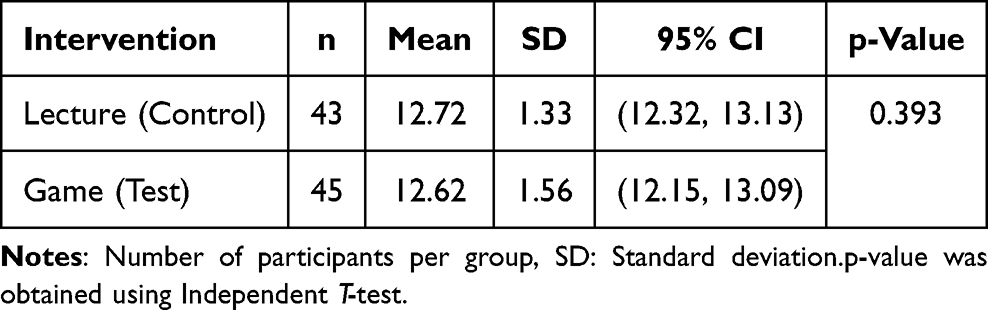 |
Table 2 The Comparison of Overall Post-Intervention Correct Scores Between the Test and Control Groups (N=88) |
Table 2 presents a comparison of the post-intervention correct scores between the lecture (control) group and the game (test) group to assess whether the type of intervention led to differences in improvement. The mean post-intervention correct score for the lecture group was 12.72 (SD = 1.33; 95% CI: 12.32–13.13), while the mean score for the game group was 12.62 (SD = 1.56; 95% CI: 12.15–13.09). An independent t-test revealed no statistically significant difference between the two groups’ post-intervention scores (p = 0.393), indicating comparable improvements following both interventions.
Table 3 compares the improvement magnitude in scores between the lecture (control) and game (test) groups by evaluating the differences between pre- and post-intervention scores within each group. The lecture group demonstrated a mean increase of 2.11 points, while the game group showed a mean increase of 1.62 points. A Mann–Whitney U-test revealed no statistically significant difference in the degree of score improvement between the lecture and game groups (p = 0.315), suggesting that both interventions resulted in comparable gains.
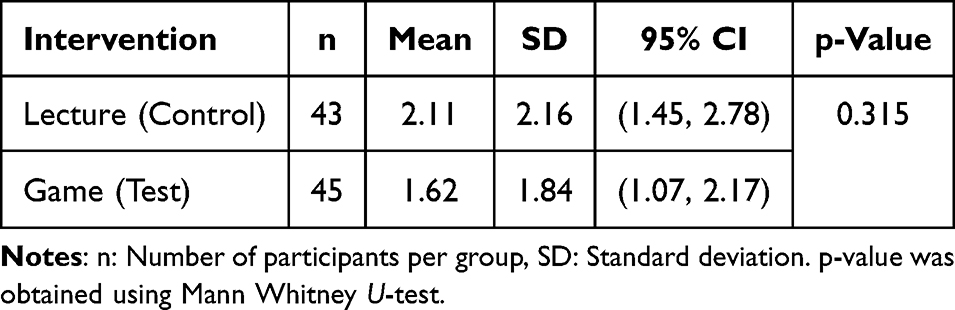 |
Table 3 The Comparison of Score Differences Between the Test and Control Groups (N=88) |
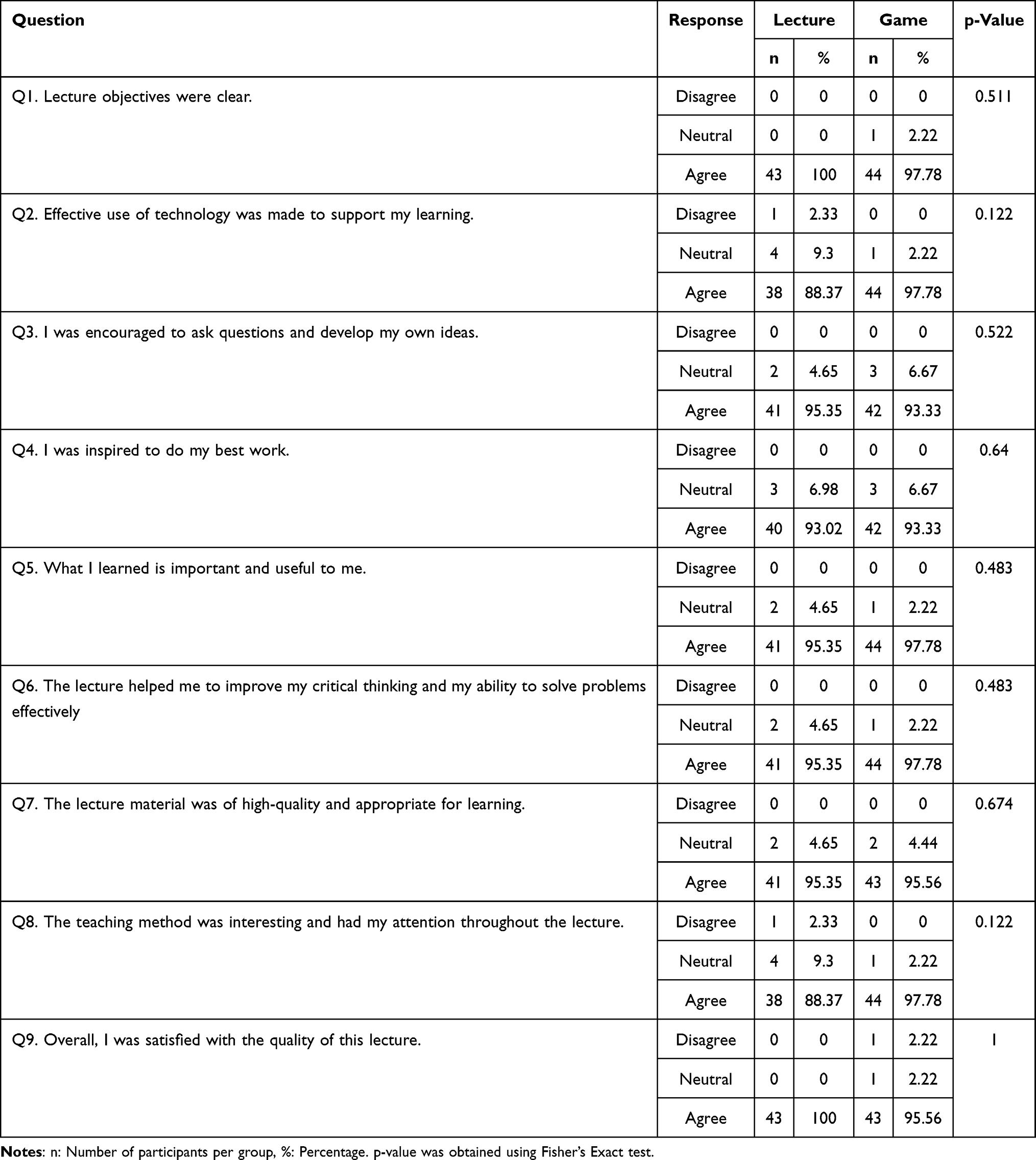 |
Table 4 Post Intervention Satisfaction Survey for Participants (N=88) |
Table 4 presents the results of the post-intervention satisfaction survey for participants in both the control and test groups. Each question was evaluated based on levels of agreement (Disagree, Neutral, Agree), and Fisher’s Exact test was used to compare the results and determine statistical significance between the two groups. The survey findings indicate that participants in both the lecture and game groups generally responded positively to the interventions. None of the p-values were below 0.05, suggesting no statistically significant differences between the groups for any survey questions.
Discussion
The aim of this research was to assess the level of knowledge and satisfaction among dental interns at KAUFD who were exposed to a game-based learning session compared to those who received a traditional lecture on traumatic dental management.
The findings of this study demonstrate that both educational interventions—lecture-based and game-based—significantly improved participants’ knowledge, as evidenced by the within-group comparison of pre- and post-intervention scores. However, when comparing the post-intervention scores between the two groups, no statistically significant difference was observed, suggesting that both methods were similarly effective in enhancing knowledge. Furthermore, analysis of the score gains (ie, the difference between pre- and post-intervention scores) revealed a slightly higher mean improvement in the lecture group compared to the game group; however, this difference was not statistically significant. Our results are closely aligned with those found by Fernández-Gómez et al in a 2024 study that also compared the traditional lecture to a gaming approach and assessed the level of satisfaction afterwards, despite some variables such as the sample being 4th and 5th year dental students versus our sample of dental interns.20 Our study’s results collectively indicate that while both interventions are effective, neither method demonstrated superiority over the other regarding knowledge acquisition. Therefore, the null hypothesis is rejected.
A systematic review evaluated 27 randomized controlled trials (RCTs) to compare the efficacy of game-based learning methods with traditional lectures. Several studies demonstrated that employing gaming as a teaching method can enhance knowledge acquisition, skill development, and satisfaction, while others indicated that both techniques yield comparable outcomes.21 On the other hand, Almashayek I. et al compared the effectiveness of game-based learning methods with traditional lecture methods. Their findings indicated that the traditional teaching method was more effective in improving knowledge than the game-based learning method due to the familiarity of the participants with traditional lectures.22 Our results indicated that both the game-based learning method and the traditional lecture resulted in similar levels of knowledge among the dental interns. The resemblance in results between the two teaching methods can be ascribed to the simplicity of the game design (drag and drop), which closely mirrored a traditional slide show lecture with minimal interaction. Furthermore, since the educational material was not new to the students and was mainly used as a review of their existing knowledge, both the lecture and the game effectively reinforced this information.
The results indicated no significant differences in satisfaction levels between game-based and traditional lectures, suggesting that both methods were similarly effective in achieving high satisfaction levels. However, outcomes could vary with new content or when utilizing a more advanced game. Given the comparable satisfaction rates obtained, it is logical to propose that both strategies are viable choices. Educators could consider integrating both methods to accommodate various learning preferences and enhance engagement. On the other hand, a randomized clinical trial was conducted with a sample of 98 students, and their findings indicated that the game-based learning method was more effective in enhancing comprehension and was perceived as more enjoyable by the students than traditional teaching methods.10 The game method they used resembled a popular TV show, which can explain the high satisfaction rate perceived from their participants. These findings were similar to the findings by Aljezawi et al, which used a Jeopardy-style game, and Moradian et al, which utilized physical tools for the game group.23,24
This study is limited by the relatively small sample size, which may affect the generalizability of the results. Furthermore, the simplicity of the game design (drag and drop) used in the study could have influenced the level of engagement and interaction, which could have influenced the overall satisfaction of the participants. Additionally, attendance was not mandatory and depended on the dental interns’ cooperation and desire to attend the offered continuous education lectures; dental interns who participated in the lectures are more likely to be the more studious students of their batch. Since the material given in these lectures was not new to the participants, a studious dental intern is expected to score higher in the pre-test, which will minimize the difference in the gained scores and affect the outcome of the study. Further research should explore the effects of more advanced game-based learning activities and new content to ascertain whether these variables yield different outcomes.
Conclusion
The findings of this research indicate that game-based learning and traditional lectures are both successful methods in enhancing the knowledge of dental interns and ensuring a high degree of satisfaction. Due to the comparable results obtained in this study, it is recommended to incorporate both approaches in academic environments. However, further investigation into the impact of new content, more complex game designs, and a series of lectures is recommended to fully understand their potential benefits.
Acknowledgments
We would like to thank Mr. Tariq M. Areesh for volunteering to develop the web-based educational game that was used in the study. Additionally, we would like to thank the KAUFD internship office for their cooperation in conducting this project.
Disclosure
The authors report no conflicts of interest in this work.
References
1. Antipovienė A, Narbutaitė J, Virtanen JI. Traumatic Dental Injuries, Treatment, and Complications in Children and Adolescents: a Register-Based Study. Eur J Dent. 2021;15(3):557. doi:10.1055/S-0041-1723066
2. Ivkošić I, Gavić L, Jerković D, et al. Knowledge and attitudes about dental trauma among the students of the university of split. Acta Stomatol Croat. 2020;54(3):302–313. doi:10.15644/asc54/3/8
3. Bourguignon C, Cohenca N, Lauridsen E, et al. International Association of Dental Traumatology guidelines for the management of traumatic dental injuries: 1. Fractures and luxations. Dent Traumatol. 2020;36(4):314–330. doi:10.1111/edt.12578
4. Al-Malik M. Oral injuries in children attending a hospital in Saudi Arabia. J Maxillofac Oral Surg. 2009;8(1):34–39. doi:10.1007/S12663-009-0009-8
5. Bastone EB, Freer TJ, McNamara JR. Epidemiology of dental trauma: a review of the literature. Aust Dent J. 2000;45(1):2–9. doi:10.1111/j.1834-7819.2000.tb00234.x
6. Kiani Z, Abbott PV, Levin L. Dental trauma education among Canadian dental schools: a Nationwide survey of dental trauma educators. Dent Traumatol. 2023;39(4):386–391. doi:10.1111/edt.12834
7. Borit M, Stangvaltaite-Mouhat L. GoDental! Enhancing flipped classroom experience with game-based learning. Eur J Dent Educ. 2020;24(4):763–772. doi:10.1111/eje.12566
8. Amir LR, Leonardy IC, Dewatmoko SN, et al. Serious game as oral histology learning strategy for undergraduate dental students; crossover randomized controlled trial. BMC Oral Health. 2023;23(1). doi:10.1186/s12903-023-03286-3
9. Taheri M, Falahchai M, Javanak M, Hemmati Y, Bozorgi M. Analyzing the relationship between learning styles (Kolb and VARK) and creativity with the academic achievement of dental students. J Educ Health Promot. 2021;10(1):252. doi:10.4103/jehp.jehp_1492_20
10. Gudadappanavar A, Benni J, Javali S. Effectiveness of the game-based learning over traditional teaching–learning strategy to instruct pharmacology for Phase II medical students. J Educ Health Promot. 2021;10(1):91. doi:10.4103/JEHP.JEHP_624_20
11. Fasinu PS, Wilborn TW. Pharmacology education in the medical curriculum: challenges and opportunities for improvement. Pharmacol Res Perspect. 2024;12(1). doi:10.1002/prp2.1178
12. Oestreich JH, Guy JW. Game-Based Learning in Pharmacy Education. Pharmacy. 2022;10(1):11. doi:10.3390/pharmacy10010011
13. Surapaneni KM. Livogena: the Ikteros Curse-A Jaundice Narrative Card and Board Game for Medical Students. MedEdPORTAL. 2024;20:11381. doi:10.15766/mep_2374-8265.11381
14. Abou Hashish EA, Al Najjar H, Alharbi M, Alotaibi M, Alqahtany MM. Faculty and students perspectives towards game-based learning in health sciences higher education. Heliyon. 2024;10(12):e32898. doi:10.1016/j.heliyon.2024.e32898
15. Allan R, McCann L, Johnson L, Dyson M, Ford J. A systematic review of ‘equity-focused’ game-based learning in the teaching of health staff. Public Health Pract. 2024;7:100462. doi:10.1016/j.puhip.2023.100462
16. Boeker M, Andel P, Vach W, Frankenschmidt A. Game-Based E-Learning Is More Effective than a Conventional Instructional Method: a Randomized Controlled Trial with Third-Year Medical Students. PLoS One. 2013;8(12):e82328. doi:10.1371/JOURNAL.PONE.0082328
17. Tubelo RA, Portella FF, Gelain MA, et al. Serious game is an effective learning method for primary health care education of medical students: a randomized controlled trial. Int J Med Inform. 2019;130:103944. doi:10.1016/J.IJMEDINF.2019.08.004
18. Morgan DJ, Scherer L, Pineles L, et al. Game-based learning to improve diagnostic accuracy: a pilot randomized-controlled trial. Diagnosis. 2024;11(2):136–141. doi:10.1515/dx-2023-0133
19. Kober SE, Wood G, Kiili K, Moeller K, Ninaus M. Game-based learning environments affect frontal brain activity. PLoS One. 2020;15(11):e0242573. doi:10.1371/journal.pone.0242573
20. Fernández-Gómez F, Cosin-Villanueva M, Almiñana-Pastor P, López-Roldán A. A comparative analysis of game-based learning and conventional learning in dental education. J Dent Educ. 2025;89(3):414–420. doi:10.1002/jdd.13747. Epub 2024 Oct 22. PMID: 39436274; PMCID: PMC11903914.
21. Gentry SV, Gauthier A, Ehrstrom BLE, et al. Serious Gaming and Gamification Education in Health Professions: systematic Review. J Med Internet Res. 2019;21(3):e12994. doi:10.2196/12994
22. Almashayek I, Al-Khateeb H, Bader M. Effective Method for Nurses Education: gaming versus Lecturing. Asian Pac J Cancer Prev. 2022;23(8):2633. doi:10.31557/APJCP.2022.23.8.2633
23. Aljezawi M, Albashtawy M. Quiz game teaching format versus didactic lectures. Br J Nurs. 2015;24(2):86–92. doi:10.12968/BJON.2015.24.2.86
24. Moradian MJ, Mehraein Nazdik Z. Game versus Lecture-Based Learning in Disaster Risk Education; An Experience on Shiraz High School Students. Bulletin of Emergency and Trauma. 2019;7(2):112–117. doi:10.29252/beat-070204
 © 2025 The Author(s). This work is published and licensed by Dove Medical Press Limited. The
full terms of this license are available at https://www.dovepress.com/terms
and incorporate the Creative Commons Attribution
- Non Commercial (unported, 4.0) License.
By accessing the work you hereby accept the Terms. Non-commercial uses of the work are permitted
without any further permission from Dove Medical Press Limited, provided the work is properly
attributed. For permission for commercial use of this work, please see paragraphs 4.2 and 5 of our Terms.
© 2025 The Author(s). This work is published and licensed by Dove Medical Press Limited. The
full terms of this license are available at https://www.dovepress.com/terms
and incorporate the Creative Commons Attribution
- Non Commercial (unported, 4.0) License.
By accessing the work you hereby accept the Terms. Non-commercial uses of the work are permitted
without any further permission from Dove Medical Press Limited, provided the work is properly
attributed. For permission for commercial use of this work, please see paragraphs 4.2 and 5 of our Terms.
Recommended articles

Basic Determinants of Disease Knowledge in COPD Patients: Results from COSYCONET
Fischer C, Jörres RA, Alter P, Trudzinski FC, Yildirim, Bals R, Vogelmeier CF, Kauffmann-Guerrero D, Behr J, Watz H, Holle R, Kahnert K
Patient Preference and Adherence 2022, 16:1759-1770
Published Date: 26 July 2022
Are We Scared of Clinical Trials if Not Sufficiently Informed and Educated?
Burnazovic-Ristic L, Todic A, Maleskic Kapo S, Kusturica J, Kulo Cesic A, Loga-Zec S, Aganovic-Musinovic I, Rakanovic-Todic M
Advances in Medical Education and Practice 2022, 13:1359-1366
Published Date: 27 October 2022
The Efficacy of a Preoperative Occupational Therapy Educational Session for Saudi Patients Undergoing a Lower Extremity Joint Replacement
Al-Heizan MO, Shoman A, Tawffeq A, Banamah A, Balkhair F, Filimban S, Alsinan W, Batouk O, Turkistani T
Journal of Multidisciplinary Healthcare 2023, 16:31-38
Published Date: 10 January 2023
Comparing Knowledge Acquisition and Retention Between Mobile Learning and Traditional Learning in Teaching Respiratory Therapy Students: A Randomized Control Trial
Alhamad BR, Agha S
Advances in Medical Education and Practice 2023, 14:333-342
Published Date: 6 April 2023
The Effect of Family Planning Education on Knowledge, Attitude and Practice Toward Family Planning Methods Among Married Couples in Kersa and Goma Districts of Jimma Zone, South West Ethiopia
Yadassa F, Debelew GT, Birhanu Z
Risk Management and Healthcare Policy 2023, 16:2051-2062
Published Date: 2 October 2023