
Back to Journals » International Journal of General Medicine » Volume 18
Characteristics and Associated Factors of Insomnia Among the General Population in the Post-Pandemic Era of COVID-19 in Zhejiang, China: A Cross-Sectional Study
Authors Da M  , Mou S, Hou G, Shen Z
Received 12 April 2024
Accepted for publication 10 September 2024
Published 15 January 2025 Volume 2025:18 Pages 191—206
DOI https://doi.org/10.2147/IJGM.S473269
Checked for plagiarism Yes
Review by Single anonymous peer review
Peer reviewer comments 3
Editor who approved publication: Dr Vinay Kumar
Miao Da,1 Shaoqi Mou,2 Guangwei Hou,3 Zhongxia Shen1
1Department of Sleep Medicine Center, Huzhou Third Municipal Hospital, the Affiliated Hospital of Huzhou University, Huzhou, Zhejiang, People’s Republic of China; 2Department of Medicine, Wenzhou Medical University, Wenzhou, Zhejiang, People’s Republic of China; 3Department of Psychiatry, Yuyao Third People’s Hospital, Ningbo City, Zhejiang Province, People’s Republic of China
Correspondence: Zhongxia Shen, Department of Sleep medicine center, Huzhou Third Municipal Hospital, the Affiliated Hospital of Huzhou University, 2088 East Tiaoxi Road, Huzhou, Zhejiang, People’s Republic of China, Tel +860572-2132661, Email [email protected]
Objective: This study aimed to analyze the changes in insomnia characteristics among the general population and explore associated factors during the COVID-19 pandemic and post-pandemic periods.
Methods: A cross-sectional study was conducted using an anonymous online survey. Questionnaires were administered at two-time points (T1: March 1– 31, 2022; T2: March 1– 31, 2023), which included an Insomnia Severity Index (ISI) and questions related to sleep risk factors, including the COVID-19 pandemic, familial influences, work and study conditions, social activities, physical health, use of electronic devices before sleep, sleep environment, food intake and exercise before sleep, etc. Insomnia characteristics were compared at two points, with logistic regression testing associations with sociodemographic covariates and risk factors. Six machine learning models were employed to develop a predictive model for insomnia, namely logistic regression, random forest, neural network, support vector machine, CatBoost, and gradient boosting decision tree.
Results: The study obtained 2769 and 1161 valid responses in T1 and T2, respectively. The prevalence of insomnia increased from 23.4% in T1 to 34.83% in T2. Univariate analyses indicated the factors of the COVID-19 pandemic, familial influences, social activity, physical health, food intake, and exercise before sleep significantly differed in T1 (p< 0.05) between insomnia and non-insomnia groups. In T2, significant differences (p< 0.05) were observed between the two groups, including the factors of the COVID-19 pandemic, family structure, work and study conditions, social activity, and physical health status. The random forest model had the highest prediction accuracy (90.92% correct and 86.59% correct in T1 and T2, respectively), while the pandemic was the most critical variable at both time points.
Conclusion: The prevalence and severity of insomnia have worsened in the post-pandemic period, highlighting an urgent need for effective interventions. Notably, the COVID-19 pandemic and physical health status were identified as significant risk factors for insomnia.
Keywords: COVID-19, public, insomnia, risk factors, machine learning
Introduction
Sleep is a process that restores the body’s physiological functions and maintains homeostasis within mental, neuro-immunological, cardiometabolic, and neurocognitive systems.1 In many countries, sleep disorders like insomnia have become major health concerns due to their prevalence. Insomnia is a disorder commonly characterized by difficulties in initiating or maintaining sleep, sometimes accompanied by early morning awakenings.2 Insomnia is linked to detrimental outcomes, including an elevated risk of physical and mental comorbidities, like depression, anxiety, diabetes, and cardiovascular disease; reduced quality of life; augmented incidence of accidents; and augmented risk of suicide.3 Short-term sleep deprivation, long-term sleep restriction, circadian rhythm disorders, and untreated sleep disorders can have significant negative impacts on physical health, mental health, mood, and public safety.4
Numerous intrinsic and extrinsic risk factors, including biological, psychological, genetic, and social, play a role in both sleep deprivation and developmental disturbance.5 Previous research has linked widespread pandemics of infectious diseases with sleep disturbances and psychological distress.6 The COVID-19 pandemic has been associated with mental health problems, such as anger, insomnia, fear, and sleep disorders, among various demographic groups, including patients, healthcare professionals, and the general public.7 The prevalence of insomnia was previously estimated to be between 10% and 30%. However, during the COVID-19 pandemic, approximately 30% to 60% of individuals reported symptoms of insomnia, indicating that the risk of insomnia has increased twofold or even threefold on a global scale.8
A study demonstrated the adverse impact of exposure to short-wavelength light in the evening and night on subjective and objective sleep-related parameters.9 The work-family conflict poses a threat to healthy sleeping behaviors among employees. Employees who experience high levels of work interference with their personal or familial lives have reported experiencing sleep deprivation, poor sleep quality, and heightened symptoms of insomnia.10 Sociodemographic factors linked to insomnia have also been documented, although results tend to vary. Research has highlighted that women are at a significantly higher risk of insomnia than men.11 Some research indicates that insomnia symptoms may be more severe in younger people,12 whereas other studies suggest that insomnia is more prevalent among older individuals.13
Research has been conducted on the sleep of healthcare professionals during the post-pandemic era; however, limited information is available on the general public’s sleep patterns.14 Therefore, we conducted an online survey to investigate insomnia and its related factors amongst the public in Zhejiang province to generate empirical data for formulating measures to enhance the sleep quality of the public. Predictive modeling can be employed as a research tool to identify significant insomnia-related factors. The objective of this study was to examine the prevalence and severity of insomnia in the general population, as well as the factors associated with insomnia symptoms during and after the COVID-19 pandemic.
Materials and Methods
Study Population
The cross-sectional survey was conducted using anonymous online questionnaires on the Questionnaire Star platform on 1 March-31 March 2022 and 1 March-31 March 2023. The inclusion criteria were as follows: (1) Participants who were ≥ 18 years old were eligible; (2) Participants were independently complete; (3) Participants were willing to participate in the survey; (4) Participants had lived in Zhejiang for more than one month; (5) Participants were able to read and comprehend the purpose and content of the survey and indicated their consent to participate by clicking an option to proceed with the survey; (6) Participants were able to read and understand Chinese. There were no specific exclusion criteria in this study.
The survey was approved by the Ethics Committee of Huzhou Third Municipal Hospital.Prior to the survey, all participants were informed about the background of the study, its purpose, the anonymity of responses, the use of confidential data, and the principle of voluntary participation.
Measures
The survey adopted the convenience sampling method, collected data through an online questionnaire, and modified the questionnaire items after the pre-survey. Organize the employees in the hospital to publish the QR code and network link of the questionnaire through the WeChat platform. The respondents read, filled in, and submitted the questionnaire online independently.
The structured questionnaire comprised five areas: (1) The gender, age, rural/urban, group, and occupation of the respondents. (2) In the last month, you were infected with a history of personal COVID-19 infection; the option is “yes/no/no response”. (3) The degree of impact of the pandemic on your sleep, the options are “no impact, slight impact, medium impact, major impact or great impact”. (4)In addition to the pandemic, what other factors have affected your sleep quality (multiple choices)? The options are “familial influences, work and study conditions, social activities, physical health status, use of electronic devices before sleep, sleep environment, food intake and exercise before bed, other factors”. (5) Chinese version of insomnia severity index(ISI):15 It is a short self-reported insomnia rating scale, mainly used to evaluate the degree of insomnia. It contains seven items, assessed as 1) severity of sleep onset, 2) sleep maintenance, 3) problems with early awakening, 4) satisfaction with current sleep patterns, 5) satisfaction with daily functioning disturbance, 6) the significance of impairment attributed to sleep problems, and 7) the degree of distress caused by sleep problems. Each item contains a 5-point scale from 0 to 4, with a total score range of 0–28, where 0–7 = insomnia of no clinical significance, 8–14 = subclinical insomnia, 15–21 points = clinical insomnia (moderate), 22–28 points = clinical insomnia (severe). The higher the score, the more severe the insomnia. A total score ≥ 15 indicated insomnia, while others were recognized as non-insomnia.16
Quality Control
The online survey restricted one submission per IP address and mobile phone to prevent duplicate responses. The first and second surveys gathered 2,785 and 1,173 questionnaires, respectively. Sixteen and twelve contenders, respectively, were among the excluded due to conspicuous abnormal answers or significant missing variables, illogical disparities, and response times of less than 300 seconds or more than 20 minutes. The final validated surveys amounted to 2769 and 1161, achieving an effectiveness rate of 99.43% and 98.98%, respectively.
Construction and Validation of a Prediction Model for Insomnia
Six machine learning models, namely logistic regression (LR), random forest (RF), neural network (NN), support vector machine (SVM), CatBoost, and gradient boosting decision tree (GBDT), were utilized and compared to select the most accurate model for identifying significant factors of insomnia—the meaning of Six machine learning models and Rminer in Supplementary File 1. The most probable value was selected for the classification problem results, and the average probability was employed for regression analysis to establish the primary factors affecting sample classification. By attributing diverse critical values to continual variables, sensitivity and specificity calculations were executed. To create a predictive model for insomnia, receiver operating characteristic curve (ROC) curves were created with sensitivity and specificity plotted on the vertical and horizontal axes, respectively. The area under the curve (AUC) was calculated, and the data were analyzed by splitting them into a 70% training set, which was utilized for model construction, and a 30% test set, employed to validate the model.
Statistical Analysis
Data in Excel format is exported directly from the questionnaire star system for data cleaning, coding, and analysis. Firstly, the data underwent normality assessment, with the result implying similarity with a normal distribution. Subsequently, analysis was carried out using SPSS 26.0. Continuous variables were presented as mean±SD.
Categorical variables were presented as percentages. Categorical data were compared using a chi-squared test. For modeling analysis, the correlation function of the Rminer package version 1.4.5 for the R language was applied. With a small sample size, our study yielded no missing values. A P-value of less than 0.05 denotes statistical significance.
Results
Participant Characteristics
The completed and eligible questionnaires constituted 2769 and 1161 in the first and second surveys, respectively. Most participants in both surveys were within the young-to-middle-aged age range, with over 70% being female. Table 1 presents the fundamental details of the participants. Other demographic characteristics of the sample participating in the two survey are put forth in Supplementary File 2: Table S1.
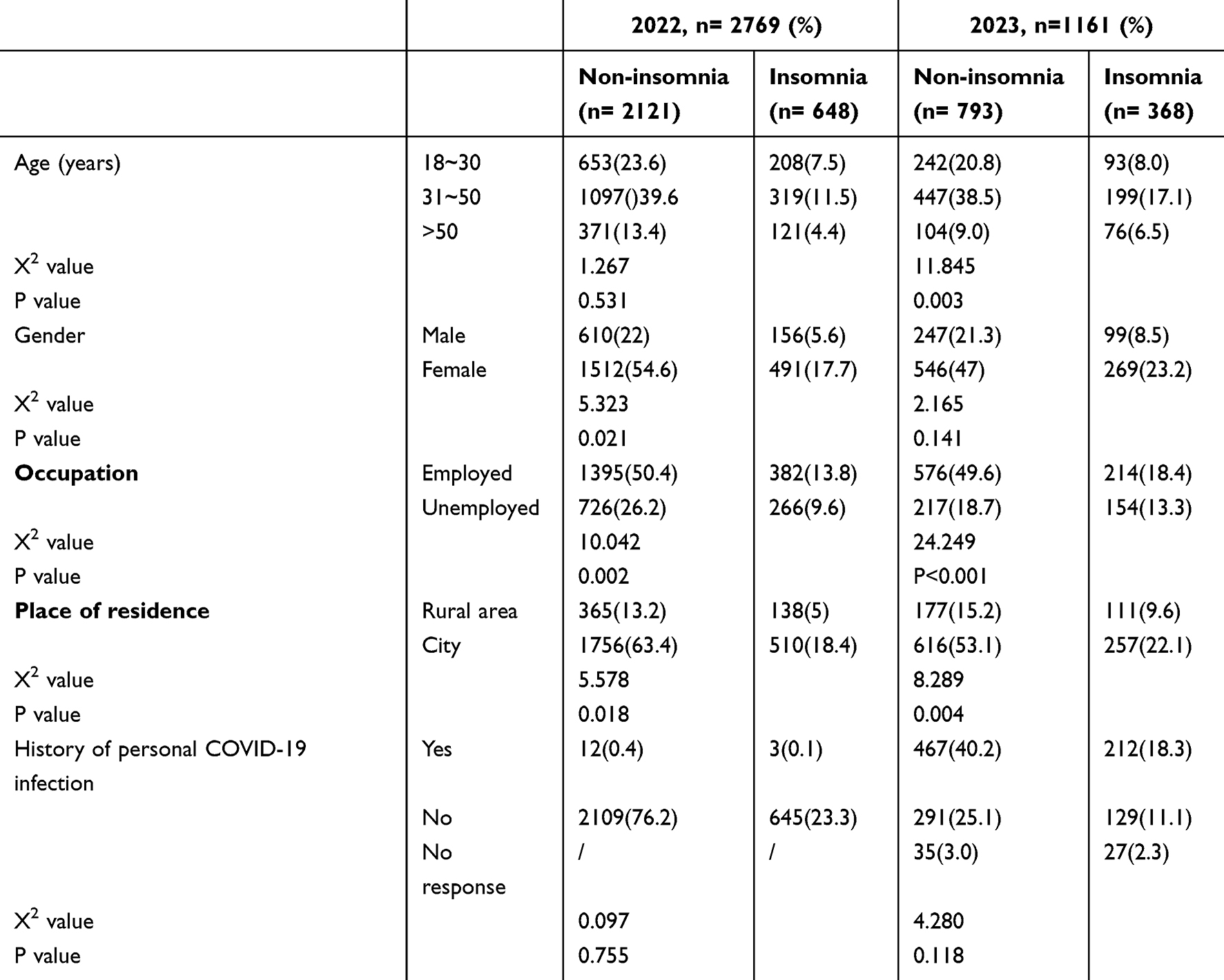 |
Table 1 Demographic Characteristics of the Sample Participating in the Two Survey |
Severity of Insomnia
As seen in Figure 1, an overview of the overall scores for insomnia was displayed using a bar chart (Figure 1A) and a line chart (Figure 1B). Compared to T1, T2’s overall ISI scores were significantly higher (P<0.001).
 |
Figure 1 Distribution of total insomnia scores overall In the bar chart (A), compared with T1(1–31 March 2022), in T2 (1–31 March 2023), there was a significant increase in the number of people with moderate to severe insomnia. (B) represented that total, the mean±SD of ISI (Insomnia Severity Index) score was 9.66±6.66 and 11.46±7.63(range=0–28) in the first and second surveys, respectively. The total ISI scores were significantly higher in T2 compared to T1 (P<0.001). *** means P<0.001. |
The distribution of respondents in the two surveys by age, gender, and location is illustrated in Figure 2. In T1, there were significant inter-group differences in the overall ISI scores between age groups, genders, and places of residence (P < 0.05). In T2, there were notable differences in the overall ISI scores between age groups and geographical regions (P < 0.001). A noteworthy discrepancy was observed between younger and older respondents in both surveys. (P < 0.001).
 |
Figure 2 Distribution of insomnia and participant characteristics As reported in (A–C), there were differences in total ISI (Insomnia Severity Index) scores between different genders, places of residence, and age groups, and the differences were statistically significant (P<0.05). (D–F), there were statistically significant differences in total ISI scores between regions and age groups (P<0.001), but no gender differences in T2. (G) highlighted significant differences between both surveys among younger and older respondents(P<0.001). (I) described in both surveys that there was little difference between the good sleepers and the poor sleepers across genders. * means P<0.05.** means P<0.001. |
Insomnia Patterns
The proportion of individuals experiencing moderately severe and very severe insomnia increased in T2 compared to T1 across the various insomnia patterns, as illustrated in Figure 3.
 |
Figure 3 Insomnia patterns. Notes: As shown in Figure 3, the proportion of individuals experiencing moderately severe and very severe insomnia increased in T2 in comparison to T1 across the various insomnia patterns. In T2, a notable increase was observed in the percentage of participants who expressed dissatisfaction with their current insomnia pattern in comparison to T1. (A) Difficulty falling asleep (B) Difficulty staying asleep (C) Problems waking up too early (D) To what extent do you consider your sleep problem to interfere with your daily functioning (eg, daytime fatigue, mood, ability to function at work/daily chores, concentration, memory, mood, etc) currently? (E) How worried are you about your current sleep problem? (F) How noticeable to others do you think your sleep problem is in terms of impairing the quality of your life? (G) How satisfied are you with your current sleep pattern? |
Factors Associated with Insomnia
The Proportion of Factors Affecting Public Insomnia
Figure 4A indicated that both surveys revealed that over half of the respondents believed the COVID-19 pandemic minimally affected their sleep. Figure 4B displayed that work and study conditions, familial influences, use of electronic devices before bedtime, and physical health status were identified as primary factors that affect individuals’ sleep.
 |
Figure 4 The proportion of factors affecting public insomnia As shown in (A), two surveys showed that more than half of the population thinks the pandemic was mildly affecting their sleep. The results showed an increase in the number of people who believed that the pandemic could affect their sleep to a greater extent in T2. (B) shows that a similar percentage of people chose factors that affected sleep in the two surveys. Work and study conditions, familial influences, use of electronic devices before bedtime, and physical health status were the main factors that the population chose to influence sleep. |
Univariate Analysis of Different Influencing Factors and Insomnia
In T1, significant differences (p<0.05) between insomnia and non-insomnia groups regarding the COVID-19 pandemic, familial influences, social activities, physical health status, food intake, and exercise before bed. In T2, significant differences (p<0.05) were observed between the two groups concerning the COVID-19 pandemic, familial influences, work and study conditions, social activities, and physical health status, as presented in Table 2.
 |
Table 2 Univariate Analysis of Different Influencing Factors and Insomnia |
Construction of a Prediction Model for Insomnia
The statistical factors mentioned above, including demographics and influencing factors, were used to develop the predictive analysis model. Six machine learning models, namely LR, RF, NN, SVM, CatBoost, and GBDT, were utilized and compared to select the most accurate model for identifying significant factors of insomnia, as depicted in Figure 5A–F. Among them, RF demonstrated the highest accuracy rate (90.92% correct in T1), as shown in Figure 5B. The variable that proved to be of particular significance in the RF model at both time points was the impact of the COVID pandemic. During model validation, the SVM model showed the highest prediction accuracy of 78.51% in T1, with an area under the curve (AUC) value of 0.684, as shown in Figure 6A–F. Six machine learning models were utilized and compared to select the most accurate model for identifying significant factors of insomnia in T2, as depicted in Figure 7A–F. Among them, RF demonstrated the highest accuracy rate (86.59% correct in T2), as shown in Figure 7B. The RF model was found to have the highest prediction accuracy of 75.62% in T2, with an AUC value of 0.859, as depicted in Figure 8A–F.
 |
Figure 5 Construction of risk prediction model for insomnia in 2022 The correlation function of the Rminer package version 1.4.5 for the R language was utilized for modeling analysis. The fitting function was used to model variable importance calculations. Subsequently, the LR (logistic regression) model (A), RF (random forest) model (B), NN (neural network) model (C), SVM (support vector machine) model (D), GBDT (gradient boosted decision tree) model (E), and CatBoost model (F) were employed, respectively. The chart displaying variable importance for the model can be seen in the top panel (a1, b1, c1, d1, e1, f1). The middle panel (a2, b2, c2, d2, e2, f2) exhibits the model’s AUC curve while the bottom panel (a3, b3, c3, d3, e3, f3) illustrates the CV. confuse matrix of the model. |
 |
Figure 6 Validation of the insomnia risk prediction model in 2022. The correlation function of the rminer package (version 1.4.5) in the R language was used for modeling analysis, and the fit function was employed to calculate the significance of the modeled variables. The dataset was separated into a training set (70%) and a test set (30%) for model building and validation, respectively. The models used were LR (A), RF (B), NN (C), SVM (D), GBDT (E), and CatBoost (F). The AUC curves of the models are displayed on the upper panel (a1, b1, c1, d1, e1, f1) while the accuracy of the models is displayed on the right panel (a2, b2, c2, d2, e2, f2). |
 |
Figure 7 Construction of risk prediction model for insomnia in 2023 The correlation function of the rminer package version 1.4.5 for the R language was utilised for modeling analysis. The fitting function was used to model variable importance calculations. Subsequently, the LR model (A), RF model (B), NN model (C), SVM model (D), GBDT model (E), and CatBoost model (F) were employed, respectively. The chart displaying variable importance for the model can be seen in the top panel (a1, b1, c1, d1, e1, f1). The middle panel (a2, b2, c2, d2, e2, f2) exhibits the model’s AUC curve while the bottom panel (a3, b3, c3, d3, e3, f3) illustrates the CV. confuse matrix of the model. |
 |
Figure 8 Validation of the insomnia risk prediction model in 2023 The correlation function of the rminer package (version 1.4.5) in the R language was used for modeling analysis, and the fit function was employed to calculate the significance of the modelled variables. The dataset was separated into a training set (70%) and a test set (30%) for model building and validation, respectively. The models used were LR (A), RF (B), NN (C), SVM (D), GBDT (E), and CatBoost (F). The AUC curves of the models are displayed on the upper panel (a1, b1, c1, d1, e1, f1) while the accuracy of the models is displayed on the right panel (a2, b2, c2, d2, e2, f2). |
Discussion
Sleep plays an integral role in maintaining optimal health. Insomnia, a prevalent condition with a substantial negative impact on physical and mental well-being, public safety, and quality of life, has been extensively studied. However, the potential effects of COVID-19 on insomnia during and after the pandemic remain understudied in the general population. This research examined the severity of insomnia, the prevalence of insomnia symptoms, and the associated factors in the public during and after the COVID-19 pandemic. Most respondents were women between the ages of young and middle-aged, residing in urban areas and working in various occupations. A limited number of individuals in T1 contracted the COVID-19 pandemic. Contrarily, over fifty percent of individuals in T2 were infected with the virus.
Sleep is a widespread physiological phenomenon that significantly and cyclically impacts our fundamental physiological processes.16 Any disturbance to the sleep-wake cycle will not only have acute repercussions but also lead to long-term effects, contingent on the duration of exposure.17 Sleep deprivation can lead to chronic inflammation and increase the risk of infectious and inflammatory diseases, such as cardiometabolic, neoplastic, autoimmune, and neurodegenerative diseases.18 The COVID-19 pandemic has resulted in significant alterations to sleep patterns, affected sleep-wake cycles through lifestyle modifications, and raised the likelihood of insomnia, jeopardizing overall physical and mental health.19 Insomnia is widely prevalent in the general population, with research indicating a surge in insomnia symptoms during the COVID-19 pandemic.20 During the COVID-19 pandemic, sleep disorders affected 40.49% of the global population and 36.73% of the general population, according to a related meta-analysis.21 Additionally, a study found that clinical insomnia (ISI ≥ 8) was prevalent in 55.2% of individuals.22 It has also been reported that respondents who developed long-term symptoms after hospitalization for the COVID-19 pandemic reported symptoms of insomnia (49.6%) and excessive daytime sleepiness (35.8%).23 The prevalence of insomnia was more significant than that reported in prior studies, plausibly explained by divergent thresholds, questionnaire design, and cultural variations. The T2 findings indicate that a higher proportion of individuals perceived a more significant effect of the pandemic on their sleep. Furthermore, according to the univariate analysis and prediction model, the pandemic exhibited an independent impact on sleep. These outcomes could be connected to a noteworthy surge in infections with COVID-19.
Sociodemographic factors, including gender and age, are highly linked with sleep. A recent study24 indicates that symptoms of insomnia are increasingly prevalent among the elderly population, leading to shorter and less frequent sleep. Overall, women’s sleep quality was inferior to men’s, despite objective measures revealing that men’s sleep is shorter and more fragmented. An international collaborative study indicated that the prevalence of insomnia symptoms (>40%) and insomnia disorders (>25%) is higher in women, younger age groups, and in some European and American countries than in residents of Asian countries such as China and Japan 8% for disorder and 22–25% for symptoms.25 Prior research has demonstrated that gender is a significant factor in the experience of sleep disruption.26 For example, one study showed that women were at a higher risk of developing insomnia than men. A substantial body of research has demonstrated that women are more likely to experience mental health issues than men.27 Furthermore, a lack of sufficient sleep can result in women exhibiting higher levels of anxiety than men.28 The present study produced comparable findings concerning age and gender.
Furthermore, a study indicated that insomnia was more prevalent in rural populations than urban populations. During the COVID-19 pandemic in China, one report showed that urban patients had a significantly higher insomnia rate than rural patients (29.5% vs 25.5%).29 This finding contradicts the results of the current study. One possible explanation is that most participants in this study resided in urban areas, whereas the rural areas needed stronger knowledge and more current information surrounding the pandemic. Additionally, elderly individuals generally experience poorer sleep quality, which is more prevalent in rural areas.30 It is also possible that socio-economic, cultural, and ethnic factors may exert a considerable influence on the occurrence of insomnia.31,32
Numerous factors, including excessive exposure to media, such as television, newspapers, and radio, modern technology, illnesses, and psychological conditions, such as anxiety and stress, are significant catalysts for acute and chronic sleep disorders.1 Work and study conditions, familial influences, use of electronic devices before bedtime, and physical health status were identified as the primary sleep factors by a similar percentage of individuals in both surveys.
The relationship between work and family has been significant over the past few decades. This is due to changes in familial influences and the composition of the labor force, such as the increase in the number of employed mothers and dual-income families. As a result, many employees now have to balance their work and family responsibilities. Additionally, societal progress is causing a blurring of lines between professional and personal life, creating a greater possibility for mutual impact.33 Research has established a correlation between insomnia and elevated work stress, high demands, and an increased workload.34 Furthermore, a study has illustrated that high levels of work-family conflict may impact the sleep quality of women who work.35 Most participants in the survey were female, which could explain the notable prevalence of work-study and family-related concerns. A study indicated a tenuous association between work demands, such as workload, time pressure, overtime, and insomnia amidst the pandemic.36
One study indicated that prolonged social media usage throughout the day was linked to a reduced risk of poor sleep quality. Utilizing social media for over two hours before bed heightened this risk.37 The findings from the investigation demonstrated that individuals who increased their use of electronic devices during the pandemic lockdown experienced a decrease in sleep quality, heightened insomnia symptoms, and reduced sleep time,38 consistent with the results found in this study. A cross-sectional study during the early COVID-19 pandemic revealed that social media usage was an independent predictive risk factor for insomnia symptoms,39 although not reported in our study. China is reported to have the most significant number of Internet users worldwide, predicted to increase to 1.14 billion by 2025,40,41 due to the growing popularity of smartphones and other technology devices. As a result, this could explain why no distinction was detected in the multivariate analysis concerning the use of electronic devices.
The data indicated a relatively high proportion of individuals experiencing physical health problems, with statistically significant differences in both univariate analysis and prediction models (P<0.05). Insomnia has been associated with a range of physical health conditions, including cancer, diabetes, chronic fatigue syndrome, asthma, and migraine headaches.42 The negative impact of prolonged sleep deprivation can create a harmful cycle with long-lasting effects on both physical and mental well-being.43 There is evidence indicating a connection between sleep disorders and a range of chronic conditions. These relationships may have reciprocal effects, as inadequate sleeping patterns can adversely affect an individual’s physical and mental well-being, further impairing their sleep ability. Although the connection between sleep disruption and certain chronic illnesses has been confirmed, how sleep patterns specifically relate to hypermorbidity remains uncertain.
Predictive models can forecast the incidence and prevalence of insomnia in different demographic groups based on historical data and current trends. These predictions can inform public health policy development and assist communities and government agencies in allocating resources to enhance sleep health. Predictive models can analyse large data sets to identify potential risk factors associated with insomnia. Identifying these factors can facilitate preventing and managing insomnia at the individual and healthcare professional level. Clinical predictive modeling uses a mathematical formula to predict the unknown based on known characteristics. The known characteristics are input into the model to calculate the probability of the unknown outcome. The results of our investigation demonstrated that neural networks were less effective than random forest. A neural network is a hierarchical structure of interconnected nodes that contain an activation function to compute the network’s output. In contrast, a random forest is a collection of decision trees, where the final nodes/leaf nodes represent the majority class for classification problems or the average class for regression problems. Random forests offer various interpretations of decision trees and exhibit better performance. However, neural networks require more data to be effective. The neural network may have yet to fully utilize its benefits due to the limited data size in this study. The SVM model showed the highest prediction accuracy during validation in T1. SVM performs better in controlling overfitting, especially when the sample size is small. It can improve the model’s generalization ability by selecting the optimal decision boundary through interval maximization. SVM often shows high prediction accuracy for small sample datasets due to its effective use of samples and generalization ability. Potential overfitting in the modeling process could be a limitation of the sample size number, and further validation using external datasets will be required in the future.
This study is subject to some limitations as it was an online survey conducted solely in Zhejiang Province, and the sampling techniques used were non-probability. The findings of this study are not generalizable to the broader Chinese population, as the study sample is not representative of the entire population of China (1.3 billion). Furthermore, China is home to 56 ethnic groups, with significant variations in socio-cultural and economic contexts across the country. Various factors, such as electronic devices used, sample size, age, gender, and occupation distribution, may have influenced the outcomes. Potential confounding variables were not explored in the statistical analyses, which is a limitation of this paper. Furthermore, evaluating insomnia and the factors affecting it relied solely on self-reported questionnaires. This cross-sectional study did not allow causal relationships to be inferred among all factors. The examination only briefly explored insomnia and omitted an investigation into additional aspects. Therefore, prudence is necessary when generalizing the present findings due to potential response and selection biases that may impact our data.
The findings of our study have significant implications for the development of health policy and the practice of clinical medicine. The COVID-19 pandemic has the potential to exert a detrimental impact on sleep patterns, affecting both the mental health of individuals and the quality of life of communities. Our study aimed to examine the prevalence and severity of public insomnia, as well as the factors associated with it, during and after the pandemic in Zhejiang Province. The investigation of public sleep problems contributes to improving individual health and psychological well-being and has far-reaching implications for social health, economic stability, and equity. The findings provide a basis for developing targeted sleep interventions for different population groups and symptom types. Several potential interventions are put forth in Supplementary File 3.
It would be beneficial for future studies to implement additional recruitment strategies, such as gender-balanced recruitment, to ensure a more representative sample and reduce any potential bias introduced by gender imbalance. Subsequent longitudinal follow-up studies will be conducted to investigate changes in the dynamics of the COVID-19 pandemic on public sleep. Further studies based on larger, more representative samples with more objective measures involving multiple psychological symptoms and time points and related studies conducted in other regions are required to validate our findings. Future studies will examine other mental health problems, including eating disorders, anxiety, depression, alcohol and drug abuse, and low self-esteem, to explore the mechanisms that occur between sleep and related factors.
Conclusion
In conclusion, the prevalence and severity of insomnia in the general population have increased in the post-pandemic period. It is noteworthy that physical health and the status of infection with the COVID-19 pandemic are significant factors influencing the prevalence of insomnia. The findings of this study will provide epidemiological evidence to inform the development of interventions for insomnia symptoms in the general population. Furthermore, the study proposes a series of potential interventions, the efficacy of which will be evaluated in future prospective studies.
Data Sharing Statement
The datasets used and/or analyzed during the current study are available from the corresponding author upon reasonable request.
Ethics Approval and Consent to Participate
The ethics committee of Huzhou Third Municipal Hospital approved this study. Written informed consent was obtained from each participant before the survey; all participants voluntarily gave their informed consent to participate in the study. (Ethical approval number: 2019-003)
Author Contributions
All authors made a significant contribution to the work reported, whether that is in the conception, study design, execution, acquisition of data, analysis, and interpretation, or in all these areas; took part in drafting, revising, or critically reviewing the article; gave final approval of the version to be published; have agreed on the journal to which the article has been submitted; and agree to be accountable for all aspects of the work.
Funding
This work was supported by Huzhou City Science and Technology Plan Public Welfare Application Research Project Population Health [Medical and Health Key Points](2023GZB07), ZhongXia Shen.
Disclosure
The authors declare that they have no competing interests.
References
1. Marco Túlio De M, Andressa S, Guerreiro Renato de C, et al. Sleep and COVID-19: considerations about immunity, pathophysiology, and treatment. Sleep Sci. 2020;13:199–209. doi:10.5935/1984-0063.20200062
2. Morin Charles M, Jarrin Denise C, Hans I, et al. Incidence, persistence, and remission rates of insomnia over 5 years. JAMA Netw Open. 2020;3:e2018782. doi:10.1001/jamanetworkopen.2020.18782
3. Fernandez-Mendoza J, Vgontzas Alexandros N. Insomnia and its impact on physical and mental health. Curr Psychiatry Rep. 2013;15:418. doi:10.1007/s11920-013-0418-8
4. Ramar K, Malhotra RK, Carden KA, et al. Sleep is essential to health: an American Academy of Sleep Medicine position statement. J Clin Sleep Med. 2021;17(10):2115–2119. doi:10.5664/jcsm.9476
5. Clark I, Landolt HP. Coffee, caffeine, and sleep: a systematic review of epidemiological studies and randomized controlled trials. Sleep Med Rev. 2017;31:70–78. doi:10.1016/j.smrv.2016.01.006
6. Athanasia P, Seraphim K, Elpitha S, et al. Sleep dysfunction in COVID-19 patients: pandemic, risk factors, mechanisms, and management. J Pers Med. 2021;11(11):1203. doi:10.3390/jpm11111203
7. Yuvaraj K, Ramya N, Ganesh Kumar S, et al. Pandemic of psychological morbidities among general population, healthcare workers and COVID-19 patients amidst the COVID-19 pandemic: a systematic review and meta-analysis. Psychiatry Res. 2020;293:113382. doi:10.1016/j.psychres.2020.113382
8. Brown Lily A, Hamlett Gabriella E, Yiqin Z, et al. Worry about COVID-19 as a predictor of future insomnia. J Sleep Res. 2022;31(5):e13564. doi:10.1111/jsr.13564
9. Šmotek M, Fárková E, Manková D, et al. Evening and night exposure to screens of media devices and its association with subjectively perceived sleep: should “light hygiene” be given more attention? Sleep Health. 2020;4:498–505. doi:10.1016/j.sleh.2019.11.007
10. Buxton OM, Lee S, Beverly C, et al. Work-family conflict and employee sleep: evidence from IT workers in the work. Family and Health Study Sleep. 2016;10:1871–1882.
11. Krishnan V, Gupta R, Grover S, et al. Changes in sleep pattern and sleep quality during COVID-19 lockdown. Indian J Psychiatry. 2020;4:370–378. doi:10.4103/psychiatry.IndianJPsychiatry_523_20
12. Wang Y, Zhu L, Ma Y, et al. Association of insomnia disorder with sociodemographic factors and poor mental health in COVID-19 inpatients in China. Sleep Med. 2020;75:282–286. doi:10.1016/j.sleep.2020.06.011
13. Ding KR, Wang SB, Xu WQ, et al. Low mental health literacy and its association with depression, anxiety and poor sleep quality in Chinese elderly. Asia Pac Psychiatry. 2022;14(4):e12520. doi:10.1111/appy.12520
14. Liu Y, Xian JS, Wang R, et al. Factoring and correlation in sleep, fatigue and mental workload of clinical first-line nurses in the post-pandemic era of COVID-19: a multi-center cross-sectional study. Front Psychiatry. 2023;13:963419. doi:10.3389/fpsyt.2022.963419
15. Morin CM, Belleville G, Bélanger L, Ivers H. The insomnia severity index: psychometric indicators to detect insomnia cases and evaluate treatment response. Sleep. 2011;34(5):601–608. doi:10.1093/sleep/34.5.601
16. Bezner TL, Sivaraman M. COVID-19 pandemic and its impact on sleep health: a rapid review. Mo Med. 2022;119(4):385–389. doi:10.1001/jama.2021.5469
17. Salehinejad MA, Azarkolah A, Ghanavati E, et al. Circadian disturbances, sleep difficulties and the COVID-19 pandemic. Sleep Med. 2022;91:246–252. doi:10.1016/j.sleep.2021.07.011
18. Garbarino S, Lanteri P, Bragazzi NL, Magnavita N, Scoditti E. Role of sleep deprivation in immune-related disease risk and outcomes. Commun Biol. 2021;4(1):1304.
19. Pizzonia Kendra L, Brandon K, Suhr Julie A, et al. Insomnia during the COVID-19 pandemic: the role of depression and COVID-19-related risk factors. Cogn Behav Ther. 2021;50:246–260. doi:10.1080/16506073.2021.1879241
20. Cha EJ, Jeon HJ, Chung S. Central symptoms of insomnia in relation to depression and COVID-19 anxiety in general population: a network analysis. J Clin Med. 2022;11(12):3416. doi:10.3390/jcm11123416
21. Jahrami HA, Alhaj OA, Humood AM, et al. Sleep disturbances during the COVID-19 pandemic: a systematic review, meta-analysis, and meta-regression. Sleep Med Rev. 2022;62:101591.
22. Sadeghniiat-Haghighi K, Mehrabinejad MM, Najafi A, et al. Cluster analysis of insomnia symptoms during COVID-19 pandemic: a general population web-based survey in Iran. Sleep Sci. 2021;14(Spec 1):63–68. doi:10.5935/1984-0063.20200087
23. Merikanto I, Dauvilliers Y, Chung F, et al. Sleep symptoms are essential features of long-COVID-Comparing healthy controls with COVID-19 cases of different severity in the international COVID sleep study (ICOSS-II). J Sleep Res. 2023;32(1):e13754. doi:10.1111/jsr.13754
24. van de Langenberg SCN, Kocevska D, Luik AI. The multidimensionality of sleep in population-based samples: a narrative review. J Sleep Res. 2022;31(4):e13608. doi:10.1111/jsr.13608
25. Morin CM, Bjorvatn B, Chung F, et al. Insomnia, anxiety, and depression during the COVID-19 pandemic: an international collaborative study. Sleep Med. 2021;87:38–45. doi:10.1016/j.sleep.2021.07.035
26. Suh S, Cho N, Zhang J. Sex differences in insomnia: from epidemiology and etiology to intervention. Curr Psychiatry Rep. 2018;20(9):69. doi:10.1007/s11920-018-0940-9
27. Matud MP, García MC. Psychological distress and social functioning in elderly Spanish people: a gender analysis. Int J Environ Res Public Health. 2019;16(3):341. doi:10.3390/ijerph16030341
28. Goldstein-Piekarski AN, Greer SM, Saletin JM, et al. Sex, sleep deprivation, and the anxious brain. J Cogn Neurosci. 2018;30(4):565–578. doi:10.1162/jocn_a_01225
29. Liu L, Xue P, Li SX, et al. Urban-rural disparities in mental health problems related to COVID-19 in China. Gen Hosp Psychiatry. 2021;69:119–120. doi:10.1016/j.genhosppsych.2020.07.011
30. Yang JJ, Cai H, Xia L, et al. The pandemic of depressive and insomnia symptoms, and their association with quality of life among older adults in rural areas in China. Front Psychiatry. 2021;12:727939. doi:10.3389/fpsyt.2021.727939
31. Gureje O, Makanjuola VA, Kola L. Insomnia and role impairment in the community: results from the Nigerian survey of mental health and wellbeing. Soc Psychiatry Psychiatr Epidemiol. 2007;42:495–501. doi:10.1007/s00127-007-0183-2
32. Ohayon MM, Partinen M. Insomnia and global sleep dissatisfaction in Finland. J Sleep Res. 2002;11(4):339–346. doi:10.1046/j.1365-2869.2002.00317.x
33. Magee CA, Robinson LD, McGregor A. The work-family interface and sleep quality. Behav Sleep Med. 2018;16:601–610. doi:10.1080/15402002.2016.1266487
34. Yang B, Wang Y, Cui F, et al. Association between insomnia and job stress: a meta-analysis. Sleep Breath. 2018;22(4):1221–1231. doi:10.1007/s11325-018-1682-y
35. Aazami S, Mozafari M, Shamsuddin K, et al. Work-family conflict and sleep disturbance: the Malaysian working women study. Ind Health. 2016;1:50–57. doi:10.2486/indhealth.2015-0086
36. Saksvik-Lehouillier I. TA, Saksvik-Lehouillier I. Insomnia among employees in occupations with critical societal functions during the COVID-19 pandemic. Sleep Med. 2022;91:185–188. doi:10.1016/j.sleep.2021.02.025
37. Aldhawyan Adam F, Alfaraj Ali A, Elyahia Sara A, et al. Determinants of subjective poor sleep quality in social media users among freshman college students. Nat Sci Sleep. 2020;12:279–288. doi:10.2147/NSS.S243411
38. Federico S, Giulia A, Domenico C, et al. Changes of evening exposure to electronic devices during the COVID-19 lockdown affect the time course of sleep disturbances. Sleep. 2021;44(9):zsab080. doi:10.1093/sleep/zsab080
39. Al Mamun F, Gozal D, Hosen I, et al. Predictive factors of insomnia during the COVID-19 pandemic in Bangladesh: a GIS-based nationwide distribution. Sleep Med. 2022;91:219–225. doi:10.1016/j.sleep.2021.04.025
40. Jinfang Z, Lin M, Jingbo Z, et al. The moderating role of lifestyle on insomnia in home quarantine college students during the COVID-19 pandemic. Front Psychiatry. 2022;13:830383.
41. Muhammed E, Ahmed A, Msherghi A, et al. Psychological health, sleep quality, behavior, and internet use among people during the COVID-19 pandemic: a cross-sectional study. Front Psychiatry. 2021;12:632496. doi:10.3389/fpsyt.2021.632496
42. Børge S, Mari H, Harvey Allison G, et al. The epidemiology of insomnia and sleep duration across mental and physical health: the SHoT study. Front Psychol. 2021;12:662572. doi:10.3389/fpsyg.2021.662572
43. Lee S. Naturally Occurring consecutive sleep loss and day-to-day trajectories of affective and physical well-being. Ann Behav Med. 2022;56:393–404. doi:10.1093/abm/kaab055
 © 2025 The Author(s). This work is published and licensed by Dove Medical Press Limited. The
full terms of this license are available at https://www.dovepress.com/terms
and incorporate the Creative Commons Attribution
- Non Commercial (unported, 3.0) License.
By accessing the work you hereby accept the Terms. Non-commercial uses of the work are permitted
without any further permission from Dove Medical Press Limited, provided the work is properly
attributed. For permission for commercial use of this work, please see paragraphs 4.2 and 5 of our Terms.
© 2025 The Author(s). This work is published and licensed by Dove Medical Press Limited. The
full terms of this license are available at https://www.dovepress.com/terms
and incorporate the Creative Commons Attribution
- Non Commercial (unported, 3.0) License.
By accessing the work you hereby accept the Terms. Non-commercial uses of the work are permitted
without any further permission from Dove Medical Press Limited, provided the work is properly
attributed. For permission for commercial use of this work, please see paragraphs 4.2 and 5 of our Terms.
Recommended articles

Using Machine Learning Algorithms to Predict High-Risk Factors for Postoperative Delirium in Elderly Patients
Liu Y, Shen W, Tian Z
Clinical Interventions in Aging 2023, 18:157-168
Published Date: 8 February 2023
A Multifactorial Risk Score System for the Prediction of Diabetic Kidney Disease in Patients with Type 2 Diabetes Mellitus
Hui D, Zhang F, Lu Y, Hao H, Tian S, Fan X, Liu Y, Zhou X, Li R
Diabetes, Metabolic Syndrome and Obesity 2023, 16:385-395
Published Date: 10 February 2023
Ten-Year Multicenter Retrospective Study Utilizing Machine Learning Algorithms to Identify Patients at High Risk of Venous Thromboembolism After Radical Gastrectomy
Liu Y, Song C, Tian Z, Shen W
International Journal of General Medicine 2023, 16:1909-1925
Published Date: 18 May 2023
Establishment and Validation of Models for the Risk of Multi-Drug Resistant Bacteria Infection and Prognosis in Elderly Patients with Pulmonary Infection: A Multicenter Retrospective Study
Wang S, Li J, Dai J, Zhang X, Tang W, Li J, Liu Y, Wu X, Fan X
Infection and Drug Resistance 2023, 16:6549-6566
Published Date: 5 October 2023
Risk Factors for Granulomatous Mastitis and Establishment and Validation of a Clinical Prediction Model (Nomogram)
Zeng Y, Zhang D, Fu N, Zhao W, Huang Q, Cui J, Chen Y, Liu Z, Zhang X, Zhang S, Mansoor KM
Risk Management and Healthcare Policy 2023, 16:2209-2222
Published Date: 20 October 2023