
Back to Journals » Patient Preference and Adherence » Volume 20
Sleep Disturbance, Treatment-Related Adverse Events, and Psychological Distress in Breast Cancer Patients: A Prospective Cohort Study
Authors Zhao F, Li Y, Zhou Y  , Fu E, Zhu S, Yu L, Xu H, Li Q, Li Q , Zhang P, Wang J, Mo H
Received 11 March 2026
Accepted for publication 3 June 2026
Published 16 June 2026 Volume 2026:20 608376
DOI https://doi.org/10.2147/PPA.S608376
Checked for plagiarism Yes
Review by Single anonymous peer review
Peer reviewer comments 2
Editor who approved publication: Dr Ramón Morillo-Verdugo
Fang Zhao,1,* Yuqiu Li,1,* Yanjun Zhou,2 Enfeng Fu,1 Shanshan Zhu,1 Lulu Yu,1 Hangcheng Xu,1 Qing Li,1 Qiao Li,1 Pin Zhang,1 Jiani Wang,1 Hongnan Mo1
1Department of Medical Oncology, National Cancer Center/National Clinical Research Center for Cancer/Cancer Hospital, Chinese Academy of Medical Sciences and Peking Union Medical College, Beijing, People’s Republic of China; 2Department of Nursing, Beijing Children’s Hospital, Capital Medical University, National Center for Children’s Health, Beijing, People’s Republic of China
*These authors have contributed equally to this work
Correspondence: Hongnan Mo, Email [email protected]
Background: Studies on the treatment-related adverse events have mostly overlooked sleep quality and psychological distress in patients with cancer. The aim of this study was to analyze the relationship between sleep disturbance, treatment-related adverse events, and psychological distress in Chinese patients with breast cancer.
Methods: This was a prospective cohort study of 300 female patients diagnosed with breast cancer, who were recruited from two medical centers in China. Sleep disturbances and psychological distress were assessed before and after every treatment cycle using the Pittsburgh Sleep Quality Index and the Symptom Checklist-90 questionnaire. Treatment-related adverse events were assessed using a validated 26‑item scale after each of 6 chemotherapy cycles. Spearman’s rank correlation was used for bivariate analyses and multivariable linear regression was used to test independent associations. False Discovery Rate correction was applied for multiple comparisons.
Results: The incidence of most treatment-related adverse events was significantly higher in the baseline sleep disorder group than in the normal sleep group (all P values < 0.05). Psychological distress at baseline was correlated with the total treatment-related adverse events score (rs=0.54, P< 0.001). Multivariate analysis showed that psychological distress was independently associated with the occurrence of treatment-related adverse events (β=0.19, P< 0.001). In addition, the pre-treatment total psychological distress score in the baseline sleep disorder group was significantly higher than that in the normal sleep group (P=0.001). Furthermore, the severity of treatment-related adverse events and baseline sleep quality were associated with psychological distress (all P values < 0.05).
Conclusion: Poor baseline sleep quality is correlated with increased occurrence and severity of treatment-related adverse events. In addition, baseline psychological distress is correlated with the occurrence of treatment-related adverse events. Both baseline sleep quality and the severity of treatment-related adverse events were associated with the psychological distress of patients after treatment for breast cancer.
Keywords: breast cancer, psychological distress, sleep quality, treatment-related adverse events
Introduction
Breast cancer is one of the most common malignant tumors that affect women worldwide. In 2020, more than 400,000 women in China were diagnosed with breast cancer, making it the most frequently diagnosed cancer in the country.1 Although chemotherapy can control the progression of cancer, it also causes adverse reactions that affect the quality of life and survival of patients.2 Assessment of patient-reported outcomes can provide a more comprehensive and accurate reflection of the effects of treatment-related adverse events on patients. Previous studies have indicated that therapeutic drugs and patient factors, such as serum levels of biochemical indicators, could affect the occurrence of treatment-related adverse events.3,4 Therefore, comprehensive analysis and understanding of the factors associated with treatment-related adverse events and effectively controlling them is important for reducing the incidence of treatment-related adverse events and improving the quality of life and prognoses of patients with cancer.
Many patients with cancer experience sleep disorders, which are often accompanied by psychological distress. The findings of some studies suggest that insomnia symptoms are three times more prevalent in patients with cancer than in the general population, with patients with breast cancer having the highest incidence of insomnia among all patients with cancer.5 Specifically, 57–66% of patients with breast cancer experience poor sleep quality before starting adjuvant chemotherapy.6,7 It has been reported that sleep disorders affect the incidence and severity of treatment-related adverse events in patients with cancer. Nishiura et al found that patients with lung cancer who experience sleep disturbances experience significantly higher levels of fatigue and pain and have lower quality of life scores than those without sleep disturbances.8 Sleep disorders can also aggravate the occurrence and severity of adverse events such as alopecia, gastrointestinal reactions, and myelosuppression in patients with cancer who are undergoing chemotherapy.9 Sleep disorders are major causes of fatigue during chemotherapy.10 However, only a few studies have been conducted to examine the effect of psychological distress on sleep quality and treatment-related adverse events.
Patients with cancer commonly experience negative emotions such as depression, anxiety, interpersonal sensitivity, and hostility, which indicate their significantly poorer psychological distress than the general population. In addition, breast cancer survivors have an increased risk of developing depression compared with the general population.11 Previous meta-analyses have indicated that the prevalence rates of anxiety and depression in patients with cancer are 41.9% and 32.2%, respectively.12,13 Similarly, studies conducted in China shown that breast cancer survivors often experience significant depression and anxiety.14 Anti-tumor treatment can lead to the development of several psychological distress problems such as anxiety and depression. Nakamura et al reported that in their study, 40% of the patients with breast cancer included in their study reported mild, moderate, or severe depressive symptoms at the end of chemotherapy; 52% reported mild, moderate, or severe anxiety symptoms; and 33% reported both depressive and anxiety symptoms.15 Another study indicated that during an average three-year follow-up period after chemotherapy, 23% of patients with cancer received new psychiatric diagnoses, 21% were receiving psychological distress care, and more than 60% were prescribed antidepressants or anxiolytics, indicating that a large proportion of the patients experienced psychological distress.16 However, the correlation between psychological distress and treatment-related adverse events in patients with cancer has not been studied comprehensively. Moreover, considering the interaction between sleep quality and adverse events, no study has been conducted to clarify whether psychological issues aggravate sleep disorders and treatment-related adverse events in patients with cancer.
Although the pairwise associations between sleep disturbance, psychological distress, and treatment-related adverse events have been examined separately, they are likely interdependent and cyclical rather than operating in isolation. Poor sleep quality may increase the severity of treatment-related adverse events through neuroendocrine and inflammatory pathways, with evidence implicating proinflammatory cytokines such as IL-1β, TNF-α, and IL-6 in the development of fatigue, pain, and sleep disturbance during chemotherapy.17,18 Conversely, experiencing severe treatment-related adverse events can disrupt sleep. For instance, chemotherapy-induced peripheral neurotoxicity has been identified as a significant risk factor for poor sleep quality,19 and sleep deprivation can in turn increase pain sensitivity, creating a vicious cycle.20 Similarly, psychological distress can heighten the perceived severity of treatment-related adverse events and reduce treatment tolerance through expectancy effects and psychoneuroimmune pathways,21 while the physical burden of treatment-related adverse events can exacerbate emotional distress. Moreover, sleep disturbance and psychological distress are closely intertwined. Reductions in sleep problems correspond with decreased emotional distress and attenuation of pro-inflammatory cytokines in cancer survivors,22 and immune activation may serve as a physiological link between distress and sleep. Despite this evidence, no single prospective study has simultaneously measured all three constructs including sleep quality, psychological distress and treatment-related adverse events burden in a unified cohort of breast cancer patients undergoing adjuvant chemotherapy.
In this study, we mainly investigated whether preexisting sleep problems and psychological distress were associated with the incidence and severity of treatment-related adverse events in patients with breast cancer, with the ultimate goal of providing new insights into possible options for reducing the risk of treatment-related adverse events in patients breast cancer. We also analyzed the correlation between the treatment-related adverse event and the psychological distress of patients after treatment, further highlighting the significance of reducing adverse events in improving the quality of life of patients. In addition, we conducted exploratory analyses to examine associations between baseline sleep quality and post-treatment psychological distress. To our knowledge, no prospective study has yet examined the simultaneous associations among these three variants in breast cancer patients.
Materials and Methods
Participants
This was a prospective cohort study of inpatients with breast cancer recruited from National Cancer Center/Cancer Hospital, Chinese Academy of Medical Sciences, and the Cancer Hospital of Huanxing Chaoyang District, Beijing, China, between January 1, 2023, and October 31, 2023. The included patients were women aged 18 years or older at the time of diagnosis, diagnosed with breast cancer based on pathological findings, and required to undergo adjuvant chemotherapy after surgery according to the 2022 NCCN guidelines. Patients with a history of psychiatric illness, treatment for anxiety or depression, or drug dependence were excluded. We also excluded patients who could not provide informed consent for any reason after receiving an explanation of the study or complete the questionnaires used in this study, even after receiving assistance from family members.
This study was approved by the ethics committee of the National Cancer Center and written informed consent was obtained from each participant (22/272-3474).
Study Measures
Demographic and Clinical Information
Baseline was defined as the first day of the first cycle of chemotherapy. Demographic and clinical information (age, body mass index [BMI; calculated as weight in kilograms divided by height in meters squared], education level, marital status, employment status, molecular subtype, tumor stage, and chemotherapy regimens) was retrieved from the digital medical record system iMedical8.3.0. In addition, data on the results of blood tests conducted on the earliest date within 30 days from baseline were extracted from the patient’s medical records.
Sleep Quality
The Pittsburgh Sleep Quality Index (PSQI) is primarily used for evaluating the subjective sleep quality of patients.23 It consists of 19 self-evaluation items and five items evaluated by others. The 19th self-evaluation item and the five items evaluated by others were not included in the scoring in this study; only 18 self-evaluation items were used. The PSQI consists of seven components: subjective sleep quality, sleep latency, sleep duration, habitual sleep efficiency, sleep disturbances, use of sleeping medications, and daytime dysfunction. The total scores range from 0 to 21, with higher scores indicating poorer sleep quality. A PSQI score ≥5 points is considered indicative of a sleep disorder. The patients included in this study completed the PSQI at baseline and were divided into sleep disorder and normal groups based on their scores. Sleep quality after treatment was measured after each treatment cycle using the sleep scores of a symptom rating scale of treatment-related adverse events.
In addition, sleep data were also collected using KEEP B3 smart wristbands. The smart bracelet data were used only for descriptive purposes and to validate baseline subjective reports PSQI with objective metrics but were not included as a primary exposure in regression models. The device integrated an optical heart rate and blood oxygen sensor, a three-axis accelerometer, and a gyroscope, configured as a 6-axis sensor system. Participants were instructed to wear the KEEP B3 wristband continuously from 9 p.m. until 7 a.m. the next day of each chemotherapy cycle. Each chemotherapy cycle lasts for one day. Sleep parameters recorded by the wristband included total sleep duration, deep sleep duration, light sleep duration, rapid eye movement sleep duration, waking duration, and the sleep quality score. All sleep data were wirelessly synchronized daily with the KEEP App via Bluetooth and subsequently exported for research analysis. Adherence was defined as whether the participant successfully wore the wristband for the entire night and provided usable data. A valid night was defined as ≥4 hours of recorded accelerometer data between 9 PM and 7 AM with no missing data blocks exceeding 60 minutes. For participants with ≥4 valid cycles out of 6 chemotherapy cycles, we imputed the missing cycles using multiple imputation. Participants with <4 valid cycles were excluded from all wearable analyses.
Psychological Distress
Psychological distress was determined at baseline and after one cycle of treatment using the Symptom Checklist-90 (SCL‐90), which contains 90 items on self-reported symptoms24 classified into 9 subscales: somatization, obsessive–compulsive, interpersonal sensitivity, depression, anxiety, anger-hostility, phobic-anxiety, paranoid ideation, and psychoticism. Somatization reflects subjective perceptions of body discomfort. Interpersonal sensitivity mainly refers to discomfort and feelings of inferiority in interpersonal interactions, particularly in comparison to others. Hostility reflects the patient’s expression of hostility across emotional, behavioral, and cognitive domains. Phobic-anxiety is generally aligned with traditional fear. Paranoid ideation reflects suspicions. Psychoticism denotes symptoms akin to those observed in schizophrenia. Additional items assess the patient’s dietary and sleep patterns. The items of the SCL-90 are assessed using a 5-point Likert scale, with scores ranging from 1 to 5 points indicating the severity of symptoms (from “no” to “severe”). Higher scores denote a higher frequency and intensity of psychological symptoms. Cronbach’s α coefficients for SCL-90 were 0.97.
Treatment-Related Adverse Events
A symptom rating scale for breast cancer patients undergoing chemotherapy25 was used for the assessment of the patient-reported treatment-related adverse events. The scale consists of 26 symptoms: nausea, emesis, fatigue, numbness in the hands or feet, generalized aches and pains, dental ulcers, depression, alopecia, diarrhea, constipation, decreased libido, memory deterioration, fever, taste alteration, loss of appetite, difficulty concentrating, skin changes, cough, menstrual disorder, photophobia, weight loss, hemorrhage, headache, sore throat, and pain at the chemotherapy administration site. The items are assessed using a 5-point scale, with scores ranging from 0 to 4 indicating the severity of symptoms (from “no” to “very severe symptom”). According to the original study,19 the scale was developed through two rounds of expert panel review. The item-level content validity index (I-CVI) ranged from 0.800 to 1.000, the scale-level content validity index (S-CVI) was 0.977, and the universal agreement rate was 0.885, indicating excellent content validity. Symptom scores differed significantly across treatment stages (pre-treatment, during treatment, post-treatment), supporting convergent validity. The original study reported a Cronbach’s α of 0.818 for the total scale, indicating acceptable internal consistency. We have also calculated Cronbach’s α for the scale using baseline data from our own cohort, which yielded a value of 0.86. This is comparable to the original validation study and further confirming its reliability in the population. Although the scale was developed in the Chinese context, its design principles align with the Common Terminology Criteria for Adverse Events (CTCAE v5.0) framework used globally in oncology. Each symptom item in the scale corresponds directly to a CTCAE term, and the 0–4 grading system parallels CTCAE severity grades.
Psychological health and treatment-related adverse events were assessed at the end of each of the 6 chemotherapy cycles. To obtain a single summary measure of the overall treatment-period status for each patient, we calculated the median of the 6 post-cycle values for each variable, including treatment-related adverse events scores and SCL-90 scores. The median was chosen because it is robust to outliers and better represents the typical symptom burden over the entire chemotherapy course. This aggregation uses all available repeated measurements while eliminating within-patient correlation, as each patient contributes only one aggregated value to the primary analyses.
Statistical Analysis
All data were analyzed using SPSS for Windows version 26.0. Normally distributed quantitative data are expressed as mean±standard deviation (x±s), and t-test of two independent samples was used for comparison between groups. Skewed quantitative data are presented as medians with interquartile ranges (P50 [P25–P75]), and between-group comparisons were performed using the Mann–Whitney U-test. Count data are expressed as number and frequencies, and group comparisons were performed using the chi-square test. The total scores of treatment-related adverse events and SCL-90 both followed approximated normal distributions, as shown in Supplementary Figure S1. Spearman’s rank correlation analysis was performed to explore the correlations between variables. Statistical significance was set at P < 0.05. To control for type I error, we applied Benjamini–Hochberg FDR correction to the correlation matrices in the analysis. Univariate analysis was conducted to identify variables that were significantly associated with treatment-related adverse events or psychological distress. After assessment of linear regression assumptions (Supplementary Figure S2), two multivariable linear regression models were constructed for each primary analysis to identify the factors independently associated with treatment-related adverse events or psychological distress. For Multivariable Model 1, covariates were entered if they showed a statistically significant association with the dependent variable in univariate analysis (P<0.05). For Multivariable Model 2, to assess robustness to potential residual confounding, all clinically relevant covariates were forced into the model regardless of univariate significance including age, chemotherapy regimen, molecular subtype and other covariates. These covariates were selected a priori based on clinical knowledge and previous literature.
Results
Baseline Clinical and Demographic Characteristics of the Patients
A total of 300 patients with breast cancer (mean [SD] age: 49.64 [10.38] years) were included in the analysis. The baseline clinical and demographic characteristics of the patients are summarized in Table 1. A total of 132 (44.0%) patients had sleep disorders (based on their PSQI scores) at baseline. Regarding history of treatment at baseline, 31 (10.3%) patients had previously received radiation therapy, whereas 24 (8.0%) had undergone hormone therapy. Regarding chemotherapy regimens, 252 (86.6%) patients received paclitaxel, 103 (35.4%) patients received platinum, and 127 (43.6%) patients received anthracyclines. A total of 118 (40.5%) patients received HER2-targeted drugs. There were no statistically significant differences in general demographic and clinical characteristics, such as age, BMI, education level, menopausal status, tumor stage, molecular subtype, and treatment regimens, between the sleep disorder and normal sleep groups (Table 1).
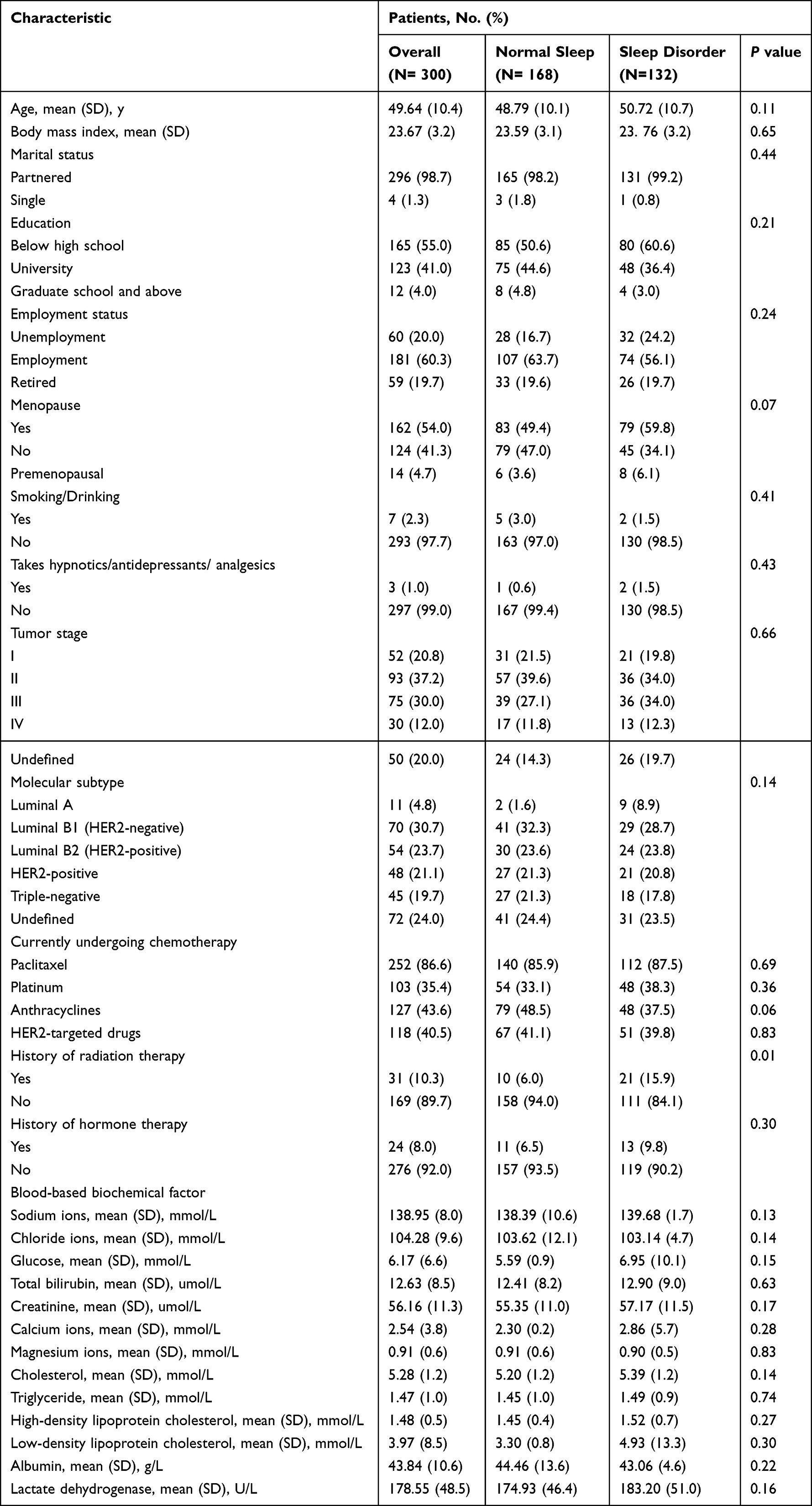 |
Table 1 Baseline Clinical and Demographic Characteristics of Patients |
PSQI scores and the sleep data measured using a smart bracelet were correlated and showed consistency in the evaluation of the sleep quality (rs=−0.447, P<0.001) (Supplementary Figure S3A). Analysis of the sleep data indicated that the longer the sleep duration, deep sleep duration, shallow sleep duration, or rapid eye movement duration and the lower the PSQI score, the better the sleep quality of the patients (all P values <0.05) (Supplementary Figure S3B–F).
Associations Between Baseline Sleep Quality and Treatment-Related Adverse Events of Patients
At baseline, the incidence of most treatment-related adverse events in the sleep disorder group, including nausea and vomiting, fatigue, numbness in the hands or feet, depression, alopecia, memory deterioration, and photophobia, was significantly higher than that in the normal sleep group (all P values <0.05) (Table 2). In addition, the severity of depression, fatigue, numbness in the hands or feet, memory deterioration, photophobia, and difficulty concentrating were positively correlated with sleep quality at baseline (all P values <0.05). Furthermore, the Figure 1 revealed the total treatment-related adverse events scores in the baseline sleep disorder group was significantly higher than that in the normal sleep group (P=0.008). The baseline sleep quality of the patients was significantly correlated with the severity of treatment-related adverse events (rs=0.15, P=0.011) (Table 3).
 |
Table 2 Effects of Baseline Sleep Quality on the Occurrence of Treatment-Related Adverse Events |
 |
Table 3 Analysis of the Correlation Between the Baseline Sleep Quality of the Patients and the Occurrence of Treatment-Related Adverse Events |
 |
Figure 1 The total treatment-related adverse events scores in the baseline sleep disorder group was significantly higher than that in the normal sleep group (P=0.008). (** P < 0.01). |
Associations Between Baseline Psychological Distress and Treatment-Related Adverse Events of Patients
Spearman’s rank correlation analysis revealed that the total SCL-90 score at baseline was positively correlated with the total treatment-related adverse event score (rs=0.57, P<0.001) (Figure 2). The scores of all the SCL-90 subscales were associated with adverse events, such as skin changes, fatigue, loss of appetite, numbness in hands or feet, generalized aches and pains, decreased libido, cough, memory deterioration, difficulty concentrating, fever, and headache (all P values <0.05) (Table 4). All the correlation results have undergone multiple correction analyses.
 |
Table 4 Analysis of the Correlation Between the Baseline Psychological Distress of the Patients and the Occurrence of Treatment-Related Adverse Events |
 |
Figure 2 Psychological distress at baseline was correlated with the total treatment-related adverse events score (rs=0.54, P<0.001). |
Multiple linear regression revealed that baseline SCL-90 score was a predictive factor for treatment-related adverse events (β=0.19, P<0.001) after adjusting for covariables including age, menopausal status, HER-2 positive subtype, and sleep quality at baseline (Supplementary Table 1, multivariable Model 1). SCL-90 score was still associated with treatment-related adverse events even after other covariates such as smoking/drinking, BMI, duration from the time of diagnosis, tumor stage, molecular subtype, treatment regimens, history of radiation therapy, and history of hormone therapy were included in the models (β=0.22, P<0.001) (Supplementary Table 1, multivariable Model 2). Furthermore, the pre-treatment total SCL-90 and symptom scores of the baseline sleep disorder group were significantly higher than those of the normal group (all P-values <0.05) (Supplementary Table 2).
Associations Between Baseline Sleep Quality and the Post-Treatment Psychological Distress of Patients
The post-treatment somatization, obsessive–compulsive, interpersonal sensitivity, depression, anxiety, anger–hostility, paranoid ideation, additional items (dietary and sleep patterns) subscale scores in the baseline sleep disorder group were significantly higher than those in the normal sleep group (all P values <0.05) (Supplementary Table 3). The total post-treatment psychological distress scores in the baseline sleep disorder group were significantly higher than those in the normal sleep group (P=0.001) (Figure 3). In addition, Spearman’s rank correlation analysis showed that sleep quality at baseline was positively correlated with SCL-90 scores after treatment, especially in the somatization, obsessive–compulsive symptoms, interpersonal sensitivity, depression, anxiety, anger–hostility, paranoid ideation, and dietary and sleep patterns subscales (all P values <0.001) (Table 5).
 |
Table 5 Analysis of the Correlation Between the Baseline Sleep Quality, Treatment-Related Adverse Events of the Patients and Their Psychological Distress After Treatment Respectively |
 |
Figure 3 The total post-treatment total SCL-90 scores in the baseline sleep disorder group were significantly higher than those in the normal sleep group (P=0.001) (** P < 0.01). |
Associations Between Treatment-Related Adverse Events and the Post-Treatment Psychological Distress of Patients
Spearman’s rank correlation analysis showed that the severity of adverse events was positively correlated with post-treatment SCL-90 scores, indicating that more severe adverse events were associated with poorer post-treatment psychological distress status (all P values <0.05) (Table 5). These results have undergone multiple correction analyses. The Figure 4 revealed the total scores of adverse events was positively correlated with post-treatment psychological distress scores. (rs=0.71, P<0.001).
 |
Figure 4 The total scores of adverse events was positively correlated with post-treatment psychological distress scores. (rs=0.71, P<0.001). |
We performed linear regression analysis to determine the univariate factors that affected the psychological distress of the patients after treatment and constructed multivariable models for the entire cohort. The results indicated that treatment-related adverse events were independent predictive factors for psychological distress after treatment (β = 0.69, P<0.001) after adjusting for covariates, including menopausal status and baseline sleep status (Supplementary Table 4, multivariable Model 1). In addition, treatment-related adverse events remained independent predictive factors for psychological distress after treatment (β= 0.67, P<0.001) when other covariates, including age, smoking/drinking, BMI, duration from the time of diagnosis, tumor stage, molecular subtype, chemotherapy regimens, history of radiation therapy, and history of hormone therapy, were included in the model (Supplementary Table 4, multivariable Model 2).
Discussion
In this study, we analyzed the relationships between sleep disturbance, adverse events after chemotherapy, and psychological distress in patients with breast cancer. Our results indicated that baseline sleep quality and psychological distress were critical factors associated with treatment-related adverse events in the study population. Moreover, we found that baseline sleep quality and treatment-related adverse events were associated with the psychological distress of the patients after treatment. To our knowledge, this is the first prospective study to simultaneously examine all three constructs including baseline sleep quality, baseline psychological distress, treatment-related adverse events, and psychological distress in a unified cohort of breast cancer patients. Unlike previous studies that focused on pairwise associations in separate populations, we integrated repeated assessments across six chemotherapy cycles, used the median to represent overall treatment-period burden, and provided both subjective and descriptive wearable sleep data. Our findings are clinically relevant and encourage clinicians to consider the assessment of pre-treatment sleep quality and psychological distress to potentially predict and reduce the incidence and severity of treatment-related adverse events and improve quality of life in patients with breast cancer.
People diagnosed with cancer often exhibit poor sleep quality. Xiang et al analyzed the results of 59 cross-sectional studies and reported that the overall prevalence of poor sleep quality in patients with cancer is 57.4% (range: 16.2–92.6%), which is higher than the prevalence rates observed in patients with other diseases, including diabetes, cardiovascular disease, epilepsy, and inflammatory bowel disease.26 Factors associated with sleep disorders in patients with malignant tumors are highly complex. Patients with cancer often experience negative emotions, such as depression and anxiety, and face substantial psychosocial stress and financial pressure, which can also lead to the occurrence of sleep disorders.27–29 In the present study, we found that the baseline prevalence of sleep disorders in the patients was 44%, which is consistent with the results reported in the literature.
Sleep disorders can lead to fatigue, weakened immunity, and low tolerance to treatment-related adverse effects, which can aggravate the adverse effects and affect rehabilitation outcomes. In the present study, we found that sleep disorders increased the incidence of nausea and vomiting, fatigue, numbness in the hands or feet, alopecia, and memory deterioration in the patients, a finding similar to those reported in previous studies.30–32 The mechanisms underlying the relationship between sleep disorders and treatment-related adverse events are complex and unclear. Studies have shown that sleep disorders may affect the incidence of chemotherapy-induced nausea and vomiting via neurotransmitters associated with the circadian rhythm, such as melatonin and serotonin.33,34 Exposure to chemotherapeutic agents stimulates the release of serotonin, which binds to 5-HT3 receptors on vagal afferent neurons in the abdomen to transmit sensory input to the emetic center of the brain, causing chemotherapy-induced nausea and vomiting.35 Cancer-related fatigue, one of the most common and distressing complaints reported by patients during chemotherapy, is characterized by multidimensional physical and/or mental exhaustion that disrupts motivation and normal functioning.36 Poor sleep quality and insomnia may alter rest–activity patterns and circadian rhythm systems, which dysregulate rhythms of the immune system and disrupt cytokine production, aggravating cancer-related fatigue.37
Chemotherapy-induced peripheral neurotoxicity leads to the occurrence of symptoms such as numbness, tingling, neuropathic pain, and functional loss. Studies have shown that sleep disorders are associated with worse neuropathy outcomes in physical, social, and emotional functioning.32 However, further research is needed to clarify the mechanisms underlying the association between sleep disorders and the chemotherapy-induced peripheral neurotoxicity. Notably, sleep problems and treatment-related adverse events co-occur and influence each other.8 For instance, studies have demonstrated that sleep disturbance can lead to a decrease in pain threshold and increased pain,38–40 which may interfere with the induction and maintenance of sleep and increase the risk of sleep disorders.8
In addition to sleep disorders, patients with cancer commonly experience varying degrees of psychological distress issues, with anxiety and depression being particularly prevalent among them.41 The effects of depression and anxiety on physiological function, treatment compliance, and quality of life in patients with breast cancer have long been acknowledged. Moreover, it has been reported that these psychological factors may play crucial roles in patient survival.42 Independent risk factors for depression include age, socioeconomic status, and comorbid conditions.43,44 The multifaceted nature of these psychological factors indicates that the relationship between sleep and emotional distress is complex. Sleep disturbances have been identified as predictors of subsequent development of depression and other psychological conditions.45,46 The results of the present study also illustrated that sleep quality is positively correlated with SCL-90 score after chemotherapy. Specifically, the results indicated that the worse the sleep quality, the worse the psychological distress of the patients. The mechanisms underlying the association between sleep disorders and physiological health are complex. Studies have revealed that sleep disorders serve as mediators of disruptions in the psychoneuroimmunological axis, which is involved in chronic stress responses.47–49 Activation of the immune system and the resultant inflammation could serve as a physiological link between distress and sleep.
In this study, we found that treatment-related adverse events were associated with the psychological distress of the patients with breast cancer. Arora et al also found that chemotherapy can lead to the development of psychological and cognitive abnormalities in patients with breast cancer.50 The mechanism of the relationship between chemotherapy for malignant tumors and psychological abnormalities may be related to the tumor inflammatory microenvironment and the increased concentration of pro-inflammatory cytokines such as interleukin-1α, interleukin-1β, interleukin-6, interleukin-8, and tumor necrosis factor-α.51 In addition, psychological abnormalities may occur as a consequence of chemotherapy or may be associated with the substantial cost of chemotherapy, which exerts a considerable burden on patients who must undergo the therapy for an extended duration.52
Several studies have demonstrated that sleep disturbance, pain, fatigue, anxiety, and psychological distress often co-occur in what is referred to as the “symptom clusters” phenomenon.53–56 Similar to the findings of the present study, the results of some previous studies have indicated that the sleep status of patients with cancer, treatment-related adverse events, and psychological distress influence each other. Mitigating sleep disorders can reduce the occurrence and severity of treatment-related adverse effects and the incidence of psychological symptoms, whereas the improvement of treatment-related adverse effects and psychological distress can enhance sleep quality. Similarly, alleviating treatment-related adverse effects can reduce the occurrence of psychological symptoms, whereas improvement in psychological distress may increase tolerance to adverse effects. Therefore, clinicians should consider and assess not only sleep disturbances, but also psychological distress and treatment-related adverse events, to improve the overall quality of life and prognoses of patients with cancer.
This study has several limitations that warrant consideration. First, the observational prospective cohort design precludes causal inference. Reverse causality and bidirectional influences cannot be ruled out. For example, subclinical adverse events or prodromal symptoms before chemotherapy may have influenced baseline self-reports, and sleep, psychological distress, and adverse events likely interact reciprocally throughout treatment. Second, the magnitude of associations was modest. The Spearman correlation between baseline PSQI and total treatment-related adverse events score was 0.16, indicating a small to modest effect size according to conventional benchmarks. Even the strongest independent association in multivariable regression should be interpreted as an association, not a causal effect, and its clinical relevance requires further validation. Third, there is conceptual and psychometric overlap between several items in the treatment-related adverse events scale, SCL-90 and PSQI. Specifically, the treatment-related adverse events scale includes symptoms such as depression, fatigue, memory deterioration, difficulty concentrating, which overlap with the depression, somatization, and additional items of the SCL-90. This overlap likely inflates the observed correlations between these instruments. Fourth, although the symptoms assessment inventory for treatment related-adverse events has acceptable psychometric properties as evidenced by the original validation study and our own reliability assessment, it was developed and validated in a Chinese population and is not a widely recognized international instrument. Its cross-cultural generalizability to non-Chinese populations may be limited. Future research should consider validating this scale against established international frameworks. Fifth, we recorded only recent treatment-related adverse events. Thus, the association between sleep disorders and long-term adverse events and prognoses, such as recurrence and metastasis, requires further investigation. Sixth, we only included patients from the mainland Chinese population. Therefore, future studies with larger sample sizes that include other ethnic groups are required. Seventh, as this was an observational cohort study rather than a randomized trial, the possibility of unmeasured confounding variables such as genetic predisposition, social support, financial support, and coping styles cannot be ruled out. Finally, several variables were evaluated using a single or a limited number of items, which may not reflect the multidimensional nature of the symptoms.
Conclusions
This study demonstrated that the sleep status of patients with breast cancer was associated with the patient’s psychological state and occurrence of adverse events related to anti-tumor treatment. In addition, the results of this study showed that the patient’s psychological distress is correlated with the occurrence of adverse events related to anti-tumor treatment. These findings suggested that pre-treatment assessment of sleep quality and psychological distress may help identify patients at higher risk for adverse events and post-treatment psychological distress and enable early intervention.
Data Sharing Statement
The original data obtained in this study are included in this article. Further inquiries can be directed to the corresponding authors.
Ethics Approval and Consent to Participate
The study was conducted in accordance with the Declaration of Helsinki and was approved and performed in accordance with the guidelines and regulations by the Ethics Committee of the National Cancer Center/National Clinical Research Center for Cancer/Cancer Hospital, Chinese Academy of Medical Sciences (Ref. 22/272-3474). Written informed consent was obtained from each participant. All data analyzed were aggregated and stripped of any patient identifiers.
Acknowledgments
Fang Zhao and Yuqiu Li are co-first authors for this study. The abstract of this paper was presented at The Lancet Summit Cancer Control in China Conference as a poster presentation with interim findings. The poster’s abstract was published in ‘Poster Abstracts’ in The Lancet Regional Health-Western Pacific Journal: Hyperlink with DOI: 10.1016/j.lanwpc.2024.101325.
Author Contributions
All authors made a significant contribution to the work reported, whether that is in the conception, study design, execution, acquisition of data, analysis and interpretation, or in all these areas; took part in drafting, revising or critically reviewing the article; gave final approval of the version to be published; have agreed on the journal to which the article has been submitted; and agree to be accountable for all aspects of the work.
Funding
This study was supported by the Nursing Cultivation Fund Project of the Key Discipline Fund of Internal Medicine from the Cancer Hospital of the Chinese Academy of Medical Sciences (grant no.: CICAMS-MONP2022001) and the National Science and Technology Major Project (2025ZD0543900). The funders had no role in the design and conduct of the study; collection, management, analysis, and interpretation of the data; preparation, review, or approval of the manuscript; or the decision to submit the manuscript for publication.
Disclosure
The authors declare that they have no competing interests in this work.
References
1. Sung H, Ferlay J, Siegel RL, et al. Global cancer statistics 2020: GLOBOCAN estimates of incidence and mortality worldwide for 36 cancers in 185 countries. CA Cancer J Clin. 2021;71(3):209–17.
2. Prieto-Callejero B, Rivera F, Fagundo-Rivera J, et al. Relationship between chemotherapy-induced adverse reactions and health-related quality of life in patients with breast cancer. Medicine (Baltimore). 2020;99(33):e21695.
3. Mo H, Yan X, Zhao F, et al. Association of taxane type with patient-reported chemotherapy-induced peripheral neuropathy among patients with breast cancer. JAMA Netw Open. 2022;5(11):e2239788. doi:10.1001/jamanetworkopen.2022.39788
4. Zhai J, Sun X, Zhao F, et al. Serum sodium ions and chloride ions associated with taxane-induced peripheral neuropathy in Chinese patients with early-stage breast cancer: a nation-wide multicenter study. Breast. 2023;67:36–45. doi:10.1016/j.breast.2022.12.034
5. Palesh OG, Roscoe JA, Mustian KM, et al. Prevalence, demographics, and psychological associations of sleep disruption in patients with cancer: university of rochester cancer center-community clinical oncology program. J Clin Oncol. 2010;28(2):292–298. doi:10.1200/JCO.2009.22.5011
6. Berger AM, Farr LA, Kuhn BR, Fischer P, Agrawal S. Values of sleep/wake, activity/rest, circadian rhythms, and fatigue prior to adjuvant breast cancer chemotherapy. J Pain Symptom Manage. 2007;33(4):398–409. doi:10.1016/j.jpainsymman.2006.09.022
7. Liu L, Fiorentino L, Natarajan L, et al. Pre-treatment symptom cluster in breast cancer patients is associated with worse sleep, fatigue and depression during chemotherapy. Psychooncology. 2009;18(2):187–194. doi:10.1002/pon.1412
8. Nishiura M, Tamura A, Nagai H, Matsushima E. Assessment of sleep disturbance in lung cancer patients: relationship between sleep disturbance and pain, fatigue, quality of life, and psychological distress. Palliat Support Care. 2015;13(3):575–581. doi:10.1017/S1478951513001119
9. Ancoli-Israel S, Moore PJ, Jones V. The relationship between fatigue and sleep in cancer patients: a review. Eur J Cancer Care (Engl). 2001;10(4):245–255. doi:10.1046/j.1365-2354.2001.00263.x
10. Tao L, Lv J, Zhong T, et al. Effects of sleep disturbance, cancer-related fatigue, and psychological distress on breast cancer patients’ quality of life: a prospective longitudinal observational study. Sci Rep. 2024;14(1):8632. doi:10.1038/s41598-024-59214-0
11. So WK, Marsh G, Ling WM, et al. Anxiety, depression and quality of life among Chinese breast cancer patients during adjuvant therapy. Eur J Oncol Nurs. 2010;14(1):17–22. doi:10.1016/j.ejon.2009.07.005
12. Hashemi SM, Rafiemanesh H, Aghamohammadi T, et al. Prevalence of anxiety among breast cancer patients: a systematic review and meta-analysis. Breast Cancer. 2020;27(2):166–178. doi:10.1007/s12282-019-01031-9
13. Pilevarzadeh M, Amirshahi M, Afsargharehbagh R, Rafiemanesh H, Hashemi SM, Balouchi A. Global prevalence of depression among breast cancer patients: a systematic review and meta-analysis. Breast Cancer Res Treat. 2019;176(3):519–533. doi:10.1007/s10549-019-05271-3
14. Lam WW, Bonanno GA, Mancini AD, et al. Trajectories of psychological distress among Chinese women diagnosed with breast cancer. Psychooncology. 2010;19(10):1044–1051. doi:10.1002/pon.1658
15. Nakamura ZM, Damone EM, Herrick HP, et al. Anticipating mental health needs after chemotherapy in early-stage breast cancer using patient-reported symptom screening. Support Care Cancer. 2022;30(5):3933–3941.
16. Nakamura ZM, Deal AM, Nyrop KA, et al. Serial assessment of depression and anxiety by patients and providers in women receiving chemotherapy for early breast cancer. Oncologist. 2021;26(2):147–156. doi:10.1002/onco.13528
17. Wood LJ, Nail LM, Gilster A, Winters KA, Elsea CR. Cancer chemotherapy-related symptoms: evidence to suggest a role for proinflammatory cytokines. Oncol Nurs Forum. 2006;33(3):535–542. doi:10.1188/06.ONF.535-542
18. Wood LJ, Weymann K. Inflammation and neural signaling: etiologic mechanisms of the cancer treatment-related symptom cluster. Curr Opin Support Palliat Care. 2013;7(1):54–59. doi:10.1097/SPC.0b013e32835dabe3
19. Chan YN, Jheng YW, Wang YJ. Chemotherapy-induced peripheral neurotoxicity as a risk factor for poor sleep quality in breast cancer survivors treated with docetaxel. Asia Pac J Oncol Nurs. 2021;8(1):68–73. doi:10.4103/apjon.apjon_51_20
20. Zhu M, Huang H. The underlying mechanisms of sleep deprivation exacerbating neuropathic pain. Nat Sci Sleep. 2023;15:579–591. doi:10.2147/NSS.S414174
21. Whitford HS, Olver IN. When expectations predict experience: the influence of psychological factors on chemotherapy toxicities. J Pain Symptom Manage. 2012;43(6):1036–1050. doi:10.1016/j.jpainsymman.2011.06.026
22. Tucker JA, Osann K, Hsieh S, et al. Longitudinal changes in sleep: associations with shifts in circulating cytokines and emotional distress in a cancer survivor population. Int J Behav Med. 2021;28(1):140–150.
23. Buysse DJ, Reynolds CF, Monk TH, Berman SR, Kupfer DJ. The pittsburgh sleep quality index: a new instrument for psychiatric practice and research. Psychiatry Res. 1989;28(2):193–213. doi:10.1016/0165-1781(89)90047-4
24. Han J, Zhou F, Zhang L, Su Y, Mao L. Psychological symptoms of cancer survivors during the COVID-19 outbreak: a longitudinal study. Psychooncology. 2021;30(3):378–384. doi:10.1002/pon.5588
25. Wen CJ, Ding Y. Development and reliability and validity test of symptom rating Scale for breast cancer patients undergoing chemotherapy. Chin J Nursing. 2012;47(05):451–453.
26. Chen MY, Zheng WY, Liu YF, et al. Global prevalence of poor sleep quality in cancer patients: a systematic review and meta-analysis. Gen Hosp Psychiatry. 2024;87:92–102.
27. Smith TG, Troeschel AN, Castro KM, et al. Perceptions of patients with breast and colon cancer of the management of cancer-related pain, fatigue, and emotional distress in community oncology. J Clin Oncol. 2019;37(19):1666–1676. doi:10.1200/JCO.18.01579
28. Sheard T, Maguire P. The effect of psychological interventions on anxiety and depression in cancer patients: results of two meta-analyses. Br J Cancer. 1999;80(11):1770–1780.
29. Smith GL, Banegas MP, Acquati C, et al. Navigating financial toxicity in patients with cancer: a multidisciplinary management approach. CA Cancer J Clin. 2022;72(5):437–453. doi:10.3322/caac.21730
30. Jung S, Son KL, Jung S, et al. The longitudinal effects of chronotype on chemotherapy-induced nausea and vomiting in patients with breast cancer receiving neoadjuvant chemotherapy. J Psychosom Res. 2022;157:110804. doi:10.1016/j.jpsychores.2022.110804
31. Fox RS, Ancoli-Israel S, Roesch SC, et al. Sleep disturbance and cancer-related fatigue symptom cluster in breast cancer patients undergoing chemotherapy. Support Care Cancer. 2020;28(2):845–855. doi:10.1007/s00520-019-04834-w
32. Mahfouz FM, Li T, Joda M, et al. Sleep dysfunction associated with worse chemotherapy-induced peripheral neurotoxicity functional outcomes. Support Care Cancer. 2023;32(1):46. doi:10.1007/s00520-023-08245-w
33. Roenneberg T, Pilz LK, Zerbini G, Winnebeck EC. Chronotype and social jetlag: a (Self-) Critical Review. Biology (Basel). 2019;8(3):54.
34. Matsumura T, Nakagawa H, Suzuki K, Ninomiya C, Ishiwata T. Influence of circadian disruption on neurotransmitter levels, physiological indexes, and behaviour in rats. Chronobiol Int. 2015;32(10):1449–1457.
35. Aapro M. CINV: still troubling patients after all these years. Support Care Cancer. 2018;26(Suppl 1):5–9. doi:10.1007/s00520-018-4131-3
36. Invernizzi M, de Sire A, Lippi L, et al. Impact of rehabilitation on breast cancer related fatigue: a pilot study. Front Oncol. 2020;10:556718. doi:10.3389/fonc.2020.556718
37. O’Higgins CM, Brady B, O’Connor B, Walsh D, Reilly RB. The pathophysiology of cancer-related fatigue: current controversies. Support Care Cancer. 2018;26(10):3353–3364. doi:10.1007/s00520-018-4318-7
38. Lv D, Lan B, Zhang L, Sun X, Yang M, Ma F. Association between depression and anxiety status of breast cancer patients before adjuvant chemotherapy and chemotherapy-induced adverse events. Cancer Med. 2023;12(4):4794–4800. doi:10.1002/cam4.5283
39. Irwin MR, Olmstead RE, Ganz PA, Haque R. Sleep disturbance, inflammation and depression risk in cancer survivors. Brain Behav Immun. 2013;30 Suppl(Suppl):S58–67.
40. Sateia MJ. Update on sleep and psychiatric disorders. Chest. 2009;135(5):1370–1379. doi:10.1378/chest.08-1834
41. Roehrs T, Hyde M, Blaisdell B, Greenwald M, Roth T. Sleep loss and REM sleep loss are hyperalgesic. Sleep. 2006;29(2):145–151.
42. Wang X, Wang N, Zhong L, et al. Prognostic value of depression and anxiety on breast cancer recurrence and mortality: a systematic review and meta-analysis of 282,203 patients. Mol Psychiatry. 2020;25(12):3186–3197. doi:10.1038/s41380-020-00865-6
43. Wang F, Liu J, Liu L, et al. The status and correlates of depression and anxiety among breast-cancer survivors in Eastern China: a population-based, cross-sectional case-control study. BMC Public Health. 2014;14(1):326. doi:10.1186/1471-2458-14-326
44. Yang H, Brand JS, Fang F, et al. Time-dependent risk of depression, anxiety, and stress-related disorders in patients with invasive and in situ breast cancer. Int J Cancer. 2017;140(4):841–852. doi:10.1002/ijc.30514
45. Fortner BV, Stepanski EJ, Wang SC, Kasprowicz S, Durrence HH. Sleep and quality of life in breast cancer patients. J Pain Symptom Manage. 2002;24(5):471–480.
46. Mercadante S, Girelli D, Casuccio A. Sleep disorders in advanced cancer patients: prevalence and factors associated. Support Care Cancer. 2004;12(5):355–359. doi:10.1007/s00520-004-0623-4
47. Axelsson J, Rehman JU, Akerstedt T, et al. Effects of sustained sleep restriction on mitogen-stimulated cytokines, chemokines and T helper 1/ T helper 2 balance in humans. PLoS One. 2013;8(12):e82291. doi:10.1371/journal.pone.0082291
48. Akerstedt T. Psychosocial stress and impaired sleep. Scand J Work Environ Health. 2006;32(6):493–501. doi:10.5271/sjweh.1054
49. Vgontzas AN, Bixler EO, Lin HM, et al. Chronic insomnia is associated with nyctohemeral activation of the hypothalamic-pituitary-adrenal axis: clinical implications. J Clin Endocrinol Metab. 2001;86(8):3787–3794. doi:10.1210/jcem.86.8.7778
50. Arora NK, Gustafson DH, Hawkins RP, et al. Impact of surgery and chemotherapy on the quality of life of younger women with breast carcinoma: a prospective study. Cancer. 2001;92(5):1288–1298. doi:10.1002/1097-0142(20010901)92:5<1288::AID-CNCR1450>3.0.CO;2-E
51. Luo X, Yang L, Chen J, Zhang J, Zhao Q, Zhu J. Chemotherapy induced nausea and vomiting may cause anxiety and depression in the family caregivers of patients with cancer. Front Psychiatry. 2023;14:1221262. doi:10.3389/fpsyt.2023.1221262
52. Thornton LM, Carson WE, Shapiro CL, Farrar WB, Andersen BL. Delayed emotional recovery after taxane-based chemotherapy. Cancer. 2008;113(3):638–647. doi:10.1002/cncr.23589
53. Donovan KA, Jacobsen PB. Fatigue, depression, and insomnia: evidence for a symptom cluster in cancer. Semin Oncol Nurs. 2007;23(2):127–135. doi:10.1016/j.soncn.2007.01.004
54. Theobald DE. Cancer pain, fatigue, distress, and insomnia in cancer patients. Clin Cornerstone. 2004;6 Suppl 1D(1):S15–21. doi:10.1016/S1098-3597(05)80003-1
55. Dirksen SR, Epstein DR, Hoyt MA. Insomnia, depression, and distress among outpatients with prostate cancer. Appl Nurs Res. 2009;22(3):154–158. doi:10.1016/j.apnr.2007.09.001
56. Cheng KK, Lee DT. Effects of pain, fatigue, insomnia, and mood disturbance on functional status and quality of life of elderly patients with cancer. Crit Rev Oncol Hematol. 2011;78(2):127–137. doi:10.1016/j.critrevonc.2010.03.002
 © 2026 The Author(s). This work is published and licensed by Dove Medical Press Limited. The
full terms of this license are available at https://www.dovepress.com/terms
and incorporate the Creative Commons Attribution
- Non Commercial (unported, 4.0) License.
By accessing the work you hereby accept the Terms. Non-commercial uses of the work are permitted
without any further permission from Dove Medical Press Limited, provided the work is properly
attributed. For permission for commercial use of this work, please see paragraphs 4.2 and 5 of our Terms.
© 2026 The Author(s). This work is published and licensed by Dove Medical Press Limited. The
full terms of this license are available at https://www.dovepress.com/terms
and incorporate the Creative Commons Attribution
- Non Commercial (unported, 4.0) License.
By accessing the work you hereby accept the Terms. Non-commercial uses of the work are permitted
without any further permission from Dove Medical Press Limited, provided the work is properly
attributed. For permission for commercial use of this work, please see paragraphs 4.2 and 5 of our Terms.
Recommended articles

Predictive Models of Psychological Distress, Quality of Life, and Adherence to Medication in Breast Cancer Patients: A Scoping Review
Pezzolato M, Spada GE, Fragale E, Cutica I, Masiero M, Marzorati C, Pravettoni G
Patient Preference and Adherence 2023, 17:3461-3473
Published Date: 19 December 2023
The Sequelae and Moderators of Influence of Dandruff on Mental Health Among Mainland Chinese Adults
Chan CS, Smith T, He Z, Garter C
Clinical, Cosmetic and Investigational Dermatology 2024, 17:1333-1346
Published Date: 11 June 2024

Central Sensitization Severity in Chronic Low Back Pain: Associations with Sleep, Distress, Cortisol, and Visuospatial Working Memory
Sahebalam M, Hatef B, Pirzad Jahromi G
Journal of Pain Research 2026, 19:583843
Published Date: 13 February 2026