
Back to Journals » Journal of Pain Research » Volume 19
Safety, Tolerability, and Efficacy of Hox Alpha, a Dry Extract from Stinging Nettle Leaves versus OTC NSAIDs in Osteoarthritis: A Retrospective, Propensity-Matched 12-Week Analysis from the German Pain e-Registry (SIPHARO Study)
Authors Überall MA  , Küster MA, Müller-Schwefe PCG , Müller-Schwefe GH
Received 12 June 2025
Accepted for publication 16 November 2025
Published 19 February 2026 Volume 2026:19 546747
DOI https://doi.org/10.2147/JPR.S546747
Checked for plagiarism Yes
Review by Single anonymous peer review
Peer reviewer comments 4
Editor who approved publication: Professor King Hei Stanley Lam
Michael A Überall,1 Michael A Küster,2 Philipp Christian Gerhard Müller-Schwefe,3 Gerhard HH Müller-Schwefe3
1IFNAP – Private Institute of Neurological Sciences; Center of Excellence in Health Care Research, Nürnberg, Germany; 2Interdisciplinary Center for Pain & Palliative Care Medicine, Bonn, Germany; 3Interdisciplinary Center for Pain & Palliative Care Medicine, Göppingen, Germany
Correspondence: Michael A Überall, Email [email protected]
Background: Pharmacological self-management of osteoarthritis (OA) with over the counter (OTC) drugs remains challenging.
Aim: To compare the safety, tolerability, and efficacy of a finished phytotherapeutic product (FPP; 2-propanolic dry extract from stinging nettle leaves, Hox alpha [HOXA]) with conventional non-steroidal anti-inflammatory drugs (NSAIDs) used as OTC self-medication in OA.
Methods: Retrospective, longitudinal exploratory analysis of depersonalized data from the German Pain e-Registry. Two propensity score–matched cohorts of 1073 OA patients each, reporting at least 3 months of continuous OTC treatment with HOXA or NSAIDs, were evaluated. The composite primary endpoint was the proportion of patients who did not discontinue due to an adverse drug reaction (ADR) AND achieved a clinically relevant reduction in average 24‑h pain intensity at the end of the evaluation period. Secondary endpoints included improvements in pain intensities, pain‑related disability, and physical/mental quality of life; safety analyses assessed ADR frequency, number of affected patients, and ADR‑related discontinuations.
Results: Both treatments were associated with significant relief of OA-related symptoms compared to baseline, with greater improvements observed for HOXA across all evaluated domains (all p < 0.001). The frequency of ADRs (789 vs 152), the proportion of patients with ADRs (46.8 vs 13.1%) and ADR-related discontinuations (25.2 vs 2.1) were all significantly higher with NSAIDs compared to HOXA (all p < 0.001). The composite primary endpoint was achieved by 96.2% (HOXA) vs 73.2% (NSAIDs; p < 0.001; OR 9.23; RR 7.02; effect size 0.319).
Conclusion: In this real‑world OTC setting, HOXA use was associated with fewer ADRs and more favorable multidimensional outcomes compared with NSAID. Given the retrospective design, these findings should be interpreted as exploratory and hypothesis‑generating and confirmed in randomized controlled trials.
Trial Registration: HMA‑EMA Catalogues of real‑world data sources and studies; EU PAS number 1000000564 (encepp.europa.eu).
Keywords: Hox alpha, NSAIDs, OTC, osteoarthritis, pain, real-world evidence study, German Pain e-Registry
Introduction
Osteoarthritis (OA), the most common joint disease worldwide, is one of the main causes of disability in older adults and the second most common chronic disease treated by general practitioners after hypertension.1,2 Knee, hip, and hand are most affected, and while patients initially often suffer from intermittent pain exacerbations only, progressive OA has an increasingly negative impact on individual factors (eg function, daily life activities, quality of life, etc.) but also results in a significant socio-economic burden to society.3,4
 |
Table 1 Demographic and Non-Pain Baseline Characteristics |
 |
Table 2 Non-Pain Comorbidities |
 |
Table 3 Non-Pain-/Osteoarthritis-Related Medication |
 |
Table 4 Baseline Pain Characteristics |
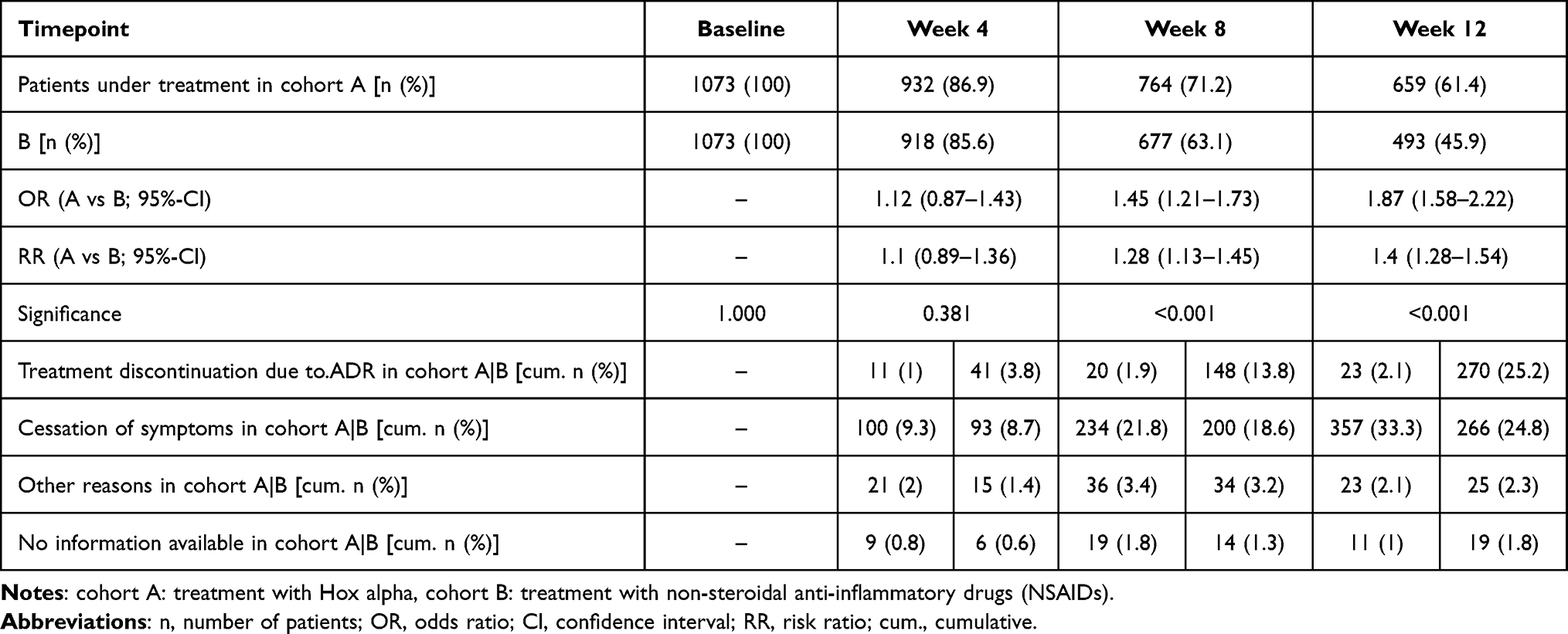 |
Table 5 Treatment Maintenance and Discontinuation Rates |
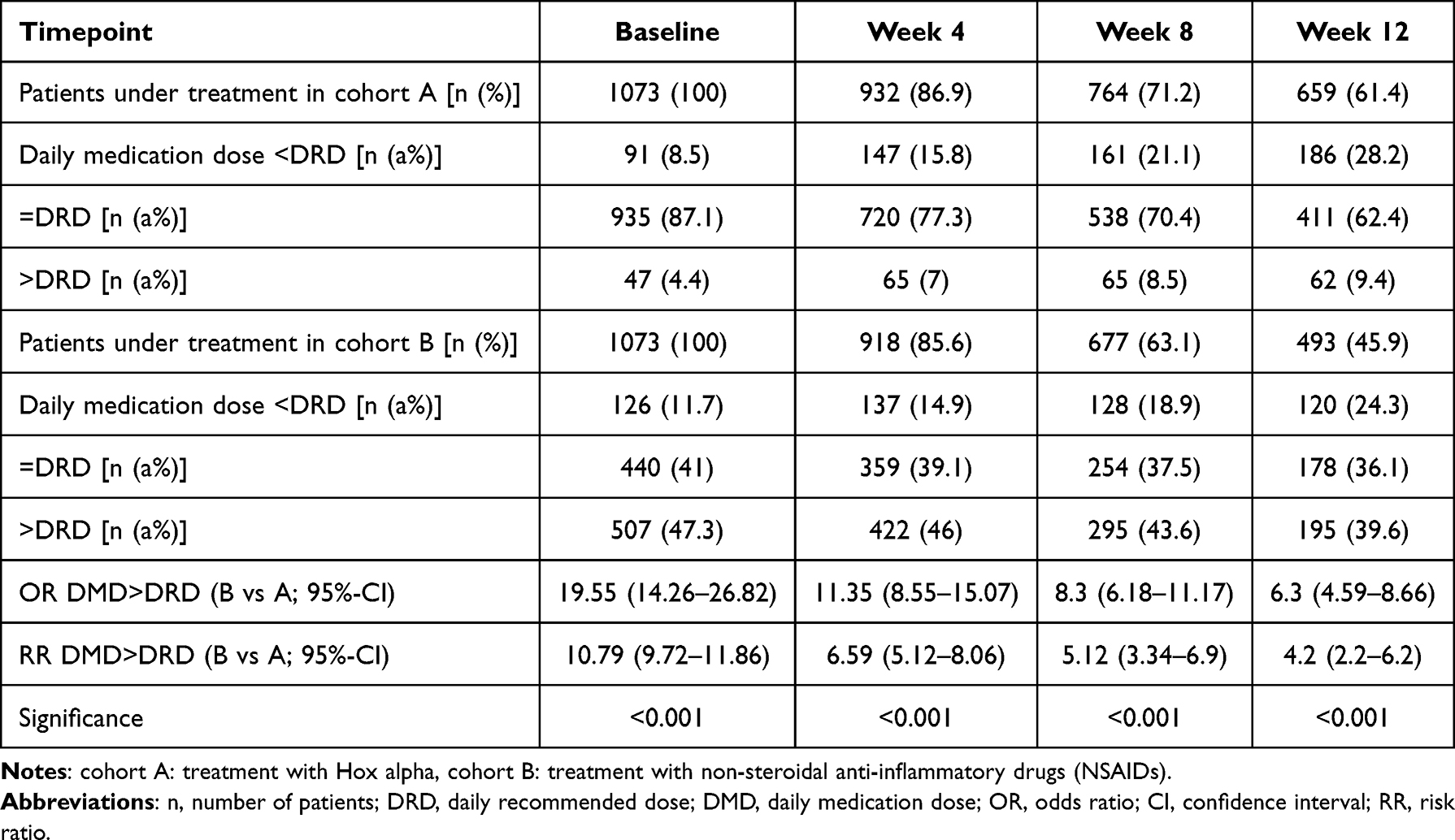 |
Table 6 Daily Medication Doses |
 |
Table 7 Safety and Tolerability Data |
 |
Table 8 Treatment Effects on Pain Intensity |
 |
Table 9 Treatment Effects on Pain-Related Disability and Quality-of-Life |
 |
Table 10 Primary Endpoint |
Management of OA is multimodal, combining lifestyle measures, physical therapy, pharmacological treatment, and in selected cases intra-articular injections or surgery.4,5 Guidelines recommend the 1st-line use of non-steroidal anti-inflammatory drugs (NSAIDs), a chemically heterogeneous group of active substances that inhibit the production of prostaglandins (PG) by blocking cyclooxygenases (COX) isoenzymes 1 and 2.3–7
In daily practice, the choice of which NSAID is ultimately used is influenced by distinct properties of the different molecules as well as by the patients’ comorbidities and concomitant therapies. This individual risk/benefit decision is clinically important, as COX inhibition by NSAIDs is frequently associated with (potentially serious) adverse drug reactions (ADRs) due to the diverse physiological functions of both isoenzymes. Although the most common adverse reactions to NSAIDs statistically affect the gastrointestinal tract, heart/circulation, and renal function, the spectrum of ADRs relevant in individual cases is much broader. According to a recent long-term pharmacovigilance study, NSAIDs are responsible not only for 8.4% of all visits to emergency departments (ED), but also for 24.4% of those ED-visits resulting in hospitalizations.8 Long-term NSAID use has been associated not only with ADRs, but also with accelerated structural OA progression, possibly due to altered subchondral bone remodeling and cartilage metabolism, with a meta-analysis suggesting that long-term NSAID use nearly doubles the risk of radiographic progression.9,10
Particularly worrying in this context is not only the increasing quantity of over-the-counter NSAIDs being taken, but also the fact that they are often taken inappropriately (long-term and excessively), as the use of OTC NSAIDs – frequently taken without knowledge of physicians – carries the same risks for ADRs as those prescribed.11–13 Thus, the widespread unsupervised use of OTC NSAIDs may exacerbate both safety concerns and potential disease progression.
From a pathophysiological point of view is OA a biomechanical and inflammatory disease that is significantly influenced by various factors such as mechanical and oxidative stress, injuries, age, obesity, and metabolic diseases.14 Structurally, OA is characterized by joint cartilage degeneration, changes in the underlying bone, and synovitis.15 Inflammatory and catabolic mediators are localized in the synovial fluid, and hydrolytic enzymes such as matrix metalloproteinases (MMPs) are associated with cartilage degeneration. The degradation of the extracellular matrix can trigger the accumulation of cells of the innate immune system, leading to inflammation and tissue destruction.16 It has also been found that signaling pathways and reactions, such as the involvement of nuclear factor κB (NF-κB) and mitogen-activated protein kinase (MAPK), TNF-α, IL-1β, and IL-2 play a decisive role in the development and progression of OA.14,17
Taking these complex processes into account, the monomodal use of NSAIDs inhibiting prostaglandin synthesis appears to be at least open to discussion, especially in view of their confirmed safety risks and their potentially harmful effects on OA progression. In search of alternative anti-inflammatory treatment options, phytotherapeutics are increasingly attracting the interest of both scientists and those affected by OA who are looking for more efficacious natural remedies, not only to alleviate the acute inflammatory reactions, pain, and functional limitations associated with OA, but also for their potential long-term effects in slowing progression.
Among the numerous phytotherapeutic options, the stinging nettle (Urtica dioica L.) became particularly important due to recent findings on its prostaglandin-independent anti-inflammatory mechanisms. Urtica has been used as a wild vegetable for centuries.18,19 It is a perennial herbaceous plant with stinging leaves that belongs to the nettle family (Urticaceae). Although the stinging nettle can be found almost everywhere, it is most common in Europe, North America, North Africa, and parts of Asia. Due to its healing properties, stinging nettle has been used as a natural remedy for over 2000 years. However, its medicinal potential was only fully recognized at the turn of the century, beginning with the identification of the chemical structure and pharmacological properties of its most important chemically active compounds.20–22 The chemicals discovered in this plant include lignan, secolignan, norlignan, alkaloid, sesquiterpenoid, flavonoid, triterpenoid, sphingolipid, oxylipin, and sterol.23,24 Its properties include antiproliferative, anti-inflammatory, antioxidant, analgesic, immunostimulant, antiseptic, hypotensive, antiulcer, and beneficial cardiovascular effects.20
At the end of the 20th century, Riehemann and coworkers reported the results of their investigations on the anti-inflammatory properties of a 2-propanolic nettle leaf extract and its inhibitory effect on the activation of NF-κB.25 After intensive research, 13-hydroxyoctadecatrienoic acid (13-HOTrE) was identified as the component responsible for these effects.26 13-HOTrE, a hydroxy fatty acid, which is derived from linolenic acid (a polyunsaturated fatty acid) belongs to the oxylipins, a group of biologically active lipid metabolites. Structurally, it is a hydroxy fatty acid with a hydroxyl group (-OH) at position 13 of the fatty acid chain and three double bonds (trienoic acid). 13-HOTrE is formed by enzymatic reactions, in particular by lipoxygenases (LOX), from linolenic acid. Biologically, the oxylipin 13-HOTrE has various functions in plant physiology as a signaling molecule involved in stress responses such as wound healing and defense reactions against pathogens and in signal transduction (as it is involved in the synthesis of jasmonates, a class of plant hormones that regulate the immune response and plant growth).27
The role of 13-HOTrE in inhibiting inflammation in humans, particularly in the context of OA, is an active area of research. There is evidence that oxylipins such as 13-HOTrE, have inflammation-modulating properties. Whether 13-HOTrE can directly inhibit inflammation in OA depends on various factors, such as the specific signal transduction pathways in which it is involved and the cell type on which it acts.28,29
The immunomodulatory anti-inflammatory mechanisms of 13-HOTrE are of particular interest for human medicine in general and OA treatment in particular as there is evidence that 13-HOTrE inhibits not only the production of pro-inflammatory cytokines (such as TNF-α, IL-1β, IL-2, and IL-6, but also suppresses inflammatory processes in cartilage (chondrocytes) and synovial cells, modulates signaling pathways (such as the NF-κB or MAPK pathway), reduces oxidative stress, suppresses catabolic changes in the cartilage due to matrix metalloproteinases, and promotes the restitution (resolution) processes after inflammation.27
The laboratory studies currently available suggest that 13-HOTrE – unlike the biologicals etanercept and infliximab, approved as finished medicinal products for the treatment of rheumatoid arthritis – prevents the release of the transcription factor NF-κB from its binding to its inactivator IxB by inhibiting the enzyme IxB kinase (IKK), thereby modulating its production to maintain a physiologically reasonable level (rather than completely suppressing it).
Although the research on the specific mechanisms of action of 13-HOTre is quite comprehensive, its clinical effects have only been evaluated to a limited extent so far. In 2001, Wolf et al reported on the clinical effects of a finished medicinal product in the form of a 2-propanolic nettle leaf extract with the active ingredient 13-HOTrE in 20 patients with active gon- and coxarthrosis over a period of 12 weeks.30 Under a treatment regimen of 2–3 times 145 mg 13-HOTrE per day, pain intensity decreased by an average of 42% vs baseline (p<0.05) within the observation period. No ADRs were observed, and eight out of ten physicians rated tolerability as good or very good. In addition, accompanying laboratory tests during the first four weeks of treatment showed a 24.8% decrease in TNF-a concentration and a 57.8% decrease in IL-1ß secretion.30
Based on currently available data, 13-HOTrE appears to have a potentially therapeutic role in inhibiting inflammation associated with activated OA, but this has not yet been conclusively confirmed. Further studies, particularly prospective randomized placebo- and active controlled clinical trials, are necessary to clarify whether and to what extent 13-HOTrE can be used to treat inflammatory joint pain in OA and what effects can be observed in daily practice, especially in comparison to NSAIDs. Since such studies are unlikely to be carried out in the foreseeable future due to the considerable financial resources required, the executive board of the German Pain League – Europe’s largest umbrella organization for people with chronic pain – recommended a retrospective real-world evidence study of routine data from clinical care to gain further insights into the comparative efficiency of 13-HOTrE vs OTC NSAIDs.
This study aimed to evaluate real-world clinical practice data in order to assess the 12-week safety, tolerability, and effectiveness, of a finished phytotherapeutic product (FPP) containing 13-HOTrE compared to NSAIDs as OTC self-medication in primary care patients with OA.
Materials and Methods
Study Design and Data Source
SIPHARO (registration number: EUPAS1000000564) is a retrospective, exploratory dual cohort study using depersonalized 12-week real-world data from the German Pain e-Registry (GPeR), a national web-based pain treatment registry developed by the private Institute for Neurological Sciences (IFNAP) on behalf of the German pain Association and hosted by the O.Meany-MDPM GmbH on behalf of the German Pain League. The GPeR facilitates the exchange of information between patients and healthcare providers (HCPs) about individual pain treatments using scientifically validated parameters recommended by the German Pain Association, the German Pain Society, and the German Pain League (in accordance with the legal requirements of the Quality Assurance Agreement for Special Pain Therapy pursuant to § 135 Social Code Book V [SGB V]). The data is primarily provided by patients and checked by their HCPs for plausibility and missing information. For the evaluated period of time (January 1st, 2015 until April 30, 2024), the GPeR dataset comprised information on a total of 384,927 treatment cases, of whom more than 60.000 participated without mediation through a physician or pain-specialist (see Figure 1).
 |
Figure 1 Diagram of patient data selection and flow. Abbreviations: GPeR, German Pain e-Registry; OTC, over the counter; NSAIDs, nonsteroidal anti-inflammatory drugs; NNWOR, nearest neighbor without replacement; BMI, body mass index; OA, osteoarthritis; ADR, adverse drug reaction; GI, gastro-intestinal. |
OTC-Treatments Under Evaluation
In many Western countries, the economic and health-related importance of OTC medicines have grown significantly over the past two decades.31–35 In principle, OTC medications offer several advantages both for the individual as well as society. For individual patients, OTC drugs strengthen empowerment, awareness, personal responsibility, and autonomy, offering a high degree of independence.31,35 In addition, simplified supply chains and cost coverage by patients themselves, results in cost and time savings for the healthcare system.33,36,37
Nevertheless, OTC medications can lead to serious problems under conditions of excessive self-medication, especially when different preparations are combined and interactions occur or when preparations such as NSAIDs are used, which are known to interfere with a broad spectrum of physiological functions.38–40 These risks are particularly high in multimorbid patients who are already taking medication,33 however, may also be relevant in younger or healthier patients. Careless use of OTC preparations can also lead to excessive dosing and associated negative effects, and the classification as non-prescription may lead some patients to mistakenly assume that these medications are less effective and therefore not harmful even if the recommendations in the package insert are ignored and the specified daily doses are exceeded.36,41
After cold and flu medicines, basic painkillers were the second largest OTC category in German pharmacies in 2015 and generated revenues of approximately € 655 million.33 Among those non-opioid OTC analgesics, NSAIDs such as ibuprofen (up to 400 mg per tablet), naproxen (220–250 mg per tablet), diclofenac (12.5 mg per tablet), acetylsalicylic acid (up to 1000 mg per tablet) and phenazone (500 mg per tablet), each available OTC in small quantities represent the largest subgroup responsible for approximately 80% of all OTC sales in German pharmacies. The main indications for these OTC NSAIDs are acute or recurrent headaches and joint pain, whereby the duration of treatment, particularly in the latter case, deviates increasingly from the usual guideline recommendations (as low as possible and as short as necessary) with increasing joint damage.
Hox Alpha
The data for treatment cohort A were derived from information provided by patients who treated their OA with Hox alpha (HOXA), a finished phytotherapeutic product (FPP) available OTC in pharmacies in Germany and numerous other European countries.
HOXA is a nettle leaf extract [19–23:1; extraction solvent 2-propanol 95% (v/v) 145 mg/hard capsule] with which 13-HOTrE can be taken in concentrated form. HOXA is approved as an OTC medicine for patients aged 12 years and older (approval was extended in June 2003) and is available exclusively in pharmacies for the supportive treatment of rheumatic complaints and, accordingly, for the relief of muscle and joint pain.
The recommended daily dose of HOXA is 3×1 capsule after meals. The duration of use is not limited and should depend on the type, severity, and course of the disease. Prescribing/usage occurred as “no-label” OTC self-medication without external guidance beyond the package leaflet (ie, physicians were neither involved in prescribing or recommending this product for its specific use, nor in documenting the effects observed during its use via the GPeR).
The preparation is well tolerated. The product monograph and the instructions for use contain only information on occasional (ie, in less than 1 in 100 but more than 1 in 1000 patients) hypersensitivity reactions of the skin, gastrointestinal complaints, and urinary urgency. Very rarely (ie, in less than 1 in 10,000 patients), blood sugar levels have been reported to rise in patients with diabetes mellitus while taking medicines containing preparations of nettle leaves or herbs.
NSAIDs
All data sets of patients within the German Pain e-Registry which contained information on the use of OTC NSAIDs, and which fulfilled the in- and exclusion criteria of this analysis formed cohort B (NSAIDs) and were considered and assessed together in terms of safety, tolerability, and efficacy, regardless of the respective ingredient.
Population and Data Selection
No formal calculation of the sample size was performed for this analysis.
The statistical analysis of SIPHARO was based on depersonalized routine data from the GPeR on patients who reported an OA treatment with either OTC NSAIDs or HOXA for the first time between January 1, 2015, and March 31, 2024, and who monitored their response to this treatment using those validated self-reporting instruments recommended and validated by the German Pain Association and the German Pain League for standardized documentation within the framework of the quality agreement on special pain therapy pursuant to Section 135 (2) SGB V over a period of at least 12 weeks.
The evaluation was conducted retrospectively, using only information available on the cut-off date (plus a three-month follow-up period) and after complete anonymization of all data relating to patients, institutions, and treating physicians. Furthermore, the results of the evaluations were provided exclusively in the form of aggregated tables that do not allow any conclusions to be drawn about the response of individual patients. Under no circumstances were individualized data transferred!
Both practitioners and patients agreed in writing (using a double opt-in procedure) to the anonymized use of their treatment data for healthcare research purposes within the scope of the online platform iDocLive. Both the selection of analgesic treatment and the determination of documentation tools and timing were based exclusively on medical requirements and the individual needs of patients without any external specifications or influences.
Inclusion criteria for consideration of a depersonalized data set in this study were: a) age ≥18 years, b) diagnosis of osteoarthritis, c) documentation of the use of HOXA or OTC-NSAIDs for the relief of OA-related pain, d) complete documentation of all parameters required for evaluation in this study at baseline, and e) active use of the German Pain e-Registry for at least 12 weeks after the first dose of the index medication (regardless of the specific duration of drug therapy). Exclusion criteria applied to data sets from patients with a) a current diagnosis of cancer, b) another active pain condition, and/or c) use of other pain medications.
The results were evaluated using standardized patient questionnaires at the start of the study (before the first use of the index therapy) and at intervals of 4 (±1) weeks to assess the response to treatment.
Evaluated Parameters
The following results were analyzed using standardized, scientifically validated self-report questionnaires (known as “patient-reported measures” or PRMs) to accurately reflect patients’ assessments of their treatment. All parameters selected and evaluated for the purposes of this study are part of the German Pain Questionnaire and the German Pain Diary and are routinely used in Germany to document pain management measures based on the recommendations of national German pain associations and patient organizations.
For methodological reasons, only part of the data available in the GPeR was used for the actual analysis: a) lowest pain intensity (LPI), average pain intensity (API), and highest 24-hr. pain intensity (HPI; each reported via a 100 mm visual analog scale [VAS, 0–100 mm]); b) the modified Pain Disability Index (mPDI) as a parameter for documenting pain-related impairment of activities of daily living (mm VAS 0–100 mm); c) physical and d) mental quality-of-life via the physical and the mental components scores of the Veterans-Rand 12-Item Health Survey (VR12-PCS/MCS); e) dosing; f) spectrum and frequency of adverse drug reactions (ADRs, including ADR-related discontinuations of treatment); g) duration of treatment; h) use of gastroprotective agents. In addition, key demographic parameters and baseline findings (such as age, gender, duration of illness, pain location, concomitant analgesic/anti-inflammatory medication, comorbidities, and concomitant non-analgesic medication) were included in the analysis and used for biometric harmonization of baseline findings between the two evaluation groups (via propensity score-based matching) to reduce confounding bias.
Cohort Matching
For each data set fulfilling the in- and exclusion criteria, a propensity score (ie, the probability of receiving a particular treatment) was calculated using a logistic regression approach based on the following covariates: age, gender, BMI, duration of illness, pain location, concomitant comorbidities, and concomitant non-analgesic medication. Data sets in both treatment groups were matched based on similar propensity scores (using nearest neighbor’s techniques without replacement, caliper 0.15) to balance the demographic and baseline covariates between cohorts, reduce selection bias, and improve causal inference in non-randomized studies. Patients for whom matching was not possible were excluded from further analysis. Following the PSM procedure, an analysis of the distribution of covariates was performed to confirm the comparability of the selected patient cohorts after PSM.
Handling of Missing Data
Missing values were checked for specific patterns and possible correlations with other parameters. Data missing during the evaluation period (ie, after baseline) was replaced in accordance with the recommendations of the European Medicines Agency using the conservative “last observation carried forward” (LOCF) method. All evaluations were performed for the complete (LOCF-imputed) data set.
Statistical Analysis
The complete set of anonymized data from the GPeR was analyzed for eligible patients who documented at least one dose of the index medication and had ≥12 weeks of follow-up data (regardless of the actual duration of treatment). The study was based on the concept of an observed case analysis with imputation of missing data as described above. Descriptive and inferential statistical methods summarized continuous variables using mean, standard deviation (SD), median, and range, and categorical variables using frequency and (adjusted) percentages.
For most analyses, a stratified analysis was performed according to the respective treatment approach (cohort A vs B). For comparative analyses within (eg, compared to baseline) and between the two treatment groups, Student’s T-tests were used for ordinal scaled data (eg, rankings or numerical values), as these data distributions were approximately normal and the sample size was sufficiently large (n=2146). Chi-square tests were used for categorical variables. Odds ratios, relative risks, number needed to treat/harm, Cohen’s d, and correlation coefficient Phi were calculated as effect size (ES) estimates where appropriate. Statistical tests were performed against baseline with a two-sided significance level of 0.05. Due to the exploratory nature of this study, a Bonferroni correction for multiplicity was only performed for the primary endpoint analysis; all other tests were performed without corresponding adjustments. All analyses were considered exploratory; effect size estimates are reported to support clinical interpretation.
All descriptive and efficacy analyses were performed using PASW Statistics (version 18.0). ADRs were coded using MedDRA (version 27.0 2024AA). If multiple diagnoses/symptoms were reported, the corresponding ADRs were split before coding and ADR frequencies were evaluated both on a patient- and event-based level.
Tables and graphs were rendered using Microsoft Excel® for Microsoft 365 MSO (Version 2504 Build 16.0.18730.20122).
Study Endpoints
Primary Endpoint
The primary objective of this study was to evaluate the safety, tolerability, and efficacy of self-medication with either OTC NSAIDs or HOXA by patients with acute OA exacerbation.
The primary composite endpoint was defined as the proportion of patients without ADR-related discontinuation AND with a clinically relevant improvement in API (≥20 mm VAS vs baseline). Comparative analyses were exploratory and effect sizes (OR, RR, Phi coefficient) were reported alongside p-values.
Secondary Efficacy Endpoints
Secondary efficacy analyses were performed regarding absolute/relative changes vs baseline findings at the end of week 4, week 8, and week 12 for lowest (LPI), average (API), and highest (HPI) 24-hr pain intensities, pain-related disabilities in daily life (mPDI, as well as physical and mental QoL (VR12-PCS and MCS).
Safety and Tolerability Endpoints
Safety analyses were based on the number and type of ADRs reported, number of patients affected by ADRs, number of patients with ADR-related treatment discontinuations, dosing, and treatment duration as well as the reported use of gastroprotective agents (as indicator for treatment-related ADRs in the GI tract). Due to the heterogeneous active ingredients in cohort B and their different dosage recommendations, dose-related analyses in both cohorts were performed with reference to the daily medication dose (DMD) for the treatment of OA in adults according to the daily recommended doses (DRD) given in the product information.
Ethics
This non-interventional study was conducted in accordance with the Declaration of Helsinki and relevant national and regulatory requirements. Since this retrospective study referred to completely (ie, regarding both patients and physicians or treatment facilities) depersonalized data from routine care, no approval from an ethics committee was required. The study concept and the evaluation of anonymized data of the GPeR were reviewed and approved by the steering committees of the German Pain Association and the German Pain League, with the latter paying particular attention to ensuring that patient rights are upheld within the framework of this study. All participants (physicians and patients) provided their written informed consent prior to participation in the GPeR, authorizing the use of their anonymized data for health-care research purposes. The study concept has been registered in the European Medicines Agency (EMA) registry for non-interventional/epidemiological studies (EUPAS identifier: 1000000564) to make this evaluation public.
Reporting
Reporting of this study followed the STROBE recommendation (Strengthening the Reporting of Observational Studies in Epidemiology), to ensure clarity, transparency, and reproducibility and support readers to evaluate the validity of our study.42
Availability of Data, Resources, and Reporting Procedures
The data supporting the study results were extracted from the GPeR. The availability of these data, which were used under license for the current study and are not publicly available, is subject to restrictions. The data are available on reasonable request to the first author.
This study is registered in the European Register of Studies following approval by the European Network of Centers for Pharmacoepidemiology and Pharmacovigilance in the European Union (EUPAS identifier: 1000000564). In accordance with German data protection guidelines and the European Union’s General Data Protection Regulation, only anonymized data was extracted from the GPeR for those biometric analyses specific in the statistical analysis plan and deleted after the analysis was completed. Only depersonalized and aggregated data was made available to the study sponsor, which ensured that no reference to individual health data was possible.
Results
Data Selection
Based on the in- and exclusion criteria and the GPeR population on the reference date (April 30, 2024), 14.866 data sets were identified in which patients treated their OA pain with OTC products without a prescription (Figure 1). Of those 1378 reported the use of HOXA, 5548 those of NSAIDs and 7940 those of other OTC analgesics. Monotherapy with either HOXA vs NSAIDs was reported by 1341 vs 5023 patients and evaluable information at baseline and for at least three months thereafter using the GPeR documentation standards (enabling an assessment of safety/tolerability and efficacy of their OTC treatment according to this study concept), were available for 1267 patients with HOXA and 4663 with NSAIDs.
As a result of the propensity score matching process, the data of 1073 patients each were ultimately selected for this analysis and formed study cohorts A (HOXA) and B (NSAIDs).
Patient Demographics and Non-Pain Baseline Characteristics
An overview of demographic characteristics, comorbidities, and non-pain-related concomitant therapies is provided in Tables 1–3. Baseline demographic and clinical characteristics were comparable between cohorts. The average age in both cohorts was 68.2±11.1 years (mean SD); 70.6% of patients were 65 years or older at the start of treatment, and 16.3% were over 80 years old (Table 1). Of all patients, 58.8% were women. Two-thirds of patients (68.8%) reported a BMI >25 kg/m2, and 10.6% were classified as obese (grade II or III).
Almost half of the patients (49.6%) reported OA in one joint, 35.7% in two joints, and 14.7% in three or more joints as the diagnosis that justified OTC treatment. The joint most commonly affected by OA in this study was the knee (77.2%), followed by the hand (40.7%), hip (36.7%), and others (11.6%). The average duration of OA was 17.7 years; 29.5% of patients reported a duration of at least 30 years.
Non-pain-related comorbidities were reported by 97.1/96.4% of patients in cohorts A/B and were common, with an average of 2.9±1.4/1.5 per patient (see Table 2). 57.8/56.5% of patients in cohorts A/B documented at least three different non-pain-related comorbidities, with the most frequently reported diseases or health areas corresponding to ICD-10 classes IX (circulatory system: 47.6/49.7%), IV (endocrine/metabolic diseases: 46.4/44.5%), X (respiratory system: 30.0/29.5%), XII (skin: 27.7/28.1%) and XI (digestive system: 24.5/25.5%). With 578 and 589 patients (53.9/54.9%) in cohorts A and B, respectively, more than half of the members of both cohorts reported at least one clinically relevant comorbidity that increases the risk of NSAID-related ADRs. One-sixth of all patients (16.8/17.1%) documented clinically relevant cardiovascular and renal risk factors.
The use of non-pain-related medication was reported by 76.7% and 76.0% of patients in cohort’s A/B, most frequently within ATC categories A (alimentary tract and metabolism: 31.1/30.5%), C (cardiovascular system: 23.8/23.8%) and R (respiratory system: 13.9/15.1%; see Table 3). Overall, three out of ten patients in both cohorts (30.2/29.8%) reported the use of drugs known to either increase the risk of NSAID-related ADRs or exacerbate their course.
Baseline Pain and Pain-Related Parameters
Table 4 provides an overview of the relevant baseline findings for patients in both cohorts prior to onset of therapy. Although these parameters were not part of the cohort matching, the PSM procedure resulted in comparable baseline values in terms of cohort means and standard deviations, as well as frequencies of patients with clinically relevant abnormalities with regard to the evaluated parameters.
The average 24-hour pain intensity (API) relevant for the calculation of the primary efficacy endpoint was 54.4±14.5 and 54.6±14.4 mm VAS at baseline, and six out of ten patients (60.0/60.1%) documented daily API values above 50 mm VAS.
At the same time, the pain-related disability in daily life was also considerable. On average, patients in cohort’s A/B reported mPDI values of 57.2±11.8/11.7 mm VAS, and seven out of ten patients (70.7/70.5%) scored above 50 mm VAS (considered indicative of severe impairments in daily life).
Looking at the consequences of OA on quality of life, the main impact for those affected resulted in physical limitations: not only were the VR12 values for the physical component score (PCS) with 30.7 and 30.8 significantly lower than those for the mental component score (MCS) with 48.8 and 48.9, respectively, but also the proportion of patients with scores of 40 or less, which were 84.9/84.7% for the PCS vs 22.8/22.4% for the MCS.
Treatment
Details on the course of treatment and the intake of the evaluated drugs can be found in Tables 5 and 6. While the number of patients in cohort A/B who reported treatment at the respective evaluation time point after four weeks was still comparable at 86.9/85.6% (p=0.381), it was significantly higher under HOXA after 8 and 12 weeks (71.2% and 61.4%) compared to NSAIDs (63.1% and 45.9%; p<0.001 for both timepoints). Main reasons for this were the significantly lower cumulative ADR discontinuation rates in cohort A vs B, which were 1.0 vs 3.8% at week four, 1.9 vs 13.9% at week eight, and 2.1 vs 25.2% at week twelve (p<0.001 for each time point).
While all patients in cohort A described their experiences with the use of HOXA via the GPeR, patients in cohort B documented the use of various OTC NSAIDs, most commonly ibuprofen (n=600, 55.9%), diclofenac (n=322, 30.0%), acetylsalicylic acid (n=69, 6.4%), naproxen (n=61, 5.7%), and phenazone (n=21, 2.0%). Table 6summarizes key information on daily medication dosing (DMD) with respect to the daily recommended dosages (DRD) in both cohorts, which differed significantly (p<0.001) at all four evaluation time points. A higher proportion of NSAID users reported exceeding the recommended daily dose throughout the observation period, while overdosing was uncommon among HOXA users: at baseline, 4.4% of patients in cohort A vs 47.3% in cohort B reported a daily intake of a higher (than recommended) amount of active substance. Over the following three evaluation time points, this proportion decreased continuously in cohort B (to 46.0%, 43.6%, and 39.6%) but was significantly higher than that in cohort A at all time points, although a slight increase was reported here (to 7.0%, 8.5%, and 9.4%; p<0.001 for all evaluations).
Safety and Tolerability
During the 12-week evaluation period, 141 vs 502 patients in cohort A vs B (13.1 vs 46.8%; p<0.001) documented a total of 152 vs 789 ADRs (see Table 7). As already described, 23 vs 270 patients (2.1 vs 25.2%) discontinued treatment for this reason (p<0.001). While the ADR event rate in patients without or with NSAID-relevant risk factors in cohort A (HOXA) was 13.0 and 13.2% (p=0.943; OR: 1.01; RR: 1.01), patients with NSAID risk factors in cohort B reported significantly more ADRs than those without (54.3% vs 33.4%; p<0.001; OR: 2.70; RR: 1.63).
Most common ADRs in cohort B vs A were abdominal pain (20.8 vs 2.6%), dyspepsia (7.5 vs 1.2%), nausea (6.8 vs 1.5%), diarrhea (6.0 vs 1.5%), increased blood pressure (5.5 vs 0.8%), and loss of appetite (5.0 vs 1.1%; p<0.001 for all). For none of the evaluated ADRs was the occurrence rate with HOXA higher than with NSAIDs.
In line with the previously described ADR frequency and the gastrointestinal-dominant ADR profile of the NSAID-treatments in cohort B, the proportion of patients who reported an add-on therapy with gastroprotective agents increased progressively in cohort B, but not in A (Table 8). While the frequency of use at baseline in cohort A vs B was comparable (11.0 vs 10.7% (p=0.835), the percentage increased to 12.1% vs 21.6% within 4 weeks, to 13.0% vs 29.7% by week 8, and further to 13.0% vs 38.0% by week 12 (p<0.001 for all time points after baseline).
Analgesic Efficacy
As shown in Table 8 and Figure 2, patients in both cohorts documented a significant reduction in all three pain intensities evaluated compared to baseline by week 12. With regard to the average 24-hour pain intensity (API) relevant for the primary endpoint, within-cohort analyses for A/B showed a decrease from 54.5±14.5/54.6±14.4 at baseline to 40.5±14.5/40.6±14.4 at week 12. (API) relevant to the primary endpoint, internal cohort analyses for A/B showed a decrease from 54.5±14.5/54.6±14.4 at baseline to 14.2±5.1/18.2±9.9 mm VAS at week 12 (p<0.001 for both), corresponding to an absolute decrease of −23.7±13.9 / −21.1±13.9 mm VAS and a relative decrease of −40.3±11.5 / −36.4±13.0%. Between-cohort analyses showed a significantly greater reduction in pain in terms of API in cohort A vs B from week 8 onwards (p<0.001; ES: 0.293), which increased further by the end of the 12-week evaluation phase (p<0.001; ES: 0.506). For both the lowest (LPI) as well as the highest (HPI) 24-hr pain intensities, there were even greater differences in favor of cohort A vs B at the end of the evaluation period at week 12, at −10.3% (for LPI; ES: 0.537) and −15.0% (for HPI; ES: 0.870), respectively.
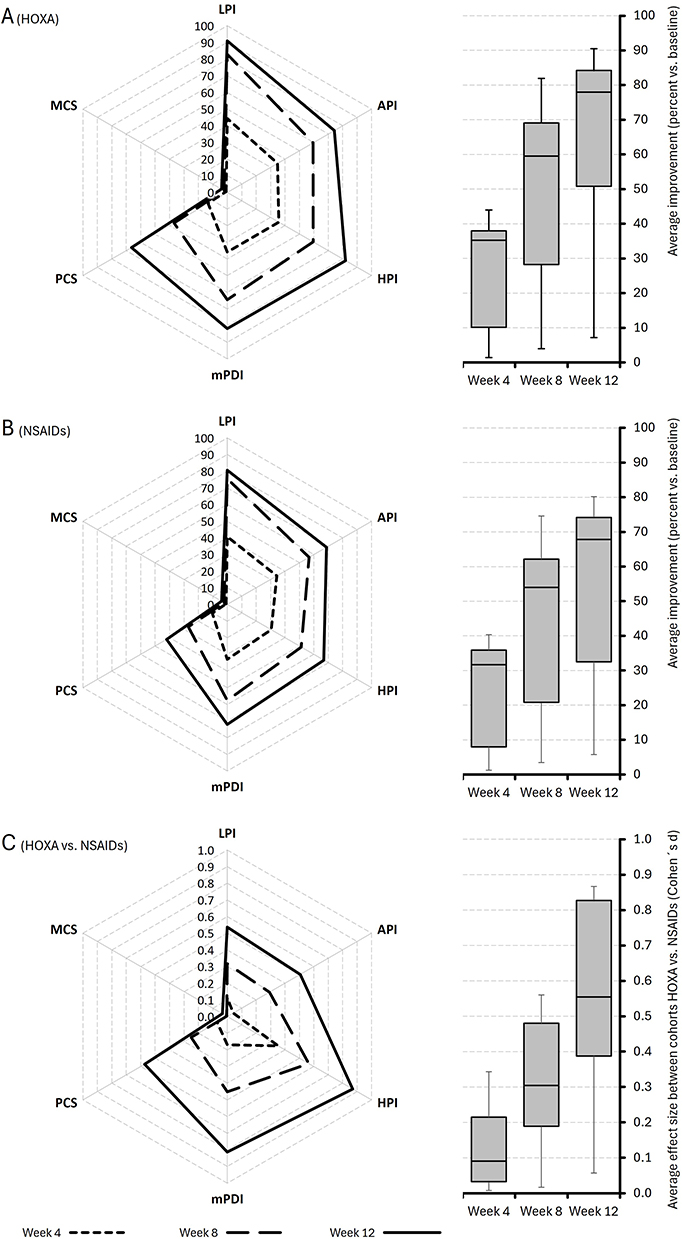 |
Figure 2 Treatment effects. Relative improvements for weeks 4, 8 and 12 vs baseline ((A) HOXA; (B) NSAIDs), and effect sizes (Cohen´s d) for between-cohort comparisons (HOXA vs NSAIDs; (C)). Left side: spider graph with percentage improvements for individual parameters. Right side: box and whisker plot with average improvements. Abbreviations: HOXA, Hox alpha; NSAIDs, with non-steroidal anti-inflammatory drugs; LPI/API/HPI, lowest/average/highest 24-hr pain intensities; mPDI, modified pain disability index; PCS/MCS, physical/mental component scores of the Veterans RAND 12-Item Health Survey. Notes: boxes: 25, 50, and 75 percentiles, whiskers: 15 and 85 percentiles. |
Parallel to the decline in the various pain intensities, patients in both cohorts also reported a significant improvement with regard to the impact of pain on their daily activities and quality of life (see Table 9). Starting from comparable pain-related disabilities in daily life at baseline (57.2±11.8 vs 57.2±11.7 mm VAS), the mPDI scores decreased significantly in both cohorts until the end of the 12-week evaluation period (A to 10.4±2.6 mm VAS, p<0.00 1, ES: 5.485; B to 16.0±9.3 mm VAS, p<0.001, ES: 3.893). Between-cohort analyses revealed for each of the three evaluation time points after baseline significantly better improvements for patients in cohort A vs B (all p<0.001), which resulted in an effect size of 0.813 for those reported at week 12. Corresponding improvements were also demonstrated for the physical and, to a limited extent, the mental subscales of the VR12, although only the effect sizes for the physical aspect of quality of life revealed significant differences between the subgroups (in each case in favor of cohort A).
Primary Study Endpoint
Based on observations for both primary endpoint components (1: no ADR-related discontinuation of treatment; 2: documentation of a clinically relevant reduction in average 24-hour pain intensity), the response rates (95%-CI) for cohort A vs B at the end of the evaluation period were 96.2 (96.1–96.3) vs 73.2 (72.9–73.4) percent (p<0.001; effect size 0.319; OR: 9.23, RR: 7.02; NNT: 4; Table 10).
Discussion
To our knowledge, SIPHARO is the first longitudinal study to evaluate the safety, tolerability, and efficacy of the finished phytotherapeutic product HOXA compared to conventional oral NSAIDs in patients with OA under real-world conditions. As primary endpoints, we chose a composite endpoint, as is routine in daily practice, which combined not only efficacy but also, and above all, safety and tolerability aspects. In addition, we have attempted to minimize the critical influence of the observation bias in non-interventional studies (eg, the Hawthorne effect, etc.) by using depersonalized routine data from standard care. We believe this approach has been successful, as the patient data we used via the GPeR were documented at a time and under circumstances when it was in no way foreseeable that it would later be used (by us) for retrospective longitudinal studies such as SIPHARO. And finally, probably even more important, the propensity score matching method we used enabled us to form treatment groups that were comparable in terms of critical baseline values (thus mimicking at least some characteristics of randomization, which helped us to reduce bias caused by confounding variables).
The results of our study show that self-treatment of OA-related pain with HOXA appears to be superior to conventional NSAIDs, particularly in terms of tolerability, but also in terms of analgesic effect. Compared to those taking NSAIDs, patients who took HOXA reported significantly greater pain relief (in all intensity ranges evaluated by us), a corresponding improvement in pain-related impairments in daily life and physical quality of life, and a significantly more favorable safety and tolerability profile.
We observed that the amounts of active ingredient necessary to achieve these effects (in terms of recommended daily doses) were significantly lower with HOXA than with NSAIDs and that HOXA was safe and well tolerated, as previously reported in earlier publications on its use, while NSAIDs led to significantly more ADRs and ADR-related discontinuations of therapy.
The efficacy of oral NSAIDs in alleviating OA-related inflammatory reactions and improving pain and function has been well established; however, their safety and tolerability — even when using the OTC preparations that are usually limited in terms of active ingredient content per tablet and number of tablets per package — leaves much to be desired and their use is complicated by a prevalent risk of gastrointestinal, cardiovascular, and renal side effects.13–15,34
This is evident as a side effect of our study, particularly in the different ADR event rates in patients with and without typical (clinical and pharmacological) risk factors for NSAID-related adverse reactions. While the ADR rates in cohort A (with HOXA) were comparable (low) to those in patients with or without such risk factors (13.0% and 13.2%, respectively; p=0.943), the ADR rate in cohort B (with NSAIDs) was significantly higher in patients with risk factors (54.3%) than in those without (33.4%; p<0.001). A closer look at the reported ADR events shows that these differences between cohorts were primarily due to the poorer gastrointestinal tolerability of NSAIDs and the significantly higher need for gastroprotective agents.
In direct comparison, our study shows that HOXA was not only significantly better tolerated than OTC NSAIDs but also associated with stronger improvements in pain and function. Whether the special mechanism of action of HOXA also slows or modifies OA progression compared to NSAIDs cannot be assessed based on our data. This would require long-term evaluations and additional clinical trials, which are essential if this alternative therapy is to be included in guidelines. Finally, we were somewhat surprised by the high proportion of OA patients who took NSAIDs despite known clinical or pharmacological risk factors. This observation underlines the importance of targeted education and individual counseling when patients ask for anti-inflammatory OTC therapies.
Limitations
The SIPHARO study complies with the recommendations of both the Osteoarthritis Research Society International (OARSI) and the European Society on Clinical and Economic Aspects of Osteoporosis, Osteoarthritis, and Musculoskeletal Diseases (ESCEO) regarding inclusion/exclusion criteria, endpoints, safety and adverse event reporting, and the evaluation period.5,43
Nevertheless, several limitations must be considered. First, its retrospective, non-interventional design with anonymized routine care data lacks randomization, blinding, and placebo control. Although data sets were carefully selected and harmonized by propensity score matching, PSM excluded more than half of the registry population and cannot address unmeasured confounders. Thus, residual selection bias is possible. In addition, the inclusion criterion of a ≥12 weeks registry activity may have introduced a bias toward patients with higher persistence; however, this was considered in the interpretation of results.
Patients self-selected and purchased OTC medications, so results may be influenced by treatment expectations or recall bias. Treatment was neither standardized nor monitored, and completeness/accuracy of patient-reported information cannot be guaranteed. The follow-up period of three months is relatively long for OTC use, but too short to draw conclusions about long-term effects. OA severity (radiographic staging) was not available, limiting generalizability.
Finally, although several between-group differences reached statistical significance, all analyses were exploratory. Therefore, results should be interpreted cautiously and regarded as hypothesis-generating. However, post-hoc power analyses indicated that the available sample was sufficiently powered to detect even small effects: approximately 13% difference in composite endpoint rates, 8% difference in ADR-related discontinuations, and 3.9 mm difference in pain intensity would have been identified with 80% power at α=0.05.
Conclusions
In summary, this non-interventional, retrospective, 3-month evaluation of depersonalized real-world data from the GPeR suggests that self-treatment with the oral FPP HOXA was associated with fewer ADRs and more favorable multidimensional outcomes than OTC NSAIDs in patients with OA. Given the retrospective and exploratory nature of the study, these findings cannot be considered proof of superior efficacy but provide valuable real-world insights. Larger prospective, randomized, placebo- and active-controlled trials are needed to confirm these observations and to explore potential progression-modifying effects of HOXA.
Acknowledgments
M.A.U, G.H.H.M.-S., P.C.G.M.-S., and M.A.K. are physicians and independent of any significant/relevant financial or other relationship to the sponsor, except for minor reimbursements for occasional lecture or consulting fees. M.A.U is honorary member of the management boards of the German Pain Association and the German Pain League, Director of the private Institute of Neurological Sciences and CEO of the O.Meany – MDPM GmbH, both Nordostpark 51, 90411 Nürnberg, Germany.
The German Pain e-Registry (GPeR) has been developed by the private Institute of Neurological Sciences (IFNAP), Nordostpark 51, 90411 Nürnberg, and is hosted by the O.Meany – Medical Data & Project Management GmbH, Nordostpark 51, 90411 Nürnberg, under control of the IFNAP. GPeR collects standardized real-world data from daily routine medical care since January 2015 via its online application iDocLive®. The O.Meany – MDPM GmbH holds the legal right to use anonymised data from the GPeR for healthcare research purposes, including the study entitled SIPHARO. This right is based on comprehensive contractual agreements, including informed written consent obtained from both participating physicians as well as patients. These agreements authorize the use of depersonalized data (with all identifiable information removed) for research purposes and allow the aggregated results of such studies to be shared with research partners (eg, health insurance providers, scientific institutions, professional associations, and pharmaceutical companies) in tabular or graphical form (free of charge or, if applicable, also against payment).
The SIPHARO study was a retrospective analysis based exclusively on fully anonymised routine care data (with no identifiable information on patients, physicians, or treatment facilities). Therefore, no ethics committee approval was required. The study concept and the use of depersonalized data were reviewed and endorsed by the steering committees of the German Pain Association and the German Pain League, with special attention given to patient rights and data protection. All participating physicians and patients provided written informed consent prior participation in the GPeR, explicitly authorizing the use of their anonymised data for healthcare research, including this study.
Data of this analysis have been presented at the annual Congress of the German Pain Society, October 16–19, 2024, Mannheim, Germany.
Authors´ Contribution
All authors made a significant contribution to the work reported, whether that is in the conception, study design, execution, acquisition of data, analysis and interpretation, or in all these areas; took part in drafting, revising or critically reviewing the article; gave final approval of the version to be published; have agreed on the journal to which the article has been submitted; and agree to be accountable for all aspects of the work.
Funding
This study has been funded by an unrestricted scientific grant from Strathmann GmbH & Co. KG, Langenhorner Chaussee 602, 22419 Hamburg, Germany. Neither Strathmann, nor any of its employees exerted any influence on data acquisition, the conduct of this analysis, or on the interpretation and publication of the results.
Disclosure
M.A.U. received financial support and/or expenses in form of research money, consultancy fees and/or renumerations for lecture activities from: Abbvie, Almirall, Averitas, Avextra, Dermapharm, Forum für Medizinische Fortbildungen – FOMF, Glaxo Smith Kline, Grünenthal, Hexal, Johnson & Johnson, MCM Klosterfrau, Nestle, Stada, Strathmann, Teva, Tilray, Trommsdorf, and Viatris. P.C.G.M.-S. received financial support and/or expenses in form of consultancy fees from: Forum für Medizinische Fortbildungen – FOMF, Grünenthal, Lundbeck, SinCephalea, Stada Pharm, Teva, Vayamed, Vertanical. M.A.K. received financial support and/or expenses in form of consultancy fees from: Hexal, Lilly, Lundbeck, Novartis. The authors report no other conflicts of interest in this work.
References
1. Kloppenburg M, Berenbaum F. Osteoarthritis year in review 2019: epidemiology and therapy. Osteoarthr Cartil. 2020;28:242–24. doi:10.1016/j.joca.2020.01.002
2. Rapporto Osservasalute. Osservatorio sulla Salute. 2019. Available from: https://www.osservatoriosullasalute.it/osservasalute/rapporto-osservasalute-2019.
3. Ariani A, Manara M, Fioravanti A, et al. The Italian Society for Rheumatology clinical practice guidelines for the diagnosis and management of knee, Hip and hand osteoarthritis. Reumatismo. 2019;71(S1):5–21. doi:10.4081/reumatismo.2019.1188
4. Kloppenburg M, Kroon FP, Blanco FJ, et al. 2018 update of the EULAR recommendations for the management of hand osteoarthritis. Ann Rheum Dis. 2019;78(1):16–24. doi:10.1136/annrheumdis-2018-213826
5. Bruyère O, Honvo G, Veronese N, et al. An updated algorithm recommendation for the management of knee osteoarthritis from the European Society for Clinical and Economic Aspects of Osteoporosis, Osteoarthritis and Musculoskeletal Diseases (ESCEO). Semin Arthritis Rheum. 2019;49(3):337–350. doi:10.1016/j.semarthrit.2019.04.008
6. Bannuru RR, Osani MC, Vaysbrot EE, et al. OARSI guidelines for the non-surgical management of knee, Hip, and polyarticular osteoarthritis. Osteoarthritis Cartilage. 2019;27(11):1578–1589. doi:10.1016/j.joca.2019.06.011
7. Kolasinski SL, Neogi T, Hochberg MC, et al. 2019 American College of Rheumatology/Arthritis foundation guideline for the management of osteoarthritis of the hand, hip, and knee. Arthritis Care Res. 2020;72(2):149–162. doi:10.1002/acr.24131
8. Lombardi N, Crescioli G, Bettiol A, et al. MEREAFaPS study group. italian emergency department visits and hospitalizations for outpatients’ adverse drug events: 12-year active pharmacovigilance surveillance (The MEREAFaPS Study). Front Pharmacol. 2020;11:412. doi:10.3389/fphar.2020.00412
9. Simic M, Harmer A, van der Esch M, et al. Do non-steroidal anti-inflammatory drugs cause osteoarthritis progression, a systematic review and meta-analysis. Osteoarthritis Cartilage. 2019;27(Supplement 1):S280–S282. doi:10.1016/j.joca.2019.02.663
10. Salis Z, Sainsbury A. Association of long-term use of non-steroidal anti-inflammatory drugs with knee osteoarthritis: a prospective multi-cohort study over 4-to-5 years. Sci Rep. 2024;14:6593. doi:10.1038/s41598-024-56665-3
11. Wilcox CM, Cryer B, Triadafilopoulos G. Patterns of use and public perception of over-the-counter pain relievers: focus on nonsteroidal antiinflammatory drugs. J Rheumatol. 2005;32:2218–2224.
12. Ussai S, Miceli L, Pisa FE, et al. Impact of potential inappropriate NSAIDs use in chronic pain. Drug Des Devel Ther. 2015;9:2073–2077. doi:10.2147/DDDT.S80686
13. Doomra R, Goyal A. NSAIDs and self-medication: a serious concern. J Family Med Prim Care. 2020;9(5):2183–2185. doi:10.4103/jfmpc.jfmpc_201_20
14. Mobasheri A, Batt M. An update on the pathophysiology of osteoarthritis. Ann Phys Rehabil Med. 2016;59:333–339. doi:10.1016/j.rehab.2016.07.004
15. Tong L, Yu H, Huang X, et al. Current understanding of osteoarthritis pathogenesis and relevant new approaches. Bone Res. 2022;10:60. doi:10.1038/s41413-022-00226-9
16. Mora JC, Przkora R, Cruz-Almeida Y. Knee osteoarthritis: pathophysiology and current treatment modalities. Pain Res. 2018;11:2189–2196. doi:10.2147/JPR.S154002
17. Choi MC, Jo J, Park J, Kang HK, Park Y. NF-κB signaling pathways in osteoarthritic cartilage destruction. Cells. 2019;8(7):734. doi:10.3390/cells8070734
18. Di Tizio A, Łj Ł, Quave CL, Redzic S, Pieroni A. Traditional food and herbal uses of wild plants in the ancient South-Slavic diaspora of Mundimitar/ Montemitro (Southern Italy). J Ethnobiol Ethnomed. 2012;8(1):1–10. doi:10.1186/1746-4269-8-21
19. Uprety Y, Poudel RC, Shrestha KK, et al. Diversity of use and local knowledge of wild edible plant re-sources in Nepal. J Ethnobiol Ethnomed. 2012;8(1):1–15. doi:10.1186/1746-4269-8-16
20. Said AAH, Otmani ISE, Derfoufi S, Benmoussa A. Highlights on nutritional and therapeutic value of stinging nettle (Urtica dioica L.). Int J Pharm Pharmaceut Sci. 2015;7(10):8–14.
21. Pant V. Himalayan stinging nettle: rich source of protein and minerals. J Ethno-biol Trad Med Photon. 2019;130:1487–1509.
22. Singh M, Kali G. Study on morpho-anatomical and histochemical characterization of stinging nettle, Urtica dioica L. in Uttarakhand, India. J Pharmacogn Phytochem. 2019;8(3):4325–4331.
23. Abdeltawab AA, Ullah Z, Al-Othman AM, et al. Evaluation of the chemical composition and element analysis of Urtica dioica. Afr J Pharmacy Pharmacol. 2012;6(21):1555–1558.
24. Wang J, Pantopoulos K. Regulation of cellular iron metabolism. Biochem J. 2011;434(3):365–381. doi:10.1042/BJ20101825
25. Riehemann K, Behnke B, Schulze-Osthoff K. Plant extracts from stinging nettle (Urtica dioica), an antirheumatic remedy, inhibiting the proinflammatory transcription factor NF-kappaB. FEBS Lett. 1999;442(1):89–94. doi:10.1016/S0014-5793(98)01622-6
26. Friebe H. Brennnessel-Extrakt Hox alpha bei Arthrose – das Antizytokin als Evidence based Medicine? Orthopädische Praxis. 2001;37(7):481–483.
27. Schulze-Tanzil G, de SP, Behnke B, Klingelhoefer S, Scheid A, Shakibaei M. Effects of the antirheumatic remedy hox alpha--a new stinging nettle leaf extract--on matrix metalloproteinases in human chondrocytes in vitro. Histol Histopathol. 2002;17(2):477–485. doi:10.14670/HH-17.477
28. Obertreis B, Ruttkowski T, Teucher T, Behnke B, Schmitz H. Ex vivo in vitro inhibition of lipopolysaccharide stimulated tumor necrosis factor-a and interleukin-1ß secretion in human whole blood by extractum Urticae dioicae foliorum. Arzneimittelforschung. 1996;46:389–394.
29. Klingelhoefer S, Obertreis B, Quast S, Behnke B. Antirheumatic effect of IDS 23, a stinging nettle leaf extract, on in-vitro expression of T helper cytokines. J Rheumatol. 1999;26:2517–2522.
30. Wolf F, Gulbin K, Mielke F. Aktivierte Arthrose – brennnesselblätter-Extrakt mit Leitsubstanz HOTrE (STRAT 5) hemmt Tumor-Nekrose-Faktor. Der Kassenarzt. 2001;16:42–47.
31. Barrenberg E, Knopf H, Garbe E. Over-the counter drug consumption among adults living in Germany: results from the German Health Interview and Examination Survey for Adults 2008–2011. Pharmacy. 2018;6(2):52. doi:10.3390/pharmacy6020052
32. Cybulski M, Cybulski L, Krajewska-Kulak E, Orzechowska M, Cwalina U. Preferences and attitudes of older adults of Bialystok, Poland toward the use of over-the-counter drugs. Clin Interv Aging. 2018;13:623–632. doi:10.2147/CIA.S158501
33. Eichenberg C, Auersperg F, Rusch BD, Brähler E. Selbstmedikation: eine bundes-deutsche Repräsentativbefragung zu Motiven, Anlässen und Informationsquel-len für den Konsum rezeptfreier Medikamente [Self-Medication: a Nationwide Representative Survey on Motives, Reasons and Sources on Consuming Over-the-Counter Medication. Psychother Psychosom Med Psychol. 2015;65(8):304–310. [German]. doi:10.1055/s-0035-1545311
34. Goetz K, Kalder M, Albert US, Jacke CO. The usage of over-the-counter products by private insured patients in Germany - a claims data analysis with focus on complementary medicine. BMC Health Serv Res. 2020;20(1):651. doi:10.1186/s12913-020-05501-1
35. Sánchez-Sánchez E, Fernández-Cerezo FL, Díaz-Jimenez J, et al. Consumption of over-the-Counter Drugs: prevalence and Type of Drugs. Int J Environ Res Public Health. 2021;11:5530. doi:10.3390/ijerph18115530
36. Eichenberg C, Self-Medication HL. Health and online orders: an online survey. Gesundheitswesen. 2017;79(2):80–85. doi:10.1055/s-0035-1549970
37. Knopf H. Medicine use in children and adolescents. Data collection and first results of the German Health Interview and Examination Survey for Children and Adolescents (KiGGS). Bundesgesundheitsblatt Gesundheitsforschung Gesundheitsschutz. 2007;50(5–6):863–870. doi:10.1007/s00103-007-0249-z
38. Bertsche T, Alexa JM, Eickhoff C, Schulz M. Self-care and self-medication as central components of healthcare in Germany - on the way to evidence-based pharmacy. Explor Res Clin Soc Pharm. 2023;9:100257. doi:10.1016/j.rcsop.2023.100257
39. Csorba V, Fekete A, Szabo P. Safety risks of over-the-counter (OTC) drugs and their management. Acta Pharm Hung. 2016;86(4):151–159.
40. Ruiz ME. Risks of self-medication practices. Curr Drug Saf. 2010;5(4):315–323. doi:10.2174/157488610792245966
41. Cham E, Hall L, Ernst AA, Weiss SJ. Awareness and use of over-the-counter pain medications: a survey of emergency department patients. South Med J. 2002;95(5):529–535. doi:10.1097/00007611-200295050-00014
42. von Elm E, Altman DG, Egger M, Pocock SJ, Gøtzsche PC, Vandenbroucke JP. STROBE Initiative. The Strengthening the Reporting of Observational Studies in Epidemiology (STROBE) statement: guidelines for reporting observational studies. Lancet. 2007;370(9596):1453–1457. doi:10.1016/S0140-6736(07)61602-X
43. Allen KD, Bierma-Zeinstra SM, Foster NE, Golightly YM, Hawker G. OARSI clinical trials recommendations: design and conduct of implementation trials of interventions for osteoarthritis. Osteoarthritis Cartilage. 2015;23(5):826–838. doi:10.1016/j.joca.2015.02.772
 © 2026 The Author(s). This work is published and licensed by Dove Medical Press Limited. The
full terms of this license are available at https://www.dovepress.com/terms
and incorporate the Creative Commons Attribution
- Non Commercial (unported, 4.0) License.
By accessing the work you hereby accept the Terms. Non-commercial uses of the work are permitted
without any further permission from Dove Medical Press Limited, provided the work is properly
attributed. For permission for commercial use of this work, please see paragraphs 4.2 and 5 of our Terms.
© 2026 The Author(s). This work is published and licensed by Dove Medical Press Limited. The
full terms of this license are available at https://www.dovepress.com/terms
and incorporate the Creative Commons Attribution
- Non Commercial (unported, 4.0) License.
By accessing the work you hereby accept the Terms. Non-commercial uses of the work are permitted
without any further permission from Dove Medical Press Limited, provided the work is properly
attributed. For permission for commercial use of this work, please see paragraphs 4.2 and 5 of our Terms.
Recommended articles
An Evaluation of Different Strategies for Sampling Controls in an Online Case-Crossover Study of Acute Flares in Knee Osteoarthritis
Rathod-Mistry T, Peat G, Neogi T, Thomas MJ
Clinical Epidemiology 2023, 15:635-644
Published Date: 16 May 2023

Modulation of Brain Network Topological Properties in Knee Osteoarthritis by Electroacupuncture in Rats
Zhang JP, Shen J, Xiang YT, Xing XX, Kang BX, Zhao C, Wu JJ, Zheng MX, Hua XY, Xiao LB, Xu JG
Journal of Pain Research 2023, 16:1595-1605
Published Date: 17 May 2023
Network Analysis of Osteoarthritis Progression Using a Steiner Minimal Tree Algorithm
Xie Y, Shao F, Ji Y, Feng D, Wang L, Huang Z, Wu S, Sun F, Jiang H, Miyamoto A, Wang H, Zhang C
Journal of Inflammation Research 2024, 17:3201-3209
Published Date: 18 May 2024
Transforming Growth Factor-β-Activated Kinase 1 (TAK1) Alleviates Inflammatory Joint Pain in Osteoarthritis and Gouty Arthritis Preclinical Models
Freeze R, Hughes P, Haystead T, Scarneo S
Journal of Pain Research 2024, 17:2287-2298
Published Date: 27 June 2024
Pathophysiological Insights Into the Role of Osteoclasts in Osteoarthritis: Mechanisms, Therapeutic Targets, and Future Directions
Chen S, Long Y, Guo Z, Di J, Xu J, Xiang C
Journal of Inflammation Research 2025, 18:11191-11204
Published Date: 17 August 2025