
Back to Journals » International Journal of General Medicine » Volume 19
Return to Work Status and Influencing Factors Among Young and Middle-Aged Patients with Stanford Type A Aortic Dissection After Cardiac Surgery: A Random Forest Model Analysis
Authors Chen S, Huang Y, Cheng Y, Chen H, You T 
Received 28 November 2025
Accepted for publication 12 February 2026
Published 11 March 2026 Volume 2026:19 582277
DOI https://doi.org/10.2147/IJGM.S582277
Checked for plagiarism Yes
Review by Single anonymous peer review
Peer reviewer comments 2
Editor who approved publication: Dr Redoy Ranjan
Siyin Chen,1 Yingwen Huang,1 Yunqing Cheng,2 Hanxi Chen,3,* Tianhui You4,*
1School of Nursing, Guangdong Pharmaceutical University, Guangzhou, Guangdong Province, People’s Republic of China; 2Department of Cardiovascular Surgery, Guangdong Provincial People’s Hospital, Guangzhou, Guangdong Province, People’s Republic of China; 3Department of Nursing, Guangzhou Red Cross Hospital of Jinan University, Guangzhou, Guangdong Province, People’s Republic of China; 4College of Undergraduate, Guangdong Pharmaceutical University, Guangzhou, Guangdong Province, People’s Republic of China
*These authors contributed equally to this work
Correspondence: Tianhui You, College of Undergraduate, Guangdong Pharmaceutical University, No. 40 Guanghan Zhi Street, Baogang, Haizhu District, Guangzhou, Guangdong Province, 510224, People’s Republic of China, Tel +86-13192706541, Fax +8620 39352082, Email [email protected] Hanxi Chen, Department of Nursing, Guangzhou Red Cross Hospital of Jinan University, Guangzhou, Guangdong Province, People’s Republic of China, Email [email protected]
Purpose: To investigate the current status of return to work (RTW) and its influencing factors among young and middle-aged patients with Stanford Type A aortic dissection (STAAD) after cardiac surgery.
Methods: A cross-sectional study was conducted, encompassing a sample of 208 participants who underwent cardiac surgery for STAAD in Guangdong Provincial People’s Hospital from July 2024 to August 2025. All participants completed a general information questionnaire, Return-to-Work Self-Efficacy Questionnaire, Hospital Anxiety and Depression Scale, Brief Illness Perception Questionnaire, and Social Support Rating Scale. Univariate analyses, binary logistic regression analyses, and a random forest model (RFM) were used to identify independent factors influencing RTW.
Results: A total of 208 participants completed the assessment, with only 82 (39.4%) returning to work. Binary logistic regression analysis revealed that being the primary household breadwinner (OR = 4.79, 95% CI: 1.70– 13.51), performing non-manual work (OR = 3.96, 95% CI: 1.34– 11.73), objective support (OR = 1.48, 95% CI: 1.03– 2.11), subjective support (OR = 1.54, 95% CI: 1.04– 2.30), return-to-work self-efficacy (OR = 10.68, 95% CI: 4.21– 27.13) and NYHA functional class III (OR = 0.155, 95% CI: 0.03– 0.77) were independent factors influencing RTW in young and middle-aged STAAD patients after cardiac surgery (all P < 0.05). The variable importance ranking for the RFM is as follows: return to work self-efficacy, objective support, subjective support, NYHA functional class, primary household breadwinner, and nature of work.
Conclusion: RTW rate among young and middle-aged STAAD patients following cardiac surgery remains low. Early identification of high-risk individuals is crucial for clinical care and rehabilitation planning. These findings provide a basis for developing targeted multidisciplinary rehabilitation strategies aimed at improving outcomes for vocational reintegration.
Keywords: aortic dissection, cardiac surgery, return to work, rehabilitation, random forest model
Introduction
Stanford type A aortic dissection (STAAD) is a devastating disease1 characterized by sudden onset, rapid progression, and extremely high mortality.2 Compared with Western countries, China shows a significant trend toward a younger onset of STAAD.3 Data from the Sino-RAD registry indicates that the average age of aortic dissection patients in China is approximately 51 years old,4 more than a decade younger than patients in Western countries.5 This implies that STAAD primarily affects the working-age population, many of whom are at critical stages of their careers and bear significant family and economic responsibilities. Consequently, an increasing number of young and middle-aged STAAD patients face the practical challenge of return to work (RTW) after cardiac surgery.
Emergency surgical reconstruction remains the primary treatment for STAAD,6 effectively reducing acute mortality rates with one-year survival rates reaching 95.0%.7 With the significant improvement in survival rates, the research focus has been shifting from saving lives to improving long-term function and quality of life. However, as one of the most complex procedures in cardiac surgery,8 STAAD surgery involves substantial trauma and intricate techniques, with patients still facing risks of mid-to-long-term complications such as new dissections and aneurysms,9 ruptures postoperatively. Following discharge, patients undergo an extended cardiac rehabilitation process, during which physiological limitations and psychological adaptation challenges coexist,10,11 collectively forming significant barriers to their RTW.12
RTW refers to the process by which patients resume their original or similar job positions (including part-time or full-time roles) after leaving work due to illness or injury.13 RTW is widely regarded as a critical indicator of disease recovery and social reintegration.14 According to the World Health Organization’s International Classification of Functioning, Disability and Health (ICF) framework, RTW reflects not only the restoration of an individual’s physical functioning but also their capacity to re-engage in social activities.15 The Chinese Guidelines for Cardiac Rehabilitation and Secondary Prevention similarly emphasize that vocational rehabilitation should be one of the ultimate goals of cardiac rehabilitation.16 Successful RTW is closely associated with lower levels of anxiety and depressive symptoms,17 as well as improved psychosocial well-being.12,18 However, a study of STAAD patients undergoing open triple-vessel stenting revealed that only about 24.8%19 successfully returned to work within one year postoperatively, suggesting that overall occupational recovery in this group remains suboptimal.
RTW following cardiovascular events is a complex process influenced by multiple factors,20,21 encompassing personal characteristics, nature of work, clinical condition, and environmental support, which have been included in a review paper.22 For STAAD, a critical illness primarily affecting young and middle-aged adults, postoperative RTW presents an especially complex challenge. At the individual and psychosocial level, younger age, higher education attainment, and economic income serve as important protective factors, while postoperative anxiety, depression, and fear of disease recurrence constitute major psychological barriers. Family and social support systems also provide crucial external resources for reintegration. Occupationally, physically demanding jobs significantly increase RTW difficulty due to high physical endurance requirements. Excessive work pressure may also exacerbate physical and mental strain, undermining the sustainability of work resumption.
However, previous studies have primarily focused on common cardiovascular diseases such as type B aortic dissection or acute myocardial infarction, while research on postoperative RTW among patients with STAAD remains limited. Currently, only a few studies have explored the variables influencing RTW among STAAD patients. A cohort study19 revealed that older age, female gender, physical labor occupation, longer operative time, prolonged aortic cross-clamping duration, and extended ICU stay were all associated with reduced probability of RTW. Additionally, a longitudinal study23 on quality of life following aortic dissection surgery revealed that patients’ self-actualization needs continued to rise after discharge. The mean scores for self-actualization items ranked highest across all dimensions at the three-month post-discharge follow-up, reflecting patients’ urgent desire to reintegrate into society and RTW to fulfill their self-worth. Given significant variations in legal regulations, cultural practices, and policy support across countries, coupled with the current lack of standardized protocols guiding RTW for STAAD patients, more high-quality evidence is needed to systematically investigate influencing factors.
Logistic regression models can identify the direction and magnitude of associations between independent variables and the dependent variable; however, logistic regression models cannot quantify the relative importance of each variable. In contrast, the Random Forest Model (RFM), an ensemble machine learning method, inherently resists overfitting and performs well in capturing complex nonlinear and multifactorial relationships. RFM enables more precise quantification and ranking of variable importance, and when used alongside logistic regression, it allows clear visualization of each factor’s relative contribution. Therefore, in this study, an RFM was constructed based on factors identified as significant in the logistic regression analysis. The RFM was then applied to rank the importance of these variables, to provide clinically meaningful insights to identify modifiable risk factors and inform targeted interventions that facilitate patients’ timely and successful RTW and reintegration into society.
Materials and Methods
Study Design
This study employed a cross-sectional design. The findings were reported in accordance with the Strengthening the Reporting of Epidemiological Observational Studies guidelines (STROBE).
Setting and Sample
This cross-sectional study was conducted at a tertiary hospital in Guangdong Province, China, from July 2024 to August 2025 using a convenience sampling method. Trained research assistants received standardized training on the study protocol prior to data collection. Questionnaires were administered by two trained researchers immediately after patients completed their follow-up appointments and provided informed consent, using standardized instructions. Inclusion criteria were as follow: (1) aged 18–59 years and not reaching the national statutory retirement age; (2) computed tomography angiography of the aorta diagnosed STAAD, and open-chest surgery was performed for treatment at least 3 months; (3) hemodynamically stable and able to communicate verbally; (4) NYHA functional class: I–III; (5) employed before STAAD (including both full-time and part-time); (6) provision of written informed consent. Exclusion criteria were as follows: (1) death or major adverse events during follow-up (eg, serious complications or unplanned readmission); (2) cognitive or psychiatric disorders that could impair reliable questionnaire completion; (3) questionnaire completion less than 80% of the required volume; (4) refusal to participate in follow-up or inability to be contacted.
The sample size for this study was calculated using G*Power 3.1.9.7. A two-tailed Z-test and logistic regression model were employed with the following parameters: Tail(s)=two; odds ratio=1.8; Pr(Y=1, X=1)HO=0.55; α err prob=0.05; power(1-βerr prob)=.95. Calculations indicated a minimum required sample size of 173 cases. Accounting for a 10% potential dropout rate, the final sample size enrolled in this study was 208.
Measurements
General Information Questionnaire
A structured questionnaire was developed based on existing literature to collect information across three domains: (1) sociodemographic characteristics, including age, gender, education level, marital status, children status, place of residence, medical expense payment method, personal monthly income, and primary household breadwinner; (2) work-related characteristics, including occupation type and nature of work; (3) disease-related characteristics, including comorbidities, body mass index (BMI), length of stay, numeric rating scale (NRS) scores, smoking status, and New York Heart Association (NYHA) functional class.
Return to Work Self-Efficacy
Return to work self-efficacy (RTW-SE) Scale, originally developed by Gjengedal24 to measure individuals’ confidence in resuming work following illness. The Chinese version was translated and adapted by Feng Liu.25 This 11-item scale comprises 8 forward-scoring items and 3 reverse-scoring items. Each item is scored from 1 to 6, with the mean of all 11 items representing the total score. Higher average scores correspond to stronger RTW-SE, while values below the threshold of 4.5 denote a lower level of RTW-SE. Cronbach’s α in this study was.76.
Anxiety and Depression
The Hospital Anxiety and Depression Scale (HADS) was developed by Zigmond AS and Snaith RP,26 and translated into Chinese by Ye Weifei.27 It is used to assess patients’ levels of anxiety and depression. HADS consists of 14 items and comprises two subscales: anxiety (7 items) and depression (7 items). Each item is rated using a four-point Likert scale. The total score for each subscale ranges from 0 to 21. Scores of 0–7 indicate the absence of anxiety or depression, scores of 8–10 suggest possible anxiety or depression, and scores of 11–21 indicate the presence of anxiety or depression. In this study, the Cronbach’s α for the anxiety and depression subscales were.69 and.75, respectively.
Illness Perception
The Brief Illness Perception Questionnaire (BIPQ) assesses patients’ feelings and perceptions regarding their illness. BIPQ was originally developed by Broadbent,28 later translated and culturally adapted into Chinese by Yaqi Mei.29 It consists of 9 items: 5 items are used to evaluate cognitive symptoms of the illness, 2 items are used to assess emotional symptoms, 1 item are used to measure the patient’s understanding of the illness, and 1 open-ended question about causation asks patients to list the 3 most important causes of their illness. The scale is scored on a 0–10 point scale, with items 3, 4, and 7 reverse-scored. The total score ranges from 0 to 80 points, with higher scores indicating a greater negative perception of the illness. Cronbach’s α in this study was.74.
Social Support
The Social Support Rating Scale (SSRS)30 was used to assess perceived social support. The scale includes 10 items grouped into three dimensions: objective support, subjective support, and utilization of support. The scale scores range from 12 to 66 points. A total score <33 indicates poor social support, 33–45 indicates average social support, and >45 indicates good social support. Higher total scores indicate higher levels of social support among the study subjects.
Cronbach’s α in this study was.70.
Data Collection
Following approval from the hospital ethics committee in July 2024, an on-site questionnaire survey was conducted among eligible subjects at the cardiac surgery outpatient clinic from July 2024 to August 2025. According to previous literature and clinical practice, and with reference to the Chinese experts’ consensus of standardized diagnosis and treatment for aortic dissection,31 postoperative follow-up is commonly recommended at approximately 3 months. Accordingly, RTW status and related variables were assessed around 3 months after hospital discharge in this study. The questionnaire was distributed and collected by the principal investigator, who had undergone standardized training. During data collection, standardized instructions were provided to patients regarding questionnaire-related precautions. For patients unable to complete or comprehend the questionnaire independently, data collectors read each item aloud without prompting, inquired about the patient’s selected response, and recorded it. All questionnaires were collected and inspected on-site; any omitted items were completed immediately. Questionnaires with filling errors or logical inconsistencies were excluded.
Data Analysis
Statistical analysis was performed using SPSS 27.0 and R version 4.4.2. Descriptive statistics were used to summarize the characteristics of the sample and the distribution of variables. Data normality was assessed using the Kolmogorov–Smirnov test. Continuous variables following normal distribution were described using mean and standard deviation (SD) and compared between groups using an independent samples t-test. Continuous variables not following normal distribution were described using median (interquartile range, IQR) and compared between groups using the Mann–Whitney U-test. Categorical data were described as frequencies and percentages, and differences between groups were compared using Fisher’s exact test. Variables with statistically significant differences in univariate analysis were initially considered for entry into the binary logistic regression model. The assumptions relevant to logistic regression were addressed during model construction, including the binary nature of the dependent variable and the independence of observations. Regression coefficients were estimated using maximum likelihood estimation, and the statistical significance of individual variables was evaluated using Wald tests under the null hypothesis that the coefficient equals zero. Multicollinearity was assessed using the Variance Inflation Factor (VIF), with a threshold of <10 considered acceptable. RFM was subsequently applied to assess the relative importance of variables associated with RTW status in this cross-sectional study using R Studio. Statistical significance was set at P <0.05 for all analyses.
Ethics Considerations
This study was conducted in accordance with the Declaration of Helsinki and approved by the Institutional Review Board of the Guangdong Provincial People’s Hospital (Approval no: KY2024-607-01). Potential participants received detailed information regarding the study’s purpose, procedures, potential risks, and benefits. No personally identifiable information was collected in this study; each participant was assigned a unique code to replace their personal details. Participation in the survey was entirely voluntary, and all participants signed written informed consent forms.
Results
Participant Characteristics
A total of 221 questionnaires were distributed. After excluding 13 participants due to death or major adverse events during follow-up, substantial missing data, or loss to follow-up, 208 valid questionnaires were included in the final analysis (see Figure 1), yielding a response rate of 94.1%. Among the 208 participants, most were male (170, 81.7%). Regarding educational background, 53 participants (25.5%) had a college degree or higher, and 124 (59.6%) lived in urban areas. In terms of occupation, 99 participants (47.6%) were employed in administrative, corporate, or institutional roles, and nearly half (103, 49.5%) were engaged in non-manual work.
 |
Figure 1 Patient flow chart. Abbreviation: STAAD, Stanford type A aortic dissection. |
Status of RTW, RTW-SE, HADS, BIPQ, SSRS
In our study, RTW was one of the outcome variables, defined as patients either resuming their previous job duties or securing new paid employment after being absent due to illness or injury. Failure to RTW three months post-STAAD surgery was defined as non-RTW. The results showed that only 82 (39.4%) young and middle-aged STAAD patients successfully returned to work 3 months after discharge. Additionally, among 208 patients, the self-efficacy of returning to work was 4.18 (1.00), anxiety and depression scores were 9.00 (3.00) and 9.00 (4.00), respectively. The BIPQ total score was 43.00 (9.00), and the social support total score was 42.00 (8.25).
Differences Between the RTW and Non-RTW Groups
Univariate analysis demonstrated significant differences between the RTW and non-RTW groups. Compared with the non-RTW group, patients in the RTW group were younger (x2= 9.08, P <0.001), had higher educational attainment with a greater proportion holding a college degree or above (x2= 8.88, P =0.031), were more likely to reside in urban areas (x2 = 4.23, P =0.040), and reported higher personal monthly income (x2 = 21.97, P <0.001). Regarding occupational characteristics, the RTW group showed a more favorable work profile, with significant differences observed in occupation type (x2 = 19.49, P <0.001) and nature of work (x2 = 38.90, P <0.001). Specifically, a higher proportion of patients in the RTW group were engaged in non-manual work. In addition, patients in the RTW group were more likely to serve as the primary household breadwinner compared with those in the non-RTW group (x2 = 43.15, P <0.001). Patients in the RTW group reported lower pain intensity (x2 = 5.65, P =0.017), better cardiac functional status as indicated by NYHA functional class distribution (x2 = 8.57, P =0.014), higher RTW self-efficacy scores (Z = −9.08, P <0.001), and lower levels of anxiety (Z = −4.56, P <0.001) and depression (Z = −4.25, P <0.001). In addition, the RTW group demonstrated lower overall illness perception (Z = −5.59, P <0.001) and higher total social support levels (Z = −4.57, P <0.001), as shown in Table 1.
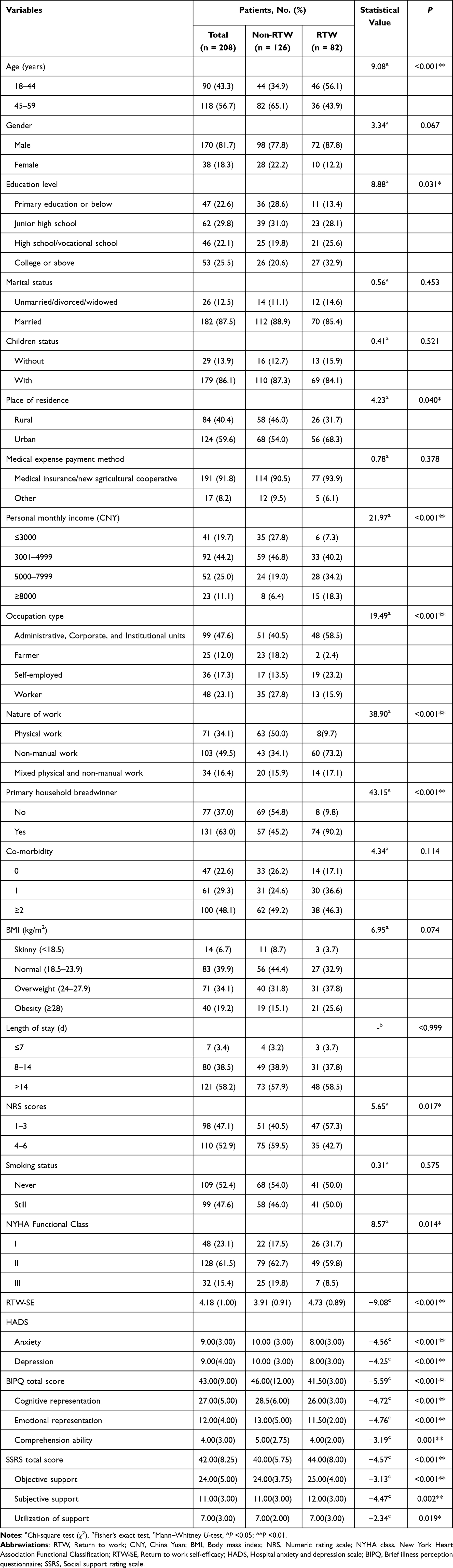 |
Table 1 Demographic Data of Young and Middle-Aged STAAD Patients and Univariate Analysis of RTW (N=208) |
Multivariate Analysis of Returning to Work After Cardiac Surgery in Young and Middle-Aged STAAD Patients
Binary logistic regression analysis was performed using backward selection to identify independent factors influencing RTW after cardiac surgery in young and middle-aged STAAD patients (Table 2). The dependent variable was RTW status (yes/no). Variables showing statistical significance in univariate analysis as independent variables. VIF within ideal ranges indicate that there are no severe multicollinearity issues in the model. Variables with clear clinical relevance and interpretability were retained in the final multivariate model. The analysis showed that being the primary household breadwinner was positively associated with RTW (OR = 4.79, 95% CI: 1.70–13.51, P =0.003). Compared with physical work, engagement in non-manual work was associated with a higher likelihood of RTW (OR = 3.96, 95% CI: 1.34–11.73, P =0.013). With regard to cardiac functional status, patients classified as NYHA functional class III were less likely to RTW than those in class I (OR = 0.15, 95% CI: 0.03–0.77, P =0.023). Higher levels of objective support (OR = 1.48, 95% CI: 1.03–2.11, P =0.033) and subjective support (OR = 1.54, 95% CI: 1.04–2.30, P =0.032) were also positively associated with RTW. In addition, RTW-SE was strongly associated with RTW (OR = 10.68, 95% CI: 4.21–27.13, P <0.001). The Hosmer–Lemeshow goodness-of-fit test indicated adequate model fit (χ2 = 4.57, df = 8, P =0.802), further confirming the robustness of the model.
 |
Table 2 Binary Logistic Regression Analysis of Factors Influencing RTW in Young and Middle-Aged STAAD Patients After Cardiac Surgery |
Ranking of Variable Importance
To further explore the relative importance of each independent variable on postoperative RTW, this study constructed an RFM based on logistic regression analysis that identified significant variables. The RFM can assess variable importance under nonlinear and multifactorial interactions. Combined with logistic regression, it enables visualization of the importance of influencing factors. This study utilized the random forest package in R version 4.4.2, inputting significant variables as independent variables into the model, with the dependent variable being whether the individual RTW. Variable importance was assessed using the MeanDecreaseGini metric, with detailed importance values summarized in Table 3. Details of variable coding and assignment are provided in Supplementary Table S1. The ranking of variable importance, from highest to lowest, was as follows: RTW-SE, objective support, subjective support, NYHA functional class, primary household breadwinner, and nature of work (see Figure 2).
 |
Table 3 Relative Importance Ranking of Variables Associated with RTW Among Young and Middle-Aged Patients with STAAD After Cardiac Surgery |
 |
Figure 2 Importance ranking of factors influencing RTW among young and middle-aged patients with STAAD after cardiac surgery. Abbreviations: RTW-SE, Return to work self-efficacy; NYHA functional class, New York Heart Association functional classification. |
Discussion
Main Findings
To our knowledge, this is the first study in China to examine the current status and influencing factors of young and middle-aged STAAD patients returning to work after cardiac surgery. The findings of this study suggest that the overall RTW rate among young and middle-aged STAAD patients after cardiac surgery remains relatively low. Compared with previous studies involving patients undergoing less invasive vascular interventions,19 the RTW rate observed in this study was moderately higher, which may be partly attributable to differences in occupational composition. A relatively higher proportion of participants in this study were engaged in non-manual work, which generally involves lower physical demands and allows greater flexibility during postoperative recovery.32,33 This observation highlights the importance of considering occupational characteristics when comparing RTW outcomes across different patient populations and clinical settings.
The RFM indicates that RTW-SE was the most prominent factor associated with RTW. Higher levels of RTW-SE may be associated with more active engagement in rehabilitation and adaptive coping with work-related challenges, consistent with the findings of Skagseth et al.34 RTW-SE reflects patients’ confidence in their ability to resume work roles after surgery and in possessing the capabilities required to RTW,35 which is closely related to work reintegration. Existing evidence suggests that RTW-SE is closely related to RTW-related outcomes, including time to RTW and job retention.36,37 From a clinical perspective, identifying patients with relatively low RTW-SE levels may help healthcare providers recognize individuals who could benefit from additional support during the RTW process. For example, exposure to successful RTW experiences and peer support may facilitate patients’ understanding of the RTW process. Furthermore, previous research grounded in Self-Determination Theory38 suggests that autonomy-supportive vocational guidance, such as work scenario simulations and goal-setting, may be beneficial for patients’ perceived competence during work capacity recovery.
Based on the RFM, objective support and subjective support were identified as the second and third most important factors influencing RTW. The findings of this study indicate that both objective and subjective dimensions of social support are associated with more favorable RTW among young and middle-aged STAAD patients after cardiac surgery. Specifically, greater levels of practical assistance and emotional support may be linked to smoother workplace reintegration, conclusion consistent with the research findings of White.39 A robust social support system not only provides essential material assistance and emotional comfort to facilitate physical and psychological recovery40,41 but also enhances patients’ social adaptation capabilities, thereby potentially supporting their return to the workplace. Based on these findings, these results highlight the potential value of health education for patients and their families in clinical rehabilitation and community interventions. This education should emphasize the importance of fostering supportive family and social environments, collectively encouraging and assisting patients in smoothly transitioning back into their social and occupational roles.
NYHA functional class was identified as the fourth critical factor inversely associated with RTW. The results of this study indicate that cardiac function plays a meaningful role in work reintegration among young and middle-aged STAAD patients following cardiac surgery. This aligns with the conclusions of Mirmohammadi,42 demonstrating that patients with better cardiac function exhibit higher RTW rates. Patients with poorer cardiac function often experience persistent fatigue, weakness, and physical limitations, making it difficult to meet the demands of their original job roles.43 This significantly impedes their RTW process. Based on these findings, clinicians may consider paying particular attention to STAAD postoperative patients with suboptimal cardiac function. A rehabilitation intervention oriented toward occupational RTW, modeled after the interdisciplinary support program,44 may be considered. This program should include dynamic assessment of cardiac function and progressively increase exercise training intensity throughout rehabilitation. The goal is to improve functional status and provide support for successful societal reintegration.
According to the RFM, serving as the primary household breadwinner was identified as the fifth most important factor related to RTW among young and middle-aged STAAD patients. The findings of this study indicate that those who were the primary household breadwinners tended to demonstrate stronger motivation to resume work compared to non-primary breadwinners, which aligns with Zou’s45 research. This phenomenon may be explained by the sense of responsibility associated with the breadwinner role, which likely serves as a strong motivator for adherence to cardiac rehabilitation.46 Better rehabilitation adherence promotes functional recovery, enhances patients’ confidence in their work capacity, and ultimately facilitates their RTW.
The nature of work was also closely related to RTW outcomes. Patients primarily engaged in non-manual work are more likely to successfully RTW than those primarily engaged in physical work. This finding aligns with the results of Hu.47 This disparity may stem from two primary factors: First, physical work labor positions typically demand higher physical capabilities, whereas STAAD patients who undergo cardiac surgery must avoid strenuous activities postoperatively, creating a direct conflict between occupational demands and health status.48 Second, the overall educational attainment of the manual labor patient cohort is relatively lower, objectively limiting their occupational choices, increasing job matching difficulties,49 and thereby elevating the risk of failed RTW attempts. Based on these findings, these results may help inform collaboration between healthcare institutions and social security departments to enhance postoperative rehabilitation and occupational transition support systems. This may include providing necessary vocational skills training, employment guidance, and policy assistance to patients struggling to return to their original positions. Such measures would alleviate their disease and economic burdens while facilitating a smooth transition back into societal roles. Additionally, a multidisciplinary collaboration may be considered, involving cardiac surgeons, rehabilitation therapists, psychological specialists, social workers, and occupational health professionals. Such collaborative approaches may help address multiple aspects of the RTW process, including physical functional recovery, psychological support, social resource linkage, and job capability matching, thereby supporting patients’ RTW process and ultimately facilitating their smooth reintegration into societal roles.
Limitations
This study has several limitations. First, the cross-sectional design does not allow causal inferences, and data were collected through self-reported questionnaires, which may be influenced by personal perceptions. Second, although the RFM was applied to rank the relative importance of variables, it was not intended to predict future RTW outcomes. Moreover, this study assessed RTW status at a single postoperative time point among patients after STAAD, without further examining changes across different follow-up periods. As a result, the dynamic patterns of RTW status and its associated factors over time could not be fully captured. Future longitudinal studies with repeated measurements at multiple postoperative time points are warranted to better describe temporal changes and associations between RTW status and related variables, thereby providing more robust evidence to inform the development and evaluation of tailored vocational rehabilitation strategies for this patient population.
Conclusion
In summary, the RTW rate among young and middle-aged STAAD patients following cardiac surgery requires improvement. Our study indicates that the primary household breadwinner, nature of work, social support, RTW-SE, and NYHA functional class are independent factors influencing RTW in this patient population. These findings can assist healthcare professionals in early identification of young and middle-aged STAAD patients who may potentially delay or refuse RTW. Moving forward, healthcare providers should prioritize young and middle-aged STAAD patients who underwent cardiac surgery and exhibit poor cardiac function, low RTW-SE, weak social support, and jobs requiring high physical exertion, ensuring they receive preferential management during follow-up and rehabilitation planning.
Furthermore, when developing individualized vocational rehabilitation plans, a multidisciplinary collaborative model is recommended. This approach involves the participation of cardiovascular medical teams, rehabilitation therapists, psychological specialists, social workers, and occupational health professionals to reduce barriers to RTW and facilitate smooth and sustainable vocational reintegration.
Data Sharing Statement
The data that support the findings of this study are available from the corresponding author upon reasonable request.
Ethics Approval and Informed Consent
This study was conducted in accordance with the Declaration of Helsinki. The ethical approval of the Institutional Review Board of Guangdong Provincial People’s Hospital was obtained before data collection (approval number: KY2024-607-01). All patients participating in this study provided written informed consent. The consent forms detailed the study’s purpose, procedures, potential risks, and measures to protect their rights and confidentiality. Participants’ personal information was kept confidential throughout the study.
Acknowledgments
The authors would like to express sincere appreciation to the relevant hospital authorities for the opportunity to conduct this study and to all participants for their time and cooperation throughout the study.
Author Contributions
All authors made a significant contribution to the work reported, whether that is in the conception, study design, execution, acquisition of data, analysis and interpretation, or in all these areas; took part in drafting, revising or critically reviewing the article; gave final approval of the version to be published; have agreed on the journal to which the article has been submitted; and agree to be accountable for all aspects of the work.
Funding
This work was supported by the Medical Scientific Research Foundation of Guangdong Province of China (Grant number A2023030) and the Nursing Innovation and Development Research Project of Guangdong Nursing Association (Grant number YJYZ202301).
Disclosure
The authors report no conflicts of interest in this work.
References
1. Zhu Y, Lingala B, Baiocchi M, et al. Type A aortic dissection-experience over 5 decades: JACC historical breakthroughs in perspective. J Am Coll Cardiol. 2020;76(14):1703–14. doi:10.1016/j.jacc.2020.07.061
2. Krüger T, Conzelmann LO, Bonser RS, et al. Acute aortic dissection type A. Br J Surg. 2012;99(10):1331–1344. doi:10.1002/bjs.8840
3. NCD-RisC. Worldwide trends in hypertension prevalence and progress in treatment and control from 1990 to 2019: a pooled analysis of 1201 population-representative studies with 104 million participants. Lancet. 2021;398(10304):957–980. doi:10.1016/s0140-6736(21)01330-1
4. Zhao R, Wu JL, Qiu JT, Yu CT. [Overview of multi-center registry of aortic dissection]. Zhonghua Wai Ke Za Zhi. 2020;58(8):604–607. Chinese. doi:10.3760/cma.j.cn112139-20190906-00448
5. Hagan PG, Nienaber CA, Isselbacher EM, et al. The International Registry of Acute Aortic Dissection (IRAD): new insights into an old disease. JAMA. 2000;283(7):897–903. doi:10.1001/jama.283.7.897
6. Malaisrie SC, Szeto WY, Halas M, et al. 2021 The American Association for Thoracic Surgery expert consensus document: surgical treatment of acute type A aortic dissection. J Thorac Cardiovasc Surg. 2021;162(3):735–758.e2. doi:10.1016/j.jtcvs.2021.04.053
7. Olsson C, Ahlsson A, Fuglsang S, et al. Medium-term survival after surgery for acute Type A aortic dissection is improving. Eur J Cardiothorac Surg. 2017;52(5):852–857. doi:10.1093/ejcts/ezx302
8. Chandiramani A, Al-Tawil M, Elleithy A, et al. Organ-specific malperfusion in acute type A aortic dissection: epidemiological meta-analysis of incidence rates. BJS Open. 2024;9(1). doi:10.1093/bjsopen/zrae146
9. Ghazy T, Mahlmann A, Fajfrova Z, et al. Anastomotic leak after surgical repair of type A aortic dissection – prevalence and consequences in midterm follow-up. Vasa. 2017;46(5):377–382. doi:10.1024/0301-1526/a000644
10. Lang X, Huang S, Wang Q, et al. Discomfort of postoperative patients with aortic dissection after discharge: telephone follow-up analysis of a cross-sectional study. J Cardiothorac Surg. 2022;17(1):31. doi:10.1186/s13019-022-01779-w
11. McEntire A, Helm BM, Landis BJ, et al. Psychological distress in response to physical activity restrictions in patients with non-syndromic thoracic aortic aneurysm/dissection. J Community Genet. 2021;12(4):631–641. doi:10.1007/s12687-021-00545-0
12. Bernt Jørgensen SM, Johnsen NF, Gerds TA, et al. Perceived return-to-work pressure following cardiovascular disease is associated with age, sex, and diagnosis: a nationwide combined survey- and register-based cohort study. BMC Public Health. 2022;22(1):1059. doi:10.1186/s12889-022-13494-1
13. Pemberton J, Smith JC. The return to work of elderly male hospital in-patients. Br Med J. 1949;2(4622):306–308. doi:10.1136/bmj.2.4622.306
14. Momsen AH, Stapelfeldt CM, Rosbjerg R, Escorpizo R, Labriola M, Bjerrum M. International classification of functioning, disability and health in vocational rehabilitation: a scoping review of the state of the field. J Occup Rehabil. 2019;29(2):241–273. doi:10.1007/s10926-018-9788-4
15. World Health Organization. International Classification of Functioning, Disability and Health. World Health Organization; 2001.
16. Committee of Cardiac Rehabilitation and Prevention of Chinese Association of Rehabilitation Medicine. Guidelines for cardiovascular rehabilitation and secondary prevention in China 2018 simplified edition. Chinese J Int Med. 2018;57(11):9. doi:10.3760/cma.j.issn.0578-1426.2018.11.003
17. McPeake J, Mikkelsen ME, Quasim T, et al. Return to employment after critical illness and its association with psychosocial outcomes. a systematic review and meta-analysis. Ann Am Thorac Soc. 2019;16(10):1304–1311. doi:10.1513/AnnalsATS.201903-248OC
18. Christensen J, Winkel BG, Eskildsen SJ, Gottlieb R, Hassager C, Wagner MK. Return-to-work and rehabilitation needs in cardiac arrest survivors: an exploratory cross-sectional study. Eur J Cardiovasc Nurs. 2022;22(3):328–331. doi:10.1093/eurjcn/zvac039
19. Lin Y, Chen Y, Zhang H, et al. Predictors of return to work after open triple-branched stent graft placement for acute type A aortic dissection. Interact Cardiovasc Thorac Surg. 2020;30(1):99–106. doi:10.1093/icvts/ivz236
20. Kamp T, Gademan MGJ, van Zon SKR, et al. Time to return to work by occupational class after total Hip or knee arthroplasty. Bone Joint J. 2023;105-b(9):977–984. doi:10.1302/0301-620x.105b9.Bjj-2023-0190.R1
21. Andersen EB, Kristiansen M, Bernt Jørgensen SM. Barriers and facilitators to return to work following cardiovascular disease: a systematic review and meta-synthesis of qualitative research. BMJ Open. 2023;13(1):e069091. doi:10.1136/bmjopen-2022-069091
22. Sheng X, Huang S. Research progress on the influencing factors and interventions for return to work among patients with aortic dissection. Chin J Emerg Crit Care Nurs. 2025;6(6):765–768. doi:10.3761/j.issn.2096-7446.2025.06.023
23. Zhang Y. A Longitudinal Study on Continuing Care Needs and Quality of Life in Patients After Aortic Dissection Surgery [Master’s thesis]. Huazhong University of Science and Technology; 2023.
24. Gjengedal RGH, Lagerveld SE, Reme SE, Osnes K, Sandin K, Hjemdal O. The Return-to-Work Self-efficacy Questionnaire (RTW-SE): a validation study of predictive abilities and cut-off values for patients on sick leave due to anxiety or depression. J Occup Rehabil. 2021;31(3):664–673. doi:10.1007/s10926-021-09957-8
25. Liu F, Zhang Z, Mei Y, Guo Y, Duan Y. Development, reliability and validity of the chinese version of the return-to-work self-efficacy questionnaire among young and middle-aged stroke patients. Chin General Pract. 2022;25(10):1227–1231.
26. Zigmond AS, Snaith RP. The Hospital Anxiety and Depression Scale. Acta Psychiatr Scand. 1983;67(6):361–370. doi:10.1111/j.1600-0447.1983.tb09716.x
27. Ye W, Xu J. An investigation of anxiety and depression in 100 inpatients with heart disease. Shanghai Arch Psychiatry. 1993;5(4):4.
28. Broadbent E, Petrie KJ, Main J, Weinman J. The brief illness perception questionnaire. J Psychosom Res. 2006;60(6):631–637. doi:10.1016/j.jpsychores.2005.10.020
29. Mei Y, Li H, Yang N, et al. Reliability and validity of chinese version of the brief illness perception questionnaire in patients with breast cancer. J Nurs. 2015;22(24):11–14. doi:10.16460/j.issn1008-9969.2015.24.011
30. Xiao S. Theoretical basis and Research Applications of the Social Support Rating Scale (SSRS). J Clin Psychiatry. 1994;2:98–100.
31. Committee of Great Vessels of Chinese Association of Cardiovascular Surgeons. Chinese experts’ consensus of standardized diagnosis and treatment for aortic dissection. Chin J Thor Cardiovasc Surg. 2017;33(11):641–654. doi:10.3760/cma.j.issn.1001-4497.2017.11.001
32. Qin M, Xiaorong D, Yang X, Wu G, Dou L, Ju M. Research progress of postoperative rehabilitation exercise in patients with aortic dissection. J Nurs Sci. 2023;38(11):126–128.
33. Wen L, Gao Z, Zhong X, Wen L, Zang S, Bai X. Readiness for return to work and its influencing factors among head and neck cancer patients: a cross-sectional study. Support Care Cancer. 2024;32(7):420. doi:10.1007/s00520-024-08622-z
34. Skagseth M, Fimland MS, Rise MB, Nilsen TIL, Aasdahl L. Return-to-work self-efficacy after occupational rehabilitation for musculoskeletal and common mental health disorders: secondary outcomes of a randomized clinical trial. J Rehabil Med. 2021;53(1):jrm00146. doi:10.2340/16501977-2787
35. Horn L, Spronken M, Brouwers EPM, de Reuver RSM, Joosen MCW. Identifying return to work self-efficacy trajectories in employees with mental health problems. J Occup Rehabil. 2022;32(1):64–76. doi:10.1007/s10926-021-09979-2
36. Heijbel B, Josephson M, Jensen I, Stark S, Vingård E. Return to work expectation predicts work in chronic musculoskeletal and behavioral health disorders: prospective study with clinical implications. J Occup Rehabil. 2006;16(2):173–184. doi:10.1007/s10926-006-9016-5
37. Liu F, Zhang Z, Lin B, Ping Z, Mei Y. Assessing the psychometric properties of the Chinese return-to-work self-efficacy questionnaire using Rasch model analysis. Health Qual Life Outcomes. 2022;20(1):27. doi:10.1186/s12955-022-01929-7
38. Smeets J, Hoefsmit N, Houkes I. Self-directing return-to-work: employees’ perspective. Work. 2019;64(4):797–807. doi:10.3233/wor-193041
39. White C, Green RA, Ferguson S, et al. The influence of social support and social integration factors on return to work outcomes for individuals with work-related injuries: a systematic review. J Occup Rehabil. 2019;29(3):636–659. doi:10.1007/s10926-018-09826-x
40. Brannigan C, Galvin R, Walsh ME, et al. Barriers and facilitators associated with return to work after stroke: a qualitative meta-synthesis. Disabil Rehabil. 2017;39(3):211–222. doi:10.3109/09638288.2016.1141242
41. Rao Y, Tang S, Lv F, et al. Factors associated with returning to work in liver transplantation survivors: a cross-sectional study. Asian Nurs Res. 2025;19(2):193–199. doi:10.1016/j.anr.2025.02.001
42. Mirmohammadi SJ, Sadr-Bafghi SM, Mehrparvar AH, et al. Evaluation of the return to work and its duration after myocardial infarction. ARYA Atheroscler. 2014;10(3):137–140.
43. Bredy C, Ministeri M, Kempny A, et al. New York Heart Association (NYHA) classification in adults with congenital heart disease: relation to objective measures of exercise and outcome. Eur Heart J Qual Care Clin Outcomes. 2018;4(1):51–58. doi:10.1093/ehjqcco/qcx031
44. Karoff M, Röseler S, Lorenz C, Kittel J. Intensivierte Nachsorge (INA)--ein Verfahren zur Verbesserung der beruflichen Reintegration nach Herzinfarkt und/oder Bypassoperation [Intensified after-care--a method for improving occupational reintegration after myocardial infarct and/or bypass operation]. Z Kardiol. 2000;89(5):423–433. German. doi:10.1007/s003920050508
45. Zou L, Jiang X, Liu H, et al. Predictors of return to work after thoracic endovascular aortic repair in patients with type b aortic dissection. J Endovasc Ther. 2025;32(3):813–821. doi:10.1177/15266028231197133
46. Li S, Wang Q, Wang J, Zhang Z, Sun Q, Jiang H. Latent profile analysis of return-to-work self-efficacy and its influencing factors in young and middle-aged stroke patients. Milit Nurs. 2024;41(1):35–39.
47. Hu Y, Zhou T, Li X, et al. Factors influencing return to work 3 months after percutaneous coronary intervention in young and middle-aged patients with coronary heart disease: a single-center, cross-sectional study. PLoS One. 2023;18(4):e0284100. doi:10.1371/journal.pone.0284100
48. Descatha A, Dumas F, Bougouin W, Cariou A, Geri G. Work factors associated with return to work in out-of-hospital cardiac arrest survivors. Resuscitation. 2018;128:170–174. doi:10.1016/j.resuscitation.2018.05.021
49. Cauter JV, Bacquer D, Clays E, Smedt D, Kotseva K, Braeckman L. Return to work and associations with psychosocial well-being and health-related quality of life in coronary heart disease patients: results from EUROASPIRE IV. Eur J Prev Cardiol. 2019;26(13):1386–1395. doi:10.1177/2047487319843079
 © 2026 The Author(s). This work is published and licensed by Dove Medical Press Limited. The
full terms of this license are available at https://www.dovepress.com/terms
and incorporate the Creative Commons Attribution
- Non Commercial (unported, 4.0) License.
By accessing the work you hereby accept the Terms. Non-commercial uses of the work are permitted
without any further permission from Dove Medical Press Limited, provided the work is properly
attributed. For permission for commercial use of this work, please see paragraphs 4.2 and 5 of our Terms.
© 2026 The Author(s). This work is published and licensed by Dove Medical Press Limited. The
full terms of this license are available at https://www.dovepress.com/terms
and incorporate the Creative Commons Attribution
- Non Commercial (unported, 4.0) License.
By accessing the work you hereby accept the Terms. Non-commercial uses of the work are permitted
without any further permission from Dove Medical Press Limited, provided the work is properly
attributed. For permission for commercial use of this work, please see paragraphs 4.2 and 5 of our Terms.
Recommended articles
The Handgrip Endurance Task as a Simple Clinical Indicator of Mental Fatigue in Patients with Chronic Low Back Pain
Grousset M, Audiffren M, Meklat H, André N
Journal of Pain Research 2026, 19:602280
Published Date: 9 July 2026