
Back to Journals » International Journal of Women's Health » Volume 18
Physical Activity and Its Predictors Among Women of Advanced Maternal Age in the First Trimester: A Cross-Sectional Study
Authors Zeng L  , Han R, Chen X, Zeng D, Yuan H, Meng L, Gao L
Received 15 October 2025
Accepted for publication 17 January 2026
Published 6 February 2026 Volume 2026:18 574662
DOI https://doi.org/10.2147/IJWH.S574662
Checked for plagiarism Yes
Review by Single anonymous peer review
Peer reviewer comments 2
Editor who approved publication: Dr Matteo Frigerio
Lei Zeng,1 Rongrong Han,1 Xin Chen,1 Dejian Zeng,2 Haobin Yuan,2 Lirong Meng,2 Lingling Gao2
1School of Nursing, Sun Yat-Sen University, Guangzhou, People’s Republic of China; 2Faculty of Health Sciences and Sports, Macao Polytechnic University, Macau City, Macau Special Administrative Region, People’s Republic of China
Correspondence: Lingling Gao, Faculty of Health Sciences and Sports, Macao Polytechnic University, Macau City, Macau Special Administrative Region, People’s Republic of China, Tel +853 8599 3424, Email [email protected]
Purpose: The number of pregnant women with advanced maternal age (AMA) is rising in China. Physical activity is a cost-effective mean of promoting health among pregnant women. This study aims to examine the prevalence, patterns, and predictors of physical activity among AMA women in the first trimester.
Patients and Methods: A cross-sectional study was conducted in Guangzhou, China, between October 2024 and July 2025. Two hundred and forty-three AMA women in the first trimester completed the Pregnancy Physical Activity Questionnaire, Pregnancy Physical Activity Knowledge Scale, Pregnancy Physical Activity Self-Efficacy Scale, Pregnancy Physical Activity Social Support Scale, and a sociodemographic and obstetric data sheet. Multiple linear regression was used to identify predictors of physical activity.
Results: Over half (53.1%) of AMA women did not meet the current physical activity guidelines. Sedentary behavior was the predominant intensity of physical activity, while sports accounted for the least time among activity types. The regression model explained 32.1% of the variance in physical activity and identified six predictors. Unplanned pregnancy (β = − 0.11, p = 0.049), and primiparous (β = − 0.12, p = 0.035) women were less active. Higher self-efficacy (β = 0.18, p = 0.017), social support (β = 0.17, p = 0.025), action planning (β = 0.14, p = 0.035), and knowledge (β = 0.14, p = 0.039) predicted higher physical activity.
Conclusion: The prevalence of physical inactivity among Chinese AMA women was high. Early clinical efforts should prioritize unplanned pregnancy and primiparous women. Interventions targeting self-efficacy, social support, action planning, and knowledge may increase physical activity, prevent complications, and promote lifelong wellness.
Keywords: advanced maternal age, physical activity, knowledge, self-efficacy, social support, action planning
Introduction
Advanced maternal age (AMA), defined as giving birth at 35 years or older,1 is becoming increasingly common worldwide,2 as well as in mainland China.3 It was reported that the proportion of Chinese AMA births rose from 14.6% in 2010 to 31.6% in 2022.4 Ageing is a key risk factor for many chronic conditions, including endocrine and cardiovascular system diseases.5 Due to both biological disadvantages and higher prevalence of pre-existing diseases,6 AMA women may have an elevated risk for adverse pregnancy outcomes, such as gestational diabetes mellitus, hypertensive disorders of pregnancy, preterm birth, and cesarean delivery.7–9
Physical activity refers to any bodily movement that causes energy expenditure.10 It can be classified by intensity (sedentary, light, moderate, and vigorous) or type (household, transportation, sports/leisure-time, and occupation). Physical activity is vital for AMA women, as it offers a cost-effective approach to disease prevention. It can improve insulin sensitivity, enhance cardiopulmonary function, and further reduce the risk of gestational diabetes mellitus and gestational hypertension,11,12 prevent excessive weight gain, and decrease the risk of preterm birth.13,14 The World Health Organization (WHO) recommends that healthy pregnant women engage in at least 150 minutes of moderate-intensity physical activity weekly. Physical inactivity refers to not meeting the current physical activity guidelines.10
Pregnant women may engage in less physical activity than during the pre-pregnancy period.15 Concerns about miscarriage, bleeding, and fetal safety usually drive them toward physical inactivity.16 About 60.0% of pregnant women worldwide are inactive,17 with the rate rising to 79.0% in China.18 The prevalence even reaches as high as 85.8% during the first trimester.19 Notably, AMA women may exhibit an even higher percentage of physical inactivity than that of younger women.20 These findings highlight the urgent need to promote physical activity as an integral component of prenatal health management.
Several modifiable factors are associated with physical activity during pregnancy, including knowledge of physical activity, self-efficacy, social support, and action planning. Numerous studies have found that pregnant women with greater knowledge of physical activity tend to engage in more physical activity.21,22 Self-efficacy is defined as the individual’s confidence to engage in physical activity.23 Xiang et al found that self-efficacy in the first trimester is a positive predictor of physical activity.24 Social support from family, friends, colleagues, or healthcare providers can also enhance motivation for physical activity.25 In addition, the theory of Health Action Process Approach highlights action planning as a direct predictor in translating intention into behavior.26 By specifying when, where, and how to engage in physical activity, action planning may help increase activity levels during pregnancy.27 Other non-modifiable factors have also been found to be related to the physical activity of pregnant women, including occupation, income, and parity.18
Although the preconception period is essential for adopting a healthy lifestyle throughout pregnancy, women planning a pregnancy are relatively difficult to reach, as they seldom engage in regular healthcare before pregnancy.28 Consequently, the first trimester may offer a more accessible target point for establishing healthy lifestyle behaviors.29,30 Identifying predictors of physical activity in this stage may help to design appropriate interventions to improve physical activity among AMA women and further shape their lifelong wellness. Therefore, the objectives of this study are to describe the prevalence and patterns of physical activity in AMA women and explore its predictors during the first trimester.
Materials and Methods
Study Design, Setting, and Participants
This cross-sectional study was implemented from October 2024 to July 2025 in Guangzhou, China. This study was reported in accordance with the Strengthening the Reporting of Observational Studies in Epidemiology (STROBE) checklist.
The AMA women were recruited consecutively from the antenatal clinic of a tertiary hospital. This hospital is located in the most economically developed area of the city, where approximately 3000 births occur annually. The inclusion criteria were (1) maternal age at birth ≥ 35 years, and (2) ultrasound-confirmed intrauterine singleton pregnancy with gestational age < 14 weeks. The women were excluded if they (1) had a psychiatric or other serious illness; (2) had any contraindication to physical activity,31 including unexplained persistent vaginal bleeding, incompetent cervix, ruptured membranes, recurrent pregnancy loss, a history of spontaneous preterm birth, poorly controlled asthma, symptomatic anemia, bone or joint problems, malnutrition, eating disorder, uncontrolled type 1 or type 2 diabetes, hypertension or thyroid disease; or (3) had undergone fertility treatment.
The sample size was calculated using PASS 2021 for multiple regression analysis based on effect size.32 Assuming a medium effect size (f2 = 0.15), 95% power, a significance level of 0.05, and 16 potential independent variables, a minimum of 209 participants were required. Given a 10% attrition rate, the final sample size was set at 232 to ensure adequate statistical power.
Measurements
Outcome Variable
Physical activity was measured using the Chinese version of Pregnancy Physical Activity Questionnaire (PPAQ), which was translated and validated by Zhang et al.33 The questionnaire comprises 31 items of physical activity. Items are categorized by both intensity (sedentary, light, moderate, and vigorous) and type (household, transportation, sports, and occupation). Each item was assigned a metabolic equivalent of task (MET) value, with time allocations weighted differently: 0 to 21 hours, 0 to 42 hours, and 0 to 3 hours per week. The total physical activity energy expenditure (MET-h/week) was calculated by multiplying each item’s MET value by its weekly weight (h/week). The total physical activity time (in hours per week) is obtained by summing the weekly weights across all activities. In this study, pregnant women who did not meet the guideline-recommended 150 minutes of moderate-intensity physical activity per week were classified as physically inactive. The PPAQ has demonstrated excellent test-retest reliability of 0.94 and content validity of 0.94.33
Study Factors
Knowledge was evaluated using the Pregnancy Physical Activity Knowledge Scale (P-PAKS), developed by Liu et al.34 The 20-item scale requires participants to assess their knowledge of physical activity during pregnancy, including benefits, contraindications, recommended types, duration, and intensity. For each item, respondents select from “yes”, “no”, and “do not know”. Scoring is binary, with 1 point for correct and 0 for incorrect or “do not know” answers. The total score ranges from 0 to 20, with higher scores indicating better knowledge of physical activity. A score of 0–13 indicates a low level of knowledge, whereas 14–20 indicates a high level of knowledge.34 In this study, the P-PAKS demonstrated good internal consistency, with a Cronbach’s α of 0.82.
Self-efficacy was measured using the Chinese version of Pregnancy Physical Activity Self-Efficacy Scale (P-PASES), which was translated and validated by Yang et al.23 The 10-item scale measures participants’ confidence in physical activity over the past 7 days. Each item is scored on a 5-point Likert scale from “strongly disagree = 1” to “strongly agree = 5”. The total score ranges from 10 to 50, with higher scores indicating higher physical activity self-efficacy. A score of 10–20 indicates low self-efficacy, 21–40 indicates moderate self-efficacy, and 41–50 indicates high self-efficacy.23 In this study, the P-PASES demonstrated great internal consistency, with a Cronbach’s α of 0.93.
Social support was evaluated using the Pregnancy Physical Activity Social Support Scale (P-PASSS), which was adopted by Xiang et al.35 The 24-item scale assesses the level of social support received for physical activity engagement over the past 7 days, including support and assistance from family members, friends, colleagues, and healthcare providers. Each item is scored on a 5-point Likert scale from “strongly disagree = 1” to “strongly agree = 5”. The total score ranges from 24 to 120, with higher scores indicating greater social support for physical activity. A score of 24–72 indicates low social support, whereas 73–120 indicates high social support.36 In this study, the P-PASSS demonstrated great internal consistency, with a Cronbach’s α of 0.97.
Action planning was measured using a 4-item instrument adapted from Rhodes et al.37 It determined whether participants had made detailed plans for physical activity, including “when”, “where”, “what”, and “how” they would engage in physical activity. All items were used on a 7-point Likert scale ranging from “strongly disagree = 1” to “strongly agree = 7”. The scores were calculated as the mean of item scores, with higher scores indicating better action planning for physical activity. In this study, the internal consistency was excellent, with a Cronbach’s α of 0.99.
A sociodemographic and obstetric data sheet was used to collect participants’ characteristics, including maternal age at birth, educational degree, occupation, personal monthly household income, marital status, insurance, residence, parity, body mass index (BMI), history of adverse pregnancy outcomes, planned pregnancy, and planned mode of birth.
Ethical Considerations and Data Collection
The Institutional Review Board of the School of Nursing at Sun Yat-sen University approved this study (the ethical approval NO. L2024SYSU-HL-041). This study complied with the provisions of the Declaration of Helsinki. The first author worked as a research assistant (RA) in the antenatal clinic of the study hospital. Eligible pregnant women were invited to participate in the study and given informed consent. A quiet room was prepared for AMA women to complete the questionnaires. The RA remained on-site to collect the questionnaires and to answer any questions from the women during this period.
Statistical Analysis
Analyses were conducted using IBM SPSS Statistics, version 25.0 (IBM Corp., Armonk, N.Y., USA). All statistical tests were two-tailed, with a significance threshold set at p < 0.05. Sociodemographic, obstetric, and study variables were summarized as frequencies (percentages) and means (standard deviations). Describing and ranking the time spent on physical activity of different types according to the PPAQ items. Univariate analyses, including independent-samples t-tests, one-way analysis of variance (ANOVA), and Pearson correlation, were used to screen for potential variables. Statistically significant variables were entered into multiple linear regression, with results reported as the multivariate coefficient of determination (R2) and standardized partial regression coefficient (β).
Results
Sample Characteristics
This study initially recruited 263 eligible pregnant women. After excluding 12 women who completed the questionnaires in an excessively short time and eight who refused to complete the questionnaire, a total of 243 pregnant women were included in the analysis, with a valid response rate of 92.4%.
Table 1 presents the sociodemographic and obstetric characteristics of AMA women. The mean maternal age at birth was 37.33 (2.21) years, ranging from 35 to 45 years. Most participants held an undergraduate degree (37.9%), were employed (77.0%), had a personal monthly household income of ¥6001–¥10,000 (Chinese Yuan, CNY) (37.9%), were married (90.9%), and lived in an urban area (95.5%). The average gestational age was 11.09 (2.21) weeks. A total of 161 (66.3%) AMA women were multiparous.
 |
Table 1 Sociodemographic and Obstetric Characteristics in AMA Women (n = 243) |
Prevalence and Patterns of Physical Activity in AMA Women
More than half (53.1%) of AMA women failed to meet the WHO physical activity guidelines. The average time of total physical activity was 58.04 (29.10) hours per week, with the energy expenditure being 103.74 (53.25) MET-hours per week.
Table 2 presents the details on each item of physical activity. Based on intensity, AMA women spent the most time being sedentary, with a mean of 41.14 (25.30) hours per week, followed by light and moderate intensity physical activity. Time spent on vigorous intensity activity was negligible. In terms of activity types, the most time was spent on household physical activity, averaging 30.95 (24.45) hours per week, followed by occupational, transportational, and sports physical activity.
 |
Table 2 Description of Physical Activity Time Engagement in AMA Women (n = 243) |
Univariate Analysis of Factors Associated with Physical Activity
Table 1 provides ANOVA and t-tests results for factors associated with physical activity. Five categorical variables showed statistically significant differences. Regarding sociodemographic variables, AMA women with an undergraduate degree or higher (F = 5.35, p = 0.001), those who were employed (t = −2.06, p = 0.041), were married (t = 2.96, p = 0.003) reported higher levels of physical activity. Regarding obstetric variables, multiparous women (t = −2.29, p = 0.023) and those planning to give birth (t = 2.23, p = 0.027) were more likely to engage in physical activity.
Table 3 displays the Pearson correlation analysis results. Knowledge (r = 0.40, p < 0.001), self-efficacy (r = 0.47, p < 0.001), social support (r = 0.46, p < 0.001), and action planning (r = 0.40, p < 0.001) were positively correlated with physical activity.
 |
Table 3 Correlation Analysis Between Physical Activity and Study Factors (n = 243) |
Multivariate Analysis of Physical Activity Predictors
Table 4 presents the multiple regression results for physical activity among AMA women, using the enter method. The final model was statistically significant (F = 11.42, p < 0.001) and accounted for 32.1% of the variance in physical activity. For continuous variables, self-efficacy (β = 0.18, p = 0.017), social support (β = 0.17, p = 0.025), action planning (β = 0.14, p = 0.035), and knowledge (β = 0.14, p = 0.039) were positively associated with physical activity. For categorical variables, women with unplanned pregnancies (β = −0.11, p = 0.049) and primiparous women (β = −0.12, p = 0.035) reported lower levels of physical activity. The variance inflation factor (VIF) ranged from 1.10 to 2.15, all of which were below the cutoff of 5, indicating no multicollinearity among the variables.
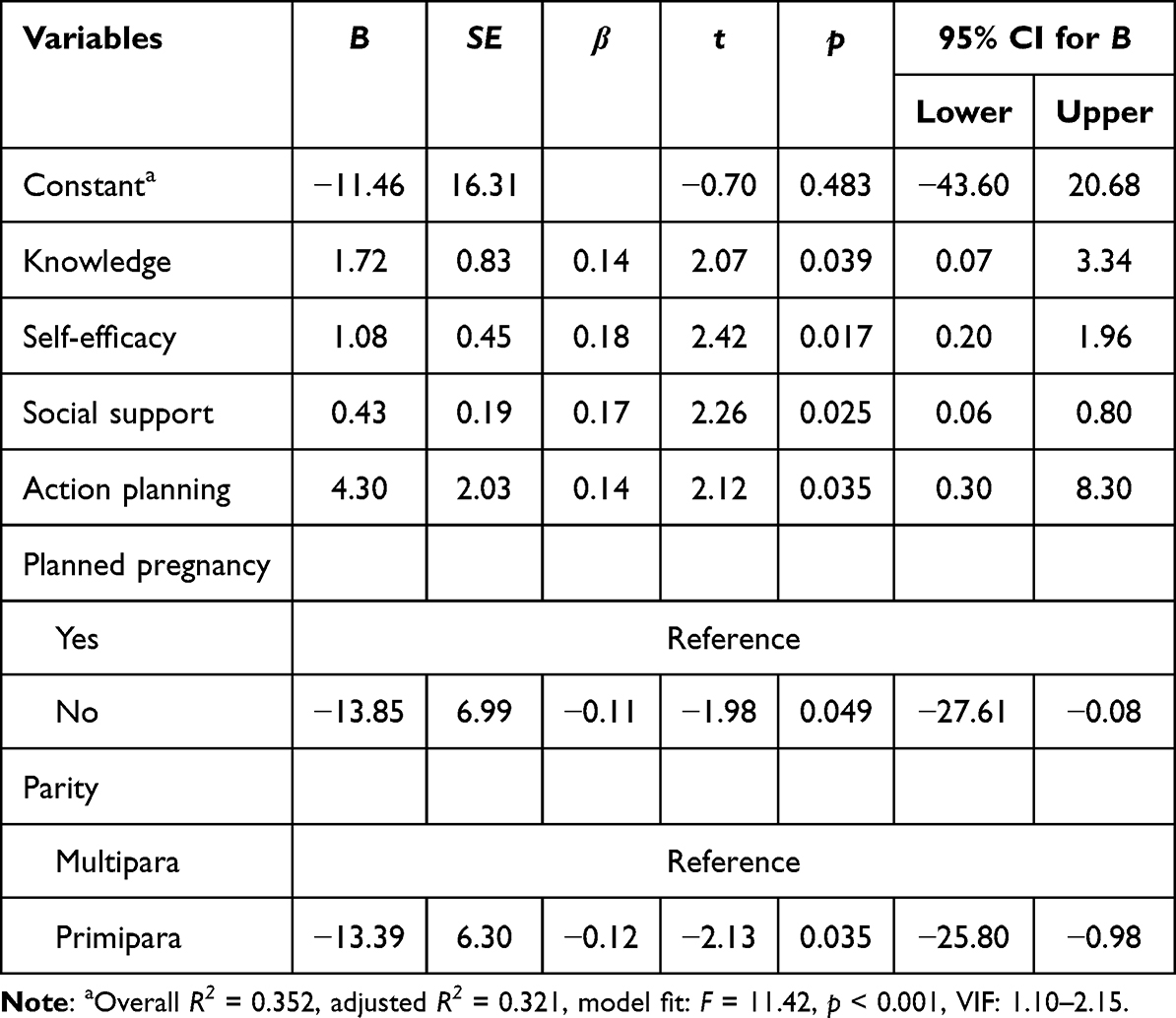 |
Table 4 Multiple Linear Regression of Physical Activity (MET-h/Week) in AMA Women (n = 243) |
Discussion
To our knowledge, this study is the first to examine the pattern and predictors of physical activity among AMA women. The present study found that more than half of the AMA women were physically inactive. The predictors of physical activity included knowledge, self-efficacy, social support, action planning, unplanned pregnancy, and parity.
Physical Activity in AMA Women During the First Trimester
The physical activity level among AMA women during the first trimester was relatively low, with more than half (53.1%) inactive. This is comparable to the 51.0% reported among pregnant women in general in a recent large-scale study in southern China,29 but higher than 43.9% in western China,38 38.3% in Malaysia,39 and 27.2% in Serbia.40 Differences across studies may be attributed to economic factors, as the WHO reported higher physical activity levels among populations in lower-income regions.41
This study found that sedentary behavior accounted for the most time among AMA women, followed by light- and moderate-intensity activities, whereas vigorous-intensity physical activity was nearly absent. These findings were consistent with previous studies.24,38 As is well known, prolonged sedentary time is associated with increased risks of adverse pregnancy outcomes, and light-intensity activities provide limited health benefits.42 Although the moderate to vigorous physical activity is well recognized for preventing disease,43,44 our findings show that it accounted for only a small fraction of total physical activity time. Unfortunately, our study did not measure the exact distribution of physical activity intensity across the 24 hours. Therefore, we were unable to determine whether the prolonged sedentary time was interrupted by activity or accumulated in uninterrupted periods. Increasing evidence is pointing toward patterns of accumulation, particularly regular intervals of activity to break up sedentary time in 24 hours, that are essential for maintaining health.45,46 Future research could pay greater attention to increasing moderate-to-vigorous physical activity and to regular activity interruptions to break up sedentary time during pregnancy.
Across types, household physical activity was the most prevalent, followed by occupational, transportational, and sports physical activity. The findings of this study were consistent with other studies conducted in China and other countries.29,47 A study from Italy reported a slightly different pattern, with transportational activities ranked second, and minimal engagement in both occupational and sports activities.48 Nevertheless, the typical finding across studies was that pregnant women spend the most time on household activities. Specifically, the most frequently reported domestic activities in this study were watching TV or videos, and sitting while reading, talking, writing, or using a computer for non-work purposes. Activities such as preparing meals or caring for children ranked lower. Although they occupied much time, these activities were primarily sedentary or low-intensity.
In terms of occupational physical activity, the most common was sitting at work or in class, followed by standing or slowly walking at work without carrying anything. In this study, 77.0% of AMA women were employed; however, their work-related activity varied by job type. Office workers tended to sit for extended periods, while those in sales or nursing often stood or walked. Moreover, the least common activity was walking quickly while carrying things. In China, labor laws restrict pregnant women from performing higher-intensity work,49 and fetal protection culture in early pregnancy may also discourage activities like carrying heavy things and brisk walking.50 These social and cultural contexts may contribute to AMA women avoiding higher intensity activities.
Regarding transportation, AMA women primarily chose to drive or take a car or bus, followed by walking or climbing stairs. The first two involve low energy expenditure, whereas stair climbing is a moderate intensity activity. Other moderate-intensity activities, such as brisk walking and cycling, were performed for less than 60 minutes per week. Evidence suggested that neither brisk walking nor cycling increases the risk of miscarriage in early pregnancy;51 on the contrary, both are effective in preventing pregnancy complications.43 Nevertheless, AMA women still have limited participation in moderate intensity commuting activities.
Sports were the least frequent form of physical activity, with AMA women spending an average of less than 30 minutes per week. Strolling was the most common modality. Existing evidence strongly supports the conclusion that walking may provide health benefits during pregnancy.52 It is worth acknowledging that walking might be a good form of activity for women, especially those who were highly sedentary and trying to change their behavior during pregnancy. However, current guidelines place greater emphasis on moderate-intensity activities.31 Furthermore, Mahen et al53 reported that most pregnant women mistakenly believed walking was the most beneficial activity. This misconception, aligned with the uncertainty of safe exercise types during pregnancy,16,54 may further contribute to low participation in sports-related activities. Consequently, while walking should continue to be encouraged, greater emphasis is needed on the importance of engaging in moderate-intensity exercise during pregnancy, particularly through “exercise snacks”, a form of interval physical activity that leverages fragmented time.45
Modifiable and Non-Modifiable Predictors of Physical Activity Among AMA Women
Knowledge was a positive predictor of physical activity in AMA women. The more knowledge they had, the more likely they were to be active during pregnancy. This aligns with previous reviews identifying insufficient knowledge as a key barrier to physical activity.25,54 In this study, over half (54.7%) of AMA women lacked knowledge. Although the safety and benefits of physical activity during pregnancy have been widely recognized among researchers over recent decades, this knowledge may not be widely known among AMA women. On the one hand, traditional Chinese beliefs consider the first trimester a fragile stage of embryonic development, during which rest is encouraged to prevent miscarriage.50 On the other hand, some conservative healthcare providers place greater emphasis on rest rather than encouraging appropriate physical activity.55 As the first trimester represents a critical “teachable moment” for adopting healthy behaviors,30 it is essential to enhance routine prenatal education on the types, intensity, and duration of physical activity, especially for AMA women, who may derive greater health benefits.
The present study identified self-efficacy as a significant predictor of physical activity, consistent with the previous studies.22,24 These results were also consistent with Bandura’s self-efficacy theory. When pregnant women believe they can successfully engage in physical activity, they are more likely to invest efforts in it.56 Unfortunately, 75.3% of AMA women in this study reported moderate or low levels of self-efficacy, and the average score was lower than in other studies.57 Given that AMA women faced a higher risk of miscarriage compared with younger women,7 they may lack the confidence to initiate physical activity. These findings emphasize the importance of enhancing self-efficacy as a target for promoting physical activity in AMA women.
Social support positively predicted physical activity in this study. Women with greater support were more physically active. In the present study, about 35.4% of AMA women reported experiencing low social support. Their average score was also lower than that of their younger counterparts.24 This may be attributed to the excessive protection of AMA women in social norm, which leaves them receiving less encouragement and assistance for physical activity. Primary sources of social support include family members, friends, and healthcare providers. As the closest supporters, partners’ active lifestyles play a vital role in women’s engagement in physical activity.18 Considering the traditional Chinese culture, healthcare professionals could involve AMA women’s partners in physical activity educational programme and encourage them to support AMA women to do physical activity together.
Action planning was also identified as a predictor in the present study. AMA women were more likely to engage in more physical activity with higher action planning. According to the Health Action Process Approach, detailed planning facilitates the transition from intention to behavior.26 Action planning involves specific arrangements regarding when, where, and how to perform physical activity, using situational cues to trigger behavioral execution.26 As an alterable variable, it has the potential for intervention. Frie et al highlighted that action planning plays a central role in facilitating behavior change, with approximately 80% adherence among participants.58 In line with this, prior studies have indicated its positive impact on physical activity among pregnant women.27
This study found that planned pregnancy and parity could predict AMA women’s physical activity level. Specifically, women with planned pregnancy tend to engage in higher level of physical activity, consistent with a prior review.18 Those women are more likely to have established physical activity habits during preconception period, which may be sustained into pregnancy.59 However, women with unplanned pregnancy may may recognize their pregnancy later or have limited access to behavioral change recommendations in early pregnancy.59 Besides, multiparous women were more active than primiparas, possibly due to childcare and household responsibilities.18 In contrast, first-time AMA mothers may be more cautious and tend to rest, particularly without prior pregnancy experience.55
Implication for Research and Practices
Given the low physical activity engagement and imbalance intensity distribution among Chinese AMA women, healthcare professionals should consider both patterns and predictors when improving their physical activity. The current study found AMA women spent the most time in sedentary behavior, while the moderate activities occupied less time. To address this, interventions in the first trimester should encourage more moderate intensity activities, such as playing with children or pets, brisk walking, and cycling. Additionally, promote the concept of “exercise snacks” can help break up prolonged sitting with short bouts of activity.45 Obstetricians should also emphasize reliable knowledge on safe physical activity types to alleviate miscarriage-related concerns of AMA women. Strategies such as drawing on previous or vicarious experiences, verbal persuasion, and emotional arousal may further strengthen self-efficacy. Interventions targeting social support need to place more emphasis on the role of partners who can do physical activity with AMA pregnant women. Moreover, developing specific action plans may help AMA women translate intentions into sustained behavior.
Limitations
Several limitations should be acknowledged. First, the cross-sectional design limits the ability to infer causal relationships. Second, physical activity was self-reported and may be subject to recall and social desirability bias. Third, this was a single-center study, with most participants living in urban areas, which may limit the generalizability of the findings. Future studies should incorporate objective measurement tools and innovative technologies to improve the accuracy of physical activity assessment. Moreover, researchers could further examine the patterns of activity accumulations. Longitudinal designs and multicenter studies are also warranted to validate the findings further.
Conclusion
This study revealed that over half of Chinese AMA women failed to meet the recommended guidelines. There is a need to reduce sedentary behavior and increase moderate intensity activity, particularly exercise. Women with unplanned pregnancy and who are primiparous should be prioritized in the early interventions. Strategies should focus on enhancing self-efficacy, strengthening partner’s support, developing detailed action plans, and raising awareness of physical activity knowledge. These efforts may help AMA women increase physical activity levels, prevent pregnancy-related complications, and foster long-term healthy lifestyles.
Acknowledgments
The authors are highly grateful to all the pregnant women who took part in this study. The study was funded by the National Natural Science Foundation of China under the grant “Development and evaluation of a precise intervention on physical inactivity to prevent gestational diabetes mellitus based on the ecological model” (Grant No. 72174216).
Disclosure
The authors report no conflicts of interest in this work.
References
1. American College of Obstetricians and Gynecologists, Gantt A, Society for Maternal-Fetal Medicine; Gantt A, Metz TD, Kuller JA, et al. Obstetric care consensus #11, pregnancy at age 35 years or older. Am J Obstet Gynecol. 2023;228(3):B25–12. doi:10.1016/j.ajog.2022.07.022
2. Osterman M, Hamilton B, Martin JA, Driscoll AK, Valenzuela CP. Births: final data for 2020. Natl Vital Stat Rep. 2021;70(17):1–50.
3. Qiao J, Wang Y, Li X, et al. A Lancet Commission on 70 years of women’s reproductive, maternal, newborn, child, and adolescent health in China. Lancet. 2021;397(10293):2497–2536. doi:10.1016/S0140-6736(20)32708-2
4. Zhu C, Zhang S, Shen L, et al. Changes in the characteristics and outcomes of high-risk pregnant women who delivered prior to and after China’s universal two-child policy: a real-world retrospective study, 2010-2021. BMC Public Health. 2024;24(1):336. doi:10.1186/s12889-024-17810-9
5. Sparić R, Stojković M, Plešinac J, Pecorella G, Malvasi A, Tinelli A. Advanced maternal age (AMA) and pregnancy: a feasible but problematic event. Arch Gynecol Obstet. 2024;310(3):1365–1376. doi:10.1007/s00404-024-07678-w
6. Frick AP. Advanced maternal age and adverse pregnancy outcomes. Best Pract Res Clin Obstet Gynaecol. 2021;70:92–100. doi:10.1016/j.bpobgyn.2020.07.005
7. Ye X, Baker PN, Tong C. The updated understanding of advanced maternal age. Fundam Res. 2024;4(6):1719–1728. doi:10.1016/j.fmre.2023.09.013
8. Lean SC, Derricott H, Jones RL, Heazell AEP. Advanced maternal age and adverse pregnancy outcomes: a systematic review and meta-analysis. PLoS One. 2017;12(10):e0186287. doi:10.1371/journal.pone.0186287
9. Lin L, Sun B, Wang X, Zhang R, Lin J, Yan J. The mediating effects of gestational diabetes mellitus and hypertensive disorders of pregnancy between maternal advanced age, previous caesarean section and the risk of small- or large-for-gestational-age newborns: a multicentric prospective cohort study in southern China. J Glob Health. 2025;15:04053. doi:10.7189/jogh.15.04053
10. World Health Organization. WHO guidelines on physical activity and sedentary behaviour. 2020. Available from: https://www.who.int/publications/i/item/9789240015128.
11. Cid M, González M. Potential benefits of physical activity during pregnancy for the reduction of gestational diabetes prevalence and oxidative stress. Early Hum Dev. 2016;94:57–62. doi:10.1016/j.earlhumdev.2016.01.007
12. Hardy DB, Mu X, Marchiori KS, Mottola MF. Exercise in pregnancy increases placental angiogenin without changes in oxidative or endoplasmic reticulum stress. Med Sci Sports Exerc. 2021;53(9):1846–1854. doi:10.1249/MSS.0000000000002647
13. Davenport MH, Meah VL, Ruchat SM, et al. Impact of prenatal exercise on neonatal and childhood outcomes: a systematic review and meta-analysis. Br J Sports Med. 2018;52(21):1386–1396. doi:10.1136/bjsports-2018-099836
14. Teede HJ, Bailey C, Moran LJ, et al. Association of antenatal diet and physical activity-based interventions with gestational weight gain and pregnancy outcomes: a systematic review and meta-analysis. JAMA Intern Med. 2022;182(2):106–114. doi:10.1001/jamainternmed.2021.6373
15. Wallace MK, Jones MA, Whitaker K, Gibbs BB. Patterns of physical activity and sedentary behavior before and during pregnancy and cardiometabolic outcomes. Midwifery. 2022;114:103452. doi:10.1016/j.midw.2022.103452
16. Helen G, Alg S, Mr D, et al. Why are pregnant women physically inactive? A qualitative study on the beliefs and perceptions about physical activity during pregnancy. Cad Saude Publica. 2024;40(1):e00097323. doi:10.1590/0102-311XEN097323
17. Silva-Jose C, Sanchez-Polan M, Barakat R, Gil-Ares J, Refoyo I. Level of physical activity in pregnant populations from different geographic regions: a systematic review. J Clin Med. 2022;11(15):4638. doi:10.3390/jcm11154638
18. Zhang W, Zhang L, Xu P, et al. Physical activity levels and influencing factors among pregnant women in China: a systematic review and meta-analysis. Int J Nurs Stud. 2024;158:104841. doi:10.1016/j.ijnurstu.2024.104841
19. Feng Y, Zhan Y, Wu S, et al. Investigation on physical activity of primiparas and multiparas women in the first trimester. Chin J Reprod Health. 2020;31(6):512–516. doi:10.3969/j.issn.1671-878X.2020.06.003
20. Haakstad LAH, Voldner N, Bø K. Pregnancy and advanced maternal age—the associations between regular exercise and maternal and newborn health variables. Acta Obstet Gynecol Scand. 2019;99:240–248. doi:10.1111/aogs.13738
21. Xiang Z, Sun K, Han R, Chen L, Wang Z, Gao L. Predictors of physical inactivity among pregnant women. Nurs Health Sci. 2024;26(1):e13086. doi:10.1111/nhs.13086
22. Chen L, Deng YF, Fan MQ, Yuan HB, Meng LR, Gao LL. Assisted reproductive technology and physical activity among Chinese pregnant women at high risk for gestational diabetes mellitus in early pregnancy: a cross-sectional study. Res Nurs Health. 2024;47(3):324–334. doi:10.1002/nur.22369
23. Yang H, Deng Y, Gao L. Reliability and validity of the Chinese version of the pregnancy exercise self-efficacy scale. Chin J Nurs. 2017;632–636. doi:10.3761/j.issn.0254-1769.2017.05.028
24. Xiang Z, Han R, Chen L, Gao L. Predictors of physical activity among Chinese pregnant women during the first trimester: a cross-sectional study. J Sports Sci. 2023;41(20):1883–1891. doi:10.1080/02640414.2024.2306448
25. Harrison AL, Taylor NF, Shields N, Frawley HC. Attitudes, barriers and enablers to physical activity in pregnant women: a systematic review. J Physiother. 2018;64(1):24–32. doi:10.1016/j.jphys.2017.11.012
26. Schwarzer R. Health action process approach (HAPA) as a theoretical framework to understand behavior change. Actual Psicol. 2016;30(121):119–130. doi:10.15517/ap.v30i121.23458
27. Zhang W, Zhao R, Zhang L, et al. Theory-based interventions aimed at promoting physical activity in pregnant women: a systematic review and meta-analysis of randomized controlled trials. Int J Nurs Stud. 2024;154:104761. doi:10.1016/j.ijnurstu.2024.104761
28. Khan NN, Boyle JA, Lang AY, et al. Preconception health attitudes and behaviours of women: a qualitative investigation. Nutrients. 2019;11(7):1490. doi:10.3390/nu11071490
29. Chen X, Xiang Z, Chen L, Sun K, Deng Y, Gao L. Physical activity among Chinese pregnant women in the first trimester: a cross-sectional study. Int J Nurs Sci. 2025;12(3):261–267. doi:10.1016/j.ijnss.2025.02.013
30. Olander EK, Darwin ZJ, Atkinson L, Smith DM, Gardner B. Beyond the ‘teachable moment’ – a conceptual analysis of women’s perinatal behaviour change. Women Birth. 2016;29(3):e67–e71. doi:10.1016/j.wombi.2015.11.005
31. Yang X, Li H, Zhao Q, Han R, Xiang Z, Gao L. Clinical practice guidelines that address physical activity and exercise during pregnancy: a systematic review. J Midwife Womens Health. 2022;67(1):53–68. doi:10.1111/jmwh.13286
32. Cohen J. A power primer. Psychol Bull. 1992;112(1):155–159. doi:10.1037//0033-2909.112.1.155
33. Zhang Y, Zhao Y, Dong S, Xiong Y, Hu X. Reliability and validity of the Chinese version of the Pregnancy Physical Activity Questionnaire (PPAQ). Chin J Nurs. 2013;48(9):825–827. doi:10.3761/j.issn.0254-1769.2013.09.019
34. Liu Q, Gou B, Xiao Q. Investigation on cognition of pregnant women to exercise during pregnancy. Chin J Mod Nurs. 2013;19(13):1528–1531. doi:10.3969/j.issn.1009-6493.2013.23.018
35. Xiang Z, Han R, Zhao Q, Yang X, Gao L. Adaptation and psychometric evaluation of the social support scale for exercise among pregnant women. Chin Nurs Manag. 2022;22(7):998–1002. doi:10.3969/j.issn.1672-1756.2022.07.008
36. Chen L, Han RR, Chen X, Fu BL, Nogueira BOCL, Gao LL. Evaluation of the mediating role of physical activity self-efficacy in the relationship between knowledge, social support, and physical activity in pregnant women with a high risk for gestational diabetes. BMC Pregnancy Childbirth. 2024;24(1):857. doi:10.1186/s12884-024-07068-9
37. Rhodes RE, Blanchard CM, Matheson DH, Coble J. Disentangling motivation, intention, and planning in the physical activity domain. Psychol Sport Exerc. 2006;7(1):15–27. doi:10.1016/j.psychsport.2005.08.011
38. Xiang M, Zhang J, Liang H, et al. Physical activity and dietary intake among Chinese pregnant women: an observational study. BMC Pregnancy Childbirth. 2019;19(1):295. doi:10.1186/s12884-019-2452-y
39. Nor SFS, Idris IB, Isa ZM. Physical inactivity in early pregnancy and the determinants in an urban city setting of Kuala Lumpur, Malaysia. BMC Public Health. 2022;22(1):93. doi:10.1186/s12889-022-12513-5
40. Todorović J, Terzić-šupić Z, Bjegović-Mikanović V, Piperac P, Dugalić S, Gojnic-Dugalic M. Factors associated with the leisure-time physical activity (LTPA) during the first trimester of the pregnancy: the cross-sectional study among pregnant women in Serbia. Int J Environ Res Public Health. 2020;17(4):1366. doi:10.3390/ijerph17041366
41. World Health Organization. Global status report on physical activity 2022. World Health Organization; 2022. Available from: https://iris.who.int/handle/10665/363607.
42. Whitaker KM, Barone Gibbs B, Hivert MF, et al. Sedentary behavior and light-intensity physical activity during pregnancy and cardiovascular health: a science advisory from the American Heart Association. Circulation. 2025;151(19):e990–e999. doi:10.1161/CIR.0000000000001316
43. Davenport MH, Ruchat SM, Poitras VJ, et al. Prenatal exercise for the prevention of gestational diabetes mellitus and hypertensive disorders of pregnancy: a systematic review and meta-analysis. Br J Sports Med. 2018;52(21):1367–1375. doi:10.1136/bjsports-2018-099355
44. Dipietro L, Evenson KR, Bloodgood B, et al. Benefits of physical activity during pregnancy and postpartum: an umbrella review. Med Sci Sports Exerc. 2019;51(6):1292–1302. doi:10.1249/MSS.0000000000001941
45. Wang T, Laher I, Li S. Exercise snacks and physical fitness in sedentary populations. Sports Med Health Sci. 2025;7(1):1–7. doi:10.1016/j.smhs.2024.02.006
46. Loh R, Stamatakis E, Folkerts D, Allgrove JE, Moir HJ. Effects of interrupting prolonged sitting with physical activity breaks on blood glucose, insulin and triacylglycerol measures: a systematic review and meta-analysis. Sports Med. 2020;50(2):295–330. doi:10.1007/s40279-019-01183-w
47. Mitro SD, Peddada S, Gleason JL, et al. Longitudinal changes in physical activity during pregnancy: national institute of child health and human development fetal growth studies. Med Sci Sports Exerc. 2022;54(9):1466–1475. doi:10.1249/MSS.0000000000002947
48. Sarno L, Borrelli P, Mennitti C, et al. Adherence to physical activity among pregnant women in Southern Italy: results of a cross-sectional survey. Midwifery. 2024;137:104102. doi:10.1016/j.midw.2024.104102
49. Huang G. Guarantees of women’s reproductive rights and labour and employment rights: agreement and disagreement. J Chin Womens Stud. 2019;(05):89–98.
50. Guelfi KJ, Wang C, Dimmock JA, Jackson B, Newnham JP, Yang H. A comparison of beliefs about exercise during pregnancy between Chinese and Australian pregnant women. BMC Pregnancy Childbirth. 2015;15:345. doi:10.1186/s12884-015-0734-6
51. Hegaard HK, Ersboll AS, Damm P. Exercise in pregnancy: first trimester risks. Clin Obstet Gynecol. 2016;59(3):559–567. doi:10.1097/GRF.0000000000000200
52. Connolly CP, Conger SA, Montoye AHK, et al. Walking for health during pregnancy: a literature review and considerations for future research. J Sport Health Sci. 2019;8(5):401–411. doi:10.1016/j.jshs.2018.11.004
53. Mahen AF, Wihongi AO, Connolly CP. Women’s perceptions of maternal and fetal health benefits of physical activity during pregnancy and what factors impact them-a cross-sectional study. Midwifery. 2025;145:104363. doi:10.1016/j.midw.2025.104363
54. Coll CVN, Domingues MR, Gonçalves H, Bertoldi AD. Perceived barriers to leisure-time physical activity during pregnancy: a literature review of quantitative and qualitative evidence. J Sci Med Sport. 2017;20(1):17–25. doi:10.1016/j.jsams.2016.06.007
55. Koleilat M, Vargas N, vanTwist V, Kodjebacheva GD. Perceived barriers to and suggested interventions for physical activity during pregnancy among participants of the special supplemental nutrition program for women, infants, and children (WIC) in Southern California. BMC Pregnancy Childbirth. 2021;21(1):69. doi:10.1186/s12884-021-03553-7
56. Bandura A. Self-efficacy: toward a unifying theory of behavioral change. Psychol Rev. 1977;84(2):191–215. doi:10.1037//0033-295x.84.2.191
57. Yang X, Song Y, Wang Y, et al. Physical inactivity among pregnant women at high risk for gestational diabetes mellitus: a cross-sectional study. Int J Nurs Pract. 2025;31(2):e70013. doi:10.1111/ijn.70013
58. Frie K, Hartmann-Boyce J, Jebb SA, Aveyard P. Effectiveness of a self-regulation intervention for weight loss: a randomized controlled trial. Br J Health Psychol. 2020;25(3):652–676. doi:10.1111/bjhp.12436
59. Nkrumah I, North M, Kothe E, et al. The relationship between pregnancy intentions and diet or physical activity behaviors in the preconception and antenatal periods: a systematic review and meta‐analysis. J Midwifery Womens Health. 2020;65(5):660–680. doi:10.1111/jmwh.13112
 © 2026 The Author(s). This work is published and licensed by Dove Medical Press Limited. The
full terms of this license are available at https://www.dovepress.com/terms
and incorporate the Creative Commons Attribution
- Non Commercial (unported, 4.0) License.
By accessing the work you hereby accept the Terms. Non-commercial uses of the work are permitted
without any further permission from Dove Medical Press Limited, provided the work is properly
attributed. For permission for commercial use of this work, please see paragraphs 4.2 and 5 of our Terms.
© 2026 The Author(s). This work is published and licensed by Dove Medical Press Limited. The
full terms of this license are available at https://www.dovepress.com/terms
and incorporate the Creative Commons Attribution
- Non Commercial (unported, 4.0) License.
By accessing the work you hereby accept the Terms. Non-commercial uses of the work are permitted
without any further permission from Dove Medical Press Limited, provided the work is properly
attributed. For permission for commercial use of this work, please see paragraphs 4.2 and 5 of our Terms.
Recommended articles

Self-Efficacy, Exercise Anticipation and Physical Activity in Elderly: Using Bayesian Networks to Elucidate Complex Relationships
Chen X, Yang S, Zhao H, Li R, Luo W, Zhang X
Patient Preference and Adherence 2022, 16:1819-1829
Published Date: 28 July 2022
The Impact of Smartphone Addiction on Chinese University Students’ Physical Activity: Exploring the Role of Motivation and Self-Efficacy
Lin B, Teo EW, Yan T
Psychology Research and Behavior Management 2022, 15:2273-2290
Published Date: 23 August 2022
Patient-Centered Communication Among Pharmacy Professionals Working in Hospitals and Drug Retail Outlets in Asmara, Eritrea: Knowledge, Attitude, Self-Efficacy and Barriers
Michael E, Nurahmed A, Mihreteab H, Nurhussien M, Adem M, Goitom A, Mihreteab Siele S, Tesfamariam EH, Abdu N
Integrated Pharmacy Research and Practice 2022, 11:153-164
Published Date: 6 October 2022
Pathways of Media Contact to Health Literacy in Middle-Aged and Older People: The Chain Mediation Effect of Perceived Social Support and Self-Efficacy
Jiang MM, Xiao YW, Liao ZL
Journal of Multidisciplinary Healthcare 2024, 17:111-121
Published Date: 6 January 2024
Mediating Effects of Health Literacy, Self-Efficacy, and Social Support on the Relationship Between Disease Knowledge and Patient Participation Behavior Among Chronic Ill Patients: A Cross-Sectional Study Based on the Capability-Opportunity-Motivation and Behavior (COM-B) Model
Wu M, Wang W, He H, Bao L, Lv P
Patient Preference and Adherence 2025, 19:1337-1350
Published Date: 8 May 2025