
Back to Journals » Psychology Research and Behavior Management » Volume 19
Parent-Adolescent Mobile Phone Addiction and Mental Health: Actor-Partner Effects in 4,633 Chinese Dyads
Authors Mei X  , Li Y, Bressington D, Li M, Li J , Tan WY, Ke Y, Liu RH, Lu W, Wang SB
Received 8 September 2025
Accepted for publication 14 January 2026
Published 29 January 2026 Volume 2026:19 566094
DOI https://doi.org/10.2147/PRBM.S566094
Checked for plagiarism Yes
Review by Single anonymous peer review
Peer reviewer comments 3
Editor who approved publication: Professor Mei-Chun Cheung
Xiaoxiao Mei,1 Yan Li,1– 3 Daniel Bressington,4 Mengqi Li,1 Jiaying Li,1 Wen-Yan Tan,5 Yunfei Ke,5 Ri-Hui Liu,5 Wenze Lu,1 Shi-Bin Wang5
1School of Nursing, The Hong Kong Polytechnic University, Hong Kong SAR, People’s Republic of China; 2Mental Health Research Centre, The Hong Kong Polytechnic University, Hong Kong SAR, China; 3Research Institute for Intelligent Wearable Systems, The Hong Kong Polytechnic University, Hong Kong SAR, China; 4Faculty of Nursing, Chiang Mai University, Chiang Mai, Thailand; 5Guangdong Mental Health Center, Guangdong Provincial People’s Hospital, Guangdong Academy of Medical Sciences, Southern Medical University, Guangzhou, People’s Republic of China
Correspondence: Wenze Lu, Email [email protected] Shi-Bin Wang, Email [email protected]
Background: Mobile phone addiction is a growing concern for mental health, especially among adolescents. Previous studies link overuse to anxiety and depression, but dyadic effects within family dynamics remain unclear.
Methods: This cross-sectional study involved 4,633 parent-adolescent dyads from the Guangdong Mental Health Survey. Mobile phone addiction in adolescents was assessed using three items from the Smartphone Addiction Scale-Short Version, while two items from the same scale were employed for parents. Adolescent depression was evaluated using the Center for Epidemiological Studies Depression Scale, whereas parent depression was assessed using the Patient Health Questionnaire. Anxiety levels in both groups were measured using the Generalized Anxiety Disorder scale. Actor-Partner Interdependence Models were used to assess the effects of mobile phone addiction on individual and dyadic symptoms.
Results: The model fit for mobile phone addiction and depression was acceptable (CFI=0.970, RMSEA=0.054). Moderate actor effects were identified, indicating that mobile phone addiction was associated with depression symptoms in both groups (βadolescents=0.279, βparents=0.271, all P < 0.001). Additionally, two small partner effects were observed (βparents-adolescents=0.065, β adolescents-parents=0.063, all P < 0.001). Similarly, the model fit for mobile phone addiction and anxiety was acceptable (CFI=0.975, RMSEA=0.046). Moderate actor effects noted for both adolescents (β=0.288, P < 0.001) and parents (β=0.250, P < 0.001), as well as small partner effects (βparents-adolescents=0.062, βadolescents-parents=0.061, all P < 0.001).
Conclusion: The findings highlight the interrelationship between mobile phone addiction and mental health in adolescents and their parents. Healthcare providers could consider implementing structured, family‑based interventions that target phone use patterns, communication, and coping strategies to promote healthier habits and mental well‑being. Furthermore, longitudinal studies and comprehensive measurement approaches are essential to better understand these complexities.
Keywords: actor-partner interdependence model, adolescents, anxiety, China, depression, dyadic analysis, mobile phone addiction, family systems
Introduction
In an increasingly digital age, mobile phone usage has become an essential aspect of modern life. In 2021, the global number of mobile phone users reached 7.1 billion, with China exceeding 1.028 billion users during the same period.1,2 The widespread use of mobile phones has transformed communication, social interactions, and daily routines.3 While mobile phones offer significant benefits, their overuse raises concerns, particularly regarding the risk of addiction.4 Mobile phone addiction is characterized by diminished self-control, withdrawal symptoms, and an uncontrollable urge to engage with digital content.5,6 Adolescents are particularly vulnerable to mobile phone addiction due to the accessibility and multifunctionality of these devices, coupled with their desire for social validation, escapism, peer influence, and the ongoing process of identity formation.5,7 Furthermore, the traditional Chinese family structure, characterized by close-knit relationships and parental involvement, may contribute to their vulnerability to addiction.8,9 Approximately 80% of Chinese adolescents own mobile phones, and nearly 40% use them without restrictions, with 22.8% displaying symptoms of phone addiction.10 This addiction has been associated with adverse psychological and behavioral consequences, including sleep disturbances, social withdrawal, academic decline, and heightened risks of depression and anxiety.11,12
Family Systems Theory posits that the family unit plays a fundamental role in an adolescent’s psychological and behavioral development, influencing their sense of security, emotional regulation, and social habits through factors like attachment styles, communication patterns, and parental influence.13 Crucially, the theory highlights that the behaviors and emotional states of one family member, such as a parent, can influence others via reciprocal interactions, known as partner effects.13,14 These partner effects are further explained by social learning mechanisms, whereby adolescents observe and imitate parental behaviors, including mobile phone usage patterns and emotional responses.15
Research indicates a direct correlation between parental and adolescent mobile phone addiction, with adolescents more likely to develop problematic usage patterns when their parents do the same.16,17 Increased smartphone use by parents can lead to neglect, reduced parent-child relationship satisfaction, and heightened feelings of neglect among adolescents.18,19 When attachments are insecure, adolescents may experience reduced emotional warmth and social support,20 which can drive them to excessive mobile phone use as a way to compensate for unmet emotional needs.16 Moreover, parents’ mobile phone addiction negatively impacts both their own mental health and that of their adolescents. A study involving 264 parents over 8 days found that objectively measured smartphone use was significantly associated with daily fluctuations in depressed mood.21 Additionally, a four-wave longitudinal study conducted from 2021 to 2023 revealed that more frequent smartphone use by parents is linked to increased incidences of anger and sadness in adolescents.22
When parents experience depression, they may become less responsive to their child’s emotional and developmental needs, exhibit diminished emotional availability, and adopt more negative parenting practices. These disruptions in parental responsiveness can subsequently increase the likelihood of adolescents developing anxiety and depression.23,24 Importantly, the transmission of mental health problems between parents and adolescents is often bidirectional; just as parental mental health problems can negatively impact children, adolescents’ emotional difficulties can also influence their parents’ mental health in both Chinese and Western contexts.25,26
These reciprocal dynamics underscore the necessity of considering the entire family system when examining the relationship between mobile phone addiction and mental health. Existing studies utilizing serial multiple-mediator or parallel mediator models to investigate the effect of mobile phone addiction on mental health have frequently overlooked bidirectional relationships within and between parents and adolescents.17,27 Such studies have focused on the mediation pathways, neglecting the critical dynamics of mutual influence between both parties in this context. The cross-sectional Actor-Partner Interdependence Model (APIM) presents a promising approach by examining the interdependence between parents and adolescents and focusing on the direct links within dyads.28
Thus, this study aims to employ the APIM to assess whether self-reported constructs of mobile phone addiction from both parents and adolescents are associated with their respective anxious and depressive symptoms (actor effects) as well as with each other’s symptoms (partner effects). We hypothesize that APIMs will show adequate-to-good fit (see Figure 1) and propose that: (1) Higher levels of self-reported parental mobile phone addiction will exhibit a moderate correlation with increased anxious and depressive symptoms in parents (actor effect); (2) Higher levels of self-reported adolescent mobile phone addiction will be moderately associated with increased anxious and depressive symptoms in adolescents (actor effect); (3) Higher levels of self-reported parental mobile phone addiction will have a weak but significant correlation with increased anxious and depressive symptoms in adolescents (partner effect); and (4) Higher levels of self-reported adolescent mobile phone addiction will show a weak but significant correlation with increased anxious and depressive symptoms in parents (partner effect).
 |
Figure 1 The theoretical framework. |
Methods
Participants and Procedure
This cross-sectional study utilized data from parent-adolescent dyads from a subset of the Guangdong Mental Health Survey conducted in China between September and December 2023. The Guangdong Mental Health Survey is a series of investigations that have been previously referenced in our earlier research.29,30 Inclusion criteria for adolescents were: (1) enrollment in secondary education, (2) fluency in Chinese, (3) provision of informed consent, and (4) parental agreement to participate, along with informed assent. Exclusion criteria included: (1) either the parent or the adolescent having a present or past diagnosis of schizophrenia, mental disorders caused by mental retardation, cerebral palsy, and (2) inability to match questionnaires between dyads. The target sample was selected from adolescents in secondary education and their parents, utilizing a multistage stratified cluster sampling method, similar to our previous research.31 Firstly, eight cities within the province were randomly selected as survey sites. Then, from each chosen city, three junior high schools and three senior high schools were randomly selected. Subsequently, from each sampled school, one class per grade or age group was selected, resulting in three classes from each junior and senior high school. Lastly, within each selected class, 27–28 students and their corresponding parents were systematically sampled based on student IDs (odd or even numbers). Ultimately, 4,633 complete dyads were included in the final analyses; incomplete dyads were list-wise deleted and not included in the final analyses (see Figure 2).
 |
Figure 2 The flowchart of data collection. |
Measurement
Mobile Phone Addiction
Due to the length of the questionnaire, adolescents’ mobile phone addiction was assessed using three items derived from the Smartphone Addiction Scale-Short Version:32 (1) “I cannot tolerate being without my phone”, (2) “I have failed to complete tasks due to mobile phone use”, and (3) “I find it difficult to concentrate during classes, homework, or work because of my phone use”. The Cronbach’s α was 0.673. Besides, parents’ mobile phone addiction was evaluated with two items: (1) “I have difficulty concentrating during classes, homework, or work due to my phone use”, and (2) “I spend more time on my phone than I initially intended”. The Cronbach’s α was 0.731. Each item was rated on a six-point rating scale: 1 = strongly disagree, 2 = somewhat disagree, 3 = slightly disagree, 4 = slightly agree, 5 = somewhat agree, and 6 = strongly agree. A higher total score reflects a stronger tendency toward mobile phone addiction.32
Depression
The Patient Health Questionnaire (PHQ-9) was employed to evaluate parental depression. This instrument comprises nine items that measure the frequency of depressive symptoms using a four-point Likert scale, where responses range from 0 (not at all) to 3 (nearly every day).33 Prior research has demonstrated the scale’s validity and reliability among Chinese adults.34 In this study, the Cronbach’s α was 0.879.
However, there is no previous literature supporting the application of PHQ-9 to adolescents with good reliability and validity. The Center for Epidemiological Studies Depression Scale (CESD-9) has been applied to Chinese adolescents with good reliability and validity.35,36 Therefore, the CESD-9 was utilized to assess adolescents’ depression.37 The CESD-9 consists of nine items that evaluate the frequency of depressive symptoms using a four-point Likert scale, with responses ranging from 0 (rarely) to 3 (most or all of the time). Higher scores on the CESD-9 indicate a greater presence of depressive symptoms.37 In this study, the Cronbach’s α was 0.692.
Anxiety
Anxiety in both parents and adolescents was assessed using the Generalized Anxiety Disorder-7 (GAD-7), which consists of seven items scored from 0 to 3: 0 for “not at all”, 1 for “several days”, 2 for “more than half the days”, and 3 for “nearly every day”.38 Higher total scores indicate greater anxiety severity. The GAD-7 has demonstrated satisfactory reliability and validity within the Chinese samples.39 In this study, the Cronbach’s α coefficients were 0.917 for parents and 0.922 for adolescents.
Confounders
Socio-demographic comprised items related to adolescents’ gender, place of residence, educational level, whether the adolescent is an only child, their boarding status (day student or boarding student), and their parents’ gender.
Statistical Analyses
Categorical variables were summarized as frequencies and percentages, while continuous variables were reported as means and standard deviations. To evaluate potential bias in the estimates of the outcome variables, we compared the 4,633 complete dyads with the 1,062 incomplete dyads with respect to adolescents’ anxiety and depression scores obtained from all individual respondents.
Further, to assess the normality of continuous variables, we utilized skewness and kurtosis indices, with values of skewness≤3.0 and kurtosis≤10.0 deemed acceptable.40
Additionally, a psychometric evaluation of the mobile phone addiction items was performed, which included correlational analyses between individual items and the total score, as well as tests for measurement invariance across adolescents’ gender.41 Then, Pearson’s correlation analysis was conducted to investigate the bivariate associations among mobile phone addiction, depression, and anxiety in both parents and adolescents.
Subsequently, following standardization of the data, APIMs were employed to assess both actor and partner effects on depression and anxiety. In the APIM analyses, parents’ and adolescents’ mobile phone addiction scores were designated as independent variables, while their depression and anxiety symptoms served as outcome variables.
Maximum likelihood estimation methods were utilized for the analysis. Model fit was assessed using several indices: the chi-square statistic, root mean square error of approximation (RMSEA), Comparative Fit Index (CFI), Tucker-Lewis Index (TLI), and Standardized Root Mean Square Residual (SRMR).42 Adequate model fit was indicated by CFI and TLI values above 0.90, and RMSEA and SRMR values below 0.08.42 According to previous research,43,44 effect sizes were classified as large (β ≥ 0.5), medium (β = 0.3), and small (β = 0.1),43 with β values around 0.2–0.3 often representing the minimal detectable effect at 80% power for moderate sample sizes.44
For the core hypotheses presented in Figure 1, the False Discovery Rate (FDR) correction was used to address the risk of type I errors. However, APIM analyses stratified by adolescents’ gender were not subjected to multiple testing corrections, as the results are primarily descriptive and intended to generate hypotheses for future research.
All statistical analyses were performed using SPSS, Mplus, and JASP. Statistical significance was set as a P value less than 0.05.
Ethical Considerations
This study was conducted in accordance with the principles outlined in the Declaration of Helsinki. Approval was obtained from the Research Ethics Committee of Guangdong Provincial People’s Hospital, Guangzhou Academy of Medical Sciences (No. KY-Z-2022-063-02). Informed consent was secured from all adolescents and their parents before their involvement in the survey.
Results
Participant Characteristics
Out of the 6,400 adolescents and their parents invited, a total of 4,633 dyads completed the survey, resulting in a response rate of 72.4%. There are no significant differences between complete dyads and incomplete dyads (Anxiety: 4.53 vs 4.47, P = 0.700; Depression: 10.52 vs 10.30, P = 0.078). Table 1 presents the distribution of characteristics for both parents and adolescents. The covariates associated with depression and anxiety for both parents and adolescents included adolescents’ gender and education level. These covariates were included in the models as control variables to better elucidate the interdependence of depression and anxiety between parents and adolescents (P < 0.05). Details of the screening results for these covariates are presented in Table 2. The normality test indicated that the continuous variables approximately followed a normal distribution (see Table S1).
 |
Table 1 Characteristics of Participants |
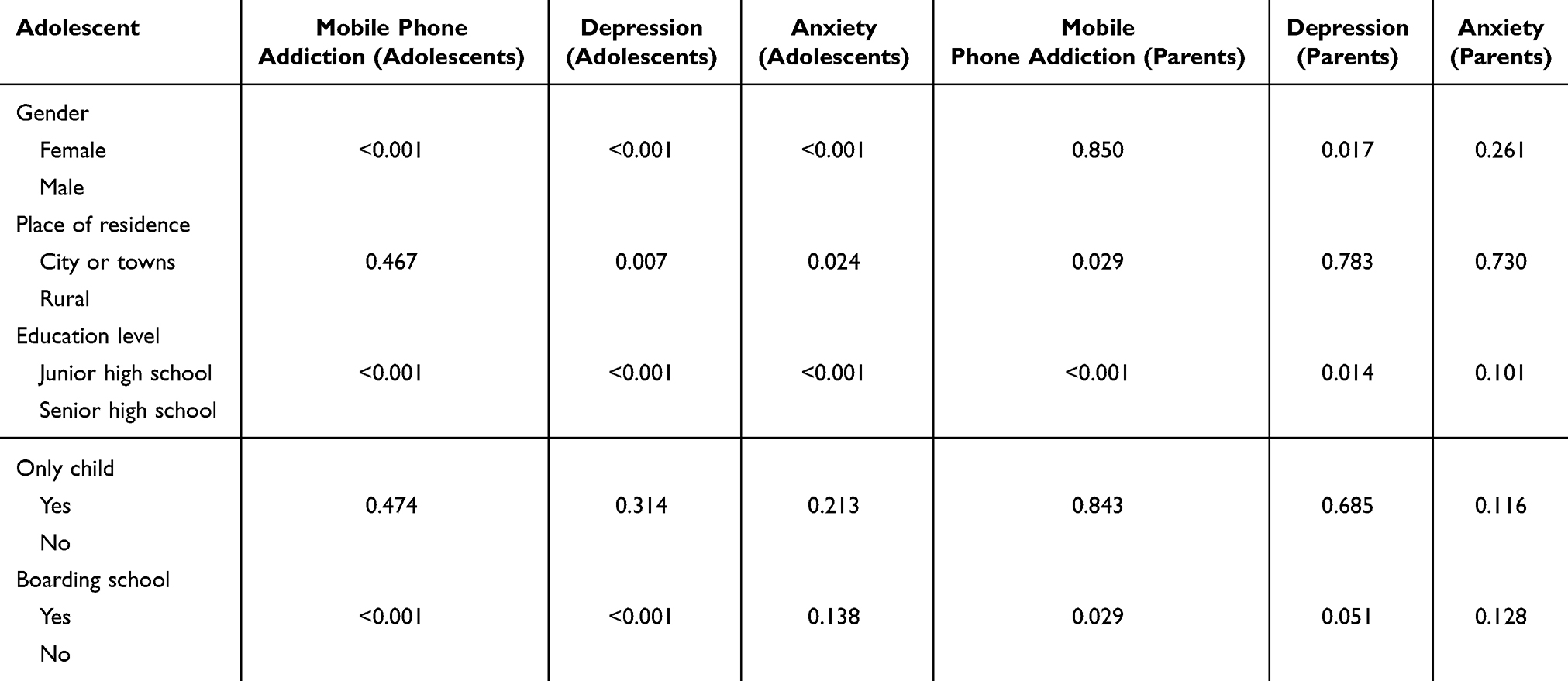 |
Table 2 Demographic Differences in Scores of Mobile Phone Addiction, Depression, and Anxiety (N=4633) |
Correlation Analysis and Measurement Invariance Test
The item-total correlations for adolescents’ mobile phone addiction ranged from 0.666 to 0.832 (see Table S2), while the item-total correlations for parents’ mobile phone addiction ranged from 0.880 to 0.896 (see Table S3). As illustrated in Figure 3, parents’ mobile phone addiction was weakly but significantly associated with their depression (r = 0.232, P < 0.001) and anxiety (r = 0.217, P < 0.001). Furthermore, parents’ mobile phone addiction was weakly correlated with adolescents’ depression (r = 0.107, P < 0.001) and anxiety (r = 0.102, P < 0.001). Additionally, parents’ mobile phone addiction, depression, and anxiety were linked to adolescents’ mobile phone addiction (r = 0.173, P < 0.001), depression (r = 0.137, P < 0.001), and anxiety (r = 0.159, P < 0.001), respectively. Notably, the correlation levels between parents and adolescents regarding mobile phone addiction, depression, and anxiety were weaker than those observed within subjects (r = 0.102 to 0.173 vs r = 0.217 to 0.792).
 |
Figure 3 Correlations between variables (N=4633). Notes: ***P <0.001, X1: Parent mobile phone addiction, Y1: Parent depression, Z1: Parent anxiety; X2: Adolescent mobile phone addiction, Y2: Adolescent depression, Z2: Adolescent anxiety. |
The chi-square difference results presented in Table S4 were not significant, indicating substantial measurement invariance across gender groups.
Actor-Partner Interdependence Models
The initial analysis of dyadic interdependence for mobile phone addiction and depression between parents and adolescents was performed without adjusting for covariates. The overall Chi-square test for distinguishability was significant (χ² (2) = 29.286, CFI = 0.970, TLI = 0.924, RMSEA = 0.054, SRMR = 0.021), indicating that actor and partner effects were statistically distinct between parents and adolescents. These findings are further detailed in Table 3 and Figure 4A. Higher scores on mobile phone addiction were significantly associated with increased levels of depression in both parents and adolescents (βparents = 0.271, 95% CI: 0.254–0.288, P < 0.001; βadolescents = 0.279, 95% CI: 0.260–0.298, P < 0.001), thus revealing significant actor effects. In terms of partner effects, parents’ mobile phone addiction was associated with adolescents’ depression (β = 0.065, 95% CI: 0.048–0.089, P < 0.001). Similarly, adolescents’ mobile phone addiction was associated with parents’ depression (β = 0.063, 95% CI: 0.047–0.081, P < 0.001).
 |
Table 3 The Actor-Partner Interdependence Model of Mobile Phone Addiction and Depression/Anxiety (Crude Model, N=4633) |
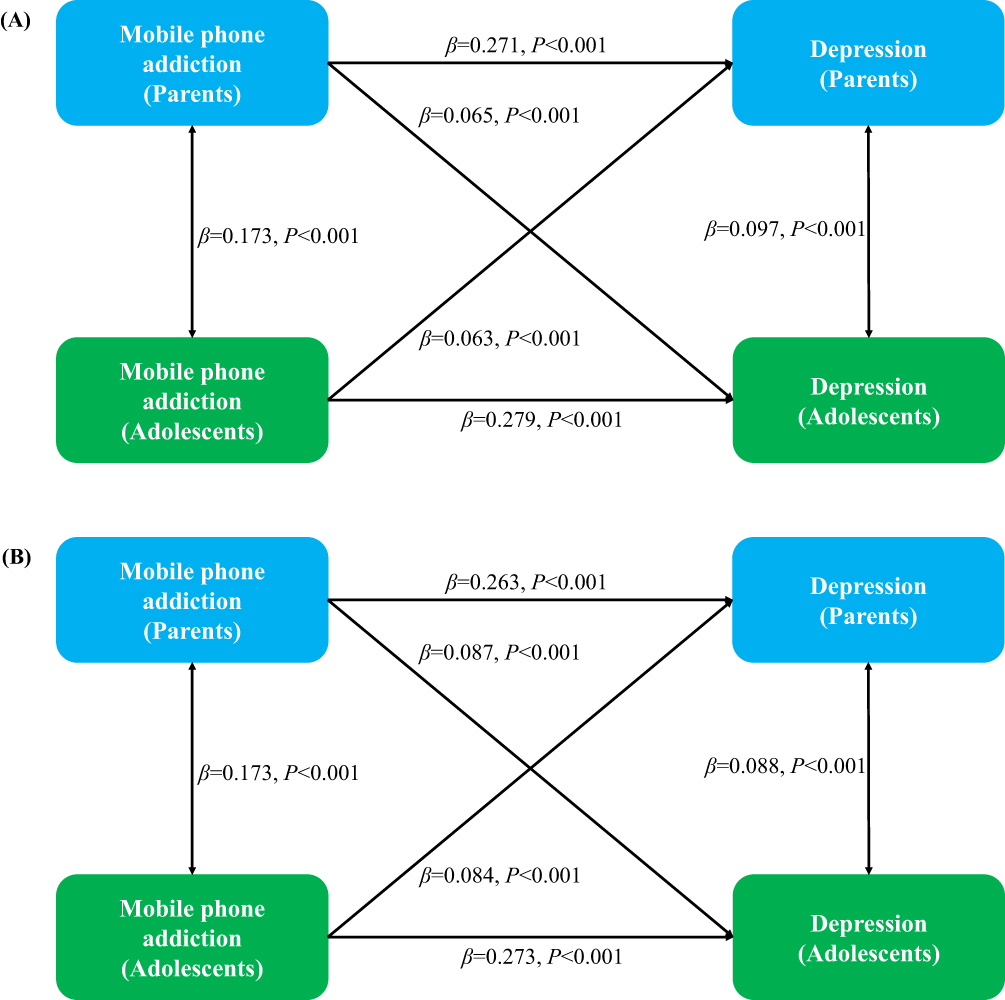 |
Figure 4 Actor and partner effects for parents and adolescent mobile phone addiction in relation to depression (N=4633). (A) Crude model without covariates; (B) Adjusted model controlling for gender and education level. |
Subsequently, after controlling for adolescents’ gender and education level, the APIM assessing the connection between mobile phone addiction and depression was updated, as shown in Table 4 and Figure 4B. The adjusted model (Model 2) continued to distinguish between actor and partner effects, consistent with the initial model (Model 1). Parents’ mobile phone addiction was positively associated with both their own and adolescents’ depression (βparents = 0.263, 95% CI: 0.231–0.263, P < 0.001; βadolescents = 0.087, 95% CI: 0.073–0.101, P < 0.001). Moreover, adolescents’ mobile phone addiction was significantly associated with their own depression (β = 0.273, 95% CI: 0.254–0.292, P < 0.001) as well as parents’ depression (β = 0.084, 95% CI: 0.070–0.098, P < 0.001).
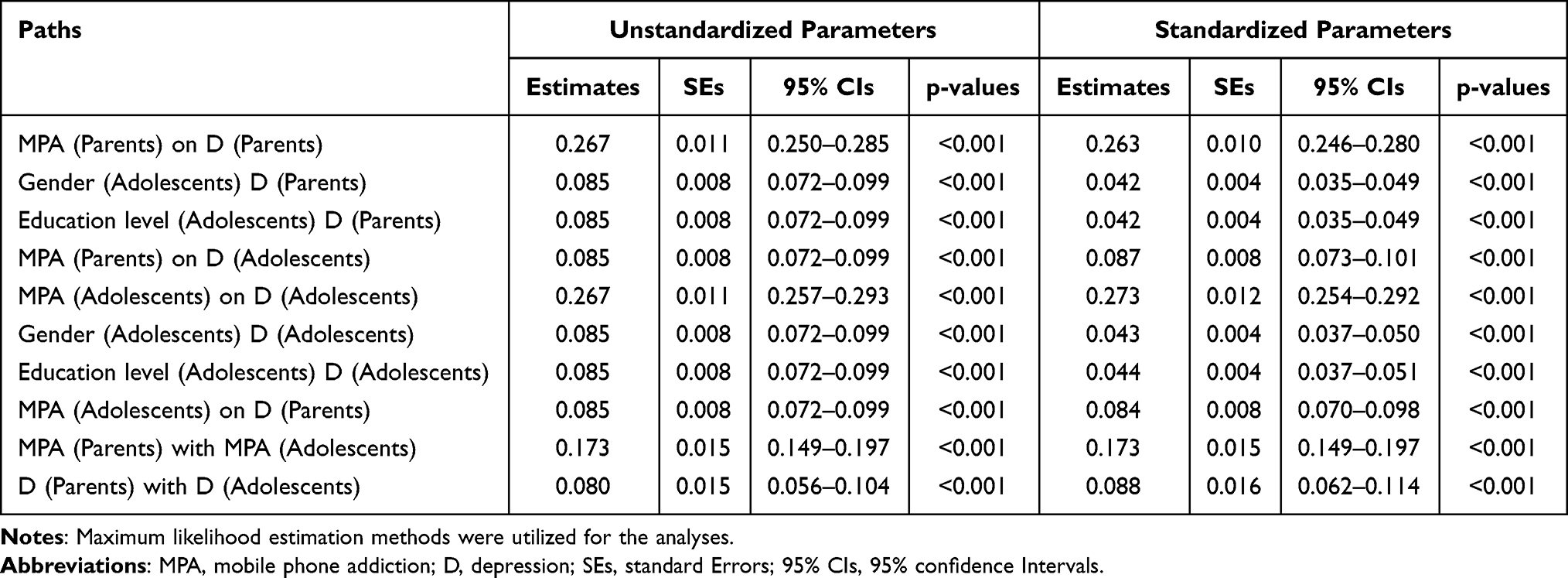 |
Table 4 The Actor-Partner Interdependence Model of Mobile Phone Addiction and Depression (Adjusted Model, N=4633) |
The analysis of dyadic interdependence concerning the link between mobile phone addiction and anxiety also yielded significant results. The overall model showed a satisfactory fit (χ² (2) =21.359, CFI = 0.975, TLI = 0.939, RMSEA = 0.046, SRMR = 0.018). As shown in Figure 5A, increased mobile phone addiction in both parents and adolescents was significantly correlated with greater anxiety (βparents = 0.250, 95% CI: 0.233–0.266, P < 0.001; βadolescents = 0.255, 95% CI: 0.237–0.275, P < 0.001). Besides, two partner effects were identified: parents’ mobile phone addiction was associated with adolescents’ anxiety (β = 0.062, 95% CI: 0.045–0.079, P < 0.001), and adolescents’ mobile phone addiction correlated with increased anxiety in parents (β = 0.061, 95% CI: 0.044–0.078, P < 0.001). Table 3 summarizes the unstandardized and standardized parameters of each path.
 |
Figure 5 Actor and partner effects for parents and adolescent mobile phone addiction in relation to anxiety (N=4633). (A) Crude model without covariates; (B) Adjusted model controlling for gender and education level. |
Following adjustments for covariates, the modified model is presented in Table 5 and Figure 5B. Analysis revealed significant actor effects, indicating that both parents’ and adolescents’ mobile phone addiction was associated with their own anxiety (βparents = 0.243, 95% CI: 0.226–0.260, P < 0.001; βadolescents = 0.251, 95% CI: 0.232–0.270, P < 0.001). Additionally, partner effects were evident, with parents’ mobile phone addiction linking with adolescents’ anxiety (β = 0.080, 95% CI: 0.067–0.094, P < 0.001) and adolescents’ mobile phone addiction similarly correlating with parents’ anxiety (β = 0.078, 95% CI: 0.064–0.091, P < 0.001).
 |
Table 5 The Actor-Partner Interdependence Model of Mobile Phone Addiction and Anxiety (Adjusted Model, N=4633) |
The FDR values ranged from 0.02500 to 0.00625. Notably, all path coefficients yielded P values less than 0.001, indicating that the above effects are statistically significant and robust.
Sensitivity Analyses
To enhance the validity and reliability of the findings, sensitivity analyses stratified by adolescents’ gender were conducted. The actor and parter effects were found to be significantly robust across both groups, confirming the consistency of the results. Notably, the actor effect of mobile phone addiction on depression was more pronounced in both parents and adolescents within the male adolescent group compared to the female group, as well as in the correlation between parents’ mobile phone addiction and adolescents’ depression (see Table S5). Likewise, the actor effect of mobile phone addiction on anxiety, along with the link between parents’ mobile phone addiction and adolescents’ anxiety, showed greater relevance in the male adolescent group than in the female group (Table S6).
Discussion
The findings indicate that mobile phone addiction is not merely an individual issue but a relational phenomenon, exhibiting significant correlations with depression and anxiety among both parents and adolescents. By examining these dynamics, we can better understand the potential underlying mechanisms that contribute to mental health challenges within familial contexts.
The significant actor effects observed suggest that both parents and adolescents experience a direct reciprocal influence between mobile phone addiction and mental health. For parents, reliance on mobile phones as a coping mechanism for stress may lead to increased feelings of isolation and reduced engagement in meaningful family interactions.45 This withdrawal has the potential to further exacerbate depressive and anxiety symptoms, as parents may miss opportunities for emotional support from their children.46 The stress-coping model serves as a useful framework for understanding this phenomenon. Instead of facilitating communication, excessive mobile phone use could potentially emerge as a maladaptive strategy, hindering emotional connection and support within the family.45,47 Similarly, adolescents, who are typically navigating a developmental stage centered on identity exploration, are likely to resort to mobile phones as a means to cope with the mimetic, coercive, and normative stress present in their social environments.48 The immersive nature of smartphones may impede the development of healthy coping strategies, making it difficult for adolescents to manage stress effectively.10 As they increasingly rely on digital interactions, they might find themselves trapped in a cycle of addiction that heightens feelings of anxiety and depression.49
The significant impact of parents’ mobile phone addiction on adolescents’ mental health aligns with social learning theory, which posits that behaviors are frequently modeled and imitated within family settings.50 When parents engage excessively with their mobile phones, adolescents may internalize these behaviors, leading to similar patterns of addiction.51 Besides, if parents prioritize their mobile phones over meaningful family interactions, adolescents may feel neglected, fostering feelings of anxiety and depression.52 Conversely, when adolescents exhibit high levels of mobile phone addiction, parents may experience increased anxiety and depression due to concerns about the adverse effects of such addiction on their children’s mental health, academic performance, and social skills.53–55 The observed partner effects might be explained by co-regulation theory, which suggests that two individuals mutually influence each other’s emotional and physiological states.56 Furthermore, consistent co-regulation strengthens the parent-teen bond and fosters vital self-regulation skills, benefiting both parties and leading to improved life outcomes.56,57
The correlation between parents’ and adolescents’ mental health suggests a bidirectional influence that aligns with family systems theory.13 This theory emphasizes that family members influence one another’s behaviors and emotional states.13 As parents and adolescents navigate their respective challenges with mobile phone addiction, their mental health can become intertwined, leading to shared experiences of distress. For instance, if parents experience elevated levels of anxiety or depression, this can lead to a less supportive and nurturing environment, which may hinder adolescents’ ability to thrive emotionally.58,59 Adolescents are particularly sensitive to their parents’ emotional states, and negative mental health outcomes can manifest in their own experiences, leading to increased vulnerability to anxiety and depressive symptoms.60 In turn, if adolescents exhibit significant mental health challenges, this can heighten parental stress and anxiety, creating further strain within the family unit.61
Strengths and Limitations
This study’s strengths lie in its application of the APIM, which provides a comprehensive framework for understanding parent–adolescent dyadic relationships in mobile phone addiction and mental health. The utilization of a large dataset further enhances the robustness of the findings, providing nuanced insights into the interplay between individual and relational factors. Nonetheless, there are several limitations to consider. The cross-sectional nature of the research restricts the ability to establish causality, and reliance on self-reported measures may introduce social desirability bias.62,63 Mobile phone addiction was assessed using brief and non‑equivalent item sets, observed relationship may be underestimated.64 Additionally, as the study was conducted in a specific area of China, the generalizability of the findings to broader populations may be limited.
Implications for Research and Practice
Our study has several implications. From a research standpoint, future investigations should employ longitudinal designs and utilize more comprehensive and invariant scales to better capture the evolving nature of these relationships. Additionally, contextual factors such as socioeconomic status and family structure should be considered, thereby deepening our insight into how mobile phone addiction and mental health interact within family settings. Given that this study is based on a sample from China, it is also recommended that cross-cultural replication research be conducted. From a practical perspective, schools may consider implementing initiatives to promote healthy technology use among students, and community organizations could establish support groups for individuals who are affected. Furthermore, healthcare providers could develop co-regulation programs for parents and adolescents to help them enhance their emotional connections and improve coping strategies, creating a comprehensive approach to address these challenges and foster healthier family dynamics.57
Conclusions
This study highlights the intricate relationship between mobile phone addiction and mental health outcomes among parents and adolescents within a cross-sectional framework. Future research may consider family-based interventions that address phone use patterns, communication, and coping strategies to promote healthier habits and mental well-being. Longitudinal research and more comprehensive measurement approaches are needed to further elucidate these relationships.
Data Sharing Statement
The data supporting the findings of this study are available from the two corresponding authors (Dr. Shi-Bin Wang, [email protected], and Dr. Wenze Lu, [email protected]) upon reasonable request.
Ethics Approval and Consent to Participate
Informed consent was obtained from all participants, and they were informed that their information would remain confidential. Participants were allowed to withdraw from the study at any desired time. Approval was obtained from the Research Ethics Committee of Guangdong Provincial People’s Hospital, Guangzhou Academy of Medical Sciences (No. KY-Z-2022-063-02, KY2025-885-02). The study was performed per the national legislation and institutional requirements. All methods were performed per the Declaration of Helsinki.
Acknowledgments
The authors would like to acknowledge all respondents, interviewers, and the support from the Health Commission of Guangdong Province.
Author Contributions
All authors made a significant contribution to the work reported, whether that is in the conception, study design, execution, acquisition of data, analysis and interpretation, or in all these areas; took part in drafting, revising or critically reviewing the article; gave final approval of the version to be published; have agreed on the journal to which the article has been submitted; and agree to be accountable for all aspects of the work.
Funding
This study was supported by the Medical Scientific Research Foundation of Guangdong Province of China (No. C2022010) and the Research Funds of the National Center for Mental Health, China (No. 2025-134).
Disclosure
All authors declare that they have no conflict of interest.
References
1. Marie H. Mobile Apps: A Trend in Language Learning? Assessing the Engagement of Independent Learners with New Media. University of Bedfordshire; 2021.
2. Gao Q, Sun R, Li B, et al. How different levels of mobile phone addiction relate to adolescent depressive symptoms: the mediating role of parent-adolescent relationships. J Psychopathol Behavioral Assessment. 2022;44(4):1099–15. doi:10.1007/s10862-022-09993-5
3. Shanmugasundaram M, Tamilarasu A. The impact of digital technology, social media, and artificial intelligence on cognitive functions: a review. Front Cognition. 2023;2:1203077.
4. Xia X, Qin S, Zhang S. Leisure experience and mobile phone addiction: evidence from Chinese adolescents. Heliyon. 2024;10(3):e24834. doi:10.1016/j.heliyon.2024.e24834
5. Qiu C, Li R, Luo H, et al. Parent-Child relationship and smartphone addiction among chinese adolescents: a longitudinal moderated mediation model. Addict Behav. 2022;130:107304
6. Zhou H, Dang L, Lam LW, et al. A Cross-Lagged Panel Model for Testing the Bidirectional Relationship Between Depression and Smartphone Addiction and the Influences of Maladaptive Metacognition on Them in Chinese Adolescents. Addict Behav. 2021;120:106978
7. Kaplan V, Düken ME, Kaçkin Ö, et al. An investigation of adolescents’ social media use and self-perceptions in the framework of peer bullying. J Psychol Perspective. 2023;5(1):35–44. doi:10.47679/jopp.515102023
8. Zhang C, Jiang Y, Zhu C, et al. Parent-child relationship and problematic smartphone use among Chinese adolescents: a moderated mediation model. Curr Psychol. 2022:1–15.
9. Zhou N, Liang Y, Cao H, et al. Chinese adolescents’ problematic cellphone use: exploring the implications of configuration profiles of cellphone-specific parenting behaviors. Comput Human Behav. 2022;137:107408. doi:10.1016/j.chb.2022.107408
10. Lu G-L, Ding Y-M, Zhang Y-M, et al. The correlation between mobile phone addiction and coping style among Chinese adolescents: a meta-analysis. Child Adolescent Psychiatry Mental Health. 2021;15(1):60. doi:10.1186/s13034-021-00413-2
11. Li Y, Li G, Liu L, et al. Correlations between mobile phone addiction and anxiety, depression, impulsivity, and poor sleep quality among college students: a systematic review and meta-analysis. J Behav Addict. 2020;9(3):551–571. doi:10.1556/2006.2020.00057
12. Sahu M, Gandhi S, Sharma MK. Mobile phone addiction among children and adolescents: a systematic review. J Addict Nurs. 2019;30(4):261–268. doi:10.1097/JAN.0000000000000309
13. White JM. Understanding family process: basics of family systems theory (Book). J Comp Family Stud. 1993;26(2):281–282.
14. Yan J, Sakahara T, Chen S, et al. Cultural stress, parenting practices, and mental health among Mexican-origin mothers and adolescents: a dyadic approach. Dev Psychol. 2025;61(7):1292–1305. doi:10.1037/dev0001954
15. Proctor KR, Niemeyer RE. Retrofitting social learning theory with contemporary understandings of learning and memory derived from cognitive psychology and neuroscience. J Criminal Justice. 2020;66:101655. doi:10.1016/j.jcrimjus.2019.101655
16. Gong J, Zhou Y, Wang Y, et al. How parental smartphone addiction affects adolescent smartphone addiction: the effect of the parent-child relationship and parental bonding. J Affect Disord. 2022;307:271–277. doi:10.1016/j.jad.2022.04.014
17. Mun IB, Lee S. How does parental smartphone addiction affect adolescent smartphone addiction?: Testing the mediating roles of parental rejection and adolescent depression. Cyberpsychol Behav Soc Netw. 2021;24(6):399–406. doi:10.1089/cyber.2020.0096
18. Solecki S. The phubbing phenomenon: the impact on parent-child relationships. J Pediatr Nurs. 2022;62:211–214. doi:10.1016/j.pedn.2021.09.027
19. Borelli JL, Compare A, Snavely JE, et al. Reflective functioning moderates the association between perceptions of parental neglect and attachment in adolescence. Psychoanalytic Psychol. 2015;32(1):23–35. doi:10.1037/a0037858
20. Sun R, Gao Q, Xiang Y, et al. Parent–child relationships and mobile phone addiction tendency among Chinese adolescents: the mediating role of psychological needs satisfaction and the moderating role of peer relationships. Child Youth Services Rev. 2020;116:105113. doi:10.1016/j.childyouth.2020.105113
21. McDaniel BT, Uva S, Pater J, et al. Daily smartphone use predicts parent depressive symptoms, but parents’ perceptions of responsiveness to their child moderate this effect. Front Develop Psychol. 2024;2. doi:10.3389/fdpys.2024.1421717
22. Selak MB, Merkaš M, Žulec Ivanković A. Effects of parents’ smartphone use on children’s emotions, behavior, and subjective Well-Being. Eur J Investig Health Psychol Educ. 2025;15(1).
23. Daches S, Vine V, Layendecker KM, et al. Family functioning as perceived by parents and young offspring at high and low risk for depression. J Affect Disord. 2018;226:355–360. doi:10.1016/j.jad.2017.09.031
24. Keijser R, Olofsdotter S, Nilsson KW, et al. The influence of parenting styles and parental depression on adolescent depressive symptoms: a cross-sectional and longitudinal approach. Mental Health Prev. 2020;20:200193. doi:10.1016/j.mhp.2020.200193
25. Jiang YL, Lv ZY, Zhou Y, et al. Application of the actor-partner interdependence model in parent-adolescent mental health knowledge and depression. J Adv Nurs. 2024;2024.
26. Wilkinson K, Ball S, Mitchell SB, et al. The longitudinal relationship between child emotional disorder and parental mental health in the British child and adolescent mental health surveys 1999 and 2004. J Affect Disord. 2021;288:58–67. doi:10.1016/j.jad.2021.03.059
27. Lam LT. The roles of Parent-and-Child mental health and parental internet addiction in adolescent internet addiction: does a parent-and-child gender match matter? Front Public Health. 2020;8:142.
28. Campbell L, Stanton SCE.Actor–Partner interdependence model.Encyclopedia Clin Psychol. 2015;2015. 1–7
29. Dong M, Lu W, Zeng X, et al. Prevalence and correlates of generalized anxiety disorder and subthreshold anxiety symptoms in south China: a network perspective. J Affect Disord. 2025;379:232–240. doi:10.1016/j.jad.2025.03.026
30. Zhong SL, Wang S-B, Ding K-R, et al. Low mental health literacy is associated with depression and anxiety among adults: a population-based survey of 16,715 adults in China. BMC Public Health. 2024;24(1):2721. doi:10.1186/s12889-024-20020-y
31. Liao DD, Dong M, Ding K-R, et al. Prevalence and patterns of major depressive disorder and subthreshold depressive symptoms in south China. J Affect Disord. 2023;329:131–140. doi:10.1016/j.jad.2023.02.069
32. Cheung T, Lee RLT, Tse ACY, et al. Psychometric properties and demographic correlates of the smartphone addiction scale-short version among chinese children and adolescents in Hong Kong. Cyberpsychol Behav Soc Network. 2019;22(11):714–723. doi:10.1089/cyber.2019.0325
33. Spitzer RL, Kroenke K, Williams JB. Validation and utility of a self-report version of PRIME-MD: the PHQ primary care study. JAMA. 1999;282(18):1737–1744. doi:10.1001/jama.282.18.1737
34. Wang W, Bian Q, Zhao Y, et al. Reliability and validity of the Chinese version of the patient health questionnaire (PHQ-9) in the general population. Gen Hosp Psychiatry. 2014;36(5):539–544. doi:10.1016/j.genhosppsych.2014.05.021
35. Chen R, Zhu X, Wright L, et al. Suicidal ideation and attempted suicide amongst Chinese transgender persons: national population study. J Affect Disord. 2019;245:1126–1134. doi:10.1016/j.jad.2018.12.011
36. Chen X, Qi H, Liu R, et al. Depression, anxiety and associated factors among Chinese adolescents during the COVID-19 outbreak: a comparison of two cross-sectional studies. Transl Psychiatry. 2021;11(1):148. doi:10.1038/s41398-021-01271-4
37. Primack BA, Swanier B, Georgiopoulos AM, et al. Association between media use in adolescence and depression in young adulthood: a longitudinal study. Arch Gen Psych. 2009;66(2):181–188. doi:10.1001/archgenpsychiatry.2008.532
38. Spitzer RL, Kroenke K, Williams JBW, et al. A brief measure for assessing generalized anxiety disorder: the GAD-7. Archiv Intern Med. 2006;166(10):1092–1097. doi:10.1001/archinte.166.10.1092
39. Xu WQ, Tan W-Y, Li X-L, et al. Prevalence and correlates of depressive and anxiety symptoms among adults in Guangdong Province of China: a population-based study. J Affect Disord. 2022;308:535–544. doi:10.1016/j.jad.2022.04.089
40. Kline RB. Principles and Practice of Structural Equation Modeling, 4th Ed. Principles and Practice of Structural Equation Modeling, 4th Ed. New York, NY, US: The Guilford Press; 2016:xvii,534–xvii,534.
41. Chen PY, Jan YW, Yang CM. Are the insomnia severity index and pittsburgh sleep quality index valid outcome measures for cognitive behavioral therapy for insomnia? Inquiry from the perspective of response shifts and longitudinal measurement invariance in their Chinese versions. Sleep Med. 2017;35:35–40. doi:10.1016/j.sleep.2017.04.003
42. Schermelleh-Engel K, Moosbrugger H, Müller H. Evaluating the fit of structural equation models: tests of significance and descriptive goodness-of-fit measures. Methods Psychol Res Online. 2003;8(2):23–74.
43. Brydges CR. Effect size guidelines, sample size calculations, and statistical power in gerontology. Innov Aging. 2019;3(4):igz036. doi:10.1093/geroni/igz036
44. Djimeu EW, Houndolo D-G. Power calculation for causal inference in social science: sample size and minimum detectable effect determination. J Develop Effect. 2016;8(4):508–527. doi:10.1080/19439342.2016.1244555
45. Wolfers LN. Parental mobile media use for coping with stress: a focus groups study. Human Behav Emerg Technol. 2021;3(2):304–315. doi:10.1002/hbe2.252
46. McDaniel BT. Parent distraction with phones, reasons for use, and impacts on parenting and child outcomes: a review of the emerging research. Human Behav Emerg Technol. 2019;1(2):72–80. doi:10.1002/hbe2.139
47. Zhang A, Xiong S, Peng Y, et al. Perceived stress and mobile phone addiction among college students: the roles of self-control and security. Front Psych. 2022;13:1005062.
48. Bai H, Liu J, Bai W, et al. Social pressures and their impact on smartphone use stickiness and use habit among adolescents. Heliyon. 2024;10(7):e29111. doi:10.1016/j.heliyon.2024.e29111
49. Pera A, Fultz EK, Ferdousian S. The psychology of addictive smartphone behavior in young adults: problematic use, social anxiety, and depressive stress. Front Psych. 2020;11:11. doi:10.3389/fpsyt.2020.00011
50. Bandura A, Walters RH. Social Learning Theory. Vol. 1. Prentice hall Englewood Cliffs, NJ; 1977.
51. Doo EY, Kim JH. Parental Smartphone Addiction and Adolescent Smartphone Addiction by Negative Parenting Attitude and Adolescent Aggression: A Cross-Sectional Study. Vol. 10. Front Public Health; 2022:981245.
52. Huang XC, Zhang Y-N, Wu X-Y, et al. A cross-sectional study: family communication, anxiety, and depression in adolescents: the mediating role of family violence and problematic internet use. BMC Public Health. 2023;23(1):1747. doi:10.1186/s12889-023-16637-0
53. Lam LT. Parental mental health and internet addiction in adolescents. Addict Behav. 2015;42:20–23. doi:10.1016/j.addbeh.2014.10.033
54. Luo J, Cai G, Zu X, et al. Mobile phone addiction and negative emotions: an empirical study among adolescents in Jiangxi Province. Front Psych. 2025;16:1541605.
55. Akhtar F, Patel PK, Heyat MB, et al. Smartphone addiction among students and its harmful effects on mental health, oxidative stress, and neurodegeneration towards future modulation of anti-addiction therapies: a comprehensive survey based on SLR, research questions, and network visualization techniques. CNS Neurol Disord. 2023;22(7):1070–1089.
56. Kostøl EMF, Kovač VB. Co-regulation in dyadic parent–child relationships: a video analysis of well-functioning interactions. Early Child Develop Care. 2024;194(1):72–86. doi:10.1080/03004430.2023.2282357
57. Khurana A, Leonard H, Michaelson L, et al. Transactional linkages between parenting behaviors and child executive functions and self-regulation from early childhood to adolescence. J Pers Oriented Res. 2024;10(1):26–55. doi:10.17505/jpor.2024.26261
58. Van Loon LMA, Van de Ven MOM, Van Doesum KTM, et al. The relation between parental mental illness and adolescent mental health: the role of family factors. J Child Family Stud. 2014;23(7):1201–1214. doi:10.1007/s10826-013-9781-7
59. Apsley HB, Padilla-Walker LM. Longitudinal links between parents’ mental health, parenting, and adolescents’ mental health: moderation by adolescent sex. J Family Psychol. 2020;34(7):886–892. doi:10.1037/fam0000788
60. Chiang SC, Ting S-J, Chen W-C, et al. Parent and adolescent emotional variability and adolescent psychopathology. J Fam Psychol. 2023;37(4):538–546. doi:10.1037/fam0001069
61. Maciejewski DF, van Lier PAC, Neumann A, et al. The development of adolescent generalized anxiety and depressive symptoms in the context of adolescent mood variability and parent-adolescent negative interactions. J Abnormal Child Psychol. 2014;42(4):515–526. doi:10.1007/s10802-013-9797-x
62. Maier C, Thatcher JB, Grover V, et al. Cross-sectional research: a critical perspective, use cases, and recommendations for IS research. Int J Inform Manage. 2023;70:102625. doi:10.1016/j.ijinfomgt.2023.102625
63. Mortel VD, Thea FG. Faking it: social desirability response bias in self-report research. Australian J Advanc Nurs. 2008;25:40–48.
64. Bowdle BF, Gentner D. Informativity and Asymmetry in Comparisons. Cognitive Psychol. 1997;34(3):244–286. doi:10.1006/cogp.1997.0670
 © 2026 The Author(s). This work is published and licensed by Dove Medical Press Limited. The
full terms of this license are available at https://www.dovepress.com/terms
and incorporate the Creative Commons Attribution
- Non Commercial (unported, 4.0) License.
By accessing the work you hereby accept the Terms. Non-commercial uses of the work are permitted
without any further permission from Dove Medical Press Limited, provided the work is properly
attributed. For permission for commercial use of this work, please see paragraphs 4.2 and 5 of our Terms.
© 2026 The Author(s). This work is published and licensed by Dove Medical Press Limited. The
full terms of this license are available at https://www.dovepress.com/terms
and incorporate the Creative Commons Attribution
- Non Commercial (unported, 4.0) License.
By accessing the work you hereby accept the Terms. Non-commercial uses of the work are permitted
without any further permission from Dove Medical Press Limited, provided the work is properly
attributed. For permission for commercial use of this work, please see paragraphs 4.2 and 5 of our Terms.
Recommended articles

Subjective Sleep Disruption and Mood Disorders are Associated with the Risk of Chronic Pain in Patients with Obstructive Sleep Apnea
Liu L, Li X, Xue P, Wu M, Zeng S, Dai Y, Zhou J
Nature and Science of Sleep 2022, 14:2023-2032
Published Date: 7 November 2022
Vitamin B12, Folate, Homocysteine, Inflammatory Mediators (Interleukin-6, Tumor Necrosis Factor-α and C-Reactive Protein) Levels in Adolescents with Anxiety or Depressive Symptoms
Tan Y, Zhou L, Huang J, Chen X, Wu Y, Song X, Wang J, Hu H, Yang Q
Neuropsychiatric Disease and Treatment 2023, 19:785-800
Published Date: 7 April 2023
AI Technology panic—is AI Dependence Bad for Mental Health? A Cross-Lagged Panel Model and the Mediating Roles of Motivations for AI Use Among Adolescents
Huang S, Lai X, Ke L, Li Y, Wang H, Zhao X, Dai X, Wang Y
Psychology Research and Behavior Management 2024, 17:1087-1102
Published Date: 12 March 2024
The Influence of Negative Emotions on Mobile Phone Addiction Among Chinese College Students: The Mediating Role of Negative Coping Styles and the Moderating Role of Gender
Pan J, Guo J, Wu Y, Zhao X
Psychology Research and Behavior Management 2025, 18:3-13
Published Date: 6 January 2025
Mushrooms, Microdosing, and Mental Illness: The Effect of Psilocybin on Neurotransmitters, Neuroinflammation, and Neuroplasticity
Kinderlehrer DA
Neuropsychiatric Disease and Treatment 2025, 21:141-155
Published Date: 29 January 2025