
Back to Journals » Diabetes, Metabolic Syndrome and Obesity » Volume 19
Obesity-Related Insulin Resistance Indices and CKD Risk in Patients with Diabetes and Coronary Heart Disease: A Multicenter Cohort Analysis
Authors Zhang J, Zhang Z, He Y, Liu S, Zhao J  , Ge X
Received 19 March 2026
Accepted for publication 8 June 2026
Published 26 June 2026 Volume 2026:19 610602
DOI https://doi.org/10.2147/DMSO.S610602
Checked for plagiarism Yes
Review by Single anonymous peer review
Peer reviewer comments 3
Editor who approved publication: Dr Rebecca Baqiyyah Conway
Jianwei Zhang,1,* Zherui Zhang,2,* Yuanyuan He,3 Shanshan Liu,4 Junjie Zhao,5 Xiaofang Ge5
1Department of Cardiology, Changzhi People’s Hospital, Changzhi, People’s Republic of China; 2School of Public Health, Jilin University, Changchun, People’s Republic of China; 3Department of Cardiology, The Affiliated Hospital of Southwest Medical University, Sichuan, People’s Republic of China; 4Department of Cardiology, Anyang People’s Hospital, Anyang, People’s Republic of China; 5Emergency and Critical Care Center, Department of Emergency Medicine, Zhejiang Provincial People’s Hospital (Affiliated People’s Hospital), Hangzhou Medical College, Hangzhou, Zhejiang, People’s Republic of China
*These authors contributed equally to this work
Correspondence: Junjie Zhao, Emergency and Critical Care Center, Department of Emergency Medicine, Zhejiang Provincial People’s Hospital (Affiliated People’s Hospital), Hangzhou Medical College, Hangzhou, Zhejiang, People’s Republic of China, Email [email protected] Xiaofang Ge, Emergency and Critical Care Center, Department of Emergency Medicine, Zhejiang Provincial People’s Hospital (Affiliated People’s Hospital), Hangzhou Medical College, Hangzhou, Zhejiang, People’s Republic of China, Email [email protected]
Background: Chronic kidney disease (CKD) is primarily caused by diabetes, a condition frequently complicated by obesity and insulin resistance (IR)—factors that also promote the development of diabetes and coronary heart disease (CHD). Consequently, whether the obesity-related IR index independently increases CKD risk requires further exploration.
Methods: A total of 7741 patients with coexisting diabetes and CHD from three centers were included in this study. Multivariable-adjusted Cox regression analyses were performed to investigate the associations between four obesity-related IR indices—weight-adjusted-waist index (WWI), triglyceride glucose-body mass index (TyG-BMI), TyG combined with waist circumference (TyG-WC), and metabolic score for visceral fat (METS-VF)—and the risk of CKD in patients with concomitant diabetes and CHD. Restricted cubic splines (RCS) were plotted to further explore potential threshold effects. The predictive ability and incremental predictive value of these indices were evaluated using receiver operating characteristic (ROC) curves, time-dependent ROC curves, decision curve analysis (DCA), and the C-index.
Results: Obesity-related IR indices were closely associated with an increased risk of CKD in patients with diabetes and CHD, with evidence of threshold effects. Notably, the risk became particularly pronounced when WWI, TyG-BMI, TyG-WC, and METS-VF exceeded 11.2 cm/√kg, 245 kg/m2, 530 cm, and 6.2 mg/dL*kg/m2, respectively. Furthermore, ROC analysis, time-dependent ROC curves, DCA, and the C-index consistently demonstrated that METS-VF possessed the greatest predictive capacity and the highest incremental predictive value among the four indices.
Conclusion: Obesity-related IR indices are significantly associated with an increased risk of CKD in patients with diabetes and CHD. Notably, METS-VF, which reflects visceral obesity and IR, demonstrated the strongest predictive capacity among the indices. These findings may have important implications for CKD risk assessment and clinical intervention in this high-risk population.
Keywords: obesity-related insulin resistance indices, Insulin resistance, coronary heart disease, diabetes, chronic kidney disease
Introduction
Chronic kidney disease (CKD) is a chronic condition characterized by structural or functional abnormalities of the kidney resulting from a persistent and significant decline in renal function.1,2 Its primary clinical manifestations are impaired glomerular filtration and the presence of proteinuria.2 The long-term, progressive deterioration of renal function leads to complications such as fluid and sodium retention and electrolyte imbalances, which in turn precipitate a cascade of disorders affecting the cardiac, skeletal, and hematological systems.3–6 Notably, cardiovascular mortality is the leading cause of death in patients with end-stage renal disease.4,5 Diabetes and hypertension are the two principal causes of CKD.7–9 Patients with diabetes frequently present with concomitant obesity and insulin resistance (IR).10,11 Crucially, these very factors—diabetes, IR, and obesity—are also major contributors to the pathogenesis of coronary heart disease (CHD).12,13 Therefore, for patients with both diabetes and CHD, the prevention of CKD is of paramount importance to mitigate disease progression and reduce the overall disease burden.
Traditionally, strategies for preventing CKD in this high-risk population have been predominantly confined to glycemic and blood pressure (BP) control.8,14 Consequently, the detrimental impact of obesity and IR on renal health has often been underappreciated and inadequately addressed. Prior research has largely framed obesity and IR as underlying causes of glucose and lipid metabolism disorders.15,16 However, whether they function as independent risk factors for renal injury and the subsequent development of CKD has been a subject of limited investigation.
Emerging evidence is now beginning to illuminate the direct role of obesity and IR in renal pathology.17–20 For instance, a study from the United Kingdom indicated that obese individuals have a significantly higher incidence of CKD, suggesting a potential benefit of weight loss in reducing CKD risk.17 Similarly, IR has been implicated as a key driver of CKD, with research demonstrating its association with declining renal function in middle-aged and older adults.19 It is proposed that IR may mediate the onset of CKD through its interaction with adiposity-related indicators.21
Given the complex pathophysiology of obesity and IR, traditional measures like body mass index (BMI) may not accurately reflect an individual’s true metabolic and adiposity status.22,23 In response, recent studies have increasingly utilized and validated composite indices that better capture visceral obesity and IR. These include the weight-adjusted-waist index (WWI), the triglyceride glucose-body mass index (TyG-BMI), TyG combined with waist circumference (TyG-WC), and the metabolic score for visceral fat (METS-VF).22,24–26 These novel indices are believed to provide a more precise assessment of an individual’s internal obesity profile and insulin sensitivity and have demonstrated superior diagnostic and predictive value for a variety of diseases.22,23,26 Notably, studies have confirmed that IR indices are associated with decreased kidney function in the general population and mediate the occurrence of CKD.19,21 Furthermore, basic research has further revealed that visceral obesity, as represented by METS-VF, may impair renal function through pathways including lipid accumulation, long-term chronic low-grade inflammation, and excessive activation of the renin-angiotensin-aldosterone system (RAAS).27,28 Collectively, these lines of evidence from both epidemiological and basic research provide an important theoretical basis for our study.
However, within the specific, high-risk population of patients with coexisting diabetes and CHD—who are inherently prone to obesity and IR, which in turn exacerbate poor glycemic control and accelerate vascular damage—the relationship between these factors and CKD risk remains unclear. It is unknown whether obesity and IR in this group are associated with an increased risk of incident CKD.
To address this knowledge gap, this study aims to investigate the association between obesity-related IR indices and the risk of CKD in patients with diabetes and CHD. By doing so, we seek to provide crucial epidemiological evidence to inform future strategies focused on weight management and metabolic improvement for the effective preservation of renal function in this vulnerable population.
Materials and Methods
Study Design and Population
This multicenter cohort study was conducted across three centers, enrolling patients with concomitant diabetes and CHD from the Changzhi People’s Hospital, West Southwest Medical University Affiliated Hospital, and Anyang People’s Hospital. A total of 9395 patients were initially screened. After excluding those with baseline CKD, acute coronary syndrome or coronary revascularization within the preceding three months, missing data for variables required to calculate obesity-related IR indices, malignant tumors, and use of any weight-loss medications, a final cohort of 7744 patients was included in the analysis. The detailed patient selection process is illustrated in Figure 1.
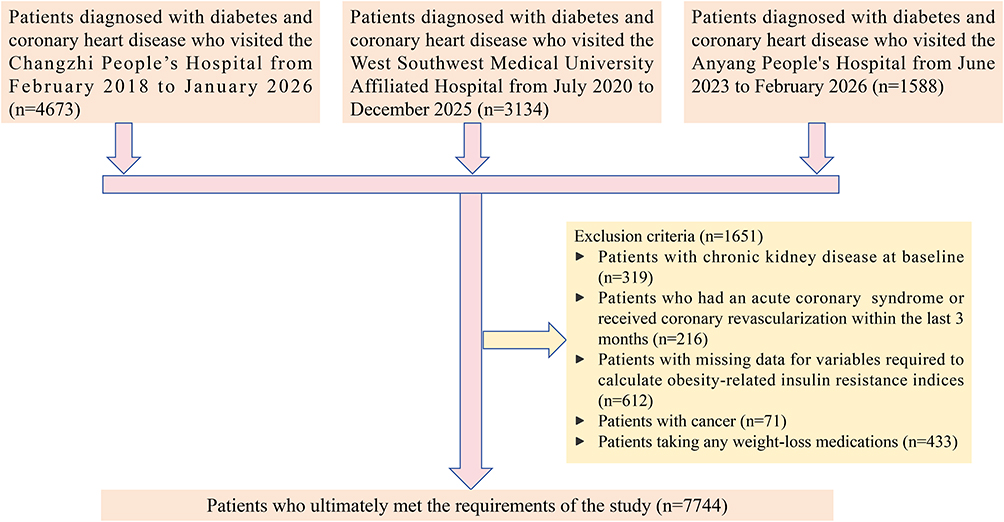 |
Figure 1 Selection of study population. |
This study was conducted in strict accordance with the Declaration of Helsinki. Ethical approval was obtained from the institutional review boards of all three participating hospitals: Changzhi People’s Hospital (Approval No. CZX.20180211), West Southwest Medical University Affiliated Hospital (Approval No. WSXN.20200711), and Anyang People’s Hospital (Approval No. N.20230607). Written informed consent was obtained from all participants prior to study initiation.
Collection of Covariates
Covariate data were systematically collected from multiple sources, including hospital electronic medical records, follow-up records, and medical insurance databases. The collected information encompassed demographic characteristics, physical examination findings, laboratory test results, medical history, and medication use. Demographic information and physical examination included patients’ sex, age, BMI, WC, systolic and diastolic BP, as well as smoking and alcohol consumption status. Laboratory measurements comprised the following: liver function parameters, total cholesterol (TC), triglycerides (TG), high-density lipoprotein cholesterol (HDL-C), low-density lipoprotein cholesterol (LDL-C), hemoglobin A1c (HbA1c), and fasting plasma glucose (FPG). Renal function was assessed by estimating the glomerular filtration rate (eGFR), which was calculated using the CKD-EPI equation adapted for the Chinese population.9,29 Medication history documented the use of various therapeutic agents, including antiplatelet drugs, lipid-lowering medications, beta-blockers, angiotensin-converting enzyme inhibitors (ACEIs)/angiotensin receptor blockers (ARBs), and insulin. Medical history primarily focused on the presence of hypertension and hyperlipidemia.
Calculation of Obesity-Related IR Indices
Obesity-related IR indices included WWI, TyG-BMI, TyG-WC, and METS-VF, and the specific calculation formulas were as follows:22,24,26
WWI = WC/√BMI.
TyG-BMI = Ln [(TG ×FPG)/2] × BMI.
TyG-WC = Ln [(TG ×FPG)/2] ×WC.
METS-IR = [ln((2 × FPG) + TG) × BMI] / ln(HDL-C).
METS-VF = 4.466 + 0.011 × [ln(METS-IR)]3 + 3.239 × [ln(WHtR)]3 + 0.319 × Sex (Female=0, Male=1) + 0.594 × ln(Age).
Outcomes
The primary endpoint of this study was the incidence of new-onset CKD. The diagnosis of CKD was established in accordance with the latest kidney disease clinical practice guidelines.30,31 Specifically, CKD was defined as the presence of either of the following criteria persisting for more than three months: (1) a persistently reduced eGFR of less than 60 mL/min/1.73 m2, calculated using the CKD-EPI equation; and/or (2) a persistently elevated urinary albumin-to-creatinine ratio of greater than 30 mg/g. To ensure the chronicity required for a definitive CKD diagnosis, at least two consecutive measurements meeting these criteria, obtained at different time points with an interval exceeding three months, were required. Cases of acute kidney injury were excluded from the outcome ascertainment.
Statistical Analysis
Participants were dichotomized based on the occurrence of the endpoint outcome, CKD, and baseline characteristics were compared between the two groups. Multivariable Cox regression analyses with stepwise adjustment were performed to investigate the association between obesity-related IR indices and the risk of CKD in patients with coexisting diabetes and CHD. To examine trend effects, these indices were categorized into four groups according to their quartiles. The Kaplan-Meier (KM) method was utilized to assess the cumulative incidence of CKD across different groups during the follow-up period. Restricted cubic splines (RCS) were plotted to evaluate the dose-response relationship, and a two-piecewise regression analysis was performed using the identified inflection point. Extensive subgroup analyses and sensitivity analyses were conducted to further verify the robustness of the findings. Finally, receiver operating characteristic (ROC) curves, time-dependent ROC curves, decision curve analysis (DCA), and the C-index were employed to assess the predictive ability of various obesity-related IR indices for CKD and their incremental predictive value to the baseline model.
All statistical analyses were performed using R software (version 4.4.1), and a two-tailed P-value < 0.05 was considered statistically significant.
Results
Comparison of Baseline Characteristics Between the Two Groups
A total of 7744 patients with diabetes and coronary heart disease were enrolled from three centers. During a median follow-up of 3.95 years, 1725 patients developed CKD. Table 1 presents the baseline characteristics of participants stratified by CKD occurrence.
 |
Table 1 Baseline Characteristics of CKD Patients and Non-CKD Patients |
Compared with those who did not develop CKD, patients who developed CKD were older and had significantly higher BMI, SBP, and DBP. They were more likely to consume alcohol but exhibited a lower smoking rate. Regarding laboratory parameters, the CKD group showed significantly higher levels of liver enzymes, TC, TG, HbA1c, and FPG, whereas HDL-C and eGFR were significantly lower. Additionally, patients who developed CKD had a higher prevalence of hypertension and hyperlipidemia and were more frequently prescribed lipid-lowering drugs, antiplatelet drugs, beta-blockers, ACEIs/ARBs, and insulin.
Impact of Obesity-Related IR Indices on CKD Risk in Patients with Diabetes and CHD
To evaluate the relationship between obesity-related IR indices and CKD, participants were initially stratified into four groups according to the quartiles of these indices, and the incidence of the endpoint outcome—CKD—was compared across the groups. The findings revealed a progressively higher incidence of CKD with increasing levels of the obesity-related IR indices, demonstrating a clear upward trend from the first quartile (Q1) to the fourth quartile (Q4) (Figure 2).
 |
Figure 2 Incidence of CKD across four obesity-related IR indices by group. (A) WWI; (B) TyG-BMI; (C) TyG-WC; (D) METS-VF. Q1: First quartile group; Q2: Second quartile group; Q3: Third quartile group; Q4: Fourth quartile group. |
Subsequently, multivariable-adjusted Cox regression analyses were conducted to further explore these associations. In the fully adjusted Model 5, each one-standard-deviation increase in the four obesity-related IR indices—WWI, TyG-BMI, TyG-WC, and METS-VF—was associated with a 32.0% (Hazard Ratio [HR]: 1.320, 95% confidence interval [CI]: 1.264–1.379), 39.4% (HR: 1.394, 95% CI: 1.333–1.457), 37.5% (HR: 1.375, 95% CI: 1.322–1.429), and 44.0% (HR: 1.440, 95% CI: 1.381–1.501) increased risk of CKD, respectively (Table 2).
 |
Table 2 Association Between Obesity-Related IR Indices and CKD Risk in Patients with Diabetes and CHD |
When these indices were analyzed as categorical variables based on quartiles, a graded increase in CKD risk was observed across higher quartiles (Q2–Q4) compared with the lowest quartile (Q1), with the highest risk observed in Q4 (Table 2). Specifically, participants in the Q4 groups of the four indices exhibited a 1.897-fold (HR: 1.897, 95% CI: 1.642–2.190), 2.358-fold (HR: 2.358, 95% CI: 2.034–2.735), 2.477-fold (HR: 2.477, 95% CI: 2.113–2.904), and 3.477-fold (HR: 3.477, 95% CI: 2.909–4.157) higher risk of CKD compared with those in the Q1 groups (Table 2). These findings were further corroborated by KM curve analysis, which demonstrated that the Q4 group consistently had the highest cumulative incidence of CKD throughout the follow-up period (Figure 3).
 |
Figure 3 Kaplan-Meier curves for CKD risk across different groups. (A) WWI; (B) TyG-BMI; (C) TyG-WC; (D) METS-VF. Q1: First quartile group; Q2: Second quartile group; Q3: Third quartile group; Q4: Fourth quartile group. |
Dose-Response Relationship Between Obesity-Related IR Indices and CKD
Subsequently, based on our findings that elevated levels of all four obesity-related IR indices were associated with an increased risk of CKD, we further evaluated the dose-response relationship by plotting RCS. The results demonstrated that each of the four indices exhibited a progressively increasing nonlinear association with CKD risk in patients with diabetes and CHD, with evidence of threshold effects (Figure 4). Notably, the risk of CKD increased more markedly when WWI, TyG-BMI, TyG-WC, and METS-VF exceeded 11.2, 245, 530, and 6.2, respectively (Figure 4).
 |
Figure 4 Dose-Response relationship between different obesity-related IR indices and CKD risk. (A) WWI; (B) TyG-BMI; (C) TyG-WC; (D) METS-VF. The solid line represents the fitted line, and the dashed line represents the confidence interval. |
To further characterize these threshold effects, we conducted a two-piecewise comparative analysis based on these inflection points. The results revealed that individuals with WWI > 11.2, TyG-BMI > 245, TyG-WC > 530, and METS-VF > 6.2 had a 1.525-fold, 1.729-fold, 2.123-fold, and 2.182-fold higher risk of CKD, respectively, compared with those at or below these thresholds (Table 3).
 |
Table 3 Association Between Obesity-Related IR Indices and CKD Risk in Patients with Diabetes and CHD Based on the Turning Point |
These findings suggest that for patients with diabetes and CHD, weight management and improvement of IR—thereby maintaining these obesity-related IR indices within an optimal range—may not only reduce cardiovascular events but also lower the future risk of incident CKD.
Subgroup Analysis and Sensitivity Analysis
Considering that variations in disease status and individual characteristics among patients might confound the association between obesity-related IR indices and CKD risk, we conducted subgroup analyses stratified by sex, age, BMI, hypertension, hyperlipidemia, and insulin use. The results consistently demonstrated that elevated levels of obesity-related IR indices were associated with an increased risk of CKD across all subgroups examined (Figure 5).
 |
Figure 5 Association between different obesity-related IR indices (WWI,TyG-BMI, TyG-WC, and METS-VF) and CKD risk across different subgroups. |
To address potential reverse causality during follow-up, we performed a sensitivity analysis by excluding individuals with follow-up duration of less than one year; the results remained substantially unchanged (Table S1). Furthermore, to account for the possibility of unmeasured confounding, we conducted E-value analysis, which indicated that the observed associations were robust and unlikely to be explained by unmeasured confounders (Table S2).
Collectively, these analyses consistently reinforce our conclusion that elevated obesity-related IR indices are associated with an increased risk of CKD in patients with diabetes and CHD.
Comparison of Predictive Performance of Obesity-Related IR Indices for CKD
Based on the observed close associations between various obesity-related IR indices and the increased risk of CKD in patients with diabetes and CHD, we further investigated the predictive capacity of these indices. First, we compared the area under the receiver operating characteristic curve (AUC) for each index. The results demonstrated that METS-VF exhibited the largest AUC, reaching 0.7226 (Figure 6 and Table 4).
 |
Table 4 Comparison of the Predictive Performance of Different Obesity-Related IR Indices for the Risk of CKD in Patients with Diabetes and CHD |
 |
Figure 6 Comparison of ROC curves for different obesity-related IR indices. |
Given the longitudinal nature of this study, we further conducted time-dependent ROC analysis, which consistently showed that METS-VF possessed the highest predictive ability throughout the entire follow-up period (Figure 7). Additionally, DCA revealed that METS-VF provided the greatest clinical net benefit among the four indices (Figure 8).
 |
Figure 7 Comparison of time-dependent ROC curves for different obesity-related IR indices. |
 |
Figure 8 Decision Curve Analysis of different obesity-related IR indices. |
Finally, to evaluate the incremental predictive value of these indices for CKD risk, we performed C-index analysis by adding WWI, TyG-BMI, TyG-WC, and METS-VF to the fully adjusted Model 5. The C-index increased by 0.013, 0.022, 0.027, and 0.030, respectively, with METS-VF again demonstrating the largest incremental improvement in predictive performance (Table 5).
 |
Table 5 Incremental Predictive Value of Obesity-Related IR Indices for CKD |
Collectively, these findings consistently indicate that METS-VF, as a representative obesity-related IR index, possesses the greatest predictive capacity for CKD risk in patients with diabetes and CHD.
Discussion
Traditionally, obesity and IR have been recognized as major contributors to diabetes and metabolic disorders, which in turn exacerbate vascular injury and dyslipidemia, leading to vascular occlusion and consequently increasing the risk of CHD.12,13 Emerging evidence has further corroborated that obesity and IR also play significant roles in renal impairment.32,33 Therefore, patients with coexisting diabetes and CHD, as a high-risk population, warrant particular attention.
Conventionally, BMI has been widely used to assess obesity; however, this metric is relatively simplistic and may not accurately reflect actual body fat distribution or insulin resistance status.33,34 Consequently, more comprehensive composite indices incorporating both obesity and IR—such as WWI, TyG-BMI, TyG-WC, and METS-VF—have been progressively developed and have demonstrated superior predictive capability across various disease conditions.22,24,26 Against this background, the present study employed a multicenter cohort design to investigate the associations between these composite obesity-related IR indices and the future risk of CKD in patients with coexisting diabetes and CHD. Our findings confirmed that these metabolic indices were strongly associated with an increased risk of CKD, with evidence of threshold effects. Specifically, when WWI, TyG-BMI, TyG-WC, and METS-VF exceeded 11.2, 245, 530, and 6.2, respectively, the risk became more pronounced. These results underscore the importance of weight management and improvement of IR to maintain these indices within an optimal range, thereby mitigating future CKD risk. Further comparative analyses revealed that METS-VF, which reflects visceral adiposity, demonstrated the strongest predictive capacity, suggesting its superior ability to capture visceral obesity and IR status. Our study not only extends the research scope to a high-risk population for CKD—namely, patients with diabetes and CHD—thereby breaking through the limitations of traditional studies, but also identifies a critical threshold effect. This finding has significant clinical implications: as a simple and easily obtainable indicator, METS-VF can serve as an effective tool for CKD risk assessment in patients with diabetes and CHD. Its clinical application may help promptly identify high-risk individuals and highlight the importance of reducing obesity (especially visceral fat accumulation) and improving insulin resistance in this susceptible population, thereby enabling early risk evaluation and stratified management of CKD.
These composite obesity-related IR indices have demonstrated excellent performance across a wide spectrum of diseases, including kidney disorders.20,22,24,26,35 A nationwide cohort study in China revealed that TyG-related obesity-IR indices were associated with renal function decline and progression of CKD in middle-aged and older adults, with TyG-WC identified as the optimal predictor of renal function deterioration.22 Similarly, a trajectory analysis demonstrated that individuals with persistently high trajectories of IR exhibited a significantly elevated risk of CKD.36 In the context of cardiovascular disease (CVD), these indices have also shown notable predictive value.22,24,25 Research has indicated that obesity assessed by WWI is associated with an increased risk of cardiovascular events in patients with hypertension.22 Compared with other indicators, METS-VF has several distinct advantages. First, in terms of indicator composition, METS-VF integrates more comprehensive metabolic detection indicators and obesity indicators, thereby capturing the overall metabolic disorders and obesity status more holistically. Second, this indicator also incorporates sex and age, enabling it to more effectively reflect and distinguish individual differences. Based on these compositional advantages, METS-VF demonstrates higher accuracy and stronger predictive capability. As a more precise indicator of visceral obesity, METS-VF has been shown to be closely associated with a wide range of conditions, including cardiovascular disease and related mortality, renal impairment, bone health, and hyperuricemia. Moreover, it serves as an excellent predictive marker for these clinical outcomes, highlighting its broad clinical applicability.24,35,37,38
Collectively, these previous investigations have substantiated the significant value of these composite indices and provide important support and rationale for our exploration of the relationship between these indices and future CKD risk in the high-risk population of patients with concomitant diabetes and CHD.
Obesity-related IR drives CKD progression in patients with diabetes and CHD through several interconnected pathophysiological mechanisms. First, ectopic fat deposition leads to lipotoxicity.27,39,40 As adipose tissue storage capacity is exceeded, triglycerides accumulate in renal sinuses and perirenal fat, causing mechanical vascular compression.39,41 Concurrently, lipid accumulation within renal cells directly damages tubular cells and podocytes by inducing endoplasmic reticulum stress and mitochondrial dysfunction.40,42 Second, microcirculatory dysfunction develops.39,43 IR impairs the PI3K/AKT vasodilatory pathway while simultaneously enhancing MAPK/ET-1-mediated vasoconstriction, resulting in increased endothelin-1 production.39,43 This imbalance causes sustained renal vasoconstriction, reduced blood flow, and subsequent microcirculatory deficits.43,44 Third, RAAS overactivation occurs. Hyperinsulinemia upregulates angiotensin II receptors in the kidneys, exacerbating intraglomerular hypertension and proteinuria.28,45 Fourth, chronic low-grade inflammation emerges.28,46 Dysfunctional adipose tissue recruits macrophages that secrete pro-inflammatory cytokines such as TNF-α and IL-6, directly damaging renal tissue and amplifying local inflammatory responses.46–48 Fifth, oxidative stress ensues.40,49,50 Energy excess promotes overproduction of reactive oxygen species, triggering oxidative stress that particularly damages renal mitochondria, thereby accelerating nephron loss and fibrotic progression.40,48,51 Collectively, these interconnected mechanisms synergistically drive CKD progression.
The primary strength of this study lies in its comprehensive statistical analyses, which systematically investigated the relationship between obesity-related IR indices and future CKD risk in a high-risk population of patients with diabetes and CHD—a group often characterized by concomitant obesity and IR. These findings extend the current understanding of CKD prevention and management strategies in this vulnerable population. Additionally, we identified METS-VF as the optimal predictive marker for CKD risk, reflecting its superior ability to capture visceral obesity and IR, which may have significant implications for future CKD screening initiatives.
However, several limitations should be acknowledged. First, our study assessed obesity-related IR indices only at baseline, thereby failing to capture their dynamic changes over time. Second, the lack of data on weight-loss medications during follow-up may have introduced potential confounding, and future studies should incorporate this information. Third, despite the longitudinal design, the observational nature of this study precludes causal inferences; multicenter randomized controlled trials focusing on weight reduction are warranted to validate these findings. Fourth, as our study population was exclusively derived from Chinese centers, the generalizability of our results to other regions and ethnicities requires further investigation. Furthermore, although METS-VF demonstrated better performance compared to other indicators, its AUC was relatively low. It may be more suitable as a risk assessment tool rather than a standalone test. Finally, although we adjusted for numerous confounding factors, the possibility of residual unmeasured confounding cannot be entirely ruled out. Nevertheless, E-value analysis suggested that such unmeasured confounders are unlikely to fully explain the observed associations.
Conclusion
In patients with coexisting diabetes and CHD, elevated obesity-related IR indices are closely associated with an increased risk of CKD, with threshold effects observed. These findings suggest that weight management and improvement of insulin control are important for reducing CKD risk in this population. Notably, METS-VF (threshold >6.2) was identified as the optimal predictive marker, which may serve as a simple and accurate tool for CKD risk assessment. However, given the observational design of this study, these findings suggest that METS-VF may help guide clinical interventions, but further validation is needed. Moreover, as these results are derived from a Chinese multicenter cohort, external validation in other populations is warranted to establish generalizability.
Data Sharing Statement
The dataset generated and analyzed in this study is available upon reasonable request to the corresponding author.
Ethics Approval and Consent to Participate
This study was conducted in strict accordance with the Declaration of Helsinki. Ethical approval was obtained from the institutional review boards of all three participating hospitals: Changzhi People’s Hospital (Approval No. CZX.20180211), West Southwest Medical University Affiliated Hospital (Approval No. WSXN.20200703), and Anyang People’s Hospital (Approval No. N.20230607). Written informed consent was obtained from all participants prior to study initiation.
Author Contributions
Jianwei Zhang: Conceptualization, Methodology, Investigation, Data Curation, Formal Analysis, Writing – Original Draft, Writing – review and editing. Zherui Zhang: Methodology, Formal Analysi, Writing – Review and Editing. Yuanyuan He: Methodology, Investigation, Data Curation, Writing – Review and Editing. Shanshan Liu: Methodology, Investigation, Data Curation, Writing – Review and Editing. Junjie Zhao: Methodology, Formal Analysis, Investigation, Writing – review and editing. Xiaofang Ge: Conceptualization, Methodology, Investigation, Supervision, Data Curation, Writing – Original Draft, Writing – review and editing. All authors gave final approval of the version to be published; have agreed on the journal to which the article has been submitted; and agree to be accountable for all aspects of the work.
Funding
The authors declare that no funding was received for this study.
Disclosure
The authors declare that there are no conflicts of interest in this study.
References
1. Eisenstein M. Chronic kidney disease: highlights from research. Nature. 2023;615(7951):S16–17. doi:10.1038/d41586-023-00655-4
2. Bangalore S. Diagnostic, therapeutic, and clinical trial conundrum of patients with chronic kidney disease. JACC. 2016;9(20):2110–2112. doi:10.1016/j.jcin.2016.08.031
3. Mazzaferro S, Pasquali M. Bone biopsy in chronic kidney disease: still neglected and in need of revitalization. Nephrol Dial Transplant. 2021;36(2):202–204. doi:10.1093/ndt/gfaa269
4. Li Y, Jiang R, Ouyang C, et al. Chronic kidney disease is associated with increased risk of sudden cardiac death. Nat Commun. 2025;16(1):9180. doi:10.1038/s41467-025-64254-9
5. Zoccali C, Mallamaci F, Adamczak M, et al. Cardiovascular complications in chronic kidney disease: a review from the European renal and cardiovascular medicine working group of the European renal association. Cardiovasc Res. 2023;119(11):2017–2032. doi:10.1093/cvr/cvad083
6. Badura K, Janc J, Wąsik J, et al. Anemia of chronic kidney Disease-A narrative review of its pathophysiology, diagnosis, and management. Biomedicines. 2024;12(6):1191. doi:10.3390/biomedicines12061191
7. Ma X, Liu R, Xi X, et al. Global burden of chronic kidney disease due to diabetes mellitus, 1990-2021, and projections to 2050. Front Endocrinol. 2025;16:1513008. doi:10.3389/fendo.2025.1513008
8. Burnier M, Damianaki A. Hypertension as cardiovascular risk factor in chronic kidney disease. Circ Res. 2023;132(8):1050–1063. doi:10.1161/CIRCRESAHA.122.321762
9. Song S, Cai X, Shen D, et al. Relationship between cumulative exposure and time course of plasma aldosterone concentrations and chronic kidney disease in hypertensive patients: a real-world cohort study. Am J Nephrol. 2025;56(5):641–656. doi:10.1159/000545451
10. Yao J, Zhu CQ, Sun Y, et al. Insulin resistance: the role in comorbid type 2 diabetes mellitus and depression. Neurosci Biobehav Rev. 2025;175:106218. doi:10.1016/j.neubiorev.2025.106218
11. Nakamura M, Sadoshima J. Cardiomyopathy in obesity, insulin resistance and diabetes. J Physiol. 2020;598(14):2977–2993. doi:10.1113/JP276747
12. Horton WB, Love KM, Gregory JM, et al. Metabolic and vascular insulin resistance: partners in the pathogenesis of cardiovascular disease in diabetes. Am J Physiol Heart Circ Physiol. 2025;328(6):H1218–H1236. doi:10.1152/ajpheart.00826.2024
13. Hill MA, Yang Y, Zhang L, et al. Insulin resistance, cardiovascular stiffening and cardiovascular disease. Metabolism. 2021;119:154766. doi:10.1016/j.metabol.2021.154766
14. Yu MK, Kim SH. Second-Line agents for the treatment of type 2 diabetes and prevention of CKD. Clin J Am Soc Nephrol. 2016;11(12):2104–2106. doi:10.2215/CJN.10361016
15. Piché ME, Tchernof A, Després JP. Obesity phenotypes, diabetes, and cardiovascular diseases. Circ Res. 2020;126(11):1477–1500. doi:10.1161/CIRCRESAHA.120.316101
16. Ahmad MS, Minaee N, Serrano-Contreras JI, et al. Exploring the interactions between obesity and diabetes: implications for understanding metabolic dysregulation in a Saudi Arabian adult population. J Proteome Res. 2024;23(2):809–821. doi:10.1021/acs.jproteome.3c00717
17. Wang J, Niratharakumar K, Gokhale K, et al. Obesity without metabolic abnormality and incident CKD: a population-based british cohort study. Am J Kidney Dis. 2022;79(1):24–35.e1. doi:10.1053/j.ajkd.2021.05.008
18. Yun HR, Kim H, Park JT, et al. Obesity, metabolic abnormality, and progression of CKD. Am J Kidney Dis. 2018;72(3):400–410. doi:10.1053/j.ajkd.2018.02.362
19. Liu S, Sun H, Liu J, et al. Accessing the relationship between six surrogate insulin resistance indexes and the incidence of rapid kidney function decline and the progression to chronic kidney disease among middle-aged and older adults in China: results from the China health and retirement longitudinal study. Diabet Res Clin Pract. 2024;212:111705. doi:10.1016/j.diabres.2024
20. Leyking S, Fliser D. Insulin resistance in CKD. Clin J Am Soc Nephrol. 2014;9(4):638–640. doi:10.2215/CJN.01290214
21. Wang X, Lin R, Ji X, et al. Insulin resistance mediates the association between adiposity markers and incident chronic kidney disease: findings from the UK Biobank prospective cohort study. Diabet Res Clin Pract. 2025;225:112255. doi:10.1016/j.diabres.2025.112255
22. Zhao J, Cai X, Hu J, et al. J-Shaped relationship between weight-adjusted-waist index and cardiovascular disease risk in hypertensive patients with obstructive sleep apnea: a cohort study. Diabetes Metab Syndr Obes. 2024;17:2671–2681. doi:10.2147/DMSO.S469376
23. Bello-Chavolla OY, Antonio-Villa NE, Vargas-Vázquez A, et al. Metabolic score for visceral fat (METS-VF), a novel estimator of intra-abdominal fat content and cardio-metabolic health. Clin Nutr. 2020;39(5):1613–1621. doi:10.1016/j.clnu.2019.07.012
24. Liu Q, Cui H, Si F, et al. Association of cumulative exposure to metabolic score for visceral fat with the risk of cardiovascular disease and all-cause mortality: a prospective cohort study. J Cachexia Sarcopenia Muscle. 2025;16(1):e13702. doi:10.1002/jcsm.13702
25. Dang K, Wang X, Hu J, et al. The association between triglyceride-glucose index and its combination with obesity indicators and cardiovascular disease: NHANES. Cardiovasc Diabetol. 2024;23(1):8. doi:10.1186/s12933-023-02115-9
26. Zhou Z, Liu Q, Zheng M, et al. Comparative study on the predictive value of TG/HDL-C, TyG and TyG-BMI indices for 5-year mortality in critically ill patients with chronic heart failure: a retrospective study. Cardiovasc Diabetol. 2024;23(1):213. doi:10.1186/s12933-024-02308-w
27. Godoy-Matos AF, Valério CM, Júnior WSS, et al. CARDIAL-MS (CArdio-Renal-DIAbetes-Liver-Metabolic Syndrome): a new proposition for an integrated multisystem metabolic disease. Diabetol Metab Syndr. 2025;17(1):218. doi:10.1186/s13098-025-01796-4
28. Kalupahana NS, Moustaid-Moussa N. The renin-angiotensin system: a link between obesity, inflammation and insulin resistance. Obes Rev. 2012;13(2):136–149. doi:10.1111/j.1467-789X.2011.00942.x
29. Ma Y, Lin J, Xia P, et al. Comparison of the profiles of patients defined by age-adapted and fixed threshold CKD criteria: a nationwide, cross-sectional study. Clin Kidney J. 2022;15(12):2312–2321. doi:10.1093/ckj/sfac188
30. Patel SS, Raman VK, Zhang S, et al. Identification and outcomes of KDIGO-defined chronic kidney disease in 1.4 million U.S. Veterans with heart failure. Eur J Heart Fail. 2024;26(5):1251–1260. doi:10.1002/ejhf.3210
31. Saunders MR, Cifu A, Vela M. Screening for chronic kidney disease. JAMA. 2015;314(6):615–616. doi:10.1001/jama.2015.9425
32. Zhang F, Han Y, Mao Y, et al.Associations between non-insulin-based insulin resistance indices and diabetic nephropathy in patients with diabetes mellitus in US adults: a cross-sectional study of NHANES.Front Endocrinol.2024.15;1458521. doi:10.3389/fendo.2024.1458521
33. Yang YX, Xiang JC, Ye GC, et al. Association of insulin resistance indices with kidney stones and their recurrence in a non-diabetic population: an analysis based on NHANES data from. Ren Fail. 2025;47(1):2490203. doi:10.1080/0886022X.2025.2490203
34. Ma R, Cai X, Song S, et al. Association of CVAI with BMD, FRAX scores, and osteoporosis risk in Chinese elderly patients with hypertension. Sci Rep. 2025;15(1):26684. doi:10.1038/s41598-025-07129-9
35. Feng L, Chen T, Wang X, et al. Metabolism score for visceral fat (METS-VF): a new predictive surrogate for CKD risk. Diabetes Metab Syndr Obes. 2022;15:2249–2258. doi:10.2147/DMSO.S370222
36. Yang S, Kwak S, Song YH, et al. Association of longitudinal trajectories of insulin resistance with adverse renal outcomes. Diabetes Care. 2022;45(5):1268–1275. doi:10.2337/dc21-2521
37. Xue H, Zhang L, Xu J, et al. Association of the visceral fat metabolic score with osteoarthritis risk: a cross-sectional study from NHANES. BMC Public Health. 2024;24(1):2269. doi:10.1186/s12889-024-19722-0
38. Ji L, Jiang W, Huang J, et al. Association of Metabolic Score for Visceral Fat (METS-VF) with gout risk in patients with hypertension and hyperuricemia: a multicenter study based on the Chinese population. Diabetes Metab Syndr Obes. 2025;18:761–779. doi:10.2147/DMSO.S502675
39. Jang KW, Hur J, Lee DW, et al. Metabolic syndrome, kidney-related adiposity, and kidney microcirculation: unraveling the damage. Biomedicines. 2024;12(12):2706. doi:10.3390/biomedicines12122706
40. Cao X, Wang N, Yang M, et al. Lipid accumulation and insulin resistance: bridging metabolic dysfunction-associated fatty liver disease and chronic kidney disease. Int J Mol Sci. 2025;26(14):6962. doi:10.3390/ijms26146962
41. Guebre-Egziabher F, Alix PM, Koppe L, et al. Ectopic lipid accumulation: a potential cause for metabolic disturbances and a contributor to the alteration of kidney function. Biochimie. 2013;95(11):1971–1979. doi:10.1016/j.biochi.2013.07.017
42. Xu X, Rao X, Wang TY, et al. Effect of co-exposure to nickel and particulate matter on insulin resistance and mitochondrial dysfunction in a mouse model. Part Fibre Toxicol. 2012;9:40. doi:10.1186/1743-8977-9-40
43. Lin L, Tan W, Pan X, et al. Metabolic syndrome-related kidney injury: a review and update. Front Endocrinol. 2022;13:904001. doi:10.3389/fendo.2022.904001
44. Cersosimo E, DeFronzo RA. Insulin resistance and endothelial dysfunction: the road map to cardiovascular diseases. Diabetes Metab Res Rev. 2006;22(6):423–436. doi:10.1002/dmrr.634
45. Song S, Li N, Shen D, et al. Plasma aldosterone elevation in hypertensive patients and association with urinary stone formation: a large-scale population study from Northwest China. Clin Epidemiol. 2025;17:497–512. doi:10.2147/CLEP.S522455
46. Sinha SK, Carpio MB, Nicholas SB. Fiery connections: macrophage-mediated inflammation, the journey from obesity to type 2 diabetes mellitus and diabetic kidney disease. Biomedicines. 2024;12(10):2209. doi:10.3390/biomedicines12102209
47. Chen J, Wang T, Zhu J, et al. SB-525334 ameliorates renal injury in diabetic kidney disease mouse model via suppressing inflammation. Am J Med Sci. 2024;368(4):369–381. doi:10.1016/j.amjms.2024.06.009
48. Liu H, Xiang X, Shi C, et al. Oxidative stress and inflammation in renal fibrosis: novel molecular mechanisms and therapeutic targets. Chem Biol Interact. 2025;421:111784. doi:10.1016/j.cbi.2025.111784
49. Li H, Ren J, Li Y, et al. Oxidative stress: the nexus of obesity and cognitive dysfunction in diabetes. Front Endocrinol. 2023;14:1134025. doi:10.3389/fendo.2023.1134025
50. Lefranc C, Friederich-Persson M, Palacios-Ramirez R, Nguyen Dinh Cat A. Mitochondrial oxidative stress in obesity: role of the mineralocorticoid receptor. J Endocrinol. 2018;238(3):R143–R159. doi:10.1530/JOE-18-0163
51. Kishi S, Nagasu H, Kidokoro K, Kashihara N. Oxidative stress and the role of redox signalling in chronic kidney disease. Nat Rev Nephrol. 2024;20(2):101–119. doi:10.1038/s41581-023-00775-0
 © 2026 The Author(s). This work is published and licensed by Dove Medical Press Limited. The
full terms of this license are available at https://www.dovepress.com/terms
and incorporate the Creative Commons Attribution
- Non Commercial (unported, 4.0) License.
By accessing the work you hereby accept the Terms. Non-commercial uses of the work are permitted
without any further permission from Dove Medical Press Limited, provided the work is properly
attributed. For permission for commercial use of this work, please see paragraphs 4.2 and 5 of our Terms.
© 2026 The Author(s). This work is published and licensed by Dove Medical Press Limited. The
full terms of this license are available at https://www.dovepress.com/terms
and incorporate the Creative Commons Attribution
- Non Commercial (unported, 4.0) License.
By accessing the work you hereby accept the Terms. Non-commercial uses of the work are permitted
without any further permission from Dove Medical Press Limited, provided the work is properly
attributed. For permission for commercial use of this work, please see paragraphs 4.2 and 5 of our Terms.
Recommended articles

Gender Differences in Relation to Body Composition, Insulin Resistance, and Islet Beta Cell Function in Newly Diagnosed Diabetic or Pre-Diabetic Patients
Ma M, Jiang T, Wen Z, Zhang D, Xiu L
Diabetes, Metabolic Syndrome and Obesity 2023, 16:723-732
Published Date: 10 March 2023
Association Between Interleukin-6 Gene Polymorphism and Severity of Coronary Artery Disease in Patients with Diabetes
Yao H, Pang Y, Chen Y, Si N, Wu C, Wang Z, Ren Y
Diabetes, Metabolic Syndrome and Obesity 2023, 16:3599-3608
Published Date: 9 November 2023
Efficacy and Safety of the Utilization of Dipeptidyl Peptidase IV Inhibitors in Diabetic Patients with Chronic Kidney Disease: A Meta-Analysis of Randomized Clinical Trials
Mahzari MM, Alqirnas MQ, Alhamadh MS, Alrasheed F, Alhabeeb AY, Al Madani W, Aldera H
Diabetes, Metabolic Syndrome and Obesity 2024, 17:1425-1440
Published Date: 23 March 2024
Gender Differences of Visceral Fat Area to Hip Circumference Ratio for Insulin Resistance
Cao H, Huang X, Luo B, Shi W, Li H, Shi R
Diabetes, Metabolic Syndrome and Obesity 2024, 17:3935-3942
Published Date: 22 October 2024
Inflammation Mediates the Relationship Between Serum Uric Acid and New-Onset Diabetes Risk in Patients with Coronary Heart Disease: Results from a Multicenter Cohort Study
Song S, Cai X, Xu T, Cui P, Zou Z, Zhao J, Liu Y, Wang K
Diabetes, Metabolic Syndrome and Obesity 2026, 19:602643
Published Date: 18 June 2026