
Back to Journals » Infection and Drug Resistance » Volume 19
Molecular Epidemiology and Antimicrobial Resistance of Group B Streptococcus in Hainan, China: Genomic Insights from Perinatal and Adult Clinical Isolates
Authors Zhao HM, Song XD, Li J, Miao BB, Zhang JY, Gong XY, He Y, Wang YJ, Fu YS, Wu H 
Received 23 April 2026
Accepted for publication 30 June 2026
Published 15 July 2026 Volume 2026:19 617393
DOI https://doi.org/10.2147/IDR.S617393
Checked for plagiarism Yes
Review by Single anonymous peer review
Peer reviewer comments 3
Editor who approved publication: Dr Hazrat Bilal
Hui-min Zhao,1,2,* Xiao-ding Song,3,* Juan Li,4 Bei-bei Miao,4 Jing-yi Zhang,4 Xin-yi Gong,4 Yuan He,5 Ying-juan Wang,5 Yong-shuai Fu,6 Hua Wu1
1Department of Clinical Laboratory, Hainan Women and Children’s Medical Center (Hainan Medical University), Haikou, Hainan, 570206, People’s Republic of China; 2Hainan Medical University, Haikou, Hainan, 571199, People’s Republic of China; 3Department of Clinical Laboratory, Hainan General Hospital, Hainan Affiliated Hospital of Hainan Medical University, Hainan, Haikou, 570311, People’s Republic of China; 4National Key Laboratory of Intelligent Tracking and Forecasting for Infectious Diseases, National Institute for Communicable Disease Control and Prevention, Chinese Center for Disease Control and Prevention, Haikou, Hainan, People’s Republic of China; 5NHC Key Laboratory of Tropical Disease Control, School of Life Sciences and Medical Technology, Hainan Medical University, Haikou, Hainan, 571199, People’s Republic of China; 6Changsha Medical University, Changsha, Hunan, 410219, People’s Republic of China
*These authors contributed equally to this work
Correspondence: Hua Wu, Department of Clinical Laboratory, Hainan Women and Children’s Medical Center (Hainan Medical University), No. 75 Longkun South Road, Qiongshan District, Haikou, Hainan, 570206, People’s Republic of China, Tel +8613876365135, Email [email protected]
Background: Group B Streptococcus (GBS) is a major cause of perinatal infection and increasingly affects non-pregnant adults. However, comprehensive whole-genome sequencing (WGS)-based molecular epidemiological data from Hainan Province remain largely uncharacterized. The objective of this study was to determine the molecular epidemiology and antimicrobial resistance profiles of GBS, alongside their clinical features, in a hospital in Hainan, China.
Methods: A retrospective analysis was conducted on patients with GBS isolated from clinical specimens at Hainan General Hospital between June 2020 and September 2023. Antimicrobial susceptibility testing was performed using the Vitek 2 Compact system. Capsular serotyping and multilocus sequence typing (MLST) were conducted via whole-genome sequencing.
Results: Among 95 patients with GBS isolated from clinical specimens, 62 (65.3%) were perinatal cases, including 10 confirmed neonatal infections. GBS was isolated from fetal appendageal tissues (placenta, amniotic fluid, and umbilical cord) in 57 perinatal cases. The remaining 33 were non-pregnant adults (mean age 51.8 years), of whom 84.8% had underlying diseases, and urinary tract infection was the most common diagnosis (75.8%). The predominant serotypes were III (36.8%), V (30.5%), and Ib (10.5%). The main sequence types included ST529 (15.8%), ST862 (15.8%), ST1 (13.7%), and ST19 (11.6%). All isolates were susceptible to penicillin and ampicillin, whereas resistance to tetracycline was 96.8%.
Conclusion: This single-center retrospective study provides the first WGS-based molecular epidemiological data from Hainan. GBS infections in Hainan predominantly affect perinatal women and non-pregnant adults with comorbidities. Serotypes III, V, and Ib are the most prevalent. Penicillins retain excellent activity and remain the first-line treatment, whereas tetracycline is not recommended due to near-ubiquitous resistance.
Keywords: group b streptococcus, epidemiology, capsular serotyping, multilocus sequence typing, antimicrobial resistance
Introduction
Streptococcus agalactiae, commonly referred to as Group B Streptococcus (GBS), is a β-hemolytic, Gram-positive coccus that forms chains. On blood agar, GBS typically appears as moist, shiny, white colonies surrounded by a zone of β-hemolysis. As an opportunistic pathogen, GBS frequently colonizes the human urogenital and lower gastrointestinal tracts, particularly the vagina and rectum.1 Maternal colonization is common worldwide, with reported prevalence rates ranging from 10% to 30% across different regions.2–4 Vertical or ascending transmission of GBS during delivery or after membrane rupture can lead to serious perinatal complications. In pregnant women, ascending infection may cause chorioamnionitis, premature rupture of membranes, preterm birth, and puerperal sepsis.5 In neonates, GBS is a leading cause of life-threatening conditions such as sepsis and meningitis.6 Moreover, the incidence of invasive GBS disease in non-pregnant adults, including those with soft tissue infections, bacteremia, pneumonia, and osteomyelitis has been rising. Severe outcomes such as sepsis and endocarditis are associated with high mortality and poor prognosis.7,8
Despite the clinical significance of GBS, epidemiological data from Hainan Province remain scarce. Hainan is a tropical island in southern China with high year-round humidity and temperature, unique demographic characteristics, and local variations in maternal screening coverage and antibiotic usage patterns. These factors may influence bacterial transmission dynamics and warrant region-specific epidemiological investigation. The region also has unique demographic characteristics, including a high proportion of migrants and tourism-related population movement. These factors, combined with local variations in maternal GBS screening coverage and antibiotic usage patterns, warrant region-specific epidemiological investigation. This study aims to address this gap by characterizing the clinical and molecular characteristics of GBS isolates from a hospital in Hainan, providing evidence to inform local prevention and treatment strategies.
Materials and Methods
Study Population and Data Collection
All consecutive patients with GBS isolated from clinical specimens at Hainan General Hospital between June 2020 and September 2023 were included. No additional inclusion or exclusion criteria were applied. In accordance with the guidelines of the Centers for Disease Control and Prevention (CDC) for the prevention of perinatal GBS disease, universal screening and intrapartum antibiotic prophylaxis were implemented as key strategies to reduce neonatal infection,9 Specimens including placenta, amniotic fluid, umbilical cord, gastric fluid (collected from newborns suspected of early-onset sepsis or aspiration), and blood were collected from perinatal women or neonates for bacterial culture. For non-pregnant adults, clinical samples such as blood, urine, sputum, and wound exudates were obtained from infected sites. Only the first GBS isolate from each patient was included in subsequent analyses to avoid duplication. Data management and preliminary analysis were performed using WHONET 5.6 software. For molecular characterization (serotyping, MLST, and resistance gene analysis), only the first GBS isolate from each patient was included (n=95). For clinical association analyses and specimen type distribution, all isolates were considered where appropriate, with no double-counting of patients in prevalence estimates. The “first isolate” was defined as the earliest specimen collected from each patient by date; when isolates were collected on the same day, the isolate from the clinically most relevant site was selected.
Bacterial Culture, Identification, and Antimicrobial Susceptibility Testing
GBS isolates were cultured and identified using standard microbiological methods. Samples were inoculated onto Autobio chromogenic GBS screening plates (Autobio Diagnostics, Zhengzhou, China) for selective isolation and preliminary identification of GBS. Plates were incubated at 35–37 °C under 5% CO2 for 18–24 hours to promote growth and characteristic pigment production. Species identification and antimicrobial susceptibility testing were conducted using the Vitek 2 Compact automated system (bioMérieux, France) with the GP identification card and AST-GP67 card according to the manufacturer’s instructions. Antimicrobial susceptibility results obtained from the Vitek 2 Compact system were interpreted according to the Clinical and Laboratory Standards Institute (CLSI) guidelines (M100 33rd edition, 2023). No additional confirmatory tests (eg, CAMP, latex agglutination, or MALDI-TOF) were performed, as Vitek 2 is used as the primary identification method for GBS in routine clinical microbiology practice in our hospital. Quality control was ensured using Streptococcus agalactiae ATCC 13813.
DNA Extraction
Genomic DNA was extracted from all 95 GBS isolates using the Wizard® Genomic DNA Purification Kit (Promega, USA) according to the manufacturer’s instructions. DNA concentration and purity were assessed using a NanoDrop spectrophotometer (Thermo Fisher Scientific, USA).
Molecular Serotyping, Multilocus Sequence Typing (MLST), and Clonal Complex (CC) Analysis
Whole-genome sequencing was performed on the Illumina HiSeq 2000 platform (Illumina, USA) with 2×150 bp paired-end reads, achieving a minimum coverage of 100× for all isolates. Raw sequencing data were processed using EDATABOX v1.2.1 (https://www.bioconductor.org/). Clean reads were assembled into contigs using Velvet v1.2.10^[Zerbino DR, Birney E. Velvet: algorithms for de novo short read assembly using de Bruijn graphs,10 followed by refinement with SPAdes v3.15.5.11 Final genome assembly was integrated using CISA v1.3.12
Serotyping was performed in silico by extracting the capsular polysaccharide (cps) gene cluster sequences from the assembled genomes and comparing them to reference sequences in the Streptococcus agalactiae cps locus database (reference sequences: cpsIa: NZ_LT669838.1; cpsIb: NZ_LT669839.1; cpsII: NZ_LT669840.1; cpsIII: NZ_LT669841.1; cpsIV: NZ_LT669842.1; cpsV: NZ_LT669843.1; cpsVI: NZ_LT669844.1; cpsVII: NZ_LT669845.1; cpsVIII: NZ_LT669846.1; cpsIX: NZ_LT669847.1) using BLASTn (v2.12.0) with ≥95% identity and ≥80% coverage as the cutoff.
Serotyping was performed in silico by extracting the capsular polysaccharide (cps) gene cluster sequences from the assembled genomes and comparing them to the reference sequences in the Streptococcus agalactiae cps locus database using BLASTn.13 For MLST, sequence types (STs) were determined by analyzing seven housekeeping genes (adhP, pheS, atr, glnA, sdhA, glcK, tkt) via the PubMLST database (https://pubmlst.org/organisms/streptococcus-agalactiae). Clonal complexes (CCs) were defined using the PubMLST criteria, grouping strains with ≤3 allelic mismatches. Genome assembly quality statistics for all 95 isolates are provided in Supplementary Table S1. Data were analyzed with Bionumerics software (Applied Maths, Belgium).
Statistical Analysis
Statistical analyses were performed using SPSS 24.0 (IBM Corp., USA). Categorical variables are presented as n (%), and comparisons between perinatal and non-pregnant groups were made using the χ2-test or Fisher’s exact test, as appropriate. A P value < 0.05 was considered statistically significant.
Results
Case Distribution and Specimen Types
A total of 95 patients with GBS isolation were included in this study. These comprised 62 perinatal patients and 33 non-pregnant adults. Notably, GBS was isolated from multiple anatomical sites in six perinatal patients, yielding a total of 101 isolates for analysis (68 from perinatal cases and 33 from non-pregnant adults; Table 1).
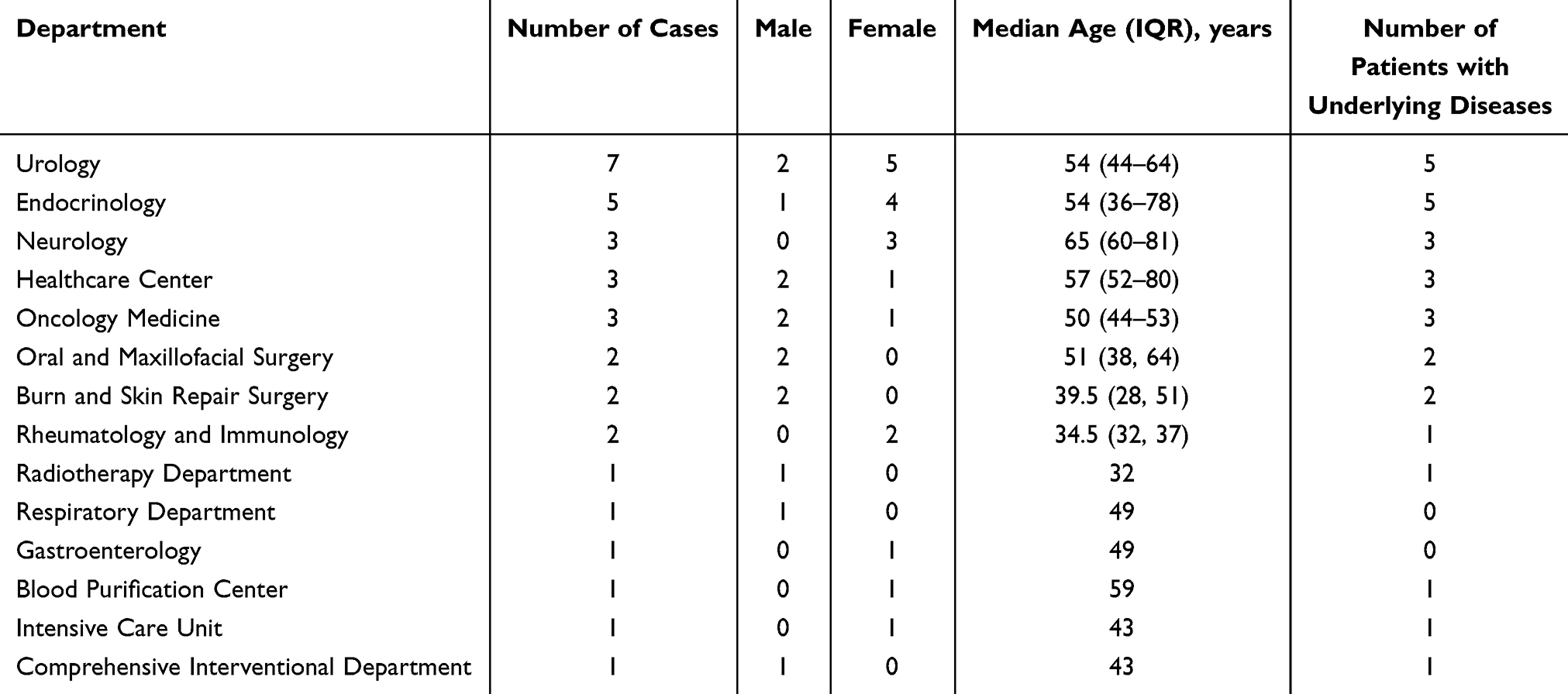 |
Table 1 Departmental Distribution of 33 Non-Pregnant Patients with GBS Isolation |
Among the 33 non-pregnant adults, 13 were male and 20 were female, with a median age of 52 years (IQR: 43–64 years; range: 17–81 years). Comorbidities were highly prevalent in this group: 11 patients had diabetes, 11 had malignancies, 10 had hypertension, two had anemia, three had hypoproteinemia, one had kidney disease, and one had systemic lupus erythematosus. Overall, 84.8% (28/33) of non-pregnant adults had at least one underlying condition.
A total of 101 clinical specimens from 95 patients yielded GBS growth, representing six specimen types. The most common source was fetal appendageal tissues (placenta, amniotic fluid, and umbilical cord; n = 57), followed by urine (n = 30) and blood (n = 6). Other specimens included pus (n = 5), and one case each of neonatal gastric fluid, drainage fluid, and sputum.
As shown in Table 2, among the 68 isolates obtained from perinatal cases, the majority (83.8%) were recovered from fetal appendageal tissues. Among perinatal cases, clinical complications included premature rupture of membranes (n = 19), fetal distress (n = 11), neonatal infection (n = 10), urinary tract infection (n = 5), eclampsia (n = 3), and intrauterine infection (n = 4). Bloodstream infection was confirmed in five perinatal cases (three mothers and two newborns). Notably, among the 57 patients with GBS‑positive fetal appendage cultures, four and two cases had concurrent GBS bacteremia and bacteriuria, respectively.
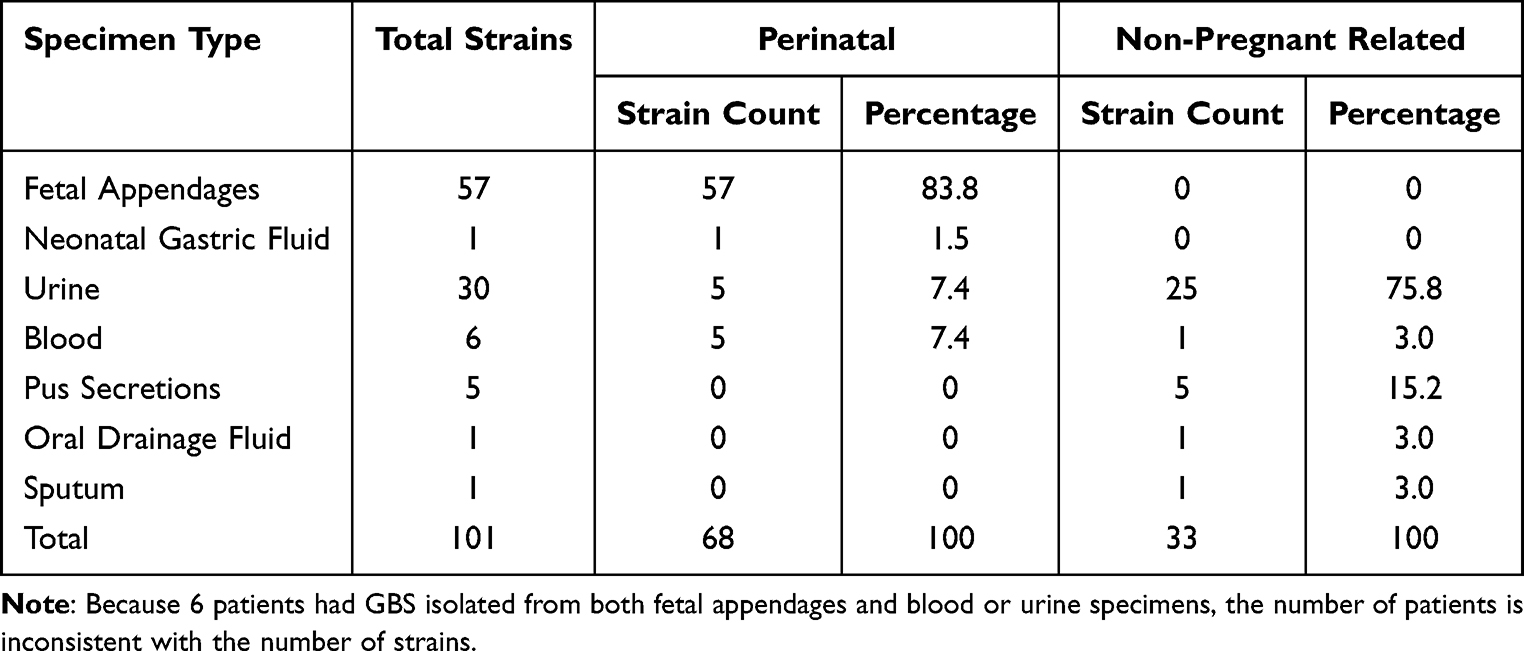 |
Table 2 Distribution of Specimen Types Yielding GBS Among 95 Patients |
In non-pregnant adults, urinary tract infection was the leading diagnosis (n = 25), with urine being the predominant specimen source (75.8%). Skin and soft tissue infection was the second most common diagnosis (n = 5, 15.2%), with GBS isolated from wound pus or drainage fluid. One case each of bacteremia and respiratory infection were also recorded (Table 2).
GBS Serotyping and Molecular Characteristics
Serotyping and MLST were performed on the first isolate from each of the 95 patients. No significant differences were found in the distribution of serotypes, STs, or CCs between perinatal and non-pregnant groups (P > 0.05 for all comparisons). Serotyping identified 10 distinct serotypes among the 95 isolates. Serotype III (n = 35) was the most prevalent, followed by V (n = 29) and Ib (n = 11). All 10 serotypes identified in this study were detected in perinatal isolates, whereas serotypes IV, VII, and VIII were absent among non-pregnant adults (Table 3).
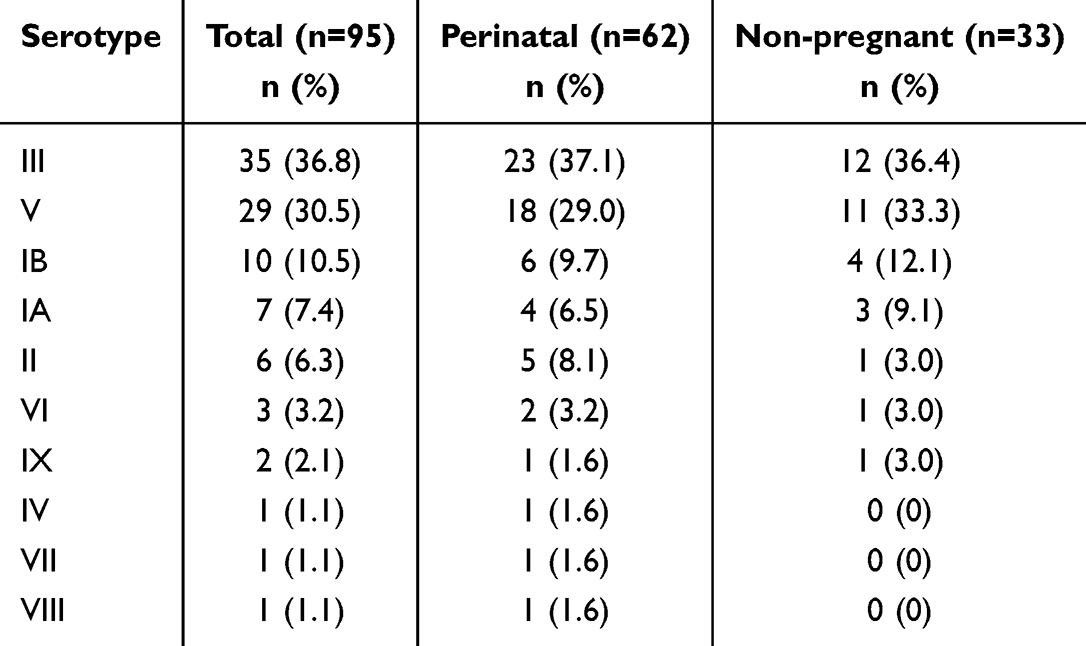 |
Table 3 Distribution of Serotypes Among Total, Perinatal, and Non-Pregnant Adult GBS Isolates |
Multilocus sequence typing (MLST) revealed 21 sequence types (STs). Predominant STs included ST529, ST862, ST1, and ST19. Two perinatal isolates exhibited a single-locus variant (SLV) of ST862 (with glcK‑1 instead of glcK‑3) and were designated ST862‑SLV. Similarly, two non-pregnant isolates matched ST19 at six loci and were designated ST19‑SLV. ST3 and ST498 were exclusive to non-pregnant cases, while ST2, ST23, ST106, ST196, ST651, and ST929 were only found in perinatal isolates (Table 4).
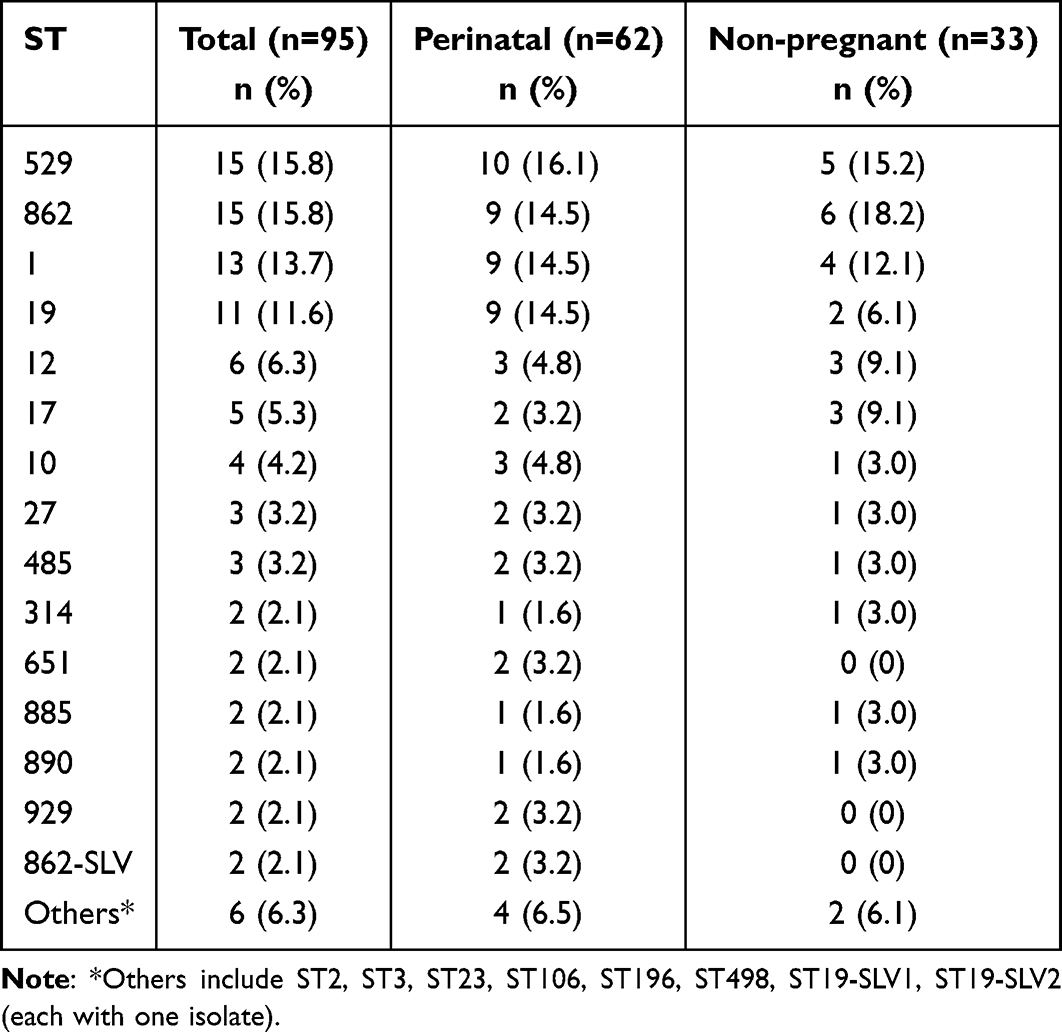 |
Table 4 Distribution of Sequence Types (STs) Among Total, Perinatal, and Non-Pregnant Adult GBS Isolates |
Based on MLST, the 95 isolates clustered into nine clonal complexes (CCs). The most common were CC651 (n = 21), CC327 (n = 20), CC19 (n = 19), CC1 (n = 15), and CC12 (n = 10). Other CCs included CC17 (n = 5), CC452 (n = 3), CC23 (n = 1), and CC459 (n = 1) (Table 5).
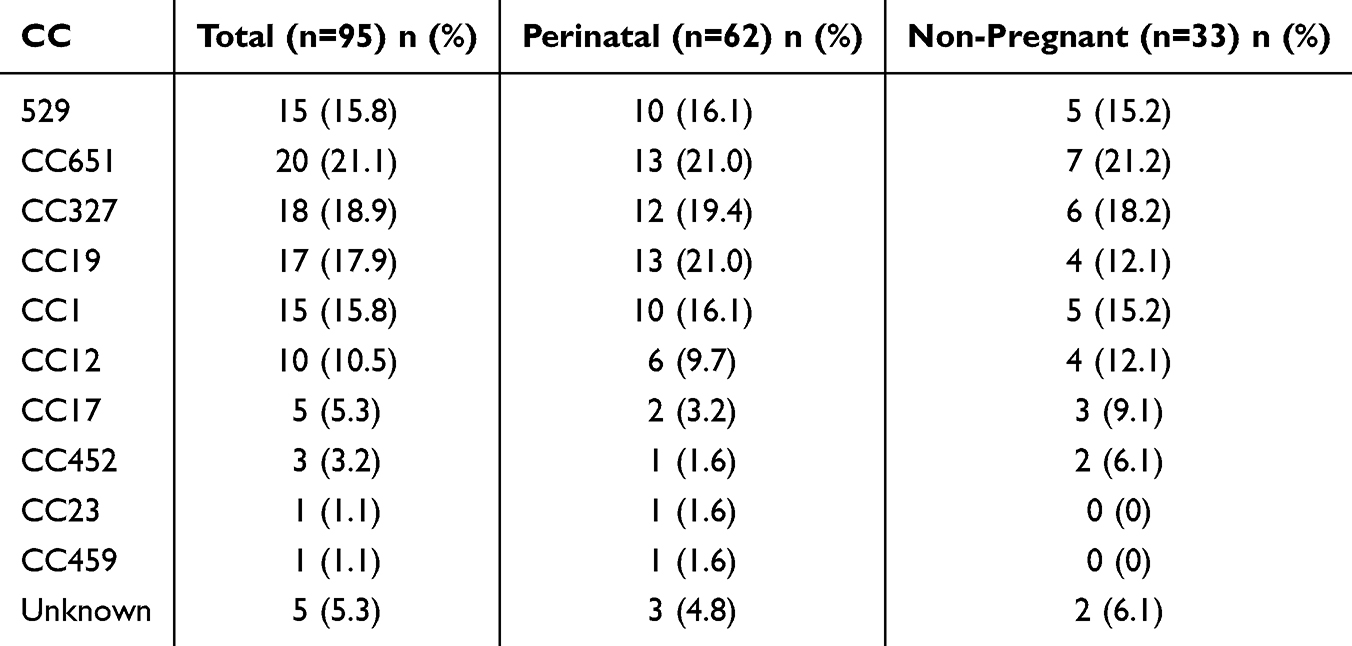 |
Table 5 Distribution of Clonal Complexes (CCs) Among Total, Perinatal, and Non-Pregnant Adult GBS Isolates |
Strong associations were observed between ST/CC groups and serotypes. For instance, all ST862 (and SLV), ST17, ST106, and ST651 isolates were serotype III; 19/20 CC651 and all CC17 isolates were serotype III. ST529, ST498, ST890, ST929, and ST2282 were all serotype V; 15/18 CC327 and all CC452 isolates were serotype V. All ST12 isolates were serotype Ib; ST485 and ST314 were serotype Ia; ST885 was serotype II. No significant differences in serotype, ST, or CC distribution were observed between perinatal and non-pregnant groups (Figure 1–3).
 |
Figure 1 Distribution of clonal complexes (CCs) among total, perinatal, and non-pregnant adult GBS isolates. The x-axis shows the different clonal complexes (CCs) identified in this study. The y-axis represents the percentage of isolates within each CC group. For each CC, three bars are displayed: red bars indicate the proportion among all 95 isolates (total), yellow bars indicate the proportion among perinatal cases (n=62), and green bars indicate the proportion among non-pregnant adults (n=33). |
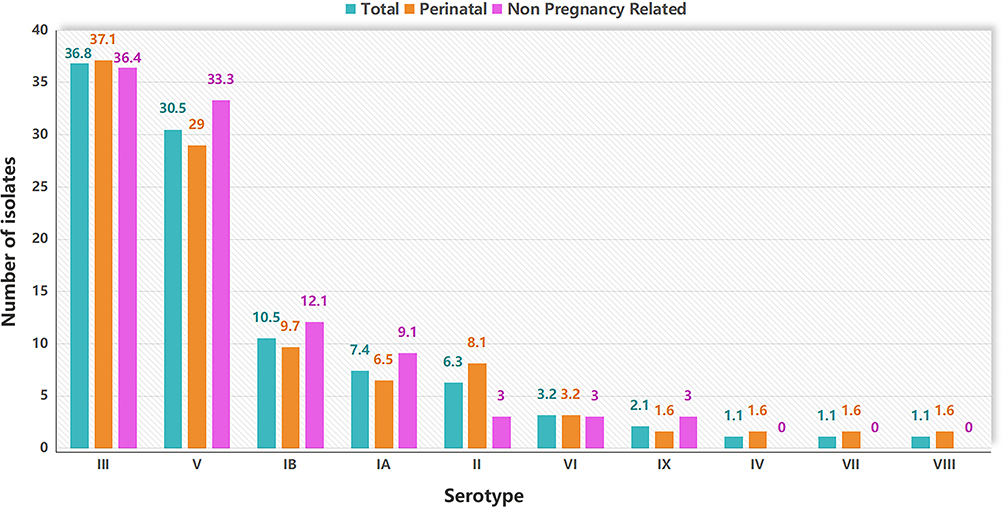 |
Figure 2 Distribution of serotypes among total, perinatal, and non-pregnant adult GBS isolates. The x-axis shows the different capsular serotypes identified in this study. The y-axis represents the number of isolates (count) for each serotype. For each serotype, three bars are displayed: green bars represent total isolates (n=95); Orange bars represent isolates from perinatal cases (n=62); purple bars represent isolates from non‑pregnant adults (n=33). The percentage of isolates within each group (total, perinatal, or non‑pregnant) is shown directly above the corresponding bar. |
 |
Figure 3 Distribution of sequence types (STs) among total, perinatal, and non-pregnant adult GBS isolates. The x-axis shows the different sequence types (STs) identified in this study. The y-axis represents the number of isolates (count) for each ST. For each ST, three bars are displayed: red bars represent total isolates (n=95); Orange bars represent isolates from perinatal cases (n=62); green bars represent isolates from non-pregnant adults (n=33). The percentage of isolates within each group (total, perinatal, or non-pregnant) is shown directly above the corresponding bar. Only STs with at least two isolates are shown. |
Antimicrobial Susceptibility Profiles (2020–2023)
Among the 95 GBS isolates, resistance to tetracycline was highest (96.84%, 92/95), followed by clindamycin (35.79%) and levofloxacin (15.79%). No resistance was detected to benzylpenicillin, ampicillin, quinupristin‑dalfopristin, linezolid, vancomycin, or tigecycline. Resistance rates between perinatal and non-pregnant adult isolates did not differ significantly for levofloxacin, clindamycin, or tetracycline (P > 0.05) (Table 6).
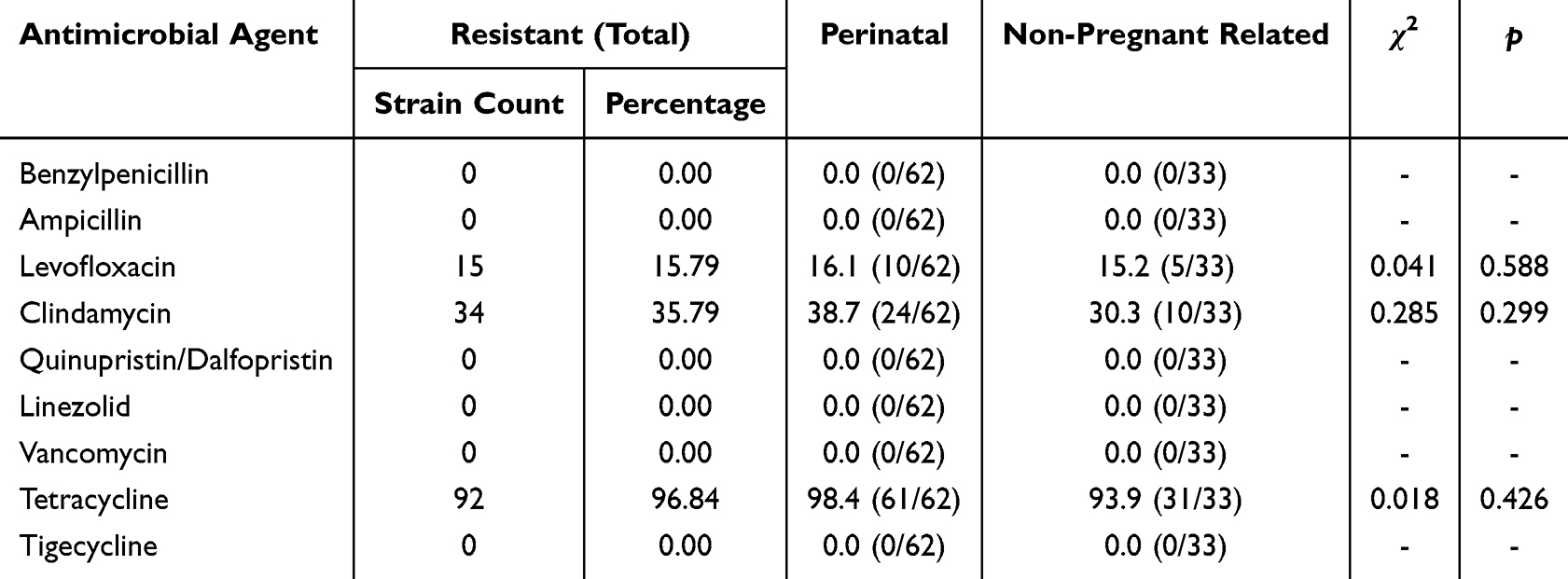 |
Table 6 Resistance Rates of GBS to Antimicrobial Agents from 2020 to 2023 |
Resistance Genes and Quinolone Resistance-Determining Region (QRDR) Mutations
Whole‑genome sequencing analysis was performed on 95 isolates to identify resistance genes and QRDR mutations. The tetracycline resistance genes tet(M), tet(O), and tet(S) were detected in 38.9% (37/95), 32.6% (31/95), and 18.9% (18/95) of isolates, respectively. The macrolide resistance gene erm(B) was identified in 56.8% (54/95) of isolates, and mef(A) in 13.7% (13/95). Point mutations in the quinolone resistance‑determining region (QRDR) were found in 15.8% (15/95) (gyrA Ser81Leu) and 14.7% (14/95) (parC Ser79Tyr) of isolates; four isolates (4.2%) harbored both substitutions. These genotypic findings are consistent with the observed high rates of tetracycline, clindamycin, and levofloxacin resistance, although the presence of additional resistance mechanisms cannot be excluded.
Discussion
This study provides the first detailed molecular epidemiological analysis of clinical GBS isolates from Hainan, a tropical region of China. We found that infections predominantly affected perinatal women and older non-pregnant adults with comorbidities, with serotypes III and V and clones CC651/CC327 and ST862/ST529 being particularly prevalent. GBS poses significant risks to maternal and neonatal health; colonization in pregnant women can lead to puerperal infection and ascending intrauterine infection, increasing the risk of adverse outcomes such as preterm premature rupture of membranes, preterm birth, and chorioamnionitis.4 In non-pregnant adults, GBS can cause a range of infections, with sepsis carrying a poor prognosis.8
In our cohort, perinatal cases accounted for 65.3% (62/95) of all patients with GBS-positive specimens, with GBS frequently isolated from fetal appendageal tissues (57 isolates from 57 perinatal patients) and associated with complications such as premature rupture of membranes and neonatal infection. Among the 33 non-pregnant adults, the median age was 52 years, and 84.8% had at least one underlying condition. Notably, nearly half were managed in departments caring for immunocompromised individuals. Urinary tract infection was the leading diagnosis (75.8%), underscoring GBS as a pathogen of concern in older, comorbid adults, particularly those with diabetes or malignancies.7
Our WGS analysis detected tet(M), tet(O), and tet(S) in 38.9%, 32.6%, and 18.9% of isolates, respectively. Although at least one of these tet genes was present in 70.5% of isolates, the phenotypic tetracycline resistance rate (96.8%) was higher, suggesting the possible presence of additional tetracycline resistance mechanisms (eg, tet(L), tet(K), or efflux pumps) not captured by our analysis. For clindamycin, the erm(B) gene was detected in 56.8% of all isolates and was present in 88.2% (30/34) of clindamycin‑resistant isolates, underscoring the risk of cross‑resistance to macrolides. Among the 15 levofloxacin‑resistant isolates (MIC ≥8 μg/mL), all carried a gyrA Ser81Leu substitution, and four also harbored a parC Ser79Tyr substitution. These genotypic findings are consistent with the observed phenotypic resistance patterns, although the presence of additional resistance mechanisms cannot be excluded.
Molecular characterization revealed serotype III (36.8%) as the most prevalent, consistent with reports from other parts of China.14,15 Multilocus sequence typing identified 21 STs, with ST862 and ST529 (15.8% each) being dominant. The predominant clonal complexes were CC651 (21.1%) and CC327 (18.9%). While globally common lineages such as CC1 and CC19 were present in our cohort,3,16 the dominance of CC651 and CC327 is particularly notable These clones are not frequently reported as the leading lineages in other geographical settings (eg, Egypt),17 which suggests possible unique local clonal dynamics in tropical Hainan, though this observation warrants confirmation with a larger, multicenter strain collection. A strong association was observed between ST/CC groups and serotypes, though a single serotype could encompass multiple STs/CCs, indicating substantial local genetic diversity.
The dominant clones in Hainan, CC651 and CC327, exhibited distinct resistance profiles. CC651 isolates frequently carried the aminoglycoside resistance gene ant(6)-Ia, while CC327 isolates were consistently serotype V and commonly carried tet(O) and erm(B). Whether these genetic features contribute to the predominance of these clones in the tropical environment of Hainan requires further investigation with a larger strain collection and comparative genomic analysis.
Consistent with global data, all isolates remained susceptible to penicillins, reaffirming their role as first-line therapy.9,18 However, substantial resistance to clindamycin (35.8%) and levofloxacin (15.8%) poses a critical challenge for managing penicillin-allergic patients,19,20 underscoring the need for local susceptibility testing prior to using these alternatives. The near-ubiquitous resistance to tetracycline (96.8%) precludes its clinical use in this setting.18
Importantly, no significant differences in serotype, ST/CC distribution, or resistance profiles were observed between perinatal and non-pregnant adult isolates (P > 0.05), indicating similar circulating populations in both groups. Collectively, these findings establish the first baseline for GBS molecular epidemiology in tropical Hainan. They underscore the importance of region-specific surveillance to guide empirical therapy and inform future vaccine strategies that account for the local predominance of clones like CC651 and CC327.
From a vaccine perspective, the serotypes identified in our study (III, V, Ib, Ia, II) are all included in the hexavalent GBS conjugate vaccine currently under development. Given the high coverage of vaccine-covered serotypes in our cohort (approximately 90%), a hexavalent vaccine could have substantial preventive potential in this population.
Limitations
This study has several limitations. First, the small sample size, particularly of non-pregnant adults (n = 33), may limit generalizability. Second, our study included only symptomatic perinatal cases; follow-up of neonates colonized at birth but asymptomatic (i.e, potential late-onset disease cases) was not conducted, which may underestimate the true burden of neonatal GBS colonization and infection. Third, phenotypic macrolide susceptibility testing (eg, for erythromycin and azithromycin) was not performed due to the retrospective scope of this study. Although our WGS analysis detected macrolide resistance genes including erm(B) and/or mef(A) in a subset of isolates, the absence of phenotypic confirmation limits our ability to guide alternative prophylaxis for penicillin-allergic patients. Fourth, as a single-center, retrospective study, our findings may not be fully generalizable to the entire Hainan Province or other tropical regions. The observed dominance of CC651 and CC327 may reflect local referral patterns rather than province-wide circulation. Independent validation in multicenter studies is needed.
Conclusion
In this cohort from a Hainan hospital, perinatal cases accounted for approximately two-thirds of all GBS infections. Non-pregnant adults were predominantly older adults with comorbidities or immunocompromising conditions, most frequently presenting with genitourinary infections. Serotype III, V, and Ib dominated; ST529, ST862, ST1, and ST19 were the most common sequence types. Penicillin remains the first-line therapy. For penicillin-allergic patients, clindamycin should only be used after confirmation of susceptibility due to high resistance rates. Tetracycline is not recommended due to high resistance. No significant differences in molecular epidemiology or resistance patterns were observed between perinatal and non-pregnant isolates.
Data Sharing Statement
The genome sequences of the 95 Streptococcus agalactiae isolates reported in this study have been deposited in the National Microbiology Data Center (NMDC) under submission number SUB1762937664470. The data are currently under embargo until November 30, 2027, and can be accessed via the NMDC website (https://nmdc.cn) by searching the submission number.
Ethics Approval
The studies involving humans were approved by the Medical Ethics Committee of Hainan General Hospital (2025–176). This study was conducted in accordance with the principles of the Declaration of Helsinki. The studies were conducted in accordance with the local legislation and institutional requirements. Written informed consent for participation was not required from the participants or the participants’ legal guardians/next of kin, in accordance with Article 39(2) of the “Measures for Ethical Review of Biomedical Research Involving Humans” (National Health and Family Planning Commission Order No. 11, 2016). This regulation permits the waiver of informed consent for research using identifiable human materials or data when the subjects cannot be reasonably contacted and the research involves no more than minimal risk and does not adversely affect the rights or welfare of the subjects.
Funding
This work was supported by the Academic Enhancement Support Program of Hainan Medical University (XSTS2025105), Hainan Province Science and Technology Special Fund (ZDYF2022SHFZ050).
Disclosure
The authors report no conflicts of interest in this work.
References
1. Absalon J, Segall N, Block SL, et al. Safety and immunogenicity of a novel hexavalent group B streptococcus conjugate vaccine in healthy, non-pregnant adults: a Phase 1/2, randomised, placebo-controlled, observer-blinded, dose-escalation trial. Lancet Infect Dis. 2021;21(2):263–10. doi:10.1016/S1473-3099(20)30478-3
2. Hernández Trejo M, Becerril DS. High prevalence of group B Streptococcus colonization in Mexican pregnant women. Ginecol Obstet Mex. 2006;74(3):139–143.
3. Alzayer M, Alkhulaifi MM, Alyami A, et al. Genomic insights into the diversity, virulence, and antimicrobial resistance of group B Streptococcus clinical isolates from Saudi Arabia. Front Cell Infect Microbiol. 2024;14:1377993. doi:10.3389/fcimb.2024.1377993
4. Ge Y, Pan F, Bai R, et al. Prevalence of group B streptococcus colonization in pregnant women in Jiangsu, East China. BMC Infect Dis. 2021;21(1):492. doi:10.1186/s12879-021-06186-5
5. Yuan XY, Liu HZ, Liu JF, et al. Pathogenic mechanism, detection methods and clinical significance of group B Streptococcus. Future Microbiol. 2021;16:671–685. doi:10.2217/fmb-2020-0189
6. Espinal ER, Matthews T, Holder BM, et al. Group B streptococcus-induced macropinocytosis contributes to bacterial invasion of brain endothelial cells. Pathogens. 2022;11(4):474. doi:10.3390/pathogens11040474
7. Graux E, Hites M, Martiny D, et al. Invasive group B Streptococcus among non-pregnant adults in Brussels-Capital Region, 2005-2019. Eur J Clin Microbiol Infect Dis. 2021;40(3):515–523. doi:10.1007/s10096-020-04041-0
8. Abdelradi A, Murphy A, Ahasic AM. Invasive Streptococcus agalactiae causing meningitis, ventriculitis, and endocarditis in a non-pregnant adult. Cureus. 2020;12(11):e11412. doi:10.7759/cureus.11412
9. Puopolo KM, Lynfield R, Cummings JJ. Management of infants at risk for group b streptococcal disease. Pediatrics. 2019;144(2). doi:10.1542/peds.2019-1881
10. Zerbino DR, Birney E. Velvet: algorithms for de novo short read assembly using de Bruijn graphs. Genome Res. 2008;18(5):821–829. doi:10.1101/gr.074492.107
11. Bankevich A, Nurk S, Antipov D, et al. SPAdes: a new genome assembly algorithm and its applications to single-cell sequencing. J Comput Biol. 2012;19(5):455–477. doi:10.1089/cmb.2012.0021
12. Lin SH, Liao YC. CISA: contig integrator for sequence assembly of bacterial genomes. PLoS One. 2013;8(3):e60843. doi:10.1371/journal.pone.0060843
13. Founou LL, Khan UB, Medugu N, et al. Molecular epidemiology of Streptococcus agalactiae in non-pregnant populations: a systematic review. Microb Genom. 2023; 9:001140
14. Liang B, Chen H, Yu D, et al. Molecular Epidemiology of Group B Streptococcus Isolates from Pregnant Women with Premature Rupture of Membranes in Fuzhou, China. Infect Drug Resist. 2023;16:269–278. doi:10.2147/IDR.S393935
15. Zhou W, Chen X, Chen J, et al. Genotype distribution and high-risk factors analysis of group b streptococcus in late-stage pregnant women in the linyi region. Int J Microbiol. 2024;2024:9910073. doi:10.1155/ijm/9910073
16. Lacasse M, Valentin A-S, Corvec S, et al. Genotypic characterization and biofilm production of group b streptococcus strains isolated from bone and joint infections. Microbiol Spectr. 2022;10(2):e0232921. doi:10.1128/spectrum.02329-21
17. Shabayek S, Spellerberg B. Group B streptococcal colonization, molecular characteristics, and epidemiology. Front Microbiol. 2018;9:437. doi:10.3389/fmicb.2018.00437
18. Hu F, Guo Y, Yang Y, et al. Resistance reported from China antimicrobial surveillance network (CHINET) in 2018. Eur J Clin Microbiol Infect Dis. 2019;38(12):2275–2281. doi:10.1007/s10096-019-03673-1
19. Venkatesh KK, Vladutiu CJ, Glover AV, et al. Is group b streptococcus colonization associated with maternal peripartum infection in an era of routine prophylaxis? Am J Perinatol. 2021;38(S 01):e262–e268. doi:10.1055/s-0040-1709666
20. Dhudasia MB, Spergel JM, Puopolo KM, et al. Intrapartum group b streptococcal prophylaxis and childhood allergic disorders. Pediatrics. 2021:147(5). e2020012187
 © 2026 The Author(s). This work is published and licensed by Dove Medical Press Limited. The
full terms of this license are available at https://www.dovepress.com/terms
and incorporate the Creative Commons Attribution
- Non Commercial (unported, 4.0) License.
By accessing the work you hereby accept the Terms. Non-commercial uses of the work are permitted
without any further permission from Dove Medical Press Limited, provided the work is properly
attributed. For permission for commercial use of this work, please see paragraphs 4.2 and 5 of our Terms.
© 2026 The Author(s). This work is published and licensed by Dove Medical Press Limited. The
full terms of this license are available at https://www.dovepress.com/terms
and incorporate the Creative Commons Attribution
- Non Commercial (unported, 4.0) License.
By accessing the work you hereby accept the Terms. Non-commercial uses of the work are permitted
without any further permission from Dove Medical Press Limited, provided the work is properly
attributed. For permission for commercial use of this work, please see paragraphs 4.2 and 5 of our Terms.
Recommended articles

Characterization of Group B Streptococcus Recovered from Pregnant Women and Newborns Attending in a Hospital in Beijing, China
Li X, Gao W, Jia Z, Yao K, Yang J, Tong J, Wang Y
Infection and Drug Resistance 2023, 16:2549-2559
Published Date: 27 April 2023
Epidemiological and Antimicrobial Resistant Patterns, and Molecular Mechanisms of Carbapenem-Resistant Klebsiella pneumoniae Infections in ICU Patients
Lu F, Zhang L, Ji J, Xu Y, Wang B, Xia J
Infection and Drug Resistance 2023, 16:2813-2827
Published Date: 9 May 2023
Epidemiology and Antimicrobial Resistance Trends of Bloodstream Infections During and After the Implementation of the National Action Plan on Antimicrobial Resistance in Mwanza, Tanzania: A Comparative Cross-Sectional Study
Silago V, Matthews L, Oravcova K, Mshana SE, Seni J, Claus H
Infection and Drug Resistance 2025, 18:4441-4453
Published Date: 29 August 2025
Serotype Distribution, Antibiotic Resistance Characteristics, and Virulence Factor Analysis of Group B Streptococcus Isolates in Guangzhou Based on Whole-Genome Sequencing
Ling Y, Deng Y, Zhang P, Yuan K, Ye L, Zhang X, Chen X, Cui S, Liu J, Zhao Y
Infection and Drug Resistance 2026, 19:549193
Published Date: 15 January 2026
Genomic Characterization of Antibiotic-Resistant Enterococcus Spp. Strains in Clinical Settings of Yichang, China
Yu H, Xiong P, Zhang H, Lu Z, Chen X, Yan R, Wang L, Yu L, Zhang Q, Zou L, Wang L
Infection and Drug Resistance 2026, 19:573082
Published Date: 14 April 2026