
Back to Journals » International Journal of Women's Health » Volume 18
Measuring Maternal Resilience in the Context of Parenting Challenges: A Korean Adaptation of the Maternal Resilience Scale
Authors Jang HJ, Nam SH  , Lee K, Lee J
Received 29 October 2025
Accepted for publication 3 February 2026
Published 10 February 2026 Volume 2026:18 574491
DOI https://doi.org/10.2147/IJWH.S574491
Checked for plagiarism Yes
Review by Single anonymous peer review
Peer reviewer comments 2
Editor who approved publication: Dr Everett Magann
Hee Jung Jang,1,* Soo-Hyun Nam,2,* Koeun Lee,1 Jungmin Lee1
1School of Nursing and Research Institute of Nursing Science, Hallym University, Chuncheon, Gangwon-do, Republic of Korea; 2School of Nursing Science, Gyeongkuk National University, Andong, South Korea
*These authors contributed equally to this work
Correspondence: Jungmin Lee, School of Nursing and Research Institute of Nursing Science, Hallym University, 1 Hallymdaehak-Gil, Chuncheon-si, Gangwon-do, 24252, Republic of Korea, Tel +82-33-248-2728, Fax +82-33-248-2734, Email [email protected]
Introduction: This study aimed to culturally adapt and validate the Korean version of the Maternal Resilience Scale (MRS-K) for mothers of school-aged children who are experiencing parenting difficulties.
Methods: Based on DeVellis’ framework for instrument development, the original MRS was translated, culturally adapted, and data were collected from 250 South Korean mothers of school-aged children experiencing parenting difficulties. Confirmatory factor analysis (CFA) was conducted to evaluate the construct validity of the scale.
Results: Confirmatory factor analysis supported a six-factor structure (self-determination, hopelessness, spiritual faith, rejection of personal responsibility, lack of partner support, and limited resources), demonstrating good model fit (χ2/df = 2.271, root mean square error of approximation = 0.071, standardized root mean square residual = 0.073).
Discussion: The MRS-K is a valid and reliable tool for assessing maternal resilience in South Korean mothers of school-aged children. Its application can inform the early identification of at-risk caregivers and support the development of customized interventions in clinical and community contexts.
Keywords: factor analysis, mothers, parenting, psychometrics, resilience
Introduction
Parenting school-aged children is associated with diverse challenges that require considerable emotional, cognitive, and social resources from mothers.1 The concept of maternal resilience, defined as a mother’s ability to effectively cope with and adapt to the demands associated with parenting, has emerged as a critical factor influencing maternal well-being and child developmental outcomes.2 Resilient mothers are more likely to maintain positive parenting practices, mitigate the negative effects of stress, and foster healthier family dynamics.3,4 This ultimately contributes to better physical, emotional, and behavioral outcomes for their children.
Despite the global recognition of the importance of maternal resilience, research has focused on mothers of children with chronic illnesses,5 leaving the resilience of mothers parenting school-aged children underexplored in these communities. Moreover, resilience measurement tools developed in Western contexts may not adequately capture the culturally nuanced experiences of South Korean mothers, whose caregiving practices are shaped by their unique cultural, societal, and familial expectations. Particularly, the intense educational and social demands placed on South Korean mothers, along with limited systemic parenting support, create a distinct context in which resilience functions and manifests differently than in Western.6,7
Currently, a validated Korean-language instrument that comprehensively assesses maternal resilience in mothers of school-aged children, particularly those experiencing caregiving difficulties, does not exist. Although some international tools have been translated or adapted, few have undergone rigorous psychometric evaluations to ensure their reliability, validity, and cultural appropriateness for use in South Korea. Considering the centrality of culturally sensitive and psychometrically sound instruments in clinical practice and research, addressing this gap is essential for advancing evidence-based maternal and pediatric healthcare in South Korea.
Several resilience-related instruments have been used in Korean populations; however, most existing tools were developed for general adult samples or adapted from Western measures with limited attention to parenting-specific demands. In particular, currently available Korean instruments tend to emphasize individual psychological resilience while insufficiently addressing parenting-related stressors, relational dynamics within the family, and contextual pressures associated with childrearing in South Korea. As a result, these tools may not fully capture the multidimensional and culturally embedded nature of maternal resilience among mothers of school-aged children, highlighting the need for a culturally adapted and parenting-focused measurement instrument.
From a psychometric perspective, establishing construct validity requires a clear theoretical foundation that explains how maternal resilience is conceptually structured and empirically represented. Previous studies have conceptualized maternal resilience as a multidimensional construct encompassing individual psychological resources, relational support, and contextual or environmental factors. In addition, convergent validity is supported when resilience measures demonstrate meaningful associations with theoretically related constructs, such as psychological resilience and parenting competence. Examining these relationships is essential to confirm that a maternal resilience instrument adequately captures the intended construct within a specific cultural context.
This study developed and evaluated the psychometric properties of a Korean-language maternal resilience measurement tool specifically designed for mothers of school-aged children experiencing parenting challenges. This study assessed the internal consistency, construct validity, and criterion-related validity of the tool to establish its suitability for use in research and clinical contexts. It was hypothesized that (1) the Korean version of the Maternal Resilience Scale would demonstrate an acceptable factor structure consistent with the original scale, supporting construct validity, and (2) maternal resilience would be positively associated with psychological resilience and parenting competence, supporting convergent validity. By providing a validated instrument, this study aimed to support clinicians in identifying mothers at risk of reduced resilience, providing information for the development of targeted interventions, and contribute to a broader understanding of resilience as a culturally entrenched aspect.
Methods
Design
This cross-sectional quantitative study aimed to assess the psychometric properties of the Korean version of the maternal resilience measurement among mothers of school-aged children, particularly those experiencing caregiving difficulties in South Korea.
Participants
According to DeVellis,8 instrument development studies should include a sample size at least five times the number of items to conduct a confirmatory factor analysis (CFA). Based on this recommendation, a minimum of 225 participants was required for the 45-item instrument. To account for potential attrition, 250 participants were recruited, and all responses were retained for the final analysis.
Eligibility criteria included being a mother of at least two children, with at least one child currently attending elementary school (aged 6–12 years), regardless of whether the child had special needs or developmental conditions.
Participants were recruited through Embrain, a professional online research panel in South Korea. Eligibility criteria included being a mother of at least two children, with at least one child currently in elementary school (aged 6–12 years). Upon beginning the survey, participants were instructed to respond with one elementary school-aged children in mind when answering the questions.
Measurements
Maternal Resilience Scale
The Maternal Resilience Scale (MRS) was developed by Roque Hernández et al9 to assess the level of resilience of mothers parenting children with special needs. The scale was originally designed for mothers experiencing parenting difficulties owing to their children’s exceptional conditions, such as disabilities, psychosocial or developmental challenges, and giftedness, and has been validated for reliability and cultural applicability in various contexts.10 Although the MRS was originally developed for mothers of children with special needs, its conceptual focus on coping with parenting-related adversity supports its applicability to mothers of school-aged children experiencing diverse parenting challenges. The MRS comprises 45 items, including 14 and 31 positively and negatively worded items, respectively, with 31 items requiring reverse scoring. Each item was rated on a five-point Likert scale (1 = not at all true, 5 = very true), with higher total scores indicating greater levels of maternal resilience. This scale comprises six subscales: self-determination, hopelessness, spiritual faith, rejection of personal responsibility, lack of support from partners, and limited resources to meet needs.
The psychometric properties of the Korean version of the Maternal Resilience Scale were evaluated using multiple indicators of reliability and validity. Internal consistency reliability was assessed using Cronbach’s alpha coefficients for the total scale and each subscale. Construct validity was examined by confirmatory factor analysis to verify the factor structure of the instrument. Convergent validity was assessed by calculating the average variance extracted (AVE) and construct reliability (CR) for each latent factor. In addition, criterion-related validity was examined by analyzing correlations between maternal resilience and theoretically related constructs, including psychological resilience and parenting competence.
Psychological Resilience
Psychological resilience was measured using the Korean Resilience Quotient Test developed by Kim.11 It comprises 53 items in three areas: self-regulation, interpersonal relationships, and positivity. They were self-reported on a five-point Likert scale (1 = not at all to 5 = very much). Self-regulation subscales were emotion regulation, impulse control, and causal analysis; interpersonal relationships subscales were communication, empathy, and self-expansion; and positivity subscales were optimistic thinking, life satisfaction, and gratitude. Choi and Seok12 determined the overall scale reliability (Cronbach’s alpha) as.93; the Cronbach’s alpha values of the subscales were.84 for self-regulation,0.79 for interpersonal relationships, and.86 for positivity.
Parenting Competence Scale
Parenting competence was measured using the Parenting Self-Efficacy of Korean Mothers Scale developed by Choe and Chung.13 The scale comprises 37 items with five parenting competence factors. They were self-reported on a five-point Likert scale (1 = not at all, 5 = very much). The subscales were general parenting competence, health, communication, education, and control. The scores ranged from 37 to 185, with higher scores indicating higher parenting competence. The Cronbach’s alpha of the original scale was.92 and.96 in this study. This scale provides a comprehensive overview of parental functioning and has been widely used in research involving caregivers of children at various developmental stages.
Translation Procedures
This study followed the tool development and validation procedures outlined by DeVellis8 who proposed an eight-step process. Following DeVellis’s eight-step framework for scale development and adaptation, this study focused on construct definition, item translation, and response format selection to culturally adapt the instrument for use in South Korea. Considering that this study aimed to adapt an existing English language instrument for use in South Korea, the following steps were conducted: defining the construct, generating items, and selecting the response format.
With permission from the original developer to use the complete set of items, the scale was initially translated into Korean by two independent native Korean speakers. A third translator, fluent in Korean and English, conducted the back-translation. The first and second authors compared the original English versions with the back-translated versions to ensure semantic equivalence.
To enhance cultural and linguistic appropriateness, four nursing professors reviewed the translated items and provided feedback regarding vocabulary usage, clarity, and cultural relevance. Based on their input, the necessary revisions were made while preserving the original meaning of the items.
Finally, a face-validity test was conducted with five mothers of school-aged children. These participants were excluded from the main survey and no further modifications were made to the final Korean version of the tool.
Data Analysis
Data analysis was performed in accordance with DeVellis’s8 recommendations to assess the reliability, and content, structural, and criterion validity of the tool. Content validity was evaluated using the content validity index, and structural validity was tested using confirmatory factor analysis in SPSS version 29.0 (IBM, Armonk, NY, USA) to identify the instrument factor structure. As the factor structure of the MRS was theoretically established, only confirmatory factor analysis was conducted without prior exploratory factor analysis. CFA was conducted to examine the construct validity of the Korean version of the Maternal Resilience Scale. The hypothesized factor structure was tested using maximum likelihood estimation. Model fit was evaluated using multiple goodness-of-fit indices, including the chi-square statistic (χ2), the comparative fit index (CFI), the Tucker–Lewis index (TLI), the root mean square error of approximation (RMSEA), and the standardized root mean square residual (SRMR). Acceptable model fit was determined based on commonly recommended criteria (CFI and TLI ≥.90, RMSEA ≤.08, and SRMR ≤.08). Standardized factor loadings were examined to assess the adequacy of item representation for each latent construct. Internal consistency was assessed using Cronbach’s alpha to verify that the items consistently measured the intended constructs.
Ethical Considerations
Ethical approval was granted by the Institutional Review Board of Hallym University (HIRB-2025-083). This study was conducted in accordance with the ethical principles of the Declaration of Helsinki. To ensure the protection of participants’ rights, all individuals were informed of the study objectives and procedures before data collection began. They were assured of their right to withdraw from the survey without consequences. Written informed consent was obtained, and participants were assured that their responses would be used solely for the purposes of the research.
Findings
General Characteristics of Participants
In total, 250 participants were included in this study (Table 1). The mean age was 42.26 years (SD = 4.18). Most participants were in their 40s and 50s (75.6%), and 24.4% were aged between 20 and 39 years. Most participants (82.4%) had two children, whereas 17.6% had three or more children. Notably, 79.6%, 13.6%, and 6.8% had attended or graduated from college, completed high school, and earned a graduate degree or higher, respectively. Further, most (55.6%) reported no religious affiliation, followed by Christian (20.4%), Buddhist (12.0%), Catholic (8.4%), and other (3.6%) religious affiliations. Subsequently, 63.6% were currently engaged in economic activities, whereas 36.4% were not. The average monthly household income varied, with 66.0%, 29.2%, and 4.8% earning 4 or more, between 2 and 3.99, and less than 2 million KRW, respectively. Regarding the support system for parenting, 42.0%, 46.4%, and 11.6% reported having sufficient, average, and no support, respectively. When asked about difficulties in emotional, behavioral, and interactional aspects of child parenting, 38.8%, 30.0%, 14.8%, 13.6%, and 2.8% responded “somewhat not difficult,” “average,” “somewhat difficult,” “not at all,” and “very difficult,” respectively. Regarding perceived stress, 36.0%, 33.6%, 22.8%, and 7.6% experienced it frequently, occasionally, rarely, and frequently, respectively. Notably, 6.4% of the participants were currently receiving help from mental health professionals, whereas 93.6% were not. Regarding the availability of supportive persons for parenting, the largest group (41.6%) reported having someone to help, whereas 25.6% (n = 64) indicated having little to no support, including those who responded “almost no one” or “none at all.” Additionally, most participants (93.6%) had not sought professional help for parenting-related issues in the past 6 months.
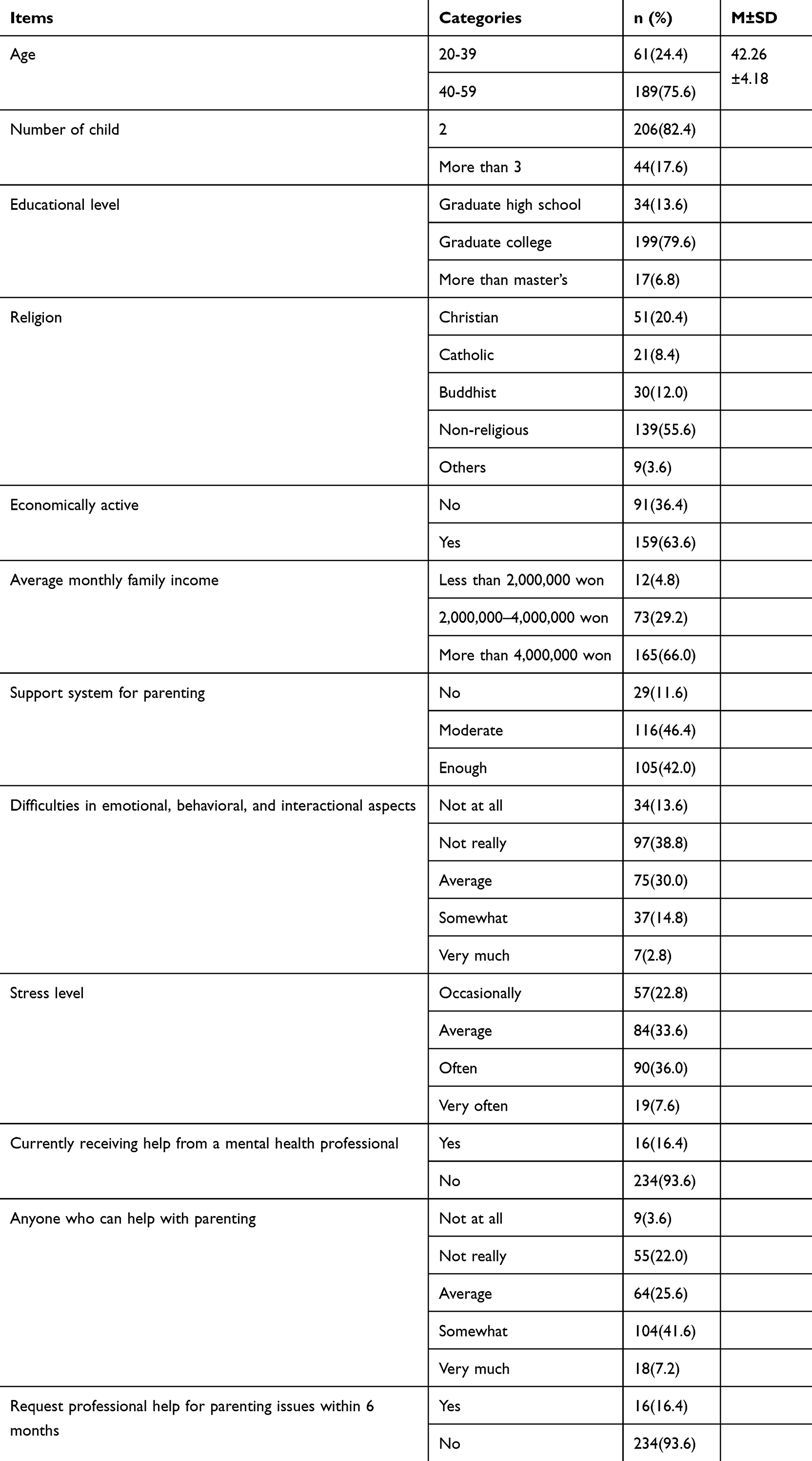 |
Table 1 General Characteristics |
Descriptive Statistics for Maternal Resilience, Psychological Resilience, and Parenting Efficacy
Table 2 presents the descriptive statistics for parenting efficacy, maternal, and psychological resilience among the participants. The overall mean maternal resilience was 157.87 (SD = 18.14), with scores ranging from 110 to 201. The total mean psychological resilience score was 184.52 (SD = 22.44), ranging from 124 to 247. Subscale scores were as follows: self-regulation averaged 61.60 (SD = 8.08) with a range of 40 to 89, interpersonal relationships averaged 64.62 (SD = 9.02; range = 38 to 89), and positivity had a mean of 58.30 (SD = 9.49), ranging from 29 to 81. Parenting efficacy showed a mean total score of 137.53 (SD = 19.69), with scores ranging from 78 to 182.
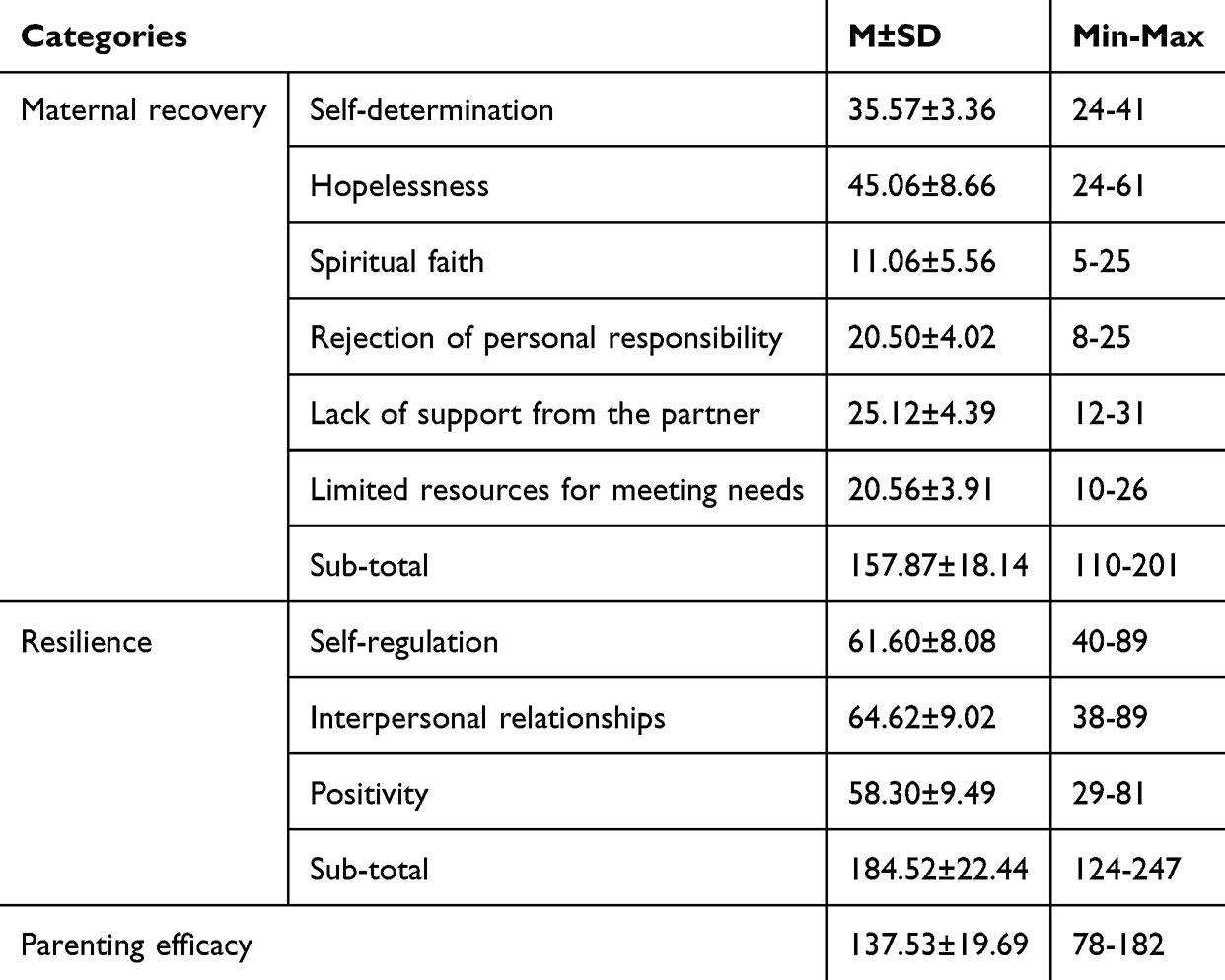 |
Table 2 Mean and Standard Deviation of Maternal Recovery, Resilience, and Parenting Efficacy |
Correlation Among Maternal Resilience, Psychological Resilience, and Parenting Efficacy and Cronbach’s Alpha
Table 3 presents the Pearson correlation coefficients among the subdomains of parenting efficacy, maternal and psychological resilience, and Cronbach’s α values for internal consistency.
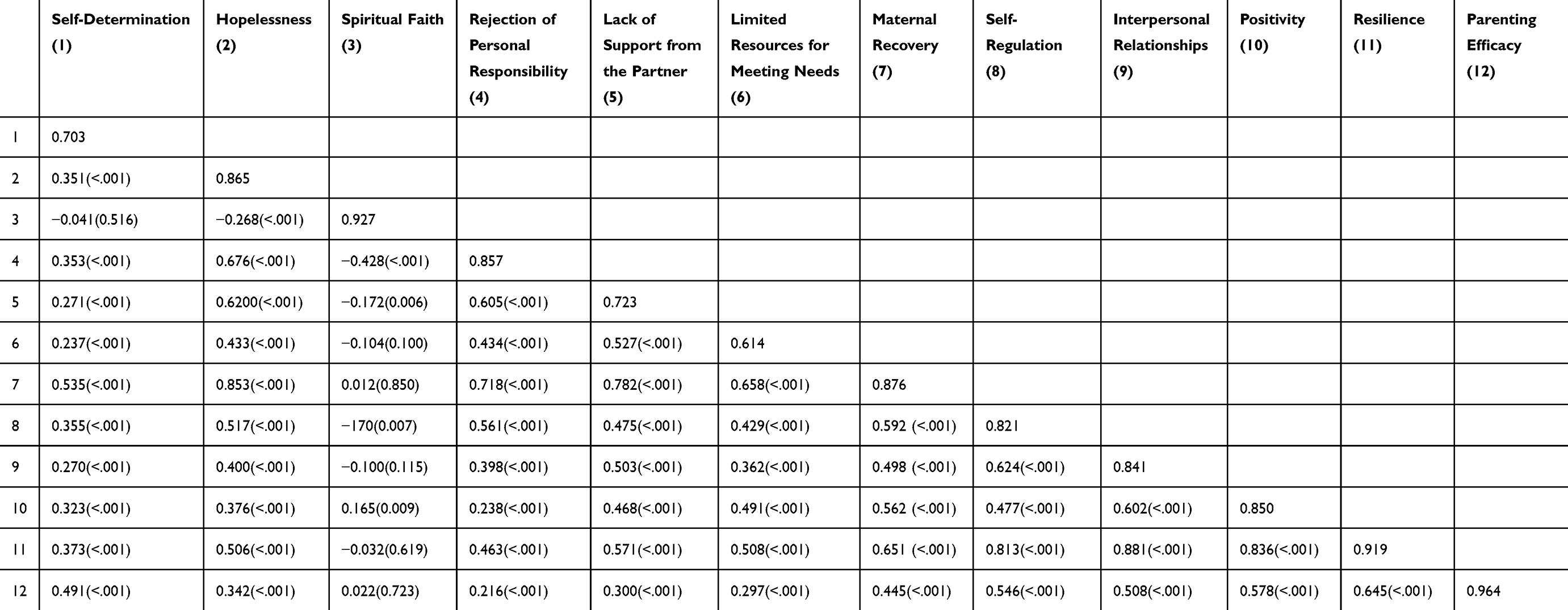 |
Table 3 Correlation of Variables and Cronbach’s Alpha |
Correlations among the latent factors were examined to assess the distinctiveness of the constructs. The inter-factor correlations were positive and statistically significant, yet none exceeded the commonly accepted threshold, indicating no evidence of excessively high correlations or multicollinearity among factors. Maternal resilience was positively correlated with psychological resilience (r =0.651, p <0.001). Among the subdomains, psychological resilience, self-regulation (r =0.592, p <0.001), interpersonal relationships (r =0.493, p <0.001), and positivity (r =0.562, p <0.001) were significantly correlated with maternal resilience. Parenting competence was significantly and positively correlated with maternal (r =0.445, p <0.001) and psychological resilience (r =0.645, p <0.001). Among the psychological resilience subdomains, self-regulation (r =0.546, p <0.001), interpersonal relationships (r =0.508, p <0.001), and positivity (r =0.578, p <0.001) were significantly correlated with parenting competence. These findings further support the criterion-related validity of the Korean version of the MRS, as maternal resilience showed meaningful positive associations with psychological resilience and parenting competence, consistent with theoretical expectations.
The internal consistency of the Korean version of maternal resilience was assessed using Cronbach’s α, which demonstrated excellent reliability (Table 3). The overall Cronbach’s α for maternal resilience was.876, indicating a high internal consistency. The internal consistency and reliability of each scale, measured using Cronbach’s alpha, ranged from acceptable to excellent. Further, Cronbach’s alpha values were.821,0.841,0.850,0.919, and.964 for self-regulation, interpersonal relationships, positivity, overall psychological resilience, and parenting efficacy, respectively. The Korean version of the Maternal Resilience Scale demonstrated good to excellent internal consistency reliability. Cronbach’s alpha coefficients for the total scale and all subscales exceeded the recommended threshold for psychometric adequacy, indicating that the items consistently measured the intended constructs.
Validity of the Korean Version of the Maternal Resilience Measurement
Model Fit
Confirmatory factor analysis was conducted to evaluate the construct validity of the Korean version of the Maternal Resilience Scale. The CFA results indicated that the model fit of the Korean version of maternal resilience was adequate and acceptable The model fit indices were as follows: χ2 = 2111.956 (df = 930, p <0.001), root mean square error of approximation (RMSEA) = 0.071 (p <0.001), minimum discrepancy divided by degrees of freedom = 2.271, and standardized root mean square residual (SRMR) = 0.073. All fit indices met the recommended thresholds, thus supporting the adequacy of the model. These findings indicate that the Korean version of the maternal resilience tool has a sound factor structure, thereby supporting its construct validity.
Construct Validity of the Korean Version of the MRS
Construct and convergent validity of the Korean version of the MRS were supported by the confirmatory factor analysis results and convergent validity indices. All latent factors demonstrated AVE values of.50 or higher and CR values exceeding.70, indicating that the constructs adequately explained the observed variables and met established criteria for convergent validity.
Based on the factors identified in the original tool, six latent factors were derived through CFA. Standardized factor loadings were all statistically significant and exceeded the recommended cutoff, suggesting that all items adequately represented their respective latent constructs. No items demonstrated weak loadings or cross-loading issues, and therefore no items were removed from the final model. According to Fornell and Larcker (1981), the average variance extracted (AVE) value should be at least.50, indicating that the factor has a valid relationship with the observed variables. Anderson and Gerbing (1988) reported that a construct reliability (CR) value of.70 or higher indicates an acceptable level of convergent validity. The AVE and CR values for each factor were within the acceptable range, indicating satisfactory convergent validity (Table 4). The characteristics of each factor are described in the following sections.
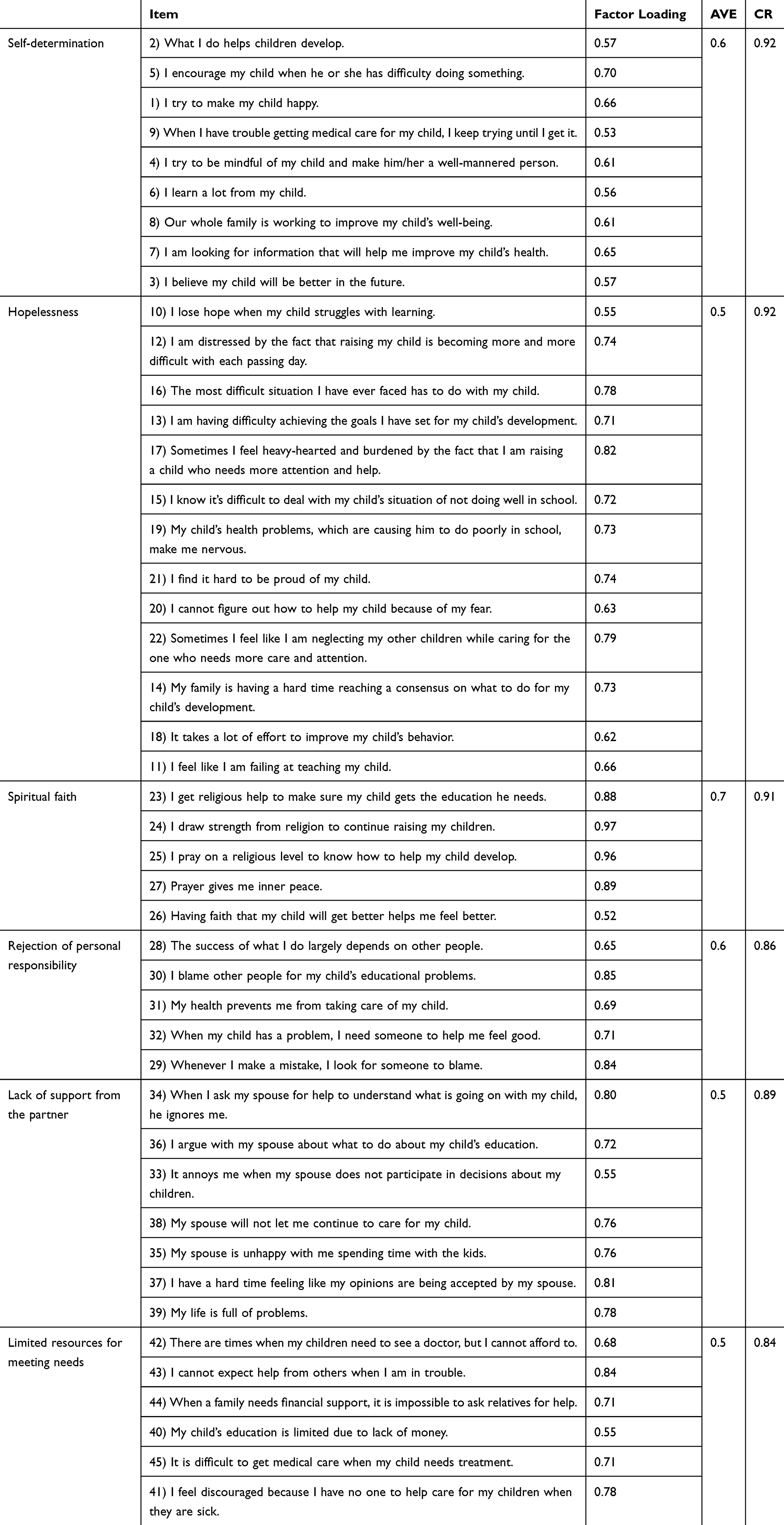 |
Table 4 Confirmatory Factor Analysis (CFA) |
Self-Determination
This factor comprised nine items (Items 1, 2, 3, 4, 5, 6, 7, 8, and 9) with factor loadings ranging from.53 to.70. The AVE and CR were.60 and.92, respectively, demonstrating adequate convergent validity. This factor reflects efforts to improve the child’s well-being, positive parenting attitudes, and cooperation among family members.
Hopelessness
This factor comprised 13 items (Items 10 to 22) with factor loadings ranging from.55 to.82. The AVE and CR were.50 and.92, respectively. This factor includes despair, emotional burden, and lack of control caused by parenting challenges.
Spiritual Faith
This factor included five items (Items 23 to 27) with factor loadings ranging from.52 to.97. The AVE and CR were.70 and.91, respectively, representing the highest level of convergent validity among all the factors. This finding suggests that religious beliefs and prayers provide emotional stability and inner resilience in parenting.
Rejection of Personal Responsibility
This factor comprised five items (Items 28 to 32) with factor loadings ranging from.65 to.85. The AVE and CR were.60 and.86, respectively. This factor reflects a tendency to attribute the causes of a child’s problems to others or external circumstances.
Lack of Support from the Partner
This factor included seven items (Items 33 to 39) with factor loadings ranging from.55 to.81. The AVE and CR were.50 and.89, respectively. It captures the experiences of conflict with one’s partner, communication breakdowns, and insufficient spousal support.
Limited Resources for Meeting Needs
This factor comprised six items (Items 40 to 45) with factor loadings ranging from.55 to.84. The AVE and CR were.50 and.84, respectively, indicating acceptable convergent validity. This reflects the impact of financial constraints and lack of access to healthcare and caregiving resources during parenting.
Discussion
This study aimed to adapt the Korean version of the MRS for mothers experiencing parenting difficulties, and examined its validity and reliability. Resilience refers to an individual’s ability to cope effectively with and recover from stress or adversity.14 Maternal resilience has traditionally been defined in the context of pregnancy, childbirth, and the postpartum period.2,15–17 However, as children attain school age, mothers are increasingly required to maintain resilience considering emotional and behavioral challenges, as well as educational and social demands.2,18 School-aged children have specific developmental characteristics associated with their life stage, and during this period, they require the appropriate care and support of their primary caregivers.1,4,19 This highlights the need to reexamine maternal resilience more broadly throughout the life course.20 In South Korean society, where a mother-centered parenting culture remains dominant, mothers often experience complex and significant burdens.21 In addition to general responsibilities of childcare, they encounter high expectations to ensure their children’s academic success, societal demands stemming from a competitive environment, and the stress of managing parenting with a demanding workforce.22,23 In this context, assessing and evaluating maternal resilience, particularly the ability to cope with and recover from psychological distress related to parenting, has critical implications at the individual and societal levels.
In addition to maternal characteristics, children’s and adolescents’ developmental attributes may also play an important role in shaping responses to parental behavior. Recent cross-cultural research has highlighted adolescents’ aspects of identity, particularly self-construal, as robust and culturally invariant psychological constructs across diverse societies. Jovanović et al24 demonstrated that adolescent identity structures show strong measurement invariance across 30 countries, underscoring identity as a key developmental factor in social and relational processes. These findings suggest that adolescents’ identity-related characteristics may interact with parental behaviors and family dynamics. Considering adolescent identity development alongside maternal resilience may therefore provide a more comprehensive understanding of parent–child interactions and developmental outcomes across cultures.
The finding that maternal resilience showed a moderate-to-strong positive association with psychological resilience in this study suggests the criterion-related validity of the Korean version of the MRS. Specifically, this result indicates that maternal resilience is theoretically aligned with resilience as a broader psychological resource and higher-order construct, while simultaneously retaining its distinct characteristics as a construct specific to the context of motherhood and childrearing. In addition, maternal resilience was significantly and positively associated with parenting competence, indicating that higher levels of resilience in the parenting context tend to co-occur with greater perceived parenting capability and confidence in addressing child-rearing demands.
The six factors of maternal resilience identified in this study—self-determination, hopelessness, spiritual faith, rejection of personal responsibility, lack of support from partners, and limited resources for meeting needs—were derived based on the original scale structure developed by Roque Hernández et al9 and demonstrated an overall acceptable model fit. The CFA indicated that the six-factor structure of the Korean version of the MRS was well replicated, showing fit indices of χ2/df = 2.271, RMSEA = 0.071, and SRMR = 0.073, demonstrating a good model fit consistent with the original instrument. The AVE for most factors exceeded the recommended threshold of.50, whereas CR ranged from.84 to.92, indicating excellent reliability. These results suggest that each factor of the Korean version of the MRS adequately explained the associated items, demonstrating the construct’s strong internal consistency and convergent validity.25,26
The original instrument was developed based on the understanding that resilience is influenced by individual internal factors as well as social and environmental contexts, emphasizing the need for an integrative perspective.9 Accordingly, maternal resilience was conceptualized as comprising six factors centered on maternal self-determination. These factors encompass individual-level aspects, such as hopelessness, spiritual faith, and rejection of personal responsibility, as well as socio-familial aspects, such as lack of support from the partner and limited resources for meeting needs. In the original scale, the factor explaining the largest proportion of variance was “hopelessness,” followed by “self-determination” and “lack of support from the partner.” By contrast, this study found that “spiritual faith” demonstrated the highest validity (AVE =0.70, CR =0.91), followed by “self-determination,” and “rejection of personal responsibility” indicating cultural or contextual differences in factor prominence while maintaining the overall structure.
The differences in findings between the original instrument and this study may be attributed to variations in the sample size and broader sociocultural contexts in which the studies were conducted. In the original study, in which “hopelessness” accounted for the largest percentage of variance, participants were mothers of children with exceptional conditions such as disabilities, psychosocial or developmental challenges, or giftedness. These mothers were likely to experience increased emotional distress, helplessness, and uncertainty regarding their children’s futures, which may have contributed to the prominence of despair.
By contrast, this study found that “spiritual faith” demonstrated the highest validity, suggesting that religious beliefs may serve as a critical resource for fostering emotional stability and psychological resilience amid parenting-related stress among South Korean mothers of school-aged children. This finding highlights the role of informal support systems in promoting resilience, particularly in a societal context such as South Korea, where formal mental health resource utilization remains relatively low.27 In the original instrument, “spiritual faith” was conceptualized as a major resilience factor, with theoretical explanations noting that many mothers use faith as a source of emotional support and strength. This was perceived as a means of empowerment, helping mothers cope with the challenges of parenting and educating their children, particularly those who have special needs. These findings are consistent with this theoretical framework, reinforcing the role of spiritual beliefs as an important psychological buffer in parenting experiences.
Self-determination consistently demonstrated strong explanatory power in the original instrument and this study. Self-determination refers to a mother’s ability to independently set goals and chart a course, work hard toward achievement, as well as evaluate and adjust outcomes to provide appropriate care for her child.9 This capacity is the main component of resilience. Therefore, self-determination may be a major facilitating factor in interventions aimed at enhancing maternal resilience.
In summary, the Korean version of the MRS effectively captured the diverse nature of maternal resilience by integrating individual and social factors, demonstrating strong theoretical consistency as well as excellent reliability and validity. The practical implications of applying this scale are as follows: First, although the original scale was developed for mothers of children with exceptionalities, this study is significant because it confirmed its applicability to a broader population of mothers who experienced parenting-related challenges, such as emotional stress, educational demands, limited social support, and perceived difficulties in managing their children’s emotional or behavioral problems during the school-age period. Second, the validated maternal resilience tool developed in this study can be used in clinical and community contexts to facilitate early identification of caregivers with low resilience. This may serve as a foundational resource for designing customized psychosocial intervention programs. For example, informal social support systems, such as religious engagement, can be effective resources, and intervention strategies aimed at enhancing self-determination, such as goal-setting training, self-reflection exercises, and autonomy-supportive counseling, may serve as powerful means for enhancing maternal resilience. Further, this tool may contribute to the development of health and welfare policies aimed at reinforcing support systems for caregivers, serving as an evidence-based assessment instrument to inform policy and decision-making.
Several limitations of this study should be noted. Although the sample size met commonly accepted recommendations for scale validation (ie, at least five participants per item), it was smaller than the more conservative thresholds often suggested for factor analytic studies (eg, ≥300 participants or more than ten participants per item). Therefore, caution is warranted regarding the stability and generalizability of the factor structure. In addition, exploratory factor analysis was not conducted in this study, as the factor structure of the MRS was theoretically derived and previously established. Furthermore, this study employed a cross-sectional design, which precludes any inference regarding temporal stability or causal relationships. All data were collected using self-report measures, which may be subject to reporting or social desirability bias. The use of an online panel recruitment method may also limit the representativeness of the sample, as mothers without internet access or those from more socioeconomically disadvantaged backgrounds may have been underrepresented. Finally, test–retest reliability was not assessed, and thus the temporal stability of the Korean version of the Maternal Resilience Scale could not be examined. Future studies with larger and more diverse samples, longitudinal designs, and repeated measurements are warranted to further examine factor stability, test–retest reliability, and to explore alternative or refined factor structures.
Conclusion
This study expands the scope of resilience research by developing a culturally appropriate tool for measuring maternal resilience in the South Korean context and demonstrating its validity and reliability. The Korean version of the Maternal Resilience Scale demonstrated satisfactory psychometric properties, including construct validity, convergent validity, criterion-related validity, and internal consistency reliability, confirming its applicability for use among mothers experiencing parenting difficulties. In particular, the significant positive associations between maternal resilience, psychological resilience, and parenting competence support the criterion-related validity of the instrument, suggesting that maternal resilience is theoretically aligned with general resilience while also functioning as an adaptive resource specific to the parenting context. In addition, this study underscores the importance of considering not only maternal characteristics but also the developmental attributes of children and adolescents. Identity-related characteristics, such as self-construal, have been identified as important factors in understanding parent–child interactions and family dynamics. When considered alongside maternal resilience, these developmental attributes may enable a more comprehensive understanding of parent–child relationships and developmental outcomes. Future research should include longitudinal studies and intervention-based evaluations that use this instrument. Further examination is needed to assess the appropriateness of the tool across diverse caregiving contexts, such as single-parent households, grandparent-led families, and multicultural families.
Author Contributions
All authors made a significant contribution to the work reported, whether that is in the conception, study design, execution, acquisition of data, analysis and interpretation, or in all these areas; took part in drafting, revising or critically reviewing the article; gave final approval of the version to be published; have agreed on the journal to which the article has been submitted; and agree to be accountable for all aspects of the work.
Disclosure
Hee Jung Jang and Soo-Hyun Nam are co-first authors for this study. The authors report no conflicts of interest in this work.
References
1. Coleman PK, Karraker KH. Parenting self-efficacy among mothers of school-age children: conceptualization, measurement, and correlates. Fam Relat. 2000;49(1):13–14. doi:10.1111/j.1741-3729.2000.00013.x
2. Gavidia-Payne S, Denny B, Davis K, Francis A, Jackson M. Parental resilience: a neglected construct in resilience research. Clin Psychol. 2015;19(3):111–121. doi:10.1111/cp.12053
3. Benzies K, Mychasiuk R. Fostering family resiliency: a review of the key protective factors. Child Fam Soc Work. 2009;14(1):103–114. doi:10.1111/j.1365-2206.2008.00586.x
4. Ma J, Chen D, Wang K, Li C, Wang L, Zhang H. Dyadic associations of parenting stress, family resilience, and coping styles among parents and grandparents in intergenerational co-parenting families. Nurs Res Pract. 2025;2025(1):8036580. doi:10.1155/nrp/8036580
5. Jin X, Wong CL, Li H, Chen J, Chong YY, Bai Y. Acceptance and commitment therapy for psychological and behavioural changes among parents of children with chronic health conditions: a systematic review. J Adv Nurs. 2021;77(7):3020–3033. doi:10.1111/jan.14798
6. Ahn JA, Roh EH, Kim T, Lee JH, Song JE. Maternal adaptation of working mothers with infants or toddlers in South Korea: a systematic review. BMC Womens Health. 2021;21(1):213. doi:10.1186/s12905-021-01357-7
7. Chung JH, Park YS. A study on the relationship between academic stress and mental health among high school students in South Korea. Res Adv Educ. 2024;3(1):54–65. doi:10.56397/RAE.2024.01.06
8. DeVellis RF. Scale Development: Theory and Applications.
9. Roque Hernández MP, Acle G, García M. Escala de resiliencia materna: un estudio de validación en una muestra de madres con niños especiales. Rev Iberoam Diagn Eval Psicol. 2009;1(27):107–132.
10. Roque Hernández MP. Evaluación de las características de resiliencia materna y mediadores ante la excepcionalidad. In: Acle G, editor. Resiliencia en educación especial: Una experiencia en la escuela regular. Gedisa;2012.105–135.
11. Kim JH. Resilience. Wisdom House; 2011.
12. Choi HJ, Seok EJ. An analysis of child care teachers’ resilience and job satisfaction. Korean J Child Care Educ. 2013;75:93–115.
13. Choe HS, Chung OB. The development of an inventory for measuring the parenting self-efficacy of Korean mothers. Korean J Child Stud. 2001;22(3):1–15.
14. American Psychological Association. Resilience. APA Dictionary of Psychology. Available from: https://www.apa.org/topics/resilience.
15. Alves AC, Souza RT, Mayrink J, et al; MAESI Study Group. Measuring resilience and stress during pregnancy and its relation to vulnerability and pregnancy outcomes in a nulliparous cohort study. BMC Pregnancy Childbirth. 2023;23(1):396. doi:10.1186/s12884-023-05692-5
16. Hajure M, Alemu SS, Abdu Z, et al. Resilience and mental health among perinatal women: a systematic review. Front Psychiatry. 2024;15:1373083. doi:10.3389/fpsyt.2024.1373083
17. Makinde OA, Okusanya BO, Ichegbo NK, et al. Resilience in maternal, newborn, and child health in low- and middle-income countries: findings from a scoping review. Reprod Health. 2025;22(1):4. doi:10.1186/s12978-025-01947-w
18. Jones LB, Kiel EJ, Luebbe AM, Hay MC. Resilience in mothers during the COVID-19 pandemic. J Fam Psychol. 2022;36(6):815–826. doi:10.1037/fam0000985
19. Rungsattatharm L, Tasingha P, Trairatvorakul P, Chonchaiya W. Longitudinal associations between executive function and positive parenting during early childhood and resilience, self-regulation, and behavioral problems in school-age children. Child Adolesc Psychiatr Ment Health. 2025;19(1):19. doi:10.1186/s13034-025-00875-8
20. Davis EP, Narayan AJ. Pregnancy as a period of risk, adaptation, and resilience for mothers and infants. Dev Psychopathol. 2020;32(5):1625–1639. doi:10.1017/S0954579420001121
21. Kim HJ, Kim SS, Jo DH. A study on the effect of work-family conflict on parenting stress and parenting attitude. J Korea Serv Manag Soc. 2022;23(2):232–256. doi:10.15706/jksms.2022.23.2.010
22. Kim H, Hlasny V. Education fever in South Korea: rite of passage versus children’s rights. Int J Popul Stud. 2025;11(4):41–52. doi:10.36922/ijps.2955
23. Lee G, Lee M. The effects of gender, academic stress, achievement pressure, and parental parenting stress on child abuse among 6th-grade elementary school students. J Child Parent Stud. 2023;9(3):49–71.
24. Jovanović V, Adams S, Al Banna MH, et al. Adolescent self-construal across cultures: measurement invariance of the aspects of identity Questionnaire-IV in 30 countries. J Res Adolesc. 2025;35(2):e70017. doi:10.1111/jora.70017
25. Anderson JC, Gerbing DW. Structural equation modeling in practice: a review and recommended two-step approach. Psychol Bull. 1988;103(3):411–423. doi:10.1037/0033-2909.103.3.411
26. Fornell C, Larcker DF. Evaluating structural equation models with unobservable variables and measurement error. J Mark Res. 1981;18(1):39–50. doi:10.1177/002224378101800104
27. Seo HY, Song GY, Ku JW, et al. Perceived barriers to psychiatric help-seeking in South Korea by age groups: text mining analyses of social media big data. BMC Psychiatry. 2022;22(1):332. doi:10.1186/s12888-022-03969-1
 © 2026 The Author(s). This work is published and licensed by Dove Medical Press Limited. The
full terms of this license are available at https://www.dovepress.com/terms
and incorporate the Creative Commons Attribution
- Non Commercial (unported, 4.0) License.
By accessing the work you hereby accept the Terms. Non-commercial uses of the work are permitted
without any further permission from Dove Medical Press Limited, provided the work is properly
attributed. For permission for commercial use of this work, please see paragraphs 4.2 and 5 of our Terms.
© 2026 The Author(s). This work is published and licensed by Dove Medical Press Limited. The
full terms of this license are available at https://www.dovepress.com/terms
and incorporate the Creative Commons Attribution
- Non Commercial (unported, 4.0) License.
By accessing the work you hereby accept the Terms. Non-commercial uses of the work are permitted
without any further permission from Dove Medical Press Limited, provided the work is properly
attributed. For permission for commercial use of this work, please see paragraphs 4.2 and 5 of our Terms.
Recommended articles

Moderating and Mediating Effects of Resilience Together with Neuroticism on Depressive Symptoms in Adult Volunteers
Ito S, Morishita C, Masuya J, Ono M, Honyashiki M, Higashi S, Tamada Y, Fujimura Y, Inoue T
Neuropsychiatric Disease and Treatment 2022, 18:1751-1761
Published Date: 17 August 2022
Psychometric Evaluation of the Grit Psychological Resources Scale (GPRS)
Schimschal SE, Cleary M, Kornhaber RA, Barnett T, Visentin DC
Journal of Multidisciplinary Healthcare 2023, 16:913-925
Published Date: 5 April 2023
Measuring Cognitive Flexibility in Chinese Individuals with Obsessive-Compulsive Disorder: Psychometric Validation and Factor Structure of the Chinese Version of the Flexibility in Daily Life Scale
Yan Z, Chen T, Ma X, Mi S, Wang P, Li Z
Psychology Research and Behavior Management 2026, 19:598045
Published Date: 20 June 2026