
Back to Journals » Journal of Multidisciplinary Healthcare » Volume 19
Male Partners’ Experiences with a Postpartum Haemorrhage Requiring Surgery: A Qualitative Study

Received 7 January 2026
Accepted for publication 2 April 2026
Published 21 April 2026 Volume 2026:19 594311
DOI https://doi.org/10.2147/JMDH.S594311
Checked for plagiarism Yes
Review by Single anonymous peer review
Peer reviewer comments 2
Editor who approved publication: Professor Tilakavati Karupaiah
Oda Sibille Moerk Moen, Bente Dahl
Faculty of Health and Social Sciences, University of South-Eastern Norway (USN), Borre, Norway
Correspondence: Bente Dahl, Faculty of Health and Social Sciences, University of South-Eastern Norway (USN), Post office Box 4, Borre, 3199, Norway, Tel +47 90626991, Email [email protected]
Purpose: To explore how male partners experience the sequence of events from the onset of a postpartum haemorrhage until the birthing woman has completed surgical treatment and is transferred to the postnatal ward.
Participants and Methods: A qualitative study was conducted using semi-structured interviews with eleven male partners living in five different counties in south-eastern Norway. The interviews were carried out in January 2024. Systematic text condensation was used to analyse the data.
Results: The data analysis identified three result categories. First, the men reported feeling “trapped in an information vacuu”. Many experienced prolonged periods of waiting alone, often for hours, without receiving timely updates. When information was eventually provided, it was often too vague to understand. Second, the men expressed feeling overwhelmed by the responsibility of caring for a newborn on their own. Finally, the extended hours of waiting without news of their partner’s condition heightened their anxiety, allowing their fears and imagination to spiral, including the fear that they might never see her again.
Conclusion: Male partners of women experiencing postpartum haemorrhage require emotional support and regular updates on their partner’s condition while they are in the operative theatre and intensive care unit. Additionally, there is a need to develop maternity care models that address the needs of both the woman and her partner during traumatic events. Midwives play a crucial role in providing support and fostering open communication, which can significantly improve the experience for both partners in challenging situations.
Keywords: male partner, interview, postpartum haemorrhage, qualitative
Introduction
According to the World Health Organization (WHO), postpartum haemorrhage (PPH) should be defined as “blood loss of 500 mL or more within 24 hours after birth”.1,2 PPH is the most common cause of maternal mortality worldwide, resulting in approximately 70000 maternal deaths each year. Although the WHO provides detailed guidelines on preventing and treating PPH, the global maternal mortality ratio still significantly exceeds the target of Sustainable Development Goal 3.1. This goal aims for fewer than 70 maternal deaths per 100000 live births by 2030. However, recent years have seen a halt in progress towards this objective. Consequently, in 2023, the WHO launched a new roadmap to reduce preventable maternal deaths related to PPH by 2030.1
PPH is often attributed to the four Ts (tone, trauma, tissue and thrombin). The most common cause is uterine atony, but PPH can also be caused by trauma in the genital tract, placental and membrane debris, a retained placenta or coagulation disorders.3 Other contributing factors are prolonged labour, oxytocin use, caesarean section, nulliparity and advanced maternal age.3 Although the risk of mortality and morbidity related to PPH particularly affects women in low- and middle-income countries, research has also demonstrated an increased prevalence of PPH in high-income countries, including Norway.4,5 The increase in these countries may be due to risk factors in women giving birth today, such as advanced age, high BMI and previous caesarean sections. A further possible contributory factor is the growing incidence of interventions in obstetric care, such as induction and vaginal operative deliveries.5 Women who experience a severe PPH are likely to undergo surgical interventions to control the bleeding. They also have an increased risk of a traumatic birth experience as well as long-term negative physical and psychological effects.6
The Norwegian gynaecological guidelines recommend that if major ongoing bleeding responds poorly to medication and interventions, the woman should be moved to an operating theatre in order to more easily identify the bleeding focus.7 When a woman is transferred to an operating theatre, her partner is usually left behind in the maternity ward.
Most studies focusing on PPH include women only, but some include the labouring woman and her partner. Studies demonstrate that partners find it challenging not only to be separated from the woman when she is transferred but also to be left with the newborn without support.8–10 Information deprivation and information needs have also been described8–10 and Briley et al stress the importance of paying attention to non-verbal cues and body language when training health care professionals (HCPs) for PPH11 Studies including the women’s partner focus on mental health and the development of postpartum depression and post-traumatic stress disorder (PTSD) in the partner after the PPH.12,13 A study by Ricbourg et al concluded that PPH is associated with a high incidence of PTSD-related symptoms in both birthing women and their partners.12
PPH has been shown to have long-term negative effects on the health and well-being of the woman and her partner, including fear of dying, flashbacks and nightmares6 as well as feelings of loss and disappointment6 and feeling emotionally disturbed and for months after the birth.8 We therefore argue for the need for qualitative studies exploring both the birthing woman’s and her partner’s experiences of a PPH. Unlike previous research, this study does not focus on mental health and PTSD in partners after a PPH. Instead, it aims to explore how male partners experience the sequence of events from the onset of a postpartum haemorrhage until the birthing woman has completed surgical treatment and is transferred to the postnatal ward.
Materials and Methods
Study Design
This study has a qualitative research design. This design is suitable when the aim is to gain insight into individuals’ lived experience of a particular phenomenon.14
Setting, Recruitment and Participants
A convenience sample of 11 male partners14 was recruited using various Facebook groups for expecting couples with due dates from January 2022 to November 2023. These groups included participants living in five counties of south-eastern Norway. We included men who had experience with a PPH requiring surgical treatment, where the birth had taken place from January 2022 to November 2023, and the child was born vaginally after gestational week 37 + 0. Those included needed to be Norwegian-speaking, over 18 years of age and competent to consent.
Seventeen men expressed an interest in participating in the study. Seven participants did not meet the inclusion criteria or did not respond to further communication with the first author. A pilot interview was carried out and included in the study, resulting in a total of eleven participants (Figure 1). Ten of these were ethnic Norwegians; one had another ethnic origin. Most had higher education. The participants were 28–41 years old (average age 36 years) at the time of birth. Seven men were first-time fathers, four were multiparous fathers, two of whom had three children already. The births took place at seven hospitals in eastern Norway.
 |
Figure 1 The recruitment process. |
Data Collection
We conducted a pilot interview to assess whether the interview guide was satisfactory. After making minor adjustments, we continued the data collection and conducted 11 semi-structured interviews in January 2024. All interviews were conducted in Norwegian. Seven face-to-face interviews were conducted by the first author at a public library or the participant’s home, while the remaining interviews were conducted digitally via Zoom or Teams. The interviews lasted from 13–45 minutes (average 29 minutes). They were audio recorded via Nettskjema, a web-based survey tool,15 and then transcribed consecutively.
The interview guide (Figure 2) consisted of one main question, and the participants were encouraged to talk freely about how they experienced the period from the onset of their partner’s PPH until she had completed the surgery and was transferred to the postnatal ward. Follow-up questions were asked and included the need for information, support and reflection in the aftermath of the incident. Time was set aside for a conversation after the interview to ensure the participants’ well-being.
 |
Figure 2 Interview guide. |
Analysis
The data were analysed in the original language by both authors using systematic text condensation, a strategy for thematic cross-case analysis consisting of four steps.14 In the first step, all the interviews were read to gain a general impression of the whole, and preliminary themes such as support, worries, communication and observation were noted. In step two, the interviews were read line-by-line to identify meaning units, ie parts of the text that helped to address the study aim. The meaning units were then coded, and related meaning units were sorted into code groups. These code groups represented different topics in the data. In the third step, the meaning units in each code group were divided into two or three subgroups. This process took place in several rounds and was performed jointly. The meaning units in each subgroup were then summarized into condensates - artificial quotations using the participants’ own words and presented in the first person.14 Based on the condensates, we prepared an analytical text that included quotes from the transcribed interviews illustrating the text. An overview of the code groups and subgroups developed during the analysis process is presented in Table 1.
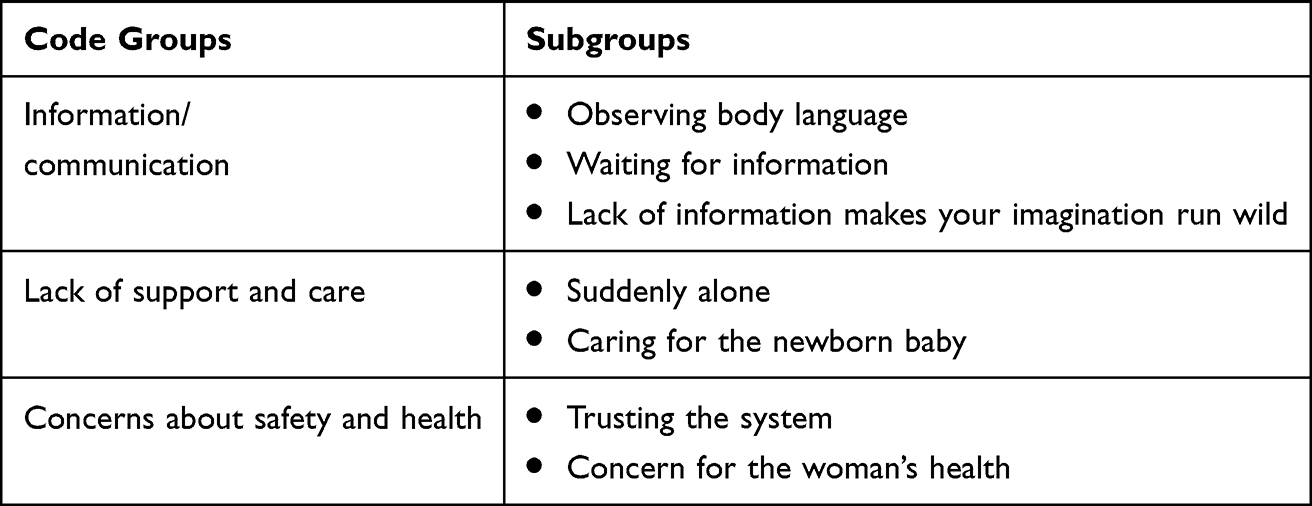 |
Table 1 Code Groups and Subgroups from the Analysis Process |
Ethical Approval and Informed Consent
The study was conducted in accordance with the Declaration of Helsinki.16 It was approved by SIKT, the Norwegian Agency for Shared Services in Education and Research (294434) and assessed by the Regional Committee for Medical and Health Research Ethics, but considered to be outside the scope of the Health Research Act (684394). The participants and their partners were given oral and written information about the study, and gave their explicit consent to participation by ticking a consent box and signing the consent form. The participants informed consent included publication of anonymized responses/direct quotes. The birthing women were classified as third parties by SIKT and were required to provide explicit consent for their male partners to participate, as there was a risk that the partners might share health information about them. The participants were given the opportunity to ask questions before the interview started. Further, they were assured of anonymity and confidentiality and informed that they could withdraw from the study at any time without any consequences.
Results
Analysis of the data resulted in three categories: 1) Waiting in an information vacuum, 2) Abandoned with a newborn baby and 3) In safe hands, or given the last kiss?
Waiting in an Information Vacuum
A recurring theme in the interviews was the lack of information. Several participants felt uneasy at not understanding what was happening when their partner started bleeding and was quickly moved to the operating theatre. The baby was handed to them and the woman was “rushed” out, without any information about the reason for this. Some were told that the bleeding had to be stopped, but they had no idea what this meant or how long it would take. They were left waiting in uncertainty, often for many hours. When they requested an update, they were given vague information or told that they would be informed later. They sensed that bad news was imminent. They lacked specific information about what had happened and what would happen next. Further, they were given no reassurance that the bleeding would not cause permanent harm to the woman:
It took quite a while before I found out that. She said, ‘Things will be ok,’ but the real confirmation didn’t come until quite a few hours later. I was in that room for a long time before I heard that everything was fine. (Informant I)
The participants gleaned a great deal of information by observing the events that occurred in the delivery room. They observed HCPs with serious expressions, hectic examination of the placenta, frequent monitoring of blood pressure and pulse, bags of blood being weighed and a focus on the woman’s genitals. Some noticed that HCPs sat on the woman’s bed, pressing her stomach hard and looking stressed. One participant pointed out that many people came into the delivery room after the midwife had raised the alarm about the bleeding, but none of them spoke to him. They mixed medication and focused only on the woman. The participants said that they sought information and confirmation of the situation by observing the HCPs’ body language and actions. One man was reassured to see that the doctor appeared calm and composed despite the stress. However, the participants also pointed out that some of the HCPs had body language that was difficult to interpret:
I couldn’t read her face; it was very neutral. There wasn’t a smile on her face. If you have good news to give someone, you could at least smile. Doctors must make sure that their body language shows that there’s a good outcome even though some things have happened. (Informant J)
Several participants emphasized that it was not the bleeding itself that made them feel stressed and uneasy, but the feeling that something was wrong. This uncertainty and insecurity filled them with ideas about what might be happening. In some cases, the women had been moved to the intensive care unit, but their partners did not know whether they were hovering between life and death or if they were okay. One participant realized that the bleeding was abnormal, but found it difficult to understand the extent of it. Another understood that something had to be done, but had not been told whether the doctors had been able to stop the bleeding. The men felt bewildered and frustrated. In addition, the lack of information and the fact that they had to ask for information themselves led to many overwhelming thoughts and the fear that their loved one was bleeding to death. One participant described the thoughts spinning in his head in this way:
If it’s all uncertain, or if you don’t get any information early on, well then you come up with your own versions in your head. And then these versions can vary a lot from ‘things are fine’ to ‘she’s died’ and none of them knows how to pluck up enough courage to tell you. They’re waiting for a senior doctor to come and tell me the bad news, or a psychologist coming to give me some support. You can get a whole range of ideas in situations where there’s an information vacuum. (Informant K)
Abandoned with a Newborn Baby
Some of the participants received regular information on what was taking place after their partner had been taken to the operating room, and the staff frequently came over to update and reassure them. However, most participants found this a difficult time and they missed receiving care and support. There was a deafening silence after their partner had been moved, and their uncertainty resulted in feelings of insecurity and unease. No one came to talk to them. They stressed that they did not need someone to pat their head and comfort them, but they wanted someone to regularly check how they were and help them as needed. They wanted a person to sit down with them for a few minutes to hear if they had any questions and to discuss the incident. One participant described the uncertainty as follows:
You’re just kind of left to yourself. You realize that things are happening. I couldn’t stay in that small room; I had to walk up and down the corridor. Because you get restless from all the waiting. (Informant J)
Most participants were first-time fathers, and were more frightened by being left alone with the baby than seeing their partner being wheeled away to the operating theatre. They felt that the baby was being dumped onto their lap but were unsure about how to deal with it. They did not know how to hold the baby, and they wondered if it was too cold or too hot or if it was breathing normally. It was a brutal and lonely feeling to receive minimal care and support after the birth. One participant mentioned that it was a little risky of the staff to leave a first-time father alone with a baby who was barely one hour old, but he just had to do the best he could and follow his instincts. However, several of the fathers said it gave them a pleasant feeling of satisfaction to sit there with the baby that they had long been waiting for, and they felt they had good contact with the baby when the two of them were alone in the room. At the same time, they were upset that the baby’s mother was not with them and that the family was separated. Some also had concerns as to whether the mother-baby relationship would be affected by the incident, and whether breastfeeding would be disrupted by the separation. Others did not consider themselves capable of taking care of the baby as they had enough difficulty dealing with their thoughts. Most first-time fathers felt that they received inadequate care and support, but some multiparous fathers also felt that they were left on their own:
It’s quite likely that I’d have been wondering about things, I’d have been very anxious if I hadn’t known what I did know in advance. It was kind of like: ‘Sit here, take the baby, here’s a blanket, make sure she doesn’t get cold. See you later!’ So, you know. If I’d been completely new to this, it might not have been that easy. I don’t know. (Informant C)
In Safe Hands, or Given the Last Kiss?
Some of the participants understood what was happening, and felt confident that the HCPs were in control, as they acted calmly and decisively. They had great faith in the health care system in advance. They felt that they had been looked after properly during labour and found the HCPs to be professional and competent. These participants were not afraid that their partner would die, although they did not consider the PPH to be a trivial matter. They expressed confidence that they had been provided with correct information and they trusted the HCPs’ assessments, which allowed them to focus all their attention on the baby. One participant summed up this confidence as follows:
I wasn’t too worried about my wife. She was in the hospital, I do trust the healthcare providers to do what they can, and so it wasn’t actually life-threatening. (Informant G)
Not all participants shared this man’s confidence that everything would be fine. During the PPH in the delivery room, they noticed that their partner gradually turned pale, and that the HCPs asked her questions to prevent her from fainting. They observed blood running down the bedside, and realized that it was not normal bleeding. They said that they did not feel concerned immediately, but when their loved one was wheeled away, they started fearing for her life. The men thought a great deal about how they would manage to take care of the baby if the mother died, and thoughts about whether they had talked to and kissed their partner for the last time ran through their heads. They felt vulnerable and powerless in their fear of perhaps having lost the most important person in their lives. During the hours the men waited for definite news, many scenarios whirled in their heads, creating fear and panic. Several participants said that this fear and discomfort from the waiting period remained in their bodies for several months, and that the thought of having more children later scared them. One man described the uncertainty and emotions he experienced while waiting as follows:
Now those two are everything to me. I thought a lot about. If she dies now, what do I do? I won’t be able to take care of that baby alone. (Informant A)
Discussion
The Need for Information When Complications Arise
The participants in this study were not expecting the birth to end with a PPH. They did not immediately realize that something wrong was happening, but it was soon conveyed by the body language and actions of the HCPs. Verbal reassurances in stressful situations can be helpful, but they are not credible if the body language says otherwise.11 This created hypotheses about what had happened based on how they interpreted the actions of HCPs. Similar findings have been described elsewhere, demonstrating that HCPs’ body language indicates the gravity of the situation.11 The body is constantly conveying messages, consciously and unconsciously, and it is difficult to conceal body signals. In such situations, men often describe a sense of helplessness, being unprepared and unable to contribute anything.17 Studies describe how men who developed symptoms of post-traumatic stress following a PPH reported flashbacks to the feeling of being excluded and not being told what was going on.13 Further, observing panic in the eyes of HCPs is a traumatic experience.13 HCPs who appear energetic and efficient, while communicating calmly among themselves and with the birthing couple, represent a protective factor and can provide reassurance that a PPH is not a surprising and rare complication.10,11,18
A study by Snowdon et al9 demonstrates that the partner desperately needs to be informed, but instead finds that the flow of information stops when the woman is wheeled away. Information was also a huge concern for the participants in this study; the men felt they were “trapped in an information vacuum”. Many were left to wait alone. When they asked for updates, they were told that information would come, but they often had to wait for hours. Moreover, when given information, it was often too vague to understand. Participants in another study pointed out that, since there are often 8–10 HCPs in the delivery room during the PPH, some could have stayed behind for a few minutes to inform the partner after the woman had been moved.18 However, it would probably be preferable for the couple’s regular midwife to come back and provide information herself. The midwife has often established a trusting relationship with the partner during labour19,20 and information can be more easily understood if it is given by a familiar person.10 Another suggestion that has been put forward is that HCPs distribute a brochure with information about PPH.9 This is timesaving for HCPs and can be of great benefit to partners in making them feel better informed and reassured.
The Need for Individual Support and Care
The men who had a positive experience of care and support received regular updates on the woman’s status. Often, little attention is needed for a partner to feel supported and reassured.
Listening to and responding to the partners’ concerns and questions can help them feel recognized, which can reduce stress levels and increase coping skills.21 The men who felt safe during the PPH had great faith in healthcare services and the local hospital; they did not fear for the woman’s life even though they realized that the bleeding was abnormal. However, most participants reflected on the possibility of becoming single fathers. This is a common thought in many fathers in connection with PPH.4,18 The many hours of waiting before receiving news of their partner’s situation reinforced the participants’ imagination and fear that they would never see her again. Studies that have examined the psychological consequences of PPH on the partner of the birthing woman show that partners have an increased prevalence of symptoms of postpartum depression and PTSD one month after birth, but that this evens out at three months.12,13 The present study did not focus on the long-term effects of PPH, but considering how alarmed the men appeared at the thought that their loved one could die, it can be assumed that they had an increased risk of postpartum depression or flashbacks in the first few months after the birth. In a study by Elmir and Schmied,20 men describe the need for a supportive culture following an adverse birth event. Further research is needed to explore the potential impact of witnessing a traumatic situation on partners’ psychological health and resilience, and what support partners find helpful in dealing with the trauma.18
The Need for a More Inclusive Maternity Care Model
In many countries, male partners commonly attend the birth of their baby and many men hold expectations of being actively involved in their child’s life as fathers.20 However, adjusting to the new role as father may take time, and requires access to appropriate support and guidance.22 The possibility to attend the birth may expose fathers to adverse or traumatic events,18 and research demonstrates that many men need to reconstruct their role as fathers after witnessing a traumatic event.20 Men’s coping strategies often appear to be shaped by their beliefs about acceptable masculine roles, which emphasize suppressing emotions and projecting strength for the sake of others.23 An interesting finding in our study revealed that some fathers found it overwhelming to be left alone with the responsibility of caring for a newborn. They were so shocked by the PPH that they felt unfit to care for their baby and struggled to express the love they wished to communicate. According to Elmir and Schmied,17 witnessing a traumatic birth can negatively impact men, potentially straining their relationship due to challenges in communication and debriefing about the event. Support and encouragement to fathers by maternity care staff can play a crucial role in helping them to navigate their new responsibilities and adjust to parenthood.22
Daniels et al question whether the current maternity model, which centres its attention and care on the woman, may inadvertently contribute to the partner’s experience of trauma18 In their study, men reported feeling like a “spare wheel”, often sidelined and kept out of the way. Similarly, Draper24 suggests that the contrasts between women’s embodied experience and fathers’ undefined roles, beginning in pregnancy, may lead to negative experiences for men, positioning the father as more of a background figure If the father is regarded as important in his own right, as an essential carer for the child, beginning in pregnancy, our approach to care should aim to include him during pregnancy, birth and the postpartum period.25 Studies examining the role of fathers suggest that paternal involvement during pregnancy can have significant implications for maternal prenatal health.26 However, research also highlights that men face their own challenges during the transition to parenthood, such as managing feelings of fear, frustration and exclusion, which are not always adequately addressed or supported.27 This highlights the need for further work on developing models of maternity care that address the needs of both the woman and her partner when traumatic events occur.
Strengths and Limitations
The study was reported according to the Standards for Reporting Qualitative Research checklist28 to enhance transparency, clarity and rigour. To discuss study limitations, we used the meta-criteria of reflexivity, internal validity and external validity as described by Malterud.14
The authors are registered nurse midwives with different experiences of caring for women experiencing a PPH and their partners. The first author works as a clinical midwife and conducted the interviews as part of her Master’s degree in midwifery, while the second author holds a PhD in midwifery and teaches midwifery in Norwegian universities. Both have clinical experience in caring for women experiencing PPH and their partners. We believe that involving fathers in maternity care positively impacts family formation and overall well-being. To reduce the potential bias of our beliefs on data analysis, we intentionally sought out evidence that might challenge or contradict this perspective. However, we acknowledge that interviews are shaped by the dynamic interaction between interviewer and the informant.
Internal validity examines whether the study successfully investigated its intended focus and whether the methods used were appropriate. The interview guide included few questions, giving participants freedom to narrate their experiences. Interview lengths varied from 13 to 45 minutes, with two notably shorter. Despite their brevity, these interviews still provided relevant information. However, they addressed events from 2022, while the remaining nine focused on 2023. This difference may indicate the risk that painful experiences are forgotten over time, potentially affecting the study’s internal validity. Participants were encouraged to attend in-person interviews to minimize technical issues, though four were conducted digitally at participants’ request. For these interviews, participants chose the location to reduce power imbalances. No notable differences were observed between digital and physical interviews in emotional communication. While some participants shared detailed emotions, others were more reserved. Follow-up questions were necessary to encourage elaboration. Both authors read the interview transcripts and agreed on preliminary themes. Thematic analysis was conducted by the first author and reviewed by the second, ensuring a diversity of interpretations.
External validity refers to the extent to which a study’s findings can be applied to contexts beyond the specific setting in which they were generated. In this context, empirical variation within the sample plays a crucial role in ensuring transferability.14 When a sample contributes rich data, a lower number of participants is needed. Our sample can be characterized as a small-scale convenience sample, consisting of 11 male partners. The sample included men living in different parts of south-eastern Norway. All but one were Norwegian, with an average age of 36 years; only two participants were under 33 years of age at their child’s birth. The sample was biased toward well-educated, Caucasian men. However, participants described diverse experiences, with recurring themes demonstrating notable variation. This provided sufficient data to explore the study’s aim. To add variety in the empirical data, further studies should include men of younger age, men from non-Western cultures and female partners.
Conclusion
Our study demonstrate that male partners who are present in the delivery room when a birthing woman needs surgical treatment for a PPH receive insufficient information during and after the traumatic event, resulting in uncertainty and frustration as well as worrying thoughts that the woman’s life may be danger. When traumatic situations occur, partners need access to HCPs to address their questions and help manage feelings of fear, frustration and exclusion. Antenatal care should include information about adverse events to prepare partners for more than just “normal” childbirth. Additionally, there is a need to develop maternity care models that address the needs of both the woman and her partner during traumatic events. Midwives can provide support and open communication to make a difference in these situations.
Declaration of Generative AI in Scientific Writing
During the preparation of this work the authors used Sikt KI-chat to translate parts of the text from Norwegian to English. After using this tool, the authors reviewed and edited the content as needed and take full responsibility for the content of the document. Finally, the manuscript was proofread by a professional native English proofreader.
Data Sharing Statement
The participants of this study did not give a written consent for their data to be shared publicly, so due to the sensitive nature of the research supporting data is not available..
Acknowledgments
The authors would like to thank the men who participated in the study for sharing their experiences.
Funding
This research did not receive any funding.
Disclosure
The authors report no conflicts of interest in this work.
References
1. World Health Organization. A roadmap to combat postpartum haemorrhage between 2023 and 2030. 2023. Available from: https://iris.who.int/bitstream/handle/10665/373221/9789240081802-eng.pdf?sequence=13;2023.
2. Say L, Chou D, Gemmill A, et al. Global causes of maternal death: a WHO systematic analysis. Lancet Glob Health. 2014;2(6):323–10. doi:10.1016/s2214-109x(14)70227-x
3. World Health Organization. Guideline on prevention and management of PPH; undated. Guideline on Prevention and Management of PPH. 2025.
4. Knight M, Callaghan WM, Berg C, et al. Trends in postpartum hemorrhage in high resource countries: a review and recommendations from the international postpartum hemorrhage collaborative group. BMC Pregnancy Childbirth. 2009;9(1):55. doi:10.1186/1471-2393-9-55
5. Pettersen S, Falk RS, Vangen S, Nyfløt LT. Exploring trends of severe postpartum haemorrhage: a hospital-based study. BMC Pregnancy Childbirth. 2023;23:363. doi:10.1186/s12884-023-05702-6
6. Allum KE, Tilly S, Dahl B. Being touched by death while giving birth to life: a meta-ethnography exploring women’s experiences with postpartum hemorrhage. Eur J Midwifery. 2025;26:9. doi:10.18332/ejm/200615
7. Nyfløt LT, Aase TA, Jacobsen AF, Pettersen S, Sanda B, Baghestan E. Postpartum blødning (PPB) [Postpartum haemorrhage]. Norwegian Society for Gynecology and Obstetrics; 2020. Available from: https://www.legeforeningen.no/foreningsledd/fagmed/norsk-gynekologisk-forening/veiledere/veileder-i-fodselshjelp/postpartum-blodning/.
8. Dunning T, Harris JM, Sandall J. Women and their birth partners’ experiences following a primary postpartum haemorrhage: a qualitative study. BMC Pregnancy Childbirth. 2016;16(1):80. doi:10.1186/s12884-016-0870-7
9. Snowdon C, Elbourne D, Forsey M, Alfirevic Z. Information-hungry and disempowered: a qualitative study of women and their partners’ experiences of severe postpartum haemorrhage. Midwifery. 2012;28(6):791–799. doi:10.1016/j.midw.2011.12.012
10. Rosvig L, Steffensen E, Brogaard L, et al. Women and partners’ experience of major postpartum haemorrhage: a qualitative study. Br J Obstet Gynaecol. 2023;130(9):1087–1095. doi:10.1111/1471-0528.17440
11. Briley AL, Silverio SA, Singh C, Sandall J, Bewley S. “It’s like a bus, going downhill, without a driver”: a qualitative study of how postpartum haemorrhage is experienced by women, their birth partners, and healthcare professionals. Women Birth. 2021;34(6):e599–607. doi:10.1016/j.wombi.2020.12.002
12. Ricbourg A, Gosme C, Gayat E, Ventre C, Barranger E, Mebazaa A. Emotional impact of severe post-partum haemorrhage on women and their partners: an observational, case-matched, prospective, single-centre pilot study. Eur J Obstet Gynecol Reprod Biol. 2015;193:140–143. doi:10.1016/j.ejogrb.2015.07.020
13. Van Steijn ME, Scheepstra KWF, Zaat TR, van der Post JAM, Olff M, van Pampus MG. Posttraumatic stress disorder in partners following severe postpartum haemorrhage: a prospective cohort study. Women Birth. 2020;33(4):360–366. doi:10.1016/j.wombi.2019.06.016
14. Malterud K. Kvalitative Forskningsmetoder for Medisin Og Helsefag [Qualitative Research Methods for Medicine and Health Sciences].
15. University of Oslo. Nettskjema; undated. Available from: https://nettskjema.no.
16. World Medical Association. WMA declaration of Helsinki – ethical principles for medical research involving human subjects. 2018. Available from: https://www.wma.net/policies-post/wma-declaration-of-helsinki-ethical-principles-for-medical-research-involving-human-subjects/.
17. Elmir R, Schmied V. A meta-ethnographic synthesis of fathers’ experiences of complicated births that are potentially traumatic. Midwifery. 2016;32:66–74. doi:10.1016/j.midw.2015.09.008
18. Daniels E, Arden-Close E, Mayers A. Be quiet and man up: a qualitative questionnaire study into fathers who witnessed their partner’s birth trauma. BMC Pregnancy Childbirth. 2020;20(1):236. doi:10.1186/s12884-020-02902-2
19. Hinton L, Locock L, Knight M. Partner experiences of “near-miss” events in pregnancy and childbirth in the UK: a qualitative study. PLoS One. 2014;9(4):e91735. doi:10.1371/journal.pone.0091735
20. Elmir R, Schmied V. A qualitative study of the impact of adverse birth experiences on fathers. Women Birth. 2022;35(1):e41–8. doi:10.1016/j.wombi.2021.01.005
21. Thornquist E. Kommunikasjon: Teoretiske Perspektiver På Praksis I Helsetjenesten [Communication: Theoretical Perspectives on Practice in Health Care].
22. The Royal College of Midwives. Reaching out: involving fathers in maternity care. 2011. Documento-RCM-Royal-College-of-Midwives-reaching-out-Involvin-fathers-in-Maternity-care-2011.pdf. 2025.
23. Etheridge J, Slade P. “Nothing’s actually happened to me”: the experiences of fathers who found childbirth traumatic. BMC Pregnancy Childbirth. 2017;17(1):80. doi:10.1186/s12884-017-1259-y
24. Draper J. Blurring, moving and broken boundaries: men’s encounters with the pregnant body. Sociol Health Illn. 2003;25(7):743–767. doi:10.1046/j.1467-9566.2003.00368.x
25. Dahl B, Prinds C. Family-centred care. In: Lundgren I, Blix E, Gottfredsdottir H, Wikberg A, Nøhr EA, editors. Theories and Perspectives for midwifery: A Nordic View. Lund: Studentlitteratur; 2022:157–169.
26. Alio AP, Salihu HM, Kornosky JL, Richman AM, Marty PJ. Feto-infant health and survival: does paternal involvement matter? Matern Child Health J. 2010;14(6):931–937. doi:10.1007/s10995-009-0531-9
27. Chalmers B, Meyer D. What men say about pregnancy, birth and parenthood. J Psychosom Obstet Gynaecol. 1996;17(1):47–52. doi:10.3109/01674829609025663
28. O’Brien BC, Harris IB, Beckman TJ, Reed DA, Cook DA. Standards for reporting qualitative research: a synthesis of recommendations. Acad Med. 2014;89(9):1245–1251. doi:10.1097/ACM.0000000000000388
 © 2026 The Author(s). This work is published and licensed by Dove Medical Press Limited. The
full terms of this license are available at https://www.dovepress.com/terms
and incorporate the Creative Commons Attribution
- Non Commercial (unported, 4.0) License.
By accessing the work you hereby accept the Terms. Non-commercial uses of the work are permitted
without any further permission from Dove Medical Press Limited, provided the work is properly
attributed. For permission for commercial use of this work, please see paragraphs 4.2 and 5 of our Terms.
© 2026 The Author(s). This work is published and licensed by Dove Medical Press Limited. The
full terms of this license are available at https://www.dovepress.com/terms
and incorporate the Creative Commons Attribution
- Non Commercial (unported, 4.0) License.
By accessing the work you hereby accept the Terms. Non-commercial uses of the work are permitted
without any further permission from Dove Medical Press Limited, provided the work is properly
attributed. For permission for commercial use of this work, please see paragraphs 4.2 and 5 of our Terms.
Recommended articles
Qualitative Exploration in Exit Interviews of Changes Observed in Clinical Trials for Individuals with Autism Spectrum Disorder Without Intellectual Disability
Chladek M, Burbridge C, Gibbons E, Willgoss T, Smith J, Clinch S
Patient Related Outcome Measures 2023, 14:313-335
Published Date: 21 November 2023