
Back to Journals » International Journal of Chronic Obstructive Pulmonary Disease » Volume 20
Lung Cancer Risk in US Adults with COPD: A Systematic Review and Meta-Analysis
Authors Obeng-Nyarkoh PI  , Valentin-Figueroa ME , Cadham CJ, Cobb NK, Han MK, Levy DT, Meza R, Sanchez-Romero LM
Received 7 June 2025
Accepted for publication 13 August 2025
Published 14 October 2025 Volume 2025:20 Pages 3399—3421
DOI https://doi.org/10.2147/COPD.S531972
Checked for plagiarism Yes
Review by Single anonymous peer review
Peer reviewer comments 3
Editor who approved publication: Dr Jill Ohar
Peggy-ita Obeng-Nyarkoh,1 Maria E Valentin-Figueroa,1 Christopher J Cadham,2 Nathan K Cobb,3 MeiLan K Han,4 David T Levy,1 Rafael Meza,5 Luz M Sanchez-Romero1
1Department of Oncology, Georgetown University Medical Center, Washington D.C, DC, USA; 2Department of Health Management and Policy, University of Michigan, Ann Arbor, MI, USA; 3Division of Pulmonary, Critical Care, and Sleep Medicine, Department of Medicine, Georgetown University Medical Center, Washington D.C, DC, USA; 4Division of Pulmonary and Critical Care Medicine, Medical School, University of Michigan, Ann Arbor, MI, USA; 5Department of Integrative Oncology, BC Cancer Research Institute, Vancouver, BC, Canada
Correspondence: Luz M Sanchez-Romero, Department of Oncology, Georgetown University Medical Center, 2115 Wisconsin Ave, Suite 300, Washington, DC, 20007, USA, Email [email protected]
Background: Chronic obstructive pulmonary disease (COPD) is an important risk factor for the development of, and death from, lung cancer.
Methods: We conducted a systematic review and meta-analysis assessing the risk of lung cancer incidence and mortality among adults with a COPD diagnosis in the United States (US) and exploring differences by subgroups. We searched MEDLINE, Embase, and PubMed from inception to July 2024 for observational studies that investigated the association between COPD and lung cancer incidence and mortality risk. We conducted a meta-analysis for overall risk and COPD assessment methods, and a systematic review for analyses within sex, race/ethnicity, smoking status.
Results: Twenty observational studies (n=638,610) were included in the systematic review and meta-analysis. US adults with COPD were found to have higher odds of developing (OR, 1.76; [1.53 to 1.99]) and higher hazards of dying (HR, 1.48; [1.06 to 1.89]) from lung cancer compared to those without COPD. Mixed results were observed when stratifying the impact of COPD on lung cancer risk by subgroups (ie, sex, race and ethnicity and smoking status). Generally, the same trend was observed where people in each subgroup with COPD were at higher risk of lung cancer incidence and mortality compared to those in the same subgroups without the disease. Individuals assessed by self-reported COPD and spirometry showed greater incidence risk but not mortality risk.
Conclusion: US adults with COPD, including those with a smoking history, are at an increased risk for lung cancer incidence and mortality compared to those without COPD regardless of sex and race and ethnicity.
Keywords: chronic obstructive pulmonary diseases, systematic review, United States, incidence, mortality, smoking
Introduction
Chronic Obstructive Pulmonary Disease (COPD) is a progressive, but preventive and treatable, lung disease characterized by an obstruction of airflow. It is an umbrella term which includes chronic bronchitis, emphysema, or a combination of both conditions,1 and continues to be among the leading causes of global mortality.2 In 2020, the age-adjusted prevalence of COPD within the United States (US), was 5.6%3 – affecting more than 15 million Americans.4 The estimated total economic burden of COPD in the US is approximately $50 billion each year5 and mortality rates from COPD continue to increase.6
COPD has been associated with an increased risk of mortality from several chronic conditions such as chronic lower respiratory diseases,7 cardiovascular diseases,8 cerebrovascular diseases,7 and lung cancer.9 In the US, lung cancer is the third most common cancer diagnosis and the leading cause of cancer deaths with an estimated 300,000 incident cases10 in 2020 and 14.3 deaths per 100,000 in the standard population.11 Estimates of the prevalence of COPD in people diagnosed with lung cancer range from 40% to 70%, dependent on diagnostic criteria and population.12–14
There is a reciprocal association between COPD and lung cancer: lung cancer may occur as a comorbidity of COPD15 and COPD is a risk factor for lung cancer.16,17 Both diseases share the etiology of tobacco exposure – whether from active smoking or second-hand smoke.9,18,19 Additionally, a pathogenic relationship exists between the two conditions as characteristics of COPD – such as pulmonary inflammation20 and lung matrix remodelling21 – are precursors to lung cancer. It has been observed that the progression of COPD and the COPD-lung cancer risk relationship are also highly influenced by biopsychosocial determinants such as sex22 and race and ethnicity,23 due in part to interactions between social, structural, environmental, and genetic24 risk factors.
Assessing the differential effects of COPD on the risk of lung cancer incidence and mortality in the US population, as well as the differential effects on subgroups of the population, provides critical information on US-specific health outcomes and health inequalities. As lung cancer is the leading cause of cancer-related deaths in the United States, and COPD is one of the main causes of morbidity,25 it is important to gain an understanding of how specific characteristics differentially impact the US population.
Although individual studies have assessed the effects of COPD on lung cancer incidence and mortality, there exists a relative gap in terms of precisely estimating the sizes of these effects particularly in the US. Moreover, there is not much evidence on how differences in sex, race and ethnicity, and/or smoking status differentially impact these estimates. This review seeks to fill in the gap by pooling available summary data. This systematic review and meta-analysis assess the risk of lung cancer incidence and mortality in the US overall adult population with COPD diagnosis and explores differences in risk by sex, race and ethnicity, smoking status, and COPD assessment methods.
Methods
Study Protocol
This systematic review and meta-analysis examine the association of COPD with the risk of developing lung cancer as found in peer-reviewed studies. We followed the Preferred Reporting Items for Systematic Reviews and Meta-Analysis (PRISMA) guidelines (Supplementary Table 1)26 and the Meta-analysis Of Observational Studies in Epidemiology (MOOSE) checklist (Supplementary Table 2).27 The review was registered with the International Prospective Register of Systematic Reviews (PROSPERO) (CRD42022349594).
Search Strategy and Search Terms
We searched OVID MEDLINE, OVID EMBASE, and PubMed to identify articles published through July 2024 that reported on the impact of COPD on lung cancer risk incidence and mortality risk among adults within the United States. Search terms were developed with a scientific librarian. A detailed description of the search is in Supplementary Table 3.
Inclusion and Exclusion Criteria
We included observational studies that examined the incidence and mortality risk of lung cancer associated with COPD overall and across subgroups (sex, race and ethnicity, smoking status, and COPD assessment methods) in the US general adult population. We excluded studies that 1) lacked data on the outcomes of interest: mortality risk, incidence risk, or the association between lung cancer and COPD (defined as COPD, chronic bronchitis, and/or emphysema); 2) was the incorrect population: not specific to the US or had co-occurring conditions (eg, HIV, chronic kidney disease, etc).; 3) only presented results by COPD severity stage; and 4) were clinical trials, post-surgical studies, in-hospital mortality studies, basic science studies, conference procedures, abstracts, or study protocols (Supplementary Table 3).
Study Selection
Two independent reviewers (LMS-R and MEV-F) conducted the literature search. Duplicates were deleted first by using two reference manager software: EndNote28 and Zotero29 followed by the systematic reviewing software Rayyan.30 Three reviewers (PO-N, LMS-R, and MEV-F) independently screened the titles and abstracts to assess eligibility and two reviewers (PO-N and MEV-F) independently conducted full text screening. Any discrepancies were resolved through discussion and consensus.
Data Extraction and Analysis
We developed a template for data abstraction in Google Sheets. One reviewer (PO-N) conducted data extraction. Extracted data included: study location, years of data collection, study design, outcomes, COPD definition (COPD, chronic bronchitis, and/or emphysema), COPD assessment/diagnosis method (self-reported, medical records, spirometry, etc), sociodemographic characteristics, lung cancer histology, values of measures of association, and adjusted covariates.
Results from included studies were extracted in the form of adjusted odds ratios (OR), hazard ratios (HR), incidence ratios (IR), and incidence rate ratios (IRR), along with 95% confidence intervals (95% CIs). Unadjusted outcomes were extracted when adjusted results were not available. Authors occasionally reported results for multiple outcomes of interest. This led to the extraction of a varying number of findings (ie, observations) from each study.
Studies were categorized by the two main outcomes – lung cancer incidence and lung cancer mortality – with further stratification by COPD type (COPD, chronic bronchitis, and/or emphysema). The collected outcomes examined findings across the overall population and subgroups: 1) Sex: male and female; 2) Race and Ethnicity: non-Hispanic Black or non-Hispanic White; 3) Smoking Status: current, former, and never; and 4) COPD Assessment Methods: self-reported, physician diagnosis only, spirometry only, medical records only, and combination; the latter group was used when studies employed more than one method of assessing COPD (eg, spirometry and CT scanner self-reported and medical records). Details about the subgroup categories (comparator and reference) from each study are provided in Supplementary Table 4.
Statistical Analyses
We conducted a random-effects meta-analysis to assess overall risk of lung cancer incidence and mortality among US adults diagnosed with COPD and for COPD assessment method. Meta-analysis was conducted when two or more eligible studies were identified based on similarities in their design, methods, definitions, populations, and/or outcomes.31 Because of the variability in the definitions and methods of the studies that reported outcomes for sex, race and ethnicity, and smoking status subgroups, we conducted only descriptive analyses –as part of the systematic review.
We reported the inconsistency index (I2) to quantify the percentage of variability in results due to heterogeneity. Based on Cochrane’s recommendation, heterogeneity can be interpreted as: 0–40% might not important, 30–60% moderate, 50–90% substantial, and 75–100% considerable.32 I2 values greater than 75% were considered statistically significant.33,34 Additionally, the point estimate with 95% CI were used to assess effect size and statistical significance. All statistical analyses were performed using Stata/BE 17.0.35
Risk of Bias Assessment
The risk of bias of each study was independently assessed by two researchers (PO-N and MEV-F) using the Risk of Bias In Non-randomized Studies – of Exposure (ROBINS-E) tool (Supplementary Table 5).36 The assessment comprised seven domains that analyzed the risk of bias due to confounding, exposure measurements, participant selection/analysis, post-exposure interventions, missing data, outcome measurements, and selection of reported data. The total score for each study was assessed on a scale of 1 to 5 – with 1 representing low and 5 representing very high risk of bias. The total score – in conjunction with the scores of the domains and sub-domains – were assessed to evaluate if the risk of bias was sufficiently high to threaten conclusions about the association between COPD and the outcomes of interest. We reproduce the meta-analyses for the primary outcomes with only studies at low risk of bias to assess the potential impact of bias in the included studies. Additionally, a common-effect model with the inverse-variance method funnel plot was created for studies with a low risk of bias (RoB=1).
Sensitivity Analysis
Studies often reported results for overall COPD (COPD, chronic bronchitis and emphysema) and/or for individual diseases (chronic bronchitis or emphysema) and defined the disease based on different assessment methods. Including all the available data in the evidence synthesis allows for more generalizable results. However, it can lead to population overlap (double counting) that could introduce bias in the analysis.37–39 To address this issue, we conducted a sensitivity analysis for incidence and mortality risk meta-analysis. We included only one observation per study, prioritizing results for studies defining COPD as either a standalone diagnosis or an umbrella term. This approach was chosen because comorbidity of emphysema and chronic bronchitis is common, and studies suggest less misclassification among participants reporting both conditions compared to those reporting only one.40 Furthermore, we prioritized objective assessment methods over self-reported diagnoses due to their established reliability.40 Similarly, we selected outcomes from fully adjusted models to strengthen the validity of our findings compared to unadjusted modes.41
Results
Study Characteristics
Our initial search identified 10,435 articles, of which 59 were selected for full text review. Twenty studies were included (Figure 1). The 20 studies reported 119 relevant observations, of which 88 measured lung cancer incidence (17 studies) and 31 measured lung cancer mortality (three studies). Our sample includes four studies conducted at the national level and 16 conducted at a city or state level. Eleven included studies were case-control and nine were cohort studies (seven prospective and two retrospective). Table 1 contains characteristics of the included studies. Supplementary Material B described the reasons for exclusion of articles retrieved.
 |
Table 1 Characteristics of the Included Studies |
 |
Figure 1 PRISMA flow diagram of the selection.62* *The reasons for full-text exclusion can be seen in Supplementary Material B. |
The 20 studies included in the review used different definitions of COPD. Seven studies47,53,54,57,58,61,63 employed the umbrella definition of COPD (ie, COPD, chronic bronchitis, and/or emphysema) only, one study51 reported emphysema only, and two studies56,59 reported airflow limitation only. The remaining ten studies42–46,48–50,52,55 employed two or more definitions of COPD, emphysema, chronic bronchitis, or airflow limitation, with individual point estimates provided for each definition.
Meta-Analysis
Lung Cancer Incidence Risk
Results from the meta-analysis assessing the risk of lung cancer incidence are presented in Figure 2.42,45,46,50,53,55,56,59,61 Across the 17 studies assessed, there was variability in the statistical measures. Studies reported odds ratios (ORs) (n=12), hazard ratios (HRs) (n=2), incidence ratios (IRs) (n=1), and incidence rate ratios (IRRs) (n=2); Hopkins et al56 presented both IRs and IRRs. For this meta-analysis, we only included the studies which provided ORs and IRRs and assumed that IRRs were similar to ORs.64 The studies by Littman et al47 and Nagasaka et al58 were excluded from this meta-analysis since the results were presented as HRs and the manuscript did not provide sufficient data for transformation; they were however included in the systematic review. Zhai et al63 was also removed from the meta-analysis since it only provided outcomes by smoking status. Li et al51 had the widest confidence interval, likely due to variability in the sample since the sample size was reasonably large.65
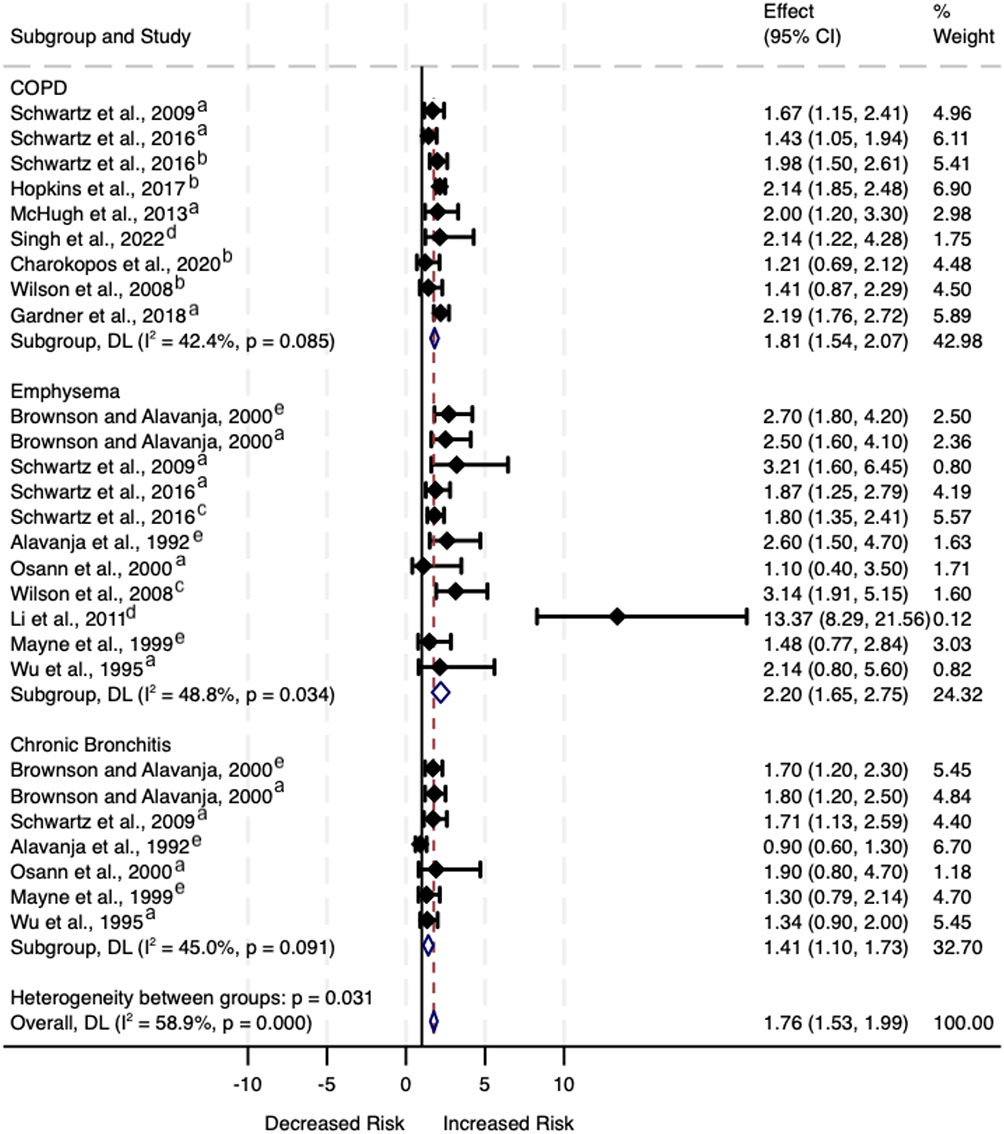 |
Figure 2 Association between Chronic Obstructive Pulmonary Disease (COPD) and Lung. Cancer Incidence Risk. aDirect interviews. bAssessed with spirometry. cAssessed with CT. dAssessed with medical records. eDirect and proxy interviews. |
The pooled results indicated that US adults with COPD had 76% greater odds of developing lung cancer compared to adults without the disease (OR, 1.76; 95% CI=1.53 to 1.99; I2 =58.9%). Across the fourteen included studies, eight studies49,50,53,55–57,59,61 reported estimates for the umbrella definition of COPD and indicate that COPD diagnosis increased the odds of lung cancer incidence (OR, 1.81; 95% CI=1.54 to 2.07; I2=42.4%). Higher odds of lung cancer incidence were observed for individuals with emphysema42–46,49–51,55 (OR, 2.20; 95% CI=1.65 to 2.75; I2=48.8%), but individuals with chronic bronchitis42–46,50 had the lowest odds (OR, 1.41; 95% CI=1.10 to 1.73; I2=45.0%). Across all analyses, a moderate level of statistical heterogeneity was noted.
Lung Cancer Mortality Risk
Results from the meta-analysis assessing the risk of lung cancer mortality are presented in Figure 3. All three studies48,52,54 measured the outcome using hazard ratios (HRs) and assessed COPD as an umbrella definition (ie, COPD, chronic bronchitis, and/or emphysema). Mina et al52 also reported estimates for emphysema while Turner et al48 reported separate estimates for both chronic bronchitis and emphysema.
 |
Figure 3 Assessing the Association between Chronic Obstructive Pulmonary Disease. (COPD) and Lung Cancer Mortality Risk. aDirect interviews. bAssessed with medical records. cAssessed with direct interviews and medical records. dAssessed with medical records (combined medical records (b) and direct interviews and medical records (c)). eAssessed with self-administered questionnaire. fAssessed with spirometry and/or CT. gAssessed with CT. |
The pooled results indicate that individuals with COPD had a 48% higher risk of lung cancer mortality than those without the disease (HR, 1.48; 95% CI=1.06 to 1.89; I2=79.1%). A significant risk was also found when using the umbrella COPD definition (HR, 1.70; 95% CI=1.13 to 2.27; I2 =77.8%).66 The pooled analyses for emphysema and chronic bronchitis alone were not statistically significant. Across all analyses, there was a high level of heterogeneity.
Risk of Bias (RoB) Assessment
Overall, the quality of the 20 included articles was high, with RoB scores between 1 and 3. The remaining eight studies presented some concerns for RoB (score 3); in these studies, the potential bias of the studies the bias was determined not to threaten their conclusions regarding the impact of the exposure on the outcome. Potential bias was not estimated for Hopkins et al56 since that study only provided unadjusted results and did not provide analyses to demonstrate the degree of uncontrolled confounding nor the effect on the conclusions. No articles were determined to have high or very high RoB (Supplementary Table 5).
The meta-analyses conducted after removal of studies at moderate or high risk of bias (RoB ≥2) had little impact on estimates of the incidence (HR 1.74; 95% CI=1.36 to 2.11. I2=52.3%). However, pooled mortality risk was no longer statistically significant (HR 1.51; 95% CI=0.95 to 2.07. I2=82.9%) (Figures 4 and 5). Additionally, the funnel plot produced after removal of studies at moderate or high risk of bias (RoB=1) was symmetric, further indicating no publication bias (Supplementary Figure 1).
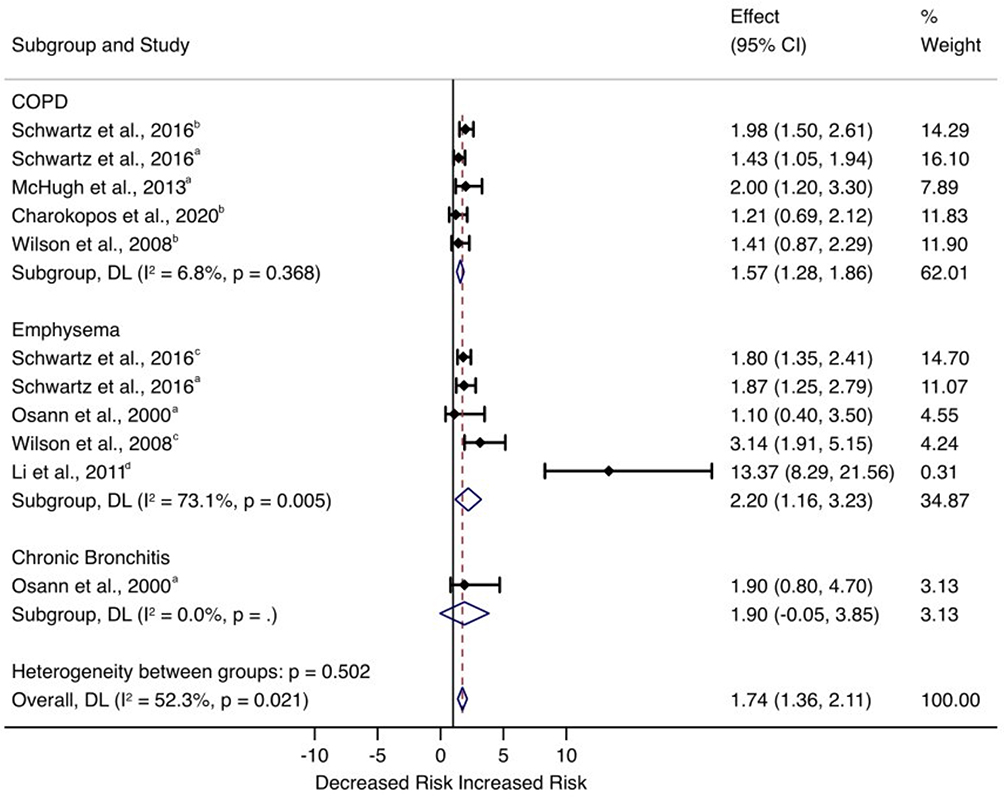 |
Figure 4 Sensitivity Analysis of Lung Cancer Incidence Risk among Studies with Low Risk of Bias (RoB=1). aDirect interviews. bAssessed with spirometry. cAssessed with CT. |
 |
Figure 5 Sensitivity Analysis of Lung Cancer Mortality Risk among Studies with Low Risk of Bias (RoB=1). aDirect interviews. bAssessed with medical records. cAssessed with direct interviews and medical records. dAssessed with medical records (combined medical records (b) and direct interviews and medical records (c)). eAssessed with spirometry and/or CT. fAssessed with CT. |
Outcomes in Population Subgroups
Only five studies examined the primary outcomes by sex44,47,48,54,57 or race/ethnicity.50,54,55,57,58 Seven studies examined outcomes by smoking status with variability on the smoking definition used across studies42,44,47,50,54,56,63 (Table 1).
Sex
Of the fifteen observations (5 studies)47,48,54 that examined lung cancer risk by sex, eight observations from three studies (Mayne et al44 Littman et al47 and Gardner et al57) assessed incidence and seven observations from two studies (Aldrich et al54 and Turner et al48) assessed mortality (Supplementary Table 6).
Incidence by Sex
Mayne et al44 (four observations), in a population of non-smokers (ie, never and former), found that males with chronic bronchitis (OR, 2.08; 95% CI=1.05 to 4.15) and females with emphysema (OR, 4.00; 95% CI=1.13 to 14.18) had higher odds of lung cancer incidence compared to controls without lung cancer. Littman et al47 (two observations) found that ever smokers (current and former) males (HR, 1.52; 95% CI=1.19 to 1.94) but not females (HR, 1.14; 95% CI=0.85 to 1.52) with COPD – defined as chronic bronchitis or emphysema – had higher risk of lung cancer incidence compared to those without COPD. However, Gardner et al57 (two observations) assessed the odds of lung cancer in people with a history of COPD compared to those without and found that both females (OR, 2.10; 95% CI=1.54 to 2.86) and males (OR, 2.28; 95% CI=1.67 to 3.10) with COPD had a higher odds of lung cancer incidence compared to those without COPD.
Mortality by Sex
Aldrich et al54 was the only study that reported lung cancer mortality risk comparing males and females with COPD, and found no difference in lung cancer mortality risk between the sexes (HR, 1.26; 95% CI=0.87 to 1.82). Turner et al48 (six observations) conducted separate analyses comparing each sex with and without chronic bronchitis, emphysema and COPD, and lung cancer mortality. The study found greater risk of lung cancer mortality among males with COPD (HR, 3.60; 95% CI=1.34 to 9.73) but not females (HR, 1.82; 95% CI=0.68 to 4.87). Higher mortality risk was observed among females with emphysema (HR, 1.82; 95% CI=1.03 to 3.21) but not among males (HR, 1.42; 95% CI=0.70 to 2.88). Nonstatistical significance between chronic bronchitis and lung cancer risk was observed among males (HR, 1.59 95% CI: 0.95, 2.66) or females (HR, 0.82 95% CI=0.58, 1.16).
Race and Ethnicity
Five studies reported risks by race and ethnicity,50,54,55 with results primarily reported for Black/non-Hispanic Black (NHB) and White/non-Hispanic White (NHW) populations. Nagasaka et al58 was the only study to provide an observation for the heterogenous category of “Other”. The five studies resulted in 19 observations – one reporting mortality and 18 incidence outcomes (Supplementary Table 7).
Incidence by Race and Ethnicity
Nagasaka et al58 (2 observations) reported no risk difference in lung cancer incidence and COPD for Black (OR, 1.22 95% CI=0.97, 1.52) or “Other” (OR 0.97, 95% CI=0.74, 1.26) participants compared to White participants. Gardner et al57 (2 observations) found that White participants with COPD were at higher risk for lung cancer incidence (OR, 2.04; 95% CI=1.57 to 2.67) compared to those without COPD. Similar findings were reported for Black participants (OR, 2.83; 95% CI=1.92 to 4.16). A total of 14 observations were extracted from two studies by Schwartz et al 200950 (6 observations) and 201655(8 observations). Five observations showed statistically significant greater odds of lung cancer incidence among non-Hispanic White (NHW) participants with COPD (2 observations) (defined as chronic bronchitis, emphysema, or COPD or spirometry) and emphysema alone (2 observations),50,55 or chronic bronchitis alone (1 observation)50 – compared to NHW participants without COPD (range from OR, 1.82; 95% CI=1.13 to 2.92 to OR, 3.75; 95% CI=1.69 to 8.32). Only Schwartz et al 201655 observed that non-Hispanic Black (NHB) participants (four of the eight observations) with COPD – defined as the umbrella term and emphysema alone – had statistically significant greater odds of lung cancer incidence than NHB participants without COPD (range from OR, 1.97; 95% CI=1.31 to 2.95 to OR, 2.40; 95% CI=1.55 to 3.72). The remaining five observations across Schwartz et al 200950 and 201655 found no differences in incidence risk.
Mortality by Race and Ethnicity
Aldrich et al54 was the only study to examine the association between lung cancer mortality and COPD stratified by race and ethnicity and found no difference in risk between NHW and NHB participants with COPD (HR, 1.17; 95% CI=0.81 to 1.69) using NHB participants as reference.
Smoking Status
The definition of smoking status varied across the studies but generally fell into the categories of never smokers, current smokers, and former smokers. Of the included 26 observations (seven studies), six observations (three studies)42,44,50 assessed the relationship between COPD and lung cancer among never smokers, ten observations (six studies)42,44,47,50,54,63 among former smokers, five observations (three studies)47,50,63 among current smokers, and one observation (one study)56 evaluated “healthy smokers” (ie, heavy smokers without COPD). Additionally, 25 of the 26 observations included looked at incidence and one looked at mortality. Four separate observations from Zhai et al63 reported incidence risk by sex and smoking status (Supplementary Table 8).
Incidence by Smoking Status
Studies found no difference in lung cancer risk among never smokers with vs without chronic lung diseases but reported an increased risk for current and former smokers. Alavanja et al42 found no difference in the risk of lung cancer in never smokers with chronic bronchitis (OR, 1.4; 95% CI=0.70 to 2.50) or emphysema (OR, 0.7; 95% CI=0.1 to 5.5) compared to those without the disease. Mayne et al44 in a sample of non-smokers (never and former), also found no increased incidence risk in individuals with chronic bronchitis (OR, 3.01; 95% CI=0.6 to14.86) or emphysema (OR, 1.57; 95% CI=0.80 to 2.72) compared to non-smokers without the disease.
Among current smokers with COPD (defined as chronic bronchitis or emphysema), Littman et al47 and Schwartz et al50 found an increased risk (HR, 1.25; 95% CI=1.04 to 1.51 and OR, 1.93; 95% CI=1.06 to 3.49, respectively) compared to those without COPD. Schwartz et al 200950 also found that current smokers with chronic bronchitis had greater odds of incidence than those without chronic bronchitis (OR, 3.08; 95% CI=1.47 to 6.43). Hopkins et al56 found increased incidence of lung cancer for heavy smokers with COPD compared to “healthy smokers” (ie, heavy smokers without COPD) (unadjusted IR, 3.04, 95% CI=2.65 to 3.48).
Regarding former smokers, Mayne et al44 found that former smokers with chronic bronchitis had greater odds of lung cancer incidence compared to those without (OR, 1.88; 95% CI=1.02 to 3.44). Schwartz et al 200950 found that former smokers with COPD – defined as the umbrella term and as emphysema – had greater odds of lung cancer incidence compared to those without COPD (range from OR, 2.03; 95% CI=1.11 to 3.71 to OR, 5.33; 95% CI=1.65 to 17.20).
Studies that compared smoking status in individuals with COPD reported higher incidence risk in smokers vs non-smokers. Zhai et al63 found increased odds of lung cancer incidence for current smokers with COPD compared to never smokers with COPD (OR, 7.92; 95% CI=5.43 to 11.57). This study also observed that male (OR, 6.43; 95% CI=3.47 to 11.89) and female (OR, 8.95; 95% CI=5.55 to 14.47) current smokers had a higher risk compared to never smokers. Zhai et al63 also found an increased odds for former smokers with COPD compared to never smokers with COPD (OR, 4.69; 95% CI=3.22 to 6.81), and when stratifying by sex (OR, 3.95; 95% CI=2.16 to 7.24 for male and OR, 5.06; 95% CI=3.14 to 8.15 for female former smokers vs never smokers).
Mortality by Smoking Status
Aldrich et al54,56 was the only study to evaluate mortality risk by smoking status. They found higher risk of COPD and lung cancer mortality among former smokers compared to never smokers (HR, 4.67; 95% CI=1.66 to 13.17).
COPD Assessment Method
The method of assessing COPD varied across studies. The majority (twelve studies) classified COPD through self-reported physician diagnoses of COPD, emphysema, and/or chronic bronchitis only.42–48,50,53,57,58,63 Two studies56,59 used spirometry only, two studies51,61 used medical records only, and four studies49,52,54,55 used a combination of assessment methods, including CT.
Our stratified meta-analysis results indicate that COPD defined by self-report (n=9) (OR, 1.68; 95% CI=1.43 to 1.93; I2=46.9%) and by spirometry only (n=4) showed greater odds (OR, 1.84; 95% CI=1.49 to 2.19; I2=50.3%) of lung cancer incidence (Figure 6). Assessment of COPD using medical records only, reported no significant differences for lung cancer incidence (n=2) but significant for lung cancer mortality (n=2) (HR, 1.89; 95% CI=1.28 to 2.51; I2=65.4%). However, pooled results of studies with COPD diagnosed by self-reported, spirometry, and combined assessment methods reported no higher risk of lung cancer mortality (Figure 7), and the individual assessment methods 95% CIs overlapped for all subgroups indicating a potentially statistically insignificant difference in risk between assessment methods.
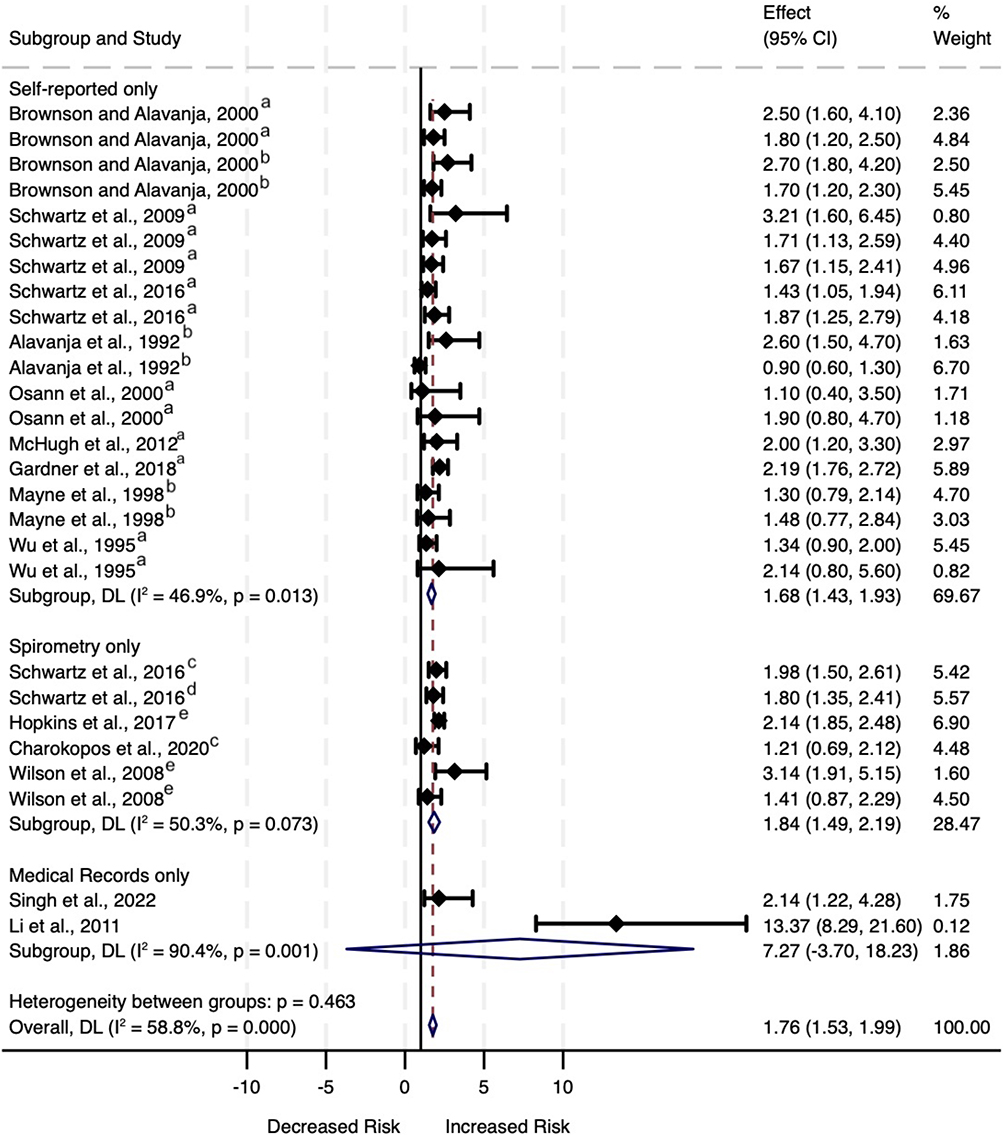 |
Figure 6 Meta-Analysis of the Effect of COPD Assessment Method on Lung Cancer. Incidence Risk. aDirect interviews. bDirect and proxy interviews c FEV1/FVC < 0.70. dGOLD I–IV. eAssessed with CT. |
 |
Figure 7 Meta-Analysis of the Effect of COPD Assessment Method on Lung Cancer. Mortality Risk. aDirect interviews. bAssessed with self-administered questionnaire. cAssessed with CT. dAssessed with medical records (combined medical records (e) and direct interviews and medical records (f)). eAssessed with medical records. fAssessed with direct interviews and medical records. gAssessed with spirometry and/or CT. |
Sensitivity Analyses
To address the issue of potential double counting, we conducted a sensitivity analysis using only one observation from included studies. Details on the methods used for study selection can be found in Supplementary Material A.
From the 14 studies (37 observations) included in the main meta-analyses for incidence and mortality, this analysis was conducted for a total of 14 observations, one for each included study. The pooled results from the sensitivity analysis indicated that US adults with COPD had 83% greater odds of developing lung cancer compared to adults without the disease (OR, 1.83; 95% CI=1.50 to 2.17; I2=55.9%). This result aligns with the main analysis (HR, 1.76; 95% CI=1.53 to 1.99) (Supplementary Figure 2). The mortality analysis was conducted only on three studies that used the COPD umbrella definition. The pooled results indicate a non-significant difference in lung cancer mortality risk between individuals with COPD and those without the disease (HR, 1.22; 95% CI=0.78 to 1.65; I2=0.0%). This differed from the main analysis which showed a higher mortality risk in those with COPD vs without (HR, 1.48; 95% CI=1.06 to 1.89) (Supplementary Figure 3).
Discussion
We conducted a systematic review and meta-analysis of the risk of lung cancer incidence and mortality among US adults with a diagnosis of COPD, within the overall general population and across subgroups. The overall pooled summary estimates (PSE) indicate that adults with COPD – inclusive of all definitions – have a 76% higher risk of developing lung cancer and 48% greater risk of lung cancer mortality compared to those without the COPD. The observed difference between incidence and mortality risk may be partially explained by early intervention strategies. Smoking cessation and timely COPD treatment improve overall respiratory health and may slow disease progression,67,68 while lung cancer screening facilitates earlier detection and treatment.69 These combined strategies enhance lung cancer survival. Additionally, individuals with COPD frequently face competing comorbidities that may lead to non-cancer associated mortality, attenuating the observed lung cancer mortality risk.6,70
When categorized by the different COPD definitions, the odds of lung cancer incidence increased by 41% for chronic bronchitis, 120% for emphysema, and 81% by the umbrella definition of COPD for those with the diseases compared to those without. Lung cancer mortality risk results indicate that the umbrella definition of COPD conferred a 70% increase in lung cancer mortality risk. However, the results did not show statistically significant differences when defined separately as chronic bronchitis or emphysema. Mixed results were observed in our systematic review when stratifying the impact of COPD on lung cancer risk by sex, race and ethnicity, and smoking status.
Our findings are largely consistent with previous systematic reviews and meta-analyses inclusive of populations within and outside the US. Ang et al71 conducted a meta-analysis using 71 studies across various countries – including the US – which combined methods of association and reported that having emphysema (PSE: 2.21; 95% CI=2.04 to 2.40) and COPD (PSE: 2.51; 95% CI=1.71 to 3.68) conferred about two times the risk of developing lung cancer. Similarly, a significant but lower risk, was associated with history of chronic bronchitis (PSE: 1.49; 95% CI=1.32 to 1.69). Likewise, Zhang et al72 conducted a meta-analysis using US and international studies and they reported an increased risk of developing lung cancer for individuals with COPD (summary relative risk (SRR), 2.06; 95% CI=1.50 to 2.85) and emphysema (SRR, 2.33; 95% CI=1.56 to 3.49) but not for those with chronic bronchitis (SRR, 1.17; 95% CI=0.79 to 1.73). Another review by Brenner et al73 – conducted using US and international studies – found that having COPD (relative risks (RR), 2.22; 95% CI=1.66 to 2.97), chronic bronchitis (RR, 1.52; 95% CI=1.25 to 1.84), or emphysema (RR, 2.04; 95% CI=1.72 to 2.41) increased lung cancer incidence risk. Our results – from only US populations – showed an increased risk of mortality and incidence with COPD that was consistent with Zhang et al,72 and Brenner et al73 albeit with slightly lower PSEs than Zhang et al. The discrepancy in PSE may reflect the inclusion of international studies, the grouping of mortality and incidence estimates, and the scarcity of studies that reported risk for lung cancer mortality with chronic bronchitis or emphysema separately.
Our results, and prior meta-analysis, report a substantial increased risk of lung cancer among individuals with COPD and emphysema. These findings highlight the importance of targeted surveillance in this population. COPD and lung cancer are highly prevalent in older individuals who currently or formerly smoked. Therefore, individuals with COPD are more likely to undergo lung cancer screening (LCS) with low-dose computed tomography (LDCT). LCS offers dual clinical benefits for survival. Beyond detecting early-stage lung cancer, which reduces lung cancer-specific mortality,74,75 LDCT frequently reveals the presence of emphysema, allowing for timely intervention and potential reduction in lung cancer incidence.76–78
In our review, subgroup analyses are similar to those from other systematic reviews and meta-analyses. Only one study in our systematic review compared mortality risk between males and females; this study found no differences in lung cancer mortality risk by sex.54 All other assessments by sex compared males or females with COPD to males or females without COPD and generally found higher risk of lung cancer mortality48 and lung cancer incidence47 among those with COPD compared to those without. Our results are in accordance with the meta-analysis conducted by Zhang et al72 which found increased risk of lung cancer in both males (SRR, 2.04; 95% CI=1.11 to 3.74) and females (SRR, 2.67; 95% CI=1.27 to 5.59) with COPD and no differences in risk by sex.
We also found an increased risk of lung cancer mortality48 and lung cancer incidence63 among people with smoking history (ie, former or current smokers) compared to never smokers. Individuals with a history of smoking and COPD were at increased risk of lung cancer incidence compared to those without COPD.50 Zhang et al72 also found that current smokers were at higher risk for lung cancer incidence (SRR, 1.63; 95% CI=1.11 to 2.39). However, their meta-analysis did not find increased risk for former smokers (SRR, 1.32; 95% CI=0.65 to 2.68). This difference may be due to Zhang et al72 restricting their analysis to prospective cohort studies or including populations from different countries outside the US.
Lung cancer risk varies by sex, race and ethnicity, and smoking status60 – which in turn propagates health inequalities through disparities in incidence,79 stage at diagnosis, treatment,80 mortality, and survival. Results stratified by sex or smoking status were more commonly found in the included studies while studies that reported results by race and ethnicity were limited and Black participants were often underrepresented. Schwartz et al 200950 found increased odds of lung cancer incidence in White populations. However, for this study, the population was comprised of approximately 76% White and 24% Black participants – compared to the 2016 study55 which was approximately 53% White and 47% Black. Because of the differences in population size, it is difficult to determine the reliability of the data and brings up a question of whether the results among the Black participants in the 2009 study population are due to underreporting, underdiagnosis, or lower risk of COPD.
Additionally, the studies included in the race and ethnicity analysis commonly classified populations that were not non-Hispanic Black or non-Hispanic-White as “Other”. This practice results in an incomplete understanding of the differential effects by race and ethnicity since a distinct focus is provided to two racial/ethnic subgroups, relegating other racial and ethnic identities to a nonspecific category. Studies conducted using National Health and Nutritional Examination Surveys (NHANES) data show that belonging to an underrepresented group, specifically Black or Mexican American, increases the odds of undiagnosed COPD.81 The sparseness of the literature restricted a comprehensive analysis of the differential impacts of race and ethnicity on COPD associated lung cancer disease burden. Further understanding of racial/ethnic diversity is needed where each identity confers its own characteristic risk because of unique interactions with health systems.
During the review process, we observed that authors defined COPD diagnosis using various assessment method. This variability, likely influence both the magnitude and direction of the observed associations. We conducted a meta-analysis examining the impact of the different COPD diagnosis assessment methods on lung cancer risk (Figures 6 and 7). Our results showed that COPD diagnosed by self-report or spirometry conferred greater odds of lung cancer incidence while COPD diagnosed with medical records conferred greater risk of lung cancer mortality. These findings are consistent with existing evidence that assessment method may influence disease categorization and consequently prevalence estimates of the disease.82 Ho et al83 in their review found that within the US, COPD prevalence ranged from 10% to 21% with pre and post-spirometry data. Studies have also shown that underdiagnosis rates with spirometry-assessed COPD range from 12% to 72%83,84 while overdiagnosis with medical records is approximately 42.5%.85
The moderate to high levels of heterogeneity in our review results may be due to differences in how each study defined and assessed COPD. Moderate levels of heterogeneity were observed in the analyses of lung cancer incidence, which is likely driven by the magnitude of the association, while high levels of heterogeneity were observed in the analyses of lung cancer mortality likely driven by the direction of the effect as well as the magnitude of association. Because COPD is an umbrella term encompassing chronic bronchitis, emphysema, or combinations of both, these differences likely had a relevant effect on the observed results. Heterogeneity may also be due to study design. Our included studies were a mix of case-control and cohort studies. Differences in study population may also impact heterogeneity; some studies only included women42,45,46,50 or were restricted to specific racial/ethnic backgrounds such as Mexican Americans53 or Black participants.52 Similarly, there was little consistency in the studies’ definitions of smoking status (eg, former smokers were defined as those who quit smoking for 2 years or quit for 15 years or more or quit 12+ months) and only one study evaluated mortality risk, which limited our comparability of the studies. Finally, in our analyses, we included unadjusted outcomes from studies which did not provide adjusted outcomes56 or relied on bootstrapping,61 which raises the possibility of confounding in our analyses. However, as the unadjusted outcomes comprised only four of the 119 extracted observations, confounding was likely a minimal effect.
In addition, studies on COPD risk are prone to double-counting due to the umbrella nature of the disease and reporting estimates for overall COPD and each disease separate. We extracted and reported results separately for COPD, chronic bronchitis and emphysema when studies provided disaggregated data. However, this can still lead to overlapping populations, which may inflate effect estimates, compromising the reliability of meta-analysis results and subsequent decision-making.39 We addressed this issue through conducting sensitivity analyses for incidence and mortality risk that included only one observation per study-prioritizing results based on overall COPD definition to reduce bias from overlapping definitions. The sensitivity analyses showed no change in the effect on incidence risk but reported a non-significant difference in lung cancer mortality risk between individuals with and without COPD which differed from the main analysis.
In our search, we found only one study86 which examined lung cancer risk by COPD severity stages, but that study was excluded from the analyses as its results were not comparable to those of the included studies. Still, studies show that the prognosis of lung cancer worsens with increasing COPD severity.87 Therefore, future studies must consider stratifying the risk outcomes by COPD severity stages.
In conclusion, US adults with COPD, particularly those with emphysema and a smoking history, are at an increased risk for lung cancer incidence and mortality compared to those without COPD. As COPD-associated morbidity and mortality continue to increase, further research is needed on the risks associated with COPD, especially among different subgroups, and the intersectional ways in which COPD and lung cancer risk manifest.
Data Sharing Statement
The data underlying this article are available in the article and in its online Supplementary Materials.
Acknowledgments
The funders did not play a role in the design of the study; the collection, analysis, and interpretation of the data; the writing of the manuscript; and the decision to submit the manuscript for publication. The authors thank Jamie Hartmann-Boyce for her input on the systematic review methods and results.
Author Contributions
All authors made significant contribution to the work reported, whether that is in the conception, study design, execution, acquisition of data, analysis and interpretation, or in all these areas; took part in drafting, revising or critically reviewing the article; gave final approval of the version to be published; have agreed on the journal to which the article has been submitted; and agree to be accountable for all aspects of the work.
Funding
Research reported in this publication was supported by the National Cancer Institute of the National Institutes of Health under Award Number K01CA260378. The content is solely the responsibility of the authors and does not necessarily represent the official views of the National Institutes of Health. MEV-F was supported by the ACS Diversity in Cancer Research internship program through a supplement to ACS IRG-17-177-23. CJC receives additional funding through pre-doctoral fellowships from the Canadian Institutes of Health Research (DFD – 187708) and the PhRMA Foundation (AWD024330).
Disclosure
Dr Christopher Cadham reports receiving funding from Imvaria, Inc. for unrelated work. Dr Meilan Han reports personal fees from GlaxoSmithKline, AstraZeneca, Boehringer Ingelheim, Cipla, Chiesi, Novartis, Pulmonx, Teva, Verona, Merck, Mylan, Sanofi, Roche, DevPro, Aerogen, Polarian, Regeneron, Amgen, UpToDate, Altesa Biopharma, Owkin, Bristol Myers Squibb, Zymeworks; grants from NIH, Novartis, Sunovion, Nuvaira, Sanofi, Astrazeneca, Boehringer Ingelheim, Galvanize Therapeutics, Biodesix, the COPD Foundation and the American Lung Association. She has participated in Data Safety Monitoring Boards for Novartis and Medtronic with funds, and stock options from Altesa and Meissa, outside the submitted work. The remaining authors report no conflicts of interest in this work.
References
1. Association AL. COPD Trends Brief. Available from: https://www.lung.org/research/trends-in-lung-disease/copd-trends-brief.
2. Mei F, Dalmartello M, Bonifazi M, et al. Chronic obstructive pulmonary disease (COPD) mortality trends worldwide: an update to 2019. Respirology. 2022;27(11):941–950. doi:10.1111/resp.14328
3. National Trends - Chronic Obstructive Pulmonary Disease (COPD) | CDC. 2022. Available from: https://www.cdc.gov/copd/data-and-statistics/national-trends.html.
4. CDC. Disease of the Week - COPD. Centers for Disease Control and Prevention. October 7, 2022.Available from: http://www.cdc.gov/dotw/copd/index.html.
5. Association AL. COPD Trends Brief - Burden. Available from: https://www.lung.org/research/trends-in-lung-disease/copd-trends-brief/copd-burden.
6. Berry CE, Wise RA. Mortality in COPD: causes, risk factors, and prevention. COPD. 2010;7(5):375–382. doi:10.3109/15412555.2010.510160
7. Park SC, Kim DW, Park EC, et al. Mortality of patients with chronic obstructive pulmonary disease: a nationwide population based cohort study. Korean J Intern Med. 2019;34(6):1272–1278. doi:10.3904/kjim.2017.428
8. Sin DD, Anthonisen NR, Soriano JB, Agusti AG. Mortality in COPD: role of comorbidities. Eur Respir J. 2006;28(6):1245–1257. doi:10.1183/09031936.00133805
9. Durham AL, Adcock IM. The relationship between COPD and lung cancer. Lung Cancer. 2015;90(2):121–127. doi:10.1016/j.lungcan.2015.08.017
10. Cancer today-Incidence. Available from: http://gco.iarc.fr/today/home.
11. Cancer today-Mortality. Available from: http://gco.iarc.fr/today/home.
12. Young RP, Hopkins RJ, Christmas T, Black PN, Metcalf P, Gamble GD. COPD prevalence is increased in lung cancer, independent of age, sex and smoking history. Eur Respir J. 2009;34(2):380–386. doi:10.1183/09031936.00144208
13. Loganathan RS, Stover DE, Shi W, Venkatraman E. Prevalence of COPD in women compared to men around the time of diagnosis of primary lung cancer. Chest. 2006;129(5):1305–1312. doi:10.1378/chest.129.5.1305
14. Congleton J, Muers MF. The incidence of airflow obstruction in bronchial carcinoma, its relation to breathlessness, and response to bronchodilator therapy. Respir Med. 1995;89(4):291–296. doi:10.1016/0954-6111(95)90090-X
15. Young RP, Hopkins RJ. Link between COPD and lung cancer. Respir Med. 2010;104(5):758–759. doi:10.1016/j.rmed.2009.11.025
16. Young RP, Duan F, Chiles C, et al. Airflow limitation and histology shift in the national lung screening trial. The NLST-ACRIN cohort substudy. Am J Respir Crit Care Med. 2015;192(9):1060–1067. doi:10.1164/rccm.201505-0894OC
17. Papi A. COPD increases the risk of squamous histological subtype in smokers who develop non-small cell lung carcinoma. Thorax. 2004;59(8):679–681. doi:10.1136/thx.2003.018291
18. Siedlinski M, Cho MH, Bakke P, et al. Genome-wide association study of smoking behaviours in patients with COPD. Thorax. 2011;66(10):894–902. doi:10.1136/thoraxjnl-2011-200154
19. Potton E, McCaughan F, Janes S. Chronic obstructive pulmonary disease and lung cancer. Respir Med COPD Update. 2009;5(2):34–37. doi:10.1016/j.rmedu.2009.07.001
20. Barnes PJ, Adcock IM. Chronic obstructive pulmonary disease and lung cancer: a lethal association. Am J Respir Crit Care Med. 2011;184(8):866–867. doi:10.1164/rccm.201108-1436ED
21. Berg J, Halvorsen AR, Bengtson MB, et al. Levels and prognostic impact of circulating markers of inflammation, endothelial activation and extracellular matrix remodelling in patients with lung cancer and chronic obstructive pulmonary disease. BMC Cancer. 2018;18(1):739. doi:10.1186/s12885-018-4659-0
22. Somayaji R, Chalmers JD. Just breathe: a review of sex and gender in chronic lung disease. Eur Respir Rev. 2022;31(163):210111. doi:10.1183/16000617.0111-2021
23. Ejike CO, Dransfield MT, Hansel NN, et al. Chronic obstructive pulmonary disease in america’s black population. Am J Respir Crit Care Med. 2019;200(4):423–430. doi:10.1164/rccm.201810-1909PP
24. Barnes PJ. Sex differences in chronic obstructive pulmonary disease mechanisms. Am J Respir Crit Care Med. 2016;193(8):813–814. doi:10.1164/rccm.201512-2379ED
25. Quaderi SA, Hurst JR. The unmet global burden of COPD. Glob Health Epidemiol Genomics. 2018;3:e4. doi:10.1017/gheg.2018.1
26. Campbell M, McKenzie JE, Sowden A, et al. Synthesis without meta-analysis (SWiM) in systematic reviews: reporting guideline. BMJ. 2020:l6890. doi:10.1136/bmj.l6890.
27. Stroup DF. Meta-analysis of observational studies in epidemiology: a proposal for reporting. JAMA. 2000;283(15):2008. doi:10.1001/jama.283.15.2008
28. McColery J. LibGuides: endNote: home. Available from: https://clarivate.libguides.com/endnote_training/home.
29. Zotero. Your personal research assistant. Available from: https://www.zotero.org/.
30. Ouzzani M, Hammady H, Fedorowicz Z, Elmagarmid A. Rayyan—a web and mobile app for systematic reviews. Syst Rev. 2016;5(1):210. doi:10.1186/s13643-016-0384-4
31. Borenstein M, Hedges LV, Higgins JPT, Rothstein HR. A basic introduction to fixed-effect and random-effects models for meta-analysis. Res Synth Meth. 2010;1(2):97–111. doi:10.1002/jrsm.12
32. 9.5.2 Identifying and measuring heterogeneity. Available from https://handbook-5-1.cochrane.org/chapter_9/9_5_2_identifying_and_measuring_heterogeneity.htm.
33. Chapter 10: analysing data and undertaking meta-analyses. Available from: https://training.cochrane.org/handbook/current/chapter-10.
34. Higgins JPT. Measuring inconsistency in meta-analyses. BMJ. 2003;327(7414):557–560. doi:10.1136/bmj.327.7414.557
35. Statistical software for data science | stata. Available from: https://www.stata.com/.
36. Risk of bias tools - ROBINS-E tool. Available from: https://www.riskofbias.info/welcome/robins-e-tool.
37. Senn SJ. Overstating the evidence – double counting in meta-analysis and related problems. BMC Med Res Methodol. 2009;9(1):10. doi:10.1186/1471-2288-9-10
38. Lehrer EJ, Wang M, Sun Y, Zaorsky NG. An introduction to meta-analysis. Int J Radiat Oncol Biol Phys. 2023;115(3):564–571. doi:10.1016/j.ijrobp.2022.07.1831
39. Hussein H, Nevill CR, Meffen A, et al. Double-counting of populations in evidence synthesis in public health: a call for awareness and future methodological development. BMC Public Health. 2022;22(1):1827. doi:10.1186/s12889-022-14213-6
40. Bobadilla A, Guerra S, Sherrill D, Barbee R. How accurate is the self-reported diagnosis of chronic bronchitis? Chest. 2002;122(4):1234–1239. doi:10.1378/chest.122.4.1234
41. Kaufman JS. Statistics, adjusted statistics, and maladjusted statistics. Am J Law Med. 2017;43(2–3):193–208. doi:10.1177/0098858817723659
42. Alavanja MCR, Brownson RC, Boice JD, Hock E. Preexisting lung disease and lung cancer among nonsmoking women. Am J Epidemiol. 1992;136(6):623–632. doi:10.1093/oxfordjournals.aje.a116542
43. Wu AH, Fontham ET, Reynolds P, et al. Previous lung disease and risk of lung cancer among lifetime nonsmoking women in the United States. Am J Epidemiol. 1995;141(11):1023–1032. doi:10.1093/oxfordjournals.aje.a117366
44. Mayne ST, Buenconsejo J, Janerich DT. Previous lung disease and risk of lung cancer among men and women nonsmokers. Am J Epidemiol. 1999;149(1):13–20. doi:10.1093/oxfordjournals.aje.a009722
45. Brownson RC, Alavanja MCR. Previous lung disease and lung cancer risk among women (United States). Cancer Causes Control. 2000;11(9):853–858. doi:10.1023/A:1008999202040
46. Osann KE, Lowery JT, Schell MJ. Small cell lung cancer in women: risk associated with smoking, prior respiratory disease, and occupation. Lung Cancer. 2000;28(1):1–10. doi:10.1016/S0169-5002(99)00106-3
47. Littman AJ, Thornquist MD, White E, Jackson LA, Goodman GE, Vaughan TL. Prior lung disease and risk of lung cancer in a large prospective study. Cancer Causes Control. 2004;15(8):819–827. doi:10.1023/B:CACO.0000043432.71626.45
48. Turner MC, Chen Y, Krewski D, Calle EE, Thun MJ. Chronic obstructive pulmonary disease is associated with lung cancer mortality in a prospective study of never smokers. Am J Respir Crit Care Med. 2007;176(3):285–290. doi:10.1164/rccm.200612-1792OC
49. Wilson DO, Weissfeld JL, Balkan A, et al. Association of radiographic emphysema and airflow obstruction with lung cancer. Am J Respir Crit Care Med. 2008;178(7):738–744. doi:10.1164/rccm.200803-435OC
50. Schwartz AG, Cote ML, Wenzlaff AS, et al. Chronic obstructive lung diseases and risk of non-small cell lung cancer in women. J Thorac Oncol. 2009;4(3):291–299. doi:10.1097/JTO.0b013e3181951cd1
51. Li Y, Swensen SJ, Karabekmez LG, et al. Effect of emphysema on lung cancer risk in smokers: a computed tomography–based assessment. Cancer Prev Res. 2011;4(1):43–50. doi:10.1158/1940-6207.CAPR-10-0151
52. Mina N, Soubani AO, Cote ML, et al. The relationship between chronic obstructive pulmonary disease and lung cancer in African American patients. Clin Lung Cancer. 2012;13(2):149–156. doi:10.1016/j.cllc.2011.09.006
53. McHugh MK, Schabath MB, Ho CH, et al. Self-reported prior lung diseases as risk factors for non-small cell lung cancer in Mexican Americans. J Immigr Minor Health. 2013;15(5):910–917. doi:10.1007/s10903-012-9690-7
54. Aldrich MC, Munro HM, Mumma M, et al. Chronic obstructive pulmonary disease and subsequent overall and lung cancer mortality in low-income adults. PLoS One. 2015;10(3):e0121805. doi:10.1371/journal.pone.0121805
55. Schwartz AG, Lusk CM, Wenzlaff AS, et al. Risk of lung cancer associated with COPD phenotype based on quantitative image analysis. Cancer Epidemiol Biomark Prev Publ Am Assoc Cancer Res Cosponsored Am Soc Prev Oncol. 2016;25(9):1341–1347. doi:10.1158/1055-9965.EPI-16-0176
56. Hopkins RJ, Duan F, Chiles C, et al. Reduced expiratory flow rate among heavy smokers increases lung cancer risk. results from the national lung screening trial-american college of radiology imaging network Cohort. Ann Am Thorac Soc. 2017;14(3):392–402. doi:10.1513/AnnalsATS.201609-741OC
57. Gardner LD, Loffredo PhD CA, Langenberg P, et al. Associations between history of chronic lung disease and non-small cell lung carcinoma in Maryland: variations by sex and race. Ann Epidemiol. 2018;28(8):543–548. doi:10.1016/j.annepidem.2018.04.012
58. Nagasaka M, Lehman A, Chlebowski R, et al. COPD and lung cancer incidence in the Women’s Health Initiative Observational Study: a brief report. Lung Cancer. 2020;141:78–81. doi:10.1016/j.lungcan.2020.01.006
59. Charokopos A, Braman SS, Whittaker Brown SA, et al. Lung cancer risk of patients with asthma-chronic obstructive pulmonary disease overlap. Am J Respir Crit Care Med. 2020;201(1):1.
60. Alberg A, Nonemaker J. Who is at high risk for lung cancer? population-level and individual-level perspectives. Semin Respir Crit Care Med. 2008;29(3):223–232. doi:10.1055/s-2008-1076742
61. Singh S, Pavesi F, Steiling K, et al. Risk factors for lung cancer in an underrepresented safety-net screening cohort. Clin Lung Cancer. 2022;23(2):e165–e170. doi:10.1016/j.cllc.2021.07.009
62. Page MJ, McKenzie JE, Bossuyt PM, et al. The PRISMA 2020 statement: an updated guideline for reporting systematic reviews. BMJ. 2021:n71. doi:10.1136/bmj.n71.
63. Zhai R, Yu X, Wei Y, Su L, Christiani DC. Smoking and smoking cessation in relation to the development of co-existing non-small cell lung cancer with chronic obstructive pulmonary disease: smoking and the Risk of NSCLC with COPD. Int J Cancer. 2014;134(4):961–970. doi:10.1002/ijc.28414
64. Greenberg RS, Daniels SR, Flanders WD, Eley JW, Boring JR. Appendix C: the Odds Ratio as an Estimator of the Incidence Rate Ratio. In: Medical Epidemiology, 4e. The McGraw-Hill Companies; 2005.
65. Hazra A. Using the confidence interval confidently. J Thorac Dis. 2017;9(10):4125–4130. doi:10.21037/jtd.2017.09.14
66. Huedo-Medina TB, Sánchez-Meca J, Marín-Martínez F, Botella J. Assessing heterogeneity in meta-analysis: q statistic or I2 index? Psychol Methods. 2006;11(2):193–206. doi:10.1037/1082-989X.11.2.193
67. Jo H, Park S, Kim NE, et al. Impact of COPD treatment on survival in patients with advanced non-small cell lung cancer. J Clin Med. 2022;11(9):2391. doi:10.3390/jcm11092391
68. Wang Z, Qiu Y, Ji X, Dong L. Effects of smoking cessation on individuals with COPD: a systematic review and meta-analysis. Front Public Health. 2024;12:1433269. doi:10.3389/fpubh.2024.1433269
69. Ajimizu H, Ozasa H, Sato S, et al. Survival impact of treatment for chronic obstructive pulmonary disease in patients with advanced non-small-cell lung cancer. Sci Rep. 2021;11(1):23677. doi:10.1038/s41598-021-03139-5
70. Labaki WW, Gu T, Murray S, et al. Causes and predictors of death in smokers with and without COPD: an analysis of the COPDGene cohort. Am J Respir Crit Care Med 2019; 199:A3995.
71. Ang L, Ghosh P, Seow WJ. Association between previous lung diseases and lung cancer risk: a systematic review and meta-analysis. Carcinogenesis. 2021;42(12):1461–1474. doi:10.1093/carcin/bgab082
72. Zhang X, Jiang N, Wang L, Liu H, He R. Chronic obstructive pulmonary disease and risk of lung cancer: a meta-analysis of prospective cohort studies. Oncotarget. 2017;8(44):78044–78056. doi:10.18632/oncotarget.20351
73. Brenner DR, McLaughlin JR, Hung RJ. Previous lung diseases and lung cancer risk: a systematic review and meta-analysis. PLoS One. 2011;6(3):e17479. doi:10.1371/journal.pone.0017479
74. Pastorino U, Silva M, Sestini S, et al. Prolonged lung cancer screening reduced 10-year mortality in the MILD trial: new confirmation of lung cancer screening efficacy. Ann Oncol. 2019;30(10):1672. doi:10.1093/annonc/mdz169
75. Jonas DE, Reuland DS, Reddy SM, et al. Screening for lung cancer with low-dose computed tomography: updated evidence report and systematic review for the us preventive services task force. JAMA. 2021;325(10):971–987. doi:10.1001/jama.2021.0377
76. Mulshine JL, Aldige CR, Ambrose LF, et al. Emphysema detection in the course of lung cancer screening: optimizing a rare opportunity to impact population health. Ann Am Thorac Soc. 2023;20(4):499–503. doi:10.1513/AnnalsATS.202207-631PS
77. Mulshine JL, Pyenson B, Healton C, et al. Paradigm shift in early detection: lung cancer screening to comprehensive CT screening. Eur J Cancer. 2025;218:115264. doi:10.1016/j.ejca.2025.115264
78. de-Torres JP, Celli BR. COPD detection in lung cancer screening programmes: “hitting two birds with one stone”. Eur Respir J. 2022;60(6):2201294. doi:10.1183/13993003.01294-2022
79. Ryan BM. Lung cancer health disparities. Carcinogenesis. 2018;39(6):741–751. doi:10.1093/carcin/bgy047
80. Forrest LF, Adams J, Wareham H, Rubin G, White M. Socioeconomic inequalities in lung cancer treatment: systematic review and meta-analysis. PLoS Med. 2013;10(2):e1001376. doi:10.1371/journal.pmed.1001376
81. Martinez CH, Mannino DM, Jaimes FA, et al. Undiagnosed obstructive lung disease in the United States. Associated factors and long-term mortality. Ann Am Thorac Soc. 2015;12(12):1788–1795. doi:10.1513/AnnalsATS.201506-388OC
82. Celli B, Fabbri L, Criner G, et al. Definition and nomenclature of chronic obstructive pulmonary disease: time for its revision. Am J Respir Crit Care Med. 2022;206(11):1317–1325. doi:10.1164/rccm.202204-0671PP
83. Ho T, Cusack RP, Chaudhary N, Satia I, Kurmi OP. Under- and over-diagnosis of COPD: a global perspective. Breathe. 2019;15(1):24–35. doi:10.1183/20734735.0346-2018
84. Coultas DB, Mapel D, Gagnon R, Lydick E. The health impact of undiagnosed airflow obstruction in a national sample of United States adults. Am J Respir Crit Care Med. 2001;164(3):372–377. doi:10.1164/ajrccm.164.3.2004029
85. Ghattas C, Dai A, Gemmel DJ, Awad MH. Over diagnosis of chronic obstructive pulmonary disease in an underserved patient population. Int J Chron Obstruct Pulmon Dis. 2013;8:545–549. doi:10.2147/COPD.S45693
86. Carr LL, Jacobson S, Lynch DA, et al. Features of COPD as Predictors of Lung Cancer. Chest. 2018;153(6):1326–1335. doi:10.1016/j.chest.2018.01.049
87. Wang W, Dou S, Dong W, et al. Impact of COPD on prognosis of lung cancer: from a perspective on disease heterogeneity. Int J Chron Obstruct Pulmon Dis. 2018;13:3767–3776. doi:10.2147/COPD.S168048
 © 2025 The Author(s). This work is published and licensed by Dove Medical Press Limited. The
full terms of this license are available at https://www.dovepress.com/terms
and incorporate the Creative Commons Attribution
- Non Commercial (unported, 4.0) License.
By accessing the work you hereby accept the Terms. Non-commercial uses of the work are permitted
without any further permission from Dove Medical Press Limited, provided the work is properly
attributed. For permission for commercial use of this work, please see paragraphs 4.2 and 5 of our Terms.
© 2025 The Author(s). This work is published and licensed by Dove Medical Press Limited. The
full terms of this license are available at https://www.dovepress.com/terms
and incorporate the Creative Commons Attribution
- Non Commercial (unported, 4.0) License.
By accessing the work you hereby accept the Terms. Non-commercial uses of the work are permitted
without any further permission from Dove Medical Press Limited, provided the work is properly
attributed. For permission for commercial use of this work, please see paragraphs 4.2 and 5 of our Terms.
Recommended articles

Characteristics of Elderly Hip Fracture Patients in Jordan: A Multicenter Epidemiological Study
Dawod MS, Alisi MS, Saber YO, Abdel-Hay QA, Al-Aktam BM, Alfaouri Y, Alfraihat LB, Albadaineh AA, Abuqudiri AZ, Odeh RM, Altamimi AAR, Alrawashdeh MA, Alebbini MM, Abu-Dhaim OA, Al-Omari AA, Alaqrabawi I, Alswerki MN, Abuawad A, Al Nawaiseh MR, Hammad Y, Al-Ajlouni J
International Journal of General Medicine 2022, 15:6591-6598
Published Date: 13 August 2022
Efficacy of Vitamin C Supplementation on Chronic Obstructive Pulmonary Disease (COPD): A Systematic Review and Meta-Analysis
Lei T, Lu T, Yu H, Su X, Zhang C, Zhu L, Yang K, Liu J
International Journal of Chronic Obstructive Pulmonary Disease 2022, 17:2201-2216
Published Date: 10 September 2022
From COPD to Lung Cancer: Mechanisms Linking, Diagnosis, Treatment, and Prognosis

Qi C, Sun SW, Xiong XZ
International Journal of Chronic Obstructive Pulmonary Disease 2022, 17:2603-2621
Published Date: 17 October 2022
Disease Burden of Total and Early-Onset Colorectal Cancer in China from 1990 to 2019 and Predictions of Cancer Incidence and Mortality

Shao B, Zhu M, Shen K, Luo L, Du P, Li J, Xu J, Deng Y, Lin N, Wu J, Hu W
Clinical Epidemiology 2023, 15:151-163
Published Date: 1 February 2023
Trend Analysis of Lung Cancer Incidence and Mortality in Xiamen (2011-2020)
Cong J, Chi J, Zeng J, Lin Y
Risk Management and Healthcare Policy 2024, 17:2375-2384
Published Date: 4 October 2024