
Back to Journals » Clinical Ophthalmology » Volume 20
Long-Term Evaluation of Autologous Serum Eye Drops in Dry Eye Disease
Authors Velier M  , Champoussin J, Dambricourt L, Bec C, Darque A, Lento C, Veran J, Dumoulin C, Dignat-George F, David T, Sabatier F, Magalon J
Received 7 January 2026
Accepted for publication 2 March 2026
Published 9 April 2026 Volume 2026:20 589337
DOI https://doi.org/10.2147/OPTH.S589337
Checked for plagiarism Yes
Review by Single anonymous peer review
Peer reviewer comments 2
Editor who approved publication: Dr Sotiria Palioura
Mélanie Velier,1,2 Justine Champoussin,1 Loic Dambricourt,3 Cecilia Bec,1 Albert Darque,4 Celia Lento,4 Julie Veran,1 Chloé Dumoulin,1 Francoise Dignat-George,2 Thierry David,3 Florence Sabatier,1,2 Jeremy Magalon1,2
1Culture and Cell Therapy Laboratory, INSERM CIC BT 1409, CHU Conception, AP-HM, Marseille, France; 2Aix-Marseille Univ, C2VN, INSERM 1263, INRAE1260, Marseille, France; 3Ophtalmology Department, CHU Conception, AP-HM, Marseille, France; 4Pharmacy Department, CHU Conception, AP-HM, Marseille, France
Correspondence: Mélanie Velier, Culture and Cell Therapy Laboratory, INSERM CIC BT 1409, CHU Conception, AP-HM, Marseille, France, Tel + 33 0760560415, Email [email protected]
Abstract: Dry eye disease (DED) remains a therapeutic challenge, particularly in refractory cases. While autologous serum eye drops (ASED) offer short-term benefits, data on their long-term efficacy are scarce. This retrospective longitudinal study evaluated patients treated with ASED for at least three years, with follow-ups at three time points (T1, T2 and T3). Our findings demonstrate that most patients (65.5% at T1, 60% at T2, 65.5% at T3), exhibit a robust and sustained response to ASED therapy over the years, suggesting the potential to identify a responder profile based on early treatment outcomes. Larger-scale studies are needed to clarify the factors underlying this profile, which could ultimately guide personalized therapeutic strategies for DED.
Keywords: dry eye disease, autologous serum eye drop, long-term outcomes, ocular surface disease
Short Report
Dry eye disease (DED) is a multifactorial disease of the ocular surface characterized by tear film instability, inflammation, and potential damage to the corneal epithelium.1–3 Affecting millions of individuals worldwide, DED has a significant impact on patients’ quality of life and poses a considerable therapeutic challenge, especially in patients that do not respond to conventional treatments. Furthermore, DED represents a significant economic burden worldwide, with healthcare costs related to management and medications. Autologous serum eye drops (ASED) are widely used for the treatment of DED, alongside other biological tear substitutes such as platelet-rich plasma (PRP) and umbilical cord serum, which have shown potential in improving ocular surface health and alleviating symptoms in severe DED cases.2,4,5 ASED are derived from the patient’s own blood serum, which contains growth factors (including EGF, NGF), vitamins and anti-inflammatory cytokines that closely mimic the composition of natural tears.2 Despite the growing interest in ASED therapy, there are, until now, no longitudinal studies investigating its clinical efficacy and safety over an extended period. Except a 2024 meta-analysis of 12 randomized clinical trials on ASED based on follow-up periods ranging from 2 weeks to 12 months6 most existing research focuses on short-term outcomes, leaving a significant gap in understanding the long-term benefits and potential limitations of this personalized therapy.
This study aims to evaluate, for the first time, the long-term outcomes of patients treated with ASED through a retrospective, single-center observational analysis of patients who have undergone ASED for a minimum of three years. The study included 29 patients (54 eyes) diagnosed with DED and treated with ASED (six drops per day per treated eye with 20% diluted ASED), at the University Hospital of Marseille (Assistance Publique–Hôpitaux de Marseille, AP-HM) between 2014 and 2024. The study was conducted in accordance with the principles of the Declaration of Helsinki. Ethical approval was obtained from the Scientific and Ethics Committee of the AP-HM (PADS No. 24/426). DED diagnostic, inclusion and exclusion criteria were consistent with those previously described, ensuring comparability of the study population with prior published data.2 Eligible patients were required to have Oxford scores and the Ocular Surface Disease Index (OSDI) available at baseline and for and at least three follow-up intervals: an early time point (T1) between 3 and 11 months after initiating ASED therapy, an intermediate time point (T2) between 12 and 35 months, and a late time point (T3) between 36 and 60 months. The demographics and baseline clinical features of patients are listed in Table 1.
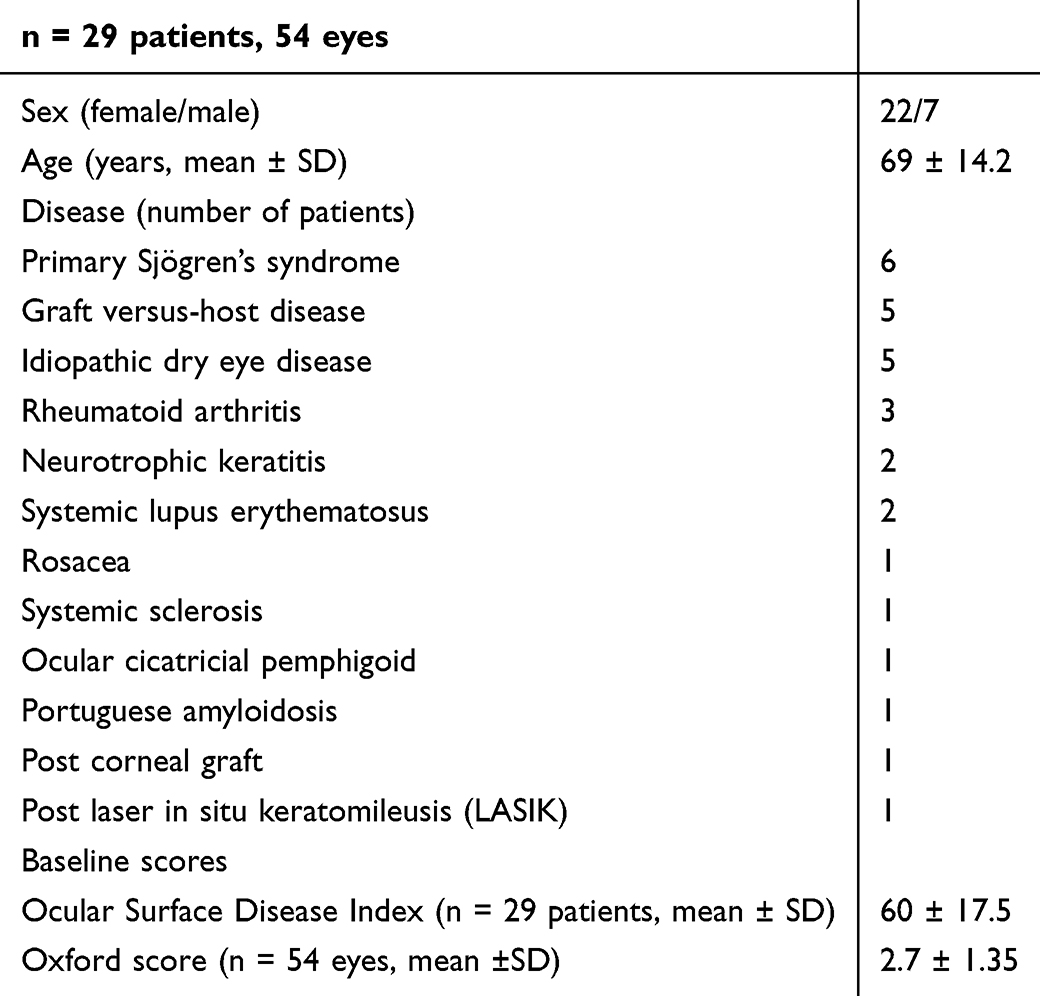 |
Table 1 Baseline Characteristics of Patients Treated with Autologous Serum Eye Drops |
According to Levy et al,2 patients were classified as responders based on at least one of the following criteria: (i) a reduction of ≥14 points in the Ocular Surface Disease Index (OSDI) and/or (ii) a decrease of ≥1 point in the Oxford scale in the treated eyes compared to baseline scores. As shown in Figure 1A, the proportion of responders remained stable throughout the study period, with 65.5% (19 patients/29) of patients identified as responders at T1, 69% at T2 (20 patients/29), and 65.5% (19 patients/29) at T3. Furthermore, the evolution of response rates across the three follow up time points are depicted in Figure 1B. It demonstrates a stable response profile over time for most patients. Among the patients classified as responders at T1, 89.5% maintained their responder status at T2. Conversely, among the non-responders at T1, only 30% transitioned to responder status at T2. Similarly, most patients maintained their response profile at T3, as 82.3% of responders at T2 continued to exhibit a positive response to long-term treatment with ASED.
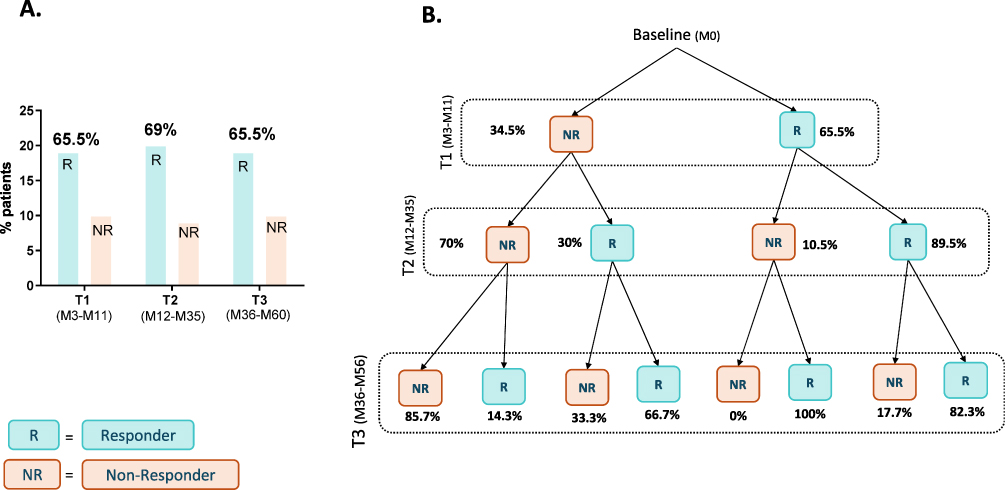 |
Figure 1 (A) Proportion of responders (R) and non-responders (NR) at the three follow-up time points (T1, T2, T3). (B) Changes in the response profile to ASED treatment over the three follow-up time points. |
This study has provided, for the first time, that most patients exhibit a robust and sustained response to ASED therapy over the years. It highlights the potential to define a “responder profile” based on early treatment outcomes, in order to better anticipate long-term therapeutic management. However, this study has limitations, including a small sample size and its retrospective design, which may have introduced selection bias and limited statistical power. The exploratory nature of the analysis and the absence of a control group preclude definitive conclusions regarding long-term efficacy. Larger-scale studies are required to elucidate the clinico-biological factors underpinning this responder profile. Such investigations could pave the way for personalized treatment approaches in the treatment of DED.
Abbreviations
DED, Dry Eye Disease; ASED, Autologous Serum Eye Drops; EGF, Epidermal Growth Factor; NGF, Nerve Growth Factor; OSDI, Ocular Surface Disease Index; AP-HM, Assistance Publique-Hôpitaux de Marseille.
Disclosure
Professor Jeremy Magalon reports personal fees from Horus Pharma and Horiba, outside the submitted work. He is co-founder of Remedex network. The authors report no other conflicts of interest in this work.
References
1. MA Lemp, GN Foulks. The definition and classification of dry eye disease: report of the Definition and Classification Subcommittee of the International Dry Eye WorkShop (2007). Ocul Surf. 2007;5(2):75–3. doi:10.1016/s1542-0124(12)70081-2. PMID: 17508116
2. Levy N, Wang Yin GH, Noharet R, et al. A retrospective analysis of characteristic features of responder patients to autologous serum eye drops in routine care. Ocul Surf. 2019;17(4):787–792. doi:10.1016/j.jtos.2019.05.003. Epub 2019 May 16. PMID: 31103732.
3. Wolffsohn JS, Arita R, Chalmers R, et al. TFOS DEWS II Diagnostic Methodology report. Ocul Surf. 2017;15(3):539–574. doi:10.1016/j.jtos.2017.05.001. Epub 2017 Jul 20. PMID: 28736342.
4. Kwaku Akowuah P, Junior Obinwanne C, Owusu E, et al. Platelet-rich plasma for treating dry eye disease - A systematic review and meta-analysis. Cont Lens Anterior Eye. 2024;47(1):102091. doi:10.1016/j.clae.2023.102091. Epub 2023 Nov 10. PMID: 37951738.
5. Li BD, Jiang JX, Zhang Q, Chu YR, Chen ZY, Hu K. Therapeutic Effects of Umbilical Cord Serum for Dry Eye Disease: a Systemic Review and Meta-Analysis. Ophthalmic Res. 2025;68(1):71–83. doi:10.1159/000542731. Epub 2024 Dec 2. PMID: 39622221; PMCID: PMC11844691.
6. He CZ, Zeng ZJ, Liu JQ, Qiu Q, He Y. Autologous serum eye drops for patients with dry eye disease: a systematic review and meta-analysis of randomized controlled trials. Front Med. 2024;11:1430785. doi:10.3389/fmed.2024.1430785. PMID: 39346942; PMCID: PMC11427303.
 © 2026 The Author(s). This work is published and licensed by Dove Medical Press Limited. The
full terms of this license are available at https://www.dovepress.com/terms
and incorporate the Creative Commons Attribution
- Non Commercial (unported, 4.0) License.
By accessing the work you hereby accept the Terms. Non-commercial uses of the work are permitted
without any further permission from Dove Medical Press Limited, provided the work is properly
attributed. For permission for commercial use of this work, please see paragraphs 4.2 and 5 of our Terms.
© 2026 The Author(s). This work is published and licensed by Dove Medical Press Limited. The
full terms of this license are available at https://www.dovepress.com/terms
and incorporate the Creative Commons Attribution
- Non Commercial (unported, 4.0) License.
By accessing the work you hereby accept the Terms. Non-commercial uses of the work are permitted
without any further permission from Dove Medical Press Limited, provided the work is properly
attributed. For permission for commercial use of this work, please see paragraphs 4.2 and 5 of our Terms.
Recommended articles

Autologous Platelet‐Rich Plasma Drops for Evaporative Dry Eye Disease from Meibomian Gland Dysfunction: A Pilot Study
Murtaza F, Toameh D, Chiu HH, Tam ES, Somani S
Clinical Ophthalmology 2022, 16:2199-2208
Published Date: 6 July 2022
Engaging Stakeholders to Develop a Roadmap for Dry Eye and MGD PCORI-Funded Research
Warren NA, Maskin SL, Gurupur V, Rector DA, Adelman D, Howell S, McAree J, Dibble R, Carlisano C, Maconi DP, Schrotenboer D, Jaimes M, Marte N, Carlisano T, Toland C, Chung J, Cremers SL, Corbin GS
Patient Related Outcome Measures 2024, 15:143-186
Published Date: 12 May 2024
Shelf-Stable, Cryopreserved Amniotic Membrane for the Management of Ocular Surface Disease: A Retrospective Assessment
Cushman S
Clinical Optometry 2025, 17:409-415
Published Date: 21 December 2025
Low-Level Light Therapy as a Potential Adjunctive Approach in Mucus Fishing Syndrome: Report of Two Clinical Cases
Mancini A, Carnovale-Scalzo G, Mancini M, Borselli M, Taloni A, Chisari D, Lucisano A, Carnevali A, Meduri A, Aragona P, Scorcia V, Giannaccare G
International Medical Case Reports Journal 2025, 18:1679-1684
Published Date: 28 December 2025
Ocular Surface Changes and Glaucoma: A Prospective Contralateral Study of IOP-Reducing Eyedrops versus iStent Inject Surgery
Gundersen KG, Gundersen M, Nilsen C, Jensen PG
Clinical Ophthalmology 2026, 20:568150
Published Date: 8 January 2026