
Back to Journals » Psychology Research and Behavior Management » Volume 19
Future Self-Continuity and Adolescents’ Depression: The Mediating Role of Pleasure Experience and the Moderating Role of School Connectedness
Authors Wei M  , Ma K, Sun Q, Sui Y, Li Y , Xia X
Received 10 October 2025
Accepted for publication 30 January 2026
Published 24 February 2026 Volume 2026:19 569508
DOI https://doi.org/10.2147/PRBM.S569508
Checked for plagiarism Yes
Review by Single anonymous peer review
Peer reviewer comments 2
Editor who approved publication: Dr Gabriela Topa
Mingyue Wei,1,2,* Kejia Ma,3,* Qilong Sun,4 Yunjie Sui,1 Yansong Li,5 Xue Xia1,6
1School of Social Development, University of Health and Rehabilitation Sciences, Qingdao, Shandong Province, People’s Republic of China; 2School of Basic Medicine, Qingdao University, Qingdao, Shandong Province, People’s Republic of China; 3School of Rehabilitation Sciences and Engineering, University of Health and Rehabilitation Sciences, Qingdao, Shandong Province, People’s Republic of China; 4Liaocheng Infant Normal School, Liaocheng, Shandong Province, People’s Republic of China; 5School of Physical Education, Qingdao University, Qingdao, Shandong Province, People’s Republic of China; 6Qingdao Hospital, University of Health and Rehabilitation Sciences (Qingdao Municipal Hospital), Qingdao, Shandong Province, People’s Republic of China
*These authors contributed equally to this work
Correspondence: Xue Xia, School of Social Development, University of Health and Rehabilitation Sciences, Qingdao, People’s Republic of China, Tel +532-57787623, Email [email protected]
Objective: Adolescent depression poses a significant mental health challenge. Drawing on cognitive theories of depression and the anhedonia susceptibility model, this study examined whether future self-continuity is associated with depressive symptoms through pleasure experience (anticipatory and consummatory pleasure), and whether these pathways are moderated by school connectedness.
Methods: Using a cross-sectional design, self-report data were collected from 835 adolescents (mean age = 16.40 years; 67.4% female) in China. Participants completed the Future Self-Continuity Questionnaire, Temporal Experience of Pleasure Scale, School Connectedness Scale, and Self-rating Depression Scale.
Results: (1) Future self-continuity positively predicted anticipatory pleasure (β = 0.181, P < 0.001) and consummatory pleasure (β = 0.166, P < 0.001). Both anticipatory pleasure (β = − 0.231, P < 0.001) and consummatory pleasure (β = − 0.141, P < 0.001) negatively predicted depression. (2) School connectedness moderated the paths from future self-continuity to anticipatory pleasure (β = − 0.056, P = 0.017) and consummatory pleasure (β = − 0.098, P < 0.001). (3) For depression prediction, the interaction between future self-continuity and school connectedness (Anticipatory model: β = − 0.093, P < 0.001; Consummatory model: β = − 0.107, P < 0.001) and the interactions between school connectedness and pleasures were significant (Anticipatory: β = − 0.084, Consummatory: β = − 0.063, Ps < 0.05). (4) The indirect effect via anticipatory pleasure was significant across all levels of school connectedness, whereas the indirect effect via consummatory pleasure was non-significant at high levels of school connectedness.
Conclusion: These findings suggest that a coherent and positive sense of the future self is associated with lower levels of depressive symptoms in adolescents through greater pleasure capacity, particularly within supportive school environments. The results underscore the importance of integrating future-oriented self-concept interventions with school-based strategies to promote adolescent mental health.
Keywords: future self-continuity, anticipatory pleasure, consummatory pleasure, school connectedness, depression, adolescents
Introduction
Depression is a prevalent psychological disorder that significantly impacts adolescents, with early onset associated with a longer duration, greater severity, and higher recurrence rates.1 Adolescence is a critical period for self-identity and personality development, and depressive symptoms during this time can adversely affect academic performance, interpersonal relationships, and long-term mental health.2 Understanding the psychological mechanisms that underlie adolescent depression is essential for developing effective interventions.
The cognitive theory of depression suggests that negative self-evaluation and cognition are pivotal factors influencing depression.3 According to Hershfield’s theoretical model, future self-continuity reflects the degree to which individuals identify with their future selves and refers to the psychological connection between an individual’s present self and their future self, reflecting the perceived continuity and coherence across temporal self-concepts.4 Future self-continuity is conceptually distinct from generalized optimism and temporal orientation: whereas optimism reflects positive expectations about future outcomes and temporal orientation refers to a general focus on the past, present, or future,5,6 future self-continuity specifically captures the perceived similarity, vividness, and positivity of one’s future self relative to the present self.7 Individuals with higher future self-continuity perceive their future selves as more similar to their present selves, envision clearer and more vivid representations of their future selves, and hold more positive evaluations of them.7 As an indicator of temporal self-coherence, future self-continuity may constitute a significant factor in adolescent depression.8 Therefore, elucidating the relationship between future self-continuity and adolescent depression could provide novel insights into the underlying mechanisms of this condition.
A model of depression susceptibility centered on anhedonia highlights the role of impaired positive emotions in the onset of depression. Anhedonia, defined as a reduced capacity to experience pleasure, is a core feature of depression and is often accompanied by deficits in positive affect and approach motivation. Conceptually, anhedonia can be differentiated into present-state (consummatory) and anticipatory components, with the latter reflecting diminished pleasure derived from future-oriented expectations. The broaden-and-build theory suggests that positive emotions enhance future self-continuity, while negative emotions diminish it.9 Temporal Self-Regulation Theory (TSRT) further posits that future-oriented self-representations play a central role in behavior regulation by shaping how individuals anticipate, value, and pursue future rewards.10 From this perspective, a weakened sense of future self-continuity may be particularly detrimental to anticipatory pleasure capacity, which relies on the ability to mentally simulate rewarding future experiences and assign motivational value to them, rather than to general positive affect that is more strongly driven by immediate emotional states.11 Accordingly, reduced anticipatory pleasure capacity may constitute a key pathway through which diminished future self-continuity is associated with depressive symptoms.
School connectedness reflects students’ sense of belonging and identification with their school environment, encompassing cognitive, emotional, and behavioral engagement. Specifically, cognitive engagement involves active participation in learning, emotional engagement includes feelings of attachment and belonging, and behavioral engagement pertains to participation in school activities and adherence to norms. It primarily includes teacher support, peer support, and a sense of school belonging.12 According to ecological systems theory, psychological development is a nested process centered on the individual and influenced by external environmental factors.13 Based on the depression susceptibility model, environmental factors can significantly influence personality and cognitive changes, which in turn may contribute to the development of anhedonia. Family and school are two closely connected environmental factors that exert a direct influence on an individual’s self-development. As adolescents gradually reduce their dependence on the family, school becomes a critical context for their individualization and socialization. Thus, school connectedness emerges as a significant factor in adolescent development.14 It has been reported that individual levels of student connectedness were associated with lower levels of suicidal behavior and depression.15 As a key variable influencing adolescents’ positive development and mental health,14,16 school connectedness may moderate the relationships among future self-continuity, pleasure experience, and adolescent depression.
In summary, this study examines the potential relationships among future self-continuity, pleasure experience, and adolescent depression, as well as the moderating role of school connectedness. We test the following hypotheses: H1: Future self-continuity will be negatively associated with adolescent depression, and this relationship will be mediated by pleasure experience. H2: School connectedness will moderate the relationship between future self-continuity and anticipatory pleasure. H3: School connectedness will moderate the indirect effect of future self-continuity on depression through anticipatory pleasure. The findings are intended to inform the development of targeted intervention programs aimed at preventing and mitigating adolescent depression.
Method
Participants and Procedure
This study was conducted via a convenience sampling administered self-report questionnaires to obtain data from adolescents residing in Shandong Province, China, selected based on accessibility and cooperation with the research team. Inclusion criteria included adolescents aged 15–19 years who were currently enrolled in school and able to read and complete the questionnaire independently. Exclusion criteria encompassed individuals with a known history of severe psychiatric disorders or those unable to provide informed consent. The sample consisted of 900 adolescents recruited through collaboration with school administrators who distributed invitations during class time. After excluding incomplete or invalid responses (eg, failing to select “strongly agree” for a prompt instructing them to do so), 835 valid questionnaires were retained, yielding an effective response rate of 92.8%. The achieved statistical power based on the current sample size was calculated using G*Power 3.1. With N = 835, α = 0.05, and a moderate effect size (f2 = 0.15), the achieved power was > 0.99 (approximately 1.00). This indicates that the present study was more than sufficiently powered to detect moderate effects in the tested regression equations.
The participants had a mean age of 16.40 years (SD = 0.71). The sample included 272 males (32.6%) and 563 females (67.4%). Geographically, 230 participants were from urban areas (27.5%), while 605 were from rural areas (72.5%). Urban/rural classification was based on participants’ self-reported current residential area, with “urban” referring to city or county-level urban districts, and “rural” referring to townships or villages, consistent with prior research on residential distinctions in adolescent mental health.17 Additionally, 66 participants (7.9%) were only children, and 769 (92.1%) were non-only children. This study was carried out following the Declaration of Helsinki and approved by the Ethics Committee of Qingdao University (Approval No.: QDU-HEC-2022216). Written consent was obtained from all participants and their legal guardians after they were informed about the study details.
To mitigate potential common method bias, several procedural remedies were implemented during the study design and data collection stages, following recommendations by Podsakoff et al18,19 All questionnaires were administered anonymously, and participants were explicitly informed that there were no right or wrong answers, thereby reducing evaluation apprehension. In addition, different Likert-type response formats were used across measures, and the constructs were presented in separate sections to minimize respondents’ tendency to infer hypothesized relationships among variables.
Measures
Future Self-Continuity Questionnaire
The Future Self-Continuity Questionnaire, developed by Sokol et al,20 translated and revised by Zhang Feng et al,21 was used to assess future self-continuity. The questionnaire comprises 10 items across three dimensions: similarity, vividness, and positivity. Responses are rated on a 6-point scale, ranging from “completely different/not vivid/dislike” to “completely similar/vivid/like.” Higher scores indicate stronger future self-continuity. In this study, the Cronbach’s α coefficient for the scale was 0.908, indicating high internal consistency.
Temporal Experience of Pleasure Scale
The Temporal Experience of Pleasure Scale (TEPS) was employed to assess pleasure experience (pleasure capacity). This 18-item scale measures two dimensions: anticipatory pleasure (experiencing pleasure in anticipation of future events, 10 items) and consummatory pleasure (experiencing pleasure from ongoing activities, 8 items).22 Responses are rated on a 6-point scale, ranging from “strongly disagree” to “strongly agree.” Higher scores indicate greater pleasure capacity whereas lower scores reflect greater anhedonia. In this study, the Cronbach’s α coefficient for the scale was 0.932, indicating excellent internal consistency.
School Connectedness Scale
The School Connectedness Scale, developed by Yu, was employed to assess school connectedness.23 This 10-item scale comprises three dimensions: peer support, teacher support, and sense of school belonging. Responses are rated on a 5-point Likert scale, ranging from “strongly disagree” to “strongly agree”. Higher scores indicate greater levels of school connectedness. In this study, the Cronbach’s α coefficient for the scale was 0.874, indicating good internal consistency.
Self-Rating Depression Scale
The Self-Rating Depression Scale (SDS), developed by Zung,24 was employed to assess depressive symptoms. This scale consists of 20 items, rated on a 4-point scale ranging from “none or a little of the time” to “most or all of the time”. Among these items, 10 are scored positively, and 10 are scored negatively. The total score is calculated by summing the item scores, multiplying by 1.25, and rounding to the nearest integer. Higher scores reflect greater severity of depressive symptoms. In this study, the Cronbach’s α coefficient for the SDS was 0.846, indicating satisfactory internal consistency.
Statistical Analyses
Data analyses were conducted using SPSS 27.0. Initially, common method bias was assessed. Prior to the main analysis, assumptions of normality and multicollinearity were tested. Skewness and kurtosis values for all main variables fell within acceptable ranges (absolute skewness < 0.8, absolute kurtosis < 0.8), indicating that the data approximated a normal distribution. Multicollinearity diagnostics revealed that all VIF values were below 2 and tolerance values exceeded 0.60, suggesting no substantial multicollinearity concerns among predictors. Subsequently, descriptive statistics and correlation analyses were performed to examine the basic characteristics and relationships among the variables. The mediation and moderation effects were tested using the PROCESS macro.
Results
Common Method Bias Test
Harman’s single-factor test was conducted to assess common method bias.25 The first factor accounting for 24.9% of the variance, which is below the critical threshold of 40%. This suggests that common method bias was not a significant concern in this study.
Descriptive Statistics and Correlation Analysis
As shown in Table 1, future self-continuity was significantly and positively correlated with both anticipatory pleasure and consummatory pleasure, as well as with school connectedness and depression. Both anticipatory pleasure and consummatory pleasure were significantly positively associated with school connectedness and negatively associated with depression. School connectedness also showed a strong negative correlation with depression.
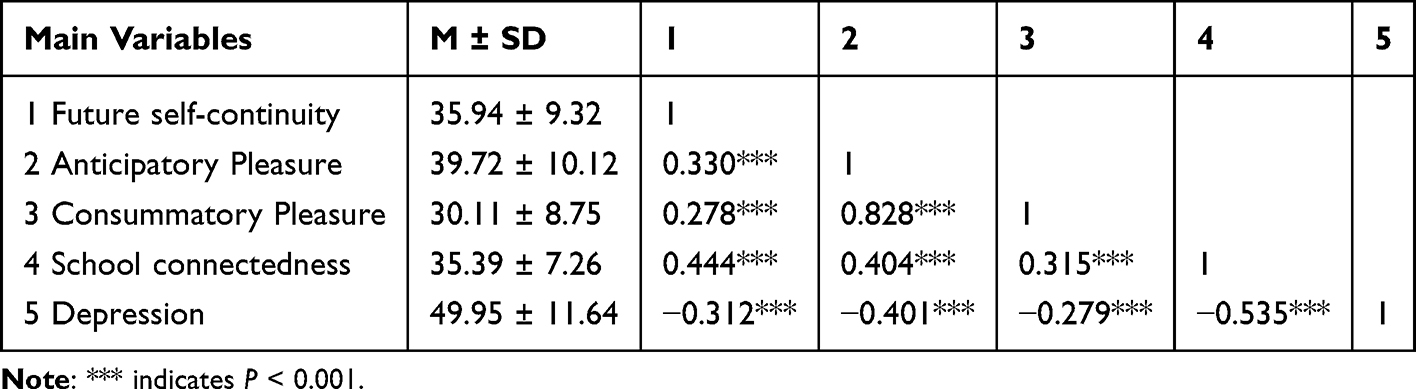 |
Table 1 Descriptive Statistics and Correlation Analysis of Each Variable |
Moderated Mediation Analysis
Table 2 presents the detailed results of the moderated mediation model with anticipatory pleasure as the mediator. The model predicting anticipatory pleasure explained a significant portion of variance (R2 = 0.205, F(5, 829) = 42.862, P < 0.001). Future self-continuity (β = 0.181, P < 0.001) and school connectedness (β = 0.311, P < 0.001) both positively predicted anticipatory pleasure, and their interaction was significant (β = −0.056, P = 0.017, ΔR2 = 0.006). Simple slope analyses indicated that future self-continuity positively predicted anticipatory pleasure at low (β = 0.236, P < 0.001), mean (β = 0.181, P < 0.001), and high levels of school connectedness (β = 0.125, P = 0.003) (Figure 1A). This pattern suggests that high school connectedness serves a compensatory role, buffering the impact of low future self-continuity on reduced anticipatory pleasure. For the outcome variable (depression), the model exhibited excellent fit (R2 = 0.371, F(7, 827) = 69.778, P < 0.001). Anticipatory pleasure (β = −0.231, P < 0.001) and school connectedness (β = −0.452, P < 0.001) negatively predicted depression. The interactions between future self-continuity and school connectedness (β = −0.093, P < 0.001, ΔR2 = 0.012) and between anticipatory pleasure and school connectedness (β = −0.084, P < 0.001, ΔR2 = 0.009) were also significant. Simple slope tests for the future self-continuity × school connectedness interaction on depression revealed that when school connectedness was low, future self-continuity did not significantly predict depression (β = 0.036, P = 0.374); when school connectedness was high, future self-continuity significantly and negatively predicted depression (β = −0.150, P < 0.001) (Figure 1B), indicating that high school connectedness strengthens the protective effect of future self-continuity against depression. For the anticipatory pleasure × school connectedness interaction on depression, simple slopes showed that the negative predictive effect of anticipatory pleasure was stronger when school connectedness was high (β = −0.314, p < 0.001) than when school connectedness was low (β = −0.147, P < 0.001) (Figure 1C). Conditional standardized indirect effects showed that the indirect effect of future self-continuity on depression through anticipatory pleasure was significant across all levels of school connectedness: low school connectedness (β = −0.035, 95% CI = [−0.060, −0.015]), mean school connectedness (β = −0.042, 95% CI = [−0.065, −0.020]), and high school connectedness (β = −0.039, 95% CI = [−0.077, −0.003]). This indicates a robust mediation effect that persists across different levels of school connectedness.
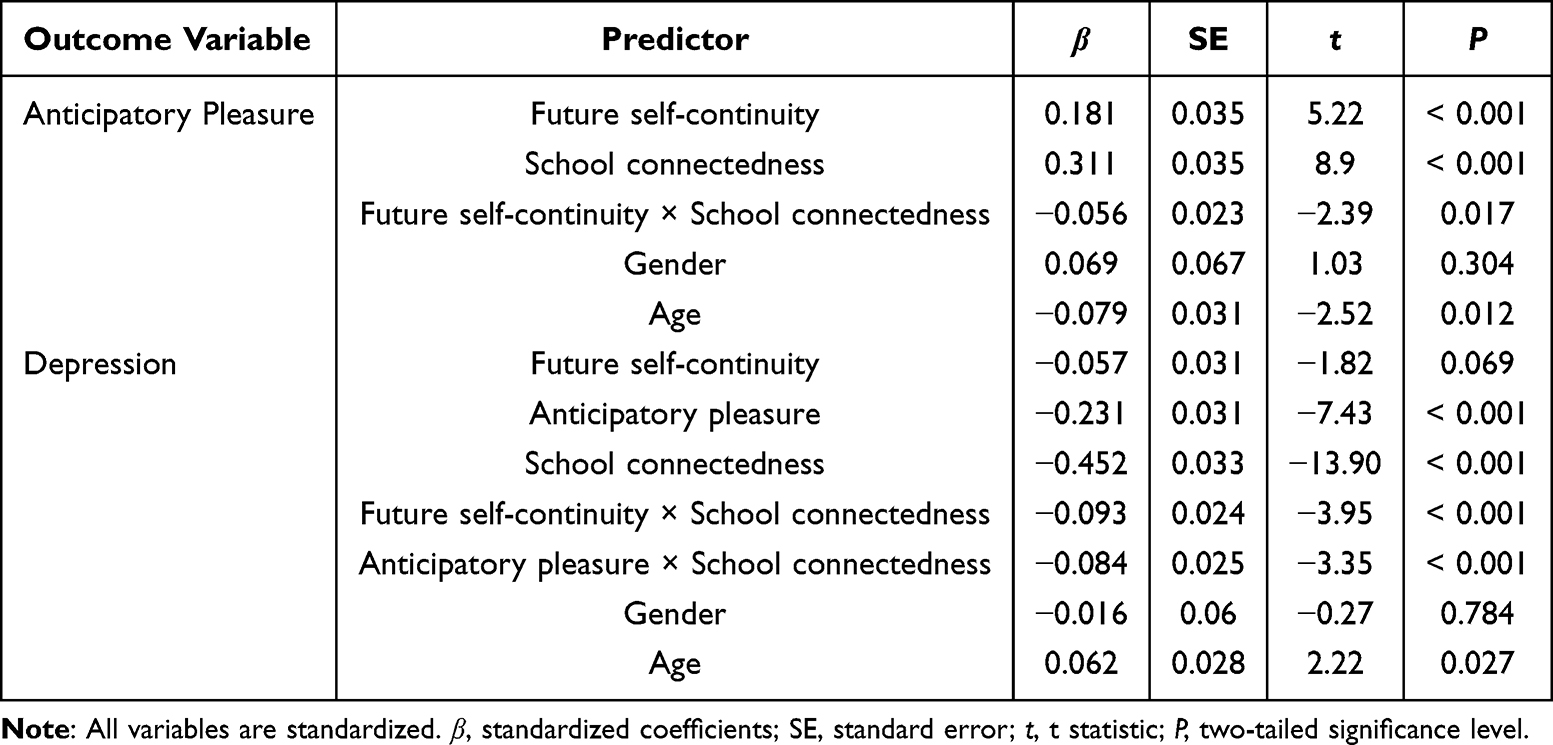 |
Table 2 Moderated Mediation Analysis Predicting Depression via Anticipatory Pleasure |
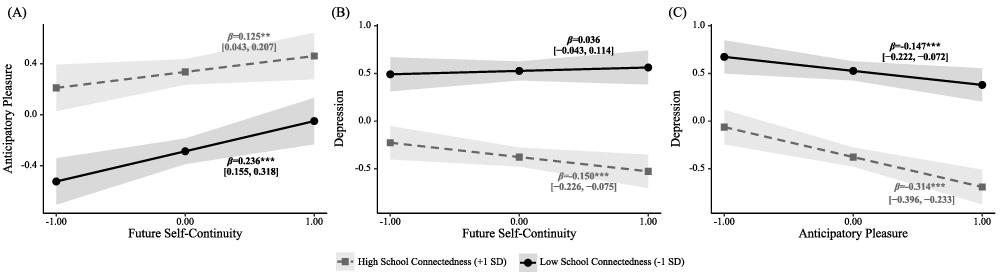 |
Figure 1 Moderating effects of school connectedness in the model with anticipatory pleasure as the mediator. Panel (A) shows the moderating effect of school connectedness on the relationship between future self-continuity and anticipatory pleasure. Panel (B) illustrates the moderating effect of school connectedness on the relationship between future self-continuity and depression. Panel (C) presents the moderating effect of school connectedness on the relationship between anticipatory pleasure and depression. All variables are standardized. High and low school connectedness are defined as ±1 standard deviation (SD) from the mean. Shaded areas show 95% CIs for simple slopes. **P < 0.01, ***P < 0.001. |
Table 3 presents the detailed results of the moderated mediation model with consummatory pleasure as the mediator. In contrast to the anticipatory pleasure model, this model explained less variance in the mediator (R2 = 0.145, F(5, 829) = 28.163, P < 0.001). Future self-continuity (β = 0.166, P < 0.001) and school connectedness (β = 0.220, P < 0.001) positively predicted consummatory pleasure, with a significant interaction (β = −0.098, P < 0.001, ΔR2 = 0.017). Simple slope analyses revealed that future self-continuity significantly predicted consummatory pleasure at low (β = 0.264, P < 0.001) and mean levels of school connectedness (β = 0.166, P < 0.001), whereas this association was no longer significant at high levels of school connectedness (β = 0.069, P = 0.113). (Figure 2A). For depression, the model’s explanatory power was lower (R2 = 0.343, F(7, 827) = 61.726, P < 0.001) than that of the anticipatory pleasure model. Future self-continuity (β = −0.076, P = 0.019), consummatory pleasure (β = −0.141, P < 0.001), and school connectedness (β = −0.494, P < 0.001) negatively predicted depression, with significant interactions between future self-continuity and school connectedness (β = −0.107, P < 0.001, ΔR2 = 0.017) and between consummatory pleasure and school connectedness (β = −0.063, P = 0.013, ΔR2 = 0.005). Simple slope tests for the future self-continuity × school connectedness interaction on depression showed that when school connectedness was low, future self-continuity did not significantly predict depression (β = 0.032, P = 0.440); when school connectedness was high, future self-continuity significantly and negatively predicted depression (β = −0.183, P < 0.001) (see Figure 2B). For the consummatory pleasure × school connectedness interaction on depression, simple slopes revealed that the negative predictive effect of consummatory pleasure was stronger when school connectedness was high (β = −0.204, P < 0.001) than when school connectedness was low (β = −0.078, P = 0.037) (see Figure 2C). However, the conditional standardized indirect effect of future self-continuity on depression through consummatory pleasure was only significant at low (β = −0.021, 95% CI = [−0.045, −0.002]) and mean (β = −0.023, 95% CI = [−0.041, −0.010]) school connectedness levels, but not at high school connectedness (β = −0.014, 95% CI = [−0.037, 0.008]). The non-significant indirect effect at high school connectedness level highlights that consummatory pleasure is a less stable mechanism than anticipatory pleasure in explaining the protective role of future self-continuity.
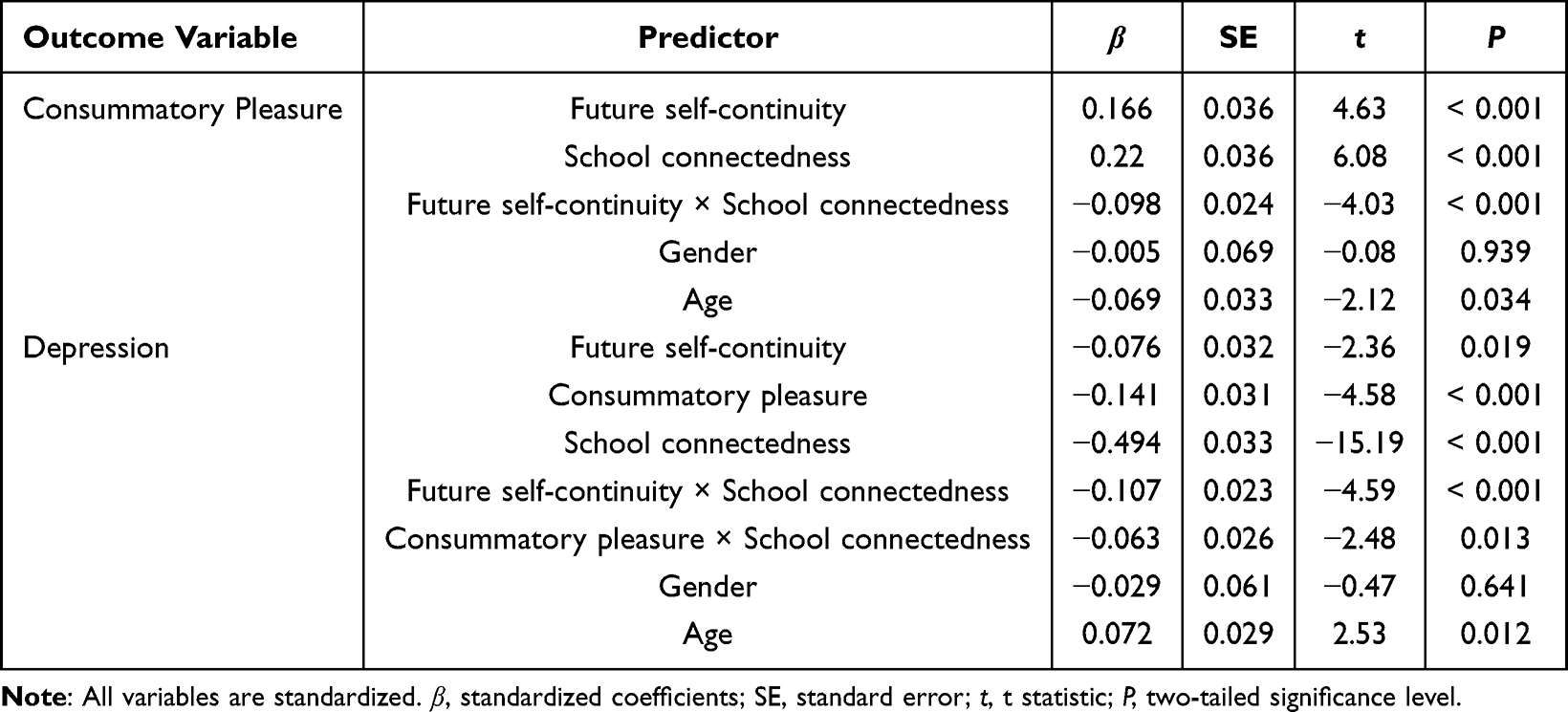 |
Table 3 Moderated Mediation Analysis Predicting Depression via Consummatory Pleasure |
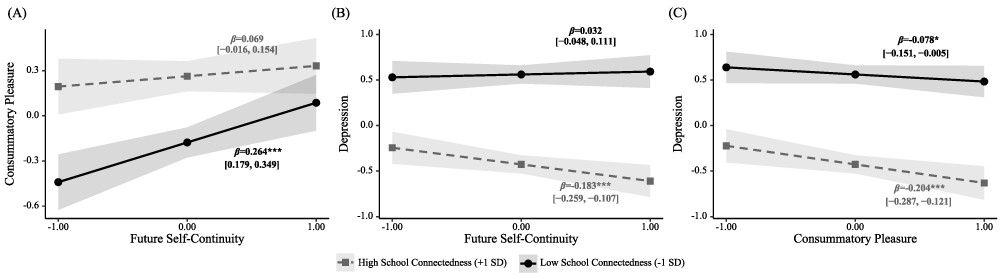 |
Figure 2 Moderating effects of school connectedness in the model with consummatory pleasure as the mediator. Panel (A) shows the moderating effect of school connectedness on the relationship between future self-continuity and consummatory pleasure. Panel (B) illustrates the moderating effect of school connectedness on the relationship between future self-continuity and depression. Panel (C) presents the moderating effect of school connectedness on the relationship between consummatory pleasure and depression. All variables are standardized. High and low school connectedness are defined as ±1 standard deviation (SD) from the mean. Shaded areas show 95% CIs for simple slopes. *P < 0.05, ***P < 0.001. |
Discussion
The findings demonstrated that higher future self-continuity is associated with greater pleasure capacity (higher anticipatory/consummatory pleasure), which in turn mitigates depressive symptoms. Additionally, school connectedness moderates the relationship between future self-continuity and depression, as well as the mediated pathway through pleasure experience.
Consistent with prior work, higher future self-continuity was associated with fewer depressive symptoms.20 Future self-continuity refers to the perceived connection, similarity, and sense of unity between one’s present and future self.26 According to the future self-continuity model, individuals with a more positive attitude toward their future selves are more likely to make decisions and engage in behaviors that are beneficial to their future selves.27 When adolescents perceive their future self as psychologically connected to who they are now, they may be more inclined to engage in future-oriented, goal-directed behaviors and to interpret setbacks as temporary and manageable rather than as personally defining. Conversely, perceiving the future self as distant or disconnected may be accompanied by reduced motivation to invest in long-term goals and a greater sense of meaninglessness or helplessness, which could heighten vulnerability to depressive symptoms.
Pleasure experience, particularly anticipatory pleasure, served as a key statistical pathway linking future self-continuity to depressive symptoms. Notably, the findings revealed meaningful differences between anticipatory and consummatory pleasure in explaining the protective role of future self-continuity against adolescent depression. Future self-continuity showed a more robust and consistent association with anticipatory pleasure, remaining significant across all levels of school connectedness, whereas its association with consummatory pleasure was conditional and disappeared at high levels of school connectedness. Correspondingly, the indirect effect of future self-continuity on depression via anticipatory pleasure was stable across contexts, while the indirect effect via consummatory pleasure was context-dependent and non-significant in highly connected school environments. These distinctions suggest that future self-continuity primarily operates through future-oriented reward processes rather than immediate hedonic responses, pointing to anticipatory pleasure as a central mechanism linking self-representation to emotional well-being.28,29
From a neuroscientific perspective, adolescence is a period marked by significant developmental changes in brain regions involved in both reward processing and future-oriented cognition.30 The limbic system, which plays a central role in processing immediate rewards, is highly active during adolescence, contributing to heightened risk-taking and sensation-seeking behaviors.31 In contrast, the prefrontal cortex, responsible for self-regulation, decision-making, and future-oriented thinking, matures more gradually. This imbalance between the impulsive reward-seeking system and the developing cognitive control system may contribute to the difficulties adolescents face in balancing immediate gratification with long-term goals.32 Within this developmental context, weaker future self-continuity may be associated with less effective integration of future-oriented cognition and reward processing, which may relate to lower anticipatory pleasure and greater depressive symptoms.
Moreover, the moderation analysis demonstrated that school connectedness significantly moderated the entire mediation model, including the direct path from future self-continuity to depression and both segments of the indirect pathway through pleasure experience. Specifically, school connectedness buffered the association between low future self-continuity and reduced pleasure capacity, suggesting that supportive peer and teacher relationships and a positive school climate may provide alternative sources of meaning, reward, and hope when adolescents lack a clear or coherent future self-image.12 In addition, school connectedness attenuated the negative association between reduced pleasure capacity and emotional well-being, such that supportive social relationships and a structured school environment offering positive feedback and reinforcement helped mitigate the emotional risks associated with elevated anhedonia.15 School connectedness also moderated the direct link between future self-continuity and depression, indicating that an external sense of structure and guidance embedded in the school context may compensate for a weak internalized future self.33 These findings are consistent with the interpersonal theory of depression, which emphasizes that disrupted relationships undermine individuals’ sense of belonging and increase depression risk, as well as with self-determination theory, which posits relatedness as a fundamental psychological need for healthy development.34 From this perspective, high levels of school connectedness may fulfill adolescents’ relatedness needs, strengthen intrinsic motivation, and function as a key contextual protective factor that dynamically interacts with individual self-representations to influence depressive outcomes.35
It also should be noted that the interaction between future self-continuity and school connectedness in predicting anticipatory pleasure exhibited a seemingly counterintuitive pattern, such that the positive association between future self-continuity and pleasure was stronger among adolescents with lower, rather than higher, levels of school connectedness (Figures 1A). According to the protective–protective model, the joint effects of two protective factors can be explained by two alternative hypotheses: the enhancing hypothesis and the antagonistic hypothesis.36 The enhancing hypothesis proposes that one protective factor strengthens the beneficial effect of another, whereas the antagonistic hypothesis suggests that the protective effect of one factor is particularly pronounced when the other protective factor is relatively weak.37 Consistent with the antagonistic interaction hypothesis, the present findings indicate that future self-continuity and school connectedness may function as mutually compensatory protective factors for anticipatory pleasure, such that future self-continuity plays a more salient role in sustaining pleasure capacity when school connectedness is low.33
These results enrich our understanding of the key factors and mechanisms underlying adolescent depression, and highlight that future self-continuity, pleasure experience, and school connectedness are critical factors influencing adolescent depression, providing practical guidance for developing intervention strategies. For instance, interventions to foster future self-continuity can involve guiding adolescents through future self-imagery or writing exercises, helping them build an emotional connection with their future self to enhance long-term goal-directed behavior.4,38 Interventions to enhance school connectedness can include structured mentoring programs or support from mentors, increasing adolescents’ sense of belonging and social support within the school community, thereby promoting mental health and positive academic outcomes.39,40
Several limitations should be noted. First, the cross-sectional design precludes causal inferences; longitudinal or experimental studies are needed to establish directionality. Second, all measures were self-reported, which may introduce common-method bias; future research could incorporate behavioral tasks or multi-informant data. Third, the sample was drawn from a specific cultural and age group, limiting generalizability; replications in diverse populations are warranted.
Conclusion
This study found that future self-continuity was associated with lower levels of depressive symptoms in adolescents, both directly and indirectly through pleasure experience, particularly anticipatory pleasure, within the context of school connectedness. Importantly, school connectedness emerged as a significant moderating factor, suggesting that it may function as a compensatory contextual resource that buffers the association between low future self-continuity and depressive symptoms.
The findings should be interpreted with caution, as the sample was limited to adolescents from Shandong Province, China, which may restrict generalizability to other regions or cultural contexts. Future longitudinal and intervention studies are needed to test the temporal ordering and causal mechanisms implied by this model and to evaluate whether enhancing future self-continuity and school connectedness can prospectively reduce adolescent depressive symptoms.
Data Sharing Statement
The data that support the findings of this study are available from the corresponding authors upon reasonable request.
Acknowledgments
The authors thank all the participants for their enthusiastic participation in this study.
Author Contributions
All authors made a significant contribution to the work reported, whether that is in the conception, study design, execution, acquisition of data, analysis and interpretation, or in all these areas; took part in drafting, revising or critically reviewing the article; gave final approval of the version to be published; have agreed on the journal to which the article has been submitted; and agree to be accountable for all aspects of the work.
Funding
This work was supported by Key R&D Program of Shandong Province, China (No. 2025RZB0804), National Natural Science Foundation of China (No. 32300921), Taishan Scholars Program for Young Experts of Shandong Province (No. tsqn202312244), Qingdao Natural Science Foundation (No. 23-2-1-32-zyyd-jch), and 2023 Qingdao Social Science Planning Research Project (No. QDSKL2301063, No. QDSKL2301050).
Disclosure
The authors declare no competing interests in this work.
References
1. Dunn V, Goodyer IM. Longitudinal investigation into childhood-and adolescence-onset depression: psychiatric outcome in early adulthood. Br J Psychiatry. 2006;188(3):216–10. doi:10.1192/bjp.188.3.216
2. Kessler RC, Walters EE. Epidemiology of DSM-III-R major depression and minor depression among adolescents and young adults in the national comorbidity survey. Depress Anxiety. 1998;7(1):3–14. doi:10.1002/(SICI)1520-6394(1998)7:1<3::AID-DA2>3.0.CO;2-F
3. Disner SG, Beevers CG, Haigh EAP, Beck AT. Neural mechanisms of the cognitive model of depression. Nat Rev Neurosci. 2011;12(8):467–477. doi:10.1038/nrn3027
4. Rutchick AM, Slepian ML, Reyes MO, Pleskus LN, Hershfield HE. Future self-continuity is associated with improved health and increases exercise behavior. Journal of Experimental Psychology. 2018;24(1):72–80. doi:10.1037/xap0000153
5. Sedikides C, Hong EK, Wildschut T. Self-Continuity. Annu Rev Psychol. 2023;74(1):333–361. doi:10.1146/annurev-psych-032420-032236
6. McMichael S, Kwan V. A Review of Temporal Self-Perceptions Among Emerging Adults: the Significance of Demographics and a Global Crisis on Psychological and Achievement Benefits. Behav Sci. 2025;15(4):471. doi:10.3390/bs15040471
7. Ersner-Hershfield H, Garton MT, Ballard K, Samanez-Larkin GR, Knutson B. Don’t stop thinking about tomorrow: individual differences in future self-continuity account for saving. Judgment and Decision Making. 2009;4(4):280–286. doi:10.1017/S1930297500003855
8. Urminsky O. The role of psychological connectedness to the future self in decisions over time. Curr Dir Psychol Sci. 2017;26(1):34–39. doi:10.1177/0963721416668810
9. Fredrickson BL. The role of positive emotions in positive psychology: the broaden-and-build theory of positive emotions. Am Psychol. 2001;56(3):218–226. doi:10.1037/0003-066X.56.3.218
10. Hall PA, Fong GT. Temporal self-regulation theory: a neurobiologically informed model for physical activity behavior. Front Hum Neurosci. 2015;9. doi:10.3389/fnhum.2015.00117
11. Suksasilp C, Griffiths S, Sebastian CL, Norbury C. Reliability and validity of a temporal distancing emotion regulation task in adolescence. Emotion. 2021;21(4):830–841. doi:10.1037/emo0000744
12. McNeely C, Falci C. School connectedness and the transition into and out of health-risk behavior among adolescents: a comparison of social belonging and teacher support. J Sch Health. 2004;74(7):284–292. doi:10.1111/j.1746-1561.2004.tb08285.x
13. Hardcastle B, Byrnes D, Bartlett A, Denton P, Walsh PR. The ecology of human development—experiments by nature and design by Urie Bronfenbrenner. Cambridge, Ma: Harvard University Press, 1979. 330 pp. $16.50. The Educational Forum. 1981;46(1):117–123. doi:10.1080/00131728109336000
14. Shochet IM, Dadds MR, Ham D, Montague R. School connectedness is an underemphasized parameter in adolescent mental health: results of a community prediction study. J Clin Child Adolesc Psychol. 2006;35(2):170–179. doi:10.1207/s15374424jccp3502_1
15. Meng X, Chen Y, Wang X, Yuan J, Yu D. The relationship between school connectedness and depression: a three-level meta-analytic review. Advances in Psychological Science. 2024;32(2):246. doi:10.3724/SP.J.1042.2024.00246
16. Wilson D. The interface of school climate and school connectedness and relationships with aggression and victimization. J Sch Health. 2004;74(7):293–299. doi:10.1111/j.1746-1561.2004.tb08286.x
17. Xiao Y. Mental health inequality between urban and rural youth under COVID-19 from survey data from China. Front Public Health. 2024;12:1389765. doi:10.3389/fpubh.2024.1389765
18. Podsakoff PM, MacKenzie SB, Lee J-Y, Podsakoff NP. Common method biases in behavioral research: a critical review of the literature and recommended remedies. J Appl Psychol. 2003;88(5):879–903. doi:10.1037/0021-9010.88.5.879
19. Podsakoff PM, Podsakoff NP, Williams LJ, Huang C, Yang J. Common method bias: it’s bad, it’s complex, it’s widespread, and it’s not easy to fix. Annu Rev Organ Psychol Organ Behav. 2024;11(1):17–61. doi:10.1146/annurev-orgpsych-110721-040030
20. Sokol Y, Serper M. Development and validation of a future self-continuity questionnaire: a preliminary report. J Pers Assess. 2020;102(5):677–688. doi:10.1080/00223891.2019.1611588
21. Zhang F, Gao X, Zang XL, li HH, Wang H.Reliability and validity of the chinese version of future self-continuity questionnaire. Chin J Clin Psychol. 2022;030(6):1358–1362.
22. Gard DE, Gard MG, Kring AM, John OP. Anticipatory and consummatory components of the experience of pleasure: a scale development study. J Res Personal. 2006;40(6):1086–1102. doi:10.1016/j.jrp.2005.11.001
23. Yu C, Zhang W, Zeng Y, et al. Relationship between adolescents’ gratitude and problem behavior:the mediating role of school connectedness. Psychol Dev Educ. 2011;(4):425–433.
24. Zung WILLIAMWK. A self-rating depression scale. Arch Gen Psychiatry. 1965;12(1):63. doi:10.1001/archpsyc.1965.01720310065008
25. Chen B, Wang W, Yang S. The impact of family functioning on depression in college students: a moderated mediation model. J Affect Disord. 2023;340:448–455. doi:10.1016/j.jad.2023.08.047
26. Hershfield HE, Goldstein DG, Sharpe WF, et al. increasing saving behavior through age-progressed renderings of the future self. J Mark Res. 2011;48(SPL):S23–S37. doi:10.1509/jmkr.48.SPL.S23
27. Hershfield HE. Future self-continuity: how conceptions of the future self transform intertemporal choice. Ann N Y Acad Sci. 2011;1235(1):30–43. doi:10.1111/j.1749-6632.2011.06201.x
28. Clayton McClure JH, Riggs KJ, Dewhurst SA, Anderson RJ. Differentiating anticipated and anticipatory emotions and their sensitivity to depressive symptoms. Emotion. 2024;24(7):1642–1651. doi:10.1037/emo0001371
29. Stefanova E, Dubljević O, Herbert C, et al. Anticipatory feelings: neural correlates and linguistic markers. Neurosci Biobehav Rev. 2020;113:308–324. doi:10.1016/j.neubiorev.2020.02.015
30. Yang Y, Zhu X, Auyeung B, Obsuth I, Murray A. Associations between reward and future-related orientations and general and specific mental health issues in adolescence. Research on Child and Adolescent Psychopathology. 2024;52(3):385–397. doi:10.1007/s10802-023-01136-y
31. Steinberg L. A social neuroscience perspective on adolescent risk-taking. Developmental Review. 2008;28(1):78–106. doi:10.1016/j.dr.2007.08.002
32. Fareri DS, Martin LN, Delgado MR. Reward-related processing in the human brain: developmental considerations. Dev Psychopathol. 2008;20(4):1191–1211. doi:10.1017/S0954579408000576
33. Li D, Li X, Wang Y, Zhao L, Bao Z, Wen F. School connectedness and problematic internet use in adolescents: a moderated mediation model of deviant peer affiliation and self-control. J Abnorm Child Psychol. 2013;41(8):1231–1242. doi:10.1007/s10802-013-9761-9
34. Stewart JG, Harkness KL. Testing a revised interpersonal theory of depression using a laboratory measure of excessive reassurance seeking: depression, ERS, and romantic relationships. J Clin Psychol. 2017;73(3):331–348. doi:10.1002/jclp.22338
35. McNeely CA, Nonnemaker JM, Blum RW. Promoting school connectedness: evidence from the national longitudinal study of adolescent health. J Sch Health. 2002;72(4):138–146. doi:10.1111/j.1746-1561.2002.tb06533.x
36. Fergus S, Zimmerman MA. Adolescent resilience: a framework for understanding healthy development in the face of risk. Annu Rev Public Health. 2005;26(1):399–419. doi:10.1146/annurev.publhealth.26.021304.144357
37. Liu -Q-Q, Zhou Z-K, Yang X-J, Kong F-C, Sun X-J, Fan C-Y. Mindfulness and sleep quality in adolescents: analysis of rumination as a mediator and self-control as a moderator. Personal Individ Differ. 2018;122:171–176. doi:10.1016/j.paid.2017.10.031
38. Blouin-Hudon E-MC, Pychyl TA. Experiencing the temporally extended self: initial support for the role of affective states, vivid mental imagery, and future self-continuity in the prediction of academic procrastination. Personal Individ Differ. 2015;86:50–56. doi:10.1016/j.paid.2015.06.003
39. Carvalho C, Santos NN, António R, Martins DSM. Supporting students’ engagement with teachers’ feedback: the role of students’ school identification. Educ Psychol. 2021;41(7):863–882. doi:10.1080/01443410.2020.1849564
40. Payne AA. A multilevel analysis of the relationships among communal school organization, student bonding, and delinquency. Journal of Research in Crime and Delinquency. 2008;45(4):429–455. doi:10.1177/0022427808322621
 © 2026 The Author(s). This work is published and licensed by Dove Medical Press Limited. The
full terms of this license are available at https://www.dovepress.com/terms
and incorporate the Creative Commons Attribution
- Non Commercial (unported, 4.0) License.
By accessing the work you hereby accept the Terms. Non-commercial uses of the work are permitted
without any further permission from Dove Medical Press Limited, provided the work is properly
attributed. For permission for commercial use of this work, please see paragraphs 4.2 and 5 of our Terms.
© 2026 The Author(s). This work is published and licensed by Dove Medical Press Limited. The
full terms of this license are available at https://www.dovepress.com/terms
and incorporate the Creative Commons Attribution
- Non Commercial (unported, 4.0) License.
By accessing the work you hereby accept the Terms. Non-commercial uses of the work are permitted
without any further permission from Dove Medical Press Limited, provided the work is properly
attributed. For permission for commercial use of this work, please see paragraphs 4.2 and 5 of our Terms.
Recommended articles

Association Between Non-Suicidal Self-Injury and Gut Microbial Characteristics in Chinese Adolescent

Cai L, Wang S, Hou C, Li Z, Liao Y, Jia FJ
Neuropsychiatric Disease and Treatment 2022, 18:1315-1328
Published Date: 1 July 2022
Anhedonia in Depression and Schizophrenia: Brain Reward and Aversion Circuits
Liang S, Wu Y, Hanxiaoran L, Greenshaw AJ, Li T
Neuropsychiatric Disease and Treatment 2022, 18:1385-1396
Published Date: 7 July 2022
Association Between Breakfast Consumption and Suicidal Attempts in Adolescents
Park H, Lee K
Psychology Research and Behavior Management 2022, 15:2529-2541
Published Date: 13 September 2022
Vitamin B12, Folate, Homocysteine, Inflammatory Mediators (Interleukin-6, Tumor Necrosis Factor-α and C-Reactive Protein) Levels in Adolescents with Anxiety or Depressive Symptoms
Tan Y, Zhou L, Huang J, Chen X, Wu Y, Song X, Wang J, Hu H, Yang Q
Neuropsychiatric Disease and Treatment 2023, 19:785-800
Published Date: 7 April 2023
AI Technology panic—is AI Dependence Bad for Mental Health? A Cross-Lagged Panel Model and the Mediating Roles of Motivations for AI Use Among Adolescents
Huang S, Lai X, Ke L, Li Y, Wang H, Zhao X, Dai X, Wang Y
Psychology Research and Behavior Management 2024, 17:1087-1102
Published Date: 12 March 2024