
Back to Journals » Journal of Multidisciplinary Healthcare » Volume 19
Exploring the Perspectives of Different Professions on Task-Based Upper-Limb Prosthesis Assessment Techniques
Authors Siegel JR, Gavrilov MG, Roberts A  , Waraich SA, Whittle RS, Schofield JS
Received 5 February 2026
Accepted for publication 2 July 2026
Published 17 July 2026 Volume 2026:19 601372
DOI https://doi.org/10.2147/JMDH.S601372
Checked for plagiarism Yes
Review by Single anonymous peer review
Peer reviewer comments 2
Editor who approved publication: Professor Tilakavati Karupaiah
Joshua R Siegel,1,2,* Momchil G Gavrilov,3,* Albany Roberts,3 Suniyya A Waraich,2 Richard S Whittle,2 Jonathon S Schofield2
1Department of Mechanical Engineering, Carnegie Mellon University, Pittsburgh, PA, USA; 2Department of Mechanical and Aerospace Engineering, University of California, Davis, CA, USA; 3Department of Biomedical Engineering, University of California, Davis, CA, USA
*These authors contributed equally to this work
Correspondence: Jonathon S Schofield, Department of Mechanical and Aerospace Engineering, University of California, 1 Shields Ave, Davis, CA, 95616, USA, Tel +1-530-754-1731, Email [email protected]
Introduction: Effective evaluation of upper-limb prostheses is essential for guiding clinical care, advancing research, and informing device development. There are numerous clinically validated, task-based assessments of function, in which users complete various activities with their prosthesis. Although these tools provide important insights into the users’ upper extremity function, their selection varies widely by professional domain and by the purpose of the assessment.
Materials and Methods: To better understand these differences, we conducted a cross-professional survey of 100 physical and occupational therapists, prosthetists, physicians, and researchers practicing in the upper extremity prosthesis field. Respondents reported their familiarity and use of 25 task-based assessments and ranked the relative importance of test attributes such as administration time, validity, comprehensiveness, and ability to track patient progress.
Results: Results revealed both common and varying priorities: validity and the ability to track patient progress were universally emphasized, while researchers placed relatively higher importance on comprehensiveness, and clinicians favored short administration times. The Box and Block Test was the most widely used across professions.
Conclusion: These findings highlight the way in which profession, competing priorities and practical constraints influence the choice of tests used to evaluate upper-limb prosthetic function.
Keywords: cross-professional, questionnaire, prosthetic test attributes, evaluation priorities, survey
Introduction
Despite advancements in upper-limb prosthetic technology, 23–45% of individuals with upper-limb loss still reject their device.1,2 Thus, being able to effectively assess the success of prosthesis prescriptions, and specifically their ability to augment upper-extremity function has important implications in understanding where user needs are being met and where devices may be falling short.
Two primary methods are typically used in clinic and in research to measure prosthesis function along with functional outcomes. Prosthesis function refers to the ability of a prosthetic device to support effective upper-extremity use in daily activities, and is influenced by various factors including end-effector capabilities, wrist function, socket fit, control system, among others. End-effector capabilities vary significantly based on the type of device used, eg, myoelectric hands versus passive or body-powered attachments. Usability which impacts prosthesis function may also vary with the way in which it is controlled, eg, with myoelectric control being less reliable than body-powered control in which a user receives direct mechanical feedback through harness and cables. Prosthesis function can be measured through validated self-reported surveys/questionnaire sets and task-based assessments.3 Task-based assessments, where individuals manipulate objects directly using their prostheses, offer unique and complementary insights to self-reports by providing immediate and unbiased evaluations of device performance and upper extremity function.4 These assessments are valuable tools for clinicians, prosthetists, physical and occupational therapists, and researchers, supporting decisions about device prescription, monitoring improvements in functional outcomes, and guiding the development of prosthetic solutions.5
As different tests examine a variety of core aspects of prosthetic use, (such as force, spontaneity of use, speed, skill, or the ability to carry out tasks resembling activities of daily living), it can be difficult to select the most appropriate test given a professional’s goals and the variety of tests available. It can likewise be difficult to compare how progress measured by one test translates to progress measured by another.3 Task-based tests for upper-limb prosthesis dexterity and function also vary significantly in their design, requisite equipment, reliability, validity, evaluation depth, and ease of administration. Despite the wide range of available task-based assessments, recent experimental studies frequently rely on relatively simple and standardized task paradigms, such as object transfer or pick-and-place actions, to evaluate prosthesis function.6,7 This trend highlights the absence of a unified and consistently adopted evaluation framework across the field, resulting in heterogeneous and often study-specific assessment practices. As a result, comparisons across studies and translation of findings into clinical or real-world contexts remain challenging.
Available assessments have different tradeoffs, making selection dependent on a professional’s priorities, yet these perspectives remain incompletely understood. As an example, the Box and Block Test (BBT),8 where participants move blocks across a barrier within 60 seconds, and the Nine-Hole Peg Test (NHPT),9 where participants place pegs into holes on a board, may be more suitable for clinical use due to their lower administration time and ease of implementation. However, these assessments may fall short in evaluating more complex or nuanced aspects of upper extremity function such as the use of multi-grasp functionality offered by modern myoelectric prostheses, bimanual symmetry, or compensatory biomechanics, among many others. Conversely, more comprehensive tests like the University of New Brunswick Test (UNBT),10 the Capacity Assessment of Prosthetic Performance for the Upper Limb (CAPPFUL),11 the Southampton Hand Assessment Procedure (SHAP),12 Activities Measure for Upper Limb Amputees (AM-ULA),13 and the Action Research Arm Test (ARAT)14 offer a richer evaluation of prosthesis function. These assessments incorporate multiple grasp types and, in some cases, simulated activities of daily living, allowing evaluation of characteristics such as spontaneity, skill, and movement speed. While these tests provide valuable insights, they may be less practical in some settings due to specific needs (eg, training requirements) of the professionals utilizing the tests, time demands, requisite equipment or software access. Reliability also varies across assessments, with BBT and ARAT considered highly reliable,15–17 and others, eg, the Refined Clothespin Relocation Test (RCRT),18 the Prosthetic Hand Assessment Measure (PHAM),19 and the Elliott and Connolly Benchmark (ECB)20 lacking as much published data evaluating their reliability.3
Because prosthesis wearers interact with diverse professionals including researchers, physicians, prosthetists, and physical and/or occupational therapists, their differing priorities can influence assessment choices. To understand how professional perspectives informed upper-limb prosthesis evaluation preferences, we recruited 100 professionals using an online survey that was disseminated via email and at a research symposium. This study aims to understand the unique needs and expectations of practitioners who work with upper-limb prosthesis users, providing insights into their diverse demands and informing improvements in assessment practices as upper-extremity technologies continue to evolve.
Materials and Methods
This study was approved by the University of California, Davis Institutional Review Board (study number: 2407647–1), and all participants provided informed consent before accessing the survey.
Participants
100 individuals responded to a survey comprised of 14 questions (see survey in Figure 1), which was distributed via a combination of email and solicitation at a research symposium. Respondents were asked to provide their job title, years of practice, frequency of patient encounters with upper-limb prostheses, and descriptions of their training background. The survey asked professionals for their knowledge, use, and preferences surrounding upper-limb prosthetic functional tests.
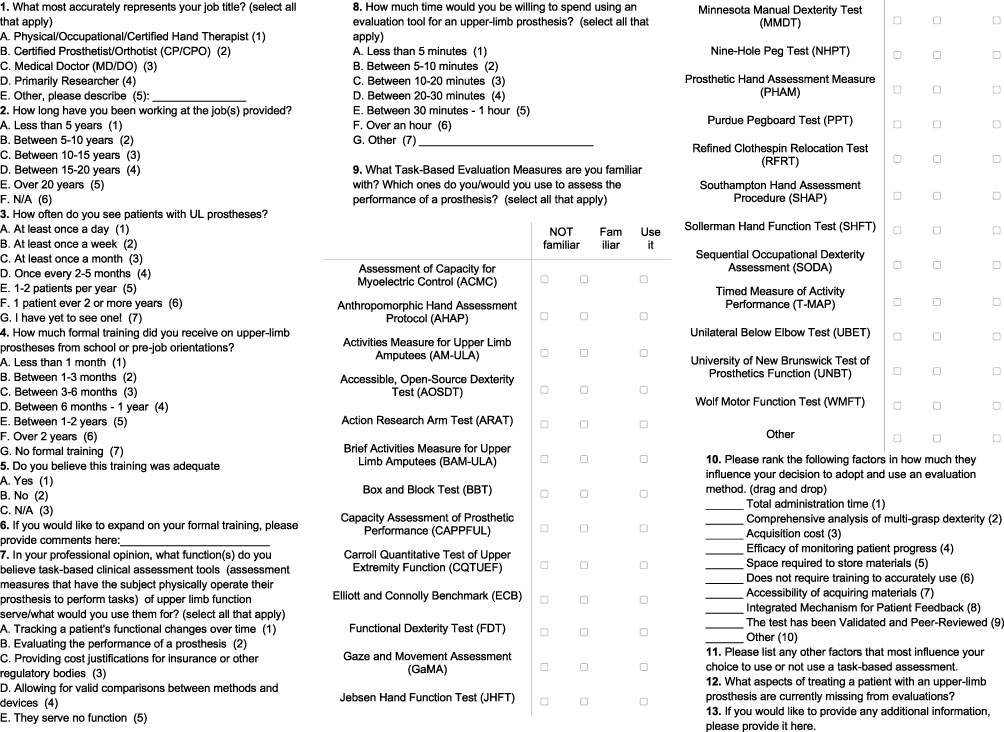 |
Figure 1 Questionnaire completed by respondents regarding their perspectives on upper-limb task assessments. |
Survey Design
The survey used was published in our prior pilot study21 that employed a small cohort of professionals (n=30) to establish its validity in detecting the diversity of needs represented across professional groups. The survey used in this work was administered online using Qualtrics and took approximately 15 minutes to complete. Fourteen questions were presented in a fixed order, and a sample survey can be found in Figure 1. The first question asked respondents to provide informed consent, after which they optionally provided contact information.
Three questions characterized each respondent’s professional background. Participants reported their job title, choosing from 1) Physical/Occupational/Certified Hand Therapist (PT/OT/CHT), 2) Certified Prosthetist/Orthotist (CP/CPO), 3) Medical Doctor (MD/DO), 4) Researcher, or 5) Other. They had the option to select multiple roles. Next, they indicated years of experience (<5, 5–10, 11–15, 16–20, or >20 years) and frequency of patient encounters with upper-limb prostheses (ranging from daily to never).
The survey then addressed training. Respondents reported the amount of formal training received, excluding work experience, and indicated whether they felt this training was adequate by answering “Yes”, “No” or “Not Applicable”. An open-response field invited elaboration on training experiences.
The core of the survey focused on familiarity with validated task-based measures of prosthetic function. The 25 assessments included in this study were selected based on a prior review by our group, in which 1442 articles were screened, and tests were included based on their scientific rigor, evaluation metrics, and psychometric properties.3 Please see Table 1 for the full list of tests.
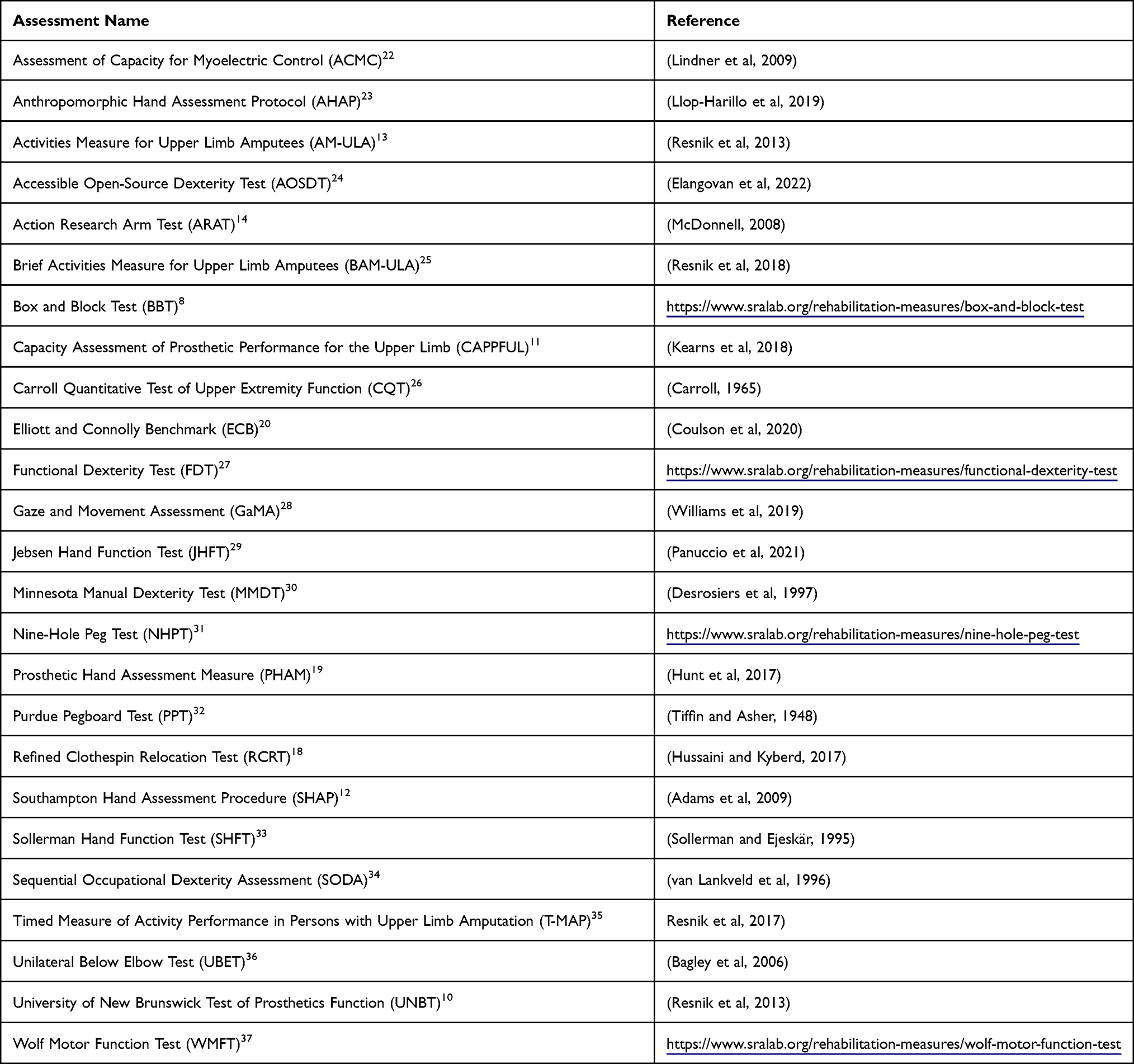 |
Table 1 List of Task-Based Assessments Used in the Survey with Associated References |
For each, participants selected whether they used the test, knew of it, or did not know it. When participants reported that they used a test, it was assumed they also knew the test. Finally, participants ranked the relative importance of ten attributes of task-based measures for upper-limb prosthetic assessment. Attributes were ranked against one another, such that lower scores indicated higher priority. The survey concluded with open-ended questions allowing respondents to provide additional details or highlight unaddressed considerations.
Data Analysis
Survey responses were analyzed using R (version 4.5.1). We first binned responses by profession and performed analyses separately for each profession. For test familiarity, we calculated both raw counts and percentages of respondents who reported knowing or using each test. We then computed an implementation ratio, defined as the number of respondents who reported using a test divided by those who reported knowing it. For attribute rankings, we calculated the median and interquartile range of each attribute within each profession. Rankings were summed, with lower scores indicating higher collective importance.
To evaluate differences in responses across professions, we first conducted non-parametric Kruskal–Wallis tests. When statistically significant differences were detected, pairwise Wilcoxon tests were applied to identify specific between-group effects. Multiple comparisons were corrected using False Discovery Rate (FDR) correction.
Results
Our goal was to assess profession differences in awareness, use, and desired attributes of upper-limb, prosthetic-control, task-based assessments. We observed that there were differences between professions when they were asked to rank attributes of a test they most value. Notably, researchers indicated they value comprehensive tests that may take longer to administer but can offer greater nuance in their results; whereas physical therapists, prosthetists, and medical professionals prefer tests with low administration time. Additionally, we found that certified prosthetists consistently placed greater value on administration time, and ranked the ability to track patient progress lower than did respondents from other professions.
Figure 2 provides a breakdown of the professional backgrounds of the respondents, showing the number of respondents by profession. We also present their median years of practice, patient interaction rate, and formal training. Finally, we report whether respondents in each group felt that their training in upper-limb prosthetic assessment was adequate.
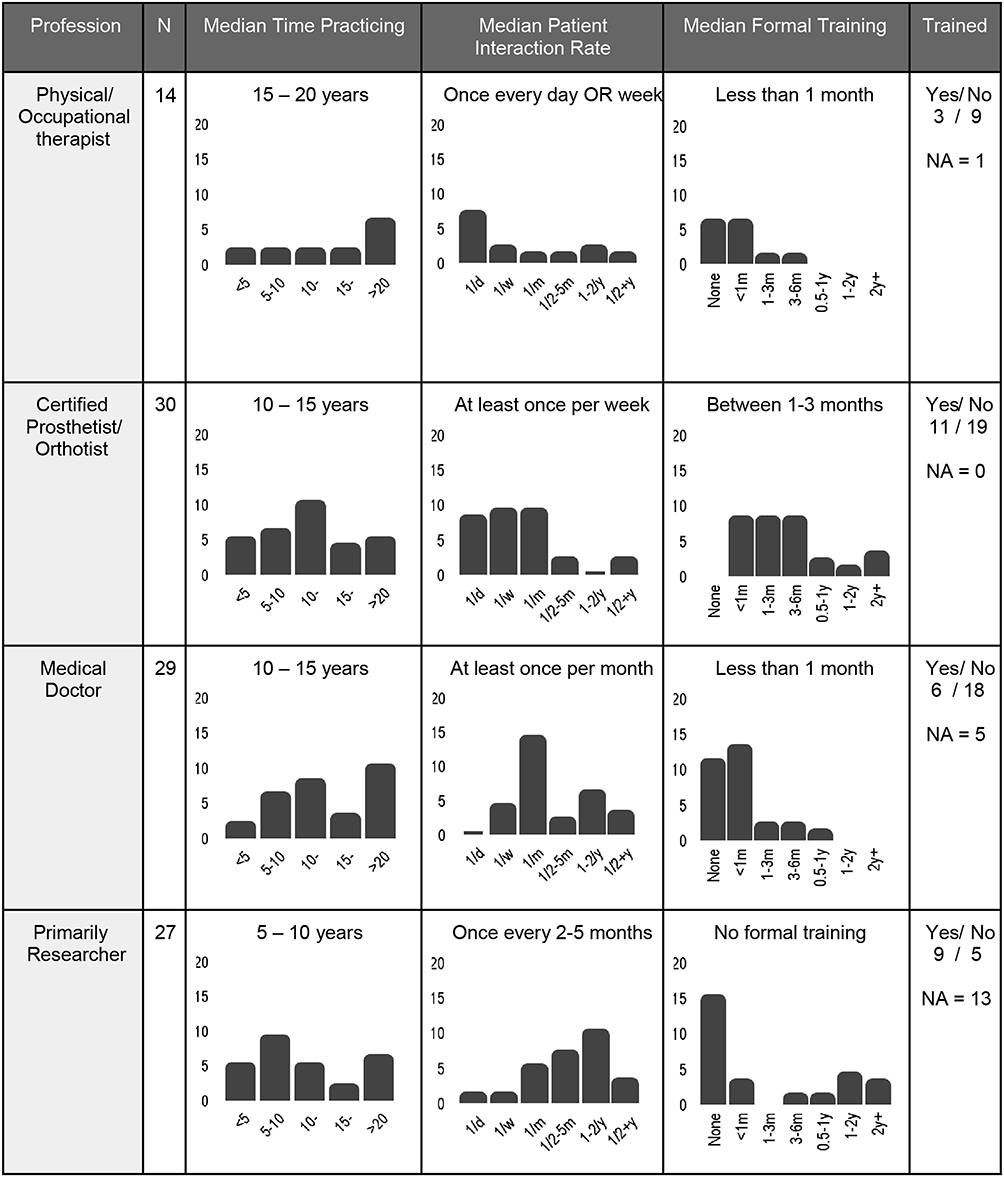 |
Figure 2 Breakdown of survey respondents by profession and experience. |
In our cohort, there were fewer physical/occupational therapists (n = 14) than prosthetists (n = 30), physicians (n = 29), or researchers (n = 27). The median time practicing for all respondents was over 10 years with researchers on the lower end (5–10 years) and physical and occupational therapists (PTs/OTs) on the higher end (15–20 years). Physical and occupational therapists also reported the most frequent patient interaction rate (often daily or weekly). Prosthetists (CPs) recorded that they saw patients with upper-limb amputation at least once per week while physicians (MDs) and researchers reported much longer times between patient interactions. The median time spent in formal training for assisting these patients was relatively consistent across most of the professions (median = less than 1 month), except for researchers (median = none). CPs reported receiving the most amount of training (median = 1–3 months) while researchers noted no training at all. Finally, respondents were asked if their formal training was adequate in their opinion, with all groups having a modal response rate of no, other than researchers (mode = yes).
Figure 3 summarizes both the most commonly used upper-limb prosthetic tests and the attributes considered most important when selecting a test across professions. The last column reports the top two upper-limb prosthetic tests for each profession. The percentage of respondents that used a test in each profession is shown alongside the tests. Some tests were tied based on the number of responses, which is marked with an asterisk (*) on the table. The Box and Block Test (BBT) appears to be the most used test among all professionals, with the exception of researchers, most of whom responded with the Refined Clothespin Relocation Test (RCRT). CPs rated the RCRT as their second choice, indicating overlap between the tests that are preferred by researchers and CPs. MDs and PT/OTs also showed alignment in their top choices, with NHPT and JHFT (both of which focus on speed of motor function) showing up in both groups. Figure 3 also summarizes the attributes considered most important when selecting an upper-limb prosthetic test. One such attribute, “total administration time”, reflects respondents’ preferred duration for completing a test, and it consistently ranked highly. For brevity, we only report the top three attributes in each profession. Aggregate attribute ranks were determined by summing the individual respondent rankings for each attribute and placing them in ascending order. Thus, it was possible for an attribute to be ranked first as long as it had been consistently ranked high, even if no respondents selected it as the single most important factor.
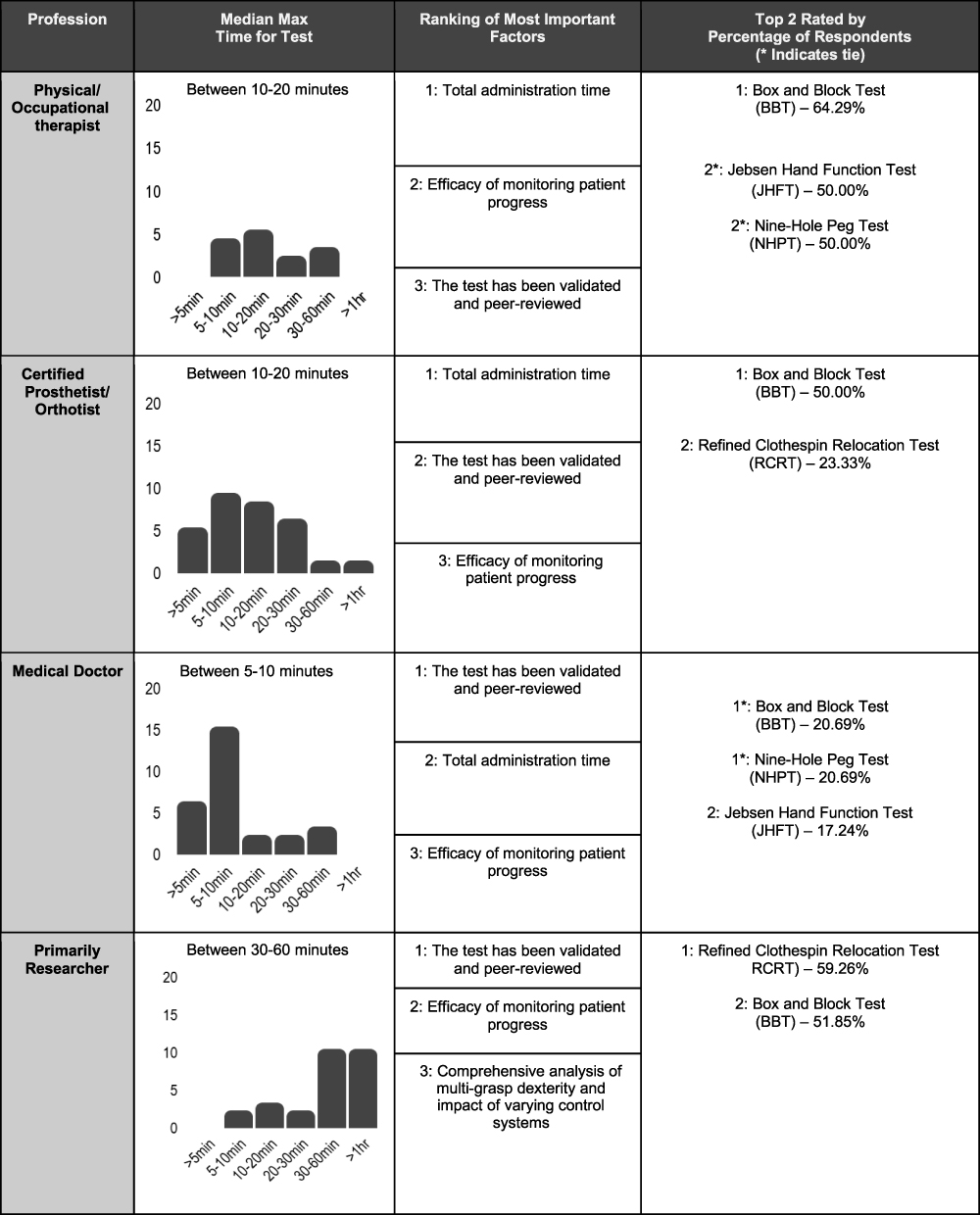 |
Figure 3 Profession-specific preferences for upper-limb prosthetic assessments, including median test duration, highest-ranked assessment attributes, and most frequently used assessments. Asterisks (*) denote ties. |
For all professions, except researchers, total administration time was ranked amongst the most important attributes. The maximum time reported by clinical practitioners for administering a test was low: 5–10 minutes for physicians; 10–20 minutes for CPs and PT/OTs. Researchers, on the other hand, indicated that they preferred to go over 30 minutes per test if it meant that it was validated, comprehensive, and monitored patient progress effectively.
Below, we present a more in-depth summary and an analysis of question ten - “Out of the 25 Task based evaluation measures below, which are you familiar with? Which have you used?” - in the survey, focusing on the awareness among practitioners in each profession, of the 25 selected upper-limb assessment tests. We examine differences between professions, and identify which tests are the most and least widely known.
As shown in Figure 4C, the tests that ranked as best-known across all professions were the BBT (n = 87), RCRT (n = 49), and ACMC (n = 40). Figure 4A shows the breakdown of the tests by profession, while Figure 4B shows the professions for which awareness of specific tests varies. Physicians indicated greatest familiarity with the BBT and NHPT (both at 79% of profession awareness), while prosthetists reported highest awareness for BBT (90%) and less so of other tests (with RCRT at the next highest awareness of 60%). Physical/occupational therapists and researchers noted high familiarity with a greater number of tests (5 tests over 75% awareness for physical therapists and 3 tests over 75% awareness for researchers).
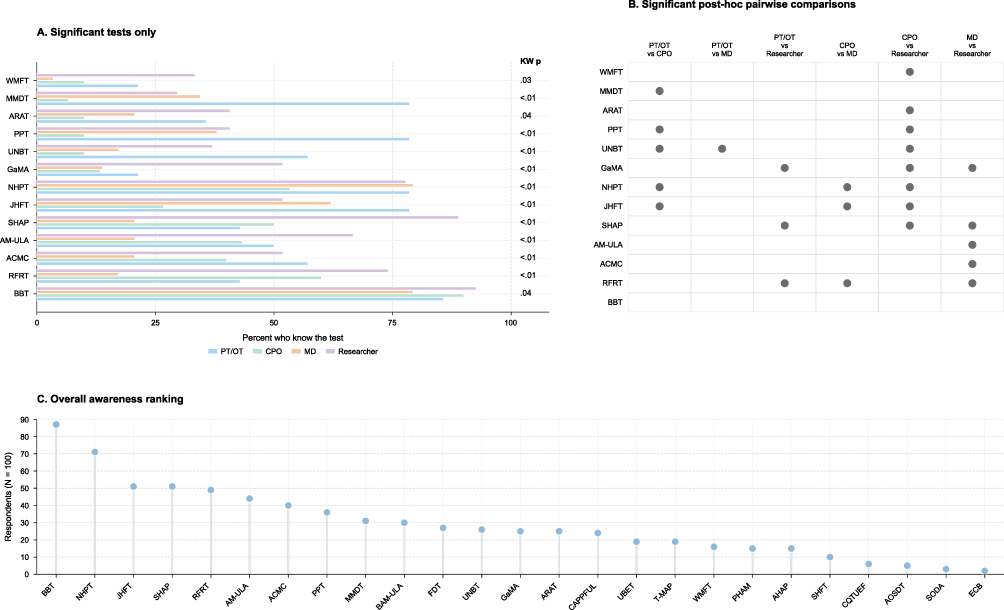 |
Figure 4 Awareness of upper-limb prosthetic assessments across professions. (A) Percentage of respondents in each profession who reported knowing about the assessments, for which significant differences across professions were seen. Corresponding Kruskal–Wallis p-values are shown on the right. (B) Significant post-hoc pairwise comparisons between professions; filled circles indicate statistically significant differences (p < 0.05 after correction for multiple comparisons). (C) Assessments ranked from most to least known across all respondents (N = 100). Counts are numerically equivalent to percentages because the total sample size was 100. |
Specifically, researchers reported significantly more awareness of the SHAP and GaMA tests as compared to all other professions (physical therapists GaMA, p = 0.0147; GaMA and SHAP with all other professions, p < 0.01). Physicians reported less awareness with AM-ULA, SHAP, RCRT and ACMC compared to researchers (p < 0.01 for all tests) and RCRT with CPs (p < 0.01). Prosthetists indicated significantly less awareness of the JHFT than all other professions (physical therapists, p < 0.01; physicians, p = 0.0456; researchers, p = 0.018), less awareness with PPT compared to physical therapists and physicians (physical therapists, p < 0.01; physicians, p = 0.0275), and less familiarity with MMDT compared to physical therapists (p < 0.01). Physical therapists indicated more awareness of UNBT compared to prosthetists and physicians, as researchers had greater awareness of UNBT than physicians (physical therapists and prosthetists, p = 0.026; physical therapists and physicians p = 0.025; researchers and prosthetists, p = 0.033).
We next examined test usage within each profession as shown in Figure 5. Using the same format, we present which tests are used in each profession, how usage differs across professions, and which tests are most widely used overall.
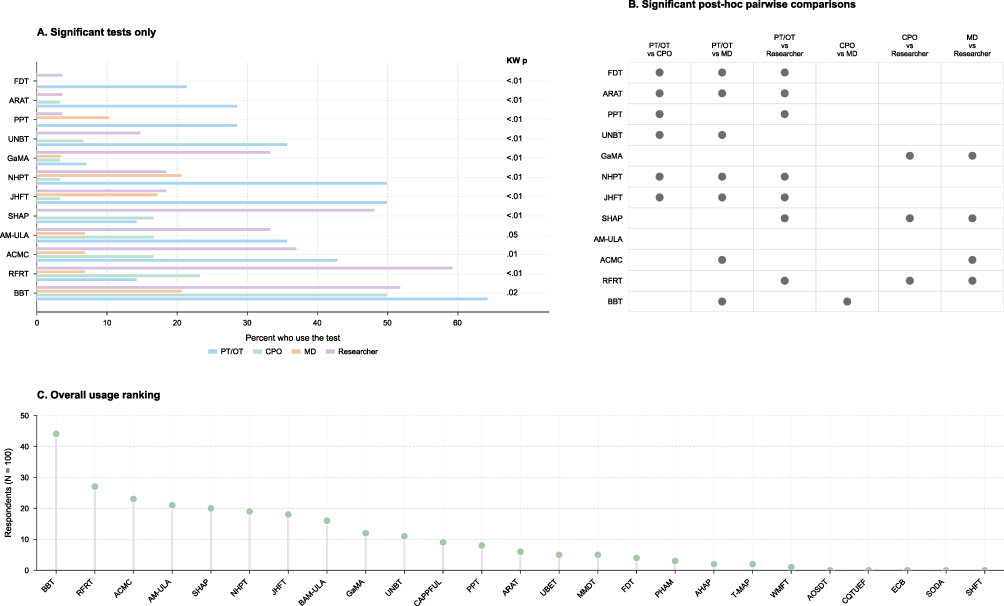 |
Figure 5 Use of upper-limb prosthetic assessments across professions. (A) Percentage of respondents in each profession who reported using the assessments, for which significant differences across professions were seen. Corresponding Kruskal–Wallis p-values are shown on the right. (B) Significant post-hoc pairwise comparisons between professions; filled circles indicate statistically significant differences (p < 0.05 after correction for multiple comparisons). AM-ULA showed a significant Kruskal–Wallis test result, but no significant post-hoc pairwise comparison was identified. (C) Assessments ranked from most to least used across all respondents (N = 100). Counts are numerically equivalent to percentages because the total sample size was 100. |
Prominent differences emerged across professions. Physicians reported less use of ACMC compared to physical therapists (p = 0.027), and researchers (p = 0.046). Physicians also indicated using the Box and Block Test significantly less than other professions (physical therapists, p = 0.043; prosthetists, p = 0.048), marginally excluding researchers (p = 0.0585). In contrast, prosthetists heavily use the Box and Block Test (50% of profession) and noted limited use of other assessments (with only 23% of prosthetists using RCRT, reported as the second most used test in their profession). Researchers reported using RCRT and SHAP significantly more than other professions (p < 0.01 for all). Physical/occupational therapists appeared to use the ARAT test significantly more than the other professions (SHAP for researchers and physical therapists, p = 0.021; for all other combinations, p < 0.01). Researchers also reported using GaMA more than prosthetists (p < 0.01), and physicians (p < 0.01). Physical therapists reported using ARAT, FDT, JHFT, and NHPT significantly more than all other professions (ARAT all, p < 0.01; FDT all, p < 0.01; JHFT with prosthetists, p < 0.01; JHFT with physicians, p = 0.0274; JHFT with researchers, p = 0.0266; NHPT with prosthetists, p < 0.01; NHPT with physicians, p = 0.044; NHPT with researchers, p = 0.046). Physical therapists also had significantly greater reported use of UNBT compared to prosthetists (p = 0.013), and physicians (p < 0.01), along with greater use of PPT compared with prosthetists (p <0.01) and researchers (p = 0.0169). Among all the professions, physicians reported the lowest usage of tests as researchers had the highest (sum of total test usage by physicians = 34 (eg, physician 1 uses 4 tests, physician 2 uses 1 test, etc., summed), sum of total test usage by physical therapists = 63, sum of total test usage by prosthetists = 53, sum of total test usage by researchers = 106).
Figure 6 shows graphically how awareness and usage of each test was related across professions. Differences emerged in this relationship, with physicians appearing to rely on the least number of tests relative to the ones they were aware of. To quantify how test usage was related to how well it was known across groups, we calculated an implementation ratio: the proportion of people in a profession who used a test relative to those who know it.
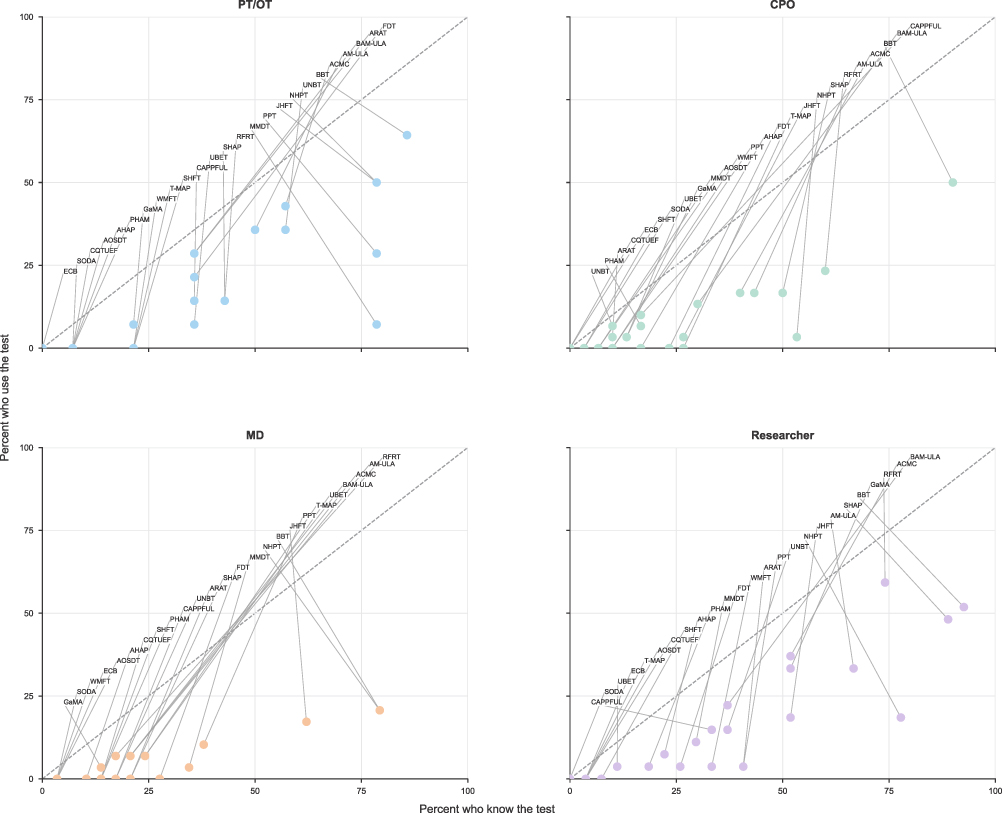 |
Figure 6 Relationship between test awareness and use across professions. Each point represents an upper-limb prosthetic assessment labeled by its acronym. The x-axis shows the percentage of respondents familiar with a test, while the y-axis shows the percentage who reported using it. Panels show results separately for PT/OTs, certified prosthetists and orthotists (CPOs), physicians (MDs), and researchers. The dashed unity line indicates equal awareness and use; points farther below the line represent tests that are known by more respondents than use them, ie, with lower implementation ratios. |
The Kruskal–Wallis test revealed a statistically significant overall difference in implementation ratios across professions (p = 0.04). However, post-hoc Wilcoxon analysis, with Benjamini-Hochberg correction, did not yield statistically significant differences between groups. Trends nevertheless emerged: physicians reported implementing the fewest tests (n = 12), with a high of 40% implementation for the RCRT test. This contrasted with physical/occupational therapists (n = 16) and researchers (n = 19), who indicated tests reaching 80% implementation rates (RCRT, BAM-ULA, and ARAT). Prosthetists reported implementation rates between these two extremes (n = 14), with their peak implementation of the UNBT at 67%. Both researchers and physicians reported peak implementation rates with the RCRT. Physical/occupational therapists indicated nine tests with implementation ratios over 50% (ARAT, BAM-ULA, BBT, ACMC, JHFT, NHPT, UNBT, and FDT). Researchers followed with seven tests over 50% implementation (RCRT, BAM-ULA, ACMC, BBT, SHAP, GaMA, AM-ULA). Prosthetists reported three tests with above 50% implementation (UNBT, CAPPFUL, BBT), and physicians reported none.
To understand the preferences for tests that different professions have, we next inspected the attributes that each profession values most. We aggregated the respondents’ rankings of pre-selected test attributes within each profession and assessed their differences. Across all professions, total administration time ranked the highest in terms of importance for upper-limb performance tests. Figure 7 shows where differences across professions were seen. Researchers assigned total administration time less importance, placing it fourth on average, but this difference was not statistically significant when compared with other professions (p = 0.17). Test validity was unanimously agreed upon as the second most important attribute. Tracking patient progress (high retest reliability) ranked third across professions but was ranked lower by prosthetists than by researchers and physical/occupational therapists (p = 0.014 and 0.020 respectively). Comprehensive analysis ranked fourth across professions, but researchers ranked it of higher importance relative to the other groups (p = 0.02 with physicians; and p = 0.01 with prosthetists), excluding physical therapists (p = 0.062).
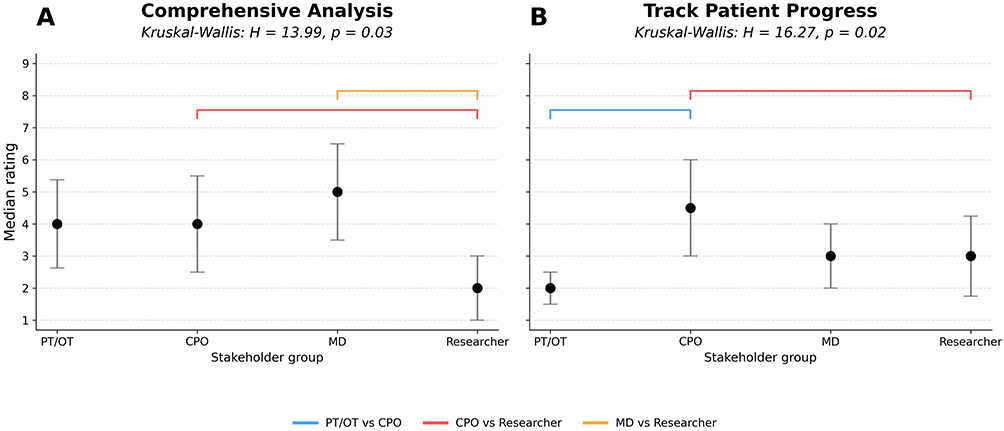 |
Figure 7 Profession-specific differences in the perceived importance of assessment attributes. Median rankings and interquartile ranges are shown for the two attributes that differed significantly across professions. (A) Comprehensive analysis. (B) Ability to track patient progress. Lower rankings indicate greater perceived importance. Above each panel, H-statistics, and p-values from Kruskal–Wallis analyses are reported per attribute. Brackets indicate significant post-hoc comparisons (p < 0.05). |
Within-profession analyses allowed us to find strong divisions in importance (shown in the Appendix). Researchers indicated prioritizing test validity, rigor, ability to track patient progress, and total administration time, while reporting significantly less emphasis on acquisition cost, storage space, training requirement, access to materials, and patient feedback. Physical and occupational therapists reported prioritizing total administration time, comprehensive analysis, efficacy of monitoring patient progress, and test validity significantly more than they did acquisition cost, storage space, training requirement, material accessibility, and patient feedback integration. Physicians grouped attributes into three categories reporting valuing administration time, efficacy of monitoring patient progress, and test validity most heavily. Comprehensive analysis and acquisition costs were assigned ranks of medium importance, and patient feedback, material accessibility, training requirement, and storage space were reported as having the lowest value. Finally, prosthetists did not indicate mechanisms for patient feedback, material accessibility, storage space, and acquisition costs as highly important. Total administration time was reported to be of greatest importance to them; monitoring patient progress and test validity were not indicated to be as important but still of high value. Comprehensive analysis and training requirements were reported to be of medium importance. Thus, clear distinctions between what professionals report to value were observed.
Discussion
Task-based assessments are widely used to evaluate upper-limb prosthesis function and dexterity by physicians, occupational and physical therapists, prosthetists, and researchers who engage with upper-limb prosthesis users. However, their individual professional perspectives on the assessments have not been thoroughly explored. Here, we report results from a cross-professional survey assessing preferences, usage, and preferred features of task-based assessments of prosthetic function.
Our findings highlight both commonalities and divergences in test selection, driven by profession-specific priorities such as time constraints, comprehensiveness, and logistical considerations. The Box and Block Test (BBT) emerged as the most widely familiar and used test across professions. However, secondary preferences diverged. Occupational and physical therapists favored dexterity-focused measures such as the Nine-Hole Peg Test (NHPT) and Jebsen Hand Function Test (JHFT) with low administration times, which align with their need to efficiently evaluate functional progress during time-limited patient visits. They also utilized a larger variety of tests. Prosthetists indicated reliance on fewer tests, mostly the BBT, and at times RCRT. Researchers gravitated toward more comprehensive tests (like SHAP, GaMA and RCRT), ie, tests encompassing multiple aspects of prosthetic function and providing a detailed and informative picture of user performance. The popularity of BBT across clinicians is consistent with its short administration time, which aligns directly with the highest-ranked attribute among PT/OTs, CPs, and physicians. In contrast, researchers’ preference for the RCRT reflects diverging priorities of balancing time with comprehensiveness.
Across professions, there was consensus that short administration time, validity, and the ability to monitor progress are critical. Where groups diverged was in their tolerance for time. PT/OTs, CPs, and MDs reported favoring tests under 20 minutes, while researchers suggested they were willing to use tests of 30–60 minutes if they offered comprehensiveness. As we report, physicians indicated having the least time for test administration (median time between 5 and 10 minutes). Physicians’ relatively lower familiarity with and use of some tests may reflect such time constraints, wherein they have fewer opportunities to gain experience with certain tests. It is also possible that their assessments rely more on self-reports and clinical observations, and that the nature of their clinical interactions has less need for task-based assessments. Prosthetists also placed more importance on administration time than on other considerations, with comparatively less emphasis on tracking progress relative to PT/OTs and researchers. Patient feedback, storage space for the equipment, and training requirements were consistently rated as low priority across all groups.
Our study’s analysis of implementation scores further highlights these role-specific priorities and the tradeoffs involved. Tests that assess multi-grasp function in detail were not always widely used, likely because they come at the cost of administration time, along with possible barriers such as need for specialized equipment or poor integration into clinical workflows. Conversely, some of the tests with lowest administration time may lack sensitivity or comprehensiveness. Crucially, our findings suggest that test familiarity alone does not determine usage; practical considerations remain a decisive factor in real-world implementation. For example, we found that physical and occupational therapists implemented the widest array of tests (nine tests with implementation scores of at least 50%), which is consistent with the high value they placed on the ability to track patient progress. While most physicians cite higher familiarity with the BBT and NHPT, they utilize several of them in practice but with lower implementation rates than PTs/OTs. Their use of BBT and RCRT fits with the attributes they report to value most: low administration time and validity. While the BBT is useful for measuring patient progress simply and flexibly, it is not designed to evaluate in detail various aspects of prosthesis function,38 (eg, multi-grasp functionality or bimanual symmetry), and tests such as the SHAP and GaMA, which may offer a more detailed assessment, may be less used in clinics due to their lengthier administration times or need for specialized equipment. Thus, there are tradeoffs between comprehensiveness, administration time, and tracking patient progress, and practitioners’ selection of tests rests on balancing them.
To understand whether differences in preferences were driven by differences in knowledge or other factors, we asked about both familiarity and usage. While test familiarity varied across professions, our implementation scores revealed that not all known tests were used. Some assessments, such as the SODA, AOSD, ECBT, and SHFT, were both suggested to be unfamiliar and largely unused. Though it is hard to say why these tests are less frequently implemented, it could be due to the time-consuming nature of some tests (eg, SHFT, WMFT) or the need for further validation (eg, ECBT).3
Researchers and clinicians alike have long cited the lack of standardization as a major obstacle in prosthetic outcome measurement.1,39,40 There is no clear, universally accepted “best” upper-limb assessment;4,41 different tests are designed for specific populations, and measure varying aspects of prosthetic use and control, e.g dexterity measures, functional outcomes, speed, spontaneity, or force etc. Importantly, the task-based assessments considered in this study are not directly interchangeable, as they prioritize different aspects of prosthesis function. For example, some tests, such as the Box and Block Test (BBT), primarily assess gross manual dexterity and grasping speed and are largely agnostic to the way in which a device is controlled. In contrast, other assessments, such as the AM-ULA and similar measures, place greater emphasis on the ability to operate the device and perform more complex, coordinated tasks. As a result, these tests do not provide equivalent information, but rather capture distinct dimensions of prosthetic function. This distinction is important when interpreting test selection, as different professionals may prioritize different aspects depending on their goals and context.
The lack of a common testing framework for upper limb prosthetics makes it difficult to track patient progress and compare outcomes across individuals, clinics, and devices.42 Clinicians need to evaluate the effectiveness of interventions and rehabilitation, but participants indicated assessments that may be more responsive to small changes in functional outcomes are used less often in the clinic, largely due to time constraints.41,43 One study compared outcome measures in the context of a structured rehabilitation protocol and found that test scores varied in their sensitivity to change.44 They found that tests did not perform equally in capturing improvement even after hours of targeted occupational therapy,44 highlighting that our ability to monitor meaningful progress, and thereby improve quality of care provided to persons with limb loss, may be influenced by the choice of assessment. Others have emphasized the need for a shared interpretive framework, one that incorporates metrics like minimal detectable change or just-noticeable differences, to improve the utility and comparability of different assessments across settings.5
Our findings add to this picture by surveying professionals from multiple disciplines in a single study and examining how their training and constraints in their daily practice shape their approach to prosthesis evaluation. Our previous effort with a smaller sample size suggested that competing priorities can influence test selection.21 This work confirms that this is the case: different professionals’ perspectives inform their usage of upper-limb tests. Researchers tend to seek comprehensive, standardized outcome measures capable of capturing prosthetic function, including multi-grasp dexterity and control strategies; clinicians appear to prioritize tools that balance efficiency with validity and progress monitoring to inform care decisions; prosthetists consider factors affecting prosthesis acceptance and long-term use.45
An additional finding of interest was the difference between reported levels of formal training and satisfaction with training across professional groups. Researchers reported lower levels of formal training but higher satisfaction, whereas clinicians reported the opposite pattern. This likely reflects differences in training pathways across domains. In research settings, training is often acquired through hands-on experience, mentorship, and research-based work rather than structured coursework, which may not be perceived as “formal” training. In contrast, clinicians are more likely to receive structured, curriculum-based instruction, which may be recognized as more “formal” in its delivery. These differences suggest that the mechanisms by which training occurs in different domains may affect how individuals evaluate and perceive their preparedness to execute the variety of different demands experienced in their unique positions.
The survey results also relate to the upper-extremity dilemma,46 where upper-extremity patients require specialized care. However, practitioners have less time to develop experience caring for these patients, as they make up a small cohort and most patients with limb loss are lower-limb patients. Over half of our respondents judged their formal training in upper-limb prosthetic assessment to be insufficient. Some professionals, such as physicians, encounter upper-limb prosthesis users infrequently (on average, once a month), limiting their opportunity to become familiar with newer or more nuanced evaluation tools. As a result, even highly promising tests may be underutilized, and the adoption of new tools remains slow despite advances in prosthetic functionality. We suggest future work should seek to further understand how different tests relate to each other, how they overlap and how they relate to self-reports to help practitioners measure outcomes in a more holistic manner for upper-limb prosthesis users.
A limitation of our study is that the sample of respondents was not random. Participant recruitment relied on professional networks, direct outreach, and attendance at the Myoelectric Control Symposium (MEC) in 2024. As a substantial portion of participants were recruited from MEC, the sample may be biased toward individuals with greater familiarity with myoelectric control and state-of-the-art evaluation approaches. As such, the results may not fully reflect the broader clinical population, but rather a highly engaged group with experience in both clinical and research-based assessment methods. Nonetheless, the survey includes responses from a broad and diverse cohort of occupational therapists, prosthetists, researchers, and physicians, making it an inclusive cross-professional effort. As this was a self-report survey, reported usage and attribute importance reflect subjective evaluations, which may not always match actual behavior in clinical or research practice. Lastly, in this study we did not directly assess which specific components of individual tests are most valued by different professionals (eg, grasp type, control, or spatial positioning of the hand). While we evaluated the importance of general test attributes, these serve only as a proxy and do not capture which nuanced aspects of assessments may drive selection and use.
Conclusion
Overall, our findings suggest the need for developing more standardized assessment frameworks and supporting efforts to reach consensus across professions (eg, through defining a classification system for tests that measure similar aspects of upper-limb use, or guidelines for test selection). The differences we observed in test attributes preferred across professional groups highlight the importance of a taxonomy which allows for selection of tests based on specific priorities or constraints. By organizing assessments around common functional domains or use cases, future work could improve consistency and communication in upper-limb prosthesis evaluation across clinical and research settings.
Data Sharing Statement
Anonymized survey data and analysis code supporting the findings of this study can be shared with researchers upon reasonable request to the corresponding author.
Acknowledgments
This work was supported by a 2024 University of California Noyce Initiative Research Award and 2024 UC Davis Next Lever Research Award. The authors would also like to thank Jedidiah Harwood for his statistical expertise. Finally, the authors would like to thank Peyton Young, Eden Winslow, Marcus Battraw, Matthew Siegel, and Erica Siegel for their support and general guidance.
Disclosure
The authors report that there are no conflicts of interest to declare for this work.
References
1. Biddiss EA, Chau TT. Upper limb prosthesis use and abandonment: a survey of the last 25 years. Prosthet Orthot Int. 2007;31(3):236–15. doi:10.1080/03093640600994581
2. Salminger S, Stino H, Pichler LH, et al. Current rates of prosthetic usage in upper-limb amputees - have innovations had an impact on device acceptance? Disabil Rehabil. 2022;44(14):3708–3713. doi:10.1080/09638288.2020.1866684
3. Siegel JR, Battraw MA, Winslow EJ, James MA, Joiner WM, Schofield JS. Review and critique of current testing protocols for upper-limb prostheses: a call for standardization amidst rapid technological advancements. Front Robot AI. 2023;10:1292632. doi:10.3389/frobt.2023.1292632
4. Burger H, Brezovar D, Marincek C. Comparison of clinical test and questionnaires for the evaluation of upper limb prosthetic use in children. Disabil Rehabil. 2004;26(14–15):911–916. doi:10.1080/09638280410001708931
5. Heinemann AW, Connelly L, Ehrlich-Jones L, Fatone S. Outcome instruments for prosthetics: clinical applications. Phys Med Rehabil Clin N Am. 2014;25(1):179–198. doi:10.1016/j.pmr.2013.09.002
6. Kalita AJ, Chanu MP, Kakoty NM, Vinjamuri RK, Borah S. Functional evaluation of a real-time EMG controlled prosthetic hand. Wearable Technol. 2025;6e18. doi:10.1017/wtc.2025.7
7. Cirelli G, Stefanelli E, Billardello R, et al. Context-aware semiautonomous control for upper-limb prostheses. Adv Intell Syst. 2026;8(4):e202501043. doi:10.1002/aisy.202501043
8. Box and Block Test | RehabMeasures Database. 2012. Available from: https://www.sralab.org/rehabilitation-measures/box-and-block-test.
9. Nine-Hole Peg Test | rehabMeasures database. 2022. Available from: https://www.sralab.org/rehabilitation-measures/nine-hole-peg-test.
10. Resnik L, Baxter K, Borgia M, Mathewson K. Is the UNB test reliable and valid for use with adults with upper limb amputation? J Hand Ther. 2013;26(4):353–359; quiz359. doi:10.1016/j.jht.2013.06.004
11. Kearns NT, Peterson JK, Smurr Walters L, Jackson WT, Miguelez JM, Ryan T. Development and psychometric validation of Capacity Assessment of Prosthetic Performance for the Upper Limb (CAPPFUL). Arch Phys Med Rehabil. 2018;99(9):1789–1797. doi:10.1016/j.apmr.2018.04.021
12. Adams J, Hodges K, Kujawa J, Metcalf C. Test-retest reliability of the southampton hand assessment procedure. Int J Rehabil Res. 2009;32:S18.
13. Resnik L, Adams L, Borgia M, et al. Development and evaluation of the activities measure for upper limb amputees. Arch Phys Med Rehabil. 2013;94(3):488–494.e4. doi:10.1016/j.apmr.2012.10.004
14. McDonnell M. Action research arm test. Aust J Physiother. 2008;54(3):220. doi:10.1016/s0004-9514(08)70034-5
15. van der Lee JH, Beckerman H, Lankhorst GJ, Bouter LM. The responsiveness of the action research arm test and the fugl-meyer assessment scale in chronic stroke patients. J Rehabil Med. 2001;33(3):110–113. doi:10.1080/165019701750165916
16. Chen HM, Chen CC, Hsueh IP, Huang SL, Hsieh CL. Test-retest reproducibility and smallest real difference of 5 hand function tests in patients with stroke. Neurorehabil Neural Repair. 2009;23(5):435–440. doi:10.1177/1545968308331146
17. Platz T, Pinkowski C, van Wijck F, Kim IH, Di Bella P, Johnson G. Reliability and validity of arm function assessment with standardized guidelines for the Fugl-Meyer Test, action research arm test and box and block test: a multicentre study. Clin Rehabil. 2005;19(4):404–411. doi:10.1191/0269215505cr832oa
18. Hussaini A, Kyberd P. Refined clothespin relocation test and assessment of motion. Prosthet Orthot Int. 2017;41(3):294–302. doi:10.1177/0309364616660250
19. Hunt C, Yerrabelli R, Clancy C, Osborn L, Kaliki R, Thakor N. PHAM: prosthetic hand assessment measure. Conf Proc Myoelec Controls Symp. 2017;221–224.
20. Coulson R, Li C, Majidi C, Pollard NS. The Elliott and connolly Benchmark: a test for evaluating the in-hand dexterity of robot hands. In:
21. Siegel J, Schofield J. Exploring the perspectives of different professions on task-based upper-limb prosthesis assessment techniques. Myoelectric Controls Symp. 2024. doi:10.57922/mec.2495
22. Lindner HYN, Linacre JM, Norling Hermansson LM. Assessment of capacity for myoelectric control: evaluation of construct and rating scale. J Rehabil Med. 2009;41(6):467–474. doi:10.2340/16501977-0361
23. Llop-Harillo I, Pérez-González A, Starke J, Asfour T. The Anthropomorphic Hand Assessment Protocol (AHAP). Rob Autom Syst. 2019;121:103259. doi:10.1016/j.robot.2019.103259
24. Elangovan N, Chang CM, Gao G, Liarokapis M. An accessible, open-source dexterity test: evaluating the grasping and dexterous manipulation capabilities of humans and robots. Front Robot AI. 2022;9:808154. doi:10.3389/frobt.2022.808154
25. Resnik L, Borgia M, Acluche F. Brief activity performance measure for upper limb amputees: BAM-ULA. Prosthet Orthot Int. 2018;42(1):75–83. doi:10.1177/0309364616684196
26. Carroll D. A quantitative test of upper extremity function. J Chronic Dis. 1965;18:479–491. doi:10.1016/0021-9681(65)90030-5
27. Functional Dexterity Test | rehabMeasures database. Available from: https://www.sralab.org/rehabilitation-measures/functional-dexterity-test.
28. Williams HE, Chapman CS, Pilarski PM, Vette AH, Hebert JS. Gaze and Movement Assessment (GaMA): inter-site validation of a visuomotor upper limb functional protocol. PLoS One. 2019;14(12):e0219333. doi:10.1371/journal.pone.0219333
29. Panuccio F, Galeoto G, Marquez MA, et al. Internal consistency and validity of the Italian version of the Jebsen-Taylor hand function test (JTHFT-IT) in people with tetraplegia. Spinal Cord. 2021;59(3):266–273. doi:10.1038/s41393-020-00602-4
30. Desrosiers J, Rochette A, Hébert R, Bravo G. The minnesota manual dexterity test: reliability, validity and reference values studies with healthy elderly people. Can J Occup Ther. 1997;64(5):270–276. doi:10.1177/000841749706400504
31. Nine-Hole Peg Test | rehabMeasures database. 2022. Available from: https://www.sralab.org/rehabilitation-measures/nine-hole-peg-test.
32. Tiffin J, Asher EJ. The Purdue pegboard; norms and studies of reliability and validity. J Appl Psychol. 1948;32(3):234–247. doi:10.1037/h0061266
33. Sollerman C, Ejeskär A. Sollerman hand function test. A standardised method and its use in tetraplegic patients. Scand J Plast Reconstr Surg Hand Surg. 1995;29(2):167–176. doi:10.3109/02844319509034334
34. van Lankveld W, Van’t Pad Bosch P, Bakker J, Terwindt S, Franssen M, van Riel P. Sequential occupational dexterity assessment (SODA): a new test to measure hand disability. J Hand Ther. 1996;9(1):27–32. doi:10.1016/S0894-1130(96)80008-1
35. Resnik L, Borgia M, Acluche F. Timed activity performance in persons with upper limb amputation: a preliminary study. J Hand Ther. 2017;30(4):468–476. doi:10.1016/j.jht.2017.03.008
36. Bagley AM, Molitor F, Wagner LV, Tomhave W, James MA. The Unilateral Below Elbow Test: a function test for children with unilateral congenital below elbow deficiency. Dev Med Child Neurol. 2006;48(7):569–575. doi:10.1017/S0012162206001204
37. Wolf Motor Function Test | RehabMeasures Database. 2016. Available from: https://www.sralab.org/rehabilitation-measures/wolf-motor-function-test.
38. Kontson K, Marcus I, Myklebust B, Civillico E. Targeted box and blocks test: normative data and comparison to standard tests. PLoS One. 2017;12(5):e0177965. doi:10.1371/journal.pone.0177965
39. Lindner HYN, Nätterlund BS, Hermansson LMN. Upper limb prosthetic outcome measures: review and content comparison based on International Classification of Functioning, Disability and Health. Prosthet Orthot Int. 2010;34(2):109–128. doi:10.3109/03093641003776976
40. Light CM, Chappell PH, Kyberd PJ. Establishing a standardized clinical assessment tool of pathologic and prosthetic hand function: normative data, reliability, and validity. Arch Phys Med Rehabil. 2002;83(6):776–783. doi:10.1053/apmr.2002.32737
41. Wright V. Prosthetic outcome measures for use with upper limb amputees: a systematic review of the peer-reviewed literature, 1970 to 2009. J Prosthet Orthot. 2009;21(9):P3. doi:10.1097/JPO.0b013e3181ae9637
42. Resnik L, Borgia M, Silver B, Cancio J. Systematic review of measures of impairment and activity limitation for persons with upper limb trauma and amputation. Arch Phys Med Rehabil. 2017;98(9):1863–1892.e14. doi:10.1016/j.apmr.2017.01.015
43. Blenkiron EL. Uptake of standardised hand assessments in rheumatology: why is it so low? Br J Occup Ther. 2005;68(4):148–157. doi:10.1177/030802260506800402
44. Resnik L, Borgia M. Responsiveness of outcome measures for upper limb prosthetic rehabilitation. Prosthet Orthot Int. 2016;40(1):96–108. doi:10.1177/0309364614554032
45. Young PR, Hebert JS, Marasco PD, Carey JP, Schofield JS. Advances in the measurement of prosthetic socket interface mechanics: a review of technology, techniques, and a 20-year update. Expert Rev Med Devices. 2023;20(9):729–739. doi:10.1080/17434440.2023.2244418
46. Lake C, Dodson R. Progressive upper limb prosthetics. Phys Med Rehabil Clin N Am. 2006;17(1):49–72. doi:10.1016/j.pmr.2005.10.004
 © 2026 The Author(s). This work is published and licensed by Dove Medical Press Limited. The
full terms of this license are available at https://www.dovepress.com/terms
and incorporate the Creative Commons Attribution
- Non Commercial (unported, 4.0) License.
By accessing the work you hereby accept the Terms. Non-commercial uses of the work are permitted
without any further permission from Dove Medical Press Limited, provided the work is properly
attributed. For permission for commercial use of this work, please see paragraphs 4.2 and 5 of our Terms.
© 2026 The Author(s). This work is published and licensed by Dove Medical Press Limited. The
full terms of this license are available at https://www.dovepress.com/terms
and incorporate the Creative Commons Attribution
- Non Commercial (unported, 4.0) License.
By accessing the work you hereby accept the Terms. Non-commercial uses of the work are permitted
without any further permission from Dove Medical Press Limited, provided the work is properly
attributed. For permission for commercial use of this work, please see paragraphs 4.2 and 5 of our Terms.
Recommended articles

Development and Validation of the Italian “Brief Five-Item Chronic Pain Questionnaire” for Epidemiological Studies
Toccaceli V, Tenti M, Stazi MA, Fagnani C, Medda E, Gargiulo L, Burgio A, Sampaolo L, Ferri M, Raffaeli W
Journal of Pain Research 2022, 15:1897-1913
Published Date: 8 July 2022
Patient Perceived Impact of Outpatient Group Substance Use Disorder Treatment in a Hybrid Model or Virtual-Only Model Relative to In-Person Delivery
Bormann NL, Stoppel CJ, Arndt S, Oesterle TS
Substance Abuse and Rehabilitation 2024, 15:223-232
Published Date: 25 October 2024