
Back to Journals » Journal of Hepatocellular Carcinoma » Volume 13
Efficacy and Safety of TACE-HAIC Combined with Molecular Targeted Therapy and Immune Checkpoint Inhibitors for Unresectable Hepatocellular Carcinoma
Authors Feng Z  , Wang X , Xu J, Chen S , Hao M , Hu H, Qiu S, Liao Y, Yu W , Fang Z
Received 16 December 2025
Accepted for publication 28 March 2026
Published 22 May 2026 Volume 2026:13 588860
DOI https://doi.org/10.2147/JHC.S588860
Checked for plagiarism Yes
Review by Single anonymous peer review
Peer reviewer comments 2
Editor who approved publication: Prof. Dr. Imam Waked
Zhipeng Feng,1,2,* Xiaolong Wang,1,* Junming Xu,1 Shiguang Chen,1 Mingzhi Hao,1 Hong Hu,2 Shixiang Qiu,2 Yunguo Liao,2 Wenchang Yu,1 Zhuting Fang1,3
1Department of Oncology and Vascular Interventional Therapy, Clinical Oncology School of Fujian Medical University, Fujan Cancer Hospital, NHC Key Laboratory of Cancer Metabolism, Fuzhou, 350001, People’s Republic of China; 2Department of Interventional Medicine, Beijing Anzhen Nanchong Hospital, Capital Medical University & Nanchong Central Hospital, Nanchong, 637000, People’s Republic of China; 3Department of Vascular and Oncology Intervention, Shengli Clinical Medical College of Fujian Medical University, Fujian Provincial Hospital, Fuzhou University Affiliated Provincial Hospital, Fuzhou, 350001, People’s Republic of China
*These authors contributed equally to this work
Correspondence: Zhuting Fang, Department of Oncology and Vascular Interventional Therapy, Clinical Oncology School of Fujian Medical University, Fujan Cancer Hospital, NHC Key Laboratory of Cancer Metabolism, Fuzhou, 350001, People’s Republic of China, Email [email protected] Wenchang Yu, Department of Oncology and Vascular Interventional Therapy, Clinical Oncology School of Fujian Medical University, Fujan Cancer Hospital, NHC Key Laboratory of Cancer Metabolism, Fuzhou, 350001, People’s Republic of China, Email [email protected]
Purpose: To evaluate the efficacy and safety of a quadruple regimen of transarterial chemoembolization (TACE)-hepatic arterial infusion chemotherapy (HAIC) plus molecular targeted therapy (MTT) and immune checkpoint inhibitors (ICIs) for unresectable hepatocellular carcinoma (uHCC).
Patients and Methods: 274 uHCC patients were divided into two groups based on two treatment methods:TACE-HAIC combined with MTT and ICIs (THTI) and TACE combined with MTT and ICIs (TTI). The primary endpoints were progression-free survival (PFS) and overall survival (OS). The secondary endpoints included the objective response rate (ORR), disease control rate (DCR), and treatment-related adverse events (TRAEs).
Results: After Propensity score matching (PSM), the THTI group significantly prolonged median PFS (14.0 vs 10.6 months, P< 0.001) and median OS (30.8 vs 24.8 months, P = 0.001) compared with the TTI group. Compared with the TTI group, the THTI group demonstrated significantly superior ORR (64.5% vs 44.9%, P=0.004) and DCR (94.4% vs 84.1%, P=0.015). In addition, responses to THTI (THTI-R) had superior median PFS (17.1 vs 13.8 months, P = 0.007) and median OS (38.1 vs 27.5 months, P = 0.002) versus responses to TTI (TTI-R). All adverse events were manageable in two groups.
Conclusion: For patients with uHCC, the THTI quadruple therapy demonstrated a superior clinical benefit over current TTI triple therapy, including significant prolongation of both PFS and OS, as well as improvements in ORR and DCR, with a manageable safety profile.
Keywords: hepatocellular carcinoma, transarterial chemoembolization, hepatic arterial infusion chemotherapy, molecular targeted therapy, immune checkpoint inhibitors
Introduction
As the third leading cause of cancer-related mortality worldwide, hepatocellular carcinoma (HCC) is often diagnosed at intermediate or advanced stages, rendering most patients ineligible for curative treatment.1 Recent guideline and research on the management of unresectable hepatocellular carcinoma (uHCC) show that locoregional therapies, such as transarterial chemoembolization (TACE), hepatic arterial infusion chemotherapy (HAIC), ablation, and radiotherapy, play a key role.2,3 At the same time, current guideline and clinical studies have demonstrated significant progress in systemic therapy for uHCC, especially with the combination of molecular targeted therapy (MTT) and immune checkpoint inhibitors (ICIs).4–6 TACE achieves local tumor control through selective arterial embolization, which induces tumor necrosis. However, this approach can trigger compensatory responses, including the development of collateral tumor vessels and up-regulation of hypoxia-inducible factor 1-alpha (HIF-1α). This promotes abnormal angiogenesis and fosters an immunosuppressive tumor microenvironment, ultimately contributing to disease progression and resistance to TACE.7,8
In recent years, the integration of TACE with systemic therapies has become increasingly recognized and utilized in the management of intermediate and advanced uHCC.9 A meta-analysis has demonstrated that the combination of TACE/HAIC with targeted therapy and immunotherapy significantly improves survival outcomes and tumor response compared with targeted therapy combined with immunotherapy alone, with a manageable safety profile.10 Several studies have shown that TACE combined with molecular targeted therapy and immune checkpoint inhibitors is superior to TACE alone in terms of PFS. However, the LEAP-012 trial did not show a statistically significant OS benefit, and EMERALD-1 study has not published mature OS results yet.11–13 Although the triple combination therapy has achieved significant breakthroughs over TACE alone for intermediate and advanced hepatocellular carcinoma, it still has limitations. Its efficacy is often diminished in cases involving massive tumors, portal vein tumor thrombus (PVTT), or multifocal intrahepatic lesions.
HAIC is a key locoregional therapy for HCC, providing long-lasting, high-concentration chemotherapy through intra-arterial infusion to improve antitumor effects.14,15 And in high burden HCC, combination therapy including HAIC leads to better therapeutic effects.16,17 Whether adding HAIC to the current triple regimen therapy of TACE combined with MTT and ICIs (TTI) confers additional clinical benefit in uHCC remains unclear. To address this, we performed a two-center retrospective cohort study comparing the efficacy and safety of a quadruple regimen therapy of TACE-HAIC combined with MTT and ICIs (THTI) versus the TTI triple regimen, aiming to provide evidence for optimizing treatment strategies in this population.
Materials and Methods
Study Design and Patient Selection
We conducted a retrospective, two-center cohort study of consecutive patients with unresectable hepatocellular carcinoma treated at the School of Clinical Oncology of Fujian Medical University and Nanchong Central Hospital from September 2019 to August 2024. Patients were assigned to either the THTI group, defined as those who received TACE-HAIC plus MTT and ICIs, or the TTI group, defined as those who received TACE-HAIC plus MTT and ICIs. Propensity score matching (PSM) with 1:1 ratio was done to balance baseline factors and form comparable cohorts. The Independent Ethics Committee of the Clinical Oncology School of Fujian Medical University, Fujian Cancer Hospital (No. K2026-168-01) approved this retrospective study, as did the Ethics Committee of Beijing Anzhen Nanchong Hospital, Capital Medical University & Nanchong Central Hospital (No. 2025–207). Informed consent was waived because the study is retrospective. Inclusion criteria were: (1) conclusion criteria were: (1) histopathologically confirmed HCC or diagnosis according to clinical guidelines2˒4; (2) determined unresectable by multidisciplinary team (MDT) due to high tumor burden, insufficient future liver remnant, or distant metastasis; (3) Barcelona Clinic Liver Cancer (BCLC) stages B or C; (4) Child-Pugh class A or B; (5) Eastern Cooperative Oncology Group (ECOG) performance status 0 or 1; and (6) with at least one measurable intrahepatic lesion as defined by the modified Response Evaluation Criteria in Solid Tumors (mRECIST). Exclusion criteria were: (1) contraindication to TACE or HAIC procedure; (2) a history of other active malignancy; (3) severe cardiac, pulmonary, renal, or hepatic dysfunction; (4) Child-Pugh class C or ECOG PS >1; (5) incomplete follow-up data.
Treatment Protocols
TACE procedure was performed using the Seldinger technique to puncture and catheterize the femoral artery. Superselective catheterisation of the tumor feeding artery (ies) and chemotherapeutic agents (epirubicin 30mg/oxaliplatin 50mg) infusion. Embolization with 10–20mg epirubicin and 5–20mL of lipiodol. If required, it will be supplemented with gelatin sponge particles and/or embolic microsphere.
HAIC procedure: A microcatheter was inserted into the primary tumor feeding artery after TACE to administer FOLFOX (oxaliplatin 85 mg/m2 over 2–3 hours, calcium folinate 400 mg/m2 over 2 hours, fluorouracil 400 mg/m2 bolus and 2400 mg/m2 continuous infusion over 46 hours) or RALOX (oxaliplatin 100 mg/m2 + raltitrexed 3 mg/m2 over 5–6 hours). Repeated TACE-HAIC or TACE were performed at intervals of 3–4 weeks.
For molecular targeted therapy, continuous oral medication was administered at the following doses: Continuous oral medication is used, the corresponding drug doses are: lenvatinib (8mg qd, when body weight≤60kg or 12mg qd, when body weight >60kg), apatinib (0.25g qd), donafenib (0.2g bid), sorafenib (0.4g bid), bevacizumab or bevacizumab analogs (15 mg/kg, once every 3 weeks intravenously). ICIs were intravenously administered as follows: 200 mg of tislelizumab, 200 mg of camrelizumab, 200 mg of sintilimab,1200mg of atezolizumab, or 200mg of pembrolizumab, every three to four weeks.
Outcomes Assessment
The primary endpoints of this study were progression-free survival (PFS) and overall survival (OS). Secondary endpoints consisted of objective response rate (ORR), disease control rate (DCR), and treatment-related adverse events (TRAEs). PFS and OS were defined as the time from treatment initiation to disease progression or death, and to death from any cause, respectively. Adverse events were documented and assessed according to the Common Terminology Criteria for Adverse Events. Radiological examinations were performed after every 1–2 treatment cycles. Two experienced abdominal radiologists read the tumour response on contrast enhanced CT or MRI scans using the mRECIST criteria.
Statistical Analysis
All statistical analyses were conducted with R (version 4.5.0, R Foundation) and SPSS (version 27.0). Categorical data were expressed as counts and percentages. To balance baseline covariates, propensity scores were derived from a logistic regression model, followed by 1:1 nearest neighbor matching.Categorical variables were compared using the chi-squared test or Fisher’s exact test as appropriate. Survival curves were generated using the Kaplan-Meier (K-M) method, and differences between groups were assessed by the Log rank test. Independent prognostic factors were identified via univariate and multivariate Cox proportional hazards regression analyses, with results presented as hazard ratios and 95% confidence intervals. A two-sided P-value < 0.05 was considered statistically significant.
Results
Baseline Characteristics and Propensity Score Matching
Between September 2019 and August 2024, a total of 274 uHCC patients who met the TACE-HAIC criteria were first included. Of these, 156 patients were included in THTI group and 118 patients were included in TTI group for the main analysis (Figure 1). Before PSM, there were significant imbalances in baseline characteristics between the two groups. In the THTI group, there were a higher percentage of patients with Child–Pugh B liver function (32.7% vs 20.3%, P=0.023), lymph node metastasis (65.4% vs 50.8%, P=0.015), tumor diameter >10 cm (44.9% vs 31.4%, P=0.023), and portal vein tumor thrombosis (43.6% vs 30.5%, P=0.027). Therefore, the THTI group had a more advanced disease stage and higher tumor burden at the baseline. In order to minimize selection bias, PSM was conducted in a 1:1 ratio, and ultimately, there were 107 patients that were well-matched in both groups. After PSM, baseline characteristics are well balanced between groups (all P>0.05), including age, sex, ECOG PS, BCLC stage, Child-Pugh grade, hepatitis B virus (HBV) infection, albumin (ALB), alpha-fetoprotein (AFP), tumor number, tumor size, lymph node metastasis, PVTT, and extrahepatic metastasis (Table 1), making it more reliable to compare the following efficacies and safety.
 |
Table 1 Baseline Characteristics of the Study Patients Before and After Propensity Score Matching |
 |
Figure 1 Flowchart of patient selection for this study. |
Survival Outcomes
Median follow-up was 34.0 (95% confidence interval [CI]: 31.3–36.9) and 33.8 months (95% CI: 31.9–38.8) in the THTI and TTI group, respectively.
Survival analysis showed a significant PFS and OS benefit for the THTI group compared with the TTI group before and after PSM. Before PSM, median PFS was 13.4 months (95% CI: 11.7–15.2) in THTI group compared with 10.9 months (95% CI: 9.5–12.8) in TTI group (hazard ratio [HR]: 0.63, 95% CI: 0.49–0.82, P<0.001) (Figure 2A). After PSM, median PFS benefit was maintained, with 14.0 months (95% CI: 12.8–17.0) in the THTI group compared with 10.6 months (95% CI: 9.4–12.6) in the TTI group (HR: 0.59, 95% CI: 0.45–0.79, P<0.001) (Figure 2B). Before matching, the median OS for THTI and TTI group were 29.7 (95% CI: 27.1–34.3) and 25.4 months (95% CI: 23.5–27.7), respectively (HR: 0.62, 95% CI: 0.45–0.84, P = 0.002) (Figure 2C). After matching, the median OS was 30.8 months (95% CI: 28.3–34.9) in the THTI group versus 24.8 months (95% CI: 23.2–27.5) in the TTI group (HR: 0.56, 95% CI: 0.39–0.81, P=0.001) (Figure 2D).
 |
Figure 2 Kaplan-Meier curves of PFS and OS for THTI and TTI groups. The K-M curves of PFS (A) and OS (B) for the two groups before PSM,and of PFS (C) and OS (D) after PSM. |
Among patients in the TTI group, 38 received HAIC-based treatment after disease progression (a group), while 71 did not (b group). Although a group had a significantly shorter median PFS than b group (8.8 vs. 11.4 months, P = 0.043)(Figure 3A), median OS did not differ significantly between the groups (25.5 vs. 24.3 months, P = 0.941)(Figure 3B).The PFS and OS rates analysis is shown in Table S1. Both before and after PSM, patients receiving THTI had significantly higher 1-year PFS rates (55.8% vs 42.4%, P=0.028; 59.8% vs 41.1%, P=0.006) and 2-year PFS rates (18.7% vs 6.8%, P=0.007; 15.0% vs 6.5%, P=0.047) versus TTI group. Both before and after PSM, the 1-year OS rates (89.1% vs 87.3%, P=0.643; 90.7% vs 86.0%, P=0.287) and 2-year OS rates (49.4% vs 46.6%, P=0.652; 47.7% vs 44.9%, P=0.681) were similar between groups, with the THTI group having marginally higher rates than the TTI group.
 |
Figure 3 K-M curves of PFS (A) and OS (B) for a and b groups. |
Tumor Response
The tumor responses assessed by mRECIST are summarized in Table 2. Before matching, the THTI group demonstrated superior antitumour activity, with a significantly greater ORR (64.7% vs 48.3%, P=0.006) and DCR (93.6% vs 84.7%, P=0.017). After matching, ORR was 64.5% for THTI group and 44.9% for TTI group (P=0.004), and the DCR was 94.4% for THTI group and 84.1% for TTI group (P=0.015). These data demonstrate that HAIC added to triple regimen therapy markedly enhances the intensity of tumor responses and the ability to control diseases.
 |
Table 2 Best Tumor Response Evaluated by mRECIST before and After PSM |
Survival Analysis of Responsive and Non Responsive Subgroups
Patients who achieved CR or PR according to tumour response were categorized as responses (R) and those with SD or PD as non-responses (NR). Among the total patients, 101 were responders to THTI (THTI-R) and 55 were non-responders to THTI (THTI-NR), while 57 were responders to TTI (TTI-R) and 61 were non-responders to TTI (TTI-NR). Importantly, THTI-R group had significantly better median PFS (17.1 vs 13.8 months, P = 0.007) and OS (38.1 vs 27.5 months, P = 0.002) than TTI-R (Figure 4A and B). On the other hand, no survival difference was seen between THTI-NR and TTI-NR patients (median PFS: 8.6 vs 6.9 months, P = 0.619; OS: 21.2 vs 20.1 months, P = 0.781) (Figure 4C and D).
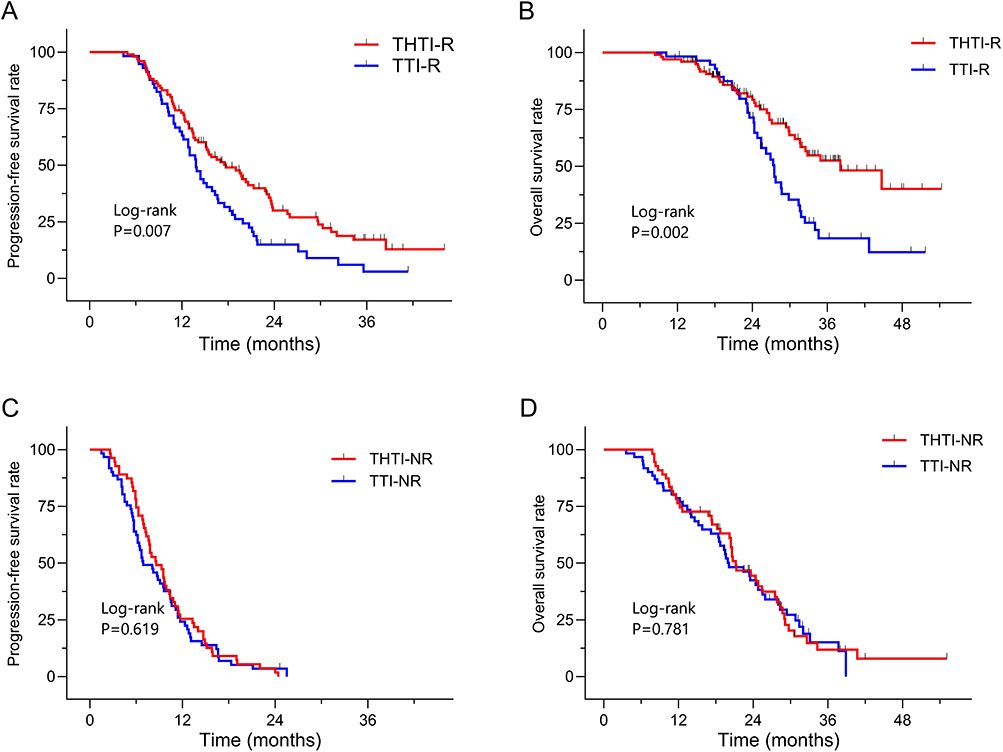 |
Figure 4 K-M curves of PFS and OS in R and NR groups. The K-M curves of PFS (A) and OS (B) for THTI-R group versus TTI-R group, and of PFS (C) and OS (D) for THTI-NR group versus TTI-NR group. |
Univariate and Multivariate Analysis
Cox proportional hazards regression analysis was performed to identify independent prognostic factors. Univariate analysis showed that the following factors were significant for PFS (all p<0.05): Treatment regimen, Child-Pugh grade, BCLC stage, AFP level, lymph node metastasis and tumour size. Multivariate analysis showed that THTI regimen therapy was an independent protective factor for PFS (HR: 0.62, 95% CI: 0.46–0.83, P=0.002), and AFP > 400 ng/mL (HR: 1.47, 95% CI: 1.09–1.98, P=0.012) is an independent risk factor for PFS (Table S2). For OS,univariate analysis showed that the treatment regimen, Child-Pugh grade, ECOG PS, BCLC stage, AFP, lymph node metastasis, tumor size and extrahepatic metastasis were all significantly associated with OS (P<0.05). Multivariate analysis showed that THTI regimen therapy was an independent protective factor for OS (HR: 0.62, 95% CI: 0.43–0.89, P=0.010), and AFP > 400ng/mL (HR: 1.55, 95% CI: 1.07–2.25, P=0.019),and tumor size > 10cm (HR: 0.64, 95% CI: 0.43–0.95, P=0.025) were independent risk factors for OS (Table S3).
Subgroup Analysis
In most predefined subgroups, the THTI regimen markedly improved PFS and OS, with consistent OS benefits observed across the entire cohort. Subgroup analysis found that the THTI regimen was associated with improved PFS and OS in most predefined subgroups. This is also consistent with an overall survival benefit observed in the overall population. However, no statistical improvement in OS was seen in Child-Pugh B or female subgroups. Similarly, no significant PFS benefit was seen for Child - Pugh B, ECOG - PS 1, or BCLC stage B subgroups. These results imply that the THTI schedule might be more suitably recommended to males and patients having more favorable clinical features, namely those having Child-Pugh A hepatic function, ECOG-PS 0, or BCLC stage C illness. The detailed results are shown in the forest plots for PFS (Figure S1) and OS (Figure S2).
Safety
Incidence of TRAEs are shown in Table 3. Both regimens had tolerable safety profiles, most events were grade 1/2 TRAEs. The frequency of most TRAEs was similar across the two groups. All reported events were managed with supportive care or dose modifications as per protocol, and no treatment-related deaths occurred. Different toxicity patterns could be recognized that correlated to the distinct treatment parts. The THTI regimen because of including HAIC, showed higher rate of chemotherapy side effects like nausea (35.3% vs 27.1%, P=0.152), vomiting (26.9% vs 17.8%, P=0.075). On the contrary, the TTI group, with greater stress on TACE-induced embolization, presented an enhanced occurrence of post-embolization sequela. Also higher fever rate was reported (28.8% vs 17.9%, P = 0.033), higher trend of post procedure liver enzymes transients elevation were observed, with higher aspartate aminotransferase (AST) elevation trend (71.2% vs 60.9%, P = 0.076) and alanine aminotransferase (ALT) (60.2% vs 51.3%, P = 0.143).
 |
Table 3 Treatment-Related Adverse Events |
Discussion
This study revealed that the THTI quadruple therapy provides a significant clinical benefit over current TTI triple therapy. After PSM, the significant PFS advantage of the THTI group over the TTI group persisted, with a median PFS of 14.0 months versus 10.6 months (P < 0.001). And the THTI group achieved significantly higher 1-year and 2-year PFS rates, indicating a sustained long-term disease control benefit. Median OS was also significantly prolonged in the THTI group compared with the TTI group (30.8 vs. 24.8 months, P = 0.002).While the 1-year and 2-year OS rates were numerically higher in the THTI group, these differences did not reach statistical significance. Two factors may explain the discordance between the significant OS improvement and the lack of difference in landmark survival rates. First, a proportion of patients in the TTI group received TACE-HAIC as salvage therapy following disease progression, a treatment strategy which may have extended their overall survival.18,19 This observation also indirectly supports the efficacy of introducing HAIC in cases of TACE resistance. Second, the number of death events in the THTI group remained relatively low at the time of analysis, suggesting that continued follow-up may further elucidate potential OS rate differences. Moreover, the THTI group achieved significantly higher ORR and DCR than the TTI group.
Previous studies have shown that TACE-HAIC combined with targeted therapy and ICIs is effective for uHCC.20–22 However, these were mostly single center experiences and not compared with the triple combination. Building on this evidence, this multicenter study shows that HAIC addition to triple regimens significantly and further prolonged survival and deepened responses. Although the combination therapies were subject to higher risks of adverse events as compared with monotherapies, the safety profile seen during the research was considered acceptable Grade 3/4 TRAEs were not different from each other and did not differ significantly among THTI and TTI groups. The toxicity profiles differed between the two groups: the THTI group showed a higher tendency for chemotherapy-related toxicities (nausea, vomiting), while the TTI group exhibited a higher incidence of post-embolization syndrome (fever, transient transaminitis). The majority of events were managed with supportive care or dose adjustment which suggests the quadruple regimen is safe to administer at experienced centers.23
This study also found that HAIC plays a key role in the clinical benefits of the quadruple therapy.Survival analysis stratified by treatment response revealed that achieving an objective tumor response (CR/PR) early in the treatment course served as a crucial predictor for long-term survival benefit. More importantly, this study has shown that the most important advantage of adding the HAIC to the triple therapy was the potential to produce a larger magnitude of response and extend survival even more among treatment responders. Among patients who did not initially have an objective response to treatment, survival outcomes were no significant difference between THTI-NR and TTI-NR. These findings demonstrate that the addition of HAIC to triple combination therapy confers a clinically meaningful survival benefit and enhances tumor response, particularly among patients with favorable characteristics for intensive treatment.
The mechanistic basis for the superiority of the quadruple regimen lies in the synergistic interplay between locoregional and systemic therapies. TACE causes tumor ischemia and necrosis through occlusion of tumor-feeding arteries. However, TACE procedure also upregulates factors such as HIF-1α and vascular endothelial growth factor (VEGF), which promote an immunosuppressive tumor microenvironment and facilitate the formation of collateral circulation, ultimately contributing to tumor recurrence and treatment resistance.24,25 By delivering continuous, high-concentration and intra-arterial chemotherapy to the liver, HAIC can overcome TACE resistance, mitigate rapid drug washout, and target residual tumor and neovascularization after TACE.7,14 The combination of TACE and HAIC facilitates rapid tumor debulking while prolonging tumor exposure to chemotherapeutic agents, which may enhance the subsequent efficacy of molecular targeted therapy.26,27 Molecular targeted therapy acts via VEGFR and FGFR to produce direct anti-angiogenic activity, suppress VEGF-dependent neovascularization following TACE, and interrupt tumor growth signaling pathways.28,29 ICIs function by blocking inhibitory signals that suppress T-cell activity, thereby enhancing the antitumor immune response primed by prior HAIC and TACE treatments. Collectively, the superior efficacy of the quadruple regimen is derived from the synergistic mechanisms of these four modalities working together.
The critical role of HAIC in enhancing quadruple therapy efficacy may be mechanistically linked to its ability to induce the formation of tertiary lymphoid structures (TLS). Tertiary lymphoid structures are ectopic, organized aggregates of immune cells that develop in non-lymphoid tissues, including tumor.30 The presence of TLS in solid malignancies, including HCC, is usually associated with a good prognosis.31,32 A variety of therapies, including chemotherapy and immunotherapy, have been shown to trigger TLS neogenesis. Recent studies have provided evidence that HAIC promotes TLS formation in HCC, and TLS-positive tumors patients often show better treatment response and PFS.33 These regions constitute the spatial niches for CD4+ T cells, dendritic cells, and B cells, whose formation correlates with the proliferation and tumour infiltration of CD8+ T cell subsets following HAIC therapy.34 Consequently, the superior survival benefit observed in the THTI-R group compared with the TTI-R group may be attributed to the dual effect of HAIC in inducing TLS neogenesis. This proposed mechanistic link needs additional supporting validation through foundational and translational study.
This study has several limitations. First, despite the use of PSM, inherent selection bias due to its retrospective design cannot be completely excluded, and the two-center sample limits the generalizability of our findings. Prospective multicenter randomized trials (eg. NCT06904183, NCT06031285) are needed. Second, the short follow-up resulted in immature OS data, with only a minority reaching the endpoint in the THTI group, warranting longer observation. Third, although we hypothesize that HAIC may enhance therapeutic efficacy by promoting TLS formation, this study did not provide direct mechanistic evidence. Future translational research utilizing paired pre- and post-treatment tissue specimens is needed to elucidate the underlying biological mechanisms.
Conclusion
For patients with uHCC, the THTI quadruple therapy provides a superior clinical benefit over current TTI triple therapy, as evidenced by significantly prolonged PFS and OS, along with higher ORR and DCR and a manageable safety profile. Importantly, this therapeutic advantage persists even in patients with high tumor burden.
Abbreviations
TACE, transarterial chemoembolization; HAIC, hepatic arterial infusion chemotherapy; MTT, molecular targeted therapy; ICIs, immune checkpoint inhibitors; uHCC, unresectable hepatocellular carcinoma; THTI, TACE-HAIC combined with MTT and ICIs; TTI, TACE combined with MTT and ICIs; PFS, progression-free survival; OS, overall survival; ORR, objective response rate; DCR, disease control rate; TRAEs, treatment-related adverse events; PSM, propensity score matching; R, responses; NR, non-responses; THTI-R, responses to THTI; TTI-R, responses to TTI; HCC, hepatocellular carcinoma; PVTT, portal vein tumor thrombus; BCLC, Barcelona Clinic Liver Cancer; ECOG, Eastern Cooperative Oncology Group; mRECIST, modified Response Evaluation Criteria in Solid Tumors; HBV, hepatitis B virus; VEGF, vascular endothelial growth factor; HIF-1α, hypoxia-inducible factor 1-alpha; HR, hazard ratio; CI, confidence interval; TLS, tertiary lymphoid structure; K-M, Kaplan–Meier; AFP, alpha-fetoprotein; AST, aspartate aminotransferase; ALT, alanine aminotransferase; CR, complete response; PR, partial response; SD, stable disease; ALB, albumin; TBIL, total bilirubin; CHE, cholinesterase.
Data Sharing Statement
The dataset used for this study is available from the corresponding author upon reasonable request.
Ethics Approval and Informed Consent
Approvals for this study were obtained from the Clinical Oncology School of Fujian Medical University, Fujian Cancer Hospital (No. K2026-168-01) and Beijing Anzhen Nanchong Hospital, Capital Medical University & Nanchong Central Hospital (No. 2025-207). This study was conducted in accordance with the Declaration of Helsinki. Patient data confidentiality was maintained in accordance with institutional review board requirements, and informed consent was waived due to the retrospective nature of the study.
Acknowledgments
We sincerely thank all the investigators and patients involved in this study.
Author Contributions
All authors made a significant contribution to the work reported, whether that is in the conception, study design, execution, acquisition of data, analysis and interpretation, or in all these areas; took part in drafting, revising or critically reviewing the article; gave final approval of the version to be published; have agreed on the journal to which the article has been submitted; and agree to be accountable for all aspects of the work.
Funding
This study was supported by the National Key R&D Program of China (No. 2023YFC2413500), the Joint Funds for the Innovation of Science and Technology, Fujian Province (Grant number: 2023Y9320), the Fujian Province Natural Science Fund Project (2024J011105), and the Fujian Provincial Health Technology Project (Grant No. 2024ZD01004).
Disclosure
The authors report no conflicts of interest in this work.
References
1. Chan SL, Sun H-C, Xu Y. et al. The Lancet Commission on addressing the global hepatocellular carcinoma burden: comprehensive strategies from prevention to treatment. Lancet. 2025;406(10504):731–12. doi:10.1016/S0140-6736(25)01042-6
2. Zhou J, Sun H, Wang Z, et al. Guidelines for the diagnosis and treatment of primary liver cancer (2022 edition). Liver Cancer. 2023;12(5):405–444. doi:10.1159/000530495
3. Zhong BY, Fan W, Guan JJ, et al. Combination locoregional and systemic therapies in hepatocellular carcinoma. Lancet Gastroenterol Hepatol. 2025;10(4):369–386. doi:10.1016/S2468-1253(24)00247-4
4. Reig M, Sanduzzi-Zamparelli M, Forner A, et al. BCLC strategy for prognosis prediction and treatment recommendations: the 2026 update. J Hepatol. 2026;84(3):631–654. doi:10.1016/j.jhep.2025.10.020
5. Qin S, Chan SL, Gu S, et al. Camrelizumab plus rivoceranib versus sorafenib as first-line therapy for unresectable hepatocellular carcinoma (CARES-310): a randomised, open-label, international Phase 3 study. Lancet. 2023;402(10408):1133–1146. doi:10.1016/S0140-6736(23)00961-3
6. Finn RS, Qin S, Ikeda M, et al. Atezolizumab plus bevacizumab in unresectable hepatocellular carcinoma. N Engl J Med. 2020;382(20):1894–1905. doi:10.1056/NEJMoa1915745
7. Li J, Liu Y, Zheng R, Qu C, Li J. Molecular mechanisms of TACE refractoriness: directions for improvement of the TACE procedure. Life Sci. 2024;342:122540. doi:10.1016/j.lfs.2024.122540
8. Zhang S, Wang WS, Zhong BY, Ni CF. Subsequent treatment after transarterial chemoembolization failure/refractoriness: a review based on published evidence. J Clin Transl Hepatol. 2022;10(4):740–747. doi:10.14218/JCTH.2021.00336
9. Vogel A, Chan SL, Dawson LA, et al. Hepatocellular carcinoma: ESMO clinical practice guideline for diagnosis, treatment and follow-up. Ann Oncol. 2025;36(5):491–506. doi:10.1016/j.annonc.2025.02.006
10. Liao Y, Zhu W, Zhang J. Efficacy and safety of TACE/HAIC combined with targeted immunotherapy versus targeted immunotherapy for advanced hepatocellular carcinoma: a meta-analysis. Front Oncol. 2025;15:1669460. doi:10.3389/fonc.2025.1669460
11. Kudo M, Ren Z, Guo Y, et al. Transarterial chemoembolisation combined with lenvatinib plus pembrolizumab versus dual placebo for unresectable, non-metastatic hepatocellular carcinoma (LEAP-012): a multicentre, randomised, double-blind, phase 3 study. Lancet. 2025;405(10474):203–215. doi:10.1016/S0140-6736(24)02575-3
12. Zhu HD, Li HL, Huang MS, et al. Transarterial chemoembolization with PD-(L)1 inhibitors plus molecular targeted therapies for hepatocellular carcinoma (CHANCE001). Signal Transduct Target Ther. 2023;8(1):58. doi:10.1038/s41392-022-01235-0
13. Sangro B, Kudo M, Erinjeri JP, et al. Durvalumab with or without bevacizumab with transarterial chemoembolisation in hepatocellular carcinoma (EMERALD-1): a multiregional, randomised, double-blind, placebo-controlled, phase 3 study. Lancet. 2025;405(10474):216–232. doi:10.1016/S0140-6736(24)02551-0
14. Li QJ, He MK, Chen HW, et al. Hepatic arterial infusion of oxaliplatin, fluorouracil, and leucovorin versus transarterial chemoembolization for large hepatocellular carcinoma: a randomized phase iii trial. J Clin Oncol. 2022;40(2):150–160. doi:10.1200/JCO.21.00608
15. Zheng K, Zhu X, Fu S, et al. Sorafenib plus hepatic arterial infusion chemotherapy versus sorafenib for hepatocellular carcinoma with major portal vein tumor thrombosis: a randomized trial. Radiology. 2022;303(2):455–464. doi:10.1148/radiol.211545
16. Yuan Y, He W, Yang Z, et al. TACE-HAIC combined with targeted therapy and immunotherapy versus TACE alone for hepatocellular carcinoma with portal vein tumour thrombus: a propensity score matching study. Int J Surg. 2023;109(5):1222–1230. doi:10.1097/JS9.0000000000000256
17. Cai M, Liang L, Zhang J, et al. Lenvatinib plus drug-eluting bead transarterial chemoembolization with/without hepatic arterial infusion chemotherapy for hepatocellular carcinoma larger than 7 cm with major portal vein tumor thrombosis: a multicenter retrospective cohort study. Int J Surg. 2024;110(12):7860–7870. doi:10.1097/JS9.0000000000001819
18. Huang Z, Wu Z, Zhang L, Yan L, Jiang H, Ai J. The safety and efficacy of TACE combined with HAIC, PD-1 inhibitors, and tyrosine kinase inhibitors for unresectable hepatocellular carcinoma: a retrospective study. Front Oncol. 2024;14:1298122. doi:10.3389/fonc.2024.1298122
19. Deng W, Xie J, Wang T, et al. The safety and efficacy of tyrosine kinase inhibitors and programmed cell death protein-1 inhibitors combined with HAIC/TACE in the treatment of recurrent unresectable hepatocellular carcinoma. BMC Cancer. 2025;25(1):779. doi:10.1186/s12885-025-14185-x
20. Pang B, Zuo B, Huang L, et al. Real-world efficacy and safety of TACE-HAIC combined with TKIs and PD-1 inhibitors in initially unresectable hepatocellular carcinoma. Int Immunopharmacol. 2024;137:112492. doi:10.1016/j.intimp.2024.112492
21. Wan J, Tang B, Zhang W, et al. Sequential HAIC-TACE combined with targeted and immunotherapy in hepatocellular carcinoma: a quality improvement study. Int J Surg. 2025;111(10):6942–6960. doi:10.1097/JS9.0000000000002890
22. Yin L, Li W, Shao W, et al. Correction: TACE-HAlC combined with Donafenib and immune checkpoint inhibitors for BCLC stage C HCC patients (THEME study): a retrospective IPTW-adjusted cohort study. Front Immunol. 2025;16:1745867. doi:10.3389/fimmu.2025.1745867
23. Cai H, Chen S, Tang S, et al. Lenvatinib and tislelizumab versus atezolizumab and bevacizumab in combination with TAE-HAIC for unresectable hepatocellular carcinoma with high tumor burden: a multicenter retrospective cohort study. Cancer Immunol Immunother. 2025;74(3):88. doi:10.1007/s00262-025-03942-3
24. Tischfield DJ, Gurevich A, Johnson O, et al. Transarterial embolization modulates the immune response within target and nontarget hepatocellular carcinomas in a rat model. Radiology. 2022;303(1):215–225. doi:10.1148/radiol.211028
25. Tan J, Fan W, Liu T, et al. TREM2+ macrophages suppress CD8+ T-cell infiltration after transarterial chemoembolisation in hepatocellular carcinoma. J Hepatol. 2023;79(1):126–140. doi:10.1016/j.jhep.2023.02.032
26. Jiang P, Chen C, Tian J, et al. Efficacy and Safety of HAIC-FOLFOX plus tyrosine kinase inhibitors and immune checkpoint inhibitors as first-line treatment for unresectable advanced hepatocellular carcinoma: a systematic review and meta-analysis. Acad Radiol. 2025;32(8):4595–4606. doi:10.1016/j.acra.2024.09.061
27. Zang M, Hu X, Yuan G, et al. Tyrosine kinase inhibitors, immune checkpoint inhibitors combined with hepatic arterial infusion of oxaliplatin and raltitrexed versus oxaliplatin, 5-fluorouracil and leucovorin for intermediate and advanced hepatocellular carcinoma: a retrospective study. Int Immunopharmacol. 2023;125(Pt A):111019. doi:10.1016/j.intimp.2023.111019
28. Xie QY, Huang LP, Gao FW, et al. Efficacy of lenvatinib combined with sequential transarterial chemoembolization for primary hepatocellular carcinoma and the effects on serum basic fibroblast growth factor and vascular endothelial growth factor. Front Pharmacol. 2022;13:965770. doi:10.3389/fphar.2022.965770
29. Yi C, Chen L, Lin Z, et al. Lenvatinib targets fgf receptor 4 to enhance antitumor immune response of anti-programmed cell death-1 in HCC. Hepatology. 2021;74(5):2544–2560. doi:10.1002/hep.31921
30. Teillaud JL, Houel A, Panouillot M, Riffard C, Dieu-Nosjean MC. Tertiary lymphoid structures in anticancer immunity. Nat Rev Cancer. 2024;24(9):629–646. doi:10.1038/s41568-024-00728-0
31. Calderaro J, Petitprez F, Becht E, et al. Intra-tumoral tertiary lymphoid structures are associated with a low risk of early recurrence of hepatocellular carcinoma. J Hepatol. 2019;70(1):58–65. doi:10.1016/j.jhep.2018.09.003
32. Ahn B, Ahn HS, Shin J, et al. Characterization of lymphocyte-rich hepatocellular carcinoma and the prognostic role of tertiary lymphoid structures. Liver Int. 2024;44(5):1202–1218. doi:10.1111/liv.15865
33. Huang Y, Du Z, Lai Z, et al. Single-nucleus and spatial transcriptome profiling delineates the multicellular ecosystem in hepatocellular carcinoma after hepatic arterial infusion chemotherapy. Adv Sci. 2025;12(5):e2405749. doi:10.1002/advs.202405749
34. Xing R, Mei J, Zuo Z, et al. Enhanced formation of tertiary lymphoid structures shapes the anti-tumor microenvironment in hepatocellular carcinoma after FOLFOX-HAIC therapy. Cell Rep Med. 2025;6(9):102298. doi:10.1016/j.xcrm.2025.102298
 © 2026 The Author(s). This work is published and licensed by Dove Medical Press Limited. The
full terms of this license are available at https://www.dovepress.com/terms
and incorporate the Creative Commons Attribution
- Non Commercial (unported, 4.0) License.
By accessing the work you hereby accept the Terms. Non-commercial uses of the work are permitted
without any further permission from Dove Medical Press Limited, provided the work is properly
attributed. For permission for commercial use of this work, please see paragraphs 4.2 and 5 of our Terms.
© 2026 The Author(s). This work is published and licensed by Dove Medical Press Limited. The
full terms of this license are available at https://www.dovepress.com/terms
and incorporate the Creative Commons Attribution
- Non Commercial (unported, 4.0) License.
By accessing the work you hereby accept the Terms. Non-commercial uses of the work are permitted
without any further permission from Dove Medical Press Limited, provided the work is properly
attributed. For permission for commercial use of this work, please see paragraphs 4.2 and 5 of our Terms.
Recommended articles
Tyrosine Kinase Inhibitors Plus Anti-PD-1 Antibodies with Hepatic Arterial Infusion Chemotherapy or Transarterial Chemoembolization for Unresectable Hepatocellular Carcinoma
Yu B, Zhang N, Feng Y, Zhang Y, Zhang T, Wang L
Journal of Hepatocellular Carcinoma 2023, 10:1735-1748
Published Date: 6 October 2023
Comparable Clinical Outcomes Between Transarterial Chemoembolization or Hepatic Arterial Infusion Chemotherapy Combined with Tyrosine Kinase Inhibitors and PD-1 Inhibitors in Unresectable Hepatocellular Carcinoma
Long T, Yang Z, Zeng H, Wu W, Hu Z, Yang Z, Hu D, Zhou Z, Chen M, Zhang Y
Journal of Hepatocellular Carcinoma 2023, 10:1849-1859
Published Date: 20 October 2023
Transarterial Chemoembolization Combined with Tyrosine Kinase Inhibitors Plus Immune Checkpoint Inhibitors for Advanced Hepatocellular Carcinoma: A Propensity Score Matching Analysis
Gao B, Yang F, Zheng D, Hu S, Liu J, Liu H, Liu Y, Liu L, Wang R, Zhao Y, Cui C, Fang C, Yang J, Su S, Han Y, Yang X, Li B
Journal of Hepatocellular Carcinoma 2023, 10:2265-2276
Published Date: 13 December 2023
Increment of Skeletal Muscle Mass Predicts Survival Benefit for Hepatocellular Carcinoma Treated with Transarterial Chemoembolization Combining Molecular Targeted Agents and Immune Checkpoint Inhibitors
Chen W, Yan HT, Zhang JX, Shen X, Liu J, Liu S, Shi HB, Ding Y, Zu QQ
Journal of Hepatocellular Carcinoma 2025, 12:415-426
Published Date: 27 February 2025
Safety and Efficacy of TACE-HAIC Combined with Lenvatinib and PD-1 Inhibitors in Large Intermediate-Stage Hepatocellular Carcinoma: A Multi-Center Retrospective Study
Ni J, Li C, Sun H, Liu Y, Guo G, Zhou X, Zhou Z, Fan R, Hu H, Xu L
Journal of Hepatocellular Carcinoma 2026, 13:586001
Published Date: 24 April 2026