
Back to Journals » Psychology Research and Behavior Management » Volume 18
Depression and Anxiety as Mediators Between Family Functioning and Academic Burnout in First-Year Traditional Chinese Medicine Students
Authors Zhang Y, Liu J, Wang X, Cheng J, Wang X, Zheng C, Liu Q, Li W
Received 12 April 2025
Accepted for publication 29 July 2025
Published 12 August 2025 Volume 2025:18 Pages 1717—1727
DOI https://doi.org/10.2147/PRBM.S531311
Checked for plagiarism Yes
Review by Single anonymous peer review
Peer reviewer comments 2
Editor who approved publication: Professor Mei-Chun Cheung
Ying Zhang,1,* Jiaqi Liu,1,* Xiaozheng Wang,1 Jinhui Cheng,1 Xueying Wang,1 Canlei Zheng,1 Qing Liu,1 Wenfu Li2
1College of Integrated Chinese and Western Medicine, Jining Medical University, Jining, Shandong Province, 272000, People’s Republic of China; 2College of Rehabilitation Medicine, Jining Medical University, Jining, Shandong Province, 272000, People’s Republic of China
*These authors contributed equally to this work
Correspondence: Qing Liu, Email [email protected] Wenfu Li, Email [email protected]
Purpose: This study examined whether depression and anxiety mediate the relationship between family functioning and academic burnout in first-year Traditional Chinese Medicine (TCM) students.
Methods: A cross-sectional survey was conducted among 319 first-year TCM students at a medical college in Shandong Province. Participants completed validated questionnaires assessing family functioning, academic burnout, depression, and anxiety. Correlational and regression analyses were conducted, and mediation effects were tested using bootstrap resampling (5,000 iterations).
Results: Poor family functioning was significantly associated with higher levels of academic burnout, depression, and anxiety. Mediation analysis showed that depression significantly mediated the relationship between family functioning and academic burnout. Anxiety demonstrated a non-significant indirect effect.
Conclusion: Deficient family functioning indirectly influences academic burnout in first-year TCM students, primarily through depression. Interventions addressing family dynamics and mental health may help reduce the risk of academic burnout in this population.
Keywords: academic burnout, anxiety, depression, family functioning, first-year traditional Chinese medicine students, mediating effect
Introduction
Academic burnout is a psychological syndrome characterized by emotional and physical exhaustion, a reduced sense of academic efficacy, and growing cynicism toward learning, which typically emerges under chronic academic stress.1,2 This condition is particularly prevalent among university students and has been linked to impaired learning motivation, diminished academic performance, and long-term negative consequences for personal and professional development.
Family functioning, the emotional connection, adaptability, and communication quality among family members, plays a pivotal role in shaping adolescents’ mental health and academic outcomes.3 Healthy family dynamics foster emotional resilience and stress regulation, while dysfunctional family environments may exacerbate vulnerability to psychological distress, including anxiety and depression.4
Weak or disrupted family ties have been associated with higher rates of mental health problems in young people. Among them, anxiety and depression are especially concerning due to their high co-occurrence and widespread impact. These disorders frequently emerge during adolescence and early adulthood and are known to impair academic engagement, social functioning, and long-term productivity. Globally, the prevalence of anxiety and depression among young people has increased, influenced not only by family-related factors but also by academic pressure, social media exposure, economic insecurity, and broader societal instability.5–7
The co-occurrence of anxiety and depression is not only clinically significant but also presents compounded risks: individuals experiencing both conditions report greater functional impairment and are more likely to experience chronic illness, disability, and social withdrawal. Furthermore, anxiety and depression are associated with a substantial global economic burden due to healthcare costs and loss of workforce productivity.8,9
While previous studies have examined academic burnout and its psychological correlates in the general student population, few have investigated the mechanisms linking family functioning, anxiety, depression, and academic burnout in first-year Traditional Chinese Medicine (TCM) students, a group that may face unique academic and cultural stressors. These students often encounter dual-system learning requirements that blend modern biomedical coursework with traditional Eastern philosophies, diagnostic logic, and therapeutic practices. Balancing these demands, mainly under high parental or societal expectations to preserve and master cultural heritage, may heighten psychological vulnerability during their early academic transition. Recent systematic reviews and meta-analyses have consistently highlighted strong associations between mental health disorders (particularly depression and anxiety) and burnout among medical students worldwide, highlighting the urgency of addressing these issues in early stages of medical training.10,11
From a theoretical perspective, Family Systems Theory12 provides a useful lens for interpreting how family dynamics influence individual functioning. It posits that individual behaviors are deeply embedded in familial interactions. Furthermore, the Transactional Model of Stress and Coping by Lazarus and Folkman13 offers a useful framework for understanding how students cognitively appraise stressors (eg, academic pressure) and deploy coping strategies. Under this model, students from well-functioning families may perceive academic demands as manageable and utilize adaptive coping mechanisms, whereas those from dysfunctional families may interpret similar stressors as overwhelming, leading to emotional exhaustion and burnout. This model aligns with our findings regarding the mediating role of depression in the relationship between family functioning and academic burnout.
This study aimed to explore the relationship between family functioning and academic burnout in first-year TCM students, with a specific focus on the mediating roles of anxiety and depression. By identifying key psychosocial pathways, this research seeks to contribute to a broader understanding of student well-being and to inform targeted mental health strategies that may benefit young learners globally.
Materials and Method
Study Design and Samples
A descriptive cross-sectional study was conducted in December 2024 at Jining Medical University, a five-year undergraduate medical college, in Shandong Province in east-central China to determine the association between academic burnout and family functioning, as well as the mediating roles of depression and anxiety, among first-year medical students majoring in TCM. A convenience sampling method was employed, as participation was limited to students enrolled in specific foundational courses available at the time of the survey. During data collection, 25 students were absent from class, resulting in a final sample of 325 TCM freshmen. Full-time students formally admitted through the National College Entrance Examination held in spring and summer were included in this study. Students on leave due to illness or other reasons were excluded. After excluding six invalid responses, 319 valid questionnaires were retained for analysis.
Data Collection
Data collection occurred during a 20-minute break before the students’ evening self-study sessions. First, all participants were informed about the significance and objectives of the study prior to obtaining informed consent. All students were explicitly assured of voluntary participation, with anonymity and confidentiality guaranteed for all collected data. Second, questionnaires—typically requiring 10–15 minutes to complete—were distributed, and the participants filled them independently after receiving standardized instructions. Lastly, all questionnaires were immediately collected upon completion, and the participants were requested to verify and complete any missing items before submission.
Procedure
The study protocol strictly adhered to the ethical principles outlined in the Declaration of Helsinki. Ethical approval was obtained from the Medical Ethics Committee of Jining Medical University prior to data collection (Approval No. JNMC-2021-DW-002). Data collection was conducted in classrooms of the teaching building, with teachers absent throughout the process to eliminate potential influence. All participants were verified to be at or above the legal adult age (≥18 years), meeting the ethical requirements of the Declaration of Helsinki regarding autonomous decision-making capacity. This confirmation established their legal eligibility to independently provide written informed consent, which was duly obtained by the investigators. Before commencing data collection, participants were explicitly informed about the voluntary nature of their involvement and their unconditional right to withdraw at any stage without prejudice. A team of professionally trained graduate students administered the questionnaire distribution and collection procedures following standardized operational protocols. These personnel also provided clarification for any participant inquiries during the data collection process, while maintaining strict adherence to ethical guidelines throughout all research activities.
Instruments
Data were obtained using the following 4 questionnaires: Academic Burnout Inventory (ABI), Family Assessment Device (FAD), Patient Health Questionnaire-9 (PHQ-9), and a brief measure for assessing Generalized Anxiety Disorder-7 (GAD-7). All instruments used in this study have demonstrated notable validity and reliability in previous research and are widely used in Chinese student populations.
General Information Questionnaire
General information was categorized into 3 sections, namely, participants’ demographic characteristics, family-related data, and professional commitment. Demographic characteristics included the following 3 items: gender, age, and whether they were from single-child families. Family-related data included household income and educational levels of the parents. Professional commitment primarily focused on the primary reasons for choosing the TCM major and their intentions to transfer to another academic program. Additional psychosocial confounders, such as physical health status, prior psychological history, and perceived social support were not assessed, which might limit the control for confounding influences on mental health and burnout.
Academic Burnout Inventory
The study utilized the ABI, which was adapted from the College Students’ Academic Burnout Scale developed by Lian et al.7 This 20-item scale comprises 3 dimensions, namely, emotional exhaustion (8 items), cynical behavior (6 items), and reduced personal accomplishment (6 items). Responses were scored on a 5-point Likert scale ranging from 1 (completely disagree) to 5 (completely agree), with 8 reverse-scored items. Higher total scores indicate a greater severity of academic burnout. Previous research has confirmed the scale’s construct validity and internal consistency in Chinese college student samples.7 The scale demonstrated good internal consistency in this study, with a Cronbach’s α coefficient of 0.89.
Family Assessment Device
Family functioning was assessed using the FAD, which was adapted from the version revised by Li et al.8 This scale comprises 5 dimensions and employs a 3-point Likert-type response format as follows: 2 (often), 1 (sometimes), and 0 (rarely/never). Higher total scores indicate better family functioning. The Chinese version of the FAD has been validated in adolescent and college student populations, with confirmed construct validity and reliability.8 The scale demonstrated excellent internal consistency in this study, with a Cronbach’s α coefficient of 0.92.
Patient Health Questionnaire-9
Depressive symptoms were assessed using PHQ-9.9 This 9-item scale evaluates the frequency of depressive symptoms over the past 2 weeks, with each item scored on a 4-point Likert-type scale as follows: 0 (not at all), 1 (several days), 2 (more than half the days), and 3 (nearly everyday). Higher total scores reflect greater severity of depressive symptoms. The PHQ-9 has been extensively validated in Chinese medical student populations, demonstrating strong criterion validity and internal consistency.9 The scale exhibited excellent reliability in this study, with a Cronbach’s α coefficient of 0.90.
A Brief Measure for Assessing Generalized Anxiety Disorder-7
Anxiety symptoms were measured using GAD-7,14 with the Chinese version validated by He et al.15 This 7-item scale assesses the frequency of generalized anxiety symptoms over the past 2 weeks. Each item was rated on a 4-point Likert-type scale as follows: 0 (not at all), 1 (several days), 2 (more than half the days), and 3 (nearly everyday). Higher total scores indicate greater severity of anxiety symptoms. The Chinese GAD-7 has shown strong construct validity, test-retest reliability, and internal consistency in previous studies of student and clinical populations.15 The scale showed exceptional reliability in this study, with a Cronbach’s α coefficient of 0.94.
Data Analysis
SPSS 22.0 (IBM Corp., Armonk, NY, USA) was used for data processing and statistical analyses. Descriptive statistical analyses, linear regression analyses, and Pearson correlation analyses were used to examine variable distributions and associations. Mediation pathways were examined using the mediation package in R (version 4.3.1), with the robustness of mediation effects evaluated using the bootstrap method (5000 resampling iterations). A two-tailed significance level of p < 0.05 was used to determine statistical significance. Although the observed effect sizes were statistically significant, no a priori power analysis was conducted. Given the medium-to-large effect sizes found, post hoc inspection suggested that the sample size was sufficient to detect meaningful effects; however, future studies should include formal power analyses for improved methodological rigor. This study employed a cross-sectional design, which is appropriate for exploring associations and mediation pathways. However, the inability to draw causal inferences or examine temporal changes in academic burnout limits the longitudinal interpretability of the results. All study variables were measured using self-report questionnaires, which may be subject to common method bias and social desirability effects.
Results
Demographic Characteristics of Participants
The mean age of the interviewed students was 18.5 ± 0.7 years, which was consistent with the age distribution of college freshmen. There was a higher percentage of female (58.3%) participants than males (41.7%). Only 29.2% of participants were only children, with 70.8% coming from only-one-child households, likely due to China’s family-planning policy, and 19.4% were in a relationship. Family income was distributed relatively evenly, but with a slight edge to those earning over 4,000 yuan per month per capita (44.8%). Most parents had a low level of education, with only 28.8% of fathers and 22.3% of mothers having a high-school education or above. Personal interest was the main driver for choosing TCM as a major (44.7%), followed by the advice of a family member (29.9%). More than half of the participants (58.2%) had visited a TCM practitioner, yet 21.6% still considered switching majors (Table 1). While demographic information, such as age, gender, and parental education was comprehensively captured, academic performance metrics (eg, GPA or exam scores) were not included in the current dataset. This omission might limit the interpretability of burnout outcomes in terms of their practical academic consequences.
 |
Table 1 Demographic Data of Respondents (N = 319) |
Distribution Characteristics of the Assessment Tools
The mean for academic burnout (55.1 ± 11.9), family functioning (7.7 ± 2.6), depression (5.9 ± 4.8), and anxiety (5.1 ± 4.6) were determined. Cronbach’s α reliability analysis of all scales was ≥ 0.89, indicating high internal consistency (Table 2). As all assessment tools were self-report questionnaires administered at a single time point, the results might be susceptible to common method variance and response bias, which could inflate observed associations.
 |
Table 2 Characteristics of Assessments (N = 319) |
Correlation Between Family Functioning and Depression, Anxiety, and Academic Burnout
Academic burnout (55.1 ± 11.9) was significantly and negatively correlated with family functioning (7.7 ± 2.6) (r = −0.39, p < 0.001), and significantly and positively correlated with depression (5.9 ± 4.8) (r = 0.50, p < 0.001) and anxiety (5.1 ± 4.6) (r = 0.36, p < 0.001). Family functioning was significantly and negatively correlated with depression (r = −0.42, p < 0.001) and anxiety (r = −0.33, p < 0.001). Depression and anxiety were significantly and positively correlated (r = 0.71, p < 0.001) (Table 3). These correlations should be interpreted with caution, as the use of a cross-sectional design precludes any claims of causality. While statistical mediation was tested, temporal sequencing of variables could not be established.
 |
Table 3 Correlations Between Assessments (N = 319) |
Multivariate Linear Regression Analysis of Academic Burnout
The model was statistically significant and the regression relationship was reliable. Regression analysis revealed that family functioning (β = −0.92, p < 0.001) was a significant negative predictor of academic burnout, whereas depression (β = 1.02, p < 0.001) was a significant positive predictor. Age, gender (female), and anxiety were not significant predictors (P > 0.05) (Table 4). Although regression analysis adjusted for age and gender, other potential confounding variables, such as physical health, academic workload, or perceived social support were not measured and might influence the outcomes.
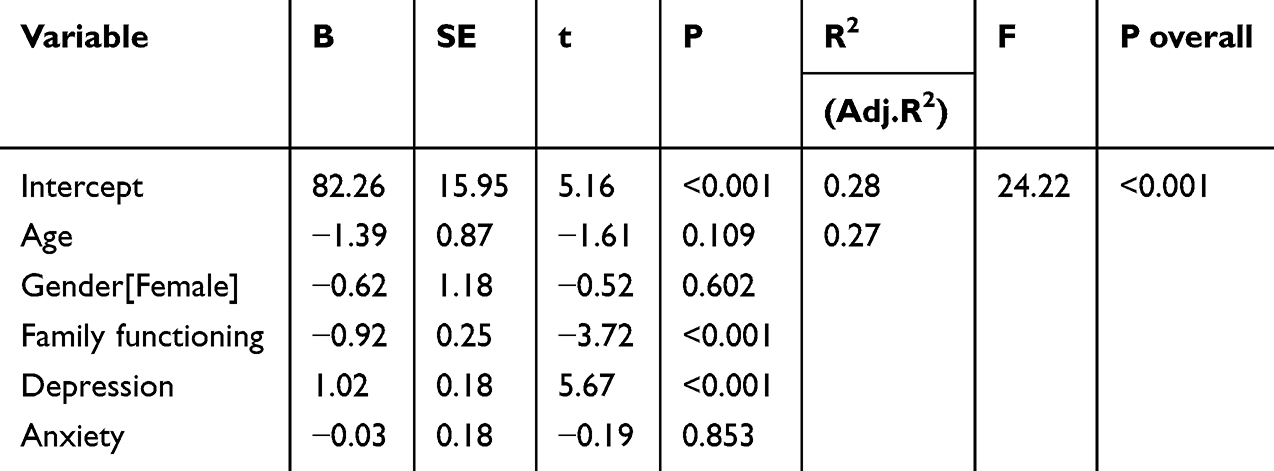 |
Table 4 Results of Multivariate Linear Regression on Academic Burnout (N = 319) |
Mediating Effect Analysis
Mediating effect analysis was performed using the mediation package in R with the bootstrap method to assess the role of depression and anxiety in the relationship between family functioning and academic burnout based on 1000 resamples. Family functioning had a significantly negative direct impact on academic burnout (β = −0.963, p < 0.001). It also had a significant negative impact on depression (β = −0.792, p < 0.001), which, in turn, had a significant positive impact on academic burnout (β = 1.021, p < 0.001). The indirect effect (IE) of family functioning on academic burnout through depression was significant (IE= −0.809, 95% confidence interval [CI] = −1.135 to −0.520). Family functioning had a significant negative impact on anxiety (β = −0.595, p < 0.001), but anxiety did not have a significant direct impact on academic burnout (β = −0.049, p = 0.785). The IE of family functioning on academic burnout through anxiety was not significant (IE = 0.029, 95% CI = −0.211 to 0.250) (Figure 1).
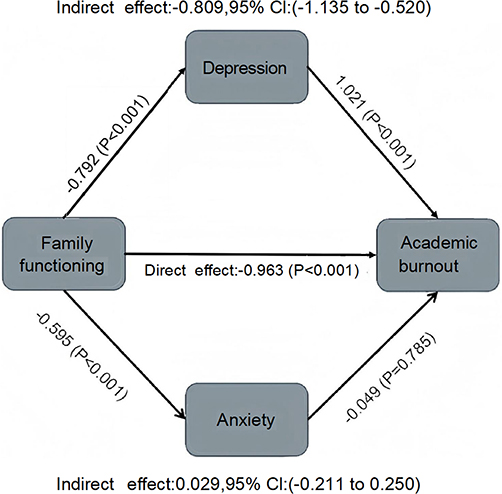 |
Figure 1 Mediating path model of depression and anxiety between family functioning and academic burnout. |
Despite statistically significant mediation pathways, the cross-sectional nature of the data prevents definitive conclusions about causal mechanisms. Longitudinal or experimental designs would be required to validate the directionality of these relationships. Additionally, the absence of qualitative data or triangulated measures limits the contextual depth and richness of interpretation, especially in understanding students’ lived experiences of family functioning or academic burnout. Although the instruments were translated and adapted for Chinese students, cultural constructs, such as filial piety or collectivism, which might influence both family dynamics and emotional expression, were not explicitly measured or operationalized. This might constrain the cross-cultural generalizability of the findings.
Discussion
As a key factor governing the mental health of individuals, the quality of family functioning directly impacts the emotion regulation and academic adaptation of students.16,17 Our study shows a significant negative correlation between family functioning and academic burnout (r = −0.39), with family functioning having a significant negative impact on academic burnout (β = −0.963). Rather than implying causality, these findings highlight an important psychosocial pattern: poor family functioning tends to co-occur with higher academic burnout in TCM freshmen and may be accompanied by increased depression and anxiety. These findings may offer actionable guidance for academic policymakers and curriculum designers. For example, universities could incorporate targeted mental health literacy programs, establish peer support systems, or offer family-informed counseling services to mitigate academic burnout in first-year students. Orientation curricula could be adapted to emphasize resilience-building strategies, emotional regulation skills, and communication training that helps students better navigate both academic and familial expectations. Family functioning is significantly and negatively correlated to depression (r = −0.42) and anxiety (r = −0.33), with a significant negative impact on both (β = −0.792 for depression, β = −0.595 for anxiety). This finding indicates that poor family functioning worsens the level of depression and anxiety in TCM freshmen. Good family functioning offers children a stable study environment and psychological support, effectively alleviating these negative emotions.18,19 Our findings are consistent with previous studies on college students.20 For example, Stubbs et al found that a lack of family cohesion can lead to emotional exhaustion and reduced academic efficacy in students.21 The impact of family function may be more pronounced in TCM freshmen who face multidimensional and complex study pressures (such as changing learning patterns and ways of thinking, increased course density and difficulty, differences in cultural background and knowledge system, and restructuring of interpersonal relationships).22
Depression and anxiety are common factors of emotional distress in medical students.23 These factors were significantly and positively correlated in our study (r = 0.71) and may play crucial roles in the progression to academic burnout. Further analysis revealed significant positive correlations between academic burnout and both depression (r = 0.50) and anxiety (r = 0.36), indicating that more severe symptoms of depression and anxiety are associated with higher levels of academic burnout in TCM freshmen. Severe depression and anxiety can cause students to lose interest in their studies, lack motivation, and have trouble concentrating, thereby affecting academic performance and increasing the risk of academic burnout24. These findings suggest that family functioning may not only directly impact academic burnout but also indirectly influence it via psychological mediators such as depression and anxiety.
Mediating effect analysis in this study revealed that family functioning indirectly impacted academic burnout via depression (IE = −0.809, 95% CI: −1.135 to −0.520), indicating that poor family functioning may weaken the regulation of emotion, worsen depression, and lead to academic burnout. This path can be explained in two ways: 1. Emotional Exhaustion Chain Reaction: Low family function (eg, poor communication, emotional distance) deprives students of support, leading to struggles with academic pressure, feelings of helplessness, and the development of low self-efficacy. The core symptoms of depression directly weaken the learning motivation of students, creating a “low-effort–low-achievement” cycle.25 The strong predictive power of depression on academic burnout (β = 1.02) in our study confirmed this aspect. 2. Social Cognitive Theory Perspective: According to Bandura’s (1997) theory,26 family functioning shapes cognition and behavior. In dysfunctional families, students may attribute academic difficulties to personal inadequacy, worsening their depression and burnout.27 TCM freshmen, facing a complex knowledge system, may experience amplified attribution bias without family support. However, the indirect impact of family functioning on academic burnout through anxiety is insignificant (IE = 0.029, 95% CI: −0.211, to −0.250). The insignificant mediation effect of anxiety (the 95% CI includes 0) differs from that in some studies.28 This could be due to: 1. The double-edged effect of anxiety: Moderate anxiety boosts motivation, whereas excessive anxiety causes burnout.29 The low average anxiety score (5.1 ± 4.6) was suggestive of most students having “adaptive anxiety” that did not harm their academic performance. The weak predictive power of anxiety on academic burnout (β = −0.049) supports this finding. 2. The short-term and context-dependent nature of anxiety: Anxiety fluctuates with specific stressors (eg, exams), whereas depression stems from a cumulative, long-term emotional load.30 Our cross-sectional design may not have captured the dynamic changes of anxiety, missing its cumulative effect on burnout. 3. The moderating role of professional characteristics: The holistic and harmony-oriented concepts of TCM may help students self-regulate and alleviate anxiety through theories such as “Dao follows nature” and “emotional balance”, weakening the mediating role of anxiety in family functioning and academic burnout.31 However, this hypothesis needs further testing.
The present study underscores the significance of family functioning in the mental health and academic performance of TCM freshmen. Our findings revealed that family functioning not only directly impacted academic burnout but also indirectly influenced it through depression. However, the indirect effect via anxiety was not significant likely due to its dual-edged nature, short-term fluctuations, and the moderating role of TCM-related professional characteristics. Future research should expand on these findings by studying additional psychological mediators and moderators to elucidate the relationship between family functioning and academic burnout. Longitudinal studies should be conducted to capture the dynamic changes in anxiety and other variables over time for a more comprehensive understanding of their cumulative effects. Moreover, interdisciplinary studies integrating TCM principles with psychological interventions could aid the development of targeted mental health–support systems tailored to the unique cultural and professional context of TCM education.
Furthermore, the psychological distress resulting from academic burnout and family dysfunction may increase the vulnerability of students to maladaptive coping strategies, including smoking, alcohol consumption, and drug use. Prior studies have reported that young people experiencing academic pressure and emotional disturbances such as depression or anxiety may turn to substance use as a form of self-medication, which in turn may exacerbate their psychological and academic difficulties.20–22 Although our study did not assess substance use directly, future research should explore its role as either a consequence or a contributing factor in the chain linking family functioning, emotional symptoms, and academic burnout. In addition, the persistent impact of family dysfunction, compounded by depression and anxiety, may pose a risk for suicidal ideation or behavior among college students. Several studies have demonstrated that academic stress, low perceived family support, and untreated depression are among the leading psychological precursors to suicide in this population.23,24 These findings underscore the urgency of early screening and targeted intervention strategies to support the mental well-being of students, particularly those with signs of emotional distress and academic disengagement rooted in familial problems.
The practical implications of this study suggest that enhancing family functioning should be a key component of mental health–education programs. Initiatives to improve family communication and emotional support could help mitigate depression and academic burnout in TCM students. Family-based psychoeducational programs and structured communication interventions have shown efficacy in improving students’ mental health and academic outcomes in higher education settings.32,33 Additionally, incorporating TCM-based stress-reduction and emotion-regulation techniques in the curriculum may further assist students in managing anxiety and promoting their overall psychological well-being.
Although this study was conducted in a Chinese TCM college context, the observed associations mirror trends reported in Western educational settings and across disciplines such as nursing and engineering, where family dynamics and emotional well-being are similarly linked to academic stress and burnout.31 However, the role of cultural values, such as filial piety and collectivism, may uniquely amplify the emotional burden faced by students from families with high expectations in East Asian contexts. These cultural interpretations, while plausible, remain speculative and should be tested in future cross-cultural studies.
However, the following 3 key limitations must be addressed: (1) causal inference: constraints arising from the cross-sectional design, which preclude establishing temporal relationships; (2) sample limitations: single institution, gender imbalance, which restrict generalizability; and (3) self-report bias: risks from subjective measures, potentially compromising the objectivity of the study. To address these limitations, future studies should adopt a longitudinal study design and multicenter collaborations to validate the dynamic interactions between family functioning and psychological states, while integrating mixed-methods approaches (eg, qualitative interviews, observational data) to enhance data reliability. Additionally, interdisciplinary efforts are warranted to explore other psychological mediators/modulators and develop culturally tailored interventions rooted in TCM principles (eg, emotion-regulation strategies and family-involved support systems).
Conclusions
This cross-sectional study demonstrated that poor family functioning was associated with higher levels of academic burnout among TCM freshmen, with depression and anxiety serving as significant mediators. Depression emerged as the core mediating pathway. These findings highlight the critical role of family dynamics and mental health in shaping students’ academic well-being. To reduce academic burnout in TCM education, practical strategies could include establishing structured mentoring systems, peer support groups, and family-inclusive mental health workshops to foster supportive academic and familial environments. While this study focused on TCM freshmen in a Chinese context, similar dynamics may be relevant in broader medical education settings, though cultural differences in family expectations and coping mechanisms should be considered when generalizing these findings. Future studies could benefit from longitudinal, multicenter designs to track causal pathways over time and enhance external validity. Additionally, psychological constructs such as resilience, coping strategies, and self-efficacy should be explored as potential mediators or moderators of the relationship between family functioning and academic burnout.
Data Sharing Statement
The datasets generated during and/or analyzed during the current study are available from the corresponding author on reasonable request.
Ethical Approval
The study is in accordance with the Declaration of Helsinki, and this research involving human participants was reviewed and approved by the Ethical Committee of the School of Medical Ethics Committee of Jining Medical University prior to implementation (Approval No. JNMC-2021-DW-002).
Informed Consent
Written informed consent was obtained from all individual participants included in the study.
Acknowledgments
The authors would like to express their sincere gratitude to all incoming students of the 2024 intake from the School of Integrated Traditional Chinese and Western Medicine, Jining Medical University, for their support and assistance.
Author Contributions
All authors made a significant contribution to the work reported, whether that is in the conception, study design, execution, acquisition of data, analysis and interpretation, or in all these areas; took part in drafting, revising or critically reviewing the article; gave final approval of the version to be published; have agreed on the journal to which the article has been submitted; and agree to be accountable for all aspects of the work.
Declaration of Generative AI Use
During the preparation of this work, the author(s) employed DeepSeek-V3 to enhance linguistic clarity, rectify grammatical errors, and refine academic expressions in non-native English sections of the manuscript. The AI-generated suggestions were meticulously reviewed, modified, and validated by the authors to ensure adherence to scholarly standards. The authors confirm that no AI-generated interpretations, conclusions, or data analyses were incorporated into the final content, and they assume full responsibility for the accuracy and originality of the research.
Funding
This study was supported by the Key Project of Classroom Teaching Reform Research, Jining Medical University, 2022[2022KT014]; Undergraduate Education Reform Research Project, Jining Medical University, 2022 [yb202210].
Disclosure
The authors state that no commercial or financial relationships existed that might be interpreted as a potential conflict of interest during the research.
References
1. Weiheng K. The Mediating Role of College Students’ Learning Self - Efficacy in the Relationship Between Professional Identity and Learning Burnout. Shanghai Normal University; 2019.
2. Yong MS, Xiang LW, Qing LY, et al. Analysis of the correlation between college students’ professional identity and academic burnout. J Wannan Med College. 2024;43(05):476–479.
3. Mengmeng L. The Impact of Family Cumulative Risk on Academic Burnout in High School Students: A Chain Mediation Model. Harbin Normal University; 2023.
4. Jiao LX, Ping OYZ, Xing LY, et al. The mediating effect of psychological resilience and emotion regulation in the relationship between family cumulative risk and positive coping styles in primary and secondary school students. Preventive Med. 2024;36(11):941–944.
5. Saad S, Ali S. Academic resilience in medical students: exploring students perception of social support provided by peers and teachers to help at-risk students for the successful academic journey. BMC MedEduc. 2025;25(1):271. doi:10.1186/s12909-025-06858-9
6. Hong S. Research on the Influencing Factors, Mechanisms and Health Impacts of Academic Burnout in Medical Graduate Students. Jilin University; 2024.
7. Rong L, Xian YL, Hua WL. The relationship and scale construction of college students’ professional commitment and learning burnout. Acta Psychologica Sinica. 2005;37(5):632–636.
8. Feng LR, Zhen XF, Qin JL, et al. Preliminary revision of the family function assessment scale. Chin J Health Psychol. 2013;21(07):996–1000.
9. Spitzer RL, Kroenke K, Williams JBW. Validation and utility of a self-report version of PRIME-MD: the PHQ primary care study. J Amer Med Assoc. 1999;282(18):1737–1744. doi:10.1001/jama.282.18.1737
10. Frajerman A, Morvan Y, Krebs MO, Gorwood P, Chaumette B. Burnout in medical students before residency: a systematic review and meta-analysis. Eur Psych. 2019;55:36–42. doi:10.1016/j.eurpsy.2018.08.006
11. Rotenstein LS, Ramos MA, Torre M, et al. Prevalence of depression, depressive symptoms, and suicidal ideation among medical students: a systematic review and meta-analysis. JAMA. 2016;316(21):2214–2236. doi:10.1001/jama.2016.17324
12. Bowen M. Family Therapy in Clinical Practice. New York: Jason Aronson; 1978.
13. Lazarus RS, Folkman S. Stress, Appraisal, and Coping. New York: Springer; 1984.
14. Spitzerr L, Kroenke K, Williamsj B, et al. A brief measure for assessing generalized anxiety disorder: the GAD-7. Arch Internal Med. 2006;166(10):1092–1097. doi:10.1001/archinte.166.10.1092
15. Xiaoyan H, Chunbo L, Jie Q, et al. Reliability and validity of the generalized anxiety disorder scale in general hospitals. Shanghai J Psych. 2010;22(04):200–203.
16. Sining Z. The impact of family function on adolescent development. Front Soc Sci. 2025;14(1):277–282.
17. W MI, E RC, I KG, et al. The McMaster approach to families: theory, assessment, treatment and research. J Family Therapy. 2000;22(2):168–189. doi:10.1111/1467-6427.00145
18. Shek DTL. A longitudinal study of the relationships between parent - adolescent conflict and adolescent psychological well - being. J Genetic Psychol. 1998;159(1):53–67. doi:10.1080/00221329809596134
19. Jie X, Xiaoyi F, Jintao Z, et al. The mechanism of family function on adolescent emotional problems. Psycholog Develop Educ. 2008;24(2):79–85.
20. Lifang D, Tianli X, Richang Z. The relationship between family function, emotional expressiveness and affective experience in college students. Psycholog Develop Educ. 2009;25(4):109–114.
21. Stubbs NS, Maynard D. Academic self - efficacy, school engagement and family functioning among postsecondary students in the Caribbean. J Child Family Stud. 2016;26(3):792–9.
22. Yiran Z. The Influence of Parents’ Rejection of Negative Academic Emotions on Students in Traditional Chinese Medicine Colleges. Shandong University of Traditional Chinese Medicine; 2023.
23. F RH, Bordbar S, Bahmaei J, et al. Predicting academic procrastination in students based on academic self - efficacy and emotional regulation difficulties. Sci Rep. 2025;15(1):3003. doi:10.1038/s41598-025-87664-7
24. Y WAW, Mindsets LAN. Emotion regulation and student outcomes: evidence from higher education students in Singapore. Curr Psychol. 2025.
25. Maslach C, Leiter MP. Burnout: a brief history and how to address it. In: Fink G, Ed. Burnout: a brief history and how to address it. Cambridge, MA: Academic Press; 2016:351–357.
26. Bandura A. Social Learning Theory. New York: General Learning Press; 1977.
27. Luo Y, Chen AH, Wang ZH. The effect of parental rearing styles on learning burnout of middle school students: the mediating role of self - concept. Psycholog Develop Educ. 2016;32(1):65–72.
28. Zarei L, Khoshouei MS. The relationship between academic procrastination and metacognitive beliefs, emotion regulation, and uncertainty tolerance in students. J Res Plan Higher Educ. 2015;22(2):113–130.
29. Shuangfu H. The relationship between family factors and learning burnout. Front Soc Sci. 2024;13(10):635–644.
30. Guoyu X. A review of research on examination anxiety. Inter J Educ. 2024;6(4):186–189.
31. Shiyu W. Research on the Theory of Emotional Regulation in Traditional Chinese Medicine. Nanjing University of Traditional Chinese Medicine; 2024.
32. Reavley NJ, Jorm AF. Prevention and early intervention to improve mental health in higher education students: a review. Early Inter Psych. 2010;4(2):132–142. doi:10.1111/j.1751-7893.2010.00167.x
33. Brady ST, Cohen GL, Jarvis SN, Walton GM. A brief social-belonging intervention in college improves adult outcomes for black Americans. Sci Adv. 2020;6(18):eaay3689. doi:10.1126/sciadv.aay3689
 © 2025 The Author(s). This work is published and licensed by Dove Medical Press Limited. The
full terms of this license are available at https://www.dovepress.com/terms
and incorporate the Creative Commons Attribution
- Non Commercial (unported, 4.0) License.
By accessing the work you hereby accept the Terms. Non-commercial uses of the work are permitted
without any further permission from Dove Medical Press Limited, provided the work is properly
attributed. For permission for commercial use of this work, please see paragraphs 4.2 and 5 of our Terms.
© 2025 The Author(s). This work is published and licensed by Dove Medical Press Limited. The
full terms of this license are available at https://www.dovepress.com/terms
and incorporate the Creative Commons Attribution
- Non Commercial (unported, 4.0) License.
By accessing the work you hereby accept the Terms. Non-commercial uses of the work are permitted
without any further permission from Dove Medical Press Limited, provided the work is properly
attributed. For permission for commercial use of this work, please see paragraphs 4.2 and 5 of our Terms.
Recommended articles

Subjective Sleep Disruption and Mood Disorders are Associated with the Risk of Chronic Pain in Patients with Obstructive Sleep Apnea
Liu L, Li X, Xue P, Wu M, Zeng S, Dai Y, Zhou J
Nature and Science of Sleep 2022, 14:2023-2032
Published Date: 7 November 2022
AI Technology panic—is AI Dependence Bad for Mental Health? A Cross-Lagged Panel Model and the Mediating Roles of Motivations for AI Use Among Adolescents
Huang S, Lai X, Ke L, Li Y, Wang H, Zhao X, Dai X, Wang Y
Psychology Research and Behavior Management 2024, 17:1087-1102
Published Date: 12 March 2024
Family Functioning, Anxiety and Depression in Chinese Higher Vocational School Students: A Network Analysis
Ye L, Chen S, Chen QW, Luo X
Psychology Research and Behavior Management 2024, 17:4399-4412
Published Date: 25 December 2024
Mushrooms, Microdosing, and Mental Illness: The Effect of Psilocybin on Neurotransmitters, Neuroinflammation, and Neuroplasticity
Kinderlehrer DA
Neuropsychiatric Disease and Treatment 2025, 21:141-155
Published Date: 29 January 2025
Association Between Sleep Quality and Cognitive Function in Patients with Hypertension in Rural Areas of Shanxi Province, China: The Chain Mediating Role of Anxiety and Depression
Li S, Liang R, Liu J, Sun W, Wang J, Li S, Zhao S, Niu Q, Yu H, Zhang H, Qin X, Bai R, Li Y
Psychology Research and Behavior Management 2026, 19:593258
Published Date: 7 April 2026