
Back to Journals » Diabetes, Metabolic Syndrome and Obesity » Volume 19
Body Appreciation and Weight Control Behaviors in Overweight Adolescents: A Cross-Sectional Study Informing a CBT-Based Health Promotion Model
Authors Wu X, Xu Q, Wu Z, Zheng L
Received 15 January 2026
Accepted for publication 26 March 2026
Published 29 May 2026 Volume 2026:19 594983
DOI https://doi.org/10.2147/DMSO.S594983
Checked for plagiarism Yes
Review by Single anonymous peer review
Peer reviewer comments 2
Editor who approved publication: Dr Donald McClain
Xiaoqiu Wu,1 Qunying Xu,2 Zhen Wu,1 Lanzhen Zheng1
1Department of Nursing, The Second Hospital of Jinhua, Jinhua, 321016, People’s Republic of China; 2Department of Supervision Ward, The Second Hospital of Jinhua, Jinhua, 321016, People’s Republic of China
Correspondence: Lanzhen Zheng, Department of Nursing, The Second Hospital of Jinhua, No. 158 Fangyan Street, Wucheng District, Jinhua, 321016, People’s Republic of China, Tel +86 0579-82271739, Email [email protected]
Background: Overweight and obesity in adolescents have become significant public health issues, with traditional interventions showing limited effectiveness. Cognitive behavioral therapy (CBT) offers a novel approach to adolescent health promotion by altering individuals’ cognitive and behavioral patterns.
Objective: This study was designed to construct a health behavior promotion model for overweight adolescents integrating CBT theory and to empirically validate it based on multidimensional behavioral scoring.
Methods: A cross-sectional study was conducted among 294 adolescents aged 13– 16 from three secondary schools. Participants were classified into overweight/obese (n = 86) and normal weight (n = 208) groups based on BMI criteria. Data were collected using the Body Appreciation Scale-2, Weight Control Practices Questionnaire, and Comprehensive Lifestyle Assessment Scale. Statistical analyses included independent t-tests, Pearson correlation, structural equation modeling (SEM), and multiple regression.
Results: Overweight adolescents scored significantly lower in body appreciation cognition (t = 4.32, p < 0.001) and healthy weight control behaviors (t = 3.87, p < 0.001), and higher in unhealthy weight control behaviors (t = 4.96, p < 0.001). SEM revealed that body appreciation cognition had a direct negative effect on BMI (β = − 0.18, p < 0.01) and an indirect effect through healthy weight control behaviors (β = − 0.12, p < 0.05). The model demonstrated good fit (χ2/df = 2.36, CFI = 0.94, RMSEA = 0.06).
Conclusion: The findings support the applicability of a CBT-based health behavior promotion model for overweight adolescents. The model, encompassing cognitive restructuring, behavioral activation, self-monitoring, and relapse prevention, provides a theoretical foundation for school- and community-based interventions.
Keywords: cognitive behavioral therapy, overweight, adolescents, health behaviors, behavioral intervention
Background
The global epidemic of overweight and obesity among adolescents has become one of the most severe public health challenges of the 21st century. According to the World Health Organization (2022), the global overweight rate among adolescents aged 5–19 has risen from 4% in 1975 to 18%, while the obesity rate has surged from less than 1% to over 8%. The situation in China is equally concerning: the China Nutrition and Chronic Disease Report (2020) indicates that the overweight and obesity rate among Chinese children and adolescents aged 6–17 has reached 19%, with a growth rate significantly higher than the global average.1 Overweight and obesity not only directly cause physiological health issues—such as hypertension, dyslipidemia, and insulin resistance—but are also closely linked to psychological and behavioral problems like low self-esteem, social avoidance, depression, anxiety, and eating disorders. Emerging evidence highlights the complex interplay between obesity and systemic inflammation, which may contribute to chronic conditions such as type II diabetes and rheumatoid arthritis.2 Traditional interventions for overweight adolescents primarily focus on dietary control and exercise promotion. While these may yield short-term weight management results, long-term follow-up studies reveal that behavioral interventions alone have limited sustainability, with weight rebound rates as high as 70%-80%.3 This phenomenon has prompted researchers to delve deeper into the underlying psychological mechanisms influencing the formation and maintenance of healthy behaviors. Cognitive behavioral theory posits that individuals’ cognitive evaluations of their body shape, weight, and health behaviors (eg., body image, self-efficacy) directly influence their behavioral choices and persistence. Negative cognitions prevalent among overweight adolescents—such as body dissatisfaction and low self-evaluation—may create a vicious “cognitive-emotional-behavioral” cycle through mechanisms like emotional eating and exercise avoidance, thereby hindering the achievement and maintenance of a healthy weight.4,5
Cognitive behavioral therapy (CBT), as a psychotherapeutic approach integrating cognitive restructuring and behavioral modification, has demonstrated significant efficacy in adult weight management. In recent years, researchers have begun exploring the application value of CBT in adolescent health promotion.6 Compared to adults, adolescence represents a critical stage for the formation of self-concept and the shaping of cognitive patterns. Cognitive behavioral interventions during this period may yield more profound effects. CBT-based adolescent weight management programs, such as the SHAPE and TEENS studies, have preliminarily demonstrated the effectiveness of techniques like cognitive restructuring, self-monitoring, and behavioral contracts in improving weight-related cognition and behavior among adolescents.7,8 However, existing research has notable limitations: first, most intervention studies focus on clinically overweight populations, with insufficient attention to differences in cognitive-behavioral characteristics among adolescents of varying weight statuses within the general population; second, evaluation metrics are often confined to physiological indicators like weight changes, lacking comprehensive assessment across cognitive, behavioral, and lifestyle dimensions.9 Furthermore, comprehensive intervention models grounded in theoretical frameworks remain incomplete, particularly regarding how to organically integrate core CBT components with adolescent developmental characteristics and health behavior theories.10,11 Multidimensional behavioral scores offer methodological support to address these issues. Through the simultaneous assessment of multiple factors—including body appreciation cognition, weight control behaviors, and lifestyle—it is possible to more comprehensively reveal the cognitive and behavioral characteristics of overweight adolescents, providing an evidence base for targeted interventions.12 In recent years, researchers have begun developing multidimensional assessment tools suitable for adolescents, such as the Body Appreciation Scale-2 and the Weight Control Behavior Scale, and have validated their reliability and validity across different cultural contexts.13–15
This study is grounded in Cognitive Behavioral Therapy (CBT), which posits that cognitive evaluations (eg., body appreciation) influence behavioral choices (eg., weight control strategies) and subsequent physiological outcomes (eg., weight status). The novelty of this study lies in: (1) applying a multidimensional behavioral scoring system to comprehensively assess cognitive, behavioral, and lifestyle factors; (2) empirically testing a CBT-informed theoretical model using structural equation modeling; and (3) identifying modifiable targets for theory-driven interventions. This study aims to systematically evaluate body appreciation cognition, weight control behaviors, and lifestyle characteristics among adolescents with different weight statuses through a cross-sectional survey, and to explore the relational pathways between cognition, behavior, and weight status, thereby constructing a health behavior promotion model for overweight adolescents based on CBT theory and integrating multidimensional behavioral scores. Based on this framework, we hypothesized that overweight adolescents would exhibit lower body appreciation and healthy behaviors but higher unhealthy behaviors versus normal-weight peers, that body appreciation would correlate positively with healthy behaviors and negatively with unhealthy behaviors and BMI, and that healthy behaviors would mediate the relationship between body appreciation and BMI.
Materials and Methods
Study Design and Subjects
This study employed a cross-sectional survey design, utilizing convenience sampling to select adolescents aged 13–16 enrolled in three secondary schools within a local region as research subjects between September 2024 and January 2025. This study was conducted in accordance with the ethical standards of the Declaration of Helsinki. The research protocol was reviewed and approved by The Second Hospital of Jinhua Ethics Committee prior to implementation (Ethics Approval No.: 2024–01-031). All participating adolescents signed informed consent forms, and their guardians also signed guardian informed consent forms.
Sample size estimation was performed prior to participant recruitment. The primary analysis involved structural equation modeling (SEM). A widely accepted rule of thumb for SEM suggests a sample size of at least 10–20 times the number of estimated parameters. Our preliminary model included approximately 15 key parameters to be estimated. Targeting a ratio of 15 participants per parameter, the minimum required sample size was calculated to be 225. Anticipating a potential invalid response rate of about 20%, the target sample size was increased to 270–300 participants to ensure sufficient statistical power (≥0.80) for detecting small-to-moderate effect sizes (Cohen’s f2 ≈ 0.10–0.15) in multiple regression and path analyses with an alpha level of 0.05.
Inclusion criteria for research subjects strictly adhered to the following principles: ①Age between 13 and 16 years; ② The individual provided informed and voluntary consent to participate in this study; ③ The guardian was informed and signed the consent form. Exclusion criteria included: ① Individuals with severe physical illnesses (eg., heart disease, chronic kidney disease, endocrine disorders) that could affect weight metabolism; ② Individuals diagnosed with mental illness or currently taking psychiatric medications; ③ Those who completed the questionnaire incompletely, with obvious logical errors, or provided arbitrary responses.
A total of 350 questionnaires were collected. 294 valid responses were obtained after excluding invalid ones, yielding an 84.0% valid response rate. All valid participants were classified according to the Chinese health industry standard “Screening for Overweight and Obesity in School-Aged Children and Adolescents” (WS/T 586–2018).16 The overweight/obese group comprised 86 individuals (29.3%), while the normal weight group included 208 individuals (70.7%). No statistically significant differences were observed between the two groups in gender distribution (χ2 = 1.24, p = 0.265) or mean age (t = 1.52, p = 0.130), indicating comparable baseline characteristics and effectively minimizing confounding bias.
Research Tools
This study was conducted using a standardized survey instrument to ensure the reliability and validity of the data.
The General Information Survey
This questionnaire collects sociodemographic information from study participants, including age, gender, and grade level. Concurrently, a uniformly trained investigator uses calibrated instruments to measure the height and weight of students in strict accordance with standard procedures, thereby calculating their body mass index (BMI). Height and weight were measured by uniformly trained research staff using calibrated instruments following standardized procedures (participants wearing light clothing, no shoes). Body mass index (BMI) was calculated as weight (kg)/height2 (m2) (see Supplementary Materials and Appendix 1).
The Body Appreciation Scale
Body appreciation was assessed using the Chinese version of the Body Appreciation Scale-2 (BAS-2), originally developed by Tylka and Wood-Barcalow16 and validated in Chinese adolescents by previous research (see Supplementary Materials and Appendix 2). The scale comprises 10 items (eg., “I respect my body,” “I feel good about my body”) rated on a 5-point Likert scale (1 = “Never,” 5 = “Always”), with total scores ranging from 10 to 50. Higher scores indicate greater body appreciation. In this study, the scale demonstrated excellent internal consistency (Cronbach’s α = 0.89). Confirmatory factor analysis supported the unidimensional structure (CFI = 0.95, RMSEA = 0.06), consistent with the original validation.
The Weight Control Practices Questionnaire
Weight control behaviors were assessed using a self-report questionnaire developed based on established measures in adolescent weight management research.14,17,18 The instrument comprises 10 items divided into two subscales (see Supplementary Materials and Appendix 3): Healthy Weight Control Behaviors (5 items; eg., “engaged in exercise to control weight,” “ate more fruits and vegetables”) and Unhealthy Weight Control Behaviors (5 items; eg., “skipped meals,” “used laxatives or diuretics”). Participants rated the frequency of each behavior over the past month on a 5-point Likert scale (0 = “Never,” 4 = “Always”). Subscale scores were calculated by summing the respective items (range 0–20), with higher scores indicating greater engagement in that behavior category. In this study, internal consistency was acceptable for both the healthy behaviors subscale (Cronbach’s α = 0.81) and unhealthy behaviors subscale (Cronbach’s α = 0.76).
The Comprehensive Lifestyle Assessment Scale
To comprehensively evaluate the lifestyle habits of study participants, we developed this self-administered questionnaire (see Supplementary Materials and Appendix 4) based on key domains of adolescent health. The initial item pool covered dietary behaviors, physical activity, sleep, and stress management. Based on data from the 294 valid respondents, psychometric properties were evaluated. The overall scale demonstrated good internal consistency (Cronbach’s α = 0.86). Exploratory factor analysis (principal component analysis with varimax rotation) revealed a clear four-factor structure explaining 65.3% of total variance, corresponding to the intended dimensions: Dietary Behaviors (3 items, factor loadings: 0.72–0.81), Physical Activity (2 items, loadings: 0.78, 0.83), Sleep Behaviors (2 items, loadings: 0.75, 0.79), and Stress Management (2 items, loadings: 0.70, 0.76). All items demonstrated primary loadings >0.60 on their respective factors and cross-loadings <0.40. For analysis, dimension scores were calculated by summing items within each factor.
Statistical Analysis
The data in this study were processed and analyzed using SPSS 25.0 and AMOS 24.0 software. First, the demographic characteristics and study variables of the participants were described using descriptive statistics. Quantitative data were presented as mean ± standard deviation ( ), while categorical data were expressed as frequency and percentage (n, %). Subsequently, an independent samples t-test was applied to continuous variables meeting normality assumptions to compare differences in scale scores between the overweight/obese group and the normal weight group. Furthermore, Pearson correlation analysis was conducted to explore the intrinsic relationships among body appreciation cognition, weight control behaviors (healthy and unhealthy), lifestyle, and BMI. To deeply validate the theoretical hypothesis—that body appreciation influences BMI through the mediating effect of healthy weight control behaviors - we constructed a structural equation model (SEM) using AMOS software and conducted path analysis.17 The model fit was comprehensively assessed using multiple indices: the chi-square/degrees of freedom ratio (χ2/df), Comparative Fit Index (CFI), Tucker-Lewis Index (TLI), and Root Mean Square Error of Approximation (RMSEA). All statistical tests employed in this study were two-tailed, with p < 0.05 indicating statistical significance.
Results
The Baseline Characteristics and BMI Distribution of the Study Subjects
A total of 294 valid participants were included in this study. Their basic characteristics are detailed in Table 1. There were no significant differences between the overweight/obese group (n=86) and the normal weight group (n=208) in terms of gender composition (male proportion: 53.5% vs 50.0%) or mean age (14.9±1.0 years vs 14.7±0.9 years) (p>0.05), which ensured comparability for subsequent intergroup comparisons. However, the difference in BMI between the two groups was highly statistically significant (t=28.37, p<0.001). The BMI of the overweight/obese group (26.3±2.1 kg/m2) was significantly higher than that of the normal weight group (19.8±1.9 kg/m2), effectively validating the grouping validity.
 |
Table 1 The Comparison of Baseline Characteristics Among Study Subjects |
The Between-Group Differences in Body Appreciation Cognition
The results of the t-test for independent samples (Table 2) indicated that overweight/obese adolescents scored significantly lower on the total body appreciation perception scale compared to normal-weight adolescents (28.5±5.2 vs 33.7±4.8; t=4.32, p<0.001). A detailed analysis of specific items revealed that this difference manifested across multiple core cognitive dimensions. For instance, overweight/obese adolescents reported significantly lower scores on the items “I think my body shape is quite good” (Overweight/Obese Group: 2.6 ± 0.8 vs. Normal Weight Group: 3.3 ± 0.6; t = 4.15, p < 0.001) and “I like my body” (Overweight/Obese Group: 2.5 ± 0.9 vs. Normal Weight Group: 3.4 ± 0.7; t=4.87, p<0.001), the overweight group scored significantly lower. This indicates that overweight adolescents exhibit markedly lower satisfaction with their body shape and affection for their bodies, reflecting more severe body dissatisfaction.
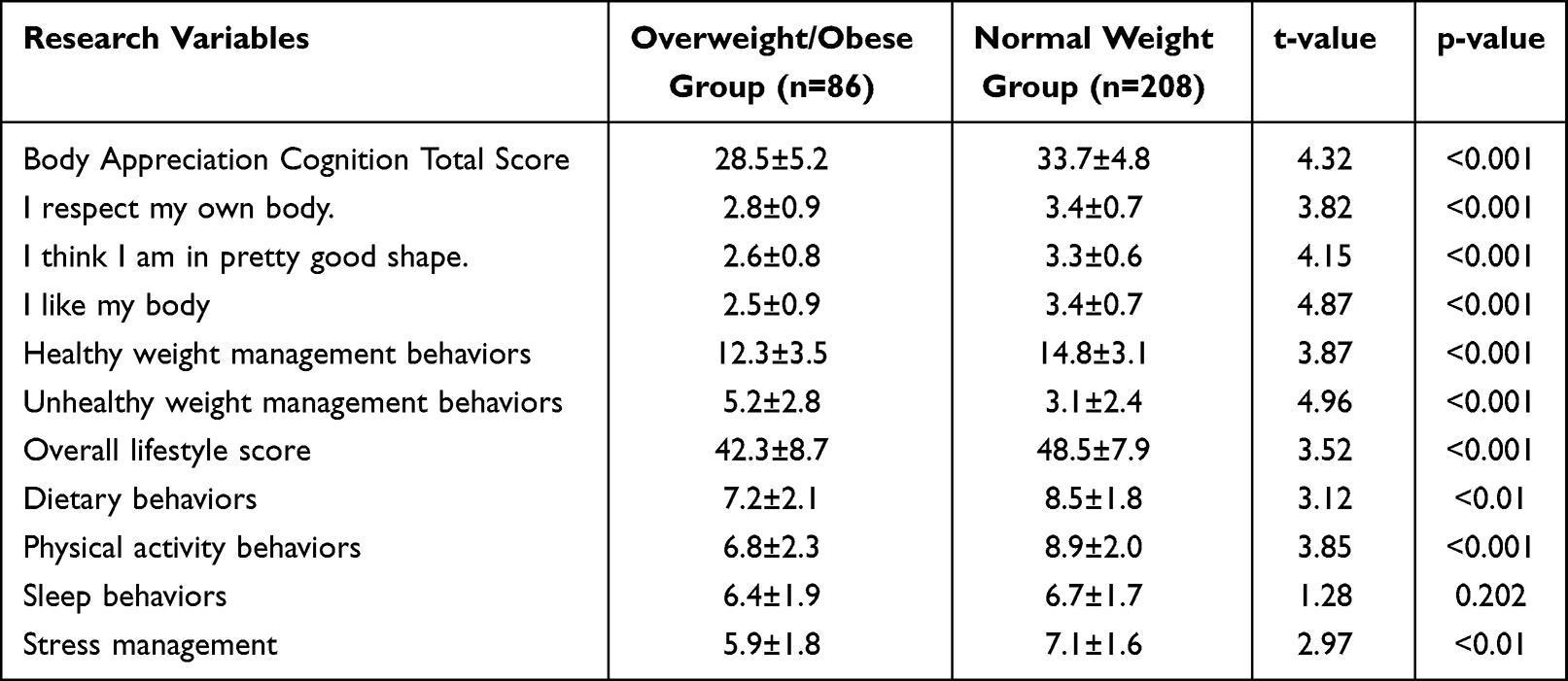 |
Table 2 The Comparison of Scores for Each Study Variable Between Overweight and Normal-Weight Adolescents ( |

Analysis of Weight Control Behavior Characteristics
With respect to weight control behaviors, the two adolescent groups exhibited distinctly different patterns (Table 2). In terms of healthy weight control behaviors, the overweight group was significantly lower (12.3 ± 3.5) than the normal weight group (14.8 ± 3.1; t = 3.87, p < 0.001), indicating that overweight adolescents employed fewer positive weight management strategies such as regular exercise and healthy eating.18 Conversely, the overweight group showed significantly higher scores (5.2 ± 2.8) than the normal-weight group (3.1 ± 2.4; t = 4.96, p < 0.001) for unhealthy weight control behaviors. This indicates a greater tendency toward rapid weight loss methods harmful to physical and mental health, such as extreme dieting and laxative use. This contradictory pattern of “low healthy behaviors and high unhealthy behaviors” reveals the cognitive and behavioral dilemmas overweight adolescents face in weight management.5
Multidimensional Comparison of Lifestyle
A comparison of total lifestyle scores revealed that overweight adolescents exhibited significantly poorer lifestyle health than their normal-weight peers (42.3 ± 8.7 vs. 48.5 ± 7.9; t = 3.52, p < 0.001). The further dimensional analysis (Table 2) revealed the specific sources of these differences: Overweight adolescents scored significantly lower in both dietary behaviors (7.2±2.1 vs 8.5±1.8; t=3.12, p<0.01) and stress management (5.9±1.8 vs 7.1±1.6; t=2.97, p<0.01). Of these, the most pronounced intergroup difference was observed in exercise behavior (6.8±2.3 vs 8.9±2.0; t=3.85, p<0.001), indicating insufficient physical activity as a core issue in overweight adolescents’ lifestyles. However, there was no significant difference in sleep behavior scores between the two groups (6.4±1.9 vs 6.7±1.7; t=1.28, p=0.202).
The Analysis of Correlations Within Variables
Pearson correlation analysis results (Table 3) reveal the complicated and close relationship among various variables. The perception of body appreciation showed a significant positive correlation with healthy weight control behaviors (r = 0.42, p < 0.001) and healthy lifestyle practices (r = 0.38, p < 0.001), while exhibiting a significant negative correlation with unhealthy weight control behaviors (r = −0.35, p < 0.001) and BMI (r = −0.32, p < 0.001). This implicated that adolescents with more positive body evaluations tended to adopt healthier weight management practices and lifestyles, while also maintaining lower BMI levels. Furthermore, there was a significant negative correlation between healthy weight control behaviors and BMI (r = −0.29, p < 0.001), which further confirmed the positive significance of healthy behaviors for weight management.
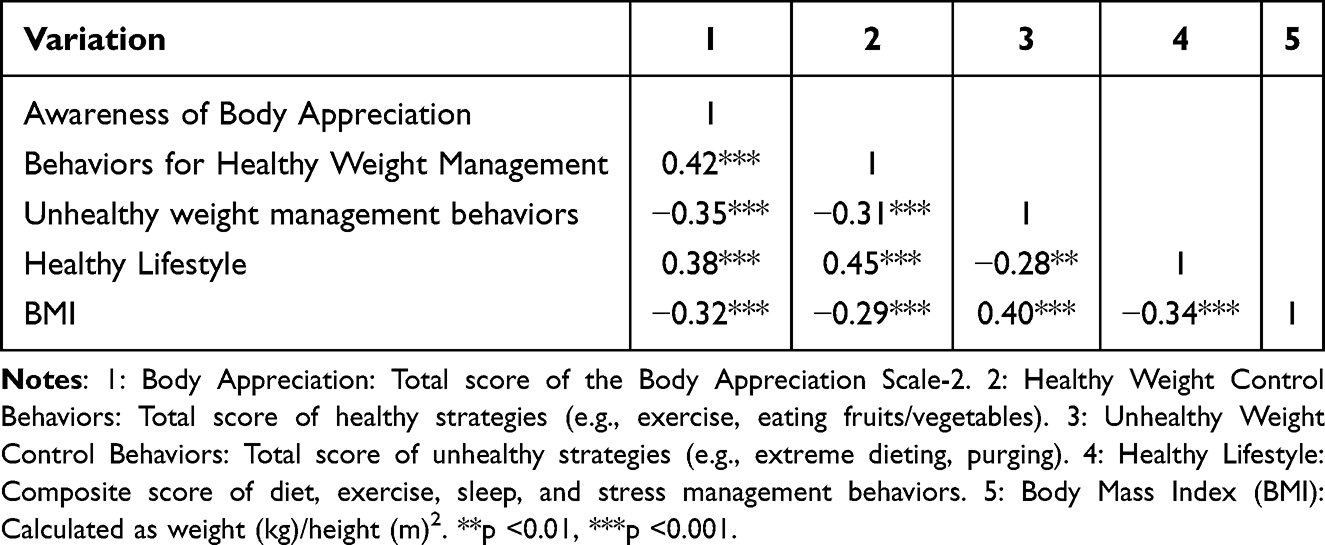 |
Table 3 The Pearson Correlation Matrix for Each Study Variable (r Values) |
The Path Analysis Examining the Influence of Body Appreciation Cognition on BMI
To delve deeper into the underlying mechanisms among variables, this study constructed a structural equation model for path analysis (Figure 1). The model analysis revealed that body appreciation cognition not only exerted a significant direct negative effect on BMI (standardized path coefficient β = −0.18, p < 0.01) but also indirectly influenced BMI through the partial mediating effect of healthy weight control behaviors (indirect effect β = −0.12, p < 0.05). This suggested that adolescents with higher body appreciation tended to have lower BMI levels, with this protective effect partially mediated by their adoption of more healthy weight control behaviors. The model fit indices of this theoretical model all met ideal standards (χ2/df = 2.36, CFI = 0.94, TLI = 0.92, RMSEA = 0.06), demonstrating good model-data fit. The proposed “cognitive-behavioral-physiological” pathway in this study is supported by empirical data.
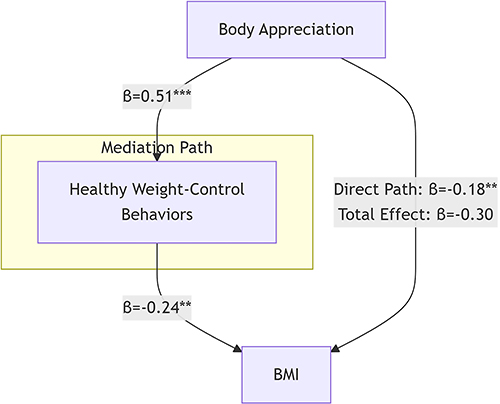 |
Figure 1 Structural equation model illustrating the mediating role of healthy weight control behaviorsThis path model depicts the relationships between body appreciation cognition, healthy weight control behaviors, and Body Mass Index (BMI) among adolescents. Standardized path coefficients (β) are shown. The solid arrow represents the significant direct effect of body appreciation on BMI. The dashed arrows indicate the significant indirect mediation pathway, where body appreciation is associated with higher engagement in healthy weight control behaviors, which in turn is associated with lower BMI. The total effect of body appreciation on BMI is also presented. ** p < 0.01, *** p < 0.001. |
The Multiple Regression Analysis of Factors Influencing Overweight Risk
To clarify the independent predictive roles of various factors on overweight (using BMI as the continuous dependent variable), a multiple linear regression analysis was conducted. Gender, grade level, boarding status, body appreciation cognition, healthy and unhealthy weight control behaviors, and total lifestyle score were included as independent variables in the model.
The regression model was significantly significant overall (F(7, 286) = 15.38, p < 0.001), with an adjusted R2 of 0.254, indicating that these variables collectively explained 25.4% of the variance in BMI. The regression coefficients and significance levels for each independent variable are presented in Table 4.
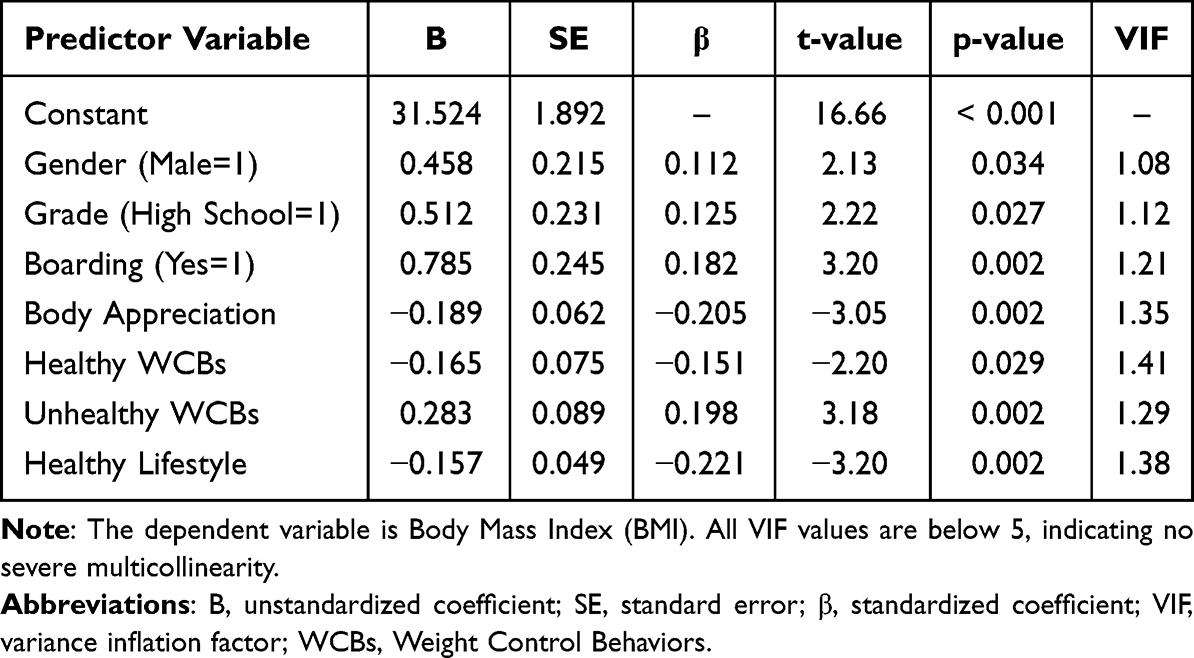 |
Table 4 Multiple Linear Regression Analysis of Factors Influencing BMI in Adolescents (n=294) |
Discussion
This study investigated the cognitive and behavioral characteristics of overweight adolescents using a multidimensional behavioral scoring system, revealing significant deficiencies in the body appreciation cognition, weight control behaviors, and lifestyle habits of overweight adolescents. In particular, overweight adolescents had significantly lower body appreciation cognition levels than their normal-weight peers, scoring notably lower on core items such as “respecting one’s own body,” “accepting one’s own physique,” and “liking one’s own body.” This finding was consistent with the results of Tylka and Wood-Barcalow (2015), further confirming the close association between overweight status and body dissatisfaction.4 Negative body images may stem from the narrow societal definition of the “ideal body type” and pervasive weight stigma, leading overweight adolescents to internalize negative body stereotypes and subsequently develop body dissatisfaction and low self-esteem. This finding underscores the importance of incorporating body appreciation and acceptance components into health promotion programs. Adolescents should be supported in developing a functional perspective on their bodies rather than one focused solely on appearance, moving beyond an exclusive emphasis on weight reduction.5
With regard to weight control behaviors, overweight adolescents exhibited a pattern characterized by “high unhealthy behaviors and low healthy behaviors.” This paradoxical behavior pattern reflected their predicament in weight management. On one hand, they might resort to extreme measures due to an urgent desire to alter their weight status; on the other hand, the lack of healthy behavioral habits and insufficient self-efficacy made it difficult for them to adhere to long-term, effective weight management strategies.14 This situation suggests that interventions must simultaneously address reducing unhealthy behaviors and establishing healthy ones, helping adolescents find balanced, sustainable weight management approaches.3,7 Notably, overweight adolescents scored significantly lower in stress management, potentially indicating a greater tendency to cope with stress through eating. This further exacerbates weight issues, creating a vicious cycle.19,20
This study identified a pathway through which body appreciation cognition may be associated with weight status via its relationship with healthy weight control behaviors by structural equation modeling. This finding has important theoretical significance and practical value. Theoretically, it supports the applicability of cognitive behavioral theory in the field of weight management, illustrating a potential pathway linking cognitive factors influence physiological indicators through behavioral mechanisms.6,10 Practically, the identification of this pathway helps identify precise targets for developing targeted interventions. It suggests that we should simultaneously focus on cognitive restructuring and behavioral change, and may promote the adoption of healthy weight control behaviors by potentially enhancing body appreciation.16,21
The multidimensional health behavior promotion model based on research findings, with CBT at its core, possesses a solid theoretical foundation and empirical support. It has four core components - cognitive restructuring, behavioral activation, self-monitoring, and relapse prevention - which address key issues that overweight adolescents face, creating a comprehensive intervention system.5,10,18 From a practical perspective, this model can be readily adapted for implementation in schools, communities, and clinical settings. School counselors can integrate cognitive restructuring techniques into health education curricula, while community programs can incorporate behavioral activation through structured physical activities. The relapse prevention component is particularly valuable for sustaining long-term behavior change, addressing a critical gap in traditional interventions that often lack follow-up support. The future research can explore different intervention formats, such as comparing the cost-effectiveness and efficacy of group versus individual CBT, or developing mobile health-based CBT interventions to expand accessibility.22,23 The cognitive restructuring component aimed to help adolescents identify and alter negative automatic thoughts about weight, body shape, and self, fostering more realistic and positive cognitive patterns.5,21 The behavioral activation component assisted adolescents in gradually increasing healthy behaviors and reducing unhealthy ones through specific behavioral techniques.18 The self-monitoring component developed the self-awareness skills necessary to inform cognitive restructuring and behavioral adjustments.24 The relapse prevention component focused on long-term maintenance, equipping adolescents to cope with challenges and setbacks.8 This model has similarities with the adolescent weight management CBT program proposed, but its distinctive feature was that it placed greater emphasis on the centrality of body appreciation and integrated the results of multidimensional behavioral assessments, making the intervention content more precise and comprehensive.4,12
Multiple regression analysis provided crucial empirical evidence to construct intervention models from the perspective of predictive factors. The analysis not only revalidated body appreciation cognition, healthy weight control behaviors, and healthy lifestyles as protective factors for weight, but also revealed a highly noteworthy finding: unhealthy weight control behaviors were independent risk factors for BMI.14 It is noteworthy that emotional and psychological states, such as depressive symptoms, may interact with unhealthy weight control behaviors to jointly influence weight outcomes, a factor that should be considered when designing interventions.25 This suggested that for adolescents who had already adopted extreme weight loss methods, their behaviors were not effective and could potentially disrupt normal metabolism or lead to later binge eating, ultimately exacerbating weight issues.19 Therefore, the correction of unhealthy weight control behaviors was equally important, if not more urgent, than the promotion of healthy behaviors in interventions.20 In addition, the identification of males, high school students, and boarding students as high-risk groups for overweight suggested that future health promotion programs should prioritize these populations and develop more targeted strategies.1
The strength of this study is that the study employs a multidimensional assessment system to comprehensively examine cognitive and behavioral factors, and constructs theoretical models based on empirical data to provide precise targets for intervention development.12 Moreover, the sample possesses a certain degree of representativeness, resulting in good generalizability of findings. Furthermore, the statistical methods are rigorous, utilizing both correlation analysis and structural equation modeling to explore variable relationships.17
However, the study also has several limitations: it was impossible to establish causality due to the cross-sectional design; the sample source was relatively limited; the sample mainly came from schools in the same region; some scales were self-developed tools; their validity needs further verification; and not all possible mediating and moderating variables, such as social support and school environment factors, were examined.26,27 Additional limitations include potential confounding by unmeasured variables (eg., family socioeconomic status, genetic factors, psychological comorbidities) and the reliance on self-reported measures, which may introduce social desirability bias. The cross-sectional design precludes causal inference, and reverse causality cannot be ruled out. Furthermore, this study did not assess physiological markers such as inflammatory cytokines or metabolic parameters, which have been shown to correlate with obesity and its comorbidities.28 Incorporating such biomarkers in future research could provide a more comprehensive understanding of the mechanisms linking cognitive-behavioral factors to weight-related health outcomes. Future longitudinal studies with objective measures and diverse samples are needed to confirm these findings.
The following practical recommendations are proposed based on the research findings: with regard to school health promotion, body appreciation education and CBT skills training should be integrated into school health curricula to help all adolescents develop positive body image and healthy behavioral patterns, rather than targeting only overweight students.5 Simultaneously, it is critical to create supportive school environments that reduce weight discrimination and bullying. In terms of family involvement, the health promotion program should include parental education components, given that parents’ body concepts and feeding practices significantly influence adolescents’ weight-related cognitions and behaviors.22,29 This helps parents provide a supportive rather than controlling home eating environment. Furthermore, a multi-level intervention strategy is recommended, which incorporates a public health model: at the individual level, provide CBT group interventions; at the group level, conduct body appreciation activities; and at the environmental level, promote improvements in healthy cafeterias and sports facilities to form a multi-level support system.10
Conclusion
This study provides initial evidence for the applicability of a CBT-based health behavior promotion model among overweight adolescents using a multidimensional behavioral scoring system. The study identified a significant deficit in overweight adolescents’ body appreciation cognition, weight control behaviors, and lifestyle habits, with these factors being interrelated and collectively associated with weight status. The body appreciation cognition was found to be directly associated with BMI and also indirectly through its relationship with healthy weight control behaviors, suggesting a potential mediating pathway. The integrated CBT health behavior promotional model developed on this basis comprises four core components: cognitive restructuring, behavioral activation, self-monitoring, and relapse prevention. It is hypothesized that through multidimensional assessment and intervention, this model may help break the vicious cycle of “negative cognition-unhealthy behaviors-weight issues” among overweight adolescents, thereby promoting their comprehensive physical and mental health development. The model offers a practical framework for schools and communities to support overweight adolescents, but findings should be interpreted with caution due to the cross-sectional design and limited sample diversity. Future research should employ longitudinal designs and intervention studies to establish causality and test real-world effectiveness. This study provides a theoretical framework and empirical support for developing effective health promotion programs for overweight adolescents. The future research should develop specific intervention protocols using this model and validate their long-term effects through rigorous experimental designs.
Data Sharing Statement
The datasets used and analyzed during the current study are available from the corresponding author on reasonable request.
Author Contributions
Wu XQ: Conceptualization, Data curation, Formal analysis, Investigation, Methodology, Resources, Software,Validation, Visualization, Writing – original draft;
Xu QY: Data curation, Formal analysis, Investigation, Methodology, Resources, Software, Validation, Visualization, Writing – original draft;
Wu Z: Data curation, Formal analysis, Investigation, Methodology, Resources, Software, Validation, Visualization, Writing – original draft;
Zheng LZ: Conceptualization, Investigation, Methodology, Project administration, Resources, Software, Supervision, Writing – review & editing;
All authors took part in drafting, revising or critically reviewing the article; gave final approval of the version to be published; have agreed on the journal to which the article has been submitted; and agree to be accountable for all aspects of the work.
Funding
The authors declare that no funding was received for this study.
Disclosure
All of the authors had no any personal, financial, commercial, or academic conflicts of interest separately.
References
1. Broadbent P, Shen Y, Pearce A, et al. Trends in inequalities in childhood overweight and obesity prevalence: a repeat cross-sectional analysis of the Health Survey for England. Arch Dis Child. 2024;109(3):233–11. doi:10.1136/archdischild-2023-325844
2. Kadhim H, Saad Kadhim A. Exploring the association between obesity, inflammation, and type ii diabetes: insights from body mass index correlation and immune response analysis. Al-Nahrain J. Sci. 2024;27(3):50–55. doi:10.22401/ANJS.27.3.06
3. Laws R, Love P, Hesketh KD, et al. Protocol for an effectiveness-implementation hybrid trial to evaluate scale up of an evidence-based intervention addressing lifestyle behaviours from the start of life: INFANT. Front Endocrinol. 2021;12:717468. doi:10.3389/fendo.2021.717468
4. Levinson JA, Kinkel-Ram S, Myers B, et al. A systematic review of weight stigma and disordered eating cognitions and behaviors. Body Image. 2024;48:101678. doi:10.1016/j.bodyim.2023.101678
5. Cole G. The trans-theoretical model for mindful cognitive behavioral therapy a paradigm for systematically advancing evidence-based practice and research. Cogent Psychol. 2022;9:2080320. doi:10.1080/23311908.2022.2080320
6. Ramalho SM, Saint-Maurice PF, Silva D, et al. Feasibility and effectiveness of a social network-based intervention for adolescents undergoing weight loss treatment: a randomized controlled trial. Nutrients. 2025;17(16):2586. doi:10.3390/nu17162586
7. Skjåkødegård HF, Danielsen YS, Morken M, et al. Study Protocol: a randomized controlled trial evaluating the effect of family-based behavioral treatment of childhood and adolescent obesity-The FABO-study. BMC Public Health. 2016;16(1):1106. doi:10.1186/s12889-016-3755-9
8. Göhner W, Schlatterer M, Seelig H, et al. Two-year follow-up of an interdisciplinary cognitive-behavioral intervention program for obese adults. J Psychol. 2012;146(4):371–391. doi:10.1080/00223980.2011.642023
9. Halder S, Mahato AK. Cognitive behavior therapy for children and adolescents: challenges and gaps in practice. Indian J Psychol Med. 2019;41(3):279–283. doi:10.4103/IJPSYM.IJPSYM_470_18
10. de Lara Perez B, Delgado-Rios M. Mindfulness-based programs for the prevention of childhood obesity: a systematic review. Appetite. 2022;168:105725. doi:10.1016/j.appet.2021.105725
11. Biggs BK, Rodgers KV, Nayman SJ, et al. Translation of a family-based behavioral intervention for adolescent obesity using the RE-AIM framework and common steps from adaptation frameworks. Transl Behav Med. 2023;13(9):700–709. doi:10.1093/tbm/ibad022
12. Pbert L, Druker S, Barton B, et al. A school-based program for overweight and obese adolescents: a randomized controlled trial. J Sch Health. 2016;86(10):699–708. doi:10.1111/josh.12428
13. Price M, Higgs S, Lee M. Self-control mediates the relationship between time perspective and BMI. Appetite. 2017;108:156–160. doi:10.1016/j.appet.2016.09.034
14. Hilbert A, Petroff D, Herpertz S, et al. Meta-analysis of the efficacy of psychological and medical treatments for binge-eating disorder. J Consult Clin Psychol. 2019;87(1):91–105. doi:10.1037/ccp0000358
15. Jelalian E, Lloyd-Richardson EE, Mehlenbeck RS, et al. Behavioral weight control treatment with supervised exercise or peer-enhanced adventure for overweight adolescents. J Pediatr. 2010;157(6):923–928.e1. doi:10.1016/j.jpeds.2010.05.047
16. Tylka TL, Wood-Barcalow NL. The body appreciation scale-2: item refinement and psychometric evaluation. Body Image. 2015;12:53–67. doi:10.1016/j.bodyim.2014.09.006
17. Gou H, Song H, Tian Z, et al. Prediction models for children/adolescents with obesity/overweight: a systematic review and meta-analysis. Prev Med. 2024;179:107823. doi:10.1016/j.ypmed.2023.107823
18. Tsiros MD, Sinn N, Brennan L, et al. Cognitive behavioral therapy improves diet and body composition in overweight and obese adolescents. Am J Clin Nutr. 2008;87(5):1134–1140. doi:10.1093/ajcn/87.5.1134
19. Goldschmidt AB, Jeong K, Yu L, et al. Executive functioning and treatment outcome among adolescents undergoing cognitive-behavioral therapy for binge-eating disorder. J Child Psychol Psychiatry. 2025;66(1):64–74. doi:10.1111/jcpp.14031
20. Drenowatz C, Greier K. Integrating diet and exercise for effective weight management-synergistic strategies for a complex challenge. Nutrients. 2025;17(21):3423. doi:10.3390/nu17213423
21. Lydecker JA, Ozbardakci EV, Lou R, et al. Trauma-focused cognitive-behavioral therapy for adolescents bullied because of weight: a feasibility study. Int J Eat Disord. 2024;57(10):2117–2127. doi:10.1002/eat.24257
22. Cha JY, Kim SY, Lim YW, et al. Comparative effectiveness of cognitive behavioral therapy and behavioral therapy in obesity: a systematic review and network meta-analysis. J Clin Psychol Med Settings. 2025;32(1):96–110. doi:10.1007/s10880-023-10000-6
23. Vidmar AP, Salvy SJ, Pretlow R, et al. An addiction-based mobile health weight loss intervention: protocol of a randomized controlled trial. Contemp Clin Trials. 2019;78:11–19. doi:10.1016/j.cct.2019.01.008
24. Healey P, Stager ML, Woodmass K, et al. Cultural adaptations to augment health and mental health services: a systematic review. BMC Health Serv Res. 2017;17(1):8. doi:10.1186/s12913-016-1953-x
25. Teixeira CV, Cuesta MGS, Gil SDS, et al. Cognitive behavioral approach to treat obesity: a randomized clinical trial. Front Nutr. 2021;8:611217. doi:10.3389/fnut.2021.611217
26. Tabbakh T, Freeland-Graves J. Development and validation of the Multidimensional Home Environment Scale (MHES) for adolescents and their mothers. Eat Behav. 2016;22:76–82. doi:10.1016/j.eatbeh.2016.03.031
27. Minjie Z, Zhijuan X, Xinxin S, et al. The effects of cognitive behavioral therapy on health-related quality of life, anxiety, depression, illness perception, and in atrial fibrillation patients: a six-month longitudinal study. BMC Psychol. 2023;11(1):431. doi:10.1186/s40359-023-01457-z
28. S KA, S A-KA. Investigating the multifactorial correlation between obesity and rheumatoid arthritis: a study of immunological and biochemical markers. Obesity Medicine. 2025;53:100578. doi:10.1016/j.obmed.2024.100578
29. Bean MK, LaRose JG, Wickham EP 3rd, et al. The role of parents in behavioral treatment for adolescent obesity: design and rationale for the TEENS+ randomized clinical trial. BMC Public Health. 2023;23(1):1484. doi:10.1186/s12889-023-16421-0
 © 2026 The Author(s). This work is published and licensed by Dove Medical Press Limited. The
full terms of this license are available at https://www.dovepress.com/terms
and incorporate the Creative Commons Attribution
- Non Commercial (unported, 4.0) License.
By accessing the work you hereby accept the Terms. Non-commercial uses of the work are permitted
without any further permission from Dove Medical Press Limited, provided the work is properly
attributed. For permission for commercial use of this work, please see paragraphs 4.2 and 5 of our Terms.
© 2026 The Author(s). This work is published and licensed by Dove Medical Press Limited. The
full terms of this license are available at https://www.dovepress.com/terms
and incorporate the Creative Commons Attribution
- Non Commercial (unported, 4.0) License.
By accessing the work you hereby accept the Terms. Non-commercial uses of the work are permitted
without any further permission from Dove Medical Press Limited, provided the work is properly
attributed. For permission for commercial use of this work, please see paragraphs 4.2 and 5 of our Terms.
Recommended articles
Body Mass Index Profile and Its Association with Social Determinants Among Adolescents from Jazan, Saudi Arabia
Gosadi IM, Abualgasem MM, Sultan YA, Bakri MY, Ageeli AM, Kaal AA, Khmees RA
International Journal of General Medicine 2023, 16:6151-6162
Published Date: 27 December 2023
Non-Cognitive Behavioral Therapy Psychological Interventions May Not Make the Difference in Children and Adolescents With Chronic Pain
Perlman L, Malka N, Terry O, Nguyen A, Guimarães Ferreira Fonseca L, Ingelmo JI, Ingelmo P
Journal of Pain Research 2025, 18:1451-1464
Published Date: 20 March 2025