
Back to Journals » Diabetes, Metabolic Syndrome and Obesity » Volume 18
Association Between GGT/HDL-C Ratio and Diabetic Kidney Disease in Patients with Type-2 Diabetes Mellitus
Authors Teng C, Lin H, Xu J  , Wu X
Received 12 November 2025
Accepted for publication 19 December 2025
Published 31 December 2025 Volume 2025:18 Pages 4859—4871
DOI https://doi.org/10.2147/DMSO.S581025
Checked for plagiarism Yes
Review by Single anonymous peer review
Peer reviewer comments 2
Editor who approved publication: Dr Rebecca Baqiyyah Conway
Chenhuai Teng,1,* Hao Lin,2,* Jing Xu,3 Xiaoying Wu3
1Department of Emergency Medicine, The Second Affiliated Hospital and Yuying Children’s Hospital of Wenzhou Medical University, Wenzhou, People’s Republic of China; 2Department of Gastroenterology, Pingyang Hospital of Wenzhou Medical University, Wenzhou, People’s Republic of China; 3Department of Endocrinology, The Second Affiliated Hospital and Yuying Children’s Hospital of Wenzhou Medical University, Wenzhou, People’s Republic of China
*These authors contributed equally to this work
Correspondence: Xiaoying Wu, The Second Affiliated Hospital and Yuying Children’s Hospital of Wenzhou Medical University, Lucheng District, Wenzhou, Zhejiang, People’s Republic of China, Email [email protected]
Purpose: The ratio of gamma-glutamyl transferase (GGT) to high-density lipoprotein cholesterol (HDL-C) (GHR) represents a novel non-insulin-based biomarker for evaluating the risk of NAFLD and T2DM. However, its correlation with diabetic kidney disease (DKD) remains unexplored. This study aims to explore the association between GHR and DKD in patients with T2DM.
Patients and Methods: In this cross-sectional study, 2798 patients diagnosed as T2DM admitted to the hospital from 2018 to 2023 were assessed. The analysis was conducted through restricted cubic spline (RCS) and logistic regression methodologies, complemented by additional stratified and interaction analyses.
Results: As the quartiles of GHR increase, there is a notable increase in the prevalence of DKD, with the rates of 43.2%, 47.2%, 52.1%, and 57.4%, respectively. Logistic regression analysis showed a positive association between GHR and DKD (OR=1.17, 95% CI: 1.05– 1.30), which was consistently observed across all subgroups through stratified analysis. RCS analysis identified an inverted L-shaped association, with an inflection point at 84.5. Additionally, AUC for GHR (AUC = 0.637, 95% CI: 0.616– 0.657) was significantly higher compared to those of GGT and HDL alone.
Conclusion: GHR exhibits a positive association with the risk of DKD, underscoring its potential utility as a cost-effective biomarker for stratifying the risk of DKD.
Keywords: diabetic kidney disease, GHR, insulin resistance, TyG, type 2 diabetes mellitus
A Letter to the Editor has been published for this article.
Introduction
DKD represents a major long-term complication of diabetes mellitus (DM), distinguished by the presence of proteinuria and the gradual progression to renal failure.1,2 The global incidence of DM is on an upward trajectory, with projections indicating that approximately 537 million adults worldwide were afflicted by DM as of 2021, a number anticipated to escalate to 783 million by 2045.3 DKD has been recognized as the predominant cause of end-stage renal disease and CKD, necessitating transplantation or dialysis on a global scale.4 Approximately 30% to 40% of individuals diagnosed as DM eventually experience DKD, and the occurrence of DKD is on an upward trajectory.5 DKD significantly contributes to the global disease burden and presents considerable healthcare security and socio-economic challenges.4 Consequently, early intervention in patients with DM to mitigate the risk of DKD is of paramount importance.
Insulin resistance (IR) is characterized by a diminished cellular responsiveness to insulin, leading to decreased efficacy in insulin-mediated glucose utilization and uptake. Subsequent research has elucidated the pivotal role of IR in the pathogenesis of diabetes, with its correlation to DKD garnering heightened scholarly interest.6–8 Numerous clinical studies have established a robust association between the severity of IR and elevated microalbuminuria, as well as a marked reduction in eGFR among diabetic patients.9–11 The hyperinsulinemic euglycemic clamp (HIEC) is currently regarded as the gold standard for evaluating IR; however, its extensive time requirements and significant economic cost restrict its widespread application in clinical settings.12
GGT is an enzyme that plays a role in amino acid metabolism and is inducible under certain physiological conditions.13 Predominantly originating from the hepatobiliary system, serum GGT is extensively utilized in clinical settings as a sensitive, albeit nonspecific, marker for assessing liver function impairment.14 Numerous prospective studies have established a correlation between GGT levels and IR, identifying elevated GGT as an independent risk factor for DKD.15–18 Research indicates that HDL-C can improve β-cell function and enhance glucose uptake, with diminished levels of HDL-C being indicative of impaired β-cell function and IR.19,20 Moreover, numerous studies have shown a correlation between reduced HDL-C levels and an elevated risk of diabetes and DKD.21,22 Numerous studies have demonstrated that the GHR serves as a robust predictor for the prevalence of MASLD, metabolic syndrome (MetS), T2DM, and cardiovascular disease (CVD), exhibiting significantly greater predictive efficacy compared to individual indicators.23–27 Nonetheless, the association between GHR and DKD remain unexplored.
Considering the established correlation between HDL-C, GGT, IR, and DKD, it is imperative to investigate the relationship between the GHR and DKD. The objective is to identify novel clinical indicators for early screening, thereby contributing to improved prevention and management strategies for DKD. The study hypothesizes that GHR, which integrates HDL-C levels and GGT, will exhibit superior predictive performance for DKD compared to the GGT or HDL-C alone.
Materials and Methods
Research Subjects
A total of 3,960 patients with T2DM were initially screened at the Second Affiliated Hospital of Wenzhou Medical University from September 2018 to May 2023. Exclusion criteria included preexisting conditions such as hypogonadism, chronic renal failure, hypopituitarism, exposure to radiation therapy, chronic alcoholism, or chronic liver disease.
Exclusion criteria were: (1) individuals younger than 18 years old, (2) those with incomplete data, including urinary albumin-to-creatinine ratio (UACR), GHR, and eGFR, (3) those with terminal malignancies, (4) pregnant females, and (5) those with incomplete covariate data. Consequently, 2798 patients were included in the final analysis (see Figure 1).
 |
Figure 1 The flow chart of the study. |
Data Collection
Trained interviewers gathered extensive clinical data from all subjects according to institutional electronic medical records, followed by standardized protocols. Demographic variables, including age and gender, were analyzed. Medical variables included the duration of DM, presence of hyperuricemia, hypertension, CHD, stroke, and dyslipidemia, while lifestyle factors encompassed smoking, alcohol abuse, and lipid-lowering drugs use. Physical examination metrics, such as weight, height, and blood pressure, were recorded. Laboratory assessments comprised measurements of fasting plasma glucose (FPG), total triglycerides (TG), AST, HDL-C, ALT, LDL-C, creatinine, GGT, cholesterol (TC), albumin, uric acid, and UACR, all conducted at the respective hospitals.
eGFR was conducted with the formula developed by the Chronic Kidney Disease Epidemiology Collaboration.28
Definition of GHR, TyG, and DKD
GHR=GGT (U/L)/HDL (mmol/L).
TyG = Ln[FPG×TG/2]29
DKD was diagnosed in patients with T2DM by identifying those with UACR greater than 30 mg/g and/or eGFR less than 60 mL/min/1.73 m2.28
Statistical Analysis
Data normally distributed and skewed were presented as mean±SD and medians with interquartile ranges (IQR), respectively. These data were compared through Kruskal–Wallis H-tests and one-way ANOVA, respectively. Categorical data were expressed as percentages and frequencies, and were analyzed through GHR quartiles using chi-square (χ2) tests. To explore the association between GHR and DKD, univariate and multivariate binary logistic regression analyses were employed, incorporating three levels of adjustment: Model 1 was unadjusted; Model 2 was adjusted for gender and age; and Model 3 included further adjustments for ALT, AST, FPG, albumin, uric acid, SBP, DBP, BMI, CHD, hyperlipidemia, stroke, smoking status, drinking status, duration of DM, and lipid-lowering drugs use. To explore the potential nonlinear association between GHR and DKD, RCS models were utilized. Effect modifications were explored through interaction and subgroup analyses based on variables such as gender, age (<60 years old or ≥60 years old), HbA1c (<9% or ≥9%), BMI, and the presence of hypertension, hyperlipidemia, and hyperuricemia. The prognostic performance of three biomarkers was assessed through ROC curves including: GHR, GGT, and HDL. For sensitivity analyses, subjects were divided into KDIGO risk categories based on combined values of UACR and eGFR, classified as moderate, low, very high, and high risk.30 Furthermore, they were further divided into very high risk, moderate risk, low risk, and high risk. All statistical analyses were performed with R software (version 4.2.2).
Results
Baseline Characteristics
The study encompassed a cohort of 2798 patients diagnosed with T2DM, among whom 1399 individuals were identified with DKD, while 1399 individuals did not present with DKD (see Table 1). Table 1 delineates the characteristics of the research population, stratified according to quartiles of GHR. Participants in the highest GHR quartile demonstrated a greater prevalence of DKD, CHD, hyperlipidemia, hypertension, and hyperuricemia. Additionally, this group had a higher proportion of males and smokers, as well as elevated levels of SBP, DBP, ALT, AST, TG, uric acid, GGT, creatinine, and UACR, compared to those in the lowest quartile. In contrast, HDL-C was significantly lower in the highest quartile (p<0.01) (Table 1).
 |
Table 1 Baseline Characteristics Participants |
Association Between GHR and DKD
The findings of this study demonstrate that an increased GHR is associated with an increased probability of DKD, as illustrated in Table 2. Upon controlling for all covariates, the positive association between GHR and the incidence of DKD remained statistically significant (Model 3: OR=1.17, 95% CI: 1.05–1.30). When GHR was stratified into quartiles, a consistent positive association with the prevalence of DKD was evident. In Model 3, subjects in the highest GHR quartile exhibited a 68% higher probability of DKD compared to those in the lowest quartile (OR=1.68, 95% CI: 1.25–2.25).
 |
Table 2 Logistic Regression Analysis for the Association Between GGT/HDL Ratio and the Risk of DKD |
Figure 2 illustrates the presence of an inverted L-shaped association between GHR and DKD, with the inflection point at 84.5. When GHR ≤84.5, the risk of DKD increased by 101% for every 1 SD increase in GHR (OR = 2.01, 95% CI: 1.05–1.18). However, when GHR >84.5, this positive association was not detected (OR =1.05, 95% CI: 0.90–1.23) (Table 3).
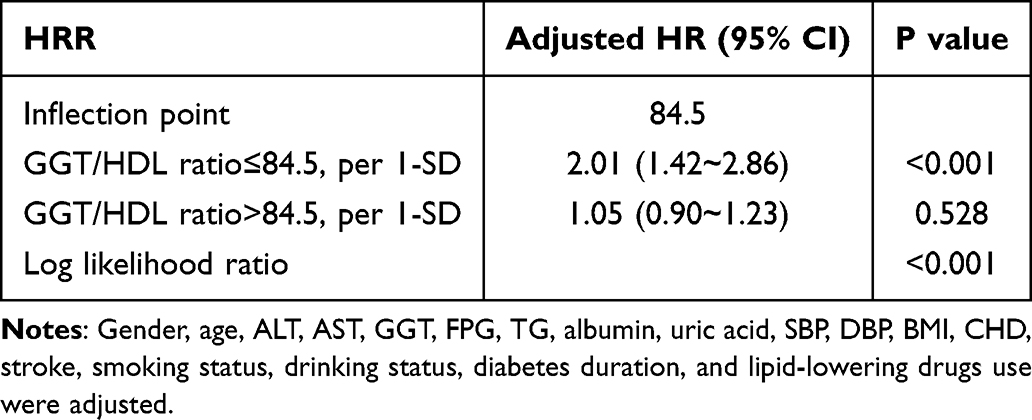 |
Table 3 Threshold Effect Analysis of GGT/HDL Ratio on DKD Using the Two-Piecewise Logistic Regression Model |
 |
Figure 2 The nonlinear association between GHR and DKD.The result was based on Model 3, which is adjusted for age, gender, ALT, AST, FPG, albumin, uric acid, SBP, DBP, BMI, CHD, hyperlipidemia, stroke, smoking status, drinking status, duration of DM, and lipid-lowering drugs use. |
Subgroup Analysis
The potential effect modification was explored through subgroup analyses by demographic variables, including age, BMI, gender, and HbA1c, as well as comorbid conditions such as hypertension, hyperlipidemia, and hyperuricemia. The association between the risk of DKD and GHR was generally consistent across most subgroups (Figure 3, P for interaction>0.05).
 |
Figure 3 Subgroup analysis of the GHR and DKD among T2DM patients. Adjusted variables: age, gender, ALT, AST, FPG, albumin, uric acid, SBP, DBP, BMI, CHD, hyperlipidemia, stroke, smoking status, drinking status, duration of DM, and lipid-lowering drugs use. |
Mediation Analysis
The mediation analysis, depicted in Figure 4, reveals that TyG partially mediated the association between GHR and DKD. Specifically, TyG contributed to 26.6% of the association with DKD.
 |
Figure 4 Mediation analysis of TyG in the association between GHR and DKD. Notes: GHR was defined as the independent variable; DKD as the dependent variable; and TyG as the mediating variable. |
Diagnostic Efficacy of GHR for DKD
The diagnostic efficacy of GHR, GGT, and HDL for DKD, was evaluated through a ROC curve analysis (see Figure 5). The findings indicate that the overall predictive value of GHR surpassed that of GGT, and HDL, with the statistical significance (p < 0.05, see Table 4).
 |
Table 4 The AUC for Each Index to Discriminate DKD |
 |
Figure 5 ROC analysis of GHR, GGT, HDL to DKD among T2DM patients. |
Sensitivity Analysis
To support the findings, sensitivity analyses were conducted. The DKD patients were divided into four stages according to KDIGO risk categories: very high, moderate, low, and high risk. As the risk severity of KDIGO increased, GHR exhibited a gradual increasing trend (p < 0.001, see Figure 6). Additionally, the proportion of patients classified in the very high-risk category increased with higher GHR quartiles (see Figure 7).
 |
Figure 6 GHR levels across KDIGO risk categories in patients with T2DM. |
 |
Figure 7 Distribution of KDIGO risk categories across quartiles of GHR. |
Table 5 illustrated the association between GHR and DKD stages. After adjusting for potentially significant confounders, it was observed that an increase in GHR was associated with a significant increase the risk of DKD within high risk, moderate risk, and very high-risk groups (p < 0.01).
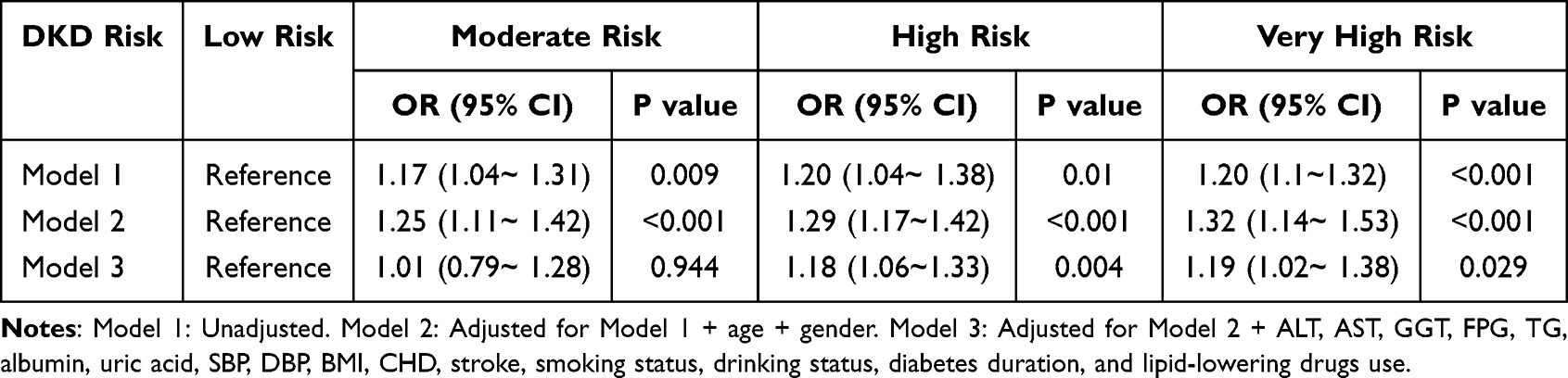 |
Table 5 Effect-Size Estimates of GGT/HDL Ratio with KDIGO Risk Categories of DKD |
Discussion
This study explored the association between GHR and DKD in patients with T2DM. The findings revealed a significant positive association between GHR and DKD. This relationship remains consistent regardless of age, BMI, gender, HbA1c, hypertension, hyperlipidemia, and hyperuricemia. Furthermore, ROC analysis indicated that GHR possesses superior predictive capabilities for DKD compared to GGT and HDL-C individually. These results suggest that GHR may serve as a simple and cost-effective biomarker for identifying patients with T2DM at an increased risk for DKD.
IR is not only a fundamental pathophysiological characteristic of diabetes but also plays a critical role in the progression and onset of DKD.11,31 IR contributes to the pathogenesis of DKD through multiple biological mechanisms, including oxidative stress,32,33 heightened inflammatory responses,34,35 facilitation of extracellular matrix accumulation,36 and endothelial dysfunction.37,38 These processes collectively result in significant alterations in renal structure and function. GGT is a widely utilized biomarker for evaluating liver function and is frequently employed in the assessment of hepatic injury. Research has demonstrated that GGT serves as a sensitive indicator of IR in adults, with serum GGT levels acting as an independent predictor of the HOMA-IR.39 Epidemiological research has also confirmed a link between high GGT levels and the occurrence of MetS, though this connection is influenced by the extent of IR.40 Moreover, a cross-sectional study in China found a notable positive relationship between GGT levels and DKD.41 Furthermore, research has shown a strong link between lipid metabolism issues and DKD, suggesting that high TC and LDL levels, combined with low HDL levels, are linked to an increase DKD risk.42
The GHR is a newly established metric used to evaluate NAFLD and is linked to diseases related to IR.23 In a longitudinal study, Jung et al identified the GHR as a significant predictor of CVD risk in females, with a stronger correlation observed in urban populations compared to rural ones.25 Additional longitudinal studies with 15,453 Japanese individuals showed that a higher GHR predicts the onset of T2DM.43 Zhao et al expanded on these findings, revealing a curvilinear relationship between the GHR and T2DM risk.44 Gong et al identified the GHR as a significant predictor of MetS risk in patients with T2DM through a cross-sectional study.27 Additionally, a recent retrospective cohort study has highlighted the GHR as a prognostic marker for MetS remission in adults who have undergone sleeve gastrectomy.23 Collectively, the extant literature suggests an association between elevated GHR and an increased risk of T2DM, NAFLD, MetS, and CVD. To our knowledge, no research has explored the link between the GHR and DKD risk. Our results indicate that a higher GHR correlates with an increased DKD risk in T2DM patients.
An increased GGT level can indicate hepatic steatosis, whereas a decreased HDL level is linked to dyslipidemia and IR. This suggests that the GHR may integrate the individual functions of HDL-C and GGT. To evaluate the diagnostic efficacy of the GHR for DKD, we conducted ROC curve analyses. Our findings indicated that the AUC for the GHR was significantly greater than those for HDL or GGT alone, demonstrating a high diagnostic value (AUC: 0.637). The GHR may help predict the occurrence of DKD. Additionally, since GGT and HDL are standard tests in clinical labs, they are easy to perform and cost-effective, suggesting promising applications of the GHR in T2DM patients.
The analyses identified a significant non-linear association between GHR and the risk of DKD, marked by an inflection point at 84.5. Below this threshold, an elevated GHR was associated with an increased risk of DKD. However, when GHR exceeding 84.5, the effect values were not statistically significant. The influence of additional baseline variables on the risk of DKD among participants cannot be overlooked. It has been observed that patients with T2DM who exhibit higher GHR also tend to present elevated levels or proportions of SBP, DBP, ALT, AST, TG, uric acid, and smoking habits, as detailed in Table 1. These indicators have been closely associated with DKD, as documented in previous studies.45–47 When the GHR exceeds 84.5, the presence of these DKD risk factors diminishes the relative impact of GHR on DKD risk. Conversely, when the GHR is below 84.5, the levels of DKD risk factors such as SBP, DBP, ALT, AST, TG, and uric acid are reduced, thereby attenuating their impact on DKD and consequently enhancing the relative effect of GHR.
To investigate the significant role of IR in the association between GHR and DKD, a mediation analysis was conducted in this study. The results demonstrated that the TyG index served as a mediator in the relationship between GHR and DKD. These findings offer valuable insights for further elucidating the connection between GHR and DKD.
The mechanisms underlying the association between elevated GHR levels and DKD remain inadequately understood. Current hypotheses suggest that this relationship may be linked to IR, dyslipidemia, and oxidative stress within the pathology of DKD.11,16,33,35 Firstly, empirical evidence indicates that elevated GGT levels are associated with metabolic syndrome and IR.23 Given the critical role of IR in the pathogenesis of DKD,11 it is plausible that GGT may influence the progression of DKD through its mediation of IR. Furthermore, oxidative stress is recognized as a pivotal factor in both the progression and initiation of DKD.48 Consequently, the antioxidative activity of HDL may contribute to the pathogenesis of DKD.42 In the context of elevated GHR, the presence of high GGT levels coupled with low HDL-c levels may be associated with the development of DKD.
This study is subject to several limitations. Firstly, because it is a cross-sectional study, causal inferences cannot be made, emphasizing the need for prospective cohort studies to explore the causal association between GHR and DKD. Secondly, the research subjects were patients from hospitals, which might restrict the applicability of the results. Thirdly, despite making adjustments for various potential confounders, factors such as diet, exercise, and medication were not considered, allowing for residual confounding. Ultimately, while this study established robust associations between GHR and DKD, interventional studies are necessary to ascertain whether targeting components of GHR can effectively mitigate the risk of DKD or enhance renal outcomes.
Conclusion
In conclusion, a substantial positive association was identified between GHR and DKD in patients with T2DM. An increased GHR is independently associated with an increased risk of DKD. These findings indicate the potential utility of GHR as a clinical marker for identifying patients at high risk, underscoring the need for targeted interventions to prevent DKD.
Data Sharing Statement
The data that support the findings of this study are available from Institutional Review Board of the second affiliated hospital and Yuying Children’s Hospital of Wenzhou Medical University but restrictions apply to the availability of these data, which were used under license for the current study, and so are not publicly available. Data are however available from the corresponding author upon reasonable request and with permission of Institutional Review Board of the Second Affiliated Hospital and Yuying Children’s Hospital of Wenzhou Medical University.
Ethics Approval and Consent to Participate
This study has obtained the approval from the Ethics Committee of the Second Affiliated Hospital of Wenzhou Medical University (No. LCKY2018-01) and has obtained the written informed consent of all subjects following the Declaration of Helsinki.
Acknowledgments
The authors thank the staff at the Department of Endocrinology, the Second Affiliated Hospital and Yuying Children’s Hospital of Wenzhou Medical University, and all the patients who participated in the study.
Author Contributions
Chenhuai Teng - Writing - original draft, Writing – review & editing, Methodology; Jing Xu - Writing - original draft, Writing – review & editing, Methodology; Hao Lin - Writing - original draft, Writing – review & editing, Conceptualization, Methodology, Formal analysis; Xiaoying Wu - Writing - original draft, Writing – review & editing, Conceptualization, Methodology, Formal analysis. All authors gave final approval of the version to be published; have agreed on the journal to which the article has been submitted; and agree to be accountable for all aspects of the work.
Funding
No funding was received for this study.
Disclosure
The author(s) report no conflicts of interest in this work.
References
1. Umanath K, Lewis JB. Update on diabetic nephropathy: core curriculum 2018. Am J Kidney Dis. 2018;71:884–895. doi:10.1053/j.ajkd.2017.10.026
2. Gupta S, Dominguez M, Golestaneh L. Diabetic kidney disease: an update. Med Clin North Am. 2023;107:689–705. doi:10.1016/j.mcna.2023.03.004
3. Xie J, Wang M, Long Z, et al. Global burden of type 2 diabetes in adolescents and young adults, 1990-2019: systematic analysis of the global burden of disease study 2019. BMJ. 2022;379:e072385.
4. GBDCKD C, Purcell CA, Levey AS. Global, regional, and national burden of chronic kidney disease, 1990-2017: a systematic analysis for the global burden of disease study 2017. Lancet. 2020;395(10225):709–733. doi:10.1016/S0140-6736(20)30045-3
5. Harding JL, Pavkov ME, Magliano DJ, Shaw JE, Gregg EW. Global trends in diabetes complications: a review of current evidence. Diabetologia. 2019;62:3–16. doi:10.1007/s00125-018-4711-2
6. Yang S, Kwak S, Song YH, et al. Association of longitudinal trajectories of insulin resistance with adverse renal outcomes. Diabetes Care. 2022;45:1268–1275. doi:10.2337/dc21-2521
7. Wang P, Li Q, Guo X, et al. Usefulness of metabolic score for insulin resistance index in estimating the risk of mildly reduced estimate glomerular filtration rate: a cross-sectional study of rural population in China. BMJ Open. 2021;11:e050907.
8. Fritz J, Brozek W, Concin H, et al. The triglyceride-glucose index and obesity-related risk of end-stage kidney disease in Austrian adults. JAMA Netw Open. 2021;4:e212612.
9. Bjornstad P, Nehus E, El Ghormli L, et al. Insulin sensitivity and diabetic kidney disease in children and adolescents with type 2 diabetes: an observational analysis of data from the TODAY clinical trial. Am J Kidney Dis. 2018;71:65–74. doi:10.1053/j.ajkd.2017.07.015
10. Palygin O, Spires D, Levchenko V, et al. Progression of diabetic kidney disease in T2DN rats. Am J Physiol Renal Physiol. 2019;317:F1450–F1461.
11. Adeva-Andany MM, Fernandez-Fernandez C, Funcasta-Calderon R, Ameneiros-Rodriguez E, Adeva-Contreras L, Castro-Quintela E. Insulin resistance is associated with clinical manifestations of diabetic kidney disease (glomerular hyperfiltration, albuminuria, and kidney function decline). Curr Diabetes Rev. 2022;18:e171121197998.
12. DeFronzo RA, Tobin JD, Andres R. Glucose clamp technique: a method for quantifying insulin secretion and resistance. Am J Physiol. 1979;237:E214–23.
13. Mitric A, Castellano I. Targeting gamma-glutamyl transpeptidase: a pleiotropic enzyme involved in glutathione metabolism and in the control of redox homeostasis. Free Radic Biol Med. 2023;208:672–683. doi:10.1016/j.freeradbiomed.2023.09.020
14. Shi R, Yang F, Wu H, Liu Y. The diagnostic value of liver biopsy for unexplained liver dysfunction: a retrospective study. J Multidiscip Healthc. 2024;17:2399–2407. doi:10.2147/JMDH.S460338
15. Perry IJ, Wannamethee SG, Shaper AG. Prospective study of serum gamma-glutamyltransferase and risk of NIDDM. Diabetes Care. 1998;21:732–737. doi:10.2337/diacare.21.5.732
16. Nakanishi N, Suzuki K, Tatara K. Serum gamma-glutamyltransferase and risk of metabolic syndrome and type 2 diabetes in middle-aged Japanese men. Diabetes Care. 2004;27:1427–1432. doi:10.2337/diacare.27.6.1427
17. Targher G. Elevated serum gamma-glutamyltransferase activity is associated with increased risk of mortality, incident type 2 diabetes, cardiovascular events, chronic kidney disease and cancer - a narrative review. Clin Chem Lab Med. 2010;48:147–157. doi:10.1515/CCLM.2010.031
18. Coelho FBV, Stefano JT, Oliveira C. Low testosterone is associated with steatosis in the male population with spinal cord injury. Arch Endocrinol Metab. 2025;68:e240047.
19. Yahya R, Jainandunsing S, Rashid M, et al. HDL associates with insulin resistance and beta-cell dysfunction in South Asian families at risk of type 2 diabetes. J Diabetes Complications. 2021;35:107993. doi:10.1016/j.jdiacomp.2021.107993
20. Bardini G, Dicembrini I, Rotella CM, Giannini S. Correlation between HDL cholesterol levels and beta-cell function in subjects with various degree of glucose tolerance. Acta Diabetol. 2013;50:277–281. doi:10.1007/s00592-011-0339-0
21. Mei Y, Zhang B, Chen Y, et al. Association between circulatory immune cell to high-density lipoprotein cholesterol ratios and testosterone level in adult men: findings from NHANES 2011-2016. BMC Endocr Disord. 2025;25:194. doi:10.1186/s12902-025-02015-x
22. Mei Y, Chen Y, Wang X, Xu R, Xu R, Feng X. The inverse relationship between the non-high-density lipoprotein cholesterol to high-density lipoprotein cholesterol ratio and testosterone in adult males in the United States: a cross-sectional study based on the NHANES database. Front Endocrinol. 2025;16:1478124. doi:10.3389/fendo.2025.1478124
23. Lizarbe-Lezama ML, Rodriguez-Macedo JE, Fernandez-Guzman D, Alcantara-Diaz AL, Salinas-Sedo G, Toro-Huamanchumo CJ. Association between gamma glutamyl transpeptidase to HDL-Cholesterol (GGT/HDL-C) ratio and metabolic syndrome resolution after sleeve gastrectomy. Diab Vasc Dis Res. 2024;21:14791641241252553. doi:10.1177/14791641241252553
24. Liang S, Yang T. Analysis of the association between changes in the GGT/HDL-C ratio and the risk of diabetes mellitus based on a latent class growth mixed modeling: a longitudinal cohort study of adults in China. Diabetes Metab Syndr Obes. 2024;17:3139–3150. doi:10.2147/DMSO.S475067
25. Jung DH, Park B, Ryu HE, Lee YJ. Sex-specific associations of gamma-glutamyltransferase to HDL-cholesterol ratio and the incident risk of cardiovascular disease: three Korean longitudinal cohorts from different regions. Front Endocrinol. 2023;14:1231502. doi:10.3389/fendo.2023.1231502
26. Xie Q, Lu S, Kuang M, et al. Assessing the longitudinal association between the GGT/HDL-C ratio and NAFLD: a cohort study in a non-obese Chinese population. BMC Gastroenterol. 2022;22:500. doi:10.1186/s12876-022-02598-y
27. Gong S, Gan S, Zhang Y, Zhou H, Zhou Q. Gamma-glutamyl transferase to high-density lipoprotein cholesterol ratio is a more powerful marker than TyG index for predicting metabolic syndrome in patients with type 2 diabetes mellitus. Front Endocrinol. 2023;14:1248614. doi:10.3389/fendo.2023.1248614
28. Alicic RZ, Rooney MT, Tuttle KR. Diabetic kidney disease: challenges, progress, and possibilities. Clin J Am Soc Nephrol. 2017;12:2032–2045. doi:10.2215/CJN.11491116
29. Zhou Y, Lin H, Weng X, Dai H, Xu J. Correlation between hs-CRP-triglyceride glucose index and NAFLD and liver fibrosis. BMC Gastroenterol. 2025;25:252. doi:10.1186/s12876-025-03870-7
30. Tuttle K. Kidney disease: improving global outcomes diabetes work G. KDIGO 2022 clinical practice guideline for diabetes management in chronic kidney disease. Kidney Int. 2022;102:S1–S127.
31. Pham H, Robinson-Cohen C, Biggs ML, et al. Chronic kidney disease, insulin resistance, and incident diabetes in older adults. Clin J Am Soc Nephrol. 2012;7:588–594. doi:10.2215/CJN.11861111
32. Jha JC, Banal C, Chow BS, Cooper ME, Jandeleit-Dahm K. Diabetes and kidney disease: role of oxidative stress. Antioxid Redox Signal. 2016;25:657–684. doi:10.1089/ars.2016.6664
33. Jha JC, Dai A, Garzarella J, et al. Independent of renox, NOX5 promotes renal inflammation and fibrosis in diabetes by activating ROS-sensitive pathways. Diabetes. 2022;71:1282–1298. doi:10.2337/db21-1079
34. Gupta J, Mitra N, Kanetsky PA, et al. Association between albuminuria, kidney function, and inflammatory biomarker profile in CKD in CRIC. Clin J Am Soc Nephrol. 2012;7:1938–1946. doi:10.2215/CJN.03500412
35. Perez-Morales RE, Del Pino MD, Valdivielso JM, Ortiz A, Mora-Fernandez C, Navarro-Gonzalez JF. Inflammation in diabetic kidney disease. Nephron. 2019;143:12–16. doi:10.1159/000493278
36. Hills CE, Siamantouras E, Smith SW, Cockwell P, Liu KK, Squires PE. TGFbeta modulates cell-to-cell communication in early epithelial-to-mesenchymal transition. Diabetologia. 2012;55:812–824. doi:10.1007/s00125-011-2409-9
37. Holterman CE, Thibodeau JF, Towaij C, et al. Nephropathy and elevated BP in mice with podocyte-specific NADPH oxidase 5 expression. J Am Soc Nephrol. 2014;25:784–797. doi:10.1681/ASN.2013040371
38. Jha JC, Thallas-Bonke V, Banal C, et al. Podocyte-specific Nox4 deletion affords renoprotection in a mouse model of diabetic nephropathy. Diabetologia. 2016;59:379–389. doi:10.1007/s00125-015-3796-0
39. Lonardo A, Lombardini S, Scaglioni F, et al. Hepatic steatosis and insulin resistance: does etiology make a difference? J Hepatol. 2006;44:190–196. doi:10.1016/j.jhep.2005.06.018
40. Andre P, Balkau B, Vol S, Charles MA, Eschwege E, Group DS. Gamma-glutamyltransferase activity and development of the metabolic syndrome (International diabetes federation definition) in middle-aged men and women: data from the epidemiological study on the insulin resistance syndrome (DESIR) cohort. Diabetes Care. 2007;30:2355–2361. doi:10.2337/dc07-0440
41. Dai H, Zhu L, Pan B, Li H, Dai Z, Su X. The relationship between serum gamma-glutamyltransferase (GGT) and diabetic nephropathy in patients with type 2 diabetes mellitus: a cross-sectional study. Clin Exp Med. 2023;23:3619–3630. doi:10.1007/s10238-023-00991-9
42. Pan J, Li C, Zhang J, et al. Association between non-high-density lipoprotein cholesterol to high-density lipoprotein cholesterol ratio (NHHR) and diabetic kidney disease in patients with diabetes in the United States: a cross-sectional study. Lipids Health Dis. 2024;23:317. doi:10.1186/s12944-024-02308-5
43. Xie W, Liu B, Tang Y, Yang T, Song Z. Gamma-glutamyl transferase to high-density lipoprotein cholesterol ratio: a valuable predictor of type 2 diabetes mellitus incidence. Front Endocrinol. 2022;13:1026791. doi:10.3389/fendo.2022.1026791
44. Zhao Y, Xin X, Luo XP. The relationship between the ratio of gamma-glutamyltransferase to high-density lipoprotein cholesterol and the risk of diabetes mellitus using publicly available data: a secondary analysis based on a longitudinal study in Japan. Lipids Health Dis. 2023;22:7. doi:10.1186/s12944-023-01772-9
45. Li T, Chen J, Zhang X, et al. A machine learning model for predicting the risk of diabetic nephropathy in individuals with type 2 diabetes mellitus. Front Endocrinol. 2025;16:1587932. doi:10.3389/fendo.2025.1587932
46. Xu J, Shi X, Pan Y. The association of aspartate aminotransferase/alanine aminotransferase ratio with diabetic nephropathy in patients with type 2 diabetes. Diabetes Metab Syndr Obes. 2021;14:3831–3837. doi:10.2147/DMSO.S330741
47. Du J, Xu X, Yuan N, Zhang X. Predictive value of serum uric acid-to-albumin ratio for diabetic kidney disease in patients with type 2 diabetes mellitus: a case-control study. Front Endocrinol. 2025;16:1577950. doi:10.3389/fendo.2025.1577950
48. Tang L, Yuan L, Ren D, et al. Tetrandrine improves oxidative stress and pyroptosis of podocytes in diabetic kidney disease by regulating TXNIP/NLRP3/GSDMD signaling pathway. J Mol Histol. 2025;56:327. doi:10.1007/s10735-025-10609-x
 © 2025 The Author(s). This work is published and licensed by Dove Medical Press Limited. The
full terms of this license are available at https://www.dovepress.com/terms
and incorporate the Creative Commons Attribution
- Non Commercial (unported, 4.0) License.
By accessing the work you hereby accept the Terms. Non-commercial uses of the work are permitted
without any further permission from Dove Medical Press Limited, provided the work is properly
attributed. For permission for commercial use of this work, please see paragraphs 4.2 and 5 of our Terms.
© 2025 The Author(s). This work is published and licensed by Dove Medical Press Limited. The
full terms of this license are available at https://www.dovepress.com/terms
and incorporate the Creative Commons Attribution
- Non Commercial (unported, 4.0) License.
By accessing the work you hereby accept the Terms. Non-commercial uses of the work are permitted
without any further permission from Dove Medical Press Limited, provided the work is properly
attributed. For permission for commercial use of this work, please see paragraphs 4.2 and 5 of our Terms.
Recommended articles

Relationship Between Four Non-Insulin-Based Indexes of Insulin Resistance and Serum Uric Acid in Patients with Type 2 Diabetes: A Cross-Sectional Study
Han R, Zhang Y, Jiang X
Diabetes, Metabolic Syndrome and Obesity 2022, 15:1461-1471
Published Date: 9 May 2022
Tang-Ping-San Decoction Remodel Intestinal Flora and Barrier to Ameliorate Type 2 Diabetes Mellitus in Rodent Model
Yin W, Zhang SQ, Pang WL, Chen XJ, Wen J, Hou J, Wang C, Song LY, Qiu ZM, Liang PT, Yuan JL, Yang ZS, Bian Y
Diabetes, Metabolic Syndrome and Obesity 2022, 15:2563-2581
Published Date: 20 August 2022
Association Between Triglyceride-Glucose Index and Serum Uric Acid Levels: A Biochemical Study on Anthropometry in Non-Obese Type 2 Diabetes Mellitus Patients
Luo Y, Hao J, He X, Wang C, Zhao H, Zhang Z, Yang L, Ren L
Diabetes, Metabolic Syndrome and Obesity 2022, 15:3447-3458
Published Date: 3 November 2022
The Association Between Sarcopenia and Diabetes: From Pathophysiology Mechanism to Therapeutic Strategy
Chen H, Huang X, Dong M, Wen S, Zhou L, Yuan X
Diabetes, Metabolic Syndrome and Obesity 2023, 16:1541-1554
Published Date: 30 May 2023
Impact of Lipids on Insulin Resistance: Insights from Human and Animal Studies
Elkanawati RY, Sumiwi SA, Levita J
Drug Design, Development and Therapy 2024, 18:3337-3360
Published Date: 31 July 2024