
Back to Journals » Journal of Hepatocellular Carcinoma » Volume 13
Adjuvant Sintilimab Plus Bevacizumab After Curative Resection of Spontaneously Ruptured Hepatocellular Carcinoma: Protocol for a Prospective, Exploratory, Single-Arm Study (CLEAR-2)
Authors Cheng Y  , Ye F , Sun HC, Chen Y
Received 7 April 2026
Accepted for publication 18 June 2026
Published 16 July 2026 Volume 2026:13 614872
DOI https://doi.org/10.2147/JHC.S614872
Checked for plagiarism Yes
Review by Single anonymous peer review
Peer reviewer comments 2
Editor who approved publication: Prof. Dr. Imam Waked
Yuan Cheng,1 Feng Ye,2 Hui-Chuan Sun,3 Yongjun Chen2
1Department of Medical Oncology, Jinling Hospital, Affiliated Hospital of Medical School, Nanjing University, Nanjing, Jiangsu, People’s Republic of China; 2Department of General Surgery, Ruijin Hospital, Shanghai Jiao Tong University School of Medicine, Shanghai, People’s Republic of China; 3Department of Hepatobiliary Surgery and Liver Transplantation, Liver Cancer Institute, Zhongshan Hospital, Fudan University, Shanghai, People’s Republic of China
Correspondence: Yongjun Chen, Email [email protected]
Background: Spontaneous rupture of hepatocellular carcinoma (srHCC) is a life-threatening complication associated with high perioperative mortality and increased postoperative recurrence, particularly peritoneal dissemination. Although timely haemostasis and curative-intent resection allow selected patients to achieve meaningful survival, postoperative management remains poorly defined, and patients with srHCC are usually excluded from major adjuvant trials.
Methods: CLEAR-2 is a prospective, exploratory, multicentre, single-arm study evaluating adjuvant sintilimab plus bevacizumab biosimilar after R0 resection of srHCC. Thirty-five patients with imaging- or intraoperatively confirmed spontaneous rupture, China Liver Cancer (CNLC) stage I–II disease, complete radiological response 4– 8 weeks after surgery, ECOG performance status 0– 1, Child-Pugh class A liver function, and adequate organ function will be enrolled. Preoperative transarterial embolisation for haemostasis is permitted as a single bridging procedure without chemotherapeutic agents, followed by surgery within 2 weeks. Treatment consists of sintilimab 200 mg plus bevacizumab biosimilar 15 mg/kg intravenously every 3 weeks for up to 1 year or until recurrence, unacceptable toxicity, or withdrawal. The primary endpoint is disease-free survival. Secondary endpoints include overall survival, safety, and recurrence patterns. Tumour assessments will be performed every 12 weeks using contrast-enhanced CT or MRI according to RECIST version 1.1.
Conclusion: CLEAR-2 is designed to generate preliminary prospective evidence on the feasibility, safety, and antitumour activity of adjuvant sintilimab plus bevacizumab in a highly selected, high-risk srHCC population. The findings may inform future randomized or comparative studies of postoperative strategies for srHCC.
Trial Registration: NCT07331883.
Keywords: hepatocellular carcinoma, spontaneous rupture, adjuvant therapy, sintilimab, bevacizumab
Introduction
Hepatocellular carcinoma (HCC) remains one of the leading causes of cancer-related mortality worldwide, with a particularly high disease burden in East Asia.1 Spontaneous rupture of hepatocellular carcinoma (srHCC) is a rare but life-threatening complication, occurring in approximately 3%–15% of patients with HCC, and is characterised by acute intraperitoneal haemorrhage, haemodynamic instability, and high early mortality.2–4 Historically, srHCC has been classified as advanced disease and associated with poor prognosis, leading to its routine exclusion from clinical trials and guideline-based treatment algorithms.5
With advances in emergency haemostatic management and surgical techniques, an increasing proportion of patients with srHCC can undergo staged treatment with transarterial embolisation followed by curative-intent resection, achieving meaningful long-term survival.6,7 However, postoperative recurrence remains frequent and appears to be more aggressive than that observed in non-ruptured HCC, particularly with an increased risk of peritoneal dissemination.2,8–10 Despite this high-risk profile, there is currently no established adjuvant treatment strategy for resected srHCC, and prospective evidence remains lacking.7,11
Recent advances in systemic therapy have changed the treatment landscape of HCC. Immune checkpoint inhibitors combined with anti-angiogenic agents have demonstrated clinically meaningful survival benefits in unresectable HCC, and immunotherapy-based adjuvant strategies have also been investigated in patients with high-risk resected or ablated HCC.12–14 However, these data cannot be directly extrapolated to srHCC. Patients with tumour rupture are usually excluded from major adjuvant trials, and srHCC differs from conventional high-risk resected HCC in its emergency presentation, potential intraperitoneal tumour spillage, perioperative bleeding risk, and distinctive recurrence pattern. Therefore, the rationale for postoperative immuno-antiangiogenic therapy in srHCC remains biologically plausible but clinically unproven.
Sintilimab plus bevacizumab biosimilar has shown efficacy in unresectable HCC and represents an established immuno-antiangiogenic regimen in this disease context.14 In resected srHCC, occult residual disease and intraperitoneal tumour seeding are of particular concern; therefore, early postoperative systemic therapy may represent a rational strategy to reduce recurrence risk. Nevertheless, the use of bevacizumab after recent rupture and surgery requires careful patient selection and safety monitoring.
On this basis, CLEAR-2 was designed as a prospective, exploratory, single-arm clinical trial to evaluate the feasibility, safety, and preliminary efficacy of adjuvant sintilimab plus bevacizumab biosimilar following curative resection of srHCC. By focusing on a high-risk subgroup that has been largely underrepresented in previous clinical trials, this study aims to generate prospective evidence to inform future risk-adapted postoperative strategies for spontaneously ruptured hepatocellular carcinoma.
Methods
Study Design
CLEAR-2 is a prospective, exploratory, multicentre, single-arm clinical study evaluating adjuvant sintilimab plus bevacizumab biosimilar after curative resection of spontaneously ruptured hepatocellular carcinoma (srHCC). The study plans to enrol 35 patients from multiple centres in China.
Given the emergency nature of srHCC, preoperative transarterial embolisation (TAE) is permitted as a bridging haemostatic intervention when clinically indicated. To minimise the potential confounding effects of locoregional treatment, TAE is limited to a single procedure without chemotherapeutic agents and must be followed by surgical resection within 2 weeks. Formal study enrolment and written informed consent will be completed after curative-intent resection, after preliminary confirmation of postoperative eligibility, and before any study-specific procedures or initiation of adjuvant study treatment.
After adequate postoperative recovery, eligible patients will initiate adjuvant systemic therapy 4–8 weeks after surgery. Treatment will continue for up to 1 year or until disease recurrence, unacceptable toxicity, withdrawal of consent, or investigator decision. The study protocol was developed in accordance with the Standard Protocol Items: Recommendations for Interventional Trials (SPIRIT) guidelines.
Patient Eligibility
Inclusion Criteria
Patients must meet all of the following criteria to be eligible for enrolment. The China Liver Cancer (CNLC) staging system was used for disease stratification, as it is widely adopted in Chinese clinical practice. CNLC stage I–II broadly corresponds to early- to intermediate-stage disease in the Barcelona Clinic Liver Cancer (BCLC) classification.
1. Provision of written informed consent prior to participation in the study.
2. Age 18–75 years.
3. Spontaneous rupture with haemorrhage confirmed by preoperative imaging or intraoperative findings, and postoperative pathological confirmation of HCC
○ For patients with unexpected intraoperative identification of ruptured HCC, documented evidence of abdominal pain within 2 weeks prior to surgery is required.
4. CNLC stage I–II disease.
5. Curative surgical resection, including intraoperative irrigation with ≥5000 mL of distilled water or normal saline, negative surgical margins (R0 resection) on postoperative pathology, and imaging-confirmed complete response (CR) within 4–8 weeks after surgery.
6. Adequate postoperative recovery before initiation of adjuvant therapy, including satisfactory wound healing, absence of active bleeding or uncontrolled infection, stable liver function consistent with Child–Pugh class A, adequate haematological and renal function, controlled blood pressure, and no radiological evidence of residual disease or early recurrence.
7. ECOG performance status of 0–1.
8. Child–Pugh liver function class A (score ≤6).
9. Estimated life expectancy ≥12 months.
10. Adequate organ and marrow function, defined by laboratory values obtained within 3 days prior to first study treatment:
1) ANC ≥1.5 × 10⁹/L;
2) Platelet count ≥75 × 109/L;
3) Haemoglobin ≥90 g/L;
4) Serum albumin ≥30 g/L;
5) Total bilirubin ≤1.5 × ULN;
6) ALT and AST ≤3 × ULN;
7) Serum creatinine ≤1.5 × ULN or creatinine clearance >50 mL/min;
8) INR ≤1.2 or PT prolongation ≤2 seconds above ULN;
9) Urine protein <2+ (or 24-hour urine protein <1.0 g if ≥2+).
11. Controlled viral hepatitis:
1) For HBsAg-positive patients, HBV DNA <2000 IU/mL (or <104 copies/mL);
2) Patients with HBV DNA ≥2000 IU/mL must receive ≥1 week of nucleos(t)ide analogue antiviral therapy with ≥1 log reduction prior to first dose and continue antiviral therapy throughout the study;
3) HCV RNA–positive patients must receive antiviral therapy according to guidelines.
12. Negative pregnancy test for women of childbearing potential prior to first dose, and agreement to use effective contraception during treatment and for 6 months after the last dose.
Exclusion Criteria
Patients meeting any of the following criteria will be excluded:
- Pathological diagnosis other than hepatocellular carcinoma, including but not limited to cholangiocarcinoma or mixed hepatocellular–cholangiocarcinoma.
- Intraoperative intraperitoneal lavage with chemotherapeutic agents.
- Child–Pugh class B or C liver function before initiation of adjuvant study treatment.
- ECOG performance status >1 before initiation of adjuvant study treatment.
- Radiological evidence after surgery of extrahepatic metastasis, residual disease, or early recurrence before initiation of adjuvant study treatment.
- Prior systemic anticancer therapy, including targeted therapy or immunotherapy, whether systemic treatment including investigational agents or locoregional therapy such as TACE, with the exception of preoperative TAE for haemostasis as defined in the protocol. Patients who receive postoperative adjuvant TACE after surgical resection are also excluded.
- Clinically symptomatic moderate or severe ascites requiring therapeutic paracentesis or drainage, or Child–Pugh ascites score >2. Patients with only minimal ascites on imaging without clinical symptoms are allowed. Patients with uncontrolled or moderate-to-large pleural effusion or pericardial effusion are excluded.
- Current interstitial pneumonia or interstitial lung disease (ILD), or a history of ILD requiring corticosteroid treatment; or other pulmonary conditions that may interfere with the assessment or management of immune-related pneumonitis, including pulmonary fibrosis, organising pneumonia such as bronchiolitis obliterans, pneumoconiosis, drug-related pneumonitis, idiopathic pneumonia, evidence of active pneumonia on screening chest CT, or severely impaired pulmonary function. Prior radiation pneumonitis confined to the radiation field is permitted. Active tuberculosis is excluded.
- Active autoimmune disease, or a history of autoimmune disease with a risk of recurrence, including but not limited to autoimmune hepatitis, interstitial lung disease, uveitis, enteritis, hypophysitis, vasculitis, nephritis, hyperthyroidism, or hypothyroidism. Patients whose hypothyroidism is well controlled with hormone replacement therapy are eligible. Patients with autoimmune conditions not requiring systemic therapy, such as vitiligo, psoriasis, or alopecia, well-controlled type 1 diabetes mellitus on insulin, or childhood asthma that has completely resolved without adult intervention are eligible. Asthma requiring bronchodilator therapy is not permitted.
- Use of immunosuppressive agents or systemic corticosteroids for immunosuppressive purposes within 2 weeks before initiation of study treatment, at a dose >10 mg/day prednisone or equivalent. In the absence of active autoimmune disease, inhaled or topical corticosteroids and physiologic replacement doses of corticosteroids ≤10 mg/day prednisone equivalent are permitted.
- History of gastrointestinal bleeding within 6 months before initiation of study treatment, or clear evidence of a high risk of gastrointestinal bleeding, including high-risk or severe oesophageal or gastric varices, active gastrointestinal ulceration, or persistent positive faecal occult blood test.
- If faecal occult blood test is positive at baseline, repeat testing is allowed. Persistent positivity requires gastroscopy, and patients with endoscopic evidence of bleeding-risk oesophageal or gastric varices are excluded.
- Oesophageal or gastric varices detected on baseline CT or MRI require investigator assessment. Patients with high-risk varices are excluded; patients with mild to moderate varices may be allowed at the investigator’s discretion if the bleeding risk is considered controlled.
- History of abdominal fistula, gastrointestinal perforation, or intra-abdominal abscess within 6 months before initiation of study treatment.
- Known inherited or acquired bleeding disorders or thrombotic tendency, including haemophilia, clinically significant coagulation disorders, or severe thrombocytopenia. Current therapeutic-dose oral or injectable anticoagulation or thrombolytic therapy is not permitted. Prophylactic low-dose agents such as aspirin are allowed if considered clinically appropriate by the investigator.
- Thrombotic or embolic events within 6 months before initiation of study treatment, including cerebrovascular events such as transient ischaemic attack, intracranial haemorrhage, or cerebral infarction, or pulmonary embolism.
- Uncontrolled or clinically significant cardiac disease, including:
- New York Heart Association class II or higher heart failure, or left ventricular ejection fraction <50%;
- Unstable angina;
- Myocardial infarction within 1 year before initiation of study treatment;
- Clinically significant supraventricular or ventricular arrhythmias requiring treatment or intervention;
- QTc >450 ms in men or >470 ms in women.
- Hypertension not adequately controlled with antihypertensive therapy, defined as systolic blood pressure ≥140 mmHg or diastolic blood pressure ≥90 mmHg based on the average of at least two measurements. Patients whose blood pressure can be adequately controlled with treatment are eligible. History of hypertensive crisis or hypertensive encephalopathy is excluded.
- Major vascular disease within 6 months before initiation of study treatment, such as an aortic aneurysm requiring surgical repair or recent peripheral arterial thrombosis.
- Severe, non-healing, or dehiscent wounds, active ulcers, or unhealed fractures before initiation of study treatment.
- Inability to swallow oral medication, malabsorption syndrome, or any condition that significantly affects gastrointestinal absorption.
- Severe infection within 4 weeks before initiation of study treatment, including but not limited to hospitalisation for infection, bacteraemia, or severe pneumonia; therapeutic oral or intravenous antibiotics within 14 days before initiation of study treatment. Prophylactic antibiotics, such as those used to prevent urinary tract infection or chronic obstructive pulmonary disease exacerbation, are allowed. Unexplained fever ≥38.5°C within 7 days before initiation of study treatment, or baseline white blood cell count >15 × 109/L, is excluded.
- Congenital or acquired immunodeficiency, including HIV infection.
- Receipt of live attenuated vaccines within 28 days before initiation of study treatment, or anticipated need for such vaccines during the study treatment period.
- Any other condition judged by the investigator to potentially interfere with study results or lead to premature discontinuation of the study, including alcohol abuse, substance abuse, other serious medical conditions including psychiatric disorders requiring concomitant treatment, severe laboratory abnormalities, or family or social factors that may compromise participant safety.
Treatment Protocol
Eligible patients will initiate adjuvant treatment 4–8 weeks after curative hepatectomy, provided that adequate postoperative recovery has been achieved and baseline assessments confirm the absence of residual disease or recurrence. The treatment regimen consists of sintilimab in combination with bevacizumab biosimilar and will be administered in 21-day cycles. The study design is shown in Figure 1.
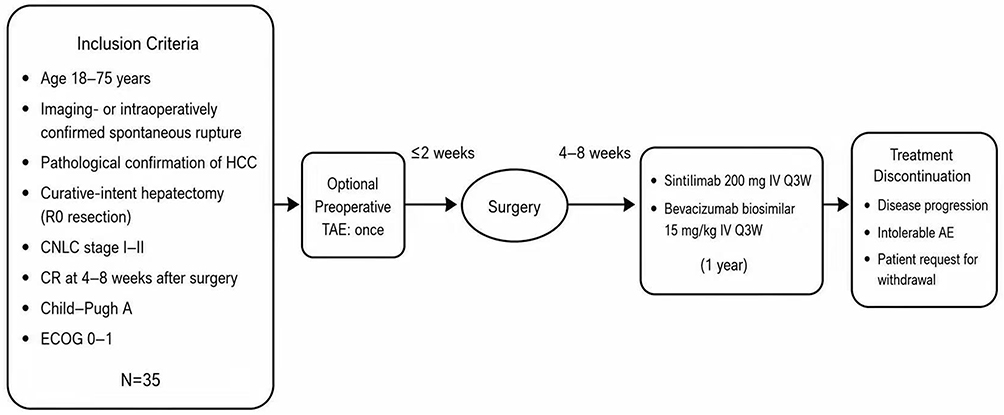 |
Figure 1 Study design of the CLEAR-2 trial. |
Sintilimab will be administered intravenously at a fixed dose of 200 mg every 3 weeks. Bevacizumab biosimilar will be administered intravenously at a dose of 15 mg/kg every 3 weeks. Both agents will be given on day 1 of each cycle. Treatment will continue for a maximum duration of 1 year (up to 17 cycles) or until disease recurrence, unacceptable toxicity, withdrawal of consent, or investigator decision.
Dose interruptions or delays are permitted for the management of treatment-related adverse events. Management of immune-related adverse events will follow established clinical guidelines, including treatment interruption, corticosteroid therapy, and permanent discontinuation when indicated. Bevacizumab biosimilar will be withheld or discontinued in the event of grade ≥3 bleeding, gastrointestinal perforation, uncontrolled hypertension, or other serious vascular complications, according to predefined safety criteria. Rechallenge after toxicity resolution will be at the discretion of the investigator, based on a comprehensive risk–benefit assessment.
Permanent discontinuation of study treatment will be required for any of the following conditions: confirmed disease recurrence, grade 4 immune-related adverse events, life-threatening treatment-related toxicity, or patient request. Patients who discontinue one study drug due to toxicity may continue the other agent if deemed safe and appropriate by the investigator.
Concomitant anticancer therapies, including chemotherapy, targeted therapy, or other immunotherapies, are not permitted during the study treatment period. Supportive care, including antiviral therapy for hepatitis B virus infection, antihypertensive treatment, and symptomatic management, will be allowed as clinically indicated.
Following treatment discontinuation, all patients will enter the follow-up phase and continue to undergo scheduled assessments for disease recurrence, survival status, and late-onset toxicities according to the study protocol.
Study Endpoints
The primary endpoint of the CLEAR-2 study is disease-free survival (DFS). DFS is defined as the time from the date of curative hepatectomy to the first documented tumour recurrence, either intrahepatic or extrahepatic, or death from any cause, whichever occurs first.
Secondary endpoints include:
- Overall survival (OS), defined as the time from the date of curative hepatectomy to death from any cause.
- Safety and tolerability, assessed by the incidence, severity, and type of adverse events, graded according to the National Cancer Institute Common Terminology Criteria for Adverse Events (NCI-CTCAE), version 5.0.
- Recurrence patterns, categorised as intrahepatic recurrence, extrahepatic recurrence, and peritoneal dissemination, based on radiological and/or pathological findings.
All efficacy endpoints will be assessed using contrast-enhanced computed tomography or magnetic resonance imaging and evaluated according to RECIST version 1.1 criteria.
Follow-Up and Assessments
All enrolled patients will undergo scheduled follow-up assessments for disease recurrence, survival status, and treatment-related toxicity according to the predefined study schedule. The detailed schedule of assessments is provided in Supplementary Table 1.
Baseline assessments will be completed before initiation of adjuvant therapy and will include medical history, physical examination, ECOG performance status, laboratory tests, tumour biomarkers including alpha-fetoprotein, and contrast-enhanced imaging. Laboratory assessments will include complete blood count, liver and renal function tests, coagulation profile, urine protein assessment, and other tests required for safety evaluation.
During the treatment period, patients will be evaluated every 3 weeks before each treatment cycle for clinical status and safety. Safety assessments will include physical examination, vital signs, blood pressure monitoring, laboratory tests, urine protein assessment, and documentation of adverse events, which will be graded according to NCI-CTCAE version 5.0.
Tumour assessments will be performed using contrast-enhanced computed tomography or magnetic resonance imaging every 12 weeks, with an allowable window of ±7 days, during treatment and follow-up. Tumour recurrence will be assessed by local investigators according to RECIST version 1.1 using standardised imaging procedures. Source imaging data will be retained for quality control and may be reviewed retrospectively if needed.
Given the distinct recurrence pattern associated with srHCC, particular attention will be paid to the detection of peritoneal dissemination. Radiological findings suggestive of peritoneal recurrence will be recorded and categorised as part of the recurrence pattern analysis.
After completion or discontinuation of study treatment, patients will continue to undergo follow-up assessments every 12 weeks until documented disease recurrence, death, loss to follow-up, or study termination. Survival status and subsequent anticancer treatments after recurrence will be collected during follow-up.
Statistical Analysis
All statistical analyses will be conducted according to a predefined statistical analysis plan before database lock.
Sample Size Calculation
The sample size calculation was based on the primary endpoint of disease-free survival (DFS). Historical data suggest that the 1-year DFS rate after curative resection of spontaneously ruptured hepatocellular carcinoma is approximately 40%.8,15 CLEAR-2 assumes that adjuvant sintilimab plus bevacizumab biosimilar may improve the 1-year DFS rate to 60%.
With 80% power, a two-sided alpha level of 0.05, a 2-year enrolment period, and a 2-year follow-up period, 32 evaluable patients are required. Considering an approximately 10% loss to follow-up or dropout rate, the planned sample size is 35 patients. Given the exploratory single-arm design, this sample size is intended to detect a preliminary efficacy signal rather than establish definitive comparative effectiveness.
Analysis Populations
The full analysis set will include all patients who receive at least one dose of study treatment and will be used for efficacy analyses. The safety set will include all patients who receive at least one dose of study treatment and will be used for safety analyses.
Efficacy and Safety Analyses
DFS and overall survival will be analysed using the Kaplan–Meier method. Median survival times and survival rates at predefined time points will be reported with 95% confidence intervals. Recurrence patterns, including intrahepatic recurrence, extrahepatic recurrence, and peritoneal dissemination, will be summarised descriptively.
Safety analyses will be descriptive. Adverse events will be graded according to NCI-CTCAE version 5.0 and summarised by incidence, severity, and type. Treatment discontinuations, treatment delays, serious adverse events, immune-related adverse events, and bevacizumab-related adverse events will be reported.
Discussion
The rationale for CLEAR-2 is based on the recognition that srHCC represents a distinct clinical entity, characterised by acute presentation, complex emergency management, and a high risk of postoperative recurrence.2–4 Although advances in haemostatic techniques and surgical management have improved short-term survival and enabled curative-intent resection in selected patients, optimal postoperative treatment strategies for srHCC remain undefined.6,7 CLEAR-2 was therefore designed to prospectively evaluate adjuvant sintilimab plus bevacizumab biosimilar after curative resection in a population that has been largely excluded from previous clinical trials.
Postoperative recurrence remains a major challenge after resection of srHCC. Compared with non-ruptured HCC, srHCC is associated with a higher risk of peritoneal dissemination, likely reflecting tumour cell spillage at the time of rupture.2,8–10 In addition to rupture-related factors, recurrence risk may also be influenced by liver function, tumour burden, vascular invasion, tumour differentiation, alpha-fetoprotein level, inflammatory status, and other pathological or microenvironmental features.16 Recent studies have suggested that prognostic markers such as lymphatic vessel density may help refine postoperative recurrence risk assessment in early-stage HCC, although their relevance to srHCC requires further validation.17 These considerations support the need for prospective studies focused specifically on recurrence patterns and risk-adapted postoperative strategies in srHCC.
The choice of sintilimab plus bevacizumab biosimilar is supported by evidence from unresectable HCC, where immune checkpoint blockade combined with anti-angiogenic therapy has demonstrated clinically meaningful efficacy.13,14 In addition, immunotherapy-based adjuvant strategies have been explored in high-risk resected or ablated HCC.12 However, these data remain indirect for srHCC. Patients with tumour rupture are commonly excluded from major adjuvant trials, and srHCC differs from conventional high-risk resected HCC in emergency presentation, perioperative bleeding risk, potential intraperitoneal tumour seeding, and recurrence pattern. Therefore, CLEAR-2 should be interpreted as an exploratory study designed to generate prospective evidence, rather than as a confirmatory trial establishing the comparative efficacy of adjuvant therapy.
Several features of the study design aim to reduce heterogeneity while preserving clinical relevance. The study focuses on patients who have achieved R0 resection and radiological complete response before adjuvant treatment, thereby defining a postoperative population with curative intent. Preoperative TAE is allowed only as a single haemostatic procedure without chemotherapeutic agents and must be followed by surgery within 2 weeks, which reflects real-world emergency management while limiting the confounding effects of locoregional therapy. Follow-up imaging is scheduled every 12 weeks, with specific attention to intrahepatic recurrence, extrahepatic metastasis, and peritoneal dissemination.
Safety is a key consideration in this population. Bevacizumab may be associated with bleeding, hypertension, proteinuria, gastrointestinal perforation, and wound-healing complications. These risks are particularly relevant after recent tumour rupture and hepatectomy. Accordingly, CLEAR-2 requires adequate postoperative recovery, satisfactory wound healing, absence of active bleeding, controlled blood pressure, urine protein assessment, and exclusion of patients with high-risk gastrointestinal bleeding or clinically significant varices before treatment initiation. During treatment, safety monitoring will be performed before each cycle, and bevacizumab will be withheld or discontinued according to predefined safety criteria.
This study has limitations. First, the single-arm design and small sample size limit the ability to draw definitive comparative conclusions. The results may be influenced by historical differences in patient selection, rupture severity, tumour burden, timing of surgery, TAE use, and perioperative management. Second, the study population represents a selected subgroup of patients with srHCC who recover sufficiently after rupture, undergo R0 resection, have Child–Pugh class A liver function, and demonstrate no residual disease or early recurrence before adjuvant therapy. Therefore, the findings may not be generalisable to all patients with ruptured HCC. Third, variations in surgical procedures, perioperative care, and imaging interpretation across centres may affect recurrence and safety outcomes, although predefined eligibility criteria, treatment rules, and follow-up schedules are intended to mitigate this variability.
Despite these limitations, CLEAR-2 may provide clinically useful prospective data for a high-risk and underrepresented population. By systematically evaluating DFS, safety, and recurrence patterns, particularly peritoneal dissemination, this study may help inform the design of future comparative or randomised studies and support the development of risk-adapted postoperative strategies for srHCC.
Recruitment for the CLEAR-2 study commenced on 17 November 2025. The primary completion is anticipated in December 2028, with final study completion expected in March 2029.
Ethics Statement
This study was approved by the institutional ethics committees of all participating centres, including the Ruijin Hospital Ethics Committee (KYAF0406/18.0/2025-09-11), the China–Japan Union Hospital of Jilin University (2025121803), and Sanming First Hospital (2025217). The study will be conducted in accordance with the principles of the Declaration of Helsinki, Good Clinical Practice (GCP) guidelines, and applicable local regulatory requirements. Written informed consent will be obtained from all participants prior to enrolment.
The results of this study will be disseminated through publication in peer-reviewed journals and presentation at national and international scientific conferences. De-identified participant data may be made available upon reasonable request to the corresponding author after publication of the primary results, subject to institutional approval and data-sharing agreements.
Disclosure
Dr Hui-Chuan Sun reports grants from Hengrui, MSD, Eisai, Roche; Honoraria from BMS, Hengrui, Innovent, Eisai, MSD, and Roche, outside the submitted work. The authors declare that they have no other competing interests in this work.
References
1. Bray F, Laversanne M, Sung H, et al. Global cancer statistics 2022: GLOBOCAN estimates of incidence and mortality worldwide for 36 cancers in 185 countries. CA Cancer J Clin. 2024;74(3):229–9. doi:10.3322/caac.21834
2. Aoki T, Kokudo N, Matsuyama Y, et al. Prognostic impact of spontaneous tumor rupture in patients with hepatocellular carcinoma: an analysis of 1160 cases from a nationwide survey. Ann Surg. 2014;259(3):532–542. doi:10.1097/SLA.0b013e31828846de
3. Zhang Z, Tan S, Tang H, et al. Risk factors and survival analysis of spontaneously ruptured hepatocellular carcinoma: a retrospective cohort study in bilateral centers. Ann Surg Oncol. 2025;32(7):4997–5007. doi:10.1245/s10434-025-17250-8
4. Joliat GR, de Man R, Rijckborst V, et al. Long-term outcomes of ruptured hepatocellular carcinoma: international multicentre study. Br J Surg. 2024;111(4):znae093. doi:10.1093/bjs/znae093
5. Chun YS, Pawlik TM, Vauthey JN. 8th edition of the AJCC cancer staging manual: pancreas and hepatobiliary cancers. Ann Surg Oncol. 2018;25(4):845–847. doi:10.1245/s10434-017-6025-x
6. Wu JJ, Zhu P, Zhang ZG, et al. Spontaneous rupture of hepatocellular carcinoma: optimal timing of partial hepatectomy. Eur J Surg Oncol. 2019;45(10):1887–1894. doi:10.1016/j.ejso.2019.02.033
7. Kwon JH, Song GW, Hwang S, et al. Surgical outcomes of spontaneously ruptured hepatocellular carcinoma. J Gastrointest Surg. 2021;25(4):941–953. doi:10.1007/s11605-020-04555-0
8. Wang W, Meng T, Chen Y, et al. Propensity score matching study of 325 patients with spontaneous rupture of hepatocellular carcinoma. Hepatobiliary Surg Nutr. 2022;11(6):808–821. doi:10.21037/hbsn-21-45
9. Wang B, Lu Y, Zhang XF, Yu L, Pan CE, Wu Z. Management of spontaneous rupture of hepatocellular carcinoma. ANZ J Surg. 2008;78(6):501–503. doi:10.1111/j.1445-2197.2008.04543.x
10. Ruan S, Shi N, Chen Z, et al. The role of hyperthermic intraperitoneal chemotherapy in the treatment of spontaneously ruptured hepatocellular carcinoma: a pilot study. Ann Transl Med. 2020;8(18):1132. doi:10.21037/atm-20-5829
11. European Association for the Study of the Liver. EASL clinical practice guidelines on the management of hepatocellular carcinoma. J Hepatol. 2025;82(2):315–374. doi:10.1016/j.jhep.2024.08.028
12. Qin S, Chen M, Cheng AL, et al. Atezolizumab plus bevacizumab versus active surveillance in patients with resected or ablated high-risk hepatocellular carcinoma (IMbrave050): a randomised, open-label, multicentre, Phase 3 trial. Lancet. 2023;402(10415):1835–1847. doi:10.1016/S0140-6736(23)01796-8
13. Finn RS, Qin S, Ikeda M, et al. Atezolizumab plus bevacizumab in unresectable hepatocellular carcinoma. N Engl J Med. 2020;382(20):1894–1905. doi:10.1056/NEJMoa1915745
14. Ren Z, Xu J, Bai Y, et al. Sintilimab plus a bevacizumab biosimilar (IBI305) versus sorafenib in unresectable hepatocellular carcinoma (ORIENT-32): a randomised, open-label, Phase 2-3 study. Lancet Oncol. 2021;22(7):977–990. doi:10.1016/S1470-2045(21)00252-7
15. Huang A, Guo DZ, Wang YP, et al. The treatment strategy and outcome for spontaneously ruptured hepatocellular carcinoma: a single-center experience in 239 patients. J Cancer Res Clin Oncol. 2022;148(11):3203–3214. doi:10.1007/s00432-022-03916-3
16. Moris D, Chakedis J, Sun SH, et al. Management, outcomes, and prognostic factors of ruptured hepatocellular carcinoma: a systematic review. J Surg Oncol. 2018;117(3):341–353. doi:10.1002/jso.24869
17. Li J, Liang YB, Chen XM, et al. Prognostic value of lymphatic vessel density in the capsule of early-stage hepatocellular carcinoma: implications for postoperative recurrence risk. Front Immunol. 2026;17:1714314. doi:10.3389/fimmu.2026.1714314
 © 2026 The Author(s). This work is published and licensed by Dove Medical Press Limited. The
full terms of this license are available at https://www.dovepress.com/terms
and incorporate the Creative Commons Attribution
- Non Commercial (unported, 4.0) License.
By accessing the work you hereby accept the Terms. Non-commercial uses of the work are permitted
without any further permission from Dove Medical Press Limited, provided the work is properly
attributed. For permission for commercial use of this work, please see paragraphs 4.2 and 5 of our Terms.
© 2026 The Author(s). This work is published and licensed by Dove Medical Press Limited. The
full terms of this license are available at https://www.dovepress.com/terms
and incorporate the Creative Commons Attribution
- Non Commercial (unported, 4.0) License.
By accessing the work you hereby accept the Terms. Non-commercial uses of the work are permitted
without any further permission from Dove Medical Press Limited, provided the work is properly
attributed. For permission for commercial use of this work, please see paragraphs 4.2 and 5 of our Terms.
Recommended articles

Retrospective Study of the Efficacy and Safety of Chemoembolization with Drug-Eluting Microspheres Combined with Intra-Arterial Infusion of Bevacizumab for Unresectable Hepatocellular Carcinoma
Ueda S, Hori S, Hori A, Makitani K, Wan K, Sonomura T
Journal of Hepatocellular Carcinoma 2022, 9:973-985
Published Date: 12 September 2022
Efficacy of TACE Combined with Lenvatinib Plus Sintilimab for Hepatocellular Carcinoma with Tumor Thrombus in the Inferior Vena Cava and/or Right Atrium
Ning S, Li X, Ma X, Liu J, Chang X
Journal of Hepatocellular Carcinoma 2023, 10:1511-1525
Published Date: 13 September 2023
Cost-Effectiveness and Budget Impact Analyses of Selective Internal Radiation Therapy versus Atezolizumab Plus Bevacizumab from a German Statutory Health Insurance Perspective
Schwander B, Klesper K, Rossol S, Herrmann K, Zoellner YF
ClinicoEconomics and Outcomes Research 2024, 16:483-492
Published Date: 6 June 2024
Spontaneous Rupture of Hepatocellular Carcinoma: Pathogenesis, Clinical Management, Prognostic Factors, and Future Directions
Cheng Y, Ye F, Chen Y
Journal of Hepatocellular Carcinoma 2025, 12:2421-2428
Published Date: 27 October 2025
Low-Dose Versus Standard-Dose Bevacizumab Plus Sintilimab for Unresectable Hepatocellular Carcinoma: A Real-World Comparative Study of Efficacy and Safety
Xu L, Wang X, Lai X, Li A, Mao Y, Wang X, Wu J
Journal of Hepatocellular Carcinoma 2026, 13:582999
Published Date: 12 April 2026