
Back to Journals » Journal of Asthma and Allergy » Volume 18
Understanding and Managing Viral-Induced Wheezing in Children: The Role of Parental Knowledge
Authors Al Omari SM  , Taybeh E, Abutaima R , Sawan HM , Alsaraireh MM
Received 26 March 2025
Accepted for publication 8 July 2025
Published 8 November 2025 Volume 2025:18 Pages 1585—1597
DOI https://doi.org/10.2147/JAA.S526723
Checked for plagiarism Yes
Review by Single anonymous peer review
Peer reviewer comments 2
Editor who approved publication: Dr Luis Garcia-Marcos
Shatha M Al Omari,1 Esra’ Taybeh,2 Rana Abutaima,1 Hana M Sawan,1 Mahmoud Mohammad Alsaraireh3
1Faculty of pharmacy, Zarqa University, Zarqa, Jordan; 2Faculty of Pharmacy, Isra University, Amman, Jordan; 3Faculty of Nursing, Al-Hussein Bin Talal University, Ma’an, Jordan
Correspondence: Shatha M Al Omari, Email [email protected]
Background: Viral-induced wheezing, a common respiratory issue in children, is characterized by wheezing triggered by viral infections. This study aims to evaluate parental knowledge, perceptions, and practices regarding viral-induced wheezing in Jordan.
Methods: A cross-sectional survey was conducted with 510 parents, recruited from schools and online platforms.
Results: The study found that 32.1% of parents had good knowledge about viral-induced wheezing, and 73.5% were aware that it could resolve in children over time. Parents of children with asthma, allergic rhinitis, or atopy were more informed about viral-induced wheezing. Regression analysis showed a significant association between children’s recurrent upper respiratory tract infections and parental knowledge. During wheezing episodes, the majority of parents (91.8%) administered medications, and 80.1% used herbal remedies.
Conclusion: Parents of children with frequent upper respiratory tract infections exhibited greater knowledge related to wheezing management. Enhancing parental education may contribute to improved symptom recognition and management. These findings underscore the need for targeted educational initiatives and future longitudinal studies to explore the long-term impact of parental knowledge on respiratory outcomes.
Keywords: assessment, knowledge, parents, wheezing, viral
Introduction
Wheezing is a common respiratory symptom in early childhood, often triggered by viral infections such as respiratory syncytial virus (RSV) and rhinovirus, and is characterized by a high-pitched whistling sound during expiration, typically due to narrowed or inflamed airways.1,2 Viral-induced wheezing in preschool-aged children may present as isolated episodes or recurrent bouts and is sometimes referred to as wheezy bronchitis, a condition that may precede the development of asthma.3
Distinguishing viral-induced wheezing from asthma can be clinically challenging, especially in younger children, due to symptom overlap and the absence of definitive diagnostic markers. Risk factors such as personal or family history of atopic conditions, including eczema and allergic rhinitis, have been identified as strong predictors of asthma in children, supporting the concept of the “allergic march”.4,5 Additionally, environmental exposures such as indoor allergens (eg, dust mites, pests), seasonal pollens, secondhand tobacco smoke, and emotional stress have been implicated in triggering wheezing episodes.6–8
The clinical presentation of viral-induced wheezing can vary over time, with acute viral bronchiolitis often being the initial sign, followed by recurrent infection-induced wheezing.9,10 Persistent or recurrent wheezing in preschool-aged children, estimated to affect one-third of them, and can eventually progress to asthma, leading to significant morbidity, reduced quality of life, increased medical utilization, and higher expenses.11
To prevent the development of persistent or recurrent wheezing and asthma, the role of medication in controlling and treating viral-induced wheezing should be emphasized.12 Delaying treatment by adopting a “wait and see” approach may allow recurring attacks to persist.
Parental recognition and interpretation of wheezing symptoms are crucial for timely intervention and management. However, studies show that nearly half of parents struggle to identify wheezing accurately, often confusing it with other respiratory sounds.13 This gap in recognition contributes to delay care-seeking and potential under diagnosis of conditions like asthma. Moreover, discrepancies in the interpretation of symptoms between parents and healthcare providers can hinder appropriate management. For example, only 45% agreement has been reported between clinicians and parents regarding a diagnosis of asthma or wheezing in children.14
Parental education level, prior experience with respiratory illnesses, and understanding of wheezing triggers significantly influence how caregivers respond to their child’s symptoms.15 Educating parents about risk factors and symptom patterns, and fostering effective communication with healthcare professionals, may enhance early recognition and improve outcomes for children with wheezing illnesses, as good knowledge in this regard is associated with positive attitudes and appropriate practices.16
This study aims to assess parental knowledge, perceptions, and practices regarding viral-induced wheezing in children. By identifying gaps in awareness and understanding, the findings may support the development of targeted educational strategies and improve the management of wheezing episodes, thereby reducing the risk of progression to persistent wheezing or asthma.
Methods
Study Design and Participants
Cross-sectional data for this study were collected from parents with at least one child, and were recruited from one of two sources: purposively selected nursery and primary schools (n=4) in Jordan, and via the internet (Social media sites – Facebook, whatsApp) during December 2022 and March 2023. No major public health initiatives were initiated during that time. The schools were selected to maximise sample variation, and included urban and rural settings; large and small schools. During data collection in schools, parent were asked to return the completed questionnaires to the school for collection by members of the research team. Questionnaires were sent with a cover letter outlining the aims of the project and explaining that participation was voluntary. After collection of responses were entered by RH (a researcher not involved in the care of participants). In school based parents a return of the questionnaire indicated consent and all questionnaires were anonymous, whereas consent was implied from online participation. To maximize confidentiality, personal identifiers were not required.
Questionnaire Development
After reviewing previous related studies about wheezing and viral induced wheezing in children, A self-administered online survey was developed using Google Forms and the link was distributed in social media in both, Arabic and English languages. The questionnaire was piloted among 10 parents with at least one child to check clarity and readability of the questions, and the questionnaire was modified accordingly. Data obtained from the pilot were not included in the data analysis.
The testing instrument was four sections questionnaire, which assessed the parental level of knowledge and attitude toward viral induce wheezing in their children. Sections were designed to elicit information about the dependent variables (knowledge and attitude) and a series of independent variables, as follows: (1) Child information; (2) parent understanding of wheezing; (3) Knowledge about viral induce wheezing; (4); parent practice during wheezing episode.
Sample Size Calculation
The sample size was calculated using the Kish formula for sample size estimation at a 95% significance level and 5% error margin.17 The estimated sample size was 377. However, a total of 510 parents were recruited in the present study to ensure generalisability of responses.
Ethical Approval
The study was approved by the Zarqa University Ethics Committee (Reference number: (Zu-2023/7/5259/35).
Outcome Measures
The following outcomes were assessed: the parental level of knowledge and attitude toward viral induce wheezing in children.
Data Analyses
The data analysis was performed using Statistical Package for the Social Sciences version 23.0. Descriptive statistics in the form of frequency and percentage were calculated for the variables under investigation. The level of knowledge about viral-induced wheeze among parents was quantified by assigning one point to each correct answer and zero points to incorrect answers. The total scores were then summed, with a maximum possible score of nine. To differentiate between good and poor knowledge, a cut-off point of five was used. Chi-squared test was utilized to identify any associations between parental knowledge about viral-induced wheeze and various variables. Additionally, binary logistic regression analysis was conducted to identify predictors of parental knowledge. Furthermore, Spearman’s rho correlation was used to examine the correlation between parental knowledge of viral-induced wheeze and their reported past experience of wheezing in their children.
Results
Characteristics of the Study Sample
A total of 510 participants completed the questionnaire. The majority of respondents were mothers (73.7%; n=376). Among the children, 22.6% (n=115) had a history of allergic rhinitis. More than half of the fathers were smokers (54.9%; n=280), and 41.3% (n=211) of the children were exposed to smoking. Relying completely on breastfeeding in the first 6 months of birth was reported by 52.9% (n=270) (Table 1).
 |
Table 1 Characteristic of the Study Sample |
Parental Knowledge of Viral Induced Wheezing
Among the study participants, a substantial proportion of individuals (32.1%) self-reported a good level of knowledge pertaining to viral-induced wheeze. This can be confirmed through the responses to the knowledge questions, where many participants exhibited a good understanding of key aspects related to viral-induced wheeze (Table 2).
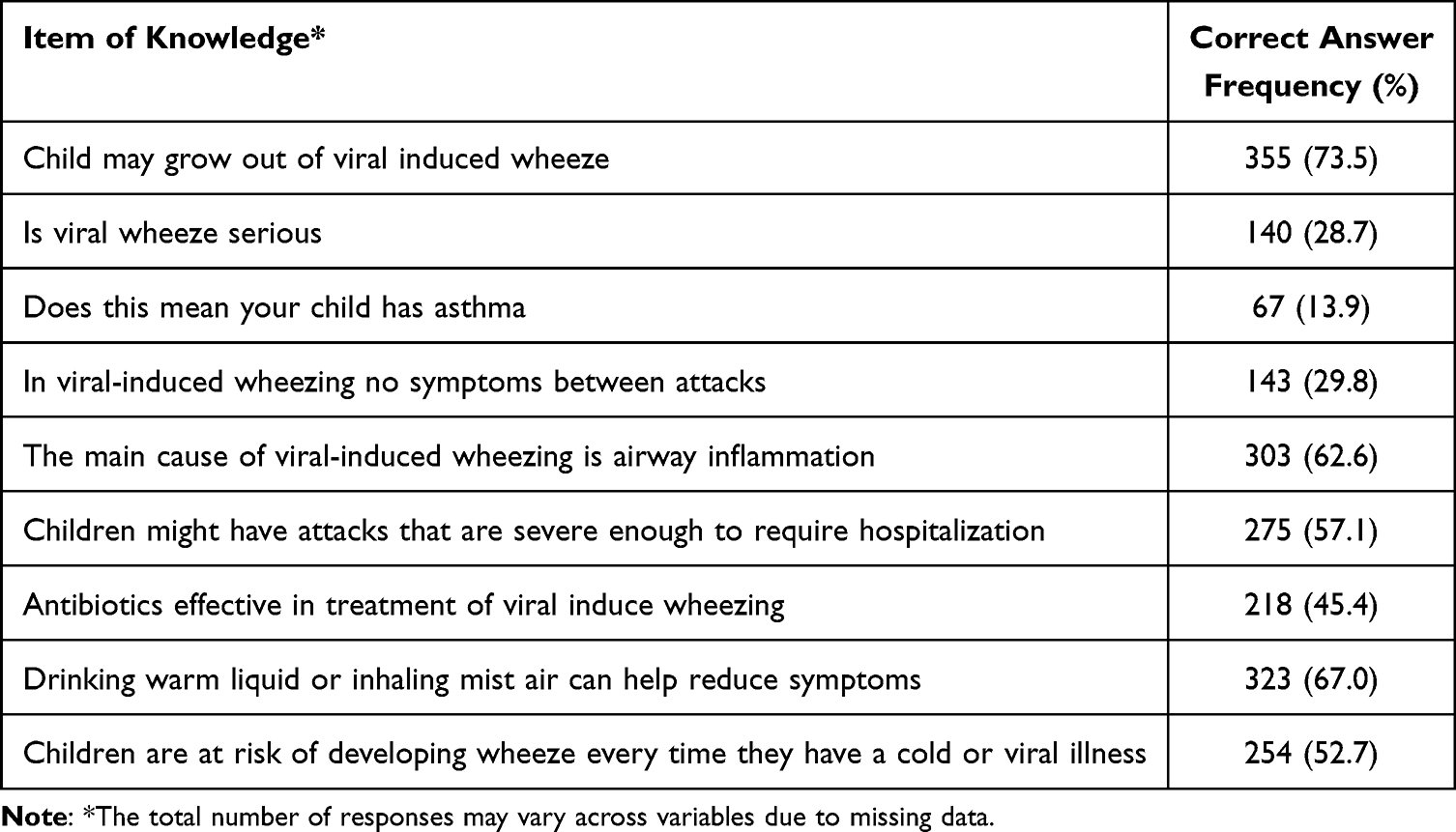 |
Table 2 Participants Knowledge About Viral Induced Wheeze |
To quantify the level of knowledge about viral-induced wheeze among parents, a scoring system was employed whereby each correct answer awarded one point. The total scores were then summed, with a maximum possible score of nine. A cut-off point of five was used to differentiate between good and poor knowledge, with a total score of five or above indicating good knowledge about viral-induced wheeze. The findings of the study indicate that 51% of participating parents had good knowledge, while the other 49% had poor knowledge of viral-induced wheeze (Figure 1).
 |
Figure 1 Parental knowledge of viral-induced wheeze. |
The results reveal the sources from which participants obtained their knowledge about viral-induced wheeze (Figure 2). Notably, the majority of participants (81.4%) obtained knowledge about viral-induced wheeze from pediatricians. Other healthcare providers, such as nurses and respiratory therapists, were also reported as a source of knowledge for 20% of participants, which indicates the significance of healthcare professionals in educating the public on this condition. Additionally, social media and internet were found to be a popular source of information, with 20% of participants reported that they relied on for their understanding of viral-induced wheeze.
 |
Figure 2 Sources of knowledge regarding viral induced wheeze. |
Table 3 shows the univariate analysis (Chi-squared test) of the variables related to knowledge about viral-induced wheeze and revealed that several factors were significantly linked with good parental knowledge. Specifically, having a child with a history of asthma, allergic rhinitis, and atopy were found to be strongly associated with good knowledge among parents (p=0.019, p=0.001, p=0.018, respectively). Furthermore, having risk factors such as a smoking father, repeated upper respiratory infections, and a family history of wheezing were also positively associated with good knowledge about viral-induced wheeze (p<0.05).
 |
Table 3 Factors Associated with Parental Knowledge of Viral-Induced Wheeze |
The results of the binary logistic regression analysis (Table 4) showed that recurrent upper respiratory tract infection was the only significant predictor of parent knowledge about viral-induced wheeze (p<0.001). Specifically, Parents of children with recurrent URTI were found to be twice as likely to have good knowledge about wheezing compared to those of children with no recurrent URTI (OR= 2.164).
 |
Table 4 Regression Analysis Results |
Previous Experience of Wheezing
Out of the 510 participants, 283 reported experiencing wheezing in their children. Of those, 201 reported wheezing in the last 12 months, with most of these cases (68.3%, n=190) occurring in children under the age of three. The most commonly reported symptoms were coughing (58.1%) and whistling (54.1%).
Common cold (62.8%) and infections (51.8%) were the most frequently reported provoking factors for wheezing. During wheezing episodes, 91.8% of the participants gave the necessary medications, while 80.1% used herbal remedies. To prevent wheezing, 82.1% of the participants reported trying to avoid triggers, and 75.2% contacted a physician in case of difficulty breathing (Table 5).
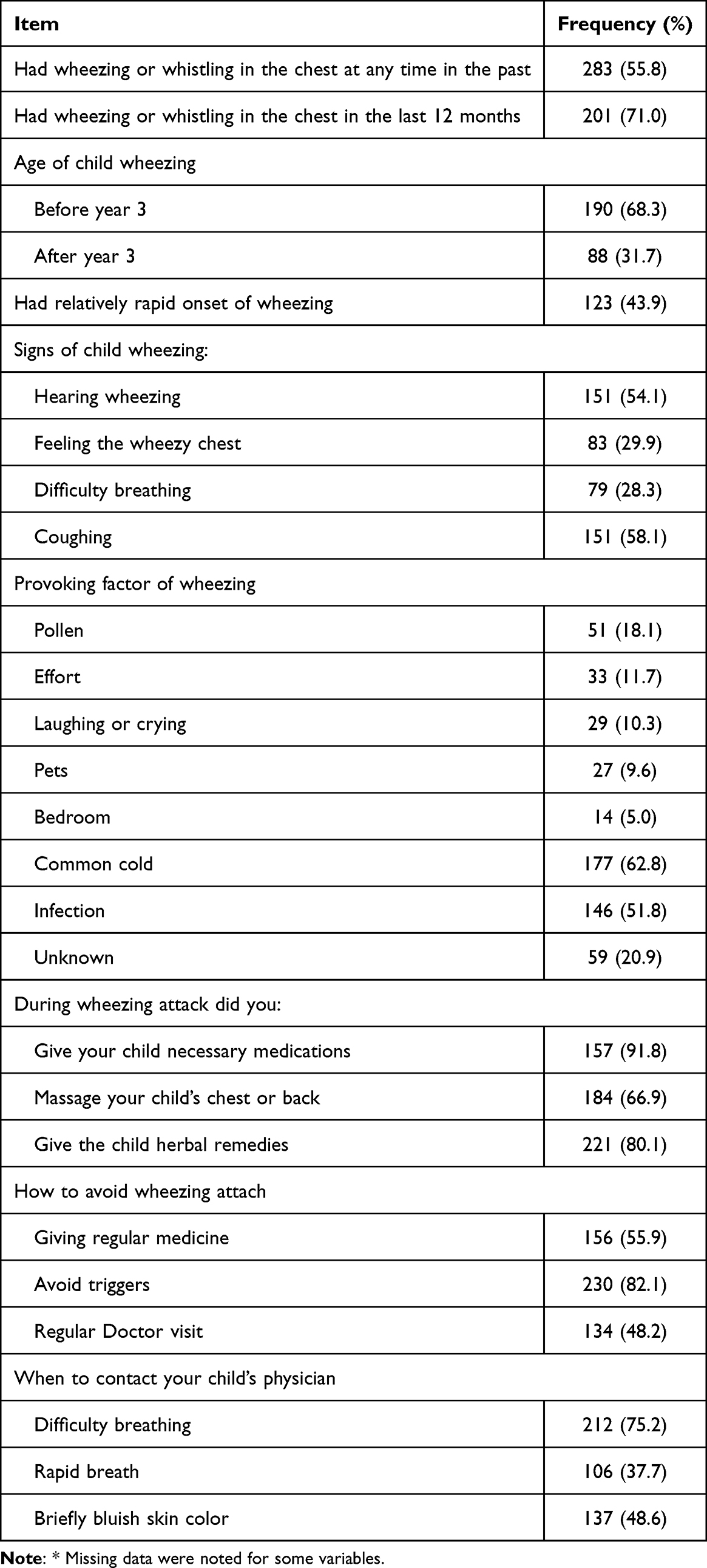 |
Table 5 Experience of Wheezing |
Our analysis revealed a statistically significant but weak correlation (Spearman’s rho correlation coefficient=0.25, p<0.001) between parental knowledge of viral-induced wheeze and their reported past experience of wheezing in their children.
Discussion
Viral-induced wheezing following upper respiratory tract infections is common in young children. A recent study conducted on 30 pediatric patients reported that 80% of emergency visits were due to such wheezing episodes.18 Our study aimed to assess parental knowledge of viral-induced wheezing in Jordan—a topic previously unexplored in this population.
Our findings indicate that 73.5% (n= 355) of parents were aware that children could develop wheezing after respiratory tract infections. However, the modest knowledge of parents about wheezing in general is not surprising. A previous epidemiological study has reported that both parents and clinicians mutually agreed in 45% of wheezing occasions recognition for children aging 6 months to 15 years old.19 Likewise, Kapil et al found in a cross-sectional study that both parents and caregivers had poor knowledge about acute respiratory tract infections in children (49.49%).20
A key limitation in interpreting our findings is the clinical overlap between viral-induced and other types of wheezing, particularly asthma or allergen-related wheezing. While our study focused on parental knowledge, not diagnosis, several children had risk factors such as family history of asthma, eczema, and allergic rhinitis—known predictors of asthma-related wheeze.6–8,21 Therefore, it is likely that some cases attributed by parents to viral infections may actually reflect early asthma or allergen-induced wheezing. This is consistent with the literature, which identifies overlapping triggers for wheezing in children, including respiratory syncytial virus (RSV), pollen, and other environmental allergens.21 While we cannot definitively determine the etiology of each case without clinical testing (eg, PCR or allergen-specific IgE), our findings remain relevant to public health education.
In our study, a significant association was found between parental smoking (particularly paternal smoking) and the risk of wheezing in children (p = 0.015), consistent with previous studies linking passive smoke exposure to increased wheezing risk by 30–70%.22 Interestingly, some studies also emphasize maternal smoking as a more potent risk factor when combined with atopic predisposition.23 The smoking prevalence in our sample 54.9% (n= 280) aligns with regional data from Mediterranean countries, including Jordan 50.1% (n= 1925).24 Additionally, we found that 62.8% of parents reported recurrent wheezing episodes in their children following URTIs, especially those caused by common cold viruses such as RSV, which is known to trigger airway inflammation and Th2-mediated immune responses.21 These findings highlight a potential educational opportunity to improve symptom recognition and early management at home.
However, the relationship between education and effective self-management was not consistently supported across studies. For example, while we observed that parents with prior experience of wheezing episodes demonstrated better knowledge, other research has found no significant differences in management practices based on parental education levels.25 In our study, home remedies and self-administered antibiotics were used by 67% and 45.4% of participants, respectively. Yet, there is no subtle evidence that home remedies could improve or prevent recurrence of symptoms,26 and their widespread use underscores the need for targeted parental education.
Another debated predictor of wheezing is breastfeeding. Wright et al reported an association between breastfeeding during early infancy and reduced incidence of viral-induced wheezing.27 However, our study did not replicate this association (p = 0.064), highlighting variability across populations.
Consistent with previous studies,28,29 our findings support a significant link between recurrent URTIs and wheezing in preschool children. Furthermore, parental knowledge appeared significantly higher among those whose children had asthma (p = 0.019), possibly due to more frequent interactions with the healthcare system and disease education.
This study has several limitations. The use of a self-administered questionnaire may have introduced recall or social desirability bias. Its cross-sectional design prevents any causal inference between parental knowledge and clinical outcomes. Online recruitment may have resulted in selection bias toward more educated or internet-literate participants. Additionally, the knowledge assessment tool lacked formal validation, which may affect the reliability of the findings.
Conclusions
In conclusion, this study identified significant gaps in the knowledge and practices of Jordanian parents regarding viral-induced wheezing in children. Although parents of children with a history of respiratory conditions demonstrated higher knowledge levels, the continued reliance on non-evidence-based home treatments and inappropriate antibiotic use remains concerning. These findings underscore the need for culturally appropriate, targeted educational interventions to improve parental management of wheezing episodes. Future research should focus on developing and evaluating the effectiveness of such interventions to support better respiratory health outcomes in children.
Contributions to the Literature
- Families were aware that viral infections may trigger wheezing, reflecting a general awareness of symptom patterns.
- Parents with prior experience of respiratory symptoms in their children demonstrated superior knowledge, likely due to repeated interactions with healthcare providers.
- Parental ability to manage wheezing was inconsistent, with a considerable number relying on home remedies and self-administered antibiotics, despite limited supporting evidence.
- Improved parental education about symptom management and appropriate response strategies may contribute to better respiratory outcomes and reduce unnecessary medication use.
Data Sharing Statement
The authors confirm that the data supporting the findings of this study are available within the article.
Ethics Approval and Consent to Participate
The study was conducted in accordance with the Declaration of Helsinki, and approved by the Institutional Review Board (or Ethics Committee) of ZARQA UNIVERSITY (Reference number: (Zu-2023/7/5259/35), Approval date: 1/ 12/2022).
Acknowledgments
We gratefully acknowledge the faculty and staff who facilitated the distribution of this study.
Author Contributions
All authors made a significant contribution to the work reported, whether that is in the conception, study design, execution, acquisition of data, analysis and interpretation, or in all these areas; took part in drafting, revising or critically reviewing the article; gave final approval of the version to be published; have agreed on the journal to which the article has been submitted; and agree to be accountable for all aspects of the work.
Funding
This research received no external funding.
Disclosure
The authors declare no conflicts of interest in this work.
References
1. Martinez FD. Development of wheezing disorders and asthma in preschool children. Pediatrics. 2002;109(2 Suppl):362–367. doi:10.1542/peds.109.SE1.362
2. Xepapadaki P, Papadopoulos NG. Childhood asthma and infection: virus-induced exacerbations as determinants and modifiers. Eur Respir J. 2010;36(2):438–445. doi:10.1183/09031936.00149009
3. Brand PLP, Baraldi E, Bisgaard H, et al. Definition, assessment and treatment of wheezing disorders in preschool children: an evidence-based approach. Eur Respir J. 2008;32(4):1096–1110. doi:10.1183/09031936.00002108
4. Illi S, von Mutius E, Lau S, et al. The natural course of atopic dermatitis from birth to age 7 years and the association with asthma. J Allergy Clin Immunol. 2004;113(5):925–931. doi:10.1016/j.jaci.2004.01.778
5. Sears MR. Predicting asthma outcomes. J Allergy Clin Immunol. 2015;136(4):829–836. quiz 837. doi:10.1016/j.jaci.2015.04.048
6. Tantisira KG, Weiss ST. Childhood infections and asthma: at the crossroads of the hygiene and Barker hypotheses. Respir Res. 2001;2(6):324–327. doi:10.1186/rr81
7. Belgrave DCM, Buchan I, Bishop C, Lowe L, Simpson A, Custovic A. Trajectories of lung function during childhood. Am J Respir Crit Care Med. 2014;189(9):1101–1109. doi:10.1164/rccm.201309-1700OC
8. Wright RJ. Stress and atopic disorders. J Allergy Clin Immunol. 2005;116(6):1301–1306. doi:10.1016/j.jaci.2005.09.050
9. Beigelman A, Bacharier LB. Infection-induced wheezing in young children. J Allergy Clin Immunol. 2014;133(2):603–604. doi:10.1016/j.jaci.2013.12.001
10. Al-Shamrani A, Bagais K, Alenazi A, Alqwaiee M, Al-Harbi AS. Wheezing in children: approaches to diagnosis and management. Int J Pediatr Adolesc Med. 2019;6(2):68–73. doi:10.1016/j.ijpam.2019.02.003
11. Tenero L, Piazza M, Piacentini G. Recurrent wheezing in children. Transl Pediatr. 2016;5(1):31–36. doi:10.3978/j.issn.2224-4336.2015.12.01
12. Yoshihara S, Kusuda S, Mochizuki H, Okada K, Nishima S, Simões EAF. Effect of palivizumab prophylaxis on subsequent recurrent wheezing in preterm infants. Pediatrics. 2013;132(5):811–818. doi:10.1542/peds.2013-0982
13. Cane RS, Ranganathan SC, McKenzie SA. What do parents of wheezy children understand by “wheeze”? Arch Dis Child. 2000;82(4):327–332. doi:10.1136/adc.82.4.327
14. Looijmans-van den Akker I, van Luijn K, Verheij T. Overdiagnosis of asthma in children in primary care: a retrospective analysis. Br J Gen Pract J R Coll Gen Pract. 2016;66(644):e152–7. doi:10.3399/bjgp16X683965
15. Ducharme FM, Zemek RL, Chalut D, et al. Written action plan in pediatric emergency room improves asthma prescribing, adherence, and control. Am J Respir Crit Care Med. 2011;183(2):195–203. doi:10.1164/rccm.201001-0115OC
16. Amro FM, Rayan AH, Eshah NF, ALBashtawy MS. ALBashtawy MS d. knowledge, attitude, and practices concerning covid-19 preventive measures among healthcare providers in Jordan. SAGE Open Nurs. 2022;8. doi:10.1177/23779608221106422
17. Wiegand H, Kish L. Survey Sampling. John Wiley \& Sons, Inc. New York, London 1965, IX + 643 S. 31 Abb. 56 Tab. Preis 83s. Biom Z. 1968;10(1):88–89. doi:10.1002/bimj.19680100122
18. Kashlout M, Osama A, Marei A, Risha A. Association of virus-induced wheezing with COVID-19. Zagazig Univ Med J. 2022. doi:10.21608/zumj.2022.127884.2525
19. Inoue Y, Shimojo N. Epidemiology of virus-induced wheezing/asthma in children. Front Microbiol. 2013;4:391. doi:10.3389/fmicb.2013.00391
20. Bhalla KN, Gupta A, Nanda S, Mehra S, Verma S. Parental knowledge and common practices regarding acute respiratory infections in children admitted in a hospital in rural setting. J Fam Med Prim Care. 2019;8(9):2908–2911. doi:10.4103/jfmpc.jfmpc_510_19
21. Heymann PW, Zambrano JC, Rakes GP. Virus-induced wheezing in children: respiratory syncytial virus (RSV) and Rhinovirus. Immunol Allergy Clin North Am. 1998;18(1):35–47. doi:10.1016/S0889-8561(05)70345-3
22. Makrinioti H, Watson M, Bush A, Hargreaves D. COVID-19 and preschool wheeze care: lessons learned. Lancet Respir Med. 2020;8(10):957–959. doi:10.1016/S2213-2600(20)30351-9
23. Schvartsman C, Lima Farhat SC, Schvartsman S, Nascimento Saldiva PH. Parental smoking patterns and their association with wheezing in children. Clinics. 2013;68(7):934–939. doi:10.6061/clinics/2013(07)08
24. Nakkash R, Khader Y, Chalak A, et al. Prevalence of cigarette and waterpipe tobacco smoking among adults in three Eastern Mediterranean countries: a cross-sectional household survey. BMJ Open. 2022;12(3):e055201. doi:10.1136/bmjopen-2021-055201
25. Stevens CA, Wesseldine LJ, Couriel JM, Dyer AJ, Osman LM, Silverman M. Parental education and guided self-management of asthma and wheezing in the pre-school child: a randomised controlled trial. Thorax. 2002;57(1):39–44. doi:10.1136/thorax.57.1.39
26. Chiappini E, Santamaria F, Marseglia GL, et al. Prevention of recurrent respiratory infections: inter-society Consensus. Ital J Pediatr. 2021;47(1):211. doi:10.1186/s13052-021-01150-0
27. Wright AL, Holberg CJ, Martinez FD, Morgan WJ, Taussig LM. Breast feeding and lower respiratory tract illness in the first year of life. Group Health Med Assoc BMJ. 1989;299(6705):946–949. doi:10.1136/bmj.299.6705.946
28. Fitzpatrick AM, Bacharier LB, Guilbert TW, et al. Phenotypes of recurrent wheezing in preschool children: identification by latent class analysis and utility in prediction of future exacerbation. J Allergy Clin Immunol Pract. 2019;7(3):915–924.e7. doi:10.1016/j.jaip.2018.09.016
29. Garcia-Aymerich J, Benet M, Saeys Y, et al. Phenotyping asthma, rhinitis and eczema in MeDALL population-based birth cohorts: an allergic comorbidity cluster. Allergy. 2015;70(8):973–984. doi:10.1111/all.12640
 © 2025 The Author(s). This work is published and licensed by Dove Medical Press Limited. The
full terms of this license are available at https://www.dovepress.com/terms
and incorporate the Creative Commons Attribution
- Non Commercial (unported, 4.0) License.
By accessing the work you hereby accept the Terms. Non-commercial uses of the work are permitted
without any further permission from Dove Medical Press Limited, provided the work is properly
attributed. For permission for commercial use of this work, please see paragraphs 4.2 and 5 of our Terms.
© 2025 The Author(s). This work is published and licensed by Dove Medical Press Limited. The
full terms of this license are available at https://www.dovepress.com/terms
and incorporate the Creative Commons Attribution
- Non Commercial (unported, 4.0) License.
By accessing the work you hereby accept the Terms. Non-commercial uses of the work are permitted
without any further permission from Dove Medical Press Limited, provided the work is properly
attributed. For permission for commercial use of this work, please see paragraphs 4.2 and 5 of our Terms.
Recommended articles

Improving Nurses Knowledge and Practices of Delirium Assessment at Mbarara Regional Referral Hospital: A Quasi Experimental Study
Baluku Murungi E, Niyonzima V, Atuhaire E, Nantume S, Beebwa E
Advances in Medical Education and Practice 2023, 14:313-322
Published Date: 30 March 2023
Level of Knowledge on Sexual and Reproductive Health Rights Among the Teenage Mothers and Their Parents in Rwanda: A Comparative Cross-Sectional Study
Lutasingwa D, Favina A, Ochora M, Rukanikigitero JMV, Gutabarwa LT, Kagaba A, Kaggwa MM
Risk Management and Healthcare Policy 2024, 17:159-169
Published Date: 16 January 2024
Parental Perspectives on Childhood Vaccination: Analysing Knowledge and Attitudes Among Families in Tabuk, Saudi Arabia
Younis FE, Elseifi OS, Toonisi FM, Alsamti MA, Alanazi HT, Mortada EM
Patient Preference and Adherence 2025, 19:2711-2721
Published Date: 2 September 2025
Knowledge, Attitudes, and Practices Towards Atopic Dermatitis Among Parents of Children with Atopic Dermatitis: A Cross-Sectional Study
Zheng H, Shen C, Xu D, Ji C, Feng J, Zhou S, Li Y
Journal of Asthma and Allergy 2026, 19:571448
Published Date: 2 April 2026