
Back to Journals » Journal of Multidisciplinary Healthcare » Volume 18

The Rise of Artificial Intelligence in Orthopedics: A Bibliometric and Visualization Analysis
Authors Wu S, Miao Y, Mei J  , Xiong S
Received 25 April 2025
Accepted for publication 2 September 2025
Published 23 September 2025 Volume 2025:18 Pages 6037—6050
DOI https://doi.org/10.2147/JMDH.S536633
Checked for plagiarism Yes
Review by Single anonymous peer review
Peer reviewer comments 3
Editor who approved publication: Dr Jagdish Khubchandani
Shenghui Wu,1,* Yu Miao,2,* Jiong Mei,2 Shengren Xiong1
1Department of Orthopedic Surgery, Fujian Medical University Union Hospital, Fujian, People’s Republic of China; 2Department of Orthopaedic Surgery, Shanghai Sixth People’s Hospital Affiliated to Shanghai Jiao Tong University School of Medicine, Shanghai, People’s Republic of China
*These authors contributed equally to this work
Correspondence: Shenghui Wu, Email [email protected] Shengren Xiong, Email [email protected]
Objective: To investigate the progress and status of the application of artificial intelligence (AI) in orthopedics and highlight the current hot research areas.
Methods: A comprehensive literature search was conducted in the PubMed database, covering the period from 2010 to 2024. The R software (version 4.2.0) was used for the bibliometric analysis.
Results: A total of 112 articles related to AI and orthopedics have been published, demonstrating a consistent upward trend in research output. Hot keywords, such as “machine learning”, “deep learning”, “ChatGPT”, “ 3D printing”, and “arthroplasty”, were frequent occurring terms. While most countries engaged in extensive collaborative networks, the frequency of these partnerships remained relatively limited.
Conclusion: The influence of AI in the field of orthopedics has been growing. This impact may signify the historic onset of the AI era in orthopedics, with milestones being set along the path from precision diagnostics to targeted treatments.
Plain Language Summary: AI research in orthopedics is steadily increasing, with focus areas like AI-based diagnostics, ChatGPT, and 3D printing. These tools are helping improve diagnosis, treatment planning, and surgical outcomes.
Keywords: artificial intelligence, orthopedics, bibliometric analysis, visualization
Introduction
Artificial Intelligence (AI) has emerged as a significant area of focus within orthopedics, offering transformative potential in surgical procedures and diagnostic processes. The progressive advancements in AI technology enabled the analysis of extensive medical imaging datasets, facilitating more precise diagnoses of orthopedic conditions and enhancing post-surgical recovery predictions. Specifically, AI-driven image interpretation systems have demonstrated efficacy in identifying fractures and joint injuries, thereby elevating diagnostic accuracy and operational efficiency.1 Moreover, AI’s role in orthopedic surgery was undergoing continuous expansion. AI assisted in formulating meticulous surgical plans, forecasting surgical risks, and refining postoperative rehabilitation protocols. These applications not only augmented surgical success rates but also significantly enhanced patients’ postoperative quality of life.2
However, the current literature analysis remained inadequate, characterized by fragmented studies, unclear research priorities, and ambiguous future trends. Existing research indicated that the application of AI in orthopedics primarily concentrated on surgical outcome prediction, procedure optimization, and diagnostic accuracy enhancement. While these applications demonstrated significant potential, their clinical implementation remained nascent, necessitating further investigation to comprehensively assess their benefits and limitations.3,4 Therefore, despite the promising prospects of AI in orthopedic research, more systematic investigations were imperative to elucidate its research priorities and developmental trajectories, thereby providing clearer guidance for future studies and clinical applications.
This study sought to elucidate the current research landscape of AI applications in orthopedics through bibliometric analysis. We hypothesized that identifying research trends and frontiers would provide valuable insights and guidance for future investigations in this field.
Methods
No ethic statement was required for this study. In our study, we aimed to provide a comprehensive overview of the research landscape on the application of AI in orthopedics. Consequently, we did not apply specific exclusion criteria beyond the search strategy parameters, such as language and document type. All records that matched the search terms were included in the analysis to avoid introducing subjective bias and to ensure that the bibliometric mapping accurately reflected the full scope of related literature. The PRISMA flow chart was presented in Figure 1. This research employed the R package “bibliometrix” (version 4.1.4) (https://www.bibliometrix.org) for comprehensive bibliometric analysis, establishing a global literature network focusing on the intersection of “AI” and “orthopedics”. The analysis encompassed journals, authors, citations, keywords, institutions, countries, and co-occurrence networks. The search strategy was “(artificial intelligence[topic]) AND (orthopedics[topic])”. Complete metadata were extracted on February 10, 2025, from the PubMed database, with a timespan ranging from January 1, 2010, to December 31, 2024, in the “PubMed export file” format and processed using R (version 4.2.0) with the Bibliometrix package. Initial data assessment was conducted via the “biblioAnalysis()” command and “summary()” function, yielding insights into article temporal distribution, document types and quantities, average publication year, citation metrics, authorship patterns, and geographical distribution of corresponding authors. Additionally, the analysis identified prolific authors, highly cited manuscripts, and key publication sources. Feature mapping and collaboration networks were developed using the “metaTagExtraction” and “Biblionetwork” commands, with visualizations generated via “Networkplot”. Further analyses, including national and institutional collaboration networks, keyword analysis, co-occurrence network synthesis, and thematic mapping, were performed using the “Biblioshiny()” command.
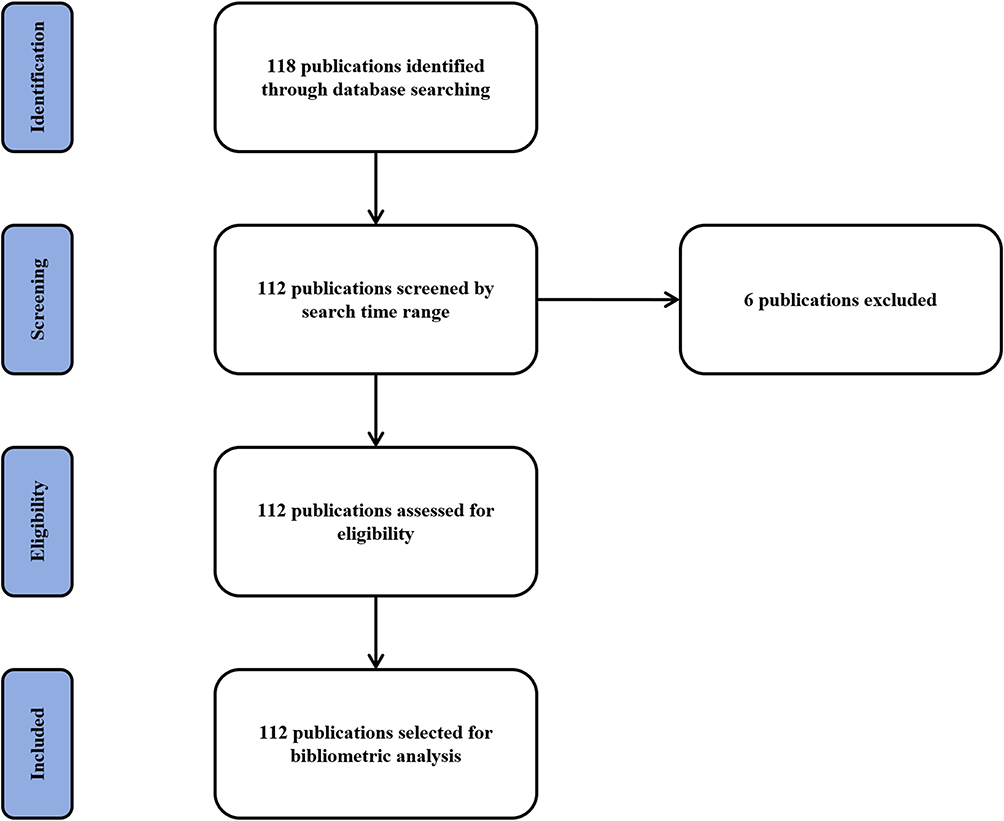 |
Figure 1 The PRISMA flow chart of bibliometric analysis of publications on the application of AI in orthopedics. |
Results
Annual Publication Trends Analysis
A search using the keywords “AI” and “orthopedics” yielded 112 publications from January 2010 to December 2024, with an average annual publication count of 8. As illustrated, research related to “AI” and “orthopedics” can be broadly divided into two phases. The initial phase (2017–2020) exhibited fluctuating trends, while the subsequent phase (2021–2024) was considered a period of sustained growth. The number of publications peaked in 2024 with 45 articles, marking a 44-fold increase compared to 2017. During 2021–2024, the average annual publication count was 24. However, the average annual citation count showed an overall declining trend, with the highest average citation count recorded in 2017 (15), followed by a gradual decrease after 2019 (Figure 2).
 |
Figure 2 Annual Publication Trends and Average Citation Counts of Literature at the Intersection of AI and Orthopedics from January 2010 to December 2024. |
Three-Field Plot
The Sankey diagram, illustrating the relationship among Author (AU), Affiliation (AU_UN), and Source (SO) in global literature related to “AI” and “Orthopedics”, revealed the flow and connections between these fields (Supplementary Figure S1). Notably, the highest flow from the Author category was directed toward the Hospital for Special Surgery, highlighting its significant role in the intersection of “AI” and “Orthopedics”.
Most Relevant Sources
The top 10 journals ranked by publication volume were shown (Supplementary Figure S2). Among them, FRONTIERS IN SURGERY, JOURNAL OF ARTHROPLASTY, JOURNAL OF MEDICAL INTERNET RESEARCH, and ORTHOPEDICS leaded with the highest number of publications, each publishing 4 articles. EFORT OPEN REVIEWS and WORLD JOURNAL OF ORTHOPEDICS followed closely in second place, with 3 publications each (Supplementary Figure S2).
Sources’ Production Over Time
The line graph illustrated the annual publication trends of the top 10 journals, ranked by cumulative article output, on the topic of AI applications in orthopedics. Notably, the JOURNAL OF ARTHROPLASTY has consistently published relevant literature each year since 2018 (Supplementary Figure S3).
Most Relevant Authors
The comprehensive literature review encompassed contributions from a total of 620 distinct authors. Through detailed comparative analysis of authors and their affiliated institutions, it was observed that 17.86% of the 112 reviewed publications involved international collaborations. Among the top 10 most prolific authors, RAMKUMAR PREM N leaded with 5 publications, followed by HAEBERLE HEATHER S and PAREEK AYOOSH, each with 4 publications (Figure 3).
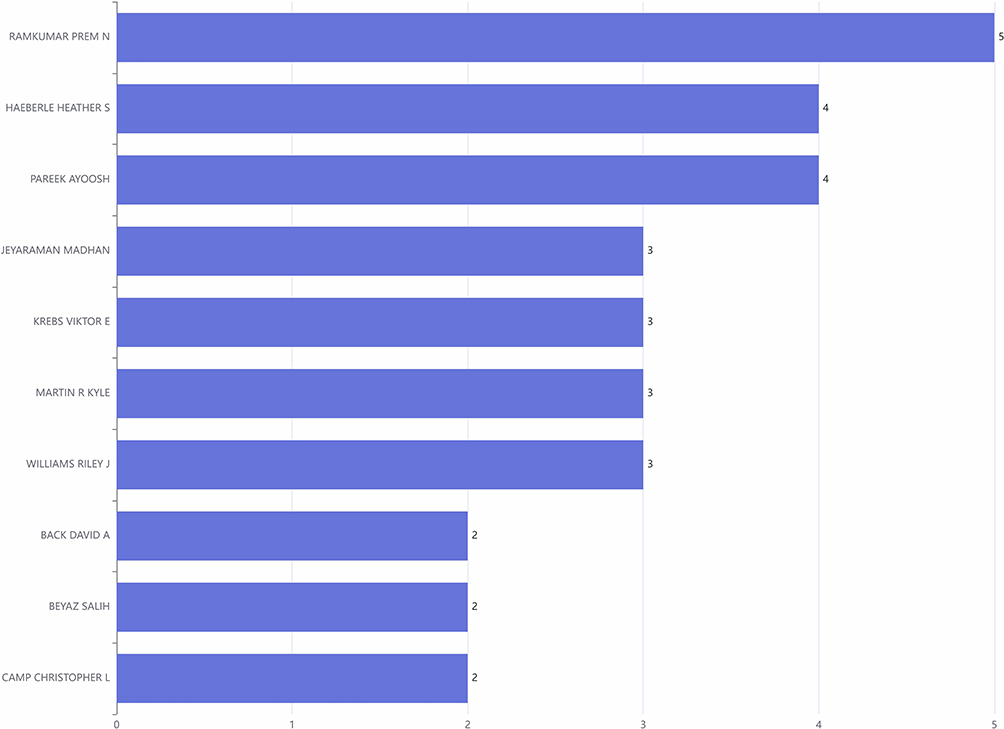 |
Figure 3 Ranking of Authors at the Intersection of AI and Orthopedics Based on Publications from January 2010 to December 2024. |
Authors’ Production Over Time
Lotka’s Law illustrated the unequal distribution of academic productivity, where a limited number of prolific authors generated the majority of scholarly output, while most contributors produced only a minimal number of publications. The empirical data demonstrated a notable deviation from the theoretical model: single-author publications (N.Authors = 1) exhibit the highest frequency (Freq = 0.921), significantly exceeding the predicted value of 0.68 (Supplementary Figure S4). This disparity underscored the predominance of authors who published just one article during the study period. Notably, Jeyaraman Madhan, Martin R. Kyle, and Pareek Ayoosh emerged as the most productive contributors in 2022 and 2024, each publishing three articles (Supplementary Figure S5). Their substantial output has been instrumental in driving research advancements in the application of AI within orthopedics, establishing them as key opinion leaders in this specialized domain.
Most Relevant Affiliations
The Figure 4 illustrated the leading research institutions in the application of AI in orthopedics, ranked based on their publication output. The Hospital for Special Surgery and Huazhong University of Science and Technology appeared most frequently (9 times each), followed by the University of Palermo in second place (7 times). Indiana University School of Medicine and Mayo Clinic shared the third position (5 times each).
 |
Figure 4 Ranking of Institutions Publishing in AI-Orthopedics Interdisciplinary Research from January 2010 to December 2024. |
Affiliations’ Production Over Time
The line graph illustrated the cumulative publication output of the top 10 research institutions over different years. Starting from 2020, several institutions have shown a significant increase in their publication numbers. Notably, the Hospital for Special Surgery and Huazhong University of Science and Technology reached their highest publication count in recent years, with 9 papers published in 2024 (Supplementary Figure S6).
Corresponding Author’s Countries
The corresponding authors of the related literature were from 38 countries. Based on the number of publications, the countries of the corresponding authors were ranked. China leaded with the highest number of articles (total: 19; SCP: 18; MCP: 1), followed by the USA in second place (total: 17; SCP: 13; MCP: 4), and India in third place (total: 9; SCP: 9; MCP: 0). Among the 19 countries, China had the highest SCP ratio at 28.1%, while the USA had the highest MCP ratio at 25% (Supplementary Figure S7).
Countries’ Scientific Production
The regional distribution of research output across different countries in the relevant field was illustrated (Supplementary Figure S8). The top three countries/regions with the highest number of publications were the USA (60 articles, 22.99%), followed by China (53 articles, 20.31%) and India (29 articles, 11.11%) (Supplementary Figure S8).
Countries’ Production Over Time
The line graph illustrated the cumulative publication output of the top five countries over different years. Starting in 2018, the USA surged to the top in terms of publication volume, reaching a total of 154 articles by December 2024, while China ranked second with 97 articles (Supplementary Figure S9). The global citation rankings aligned with the publication rankings, with the USA maintaining its leading position in total citations, accumulating 65 citations, followed by China with 36 citations (Supplementary Figure S10).
Most Global Cited Documents
In the relevant literature, the most frequently cited works were as follows: OLCZAK JAKUB, 2017, with a total of 135 citations, ranked first. BINI STEFANO A, 2018, with 58 citations, took the second position. RAMKUMAR PREM N, 2019, with 40 citations, was ranked third (Supplementary Figure S11).
WordCloud
The analysis of author keywords in the article was conducted to evaluate various themes in the application of AI within the field of orthopedics. A word cloud and tree map were used to visualize the 50 most frequently occurring author keywords (Figure 5A and B). The most prominent keywords included “artificial intelligence” (68 times), “orthopedics” (32 times), “machine learning” (23 times), “deep learning” (19 times), and “ChatGPT” (13 times) (Figure 5C).
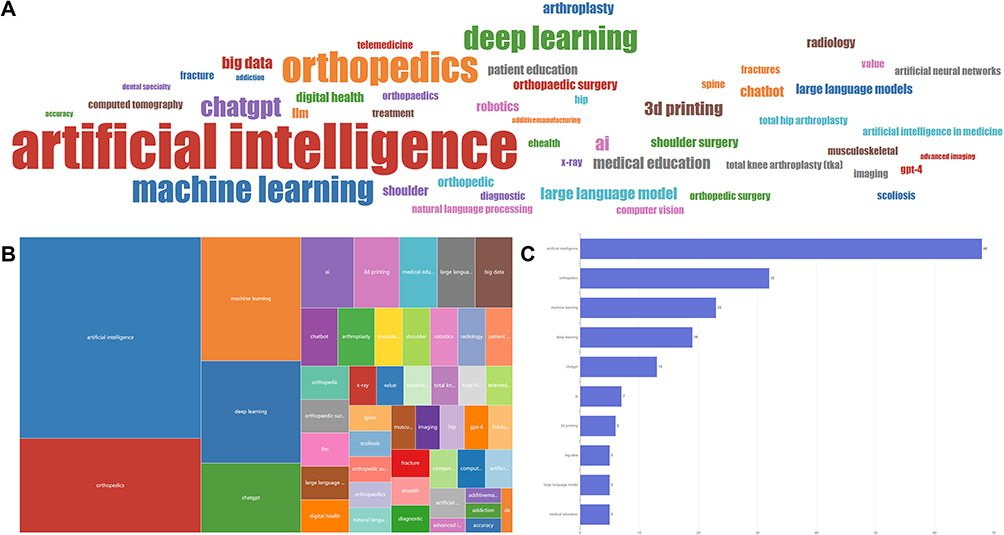 |
Figure 5 From January 2010 to December 2024, high-frequency keywords in the literature at the intersection of AI and orthopedics are visualized through a WordCloud (A), TreeMap (B), and bar chart (C) illustrating the changes in word frequency. |
Words’ Frequency Over Time
When analyzing the frequency of keywords in AI-related orthopedic literature over the years, it was evident that terms such as AI, MACHINE LEARNING, DEEP LEARNING, and 3D PRINTING have consistently been the focus of research since 2018 (Supplementary Figure S12).
Trend Topics
A trend analysis was conducted on scientific articles addressing the global application of AI in orthopedics. By examining the literature data from this period, the primary research themes and their evolutionary trends were identified at the intersection of AI and orthopedics (Figure 6). The analysis revealed several key research topics that have shown significant development trends in recent years:
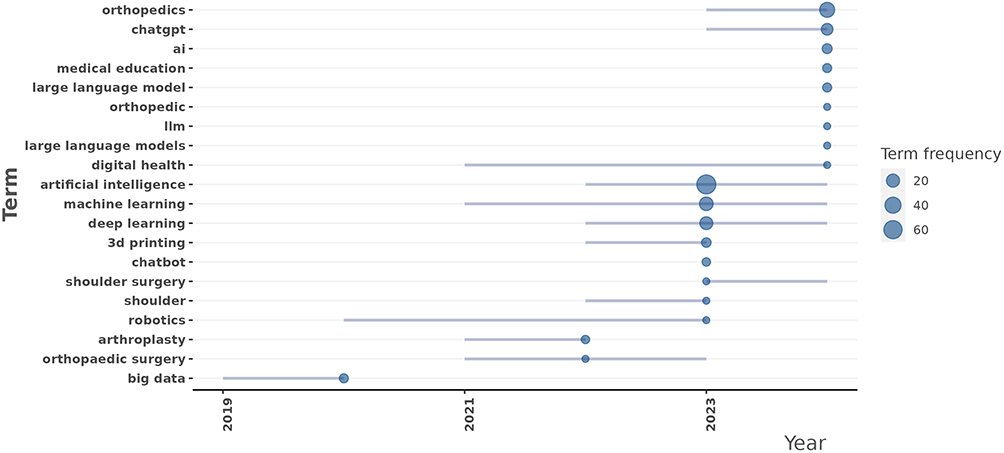 |
Figure 6 Research Topic Trends at the Intersection of AI and Orthopedics from January 2010 to December 2024. |
Artificial Intelligence (Frequency: 68)
Research in this area began to increase in 2022, with a median year of 2023, and maintained a high research frequency through 2024. This indicated that AI has remained a consistently focused area in orthopedic research.
Orthopedics (Frequency: 32)
Research in orthopedics saw a rapid rise starting in 2023, with a median year of 2024, and remained active through 2024. This reflected that while global AI research in orthopedics started later, it quickly became a hot topic.
Machine Learning (Frequency: 23)
Research in machine learning significantly increased from 2021, with a median year of 2023, and continued actively through 2024. This demonstrated the scientific community’s sustained interest in machine learning.
Deep Learning (Frequency: 19)
Research in deep learning began to grow in 2022, with a median year of 2023, and was still ongoing in 2024.
ChatGPT (Frequency: 13)
Research related to ChatGPT in orthopedics started to increase in 2023, with a median year of 2024, and remained active through 2024. This highlighted that ChatGPT-related studies remained an important branch of AI applications in orthopedics.
Clustering by Coupling
After conducting a coupling cluster analysis on scientific articles related to the global application of AI in orthopedics, 20 major clusters were identified, each with an impact score of 1.000. These clusters exhibited distinct research focuses and characteristics (Supplementary Figure S13). Below was a detailed description of four prominent clusters:
Cluster 1
The largest cluster, comprising 19 articles, was primarily labeled with “arthroplasty - conf 50%” and “chatbot - conf 50%”, highlighting its dominant position. “Artificial intelligence - conf 27.7%” was another significant component. The centrality score of 1.0655 underscored its importance within the overall network.
Cluster 2
This cluster consisted of 13 articles, with “deep learning - conf 57.9%” as the primary label, reflecting its prominence. “Artificial intelligence - conf 18.5%” and “machine learning - conf 31.8%” were also key components. Its centrality score of 1.39, higher than Cluster 1, indicated a strong network centrality.
Cluster 3
Comprising 12 articles, this cluster was labeled with “machine learning - conf 45.5%”, while “artificial intelligence - conf 16.9%” and “orthopedics - conf 32.3%” were notable features. With a centrality score of 1.5785, the highest among all clusters, it held a core position in the network, signifying substantial academic influence.
Cluster 4
This cluster included 10 articles, with “chatgpt - conf 76.9%” as the primary label. “Artificial intelligence - conf 15.4%” and “orthopedics - conf 19.4%” were prominent features, emphasizing their importance. Its centrality score of 1.4864, the second highest among all clusters, reflected its critical position in the network, similar to Cluster 3, indicating significant academic influence.
Through coupling cluster analysis, we not only identified the main research clusters at the intersection of AI and orthopedics but also revealed their centrality and impact within the research network.
Co-Occurence Network
The keyword contribution network analysis revealed that nodes represented keywords, and the connections between nodes indicated co-occurrence or citation relationships. In the co-occurrence network, “artificial intelligence” emerged as the most significant node, with the highest betweenness centrality (628.5765), a relatively high closeness centrality (0.0238), and a notable PageRank value (0.2822). This highlighted “artificial intelligence” as a pivotal bridge connecting diverse research themes and solidified its central role in the network. Additionally, “orthopedics” and “machine learning” were also key nodes, with betweenness centrality values of 71.2969 and 43.9792, respectively, underscoring their critical mediating roles (Supplementary Figure S14A).
The density map visually represented the interactions between keywords, with darker areas indicating higher co-occurrence frequencies or stronger relational densities. In this map, “artificial intelligence” and “deep learning” appeared in darker regions, signifying frequent interactions and discussions between these topics and reflecting current research hotspots (Supplementary Figure S14B). The degree distribution plot illustrated the number of connections each node had, with “artificial intelligence” and “deep learning” prominently featured (Supplementary Figure S14C). This aligned with their central positions in the network and indicated their extensive connections with other nodes, marking them as focal keywords in the research. The co-linearity network further emphasized the central role of “machine learning” and “deep learning” in the application of AI in orthopedic research.
Thematic Map
By integrating Callon’s centrality and density metrics, the research topics related to AI applications in orthopedics were primarily divided into five clusters (Supplementary Figure S15A and B):
Artificial Intelligence (Centrality: 2.1968, Density: 37.4111, Centrality Rank: 12)
This cluster held a significant central position in the network, indicating strong connections to other topics and a high level of internal coherence. Its top centrality rank confirmed that artificial intelligence remained a core theme in the field.
3D Printing (Centrality: 0.8333, Callon Density: 71.6049, Centrality Rank: 11)
This cluster shared a similar centrality to artificial intelligence, suggesting that 3D printing also played a central role in the research network. Its higher Callon density reflected even greater internal consistency.
Machine Learning (Centrality: 0.5007, Density: 47.8924, Centrality Rank: 9)
This cluster demonstrated a notable presence in the network, with a moderate level of centrality and a relatively high density, indicating its importance in the field.
Arthroplasty (Centrality: 0.7708, Density: 43.75, Centrality Rank: 10)
This cluster also held a significant position, with a slightly lower centrality but a comparable density to machine learning, highlighting its relevance in orthopedic research.
Chatbot (Centrality: 0.4583, Density: 43.5185, Centrality Rank: 7)
This cluster, while having a lower centrality, still showed a significant level of internal coherence, indicating its growing importance in the domain.
Co-Citation Network
A co-citation network analysis was performed to map the core literature on AI applications in orthopedics in 2019 and their positions within the academic network (Supplementary Figure S16). The study by Ramkumar PN (2019) stood out as the most influential paper, with its high betweenness centrality and PageRank score indicating its pivotal role in the research community. Other significant contributions included works by Olczak J (2017) and Makhni EC (2020), which also held considerable importance in the field (Supplementary Figure S16A–C). These findings not only highlighted key contributors at the intersection of AI and orthopedics but also shed light on the interconnections and distribution of influence across research themes.
Collaboration Network
A thorough examination of global literature indicated that 620 authors have contributed to this field of research. A collaborative network was formed, consisting of authors who have published a minimum of two papers. As illustrated in the co-authorship network diagram, Ramkumar P.N. stood out as the most influential researcher, with his high betweenness centrality and PageRank scores highlighting his pivotal role within the research community. Furthermore, other researchers such as Pareek ayoosh and Martin r kyle, though less prominent, still occupied significant positions in the network, demonstrating their active involvement and impact in the co-authorship network of the literature (Supplementary Figure S17).
Countries’ Collaboration World Map
When analyzing the patterns and trends in global scientific research collaboration, it became evident that the most frequent occurrence of cooperation was twice. Although most countries engaged in extensive collaborative networks, the frequency of these partnerships remained relatively limited (Supplementary Figure S18).
Literature Recommendation
By evaluating global academic literature, 10 influential papers were identified based on their impact factor (Table 1). Furthermore, 10 frequently cited papers were selected according to their citation metrics (Table 2).
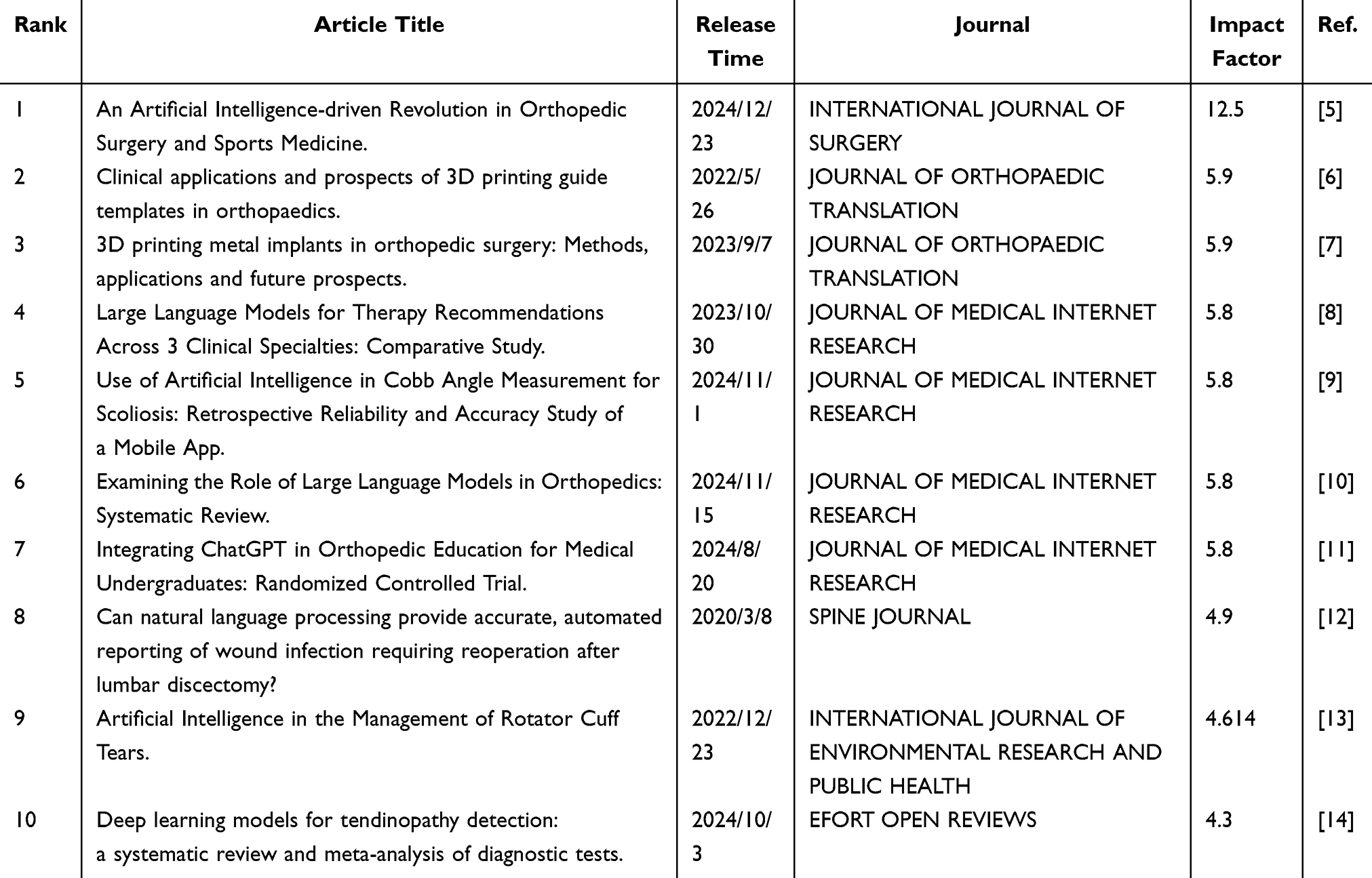 |
Table 1 High-Scoring Recommended Literature Based on the Impact Factor Criteria |
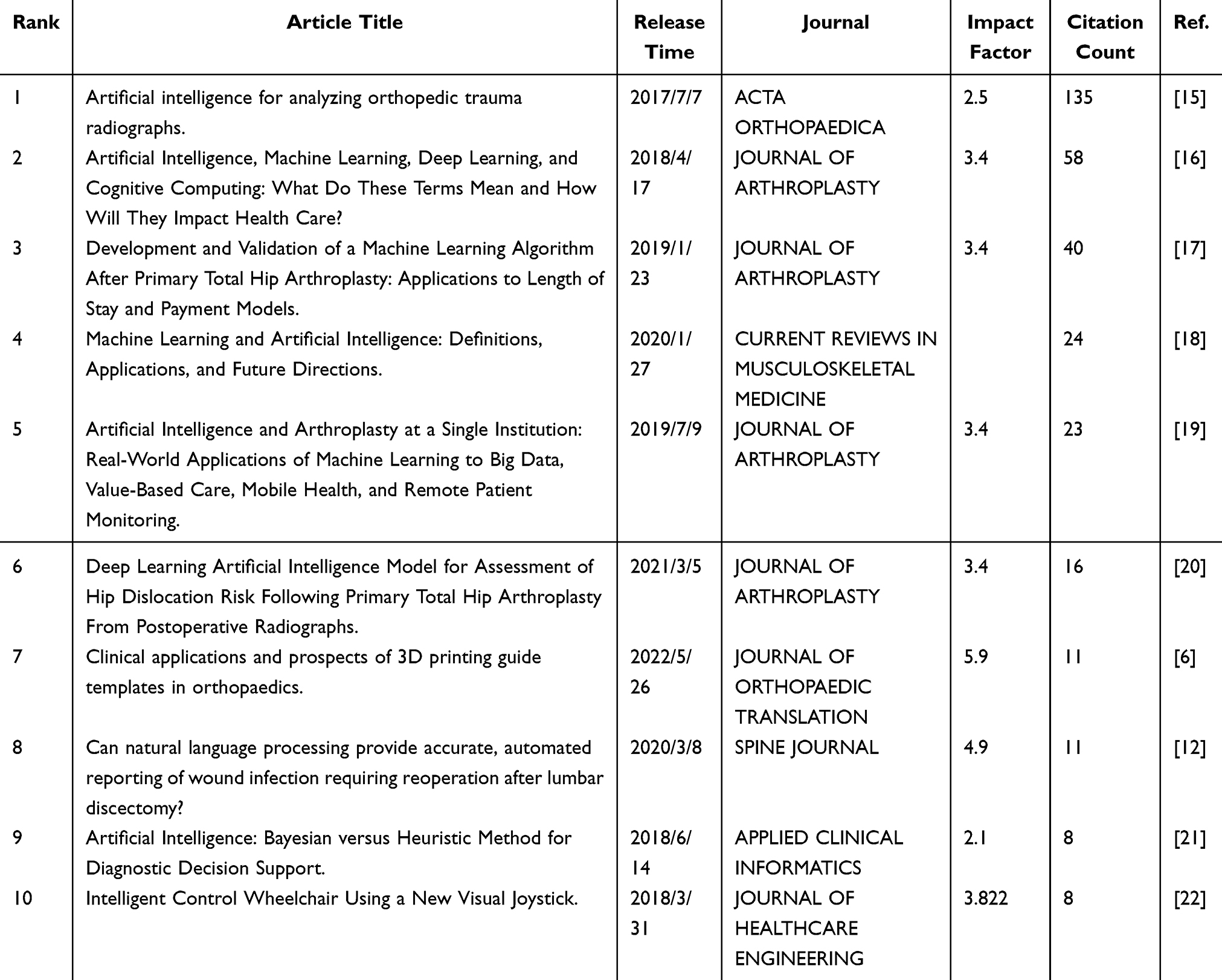 |
Table 2 Identify Highly Cited Literature Based on Citation Count |
Discussion
Major Findings
Our findings indicated that AI applications have gradually become a research hotspot in orthopedics, with publication numbers peaking in 2024. The Hospital for Special Surgery played a significant role in this field. Journals such as Frontiers in Surgery, Journal of Arthroplasty, Journal of Medical Internet Research, and Orthopedics, led with the highest number of publications. Researchers like Ramkumar Prem N., Haehberle Heather S., Pareek Ayoosh, Jeyaraman Madhan, and Martin R. Kyle made substantial contributions to this field. China and the USA were major contributors. The works by Olczak Jakub (2017) and Bini Stefano A. (2018) were the most frequently cited.15,16 Key terms such as “machine learning”, “deep learning”, “ChatGPT”, “3D printing”, and “arthroplasty” emerged as the most popular topics. Despite the extensive research conducted on AI applications in orthopedics across numerous countries, international collaboration remained relatively limited.
Future Directions
The application of machine learning in orthopedics not only enhanced the accuracy and efficiency of clinical decision-making but also provided extensive opportunities for future research and application. Its use in orthopedic oncology has notably enhanced the accuracy of clinical decisions. By developing predictive models based on large datasets, machine learning can generate outputs without explicit instructions, thereby aiding in clinical predictions. These models excelled at predicting survival rates for primary sarcomas and metastatic bone diseases. However, their robustness must be evaluated according to standardized guidelines to ensure their applicability across different clinical settings.23,24 Additionally, machine learning has shown potential in predicting and preventing periprosthetic infections after total knee arthroplasty. Through machine learning techniques, preoperative health optimization and surgical planning can be conducted, early infection diagnosis can be achieved, appropriate antibiotics can be administered promptly, and clinical outcomes can be predicted. These applications not only increased the success rate of surgery but also reduced the incidence of postoperative complications. However, current machine learning applications still faced limitations, such as the need for large datasets and insufficient external validation, which required further research to overcome these challenges.25 Furthermore, the integration of social health determinants into machine learning models for orthopedic prognosis was gradually gaining attention. Studies showed that social health determinants played a crucial role in the outcomes of orthopedic treatments. Therefore, considering these factors when developing machine learning models can help reduce potential differences and biases. However, most current models still had limited consideration of these factors during development. Future research should focus on improving the quality of model development to avoid bias and inequality in orthopedic applications.3 With the continuous advancement of technology, machine learning was expected to play an even greater role in the field of orthopedics.
Deep learning has garnered significant attention in orthopedics, demonstrating substantial clinical value across various domains. Its applications in orthopedics encompassed fracture detection, bone tumor diagnosis, implant recognition, and the assessment of osteoarthritis severity. These applications frequently offered more accurate and efficient diagnoses compared to traditional methods, thereby decreasing diagnostic time and costs for both patients and orthopedic practitioners.26 Moreover, deep learning was also being used to accelerate the reconstruction of magnetic resonance imaging for knees and ankles. Research indicated that sequences reconstructed using deep learning matched traditional sequences in diagnostic performance and image quality while halving the acquisition time. This technology enhanced clinical efficiency and reduced patient discomfort during examinations.27 Lastly, current research hotspots in orthopedics involving deep learning included the identification and classification of bone tumors and osteoporosis. Future research directions may focus on reducing intraoperative risks, predicting postoperative complications, screening for osteoporosis, and identifying and classifying bone tumors from routine imaging. Exploring these areas will further advance the application and development of deep learning in orthopedics.28
The application of ChatGPT in orthopedics extended beyond clinical practice to encompass education and research, demonstrating its considerable potential to enhance medical efficiency and educational quality. Its use in orthopedic trauma surgery has shown that it can provide valuable and generally accurate answers. Studies have indicated that ChatGPT can generate adaptable responses tailored to different target groups, including patients, non-orthopedic doctors, and orthopedic experts, achieving high scores for accuracy, completeness, and adaptability.29 Moreover, the application of ChatGPT in orthopedic education has yielded notable results. A randomized controlled trial found that medical students who utilized ChatGPT as a learning tool performed better on orthopedic tests compared to those in the control group who did not use AI tools. This suggested that ChatGPT had the potential to enhance both short-term and long-term learning outcomes, supporting its integration into medical education.11 Additionally, a systematic review of large language models in orthopedics highlighted the potential applications of ChatGPT in various domains, including clinical practice, education, research, and management. While ChatGPT cannot yet fully replace orthopedic professionals, it can significantly improve work efficiency as an auxiliary tool.10
The application of 3D printing technology in orthopedics was rapidly expanding, particularly in arthroplasty, where it demonstrated significant potential and advantages. The 3D printing technology enabled the production of highly customized implants tailored to a patient’s specific anatomical structure and disease characteristics, thereby enhancing surgical precision and postoperative recovery outcomes.30 In joint replacement surgery, 3D printing technology served multiple purposes, including the manufacturing of personalized implants, preoperative planning, and surgical navigation. By integrating medical imaging techniques such as CT and MRI, 3D printing can accurately replicate the anatomical structure of damaged tissues, aiding surgeons in developing more precise surgical plans. This application not only mitigated excessive mechanical stress and stress shielding effects but also enhanced biocompatibility and functionality, promoting angiogenesis and bone growth.7 Moreover, the use of 3D printing in orthopedics extended to innovations in biomaterials. For instance, 3D-printed biomaterials can be employed in bone tissue engineering, offering improved pore structures that supported cell proliferation and differentiation, thus enhancing bone regeneration efficiency. These advancements provided better options for personalized treatment and bone defect repair, with significant research value in orthopedic applications.31
Implications, Limitations, and Strengths
From a research perspective, the identification of evolving hotspots, such as AI-based diagnostics, ChatGPT, and 3D printing, can guide future studies toward high-impact and underexplored areas. For clinical practice, understanding global trends in AI applications may help orthopedic professionals anticipate technological advancements and prepare for integration into workflows. The analysis also provided valuable insights for policymakers and funding agencies, highlighting regions and institutions actively contributing to AI-driven orthopedic innovation, thereby informing strategic investment and international collaboration. Furthermore, this study can aid in shaping educational and training programs by emphasizing key areas where AI literacy will become increasingly important in orthopedic care. The findings of this bibliometric analysis have several important implications.
This study had several limitations. Firstly, the data were sourced exclusively from the PubMed database, which may have led to the omission of relevant articles indexed in other databases such as Web of Science or Scopus. Secondly, although the search strategy aimed to be as comprehensive as possible, it may not have captured all relevant articles due to variations in terminology and indexing practices. Additionally, bibliometric analysis itself had inherent limitations, including reliance on publication volume rather than research quality, and limited insight into clinical validation or real-world effectiveness of AI tools. Many AI applications reported in orthopedic literature may still be in early stages of development and lack external validation, limiting the generalizability of their perceived impact.
Despite these limitations, this study offered several strengths. It provided a systematic and reproducible overview of global research trends using a widely accepted bibliometric platform (Bibliometrix), ensuring methodological transparency. By mapping thematic clusters, leading contributors, and emerging topics, the study offered a valuable resource for researchers, clinicians, and policymakers seeking to understand and shape the future of AI in orthopedics.
Conclusion
In recent years, the influence of artificial intelligence in the field of orthopedics has been steadily growing, marking a potential turning point toward an AI-driven era. Key applications, such as AI-based diagnostics, ChatGPT and 3D printing, were shaping the evolution from precision diagnostics to personalized treatment strategies. This study employed bibliometric analysis to identify research trends and hotspots in the interdisciplinary field of artificial intelligence and orthopedics, providing valuable insights for future investigations. While the study has certain limitations, such as reliance on publication databases and keyword selection, these should be considered when interpreting the broader applicability of the findings. Nonetheless, the results served as a useful reference for researchers and policymakers aiming to advance the field.
Data Sharing Statement
The datasets used and/or analysed during the current study are available from the corresponding author on reasonable request.
Funding
This work was supported by the Investigator Initiation Fund Project of Fujian Medical University Union Hospital (No.2024XH047), the Fujian Provincial Natural Science Foundation of China (No.2025J08180), and the National Natural Science Foundation of China (No. 12172224).
Disclosure
The authors declare that they have no competing interests.
References
1. González G, Galant J, Salinas JM, et al. Classification and segmentation of hip fractures in x-rays: highlighting fracture regions for interpretable diagnosis. Insights Imaging. 2025;16(1):86. doi:10.1186/s13244-025-01958-y
2. Shi W, Giuste FO, Zhu Y, et al. Predicting pediatric patient rehabilitation outcomes after spinal deformity surgery with artificial intelligence. Commun Med. 2025;5(1):1. doi:10.1038/s43856-024-00726-1
3. Han F, Huang X, Wang X, et al. Artificial intelligence in orthopedic surgery: current applications, challenges, and future directions. MedComm. 2025;6(7):e70260. doi:10.1002/mco2.70260
4. Misir A, Yuce A. AI in orthopedic research: a comprehensive review. J Orthop Res. 2025;43(8):1508–1527. doi:10.1002/jor.26109
5. Guan J, Li Z, Sheng S, et al. An artificial intelligence-driven revolution in orthopedic surgery and sports medicine. Int J Surg. 2025;111(2):2162–2181. doi:10.1097/js9.0000000000002187
6. Meng M, Wang J, Sun T, et al. Clinical applications and prospects of 3D printing guide templates in orthopaedics. J Orthop Translat. 2022;34:22–41. doi:10.1016/j.jot.2022.03.001
7. Meng M, Wang J, Huang H, Liu X, Zhang J, Li Z. 3D printing metal implants in orthopedic surgery: methods, applications and future prospects. J Orthop Translat. 2023;42:94–112. doi:10.1016/j.jot.2023.08.004
8. Wilhelm TI, Roos J, Kaczmarczyk R. Large language models for therapy recommendations across 3 clinical specialties: comparative study. J Med Internet Res. 2023;25:e49324. doi:10.2196/49324
9. Li H, Qian C, Yan W, et al. Use of artificial intelligence in Cobb angle measurement for scoliosis: retrospective reliability and accuracy study of a mobile app. J Med Internet Res. 2024;26:e50631. doi:10.2196/50631
10. Zhang C, Liu S, Zhou X, et al. Examining the role of large language models in orthopedics: systematic review. J Med Internet Res. 2024;26:e59607. doi:10.2196/59607
11. Gan W, Ouyang J, Li H, et al. Integrating ChatGPT in orthopedic education for medical undergraduates: randomized controlled trial. J Med Internet Res. 2024;26:e57037. doi:10.2196/57037
12. Karhade AV, Bongers MER, Groot OQ, et al. Can natural language processing provide accurate, automated reporting of wound infection requiring reoperation after lumbar discectomy? Spine J. 2020;20(10):1602–1609. doi:10.1016/j.spinee.2020.02.021
13. Familiari F, Galasso O, Massazza F, et al. Artificial intelligence in the management of rotator cuff tears. Int J Environ Res Public Health. 2022;19(24). doi:10.3390/ijerph192416779
14. Droppelmann G, Rodríguez C, Smague D, Jorquera C, Feijoo F. Deep learning models for tendinopathy detection: a systematic review and meta-analysis of diagnostic tests. EFORT Open Rev. 2024;9(10):941–952. doi:10.1530/eor-24-0016
15. Olczak J, Fahlberg N, Maki A, et al. Artificial intelligence for analyzing orthopedic trauma radiographs. Acta Orthop. 2017;88(6):581–586. doi:10.1080/17453674.2017.1344459
16. Bini SA. Artificial intelligence, machine learning, deep learning, and cognitive computing: what do these terms mean and how will they impact health care? J Arthroplasty. 2018;33(8):2358–2361. doi:10.1016/j.arth.2018.02.067
17. Ramkumar PN, Navarro SM, Haeberle HS, et al. Development and validation of a machine learning algorithm after primary total hip arthroplasty: applications to length of stay and payment models. J Arthroplasty. 2019;34(4):632–637. doi:10.1016/j.arth.2018.12.030
18. Helm JM, Swiergosz AM, Haeberle HS, et al. Machine learning and artificial intelligence: definitions, applications, and future directions. Curr Rev Musculoskelet Med. 2020;13(1):69–76. doi:10.1007/s12178-020-09600-8
19. Ramkumar PN, Haeberle HS, Bloomfield MR, et al. Artificial intelligence and arthroplasty at a single institution: real-world applications of machine learning to big data, value-based care, mobile health, and remote patient monitoring. J Arthroplasty. 2019;34(10):2204–2209. doi:10.1016/j.arth.2019.06.018
20. Rouzrokh P, Ramazanian T, Wyles CC, et al. Deep learning artificial intelligence model for assessment of hip dislocation risk following primary total hip arthroplasty from postoperative radiographs. J Arthroplasty. 2021;36(6):2197–2203.e3. doi:10.1016/j.arth.2021.02.028
21. Elkin PL, Schlegel DR, Anderson M, Komm J, Ficheur G, Bisson L. Artificial intelligence: Bayesian versus heuristic method for diagnostic decision support. Appl Clin Inform. 2018;9(2):432–439. doi:10.1055/s-0038-1656547
22. Rabhi Y, Mrabet M, Fnaiech F. Intelligent control wheelchair using a new visual joystick. J Healthc Eng. 2018;2018:6083565. doi:10.1155/2018/6083565
23. Marconi L, Cabitza F. Show and tell: a critical review on robustness and uncertainty for a more responsible medical AI. Int J Med Inform. 2025;202:105970. doi:10.1016/j.ijmedinf.2025.105970
24. Rizk PA, Gonzalez MR, Galoaa BM, et al. Machine learning-assisted decision making in orthopaedic oncology. JBJS Rev. 2024;12(7):e24. doi:10.2106/jbjs.Rvw.24.00057
25. Gallitto G, Englert R, Kincses B, et al. External validation of machine learning models-registered models and adaptive sample splitting. Gigascience. 2025;14. doi:10.1093/gigascience/giaf036
26. Alzubaidi L, Al-Dulaimi K, Salhi A, et al. Comprehensive review of deep learning in orthopaedics: applications, challenges, trustworthiness, and fusion. Artif Intell Med. 2024;155:102935. doi:10.1016/j.artmed.2024.102935
27. Bedoya MA, Iwasaka-Neder J, Tsai A, et al. Deep learning MR reconstruction in knees and ankles in children and young adults. Is it ready for clinical use? Skeletal Radiol. 2025;54(3):509–529. doi:10.1007/s00256-024-04769-2
28. Huang X, Han F, Chen YF, et al. Bibliometric analysis of the application of artificial intelligence in orthopedic imaging. Quant Imaging Med Surg. 2025;15(5):3993–4013. doi:10.21037/qims-24-1384
29. Kaarre J, Feldt R, Zsidai B, et al. ChatGPT can yield valuable responses in the context of orthopaedic trauma surgery. J Exp Orthop. 2024;11(3):e12047. doi:10.1002/jeo2.12047
30. Cong B, Zhang H. Innovative 3D printing technologies and advanced materials revolutionizing orthopedic surgery: current applications and future directions. Front Bioeng Biotechnol. 2025;13:1542179. doi:10.3389/fbioe.2025.1542179
31. Zhan L, Zhou Y, Liu R, et al. Advances in growth factor-containing 3D printed scaffolds in orthopedics. Biomed Eng Online. 2025;24(1):14. doi:10.1186/s12938-025-01346-z
 © 2025 The Author(s). This work is published and licensed by Dove Medical Press Limited. The
full terms of this license are available at https://www.dovepress.com/terms
and incorporate the Creative Commons Attribution
- Non Commercial (unported, 4.0) License.
By accessing the work you hereby accept the Terms. Non-commercial uses of the work are permitted
without any further permission from Dove Medical Press Limited, provided the work is properly
attributed. For permission for commercial use of this work, please see paragraphs 4.2 and 5 of our Terms.
© 2025 The Author(s). This work is published and licensed by Dove Medical Press Limited. The
full terms of this license are available at https://www.dovepress.com/terms
and incorporate the Creative Commons Attribution
- Non Commercial (unported, 4.0) License.
By accessing the work you hereby accept the Terms. Non-commercial uses of the work are permitted
without any further permission from Dove Medical Press Limited, provided the work is properly
attributed. For permission for commercial use of this work, please see paragraphs 4.2 and 5 of our Terms.
Recommended articles

Bibliometric Analysis: Research Trends and Performances of Stroke on Acupuncture
Yang F, Cui Y, Zhao Y, Jiao H
Journal of Pain Research 2024, 17:1837-1851
Published Date: 22 May 2024
Theoretical Domains Framework: A Bibliometric and Visualization Analysis from 2005-2023
Zhou Y, Huang Y, Wang Y, Xu X, Yu Z, Gu Y
Journal of Multidisciplinary Healthcare 2024, 17:4055-4069
Published Date: 20 August 2024
The Traditional Chinese Medicine in Treating Diabetic Nephropathy: A Bibliometric Analysis
Sun J, Shen J, Liu L, Du J
Journal of Multidisciplinary Healthcare 2024, 17:4627-4636
Published Date: 4 October 2024
Exploring Research Trends and Mechanisms: Maternal Diabetes and Neural Tube Defects (1991–2023)
Cao L, Xi Y, Jing Z, Bao Z, Bai B, Lian X, Zhang X, Di J, Liu F
Journal of Multidisciplinary Healthcare 2025, 18:1107-1121
Published Date: 25 February 2025
Mapping Artificial Intelligence Research Trends in Critical Care Nursing: A Bibliometric Analysis
Zhou L, Geng K, Yu C
Journal of Multidisciplinary Healthcare 2025, 18:2799-2811
Published Date: 19 May 2025