
Back to Journals » Psychology Research and Behavior Management » Volume 19
The Relationship Between Fear of Missing Out, Academic Burnout, and Depression, Anxiety, and Stress Among Chinese College Students: An Empirical Analysis Based on Structural Equation Modeling
Authors Ye X, Dong Y, Zhang Y, Yang W, Zhou J 
Received 24 April 2026
Accepted for publication 4 July 2026
Published 16 July 2026 Volume 2026:19 617678
DOI https://doi.org/10.2147/PRBM.S617678
Checked for plagiarism Yes
Review by Single anonymous peer review
Peer reviewer comments 3
Editor who approved publication: Dr Igor Elman
Xiaoli Ye,1 Yujie Dong,1 Yushu Zhang,1 Wei Yang,1 Jingjing Zhou2
1Institute of Higher Education, Anhui University, Hefei, 230039, People’s Republic of China; 2School of Education, South-Central Minzu University, Wuhan, 430074, People’s Republic of China
Correspondence: Jingjing Zhou, School of Education, South-Central Minzu University, Wuhan, 430074, People’s Republic of China, Email [email protected]
Purpose: To explore the relationship between fear of missing out (FoMO), academic burnout, depression, anxiety, and stress among Chinese college students, and to examine the mediating role of academic burnout.
Participants and Methods: A cross-sectional survey was conducted among 883 college students from three universities in Anhui and Hubei provinces, China. Participants completed validated scales measuring FoMO, academic burnout, depression, anxiety, and stress (DASS-21). Structural equation modeling (SEM) was employed to test the direct and indirect effects.
Results: FoMO showed significant positive correlations with academic burnout, depression, anxiety, and stress. Academic burnout significantly mediated the relationships between FoMO and each of the three psychological outcomes. The partial mediation model demonstrated good fit (CFI=0.989, TLI=0.976, RMSEA=0.064). FoMO showed positive associations with depression, anxiety, and stress, as well as associations via academic burnout.
Conclusion: FoMO is not only associated with depression, anxiety, and stress but also associated with these outcomes through academic burnout. These findings provide preliminary correlational evidence that highlight the potential relevance of FoMO and academic burnout as correlates of mental health.
Keywords: FoMO, academic burnout, depression, anxiety, stress, Chinese college students
Introduction
In an era of intense competition and rapid social change, college students face unprecedented academic and employment pressures, making their mental health an issue of growing public concern. Extensive research documents a steady increase in mental health difficulties among college students, with many experiencing depression, anxiety, and stress.1,2 As documented by Regehr et al, in examining stress mitigation programs for college students, a meta-analytic review demonstrated that nearly half of this group experiences moderate to severe mental health conditions, such as anxiety and depression.3 The annual report released by the American College Health Association-National College Health Assessment further reveals that symptoms of psychological distress are widespread, with anxiety and depression constituting the most common mental illnesses among American college students.4 Similarly, a mental health survey carried out by the Chinese Academy of Sciences involving nearly 80,000 college students aged 15 to 26 found that 21.48% were at risk of depression and 54.72% were at risk of anxiety.5 Mental health problems not only severely impair college students’ academic achievement and personal growth,6 but also constitute significant risk factors for suicidal behavior.7 Depression, anxiety, and stress are common mental health concerns that frequently impact individuals, exerting a profound effect on their overall well-being.8 For this reason, an in-depth analysis of the risk indicators and underlying mechanisms tied to depression, anxiety, and stress in college students is essential for developing effective preventive and interventional strategies.
Furthermore, the broad adoption of mobile internet and social media has profoundly reshaped college students’ daily lifestyles. Per the Statistical Report on China’s Internet Development released by CNNIC, China’s internet user base stood at 1.123 billion, and university students form the main body of mobile internet users.9 Chinese university students spend over 5 h a day on mobile phones, and around 79% of students use their mobile phones during class.10 While this highly interconnected digital environment facilitates communication and access to information, it has also given rise to an emerging psychological phenomenon known as FoMO. At the same time, an “involution” (neijuan) culture of intense academic competition has become prevalent on Chinese campuses, where students face mounting pressure to excel in grades, research, and internships. This context of combined high digital dependence and high academic competition may amplify the negative effects of FoMO on both academic and psychological outcomes. Research by Bacaksiz et al not only identified an inverse association between age and FoMO but also revealed that FoMO is predominantly observed among adolescents,11 further highlighting its prevalence and significance within younger populations. Thus, FoMO has become a critical risk factor threatening the psychological state of college students.12
However, the severity of depression, anxiety, and stress, which is observed in college students, may not be directly predicted by FoMO only through direct emotional mechanisms. To alleviate FoMO, students often develop habitual behavioral patterns characterized by frequent phone checking, constant monitoring of social updates, and continuous task switching during study sessions.13 When such behavioral patterns persist over time, substantial cognitive resources are consumed, leaving fewer resources available for other activities, particularly academic tasks. Students may then tend to adopt surface learning approaches,14 and fall into a deeper state of negative academic engagement, namely academic burnout,15 thereby posing a significant risk to their psychological well-being. Indeed, the sustained attentional fragmentation and time mismanagement associated with FoMO are related to reduced academic achievement and emotional exhaustion, which in turn are associated with academic burnout. Gong et al empirically confirmed that higher FoMO levels are significantly associated with poorer academic outcomes, primarily because FoMO disrupts academic engagement and reduces learning efficiency.16 When reduced achievement persistently overlaps with emotional exhaustion, it is ultimately associated with a state of academic burnout. It has also been shown that academic burnout significantly impairs college students’ psychological well-being.17 Put more simply, among college students, FoMO may be positively associated with depression, anxiety, and stress, and academic burnout appears to play a mediating role in these associations. However, few studies have examined how FoMO affects college students’ mental health through the mediating mechanism of academic burnout, particularly in the Chinese context.
Although prior studies have separately tested the connections between FoMO, academic burnout, depression, anxiety, and stress, few have integrated these variables into a unified theoretical framework to systematically elucidate how the mediating function of academic burnout is demonstrated in the links between FoMO and these psychological outcomes among college students. Moreover, prior research has often used regression analysis to test the separate associations of each antecedent variable with each outcome variable, which limits the ability to reveal the complex interrelationships among the variables. Accordingly, this study, employing a sample recruited from Chinese college students, constructs a structural equation model that includes depression, anxiety, and stress as parallel outcomes, while simultaneously examining both the association of FoMO on depression, anxiety, and stress, and associations through academic burnout as a mediator. This study aims to deepen insight into the mechanisms underlying college students’ psychological distress and to provide empirical evidence for universities regarding the relevance of reducing FoMO and alleviating academic burnout to student mental health.
Literature Review and Theoretical Hypotheses
FoMO and Depression, Anxiety, and Stress
Coined by Stamell, the term FoMO describes a pervasive social-psychological tendency, manifested in individuals’ characteristic behavior of continuously monitoring social media and other platforms to obtain information.18 Vaughn provided the initial conceptual definition of FoMO, characterizing it as a feeling of anxiety stemming from the fear of missing information, and reported that approximately 75% of young adults had experienced FoMO.19 Subsequently, FoMO was defined by Przybylski et al as a widespread apprehension stemming from concerns about missing important information, and they developed the most widely used FoMO scale to date. Their research demonstrated that FoMO was negatively linked to college students’ overall mood as well as life satisfaction.20 Multiple studies have further demonstrated that FoMO has extensive negative effects on individuals’ psychological states and behavioral patterns. For instance, FoMO increases individuals’ sensitivity to and dependence on online information,21 while reducing self-esteem and well-being.22,23 Research has also found that FoMO is closely associated with sleep disturbances,24 and with unhealthy behavioral manifestations such as excessive smartphone use.25
Extant research has explored the underlying association between FoMO and stress-related psychological distress, encompassing depression, anxiety, and general stress. Empirical studies have confirmed that FoMO elevates individuals’ perceived stress levels,26,27 and exhibits a notable positive link with neuroticism.28 Meanwhile, some studies have indicated that FoMO is a subtype of anxiety,29 and can lead to social anxiety.30,31 Moreover, prior research has demonstrated that FoMO exhibits a strong positive relationship with depressive symptom severity, as evidenced by significant statistical correlations.32 As an illustration, one study carried out with undergraduate students in the Southeast US revealed that elevated FoMO levels are linked to increased physical symptom severity and more severe depression.33 Similarly, it is indicated that college students with a stronger FoMO are more prone to depression.34 From a theoretical perspective, self-determination theory (SDT) holds that, if people are unable to fulfill their fundamental psychological needs, their self-regulation is impaired, leading to negative emotions. In contrast, when their intrinsic needs for social interaction and interpersonal relationships are satisfied, intrinsic motivation is maximized, and individuals experience a sense of fulfillment or well-being.35 FoMO essentially reflects a systemic frustration of fundamental psychological needs, particularly relatedness and autonomy. According to SDT, such frustration is theorized to hinder positive self-regulation, which in turn may be associated with intensified negative emotions and reduced psychological well-being. To summarize, synthesizing current theoretical perspectives and empirical evidence, FoMO can be regarded as a prominent correlate of college students’ psychological well-being, and it demonstrates a marked positive relationship with depression, anxiety, and stress. Hence, we hypothesize that:
H1: FoMO is positively associated with depression, anxiety, and stress among college students.
FoMO and Academic Burnout
Research on academic burnout initially stemmed from the exploration of job burnout.36 Then, burnout was conceptualized by Melamed et al as a detrimental emotional condition marked by emotional exhaustion, physical fatigue, and cognitive weariness.37 Recently, as research on job burnout has advanced, academic burnout among college students has increasingly become a focus of scholarly inquiry.38,39 A study conceptualized academic burnout as the outcome of prolonged academic pressure or load and energy consumption that lead to individual energy depletion, manifested as decreased motivation toward academic tasks and activities, alienated and indifferent attitudes, and ultimately, academic outcomes that fail to meet expectations.40 Furthermore, Kourea et al found that academic burnout is evidenced by emotional fatigue, withdrawal from learning engagement, as well as unfavorable cognitive evaluations of learning activities.41 Multiple studies have investigated burnout among students, indicating that burnout is relatively common among young people, with college students being particularly at high risk.42 A large-scale survey comprising 22,983 Chinese college students revealed that over 50% of participants reported experiencing academic burnout.43
Current research explores the factors influencing academic burnout from various perspectives, including environmental, psychosocial, and academic performance dimensions. Among these factors, the use of digital technology, particularly the phenomenon of excessive internet dependence among young people, has been recognized as a significant risk factor for academic burnout.44 Considering that social media gradually turned into an essential element of college students’ daily activities, a specific psychological state induced by such media, namely FoMO, may serve as a critical perspective for understanding academic burnout. Furthermore, existing empirical research has indicated that pronounced FoMO drives students to engage in continuous multitasking, thereby fragmenting their attention to learning.45 Concurrently, research has also indicated that FoMO is closely linked to college students’ academic motivation and performance,46,47 and directly and negatively affects academic achievement, with greater FoMO intensity correlated with weaker academic results.48 Moreover, other research has indicated that FoMO is positively associated with academic procrastination among college students.49 Taken together, FoMO may be a significant factor in academic burnout by interfering with learning engagement, weakening motivation, and disrupting self-regulation processes among college students.
Drawing on the Conservation of Resources (COR) theory, individuals are driven to obtain, sustain, and safeguard valued resources to avoid resource depletion.50 From this theoretical perspective, FoMO may be associated with academic burnout through chronic psychological resource depletion. Specifically, in a highly competitive campus environment, students are constantly exposed to information about their peers’ academic achievements, social activities, and various opportunities through social media. To alleviate the anxiety associated with missing out, they frequently engage in checking information, task switching, or other compensatory social behaviors, which further consume cognitive and time resources that should have been allocated to in-depth learning. Further research has indicated that FoMO may act as an important psychological process positively associated with the severity of academic burnout.51 Put simply, students with elevated FoMO levels are at greater risk of becoming caught in a cycle of resource depletion, which is associated with academic burnout, conceptualized in our study as dejection, improper behavior, and reduced personal accomplishment, dimensions linked to FoMO through resource depletion, task interruption, and sustained underperformance. Therefore, we hypothesize that:
H2: FoMO is positively associated with academic burnout among college students.
Academic Burnout and Depression, Anxiety, and Stress
Numerous research has demonstrated that academic burnout exerts a harmful influence on college students. Beyond affecting academic aspects, including attrition, academic engagement, and academic achievement,52,53 academic burnout is also closely linked to students’ mental health. Using network analysis, a study has identified that college students’ academic burnout is a complex construct consisting of emotional exhaustion, cynicism, and reduced professional efficacy, although it is a concept distinct from depression, yet the two are comorbid.54 Moreover, academic burnout is a significant negative predictor of college students’ life satisfaction, with its detrimental effects primarily mediated by heightened loneliness, leading to broader maladjustment issues.55 Furthermore, prior research has revealed a strong correlation between academic burnout and anxiety, particularly in high-pressure scenarios such as examinations, where feelings of frustration and helplessness exacerbate anxiety symptoms.56 Research conducted among medical students revealed that academic burnout plays a mediating role between individual traits and psychological distress. For instance, overweight and obesity can indirectly increase the risk of depression, anxiety, and stress by exacerbating academic burnout.57 Additionally, research has demonstrated a close correlation between academic burnout and adolescent psychosocial well-being, noting that adolescents with mobile phone dependence tend to experience higher levels of academic burnout, thereby exacerbating mental health problems.58 A strong link between academic burnout and psychological distress among Singaporean college students was revealed in a survey, with greater academic burnout intensity correlated with more severe psychological symptoms.59 In summary, academic burnout is negatively associated with students’ academic progress and positively associated with psychological distress, including depression, anxiety, and stress. Accordingly, we propose that academic burnout is positively related to these psychological outcomes.
H3: Academic burnout is positively associated with depression, anxiety, and stress among college students.
The Mediating Role of Academic Burnout
FoMO may not only be associated with depression, anxiety, and stress among college students, but also associated with these outcomes, with academic burnout acting as a mediator. Drawing on COR theory, FoMO functions as an external, chronic resource-depleting stressor. By compelling individuals to continuously invest attention and cognitive resources in monitoring social dynamics, triggering emotional fluctuations, and engaging in inefficient multitasking, it may progressively be associated with the erosion of the psychological resources that students might otherwise deploy for academic coping and self-regulation. Once individual resources are exhausted to a critical level, academic burnout, a maladaptive state stemming from chronic resource depletion, is likely to occur. Ultimately, academic burnout, as a state of resource depletion, is associated with maladjustment problems, of which mental health issues represent a typical manifestation.60 Notably, in academic contexts, students’ learning experiences and developmental outcomes are often shaped by the interplay of multiple factors. As a psychological syndrome resulting from prolonged academic pressure, academic burnout has been empirically shown to act as a key mediating variable linking antecedent risk factors to subsequent negative outcomes, as well as an explanatory mechanism between protective factors and positive outcomes. For instance, research by Veyis et al, which surveyed 690 Turkish high school students, documented that academic stress, a typical risk factor, was not directly and significantly associated with reduced academic motivation.61 Rather, its detrimental effect on academic motivation operated through academic burnout. In a study examining the link between mindfulness and self-rated foreign language proficiency, a study of Chinese non-English major college students revealed that mindfulness, as a positive psychological resource, enhanced students’ self-perceived language competence solely in an indirect manner, specifically by mitigating academic burnout, thereby validating the mediating function of academic burnout.62 Meanwhile, a study focusing on nursing students revealed that academic burnout functioned as a mediating role in the association between self-efficacy and their inclination toward patient-centered communication.63 These studies, spanning different risk factors, diverse student populations, and various outcome variables, collectively highlight the critical role of academic burnout as a mediating mechanism. In summary, we hypothesize that, among college students, FoMO is associated with psychological distress, with academic burnout serving as a mediator. Consequently, we put forward the following hypothesis:
H4: Academic burnout mediates the relationship between FoMO and depression, anxiety, and stress among college students.
The Current Study
This study centers on Chinese college students and systematically examines the associations between FoMO and their depression, anxiety, and stress, as well as the mediating role of academic burnout. Drawing on SDT and COR Theory, together with other relevant empirical research, we constructed a structural equation model, as shown in Figure 1. In contrast to traditional regression approaches, this study adopts a multivariate approach that includes depression, anxiety, and stress as parallel dependent outcomes in the model. Using SEM, we examine associations of FoMO with depression, anxiety, and stress through academic burnout among college students, thereby elucidating the complex interrelationships among the variables. By testing this SEM, this research strives to further deepen understanding of how FoMO is associated with depression, anxiety, and stress among college students via academic burnout as a mediator, within the context of increasingly competitive academic environments. It is anticipated that the findings will offer a more integrative theoretical perspective on the multifaceted factors affecting college students’ mental health, as well as provide empirical evidence regarding the relevance of FoMO and academic burnout to student well‑being for educational practices.
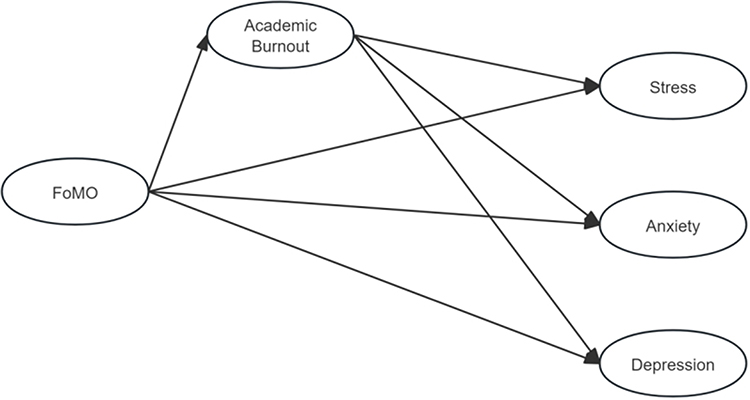 |
Figure 1 Proposed theoretical model. |
Materials and Methods
Participants
Data were obtained via a questionnaire survey that included four core sections: participants’ demographic information, experiences of FoMO, manifestations of academic burnout, and overall mental health status. Convenience sampling was used to recruit college students from three universities, located in Anhui and Hubei provinces, China. The survey was administered via the Chinese Wenjuanwang online platform between January and February 2026, with all responses collected anonymously. It should be noted that this period was neither an examination week nor a vacation; students were under routine academic pressure during the data collection period. A total of 1026 college students submitted completed survey responses. Before conducting data analysis, we preprocessed the dataset in accordance with established methodological protocols. Exclusion criteria were as follows: (1) completion time of less than 150 seconds; (2) identical answers for 10 or more consecutive items (indicating repetitive responding); (3) missing values exceeding 20% on any scale. In addition, participants who self-reported a diagnosed mental disorder (eg, major depression, generalized anxiety disorder) or current use of psychotropic medication (eg, antidepressants, anxiolytics) were excluded from the analysis. Following this screening process, 883 valid responses were included, with an effective response rate of 86.06%. All data handling procedures strictly followed confidentiality principles to safeguard the security of participants’ personal information. Detailed demographic information regarding the final study sample is presented in Table 1.
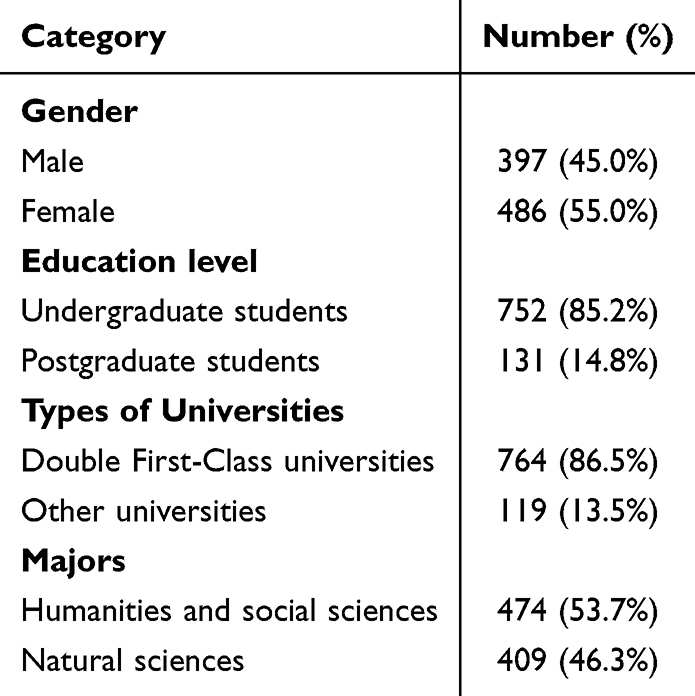 |
Table 1 Sample Demographics (N = 883) |
Informed consent was obtained from all the participants in the study. This study has been reviewed by the Ethics Committee of Anhui University (protocol code AHUIHE20251225 [25 December 2025]).
Measurement
Fear of Missing Out
The Scale measuring FoMO used in the research was developed by Przybylski et al and later revised by Q. Li et al64 It consists of two factors: fear of missing information and fear of missing situations. Participants responded on a 5-point Likert scale, and a greater cumulative score reflects an increased level of FoMO. Results of confirmatory factor analysis showed χ2/df = 4.946, NFI = 0.983, TLI = 0.972, CFI = 0.986, RMSEA = 0.060. Additionally, the Cronbach’s α coefficient of the scale was 0.889. These results confirm the measure’s satisfactory reliability and validity.
Academic Burnout
Based on the job burnout model proposed by Maslach, Lian et al developed the College Student Academic Burnout Inventory.65 The original scale consisted of 20 items covering three dimensions: dejection, improper behavior, and reduced personal accomplishment. Considering that the original scale was developed relatively early and that some of its wording and language style may no longer fully align with the daily expression habits of contemporary college students, we adapted the scale to make it more suitable for contemporary college students. Through a pilot test (n = 150), items were initially screened, and those with low factor loadings (< 0.50) or semantically redundant content were removed. The final revised version comprised 15 items, with no fewer than four items per dimension to ensure content coverage. The adapted scale still used a 5-point Likert scale for scoring. To examine the construct validity of the revised scale, we conducted a confirmatory factor analysis. The results showed: χ2/df = 4.515, CFI = 0.923, TLI = 0.906, RMSEA = 0.063. The standardized factor loadings of the items ranged from 0.52 to 0.78 (all p < 0.001), and the composite reliability (CR) values for the three dimensions were above 0.7. In addition, the Cronbach’s α coefficient for the scale was 0.812. All these indices reached acceptable psychometric standards, indicating that the revised scale had good reliability and validity in the present study sample.
Depression, Anxiety, and Stress
The Depression, Anxiety and Stress Scales (DASS), developed by Lovibond and Lovibond,66 have been recognized as reliable research tools and have also been validated for assessing psychiatric symptoms in Asian and Chinese populations. This study used the 21-item version of DASS to measure participants’ mental health status. The scale comprises three subscales, including depression, anxiety, and stress, each containing seven items. Each item is a descriptive statement, and participants responded on a 4-point Likert scale. Scores for each subscale are summed, yielding a raw score ranging from 0 to 21 for each one. To align with the standard norms established for the full-length DASS, raw scores were multiplied by 2, converting them to a 0–42 scale. According to the severity cutoffs recommended by Lovibond and Lovibond, the converted scores are categorized as follows: Depression (0–9 normal, 10–13 mild, 14–20 moderate, 21–27 severe, ≥28 extremely severe); Anxiety (0–7 normal, 8–9 mild, 10–14 moderate, 15–19 severe, ≥20 extremely severe); Stress (0–14 normal, 15–18 mild, 19–25 moderate, 26–33 severe, ≥34 extremely severe). These criteria were used to calculate the detection rates of depressive, anxiety, and stress symptoms in the present sample. The confirmatory factor analysis results for the depression subscale showed χ2/df = 4.466, NFI = 0.983, TLI = 0.977, CFI = 0.987, RMSEA = 0.063. For the anxiety subscale, the results showed χ2/df = 4.305, NFI = 0.981, TLI = 0.975, CFI = 0.986, RMSEA = 0.061. For the stress subscale, the results showed χ2/df = 3.859, NFI = 0.981, TLI = 0.979, CFI = 0.986, RMSEA = 0.057. The Cronbach’s α coefficients for each subscale were 0.889, 0.871, and 0.871. These results indicate that subscales above all have good reliability and validity.
Procedure
Participants completed the survey via a unified electronic link at their convenience. Participation was voluntary and fully anonymous, with respondents permitted to withdraw at any point. Before starting the questionnaire, all respondents reviewed an informed consent document and granted their consent by completing the survey. We used all data solely for academic research and maintained strict confidentiality throughout the entire study process.
Data Analysis
No missing data were present because all survey items were mandatory. Univariate normality was assessed using the Kolmogorov–Smirnov and Shapiro–Wilk tests, and all variables were found to be approximately normally distributed, with absolute skewness and kurtosis values below 1. Multicollinearity diagnostics indicated that all variance inflation factors (VIF) were well below 5, with a maximum of 1.175, suggesting no serious multicollinearity. Scatterplot matrices revealed approximately linear relationships among the variables. The effective sample size was 883, and the model contained 31 free parameters, meeting the minimum of at least 10 cases per free parameter. In addition, the results of the common method bias test indicated that common method bias was not a serious concern in this study.
Then, we employed Mplus 8.3 software to construct an SEM to explore the associations among FoMO, academic burnout, and depression, anxiety, and stress among college students. SPSS 27.0 software was used to compute descriptive statistics and correlation coefficients for the key variables in this investigation. Subsequently, path analysis was carried out in Mplus 8.3 with the maximum likelihood estimation method to test the proposed theoretical model. The model fit was evaluated using several key indices: CFI, TLI, RMSEA, and SRMR. According to Hu and Bentler’s recommendations, model fit is considered acceptable when CFI and TLI values approach 0.95, RMSEA approaches 0.06, and SRMR approaches 0.08.67 The mediation effect was tested following the procedures outlined in Hayes’ model.68 To reduce estimation bias, the indirect effect was calculated using 5000 bootstrap resamples, with 95% confidence intervals computed.
Results
Common Method Bias Test
The measurement data of the participants in the research involved multiple scales, which may have led to common method bias. We used Harman’s single-factor test to assess potential common method bias before conducting formal data analysis. All 44 measurement items of the core variables were imported into SPSS 27.0 for exploratory factor analysis, with unrotated principal component analysis adopted as the extraction method. The results showed that seven common factors with eigenvalues greater than 1 were identified, and the first principal component accounted for only 33.53% of the total variance, which was below the 40% critical threshold. This suggests that no severe common method bias was present in the current study.
Descriptive Statistics and Correlation Analysis
The means, standard deviations, and Pearson correlation coefficients for FoMO, academic burnout, depression, anxiety, and stress are shown in Table 2. The correlation analysis results revealed that college students’ FoMO was notably positively associated with academic burnout (r = 0.386, p < 0.01), depression (r = 0.480, p < 0.01), anxiety (r = 0.525, p < 0.01), and stress (r = 0.565, p < 0.01). Academic burnout was also notably positively associated with depression (r = 0.516, p < 0.01), anxiety (r = 0.448, p < 0.01), and stress (r = 0.507, p < 0.01). These results provided preliminary support for the research hypotheses. This study used DASS to assess 883 college students and conducted statistical analyses on the detection rates of depression, anxiety, and stress symptoms based on raw scores. The results showed that for depressive symptoms, 428 participants (48.5%) were at a normal level, 116 (13.1%) had mild depression, 202 (22.9%) had moderate depression, 81 (9.2%) had severe depression, and 56 (6.3%) had extremely severe depression. Overall, 51.5% of college students exhibited depressive symptoms to varying degrees, with a detection rate of 38.4% for moderate or above depressive symptoms. For anxiety symptoms, 344 participants (39.0%) were at a normal level, 62 (7.0%) had mild anxiety, 176 (19.9%) had moderate anxiety, 110 (12.4%) had severe anxiety, and 191 (21.7%) had extremely severe anxiety. Over sixty percent (61.0%) of college students exhibited anxiety symptoms to varying degrees, with a detection rate of 54.0% for moderate or above anxiety symptoms. For stress symptoms, 480 participants (54.4%) were at a normal level, 133 (15.1%) had mild stress, 128 (14.5%) had moderate stress, 108 (12.2%) had severe stress, and 34 (3.8%) had extremely severe stress. Overall, 45.6% of college students exhibited stress symptoms, with 30.5% experiencing moderate or above levels. The detection rates of depression, anxiety, and stress among the college students were at relatively high levels.
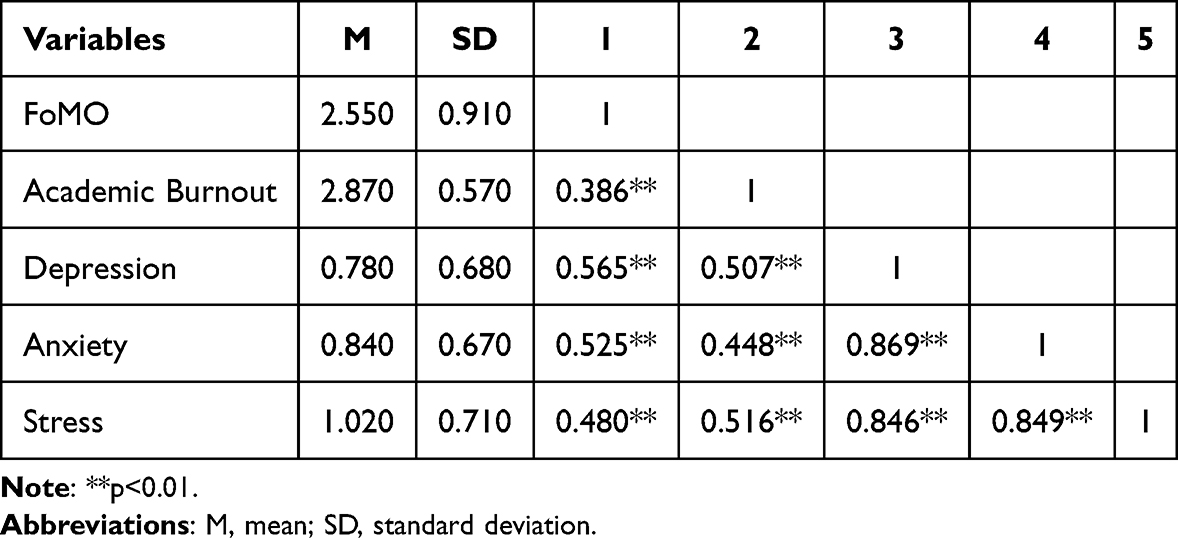 |
Table 2 Descriptive Statistics and Correlation Analysis (N=883) |
Structural Equation Model and Hypothesis Testing
To identify the optimal fitting structural model, we tested a full mediation model as well as a partial mediation model. The relevant model fit indicators were summarized in Table 3. We first tested a full mediation model (SM1), in which academic burnout served as a mediator in the relationship between FoMO and depression, anxiety, and stress (Figure 2). The model fit indices for SM1 were as follows: χ2/df = 12.96, CFI = 0.954, TLI = 0.920, RMSEA = 0.116, SRMR = 0.062. Subsequently, we tested a partial mediation model (SM2), in which academic burnout mediated the associations between FoMO and depression, anxiety, and stress, with the addition of three direct paths from FoMO to depression, anxiety, and stress. The model fit indices for SM2 were: χ2/df = 4.58, CFI = 0.989, TLI = 0.976, RMSEA = 0.064, SRMR = 0.031. Additionally, the standardized path coefficients for Model SM2 are presented in Figure 3. The results showed that FoMO was significantly positively associated with depression (β = 0.321, t = 7.579, p < 0.001), anxiety (β = 0.455, t = 11.313, p < 0.001), and stress (β = 0.477, t = 12.126, p < 0.001), supporting Hypothesis H1. FoMO was significantly positively associated with academic burnout (β = 0.559, t = 15.723, p < 0.001), supporting Hypothesis H2. Academic burnout was significantly positively associated with depression (β = 0.404, t = 9.828, p < 0.001), anxiety (β = 0.268, t = 6.643, p < 0.001), and stress (β = 0.307, t = 7.738, p < 0.001), supporting Hypothesis H3. The bias-corrected percentile Bootstrap method (with 5000 resamples) was used to test the mediating effect of academic burnout. As shown in Table 4, the 95% confidence intervals for the indirect effects of FoMO on depression, anxiety, and stress through academic burnout did not include zero. This result suggests that academic burnout served as a significant mediating role in the relationships between FoMO and college students’ depression, anxiety, and stress, supporting Hypothesis H4. Specifically, the indirect effect of FoMO on depression through academic burnout was 0.226 (95% CI [0.177, 0.283]), the indirect effect on anxiety was 0.150 (95% CI [0.107, 0.198]), and the indirect effect on stress was 0.172 (95% CI [0.130, 0.222]). Given that both the direct and indirect effects were significant, academic burnout served a partially mediating function in the relationships between FoMO and college students’ depression, anxiety, and stress.
 |
Table 3 Fit Indices Among Competing Models |
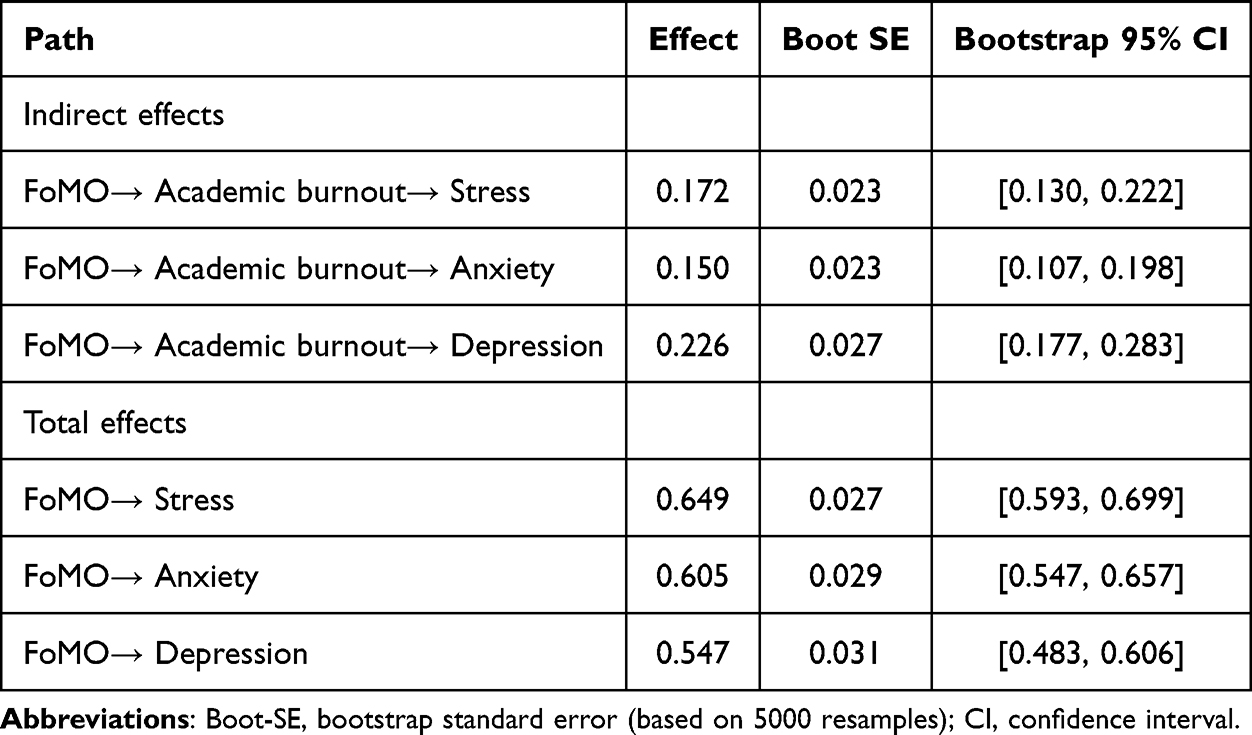 |
Table 4 Standardized Estimates for the Structural Mediation Model |
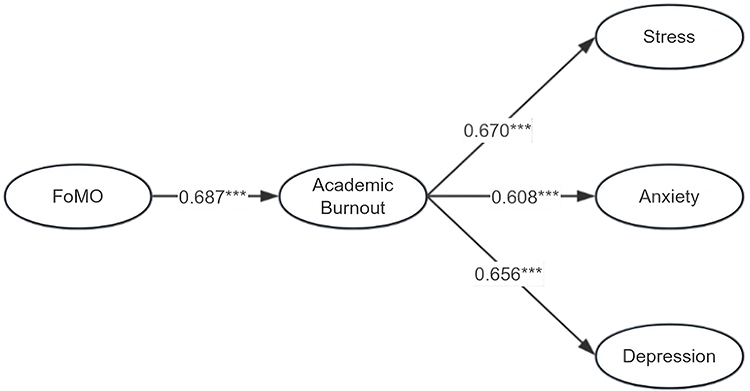 |
Figure 2 Fully mediated model SM1. Note: ***p<0.001. |
 |
Figure 3 Partially mediated model SM2. Note: ***p<0.001. |
Discussion
The Relationship Between FoMO and Depression, Anxiety, and Stress
This research systematically investigated the direct associations of FoMO on college students’ depression, anxiety, and stress. It indicates that, among college students, FoMO was significantly positively associated with depression, anxiety, and stress. The finding suggests that FoMO, as an emerging risk factor, is substantially associated with college students’ mental health. Theoretically, this finding can be explained by SDT.35 FoMO essentially reflects a self-regulation dilemma arising from temporary or persistent gaps in individuals’ fulfillment of psychological needs.20 Particularly when individuals observe through social media that others are experiencing positive events they themselves have missed, their sense of thwarted belongingness is significantly intensified. This sustained frustration of psychological needs may gradually be associated with broader psychological distress over time. As documented in a review by Elhai et al, a negative emotional state arising from the thwarting of basic psychological needs is how FoMO can be understood,69 a view that aligns closely with the core tenets of SDT. Sankapal further incorporated social comparison theory, pointing out that FoMO is closely linked to individuals’ upward social comparisons on social media, suggesting that when individuals compare their own lives with others’ exciting ones, they are prone to anxiety and feelings of loss.70 Thus, FoMO is rooted in the blocking of fundamental psychological needs and is gradually associated with mental health by steadily consuming psychological resources.
Consistent with existing empirical research are the findings yielded by the present investigation. In a study of adolescents, a significant positive relationship between FoMO and depressive and anxious symptoms was observed by Dhir et al.71 A recent study by Elhai and Casale found a notable positive link between FoMO and the severity of depression and anxiety, a relationship that was validated across different sample types and regions.72 Focus on young Spanish adults, Salazar et al further demonstrated that FoMO was significantly positively associated with depression, anxiety, and stress.73 Similarly, Kacker and Saurav, in a study of Indian college students, revealed that FoMO was notably correlated with anxiety, and also showed significant associations with social media addiction and certain factors of aggression, further confirming the close link between FoMO and negative emotions as well as related behaviors.74 Together, these studies corroborate the consistency and stability of FoMO as a correlate of mental health problems. Given that FoMO has been shown to be a notable factor associated with the mental health of contemporary college students, universities can adopt multifaceted approaches, including cognitive guidance, behavioral intervention, and environmental shaping, to integrate the alleviation of FoMO into broader mental health promotion efforts. By raising awareness and acceptance of FoMO and assisting students in planning their digital device usage time, universities can reduce students’ cognitive resource depletion caused by frequent task switching, guiding them toward a dynamic balance between digital connectivity and real-world focus, which may be associated with lower levels of mental health difficulties.
The Mediating Role of Academic Burnout
It is demonstrated in our findings that academic burnout functions as a noteworthy mediator between FoMO and college students’ depression, anxiety, and stress. Additionally, according to the SEM, FoMO was significantly positively associated with academic burnout, and academic burnout significantly positively associated with depression, anxiety, and stress. Moreover, the bias‑corrected percentile bootstrap analysis confirms that all indirect effects of FoMO via academic burnout were statistically significant. This finding indicates that FoMO is positively associated with college students’ mental health both directly and indirectly through the pathway of academic burnout.
It is worth clarifying that the academic burnout construct in this study focuses on dejection, improper behavior, and reduced personal accomplishment. Theoretically, FoMO is linked to these dimensions through resource depletion, task interruption, and sustained underperformance. Specifically, students with high FoMO tend to experience emotional exhaustion and academic frustration, which manifest as dejection and reduced accomplishment, while their frequent task switching and distraction are captured by improper behavior. From the perspective of COR theory, individuals have a tendency to obtain, protect, and maintain valuable resources.50 When confronted with possible or actual loss of such resources, they fall into a state of stress, which in turns related to a series of negative adaptive consequences. FoMO is essentially a psychological phenomenon closely related to the need for social connection, which is associated with invest substantial time in social networking platforms and frequently check their smartphones to obtain social information and avoid missing others’ updates.75 This continuous use of devices and attention to information consumes individuals’ psychological, cognitive, and time resources, thereby depleting the cognitive resources originally intended for deep learning and academic tasks. As a result, students struggle to maintain focus during learning, which is associated with declines in academic efficiency, emotional exhaustion, and diminished interest in learning. As resources continue to deplete, students eventually show a state of academic burnout characterized by behavioral disengagement, low mood, and reduced sense of achievement. This result is largely comparable to the evidence presented by C. Liu et al,51 which similarly confirmed the positive association between FoMO and college students’ academic burnout. Ye et al also confirmed through empirical research on medical students that FoMO has a stable and notable positive association with academic burnout, further supporting the role of FoMO as a correlate of academic burnout.76 Furthermore, academic burnout is associated with lower students’ self-worth and self-efficacy, which is related to broader psychological distress. Existing research also provides ample empirical support for this pathway. For example, research conducted among Italian college students documented that academic burnout represents a meaningful association.77 In addition, Keshavarzi et al revealed that academic burnout is correlated with anxiety,78 which is further associated with the influence of academic burnout on learners’ academic performance. Meanwhile, Menacho-Rivera et al, in an investigation of 566 Peruvian university students, further confirmed that academic burnout is markedly relevant to depression, anxiety, and stress, with depression and stress having the most prominent associations with the cynicism dimension, revealing the relationship of academic burnout on mental health.79 Allen et al, in a study involving 2683 graduate students, also indicated that greater academic burnout was positively related to more severe stress, as well as moderate or higher levels of anxiety and depression.80 A study focusing on biomedical doctoral students in the US revealed that academic burnout and mental health problems exhibited high comorbidity, elevated levels of academic burnout significantly related to increased risk of mental disorders, severity of depressive symptoms, and level of psychological functional impairment.81 Thus, academic burnout acts as a crucial mediator between FoMO and college students’ depression, anxiety, and stress. That is, students with higher FoMO tend to be more prone to academic burnout. This condition is then associated with a stronger association between FoMO and depressive, anxious, and stress symptoms, which may correspond to more severe mental health problems.
Notably, this research revealed that, among college students, academic burnout functions as a notable partial mediator connecting FoMO to depression, anxiety, and stress. It indicates that FoMO is associated with their depression, anxiety, and stress through both a direct pathway and an indirect pathway mediated by academic burnout. This finding reveals a dual-path mechanism: In one respect, FoMO is significantly positively associated with depression, anxiety, and stress. In another respect, FoMO is positively associated with these psychological outcomes through its association with the disrupted learning process and academic burnout. In summary, academic burnout serves as an important mediator linking FoMO to depression, anxiety, and stress. This finding not only expands our comprehension of the pathways through which FoMO is related to psychological outcomes among college students but also provides a novel entry point for mental health interventions in higher education by addressing academic burnout, which in turn may be associated with fewer negative mental health consequences related to FoMO. It should be noted that academic burnout is only one possible mediator. Other mechanisms may also explain the link between FoMO and mental health and warrant future investigation. For example, Chin and Xie demonstrated that insomnia is a behavioral pathway from FoMO to depression,82 while W.Wu et al found that irrational procrastination and media multitasking mediate the association between FoMO and online social anxiety.83 These studies, together with our findings, suggest that FoMO may impact mental health through various cognitive, behavioral, and emotional mechanisms.
Research Implications
This current research applied a quantitative design to analyze the associations linking FoMO, depression, anxiety, and stress among college students, and the mediating function of academic burnout. At the theoretical level, FoMO, academic burnout, depression, anxiety, and stress were incorporated within the context of a unified framework by this study, showing the dual pathways through which FoMO is associated with college students’ mental health. This goes beyond the limitations of prior studies that focused solely on the direct relationships between FoMO and depression, anxiety, and stress, thereby enriching studies on the antecedents of psychological well-being among college students and serving as a theoretical reference for later research. Furthermore, this study integrates SDT and COR Theory, supporting their applicability in explaining the link between FoMO and academic burnout. It describes the complete pathway from FoMO to academic burnout and subsequently to depression, anxiety, and stress, expanding the application contexts of both theories and offering a new analytical framework for understanding college students’ psychological adaptation. Meanwhile, by incorporating depression, anxiety, and stress as parallel outcome variables into a structural equation model, this study found that academic burnout was positively associated with each of the three psychological outcomes. This finding suggests that future research could further investigate the specific associations between different mental health problems and academic-related variables, thereby contributing to the further refinement of theoretical models.
The empirical findings of this research may inform mental health education and academic support efforts in colleges and universities. First, universities should prioritize the screening and prevention of FoMO and establish relevant risk prevention mechanisms. For instance, assessing FoMO levels could be integrated into routine mental health screenings for incoming students to facilitate early identification of high-risk groups. Additionally, for students with elevated FoMO levels, offering digital literacy training initiatives can help cultivate healthful digital practices and critical analytical skills for online content, equipping them with the ability to manage information overload, which may be associated with lower FoMO.84 Second, universities should conduct timely screening for academic burnout. For students already experiencing academic burnout, interventions such as providing guidance on learning strategies can help them re-establish a positive learning relationship and may be associated with a weaker association between FoMO and psychological distress. For example, targeted interventions, including psychological counseling and resilience-building programs, can assist students in developing essential emotion regulation skills.85 Third, faculty should strive to create a supportive campus environment by optimizing classroom design and fostering positive teacher-student interactions, which may help reduce unnecessary information anxiety and peer pressure. Building harmonious teacher-student relationships and peer support networks can help satisfy students’ basic psychological needs, which could be associated with lower FoMO.
Limitations and Future Studies
We must acknowledge several limitations inherent to this research. First, data can only reflect participants’ status at the time of measurement, as a cross-sectional design was adopted in the current investigation. As a result, it remains difficult to establish clear causal inferences regarding the link between FoMO and psychological distress. Moreover, complex bidirectional relationships and dynamic interactions may exist among these variables. Future investigations could adopt a longitudinal design in order to further explore temporal paths and developmental trends. Second, data were collected during a regular semester, and the DASS‑21 is a self-report screening tool rather than a clinical diagnostic instrument. These factors may have influenced the reported detection rates, and the percentages should not be directly extrapolated to clinical prevalence estimates. Additionally, the DASS subscales exhibited relatively high correlations in our sample. Future research is encouraged to employ clinical interviews or structured diagnostic instruments for further validation. Third, the research only explored the mediating function of academic burnout. However, the mechanisms by which FoMO is related to depression, anxiety, and stress are likely more complex, and there may be other unexamined mediating variables, as well as moderating variables that may buffer or moderate these associations. Subsequent studies could construct a more integrated theoretical framework that simultaneously tests multiple mediating pathways and moderating effects to more fully elucidate the underlying mechanisms. Fourth, participants were college students in mainland China, a constraint that may limit the extrapolation of conclusions across different cultural backgrounds and demographic groups. Future cross-cultural comparative studies could perform detailed examinations to analyse the similarities and differences in these relationships within diverse cultural and social settings, thereby providing empirical support for more generalizable theoretical models.
Conclusion
Using a sample of Chinese college students, the research explored the mediating role of academic burnout within the linkages among FoMO, depression, anxiety, and stress. SEM was adopted to systematically analyze the complex pathways linking FoMO to college students’ mental health. The key findings are as follows: First, FoMO demonstrated a notable positive association with academic burnout among college students. Second, FoMO was notably and positively correlated with depression, anxiety, and stress among college students. Third, academic burnout acted as a mediator in the connections between FoMO and depression, anxiety, and stress among college students. These findings elucidate the mediating mechanisms linking FoMO, academic burnout, depression, anxiety, and stress, thereby providing theoretical and empirical evidence for feasible intervention programs to foster the positive mental health of college students.
Data Sharing Statement
The data supporting this study’s findings are available from the corresponding author upon reasonable request.
Ethics Approval and Informed Consent
This study complies with the ethical principles outlined in the Declaration of Helsinki. All study procedures were approved by the Ethics Committee of Anhui University (protocol code AHUIHE20251225 [25 December 2025]). All study participants received informed consent.
Acknowledgments
We thank all the participants and staff at the study sites for their painstaking efforts in conducting the data collection.
Funding
This study was funded by the Key Project of the National Education Science Planning of the Ministry of Education of China, “International Comparative Study on the Connection Education between High Schools and Universities from the Perspective of High-Quality Development” (DDA220344).
Disclosure
The authors report no conflicts of interest in this work.
References
1. Gao W, Ping S, Liu X. Gender differences in depression, anxiety, and stress among college students: a longitudinal study from China. J Affect Disord. 2020;263:292–16. doi:10.1016/j.jad.2019.11.121
2. Auerbach RP, Alonso J, Axinn WG, et al. Mental disorders among college students in the World Health Organization World Mental Health Surveys - CORRIGENDUM. Psychol Med. 2017;47(15):2737. doi:10.1017/S0033291717001039
3. Regehr C, Glancy D, Pitts A. Interventions to reduce stress in university students: a review and meta-analysis. J Affect Disord. 2013;148(1):1–11. doi:10.1016/j.jad.2012.11.026
4. American College Health Association. American College Health Association-National College Health Assessment III: undergraduate student reference group executive summary spring 2024. Available from: https://www.acha.org/wp-content/uploads/NCHA-IIIb_SPRING_2024_UNDERGRADUATE_REFERENCE_GROUP_EXECUTIVE_SUMMARY.pdf.
5. Psychology China. 2022 mental health status survey report of Chinese college students. China Internet Information Center; 2023. Available from: https://psy.china.com.cn/2023-08/11/content_42460957.htm.
6. Alonso J, Angermeyer MC, Bernert S, et al. Prevalence of mental disorders in Europe: results from the European Study of the Epidemiology of Mental Disorders (ESEMeD) project. Acta Psychiatr Scand Suppl. 2004;(420):21–27. doi:10.1111/j.1600-0047.2004.00327.x
7. Gulec Oyekcin D, Sahin EM, Aldemir E. Mental health, suicidality and hopelessness among university students in Turkey. Asian J Psychiatr. 2017;29:185–189. doi:10.1016/j.ajp.2017.06.007
8. Kroska EB, Roche AI, Adamowicz JL, Stegall MS. Psychological flexibility in the context of COVID-19 adversity: associations with distress. J Contextual Behav Sci. 2020;18:28–33. doi:10.1016/j.jcbs.2020.07.011
9. China Internet Network Information Center (CNNIC). The 56th statistical report on the development of the Internet in China. 2025. Available from: https://www.cnnic.cn/n4/2025/0721/c88-11328.html.
10. MyCOS Research Institute. Investigation report on mobile phone use of Chinese college students. MyCOS Research Institute; 2018. Available from: http://www.mycos.com.cn/.
11. Bacaksız S, Özsoy İ, Teğin T, Bıçaksız P, Tekeş B. Anonymity as a moderator of the relationship between FoMO (Fear of Missing Out) and psychological well-being. Psychol Rep. 2023;126(5):2303–2321. doi:10.1177/00332941231180115
12. Wibowo A, Safaria T. The role of FOMO on psychological well-being with nomophobia as a mediator among college students. Curr Psychol. 2025;44(7):6092–6101. doi:10.1007/s12144-025-07636-y
13. Fuster H, Chamarro A, Oberst U. Fear of missing out, online social networking and mobile phone addiction: a latent profile approach. Aloma. 2017;35(1):22–30. doi:10.51698/aloma.2017.35.1.22-30
14. Rozgonjuk D, Elhai JD, Ryan T, Scott GG. Fear of missing out is associated with disrupted activities from receiving smartphone notifications and surface learning in college students. Comput Educ. 2019;140:103590. doi:10.1016/j.compedu.2019.05.016
15. Asikainen H, Salmela-Aro K, Parpala A, Katajavuori N. Learning profiles and their relation to study-related burnout and academic achievement among university students. Learn Individ Differ. 2020;78:101781. doi:10.1016/j.lindif.2019.101781
16. Gong Z, Guo Y, Tan J. Social media use and academic performance among college students: the chain mediating roles of social anxiety and fear of missing out and the moderating effect of teacher-student relationship. Front Psychol. 2025;16:1649890. doi:10.3389/fpsyg.2025.1649890
17. Capdevila-Gaudens P, García-Abajo JM, Flores-Funes D, García-Barbero M, García-Estañ J. Depression, anxiety, burnout and empathy among Spanish medical students. PLoS One. 2021;16(12):e0260359. doi:10.1371/journal.pone.0260359
18. Stamell A. FOMO, the fear of missing out. The Huffington Post. 2011.
19. Vaughn V. Fear of missing out. J. Walter Thompson Company; 2012.
20. Przybylski AK, Murayama K, DeHaan CR, Gladwell V. Motivational, emotional, and behavioral correlates of fear of missing out. Comput Human Behav. 2013;29(4):1841–1848. doi:10.1016/j.chb.2013.02.014
21. Buglass SL, Binder JF, Betts LR, Underwood JDM. Motivators of online vulnerability: the impact of social network site use and FOMO. Comput Human Behav. 2017;66:248–255. doi:10.1016/j.chb.2016.09.055
22. Servidio R, Soraci P, Griffiths MD, Boca S, Demetrovics Z. Fear of missing out and problematic social media use: a serial mediation model of social comparison and self-esteem. Addict Behav Rep. 2024;19:100536. doi:10.1016/j.abrep.2024.100536
23. Miller S. Fear of missing out: are you a slave to FOMO? ABC News. June 23, 2012. Available from: https://abcnews.go.com/Health/Wellness/fear-missing-slave-fomo/story?id=16629972.
24. Zhang J, Deng Y, Zheng S, Wan C. The mediating effect of rumination and fear of missing out between mobile phone addiction and sleep quality among college students. Sci Rep. 2024;14(1):27394. doi:10.1038/s41598-024-79235-z
25. Sun C, Sun B, Lin Y, Zhou H. Problematic mobile phone use increases with the fear of missing out among college students: the effects of self-control, perceived social support and future orientation. Psychol Res Behav Manag. 2022;15:1–8. doi:10.2147/PRBM.S345650
26. Beyens I, Frison E, Eggermont S. “I don’t want to miss a thing”: adolescents’ fear of missing out and its relationship to adolescents’ social needs, Facebook use, and Facebook related stress. Comput Hum Behav. 2016;64:1–8. doi:10.1016/j.chb.2016.05.083
27. Chiou WB, Lee CC, Liao DC. Facebook effects on social distress: priming with online social networking thoughts can alter the perceived distress due to social exclusion. Comput Human Behav. 2015;49:230–236. doi:10.1016/j.chb.2015.02.064
28. Rozgonjuk D, Sindermann C, Elhai JD, Montag C. Individual differences in fear of missing out (FoMO): age, gender, and the Big Five personality trait domains, facets, and items. Pers Individ Dif. 2021;171:110546. doi:10.1016/j.paid.2020.110546
29. Chai H, Niu G, Chu X, et al. Fear of missing out: what have I missed again? Adv Psychol Sci. 2018;26(3):527–537. doi:10.3724/SP.J.1042.2018.00527
30. Li X, Ye Y. Fear of missing out and irrational procrastination in the mobile social media environment: a moderated mediation analysis. Cyberpsychol Behav Soc Netw. 2022;25(1):59–65. doi:10.1089/cyber.2021.0052
31. Jiao C, Cui M, Fincham FD. Predicting changes in helicopter parenting, fear of missing out (FOMO), and social anxiety in college students. J Adult Dev. 2025;32(2):120–130. doi:10.1007/s10804-024-09478-7
32. Zhao X, Ren Z, Xin T. The relationship between basic psychological need satisfaction, fear of missing out, and university student depression: a two-year follow-up study. Behav Sci. 2025;15(10):1379. doi:10.3390/bs15101379
33. Baker ZG, Krieger H, LeRoy AS. Fear of missing out: relationships with depression, mindfulness, and physical symptoms. Trans Issues Psychol Sci. 2016;2(3):275–282. doi:10.1037/tps0000075
34. Liu M, Yao Y, Deng Z, et al. The relationship between fear of missing out and depression among college students: the mediating effect of nomophobia and social media fatigue, and the moderating effect of mindfulness. Chin J Clin Psychol. 2024;32(2):361–365, 370. doi:10.16128/j.cnki.1005-3611.2024.02.021
35. Ryan RM, Deci EL. Self-determination theory and the facilitation of intrinsic motivation, social development, and well-being. Am Psychol. 2000;55(1):68–78. doi:10.1037//0003-066x.55.1.68
36. Maslach C, Schaufeli WB, Leiter MP. Job burnout. Annu Rev Psychol. 2001;52:397–422. doi:10.1146/annurev.psych.52.1.397
37. Melamed S, Kushnir T, Shirom A. Burnout and risk factors for cardiovascular diseases. Behav Med. 1992;18(2):53–60. doi:10.1080/08964289.1992.9935172
38. Frajerman A, Morvan Y, Krebs MO, Gorwood P, Chaumette B. Burnout in medical students before residency: a systematic review and meta-analysis. Eur Psychiatry. 2019;55:36–42. doi:10.1016/j.eurpsy.2018.08.006
39. Rotenstein LS, Ramos MA, Torre M, et al. Prevalence of depression, depressive symptoms, and suicidal ideation among medical students: a systematic review and meta-analysis. JAMA. 2016;316(21):2214–2236. doi:10.1001/jama.2016.17324
40. Xie YJ, Cao P, Sun T, Yang LB. The effects of academic adaptability on academic burnout, immersion in learning, and academic performance among Chinese medical students: a cross-sectional study. BMC Med Educ. 2019;19(1):211. doi:10.1186/s12909-019-1640-9
41. Kourea L, Papanastasiou EC, Diaconescu LV, Popa-Velea O. Academic burnout in psychology and health-allied sciences: the BENDiT-EU program for students and staff in higher education. Front Psychol. 2023;14:1239001. doi:10.3389/fpsyg.2023.1239001
42. Rosales-Ricardo Y, Rizzo-Chunga F, Mocha-Bonilla J, Ferreira JP. Prevalence of burnout syndrome in university students: a systematic review. Salud Ment. 2021;44(2):91–102. doi:10.17711/SM.0185-3325.2021.013
43. Liu Z, Xie Y, Sun Z, Liu D, Yin H, Shi L. Factors associated with academic burnout and its prevalence among university students: a cross-sectional study. BMC Med Educ. 2023;23(1):317. doi:10.1186/s12909-023-04316-y
44. Chong LZ, Foo LK, Chua SL. Student burnout: a review on factors contributing to burnout across different student populations. Behav Sci. 2025;15(2):170. doi:10.3390/bs15020170
45. Al-Furaih SA, Al-Awidi HM. Fear of missing out (FoMO) among undergraduate students in relation to attention distraction and learning disengagement in lectures. Educ Inf Technol. 2021;26(2):2355–2373. doi:10.1007/s10639-020-10361-7
46. Alt D. College students’ academic motivation, media engagement and fear of missing out. Comput Hum Behav. 2015;49:111–119. doi:10.1016/j.chb.2015.02.057
47. Lenny DJ, Doleck T, Bazelais P. Self-determination, loneliness, fear of missing out, and academic performance. Knowl Manag E-Learn. 2019;11(4):485–496. doi:10.34105/j.kmel.2019.11.025
48. Rosen LD, Carrier LM, Pedroza JA, et al. The role of executive functioning and technological anxiety (FOMO) in college course performance as mediated by technology usage and multitasking habits. Psicol Educ. 2018;24(1):14–25. doi:10.5093/psed2018a3
49. Manap A, Rizzo A, Yıldırmaz A, Dilekçi Ü, Yıldırım M. The mediating role of procrastination in the relationship between fear of missing out and internet addiction in university students. Int J Environ Res Public Health. 2023;21(1):49. doi:10.3390/ijerph21010049.
50. Hobfoll SE. Conservation of resources. A new attempt at conceptualizing stress. Am Psychol. 1989;44(3):513–524. doi:10.1037//0003-066x.44.3.513
51. Liu C, Yuan G, Huang Y, et al. More burnout from online classes? The influence of fear of missing out on learning burnout. Chin J Clin Psychol. 2022;30(2):439–443, 448. doi:10.16128/j.cnki.1005-3611.2022.02.038
52. Neumann Y, Finaly-Neumann E, Reichel A. Determinants and consequences of students’ burnout in universities. J High Educ. 1990;61(1):20–31. doi:10.1080/00221546.1990.11775089
53. Zhang Y, Gan Y, Cham H. Perfectionism, academic burnout and engagement among Chinese college students: a structural equation modeling analysis. Pers Individ Dif. 2007;43(6):1529–1540. doi:10.1016/j.paid.2007.04.010
54. Wang X, Yang M, Ren L, et al. Burnout and depression in college students. Psychiatry Res. 2024;335:115828. doi:10.1016/j.psychres.2024.115828
55. Shim T, Go E. The impact of school burnout on life satisfaction among university students: the mediating effects of loneliness and fear of alienation. Behav Sci. 2025;15(8):1083. doi:10.3390/bs15081083
56. Fernández-Castillo A. State-anxiety and academic burnout regarding university access selective examinations in spain during and after the COVID-19 lockdown. Front Psychol. 2021;12:621863. doi:10.3389/fpsyg.2021.621863
57. Zhuang H, Zhao H, Liu M, et al. Depression, anxiety, stress symptoms among overweight and obesity in medical students, with mediating effects of academic burnout and internet addiction. Sci Rep. 2025;15(1):16566. doi:10.1038/s41598-025-01793-7
58. He A, Wan J, Hui Q. The relationship between mobile phone dependence and mental health among adolescents: the mediating role of academic burnout and the moderating role of coping styles. Best Evid Chin Educ. 2022;12(1):1581–1587. doi:10.16187/j.cnki.issn1001-4918.2022.03.10
59. Chue JSX, Cheung HS. Mental resilience enhances the well-being of Singaporean college students through reducing burnout. Curr Psychol. 2023;42(1):519–528. doi:10.1007/s12144-021-01481-5
60. Halbesleben JRB, Buckley MR. Burnout in organizational life. J Manage. 2004;30(6):859–879. doi:10.1016/j.jm.2004.06.004
61. Veyis F, Seçer İ, Ulaş S. An investigation of the mediator role of school burnout between academic stress and academic motivation. J Curric Teach. 2019;8(4):46–53. doi:10.5430/jct.v8n4p46
62. Gao X. Mindfulness and foreign language learners’ self-perceived proficiency: the mediating roles of anxiety and burnout. J Multiling Multicult Dev. 2024;45(10):4182–4199. doi:10.1080/01434632.2022.2150196
63. Wang J, Zheng Q, Song W, Wei L. The effect of nursing students’ self-efficacy on patient-centered communication during the COVID-19 pandemic: the mediating effect of learning burnout. Front Psychiatry. 2021;12:787819. doi:10.3389/fpsyt.2021.787819
64. Li Q, Wang JN, Zhao SQ, Jia YR. Validity and reliability of the Chinese version of the fear of missing out scale in college students. Chin Ment Health J. 2019;33(4):312–317.
65. Lian R, Yang LX, Wu LH. Relationship between professional commitment and learning burnout of undergraduates and scales developing. Xin Li Xue Bao. 2005;37(5):632–636.
66. Lovibond SH, Lovibond PF. Manual for the Depression Anxiety Stress Scales.
67. Hu LT, Bentler PM. Cutoff criteria for fit indexes in covariance structure analysis: conventional criteria versus new alternatives. Struct Equation Model. 1999;6(1):1–55. doi:10.1080/10705519909540118
68. Hayes AF. Partial, conditional, and moderated moderated mediation: quantification, inference, and interpretation. Commun Monogr. 2018;85(1):4–40. doi:10.1080/03637751.2017.1352100
69. Elhai JD, Yang H, Montag C. Fear of missing out (FOMO): overview, theoretical underpinnings, and literature review on relations with severity of negative affectivity and problematic technology use. Braz J Psychiatry. 2021;43(2):203–209. doi:10.1590/1516-4446-2020-0870
70. Sankapal S. A systematic review of fear of missing out: understanding its implications and influencing factors. Int J Nov Res Dev. 2023;8(5):k58–k61. doi:10.1729/Journal.34582
71. Dhir A, Yossatorn Y, Kaur P, Chen S. Online social media fatigue and psychological wellbeing—a study of compulsive use, fear of missing out, fatigue, anxiety and depression. Int J Inf Manage. 2018;40:141–152. doi:10.1016/j.ijinfomgt.2018.01.012
72. Elhai JD, Casale S. Is fear of missing out (FOMO) differentially related to underlying dimensions of negative affectivity? Analyzing latent factors of rumination, depression, and negative affect. Anxiety Stress Coping. 2026. doi:10.1080/10615806.2026.2624434
73. Salazar IC, Santamaría-Perales R, Cuevas-Toro AM. Are FoMO, experiential avoidance, and emotional distress related to problematic social network use in young adults? Healthcare. 2025;13(22):2988. doi:10.3390/healthcare13222988
74. Kacker P, Saurav S. Correlation of missing out (FOMO), anxiety and aggression of young adults. Int J Res Granthaalayah. 2020;8(5):132–138. doi:10.29121/granthaalayah.v8.i5.2020.107
75. Alkhazaleh ZM, Abojedi A. Academic procrastination as a mediator linking fear of missing out and social phobia to smartphone addiction among university students: a structural model. BMC Psychol. 2026. doi:10.1186/s40359-026-04240-y
76. Ye X, Li Y, Liu Y, et al. Effect of fear of missing out on learning burnout in medical students: a moderated mediation. Front Psychiatry. 2023;14:1289906. doi:10.3389/fpsyt.2023.1289906
77. Camia M, Reho M, Ferrari E, et al. Academic burnout in university students with specific learning disorders: the mediating role of anxiety in the relationship between burnout and depression. J Clin Med. 2025;14(18):6400. doi:10.3390/jcm14186400
78. Keshavarzi MH, Saneii SH, Nahardani SZ, Koohestani HR, Kohan N, Mansouri M. Investigating the mediating role of anxiety in academic burnout and academic performance of rehabilitation sciences students. J Educ Health Promot. 2024;13:293. doi:10.4103/jehp.jehp_862_23
79. Menacho-Rivera J, Castro-Ramirez L, Yarasca-Berrocal E, et al. Academic burnout syndrome associated with anxiety, stress, depression, and quality of life in Peruvian dentistry students: an analysis using a multivariable regression model. BMC Med Educ. 2025;25(1):998. doi:10.1186/s12909-025-07604-x
80. Allen HK, Lilly F, Green KM, Zanjani F, Vincent KB, Arria AM. Graduate student burnout: substance use, mental health, and the moderating role of advisor satisfaction. Int J Ment Health Addict. 2022;20(2):1130–1146. doi:10.1007/s11469-020-00431-9
81. Nagy GA, Fang CM, Hish AJ, et al. Burnout and mental health problems in biomedical doctoral students. CBE Life Sci Educ. 2019;18(2):ar27. doi:10.1187/cbe.18-09-0198
82. Chin BN, Xie Y. Insomnia as a behavioral pathway from fear of missing out to depression in emerging adults. Brain Sci. 2025;15(9):917. doi:10.3390/brainsci15090917
83. Wu W, Zhang J, Jo N. Fear of missing out and online social anxiety in university students: mediation by irrational procrastination and media multitasking. Behav Sci. 2025;15(1):84. doi:10.3390/bs15010084
84. Zhang X, Zhang J, Yao F, Cao P, Guo S, Liu S. Which symptoms of nomophobia, social networking site addiction, and fear of missing out (FoMO) directly affect mental health? A symptom network and flow analysis study. Psych J. 2026;15(1):e70068. doi:10.1002/pchj.70068
85. Alsararatee HH, Ahmed K, Elachola M. A systematic review of burnout among nursing students: impact on academic performance, psychological well-being, and strategies for prevention. Br J Hosp Med. 2025;86(11):1–23. doi:10.12968/hmed.2025.0145
 © 2026 The Author(s). This work is published and licensed by Dove Medical Press Limited. The
full terms of this license are available at https://www.dovepress.com/terms
and incorporate the Creative Commons Attribution
- Non Commercial (unported, 4.0) License.
By accessing the work you hereby accept the Terms. Non-commercial uses of the work are permitted
without any further permission from Dove Medical Press Limited, provided the work is properly
attributed. For permission for commercial use of this work, please see paragraphs 4.2 and 5 of our Terms.
© 2026 The Author(s). This work is published and licensed by Dove Medical Press Limited. The
full terms of this license are available at https://www.dovepress.com/terms
and incorporate the Creative Commons Attribution
- Non Commercial (unported, 4.0) License.
By accessing the work you hereby accept the Terms. Non-commercial uses of the work are permitted
without any further permission from Dove Medical Press Limited, provided the work is properly
attributed. For permission for commercial use of this work, please see paragraphs 4.2 and 5 of our Terms.
Recommended articles

The Psychological Impact of Quarantine During the COVID-19 Pandemic on Quarantined Non-Healthcare Workers, Quarantined Healthcare Workers, and Medical Staff at the Quarantine Facility in Saudi Arabia
Alfaifi A, Darraj A, El-Setouhy M
Psychology Research and Behavior Management 2022, 15:1259-1270
Published Date: 17 May 2022
Spiritual Well-Being, Depression, Anxiety, and Stress in Indonesian Muslim Communities During COVID-19
Hamka, Suen MW, Ramadhan YA, Yusuf M, Wang JH
Psychology Research and Behavior Management 2022, 15:3013-3025
Published Date: 17 October 2022
Dietary Supplement Consumption and Mental Health in Indonesian Adults During Second Wave of COVID-19 Pandemic
Yusof J, d'Arqom A, Andriani AP, Nasution MZ, Fatimah N, Mustika A, Handayani S, Syed Abdul Kadir SZ
Patient Preference and Adherence 2023, 17:1799-1811
Published Date: 24 July 2023

The Association Between Cognitive Functions and Psychological Factors in Patients with Severe COPD
Hansen KK, Hilberg O, Jensen HI, Løkke A, Farver-Vestergaard I
International Journal of Chronic Obstructive Pulmonary Disease 2023, 18:2065-2078
Published Date: 19 September 2023
Longitudinal Problematic Social Media Use in Students and Its Association with Negative Mental Health Outcomes
Shannon H, Bush K, Shvetz C, Paquin V, Morency J, Hellemans KGC, Guimond S
Psychology Research and Behavior Management 2024, 17:1551-1560
Published Date: 8 April 2024