
Back to Journals » Advances in Medical Education and Practice » Volume 17
The Changes in Students’ Satisfaction Rates Between the Accreditation Cycles by the Accreditation Commission on Colleges of Medicine (ACCM)
Authors Soomro A, Sholuade OA, Kottath Veetil P  , Kollukkad Mani M , Smith B , Reddy D , Arja SB
Received 13 March 2026
Accepted for publication 12 May 2026
Published 15 May 2026 Volume 2026:17 607785
DOI https://doi.org/10.2147/AMEP.S607785
Checked for plagiarism Yes
Review by Single anonymous peer review
Peer reviewer comments 2
Editor who approved publication: Prof. Dr. Balakrishnan Nair
Ameer Soomro,1 Olabosipo Adeyinka Sholuade,1 Praveen Kottath Veetil,1 Manoj Kollukkad Mani,2 Brittany Smith,1 Dishitha Reddy,1 Sateesh B Arja1
1Medical Education Department, Avalon University School of Medicine, Willemstad, Curacao, Netherlands Antilles; 2Human Structure and Function Department, Avalon University School of Medicine, Willemstad, Curacao, Netherlands Antilles
Correspondence: Sateesh B Arja, Medical Education Department, Avalon University School of Medicine, Willemstad, Curacao, Netherlands Antilles, Tel +5999 6965682, Email [email protected]
Introduction: Accreditation is a key quality assurance mechanism that promotes quality improvement. Evidence shows accreditation improves student outcomes, especially licensure exam performance for international medical graduates. Accreditation Commission on Colleges of Medicine (ACCM) is one of the accreditation agencies in the Caribbean region whose accreditation standards are comparable to the accreditation standards of the Liaison Committee on Medical Education (LCME), which accredits the medical schools in the USA, and ACCM is recognized by the World Federation of Medical Education (WFME). This study examines changes in students’ satisfaction rates between accreditation cycles using ACCM student surveys at Avalon University School of Medicine (AUSOM).
Methods: This retrospective quantitative study analyzed ACCM student survey data from 2021 and 2024 across AUSOM’s basic science and clinical students. The survey assessed students’ satisfaction across five institutional domains: dean’s office, learning environment, library, student services, and medical education program, using a 5-point Likert scale. Mean scores were compared using the Mann–Whitney U-test (non-homogeneous variance).
Results: A total of 76 (response rate 75%) and 62 (63%) basic science and 115 (90%) and 85 (88.5%) clinical students responded to the survey in 2021 and 2024, respectively. The mean values for all questions were above 3.5 in both surveys. Across all domains and questionnaire items, comparisons between 2021 and 2024 revealed no statistically significant differences (p > 0.05), and the satisfaction rates remained stable for basic science and clinical students.
Conclusion: These findings, along with the study’s results showing no significant decline in student satisfaction, differ from prior literature suggesting a dip in student satisfaction between accreditation cycles at other medical schools. Medical Schools are recommended to continue monitoring to identify subtle trends and guide targeted quality improvement initiatives, and to engage critical stakeholders, such as students, in the quality improvement process.
Keywords: accreditation, change management, continuous quality improvement, educational program, learning environment, quality assurance
Introduction
Accreditation is a government- or regulatory-mandated tool for ensuring educational quality and legitimacy,1,2 as well as quality assurance in higher education. From the perspective of accrediting bodies, accreditation serves as a valuable marker for compliance with standards and validation of institutional legitimacy. However, from other perspectives, the process may be burdensome or seen as a drain on resources, thereby skewing the cost-benefit analysis for accreditation.3–5 Despite these concerns, accreditation has improved quality improvement processes and streamlining medical schools’ educational processes.4,5 Indirect outcomes of accreditation may include shifts in stakeholder expectations, engagement levels, student satisfaction, and performance metrics for students and graduates.6
Evidence suggests a positive association between medical school accreditation and licensure exam performance among international medical graduates (IMGs), particularly those seeking certification from the Educational Commission for Foreign Medical Graduates (ECFMG).7 It has also been observed that IMGs who graduate from accredited medical schools generally achieve higher pass rates on the United States Medical Licensing Examinations (USMLEs) on their first attempt than peers from non-accredited schools.8 Moreover, this increased pass rate was temporally associated with an accreditation site visit, followed by a decrease in subsequent “mid-cycle” years in which site visits were not conducted.9 The impact of accreditation is varied, but its effect on students remains unclear.10,11 While there is a movement in student outcomes, the complexity of medical education systems makes it unclear how much of this improvement is attributable to accreditation compared with other factors.
The success of using accreditation as a quality assurance (QA) measure requires meaningful involvement from students, stakeholders, and the administration.12 For continuous quality improvement (CQI) to be effective, the involvement of these groups must be sincere.12 Al-Eyadhy and Alenezi (2021) have also identified other indirect indicators of accreditation’s impact, including student performance, stakeholder engagement, expectations, and satisfaction with the quality improvement process.13 More specifically, stakeholder satisfaction and expectations are more closely aligned with accreditation’s efficacy. At the same time, student feedback was more useful as an internal quality improvement tool, as it reflected student program alignment and areas for improvement.
Furthermore, Al-Eyadhy and Alenezi’s (2021) study demonstrated a noticeable decrease in student satisfaction between accreditation site visits and the time immediately before or after.13 The previous study14 at Avalon University School of Medicine (AUSOM) utilized the Data Collection Instrument (DCI) student surveys of the Caribbean Accreditation Authority for Education in Medicine and Other Health Professions (CAAM-HP) to compare students’ satisfaction rates before and after accreditation site visits. The previous study used the CAAM-HP data collection instrument to compare student satisfaction rates over time: 2017 (before the accreditation site visit), 2019 (between accreditation cycles), and 2022 (before another accreditation site visit). The previous study at Avalon found that student satisfaction gradually increased across three surveys, regardless of the timing of accreditation site visits.14 The study by Arja et al (2024) differed from Al-Eyadhy and Alenezi’s study in that there was no dip in student satisfaction between accreditation cycles.14 While that study was a first-of-its-kind examination of Caribbean schools, it only considered data related to CAAM-HP. However, AUSOM has another accreditation from the Accreditation Commission on Colleges of Medicine (ACCM). The previous study14 at AUSOM did not consider student surveys conducted for the ACCM. The objective of this study is to examine student satisfaction rates using the ACCM survey and determine whether satisfaction rates change across accreditation cycles. CAAM-HP and ACCM are counterparts to the Liaison Committee on Medical Education (LCME) in the Caribbean, which are recognized by the World Federation for Medical Education (WFME). As student satisfaction, feedback, and engagement are considered as the direct and indirect indicators of effectiveness of accreditation and quality assurance,6,13 the current study aims to examine the whether there are any changes in students’ satisfaction rates between accreditation cycles using ACCM student surveys for medical schools’ learning environment and facilities, students support systems, library and educational program and whether these results differ from those obtained in the previous study.14
Research Question
What is the relationship between the occurrence of ACCM accreditation site visits and the students’ satisfaction rates?
Hypothesis
The investigators tested the hypothesis that student satisfaction rates, as measured by the ACCM survey, would not decrease between accreditation cycles.
Methods
Study Setting
AUSOM offers a four-year Medical Doctorate (M.D.) program that begins with two years of basic sciences and clinical skills training on the Caribbean island of Curaçao. The final two years are completed at teaching hospitals in the USA.
Study Design
This study is a retrospective quantitative analysis comparing student satisfaction survey responses from 2021 and 2024, using the ACCM Independent Student Questionnaire. The ACCM survey, required for medical school self-study and evaluation reports, was used to assess institutional improvement and quality indicators over this period. During these years, AUSOM also underwent site visits from the accreditation body CAAM-HP. The authors recognize that the combined effects of pre-accreditation preparation and the self-evaluation processes for both accrediting bodies may have influenced student satisfaction rates.
The independent student survey was conducted among basic science and clinical students to collect their opinions. The survey consists of five domains: dean’s office, learning environment and facilities, library and information resources, student services, and medical education program. Each domain includes several questions, based on the independent survey questionnaire provided by ACCM. The survey excluded questions about clinical rotations/clerkships for basic science students. The survey link was open to students for three weeks. Filling out the survey was voluntary and anonymous. However, student representatives encouraged other students to complete the surveys. Student representatives were involved in completing the survey responses and analyzing the data, including mean values and identifying areas for improvement. This ensures that the student survey analysis remains independent of the university’s faculty and administration, promoting a fair and transparent self-study and evaluation process. Two of the student representatives were involved as the authors of this manuscript.
Please refer to Tables 1 and 2 for the questionnaire used for basic science and clinical student surveys, respectively.
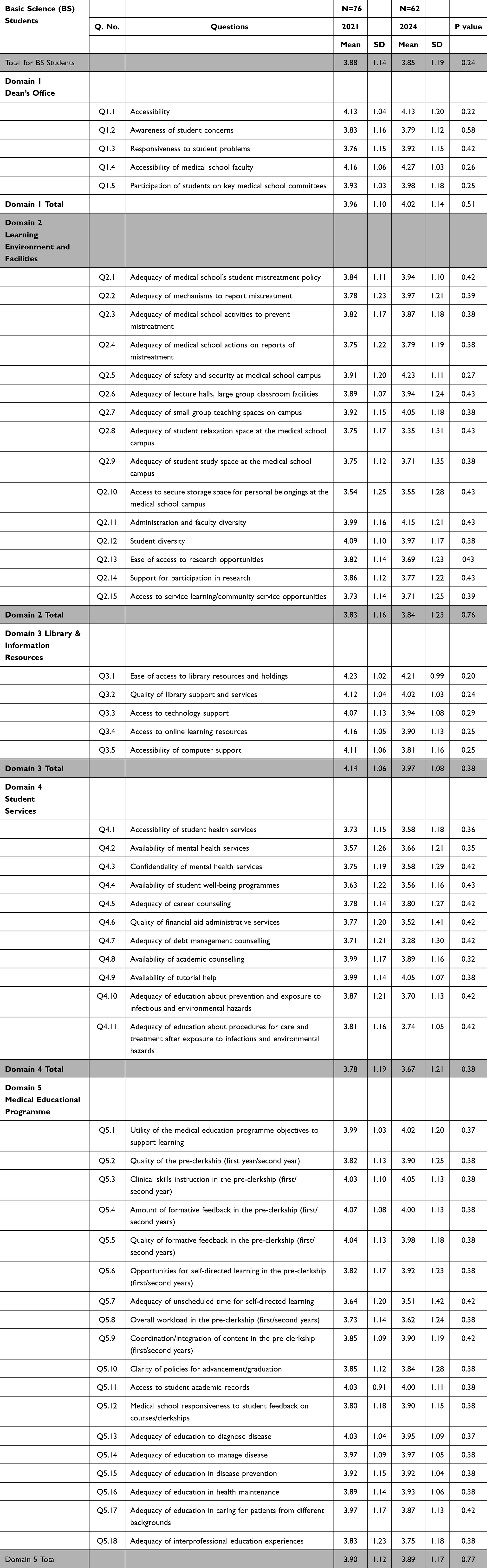 |
Table 1 Satisfaction Rates for Basic Science Students on ACCM Surveys (Mean Values and Standard Deviations for All Items/Questions) |
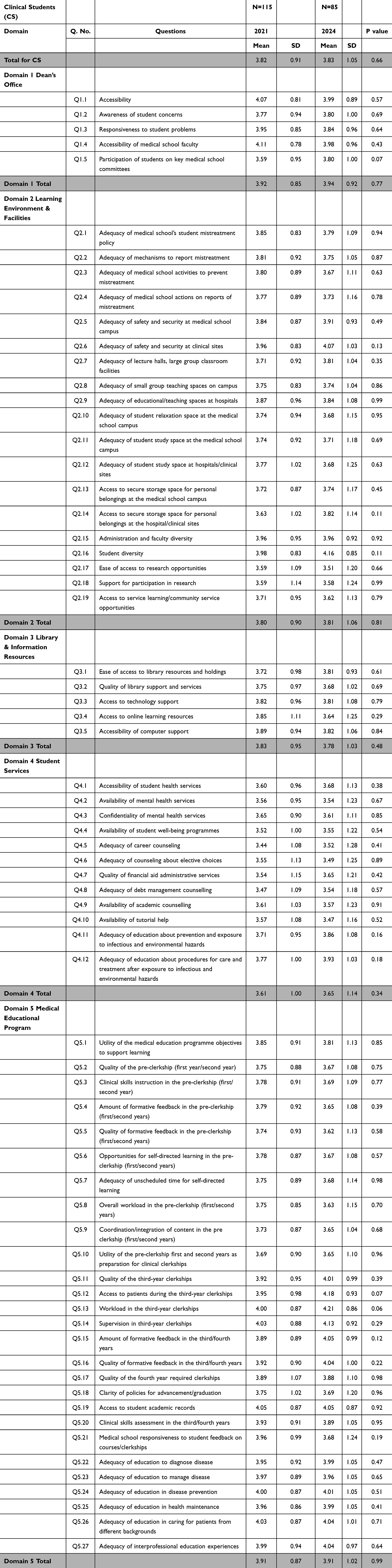 |
Table 2 Satisfaction Rates for Clinical Students on ACCM Surveys (Mean Values and Standard Deviations for All Items/Questions) |
Study Sample and Data Collection
The Dean of the School of Medicine, along with other deans, explained the process and purpose of the “Independent Student Questionnaire” and the Independent Student Analysis (ISA) to the students. A document from the ACCM website, “Independent Student Questionnaire”,15 was provided and clearly explained the independent student analysis in the accreditation process. The survey excluded questions about clinical rotations/clerkships for basic science students, which was explained to students. The survey included questions with responses on a five-point Likert scale: 1 (very dissatisfied), 2 (dissatisfied), 3 (neutral/no opinion), 4 (satisfied), and 5 (very satisfied). Please refer to Tables 1 and 2 for the questionnaire used.
The survey was conducted in 2021 to prepare for the 2022 site visit, as part of the self-evaluation process. The improvements were made at AUSOM based on 2021 results to prepare for the accreditation site visit and as part of the QI process. The 2024 survey was conducted in preparation for the 2025 site visit, a mid-cycle inspection. The authors hypothesize that there will be no dip in satisfaction rates between accreditation cycles at AUSOM (from 2021 to 2024). The rationale for this hypothesis was that previous literature has shown a dip in satisfaction rates between accreditation cycles at other medical schools13 but no dip at AUSOM14 using the CAAM-HP DCI.
Even though the batches of basic sciences and clinical sciences students who participated in the 2021 and 2024 surveys were different, the demographics of AUSOM’s student population, including geographic origin and gender distribution, remained consistent from 2021 to 2024. The survey was administered to students in years 1–4 using SurveyMonkey. Enrolled and active medical students received a survey link that allowed them to complete the questionnaire at their convenience and from any location. This process ensured that each student completed only one survey per cycle, enabling the tracking of completion rates and overall participation. After three weeks, the surveys were closed. Students were unable to submit multiple responses within the same year. However, a student may have completed the basic sciences survey in one year and the clinical sciences survey in a subsequent year as they progressed through the program. Because the surveys were anonymous and participation was voluntary, it was not possible to determine how many students responded to both survey types across different years. No names or ID numbers were collected to maintain student anonymity. The survey and data were accessible to the IT department of Avalon, the deans, other senior administrative members of the university, and the investigators of this study. Response rates are presented in Table 3.
 |
Table 3 Response Rates |
Data Analysis
Data analysis was conducted using SPSS (SPSS version 2025). Mean satisfaction scores were calculated for all survey items for both basic science and clinical students, and changes were examined across two surveys: the first one (Survey 1, conducted before the accreditation site visit in 2021) and Survey 2, conducted in 2024 for mid-cycle inspection in 2025. Because response variances were non-homogeneous and the data were not normally distributed, which was determined by the Shapiro–Wilk test, the non-parametric Mann–Whitney U-test was used.
Please refer to Appendix A for the raw data on basic science and clinical student responses in 2021.
Please refer to Appendix B for raw data for basic science and clinical student responses in 2024.
AUSOM interpreted mean values according to benchmarks established by its Continuous Quality Improvement Committee:
- Mean values of 4.0 or higher indicate very satisfactory performance.
- Mean values between 3.5 and 4.0 are considered satisfactory.
- Mean values below 3.0 indicate that the item requires improvement.
Results
A total of 76 responses were received in 2021 and 62 in 2024, respectively, from basic science students. A total of 115 responses were received from clinical students in 2021 and 85 in 2024. The response rates are presented in Table 3. Student satisfaction rates from the ACCM Independent Student Questionnaire were compared between 2021 (pre-accreditation site visit) and 2024 (mid-cycle review preparation). Overall, the findings showed no statistically significant differences between the two survey periods for either basic science or clinical students (Tables 1 and 2), confirming the study hypothesis.
Basic Science Students
Across all five domains, mean satisfaction scores remained in the satisfactory range (3.5–4.0) for both surveys, with several items scoring above 4.0, indicating very satisfactory performance per AUSOM benchmarks (Table 1).
The total mean satisfaction score for basic science students was 3.88 in 2021 and 3.85 in 2024, with no significant change (p = 0.24). P-values of less than 0.05 are considered statistically significant for data analysis and inferences in this study. Domain totals remained consistent and showed no statistically significant difference between the two surveys across all five domains (Table 1). No item/survey question across all domains demonstrated a statistically significant difference. Some showed small numerical decreases (eg., access to relaxation space, computer support), but none reached statistical significance.
Clinical Students
Clinical students also demonstrated stable satisfaction levels. The total mean satisfaction was 3.82 in 2021 and 3.83 in 2024 (p = 0.66), indicating no statistically significant difference (Table 2).
Domain totals remained consistent and showed no statistically significant difference between the two surveys across all five domains (Table 2). As with basic sciences, no item/question showed a statistically significant decline. Several clinical domains, particularly third-year clerkship access to patients and clerkship workload, showed minor numerical improvements.
The comparison between basic science and clinical students demonstrates a consistent pattern of stable satisfaction across both groups, with only minor variations in magnitude. Basic science students reported slightly higher overall satisfaction scores than clinical students in both survey years, with mean scores of 3.88 (2021) and 3.85 (2024), compared to 3.82 and 3.83 for clinical students. Despite this small difference, both groups remained within the “satisfactory” range (≥3.5) and showed no statistically significant changes over time (p > 0.05). This indicates that student perceptions of institutional quality, support systems, and educational experiences were consistently maintained across the accreditation cycle for both cohorts.
Discussion
This study evaluated whether student satisfaction at AUSOM varied across ACCM accreditation cycles and examined how satisfaction trends aligned with previously reported CAAM-HP survey outcomes. Results demonstrate that student satisfaction remained stable across all domains in 2024 compared to 2021, with no statistically significant decreases among either basic science or clinical students. At the domain level, both groups exhibited similar trends of stability across all five domains, including the dean’s office, learning environment, library resources, student services, and medical education program. However, subtle differences emerged in specific areas. Basic science students showed minor numerical declines in certain support-related aspects such as relaxation spaces and financial counseling, whereas clinical students demonstrated slight improvements in clinically oriented domains, particularly in access to patients and workload during clerkships. Overall, while basic science students reported marginally higher satisfaction in foundational and pre-clinical aspects, clinical students showed gradual improvements in their hands-on training experiences. These findings suggest that although both groups experienced stable satisfaction, their perceptions were shaped by the differing nature of their educational stages. These findings support the study hypothesis and provide further evidence that AUSOM maintains consistent educational quality and student support, irrespective of the timing of accreditation site visits. This outcome reinforces the broader understanding of accreditation’s role in promoting ongoing institutional quality assurance processes, rather than producing episodic changes solely surrounding site visits.1,2
The stability observed in this study contrasts with findings from other international medical schools, where student satisfaction declined between accreditation cycles. For example, Al-Eyadhy and Alenezi (2021) reported that satisfaction increases immediately before an accreditation site visit but subsequently declines during mid-cycle years.13 These results indicate that maintaining continuous quality improvement throughout the accreditation cycles helps maintain student satisfaction at AUSOM; further improvement of CQI in areas where student satisfaction was below 3.5 was not overlooked and is considered important for students’ educational experiences. AUSOM’s consistent performance suggests that its institutional practices promote sustained satisfaction rather than cyclical fluctuations linked to accreditation site visits. This aligns with studies by Blouin et al (2018) and Arja et al (2021), who argue that effective accreditation processes promote continuous quality improvement rather than temporary or superficial improvements tied to accreditation site visits.4,5 This outcome also likely reflects a deeply embedded culture of continuous quality improvement (CQI), characterized by collaboration between faculty and students and ongoing quality improvement activities, rather than efforts that intensify only in preparation for accreditation visits. AUSOM is the first medical school in the Caribbean to establish a Continuous Quality Improvement (CQI) committee in 2017, and one of the pioneers in establishing such a committee on the American continent. As part of our quality improvement processes, we have provided academic support to all students virtually and enhanced our student support systems during the pandemic,16 which helped us maintain high student satisfaction rates and achieve desirable student outcomes.
Through ongoing monitoring, faculty responsiveness, and continuous administrative support, AUSOM appears to provide a more stable educational environment than institutions where improvements are concentrated around accreditation cycles. Some of the notable examples that can be given, which enhanced the student support system and educational experiences, include student health counsellors, such as campus nurses, enhancing the financial counseling, formal career counseling systems, inclusion of students on key university standing committees, and revision of the basic science curriculum from a discipline-based curriculum to an integrated curriculum.17 This further strengthens the case that accreditation activities should shift their focus from student outcomes to the quality improvement process.18,19
A distinctive factor contributing to this stability may be AUSOM’s collaborative approach to the Independent Student Questionnaire. Students were involved in adapting the survey, distributing it, analyzing the data, and formulating recommendations to address areas for improvement. Such a partnership is uncommon in many institutional self-study processes, which enhances both trust in the administration and transparency in quality improvement efforts. Girotto et al (2025) emphasizes the importance of genuine stakeholder involvement in ensuring the effectiveness of quality assurance and accreditation processes.12 If students perceive that their feedback directly influences institutional decisions, satisfaction is less likely to fluctuate in response to temporary or superficial efforts related to accreditation deadlines. One indirect indicator of accreditation effectiveness is stakeholder engagement, in which their feedback is perceived as valued.6
These findings align with a previous investigation of CAAM-HP student satisfaction rates14 at AUSOM, which also reported no mid-cycle decline between 2017 and 2022. The parallel trends observed across two independent accrediting bodies suggest that stability is not attributable to instrument-specific factors or survey design artefacts. Instead, the consistency across both the ACCM and CAAM-HP frameworks reinforces the conclusion that AUSOM’s quality assurance and quality improvement processes have sustained a positive impact on the student experience. This observation corroborates prior literature suggesting that accreditation yields indirect benefits through improved stakeholder alignment, organizational learning, and continuous quality improvement.6,11 This further underscores the potential broader applicability of AUSOM’s CQI model to other Caribbean medical schools and to medical schools in general seeking to achieve or maintain accreditation with international agencies. This culture reinforces the requirement that medical schools’ visions align with a culture of continuous quality improvement.6
Although no statistically significant differences were identified, specific domain-level patterns merit attention. For example, library and technology-related items showed minor numerical decreases, while student services, particularly mental health services and financial counseling, received slightly lower scores than other domains. These trends reflect challenges commonly observed at medical schools globally and highlight areas where targeted investment could further enhance satisfaction. In contrast, clinical education indicators, such as access to patients and workload during third-year clerkships, demonstrated modest improvements, suggesting an increase in student confidence in the quality of clinical training. These results align with prior studies indicating that clinical training elements can meaningfully influence student satisfaction and preparedness.7,8 These findings demonstrate that, even in the absence of statistically significant change, domain-specific insights can inform strategic improvements aligned with student needs.
In summary, these findings contribute to the growing body of literature indicating that accreditation most significantly influences institutions by reinforcing organizational culture, administrative accountability, and a culture of continuous quality improvement, rather than by producing abrupt, measurable changes in student satisfaction. At AUSOM, the absence of a mid-cycle decline suggests that accreditation serves as a foundation for sustained, long-term enhancements. By integrating student input into quality improvement processes, student representatives on CQI committees, maintaining consistent policies and learning environments, and implementing meaningful responses to survey feedback, AUSOM demonstrates how medical schools can achieve stable student satisfaction irrespective of accreditation site visits.
Limitations
One of the most significant limitations of this study is that it was conducted at a single institution. This study is confined to a single private Caribbean medical school. The institutional culture, accreditation processes, and student expectations at AUSOM may differ substantially from those at other medical schools, particularly within larger or publicly funded systems. Other limitations that can preclude the generalizability of these results include a small sample size, only quantitative data, and no qualitative data collection. Consequently, the generalizability of these findings in other contexts, especially outside the Caribbean, is limited. However, this hypothesis could be tested at US allopathic, osteopathic, or any other medical schools through their program surveys. Also, practices such as embracing a culture of CQI and involving key stakeholders, including students, in the CQI process can be applied in any context or medical school. These results and conclusions are also testable in other institutions that consistently utilize regular CQI analyses. Second, the study included only two ACCM survey time points, 2021 and 2024, limiting the ability to identify longitudinal patterns or subtle trends that may emerge over longer periods. Additional years of data would improve the precision with which accreditation-cycle changes can be detected. Future research needs to be conducted at AUSOM longitudinally, and similar studies should be conducted at multiple institutions to generalize the results.
Future Implications
- Student representatives must be represented on the quality improvement committees of medical schools and the other university standing committees and should be involved in the continuous quality improvement (CQI) process.
- The accreditation activities should emphasize CQI processes, not just mere student outcomes.
- Medical schools should embrace the culture and vision of continuous quality improvement.
- Student engagement and the perceived value of their feedback should be part of that culture.
Conclusions
Student satisfaction at AUSOM remained stable throughout ACCM accreditation cycles, with no indication of the mid-cycle decline observed in other international studies. These findings are consistent with previous CAAM-HP survey results at AUSOM, indicating sustained educational quality and responsiveness. Student satisfaction rates remained steady in 2024 compared to 2021, with no notable declines. These results contrast with earlier literature, particularly a study from Saudi Arabia that reported a drop in student satisfaction between accreditation cycles. Continuous quality improvement processes and collaborative student engagement may account for this stability and could serve as a model for other Caribbean medical schools. Ongoing monitoring is therefore recommended to detect subtle trends and inform targeted quality improvement efforts. Additionally, involving key stakeholders, including students, is crucial to strengthening the quality improvement process.
Data Sharing Statement
All data generated or analyzed during this study are included in this article and are available as supplementary materials, Appendix A and B.
Ethical Approval
The AUSOM Research and Ethics Committee granted ethical approval for this study with approval code AUREC/APP/01/04/11/2025. Informed written consent was taken from all participants along with the survey. This study has been conducted in compliance with the Declaration of Helsinki.
Acknowledgments
The authors would like to thank the Chair of ACCM, Professor Dr Hilary Sanfey, and the ACCM convenor at Avalon University School of Medicine, Professor Dr Lawlor, for their continued support and for allowing us to use the Independent Student Questionnaire surveys for this study.
Funding
The authors have received no funding.
Disclosure
Dr Sateesh B. Arja is the Associate Editor for the Journal of Advances in Medical Education and Practice. The authors report no other conflicts of interest in this work.
References
1. Teixeira GCDS, Maccari EA. The institutional role of business school accreditation agencies: a systematic literature review. Revista de Gestao. 2018;25(3):274–15. doi:10.1108/REGE-04-2018-035
2. Di Nauta P, Omar P, Schade A, Scheele J. Accreditation models in higher education: experiences and perspectives. 2021. Available from: http://www.ffzg.unizg.hr/kvaliteta/wpcontent/uploads/2015/10/B002.
3. Simpson DE, Golden DL, Rehm JM, Kochar MS, Simons KB. The costs versus the perceived benefits of an LCME institutional self-study. Acad Med. 1998;73(9):1009–1012. doi:10.1097/00001888-199809000-00024
4. Blouin D, Tekian A, Kamin C, Harris IB. The impact of accreditation on medical schools’ processes. Medical Education. 2018;52(2):182–191. doi:10.1111/medu.13461
5. Arja SB, Arja SB, Fatteh S, Challa KT, Somagutta MKR, Blouin D. Impact of accreditation on Caribbean medical schools’ processes. Canadian Med Educ J. 2021;12(4):79–88. doi:10.36834/cmej.71333
6. Blouin D. Accreditation of Canadian undergraduate medical education programs: a study of measures of effectiveness. Acad Med. 2020;95(6):931–937. doi:10.1097/ACM.0000000000003065
7. Tackett S, Boulet JR, van Zanten M. Medical school accreditation factors associated with certification by the Educational Commission for Foreign Medical Graduates (ECFMG): a 10-Year international study. Acad Med. 2021;96(9):1346–1352. doi:10.1097/ACM.0000000000004047
8. Van Zanten M. The association between medical education accreditation and the examination performance of internationally educated physicians seeking certification in the United States. Perspect Med Educ. 2015;4(3):142–145. doi:10.1007/s40037-015-0183-y
9. Roy M, Wood TJ, Blouin D, Eva KW. The relationship between accreditation cycle and licensing examination scores: a national look. Acad Med. 2020;95(11 Suppl):S103–S108. Association of American Medical Colleges Learn Serve Lead Proceedings of the 59th Annual Research in Medical Education Presentations. doi:10.1097/ACM.0000000000003632
10. Davis DJ, Ringsted C. Accreditation of undergraduate and graduate medical education: how do the standards contribute to quality? Adv Health Sci Educ. 2006;11(3):305–313. doi:10.1007/s10459-005-8555-4
11. Tackett S, Zhang C, Nassery N, Caufield-Noll C, van Zanten M. Describing the evidence base for accreditation in undergraduate medical education internationally: a scoping review. Acad Med. 2019;94(12):1995–2008. doi:10.1097/ACM.0000000000002857
12. Girotto LC, Machado KB, Moreira RFC, Martins MA, Tempski PZ. Impacts of the accreditation process for undergraduate medical schools: a scoping review. Clin Teacher. 2025;22(2):e70031. doi:10.1111/tct.70031
13. Al-Eyadhy A, Alenezi S. The impact of external academic accreditation of undergraduate medical program on students’ satisfaction. BMC Med Educ. 2021;21(1):565. doi:10.1186/s12909-021-03003-0
14. Arja SB, Kumar A, White BA, Thompson A. Did the students’ satisfaction rates at Avalon University School of Medicine correlate with the occurrence of accreditation site visits? Med Teach. 2024;47(4):653–659. doi:10.1080/0142159X.2024.2359967
15. Independent student questionnaire accreditation commission of colleges of medicine, 2025. Available from: https://accredmed.org/downloads/.
16. Arja SB, Wilson L, Fatteh S, Kottathveetil P, Fateh A, Bala Arja S. Medical education during COVID-19: response at one medical school. J Adv Med Educ Prof. 2021;9(3):176–182. doi:10.30476/jamp.2020.88744.1351
17. Arja SB, Arja SB, Venkata MR, et al. Integrated curriculum and the change process in undergraduate medical education. Med Teach. 2018;40(5):437–442. doi:10.1080/0142159X.2018.1441988
18. Blouin D, Tekian A. Accreditation of medical education programs: moving from student outcomes to continuous quality improvement measures. Acad Med. 2018;93(3):377–383. doi:10.1097/ACM.0000000000001835
19. Barzansky B, Hunt D, Moineau G, et al. Continuous quality improvement in an accreditation system for undergraduate medical education: benefits and challenges. Med Teach. 2015;37(11):1032–1038. doi:10.3109/0142159X.2015.1031735
 © 2026 The Author(s). This work is published and licensed by Dove Medical Press Limited. The
full terms of this license are available at https://www.dovepress.com/terms
and incorporate the Creative Commons Attribution
- Non Commercial (unported, 4.0) License.
By accessing the work you hereby accept the Terms. Non-commercial uses of the work are permitted
without any further permission from Dove Medical Press Limited, provided the work is properly
attributed. For permission for commercial use of this work, please see paragraphs 4.2 and 5 of our Terms.
© 2026 The Author(s). This work is published and licensed by Dove Medical Press Limited. The
full terms of this license are available at https://www.dovepress.com/terms
and incorporate the Creative Commons Attribution
- Non Commercial (unported, 4.0) License.
By accessing the work you hereby accept the Terms. Non-commercial uses of the work are permitted
without any further permission from Dove Medical Press Limited, provided the work is properly
attributed. For permission for commercial use of this work, please see paragraphs 4.2 and 5 of our Terms.