
Back to Journals » Biologics: Targets and Therapy » Volume 20
Teclistamab for Relapsed or Refractory Multiple Myeloma: A Review of Efficacy, Safety, Resistance Mechanisms and Future Directions
Authors Piron B  , Moreau P, Touzeau C
Received 11 November 2025
Accepted for publication 9 January 2026
Published 13 January 2026 Volume 2026:20 539066
DOI https://doi.org/10.2147/BTT.S539066
Checked for plagiarism Yes
Review by Single anonymous peer review
Peer reviewer comments 3
Editor who approved publication: Dr Shein-Chung Chow
Bénédicte Piron,1,2 Philippe Moreau,1,2 Cyrille Touzeau1,2
1Department of Clinical Hematology, University Hospital of Nantes, Nantes, France; 2CRCINA, INSERM, CNRS, University of Nantes, Nantes, France
Correspondence: Cyrille Touzeau, Department of Clinical Hematology, University Hospital of Nantes, Place Alexis Ricordeau, Nantes, 44093, France, Email [email protected]
Abstract: Teclistamab is the first bispecific antibody targeting B-cell maturation antigen (BCMA) approved for the treatment of relapsed or refractory multiple myeloma. Its significant efficacy as monotherapy, particularly in the Phase 1/2 MajesTEC-1 trial, has been also confirmed in the context of combination therapies. Early safety events are dominated by grade 1 or 2 cytokine release syndrome. Risk of infection is now better characterized and can be managed through systematic prophylaxis. Notably, real-world studies have confirmed its efficacy and safety, notably in patients under-represented or ineligible for clinical trials (elderly, with renal impairment or central nervous system involvement). Mechanisms of resistance to teclistamab including target loss and T-cell environment are increasingly understood. Consequently, several strategies to overcome immune escape or antigen loss are currently being evaluated in clinical trials. The use of teclistamab in earlier lines of treatment and in combination may yield better results and is evaluating but ongoing Phase 3 clinical trials.
Keywords: BCMA, bispecific antibody, combination, immune escape, sequencing strategies
Introduction
Relapsed or refractory multiple myeloma has been profoundly transformed by BCMA-targeting bispecific antibodies such as teclistamab. Indeed, patients with relapsed/refractory multiple myeloma (RRMM) have a very poor prognosis with median progression-free survival (mPFS) and median overall survival (mOS) of 4.6 and 12.4 months, respectively.1 In this context, anti-BCMA therapies have been developed, including the antibody–drug conjugate (ADC) belantamab mafodotin,2 bispecifics antibodies (BsAbs) notably teclistamab,3 elranatamab4 and linvoseltamab,5 as well as chimeric antigen receptor (CAR)-T cells among which ide-cel6 and cilta-cel.7 Teclistamab was the first anti-BCMA BsAb approved in 2022, by the European Medicines Agency (EMA) and the US Food and Drug Administration (FDA) as it demonstrated high significant efficacy in monotherapy, notably in the phase 1/2 trial MajesTEC-1.3 Since its approval, results have been confirmed in numerous real-world studies. Future developments include the exploration of combination with other treatments and teclistamab integration in first-line options. In parallel, clinical practice is evolving toward optimized sequencing with CAR-T cells and adaptation to specific patient populations. In the present review, efficacy, safety, mechanisms of resistance and future directions will be discussed.
Mechanisms of Action
Teclistamab is a bispecific antibody designed to recognize malignant plasma cells and redirect immune cells to plasma cells via the B-cell maturation antigen (BCMA), also known as CD269 or TNFRSF17. BCMA is the most widely used target in the development of bispecific antibodies, as well as CAR-T cells. BCMA is a transmembrane receptor of the tumor necrosis factor (TNF) superfamily whose activation by its ligands B cell activating factor (BAFF) and proliferation inducing ligand (APRIL) contributes to the maturation and survival of plasma cells. It is also expressed to a very limited extent by B-cells progenitors.8 BCMA is also present in serum as a soluble form (sBCMA), as a consequence of the gamma-secretases’ action.9
Teclistamab (JNJ-64007957) is an humanized immunoglobulin G4-proline, alanine, alanine (IgG-4 PAA) bispecific antibody.10 It contains a crystallizable fragment (Fc) domain, which prolongs its elimination half-life by increasing molecular size and allowing binding to the neonatal Fc receptor (FcRn), responsible for IgG recycling.11 Its extended half-life makes intermittent administration possible. In addition, its Fc design prevents teclistamab from binding to C1q (component of complement) and to Fcγ receptors (FcγRs), which partially avoids nonspecific activation of T lymphocytes.12,13
Teclistamab takes part of T-cell engagers’ (TCEs) therapies, it targets the ε subunit of CD3 on T cells in order to connect cytotoxic T cells (T cells or natural killer cells (NK cells)) and plasma cells to cause tumor plasma-cells lysis (Figure 1).14 The development of teclistamab in vitro and ex vivo clinical studies has demonstrated antitumor activity.15 Based on safety, efficacy, pharmacokinetic (PK) and pharmacodynamic (PD) data, two step-up doses of 0.06 and 0.3 mg/kg s.c. were recommended followed by the dose recommendation of 1.5 mg/kg s.c. weekly. Biweekly dosing is available if patient achieved and maintained a complete response or better for at least 6 months.16
 |
Figure 1 Structure and mechanism of action of teclistamab. Created in BioRender by the authors: Piron, B. (2025) https://BioRender.com/oiq3fwh, publication license n. VD295LKRBG. Notes: Black arrows indicate secretion of effector molecules, including granzymes, perforin, and cytokines. |
Clinical Data: Efficacy and Safety
Efficacy Data
Teclistamab Monotherapy in RRMM Patients
In RRMM patients, the international prospective study LocoMMotion study, conducted in 248 triple-exposed patients (IMiD, PI and anti-CD38 mAbs) reported a median progression-free survival (mPFS) and median overall survival (mOS) of 4.6 months and 12.4 months, respectively.1 The phase 1/2 MajesTEC-1 study demonstrated high efficacy of teclistamab for these RRMM patients (median of five prior lines, 77.6% were triple-class refractory), with an overall response rate (ORR) of 63% with 46.1% patients achieving ≥ complete response (CR). The mPFS was 11.3 months and the mOS was 22.2 months with a median duration of response (DOR) increased to 24.0 months.3,17 In a comparative effectiveness study between teclistamab (patients from MajesTEC-1) and real-world physician’s choice therapy in LocoMMotion and MoMMent,18 teclistamab significantly improved outcomes across all endpoints: ORR (RR 2.41, p < 0.0001), ≥ CR (RR 132.32, p < 0.0001), DOR (HR 0.43, p = 0.0011), PFS (HR 0.49, p < 0.0001), and OS (HR 0.69, p = 0.0247).
Real-world data about teclistamab are rapidly accumulating and proved comparable efficacy to that reported in MajesTEC-1 (Table 1). When comparing data from MajesTEC-1 and real-world cohorts, response rates for teclistamab were consistent. However, longer follow-up will be necessary to avoid bias related to early relapsing patients. Involving 123 patients, the mPFS was 8.7 months in the German study conducted by Riedhammer et al19 11.3 months in the French study,20 8.8 months in the study conducted by Tan et al21 and 5.4 months in the study of Dima et al22 mPFS was not reached in the study of Mohan et al23 but with a rate of 52% at 6 months. These findings suggest that PFS is maintained even though these patients were often ineligible for clinical trials, either because they had already received anti-BCMA therapy or, in some cases, due to hematological criteria (neutropenia/thrombocytopenia).
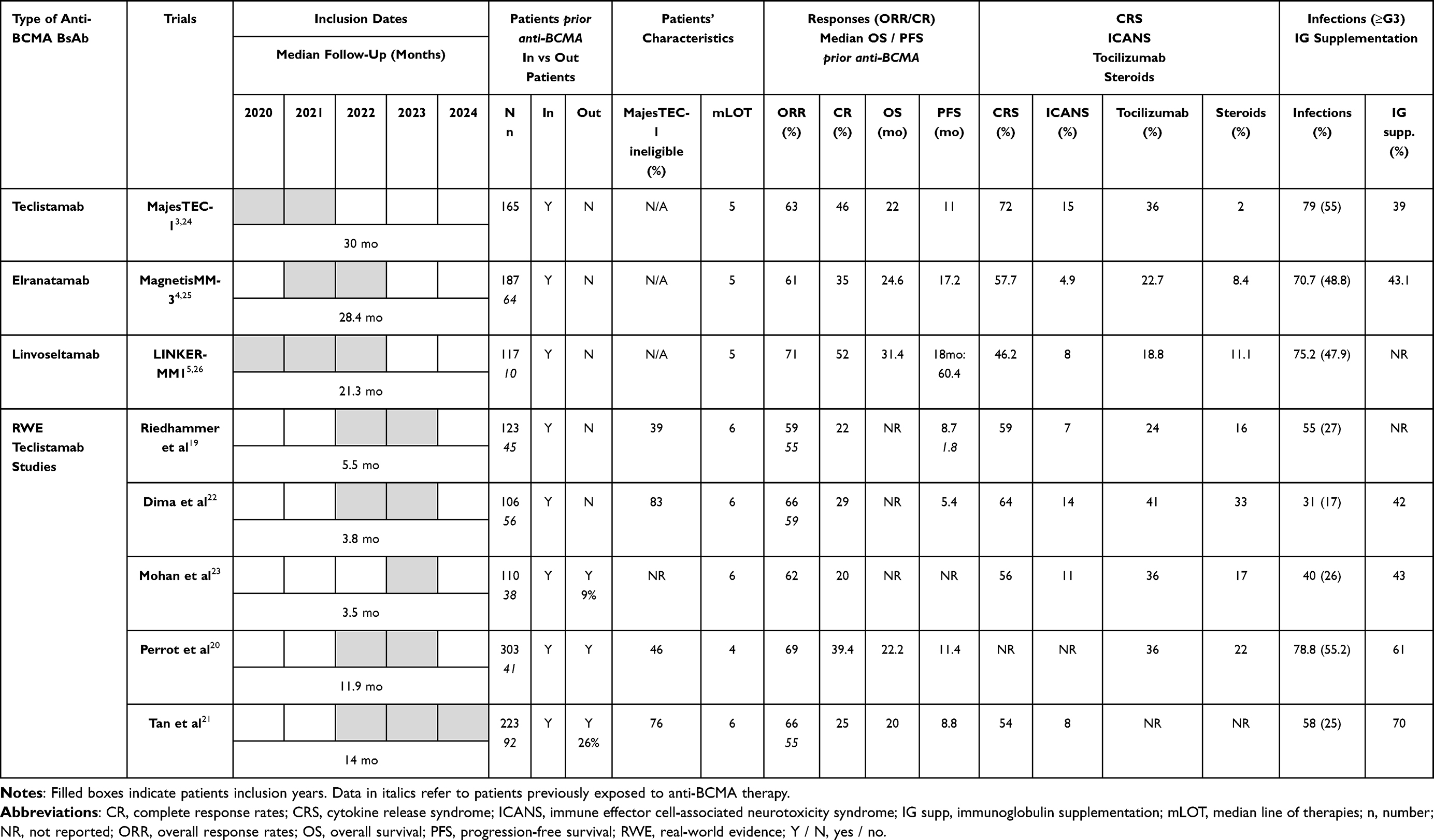 |
Table 1 Teclistamab in the BCMA Landscape: Comparison of Other Anti BCMA-BsAb Clinical Trials and Real-World Evidence in RRMM Patients |
Teclistamab Associations in RRMM Patients
To maximize efficacy and to limit resistance, association strategies with other anti-myeloma drugs are being explored (Table 2). The MajesTEC-2 (Cohort E) (NCT04722146) and TRIMM-2 (NCT04108195)27 trials including patients who had 1–3 prior lines of therapy (LOT) evaluating teclistamab, daratumumab and pomalidomide, demonstrated high efficacy. With a median follow-up of 25.8 months, ORR was 88.5%, very good partial response (VGPR) or better rate was 84.6% and CR or better rate was 61.5%. Median PFS reached 26.5 months. However, 63% of patients experienced grade 3/5 adverse events, and almost all patients had at least one infectious event. Among the seven reported deaths, six were due to infections. The frequency and severity of these infections emphasized the importance of infection prophylaxis.
 |
Table 2 Teclistamab Combinations in RRMM: MajesTEC-2 and RedirecTT-1, Key Results |
Associated with talquetamab, the anti-GPRC5D bispecific antibody, in the phase 1b-2 trial RedirecTT-1 (NCT04108195),28 teclistamab showed high ORR and particularly in extramedullary (EMD) patients, known to have poor prognosis. Thus, in the recommended Phase 2 dose (RP2D) cohort, received by 44 of the 94 patients enrolled, a response was observed in 80% of patients (including 61% of those with EMD). Across all dose levels, a response was observed in 78% of patients. The probability that patients would maintain a response to treatment at 18 months was 86% with the RP2D (82% in patients with EMD) and 77% for all doses. Grade 3 or 4 infections occurred in 64% of patients which could be better managed if this association (teclistamab + talquetamab) is approved in near future.
Teclistamab in Others Specific Populations with RRMM
Thanks to real-world studies, teclistamab has demonstrated high efficacy and favorable safety in patients with moderate-to-severe-renal impairment, a population largely excluded from clinical trials such as MajesTEC-1, in which patients with a creatinine clearance < 40 mL/min were not eligible.29 Encouraging results have also been reported in hemodialysis30 or peritoneal dialysis patients.31 To note, teclistamab is not dialysable due to its high molecular weight (146 kDa). Even though scarce, results provided from real-world studies,32 were consistent: there is a similar safety and efficacy profile compare with patients without renal impairment. Thus, as renal function is more likely to deteriorate due to cumulative injury over successive lines of therapy and prolonged disease burden, these patients should benefit from teclistamab. Severe CRS is associated with an increased risk of acute kidney injury. Vigilant monitoring and early intervention with steroids or tocilizumab are crucial. However, a consortium of experts do not recommend dosage adjustment of teclistamab.32 These experts recommend intravenous immunoglobulins (IVIg) administration on the same day or immediately after the dialysis, two or three days post teclistamab.32
To note, retrospective studies proved that teclistamab could use to treat monoclonal gammopathies with renal significance, such as amyloidosis,33,34 POEMS syndrome35 or cryoglobulinemia.36
In elderly people, teclistamab demonstrated also efficacy and safety in a real-world study.37 Thus, in this multicenter study conducted by the US Multiple Myeloma Immunotherapy Consortium (n = 385, 83 patients aged ≥75 years versus 302 <75 years), the older group presented with fewer adverse baseline disease features (including a lower incidence of high-risk cytogenetics and extramedullary disease). The overall response rate (ORR) did not differ significantly between groups (62% versus 53%, p = 0.17). Also, both real-world cohorts, Mohan et al23 and Perrot et al20 included a higher proportion of older patients compared with MajesTEC-1, with 25–30% aged over 75 years versus 14% in the pivotal trial. Their efficacy and safety outcomes were consistent with those observed in the pivotal study. These data also support the potential feasibility of teclistamab use in newly diagnosed multiple myeloma (NDMM) older patients ineligible for autologous stem cell transplantation, as being further explored in ongoing clinical trials such as MajesTEC-7 trial38 (NCT05552222) or the French Phase 2 IFM 2021–01-TecLILLE trial (NCT05572229).
The IFM2023-06 study39 despite its retrospective design and limited cohort reported safety and efficacy data from eight RRMM patients with central nervous system (CNS) involvement treated with teclistamab. Even if more data are needed to describe clinical benefits, these data are consistent with other real-word studies that included fewer patients with CNS involvement.23,40
Teclistamab in BCMA Landscape
If teclistamab has paved the way, other BCMA-targeting BsAb, such as elranatamab,4 linvoseltamab5 and alnuctamab41 have been developed, and some of them have been approved42,43 in RRMM patients. As there are no major differences in efficacy or safety between these different trials (Table 1), the choice of anti-BCMA BsAb depends on its country availability and/or effective reimbursement as well as potential mutations presented on the targeted extracellular BCMA domain.44,45
Despite logistical challenges, anti-BCMA CAR-T cells (ide-cel6 or cilta-cel7) offer a one-shot treatment approach inducing deep and durable responses. Thus, their updated phase 3 analysis, with a 30.9-month follow-up for ide-cel46 and a 33.6 month-follow-up for cilta-cel,47 indicated a mPFS of 13.3 for ide-cel and a 30-month PFS rate of 59.4% for cilta-cel. Median OS was 41.4 months for ide-cel and 30-month OS rate was 76.4% for cilta-cel.
Safety Data
CRS and ICANS
In the 2-year updated data from the MajesTEC-1 study, cytokine release syndrome (CRS) occurred in 72% of patients (0.6% grade 3, none grade 4/5) and immune effector cell–associated neurotoxicity syndrome (ICANS) occurred in 15% of patients (all grade 1/2, all resolved).24 Most CRS occur during dose escalation. Thus, among patients who experienced CRS in the MajesTEC-1 study, CRS was observed overall in 43.6% of patients after dose 1, in 35.2% of patients after dose 2, and in 24.2% of patients after the first full dose.48 For ICANS, as CRS, most patients experienced ICANS following step-up dose 1 (1.2%), step-up dose 2 (0.6%), or the full dose (1.8%). The most frequent clinical manifestations of ICANS reported were confusional state and dysgraphia. Tocilizumab reduces the risk of subsequent CRS in patients who received it for their first episode of CRS (20.0% vs 62.2% in those who did not receive it), without affecting the response to teclistamab. However, data on predicting CRS are not well established. In MajesTEC-1, no baseline characteristics (tumor burden or cytokine levels) appeared to clearly predict the occurrence or severity of CRS.48 More recently, in this retrospective study conducted at MD Anderson center, the risk factors for CRS and ICANS in 385 patients with RRMM treated with, who experienced these events at a frequency comparable to that observed in the MajesTEC-1 trial,49 included thrombocytopenia < 50 × 109/L (OR 2.65, p = 0.002) and ECOG score ≥ 2 (OR 2.07, p = 0.01).
The safety profile of teclistamab was comparable in real-world cohorts (Table 1) with to that observed in MajesTEC-1. The incidence of CRS and ICANS ranged from 54% to 64% and 7% to 14%, respectively, with the majority of event being grade 1–2. In addition, 9% to 26% of patients in the Mohan and Tan cohorts,21,23 respectively, were able to start treatment on an outpatient setting, with low CRS rates, suggesting the feasibility of outpatient step-up doses.
Risk of Infection
Although teclistamab generally have a favorable safety profile, infectious events occur frequently50,51 and can be life-threatening.52–55 Profound hypogammaglobulinemia, widely recognized as the leading cause,52,56,57 plays a central role in these infections, along with neutropenia, T/B-cell depletion, and immune effector cell exhaustion.53,58,59 While in MajesTEC-1, the infection rate is 79%, including 55% grade 3 or higher, it is broadly the same in real-world studies where more than two-thirds of patients are supplemented by IVIg. Although infection-related deaths are still reported in some real-word studies, their frequency appears to be decreasing, likely reflecting the progressive implementation of systematic IVIg prophylaxis (Table 1).
Profound hypogammaglobulinemia illustrated by reduced immunoglobulin levels52,56,57 is more commonly explained by the expression of BCMA on both malignant and normal plasma cells as well as mature B cells, leading to profound humoral immune suppression.60 Certain studies have correlated this with impaired vaccine responses.61 Currently, to face to this immune defect, international guidelines now recommend systematic administration of immunoglobulin for patients with low IgG concentrations (<400 mg/dL).57,62,63 However, real-world evidence supporting these strategies remains limited, especially regarding the timing for IG initiation. A recent study demonstrated that IVIg prophylaxis should be initiated after bispecific antibody therapy in multiple myeloma, regardless of IgG levels.64
While other factors such as prior lines of therapy, cytopenias, and immune exhaustion may also contribute to infection vulnerability, continuation of therapy in this profoundly immunocompromised population remained possible when Ig supplementation was administered.
Indeed studies61,65 showed that most infections occur during remission, and that IG dramatically reduces the risk of grade 3–5 infections. As managed infectious toxicity managed by immunoglobulin supplementation, several studies66,67 have shown trends or improvements in both PFS and OS, likely driven by prolonged infection-free survival enabled by Ig prophylaxis.
There is expert guidance advocating for teclistamab dose-spacing strategies to reduce infectious toxicity.68,69 This also is consistent with other recent data,70 which demonstrated a trend toward reduced severe infections with longer dosing intervals, although the difference did not reach statistical significance because only a limited number of patients were included.
Clinical trials evaluating teclistamab and IMiDs and/or anti-CD38 antibodies (MajesTEC-2/TRIMM-271/MajesTEC-372) reported high infection rates (93% and 96.5% for all grades, 63% and 54.1% for grade ≥ 3, respectively). Looking ahead, combination regimens with IMiDs or anti-CD38 antibodies are likely to be used more frequently thanks to ongoing trials73,74 and anti-BCMA agents move earlier in the treatment algorithm. This evolving therapeutic landscape warrants a deeper investigation into the interactions between these agents and BsAb-induced immunomodulation, to better manage infection risk.55
Others Adverse Events
In MajesTEC-1,24 other adverse events include hematologic adverse events (all grades/grade 3/4), including neutropenia (72%/65%), anemia (54%/38%), thrombocytopenia (42%/22%), and lymphopenia (35%/33%). Other notable neurological adverse events (excluding ICANS) were highly reported in the MajesTEC-1 trial concerning 57% of patients, with 2.4% experiencing grade 3–4 toxicity. The most common neurological effects were headache (25%), motor disorders (16%), sensory neuropathies (15%), and encephalopathy (13%).
Mechanisms of Resistance
Effect of Tumor Mass, sBCMA as a Decoy Receptor
Factors contributing to non-response to teclistamab include a high proportion of medullary plasma cells, patients often with ISS-III, high-risk cytogenetics, penta-refractory disease, extramedullary involvement, and high baseline sBCMA level.75 A high baseline sBCMA level, reflecting tumor mass, is associated with a higher risk of teclistamab failure.76,77 Thus, there is a statistically significant difference in PFS in the MajesTec-1 cohort of BCMA-naive patients depending on the initial sBCMA level. At equal levels of effector T cells, sBCMA has a “decoy” effect. Primary resistance is therefore a balance between tumor mass, T-cells effectors (TCE) concentration, sBCMA concentration, BCMA density expressed on the cell membrane and effector-to-target ratio: E/T ratio.76 Given that sBCMA is produced by the action of gamma-secretase, inhibiting these enzymes could be a potential therapeutic approach that could restore the action of teclistamab (Figure 2) (Table 3) and they are used in several trials as in MajesTEC-2 trial (NCT04722146).78 In the MajesTEC-1 phase 1–2 pivotal studies,3,17 patients with EMD and an ISS3 risk score had poorer outcomes in terms of both response and duration of response. In a real-world setting,20 PFS for patients with EMD was 3.7 months vs 11.3 months for patients without EMD and ORR decreased to 37.2%. In a retrospective study,79 debulking procedures were associated with improved responses to teclistamab in patients with significant tumor infiltration. With a median follow-up of 12 months, the median PFS reached to 10.2 months.
 |
Figure 2 An illustration from resistance mechanisms to therapeutic strategies in teclistamab resistant multiple myeloma. Created in BioRender by the authors: Piron, B. (2025) https://BioRender.com/ymdywcm, publication license n. VX295LP3J2. Abbreviations: APRIL, A Proliferation-Inducing Ligand; BAFF, B-cell Activating Factor; BMSC, bone marrow stromal cells; CELMoD, cereblon E3 ligase modulators; CYLD, CYLD lysine 63 deubiquitinase; GPRC5D, G protein-coupled receptor class C group 5 member D; IL-1β, interleukin-1 beta; IL-6, interleukin-6; IL-18, interleukin-18; IMiDs, immunomodulatory drugs; JNJ-79635322, trispecific targeting BCMA-GPRC5D-CD3; LAG-3, lymphocyte activation gene 3; MHC, major histocompatibility complex; MM, multiple myeloma; NCAM, neural cell adhesion molecule; NF-κB, nuclear factor kappa B; PD-1, programmed cell death protein 1; PD-L1, programmed death-ligand 1; sBCMA, soluble BCMA; TCR, T-cell receptor; TRAF3, tumor necrosis factor receptor-associated factor 3; VCAM, vascular cell adhesion molecule. Notes: Green arrows indicate activating or stimulating effects, red bar-ended lines indicate inhibitory or suppressive effects, black arrows indicate signaling pathways or biological processes. Drug names are shown in bold. |
 |
Table 3 Main Resistance Mechanisms to Teclistamab and Associated Therapeutic Strategies in Teclistamab Resistant Multiple Myeloma |
Target Antigen Loss
Whole-genomic sequencing of myeloma plasma cells before and after BCMA therapy has demonstrated TNFRSF17 inactivation as a recurrent mechanism of intrinsic resistance.45,80 In fact, since BCMA is crucial for plasma cells survival, resistance requires biallelic loss to have a functional impact. Therefore, as they impacts cell survival, biallelic mutations of BCMA are rarely observed. The presence of pre-existing deletions or mutations could therefore promote the emergence of resistant subclones. However, under anti-BCMA therapies (bispecifics anti-BCMA or CAR-T cells), some studies find biallelic inactivation of the gene, 8% by homozygous deletion or 21% by monoallelic deletion associated with a mutation.45 Moreover, in patients not previously exposed to immunotherapy, recurrent heterozygous deletions at the target gene locus concerns between 3% and 8%(5–8) as well as rare mutations of TNFRSF17 have also been described.45 The mutations identified in BCMA occur mainly in the extracellular domain of the protein. These BCMA proteins are no longer recognized by teclistamab, but even if they are mutated, they retain the ability to bind the APRIL ligand and activate the NF-κB pathway, which promotes plasma-cells survival.
TRAF3 (TNF receptor–associated factor 3) and CYLD (cylindromatosis lysine 63 deubiquitinase) negatively regulate the NF-κB pathway in normal plasma cells, thereby maintaining the cells’ dependence on the BAFF/APRIL survival signal. Biallelic loss or inactivation of TRAF3 or CYLD leads to constitutive activation of NF-κB, rendering the cells autonomous with respect to BAFF/BCMA or APRIL/BCMA. Thus, constitutive NF-κB activation downstream of TRAF3 or CYLD loss sustains plasma-cell survival and promotes resistance to teclistamab.81
In addition to these signaling-related mechanisms, mutations of the BCMA-encoding gene (TNFRSF17) include the missense mutation (p. Arg27Pro), Pro34 deletion, and Ser30 deletion, lead to resistance to teclistamab. The germline variant p.Pro33Ser of TNFRSF17 has been described in a patient who experienced primary failure of anti-BCMA therapy.44
Resistance mechanisms also guide therapeutic sequencing strategies. Complete inactivation of TNFRSF17 precludes any subsequent efficacy of treatment targeting the same gene. In contrast, point mutations in the extracellular domain of BCMA can avoid binding to teclistamab while preserving binding to another anti-BCMA (elranatamab, alnuctamab).45 Thus, while the p. Arg27Pro mutation and Pro34 deletion confer common resistance to elranatamab but not to alnuctamab, the Ser30 deletion remains specific to teclistamab, and elranatamab and alnuctamab are sensitive to it. Sequential or combined strategies targeting different BCMA epitopes are therefore possible. However, it should be noted that more than half of patients who progress after anti-BCMA treatment have no TNFRSF17 abnormalities, suggesting that other mechanisms may limit the response to whatever other TCEs may be.59
T-Cells Exhaustion and Immunosenescence
The progression of the disease promotes an immunosuppressive bone marrow microenvironment and T cell exhaustion,82,83 which could limit the effectiveness of teclistamab in advanced cases and which argues in favor of its use in earlier stages. In the context of teclistamab, immune system is ultimately changed artificially. A few immunological studies comparing non-responders and responders, identify a lymphocyte profile of non-responders. Recently, Friedrich et al even revealed that the success of BsAbs depends on pre-existing CD8+ effector T cells rather than tumor-specific recognition.59 Certain basic parameters can predict a poor outcome as having CD8 cells with an exhausted-like profile (CD38, PD-1, and PD-1/TIM-3) predicting a poor outcome.77
The clinical response also appears to depend on the frequency of total Tregs and CD38+ Tregs in the periphery at baseline. By not targeting regulatory T cells due to the absence of expression of their target, the efficacy of anti-BCMA could be affected.59 Thus, a lower frequency of Treg/CD4 cells in the periphery is associated with longer PFS.84 Indeed, Tregs, which are increased in number and function in the MM, also inhibit T and NK effectors. Their expansion is also supported by inflammatory factors as well as myeloid-derived suppressor cells (MDSCs)85 and mesenchymal stromal cells (MSCs). This immunosuppression could contribute to resistance to teclistamab. Therefore, combining daratumumab with anti-BCMA agents should be considered as a possibility for improving the efficacy of BispAb.86,87 Anti-BCMA agents can be enhanced by greater T cell stimulation when combined with immunomodulators such as IMiDs (lenalidomide or pomalidomide) and CELMoDs (iberdomide), as these lead to a microenvironment enriched in interleukin 2 (IL2).87–89
Despite moderate PD-1 (Programmed Cell Death Protein 1) expression on CD8+ T cells exhausted, PD-L1–mediated inhibition within the marrow niche contributes to T-cell dysfunction in multiple myeloma. To counteract these effects, the TRIMM-3 trial, a phase 1b study has combined BispAbs with immune checkpoint inhibitors. As a proof-of-concept, results with cohort with cetrelimab and talquetamab demonstrated an ORR at 70% and the 6-month PFS rates was 72%. In this trial, flow cytometry analysis revealed enhanced CD8+ T-cell fitness. In addition, on the CD8 T cells, a higher expression of CD27 (CD27 marker of T-cell survival and proliferation) and a lower expression of CD57 (CD57 marker of terminal differentiation and senescence) allowed greater T-cell potential, which may lead to improved outcomes in patients.90 CD8+ T cells are accompanied by a pro-inflammatory bone marrow microenvironment that promotes tumor survival and immunosuppression,91 particularly through the overexpression of IL-1β, IL-6, and IL-18, stimulating MDSCs85 and MSCs that produce BAFF.92 This chronic inflammation leads to CD8+ T cell immunosenescence and inflammatory memory, supporting tumor persistence. These mechanisms justify the association of teclistamab with cytokines (variants of IL-15, IL-18) or selective inhibitors of pro-inflammatory cytokines aimed at restoring effective antitumor immunity. A decoy resistant IL-18(ST-067) in combination with teclistamab is tested in a phase 1b trial (NCT NCT06588660).93
Perspectives
Earlier Lines
At First Relapses
Given the immune system impairment that accompanies the progression of multiple myeloma, the use of teclistamab in earlier lines of treatment could yield better results.
In MajesTEC-3 (NCT05083169), patients not refractory to anti-CD38 mAbs, who received 1–3 prior lines of treatment, including a PI and lenalidomide (patients with 1 prior line of treatment must be lenalidomide-refractory), were randomized in a 1:1 ratio to receive the combination of teclistamab and daratumumab or the investigator’s choice combination of daratumumab, pomalidomide and dexamethasone or daratumumab, bortezomib and dexamethasone. Recently published results from this study demonstrate a remarkable 36-month PFS of 83.4% in the teclistamab–daratumumab group versus 29.7% in the DPd or DVd group, with a hazard ratio of only 0.17 (P<0.001).72
The results of MajesTEC-9 (NCT05572515), a phase 3 randomized trial directly comparing teclistamab monotherapy with pomalidomide, bortezomib, and dexamethasone or carfilzomib and dexamethasone in patients with RRMM (received 1 to 3 prior lines of treatment including an anti-CD38 mAb and lenalidomide), are awaited.94
In NDMM Patients: Transplant and Non-Transplant Eligible Patients
In Transplant Eligible Patients
The phase 2 MajesTEC-5 study (NCT05695508) evaluated the benefits of teclistamab (Tec) associated with daratumumab (D) ± lenalidomide (R) ± bortezomib (V) starting at induction for transplant ineligible patients NDMM. The ORRs were 100%, 90%, and 89.5% in arms A, A1, and B, respectively (starting in cycle 2, A: DR-Tec once weekly, A1: DR-Tec monthly, B: DVR-Tec monthly). About 100% of evaluable patients achieved minimal residual disease (MRD) negativity by cycle 3, MRD-negativity maintained to cycle 6. One third of patients experienced more than grade 3 infection without grade 5.95
The MajesTEC-4 (NCT05243797), phase 3 trial, uses teclistamab as maintenance therapy alone or in combination with lenalidomide, teclistamab administered weekly or monthly. The results from these different cohorts were not available but on evaluable patients from cohort 1, 100% achieved MRD negative at 12 months. No safety signals were observed, and a decreased trend was also observed for all-grade infections with less frequent teclistamab dosing (78%, 63% to 61%).96
Moreover, the phase 2 IFM 2022–01-TEC-Nantes trial (NCT06353022) evaluated teclistamab in newly diagnosed multiple myeloma (NDMM). Patients who were MRD-negative after six cycles of induction therapy with daratumumab, bortezomib, lenalidomide, and dexamethasone received teclistamab in combination with lenalidomide, whereas those who remained MRD-positive received teclistamab in combination with talquetamab.
In Non-Transplant Eligible Patients
For patients who are not eligible for autologous transplantation, the phase 3 MajesTEC-7 trial38 (NCT05552222), which evaluated induction treatment with teclistamab with daratumumab and lenalidomide, has recently shown notable efficacy with among a median follow-up about 10.2 months, ORR was 92.3%. Infections of all grades occurred in 96.2% patients with one third of patients experienced grade 3/4 infection.
Similarly, the phase 2 IFM 2021–01-TecLILLE trial (NCT05572229), currently ongoing, is evaluating a less intensive strategy with teclistamab in combination with daratumumab or lenalidomide.
Sequencing Strategies
With the development of new therapies targeting BCMA, bispecific antibodies, and CAR-T cells, the question of the most appropriate treatment sequence has become paramount.
Indeed, in the cohort (C) of phase 1/2 MajesTEC-1 study,97 patients previously exposed to BCMA-targeted therapy included those treated with an ADC (n = 29), CAR-T cells (n = 15), or both (n = 4). At a median follow-up of 28.0 months, ORR was 52.5%. The mPFS, mDOR and mOS was 4.5, 14.8 and 15.5 months, respectively. Thus, it is interesting to note that Riedhammer and Tan et al19,21 reported an ORR of 55% for patients previously exposed to BCMA, the same rate as that reported by Dima et al98 who reported an ORR of 59% for this same prior anti-BCMA population. These real-world ORRs are thus consistent with those observed in Cohort C of the phase 1/2 MajesTEC-1 study,97 previously cited.
While prior treatment with CAR-T appears to have little impact on the efficacy of bispecific antibodies, particularly when the interval between the two treatments exceeds between six/nine months,98 the reverse does not seem to be true. In a cohort of patients with prior anti-BCMA therapy in the phase 2 CARTITUDE-2 study,99 ORR was 57%, which was far lower than the 97% ORR seen in the BCMA-non exposed patients CARTITUDE-1 cohort100 with a shorter mPFS (5.3 months) and a shorter mDOR (8.2 months). Similarly, real-world data of patients receiving ide-cel have demonstrated inferior outcomes among those with prior anti-BCMA therapy exposure, although most of these patients had anti-BCMA ADC.101,102
Conclusion
Teclistamab is now considered a standard of care for the treatment of RRMM previously exposed to PI, IMID and anti-CD38, addressing an unmet clinical need in this population with historically poor survival outcomes. Other BCMA-targeting bispecific antibodies (elranatamab, linvoseltamab) have also been approved in monotherapy in this population. Most common non-hematologic adverse events associated with teclistamab are CRS, mostly grade 1 and manageable, and risk of infection that still represent a challenge. Several combination therapies are currently explored to overcome teclistamab resistance mediated by antigen escape (ie dual targeting with talquetamab) or immune system impairment and T-cell exhaustion (ie daratumumab, IMiDs, anti PD-1). Teclistamab’s emerging role may modify future treatment strategies, including its use in earlier lines, notably in NDMM, as assessed in several ongoing phase 3 studies.
Disclosure
Professors Philippe Moreau and Cyrille Touzeau report personal fees from Janssen, during the conduct of the study; personal fees from Janssen, BMS, Abbvie, Pfizer, Takeda, Amgen, GSK, Sanofi, outside the submitted work. The authors report no other conflicts of interest in this work.
References
1. Mateos MV, Weisel K, De Stefano V, et al. LocoMMotion: a prospective, non-interventional, multinational study of real-life current standards of care in patients with relapsed and/or refractory multiple myeloma. Leukemia. 2022;36(5):1371–15. doi:10.1038/s41375-022-01531-2
2. Lonial S, Lee HC, Badros A, et al. Belantamab mafodotin for relapsed or refractory multiple myeloma (DREAMM-2): a two-arm, randomised, open-label, phase 2 study. Lancet Oncol. 2020;21(2):207–221. doi:10.1016/S1470-2045(19)30788-0
3. Moreau P, Garfall AL, van de Donk NWCJ, et al. Teclistamab in relapsed or refractory multiple myeloma. N Engl J Med. 2022;387(6):495–505. doi:10.1056/NEJMoa2203478
4. Lesokhin AM, Tomasson MH, Arnulf B, et al. Elranatamab in relapsed or refractory multiple myeloma: phase 2 MagnetisMM-3 trial results. Nat Med. 2023;29(9):2259–2267. doi:10.1038/s41591-023-02528-9
5. Bumma N, Richter J, Jagannath S, et al. Linvoseltamab for treatment of relapsed/refractory multiple myeloma. J Clin Oncol. 2024;42(22):2702–2712. doi:10.1200/JCO.24.01008
6. Rodriguez-Otero P, Ailawadhi S, Arnulf B, et al. Ide-cel or standard regimens in relapsed and refractory multiple myeloma. N Engl J Med. 2023;388(11):1002–1014. doi:10.1056/NEJMoa2213614
7. San-Miguel J, Dhakal B, Yong K, et al. Cilta-cel or standard care in lenalidomide-refractory multiple myeloma. N Engl J Med. 2023;389(4):335–347. doi:10.1056/NEJMoa2303379
8. Tai YT, Anderson KC. B cell maturation antigen (BCMA)-based immunotherapy for multiple myeloma. Expert Opin Biol Ther. 2019;19(11):1143–1156. doi:10.1080/14712598.2019.1641196
9. Laurent SA, Hoffmann FS, Kuhn PH, et al. γ-secretase directly sheds the survival receptor BCMA from plasma cells. Nat Commun. 2015;6(1):7333. doi:10.1038/ncomms8333
10. Labrijn AF, Meesters JI, de Goeij BECG, et al. Efficient generation of stable bispecific IgG1 by controlled Fab-arm exchange. Proc Natl Acad Sci U S A. 2013;110(13):5145–5150. doi:10.1073/pnas.1220145110
11. Kim J, Hayton WL, Robinson JM, Anderson CL. Kinetics of FcRn-mediated recycling of IgG and albumin in human: pathophysiology and therapeutic implications using a simplified mechanism-based model. Clin Immunol Orlando Fla. 2007;122(2):146–155. doi:10.1016/j.clim.2006.09.001
12. Hosny M, Verkleij CPM, van der Schans J, et al. Current state of the art and prospects of T cell-redirecting bispecific antibodies in multiple myeloma. J Clin Med. 2021;10(19):4593. doi:10.3390/jcm10194593
13. Lancman G, Sastow DL, Cho HJ, et al. Bispecific antibodies in multiple myeloma: present and future. Blood Cancer Discov. 2021;2(5):423–433. doi:10.1158/2643-3230.BCD-21-0028
14. Saxena A, Wu D. Advances in therapeutic Fc engineering - modulation of IgG-associated effector functions and serum half-life. Front Immunol. 2016;7:580. doi:10.3389/fimmu.2016.00580
15. Pillarisetti K, Powers G, Luistro L, et al. Teclistamab is an active T cell-redirecting bispecific antibody against B-cell maturation antigen for multiple myeloma. Blood Adv. 2020;4(18):4538–4549. doi:10.1182/bloodadvances.2020002393
16. Guo Y, Quijano Cardé NA, Kang L, et al. Teclistamab: mechanism of action, clinical, and translational science. Clin Transl Sci. 2024;17(1):e13717. doi:10.1111/cts.13717
17. Garfall AL, Nooka AK, Van De Donk NWCJ, et al. Long-term follow-up from the phase 1/2 MajesTEC-1 trial of teclistamab in patients with relapsed/refractory multiple myeloma. J Clin Oncol. 2024;42(16_suppl):7540. doi:10.1200/JCO.2024.42.16_suppl.7540
18. Moreau P, Mateos MV, Gonzalez Garcia ME, et al. Comparative effectiveness of teclistamab versus real-world physician’s choice of therapy in locommotion and momment in triple-class exposed relapsed/refractory multiple myeloma. Adv Ther. 2024;41(2):696–715. doi:10.1007/s12325-023-02738-0
19. Riedhammer C, Bassermann F, Besemer B, et al. Real-world analysis of teclistamab in 123 RRMM patients from Germany. Leukemia. 2024;38(2):365–371. doi:10.1038/s41375-024-02154-5
20. Perrot A, Hulin C, Boumendil A, et al. Teclistamab in relapsed refractory multiple myeloma: a multi-institutional real-world study from the French early access program. Haematologica. 2024;110(4):990–994. doi:10.3324/haematol.2024.286118
21. Tan CR, Asoori S, Huang CY, et al. Real-world evaluation of teclistamab for the treatment of relapsed/refractory multiple myeloma (RRMM): an international myeloma working group study. Blood Cancer J. 2025;15(1):53. doi:10.1038/s41408-025-01259-z
22. Dima D, Davis JA, Ahmed N, et al. Safety and efficacy of teclistamab in patients with relapsed/refractory multiple myeloma: a real-world experience. Transplant Cell Ther. 2024;30(3):308.e1–308.e13. doi:10.1016/j.jtct.2023.12.016
23. Mohan M, Monge J, Shah N, et al. Teclistamab in relapsed refractory multiple myeloma: multi-institutional real-world study. Blood Cancer J. 2024;14(1):35. doi:10.1038/s41408-024-01003-z
24. Van De Donk NWCJ, Moreau P, Garfall AL, et al. Long-term follow-up from MajesTEC-1 of teclistamab, a B-cell maturation antigen (BCMA) x CD3 bispecific antibody, in patients with relapsed/refractory multiple myeloma (RRMM). J Clin Oncol. 2023;41(16_suppl):8011. doi:10.1200/JCO.2023.41.16_suppl.8011
25. Tomasson MH, Iida S, Niesvizky R, et al. Long‐term survival and safety of elranatamab in patients with relapsed or refractory multiple myeloma: update from the MagnetisMM‐3 study. HemaSphere. 2024;8(7):e136. doi:10.1002/hem3.136
26. Lee HC, Zonder JA, Dhodapkar MV, et al. Linvoseltamab in patients with relapsed/refractory multiple myeloma in the LINKER-MM1 study: longer follow-up and subgroup analyses. Clin Lymphoma Myeloma Leuk. 2025:S2152265025042831. doi:10.1016/j.clml.2025.11.004
27. D’Souza A, Costa LJ, San-Miguel JF, et al. Teclistamab, daratumumab, and pomalidomide in patients with relapsed/refractory multiple myeloma: results from the MajesTEC-2 cohort A and TRIMM-2 studies. Blood 2024;144(Suppl 1):Abstract 495.
28. Cohen YC, Magen H, Gatt M, et al. Talquetamab plus teclistamab in relapsed or refractory multiple myeloma. N Engl J Med. 2025;392(2):138–149. doi:10.1056/NEJMoa2406536
29. Dima D, Afrough A, Goel U, et al. Teclistamab for patients with heavily pretreated relapsed/refractory multiple myeloma and renal impairment. Blood Adv. 2025;9(14):3408–3417. doi:10.1182/bloodadvances.2025016059
30. Lebreton P, Lachenal F, Bouillie S, et al. Teclistamab for relapsed refractory multiple myeloma patients on dialysis. Br J Haematol. 2024;205(5):2077–2079. doi:10.1111/bjh.19772
31. Jiang H, Ahlawat Y, Steinberg A. Using bispecific antibodies in a patient with peritoneal dialysis for relapsed multiple myeloma. J Oncol Pharm Pract. 2025;31(7):1179–1182. doi:10.1177/10781552251341235
32. Dimopoulos MA, Cohen YC, Perrot A, et al. Current experiences with teclistamab in patients with multiple myeloma and renal impairment. Expert Rev Hematol. 2025:1–8. doi:10.1080/17474086.2025.2567296
33. Stalker M, Garfall A, Cohen A, et al. Safety and efficacy of teclistamab in patients with relapsed or refractory AL amyloidosis. Eur J Haematol. 2025;114(3):443–447. doi:10.1111/ejh.14348
34. Forgeard N, Elessa D, Carpinteiro A, et al. Teclistamab in relapsed or refractory AL amyloidosis: a multinational retrospective case series. Blood. 2024;143(8):734–737. doi:10.1182/blood.2023022937
35. Talbot A, Forgeard N, Vaugeois T, et al. Teclistamab for heavily pretreated relapsed / refractory POEMS syndrome. Haematologica. 2025. doi:10.3324/haematol.2025.287606
36. Battaglini J, Henderson J, Sanchorawala V, Szalat R. Teclistamab therapy for refractory type 1 cryoglobulinemia Teclistamab in type 1 cryoglobulinemia. Haematologica. 2025. doi:10.3324/haematol.2025.287313
37. Pasvolsky O, Dima D, Feng L, et al. Outcomes of elderly patients with relapsed refractory multiple myeloma (RRMM) treated with teclistamab: a multicenter study from the U.S. Multiple myeloma immunotherapy consortium. Blood Cancer J. 2025;15(1):92. doi:10.1038/s41408-025-01297-7
38. Touzeau C, Beksac M, Terpos E, et al. Safety results from the phase 3 MajesTEC-7 study in patients (pts) with transplant ineligible/not intended newly diagnosed multiple myeloma (NDMM). J Clin Oncol. 2024;42(16_suppl):7506. doi:10.1200/JCO.2024.42.16_suppl.7506
39. Lachenal F, Gerome T, Chalopin T, et al. Effectiveness and safety of bispecific antibodies targeting BCMA and CD3 in patients with central nervous system multiple myeloma (CNS-MM): IFM 2023-06, a retrospective cohort study.
40. Egan PA, Elder PT, Deighan WI, O’Connor SJM, Alexander HD. Multiple myeloma with central nervous system relapse. Haematologica. 2020;105(7):1780–1790. doi:10.3324/haematol.2020.248518
41. Wong SW, Bar N, Victoria Mateos M, et al. P883: Alnuctamab (ALNUC; BMS-986349; CC-93269), A BCMA × CD3 T-cell engager, in patients (PTS) with relapsed/refractory multiple myeloma (RRMM): latest results from a Phase 1 first-in-human clinical study. HemaSphere. 2023;7(S3):e1220745. doi:10.1097/01.HS9.0000970436.12207.45
42. Dhillon S. Elranatamab: first Approval. Drugs. 2023;83(17):1621–1627. doi:10.1007/s40265-023-01954-w
43. Lee A. Linvoseltamab: first Approval. Drugs. 2025;85(10):1329–1333. doi:10.1007/s40265-025-02207-8
44. Letouzé E, Moreau P, Munshi N, Samur M, Minvielle S, Touzeau C. Mechanisms of resistance to bispecific T-cell engagers in multiple myeloma and their clinical implications. Blood Adv. 2024;8(11):2952–2959. doi:10.1182/bloodadvances.2023012354
45. Lee H, Ahn S, Maity R, et al. Mechanisms of antigen escape from BCMA- or GPRC5D-targeted immunotherapies in multiple myeloma. Nat Med. 2023;29(9):2295–2306. doi:10.1038/s41591-023-02491-5
46. Ailawadhi S, Arnulf B, Patel K, et al. Ide-cel vs standard regimens in triple-class–exposed relapsed and refractory multiple myeloma: updated KarMMa-3 analyses. Blood. 2024;144(23):2389–2401. doi:10.1182/blood.2024024582
47. Mateos MV, San-Miguel J, Dhakal B, et al. Overall survival with ciltacabtagene autoleucel versus standard of care in lenalidomide-refractory multiple myeloma: phase 3 CARTITUDE-4 study update.
48. Martin TG, Mateos MV, Nooka A, et al. Detailed overview of incidence and management of cytokine release syndrome observed with teclistamab in the MajesTEC‐1 study of patients with relapsed/refractory multiple myeloma. Cancer. 2023;129(13):2035–2046. doi:10.1002/cncr.34756
49. Pasvolsky O, Afrough A, Feng L, et al. Predictors and characterization of cytokine release syndrome (CRS) and immune effector cell-associated neurotoxicity syndrome (ICANS) in patients with multiple myeloma receiving teclistamab. Blood. 2024;144(Supplement 1):3337. doi:10.1182/blood-2024-206357
50. Sim BZ, Longhitano A, Er J, Harrison SJ, Slavin MA, Teh BW. Infectious complications of bispecific antibody therapy in patients with multiple myeloma. Blood Cancer J. 2023;13(1):34. doi:10.1038/s41408-023-00808-8
51. Jourdes A, Cellerin E, Touzeau C, et al. Characteristics and incidence of infections in patients with multiple myeloma treated by bispecific antibodies: a national retrospective study. Clin Microbiol Infect off Publ Eur Soc Clin Microbiol Infect Dis. 2024;30(6):764–771. doi:10.1016/j.cmi.2024.02.023
52. Reynolds G, Cliff ERS, Mohyuddin GR, et al. Infections following bispecific antibodies in myeloma: a systematic review and meta-analysis. Blood Adv. 2023;7(19):5898–5903. doi:10.1182/bloodadvances.2023010539
53. Hammons L, Szabo A, Janardan A, et al. The changing spectrum of infection with BCMA and GPRC5D targeting bispecific antibody (bsAb) therapy in patients with relapsed refractory multiple myeloma. Haematologica. 2023;109(3):906–914. doi:10.3324/haematol.2023.283590
54. Mohan M, Nagavally S, Dhakal B, et al. Risk of infections with B-cell maturation antigen-directed immunotherapy in multiple myeloma. Blood Adv. 2022;6(8):2466–2470. doi:10.1182/bloodadvances.2021006178
55. Yee AJ. Improving outcomes with anti-BCMA bispecific antibodies with attention to infection. Blood Cancer J. 2024;14(1):110. doi:10.1038/s41408-024-01091-x
56. Mazahreh F, Mazahreh L, Schinke C, et al. Risk of infections associated with the use of bispecific antibodies in multiple myeloma: a pooled analysis. Blood Adv. 2023;7(13):3069–3074. doi:10.1182/bloodadvances.2022009435
57. Raje N, Anderson K, Einsele H, et al. Monitoring, prophylaxis, and treatment of infections in patients with MM receiving bispecific antibody therapy: consensus recommendations from an expert panel. Blood Cancer J. 2023;13(1):116. doi:10.1038/s41408-023-00879-7
58. Lee H, Neri P, Bahlis NJ. Current use of bispecific antibodies to treat multiple myeloma. Hematol Am Soc Hematol Educ Program. 2023;2023(1):332–339. doi:10.1182/hematology.2023000433
59. Friedrich MJ, Neri P, Kehl N, et al. The pre-existing T cell landscape determines the response to bispecific T cell engagers in multiple myeloma patients. Cancer Cell. 2023;41(4):711–725.e6. doi:10.1016/j.ccell.2023.02.008
60. O’Connor BP, Raman VS, Erickson LD, et al. BCMA is essential for the survival of long-lived bone marrow plasma cells. J Exp Med. 2004;199(1):91–98. doi:10.1084/jem.20031330
61. Lancman G, Parsa K, Kotlarz K, et al. IVIg use associated with ten-fold reduction of serious infections in multiple myeloma patients treated with anti-BCMA bispecific antibodies. Blood Cancer Discov. 2023;4(6):440–451. doi:10.1158/2643-3230.BCD-23-0049
62. Ludwig H, Terpos E, van de Donk N, et al. Prevention and management of adverse events during treatment with bispecific antibodies and CAR T cells in multiple myeloma: a consensus report of the European myeloma network. Lancet Oncol. 2023;24(6):e255–e269. doi:10.1016/S1470-2045(23)00159-6
63. Rodriguez-Otero P, Usmani S, Cohen AD, et al. International myeloma working group immunotherapy committee consensus guidelines and recommendations for optimal use of T-cell-engaging bispecific antibodies in multiple myeloma. Lancet Oncol. 2024;25(5):e205–e216. doi:10.1016/S1470-2045(24)00043-3
64. Banerjee R, Mohan M, Rejeski K, et al. Immunoglobulin prophylaxis should be initiated after bispecific antibody therapy in multiple myeloma, regardless of IgG levels. Blood Adv. 2025;9(18):4720–4726. doi:10.1182/bloodadvances.2025016490
65. Frerichs K, Verkleij C, Mateos MV, et al. P1506: teclistamab reduces polyclonal immunoglobulin levels and impairs vaccination responses in heavily pretreated MM patients. HemaSphere. 2023;7(S3):e5193345. doi:10.1097/01.HS9.0000972904.51933.45
66. Cheruvalath H, Clennon A, Shrestha A, et al. Effects of intravenous immunoglobulin supplementation (IVIG) on infections in recipients of teclistamab therapy for multiple myeloma (MM): a multi-institutional study. Blood. 2024;144(Supplement 1):256. doi:10.1182/blood-2024-199374
67. Larue M. Impact of systematic IVIG prophylaxis on the rate of severe infections in patients treated with anti-BCMA bispecific antibodies for relapsed/refractory multiple myeloma.
68. elrexfio_decision_et_avisct_renouv_ap292.pdf. Available from: https://www.has-sante.fr/upload/docs/application/pdf/2024-03/elrexfio_decision_et_avisct_renouv_ap292.pdf.
69. put.pdf. Available from: https://www.ap-teclistamab.fr/docs/put.pdf.
70. Smits F, Groen K, Korst C, et al. IVIG and longer dosing intervals reduce risk of infections in patients with RRMM treated with teclistamab [Oral presentation].
71. D’Souza A, Costa LJ, San-Miguel JF, et al. Teclistamab, daratumumab, and pomalidomide in patients with relapsed/refractory multiple myeloma: results from the Majestec-2 cohort a and Trimm-2 studies. Blood. 2024;144(Supplement 1):495. doi:10.1182/blood-2024-200181
72. Costa LJ, Bahlis NJ, Perrot A, et al. Teclistamab plus daratumumab in relapsed or refractory multiple myeloma. N Engl J Med. 2025:NEJMoa2514663. doi:10.1056/NEJMoa2514663
73. Grosicki S, Yeh SP, Huang SY, Byun JM, Dirienzo C, Viqueira A. PB2130: magnetismm-6: a Phase 3 study of Elranatamab + Daratumumab + Lenalidomide vs Daratumumab + Lenalidomide + Dexamethasone in transplant ineligible patients with newly diagnosed multiple myeloma. HemaSphere. 2023;7(Suppl):e039274c. doi:10.1097/01.HS9.0000975284.03927.4c
74. Krishnan AY, Manier S, Terpos E, et al. MajesTEC-7: a Phase 3, randomized study of Teclistamab + Daratumumab + Lenalidomide (Tec-DR) versus Daratumumab + Lenalidomide + Dexamethasone (DRd) in patients with newly diagnosed multiple myeloma who are either ineligible or not intended for autologous stem cell transplant. Blood. 2022;140(Supplement 1):10148–10149. doi:10.1182/blood-2022-160173
75. Rees MJ, Mammadzadeh A, Bolarinwa A, et al. Clinical features associated with poor response and early relapse following BCMA-directed therapies in multiple myeloma. Blood Cancer J. 2024;14(1):122. doi:10.1038/s41408-024-01081-z
76. Lee H, Neri P, Bahlis NJ. BCMA- or GPRC5D-targeting bispecific antibodies in multiple myeloma: efficacy, safety, and resistance mechanisms. Blood. 2024;143(13):1211–1217. doi:10.1182/blood.2023022499
77. Cortes-Selva D, Perova T, Skerget S, et al. Correlation of immune fitness with response to teclistamab in relapsed/refractory multiple myeloma in the MajesTEC-1 study. Blood. 2024;144(6):615–628. doi:10.1182/blood.2023022823
78. Offner F, Decaux O, Hulin C, et al. S194: teclistamab (TEC) + Nirogacestat (NIRO) in relapsed/refractory multiple myeloma (RRMM): the phase 1B majestec-2 study. HemaSphere. 2023;7(S3):e1257964. doi:10.1097/01.HS9.0000967688.12579.64
79. Chalopin T, Cellerin E, Demarquette H, et al. Debulking strategy prior to anti-BCMA/CD3 bispecific antibodies in extramedullary and/or high tumor burden RRMM: a retrospective cohort study. Blood Cancer J. 2025;15(1):174. doi:10.1038/s41408-025-01365-y
80. Truger MS, Duell J, Zhou X, et al. Single- and double-hit events in genes encoding immune targets before and after T cell–engaging antibody therapy in MM. Blood Adv. 2021;5(19):3794–3798. doi:10.1182/bloodadvances.2021004418
81. Lee H, Ahn S, Poorebrahim M, et al. Tumor intrinsic and antigen-independent resistance mechanisms to bispecific T cell engagers in multiple myeloma. Blood. 2024;144(Supplement 1):1892. doi:10.1182/blood-2024-211979
82. Zavidij O, Haradhvala NJ, Mouhieddine TH, et al. Single-cell RNA sequencing reveals compromised immune microenvironment in precursor stages of multiple myeloma. Nat Cancer. 2020;1(5):493–506. doi:10.1038/s43018-020-0053-3
83. Tirier SM, Mallm JP, Steiger S, et al. Subclone-specific microenvironmental impact and drug response in refractory multiple myeloma revealed by single‐cell transcriptomics. Nat Commun. 2021;12(1):6960. doi:10.1038/s41467-021-26951-z
84. Cortes-Selva D, Casneuf T, Vishwamitra D, et al. Teclistamab, a B-cell maturation antigen (BCMA) x CD3 bispecific antibody, in patients with relapsed/refractory multiple myeloma (RRMM): correlative Analyses from MajesTEC-1. Blood. 2022;140(Supplement 1):241–243. doi:10.1182/blood-2022-162709
85. Nakamura K, Kassem S, Cleynen A, et al. Dysregulated IL-18 is a key driver of immunosuppression and a possible therapeutic target in the multiple myeloma microenvironment. Cancer Cell. 2018;33(4):634–648.e5. doi:10.1016/j.ccell.2018.02.007
86. Rodríguez-Otero P, D’Souza A, Reece DE, et al. A novel, immunotherapy-based approach for the treatment of relapsed/refractory multiple myeloma (RRMM): updated phase 1b results for daratumumab in combination with teclistamab (a BCMA x CD3 bispecific antibody). J Clin Oncol. 2022;40(16_suppl):8032. doi:10.1200/JCO.2022.40.16_suppl.8032
87. Frerichs KA, Broekmans MEC, Marin Soto JA, et al. Preclinical activity of JNJ-7957, a novel BCMA×CD3 bispecific antibody for the treatment of multiple myeloma, is potentiated by daratumumab. Clin Cancer Res. 2020;26(9):2203–2215. doi:10.1158/1078-0432.CCR-19-2299
88. Paiva B, Gaffney B, Burnett K, et al. P799: SYNERGISTIC ANTITUMOR ACTIVITY OF THE BCMA 2 + 1 T CELL ENGAGER (TCE) ALNUCTAMAB (ALNUC; BMS-986349; CC-93269) AND CELMOD AGENTS IN MULTIPLE MYELOMA (MM) PRECLINICAL MODELS. HemaSphere. 2023;7(Suppl):e805462a. doi:10.1097/01.HS9.0000970100.80546.2a
89. Cho SF, Lin L, Xing L, et al. The immunomodulatory drugs lenalidomide and pomalidomide enhance the potency of AMG 701 in multiple myeloma preclinical models. Blood Adv. 2020;4(17):4195–4207. doi:10.1182/bloodadvances.2020002524
90. Perrot A, Touzeau C, Rodríguez-Otero P, et al. Talquetamab + cetrelimab in patients with relapsed/refractory multiple myeloma: initial safety and efficacy results from the phase 1b TRIMM-3 study.
91. De Jong MME, Chen L, Raaijmakers MHGP, Cupedo T. Bone marrow inflammation in haematological malignancies. Nat Rev Immunol. 2024;24(8):543–558. doi:10.1038/s41577-024-01003-x
92. De Jong MME, Fokkema C, Papazian N, et al. An IL-1β-driven neutrophil–stromal cell axis fosters a BAFF-rich protumor microenvironment in individuals with multiple myeloma. Nat Immunol. 2024;25(5):820–833. doi:10.1038/s41590-024-01808-x
93. Banerjee R, Vandermeer J, Barton J, et al. Trial in progress: ST-067 (decoy-resistant IL-18) with teclistamab in multiple myeloma. Blood. 2024;144(Supplement 1):7100. doi:10.1182/blood-2024-198751
94. Touzeau C, Hungria VT, Bhutani D, et al. MajesTEC-9: a randomized phase 3 study of teclistamab versus pomalidomide, bortezomib, and dexamethasone or carfilzomib and dexamethasone in patients with relapsed/refractory multiple myeloma. J Clin Oncol. 2023;41(16_suppl):TPS8067–TPS8067. doi:10.1200/JCO.2023.41.16_suppl.TPS8067
95. Raab M. Phase 2 study of teclistamab-based induction regimens in patients with transplant-eligible (TE) newly diagnosed multiple myeloma (NDMM): results from the GMMG-HD10/DSMM-XX (MajesTEC-5) trial. Oral Abstract #493.
96. Zamagni E, Silzle T, Špička I, et al. Phase 3 study of teclistamab with lenalidomide, teclistamab alone, and lenalidomide alone as maintenance therapy in newly diagnosed multiple myeloma post-autologous stem cell transplant: safety run-in results from the EMN30/MajesTEC-4 trial.
97. Touzeau C, Krishnan AY, Moreau P, et al. Efficacy and safety of teclistamab in patients with relapsed/refractory multiple myeloma after BCMA-targeting therapies. Blood. 2024;144(23):2375–2388. doi:10.1182/blood.2023023616
98. Dima D, Vazquez-Martinez MA, Davis JA, et al. Outcomes of teclistamab in patients with relapsed/refractory multiple myeloma with prior exposure to BCMA-directed therapy: a multicenter study from the U.S. Multiple myeloma immunotherapy consortium. Blood Cancer J. 2025;15(1):111. doi:10.1038/s41408-025-01314-9
99. Cohen AD, Mateos MV, Cohen YC, et al. Efficacy and safety of cilta-cel in patients with progressive multiple myeloma after exposure to other BCMA-targeting agents. Blood. 2023;141(3):219–230. doi:10.1182/blood.2022015526
100. Jagannath S, Martin TG, Lin Y, et al. Long-term (≥5-Year) remission and survival after treatment with ciltacabtagene autoleucel in CARTITUDE-1 patients with relapsed/refractory multiple myeloma. J Clin Oncol. 2025;43(25):2766–2771. doi:10.1200/JCO-25-00760
101. Sidana S, Ahmed N, Akhtar OS, et al. Standard-of-care idecabtagene vicleucel for relapsed/refractory multiple myeloma. Blood. 2025;146(2):167–177. doi:10.1182/blood.2024026216
102. Ferreri CJ, Hildebrandt MAT, Hashmi H, et al. Real-world experience of patients with multiple myeloma receiving ide-cel after a prior BCMA-targeted therapy. Blood Cancer J. 2023;13(1):117. doi:10.1038/s41408-023-00886-8
 © 2026 The Author(s). This work is published and licensed by Dove Medical Press Limited. The
full terms of this license are available at https://www.dovepress.com/terms
and incorporate the Creative Commons Attribution
- Non Commercial (unported, 4.0) License.
By accessing the work you hereby accept the Terms. Non-commercial uses of the work are permitted
without any further permission from Dove Medical Press Limited, provided the work is properly
attributed. For permission for commercial use of this work, please see paragraphs 4.2 and 5 of our Terms.
© 2026 The Author(s). This work is published and licensed by Dove Medical Press Limited. The
full terms of this license are available at https://www.dovepress.com/terms
and incorporate the Creative Commons Attribution
- Non Commercial (unported, 4.0) License.
By accessing the work you hereby accept the Terms. Non-commercial uses of the work are permitted
without any further permission from Dove Medical Press Limited, provided the work is properly
attributed. For permission for commercial use of this work, please see paragraphs 4.2 and 5 of our Terms.
Recommended articles

Targeting B Cell Maturation Antigen in Patients with Multiple Myeloma: Current Perspectives
Shrivastava T, Van Rhee F, Al Hadidi S
OncoTargets and Therapy 2023, 16:441-464
Published Date: 20 June 2023