
Back to Journals » Journal of Multidisciplinary Healthcare » Volume 19
Strengthening ENT Care in Low Resource Settings: Multidisciplinary and Technology Enabled Strategies to Reduce Preventable Morbidity

Received 10 December 2025
Accepted for publication 14 March 2026
Published 17 March 2026 Volume 2026:19 587883
DOI https://doi.org/10.2147/JMDH.S587883
Checked for plagiarism Yes
Review by Single anonymous peer review
Peer reviewer comments 3
Editor who approved publication: Dr Judith Johnson
Zakaria Mohamed Adan,1 Abdullahi Abdirahman Omar2
1Department of Medicine and Surgery, Faculty of Medicine and Health Sciences, SIMAD University, Mogadishu, Somalia; 2Department of Research, Dr. Sumait Hospital, SIMAD University, Mogadishu, Somalia
Correspondence: Zakaria Mohamed Adan, Email [email protected]; [email protected]
Abstract: Ear, nose, and throat disorders remain an overlooked public health challenge in low resource settings, where shortages of trained specialists, limited diagnostic tools, and fragile health systems contribute to preventable disability. Somalia exemplifies the difficulties faced by countries affected by protracted conflict, widespread displacement, and underdeveloped healthcare infrastructure, where patients frequently present late with chronic ear infections, progressive hearing loss, airway obstruction, or advanced head and neck cancers. These challenges mirror conditions across many low and middle income countries in Africa and Asia. This commentary synthesizes published literature and institutional reports to examine the burden of ENT disease, health system gaps, and feasible strengthening strategies in Somalia and comparable low resource settings. It highlights the relevance of digital diagnostics, telemedicine, task sharing, community screening, and surgical capacity development as realistic approaches to reducing preventable morbidity in fragile health systems.
Keywords: ENT care, Somalia, low resource settings, hearing loss, digital diagnostics, universal health coverage, health systems strengthening
Introduction
Ear, nose, and throat disorders represent a major but often underrecognized cause of morbidity in low and middle income countries. More than one billion people live with hearing loss worldwide, and the majority reside in resource constrained regions where early evaluation and treatment remain scarce.1,2 Over the past two decades, the global burden of chronic ear disease and progressive hearing impairment has increased, particularly in fragile and conflict affected settings. Somalia exemplifies these challenges due to prolonged instability, limited specialist availability, underdeveloped diagnostic capacity, and restricted access to surgical care.3,4 This commentary synthesizes published literature and institutional reports to examine the burden of ENT disorders, health system gaps, and feasible strengthening strategies in Somalia and comparable low resource settings.
The Somalia Context Within Global Low Resource Settings
Somalia demonstrates how protracted conflict, recurrent displacement, and chronic underinvestment shape access to healthcare. More than three million people live in internally displaced persons settlements with poor sanitation, high communicable disease risk, and minimal access to health facilities.5,6 Rural and nomadic populations face barriers due to long travel distances, insecurity, and limited transportation. The Somalia Health and Demographic Survey reports that most households rely on primary health units with limited diagnostic capacity, and specialist services remain concentrated in Mogadishu.7 Similar constraints exist in South Sudan, Niger, Ethiopia, Afghanistan, and South Asia, where insecurity, distance, financial hardship, and low health awareness delay care.8,9 Nationally compiled data on the number of governmental and non-governmental ENT clinics, audiovestibular laboratories, speech pathology services, and dedicated ENT operating capacity in Somalia remain limited in the published literature, underscoring an important evidence gap in service mapping and planning.
Burden of ENT Disease in Low Resource Environments
Chronic suppurative otitis media remains highly prevalent across Africa and Asia. Global prevalence among children can exceed six percent in resource limited regions, substantially above global averages.10,11 In Somalia and similar settings, children often present with long standing ear discharge, tympanic membrane perforation, and significant hearing impairment that affects learning, communication, and social development.12,13 Hearing loss is strongly associated with reduced educational attainment and lower adult employment prospects.14
Adeno-tonsillar hypertrophy is common and contributes to sleep disordered breathing, growth delay, and behavioral difficulties.15,16 Chronic sinus and allergic disorders remain underdiagnosed because facilities lack appropriate endoscopic tools.17
Late stage presentation of head and neck cancers is widespread across sub-Saharan Africa. More than seventy percent of patients present with advanced disease due to fragmented referral systems and lack of diagnostic services.18,19 Somalia reflects this same trend.
Persistent Barriers and Health System Gaps
Low resource contexts typically maintain fewer than one ENT specialist per million people.20 Diagnostic tools including audiometers, tympanometry devices, and microscopes are often unavailable or nonfunctional due to limited maintenance capacity.21 The Somalia Health and Demographic Survey confirms wide gaps in diagnostic infrastructure.7 Although Somalia-specific quantitative ENT service indicators remain scarce, the limited available reports consistently point to specialist shortages, diagnostic constraints, delayed presentation, and fragmented referral pathways.
Financial barriers, insecurity, long travel distances, and low awareness delay care. Studies from Ethiopia, Malawi, Nepal, and Somalia demonstrate that families often postpone care due to transportation costs, insecurity, stigma, or lack of understanding of ENT illness.22,23
Emerging Digital and Community Based Solutions
Digital innovations are expanding ENT access. Smartphone based otoscopy enables frontline workers to capture tympanic images and receive remote specialist interpretation with high diagnostic accuracy.24 Portable audiometry devices make school and community hearing screening possible without sound treated booths.25 Artificial intelligence algorithms can support interpretation of otoscopic images and assist triage in settings where specialists are few.26 Tele ENT consultation networks connect rural clinics to specialists.
Community based interventions are equally important. Task sharing programs training nurses, community health workers, and general practitioners to recognize early ear disease, manage uncomplicated infections, perform basic hearing checks, and initiate referrals have shown success.27 School based screening programs have proven effective for early detection of hearing impairment.28
Strengthening Surgical and Workforce Capacity
Surgical care is essential for reducing preventable disability from ENT disorders. Tympanoplasty, mastoid surgery, and adeno-tonsillectomy are effective when delivered safely and early. These require functioning operating theatres, reliable electricity, sterilization systems, anesthesia capacity, and maintenance of specialized equipment.21 Workforce expansion must include ENT surgeons, audiologists, speech therapists, anesthetists, and primary care health workers. Regional training partnerships and supervised skill transfer models have shown promise for increasing capacity in resource limited settings.29
Discussion
Taken together, the reviewed evidence suggests that the major constraints facing ENT care in Somalia are not isolated clinical problems but interconnected health system challenges involving access, workforce, diagnostics, referral pathways, and financing. Framing these issues within a broader low resource context strengthens the relevance of the manuscript for other fragile and conflict affected settings. The manuscript also highlights an important evidence gap, namely the scarcity of systematically documented national data on ENT infrastructure, workforce, and service availability in Somalia. Addressing this gap should be a priority for future research and policy planning. A concise summary of the main challenges, evidence gaps, and feasible strengthening strategies is presented in (Table 1).
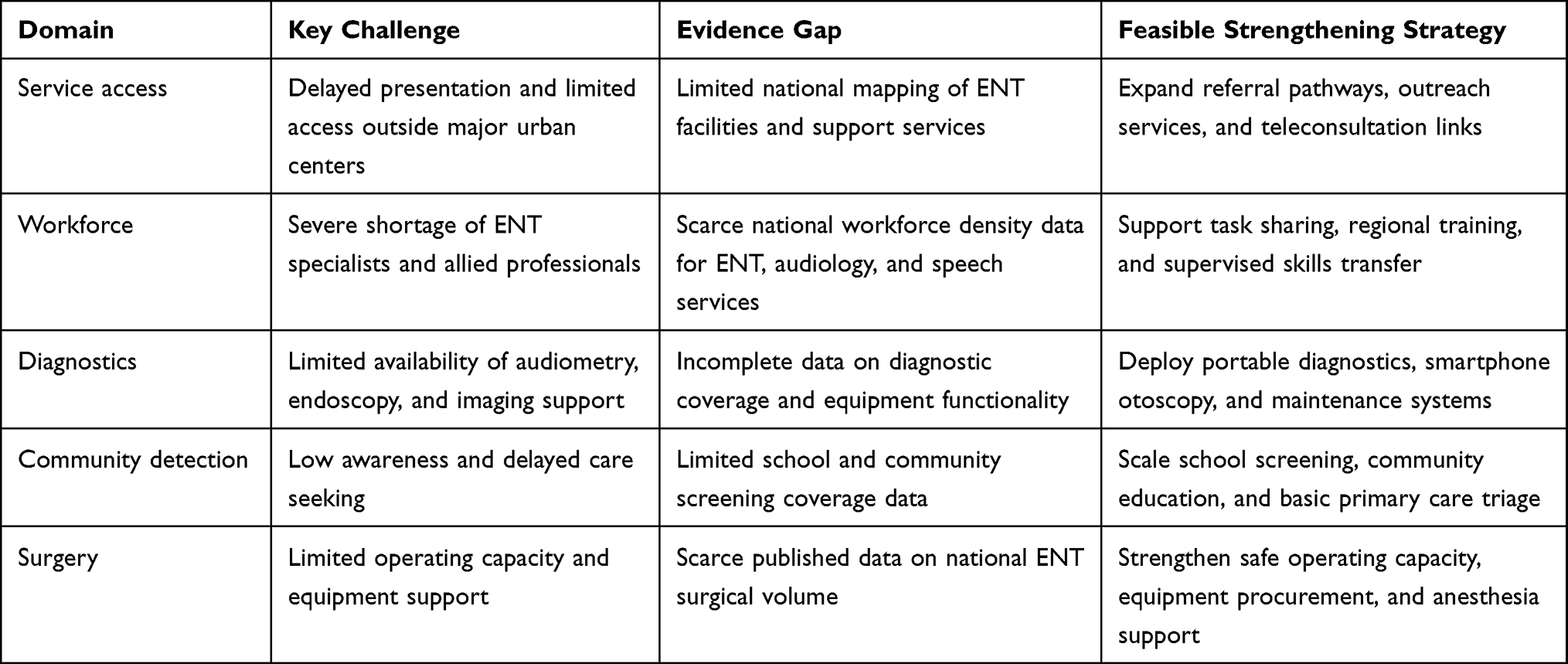 |
Table 1 Key Challenges, Evidence Gaps, and Feasible Strengthening Strategies for ENT Care in Somalia and Comparable Low Resource Settings |
Policy Implications and the Path Toward Universal Health Coverage
ENT disorders influence communication, education, employment, and social participation. Integrating ENT care into national health strategies aligns with universal health coverage goals. Strengthening referral pathways, ensuring reliable procurement and maintenance of diagnostic tools, promoting community based screening, and reducing financial barriers are essential steps. Digital health solutions provide an opportunity for rapid expansion of diagnostic and clinical support even in fragile health systems.
Conclusion
Somalia reflects a broader global pattern of preventable ENT morbidity resulting from specialist shortages, weak referral systems, limited diagnostic tools, and financial barriers. Yet scalable solutions exist. Digital diagnostics, telemedicine, task sharing, community screening, and strengthened surgical systems offer realistic opportunities for improving ENT care. With coordinated investment and alignment with universal health coverage objectives, low resource countries can substantially reduce preventable disability and improve population wellbeing. These recommendations are grounded in the reviewed evidence and are intended to support pragmatic, policy relevant strengthening of ENT services in fragile and underserved settings.
Ethics Statement
Ethical approval was not required because this commentary does not involve human subjects or identifiable data.
Acknowledgments
This research was supported by SIMAD University. The authors gratefully acknowledge the ENT professionals whose valuable service, experience sharing, and recommendations contributed meaningfully to the development of this work.
Author Contributions
All authors made a significant contribution to the work reported, whether that is in the conception, study design, execution, acquisition of data, analysis and interpretation, or in all these areas; took part in drafting, revising or critically reviewing the article; gave final approval of the version to be published; have agreed on the journal to which the article has been submitted; and agree to be accountable for all aspects of the work.
Disclosure
The authors declare no conflicts of interest in this work.
References
1. World Health Organization. World report on hearing. Geneva: World Health Organization; 2021. Available from: https://www.who.int/publications/i/item/world-report-on-hearing.
2. GBD Hearing Loss Collaborators. Global burden of hearing loss. Lancet. 2021;397(10278):996–5. doi:10.1016/S0140-6736(21)00532-5
3. Federal Ministry of Health Somalia. Somalia health sector strategic report 2020. Mogadishu: Federal Ministry of Health Somalia; 2020.
4. World Bank. Somalia health system assessment. Washington, DC: World Bank; 2020. Available from: https://documents.worldbank.org.
5. United Nations High Commissioner for Refugees. Somalia population and protection analysis 2023. Available from: https://www.unhcr.org.
6. United Nations Office for the Coordination of Humanitarian Affairs. Somalia humanitarian needs overview. 2023. Available from: https://www.unocha.org.
7. United Nations Population Fund, Ministry of Health Somalia. Somalia Health and Demographic Survey 2020. Mogadishu: UNFPA and Ministry of Health Somalia; 2020.
8. World Health Organization Regional Office for the Eastern Mediterranean. Health System Challenges in Fragile States. Cairo: WHO Regional Office for the Eastern Mediterranean; 2019.
9. United Nations Children’s Fund. Healthcare Access Barriers in the Horn of Africa. Nairobi: UNICEF; 2021.
10. Monasta L, Ronfani L, Marchetti F, et al. Burden of disease caused by otitis media: systematic review and global estimates. PLoS One. 2012;7(4):e36226. doi:10.1371/journal.pone.0036226
11. Fagan JJ, Jacobs M. Survey of ENT services in Africa: need for a comprehensive intervention. J Laryngol Otol. 2009;123(1):30–33. doi:10.1017/S0022215108003248
12. Emmett SD, Francis HW. The socioeconomic impact of chronic otitis media. Otolaryngol Head Neck Surg. 2015;152(6):1045–1056. doi:10.1177/0194599815577101
13. Mulwafu W, Kuper H, Ensink RJH. Prevalence and causes of hearing impairment in Africa. Trop Med Int Health. 2016;21(2):158–165. doi:10.1111/tmi.12633
14. Stevens G, Flaxman S, Brunskill E, et al. Global and regional hearing impairment burden. Int J Audiol. 2013;52(6):377–385. doi:10.3109/14992027.2013.781282
15. Mitchell RB. Adenotonsillar hypertrophy and pediatric sleep disordered breathing. Pediatrics. 2015;136(4):e1004–e1012. doi:10.1542/peds.2015-1139
16. Lumeng JC, Chervin RD. Epidemiology of pediatric obstructive sleep apnea. Proc Am Thorac Soc. 2008;5(2):242–252. doi:10.1513/pats.200708-135MG
17. Meltzer EO. Rhinitis and sinusitis in low and middle income countries. Clin Exp Allergy. 2018;48(9):1107–1116. doi:10.1111/cea.13214
18. Chidzonga MM. Oral and maxillofacial malignancies in Zimbabwe. Oral Oncol. 2013;49(2):190–193. doi:10.1016/j.oraloncology.2012.08.003
19. Fagan JJ. Head and neck cancer in sub-Saharan Africa. Curr Opin Otolaryngol Head Neck Surg. 2014;22(2):100–105. doi:10.1097/MOO.0000000000000037
20. World Health Organization. Global ENT workforce report. Geneva: World Health Organization; 2020.
21. Luboga S, Macfarlane SB, von Schreeb J, et al. Increasing access to surgical services in low income countries: priorities for national and international agencies recommended by the Bellagio Essential Surgery Group. World J Surg. 2017;41(10):2410–2421. doi:10.1007/s00268-017-4081-7
22. Mulwafu W, Nyirenda TE, Fagan JJ, et al. Barriers to care for ear and hearing disorders in Africa. Int J Pediatr Otorhinolaryngol. 2017;99:16–21. doi:10.1016/j.ijporl.2017.05.018
23. United Nations Office for the Coordination of Humanitarian Affairs, United Nations Children’s Fund. Somalia Health Access Barriers Assessment 2022. Nairobi: OCHA and UNICEF; 2022.
24. Cranston A, Prescher H, Arriaga M, et al. Diagnostic accuracy of smartphone otoscopy in outpatient practice. JAMA Otolaryngol Head Neck Surg. 2021;147(3):243–251. doi:10.1001/jamaoto.2020.4920
25. Bright T, Pallawela D. Validated technologies for hearing screening and assessment: key opportunities for effective use in low- and middle-income countries. Bull World Health Organ. 2019;97(10):673–681. doi:10.2471/BLT.18.227561
26. Livingstone D, Chau J. Otoscopic diagnosis using computer vision: an automated machine learning approach. Digit Health. 2020;6:2055207620914775. doi:10.1177/2055207620914775
27. Pavithran P, Nair S, Satheeshkumar P, et al. Task sharing and primary ear care delivery in low-resource settings. Glob Health Action. 2020;13(1):1822544. doi:10.1080/16549716.2020.1822544
28. Swanepoel D, Myburgh HC, Howe DM, et al. Smartphone hearing screening with integrated quality control and data management. Int J Audiol. 2019;58(5):292–299. doi:10.1080/14992027.2018.1558279
29. Australian Society of Otolaryngology Head and Neck Surgery. Global ENT training partnership annual report 2020. Sydney: ASOHNS; 2020.
 © 2026 The Author(s). This work is published and licensed by Dove Medical Press Limited. The
full terms of this license are available at https://www.dovepress.com/terms
and incorporate the Creative Commons Attribution
- Non Commercial (unported, 4.0) License.
By accessing the work you hereby accept the Terms. Non-commercial uses of the work are permitted
without any further permission from Dove Medical Press Limited, provided the work is properly
attributed. For permission for commercial use of this work, please see paragraphs 4.2 and 5 of our Terms.
© 2026 The Author(s). This work is published and licensed by Dove Medical Press Limited. The
full terms of this license are available at https://www.dovepress.com/terms
and incorporate the Creative Commons Attribution
- Non Commercial (unported, 4.0) License.
By accessing the work you hereby accept the Terms. Non-commercial uses of the work are permitted
without any further permission from Dove Medical Press Limited, provided the work is properly
attributed. For permission for commercial use of this work, please see paragraphs 4.2 and 5 of our Terms.
Recommended articles
Perspectives of Primary Health Facility Leaders on the Contributions of Clinical Residents During Community Placement in Southwestern Uganda
Kawungezi PC, Ntaro M, Turyakira E, Wesuta AC, Tushabe A, Matte M, Ndizeye R, Mwebembezi F, Turigye B, Ngonzi J, Mulogo EM
Advances in Medical Education and Practice 2026, 17:555911
Published Date: 8 January 2026
When Nurses Leave Nursing: Leadership Priorities to Prevent Professional Exit in Somalia and Other Resource Limited Settings: An Evidence Informed Commentary
Salad YM, Omar AA, Abdullahi AF, Hassan Orey FA, Abdullahi IM, Elmi AH
Journal of Healthcare Leadership 2026, 18:601204
Published Date: 17 April 2026
Maternal and Newborn Health in Somalia: A Narrative Review of Health System Challenges and Public Health Priorities
Mohamoud JH, Adam MH, Mohamed AMS, Garba B, Mahamud MA, Asowe HA
International Journal of Women's Health 2026, 18:606754
Published Date: 5 May 2026