
Back to Journals » Advances in Medical Education and Practice » Volume 17
Sleep Quality, Academic Performance, and Associated Predictors Among Undergraduate Health Sciences Students at the University of Rwanda
Authors Nzamwita F, Igihozo C, Turikumana PD  , Nshimiyimana J, Nyangezi PM, Biracyaza E , Cloete LG
Received 26 October 2025
Accepted for publication 25 January 2026
Published 6 February 2026 Volume 2026:17 576834
DOI https://doi.org/10.2147/AMEP.S576834
Checked for plagiarism Yes
Review by Single anonymous peer review
Peer reviewer comments 2
Editor who approved publication: Dr Sateesh Arja
Francois Nzamwita,1,* Chadia Igihozo,1,* Pierre Damien Turikumana,1,2 Joseph Nshimiyimana,1,2 Peter Mooni Nyangezi,1,2 Emmanuel Biracyaza,3,4 Lizahn G Cloete5
1Department of Occupational Therapy, University of Rwanda, Kigali, Rwanda; 2Department of Education and Training, Rwanda Occupational Therapy Association (RWOTA), Kigali, Rwanda; 3School of Rehabilitation, Université de Montréal, Montreal, QC, Canada; 4Centre for Interdisciplinary Research in Rehabilitation of Greater Montreal (CRIR), Montreal, QC, Canada; 5Department of Health and Rehabilitation Sciences, Stellenbosch University, Cape Town, South Africa
*These authors contributed equally to this work
Correspondence: Francois Nzamwita, Email [email protected]
Background: Sleep is an essential occupation that supports cognitive, emotional, and physical well-being functioning, all of which are critical for academic performance. Although research on students has demonstrated relationships between sleep quality and academic performance, evidence from Rwandan students from health sciences programs remains limited. This study addressed this gap by examining the relationship between sleep quality, conceptualized as an occupation, academic performance scores, and related predictors among undergraduate students at the University of Rwanda.
Methods: A cross-sectional study was conducted among 251 undergraduate health sciences students (mean age= 23.28 ± 1.99 years; 59% male). Participants completed a sociodemographic questionnaire, the Pittsburgh Sleep Quality Index (PSQI), and an academic performance assessment. Data were analyzed using descriptive statistics and inferential methods, including Pearson correlation, and multiple linear regression to identify predictors of academic performance scores.
Results: Nearly half of the participants (49.8%) reported poor sleep quality, indicating disrupted engagement in the sleep occupation. Students with good sleep quality showed higher academic performance scores (Mean score=169.53) than those with poor sleep quality (Mean score=82.12), U=2390.5, Z=− 9.56, p< 0.001. Regression analyses showed that poorer overall sleep quality was strongly correlated with lower academic performance [β=− 0.70, 95% CI (− 1.76 to − 1.36), p< 0.001]. Specific components of the sleep occupation including subjective sleep quality [β=− 0.18, 95% CI (− 0.25 to − 0.11), p< 0.001] and sleep duration [β=− 0.12, 95% CI (− 0.18 to − 0.06), p< 0.001] were significantly correlated with reduced academic performance scores. Male gender was correlated with higher academic scores [β=0.10, 95% CI (0.01 to 0.19), p=0.038] than females.
Conclusion: This research revealed significant correlations between sleep quality, gender, and academic performance among health sciences students. Considering these correlations, university should consider integrating sleep hygiene education and occupational balance strategies into wellness efforts to enhance academic success. Besides, longitudinal studies are needed to further assess the direction and nature of these relationships.
Keywords: academic performance, occupational therapy, predictor, sleep quality, students
Background
Sleep is a fundamental physiological process that supports cognitive, emotional, and physical functioning, all of which are important for successful engagement in daily activities including academic participation.1 Good sleeping plays a critical role in attention, memory consolidation, emotional regulation, and learning, whereas poor sleep is an occupational concern that leads to fatigue, impaired concentration, and reduced academic performance.2,3 Among the university students, sleep problems are recognized as a concern especially in low- and middle-income countries (LMICs). Recent systematic reviews in sub-Saharan Africa have reported a high prevalence of poor sleep among university students, with approximately 61% affected.4 Evidence from Rwanda suggests an even greater burden as a study among medical undergraduate students reported 80% experienced poor sleep.5 These evidences suggest that sleep problems are widespread among students in Rwanda university students and may substantially interfere with their ability to meet academic demands.2,3
From an occupational therapy (OT) perspective, sleep is conceptualized as a core occupation that supports health, wellbeing, and participation in other daily occupations.6 According to the Model of Human Occupation (MOHO), occupational performance is shaped by the dynamic interaction between volition, habituation, performance capacity, and environment.7,8 Good sleep is foundational to performance capacity, as it supports the physical and mental abilities required for sustained engagement in academic occupations such as attending classes, studying, completing assignments, and participating in examinations.9,10 Disruptions in sleep may therefore undermine occupational engagement and academic participation of the students.11
Sleep quality refers to an individual’s subjective evaluation of their sleep experience, including sleep onset, duration, continuity, and perceived restfulness.12,13 High-quality sleep enables physical restoration and optimal cognitive functioning, consistent with the restorative theory of sleep, which posits that sleep supports physiological recovery processes and cognitive integration.14,15 Conversely, poor sleep is associated with diminished alertness, irritability, and reduced capacity to engage effectively in daily occupations, including learning-related activities.2,3
Occupational therapy also emphasizes the concept of occupational balance, which refers to the harmonious organization of daily occupations across work, rest, sleep, and leisure.16,17 University students often experience imbalances due to academic workload, irregular schedules, prolonged screen use, and psychosocial stress, all of which may negatively affect sleep routines.18 Behavioral factors such as excessive use of electronic devices before bedtime can delay sleep onset and disrupt sleep continuity.19–21 In addition, psychological factors including academic stress and anxiety, and environmental conditions such as noise and inadequate sleeping spaces may disrupt sleep patterns and compromise the ability of students to maintain balanced occupational routines.22–24
Despite the relevance of sleep as an important occupation and its major role in academic performance, limited research has assessed sleep quality among university students in Rwanda from occupational therapy perspective. In particular, there is a limited knowledge about how sleep quality is related to academic performance and how conceptual, behavioral, and psychosocial factors influence engagement of students in sleep as an occupation. It is essential to address this gap for advancing OT knowledge related to students and for informing occupation-based approaches that support academic participation and wellbeing. This study therefore aimed to examine sleep quality, academic performance, and key predictors of academic success among undergraduate students in Rwanda, guided by occupational therapy framework that conceptualizes sleep as an occupation that support academic engagement and overall wellbeing.25
Methods
Study Design and Setting
This study employed a cross-sectional study design to determine the sleep quality and other predictors of academic performance in Rwanda undergraduate students.26 Thus, the study targeted students enrolled at the University of Rwanda, College of Medicine and Health Sciences (CMHS), School of Health Sciences at Remera Campus in Kigali. The University of Rwanda plays a great role in national and regional capacity building in health and education. Its six constituent colleges, including CMHS, are strategically distributed to enhance access and academic excellence across the country.27 Remera Campus was strategically selected for this study based on its academic relevance, infrastructural support, and student diversity. Its role as a central academic site for health education in Rwanda made it an ideal setting for exploring how sleep quality may influence academic outcomes among future healthcare professionals.
Study Population and Participants
The study target population consisted of undergraduate students pursuing their education at the School of Health Sciences in academic year 2024/2025. Participants were recruited from different departments namely: Department of Physiotherapy, Department of Anesthesia, Department of Ophthalmology, Department of Prosthetics and Orthotics, Department of Medical Imaging Sciences, Department of Biomedical Laboratory Sciences, Department of Clinical Medicine and Community Health, and Department of Occupational Therapy. The rationale emphasizes that occupational therapy provides a theoretical framework for conceptualizing sleep as an essential occupation, and including students from various health programs allows for broader insights into academic performance and wellbeing.
According to official records provided by the CMHS Registry Office for the 2024–2025 academic year, a total of 571 undergraduate students were enrolled at the Remera Campus, comprising 381 males and 190 females. From this population, students from Levels 2 to 4 were eligible for inclusion in the study to ensure that participants had sufficient academic exposures and experience to provide informed responses regarding academic performance and sleep-related behaviors. Additional inclusion criteria included being at least 18 years old, being registered in any undergraduate program of the school of health sciences during the targeted academic year, having the cognitive and physical ability to respond to the questionnaire, having completed at least one year in the program, demonstrating willingness to participate and providing the signed informed consent forms. Exclusion criteria were applied to reduce confounding and enhance the reliability of self-reported data. Students were excluded if they were within one month of scheduled academic examinations, as the associated stress and altered routines could affect sleep and performance. Students whose studies had been suspended were also excluded from this work.
Sampling Strategies and Sample Size
All participants included in this research met the established inclusion criteria, preserving the integrity of the study and improving the accuracy of the analyses. A census of all eligible students from Levels 2 to 4 across various departments in the School of Health Sciences was invited to participate. Questionnaires were distributed via Email and WhatsApp groups to reach all students within each department. Of the 571 invited students, only 251 consented and completed the survey, forming the final study sample. The distribution of participants by department was as follows: 29 from Anesthesia department, 49 from Clinical Medicine and Community Health department, 29 from Medical Imaging Sciences department, 33 from Occupational Therapy department, 31 from Ophthalmology department, 31 from Physiotherapy department, and 22 from Prosthetic and Orthotic department. The research team then considered the responses obtained from the Google Form questionnaire. This approach allowed for comprehensive coverage of the eligible population while maintaining departmental diversity and representativeness.
Data Collection and Procedures
The corresponding author of the research contacted each department to obtain the class representative contact information for each class following the ethical approval from the College of Medicine and Health Sciences of the University of Rwanda. These representatives disseminated the study invitation and questionnaire link to students via departmental Email and WhatsApp groups. The study participants granted consent before proceeding to complete the main questions in the shared questionnaire. Data collection was conducted from 21 March to 19 July 2025 which was strategically selected because it fell between mid-semester coursework and final examinations, reducing the confounding influence of exam-related stress on sleep patterns. The study team reminded participants via Email and WhatsApp to complete the questionnaire biweekly to optimize response rates. The responses of study participants were automatically recorded and securely saved in a protected Google Sheet, accessible solely to the research team.
Data Collection methods
Instruments
The study instrument consisted of two types of questionnaires. The first was socio-demographics questionnaire that comprised the variables such as age, sex, and academic-related variables including year of study, department, accommodation type, and academic performance scores. Participants were asked to report their Cumulative Grade Point Average (CGPA) from the most recent semester before the study. CGPA scores ranged from 0 to 100, following the grading categories used in academic transcripts: scores of 80–100 were classified as distinction, 70–79 as good, 60–69 as satisfactory, 50–59 as pass, and 0–49 as retake.28 Furthermore, CGPA above 69 was considered indicative of good academic performance.
The second instrument used for data collection was the psychometric instruments:
Pittsburgh Sleep Quality Index (PSQI): It is a standardized self-rated questionnaire consisting of 19 items used to assess participants’ sleep quality.29 Its items are grouped into seven components namely: subjective sleep quality, sleep latency, duration of sleep, habitual sleep efficiency, sleep disturbances, the use of sleep medications, and daytime functioning. Each component ranging from 0 to 3 scores with 0 implying no difficulty, whereas 3 denotes extreme difficulty. By summing these scores, a global sleep quality score is generated, ranging from 0 to 21, “0” indicating no difficulty and “21” indicating severe difficulties in all areas as well as a score ≤5 indicated good sleep quality, while a score >5 indicated poor sleep quality.30
The categorization of PSQI components provides a detailed understanding of sleep quality. Habitual sleep efficiency (items 1,3 and 4) evaluates sleep effectiveness, while sleep latency (items 2 and 5a) measures the time taken to fall asleep. Sleep duration (item 4) focuses on total sleep time, and subjective sleep quality (item 6) reflects an individual’s perception of their sleep. Sleep disturbances (items 5b–5j) assess interruptions, while use of sleep medication (item 7) tracks reliance on aids. Finally, daytime dysfunction (items 8 and 9) examines the impact of poor sleep on daily activities. Together, these components offer a comprehensive framework for analyzing sleep quality.29 For cultural appropriateness, the English version of the PSQI, which had been found to be cross-culturally reliable, was used without translation. Previous studies established that this instrument has good psychometric qualities.31,32 In Rwanda, this psychometric instrument was recently used and demonstrated acceptable internal consistency and construct validity among university students, making it appropriate for use in this study without further validation.33
Data Analysis
Data was first entered and cleaned using Microsoft Excel, then exported to the Statistical Package for Social Sciences (SPSS) version 26 for statistical analysis. Descriptive statistics were used to summarize demographic characteristics of participants, sleep quality (measured by PSQI scores), and academic performance. In this analysis, statistical parameters including frequencies, percentages, means, and standard deviations were computed. For inferential analysis, bivariate methods were applied. The relationship between continuous PSQI scores and academic performance (percentage scores) was examined using Pearson’s correlation coefficient, with values interpreted as follows: 0.70–1.00 indicating a strong correlation, 0.40–0.69 moderate, and 0.10–0.39 weak.34
To examine associations between categorized variables such as sleep quality (categorized as “good” for PSQI 5≤ and “poor” for PSQI >5) and academic performance (classified as “Good to excellent” for score ≥70% and “low academic performance” for scores <70%), cross tabulation and the Chi-square test of independence was used.35–37 The Mann Whitney U-test, a non-parametric test, was used to test difference in mean score of academic performance between two groups of sleep quality due to its non-parametric characteristics. Multivariate linear regression analysis was conducted to identify predictors of academic performance, controlling for potential confounding variables including age, sex, year of study, accommodation type, and academic program. A 95% confidence interval and a significance level of p<0.05 were applied.38 To ensure the validity of the regression model, multicollinearity was assessed using Tolerance and Variance Inflation Factor (VIF) values. All VIF values were below 5 and all tolerance values above 0.1 which confirmed that multicollinearity was not a concern, thereby supporting the reliability of the models. Furthermore, to address potential confounding, multivariate regression included demographic variables (age, sex, year of study, accommodation, academic program). This statistical adjustment reduced the risk of bias.
Results
Demographic Characteristics of Participants
The mean age is 23.28 years with a standard deviation of 1.99. Many students, comprising 64.9%, are aged between 23 and 26, while 31.5% fell within the 19 to 22 age range. The sample consists of 59% males and 41% females. The academic performance range of 75–84 encompasses 38.2% of the sample, indicating a pronounced tendency towards above-average results. The academic performance range of 65–74 encompasses 33.1% of the population, demonstrating a generally competent level of achievement among the categories, with only a little fraction (7.6%) scoring below 65, suggesting that low performance is rather uncommon. Additionally, 4.4% of people achieve scores between 85 and 94. More than half of students (54.6%) reside in on-campus hostels, whereas 30.7% choose off-campus accommodation. A minor proportion (14.7%) resides in homestay accommodations, cohabiting with a family (Table 1).
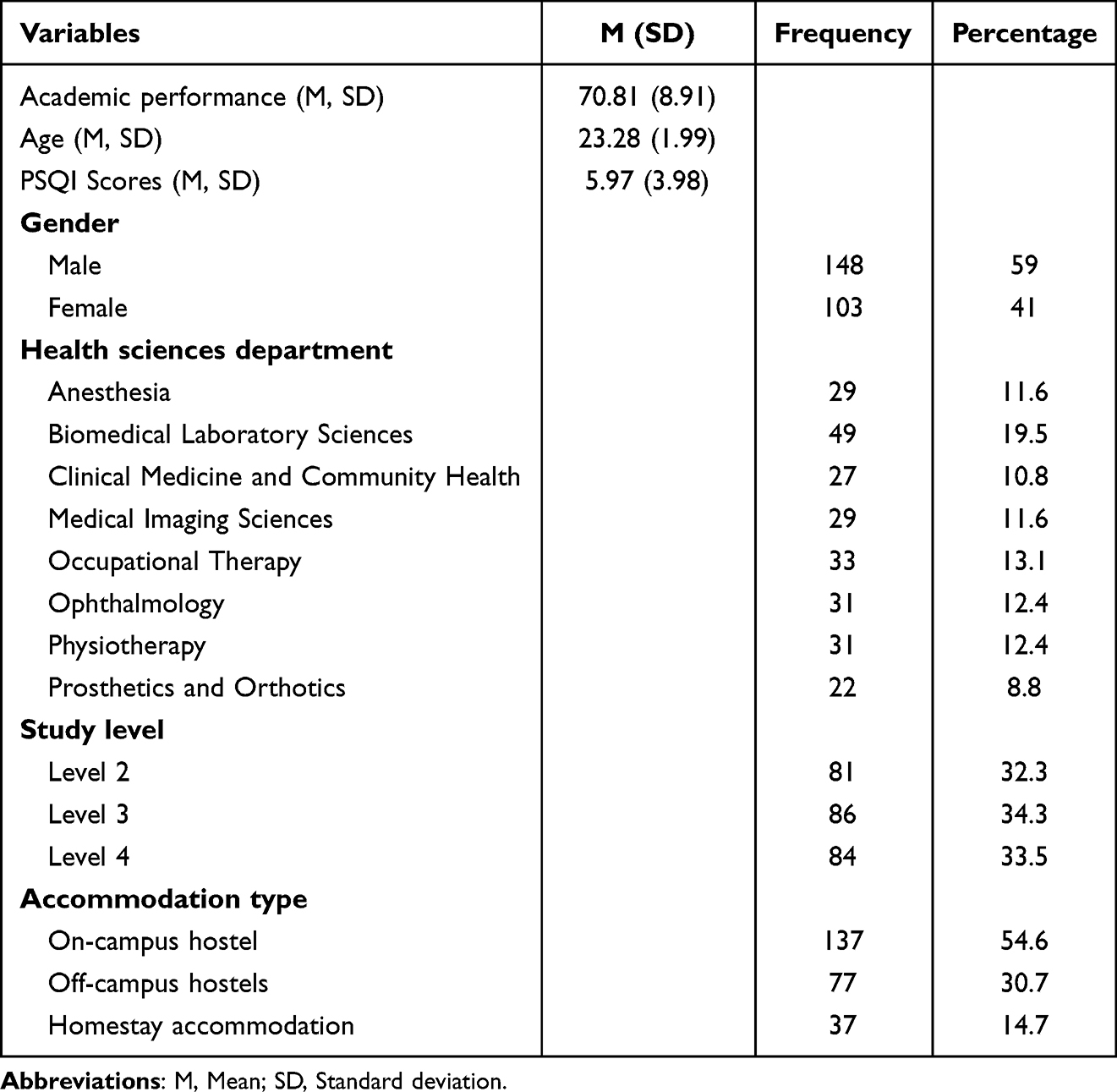 |
Table 1 Socio-Demographic Characteristics of Participants |
The mean academic score is 70.81, with a standard deviation of 8.91, indicating considerable variability in academic performance. Most of the students exhibit performance within a 9-point variance from the mean. Students demonstrate considerable variability in sleep quality, with an average score of 5.97 and a standard deviation of 3.98. Scores exceeding 5 generally signify inadequate sleep, potentially indicating significant sleep disruptions among numerous students (Table 1).
Profile of Sleep Quality: Sleep Quality Components
Among the participants, 127 (or 50.6%) indicated that they had no difficulty with the quality of their subjective sleep, 146 (or 58.2%) reported that they had no difficulty with the duration of their sleep, and 141 (or 56.2%) reported that they had no difficulties with the efficiency of their sleep. On the other hand, 194 (or 77.3%) participants reported having mild trouble with sleep disturbances, and 93 (or 37.1%) of the participants reported having mild difficulties with the usage of sleep medication (Supplementary Table 1).
Prevalence of Sleep Quality
Of the entire sample of 251 participants, 126 (50.2%) indicated good sleep quality, whereas 125 (49.8%) reported poor sleep quality (Figure 1).
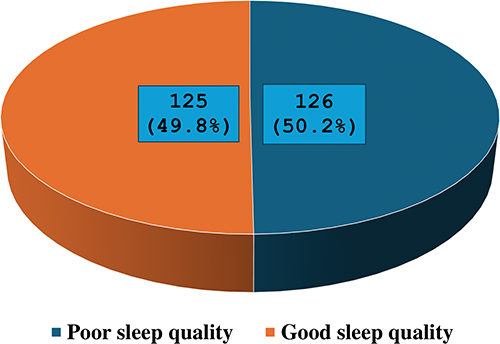 |
Figure 1 Distribution of sleep quality among undergraduate students. The pie chart indicates the distribution of sleep quality among the study participants based on the Pittsburgh Sleep Quality Index (PSQI). Poor sleep quality (PSQI >5) was observed in 126 participants (50.2%), while good sleep quality (PSQI ≤ 5) was reported by 125 participants (49.8%). Figure 1 is presented as a pie chart visually representing the proportion of participants with good versus poor sleep quality. Each segment corresponds to a sleep quality category, differentiated by color and labeled with both absolute frequencies (n) and percentages (%). This visual format allows for an immediate comparison of the prevalence of poor and good sleep quality within the study sample. |
Conversely, males indicate marginally inferior sleep quality, with merely 73 out of 148 achieving good sleep, while 75 report poor sleep. Students who achieved good to excellent academic performance (scores ≥ 70) were more likely to report good sleep quality, with 115 individuals falling into this category. In comparison, 50 students with similar academic performance reported poor sleep quality. On the other hand, among students with lower academic performance (scores < 70), only 9 reported good sleep quality, while a significantly higher number 77 students, experienced poor sleep quality (Supplementary Table 2).
The Relationship Between Sleep Quality and Academic Performance
Results indicated a strong negative correlation between sleep quality and academic performance (r=−0.701, p<0.001). The results indicated a strong negative correlation between sleep quality and academic performance, suggesting that students with poor sleep quality tend to perform worse academically. Note, an increase in PSQI scores indicates a decline in sleep quality, as higher PSQI values represent greater poor sleep quality; therefore, the strong negative Pearson correlation observed (r=−0.701) reflects that poorer sleep quality is associated with lower academic performance (Supplementary Table 3).
Academic Performance Between Good and Poor Sleep Quality
A Mann–Whitney U-test was conducted to determine whether there was a statistically significant difference in academic performance between students with good and poor sleep quality. Results indicated a significant difference in academic performance between the two groups (U=2390.5, Z=−9.56, p<0.001). The mean rank of academic performance was higher for students with good sleep quality (Mean Rank=169.53) compared to those with poor sleep quality (Mean Rank=82.12). This suggests that students who reported better sleep quality also tended to perform better academically than their counterparts.
Correlational Analysis of Academic Performance Between Academic Performance and PSQI Components
The data reveals a strong relationship between sleep quality components and academic performance among students. Components such as subjective sleep quality, sleep duration, and daytime dysfunction show the most significant correlations (p<0.001), with students experiencing fewer sleep difficulties consistently achieving higher academic scores. For instance, those reporting no issues with sleep duration or daytime alertness were far more likely to score above 70, while severe difficulties in these areas were predominantly found among lower-performing students. This suggests that both the quantity and restorative quality of sleep play a crucial role in cognitive function and academic success. Other components like sleep latency, sleep efficiency, and sleep disturbance also show meaningful associations, though to a slightly lesser extent. The use of sleep medication does not appear to influence academic outcomes (p=0.881), indicating that pharmacological interventions may not address the root causes of poor sleep (Table 2).
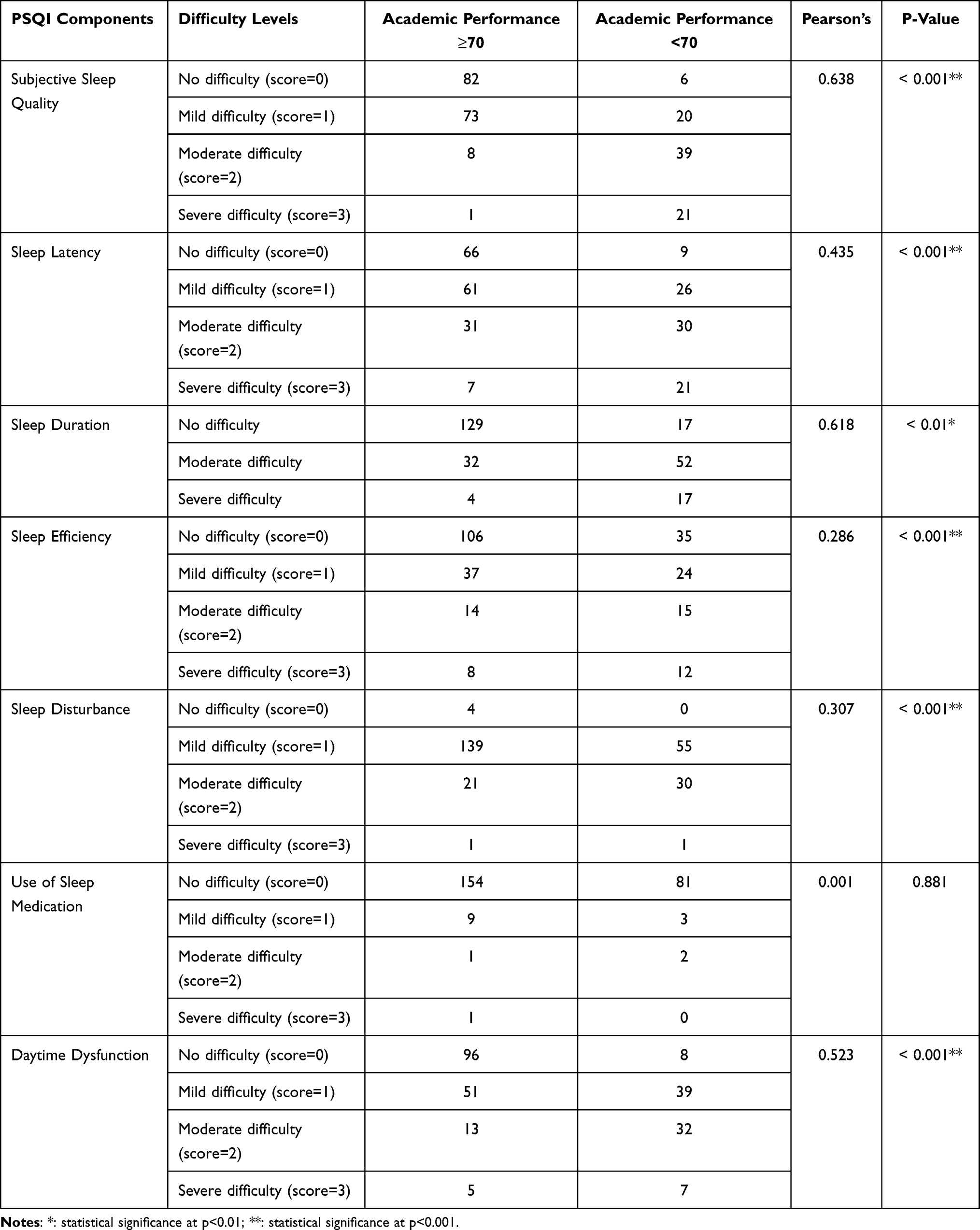 |
Table 2 Correlational Analysis of PSQI Components and Academic Performance |
Socio-Demographic Factors and Overall PSQI Score as Predictors of Academic Performance
A multiple linear regression model was performed to examine how socio-demographic characteristics and overall sleep quality were correlated with academic performance. Among these factors, sex was considerably correlated with academic performance, with male students showing slightly higher academic performance scores than females [β=0.13; 95% CI (0.79, 4.03), p=0.004]. In contrast, other socio-demographic variables like education program or faculty, level of study, accommodation, and age were not significantly correlated with academic performance. Notably, the global PSQI score was found to be a strong negative correlation with academic performance [β=−0.70; 95% CI (−1.76, −1.36), p<0.001], indicating that poorer overall sleep quality was consistently correlated with reduced academic outcomes (Table 3).
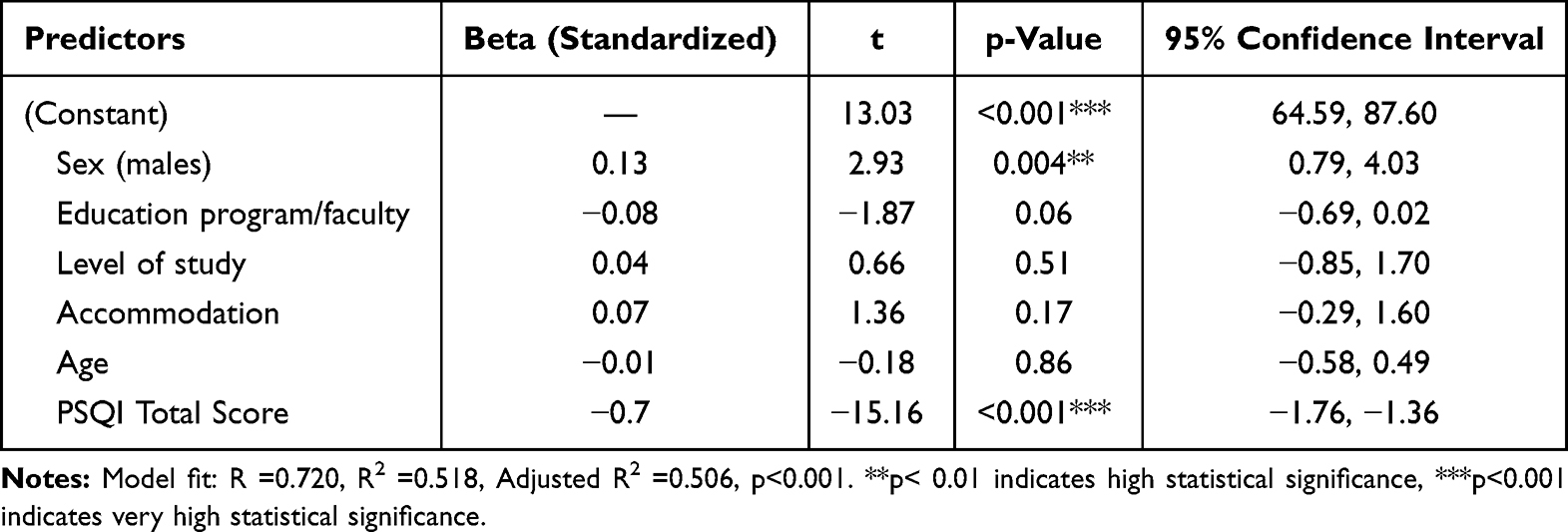 |
Table 3 Multivariate Linear Regression Models for the Predictors of Academic Performance |
Multiple Linear Regression Analyses for Correlations Between PSQI Components, Socio-Demographic and Academic Performance
The multiple linear regression model was conducted to determine the correlations between seven components of sleep quality, socio-demographic characteristics, and academic performance. In this model analyses, the overall PSQI score was replaced with the components, which explain a greater proportion of the variance in academic performance (R2=.636, p<0.001). Among the components, four indicated significant correlations with academic performance: subjective sleep quality [β= –0.38, 95% CI (−4.59, −2.42), p<0.001], sleep latency (β= –0.14, 95% CI (−2.23, −0.34), p = 0.008], sleep duration [β= –0.27, 95% CI (−3.00, −1.24), p<0.001], and daytime dysfunction [β= –0.22, 95% CI (−3.33, −1.22), p<0.001]. In addition, sex was significantly correlated with academic performance, with male students reporting higher scores than females [β=0.11, 95% CI (0.43, 3.37), p<0.001]. Overall, these findings indicated that poorer subjective sleep quality, prolonged sleep latency, shorter sleep duration, and higher daytime dysfunction are consistently associated with lower academic performance. On the other hand, the remaining components of sleep quality including sleep efficiency, sleep disturbance, and use of sleep medication were not significantly correlated with academic outcomes among the students (Table 4).
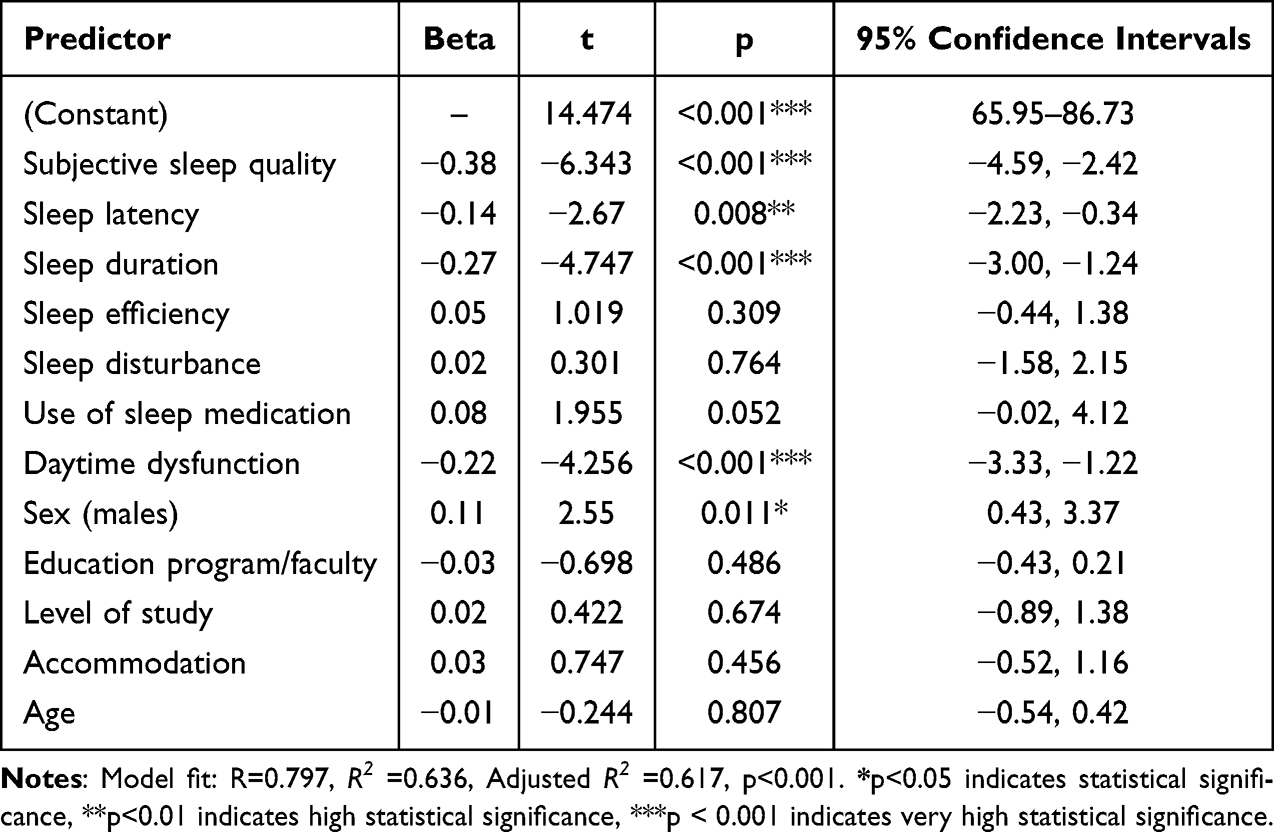 |
Table 4 Multiple Linear Regression Analyses for Correlations Between PSQI Components, Socio-Demographic Factors and Academic Performance |
Discussion
The purpose of this research was to establish the correlations between sleep quality and the academic performance as well as to explore other factors associated with academic performance among undergraduate students from the University of Rwanda. The findings indicate that poor sleep quality is common in this population, with nearly half of the students affected. The mean PSQI score exceeded the clinical cut-off, indicating poor average sleep quality across the sample. Given the established role of sleep in cognitive functioning, this pattern raises concern regarding capacity of students to sustain optimal academic performance. Additionally, the prevalence of poor sleep quality observed in this study is comparable to findings from other Sub-Saharan African countries, including Nigeria, where similar rates have been reported among undergraduate students.1 However, some studies reported higher prevalence rates,4,39 which is slightly higher than our findings. Our results are consistent with previous studies conducted in SSA. For instance, study in Ghana reported an even higher mean PSQI score of more than 7.2, indicating poorer sleep quality,40 while other studies found a slightly lower mean of 5.2 among medical students.26 These variations may stem from several contextual and methodological differences across regions and studies, including student stress levels, academic calendars, and living environments.
The mean academic performance score in this study was slightly above the commonly accepted threshold for satisfactory achievement. While this indicates that many students achieved acceptable academic outcomes, the proximity of the mean score to the cut-off suggests a level of academic vulnerability. When considered alongside the high prevalence of poor sleep quality, this finding may indicate that sleep-related difficulties contribute to marginal academic performance for a substantial proportion of students. Similar academic performance levels have been reported in other East African contexts, including studies conducted in Ethiopia,41,42 supporting the comparability of these findings across regional higher education institutions.
A key finding of this study was the inverse association between sleep quality and academic performance, with poorer sleep linked to lower academic outcomes. This relationship aligns with several previous studies reporting that students with inadequate sleep tend to perform worse academically.43,44 These findings may be explained by the integral role sleep plays in consolidating memory, maintaining attention, and regulating emotions functions vital for academic success. However, not all studies have observed this relationship, as research from some settings, such as Saudi Arabia, has reported no significant association between sleep quality and academic outcomes.45 This suggests that the relationship between sleep and academic performance may not be universal, and may be moderated by other contextual, cultural, or individual factors, including curriculum intensity, study habits, and psychosocial support. Critically, this highlights the need to consider sleep as one of several factors influencing academic achievement rather than the sole determinant.
Analysis of individual components of sleep quality revealed that subjective sleep quality, sleep duration, and sleep latency were most strongly associated with academic performance. This finding is consistent with prior research highlighting the importance of perceived sleep adequacy and sufficient sleep time in supporting academic functioning.43 Other studies have similarly demonstrated that sleep disturbances and daytime dysfunction are linked to poorer academic outcomes.3,43 While all components of the PSQI contribute to the overall understanding of sleep quality, not all showed the same level of correlation with academic performance in our study. This is not unusual and has also been observed in previous research. From the point of view of the researchers, this variation can be explained by both contextual and behavioral factors among student populations. Further, use of sleep medication was not statistically correlated with academic performance, which contrasts with scientific evidence from the previous research.46
While these findings are consistent with some studies,20,21 others have highlighted different components, such as sleep latency or sleep disturbance, as more critical in their correlations with academic outcomes. For example, Okano and her colleagues demonstrated that consistency of sleep and subjective sleep quality were more strongly correlated with achievement than total sleep time.44 Alongside this, a study among Ethiopian university students found that social and psychological factors rather than demographic variables contributed significantly to variations in sleep patterns, which in turn impacted academic achievement.2
Regarding socio-demographic factors, male students demonstrated higher academic performance compared to female students, consistent with findings from some prior studies.1,2,22 This association may reflect underlying gender-related differences in access to study resources, self-confidence in academic settings, or societal expectations that shape academic engagement. However, while earlier studies reported that academic performance tends to improve with each advancing year of university particularly from second to third and fourth year,2 our study diverged from these findings, revealing no significant correlation between year of study and academic performance. This lack of association could suggest that students encounter similar academic challenges across years or that institutional and instructional factors limit progressive skill development over time.
Study Strengths and Limitations
This research presents several notable strengths. First, it is the first in Rwanda to explore sleep quality among undergraduate students through occupational therapy perspective that conceptualizes sleep as an important daily occupation that supports their engagement in academic activities and overall functioning. This theoretical framework enabled us to explore the associations between sleeping occupation and academic performance as well as their associated predictors. Second, the study provides important evidence on sleep quality and academic performance in SSA, especially in East Africa where scientific evidence on these occupations is still needed to enrich literature. The results from this research offer foundation for future research on occupational engagement, occupational justice, and the factors influencing academic outcomes. Finally, although the cross-sectional design precludes causal inference, our results inform conceptual frameworks for future studies, including potential intervention research, and suggest areas where strategies to promote balanced daily routines and enhance student wellbeing could be explored.
Despite these strengths, certain limitations must be acknowledged. The limited availability of region-specific literature on the association between sleep quality and academic outcomes constrained our ability to contextualize and compare our findings within the broader African context. In addition, cross-sectional design restricts the ability to draw causal inferences and fails to capture longitudinal dynamics. This design also did not allow for an in-depth exploration of socio-cultural or contextual factors that might have been more effectively investigated using qualitative or mixed methods approaches. Furthermore, as the study was conducted at a single university, the generalizability of the findings to the national student population remains limited. Although efforts were made to control potential confounding factors through careful inclusion and exclusion criteria, other variables such as psychological stress, learning environment, and socio-economic background that are known to impact academic performance. These variables could have exerted residual influence. The use of self-reported measures may also have introduced social desirability or recall bias, and the presence of non-response due to incomplete questionnaires could have introduced systematic bias, potentially leading to either overestimation or underestimation of key associations. Another limitation was that the sample was small which could limit generalizability of the results. In addition, the questionnaires were distributed online, which could lead to inappropriate responses and irrelevant study participants. Finally, the results from this survey regarding medication usage should be interpreted with caution. The observed association with academic outcomes may not reflect a direct causal relationship but rather an indirect effect mediated by underlying sleep quality. Students who use sleep medication are likely managing pre-existing sleep difficulties, which in turn influence academic performance. Additionally, as our study did not differentiate between medications taken for relaxation (eg, to induce sleep) and those used for alertness (eg, stimulants to counter sleepiness), the interpretation of these results remains limited.
Implications
Building on the clear association found between sleep quality and academic performance, this study emphasizes the need to embed sleep-focused strategies within student wellness initiatives the university. Recognizing sleep as an important occupation, occupational therapists can play a leading role in developing sustainable, evidence-based interventions that support daily functioning and academic outcomes of the students. Practical actions include tailored sleep hygiene workshops, one-on-one therapeutic interventions for students with persistent sleep issues, and collaboration with campus housing services to create sleep-conducive environments. Further, campus-wide awareness campaigns can elevate the importance of sleep as a determinant of success, encouraging students to adopt healthier habits. These occupation-centered strategies reflect the broader goal of fostering equitable, supportive academic environments that prioritize student well-being through multidisciplinary collaboration. Lastly, the significant correlations between sleep duration and academic performance indicates the necessity for balance between study time and rest in academic settings. These results inform students that they may trade sleep for study, which can harm both well-being and performance. Considering these findings, we observe that the interventions should therefore promote healthy sleep habits alongside effective time management to optimize both rest and academic engagement.
Conclusions
This study highlights a high prevalence of poor sleep quality among university students in Rwanda and its significant association with reduced academic performance. Nearly half of students reported poor sleep quality with male students performed slightly better than females, but sleep quality remained the dominant predictor. These findings underscore the importance of recognizing sleep as a fundamental occupation essential for cognitive functioning and student well-being.
To enhance academic success and student health, universities should incorporate sleep health promotion into student support services. Practical strategies include providing sleep education programs, promoting stress management resources, encouraging responsible screen use before bedtime, and integrating routine sleep screening within campus health services. Institutional efforts that foster healthy daily routines and balanced academic demands may contribute to improved sleep quality and, consequently, better academic performance among university students. These interventions can be implemented within current structures such as orientation programs, and academic planning without substantial additional resources. In addition, using cross-sectional design limited causal inferences, and the results are based on self-reported data from a single university campus, which may not fully represent students in Rwanda. These limitations should be considered when interpreting the results and planning future research.
Future Directions
Future research should expand beyond single-institution samples to include students from multiple universities across Rwanda, ensuring a more comprehensive and representative understanding of sleep quality and academic performance among the broader student population. Such nationwide studies should consider variations across academic disciplines, living conditions, and socioeconomic backgrounds of the students. Additionally, longitudinal research designs are recommended to assess the direction and causality of the relationship between sleep disturbances and academic outcomes. Besides, quality study should understand deeply explore socio-cultural perspectives that could not be explored in quantitative approaches. Finally, researchers are encouraged to conduct longitudinal studies using objective measures, such as academic transcripts, to better understand and address sleep-related challenges in university settings. These approaches would strengthen the evidence base needed to inform effective, context-specific interventions and policies that promote sleep as an essential occupation supporting student well-being and academic success. We finally recommend future researchers to consider the types of medications used by the students, dosage, and purpose of sleep medications to better understand their nuances on academic performance of the students and engagement.
Data Sharing Statement
All data pertaining to this study are fully available and can be obtained from the corresponding author upon a reasonable request.
Ethics
This study was conducted in accordance with ethical research principles and regulations as required by the Helsinki Declaration. Ethical clearance was pursued and obtained on 27th January 2025 from the University of Rwanda, College of Medicine and Health Sciences Institutional Review Board (UR-CMHS, IRB), with reference number (CMHS/IRB/089/2025) prior to data collection. The clearance ensured that the study met all the guidelines necessary in terms of human subject protection, confidentiality, and informed consent. The respondents were sufficiently informed about the purpose of the study, their rights, and voluntary participation. The consent form was proved by every participant thus. Informed consent made sure that the students intentionally participated in the study and are fully aware of their rights and responsibilities. All data provided by participants was anonymized, and personal data stored on secure passworded device for privacy.
Consent for Publication
Consent for publication was obtained from the participants.
Acknowledgments
Francois Nzamwita and Chadia Igihozo are co-first authors for this study. The abstract of this paper was previously made publicly available as a preprint titled ‘Sleep Quality and Other Predictors of Academic Performance in Undergraduate Students from the University of Rwanda: A cross-sectional study’ on the Research Square/Sciety platform with interim findings: https://sciety.org/articles/activity/10.21203/rs.3.rs-7474062/v1.
The authors sincerely thank all the students who voluntarily participated in this study and generously shared their time and experiences. We are also deeply grateful to the University of Rwanda for its support, including the approval to conduct this research and the provision of ethical clearance. This collaboration was instrumental in facilitating a smooth and ethically sound research process.
Author Contributions
All authors made a significant contribution to the work reported, whether that is in the conception, study design, execution, acquisition of data, analysis and interpretation, or in all these areas; took part in drafting, revising or critically reviewing the article; gave final approval of the version to be published; have agreed on the journal to which the article has been submitted; and agree to be accountable for all aspects of the work.
Funding
Authors received no funding to conduct this study.
Disclosure
The authors declare no commercial, financial, or research-related conflicts of interest in relation to this study.
References
1. Tobi Seun-Fadipe C, Samuel Mosaku K. Sleep quality and academic performance among Nigerian undergraduate students. J Syst Integr Neurosci. 2017;3(5):1–14. doi:10.15761/jsin.1000179
2. Lemma S, Berhane Y, Worku A, Gelaye B, Williams MA. Good Quality Sleep is Associated with Better Academic Performance among University Students in Ethiopia. Sleep Breath. 2014;18(2):257–263. doi:10.1007/s11325-013-0874-8
3. Jalali R, Khazaei H, Khaledi Paveh B, Hayrani Z, Menati L. The effect of sleep quality on students’ academic achievement. Adv Med Educ Pract. 2020;11:497–502. doi:10.2147/AMEP.S261525
4. Nakie G, Takelle GM, Rtbey G, et al. Sleep quality and associated factors among university students in Africa: a systematic review and meta-analysis study. Front Psychiatry. 2024;15(March):1–16. doi:10.3389/fpsyt.2024.1370757
5. Hershner S. Sleep and academic performance: measuring the impact of sleep. Curr Opin Behav Sci. 2020;33:51–56. doi:10.1016/j.cobeha.2019.11.009
6. Kawano M. The Significant Role of Occupational Therapy in Improving Daily Life and Independence. Journal of Pain Management & Medicine. 2024;10(1000290):11–12. doi:10.35248/2684-1320.24.10.290
7. Amanios H, Hazen J, Verdoza M. Sleeping Challenges in College Students. Stanbridge University; 2023. Available from: https://repository.stanbridge.edu/162/1/MSOTRS001.08.pdf.
8. Hong M, Lee S, Kim E. Relationship of Momentary Volition to Occupational Experience and Life Perspective in Undergraduate Students. Healthc. 2023;11(18):2471. doi:10.3390/healthcare11182471
9. Chattu VK, Manzar MD, Kumary S, Burman D, Spence DW, Pandi-Perumal SR. The global problem of insufficient sleep and its serious public health implications. Healthc. 2019;7(1):1–16. doi:10.3390/healthcare7010001
10. Rappoport A. A comprehensive biological theory of sleep. In: The Science of the Brain: Function, Dysfunction and Disease.
11. Majid A, Zohaib M, Hassan U, et al. Assessing sleep quality and its impact on academic performance among undergraduate students of Peshawar. Journal of Medical Sciences. 2023;31(3):235–239.
12. Razaq R, Babar E, Sajjad R, Yousaf Q, Mahmood T. Association of stress and sleep quality among the health sciences students: an analytical study. Found Univ J Rehabil Sci. 2024;4(1):52–57. doi:10.33897/fujrs.v4i1.355
13. Park BK. The Pittsburg Sleep Quality Index (PSQI) and associated factors in middle-school students: a cross-sectional study. Child Heal Nurs Res. 2020;26(1):55–63. doi:10.4094/chnr.2020.26.1.55
14. Ecm H, Siu AMH. Review Article Occupational Therapy Practice in Sleep Management: a Review of Conceptual Models and Research Evidence. Hindawi Occup Ther Int. 2018;2018:16–18. doi:10.1155/2018/8637498
15. Diaz A, Berger R, Valiente C, et al. Children’s Sleep and Academic Achievement: the Moderating Role of Effortful Control. Int J Behav Dev. 2018;41(2):275–284. doi:10.1177/0165025416635284
16. Hocking C. Occupational justice as social justice: the moral claim for inclusion. J Occup Sci. 2017;24(1):29–42. doi:10.1080/14427591.2017.1294016
17. Whiteford G, Hocking C. Occupational Science: Society, Inclusion, Participation.
18. Leive L, Morrison R. Essential characteristics of sleep from the occupational science perspective. Cad Bras Ter Ocup. 2020;28(3):1072–1092. doi:10.4322/2526-8910.ctoARF1954
19. Lastella M, Rigney G, Browne M, Sargent C. Electronic device use in bed reduces sleep duration and quality in adults. Sleep Biol Rhythms. 2020;18(2):121–129. doi:10.1007/s41105-019-00251-y
20. Khaled A, Almaghaslah D, Siddiqua A, Kandasamy G, Orayj K. Impact of sleep quality on academic achievements of undergraduate medical students: a cross-sectional study from Saudi Arabia. BMC Med Educ. 2025;25(59). doi:10.1186/s12909-025-06664-3
21. Desjardins S, Grandbois M. Sleep parameters associated with university students’ grade point average and dissatisfaction with academic performance. Sleep Epidemiol. 2025;2:100038. doi:10.1016/j.sleepe.2022.100038
22. Huang Y, Yang L, Liu Y, Zhang S. Effects of perceived stress on college students’ sleep quality: a moderated chain mediation model. BMC Psychol. 2024;12(1). doi:10.1186/s40359-024-01976-3
23. Ho GW, Yang Z, Xing L, Tsang KKT, Ruan HD, Li Y. Nighttime Sleep Awakening Frequency and Its Consistency Predict Future Academic Performance in College Students. Int J Environ Res Public Health. 2022;19(5):2933. doi:10.3390/ijerph19052933
24. Tsai LL, Li SP. Sleep patterns in college students: gender and grade differences. J Psychosom Res. 2004;56(2):231–237. doi:10.1016/S0022-3999(03)00507-5
25. Association AOT. Occupational Therapy Practice Framework: domain and Process Fourth Edition. Am J Occup Ther. 2020;74(Supplement 2):96.
26. Xu Z, Niu M, Du W, Dang T. The effect of sleep quality on learning engagement of junior high school students: the moderating role of mental health. Front Psychol. 2025;16(January):147680. doi:10.3389/fpsyg.2025.1476840
27. Ransom J. Pathways to Engagement at the University of Rwanda: pressures, Relevance and Alignment. Cent Glob High Educ. 2024;2024(118):1–72.
28. Rwanda GPA calculator. Grading System for University of Rwanda. 2025. Available from: https://www.scholaro.com/db/Countries/Rwanda/Grading-System/University-of-Rwanda-28759.
29. Guo S, Sun W, Liu C, Wu S. Structural validity of the Pittsburgh Sleep Quality Index in Chinese undergraduate students. Front Psychol. 2016;7(AUG):1–7. doi:10.3389/fpsyg.2016.01126
30. Nwakego U, Ogechi A, Oledibe J, et al. Cross - cultural adaptation and validation of the Pittsburgh Sleep Quality Index (PSQI) in the Igbo language. Discover Psychology. 2024;4(1):154
31. Zhang C, Zhang H, Zhao M, et al. Reliability, Validity, and Factor Structure of Pittsburgh Sleep Quality Index in Community-Based Centenarians. Front Psychiatry. 2020;11(August):1–11. doi:10.3389/fpsyt.2020.573530
32. Nariya DM, Khatri S. Reliability and Validity of Gujarati Pittsburgh Sleep Quality Index: a Cross-sectional Study. J Clin Diagn Res. 2021;15(August 2020):15664. doi:10.7860/jcdr/2021/52006.15664
33. Nsengimana A, Mugabo E, Niyonsenga J, et al. Sleep quality among undergraduate medical students in Rwanda: a comparative study. Sci Rep. 2023;13(1):1–10. doi:10.1038/s41598-023-27573-9
34. Schober P, Schwarte LA, Schwarte LA. Correlation coefficients: appropriate use and interpretation. Anesth Analg. 2018;126(5):1763–1768. doi:10.1213/ANE.0000000000002864
35. De Moraes ACF, Conceição da Silva LC, Lima BS, Marin KA, Hunt ET, Nascimento-Ferreira MV. Reliability and validity of the online Pittsburgh Sleep Quality Index in college students from low-income regions. Front Digit Heal. 2024;6(July):1–6. doi:10.3389/fdgth.2024.1394901
36. Shadzi MR, Rahmanian M, Heydari A, Salehi A. Structural validity of the Pittsburgh Sleep Quality Index among medical students in Iran. Sci Rep. 2024;14(1):1–6. doi:10.1038/s41598-024-51379-y
37. Stadtländer CTKH. Qualitative, Quantitative, and Mixed-Methods Research. Microbe Mag. 2009;4(11):485. doi:10.1128/microbe.4.485.1
38. Marshall G, Jonker L. An introduction to inferential statistics: a review and practical guide. Radiography. 2011;17(1):e1–e6. doi:10.1016/j.radi.2009.12.006
39. Gaultney JF. The prevalence of sleep disorders in college students: impact on academic performance. J Am Coll Heal. 2010;59(2):91–97. doi:10.1080/07448481.2010.483708
40. Simpong DL, Bockarie A, Kumah AB, et al. Poor sleep quality remains a major challenge among tertiary education students in Ghana: a cross-sectional study in a Ghanaian University. IBRO Neurosci Rep. 2025;18(September 2024):130–134. doi:10.1016/j.ibneur.2024.12.014
41. Hailu M, Abie A, Mehari MG, et al. Magnitude of academic performance and its associated factors among health science students at Eastern Ethiopia University’s 2022. BMC Med Educ. 2024;24(1). doi:10.1186/s12909-024-06296-z
42. Gedefaw A, Tilahun B, Asefa A. Predictors of self-reported academic performance among undergraduate medical students of Hawassa University, Ethiopia. Adv Med Educ Pract. 2015;6:305–315. doi:10.2147/AMEP.S78604
43. Maheshwari G, Shaukat F. Impact of Poor Sleep Quality on the Academic Performance of Medical Students. Cureus. 2019;11(4):3–8. doi:10.7759/cureus.4357
44. Okano K, Kaczmarzyk JR, Dave N, Gabrieli JDE, Grossman JC. Sleep quality, duration, and consistency are associated with better academic performance in college students. Npj Sci Learn. 2019;4(1). doi:10.1038/s41539-019-0055-z
45. Sohail N. Stress and academic performance among medical students. J Coll Physicians Surg Pakistan. 2013;23(1):67–71. doi:10.2013/JCPSP.6771
46. Falloon K, Bhoopatkar H, Moir F, Nakatsuji M, Wearn A. Sleep well to perform well: the association between sleep quality and medical student performance in a high-stakes clinical assessment. SLEEP Adv. 2022;3(1):1–8. doi:10.1093/sleepadvances/zpac019
 © 2026 The Author(s). This work is published and licensed by Dove Medical Press Limited. The
full terms of this license are available at https://www.dovepress.com/terms
and incorporate the Creative Commons Attribution
- Non Commercial (unported, 4.0) License.
By accessing the work you hereby accept the Terms. Non-commercial uses of the work are permitted
without any further permission from Dove Medical Press Limited, provided the work is properly
attributed. For permission for commercial use of this work, please see paragraphs 4.2 and 5 of our Terms.
© 2026 The Author(s). This work is published and licensed by Dove Medical Press Limited. The
full terms of this license are available at https://www.dovepress.com/terms
and incorporate the Creative Commons Attribution
- Non Commercial (unported, 4.0) License.
By accessing the work you hereby accept the Terms. Non-commercial uses of the work are permitted
without any further permission from Dove Medical Press Limited, provided the work is properly
attributed. For permission for commercial use of this work, please see paragraphs 4.2 and 5 of our Terms.
Recommended articles

Impact of Sleep and Psychological Well-Being on the Academic and Clinical Performance of Nursing Students in Saudi Arabia
Benjamin LS, Pasay-an E, Pangket P, Alqarni AS, Gonzales F, Sacgaca L, Mahmoud DA, Mohsen MM, Ali Hamdi YS, Shanmugam SR
Psychology Research and Behavior Management 2024, 17:1355-1364
Published Date: 21 March 2024
Association Between Dietary Magnesium Intake and Sleep Quality in Saudi University Students: A Cross-Sectional Study
Alshammari AA, Alsawad KA, Ahmed NK, Alsaadi R, Alholieli RS, Alsaif S, Al Mulhim NS, Rafique N, Al Ghamdi K, ALQarni AS, Al-Hariri M
Nature and Science of Sleep 2025, 17:3127-3136
Published Date: 16 December 2025