
Back to Journals » Journal of Pain Research » Volume 19
Psychological Subtypes and Intervention Strategies in Burning Mouth Syndrome: A Narrative Review
Authors Li J  , Mu J, Sun T, Li X, Wu F, Zhuo Y, He J, Liu F
Received 3 February 2026
Accepted for publication 5 June 2026
Published 16 June 2026 Volume 2026:19 600859
DOI https://doi.org/10.2147/JPR.S600859
Checked for plagiarism Yes
Review by Single anonymous peer review
Peer reviewer comments 2
Editor who approved publication: Dr Helen Koechlin
Jia Li,1,* Jingtian Mu,1,* Tongxv Sun,1 Xiaoying Li,1 Fanglong Wu,1 Yu Zhuo,2 Jing He,3 Fan Liu4,5
1Department of Oral Medicine, West China Hospital of Stomatology, Sichuan University, Chengdu, Sichuan, 610041, People’s Republic of China; 2Mental Health Center, West China Hospital, Sichuan University, Chengdu, Sichuan, 610041, People’s Republic of China; 3Department of Oral Implantology, West China Hospital of Stomatology, Sichuan University, Chengdu, Sichuan, 610041, People’s Republic of China; 4Department of Nursing, West China Hospital of Stomatology, Sichuan University, Chengdu, Sichuan, 610041, People’s Republic of China; 5Nursing Key Laboratory of Sichuan Province, Sichuan University, Chengdu, Sichuan, 610041, People’s Republic of China
*These authors contributed equally to this work
Correspondence: Jing He; Fan Liu, Email [email protected]; [email protected]
Abstract: Burning mouth syndrome (BMS) is a complex chronic orofacial pain condition characterized by a multifactorial etiology and poorly understood pathophysiology. Conventional monotherapies often have limited efficacy, necessitating a transition toward personalized management. Accordingly, we searched PubMed, Web of Science, Embase, and the Cochrane Library for articles published up to January 2026 using keywords related to BMS. Following screening, we synthesized the available evidence to propose a psychological classification framework for BMS, identifying four distinct subtypes: emotion-dominant, stressor-related, cognitive-distortion, and personality-based. These four subtypes were derived from a synthesis of existing literature on BMS comorbidities and clinical heterogeneity, providing potential insights for clinical practice. We delineated the core clinical features and putative neurobiological mechanisms and validated the psychometric assessment tools corresponding to each phenotype. We also evaluated evidence-based interventions tailored to these psychological profiles. Current evidence supports cognitive behavioral therapy (CBT) as a well-supported first-line intervention for emotional- and personality-based dimensions, biofeedback for stressor-related symptoms, and mindfulness-based cognitive therapy (MBCT) for addressing cognitive distortions. We posit that a stratified, integrated therapeutic strategy grounded in rigorous psychological subtyping can address the limitations of traditional “one-size-fits-all” approaches, thereby potentially helping to guide individualized treatment strategies and improve clinical outcomes, pending prospective validation. Future research should prioritize the clinical validation and feasibility of this precision-oriented paradigm to establish a new standard of care for patients with BMS.
Keywords: burning mouth syndrome, phenotype, depression, anxiety disorders, personality, psychological stress
Introduction
Burning mouth syndrome (BMS) is a common chronic orofacial pain condition.1 According to the International Classification of Orofacial Pain, 1st edition (ICOP 2020), BMS is clinically characterized by intraoral burning or dysesthetic sensations that recur daily for more than two hours over a period exceeding three months.2 The global prevalence of BMS is estimated to be approximately 1.73%, with a marked predominance in peri- and postmenopausal women.3 Despite the absence of visible mucosal lesions, BMS imposes a substantial disease burden. Its refractory nature profoundly compromises both physical and psychological well-being, thereby diminishing overall quality of life.4,5 Recently, neurophysiological evidence has reclassified BMS as a neuropathic pain disorder stemming from the synergistic effects of peripheral and central neural dysfunctions. Peripheral alterations, including reduced intraepithelial small fiber density and upregulation of transient receptor potential vanilloid 1 (TRPV1) and purinergic receptor P2X ligand-gated ion channel 3 (P2X3) nociceptive receptors, interact with impaired central inhibitory control to sustain chronic pain signaling.6
Guided by these neuropathological insights, various clinical interventions have been developed, and pharmacotherapy remains the cornerstone of treatment. Current modalities include oral clonazepam, alpha-lipoic acid (ALA), capsaicin, melatonin, amitriptyline, and topical retinoids,7–12 These agents target distinct pathways: clonazepam enhances GABAergic inhibition to attenuate central sensitization; ALA mitigates oxidative neuronal injury; capsaicin desensitizes peripheral nociceptive terminals via TRPV1 activation; melatonin provides neuroprotective and antioxidant benefits; and amitriptyline modulates monoaminergic neurotransmission to alleviate both pain and concomitant mood disturbances.13,14 However, the clinical efficacies of these systemic therapies remain unclear. For instance, ALA monotherapy yields a response rate of only 64%,15 suggesting the limitations of treatments directed solely at neural pathways and underscoring the multifactorial etiology of BMS. Moreover, concerns regarding the adverse effects and potential drug interactions associated with polypharmacy further highlight the importance of integrative therapeutic approaches. Psychological interventions offer a promising avenue for complementing conventional pharmacological management and achieving more robust symptom control.16
Among these multifaceted factors, the psychological component is increasingly recognized as a cardinal determinant. The prevailing mechanistic hypothesis suggests that chronic stress triggers the hypothalamic-pituitary-adrenal (HPA) axis, initiating a cascade of neuroimmune events. This cascade facilitates both peripheral and central neural sensitization, ultimately manifesting as characteristic burning pain.17,18 Consequently, the synergistic application of psychological and pharmacological treatments can significantly enhance the therapeutic efficacy while mitigating medication-related risks, thereby addressing the complex nature of BMS and overcoming the inherent constraints of monotherapy.13,19 To effectively implement this synergistic paradigm, a nuanced understanding of patient psychological heterogeneity is essential. Given the marked variability in psychological manifestations among patients with BMS, a uniform intervention strategy may fail to adequately address dominant symptom-driving mechanisms in different individuals. Therefore, based on the currently available literature evidence, we propose a conceptual framework classifying BMS into four psychological subtypes: emotion-dominant, stressor-related, cognitive-distortion, and personality-based. This framework is intended to facilitate clinically oriented psychological stratification and subtype-informed intervention selection rather than serve as a definitive diagnostic taxonomy. Future large-scale empirical studies employing latent profile analysis are warranted to validate and refine this provisional categorization. Aligning with the international diagnostic consensus-which has shifted the focus of psychological assessment from diagnostic utility to guiding clinical management,20 this review addresses a critical knowledge gap.
Methodology
This article is a narrative review. To investigate the psychological subtypes and corresponding intervention strategies for patients with BMS, we conducted a literature review using the electronic databases PubMed, Web of Science, Embase, and Cochrane Library, covering publications from database inception to January 2026. The review included randomized controlled trials, retrospective studies, meta-analyses, systematic reviews, and narrative reviews. The search strategy utilized MeSH terms and keywords such as: (“Burning mouth syndrome”) AND (“Depression” OR “Anxiety Disorders” OR “Catastrophization” OR “Personality” OR “Psychological Stress”). The initial database search yielded 979 articles. Duplicates (n = 365) were excluded. Two independent reviewers screened the titles and abstracts (n = 614), and disagreements were resolved by a third reviewer. Subsequently, 161 articles were retrieved for full-text review. Studies with limited methodological rigor or those that did not specifically address the psychological aspects of BMS were excluded from further analysis. Given the heterogeneity of the included studies and the exploratory purpose of this review, no formal quality assessment or meta-analysis was performed, consistent with the methodology of a narrative review.
Psychological Subtyping Based on the Clinical Characteristics of BMS Patients
Patients with BMS exhibit profound heterogeneity in clinical presentations, including distinct psychological profiles, sensory alterations, and divergent therapeutic responses.21,22 For instance, patients with elevated anxiety levels often manifest measurable biochemical dysregulation along with oral pain, whereas those with depressive symptoms frequently present with pronounced paresthesia and extensive somatic complaints.23,24 Notably, patients experiencing cognitive distortions may engage in compulsive self-examination behaviors driven by maladaptive illness perceptions.25 Although emotional states, personality traits, coping mechanisms, and psychosocial factors collectively shape pain perception, functional status, and treatment adherence, most clinical trials continue to employ standardized treatments without psychosocial stratification.17,26–28 This “one-size-fits-all” approach may have contributed to the modest efficacy observed in many interventions. Consequently, to enhance therapeutic outcomes, it is imperative to classify patients with BMS based on their specific psychological characteristics and provide targeted subtype-specific interventions.
Emotional State and Its Role in Clinical Characteristics of Patients with BMS
A significant proportion of patients with BMS are peri- and post-menopausal women, who frequently exhibit elevated anxiety scores,12 suggesting a prevalent emotion-dominant phenotype. Clinically, pain intensity in this subgroup fluctuates in close temporal association with emotional states; exacerbations often coincide with periods of heightened anxiety or stress, whereas relaxation typically yields symptomatic relief.18,29,30 This pattern underscores the fact that affective states directly modulate pain perception rather than merely existing as comorbid conditions. Epidemiological evidence further supports this causal link; for instance, individuals with pre-existing anxiety disorders face a substantially higher risk of developing BMS (adjusted hazard ratio [a HR] = 5.09; 95% CI: 2.19–11.80),31 highlighting the role of emotional dysregulation as a significant predisposing factor. At the neurobiological level, emotional dysregulation exacerbates BMS through the convergence of central and peripheral signaling pathways. Castaño-Joaqui et al demonstrated that persistent negative affect facilitates central sensitization by enhancing the amplification of oral sensory inputs within the thalamus and the anterior cingulate cortex (ACC).32 Simultaneously, Lopez-Jornet et al reported that chronic emotional distress activates the HPA axis, triggering the release of pro-inflammatory cytokines such as IL-6 and IL-1β. These mediators alter the reactivity of the oral mucosa and trigeminal nerve,33 culminating in a self-sustaining “emotion–central sensitization–pain” loop that drives symptom persistence in emotion-dominant BMS.
To evaluate emotional factors systematically in clinical practice, a structured framework encompassing both screening and diagnostic classifications is essential. Initial screening typically employs rapid instruments to identify emotional distress. The Depression Anxiety Stress Scales-21 (DASS-21) is widely used for its ability to independently quantify depression, anxiety, and stress, enabling the efficient detection and preliminary differentiation of core affective dimensions.34 Beyond general emotional screening, more targeted instruments are necessary to elucidate the emotional components of pain. To further elucidate the emotional components embedded specifically within the pain experience, the Short-Form McGill Pain Questionnaire-2 (SF-MPQ-2) was employed, as its affective subscale specifically quantifies the emotional suffering inherent to pain perception.35 For further diagnostic refinement, the integration of disorder-specific mood assessments such as the Hospital Anxiety and Depression Scale (HADS) and Beck Depression Inventory (BDI) allows for the precise evaluation of anxiety and depressive symptom severity. Concurrently, dynamic monitoring of pain intensity using the Visual Analog Scale (VAS) captures fluctuations in pain experience over time. The combined use of these measures facilitates the accurate identification of patients with emotion-dominant subtypes, indicating that an integrated multidimensional assessment strategy enhances both screening efficiency and diagnostic classification accuracy.36 Collectively, a dual approach that integrates direct psychological assessment with pain-specific affective evaluation enables the precise delineation of emotion-dominant somatization symptom subtypes.
Stressor-Related Factors and Their Role in the Clinical Characteristics of BMS Patients
In clinical practice, elevated psychological stress is closely correlated with increased symptom severity and higher burden of psychological comorbidities in patients with BMS. Individuals experiencing high stress levels are more predisposed to developing diffuse pan-tongue pain accompanied by concomitant anxiety and somatization, suggesting that stress intensifies both the sensory and affective dimensions of the disorder.37 Epidemiological investigations further substantiated the role of stress as a critical contributing factor. Specifically, stressful life events were significantly associated with disease onset, with an estimated odds ratio (OR) of 2.9.38 Notably, multicenter studies conducted during periods of collective stress exposure, such as the COVID-19 pandemic, have reported that approximately 27% of patients with BMS experience drug-refractory exacerbations. These episodes are characterized by prolonged symptom persistence and are frequently associated with heightened post-traumatic stress symptoms.39 From a pathophysiological standpoint, psychological stress may exacerbate BMS symptoms or precipitate mood disorders via stress-induced neuroendocrine and immune dysregulation. Central to this mechanism is the cumulative burden of these physiological alterations, which promotes sensitization of the nociceptive system. This provides a mechanistic framework through which sustained stress contributes to symptom amplification and chronification of BMS.40
The assessment of stress and its associated psychological states is primarily based on a range of well-validated self-report questionnaires, each capturing distinct dimensions of the stress experience. The Perceived Stress Scale (PSS) is widely used to evaluate individuals’ subjective appraisals of general stress levels.41,42 Complementing this global measure, the Lipp Stress Symptoms Inventory(LSSI) provides a more comprehensive evaluation of the frequency of psychosomatic symptoms elicited by stress exposure.43 Additionally, the Perceived Stress Questionnaire (PSQ) offers a reliable, multidimensional assessment across the emotional and cognitive domains.28 Although stressor-related symptoms often overlap with depression and anxiety, the DASS-21 maintains a stable factor structure that effectively differentiates the three interrelated yet conceptually distinct constructs.34,44 Together, these methods enable multidimensional characterization of stress and its psychological correlates within the context of BMS. Collectively, accumulating evidence supports the notion that psychological stress plays a central role in the pathophysiology of BMS, extending beyond concomitant symptoms, to influence disease manifestation and symptom maintenance.
Cognitive Distortions and Their Role in the Clinical Characteristics of Patients with BMS
Maladaptive cognitive patterns are prevalent among patients with BMS. Pain catastrophizing is a primary and particularly detrimental form of negative cognitive bias. Clinically, these cognitive distortions contribute to symptom persistence, pain amplification, and reduced responsiveness to time.45 Patients who catastrophically misinterpret BMS symptoms, for instance, perceive them as indicative of an undiagnosed malignancy, often exhibit marked treatment resistance. Research indicates that cure rates in such cases may be as low as 8.33%, compared to 39.58% in patients without catastrophic thinking.46 Multiple epidemiological studies have consistently demonstrated elevated levels of pain catastrophizing in patients with BMS. Chana et al reported significantly higher catastrophizing scores in patients with BMS than in healthy controls,47 and further evidence indicates that catastrophic thinking is even more pronounced among those with comorbid psychiatric disorders.48 Overall, approximately 33% of individuals with BMS met the criteria for clinically significant pain catastrophizing, highlighting its high prevalence and clinical relevance.47,49 At the neurophysiological level, cognitive distortions in BMS are associated with abnormal functional connectivity within the ACC. Dysregulation of this salience-related network is believed to continuously deplete neural resources and amplify affective pain processing, providing a mechanistic basis for the persistence and chronification of pain in patients with prominent catastrophizing tendencies.50
In the assessment of pain-related cognitive factors, the Pain Catastrophizing Scale (PCS) serves as a pivotal tool for evaluating maladaptive cognition in BMS. By quantifying catastrophic thinking across three dimensions—rumination, magnification, and helplessness—the PCS identifies high-risk individuals and provides clinically actionable into psychological comorbidities, pain chronicity, and treatment responsiveness.48,49,51,52 Given that pain catastrophizing rarely occurs in isolation and is frequently embedded in broader psychological distress, a supplementary evaluation of general psychopathological profiles is warranted. In this context, the Symptom Checklist-90 (SCL-90) can be employed to characterize coexisting domains such as anxiety, depression, and somatization. This approach contextualizes pain-specific cognitive distortions within a broader psychological framework, thereby informing integrated and personalized intervention strategies.17,53 Collectively, these observations suggest that catastrophizing in BMS operates as a maladaptive cognitive schema. It functions not only as an amplifier of nociceptive perception but also as a critical transducer that drives the dysregulated top-down modulation of sensory signals, converting them into sustained affective suffering and perceived threat. Consequently, targeting these cognitive distortions is a crucial therapeutic objective for disrupting pain chronification, particularly in patients who exhibit a limited response to conventional neuromodulatory or anxiolytic therapies.
Personality Traits and Their Role in the Clinical Characteristics of Patients with BMS
Patients with BMS exhibit distinct personality profiles that contribute to the pronounced heterogeneity in disease onset, clinical manifestations, and treatment response. Distinguishing between maladaptive personality traits (eg., neuroticism, alexithymia, and obsessive-compulsive traits) and formal personality disorders is essential. Given that most BMS research relies on trait-based self-report measures, this review focuses on specific traits rather than on full-threshold disorders. Prominent personality-based features include alexithymia, obsessive-compulsive traits, high neuroticism, and elevated stress susceptibility, all of which are inextricably associated with pain perception, symptom persistence, and therapeutic outcomes.25,28 Among these, neuroticism emerged as the most critical dimension, demonstrating the strongest correlation between pain severity and cumulative disease burden.54 Furthermore, specific personality constructs may adversely affect treatment efficacy. For instance, patients characterized by low group conformity and obsessive-compulsive tendencies often exhibit cognitive rigidity and treatment aversion, leading to diminished therapeutic responsiveness.55 Alexithymia is notably prevalent in BMS, with self-report measures (TAS-20) indicating clinically elevated traits in up to 79.3% of patients, whereas structured interviews (CPAS) diagnose obsessive-compulsive personality disorder in approximately 37%25,56 Crucially, these trait-level vulnerabilities are not merely descriptive but are increasingly linked to specific neurobiological mechanisms underlying pain processing. Mechanistically, high neuroticism and heightened stress susceptibility are associated with hyperreactivity within the amygdala and somatosensory-related cortical regions.57 This neurobiological profile amplifies the emotional appraisal of nociceptive input, providing a plausible neurophysiological pathway through which stable personality traits modulate pain processing and facilitate the maintenance of BMS symptoms.58 Notably, these mechanistic interpretations were primarily extrapolated from the general literature on chronic pain, as direct neuroimaging evidence specific to BMS remains limited.
To comprehensively characterize the psychological and personality profiles of patients with BMS, existing assessments have primarily focused on multiple, partially overlapping personality-based domains. A broad personality structure is commonly evaluated using instruments such as the Neo Personality Inventory-Revised (NEO-PI-R), which captures stable trait dimensions. In parallel, trait-specific measures, including the CPAS-are applied to screen for compulsive features that may be relevant to symptom manifestation. In addition to personality traits, emotional processing, and stressor-related dispositions are frequently assessed. The 20-item Toronto Alexithymia Scale (TAS-20) is used to evaluate deficits in emotional awareness and expression, while temperament-based frameworks such as the Temperament and Character Inventory (TCI), provide a biopsychosocial perspective on temperament and character dimensions. Additionally, the Swedish Universities Scales of Personality (SSP) was used to assess stress susceptibility and related personality traits.25,28,56,59,60 Despite the extensive use of self-report questionnaires, an analysis of the available literature indicates that research on psychiatric and personality-based comorbidities in BMS has predominantly relied on trait-based self-assessment tools. In contrast, structured clinical interviews considered the most evidence-supported first-line intervention for diagnosing personality disorders, such as the Structured Clinical Interview for DSM (SCID),61 remain markedly underutilized in BMS research. To synthesize these disparate psychological dimensions into a cohesive clinical model and clarify the complex interplay between psychological factors and their underlying biological mechanisms, we propose a comprehensive multidimensional framework encompassing the four identified subtypes (Figure 1). To provide a robust evidence base for this framework, Table 1 synthesizes the study designs, assessment tools, and key psychological data from the existing literature that characterize each BMS subtype.17,25,28,32–36,41,42,44,48,49,51–53,56,60,62–67
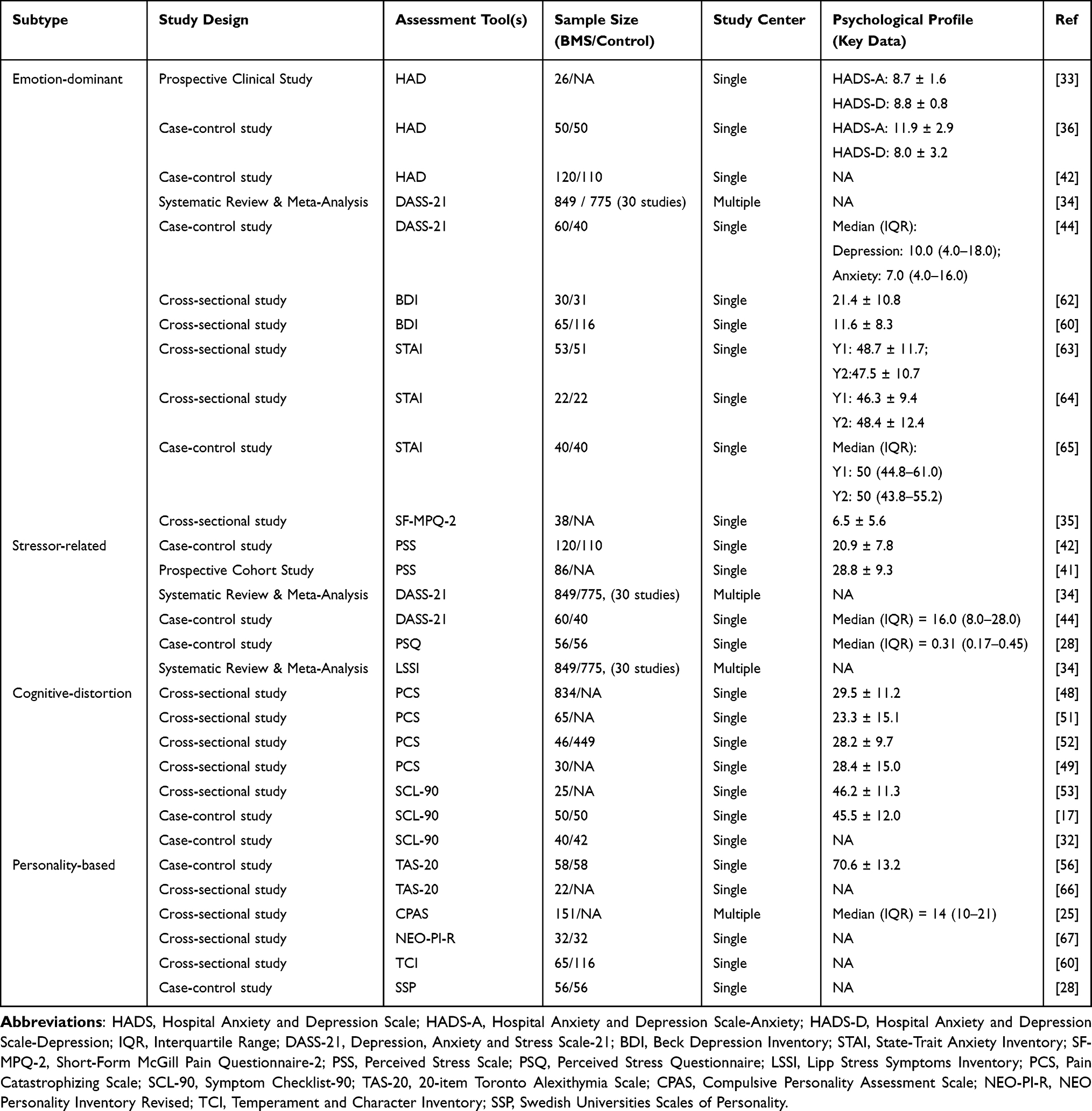 |
Table 1 Psychological Subtypes of BMS Patients and Their Key Features |
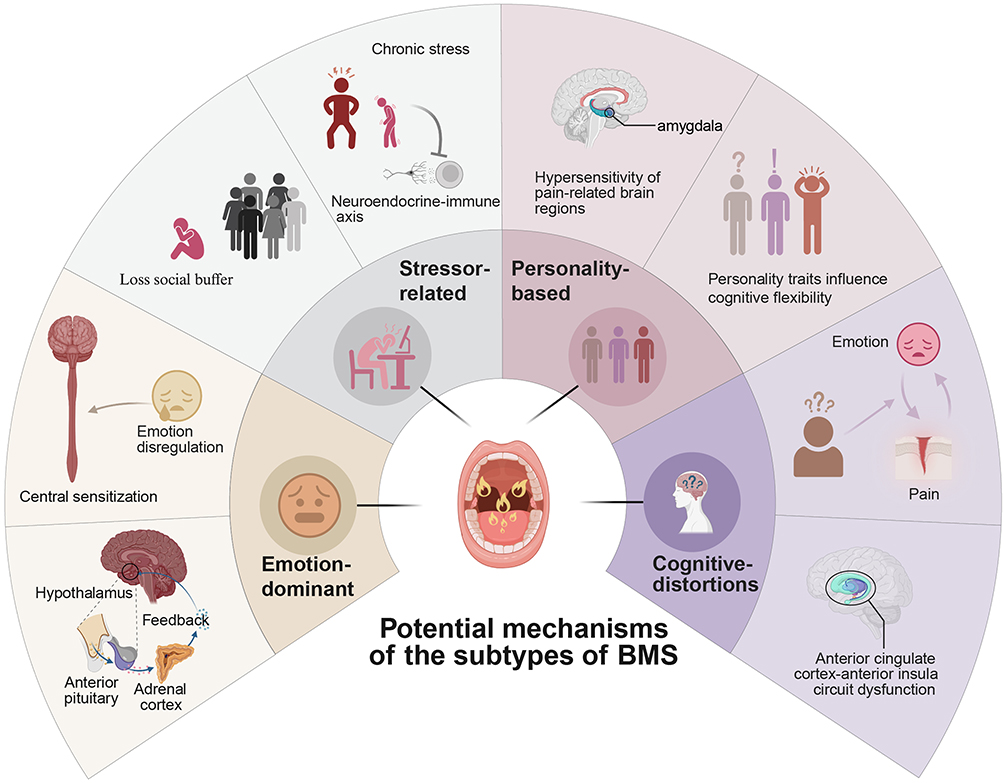 |
Figure 1 Potential Mechanisms Underlying the Psychological Subtypes of BMS. The figure illustrates the four proposed psychological phenotypes of Burning Mouth Syndrome (BMS) and their corresponding pathophysiological pathways. The Emotion-dominant subtype is characterized by emotion dysregulation and central sensitization involving the HPA axis (Hypothalamus-Pituitary-Adrenal) feedback loop. The Stressor-related subtype highlights the impact of chronic stress and loss of social buffers on the neuroendocrine-immune axis. The Cognitive-distortion subtype is driven by dysfunctional top-down modulation, primarily involving the anterior cingulate cortex (ACC)-anterior insula circuit. Lastly, the Personality-based subtype underscores how stable traits, such as high neuroticism, lead to hypersensitivity in pain-related brain regions like the amygdala. Together, these dimensions drive the transition from nociceptive signals to sustained affective suffering. |
The Intervention Strategies Based on Psychological Subtypes in Patients with BMS
Building on the psychological subtyping framework delineated in the previous section, therapeutic strategies for BMS should be tailored to the distinct profiles of the emotion-dominant, stressor-related, cognitive-distortion, and personality-based subtypes. Although a wide range of interventions has been proposed for BMS, their reported efficacy remains highly variable. Consequently, identifying treatment approaches supported by higher levels of evidence and determining their optimal alignment with specific patient subgroups represent an urgent clinical challenge. To address this issue, we systematically stratified the existing therapeutic modalities according to their levels of evidence and integrated this hierarchy with psychological subtyping to generate subtype-specific treatment recommendations. The following subsections summarize these evidence-based interventions, advancing from a conventional symptom-oriented approach to a precision-management paradigm for BMS. The strategic alignment between the psychological subtypes and evidence-based therapeutic modalities is shown in (Figure 2).
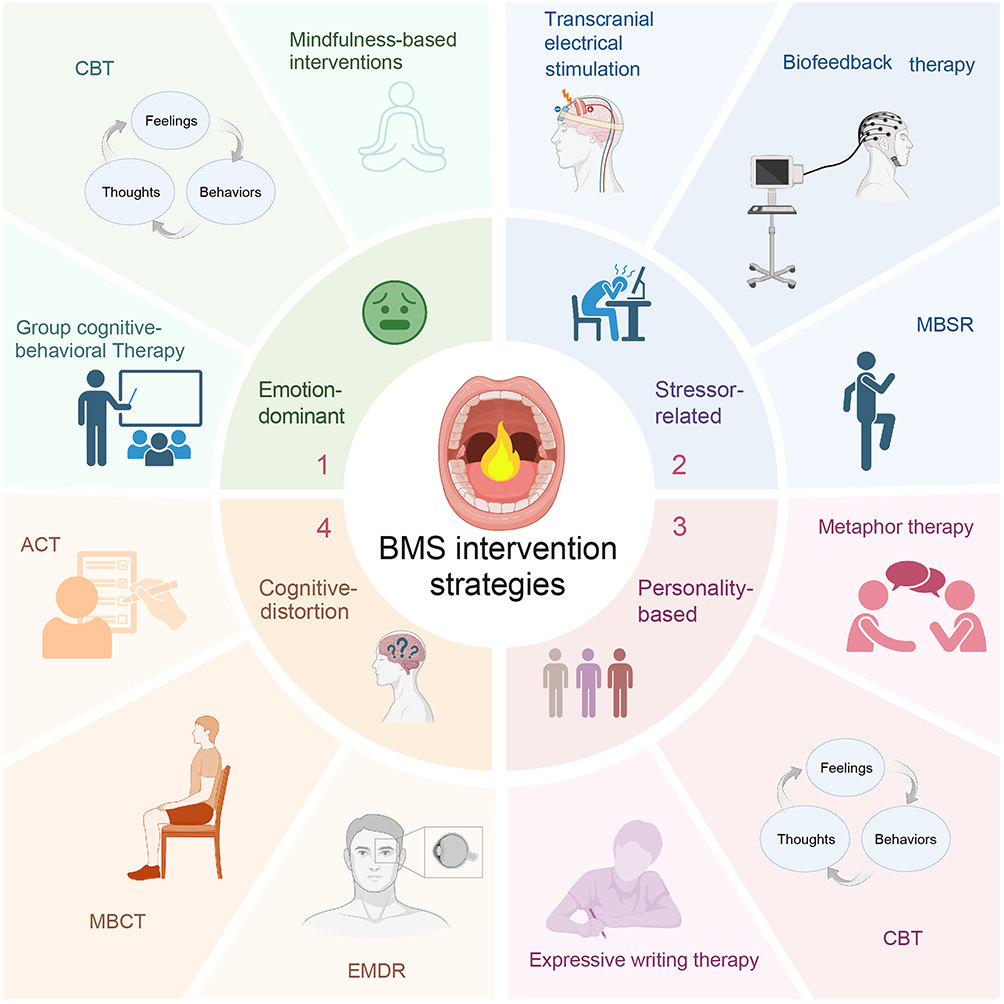 |
Figure 2 Tailored intervention strategies for BMS psychological subtypes. Subtype-concordant interventions targeting specific psychological drivers to achieve precision management in BMS. Abbreviations: CBT, Cognitive Behavioral Therapy; MBSR, Mindfulness-Based Stress Reduction; ACT, Acceptance and Commitment Therapy; MBCT, Mindfulness-Based Cognitive Therapy; EMDR, Eye Movement Desensitization and Reprocessing. |
Interventions Targeting Anxiety and Depression in Patients with BMS
A range of psychological interventions have been explored for the management of comorbid anxiety and depressive symptoms in patients with BMS, although the strength of the supporting evidence varies considerably across modalities. Among these approaches, cognitive behavioral therapy (CBT) is supported by the highest level of evidence and is consistently recommended as the first-line psychological intervention. The 2022 National Institute for Health and Care Excellence (NICE) guidelines identify CBT, including individual and group-based formats, as the primary treatment for individuals with depressive symptoms and anxiety-related disorders.68 Recent systematic reviews and meta-analyses have consistently confirmed that CBT is the most evidence-based non-pharmacological intervention for anxiety disorders.69 In patients with BMS, randomized controlled trials (RCTs) and longitudinal studies have demonstrated that CBT components targeting emotion regulation and behavioral activation significantly reduce anxiety and depressive symptoms, correlating with sustained improvements in pain perception and overall symptom burden.19,70–72 Reflecting on the dominant clinical approach in most BMS centers, CBT protocols are often combined with pharmacological agents (eg., selective serotonin reuptake inhibitors or tricyclic antidepressants), producing synergistic benefits that leverage medication for neurobiological stabilization and CBT for long‑term coping.14
Group-based CBT is a pragmatic alternative to standard individual CBT, particularly in settings where resource availability is limited. A single-arm intervention study in patients with BMS suggested that when group CBT incorporates individualized components and structured psychoeducation, it can achieve therapeutic effects similar to those of individual CBT, while improving accessibility and adherence.73,74 However, the overall quality and quantity of evidence remain lower than those for individual CBT. Mindfulness-based interventions have been investigated as adjunctive or alternative strategies, but current evidence does not demonstrate superior efficacy compared to CBT. Although a systematic review and meta-analysis of 61 RCTs reported modest improvements in anxiety and depressive symptoms, the findings were inconsistent.75 In contrast, psychological counseling is supported by the weakest evidence base. Most available studies consist of case reports or small observational cohorts, and there is a lack of RCTs on BMS. Consequently, counseling is currently assigned a lower recommendation level for the management of BMS-related psychological comorbidities.76 Taken together, CBT remains the preferred first-line psychological intervention for BMS because of its robust evidence base and durable therapeutic effects. Strategies aimed at improving accessibility, such as abbreviated or digitalized CBT programs, structured group formats with individualized elements, and stepwise integration of mindfulness-based interventions for partial or non-responders may enhance real-world applicability.
Interventions Targeting Stressor-Related Factors in BMS
Although a wide range of interventions, including biofeedback, CBT, mindfulness-based stress reduction (MBSR), and transcranial electrical stimulation have been applied to alleviate stress in patients with BMS, their therapeutic efficacy and supporting evidence vary considerably. Biofeedback therapy is supported by accumulating evidence. Although direct BMS-specific evidence remains limited, data from RCTs and systematic reviews suggest that biofeedback reduces stressor-related symptoms in general and orofacial chronic pain populations.77,78 Therefore, biofeedback alone or in combination with CBT may be considered a promising intervention for stress management in BMS, pending future validation.79–81 We acknowledge that no RCT has directly tested biofeedback in BMS, and the recommendation is based on mechanistic rationale and extrapolation. CBT was supported by a moderate level of evidence. Evidence suggests that CBT that emphasizes stress management and problem-solving skills improves stressor-related outcomes in BMS, although effect sizes and durability vary across trials, reflecting substantial heterogeneity in treatment responses. Despite these limitations, CBT remains a commonly adopted intervention owing to its overall clinical benefits and established role in psychological symptom management.
Furthermore, although MBSR has been widely applied in clinical practice, current support is primarily derived from small-scale studies, and high-quality RCTs and systematic reviews of BMS remain scarce.82,83 Transcranial electrical stimulation has also been explored as a potential intervention for stress reduction in BMS,84,85 however, only a few RCTs and systematic reviews are available, with no strong clinical recommendations. Together, this evidence suggests that biofeedback is the most evidence-supported intervention for stressor-related symptoms in BMS, whereas CBT plays a secondary but complementary role. Other modalities, including MBSR and transcranial electrical stimulation, may be considered adjunctive or investigational approaches, pending further high-quality evidence.
Interventions Targeting Cognitive Distortions in BMS
Several psychological interventions have been explored for the management of catastrophic thinking in patients with BMS. However, the reported efficacy and levels of supporting evidence vary considerably across modalities. Mindfulness-based cognitive therapy (MBCT) has recently been developed to improve cognitive distortion. In support of this notion, multiple RCTs and systematic reviews have consistently demonstrated its superiority over conventional CBT and pharmacological approaches for reducing catastrophic and ruminative thinking.86 Furthermore, cross-sectional studies indicate that higher levels of mindfulness skills cultivated through MBCT are significantly associated with lower pain intensity; in particular, the core “describing” facet has been shown to have an independent inverse association with pain reduction (β = −0.231).87 Collectively, these findings suggest that the MBCT is the most robust psychological intervention for catastrophic cognition in patients with BMS. Acceptance and commitment therapy (ACT) has also shown promising results, fostering psychological resilience by facilitating value-based actions rather than avoidance behaviors driven by catastrophic cognition to mitigate the behavioral consequences of cognitive distortions, particularly in patients with BMS experiencing acute distress and functional impairment.82 Evidence supporting eye movement desensitization and reprocessing (EMDR) remains preliminary. Existing reports indicate potential benefits in alleviating anxiety-related symptoms and improving sleep quality in patients with BMS;88 however, these observations are derived mainly from small-scale studies, and larger RCTs are required to substantiate its efficacy. Neurophysiological education reduces catastrophic thinking in specific patient subgroups, particularly among female patients with lower educational levels.89,90 Additionally, the emotion exposure-based interventions currently lack sufficient empirical support and may be regarded as adjunctive or experimental approaches.91,92
In addition to active treatment, preventive strategies aimed at enhancing psychological resilience have been proposed to reduce catastrophic cognition and limit the development of comorbid emotional disorders and chronic disease progression. However, evidence supporting these preventive approaches remains limited and requires confirmation through rigorous prospective studies.93 In summary, MBCT represents the most evidence-supported intervention for catastrophic thinking in BMS and is therefore recommended as the first-line psychological approach. Other modalities, including ACT, EMDR, and neurophysiological education, may serve complementary roles in selected patients but currently lack sufficient evidence to support routine first-line use.
Interventions Targeting Personality-Based Vulnerabilities in BMS
A range of psychological interventions have been investigated to address maladaptive personality traits in patients with BMS. However, the strength of the supporting evidence differs markedly across modalities. Meta-analyses have demonstrated that CBT is associated with moderate but significant improvements in maladaptive personality traits, with a pooled effect size of d = 0.46 (95% CI [0.37, 0.54]).94 In BMS populations, CBT-based psychoeducation incorporating cognitive flexibility training alleviates anxiety in patients with elevated neuroticism and catastrophic thinking, while simultaneously mitigating maladaptive cognitive patterns.95,96 These findings suggest that CBT might be the most effective evidence-based psychological intervention for personality-based symptom profiles in patients with BMS.
In contrast, evidence supporting metaphorical therapy remains limited. Existing reports are largely restricted to case studies, suggesting their potential utility as a supportive communication approach, particularly for patients with difficulties in emotional expression;97 however, high-quality clinical trials are lacking. Similarly, expressive writing therapy has been described in isolated case reports, with reported benefits including improved emotional processing and subjective psychological comfort.98 However, its efficacy has not been confirmed in RCTs, and the current evidence remains insufficient to support its routine clinical use. Taken together, this evidence suggests that CBT is a first-line psychological intervention for patients with BMS characterized by maladaptive personality traits. Furthermore, metaphor therapy and expressive writing may be considered adjunctive options in selected cases; however, they currently lack sufficient evidence to warrant recommendation as primary treatments.
Summary and Perspective
The clinical management of BMS remains limited by its modest efficacy and the lack of rationally stratified therapeutic strategies. It is critical to note that the four proposed psychological subtypes–emotion-dominant, stressor-related, cognitive distortion, and personality-based–are not mutually exclusive. In clinical practice, patients often present with overlapping features and one subtype may amplify or trigger another. For instance, a stable personality trait such as high neuroticism (personality-based subtype) can increase vulnerability to perceived stress, thereby exacerbating the stressor-related subtype. Therefore, we recommend that, in cases of overlapping features, the subtype with the most severe or clinically impactful domain should be prioritized for initial intervention, and a formally validated algorithm remains to be developed. Building on this subtyping framework, treatment selection can move from a uniform approach to precision-oriented interventional matching. Although first-line interventions differ across subtypes including CBT, biofeedback, MBCT, and adapted CBT, an overarching therapeutic principle emerges. The optimal management of BMS requires prioritizing evidence-based interventions that directly target the dominant psychological driver while mitigating chronic pain amplification. Thus, psychological heterogeneity in BMS does not imply fragmented care, but rather a structured hierarchy of interventions ranked by evidence strength and mechanistic relevance. On this basis, we propose a precise, evidence-sequenced treatment paradigm for BMS, in which psychological subtyping guides initial therapy selection, and subsequent adjustments are informed by treatment response rather than empirical trial-and-error. This framework integrates precise phenotyping, subtype-concordant intervention, and stepwise sequencing of therapies as supported by the highest level of evidence (Figure 3). Thus, this model advances BMS management in terms of precise classification, differentiated treatment, and evidence-based sequential care. Validation of this stratified approach and optimization of its clinical feasibility represent the essential next steps; however, definitive evidence for improved long‑term prognosis is currently lacking. At present, however, the field still lacks prospective evidence validating psychological stratification models in BMS populations. Moreover, the current evidence base remains uneven across subtypes, with stronger support for affective symptoms such as anxiety and depression than for personality-related or cognitive-distortion dimensions. Importantly, because the core premise of this framework is that different psychological profiles may exhibit distinct treatment responses, future research should move beyond generalized efficacy studies and adopt stratification-oriented designs.
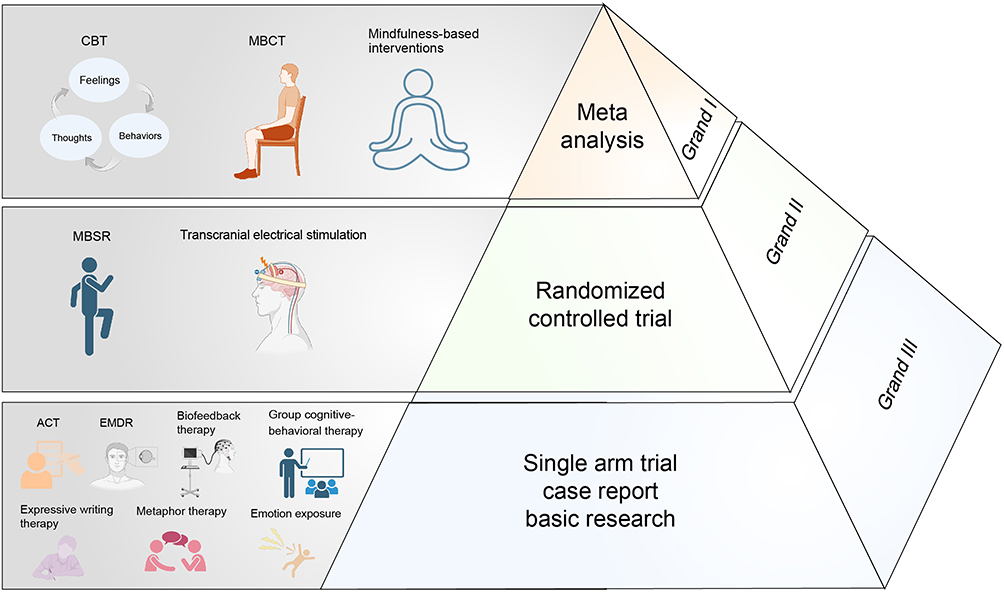 |
Figure 3 A hierarchical framework of evidence-based psychological interventions for BMS. The pyramid illustrates the stratification of therapeutic modalities based on their levels of clinical evidence, ranging from foundational basic research and case reports (Grade III) to high-level meta-analyses (Grade I). Interventions are categorized by their evidence strength, including Cognitive Behavioral Therapy (CBT), Mindfulness-based interventions, and biofeedback at the apex, alongside neuromodulation (e.g., transcranial electrical stimulation) and specialized approaches (e.g., EMDR, MBSR) at the intermediary levels. This structured hierarchy provides a roadmap for clinicians to prioritize interventions within a precision-care framework. |
Specifically, large-scale multicenter prospective observational studies are needed to evaluate the reproducibility, stability, and clinical distribution of these psychological subtypes across diverse BMS populations using standardized assessment batteries (eg., HADS, PCS, TAS-20, CPAS). In parallel, subtype-stratified randomized controlled trials should be prioritized to determine whether subtype-matched interventions produce superior clinical outcomes compared with non-stratified treatment approaches. For example, future studies may compare mindfulness-based cognitive therapy in cognitive-distortion subtypes with emotion-focused CBT in emotion-dominant subtypes. To improve cross-study comparability and clinical translation, a standardized set of patient-reported outcome measures—including pain intensity, catastrophizing, anxiety, depression, sleep quality, functional impairment, and quality of life—should also be incorporated into future trial designs.
Funding
This study was supported by grants from the Nursing Research Project Program of Sichuan Province (No. H21044), the Research and Development Program, West China Hospital of Stomatology Sichuan University (No. LCYJ-HL202302), the National Natural Science Foundation of China 82370963 (F.W.), the National Key Research and Development Program of China 2023YFC3605600 (F.W.) and the Sichuan Science and Technology Program 2026NSFSC0673 (F.W.).
Disclosure
The authors declare that they have no known competing financial interests or personal relationships that could have appeared to influence the work reported in this paper.
References
1. Musella G, Canfora F, Caponio VCA, et al. Oral Dysaesthetic and Perceptual Disorder, A Distinct Subset of Chronic Orofacial Pain Without Burning Symptoms: a Case–Control Study. J Oral Rehabil. 2025;52(5):651–14. doi:10.1111/joor.13945
2. Benoliel R, May A, Svensson P, et al. International Classification of Orofacial Pain, 1st edition (ICOP). Cephalalgia. 2020;40(2):129–221. doi:10.1177/0333102419893823
3. Wu S, Zhang W, Yan J, Noma N, Young A, Yan Z. Worldwide prevalence estimates of burning mouth syndrome: a systematic review and meta-analysis. Oral Dis. 2022;28(6):1431–1440. doi:10.1111/odi.13868
4. Mathur VA, Payano Sosa JS, Keaser ML, Meiller TF, Seminowicz DA. The social context of burning mouth syndrome: an exploratory pilot study of stigma, discrimination, and pain. Pain Med. 2023;24(11):1213–1218. doi:10.1093/pm/pnad078
5. Pereira JV, Normando AGC, Rodrigues-Fernandes CI, Rivera C, Santos-Silva AR, Lopes MA. The impact on quality of life in patients with burning mouth syndrome: a systematic review and meta-analysis. Oral Surg Oral Med Oral Pathol Oral Radiol. 2021;131(2):186–194. doi:10.1016/j.oooo.2020.11.019
6. Kim HK, Chung KM, Xing J, Kim HY, Youn DH. The Trigeminal Sensory System and Orofacial Pain. Int J Mol Sci. 2024;25(20):11306. doi:10.3390/ijms252011306
7. Shin HI, Bang JI, Kim GJ, Kim MR, Sun DI, Kim SY. Therapeutic effects of clonazepam in patients with burning mouth syndrome and various symptoms or psychological conditions. Sci Rep. 2023;13(1):7257. doi:10.1038/s41598-023-33983-6
8. Banik S, Ghosh A, Sato H, Onoue S. The efficacy of alpha-lipoic acid in the management of burning mouth syndrome: an updated systematic review of randomized controlled clinical trials. Health Sci Rep. 2023;6(4):e1186. doi:10.1002/hsr2.1186
9. Rupel K, Buoite Stella A, Tamos M, et al. Effects of Oral Topical Capsaicin Gel on Taste Perception in Healthy Subjects: a Pilot Study. J Oral Pathol Med. 2025;54(5):392–396. doi:10.1111/jop.13620
10. Castillo-Felipe C, Tvarijonaviciute A, López-Arjona M, Pardo-Marin L, Pons-Fuster E, López-Jornet P. Response to Treatment with Melatonin and Clonazepam versus Placebo in Patients with Burning Mouth Syndrome. J Clin Med. 2022;11(9):2516. doi:10.3390/jcm11092516
11. Haviv Y, Merimsky B, Kay Z, et al. Topical tretinoin treatment for burning mouth syndrome: a pilot study. Quintessence Int. 2022;53(10):860–867. doi:10.3290/j.qi.b3315031
12. Lebel A, Da Silva Vieira D, Boucher Y. Topical amitriptyline in burning mouth syndrome: a retrospective real-world evidence study. Headache. 2024;64(9):1167–1173. doi:10.1111/head.14818
13. Tan HL, Smith JG, Hoffmann J, Renton T. A systematic review of treatment for patients with burning mouth syndrome. Cephalalgia. 2022;42(2):128–161. doi:10.1177/03331024211036152
14. Sangalli L, Mirfarsi S, Kramer JM, Eisa E, Miller CS. Managing Burning Mouth Syndrome: current and Future Directions. Drugs. 2025;85(9):1109–1131. doi:10.1007/s40265-025-02220-x
15. Palacios-Sánchez B, Moreno-López LA, Cerero-Lapiedra R, Llamas-Martínez S, Esparza-Gómez G. Alpha lipoic acid efficacy in burning mouth syndrome. A controlled clinical trial. Med Oral Patol Oral Cir Bucal. 2015;20(4):e435–40. doi:10.4317/medoral.20410
16. Wu YH, Chiang CP. Association of medications with burning mouth syndrome in Taiwanese aged patients. J Dent Sci. 2023;18(2):833–839. doi:10.1016/j.jds.2023.01.009
17. Yoo HS, Jin SH, Lee YJ, Song CM, Ji YB, Tae K. The role of psychological factors in the development of burning mouth syndrome. Int J Oral Maxillofac Surg. 2018;47(3):374–378. doi:10.1016/j.ijom.2017.09.012
18. Mao F, Cai L, Pan D, et al. Burning Mouth Syndrome May Essentially Be Related To Psychoneuroimmunology: mechanism Hypothesis. J Oral Rehabil. 2025;52(2):199–207. doi:10.1111/joor.13893
19. Bergdahl J, Anneroth G, Perris H. Cognitive therapy in the treatment of patients with resistant burning mouth syndrome: a controlled study. J Oral Pathol Med. 1995;24(5):213–215. doi:10.1111/j.1600-0714.1995.tb01169.x
20. Chmieliauskaite M, Stelson EA, Epstein JB, et al. Consensus agreement to rename burning mouth syndrome and improve International Classification of Diseases-11 disease criteria: an international Delphi study. Pain. 2021;162(10):2548–2557. doi:10.1097/j.pain.0000000000002243
21. Moisset X, Calbacho V, Torres P, Gremeau-Richard C, Dallel R. Co-occurrence of Pain Symptoms and Somatosensory Sensitivity in Burning Mouth Syndrome: a Systematic Review. PLoS One. 2016;11(9):e0163449. doi:10.1371/journal.pone.0163449
22. Galli F, Lodi G, Sardella A, Vegni E. Role of psychological factors in burning mouth syndrome: a systematic review and meta-analysis. Cephalalgia. 2017;37(3):265–277. doi:10.1177/0333102416646769
23. He M, Huoshen W, Li X, Sun C. Salivary and serum biomarkers to evaluate psychological disorders in burning mouth syndrome: a systematic review and meta-analysis. J Oral Pathol Med. 2024;53(3):182–192. doi:10.1111/jop.13526
24. Davies SJ, Underhill HC, Abdel-Karim A, et al. Individual oral symptoms in burning mouth syndrome may be associated differentially with depression and anxiety. Acta Odontol Scand. 2016;74(2):155–160. doi:10.3109/00016357.2015.1100324
25. Pellegrini L, Canfora F, Ottaviani G, et al. Obsessive-compulsive symptoms and traits in patients with burning mouth syndrome: a cross-sectional multicentric analysis. Clin Oral Investig. 2025;29(4):223. doi:10.1007/s00784-025-06293-6
26. Kim MJ, Kim J, Kho HS. Comparison between burning mouth syndrome patients with and without psychological problems. Int J Oral Maxillofac Surg. 2018;47(7):879–887. doi:10.1016/j.ijom.2018.02.001
27. Kim MJ, Kho HS. Understanding of Burning Mouth Syndrome Based on Psychological Aspects. Chin J Dent Res. 2018;21(1):9–19. doi:10.3290/j.cjdr.a39914
28. Jedel E, Elfström ML, Hägglin C. Differences in personality, perceived stress and physical activity in women with burning mouth syndrome compared to controls. Scand J Pain. 2021;21(1):183–190. doi:10.1515/sjpain-2020-0110
29. Fang M, Huang Y, Li C, et al. The over-expression of miRNA-206 in peripheral blood of patients with burning mouth syndrome and its relationship with anxiety and depression. J Oral Rehabil. 2023;50(4):324–331. doi:10.1111/joor.13407
30. Adamo D, Sardella A, Varoni E, et al. The association between burning mouth syndrome and sleep disturbance: a case-control multicentre study. Oral Dis. 2018;24(4):638–649. doi:10.1111/odi.12807
31. Lee SJ, Kim C, Yu H, Kim DK. Relationship of Depression, Anxiety, and Bipolar Disease with Burning Mouth Syndrome: a Nationwide Cohort Study. Int J Environ Res Public Health. 2023;20(4):3391. doi:10.3390/ijerph20043391
32. Castaño-Joaqui OG, Jiménez Ortega L, Cerero Lapiedra R, Domínguez Gordillo A. Burning Mouth Syndrome Underlying Factors: a Roadmap From a Network Perspective. Oral Dis. 2024;2024:15219. doi:10.1111/odi.15219
33. Lopez-Jornet P, Molino Pagan D, Andujar Mateos P, Rodriguez Agudo C, Pons-Fuster A. Circadian rhythms variation of pain in burning mouth syndrome. Geriatr Gerontol Int. 2015;15(4):490–495. doi:10.1111/ggi.12303
34. Porporatti AL, Schroder ÂGD, Lebel A, et al. Is burning mouth syndrome associated with stress? A meta-analysis. J Oral Rehabil. 2023;50(11):1279–1315. doi:10.1111/joor.13536
35. Shimura T, Itagaki T, K-i S, et al. Exploration of a pain assessment tool on burning mouth syndrome. J Oral Facial Pain Headache. 2025;39(3):183–190. doi:10.22514/jofph.2025.060
36. Leuci S, Coppola N, Adamo D, et al. Sexual desire, mood disorders and sleep disturbances in female BMS patients: a controlled study. J Oral Pathol Med. 2023;52(3):276–282. doi:10.1111/jop.13362
37. Lee YH, Suk C. Effects of self-perceived psychological stress on clinical symptoms, cortisol, and cortisol/ACTH ratio in patients with burning mouth syndrome. BMC Oral Health. 2023;23(1):513. doi:10.1186/s12903-023-03235-0
38. Katz J, Sacks I. Glossodynia, burning mouth syndrome, and COVID-19. Am J Dent. 2022;35(1):9–11.
39. Ottaviani G, Canfora F, Leuci S, et al. COVID-19 impact on post-traumatic stress symptoms in burning mouth syndrome: a multicentric study. Oral Dis. 2024;30(7):4653–4667. doi:10.1111/odi.14915
40. Bouvier E, Brouillard F, Molet J, et al. Nrf2-dependent persistent oxidative stress results in stress-induced vulnerability to depression. Mol Psychiatry. 2017;22(12):1701–1713. doi:10.1038/mp.2016.144
41. Garcia-Martinez A, Tvarijonaviciute A, López-Jornet P. Psychometric Assessment of Clinical Factors in Burning Mouth Syndrome Progression. Int Dent J. 2025;75(4):100838. doi:10.1016/j.identj.2025.100838
42. Dugan C, Popescu BO, Țovaru S, et al. Neuropsychological assessment of Romanian burning mouth syndrome patients: stress, depression, sleep disturbance, and verbal fluency impairments. Front Psychol. 2023;14:1176147. doi:10.3389/fpsyg.2023.1176147
43. Malta CEN, Costa FWG, Dias CC, et al. Association of anxiety, depression, and stress with burning mouth syndrome: a case-control study. Gen Dent. 2021;69(4):46–52.
44. Glavina A, Lugović-Mihić L, Martinović D, et al. Association between Salivary Cortisol and α-Amylase with the Psychological Profile of Patients with Oral Lichen Planus and Burning Mouth Syndrome: a Case-Control Study. Biomedicines. 2023;11(8):2182. doi:10.3390/biomedicines11082182
45. Mercadante S, Ferrera P, Lo Cascio A, Casuccio A. Pain Catastrophizing in Cancer Patients. Cancers. 2024;16(3):568. doi:10.3390/cancers16030568
46. Zhang Q, Tan Z, Ma Q, Guo J, Yang Y. Analysis of pain prognosis, medication efficacy, treatment willingness and influencing factors in patients with burning mouth syndrome: a cross-sectional survey. BMC Oral Health. 2025;25(1):300. doi:10.1186/s12903-025-05674-3
47. Chana P, Smith JG, Karamat A, Simpson A, Renton T. Catastrophising, pain self-efficacy and acceptance in patients with Burning Mouth Syndrome. J Oral Rehabil. 2021;48(4):458–468. doi:10.1111/joor.13136
48. Takao C, Watanabe M, Nayanar G, et al. Clinical Features and Variations of Pain Expressions in 834 Burning Mouth Syndrome Patients With or Without Psychiatric Comorbidities. Cureus. 2023;15(12):e51139. doi:10.7759/cureus.51139
49. Rogulj AA, Richter I, Brailo V, Krstevski I, Boras VV. Catastrophizing In Patients With Burning Mouth Syndrome. Acta Stomatol Croat. 2014;48(2):109–115.
50. Malfliet A, Coppieters I, Van Wilgen P, et al. Brain changes associated with cognitive and emotional factors in chronic pain: a systematic review. Eur J Pain. 2017;21(5):769–786. doi:10.1002/ejp.1003
51. Lee GS, Kim HK, Kim ME. Relevance of sleep, pain cognition, and psychological distress with regard to pain in patients with burning mouth syndrome. Cranio. 2022;40(1):79–87. doi:10.1080/08869634.2019.1681621
52. Matsuoka H, Himachi M, Furukawa H, et al. Cognitive profile of patients with burning mouth syndrome in the Japanese population. Odontology. 2010;98(2):160–164. doi:10.1007/s10266-010-0123-6
53. Lee Yh Dds P, Chon SMP. Burning mouth syndrome in postmenopausal women with self-reported sleep problems. Cranio. 2020;38(4):221–232. doi:10.1080/08869634.2018.1512549
54. TTH T, Watanabe M, Suga T, et al. Personality Traits in Burning Mouth Syndrome Patients With and Without a History of Depression. Front Psychiatry. 2021;12:659245. doi:10.3389/fpsyt.2021.659245
55. Umezaki Y, Egashira R, Motomura H, Tu TT, Naito T. Relationship Between Clinical Course of Treatment for Burning Mouth Syndrome in Early Period and Aggression Using Rosenzweig Picture Frustration Study: a Retrospective Observational Study. Cureus. 2024;16(5):e60174. doi:10.7759/cureus.60174
56. Marino R, Picci RL, Ferro G, Carezana C, Gandolfo S, Pentenero M. Peculiar alexithymic traits in burning mouth syndrome: case-control study. Clin Oral Investig. 2015;19(8):1799–1805. doi:10.1007/s00784-015-1416-5
57. Lee JA, Han YK, Jung WJ, Lee BH, Lee S. Associations between personality traits and pain experiences in trigeminal neuralgia. J Headache Pain. 2025;26(1):68. doi:10.1186/s10194-025-02010-6
58. Schlüter C, Fraenz C, Friedrich P, Güntürkün O, Genç E. Neurite density imaging in amygdala nuclei reveals interindividual differences in neuroticism. Hum Brain Mapp. 2022;43(6):2051–2063. doi:10.1002/hbm.25775
59. Furnham A, Guenole N, Levine SZ, Chamorro-Premuzic T. The NEO Personality Inventory-Revised: factor structure and gender invariance from exploratory structural equation modeling analyses in a high-stakes setting. Assessment. 2013;20(1):14–23. doi:10.1177/1073191112448213
60. Tokura T, Kimura H, Ito M, et al. Temperament and character profiles of patients with burning mouth syndrome. J Psychosom Res. 2015;78(5):495–498. doi:10.1016/j.jpsychores.2015.02.006
61. Bottiroli S, De Icco R, Vaghi G, et al. Psychological predictors of negative treatment outcome with Erenumab in chronic migraine: data from an open label long-term prospective study. J Headache Pain. 2021;22(1):114. doi:10.1186/s10194-021-01333-4
62. de Souza FT, Teixeira AL, Amaral TM, et al. Psychiatric disorders in burning mouth syndrome. J Psychosom Res. 2012;72(2):142–146. doi:10.1016/j.jpsychores.2011.11.008
63. Schiavone V, Adamo D, Ventrella G, et al. Anxiety, depression, and pain in burning mouth syndrome: first chicken or egg? Headache. 2012;52(6):1019–1025. doi:10.1111/j.1526-4610.2012.02171.x
64. Ozasa K, Noma N, Kobayashi M, et al. Association Between Anxiety and Descending Pain Modulation of Thermal Stimuli in Patients with Burning Mouth Syndrome: a Cross-Sectional Study. J Oral Facial Pain Headache. 2022;36(1):67–77. doi:10.11607/ofph.3050
65. Canfora F, Calabria E, Pecoraro G, et al. The use of self-report questionnaires in an analysis of the multidimensional aspects of pain and a correlation with the psychological profile and quality of life in patients with burning mouth syndrome: a case-control study. J Oral Rehabil. 2022;49(9):890–914. doi:10.1111/joor.13343
66. Sandri A, Cecchini MP, Zanini A, et al. Unpleasant olfactory and gustatory stimuli increase pain unpleasantness in patients with chronic oral burning pain: an exploratory study. Eur J Pain. 2022;26(5):1094–1106. doi:10.1002/ejp.1933
67. Al Quran FA. Psychological profile in burning mouth syndrome. Oral Surg, Oral Med Oral Pathol Oral Radiol Endod. 2004;97(3):339–344. doi:10.1016/j.tripleo.2003.09.017
68. NICE. National Institute for Health and Care Excellence: guidelines. In: Depression in Adults: Treatment and Management. National Institute for Health and Care Excellence; 2022.
69. Schiele MA, Fagan HA, Baldwin DS, Domschke K. INTEGRATIVE SYSTEMATIC REVIEW ON PHARMACOLOGICAL, PSYCHOTHERAPEUTIC AND NEUROSTIMULATORY TREATMENT OPTIONS IN TREATMENT-RESISTANT ANXIETY DISORDERS. Psychother Psychosom. 2025;1–43. doi:10.1159/000547926
70. Rosser BA, Fisher E, Janjua S, Eccleston C, Keogh E, Duggan G. Psychological therapies delivered remotely for the management of chronic pain (excluding headache) in adults. Cochrane Database Syst Rev. 2023;8(8):Cd013863. doi:10.1002/14651858.CD013863.pub2
71. Scott AJ, Bisby MA, Heriseanu AI, et al. Cognitive behavioral therapies for depression and anxiety in people with chronic disease: a systematic review and meta-analysis. Clin Psychol Rev. 2023;106:102353. doi:10.1016/j.cpr.2023.102353
72. Li C, Hou W, Ding D, Yang Y, Gu S, Zhu Y. Evidence Mapping Based on Systematic Reviews of Cognitive Behavioral Therapy for Neuropathic Pain. Neural Plast. 2023;2023:2680620. doi:10.1155/2023/2680620
73. TTH T, Takenoshita M, Matsuoka H, et al. Current management strategies for the pain of elderly patients with burning mouth syndrome: a critical review. Biopsychosoc Med. 2019;13:1. doi:10.1186/s13030-019-0142-7
74. Komiyama O, Nishimura H, Makiyama Y, et al. Group cognitive-behavioral intervention for patients with burning mouth syndrome. J Oral Sci. 2013;55(1):17–22. doi:10.2334/josnusd.55.17
75. Mao L, Li P, Wu Y, Luo L, Hu M. The effectiveness of mindfulness-based interventions for ruminative thinking: a systematic review and meta-analysis of randomized controlled trials. J Affect Disord. 2023;321:83–95. doi:10.1016/j.jad.2022.10.022
76. Gupta D, Sheikh S, Pallagatti S, Kasariya K, Buttan A, Gupta M. Burning Mouth Syndrome due to Television Moans, an Enigma for Oral Physician: treatment with Counseling. J Dent Res Dent Clin Dent Prospects. 2014;8(2):118–122. doi:10.5681/joddd.2014.022
77. De Witte NAJ, Buyck I, Van Daele T. Combining Biofeedback with Stress Management Interventions: a Systematic Review of Physiological and Psychological Effects. Appl Psychophysiol Biofeedback. 2019;44(2):71–82. doi:10.1007/s10484-018-09427-7
78. Lee E, Hong JK, Choi H, Yoon IY. Modest Effects of Neurofeedback-Assisted Meditation Using a Wearable Device on Stress Reduction: a Randomized, Double-Blind, and Controlled Study. J Korean Med Sci. 2024;39(9):e94. doi:10.3346/jkms.2024.39.e94
79. Zhang H, Hu S, Wang Z, Li X, Wang S, Chen G. A Temporospatial Study of Sympathetic Skin Response and Electroencephalogram in Oral Mucosa Thermal Perception. Front Neurosci. 2022;16:907658. doi:10.3389/fnins.2022.907658
80. Kenchadze R, Iverieli M, Okribelashvili N, Geladze N, Khachapuridze N. The psychological aspects of burning mouth syndrome. Georgian Med News. 2011;194:24–28.
81. Noma N, Watanabe Y, Shimada A, et al. Effects of cognitive behavioral therapy on orofacial pain conditions. J Oral Sci. 2020;63(1):4–7. doi:10.2334/josnusd.20-0437
82. Ganesan A, Gauthaman J, Kumar G. The Impact of Mindfulness Meditation on the Psychosomatic Spectrum of Oral Diseases: mapping the Evidence. J Lifestyle Med. 2022;12(1):1–8. doi:10.15280/jlm.2022.12.1.1
83. Zhu M, Wong SY, Zhong CC, et al. Which type and dosage of mindfulness-based interventions are most effective for chronic pain? A systematic review and network meta-analysis. J Psychosom Res. 2025;191:112061. doi:10.1016/j.jpsychores.2025.112061
84. Palmer A, Hamann T, Liese J, et al. Efficacy of cranial electrotherapy stimulation in patients with burning mouth syndrome: a randomized, controlled, double-blind pilot study. Front Neurol. 2024;15:1343093. doi:10.3389/fneur.2024.1343093
85. Subhani AR, Kamel N, Mohamad Saad MN, Nandagopal N, Kang K, Malik AS. Mitigation of stress: new treatment alternatives. Cogn Neurodyn. 2018;12(1):1–20. doi:10.1007/s11571-017-9460-2
86. Wei S, Qin W, Yu Z, Cao Y, Li P. The effectiveness of mindfulness-based cognitive therapy on rumination and related psychological indicators: a systematic review and meta-analysis. BMC Psychol. 2025;13(1):968. doi:10.1186/s40359-025-03348-x
87. He J, Liu J, Ye X, et al. Associations between pain, anxiety and depression and mindfulness in patients with burning mouth syndrome: a cross-sectional study. J Oral Facial Pain Headache. 2025;39(3):113–120. doi:10.22514/jofph.2025.053
88. Magne H. Effect of eye movement desensitization and reprocessing therapy in a patient with anxiety and burning mouth syndrome. Gerodontology. 2024;41(3):433–435. doi:10.1111/ger.12738
89. Calabria E, Canfora F, Leuci S, et al. Gender differences in pain perception among burning mouth syndrome patients: a cross-sectional study of 242 men and 242 women. Sci Rep. 2024;14(1):3340. doi:10.1038/s41598-024-53074-4
90. Geneen LJ, Martin DJ, Adams N, et al. Effects of education to facilitate knowledge about chronic pain for adults: a systematic review with meta-analysis. Syst Rev. 2015;4:132. doi:10.1186/s13643-015-0120-5
91. Wideman TH, Sullivan MJ. Reducing catastrophic thinking associated with pain. Pain Manag. 2011;1(3):249–256. doi:10.2217/pmt.11.14
92. Sullivan MJ, Neish N. The effects of disclosure on pain during dental hygiene treatment: the moderating role of catastrophizing. Pain. 1999;79(2–3):155–163. doi:10.1016/s0304-3959(98)00163-8
93. Leccese A, Severo M, Ventriglio A, Petrocchi S, Limone P, Petito A. Psychological Interventions in Patients with Physical Pain: a Focus on Catastrophizing and Resilience-A Systematic Review. Healthcare. 2025;13(6):581. doi:10.3390/healthcare13060581
94. Roberts BW, Luo J, Briley DA, Chow PI, Su R, Hill PL. A systematic review of personality trait change through intervention. Psychol Bull. 2017;143(2):117–141. doi:10.1037/bul0000088
95. Brailo V, Firić M, Vučićević Boras V, Andabak Rogulj A, Krstevski I, Alajbeg I. Impact of reassurance on pain perception in patients with primary burning mouth syndrome. Oral Dis. 2016;22(6):512–516. doi:10.1111/odi.12493
96. Kandula S, Bajoria A, Nc S, Mishra S, Biswas T. Beyond Burning Mouth Pattern: a Veiled Masquerading Oral Health Anxiety Concern. Cureus. 2025;17(8):e89712. doi:10.7759/cureus.89712
97. Seeman MV. Use of metaphors when treating unexplained medical symptoms. World J Clin Cases. 2023;11(2):332–341. doi:10.12998/wjcc.v11.i2.332
98. Grignoli N, La Spina A, Gabutti L. Phantosmia and psychogenic non-epileptic seizures in a patient with burning mouth syndrome suffering from severe depression. BMJ Case Rep. 2022;15(6):e249843. doi:10.1136/bcr-2022-249843
 © 2026 The Author(s). This work is published and licensed by Dove Medical Press Limited. The
full terms of this license are available at https://www.dovepress.com/terms
and incorporate the Creative Commons Attribution
- Non Commercial (unported, 4.0) License.
By accessing the work you hereby accept the Terms. Non-commercial uses of the work are permitted
without any further permission from Dove Medical Press Limited, provided the work is properly
attributed. For permission for commercial use of this work, please see paragraphs 4.2 and 5 of our Terms.
© 2026 The Author(s). This work is published and licensed by Dove Medical Press Limited. The
full terms of this license are available at https://www.dovepress.com/terms
and incorporate the Creative Commons Attribution
- Non Commercial (unported, 4.0) License.
By accessing the work you hereby accept the Terms. Non-commercial uses of the work are permitted
without any further permission from Dove Medical Press Limited, provided the work is properly
attributed. For permission for commercial use of this work, please see paragraphs 4.2 and 5 of our Terms.
Recommended articles

State of Emotional Health Disorders of Undergraduate Students in the United Arab Emirates: A Cross-Sectional Survey
Al Marzouqi AM, Otim ME, Alblooshi A, Al Marzooqi S, Talal M, Wassim F
Psychology Research and Behavior Management 2022, 15:1423-1433
Published Date: 7 June 2022
Psychological Stress and Its Correlations to Patients with Acute Lymphedema After Breast Cancer Surgery
Ge LP, Tang L, Zuo W, Zhou C, Gao T, Li Y, Fu C, Qiu J, Li P, Lu R, Chen L, Xue Y, Shen Z, Shao Z, Di G, Feng W
Breast Cancer: Targets and Therapy 2024, 16:867-876
Published Date: 6 December 2024