
Back to Journals » International Journal of Nanomedicine » Volume 21
Precise Catalysis and Immune Activation: New Strategies for Tumor Immunotherapy with Cascade Nanozymes
Authors Wang R, Zhang X, Cheng M, Cao Y 
Received 3 February 2026
Accepted for publication 22 June 2026
Published 21 July 2026 Volume 2026:21 600885
DOI https://doi.org/10.2147/IJN.S600885
Checked for plagiarism Yes
Review by Single anonymous peer review
Peer reviewer comments 3
Editor who approved publication: Dr Kamakhya Prakash Misra
Ruxue Wang,1,* Xiaoxuan Zhang,1,* Ming Cheng,2 Yuan Cao1
1Department of Basic Medical Sciences, the 960th Hospital of PLA, Jinan, Shandong, 250031, People’s Republic of China; 2Department of Neurology, the 960th Hospital of PLA, Jinan, Shandong, 250031, People’s Republic of China
*These authors contributed equally to this work
Correspondence: Yuan Cao, Email [email protected] Ming Cheng, Email [email protected]
Abstract: Tumor immunotherapy can activate host antitumor immune responses and specifically eliminate tumor cells, making it a research frontier in tumor therapy. However, its clinical efficacy remains limitations by the immunosuppressive tumor microenvironment (TME) and insufficient tumor immunogenicity. Cascade nanozymes possess the capability to mimic diverse enzymatic activities, catalyze multi-step reactions, regulate the redox equilibrium of the TME, generate reactive oxygen species (ROS) for the eradication of tumor cells, induce immunogenic cell death (ICD), and modulate innate immune signaling pathways. These effects further trigger both innate and adaptive immune responses, thereby suppressing tumor metastasis and recurrence. Nevertheless, achieving selective killing of tumor cells without damaging normal cells via enzymatic reactions and clarifying the underlying mechanisms of cascade nanozyme-based immunotherapy remains a major challenge in cancer treatment. This review summarizes the latest advances of cascade nanozymes in cancer immunotherapy. It critically evaluates the design strategies and mechanisms of cascade nanozymes for immunotherapeutic applications, and highlights the key challenges and future perspectives in this field. It is expected to provide new insights for developing more efficient and targeted tumor immunotherapy strategies.
Keywords: tumor immunotherapy, tumor microenvironment, cascade nanozymes, immunogenic cell death, immune signaling pathways
Introduction
Malignant tumors are characterized by high incidence, high metastatic potential, and poor prognosis, posing a significant threat to human health and life.1,2 Despite significant progress in tumor treatment, cancer remains a leading cause of death worldwide. Currently, conventional tumor treatments mainly include radiotherapy (RT), chemotherapy, and surgical resection.3,4 However, these treatments are often limited by severe toxic side effects, long treatment cycles, and tumor drug resistance.5–7 With the development of nanotechnology, emerging therapeutic strategies such as photothermal therapy (PTT),8 chemodynamic therapy (CDT),9,10 immunotherapy,11,12 and combination therapy7 exhibit fewer side effects and a low risk of inducing tumor drug resistance.13 These novel modalities provide new insights into tumor treatment and hold great significance for the research of cancer prevention and clinical therapy.
Nanozymes are a class of nanomaterials with enzyme-like catalytic activity, capable of catalyzing the corresponding substrates under mild conditions.14 In comparison to natural enzymes, nanozymes possess the merits of high stability, adjustable particle size, low cost, and facile surface modification.15,16 Based on material composition, nanozymes can be mainly divided into four categories: metal-based nanozymes,17 metal oxide-based nanozymes,18 carbon-based nanozymes,19,20 and MOF-based nanozymes.21,22 They have been widely applied in biomedical fields, including biosensors,23 antibacterial therapy,24 and cancer therapy.25,26 Cascade reactions are composed of two or more catalytic reactions that occur sequentially. In these reactions, the product of the upstream reaction acts as the substrate for the downstream reaction, thereby initiating a series of chemical transformations.27 These cascade reactions, by modulating the tumor microenvironment (TME), enhance intermediate utilization, optimize catalytic performance, and yield high-purity products.28 For example, Jin et al designed a nitrogen-doped carbon-supported cerium single-atom nanozyme (Ce SAs@NC).29 Leveraging its peroxidase-like, oxidase-like, and catalase-like activities, the nanozyme can alleviate tumor hypoxia, generate O2•- and •OH, and induce lipid peroxidation as well as tumor cell apoptosis and necrosis, thereby achieving effective cancer therapy.
Immunotherapy can activate the host immune system to precisely recognize and attack cancer cells, and form long-term immune memory to prevent tumor recurrence,30 which attracts widespread attention. However, owing to the limited therapeutic efficacy, low clinical response rates, feeble tumor immunogenicity, and severe adverse effects,31,32 its clinical application continues to encounter significant challenges. Therefore, developing cascade nanozymes for multidimensional applications in tumor immunotherapy is crucial. Chen et al developed a Cu2-xO@MnO2@GOx@HA nanozyme.33 Hyaluronic acid (HA) endows the nanozyme with excellent tumor targeting performance. The Cu2-xO@MnO2@GOx@HA nanozyme integrates GOx-mediated starvation therapy (ST), Cu-triggered CDT, NIR-II light-mediated PTT, and reactive oxygen species (ROS)-mediated immunotherapy. It enables synergistic and low-toxicity treatment for colorectal cancer. Liu et al developed a cascade reaction platform termed Ir Metallene@LOx@HA (ILH).34 This platform effectively ameliorated the immunosuppressive TME through the synergistic effects of intratumoral oxygen generation, lactate consumption and photoacoustic effect. These effects promoted the polarization of tumor-associated macrophages (TAMs) from the M2 to the M1 phenotype, thereby activating antitumor immunity. Although several reviews have addressed nanozymes in tumor therapy, only a limited number have systematically concentrated on cascade systems and their immunomodulatory mechanisms. To this end, it is necessary to systematically organize and comprehensively elucidate the catalytic processes of cascade nanozymes and their mechanisms of action in enhancing tumor immunotherapy, with the aim of providing new insights for the rational design of nanozymes and the development of precise tumor immunotherapy strategies.
In this review, we provide a comprehensive overview of the regulatory mechanisms of nanozyme cascade catalysis and the rational design for tumor immunotherapy. First, we summarize the main types of nanozymes and elaborate on their catalytic mechanisms in detail. Second, we briefly recapitulate application examples of cascade catalytic reaction systems in the field of tumor therapy and the research progress in this area. Third, the review particularly highlights strategies based on cascade nanozymes for tumor immunotherapy to enhance the accuracy and efficiency of treatment within the TME. Finally, we discuss the potential applications of nanozymes in biomedicine, as well as the practical challenges they face in clinical tumor immunotherapy, providing a theoretical reference for the rational design of nanozymes and precise tumor immunotherapy.
Catalytic Activity of Nanozymes and Cascade Catalytic
Types of Mimetic Activities by Nanozymes
Nanozymes not only possess catalytic capabilities similar to natural enzymes, but also allow the modulation of their catalytic performance through the unique physicochemical properties of nanomaterials.35,36 Based on catalytic activity, nanozymes can mainly be divided into two categories: redox-mimicking enzymes and hydrolases.37 Among them, nanozymes used for tumor therapy usually have redox enzyme-like activity, including peroxidase-like (POD-like), oxidase-like (OXD-like), catalase-like (CAT-like), and superoxide dismutase-like (SOD-like) activities (Figure 1).
 |
Figure 1 Common classifications of nanozymes and their catalytic mechanisms. |
POD-Like Nanozymes
POD-like nanozymes are designed to mimic the catalytic functions of natural peroxidases. Under acidic conditions, they can catalyze hydrogen peroxide and other peroxides to produce toxic •OH, thereby causing oxidative stress at tumor sites.38 Notably, tumor oxidative stress can not only directly damage tumor cells but also trigger immunogenic cell death (ICD), prompting tumor cells to release tumor-associated antigens (TAAs).39 These antigens can activate dendritic cells (DCs), which in turn promote the proliferation and tumor infiltration of cytotoxic T cells, enhancing the specific antitumor immune response.40 Currently, nanozymes with POD-like activity such as Au,41 Fe,42 Cu,43 and Pd44 have been successfully developed and are widely used in environmental remediation45 and biomedical applications.46
OXD-Like Nanozymes
OXD-like nanozymes primarily use oxygen as the electron acceptor, reducing oxygen to H2O2 or H2O while catalyzing substrate oxidation,47,48 thereby completing the conversion of energy and matter. Common oxidases include glucose oxidase,49 polyphenol oxidase,50 NADPH oxidase,51 lactate oxidase,52 xanthine oxidase,53 and uricase.54 They are widely used in the quantitative detection of biomacromolecules such as glucose,55 in the degradation of organic pollutants,56 and in antibacterial therapy.57
Lactate oxidase (LOx) catalyzes the oxidation of lactate within the TME into pyruvate and H2O2.58 It exerts multiple functions, including eliminating immunosuppressive lactate,59 generating H2O2 for CDT,60 and augmenting the activation of the cGAS-STING pathway.61 However, as a natural enzyme, LOx has limitations such as poor stability and high cost, which limit its applications. LOx encapsulated in nanomaterials can target lactate consumption and alleviate excessive H2O2 accumulation, effectively enhancing the efficacy and safety of immunotherapy.62 For example, Wang et al combined LOx with Ce6 and Mn through biomineralization, synthesizing LOx-Ce6-Mn (LCM NPs) (Figure 2a).63 Compared with the control group, the lactate concentrations in the LOx and LCM groups were significantly reduced (Figure 2b), indicating that LOx can still consume lactate in tumor cells after mineralization, cutting off their energy supply. LCM can also provide the H2O2 substrate required for POD-like enzyme catalysis, cooperating with other enzyme-like activities to remodel the TME, eliminate tumor cells, and achieve efficient tumor therapy (Figure 2c).
 |
Figure 2 (a) Schematic illustration of the synthesis of LCM and LCM-based tumor therapy. Upward arrows indicate up-regulation, downward arrows indicate down-regulation. (b) Lactate levels in 4T1 cells after 24 hours of treatment with different solutions. (c) Schematic illustration of the cascade catalytic reactions of LCM. **p < 0.01 and ***p < 0.001. Reproduced with permission from ref.63 (d) Schematic diagram of CMGCL for lung cancer treatment. Upward arrows indicate up-regulation, downward arrows indicate down-regulation. (e) The synergistically induced PD-L1 upregulation by glucose starvation and cuproptosis. ***p < 0.001. Reproduced with permission from ref.64 (f) Schematic illustration of the synthesis of FeSHS/BQR/YC-1 and its application in tumor therapy. Upward arrows indicate up-regulation, downward arrows indicate down-regulation. Reproduced with permission from ref.65 |
In the presence of oxygen, glucose oxidase (GOx) catalyzes glucose oxidation into D-gluconic acid and H2O2.66 Nutrient depletion by GOx starves tumor cells and ultimately leads to cell death.67 Xu et al constructed Cu-LDH nano-drug CMGCL loaded with GOx and coated with lung cancer cell membranes.64 CMGCL exhibits excellent GOx activity, efficiently catalyzing glucose oxidation and triggering starvation stress (Figure 2d). Moreover, compared with normal culture medium, programmed death ligand-1 (PD-L1) expression in LLC lung cancer cells is significantly upregulated in low-glucose (low-glc) medium (Figure 2e). This indicates that it can synergize with cuproptosis and mitochondrial damage, effectively enhancing αPD-L1 immunotherapy. GOx catalysis can synergize with other enzyme activities to realize substrate self-sufficiency and cascade amplification, thereby achieving low-toxicity and high-efficiency tumor therapy and remodeling the TME. Nevertheless, its function relies on high glucose levels in tumors, and its catalytic activity is easily affected by the physiological environment, so its stability needs to be further improved.
CAT-Like Nanozymes
Natural CAT enzyme is composed of four subunits containing heme prosthetic groups and can promote the decomposition of H2O2 into H2O and O2.68 By reducing intracellular H2O2 levels, it effectively protects cells from damage caused by oxidative stress and thus activates the immune defense mechanisms within tumors. Compared with natural enzymes, nanozymes not only exhibit high CAT-like activity but also possess advantages such as high stability, low cost, and the ability to modulate enzymatic activity through the regulation of properties like morphology, size, and crystal defects.69,70 Therefore, CAT-like nanozymes have attracted considerable attention and are anticipated to become effective substitutes for natural enzymes in a variety of applications, particularly in the treatment of tumors.71
SOD-Like Nanozymes
SOD-like nanozymes are antioxidant enzymes that use metals as cofactors to catalyze the dismutation of O2•- into hydrogen peroxide and oxygen.72 The reported nanozymes with SOD-like activity include Fe, Mn, Pt, Ru, as well as other metals, oxides, carbides, and nitrides.73–76 In addition, most SOD-like nanozymes also exhibit CAT activity, which can further decompose H2O2 into H2O and O2. This synergistic effect enables them to effectively regulate cellular H2O2 levels and reduce oxidative damage, overcoming the limitations of poor stability of natural SOD and the single function of small-molecule antioxidants, and demonstrating more prominent application potential in the field of immunotherapy.77
Other Nanozymes
Glutathione peroxidase (GPx) is an antioxidant enzyme responsible for maintaining the cellular redox balance.78 In the presence of H2O2, it can catalyze the conversion of reduced glutathione (GSH) to glutathione disulfide (GSSG),76,79 and enhance cellular antioxidant capacity. For example, Xue et al successfully synthesized polyethylene glycol (PEG)-modified hollow iron-doped silica-based nanozymes (FeSHS) loaded with brequinar (BQR) and lificiguat (YC-1), denoted as FeSHS/BQR/YC-1 (Figure 2f).65 FeSHS/BQR/YC-1-PEG nanozymes exhibit GPx-like activity, which can consume intracellular GSH and downregulate the expression of GPX4, leading to the massive accumulation of lipid peroxides (LPO) that cannot be effectively eliminated. Ultimately, these nanozymes synergize with other enzymatic activities and drug effects to trigger ferroptosis in tumor cells and inhibit tumor growth.
Cascade Catalysis
Biological systems are a coordinated and unified whole, with each unit cooperating to achieve complex life activities. Due to the high catalytic activity and specificity of enzymes, biological cascade catalytic reactions can efficiently and selectively mediate various biological processes within organisms.80 Inspired by nature, researchers have constructed multi-enzyme cascade systems, where the product of one enzyme directly serves as the substrate for the next enzyme, generating self-sustaining catalytic cycles. On one hand, this system effectively enhances the utilization of intermediates and overall catalytic efficiency by reducing intermediate diffusion between enzymes; on the other hand, through consecutive catalysis by multiple enzymes, a single target substrate can be converted into abundant signaling molecules,81,82 which can amplify antitumor immune responses and significantly enhance the efficacy of tumor immunotherapy.83 In this section, we explore and discuss the construction of nanozyme-based cascade catalytic systems, and based on their structure and action mechanism, we classify them into three categories: self-cascade nanozymes, nanozyme-nanozyme cascade catalytic systems, and nanozyme-natural enzyme cascade catalytic systems.
Self-Cascade Nanozymes
Self-cascade nanozymes possess two or more distinct catalytic activities simultaneously. Such nanozymes enable in-situ substrate self-supply and autonomous cascade circulation, circumventing the delivery efficiency limitation of multi-component systems and exhibiting excellent stability.84 They hold broad prospects in fields such as biocatalysis85 and disease diagnosis and treatment.86 For example, Zhong et al designed a Ga/Zn dual-atom nanozyme (Ga/Zn-NC) with POD-like and GSHOx-like activities (Figure 3a).87 The process of forming Ga-Zn metal bonds is capable of accelerating electron transfer and reducing the reaction energy barrier, thus enhancing catalytic activity. Ga/Zn-NC can catalyze the generation of cytotoxic •OH as well as deplete the antioxidant GSH. Meanwhile, Ga/Zn-NC can specifically release Ga (III) in the TME, enhancing ferroptosis effects and amplifying catalysis-induced breast cancer cell damage. The diatomic Ga/Zn nanozyme significantly boosts ferroptosis efficiency through POD/GSHOx self-cascade catalysis. However, its ROS generation mechanism is relatively simple, making it insufficient to counteract the complex antioxidant defense systems in tumors.
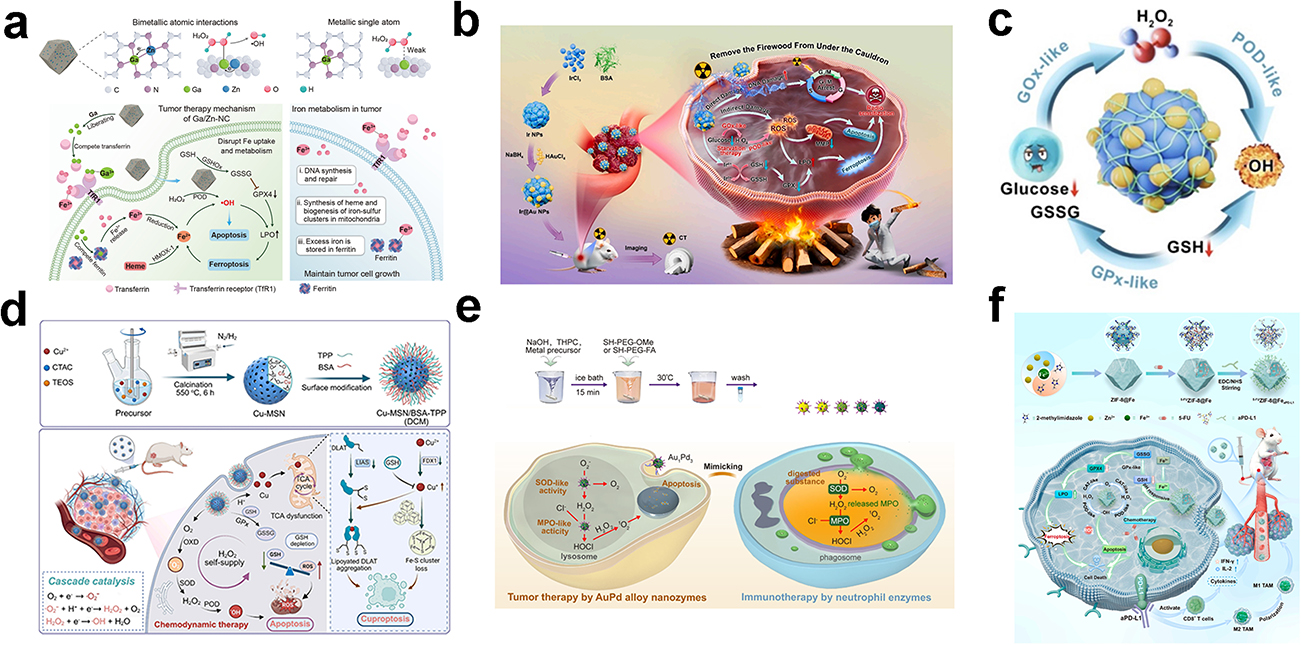 |
Figure 3 (a) Schematic illustration of the specific intracellular mechanism of tumor cell death induced by Ga/Zn-NC. Upward arrows indicate up-regulation, downward arrows indicate down-regulation. Reproduced with permission from ref.87 (b) The synthesis of Ir@Au nanozymes and their antitumor mechanisms. Upward arrows indicate up-regulation, downward arrows indicate down-regulation. (c) Schematic representation of the enzyme-like activity of Ir@Au NPs in cells. Upward arrows indicate generation, downward arrows indicate consumption. Reproduced with permission from ref.88 (d) Schematic diagram of the synthesis of DCM and its use in tumor therapy. Upward arrows indicate up-regulation, downward arrows indicate down-regulation. Reproduced with permission from ref.89 (e) Schematic diagram of ultrasmall AuPd alloy nanozyme simulating SOD-MPO enzyme cascade killing function for tumor therapy. Upward arrows indicate generation, downward arrows indicate consumption. Reproduced with permission from ref.90 (f) Schematic diagram of the synthesis of 5-FUZIF-8@FeaPD-L1 and its tumor therapy. Upward arrows indicate generation, downward arrows indicate consumption. Reproduced with permission from ref.91 |
Due to the insufficient generation and rapid depletion of ROS, tumor radioresistance limits the efficacy of RT.92 Li et al developed Ir@Au nanoparticles (Ir@Au NPs) to enhance tumor radiosensitivity and inhibit the growth of lung adenocarcinoma (Figure 3b).88 Benefiting from the GOx-like activity of Ir@Au NPs, these nanoplatforms consume glucose at tumor sites, accompanied by H2O2 generation and TME acidification (Figure 3c). They also possess POD- and GPx-like activities, promoting the decomposition of H2O2 to generate •OH and consuming GSH, thereby disrupting the tumor antioxidant system and inducing apoptosis and ferroptosis in lung adenocarcinoma cells. However, their cascade efficiency is easily affected by fluctuations in intracellular glucose and H2O2 levels. To overcome the intrinsic limitation of insufficient H2O2 in TME and enhance the catalytic efficiency of POD-like nanozymes, Liu et al developed a triphenylphosphine-functionalized copper-doped mesoporous silica self-cascading nanoplatform (DCM) (Figure 3d).89 DCM achieves self-sufficient H2O2 production through its OXD- and SOD-like activities and uses POD-like activity to produce •OH, inducing apoptosis. Its GPx-like activity allows DCM to effectively consume GSH, further aggravating redox imbalance, promoting cuproptosis, and disrupting the tumor antioxidant defense system.
Meng et al successfully prepared Au1Pd3 nanozymes with SOD- and myeloperoxidase-like (MPO) activities (Figure 3e).90 By simulating the SOD-MPO cascade enzyme killing function of neutrophils, these nanozymes induce DNA damage and tumor cell apoptosis through the generation of hypochlorous acid (HClO) and singlet oxygen (1O2). Although SOD-MPO biomimetic cascades can specifically kill tumors, they lack regulation of the immune TME, making it difficult to achieve long-lasting antitumor effects. Liu et al developed a 5-FUZIF-8@FeαPD-L1 self-cascading nanozyme, which was loaded with 5-fluorouracil and surface-functionalized with αPD-L1 (Figure 3f).91 In the TME, this nanozyme initiates a sequential catalytic cascade to mediate oxygen release, generate •OH, and deplete GSH, thereby alleviating TME hypoxia and inducing tumor cell apoptosis and ferroptosis. These effects trigger the release of immunostimulatory signals, enhance CD8+ T cell infiltration, and promote M1 polarization of TAMs. Combined with αPD-L1, the nanozyme effectively activates systemic antitumor immunity. However, similar to most self-cascading nanozymes, 5-FUZIF-8@FeαPD-L1 still has critical limitations. It is vulnerable to disruption by biological barriers in vivo, and the magnitude and persistence of its immune activation remain restricted.
Nanozyme-Natural Enzyme Cascade Catalytic Systems
The nanozyme-natural enzyme cascade catalytic system is a novel catalytic framework that integrates nanozymes and natural enzymes. By precisely designing the spatial arrangement and reaction sequence of the two, it can achieve efficient synergistic multi-step catalytic reactions. Natural enzymes have the advantages of strong substrate specificity and high catalytic efficiency but are easily inactivated under varying environmental pH and temperature conditions.93 Nanozymes, on the other hand, exhibit good stability and tunability, allowing catalytic activity to be optimized by adjusting their size, morphology, and surface electronic states,94,95 although they are limited by insufficient substrate selectivity.96 When assembled into a cascade catalytic system, nanozymes can first convert substrates into intermediates through enzyme-like activity, which are then specifically recognized by natural enzymes to complete subsequent reactions; alternatively, natural enzymes can initiate the reaction while nanozymes accelerate the catalytic cycle.97,98 This effectively solves the inherent drawbacks of poor substrate adaptability and low specificity in cascade catalysis.99
Mao et al developed an FeCo/PCP-GOx-DOX nanozyme loaded with GOx and the anticancer drug doxorubicin (DOX) (Figure 4a).100 GOx consumes glucose to generate H2O2. FeCo/PCP-GOx-DOX exhibits POD-like activity for catalyzing the conversion of H2O2 into •OH. Combined with DOX-mediated chemotherapy, this cascade system ultimately triggers efficient cancer cell death. To enhance the enrichment of nanozyme-natural enzyme cascades at tumor sites, Li et al constructed an MNPs/GOx@CS/IR820 nanosystem, which integrates Fe3O4 nanozymes, IR820 and GOx, and is modified with chitosan.101 It can actively accumulate at tumor sites under an external magnetic field (Figure 4b). GOx consumes intracellular glucose and produces H2O2, initiating a cascade reaction. Fe3O4 nanozymes catalyze H2O2 decomposition to generate highly toxic •OH and O2. Under near-infrared light excitation, IR-820 converts the generated O2 into cytotoxic 1O2, inducing tumor cell apoptosis through a synergistic mechanism. Zhou et al synthesized PCN222-Mn (PM) by coordinating porphyrin-manganese (TCPP-Mn) with zirconium clusters, and further modified it with HA and GOx to fabricate PCN222-Mn@GOx/HA (PMGH) (Figure 4c).102 PMGH can effectively accumulate in tumor sites through both active and passive targeting. GOx consumes intracellular glucose and generates H2O2, while PM catalyzes the conversion of H2O2 to O2 through its CAT-like activity (Figure 4d), thereby alleviating tumor hypoxia in situ. In addition, Zr4+ in the framework consumes GSH, further amplifying oxidative stress. Ultimately, tumor cell death is induced by glucose depletion and oxidative damage. Although the cascade strategy of nanozymes with natural GOx is easier to scale up, it is overly dependent on acidic environments, limiting the catalytic efficiency in deep tumors.
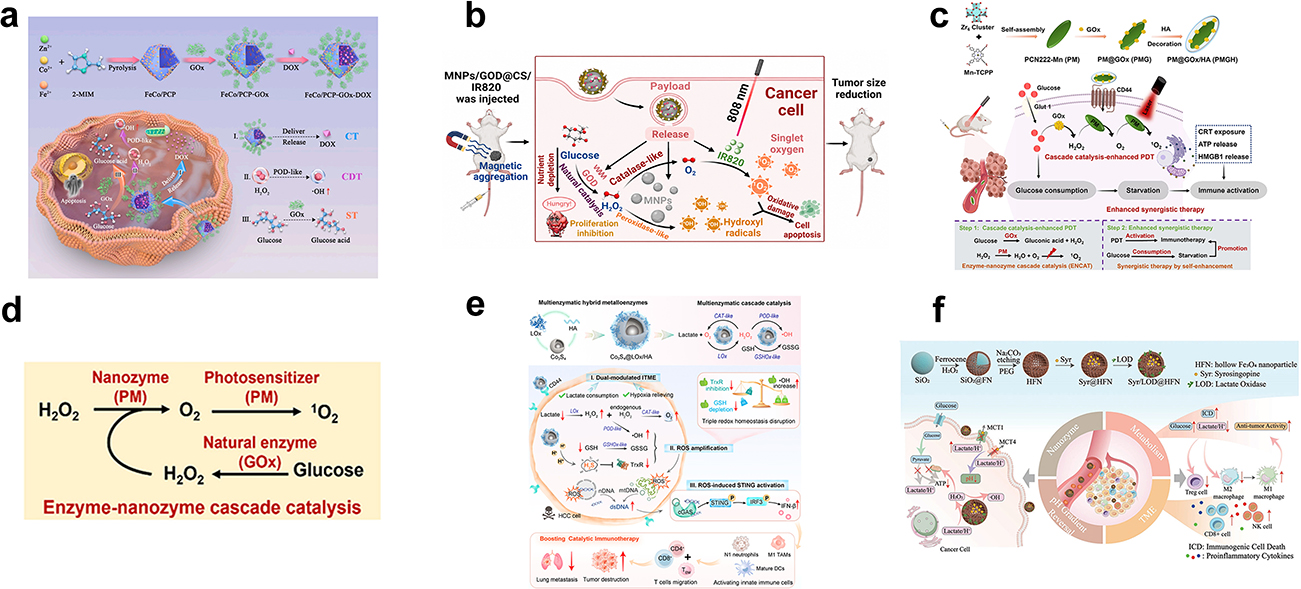 |
Figure 4 (a) Schematic illustration of the synthesis of FeCo/PCP-GOx-DOX nanozyme and its tumor therapy. Upward arrows indicate generation. Reproduced with permission from ref.100 (b) Schematic diagram of MNPs/GOx@CS/IR820 nanosystem for tumor therapy. Upward arrows indicate up-regulation, downward arrows indicate down-regulation. Reproduced with permission from ref.101 (c) Schematic diagram of the synthesis of PCN222-Mn@GOx/HA (PMGH) and its application in tumor therapy. Upward arrows indicate up-regulation, downward arrows indicate down-regulation. (d) Schematic description of PMGH cascade catalysis. Reproduced with permission from ref.102 (e) Schematic diagram of the synthesis of Co3S4@LOx/HA and its application in tumor therapy. Upward arrows indicate up-regulation, downward arrows indicate down-regulation. Reproduced with permission from ref.103 (f) Schematic diagram of the synthesis of Syr/LOx@HFN and its cancer treatment. Upward arrows indicate up-regulation, downward arrows indicate down-regulation. Reproduced with permission from ref.104 |
ROS have been confirmed to damage DNA and activate the immune response mediated by the STING pathway. Sun et al developed a novel multi-enzyme hybrid metal enzyme Co3S4@LOx/HA (Figure 4e).103 After being internalized by liver cancer cells, this enzyme generates H2O2 and •OH through a cascade reaction, consuming GSH and increasing ROS levels within the TME, thereby triggering antitumor immune responses. During the catalytic process, the consumption of lactate and the generation of oxygen also help reshape the immunosuppressive TME. In vivo experiments validated its efficacy to inhibit liver cancer growth and lung metastasis. Wu et al developed a Syr/LOx@HFN nanoplatform based on hollow Fe3O4 nanoparticles, which loads the antihypertensive drug syrosingopine (Syr) and LOx (Figure 4f).104 LOx converts accumulated lactic acid into H2O2, providing substrates for nanozyme-based Fenton reactions, amplifying ROS in situ and triggering ICD, while reversing the acidic TME and enhancing the efficacy of immune checkpoint blockade. However, inhibiting lactate export reverses the acidic TME but fails to establish an efficient substrate conversion cycle, making it susceptible to intracellular lactate accumulation.
Nanozyme−Nanozyme Cascade Catalytic System
Although nanozyme-natural enzyme cascade catalytic systems have made certain progress in the field of antitumor immunotherapy research, challenges including nanozyme aggregation, low loading efficiency, decreased catalytic activity and high cost remain to be addressed.105 Nanozyme-nanozyme cascade catalytic systems are synergistic catalytic systems constructed from two or more nanozymes with different enzyme-like activities.28 By regulating the composition of nanozymes and employing reasonable spatial arrangement strategies, efficient coupling of multi-step continuous catalytic reactions can be achieved,106 offering new prospects for the translational application of cascade catalytic tumor therapy.
Gu et al designed a nanozyme-nanozyme cascade catalytic system, Au@COF@MnO2.107 MnO2 can be reduced by GSH to Mn2⁺, which can catalyze H2O2 to generate •OH, synergistically amplifying ferroptosis (Figure 5a). The gold nanozyme decomposes glucose to produce H2O2 and remodels the acidic TME. In addition, glucose depletion can downregulate the expression of heat shock proteins in tumor cells, thereby markedly improving antitumor efficacy. Li et al synthesized Cu2O@Au nanozymes, achieving efficient integration of the GOx-like activity of gold nanozymes, the POD-like activity of Cu2O, and GSHOx-like activity, thereby realizing a GOx-POD-GSHOx continuous cascade reaction (Figure 5b).108 The GOx-like activity consumes glucose and generates H2O2 in situ while acidifying the TME; the POD-like activity catalyzes H2O2 to produce •OH; the GSHOx-like activity continuously consumes GSH and enhances oxidative stress. The Cu2O@Au nanozyme cascade operates without exogenous substrates or natural enzymes. It affords efficient intermediate conversion and excellent structural stability. This work provides an important reference for designing high-efficiency nanozyme cascade catalytic systems.
 |
Figure 5 (a) Schematic diagram of Au@COF@MnO2 nanocomposite synthesis and its application in tumor therapy. Upward arrows indicate up-regulation, downward arrows indicate down-regulation. Reproduced with permission from ref.107 (b) Schematic diagram of the synthesis of Cu2O@Au nanozyme and its anti-tumor mechanism. Upward arrows indicate generation, downward arrows indicate consumption. Reproduced with permission from ref.108 (c) Schematic diagram of the synthesis process of Pt@CNDs nanocomposites and their application in intracellular antioxidant therapy. Upward arrows indicate up-regulation, downward arrows indicate down-regulation. Reproduced with permission from ref.109 (d) Schematic diagram of the synthesis of gCM@MnAu and its enhanced cancer immunotherapy. Upward arrows indicate up-regulation, downward arrows indicate down-regulation. Reproduced with permission from ref.110 |
Zhang et al constructed Pt@CNDs nanocomposites by integrating carbon nanodots (CNDs) with SOD-like activity and platinum nanoparticles (PtNPs) with CAT-like activity, achieving efficient SOD-CAT nanozyme-nanozyme cascade catalysis (Figure 5c).109 CNDs first disproportionate O2•- into H2O2, and PtNPs immediately decompose H2O2 in situ into water and oxygen, completing a sequential antioxidative cascade reaction. The carbonyl and hydroxyl groups present on the surface of CNDs have been shown to bind with PtNPs, thereby facilitating electron transfer between PtNPs and CNDs. This process has been demonstrated to result in Pt@CNDs exhibiting enhanced catalytic performance, dispersibility, and stability. Such nanozymes can target mitochondria and efficiently scavenge multiple ROS, providing a typical paradigm for designing high-performance cascade antioxidative systems. To further enhance the tumor targeting and immunomodulatory capabilities of the system, Zhang et al constructed genetically engineered cell membrane-coated gCM@MnAu nanoreactors (Figure 5d).110 This system is composed of MnO2 with CAT-like activity and Au nanoparticles with GOx-like activity. It achieves substrate self-sufficiency via a sequential GOx-CAT cascade reaction, generates •OH in situ, and induces antitumor immune responses. The gCM@MnAu nanoreactor integrates cascade catalysis, targeted delivery, and immune regulation, featuring favorable biocompatibility and tumor-targeting ability, thereby effectively inhibiting tumor growth and lung metastasis. However, this system suffers from cumbersome preparation procedures and its catalytic activity being highly dependent on the acidic TME, which limits its further clinical translation.
In summary, the three types of cascade catalytic systems exhibit distinct advantages and disadvantages for in vivo tumor immunotherapy. Self-cascaded nanozymes feature mature fabrication procedures, favorable in vivo biological stability and low immunogenicity, thus possessing high potential for clinical translation. Nevertheless, their inherent reaction pathways are inflexible, hindering the realization of multidimensional dynamic functional regulation. Nanozyme-natural enzyme cascade systems show superior substrate recognition specificity, and their catalytic activities can be precisely modulated via exogenous stimuli to achieve excellent regulatory performance. However, natural enzyme components are prone to metabolic clearance in vivo, accompanied by high risk of immune rejection and unsatisfactory in vivo circulation stability. By contrast, nanozyme-nanozyme cascade systems can integrate diverse catalytic activities to trigger synergistic cascade responses within the TME and exert comprehensive immune activation effects. Nonetheless, these systems suffer from uneven mass transfer efficiency among different components and difficulties in accurate regulation of interfacial synergistic effects, which pose prominent obstacles to large-scale practical applications.
Mechanism of Cascade Nanozyme Regulation of Tumor Immune Response
Immunotherapy achieves tumor-specific clearance by activating the body’s immune system and has become an important direction in cancer treatment.111 However, issues such as the TME, low immune response rates, and tumor heterogeneity severely limit its clinical efficacy.112 Cascade nanozymes are a new type of nanoplatform that integrates multiple enzyme catalytic activities. They can kill tumor cells directly and activate immunotherapy through various regulatory mechanisms, such as inducing ICD, remodelling the TME and activating immune signalling pathways. They show great potential in tumor immunotherapy for breast cancer, colorectal cancer, bladder cancer and others (Table 1).
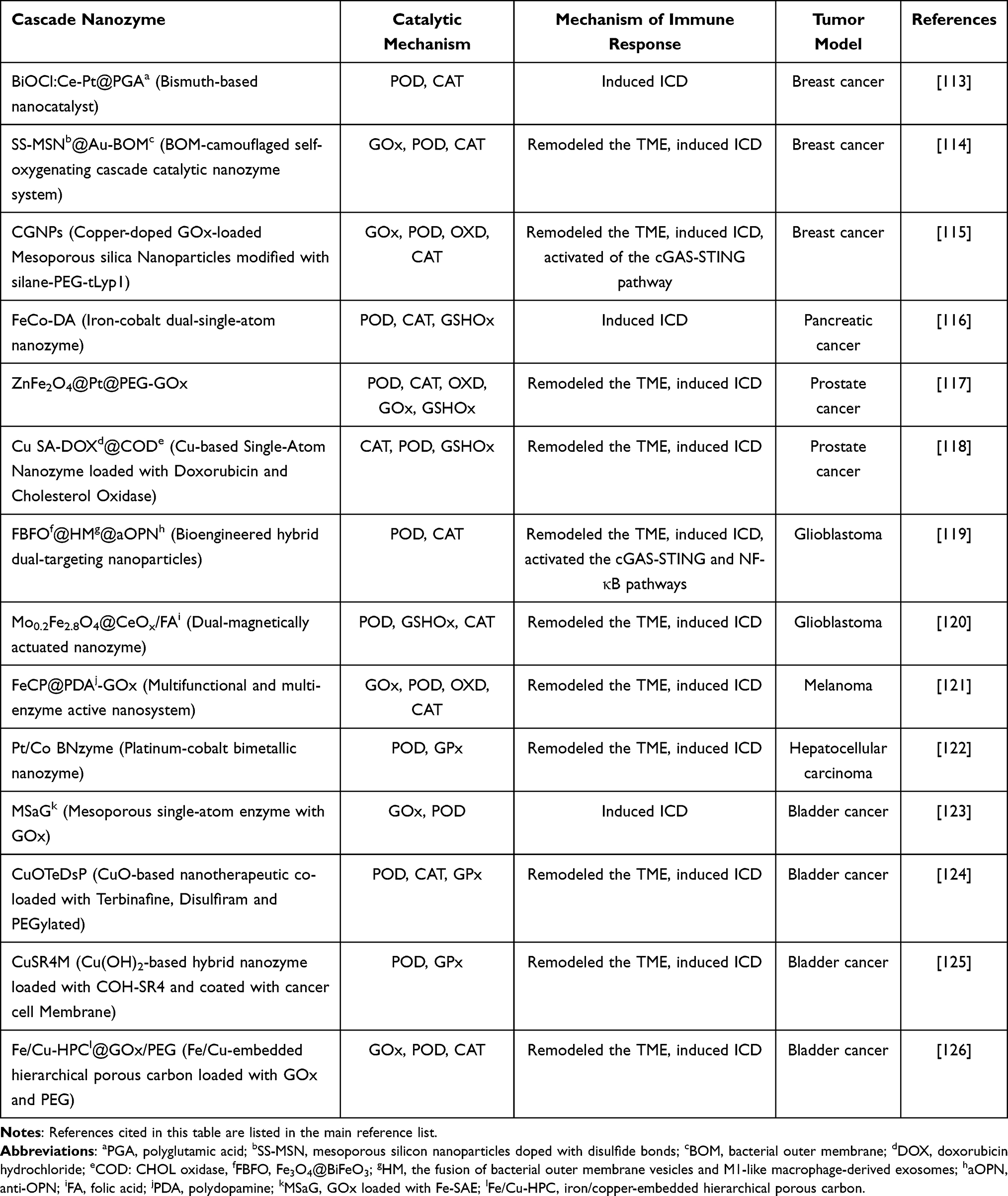 |
Table 1 Cascade Nanozymes in Immunotherapy for Different Tumors |
Induction of Immunogenic Cell Death
ICD serves as an effective strategy to boost immunotherapeutic efficacy. It facilitates the release of TAAs and damage-associated molecular patterns (DAMPs) into the TME, activates innate immune cells such as DCs and macrophages, promotes DC maturation and initiates innate immune responses to accomplish antigen recognition, uptake and preliminary immune activation. Mature antigen-presenting cells further process and present antigens to trigger specific T cell immune responses. Among them, CD4⁺ and CD8⁺ T cells are specifically activated via antigen presentation, which can not only precisely eliminate tumor cells, but also establish immune memory to exert long-lasting and stable antitumor immune effects.127 Although ICD can be induced by chemotherapy, radiotherapy, and phototherapy, its efficacy is severely limited due to the constraints of the TME.128 Therefore, constructing an ICD amplifier to activate the immune system is one of the effective methods for treating tumors and preventing cancer metastasis or recurrence. Cascade nanomaterials, by generating ROS, induce ICD while regulating the release of DAMPs to enhance immunogenicity, holding promise to significantly improve the efficacy of antitumor immunotherapy.129
Yan et al developed an iron-based benchmark MOF nanozyme, Q-MIL-53 (Fe), which can catalyze ROS generation in a cascade, deplete GSH, induce mitochondrial dysfunction, promote LPO accumulation, and trigger ferroptosis.130 Ferroptosis further induces ICD, accompanied by the release of DAMPs including CRT, HMGB1, and ATP. These DAMPs act on innate immune cells, promoting the maturation of DCs and driving the polarization of TAMs toward the M1 phenotype. Meanwhile, they recruit and activate adaptive immune cells, enhancing the infiltration and cytotoxicity of CD4⁺/CD8⁺ T cells. This system significantly boosts antitumor efficacy when combined with αPD-L1 antibody, yet its in vivo delivery efficiency and duration of action still require further optimization. Besides iron-based MOF nanozymes, copper-based single-atom nanozymes exhibit superior catalytic activity and dual cell death-inducing capacity, emerging as a novel direction for catalytic immunotherapy. For example, Zhang et al used N-acetyl-L-cysteine (NAC) as a ligand to coordinate with copper ions and self-assemble onto the surface of 2D Ti3C2 to synthesize a Cu SAzyme (CuNTD) (Figure 6a).131 CuNTD consumes GSH and explosively generates ROS through multi-enzyme cascade catalysis, and simultaneously induces ferroptosis and cuproptosis. The resulting oxidative stress and mitochondrial damage further trigger ICD. By releasing DAMPs including ATP, HMGB1, and exposing CRT, tumor cells effectively activate innate immune cells such as DCs, and further initiate the CD8⁺ T cell-dominated adaptive immune response. This system highly integrates single-atom catalysis, dual cell death pathways, and ICD, exhibiting remarkable immune activation efficacy. However, the potential toxicity of copper ions and insufficient long-term immune memory still limit its clinical translation potential.
 |
Figure 6 (a) Schematic illustration of the preparation of CuNTD single-atom copper enzyme and its enhanced tumor immunotherapy effect. Reproduced with permission from ref.131 (b) Schematic of the synthesis of ES@Cu(II)-MOF and its application in tumor immunotherapy. Reproduced with permission from ref.132 (c) Schematic diagram of the catalytic mechanism of SANE and intracellular therapeutic mechanism of iEV@SANE. Reproduced with permission from ref.133 (d) Schematic diagram of the synthesis of PBAF nanozyme and its application in tumor therapy. Upward arrows indicate up-regulation, downward arrows indicate down-regulation. Reproduced with permission from ref.134 (e) Schematic diagram of the synthesis of CaO2/AuPt@BSA (CAPB) nanozyme and its application in tumor therapy. Upward arrows indicate generation, downward arrows indicate consumption. Reproduced with permission from ref.135 (f) Schematic diagram of the synthesis of FePt/CeO2 nanozyme and its application in immunotherapy. Downward arrows indicate consumption. Reproduced with permission from ref.136 |
To address the inadequate tumor-targeting capability of metal nanozymes, researchers have employed passive targeting carriers for surface modification, which effectively improves their tumor accumulation efficiency. Lu et al successfully synthesized an Elesclomol@Cu(II)-MOF modified with polyethylene glycol (PEG) (Figure 6b).132 ES@Cu(II)-MOF possesses both POD-like and GPx-like activities. It generates •OH through catalysis, depletes GSH, and converts Cu2+ into highly toxic Cu⁺, triggering abnormal aggregation of mitochondrial lipoylated DLAT protein, thereby inducing cuproptosis. Cuproptosis induces ICD through oxidative stress and mitochondrial damage, promoting CRT membrane externalization, HMGB1 extracellular release, and ATP secretion. These signals first activate innate immunity, recruiting and activating macrophages and dendritic cells; subsequently, they initiate adaptive immunity. Furthermore, PEG enables passive tumor targeting via the enhanced permeability and retention effect, effectively improving tumor accumulation and reducing off-target effects, thereby simultaneously enhancing the biosafety and antitumor efficacy of the system. However, this system lacks active targeting capability for tumor recognition and cannot completely inhibit tumor recurrence and metastasis, thus still failing to meet the requirements for clinical applications. Consequently, researchers have further shifted towards more efficient design strategies based on polymetallic synergy and coupling with immune biological carriers. Wu et al constructed a cyano-bridged bimetallic single-atom nanozyme Cu2[Fe(CN)6] (SANE), which was modified with immunogenic exosomes (iEV) to achieve efficient catalytic immunotherapy.133 The nanozyme triggers a ROS burst and depletes GSH through dual POD and GSHOx enzymatic activities, and inhibits GPX4 and induces ferroptosis (Figure 6c). Ferroptosis promotes tumor cells to release DAMPs such as CRT, HMGB1 and ATP, activating innate immunity and initiating adaptive immunity. DAMPs further activate dendritic cells, upregulate CD80/CD86, and promote CD8⁺ T cell infiltration and the secretion of pro-inflammatory cytokines including IFN-γ. This work precisely clarifies the relationship between electronic structure regulation and ICD, providing an important direction for the subsequent catalytic-immune synergistic design of bimetallic nanozymes.
Remodel the TME
The accumulation of GSH in the TME, along with hypoxia and infiltration of immunosuppressive cells, can inhibit T cell proliferation, promote M2 macrophage polarization, and weaken immunotherapy efficacy.137,138 Cascade nanozymes can efficiently and orderly catalyze multiple biochemical reactions at tumor sites by mimicking the synergistic action of natural cascade enzyme systems, eliminating immunosuppressive factors, and effectively regulating the TME to create conditions for activating immune responses.139 For example, Zheng et al synthesized a PBAF nanozyme covalently assembled from the organic bridging ligand ([FeIII(CN)6]), manganese ions, pentafluorophenyl bacteriochlorin with benzoic acid (FBC-MBA), and biocompatible polyvinylpyrrolidone (PVP) (Figure 6d).134 PBAF displays GSHOx-like activity, which specifically depletes intratumoral GSH, disrupts cellular redox homeostasis, and induces ferroptosis. Meanwhile, PBAF possesses POD-like activity to consume intratumoral H2O2 and generate •OH. Moreover, PBAF is capable of producing 1O2 under 750 nm laser irradiation, further amplifying oxidative stress and remodeling the TME. By inducing ICD, PBAF promotes DC maturation, facilitates M1 phenotypic polarization of TAMs, and reduces the infiltration of Tregs and MDSCs. It markedly increases the intratumoral infiltration of cytotoxic T lymphocytes and activates both innate immunity and adaptive antitumor immunity, thereby effectively inhibiting tumor recurrence and metastasis. Although this photosensitive nanozyme can remodel the TME and boost T cell infiltration via oxidative stress, its immune activation is heavily dependent on external light stimulation. In contrast to endogenously responsive nanozymes with autonomous cascade amplification capacity, this material fails to achieve sustained TME remodeling.
Liu et al constructed a CaO2/AuPt@BSA (CAPB) nanozyme encapsulated with bovine serum albumin (BSA) (Figure 6e).135 AuPt exerts GOx- and POD-like activities, consuming glucose and self-supplying H2O2 to generate abundant ROS. Meanwhile, CaO2 decomposes to release Ca2⁺, triggering calcium overload. Together, these effects induce ICD, promoting CRT externalization and the release of HMGB1 and ATP, which facilitates DC maturation and activates innate immunity. Mature DCs further initiate adaptive immunity, enhancing CD8⁺ T cell infiltration and cytotoxicity. Combination with αPD-L1 blocks immune escape and enables synergistic amplification of innate and adaptive immunity, providing important insights for subsequent research on immune regulation by cascade nanozymes. On the basis of autonomous cascade catalysis, the introduction of defect engineering and electronic structure modulation can further enhance the synergistic catalytic-immunotherapeutic effect of nanozymes. Yang et al fabricated a FePt/CeO2 cascade nanozyme with boosted POD-like activity via defect engineering and electronic modulation (Figure 6f).136 This nanozyme initiated a self-amplified cascade cycle to reshape the TME, including ROS burst, ferroptosis-driven GSH depletion, and catalytic self-enhancement. It effectively activated innate immunity and further triggered adaptive antitumor immunity. It induced ICD with the release of ATP, CRT, and HMGB1. It promoted dendritic cell maturation, activated CD8⁺/CD4⁺ T lymphocytes, drove tumor-associated macrophage polarization from M2 to M1 phenotype, and decreased the infiltration of Tregs and MDSCs. However, this strategy does not directly activate immune pathways such as STING and exerts weak direct regulation of immune cells, making it difficult to elicit a strong antitumor response.
Activation of Immune Signaling Pathways
Innate immunity, as the first line of defense in the body’s immune system, can trigger broad-spectrum antitumor immune responses when its signaling pathways are activated.140 Cascade nanozymes can activate immune signaling pathways and alleviate immunosuppression either through catalytic reaction products or by directly acting on signaling molecules.141 Liu et al successfully constructed a Cu-SAs/C2N copper single-atom cascade nanozyme (Figure 7a).142 Cu-SAs/C2N efficiently mimics both POD- and OXD-like activities, triggering an ROS burst in the TME. ROS inhibit the phosphorylation and activation of the PI3K-AKT pathway via oxidative stress-mediated interference with upstream regulatory molecules, thereby downregulating the antiapoptotic protein Bcl-2 and upregulating Bax to trigger tumor cell apoptosis. Apoptotic tumor cells not only drive macrophage polarization toward the M1 phenotype and activate NK cells to strengthen innate immune clearance, but also promote CD8⁺ T cell infiltration and alleviate immune exhaustion, initiating adaptive antitumor immune responses. This system exhibits a significant synergistic effect when combined with PD-1 inhibitors. This work provides a novel strategy for catalytic therapy combined with immune checkpoint blockade, yet its in vivo translation is still limited by targeting efficiency, metabolic clearance rate, and long-term biosafety.
 |
Figure 7 (a) Schematic diagram of the synthesis of Cu-SAs/C2N nanozyme and its application in tumor therapy. Upward arrows indicate up-regulation, downward arrows indicate down-regulation. Reproduced with permission from ref.142 (b) Synthesis of PCFP@H-TDN cascade nanozyme and its catalytic mechanism in tumor therapy. Upward arrows indicate up-regulation, downward arrows indicate down-regulation. Reproduced with permission from ref.143 (c) Synthesis of BMP-Au nanoadjuvants and their mechanisms for tumor therapy. Downward arrows indicate consumption. (d) Schematic diagram of the cGAS-STING pathway activated by BMP-Au. Reproduced with permission from ref.144 (e) Schematic diagram of CMG synthesis and its application in enhanced cancer immunotherapy. Red upward arrows indicate activation. (f) Schematic diagram of the CMG cascade reaction. (g) Schematic diagram of the cGAS-STING pathway activated by CMG. Reproduced with permission from ref.145 (h) Schematic diagram of FMGC nanozyme for cancer immunotherapy. (i) Diagram illustrating the inherent immunomodulatory actions of FM in ICD induction and DC maturation. Reproduced with permission from ref.146 |
To further improve the targeting ability and immune regulatory specificity of nanozymes, researchers have incorporated biological molecules such as nucleic acid aptamers into nanozymes to construct multifunctional synergistic systems. Li et al developed a bifunctional cascade Pt single-atom nanozyme (PCFP@H-TDN) modified with a hairpin tetrahedral DNA nanostructure (H-TDN) (Figure 7b).143 The PD-L1 nucleic acid aptamer on the surface of H-TDN directly blocks the recognition and binding of PD-1 and PD-L1 at the cell membrane level, relieving the immune checkpoint inhibitory signal. Furthermore, H-TDN can targetedly deliver PD-L1 antisense oligonucleotides, which degrade PD-L1 mRNA via the RNase H1 pathway and downregulate total protein expression, thereby targeting and regulating the PD-1/PD-L1 pathway through dual mechanisms. While relieving tumor hypoxia through cascade oxygen production, this system induces ICD, releasing DAMPs such as ATP, CRT, and HMGB1. It significantly activates innate immunity, increases CD4⁺/CD8⁺ T cell infiltration, enhances T cell killing function, and further initiates adaptive antitumor immunity. However, this system is highly dependent on 660 nm external laser triggering, and its deep tumor penetration capability is still limited. Moreover, it does not directly activate key innate immune pathways such as cGAS-STING, and the intensity and duration of immune activation need to be further improved.
Zhang et al developed a BMP-Au nanoadjuvant via integrating gold nanoparticles (Au NPs) with biomineralized manganese phosphate (BMP) nanosheets (Figure 7c).144 Through the cascade catalysis of GOx-like activity of Au NPs and POD-like activity of Mn2⁺, it consumes glucose and generates ROS in tumor cells. ROS induce DNA damage, leading to the accumulation of cytoplasmic double-stranded DNA (dsDNA) (Figure 7d). The dsDNA is recognized by cGAS, which catalyzes the production of 2’3’-cGAMP. 2’3’-cGAMP binds to the adaptor protein STING, triggering its translocation and activating the transcription factors IRF3 and NF-κB, thereby driving the expression of type I interferons and pro-inflammatory cytokines and activating the cGAS-STING pathway. In addition, ROS also triggers ICD, causing tumor cells to expose CRT and release DAMPs including ATP and HMGB1, activating both innate and adaptive immune responses, offering a new paradigm for breast cancer therapy. To further enhance the cascade catalytic efficiency and immune activation potency of manganese-based materials, Zhang et al modified Cu-MOF with MnO2 and GOx to synthesize Cu-MOF@MnO2/GOx (CMG) (Figure 7e).145 After CMG is endocytosed by cells, it can be degraded by GSH, releasing Cu2+, Mn2+, and GOx (Figure 7f). GOx consumes glucose, reprogramming tumor metabolism and making cells sensitive to copper toxicity. The released Cu2+ and Mn2+ trigger Fenton-like reactions, generating ROS, inducing cuproptosis. Cuproptosis disrupts the tricarboxylic acid cycle and promotes the release of mitochondrial DNA (mtDNA) into the cytoplasm (Figure 7g). As a natural double-stranded DNA ligand for cGAS, mtDNA is recognized and bound by cGAS, initiating the catalytic synthesis of the second messenger cGAMP. Meanwhile, Mn2⁺ acts as an allosteric activator that directly binds to the cGAS protein, alters its conformation, and markedly enhances the DNA-binding affinity and catalytic activity of cGAS. Through a synergistic mechanism of “substrate supply plus enzymatic potentiation”, mtDNA and Mn2⁺ co-activate the cGAS-STING pathway, strongly stimulating the STING-TBK1-IRF3 signaling cascade. This ultimately drastically promotes the secretion of type I interferons and pro-inflammatory cytokines, potently activating innate immunity and further driving adaptive antitumor immune responses.
Compared with the CMG nanoplatform that only focuses on cuproptosis and cGAS-STING pathway activation, cascading nanozymes can further achieve systematic regulation of tumor immunotherapy through multi-pathway synergy. Zhao et al engineered Fe3O4 cores and MnO2 shells (FM) nanozymes loaded with the chemotherapeutic drug gemcitabine and the immune adjuvant curcumin, synthesizing the FMGC nanozymes to enhance immunotherapy for pancreatic cancer (Figure 7h).146 FM can deplete GSH, induce ferroptosis, catalyze H2O2 to produce •OH, thereby enhancing the chemotherapy effect and promoting the release of immune antigens. Gemcitabine induces DNA double-strand breaks in tumor cells, and MnO2 responsively releases Mn2⁺. As an allosteric activator, Mn2⁺ binds to cGAS, improves its affinity and catalytic activity toward cytoplasmic DNA, and synergistically hyperactivates the cGAS-STING pathway with DNA damage, promoting DC maturation and type I interferon secretion (Figure 7e). Meanwhile, curcumin directly inhibits the IL-6/STAT3 signaling pathway by blocking JAK phosphorylation downstream of the IL-6 receptor, reducing MDSC recruitment and activation and relieving their immunosuppression on CD8⁺ T cells. This work achieves quadruple synergy of ferroptosis, chemotherapy, STING activation, and MDSC regulation, providing important insights for the immune regulation and clinical translation of multifunctional nanozymes in the future.
In brief, cascade nanozymes are capable of inducing ICD in tumor cells, remodeling the TME and effectively regulating signaling pathways. ICD rapidly releases immune-stimulatory signals to initiate host immune responses. TME remodeling alleviates hypoxia and immunosuppression, achieving the most sustained and stable therapeutic effects. The regulation and activation of signaling pathways can potently amplify antitumor immune responses with higher therapeutic efficiency. The synergistic action of the above three approaches strengthens immunotherapeutic effects and facilitates the improvement of overall efficacy in tumor immunotherapy.
Application of Cascade Nanozymes in Tumor Immunotherapy
In tumor treatment, monotherapy is often limited by the complexity of TME and tumor heterogeneity.147 Immunotherapy can activate the body’s antitumor immunity, but its response rate is relatively low due to high PD-L1 expression and immune suppression in the TME. Therefore, various strategies need to be explored to improve the efficiency of immunotherapy. Although CDT, PT, SDT, RT and other treatment methods can directly kill tumors, they may cause damage to surrounding normal tissues and even lead to unnecessary tumor metastasis and spread. Research has shown that the synergistic therapeutic effect of immunotherapy and the above-mentioned tumor treatment strategies can compensate for their respective shortcomings and improve the efficacy of tumor treatment.148
Chemodynamic Therapy @ Immunotherapy
The chemodynamic therapy @ immunotherapy synergistic strategy mediated by nanozymes can not only catalyze the Fenton-like reaction via CDT to convert H2O2 into •OH for specific killing of tumor cells, but also trigger ICD to release TAAs and DAMPs.149 These phenomena facilitate immunotherapeutic efficacy. For example, Jiao et al designed a DNA origami (DO)-based enzymatic cascade nanoreactor (DOECN) that integrates AuNPs and Fe2O3.150 DOECN can promote the generation of H2O2, consume GSH, and amplify the Fenton-like reaction to enhance the efficacy of CDT. CDT directly kills tumor cells through in-situ burst generation of ROS. Simultaneously, CDT triggers ICD and releases DAMPs including CRT, ATP, and HMGB1, converting “cold tumors” into “hot tumors”. This not only provides sufficient tumor antigens for subsequent immunotherapy, but also addresses the core limitations of monotherapy, including inadequate antigen supply and impaired initiation of adaptive immunity. To further trigger innate immunity at the source and reinforce the efficacy of immune priming, Zhang et al successfully developed an OMV-DFA nanoplatform by encapsulating bacterial outer membrane vesicles (OMVs) with a DaFe shell and incorporating Au nanoparticles (Figure 8a).151 OMV-DFA can catalyze GSH oxidation, trigger ST, promote DaFe depolymerization and release Fe3+, and improve CDT efficacy. ST combined with CDT synergistically exacerbates tumor oxidative stress and energy depletion, further strengthening the ICD effect. Meanwhile, as natural immune agonists, OMVs directly activate innate immunity, compensating for the shortcomings of single immunotherapy, such as insufficient initiation of innate immunity and difficulty in reversing the immunosuppressive TME.
 |
Figure 8 (a) Schematic diagram of OMV-DFA preparation and its cascade effect in cancer therapy. Reproduced with permission from ref.151 (b) Synthesis of ZIF-8@Pt@TBZC NPs and its mechanism for colorectal cancer treatment. Reproduced with permission from ref.152 (c) Schematic illustrations showing the fabrication and tumor therapy of FeSA-Ir@PF NSs. Reproduced with permission from ref.153 (d) Schematic diagram of the synthesis of CuTA-Ce6 and their dual activation and amplification effect mediated by US and TME-targeted ferroptosis. Upward arrows indicate an increase. Reproduced with permission from ref.154 (e) Schematic diagram of the preparation of MARS nanoparticles and their application in tumor therapy. Upward arrows indicate activation, and downward arrows indicate inhibition. Reproduced with permission from ref.155 (f) Schematic diagram of ZnO2@Cu preparation and its cascade reaction-based enhancement of radiotherapy immunotherapy. Reproduced with permission from ref.156 |
By integrating TME-responsive self-supply and self-depletion designs, such strategies can further break through the limitations of catalytic efficiency and achieve deeper and more durable remodeling of the TME. Li et al fabricated the chlorogenic acid (CA)-loaded CA@ZIF-8/MnO2 (CZM) nanoreactor. The nanoreactor achieves cascade catalysis of CDT via GSH depletion and endogenous H2O2 self-supply.157 The degradation of the MnO2 shell simultaneously achieves GSH scavenging and Mn2+ release, which not only enhances the Fenton reaction efficiency but also activates the cGAS-STING innate immune pathway. CA continuously converts superoxide anions into H2O2, addressing the bottleneck of insufficient substrates in conventional CDT. The resulting strong oxidative stress further induces ICD, promotes M1 phenotypic polarization of macrophages, and remodels the TME. These effects overcome multiple limitations of single immunotherapy, including low immunogenicity, hypoxia-induced drug resistance, enrichment of immunosuppressive cells, and insufficient T cell infiltration, ultimately yielding superior antitumor therapeutic outcomes.
Phototherapy @ Immunotherapy
In the field of minimally invasive tumor therapy, phototherapy (PT) possesses high controllability and reduces damage to normal tissues,158 making it a research hotspot in tumor treatment. PT mainly includes photodynamic therapy (PDT) and photothermal therapy (PTT).159 PDT can kill tumor cells and damage tumor blood vessels under specific light and photosensitizers, but hypoxia in the TME can limit its efficacy.160 PTT can use photothermal agents to convert light energy into heat energy for local high-temperature ablation,161 but suffers from insufficient photothermal conversion efficiency and limited deep tissue penetration, resulting in incomplete treatment.162,163 Therefore, there is an urgent need to combine other cancer treatment strategies to improve tumor-specific therapeutic efficacy.
Zhu et al designed a cascade nanoplatform denoted as ZIF-8@Pt@TBZC NPs (ZPT NPs). Pt NPs and the photosensitizer TBZ-CPi (TBZC) were loaded on zeolitic imidazolate framework-8 (ZIF-8) (Figure 8b).152 Platinum nanoparticles catalyze H2O2 to produce oxygen, relieve tumor hypoxia, and improve PDT efficiency. The TBZC photosensitizer targets mitochondria and causes mitochondrial DNA damage. The oxidized Pt (II) induces nuclear DNA breakage. Dual DNA damage strongly activates the cGAS-STING innate immune pathway. This process promotes DC maturation, CD8⁺ T cell infiltration, and macrophage M1 polarization, as well as inducing ICD. This combination effectively overcomes the limitations of monotherapy, including insufficient T cell infiltration, difficulty in reversing the immunosuppressive TME, and low response rates, providing a new strategy for direct tumor killing and long-term antitumor immunity. Building on these findings, subsequent studies have focused on developing integrated strategies that combine PDT with immunotherapy to achieve more potent and systematic antitumor efficacy. For example, Fan et al successfully constructed a self-oxygenated photodynamic system named Fe-TCPP-R848-PEG (FeMOF-RP), which integrates Fe-TCPP metal-organic frameworks and R848 agonists.164 This system achieves synergistic antitumor effects through the combination of PDT, CDT and immunotherapy. Upon excitation by 660 nm laser irradiation, TCPP generates 1O2 via type‑II photodynamic reactions and produces ROS including superoxide anions and •OH via type‑I reactions, directly killing tumor cells and inducing ICD. This process releases DAMPs, converting “cold tumors” into “hot tumors” and supplying sufficient antigens for immunotherapy. Meanwhile, PDT alleviates tumor hypoxia, downregulates immunosuppressive cells such as M2-type macrophages and MDSCs, and restores the function of effector immune cells. From the dual dimensions of antigen supply and TME remodeling, this system overcomes the limitations of monotherapy including insufficient antigens, weak innate immune activation, and irreversible immunosuppression. Furthermore, cascade nanozymes achieve a closed‑loop amplification effect of oxygen supply, ROS generation, and GSH depletion through multi‑enzymatic cascade reactions, further enhancing the efficacy of combination therapy.
Yang et al developed FeSA-Ir@PF nanosheets constructed with supramolecularly encapsulated Fe single atoms and iridium metallene, which achieved synergistic antitumor effects through PTT and single-atom cascade catalysis (Figure 8c).153 Under NIR-II light irradiation, PTT not only directly ablates tumor cells via hyperthermia but also enhances the cascade catalytic efficiency of nanozymes to generate ROS, thereby inducing ferroptosis and pyroptosis and releasing DAMPs. This process effectively initiates both innate and adaptive immune responses. This system successfully addresses the limitations of single immunotherapy, including insufficient tumor antigen release, low DC maturation, and poor effector T cell infiltration. Meanwhile, it remodels the TME via ROS-mediated oxidative stress and efficiently inhibits tumor lung metastasis when combined with αPD-L1. In addition to the synergistic antitumor effect of single-atom cascade catalysis and PTT, multi-enzyme-like composites loaded with immune adjuvants and functional metal ions also enable photothermal-immunological synergistic therapy. Zhang et al synthesized MCMSFT using Cu2MoS4 as the carrier to encapsulate the immune adjuvant MET, Fe3⁺, and tannic acid (TA).165 This material exhibits triple enzyme-like activities of CAT, POD, and GPx, which induce tumor cell apoptosis and ferroptosis. Meanwhile, photothermal ablation and ferroptosis trigger ICD, promoting DC maturation and T cell activation. This strategy effectively overcomes the bottlenecks of pure immunotherapy, such as tumor hypoxia, strong immunosuppression, and the lack of positive immune feedback. Furthermore, MET downregulates PD-L1 expression, overcomes tumor cell apoptosis resistance and immune escape, promotes tumor regression, and suppresses metastasis and recurrence. To accurately identify osteosarcoma, Cheng et al encapsulated these nanospheres with indocyanine green (ICG) and grafted RGD peptide onto the surface of mCu&Ce nanospheres to obtain an mCu&Ce@ICG/RGD nanoplatform.166 After the nanoplatform enters osteosarcoma cells, the photothermal effect significantly enhances the Cu/Ce-based Fenton-like reaction, amplifies ROS cascades, induces ICD, and activates effector T cells, eliciting systemic and specific antiosteosarcoma immune responses. In addition, this platform enables early diagnosis of osteosarcoma via NIR-II fluorescence and magnetic resonance dual-mode imaging, providing a novel paradigm for precision immunotherapy of bone tumors.
Sonodynamic Therapy @ Immunotherapy
Sonodynamic Therapy (SDT) is a non-invasive tumor ablation method that uses ultrasound (US) to activate sonosensitizers and generate cytotoxic ROS.167,168 The resulting ROS can trigger cell apoptosis and necrosis, induce ICD, and promote TAAs release to activate DCs and CTLs, providing a new strategy to improve the therapeutic efficacy of immune checkpoint blockade.169 For example, Zhao et al synthesized a CD@H-MnO2 heterojunction platform with multiple enzymatic activities.170 Upon ultrasound irradiation, this system generates massive ROS, directly inducing ICD and releasing tumor antigens. As a cascade nanozyme, CD@H-MnO2 decomposes H2O2 via CAT-like activity to produce oxygen, relieving tumor hypoxia and enhancing SDT efficiency. Meanwhile, it depletes GSH, further amplifying oxidative stress and ICD effects. This strategy overcomes the limitations of single immunotherapy, such as hypoxia-suppressed SDT and impaired immune cell activation, thereby achieving potent antitumor efficacy.
To further exploit the synergistic potential of SDT and immunotherapy, cascade nanozymes with diverse compositions are developed to boost synergistic antitumor efficacy. Wang et al successfully synthesized a CuTA-Ce6 pyroptosis amplifier integrating the photosensitizer chlorophyll e6 (Ce6) and copper-tannic acid (CuTA), which exhibits dual activation and amplification effects mediated by US and TME-targeted ferroptosis (Figure 8d).154 CuTA can activate and disrupt the tumor antioxidant system in the TME, and Ce6-mediated SDT further enhances pyroptosis. The two synergistically generate ROS, thereby inducing TAMs polarization, DC maturation, and T cell immune response. This approach addresses the key challenges of immunotherapy alone, including abundant immunosuppressive cells and insufficient T cell infiltration. Building on the synergy between SDT and immunotherapy, multi-enzyme-active nanomaterials can further amplify the superiority of ultrasound-triggered immunotherapy via the regulation of signaling pathways. Luo et al developed an ECHO nanosheet incorporating Mn2⁺ as metal nodes to connect meso-tetra (4-carboxyphenyl) porphine Cu (TCPP(Cu)) while simultaneously loading niclosamide (Nic).171 Ultrasound-driven SDT generates ROS to trigger DNA damage, and ECHO acts as a cascade nanozyme to sustain ROS supply and maintain oxidative stress. Simultaneously, ECHO releases Mn2⁺ to activate the STING pathway and Nic to inhibit STAT3, realizing asynchronous regulation of STING and STAT3 signaling. This system not only sensitizes cells to DNA damage and suppresses intrinsic DNA repair but also strongly activates systemic innate antitumor immunity, advancing cascade nanozymes from “catalytic synergy” to “dual regulation of immunity and DNA repair”.
Radiotherapy @ Immunotherapy
Radiotherapy (RT), as a commonly used clinical modality, can directly kill tumor cells through ionizing radiation,172 yet it inevitably damages adjacent normal tissues. Cascade nanozymes, with their tunable enzymatic activities, have become an ideal bridge between RT and immunotherapy. They can remodel the TME through catalytic reactions, enhance the tumor-killing efficacy of RT, and promote the activation of immune pathways, providing a new strategy for synergistic RT-immunotherapy.173 Bai et al constructed MARS nanoparticles containing GOx, Cu⁺-based POD-like nanozyme, and R848 agonist (Figure 8e).155 Radiotherapy directly eradicates tumor cells via ionizing radiation and induces ICD to release TAAs. As a cascade nanozyme, MARS catalyzes glucose to produce H2O2 via GOx-like activity for ST, supplies substrates for POD-mediated Fenton-like reactions, and produces abundant ROS, which synergize with RT to amplify ICD. In addition, the combined treatment of RT and MARS can effectively inhibit local tumor growth and reduce lung metastasis and postoperative recurrence rates by nearly 90%. This overcomes the limitations of the weak abscopal effect and high risk of postoperative recurrence and metastasis in radiotherapy alone.
On this basis, the new-generation cascade nanozymes further incorporate ion interference and cuproptosis mechanisms, enhancing the synergy of RT-immunotherapy. Zhong et al designed core-shell structured nanoparticles ZnO2@Cu (Figure 8f).156 Radiotherapy causes DNA damage and triggers ICD. As a cascade nanozyme, ZnO2@Cu dissociates in the acidic TME to release Cu2⁺ and ZnO2. Cu2⁺ efficiently depletes GSH to weaken tumor antioxidant defenses, catalyzes H2O2 to generate ROS for radiosensitization, and induces cuproptosis. The co-activation of multiple cell death pathways further promotes antigen release, strongly activating innate immunity and significantly boosting adaptive immune responses. This overcomes the limitations of insufficient immunogenicity and poor efficacy in eliminating residual lesions in single-agent immunotherapy.
Conclusions and Perspectives
Nanozymes integrate the catalytic activity of natural enzymes and the inherent advantages of nanomaterials, and have been widely used in tumor therapy, biosensing and other research fields. Based on nanozymes, cascade catalysis can establish multi-step continuous catalytic systems to elevate catalytic efficiency, reduce the loss of intermediate products, alleviate side reactions and realize multifunctional regulation.174 Different from conventional tumor therapies, immunotherapy exerts therapeutic effects by regulating the immune system. It shows prominent curative effects in certain patients and reduces tumor recurrence risks,175 whereas its application is greatly restricted by the TME and individual immune status. Benefiting from superior catalytic activity, cascade nanozymes provide novel strategies to break the bottlenecks of immunotherapy. They can amplify ROS production and consume GSH within the TME via cascade reactions, thereby inducing ICD of tumor cells and promoting the release of DAMPs. Meanwhile, they can modulate immune cell functions and ameliorate the immunosuppressive TME,176 which creates favorable conditions for the action of immune effector cells.
In summary, this review focuses on the applications of cascade nanozymes in tumor immunotherapy, illustrates the antitumor mechanisms of three types of cascade catalytic systems, and deeply explores the immunoregulatory mechanisms of cascade nanozymes in remodeling TME, activating immune signaling pathways and triggering ICD. These approaches can ultimately achieve the dual effects of improving local therapeutic efficacy and activating systemic antitumor immunity, providing innovative research concepts to overcome the limitations of traditional immunotherapy. Nevertheless, their clinical translation still faces many core challenges, including insufficient in vivo tumor targeting ability, poor delivery and penetration capacity towards solid tumors, lack of research on long-term immune effects, and unclear biosafety mechanisms. Future studies should focus on optimizing the tumor targeting capability of nanozymes, improving the deep penetration efficiency in solid tumors, establishing evaluation systems for long-term immune effects and perfecting biosafety assessment systems, so as to promote cascade nanozymes to evolve into practical and multifunctional novel strategies for clinical tumor immunotherapy.
Author Contributions
All authors made a significant contribution to the work reported, whether that is in the conception, study design, execution, acquisition of data, analysis and interpretation, or in all these areas; took part in drafting, revising or critically reviewing the article; gave final approval of the version to be published; have agreed on the journal to which the article has been submitted; and agree to be accountable for all aspects of the work.
Funding
This work was supported by the Shandong Provincial Natural Science Foundation (grant no. ZR2023MH370).
Disclosure
The authors declare that the research was conducted in the absence of any commercial or financial relationships that could be construed as a potential conflict of interest.
The authors report grants from Department of Science & Technology of Shandong Provincial, during the conduct of the study.
References
1. Liu Z, Chen J, Ren Y, et al. Multi-stage mechanisms of tumor metastasis and therapeutic strategies. Signal Transduct Target Ther. 2024;9(1):270. doi:10.1038/s41392-024-01955-5
2. Sun Y, Zhang M, Zhao Y, et al. Spatial transcriptomics reveals macrophage domestication by epithelial cells promotes immunotherapy resistance in small cell lung cancer. NPJ Precis Oncol. 2025;9(1):252. doi:10.1038/s41698-025-01005-5
3. Liu B, Zhou H, Tan L, Siu KTH, Guan X-Y. Exploring treatment options in cancer: tumor treatment strategies. Signal Transduct Target Ther. 2024;9(1):175.
4. Zang J, Ren Z, Wang H, et al. Emerging nanozyme strategies for precision breast cancer treatment. Adv Sci. 2025;12(46):e14085. doi:10.1002/advs.202514085
5. Oršolić N, Jazvinšćak Jembrek M. Potential strategies for overcoming drug resistance pathways using propolis and its polyphenolic/flavonoid compounds in combination with chemotherapy and radiotherapy. Nutrients. 2024;16(21):3741. doi:10.3390/nu16213741
6. Khan MS, Rehman U, Alqahtani T, et al. Advances in PLGA-based polymeric nanocarriers for colorectal cancer therapy: overcoming chemoresistance through controlled delivery strategies. Mol Cancer. 2025;24(1):288. doi:10.1186/s12943-025-02435-2
7. Jiang L, Fu Z, Ye B, et al. Metal nanoparticles in cancer theranostics: from synthesis to tumor microenvironment-responsive applications. Drug Deliv. 2025;32(1):2565480. doi:10.1080/10717544.2025.2565480
8. Lei X, Meng J, Gao T, et al. pH-responsive photothermal effect and heterojunction formation for tumor-specific pyroelectrodynamic and nanozyme-catalyzed starvation therapy. Acta Biomater. 2025;197:444–27. doi:10.1016/j.actbio.2025.03.031
9. Li G, Zhang X, Yang W, et al. 2D Fe-hxl-UiO-67-SH/Au nanosheets: cascaded nanozyme-driven chemodynamic therapy enhancement for triple-negative breast cancer. ACS Appl Nano Mater. 2025;8(19):9643–9649. doi:10.1021/acsanm.5c00664
10. Liu H, Deng Z, Zhang Z, Lin W, Zhang M, Wang H. Graphene quantum dots as metal-free nanozymes for chemodynamic therapy of cancer. Matter. 2024;7(3):977–990. doi:10.1016/j.matt.2023.12.005
11. Wang J, Gai J, Zhang T, et al. Neoadjuvant radioimmunotherapy in pancreatic cancer enhances effector T cell infiltration and shortens their distances to tumor cells. Sci Adv. 2024;10(6):eadk1827. doi:10.1126/sciadv.adk1827
12. Qiao G, Li S, Pan X, et al. Surgical tumor-derived nanoplatform targets tumor-associated macrophage for personalized postsurgical cancer immunotherapy. Sci Adv. 2024;10(13):eadk7955. doi:10.1126/sciadv.adk7955
13. Li Y, Fu B, Jiang W. Emerging roles of nanozyme in tumor metabolism regulation: mechanisms, applications, and future directions. ACS Appl Mater Interfaces. 2025;17(8):11552–11577. doi:10.1021/acsami.4c20417
14. Zhang R, Yan X, Gao L, Fan K. Nanozymes expanding the boundaries of biocatalysis. Nat Commun. 2025;16(1):6817. doi:10.1038/s41467-025-62063-8
15. Zheng -J-J, Zhu F, Song N, et al. Optimizing the standardized assays for determining the catalytic activity and kinetics of peroxidase-like nanozymes. Nat Protoc. 2024;19(12):3470–3488. doi:10.1038/s41596-024-01034-7
16. Hu J, Tang X, He Q, et al. Nanozymes in therapeutic prospects and challenges for autoimmune diseases. Int J Nanomed. 2026;21:556762. doi:10.2147/IJN.S556762
17. Ma N, You H, Liang B, Yu Z, Gan N. Cascade electron transfer-enhanced Fe-Cu bimetallic nanozyme for on-site and specific foodborne pathogen detection through bacteriophage recognition. Chem Eng J. 2025;524:169765. doi:10.1016/j.cej.2025.169765
18. Zhang H, Chen Y, Wei Y, Zhang X, Ma H. Construction of a CuO2@PDA nanozyme with switchable dual enzyme-mimic activities for colorimetric sensing of catechol and hydroquinone. ACS Appl Mater Interfaces. 2025;17(10):15886–15895. doi:10.1021/acsami.5c00904
19. Dong X, Yan W, Zhang D, Dong X, Li Y. Biomass spinach-drived metal-free carbon dots-based nanozyme for multimodal nitrite sensing and functionalized by glucose oxidase as ROS amplifiers to enhance tumor therapy. Int J Biol Macromol. 2025;304:140875. doi:10.1016/j.ijbiomac.2025.140875
20. Zhang Y, Huang X, Luo Y, et al. A carbon dot nanozyme hydrogel enhances pulp regeneration activity by regulating oxidative stress in dental pulpitis. J Nanobiotechnology. 2024;22(1):537. doi:10.1186/s12951-024-02810-z
21. Arul P, Huang S-T, Nandhini C, Huang C-H, Gowthaman NSK, Huang C-H. Development of a nanozyme-based electrochemical catalyst for real-time biomarker sensing of superoxide and nitric oxide anions released from living cells and exogenous donors. Biosens Bioelectron. 2024;261:116485. doi:10.1016/j.bios.2024.116485
22. Liu C, Huang Q. LTP-assisted fabrication of laccase-like Cu-MOF nanozyme-encoded array sensor for identification and intelligent sensing of bioactive components in food. Biosens Bioelectron. 2025;267:116784. doi:10.1016/j.bios.2024.116784
23. Zhang S, Zhai X, Yang J, et al. Nanozyme-based dual-mode DNA biosensor for self-powered ultrasensitive detection of sulfate-reducing bacteria. Biosens Bioelectron. 2025;273:117177. doi:10.1016/j.bios.2025.117177
24. Wu X, Wang L, Lu Y, et al. A microenvironment-responsive graphdiyne-iron nanozyme hydrogel with antibacterial and anti-inflammatory effect for periodontitis treatment. Adv Healthc Mater. 2024;14(26):2403683. doi:10.1002/adhm.202403683
25. Yue Z, Li J, Tang M, Sun T, Chen C, Wu Z. Nanozyme-based clusterphene for enhanced electrically catalytic cancer therapy. Adv Healthc Mater. 2024;13(9):2303222. doi:10.1002/adhm.202303222
26. Liu S, Bao J, Tian B, et al. Piezoelectric bilayer nickel-iron layered double hydroxide nanosheets with tumor microenvironment responsiveness for intensive piezocatalytic therapy. Adv Sci. 2024;11(39):2404146. doi:10.1002/advs.202404146
27. Cai X, Huang Y, Zhu C. Immobilized multi-enzyme/nanozyme biomimetic cascade catalysis for biosensing applications. Adv Healthc Mater. 2024;14(8):e2401834. doi:10.1002/adhm.202401834
28. Jia X, Wang E, Wang J. Rational design of nanozymes for engineered cascade catalytic cancer therapy. Chem Rev. 2025;125(5):2908–2952. doi:10.1021/acs.chemrev.4c00882
29. Jin M, Liang Z, Huang Y, et al. Boosting enzyme-like activities via atomization of cerium for tumor microenvironment-responsive cascade therapy. J Am Chem Soc. 2024;146(49):34092–34106. doi:10.1021/jacs.4c13573
30. Zhang J, Wang F, Sun Z, Ye J, Chu H. Multidimensional applications of prussian blue-based nanoparticles in cancer immunotherapy. J Nanobiotechnology. 2025;23(1):161. doi:10.1186/s12951-025-03236-x
31. Shi Y, Hou Y, Mabrouk MT, Yu C, Yang Y. In Situ Vaccines in the Era of Cancer Immunotherapy: Conceptual Innovation and Clinical Translation. Adv Sci. 2025;12(37):e09836.
32. Zhang M, Liu C, Tu J, et al. Advances in cancer immunotherapy: historical perspectives, current developments, and future directions. Mol Cancer. 2025;24(1):136. doi:10.1186/s12943-025-02305-x
33. Chen Y, Cao H, Jiang C, Li Y. Tumor-microenvironment-mediated second near-infrared light activation multifunctional cascade nanoenzyme for self-replenishing O2/H2O2 multimodal tumor therapy. J Colloid Interface Sci. 2025;683:930–943. doi:10.1016/j.jcis.2024.12.228
34. Liu H, Jiang S, Li M, et al. Dual enzyme-driven cascade reactions modulate immunosuppressive tumor microenvironment for catalytic therapy and immune activation. ACS Nano. 2024;18(44):30345–30359. doi:10.1021/acsnano.4c07374
35. Li Z, Mao K, Yue M, Liu Y, Fan K. Nanozymes in oral medicine: from catalytic design to advanced dental therapies. Small. 2025;21(38):e07226. doi:10.1002/smll.202507226
36. Zong X, Xu X, Pang DW, Huang X, Liu AA. Fine-tuning electron transfer for nanozyme design. Adv Healthc Mater. 2024;14(8):2401836. doi:10.1002/adhm.202401836
37. Wang C, Ye X, Li Y, Wei W, Liu S. Construction of amino acid and peptide-modified cerium oxide nanozymes for enhanced alkaline phosphatase-mimicking catalytic activity. Sens Actuators B Chem. 2026;450:139187. doi:10.1016/j.snb.2025.139187
38. Wang Y, Zhang X, Ma Y, et al. Self-assembled copper-based nanoparticles for enzyme catalysis-enhanced chemodynamic/photodynamic/antiangiogenic tritherapy against hepatocellular carcinoma. J Nanobiotechnology. 2024;22(1):375. doi:10.1186/s12951-024-02626-x
39. Ning S, Zhang Z, Ren Y, et al. A synergistic dual-atom sites nanozyme augments immunogenic cell death for efficient immunotherapy. Adv Sci. 2024;12(7):2414734. doi:10.1002/advs.202414734
40. Peng J, Li S, Ti H. Sensitize tumor immunotherapy: immunogenic cell death inducing nanosystems. Int J Nanomed. 2024;19:5895–5930. doi:10.2147/IJN.S457782
41. Chang L, Qin Y, Shen Z, Wu D, Yin X, Zeng L. A photothermal-promoted cascade nanozyme to enhance hydroxyl radical/nitric oxide generation for reactive oxygen species-modulated catalytic/gas therapy. J Colloid Interface Sci. 2026;701:138653. doi:10.1016/j.jcis.2025.138653
42. Zhang L, Liu S, Xu J, et al. Hydrogenated Fe-Mo nanozymes with tannin networks-enabled targeting delivery for NIR-II-intensified tumor therapy. Chem Eng J. 2026;532:174410. doi:10.1016/j.cej.2026.174410
43. Liu H, Yu B, Shi J, et al. Ultrahigh density copper (I) single atom enzymes for tumor self-cascade catalytic therapy. Chem Eng J. 2024;480:148273. doi:10.1016/j.cej.2023.148273
44. Ning J, Zhu X, Hu T, et al. Hydrogen incorporation selectively modulates the catalytic performance of Pd nanozymes for cascade-catalytic tumor therapy. J Am Chem Soc. 2025;147(18):15519–15533. doi:10.1021/jacs.5c02114
45. Dadigala R, Bandi R, Han S-Y, Cho S-W, Kwon G-J, Lee S-H. Fabrication of a novel reusable nanozyme by immobilizing Co-doped carbon dots on nanocellulose aerogels for efficient dyes degradation. Int J Biol Macromol. 2025;297:139824. doi:10.1016/j.ijbiomac.2025.139824
46. Li L, Wang D, Ren L, et al. Chitosan-chelated carbon dots-based nanozyme of extreme stability with super peroxidase activity and antibacterial ability for wound healing. Int J Biol Macromol. 2024;258:129098. doi:10.1016/j.ijbiomac.2023.129098
47. Zhang H, Saadeldin MG, Buesen D, et al. A universal oxygen scavenger for oxidase-based biosensors. Sci Adv. 2025;11(37):eadw6133. doi:10.1126/sciadv.adw6133
48. Cao M, Ma J, Yang Y, et al. Oxidoreductase-like nanozymes: from biosensing to molecular mechanisms in disease therapy. Int J Nanomed. 2026;21:590337. doi:10.2147/IJN.S590337
49. He S, Lin M, Zheng Q, et al. Glucose oxidase energized osmium with dual-active centers and triple enzyme activities for infected diabetic wound management. Adv Healthc Mater. 2024;13(16):2303548. doi:10.1002/adhm.202303548
50. Li L, Xu X, Liu X, Ashori A, Xu F, Zhang X. Thermophilic lignin-based laccase nanozyme with CuNx center for the detection of epinephrine and degradation of phenolic pollutants. Int J Biol Macromol. 2024;283:137453. doi:10.1016/j.ijbiomac.2024.137453
51. Wu D, Li J, Xu S, et al. Engineering Fe-N doped graphene to mimic biological functions of NADPH oxidase in cells. J Am Chem Soc. 2020;142(46):19602–19610. doi:10.1021/jacs.0c08360
52. Xie Y, Wang M, Qiao L, et al. Photothermal-enhanced dual inhibition of lactate/kynurenine metabolism for promoting tumor immunotherapy. Small Methods. 2024;8(3):e2300945. doi:10.1002/smtd.202300945
53. Yin C, Sun Q, Wu M, Yu X, Niu N, Chen L. Novel lignin-derived carbon dots nanozyme cascade-amplified for ratiometric fluorescence detection of xanthine oxidase and intracellular imaging. Sens Actuators B Chem. 2024;406:135458. doi:10.1016/j.snb.2024.135458
54. Wang K, Hong Q, Zhu C, et al. Metal-ligand dual-site single-atom nanozyme mimicking urate oxidase with high substrates specificity. Nat Commun. 2024;15(1):5705. doi:10.1038/s41467-024-50123-4
55. Yu J, Chen T, Wen X, Shi H, Wang L, Xu Y. Highly selective nanozyme-based glucose sensing platform via construction of artificial recognition sites on gold nanospheres. Biosens Bioelectron. 2024;253:116169. doi:10.1016/j.bios.2024.116169
56. Xiao F, Xia Q, Zhang S, et al. Ultrasound and defect engineering-enhanced nanozyme with high laccase-like activity for oxidation and detection of phenolic compounds and Adrenaline. J Hazard Mater. 2024;465:133126. doi:10.1016/j.jhazmat.2023.133126
57. Zhang M, Yue W, Ma W, Wang X, Xu Y, Li A. Heterostructure nanozyme with hyperthermia-amplified enzyme-like activity and controlled silver release for synergistic antibacterial therapy. Adv Healthc Mater. 2024;14(8):2401602. doi:10.1002/adhm.202401602
58. Huang C, Zhang K, Ren Y, et al. A manganese-doped layered double hydroxide loaded with lactate oxidase and DNA repair inhibitors for synergistically enhanced tumor immunotherapy. Acta Biomater. 2024;187:340–351. doi:10.1016/j.actbio.2024.08.045
59. Yao Y, Xu R, Shao W, et al. A novel nanozyme to enhance radiotherapy effects by lactic acid scavenging, ROS generation, and hypoxia mitigation. Adv Sci. 2024;11(26):2403107. doi:10.1002/advs.202403107
60. Sun M, Chen Q, Ren Y, et al. CoNiCoNC tumor therapy by two-ways producing H2O2 to aggravate energy metabolism, chemokinetics, and ferroptosis. J Colloid Interface Sci. 2025;678:925–937. doi:10.1016/j.jcis.2024.09.067
61. Zhang L, Sun S, Wang D, et al. Lactate-Modulating Nanoreactors Facilitate Self-Amplifying Pyroptosis and the cGAS-STING Cascade for Potentiated Catalytic-Immunotherapy. Adv Sci. 2025;12(43):e11144. doi:10.1002/advs.202511144
62. Li L, Yue T, Feng J, Zhang Y, Hou J, Wang Y. Recent progress in lactate oxidase-based drug delivery systems for enhanced cancer therapy. Nanoscale. 2024;16(18):8739–8758. doi:10.1039/D3NR05952A
63. Wang H, Huang X, Gao R, et al. Multifunctional artificial peroxisome basing on lactate oxidase as a self-cascade enhancing active oxygen amplifier for tumor therapy. ACS Appl Mater Interfaces. 2025;17(5):7275–7290. doi:10.1021/acsami.4c17559
64. Xu Y, Wu Y, Zheng X, et al. A smart nanomedicine unleashes a dual assault of glucose starvation and cuproptosis to supercharge αPD-L1 therapy. Adv Sci. 2024;12(4):2411378. doi:10.1002/advs.202411378
65. Xue P, Zhuang H, Shao S, Bai T, Zeng X, Yan S. Engineering biodegradable hollow silica/iron composite nanozymes for breast tumor treatment through activation of the “ferroptosis storm”. ACS Nano. 2024;18(37):25795–25812. doi:10.1021/acsnano.4c08574
66. Fan Z, Liang C, Zhang J, et al. Multimodal synergistic strategies for diabetic wound healing using glucose oxidase nanocomposites: therapeutic mechanisms and nanomaterial design. Int J Nanomed. 2025;20:5727–5762. doi:10.2147/IJN.S515057
67. Tran NA, Moonshi SS, Lam AK, et al. Nanomaterials in cancer starvation therapy: pioneering advances, therapeutic potential, and clinical challenges. Cancer Metastasis Rev. 2025;44(2):51. doi:10.1007/s10555-025-10267-1
68. Ghaffari-Bohlouli P, Jafari H, Nie L, Kakkar A, Shavandi A. Enzymes in addressing hypoxia for biomaterials engineering. Adv Healthc Mater. 2024;13(30):2401713. doi:10.1002/adhm.202401713
69. Ma Y, Pan J, Ju C, et al. Antioxidant nanozymes: current status and future perspectives in spinal cord injury treatments. Theranostics. 2025;15(13):6146–6183. doi:10.7150/thno.114836
70. Yang W, Leng T, Miao W, et al. Photo-switchable peroxidase/catalase-like activity of carbon quantum dots. Angew Chem Int Ed Engl. 2024;63(22):e202403581. doi:10.1002/anie.202403581
71. Wang H, Chu D, Zhang M, et al. Manganese-doped carbon dots with catalase-like activity enable MRI-guided enhanced photodynamic therapy. Colloids Surf B Biointerfaces. 2025;246:114398. doi:10.1016/j.colsurfb.2024.114398
72. Wang W, Duan J, Ma W, et al. Trimanganese tetroxide nanozyme protects cartilage against degeneration by reducing oxidative stress in osteoarthritis. Adv Sci. 2023;10(17):2205859. doi:10.1002/advs.202205859
73. Feng J, Deng X, Hao P, et al. Intra-articular injection of platinum nanozyme-loaded silk fibroin/pullulan hydrogels relieves osteoarthritis through ROS scavenging and ferroptosis suppression. Int J Biol Macromol. 2024;280:135863. doi:10.1016/j.ijbiomac.2024.135863
74. Liu T, Xiao B, Xiang F, et al. Ultrasmall copper-based nanoparticles for reactive oxygen species scavenging and alleviation of inflammation related diseases. Nat Commun. 2020;11(1):2788. doi:10.1038/s41467-020-16544-7
75. Wang S, Cheng M, Wang S, et al. A Self-Catalytic NO/O2 Gas-Releasing Nanozyme for Radiotherapy Sensitization through Vascular Normalization and Hypoxia Relief. Adv Mater. 2024;36(39):2403921. doi:10.1002/adma.202403921
76. Ying T, Wang Q, Li D, et al. Constructing dual-atomic Fe-Fe sites nanozyme for targeted osteoarthritis therapy through mitigating oxidative stress and cartilage degeneration. Adv Sci. 2026;13(1):e08073. doi:10.1002/advs.202508073
77. Gao X, Zhang J, Gong Y, Yan L. The biomedical applications of nanozymes in orthopaedics based on regulating reactive oxygen species. J Nanobiotechnology. 2024;22(1):569. doi:10.1186/s12951-024-02844-3
78. Lu Q, Ding Y, Liu W, Liu S. Viral infections and the glutathione peroxidase family: mechanisms of disease development. Antioxid Redox Signal. 2025;42(10–12):623–639. doi:10.1089/ars.2024.0645
79. Zhang H, Montesdeoca N, Tang D, et al. Tumor-targeted glutathione oxidation catalysis with ruthenium nanoreactors against hypoxic osteosarcoma. Nat Commun. 2024;15(1):9405. doi:10.1038/s41467-024-53646-y
80. Xiao Y-P, Wu J, Chen P-H, et al. Biocatalytic cascade reactions for management of diseases. Chem Soc Rev. 2025;54(7):3247–3271. doi:10.1039/D3CS00410D
81. Xu W, Jiao L, Wu Y, Hu L, Gu W, Zhu C. Metal–organic frameworks enhance biomimetic cascade catalysis for biosensing. Adv Mater. 2021;33(22):e2005172. doi:10.1002/adma.202005172
82. Yuan H, Yi S, Jia L, Chen S, Guo T, Meng T. Biomimetic multienzyme nanocomplex for efficient cascade reactions. Chem Eng J. 2023;454:140276. doi:10.1016/j.cej.2022.140276
83. Y-NN T, Nguyen V-AT, Can -T-T, et al. Stimuli-responsive nanozyme reprograms tumor immunometabolism and overcomes therapeutic resistance in hepatocellular carcinoma. ACS Nano. 2026;20(2):1870–1884. doi:10.1021/acsnano.5c11352
84. Wang S, Wang L, Yan X, Jiang B. Cascade catalytic nanozymes: design, classification, and biomedical applications. ACS Appl Mater Interfaces. 2025;17(32):45354–45381. doi:10.1021/acsami.5c09544
85. Wang G, Zhang X, Zhu B, et al. Structure-tailoring cerium nanozymes with self-cascade ROS scavenging catalysis modulate the Microbiota-Gut-Joint axis for rheumatoid arthritis therapy. Adv Sci. 2025;12(47):e12281. doi:10.1002/advs.202512281
86. Song Y, Xie G, Zhao L, Zhao Y, Xu H. Multi-metal nanozyme loaded (Zr/Ce) UiO-66 driven self-cascade catalysis nanoreactor based on split aptamer for sensitive detection of pathogenic bacteria. Sens Actuators B Chem. 2026;447:138871. doi:10.1016/j.snb.2025.138871
87. Zhong S, Zhang Z, Wang Z, et al. Synergizing catalysis with post-catalysis pseudo-iron release by building dynamic catalytic active sites in diatomic nanozymes for boosting cancer therapy. J Am Chem Soc. 2025;147(18):15814–15826. doi:10.1021/jacs.5c03804
88. Li X, Zhang Y, Liu A, et al. Nanozyme as tumor energy homeostasis disruptor mediated ferroptosis for high-efficiency radiotherapy. J Colloid Interface Sci. 2025;688:44–58. doi:10.1016/j.jcis.2025.02.125
89. Liu S, Wang C, Wang C, et al. A biodegradable self-cascading copper-based nanozyme for augmented cancer catalytic therapy and cuproptosis. J Colloid Interface Sci. 2026;701:138692. doi:10.1016/j.jcis.2025.138692
90. Meng X, Fan H, Chen L, et al. Ultrasmall metal alloy nanozymes mimicking neutrophil enzymatic cascades for tumor catalytic therapy. Nat Commun. 2024;15(1):1626. doi:10.1038/s41467-024-45668-3
91. Liu T, Han M, Zhao Z, et al. A multifunctional bimetallic MOF nanozyme orchestrating ferroptosis-apoptosis synergy for enhanced gastric tumor immunotherapy. Colloids Surf B Biointerfaces. 2026;263:115575. doi:10.1016/j.colsurfb.2026.115575
92. Zhou J, Zhang Y, Dong F, Matsuyama K, Tanaka Y, Wu L. Mechanisms of tumor radiosensitization: a perspective of nano-radiotherapy. Wiley Interdiscip Rev Nanomed Nanobiotechnol. 2025;17(5):e70035. doi:10.1002/wnan.70035
93. Wu P-H, Cheng P-F, Kaveevivitchai W, Chen T-H. MOF-based nanozyme grafted with cooperative Pt(IV) prodrug for synergistic anticancer therapy. Colloids Surf B Biointerfaces. 2023;225:113264. doi:10.1016/j.colsurfb.2023.113264
94. Cao J, Li T, Liao X, et al. Ultrasensitive nanoenzymes-based lateral flow immunoassay platform for accurate detection of folic acid in human serum. Chem Eng J. 2025;514:163221. doi:10.1016/j.cej.2025.163221
95. Zhong S, Zhang Z, Zhao Q, et al. Lattice expansion in ruthenium nanozymes improves catalytic activity and electro-responsiveness for boosting cancer therapy. Nat Commun. 2024;15(1):8097. doi:10.1038/s41467-024-52277-7
96. Wei G, Liu S, Peng YK, Wei H. On the specificity of nanozymes: a perspective. Chin J Chem. 2024;42(13):1515–1522. doi:10.1002/cjoc.202300755
97. Du B, Zheng M, Ma H, et al. Nanozyme-natural enzymes cascade catalyze cholesterol consumption and reverse cancer multidrug resistance. J Nanobiotechnology. 2022;20(1):209. doi:10.1186/s12951-022-01406-9
98. Hu Y, Wang K, Ye C. “Four-in-one” nanozyme and natural enzyme symbiotic system of Cu2-xSe-GOx for cervical cancer therapy. Chemistry. 2022;28(1):e202102885. doi:10.1002/chem.202102885
99. Xu Y, Dong C, Liu X, et al. Single-atom enzymes: from evolutionary insights, precision engineering to breakthroughs in biomedical applications. Small. 2025;21(37):e05750. doi:10.1002/smll.202505750
100. Mao Y-W, Chu K-F, Song P, Wang A-J, Zhao T, Feng -J-J. Atomically dispersed bimetallic active sites as H2O2 self-supplied nanozyme for effective chemodynamic therapy, chemotherapy and starvation therapy. Biomater Adv. 2024;162:213919. doi:10.1016/j.bioadv.2024.213919
101. Li J, Li B, Liu F, et al. A multifunctional nanosystem catalyzed by cascading natural glucose oxidase and Fe3O4 nanozymes for synergistic chemodynamic and photodynamic cancer therapy. Acta Biomater. 2024;190:518–530.
102. Zhou M, Feng J, Mei Q, et al. A Powerful Tumor Catalytic Therapy by an Enzyme-Nanozyme Cascade Catalysis (ENCAT) System. Small. 2025;21(8):2409363. doi:10.1002/smll.202409363
103. Sun W, Song J, Zhu C, et al. Multienzymatic hybrid metalloenzymes triggering cascade reactions-regulated tumor redox homeostasis and immunosuppressive microenvironment for catalytic immunotherapy. ACS Nano. 2025;19(26):24034–24051. doi:10.1021/acsnano.5c06592
104. Wu S, Xu L, He C, et al. Lactate efflux inhibition by syrosingopine/LOD Co-loaded nanozyme for synergetic self-replenishing catalytic cancer therapy and immune microenvironment remodeling. Adv Sci. 2023;10(26):2300686. doi:10.1002/advs.202300686
105. Xiong R, Zhu X, Zhao J, Ling G, Zhang P. Nanozymes-mediated cascade reaction system for tumor-specific diagnosis and targeted therapy. Small Methods. 2024;8(10):e2301676. doi:10.1002/smtd.202301676
106. Zhang X, Li G, Chen G, Wu D, Wu Y, James TD. Enzyme mimics for engineered biomimetic cascade nanoreactors: mechanism, applications, and prospects. Adv Funct Mater. 2021;31(50):2106139. doi:10.1002/adfm.202106139
107. Gu D, Zhu L, Wang Z, et al. Multi-responsive cascade enzyme-like catalytic nanoassembly for ferroptosis amplification and nanozyme-assisted mild photothermal therapy. Acta Biomater. 2024;187:366–380. doi:10.1016/j.actbio.2024.08.036
108. Li X, Zhang X, Song L, et al. Nanozyme as tumor energy homeostasis disruptor to augment cascade catalytic therapy. ACS Nano. 2024;18(51):34656–34670. doi:10.1021/acsnano.4c09982
109. Zhang Y, Gao W, Ma Y, et al. Integrating Pt nanoparticles with carbon nanodots to achieve robust cascade superoxide dismutase-catalase nanozyme for antioxidant therapy. Nano Today. 2023;49:101768. doi:10.1016/j.nantod.2023.101768
110. Zhang J, Pan Y, Liu L, et al. Genetically edited cascade nanozymes for cancer immunotherapy. ACS Nano. 2024;18(19):12295–12310. doi:10.1021/acsnano.4c01229
111. Fenis A, Demaria O, Gauthier L, Vivier E, Narni-Mancinelli E. New immune cell engagers for cancer immunotherapy. Nat Rev Immunol. 2024;24(7):471–486. doi:10.1038/s41577-023-00982-7
112. Le J, Dian Y, Zhao D, et al. Single-cell multi-omics in cancer immunotherapy: from tumor heterogeneity to personalized precision treatment. Mol Cancer. 2025;24(1):221. doi:10.1186/s12943-025-02426-3
113. Pan J, Qian H, Zheng J, et al. Ultrasound-enhanced dual-responsive bismuth nanocatalysts for alleviating tumor hypoxia and promoting breast cancer sonodynamic-immunotherapy. Chem Eng J. 2025;507:160292. doi:10.1016/j.cej.2025.160292
114. Zhang B, Yuan Y, Xin Q, et al. Self-oxygenated biomimetic nanozyme for tumor catalytic immunotherapy. Adv Funct Mater. 2025;35(1):2411103. doi:10.1002/adfm.202411103
115. Xu X, Zhou H, Hong R, et al. A self-accelerating ‘copper bomb’ strategy activated innate and adaptive immune response against triple-negative breast cancer. Bioact Mater. 2025;49:193–206. doi:10.1016/j.bioactmat.2025.02.019
116. W-k H, Zhang Z, Chen J, et al. Coordination engineering of FeCo dual single-atom nanozymes with photothermal-enhanced cascaded catalysis for efficient pancreatic cancer immunotherapy. Chem Eng J. 2024;496:154203. doi:10.1016/j.cej.2024.154203
117. Wang Y, Li H, Lin J, et al. Engineering nanozyme immunomodulator with magnetic targeting effect for cascade-enzyodynamic and ultrasound-reinforced metallo-immunotherapy in prostate carcinoma. Nat Commun. 2025;16(1):1876. doi:10.1038/s41467-025-57190-1
118. Xu B, Niu R, Deng R, Tang Y, Wang C, Wang Y. A Cu-based single-atom nanozyme platform with multi-enzyme simulated activities for immunotherapy of prostate cancer by regulating cholesterol metabolism and triggering pyroptosis. Adv Funct Mater. 2024;34(46):2405265. doi:10.1002/adfm.202405265
119. Zhao R, Hou Y, Li B, et al. Bioengineered hybrid dual-targeting nanoparticles reprogram the tumour microenvironment for deep glioblastoma photodynamic therapy. Nat Commun. 2025;16(1):7672. doi:10.1038/s41467-025-63081-2
120. Liu H, Yang X, Liang X, Xia Y. Dual-magnetically driven nanozymes for glioblastoma immunotherapy via magnetothermal and NIR-amplified ferroptosis and apoptosis. Mater Today Bio. 2025;35:102363. doi:10.1016/j.mtbio.2025.102363
121. Ding Q, Liu H, Yan L, et al. Engineering a multifunctional nanozyme platform for synergistic melanoma therapy: integrating enzyme activity, immune activation, and low-temperature photothermal effects. Angew Chem Int Ed Engl. 2025;64(32):e202505911. doi:10.1002/anie.202505911
122. Huang Y, Ding L, Cao Y, et al. Mild photothermal bimetallic mesoporous nanozyme triggers immunogenic cell death and immune contexture remodeling for precision hepatocellular carcinoma treatment. Adv Sci. 2025;12(46):e12578. doi:10.1002/advs.202512578
123. Liu Y, Qi P, Chen G, Lang Z, Wang J, Wang X. Nanoreactor based on single-atom nanoenzymes promotes ferroptosis for cancer immunotherapy. Biomater Adv. 2024;157:213758. doi:10.1016/j.bioadv.2024.213758
124. Cai H, Xue P, Liu S, et al. CuOTeDsP nanotherapeutics enhance cuproptosis-mediated immunotherapy by modulating cholesterol metabolism in bladder cancer. J Nanobiotechnology. 2025;23(1):534. doi:10.1186/s12951-025-03609-2
125. Cai H, Xue P, Ma Y, et al. Cu-based hybrid nanozyme for AMPK activation and enhanced PD-1 checkpoint blockade in bladder cancer therapy. Chem Eng J. 2025;517:164343. doi:10.1016/j.cej.2025.164343
126. Chen T, Huang C, Liu Y, Nie D, Chen J. Bimetallic nanozyme-mediated dual ferroptosis/cuproptosis synergy potentiates immunotherapy in bladder cancer. Colloids Surf B Biointerfaces. 2025;255:114954. doi:10.1016/j.colsurfb.2025.114954
127. Xu W, Liu W, Yang J, Lu J, Zhang H, Ye D. Stimuli-responsive nanodelivery systems for amplifying immunogenic cell death in cancer immunotherapy. Immunol Rev. 2024;321(1):181–198. doi:10.1111/imr.13237
128. Geng B, Hu J, He X, et al. Single atom catalysts remodel tumor microenvironment for augmented sonodynamic immunotherapy. Adv Mater. 2024;36(25):e2313670. doi:10.1002/adma.202313670
129. Dong Y, Zhang Y, Chen S, et al. Photoactivatable Nanozyme-Integrated Microneedles Orchestrate a Self-Amplifying Immunogenic Cell Death–STING Signaling Circuit for Tumor Immune Rewiring. ACS Nano. 2026;20(10):8772–8788. doi:10.1021/acsnano.5c21899
130. Yan Z, Bai Y, Zhang S, et al. Quasi Fe MIL-53 nanozyme inducing ferroptosis and immunogenic cell death for cancer immunotherapy. Nat Commun. 2025;16(1):2290. doi:10.1038/s41467-025-57542-x
131. Zhang Y, Ya S, Huang J, et al. Spatial Isolation of Single Copper(I) Sites for Cascade Enzyme-Like Catalysis and Simultaneous Ferroptosis/Cuproptosis Boosted Immunotherapy. Exploration. 2025;5(3):20240275. doi:10.1002/EXP.20240275
132. Lu X, Deng W, Wang S, et al. PEGylated Elesclomol@Cu(II)-based Metal-organic framework with effective nanozyme performance and cuproptosis induction efficacy for enhanced PD-L1-based immunotherapy. Mater Today Bio. 2024;29:101317. doi:10.1016/j.mtbio.2024.101317
133. Wu Q, Chen X, Wang S, et al. Well-defined electronic configuration cyano-bridged bimetallic nanozyme for cancer catalytic-immunotherapy. Biomaterials. 2026;328:123868. doi:10.1016/j.biomaterials.2025.123868
134. Zheng J, Meng W, Cui Z, Tian J, Zhang W. A dual-enzyme-like photosensitive nanozyme for remodeling the tumor immunosuppressive microenvironment to enhance immunotherapy. Biomaterials. 2024;311:122660. doi:10.1016/j.biomaterials.2024.122660
135. Liu W, Zhu L, Yan C, Zhu W, Sun P, Quan J. CaO2-based AuPt bimetallic nanozymes with cascade catalysis for synergistic chemodynamic/photothermal/immunotherapy. Chem Eng J. 2026;531:172568. doi:10.1016/j.cej.2026.172568
136. Yang F, Liu K, Liu D, Liang Y, Zhang D, Wu L. Synergistic defect-engineered-enzymatic activities and electrical priming of nanozymes for cascade catalytic-ferroptotic immunotherapy of tumors. Chem Eng J. 2026;537:176339. doi:10.1016/j.cej.2026.176339
137. Bai C, Liu J, Bai L, et al. Design of a nanozyme-based magnetic nanoplatform to enhance photodynamic therapy and immunotherapy. J Pharm Anal. 2024;14(9):100928. doi:10.1016/j.jpha.2023.12.018
138. Tan Y, Huang J, Zhang L, et al. Glutathione-responsive nanoplatform for intra/extracellular lactate exhaustion to enhance antitumor immunotherapy. Mater Des. 2023;227:111750. doi:10.1016/j.matdes.2023.111750
139. Zeng W, Yu M, Chen T, et al. Polypyrrole nanoenzymes as tumor microenvironment modulators to reprogram macrophage and potentiate immunotherapy. Adv Sci. 2022;9(23):2201703. doi:10.1002/advs.202201703
140. Zhi H, Fu H, Zhang Y, et al. Progress of cGAS-STING signaling pathway-based modulation of immune response by traditional Chinese medicine in clinical diseases. Front Immunol. 2024;15:1510628. doi:10.3389/fimmu.2024.1510628
141. Xie X, Zhao J, Gao W, et al. Prussian blue nanozyme-mediated nanoscavenger ameliorates acute pancreatitis via inhibiting TLRs/NF-κB signaling pathway. Theranostics. 2021;11(7):3213–3228. doi:10.7150/thno.52010
142. Liu H, Xue Y, Shan S, et al. Cu single-atom nanozymes with unsaturated coordination structure drive ROS bursts to reshape the immune microenvironment for synergistic PD-1 therapy. Chem Eng J. 2025;526:170990. doi:10.1016/j.cej.2025.170990
143. Li J, Cao C, Zhang X, Zhang X, Wang S. Bifunctional cascaded single-atom nanozymes for enhanced photodynamic immunotherapy through dual-depressing PD-L1 and regulating hypoxia. Biomaterials. 2025;317:123106. doi:10.1016/j.biomaterials.2025.123106
144. Zhang K, Huang C, Ren Y, et al. Manganese-based nanoadjuvants for the synergistic enhancement of immune responses in breast cancer therapy via disulfidptosis-induced ICD and cGAS-STING activation. Biomaterials. 2025;322:123359. doi:10.1016/j.biomaterials.2025.123359
145. Zhang W, Liu Y, Wang X, et al. A Self-amplifying MOF nanoplatform for cancer immunotherapy synergizing starvation-enhanced cuproptosis and cGAS-STING activation. ACS Appl Mater Interfaces. 2025;17(28):40129–40142. doi:10.1021/acsami.5c07234
146. Zhao Y, Zhang G, Yu F, et al. Cascading catalytic nanozyme enhance ferroptosis-mediated chemoimmunotherapy via the cGAS-STING and IL-6/STAT3 pathways. Chem Eng J. 2025;509:161354. doi:10.1016/j.cej.2025.161354
147. Li K, Miao Y, Song K, et al. Collaborative CuMn diatomic nanozyme to boost nanocatalytic/mild photothermal/chemo-therapy through overcoming therapeutic resistance. Chem Eng J. 2023;471:144693. doi:10.1016/j.cej.2023.144693
148. Xu X, Zhang Y, Meng C, et al. Nanozymes in cancer immunotherapy: metabolic disruption and therapeutic synergy. J Mater Chem B. 2024;12(37):9111–9143. doi:10.1039/D4TB00769G
149. Yin Y, Wang H, Xue J, Yin C, Xing Y, Gu W. Immuno-nanozymes mediated synergistic chemodynamic/immuno-therapy with potentiated anti-tumor efficacy. Adv Healthc Mater. 2023;12(29):e2301269. doi:10.1002/adhm.202301269
150. Jiao Y, Wang H, Wang H, et al. A DNA origami-based enzymatic cascade nanoreactor for chemodynamic cancer therapy and activation of antitumor immunity. Sci Adv. 2025;11(2):eadr9196. doi:10.1126/sciadv.adr9196
151. Zhang F, Li Q, Dai H, et al. Chimeric nanozyme bacterial outer membrane vesicles reprograming tumor microenvironment for safe and efficient anticancer therapy. Adv Sci. 2025;12(22):2417712. doi:10.1002/advs.202417712
152. Zhu D, Huang W, Wang Y, et al. Enhanced photodynamic therapy induces dual nuclear/mitochondrial DNA damage and cGAS/STING-driven innate immunity for improved colorectal cancer immunotherapy. Chem Eng J. 2026;534:175330. doi:10.1016/j.cej.2026.175330
153. Yang B, Cao L, Ge K, et al. FeSA-Ir/metallene nanozymes induce sequential ferroptosis-pyroptosis for multi-immunogenic responses against lung metastasis. Small. 2024;20(42):2401110. doi:10.1002/smll.202401110
154. Wang J, Qiao L, Zhu G, et al. Biodegradable pyroptosis inducer with multienzyme-mimic activity kicks up reactive oxygen species storm for sensitizing immunotherapy. J Control Release. 2024;370:438–452. doi:10.1016/j.jconrel.2024.04.054
155. Bai L, Yang J, Yu S, et al. Self-sufficient nanoparticles with dual-enzyme activity trigger radical storms and activate cascade-amplified antitumor immunologic responses. Acta Pharm Sin B. 2024;14(2):821–835. doi:10.1016/j.apsb.2023.10.003
156. Zhong Y, Zhang Y, Peng W, et al. Cuproptosis-based nanoparticles for cascade reaction to boost radioimmunotherapy. Colloids Surf B Biointerfaces. 2025;255:114888. doi:10.1016/j.colsurfb.2025.114888
157. Li Y, Sun X, Huang Y, et al. Tumor microenvironment-responsive CA@ZIF-8/MnO2 nanoreactor for self-reinforcing cascade chemodynamic therapy and immunomodulation. Colloids Surf B Biointerfaces. 2026;257:115074. doi:10.1016/j.colsurfb.2025.115074
158. Du P, Wei Y, Liang Y, et al. Near-infrared-responsive rare earth nanoparticles for optical imaging and wireless phototherapy. Adv Sci. 2023;11(8):2305308. doi:10.1002/advs.202305308
159. Wang Y, Ma K, Kang M, et al. A new era of cancer phototherapy: mechanisms and applications. Chem Soc Rev. 2024;53(24):12014–12042. doi:10.1039/D4CS00708E
160. Kong C, Chen X. Combined photodynamic and photothermal therapy and immunotherapy for cancer treatment: a review. Int J Nanomed. 2022;17:6427–6446. doi:10.2147/IJN.S388996
161. Chen M, Sun Y, Liu H. Cell membrane biomimetic nanomedicines for cancer phototherapy. Interdiscip Med. 2023;1(2):e20220012. doi:10.1002/INMD.20220012
162. Tang Z, Hou Y, Huang S, et al. Dumbbell-shaped bimetallic AuPd nanoenzymes for NIR-II cascade catalysis-photothermal synergistic therapy. Acta Biomater. 2024;177:431–443. doi:10.1016/j.actbio.2024.01.041
163. Huang S, Song C, Zhao T, et al. Gold/prussian blue-based nanocomposites with dual nanozyme activities exert a synergistic effect of starvation therapy and sonodynamic therapy in the treatment of liver cancer. Int J Nanomed. 2025;20:10721–10737. doi:10.2147/IJN.S490343
164. Fan Z, Wu S, Deng H, Li G, Huang L, Liu H. Light-triggered nanozymes remodel the tumor hypoxic and immunosuppressive microenvironment for ferroptosis-enhanced antitumor immunity. ACS Nano. 2024;18(19):12261–12275. doi:10.1021/acsnano.4c00844
165. Zhang H, Lv J, Wu H, et al. Endogenous/exogenous dual-responsive nanozyme for photothermally enhanced ferroptosis-immune reciprocal synergistic tumor therapy. Sci Adv. 2025;11(20):eadq3870. doi:10.1126/sciadv.adq3870
166. Cheng M, Kong Q, Tian Q, et al. Osteosarcoma-targeted Cu and Ce based oxide nanoplatform for NIR-II fluorescence/magnetic resonance dual-mode imaging and ros cascade amplification along with immunotherapy. J Nanobiotechnology. 2024;22(1):151. doi:10.1186/s12951-024-02400-z
167. Huang L, Su Y, Hu X, et al. An ultrasound-activated nanozyme sonosensitizer for photoacoustic imaging-guided breast cancer sonodynamic and starvation combination therapy. ACS Appl Nano Mater. 2024;7(4):4441–4452. doi:10.1021/acsanm.3c05959
168. Tian B, Tian R, Liu S, et al. Doping engineering to modulate lattice and electronic structure for enhanced piezocatalytic therapy and ferroptosis. Adv Mater. 2023;35(38):2304262. doi:10.1002/adma.202304262
169. Zhu M, Liu J, Li Y, et al. A controllable self-amplifying oxidative stress strategy for boosting noninvasive sonodynamic therapy and synergistic immunotherapy. Biomaterials. 2026;324:123499. doi:10.1016/j.biomaterials.2025.123499
170. Zhao J, Cai J, Hu J, et al. Biodegradable hollow MnO2 decorated by carbon dots with cholesterol depletion capability for cascaded amplification of sono-immunotherapy. Biomaterials. 2026;325:123559. doi:10.1016/j.biomaterials.2025.123559
171. Luo R, Li X, Zhang M, et al. An asynchronous-regulated nanosheet cascade amplifies sonodynamic-triggered self-enhanced DNA damage for intensive tumor immunotherapy. ACS Nano. 2025;19(27):25552–25565. doi:10.1021/acsnano.5c09178
172. Wang X, Yang Y, Wang P, et al. Oxygen self-supplying nanoradiosensitizer activates cGAS-STING pathway to enhance radioimmunotherapy of triple negative breast cancer. J Control Release. 2024;376:794–805. doi:10.1016/j.jconrel.2024.10.049
173. Qiao K, Huang Y, Ning S, et al. Camouflaged nanozymes with oxidation-promoting activities triggering ferroptosis for radio-immunotherapy. Adv Sci. 2025;12(22):2417370. doi:10.1002/advs.202417370
174. Wang Q, Chen K, Jiang H, et al. Cell-inspired design of cascade catalysis system by 3D spatially separated active sites. Nat Commun. 2023;14(1):5338. doi:10.1038/s41467-023-41002-5
175. He T, Hu M, Zhu S, et al. A tactical nanomissile mobilizing antitumor immunity enables neoadjuvant chemo-immunotherapy to minimize postsurgical tumor metastasis and recurrence. Acta Pharm Sin B. 2023;13(2):804–818. doi:10.1016/j.apsb.2022.09.017
176. Li M, Jiang H, Hu P, Shi J. Nanocatalytic anti-tumor immune regulation. Angew Chem Int Ed Engl. 2024;63(13):e202316606. doi:10.1002/anie.202316606
 © 2026 The Author(s). This work is published and licensed by Dove Medical Press Limited. The
full terms of this license are available at https://www.dovepress.com/terms
and incorporate the Creative Commons Attribution
- Non Commercial (unported, 4.0) License.
By accessing the work you hereby accept the Terms. Non-commercial uses of the work are permitted
without any further permission from Dove Medical Press Limited, provided the work is properly
attributed. For permission for commercial use of this work, please see paragraphs 4.2 and 5 of our Terms.
© 2026 The Author(s). This work is published and licensed by Dove Medical Press Limited. The
full terms of this license are available at https://www.dovepress.com/terms
and incorporate the Creative Commons Attribution
- Non Commercial (unported, 4.0) License.
By accessing the work you hereby accept the Terms. Non-commercial uses of the work are permitted
without any further permission from Dove Medical Press Limited, provided the work is properly
attributed. For permission for commercial use of this work, please see paragraphs 4.2 and 5 of our Terms.
Recommended articles
Tumor Immunotherapy Targeting B7-H3: From Mechanisms to Clinical Applications

Guo Y, Wang X, Zhang C, Chen W, Fu Y, Yu Y, Chen Y, Shao T, Zhang J, Ding G
ImmunoTargets and Therapy 2025, 14:291-320
Published Date: 27 March 2025