
Back to Journals » Journal of Pain Research » Volume 19
Mechanistic Insights into Acupuncture for Chronic Prostatitis/Chronic Pelvic Pain Syndrome via Integrated Network Topology and Bioinformatics Analysis
Authors Liang C, Wang H  , Chang H, Liu M, Wang F
Received 30 December 2025
Accepted for publication 24 March 2026
Published 17 April 2026 Volume 2026:19 592476
DOI https://doi.org/10.2147/JPR.S592476
Checked for plagiarism Yes
Review by Single anonymous peer review
Peer reviewer comments 4
Editor who approved publication: Dr Houman Danesh
Cheng Liang,1,2 Hao Wang,2 Hongyuan Chang,2 Ming Liu,1 Fu Wang2
1Department of Obstetrics and Gynecology, The Second Affiliated Hospital of Xi’an Jiaotong University, Xi’an, Shaanxi, People’s Republic of China; 2Department of Andrology, Xiyuan Hospital of China Academy of Chinese Medical Sciences, Beijing, People’s Republic of China
Correspondence: Ming Liu, Department of Obstetrics and Gynecology, The Second Affiliated Hospital of Xi’an Jiaotong University, 157 Xiwu Road, Xincheng District, Xi’an, Shaanxi, 710004, People’s Republic of China, Email [email protected] Fu Wang, Department of Andrology, Xiyuan Hospital of China Academy of Chinese Medical Sciences, Beijing, 100091, People’s Republic of China, Email [email protected]
Background: Chronic prostatitis/chronic pelvic pain syndrome (CP/CPPS) is a heterogeneous condition with limited ideal therapeutic options. Acupuncture has shown clinical benefits for CP/CPPS, yet its molecular basis remains insufficiently characterized.
Purpose: To elucidate potential molecular mechanisms of acupuncture in CP/CPPS using a network acupuncture strategy.
Methods: Acupuncture-induced bioactive substances relevant to CP/CPPS were identified through a systematic literature search, and their putative high-affinity targets were predicted using the STRING database. CP/CPPS-associated genes were collected from GeneCards and DisGeNET with integrated screening. Overlapping targets were obtained via Venn analysis. Protein-protein interaction (PPI) networks and an “Acupuncture-Active Substance-Target-CP/CPPS” network were constructed in Cytoscape, and key targets were prioritized using the Maximal Clique Centrality (MCC) algorithm. Functional enrichment analyses were performed using the Database for Annotation, Visualization and Integrated Discovery (DAVID), which is commonly used for gene functional annotation and enrichment analysis.
Results: We identified 655 shared targets between acupuncture-related components and CP/CPPS. PPI analysis highlighted IL6, IL1B, IFNG, TNF, IL10, CD4, IL4, CXCL10, IL2, and CXCL8 as the top hub targets, and enrichment yielded 1878 significant Gene Ontology (GO) terms, including 214 Kyoto Encyclopedia of Genes and Genomes (KEGG) pathways.
Conclusion: Acupuncture may exert therapeutic effects in CP/CPPS through coordinated network-level regulation of immune inflammation, tissue repair, and central nervous system remodeling.
Keywords: acupuncture therapy, prostatitis, data mining, protein interaction maps
Introduction
CP/CPPS is a common disorder of the male urogenital system, primarily characterized by chronic and recurrent pelvic pain or discomfort, often accompanied by urinary tract irritation symptoms and sexual dysfunction.1,2 Epidemiological studies estimate that the prevalence of CP/CPPS is approximately 8%, with disease risk increasing with age.1 Beyond its high prevalence, CP/CPPS imposes a considerable psychological burden, as it is frequently associated with mood and anxiety disorders, with reported prevalence rates of 50.6% and 32.1%, respectively.3 Despite the availability of multiple therapeutic strategies—including antibiotics, α-blockers, non-steroidal anti-inflammatory drugs (NSAIDs), 5-α reductase inhibitors, M-receptor blockers, β3-agonists, and physical therapy—the overall clinical efficacy remains limited, and many treatments are accompanied by undesirable adverse effects.4,5 These limitations have prompted growing interest in exploring alternative pathogenic mechanisms beyond the prostate itself. Increasing evidence indicates that CP/CPPS is not merely a localized disorder of the prostate but a complex condition involving dysregulation of the central nervous system, in which abnormal central pain processing and neural regulation contribute to persistent pelvic pain and urinary symptoms.6,7 These findings suggest that CP/CPPS is a multifactorial syndrome involving multiple regulatory pathways, which may limit the effectiveness of single-target therapies.8 Consequently, treatment strategies targeting multi-level network regulation have emerged as a promising research direction.
Acupuncture, as a distinctive therapeutic modality in Traditional Chinese Medicine, is gradually gaining validation and recognition from modern medical research. Previous studies have reported that acupuncture may exert diverse biological effects, including analgesia, anti-inflammation, immune modulation, metabolic regulation, and circulatory improvement, through interactions within the neuro-immune-endocrine system.9,10 Consistent with these broad regulatory effects, acupuncture has accumulated a growing body of clinical evidence in the management of CP/CPPS.11,12 Clinical studies, including a multicenter randomized sham-controlled trial, have shown that acupuncture can significantly alleviate symptoms and provide sustained therapeutic benefits in patients with CP/CPPS.13,14 Furthermore, acupuncture can significantly improve nocturia and overall urinary function in prostate cancer survivors. Its potential mechanisms may involve modulation of bladder activity and neural regulation within the brainstem micturition center, suggesting that its regulatory effects may extend beyond a single disease context.15 Beyond conventional needle acupuncture, acupuncture-related modalities have likewise shown promising efficacy in pain management and functional improvement, further supporting the biological plausibility and translational value of acupuncture-based interventions.16 However, current animal and mechanistic studies remain fragmented and largely focus on isolated pathways or local targets, with limited understanding of the integrated therapeutic effects of acupuncture.17,18 Therefore, a more comprehensive investigation into the underlying mechanisms of acupuncture, particularly from the perspective of network-based and system-level regulation, is still needed.
Network acupuncture, which integrates acupuncture theory with modern computational methods, aims to reveal the biological mechanisms of acupuncture through mathematical modeling and big data analysis.19 This discipline analyzes data from genomics, proteomics, and metabolomics following acupuncture intervention to simulate the interactions and information flow among biological macromolecules. It employs a “three-network linkage” mechanism to establish the intrinsic connections among the local “acupoint network”, the neuro-endocrine-immune “macro-network”, and the target organ’s “disease network”.20 By integrating multi-level data, network acupuncture can uncover the biological patterns underlying acupuncture treatment, circumvent individual differences, and effectively promote the transition of acupuncture from empirical medicine to precision medicine.21
Materials and Methods
Literature Source and Search Strategy
A systematic literature search was conducted across multiple databases from January 2010 to September 2025. The search encompassed two international databases, including Web of Science (WOS) and PubMed, as well as five major Chinese databases: China National Knowledge Infrastructure (CNKI), VIP Chinese Science and Technology Periodical Database (VIP), Wanfang Data (Wanfang), Chinese Biomedical Literature Database (SinoMed), and Chinese Medical Journals Network (Yiigle). The search was restricted to studies published in English and Chinese, utilizing a combination of Medical Subject Headings (MeSH) terms and free-text keywords. Search strategies was appropriately adapted for each database. Taking PubMed as an example, the following search strategy was applied: (Prostatitis [MeSH Terms] OR Prostatitis OR “Chronic Prostatitis” OR “Chronic Pelvic Pain Syndrome” OR “CP/CPPS”) AND (Acupuncture Therapy [MeSH Terms] OR Acupuncture [MeSH Terms] OR “Acupuncture” OR “Electroacupuncture” OR “Warm Acupuncture” OR “Needling” OR “Acupoint Stimulation”) NOT (“Review”[Publication Type] OR “Randomized Controlled Trial”[Publication Type] OR “Comment”[Publication Type]).
Literature Screening
Inclusion Criteria: Studies were included if they were animal or clinical studies investigating the therapeutic mechanisms of acupuncture in the treatment of CP/CPPS. Eligible studies were required to explore biological or molecular mechanisms underlying acupuncture intervention, such as changes in gene or protein expression, signaling pathways, inflammatory mediators, or neuroimmune regulation, and to employ clearly defined, quantifiable outcome measures with standardized and reproducible experimental methodologies. Sufficient methodological and results details had to be provided to allow data extraction and interpretation.
Exclusion Criteria: Studies were excluded if they did not investigate the underlying therapeutic mechanisms of acupuncture and instead focused solely on clinical efficacy outcomes, including randomized controlled trials, observational studies, case reports, or other clinical studies. Additional exclusion criteria included studies that reported only phenotypic or symptomatic outcomes without mechanistic investigation, studies focusing on non-acupuncture interventions, articles with inaccessible full text or insufficient methodological or outcome data, and duplicate publications or overlapping data sets.
Study Selection Process
Strict quality control measures were implemented for the literature selection process. The titles and abstracts of all retrieved articles were reviewed by two independent reviewers. Any entries that did not meet the established criteria were subsequently excluded. Discrepancies were resolved through discussion or consultation with a third reviewer.
Establishment and Standardization of the Acupuncture Target Database
The potentially effective active compounds detected in the literature were screened, compiled, and deduplicated. Their names were standardized using the Uniprot database. Subsequently, the STRING database (https://cn.string-db.org) was used to predict interacting proteins for the standardized active substances. After merging and removing duplicates, an “acupuncture target database” was established using Microsoft Excel 2021.
Establishment of the CP/CPPS Disease Target Database
The keywords “chronic prostatitis with chronic pelvic pain syndrome” were entered into the GeneCards (http://www.genecards.org) and DisGeNET (https://www.disgenet.org) databases to search for disease targets. After comprehensive screening and data integration, the targets from both databases were combined and duplicates were removed to establish the CP/CPPS disease target database using Microsoft Excel 2021.
Acquisition of Potential Targets and Network Construction
The targets from the two databases were analyzed using an online Venn diagram tool (https://www.bioinformatics.com.cn). The intersection represented the potential therapeutic targets of acupuncture for CP/CPPS. Cytoscape 3.10.3 software was used to visualize the “Acupuncture-Active Substance-Target-CP/CPPS” interaction network.
Construction of the PPI Network
The potential targets for acupuncture in treating CP/CPPS were uploaded to the STRING database to obtain PPI network information. The results were imported into Cytoscape 3.10.3 software for visualization. To identify the core target cluster, network topological properties were analyzed using the CytoHubba plugin, and candidate hub genes were identified based on the MCC algorithm.
GO and KEGG Enrichment Analysis of Common Targets
The common targets were subjected to GO and KEGG enrichment analyses using the DAVID, a web-based functional annotation tool (https://davidbioinformatics.nih.gov/tools.jsp). GO and KEGG enrichment analyses were performed, and the results were visualized using the Bioinformatics platform (https://www.bioinformatics.com.cn).
Results
Literature Processing Results
A total of 1,132 records were identified from seven databases. After deduplication, initial screening, and secondary screening, 26 articles were ultimately included (Supplementary Material). The screening process and results are summarized in Figure 1.
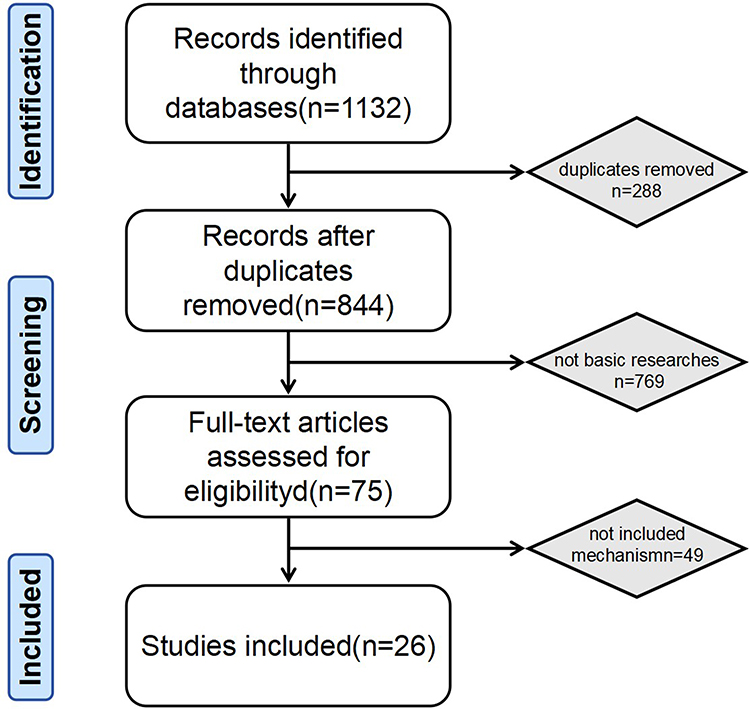 |
Figure 1 Study selection and search results. |
Identification of Active Components and Corresponding Targets After Acupuncture Treatment and CP/CPPS-Related Genes
An acupuncture target database comprising 1,059 genes was established through systematic screening and target prediction. Disease-related targets were retrieved from the GeneCards and DisGeNET databases and subsequently merged and deduplicated, resulting in a total of 6,485 unique CP/CPPS-associated genes. The screening and integration workflow is illustrated in Figure 2A. The Venn diagram in Figure 2B illustrates the overlap between acupuncture-related targets and CP/CPPS-associated genes, revealing 655 shared targets. These common genes were considered the key potential targets through which acupuncture may exert therapeutic effects in the treatment of CP/CPPS and were therefore selected for subsequent network construction and enrichment analyses. Cytoscape 3.10.3 software was subsequently used to create the “Acupuncture-Active Substance-Target-CP/CPPS” relationship network diagram, illustrating the potential regulatory mechanisms, as indicated in Figure 3.
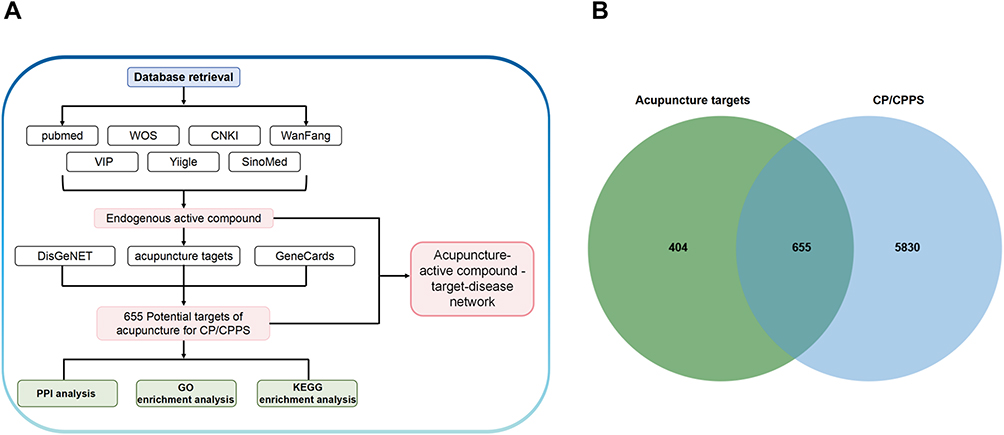 |
Figure 2 Screening and identification of candidate acupuncture targets for CP/CPPS. (A) Flowchart of acupuncture target database construction and CP/CPPS-related gene retrieval. (B) Venn diagram depicting the intersection of acupuncture-related targets and CP/CPPS-associated genes. |
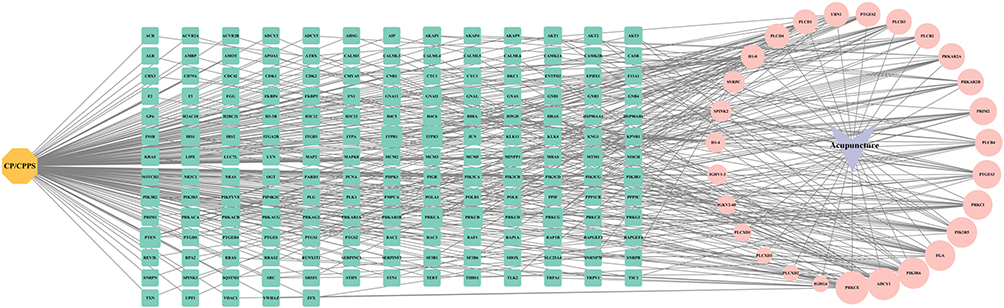 |
Figure 3 Acupuncture-Active Components-Target-CP/CPPS Interaction Network. |
PPI Network Construction and Hub Gene Identification
The key targets were imported into STRING to obtain PPI network information, which was then analyzed using Cytoscape 3.10.3 software. Targets with a Degree value ≥ 25 were selected for visualization, displaying 265 nodes. “Degree” represents the number of connections for a node, reflecting its interaction importance. The nodes were visualized with sizes and color gradients proportional to their Degree values, with larger, darker nodes placed more centrally to indicate greater importance (Figure 4A). Using the CytoHubba plugin and the MCC algorithm, we identified the top 10 hub genes based on Degree value: IL6, IL1B, IFNG, TNF, IL10, CD4, IL4, CXCL10, IL2, and CXCL8 (Figure 4B).
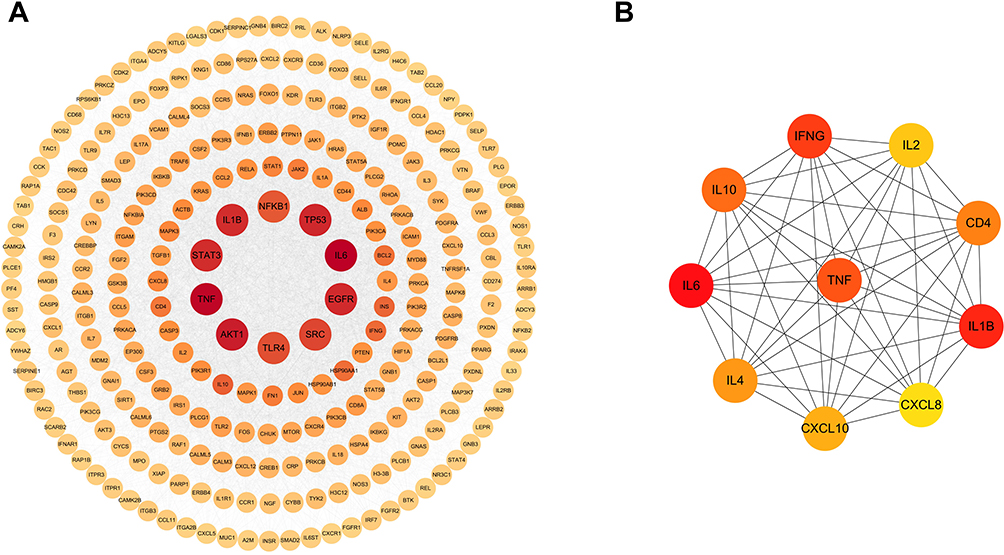 |
Figure 4 Construction of the Targets PPI network and identification of hub genes. (A) PPI network of Targets (B) Top 10 node networks identified by the MCC. |
GO and KEGG Enrichment Analysis of Key Targets
The GO analysis, from the three dimensions of Biological Process (BP), Cellular Component (CC), and Molecular Function (MF), revealed the potential biological characteristics of acupuncture in treating CP/CPPS, the results of which are displayed in Figure 5A. The analysis yielded a total of 1,878 terms (1,315 BP, 199 CC, and 364 MF). The top 10 terms from each category were analyzed. Key enriched BPs were centered on signal transduction, cytokine-mediated signaling, positive regulation of PI3K/AKT signaling, and the ERK1/ERK2 cascade, also involving regulation of cell population proliferation, gene expression, interleukin-6 production, immune response, and apoptosis. Key enriched CCs included collagen-containing extracellular matrix, extracellular space, extracellular exosome, plasma membrane, the external side of the plasma membrane, receptor complex, cell surface, cytosol, and protein-containing complex. Key enriched MFs were twofold: various binding functions (protein homodimerization, protein binding, protease binding, enzyme binding, protein kinase binding, scaffold protein binding, integrin binding, and ATP binding) and specific molecular activities (protein kinase activity and coreceptor activity).
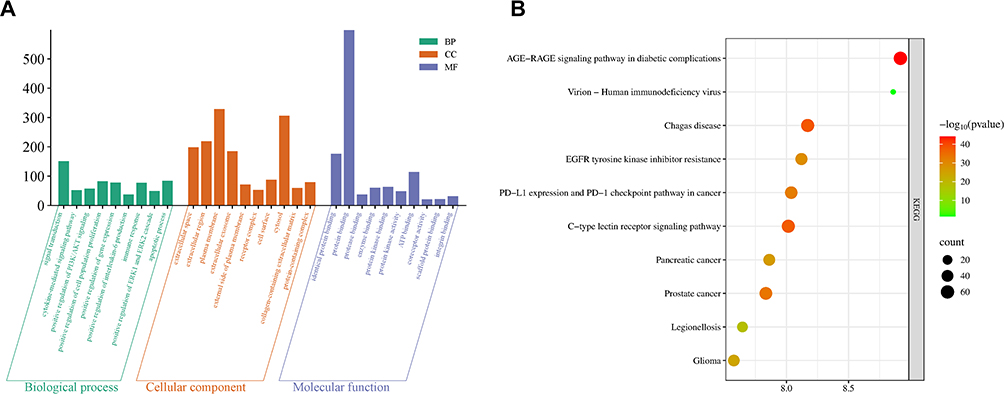 |
Figure 5 GO functional analysis and KEGG pathway enrichment analysis (A) GO functional analysis (B) KEGG pathway enrichment analysis. |
KEGG enrichment analysis suggested that acupuncture may exert its therapeutic effects by modulating various biological pathways, the results of which are displayed in Figure 5B. The top 10 signaling pathways included metabolic pathways (eg AGE-RAGE), immune regulatory pathways (eg C-type lectin receptor), virus- and infection-related pathways (eg HIV infection and Chagas disease), and immune checkpoint pathways (eg PD-L1/PD-1).
Discussion
This study employed a network-based acupuncture strategy to explore the mechanisms underlying acupuncture treatment for CP/CPPS. Our findings indicate that regulation of inflammatory responses may represent a core mechanism, with multiple key targets involved, including representative pro-inflammatory and anti-inflammatory factors such as IL6 and IL10. While the contribution of individual genes may be modest, their combined effects may be more effectively captured by a systems-level framework than by conventional reductionist approaches. Furthermore, enrichment analysis revealed biological processes related to tissue repair and neural remodeling, suggesting that acupuncture may exert broader regulatory effects beyond inflammation modulation. Collectively, these findings provide potential candidate molecular targets and biological pathways for future experimental validation and mechanistic investigation.
Immunomodulatory Effects of Acupuncture in CP/CPPS
A major finding of this study is that acupuncture may exert upstream regulatory effects by reshaping the local immune microenvironment. CP/CPPS is currently widely recognized as a chronic inflammatory condition mediated by immune and neuroendocrine factors.22 Our network analysis identified hub genes including pro-inflammatory mediators (IL6, IL1B, TNF, CXCL8, and CXCL10) and immunoregulatory cytokines (IL10 and IL4), suggesting that CP/CPPS is characterized by concurrent inflammatory activation and compensatory immunoregulatory responses. In line with this interpretation, IL6, IL1B, TNF, and CXCL8 have been reported as biomarkers associated with disease severity, while experimental autoimmune prostatitis models show sustained elevation of IL-1β, IL-6, and TNF-α, supporting persistent activation of the prostatic immune microenvironment.23–25 Within this inflammatory milieu, chemokines such as CXCL10 may further exacerbate disease progression by promoting immune cell recruitment and neuroinflammation, thereby contributing to the development of chronic pelvic pain.26 Conversely, Th2-related cytokines such as IL-4 and anti-inflammatory mediators like IL-10 may exert regulatory effects that help restrain excessive immune activation and tissue damage, providing a plausible mechanistic basis for the immunomodulatory effects observed in acupuncture treatment.27
This interpretation was further supported by pathway enrichment analyses. KEGG analysis showed significant enrichment of the AGE-RAGE and C-type lectin receptor signaling pathways, both of which are closely related to inflammatory amplification and innate immune activation. Evidence from other disease models suggests that acupuncture can suppress AGE-RAGE signaling and modulate CLR-related immune pathways.28,29 GO analysis further indicated that acupuncture-regulated genes were mainly involved in cytokine-mediated signaling, immune responses, and intracellular signal transduction, including PI3K-AKT and ERK pathways known to participate in prostatitis-associated immune activation.30,31 Although IL-6 is classically considered a pro-inflammatory cytokine, recent evidence suggests that it may also contribute to inflammatory resolution and neuroimmune homeostasis.32 Therefore, enrichment of IL-6-related processes in the present study may reflect dynamic remodeling of inflammatory regulatory networks rather than simple pro-inflammatory activation. Overall, these findings suggest that acupuncture exerts immunomodulatory effects through coordinated regulation of inflammation-related signaling networks.
Acupuncture’s Role in Tissue Repair and Extracellular Matrix Remodeling
In addition to inflammation control, our findings suggest that acupuncture may facilitate tissue repair and structural remodeling in CP/CPPS. Clinical and experimental studies indicate that CP/CPPS is frequently accompanied by extracellular matrix (ECM) disruption and impaired remodeling, which may compromise tissue integrity and barrier function and partly explain the limited efficacy of therapies targeting inflammation alone.33
Consistent with this view, enrichment analyses identified biological processes related to cell proliferation, regulation of gene expression, and positive regulation of apoptosis, suggesting that acupuncture may promote regeneration of prostatic epithelial and stromal compartments after inflammatory injury. Similar reparative effects of electroacupuncture have been reported in other chronic inflammatory and injury models.34,35 We also observed enrichment of ECM-related terms involving collagen components, together with molecular functions such as integrin binding and scaffold protein binding, indicating potential regulation of cell-matrix interactions and structural stability. Evidence from chronic wound models likewise supports a role for acupuncture in promoting collagen reconstruction, angiogenesis, and tissue repair.36 Collectively, these findings suggest that the therapeutic effects of acupuncture in CP/CPPS extend beyond inflammation suppression to include post-inflammatory tissue repair and functional restoration.
Neuromodulatory Effects of Acupuncture on the Central Nervous System in CP/CPPS
Neuroimaging studies have revealed abnormal activity and connectivity in pain-related brain regions, supporting the presence of central sensitization in chronic pelvic pain disorders.37 Consistently, neurochemical and structural imaging studies further demonstrate altered neurotransmitter balance and reduced gray matter volume in these regions, changes that correlate with pain severity and emotional distress.38,39 Neuroimaging studies indicate that acupuncture can regulate activity in pain-related brain regions, particularly the anterior cingulate cortex and associated limbic structures, potentially contributing to normalization of dysfunctional pain networks.40,41 While these studies highlight important neural alterations, the precise mechanisms underlying acupuncture’s therapeutic effects remain unclear.
In this context, our study provides new insights into the potential mechanisms underlying acupuncture’s effects. Specifically, GO analysis revealed enrichment of differentially expressed genes in CC associated with extracellular exosomes, extracellular space, and the plasma membrane, while BP enrichment highlighted signal transduction. These findings suggest that intercellular communication mechanisms may participate in acupuncture-induced regulation.42,43 Given the roles of neuroinflammation and maladaptive neural plasticity in CP/CPPS, it is plausible that exosome-mediated signaling contributes to the central analgesic effects of acupuncture by modulating the neuroimmune microenvironment. Based on these findings, a schematic model summarizing the network-level regulatory effects of acupuncture in CP/CPPS is presented in Figure 6.
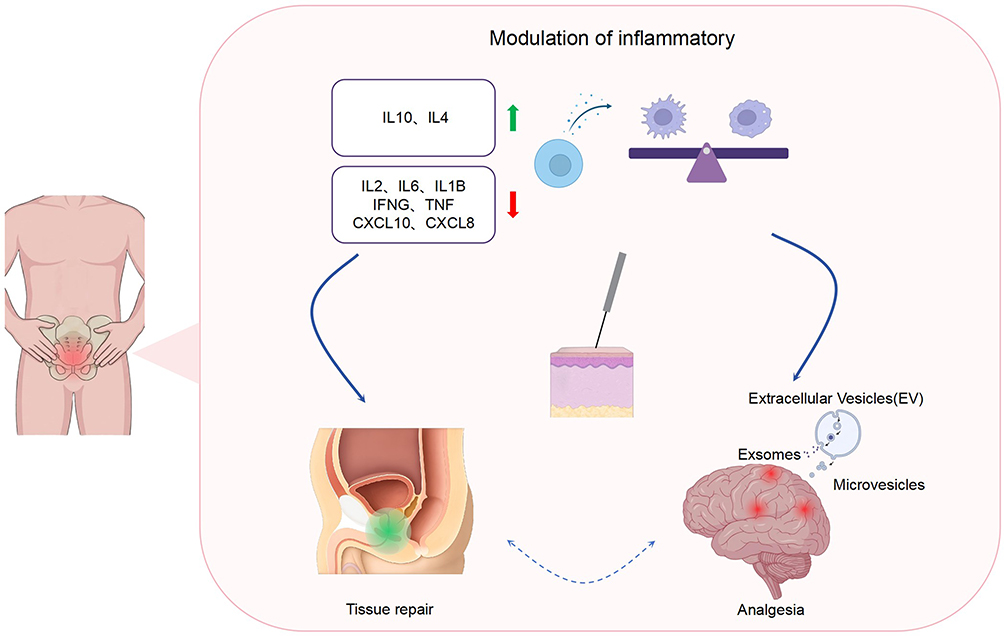 |
Figure 6 Potential regulatory mechanisms of acupuncture for treating CP/CPPS. Green upward arrows represent the upregulation of anti-inflammatory factors, whereas red downward arrows represent the downregulation of pro-inflammatory factors. Solid curved arrows indicate established interactions between different phenotypes, while dashed curved arrows indicate potential interactions. The graphical elements were generated using Figdraw. |
Limitations and Prospects
Based on the current literature, mechanistic studies on acupuncture are still in a developmental and accumulative stage. Accordingly, the data analysis in the present study was primarily based on the integration of existing datasets, which may be affected by incomplete or biased database annotations, potentially influencing the robustness of the results. In addition, the protein-protein interaction network constructed in this study is inherently static and undirected, reflecting molecular associations rather than dynamic or causal regulatory relationships. In the absence of experimental validation, the capacity for causal inference remains limited. Moreover, key acupuncture-related parameters, including acupoint selection, stimulation intensity, and needle retention time, may substantially influence biological responses; however, these factors could not be systematically controlled or quantitatively modeled within the current analytical framework.
Despite these limitations, this study innovatively applies a network acupuncture framework to capture the cumulative effects of multiple modest regulatory responses that may not be readily detectable in conventional experimental studies. More broadly, future mechanistic research on acupuncture should move beyond fragmented descriptions of local effects to clarify how local stimulation translates into system-level therapeutic regulation. This will require a more precise characterization of acupuncture interventions, including acupoint selection, stimulation parameters, and treatment context, so that apparently similar procedures can be interpreted as comparable biological inputs. In addition, mechanistic studies should pay greater attention to how local responses are transmitted across spatially organized cellular microenvironments and multi-level biological networks, and how these dynamic processes are ultimately linked to therapeutic outcomes. In this regard, spatial transcriptomics may offer a particularly valuable approach. Progress along these lines may help explain the holistic regulatory effects of acupuncture more clearly and strengthen its mechanistic foundation within modern biomedicine.
Conclusion
In summary, this study employed a bioinformatics-based approach combined with network topological analysis to integrate multiple target datasets and identify key hub genes and functional pathways associated with acupuncture in CP/CPPS. The findings suggest that acupuncture may exert its therapeutic effects through coordinated regulation of immune-inflammatory networks, tissue repair-related processes, and central nervous system remodeling and functional recovery, rather than through a single target or pathway. These results provide a theoretical basis for understanding the multi-target regulatory mechanisms of acupuncture in CP/CPPS from a global network perspective and support future experimental validation and translational research.
Abbreviations
CP/CPPS, Chronic prostatitis/chronic pelvic pain syndrome; PPI, Protein-protein interaction; MCC, Maximal Clique Centrality; DAVID, Database for Annotation, Visualization and Integrated Discovery; KEGG, Kyoto Encyclopedia of Genes and Genomes; GO, Gene Ontology; WOS, Web of Science; CNKI, China National Knowledge Infrastructure; VIP, VIP Chinese Science and Technology Periodical Database; MeSH, Medical Subject Headings; BP, Biological Process; CC, Cellular Component; MF, Molecular Function; ECM, extracellular matrix; NSAIDs, non-steroidal anti-inflammatory drugs.
Acknowledgments
Thanks for the learning experience at the Department of Andrology, Xiyuan Hospital of China Academy of Chinese Medical Sciences.
Funding
This work was supported by the Beijing Municipal Scheme for Supporting High-Level Innovation and Entrepreneurship Talent (Grant No. G202524104); the Beijing Traditional Chinese Medicine New Era 125 Project Training Programme; the National Administration of Traditional Chinese Medicine Project for the Development of High-Level Key Disciplines in Traditional Chinese Medicine (Grant No. Zyyzdxk-2023238); and the “Seeking Truth” Project of the Chinese Association of Traditional Chinese Medicine (Grant No. 2023-QNQS-02).
Disclosure
The authors report no conflicts of interest in this work
References
1. Borgert BJ, Wallen EM, Pham MN. Prostatitis: a Review. JAMA. 2025;334(11):1003–11. doi:10.1001/jama.2025.11499
2. Li H, Kang D. Prevalence of sexual dysfunction in men with chronic prostatitis/chronic pelvic pain syndrome: a meta-analysis. World J Urol. 2016;34(7):1009–1017. doi:10.1007/s00345-015-1720-3
3. Brünahl C, Dybowski C, Albrecht R, et al. Mental disorders in patients with chronic pelvic pain syndrome (CPPS). J Psychosom Res. 2017;98:19–26. doi:10.1016/j.jpsychores.2017.04.011
4. Franco JVA, Turk T, Jung JH, et al. Pharmacological interventions for treating chronic prostatitis/chronic pelvic pain syndrome: a Cochrane systematic review. BJU Int. 2020;125(4):490–496. doi:10.1111/bju.14988
5. Qin Z, Zhang C, Guo J, et al. Oral pharmacological treatments for chronic prostatitis/chronic pelvic pain syndrome: a systematic review and network meta-analysis of randomised controlled trials. EClinicalMedicine. 2022;48:101457. doi:10.1016/j.eclinm.2022.101457
6. Schrepf AD, Mawla I, Naliboff BD, et al. Neurobiology and long-term impact of bladder-filling pain in humans: a multidisciplinary approach to the Study of Chronic Pelvic Pain (MAPP) research network study. Pain. 2023;164(10):2343–2351. doi:10.1097/j.pain.0000000000002944
7. Clemens JQ, Mullins C, Ackerman AL, et al. Urologic chronic pelvic pain syndrome: insights from the MAPP Research Network. Nat Rev Urol. 2019;16(3):187–200. doi:10.1038/s41585-018-0135-5
8. Ma X, Lao Y, Bai Y, et al. Study progress of etiologic mechanisms of chronic prostatitis/chronic pelvic pain syndrome. Int Immunopharmacol. 2025;148:114128. doi:10.1016/j.intimp.2025.114128
9. Han R, Hu J. Acupuncture: an overview on its functions, meridian pathways and molecular mechanisms. Am J Chin Med. 2024;52(5):1215–1244. doi:10.1142/S0192415X24500496
10. Allen J, Mak SS, Begashaw M, et al. Use of acupuncture for adult health conditions, 2013 to 2021: a systematic review. JAMA Network Open. 2022;5(11):e2243665. doi:10.1001/jamanetworkopen.2022.43665
11. Pan J, Jin S, Xie Q, et al. Acupuncture for chronic prostatitis or chronic pelvic pain syndrome: an updated systematic review and meta-analysis. Pain Res Manag. 2023;2023:7754876. doi:10.1155/2023/7754876
12. Qin Z, Guo J, Chen H, Wu J. Acupuncture for chronic prostatitis/chronic pelvic pain syndrome: a GRADE-assessed systematic review and meta-analysis. Eur Urol Open Sci. 2022;46:55–67. doi:10.1016/j.euros.2022.10.005
13. Sun D, Chang H, Luo D, Du G, Wang H, Yan B. Una revisión narrativa de la acupuntura en enfermedades de la próstata: perspectivas de la medicina tradicional China, evidencia actual y direcciones futuras [A narrative review of acupuncture in prostate diseases: perspectives from traditional Chinese medicine, current evidence and future directions]. Rev Int Androl. 2025;23. doi:10.22514/j.androl.2025.027
14. Sun Y, Liu Y, Liu B, et al. Efficacy of acupuncture for chronic prostatitis/chronic pelvic pain syndrome: a randomized trial. Ann Intern Med. 2021;174(10):1357–1366. doi:10.7326/M21-1814
15. Liou KT, Carlsson S, Ajay D, et al. Acupuncture for nocturia in survivors of prostate cancer: the NOCTURNAL randomized clinical trial. JAMA Oncol. 2025;11(7):791–794. doi:10.1001/jamaoncol.2025.1199
16. Yetişir A, Öztürk GY. Effects of low-level laser therapy on acupuncture points on knee pain and function in knee osteoarthritis. Rev Assoc Med Bras. 2023;70(1):e20230264. doi:10.1590/1806-9282.20230264
17. Wu X, Cheng K, Xu C, et al. Mechanism of acupuncture and moxibustion on chronic prostatitis/chronic pelvic pain syndrome: a narrative review of animal studies. Pain Res Manag. 2021;2021:2678242. doi:10.1155/2021/2678242
18. Wang H, Zhang J, Ma D, Zhao Z. The role of acupuncture and its related mechanism in treating chronic prostatitis/chronic pelvic pain syndrome. Int J Gen Med. 2023;16:4039–4050. doi:10.2147/IJGM.S417066
19. Li F, Liu Z, Xu Y, et al. Potential mechanisms of acupuncture treatment for rheumatoid arthritis: a study based on network topology and machine learning. Chin Med. 2025;20(1):164. doi:10.1186/s13020-025-01209-8
20. Han Z, Zhang Y, Wang P, Tang Q, Zhang K. Is acupuncture effective in the treatment of COVID-19 related symptoms? Based on bioinformatics/network topology strategy. Brief Bioinform. 2021;22(5):bbab110. doi:10.1093/bib/bbab110
21. Tian M, Sun W, Mao Y, Zhang Y, Liu H, Tang Y. Mechanistic study of acupuncture on the pterygopalatine ganglion to improve allergic rhinitis: analysis of multi-target effects based on bioinformatics/network topology strategie. Brief Bioinform. 2024;25(4):bbae287. doi:10.1093/bib/bbae287
22. Wang H, Zhao M, Zhang J, Yan B, Gao Q, Guo J. Traditional Chinese medicine regulates inflammatory factors in chronic prostatitis/chronic pelvic pain syndrome: a review. Integr Med Nephrol Androl. 2023;10(1). doi:10.1097/IMNA-D-22-00001
23. Moryousef J, Blankstein U, Curtis Nickel J, Krakowsky Y, Gilron I, Jarvi K. Overview of seminal fluid biomarkers for the evaluation of chronic prostatitis: a scoping review. Prostate Cancer Prostatic Dis. 2022;25(4):627–640. doi:10.1038/s41391-021-00472-8
24. Chen Z, Ma J, Yu X, Liu X, Wang S, Wang Z. Zinc ameliorates inflammation and sperm parameters in rats with experimental autoimmune prostatitis. Prostate. 2026;86(2):167–178. doi:10.1002/pros.70067
25. Meng LQ, Yang FY, Wang MS, et al. Quercetin protects against chronic prostatitis in rat model through NF-κB and MAPK signaling pathways. Prostate. 2018;78(11):790–800. doi:10.1002/pros.23536
26. Chen L, Chen Z, Chen J, et al. CXCL10 promotes spinal macrophage recruitment via the JAK/STAT3 pathway to induce pain in experimental autoimmune prostatitis. Cell Prolif. 2025;58(4):e13784. doi:10.1111/cpr.13784
27. Motrich RD, Breser ML, Sánchez LR, Godoy GJ, Prinz I, Rivero VE. IL-17 is not essential for inflammation and chronic pelvic pain development in an experimental model of chronic prostatitis/chronic pelvic pain syndrome. Pain. 2016;157(3):585–597. doi:10.1097/j.pain.0000000000000405
28. Wang X, Li Q, Han X, Gong M, Yu Z, Xu B. Electroacupuncture alleviates diabetic peripheral neuropathy by regulating glycolipid-related GLO/AGEs/RAGE axis. Front Endocrinol. 2021;12:655591. doi:10.3389/fendo.2021.655591
29. Jingxuan L, Qian MO, Guowu L, et al. Four-dimensional data independent acquisition proteomics and metabolomics reveal mechanisms of hydrogen-rich water at Zusanli (ST36) point against triple-negative breast cancer in mice. J Tradit Chin Med. 2025;45(6):1238–1253. doi:10.19852/j.cnki.jtcm.20250929.002
30. Xu S, Chen J, Yue S, et al. Alcohol intake exacerbates experimental autoimmune prostatitis through activating PI3K/AKT/mTOR pathway-mediated Th1 differentiation. Front Immunol. 2024;15:1512456. doi:10.3389/fimmu.2024.1512456
31. Song G, Zhao F, Ni R, et al. Epithelial cells derived exosomal miR-203a-3p facilitates stromal inflammation of type IIIA chronic prostatitis/chronic pelvic pain syndrome by targeting DUSP5 and increasing MCP-1 generation. J Nanobiotechnology. 2024;22(1):236. doi:10.1186/s12951-024-02513-5
32. Miller LJ, Fischer KA, Goralnick SJ, et al. Nerve growth factor and chronic prostatitis/chronic pelvic pain syndrome. Urology. 2002;59(4):603–608. doi:10.1016/s0090-4295(01)01597-7
33. Froehlich JW, Wang HHS, Logvinenko T, et al. The urinary proteomic profile implicates key regulators for Urologic Chronic Pelvic Pain Syndrome (UCPPS): a MAPP Research Network Study. Mol Cell Proteomics. 2022;21(1):100176. doi:10.1016/j.mcpro.2021.100176
34. Zhang Q, Wei F, Zhang L, et al. Electroacupuncture at Huatuo-Jiaji acupoints combined with conductive hydrogel synergistically improves bladder and motor functions after spinal cord injury. Mater Today Bio. 2025;35:102335. doi:10.1016/j.mtbio.2025.102335
35. Hu R, He K, Chen B, et al. Electroacupuncture promotes the repair of the damaged spinal cord in mice by mediating neurocan-perineuronal net. CNS Neurosci Ther. 2024;30(1):e14468. doi:10.1111/cns.14468
36. Chen TY, Wen TK, Dai NT, Hsu SH. Cryogel/hydrogel biomaterials and acupuncture combined to promote diabetic skin wound healing through immunomodulation. Biomaterials. 2021;269:120608. doi:10.1016/j.biomaterials.2020.120608
37. Kleinhans NM, Yang CC, Strachan ED, Buchwald DS, Maravilla KR. Alterations in connectivity on functional magnetic resonance imaging with provocation of lower urinary tract symptoms: a MAPP research network feasibility study of urological chronic pelvic pain syndromes. J Urol. 2016;195(3):639–645. doi:10.1016/j.juro.2015.09.092
38. Harper DE, Ichesco E, Schrepf A, et al. Relationships between brain metabolite levels, functional connectivity, and negative mood in urologic chronic pelvic pain syndrome patients compared to controls: a MAPP research network study. Neuroimage Clin. 2018;17:570–578. doi:10.1016/j.nicl.2017.11.014
39. Mordasini L, Weisstanner C, Rummel C, et al. Chronic pelvic pain syndrome in men is associated with reduction of relative gray matter volume in the anterior cingulate cortex compared to healthy controls. J Urol. 2012;188(6):2233–2237. doi:10.1016/j.juro.2012.08.043
40. Wu MT, Hsieh JC, Xiong J, et al. Central nervous pathway for acupuncture stimulation: localization of processing with functional MR imaging of the brain--preliminary experience. Radiology. 1999;212(1):133–141. doi:10.1148/radiology.212.1.r99jl04133
41. Cai RL, Shen GM, Wang H, Guan YY. Brain functional connectivity network studies of acupuncture: a systematic review on resting-state fMRI. J Integr Med. 2018;16(1):26–33. doi:10.1016/j.joim.2017.12.002
42. Zhang S, Jin T, Wang L, et al. Electro-acupuncture promotes the differentiation of endogenous neural stem cells via exosomal microRNA 146b after ischemic stroke. Front Cell Neurosci. 2020;14:223. doi:10.3389/fncel.2020.00223
43. Li NC, Li MY, Lu ZX, et al. Exosome is an important novel way of acupuncture information transmission. World J Tradit Chin Med. 2020;6(4):377. doi:10.4103/wjtcm.wjtcm_57_20
 © 2026 The Author(s). This work is published and licensed by Dove Medical Press Limited. The
full terms of this license are available at https://www.dovepress.com/terms
and incorporate the Creative Commons Attribution
- Non Commercial (unported, 4.0) License.
By accessing the work you hereby accept the Terms. Non-commercial uses of the work are permitted
without any further permission from Dove Medical Press Limited, provided the work is properly
attributed. For permission for commercial use of this work, please see paragraphs 4.2 and 5 of our Terms.
© 2026 The Author(s). This work is published and licensed by Dove Medical Press Limited. The
full terms of this license are available at https://www.dovepress.com/terms
and incorporate the Creative Commons Attribution
- Non Commercial (unported, 4.0) License.
By accessing the work you hereby accept the Terms. Non-commercial uses of the work are permitted
without any further permission from Dove Medical Press Limited, provided the work is properly
attributed. For permission for commercial use of this work, please see paragraphs 4.2 and 5 of our Terms.
Recommended articles
Core Acupoint Prescription Patterns for Primary Dysmenorrhea: Data Mining and Network-Based Analysis
Yang T, Guo W, Deng C, Zhang L
Journal of Pain Research 2026, 19:579686
Published Date: 16 March 2026