
Back to Journals » Journal of Multidisciplinary Healthcare » Volume 18
Knowledge, Attitudes, and Willingness Towards Organ Donation Among Operating Room Nurses in Sichuan, China: A Cross-Sectional Study

Received 10 April 2025
Accepted for publication 10 September 2025
Published 30 September 2025 Volume 2025:18 Pages 6247—6256
DOI https://doi.org/10.2147/JMDH.S533619
Checked for plagiarism Yes
Review by Single anonymous peer review
Peer reviewer comments 2
Editor who approved publication: Dr Scott Fraser
Chunrong Luo,1,2 Yongqiong Tan,1,2 Jingyi Wei3
1Operating Room, West China Hospital, Sichuan University, Chengdu, Sichuan, 610000, People’s Republic of China; 2West China School of Nursing, Sichuan University, Chengdu, Sichuan, 610000, People’s Republic of China; 3State Key Laboratory of Oral Diseases & National Center for Stomatology & National Clinical Research Center for Oral Diseases, West China Hospital of Stomatology, Sichuan University, Chengdu, Sichuan, 610041, People’s Republic of China
Correspondence: Jingyi Wei, State Key Laboratory of Oral Diseases & National Center for Stomatology & National Clinical Research Center for Oral Diseases, West China Hospital of Stomatology, Sichuan University, No. 14, Section 3, Renmin South Road, Chengdu, Sichuan, 610041, People’s Republic of China, Tel +8618981755241, Email [email protected]
Purpose: Despite significant progress in organ donation programs worldwide, there remains an imbalance between the global demand for and availability of organs. While healthcare professionals play an important role in organ donation, operating room nurses, due to their direct involvement in transplant-related procedures such as organ retrieval and transplantation surgery, play an important role, yet their perspectives remain underexplored. This study aims to investigate the knowledge, attitudes, and willingness towards organ donation among nurses in the operating room.
Patients and Methods: A cross-sectional study was conducted from April 15, 2024, to April 25, 2024, at four tertiary hospitals in Sichuan Province, all of which are accredited for organ transplantation procedures. Demographic data, knowledge, attitudes, and willingness towards organ donation were collected from operating theatre nurses through a questionnaire. Using snowball sampling via WeChat, we disseminated an electronic questionnaire to operating room nurses across the selected hospitals. Adequate knowledge was defined as achieving 70% or more of the maximum possible score.
Results: A total of 502 nurses were included in the study, of whom 442 (88.05%) were female. Furthermore, 230 (45.82%) of the participants had been employed in the field for over a decade. The mean knowledge and attitude scores were 7.57/10 and 105.32/154, respectively. While only 16.14% were unwilling to donate, nearly half (49.6%) remained undecided, respectively. Multivariate logistic regression analysis revealed that the total attitude score (OR = 1.037, 95% CI: [1.024– 1.050], P < 0.001), participation in voluntary blood donation (OR = 1.564, 95% CI: [1.013– 2.415], P = 0.044), registration for organ donation (OR = 6.056, 95% CI: [1.514– 24.225], P = 0.011), and discussions about organ donation with family members (OR = 2.898, 95% CI: [1.818– 4.621], P < 0.001) were independently associated with a willingness to donate.
Conclusion: Nurses in operating room had adequate knowledge and neutral attitudes, particularly concerning family consent and concerns over organ allocation towards organ donation.
Keywords: knowledge, attitudes, willingness, operating room, nurses, organ donation
Introduction
Organ donation, an important aspect of healthcare since the 1960s, has prompted the initiation of national programs in at least eighty countries.1 It stands as a lifeline for patients in need of organ transplants. Despite concerted efforts, there persists a global imbalance between the demand for organs and their availability.2 Each year, the number of individuals added to solid organ donation people waiting for transplants surpasses those who actually receive a transplant.3,4 This disparity underscores the urgent need to optimize organ donation practices.
In most countries, health professionals, particularly health professionals involved in organ donation, particularly physicians, play a key role in organ donation. Serving as local champions within intensive care units and hospitals, they shoulder the responsibility and accountability for facilitating deceased organ donation.5 While these programs are indispensable, they alone fall short of meeting the escalating demand for organs. Literature suggests that expanding education and involvement in organ donation beyond physicians to include other key medical personnel is necessary.6 Operating room nurses are uniquely positioned to influence organ donation outcomes through their roles in intraoperative care of donors and recipients, coordination with transplant teams, and organ procurement logistics. Yet, their perspectives remain underexplored during surgeries and deep understanding of physical conditions. Despite their significant role, research has predominantly focused on physicians and general nursing staff, leaving a knowledge gap about operating theatre nurses’ attitudes towards organ donation.7–9 This gap is particularly concerning given their potential impact on organ donation outcomes. In China, despite the implementation of a voluntary organ donation system in 2015, family consent remains a significant barrier, and cultural beliefs regarding bodily integrity persist. Understanding OR nurses’ perspectives is thus essential for improving donation rates in this unique sociocultural context.
The Knowledge-Attitude-Practice model is a fundamental theory in health literacy and plays a core role in shaping human health behaviors.10 It posits that knowledge positively influences attitudes, which in turn drive individual practices.11 Given OR nurses’ hands-on involvement in the donation process, their knowledge gaps or negative attitudes may directly hinder organ donation implementation, making a KAP assessment particularly relevant. In Hong Kong, medical students showed high positivity but low donor registration, indicating a gap between attitude and action.12 The Saudi Arabian community exhibited moderate knowledge with a preference for family member donations, reflecting cultural influences.13 Karachi’s students and physicians demonstrated high knowledge and attitudes but low practical application, suggesting a disconnect between theoretical understanding and real-world practices.7 In Southern Saudi Arabia, healthcare professionals and students had adequate knowledge but hesitance to donate, highlighting barriers like religious beliefs and knowledge gaps.14 The integrative review showed positive effects of educational initiatives on healthcare professionals’ attitudes and knowledge,15 while in Quebec, pharmacists were positively inclined but identified a need for more knowledge, emphasizing the role of targeted educational programs.16
Understanding an individual’s willingness is important for future practice implementation, especially in contexts like organ donation. To address these gaps, this study assessed operating room nurses’ knowledge, attitudes, and willingness regarding organ donation in Sichuan, China, and identified predictors associated with these outcomes.
Materials and Methods
Study Design and Participants
Data collection for this cross-sectional study was conducted between April 15, 2024, and April 25, 2024, in four tertiary care hospitals in Sichuan Province, China, authorized for organ transplantation, focusing on operating theatre nurses. This study was approved by the Ethics Committee of the West China Hospital of Sichuan University (No.2024 Review (504), and all participants provided written informed consent.
Inclusion criteria encompassed registered nurses with a valid license and a minimum of one year of experience in the operating room. Exclusion criteria comprised interns, residents, fellows, and those on medical leave, vacation, or involved in external educational activities.
Questionnaire Design
In our study, we utilized the Organ Donation Scale, originally developed by Shih Li-chu and others from Taiwan,17 and enhanced it with additional demographic information derived from a comprehensive literature review.18–20 The final questionnaire, presented in Chinese, was structured into four sections: Demographic Information (including gender, age, education level, professional title, years of work experience, etc)., Knowledge, Attitude, and Willingness.
The Knowledge section comprised 10 questions, with correct answers awarded 1 point and incorrect ones 0 points, leading to a total possible score ranging from 0 to 10. The Attitude section consisted of 22 questions, divided into three sub-sections: “Barriers to Organ Donation” (9 questions, items 12–22), “Recognition of the Value of Organ Donation” (items 1–6), and “Non-recognition of the Value of Organ Donation” (items 7–9, 10–11). This section employed a 7-point Likert scale, with options ranging from “Strongly Disagree” (1 point) to “Strongly Agree” (7 points). For the positively framed questions (items 1–6), higher scores indicated a more favorable attitude towards organ donation, whereas for the negatively framed questions (items 7–22), higher scores suggested a less favorable attitude. The Willingness Dimension was assessed with five questions. The first item, the Organ Donation Willingness Scale, used a 5-point Likert scale ranging from “Unwilling” (1 point) to “Willing and have signed an organ donation card” (5 points), with higher scores reflecting greater willingness to donate. The internal consistency of the questionnaire was assessed using Cronbach’s alpha, yielding an overall value of 0.898, indicating good reliability. The subsequent items (2 to 4) focused on the willingness to donate specific organs, similar organs, and preferences for organ recipients. Adequate knowledge and a positive attitude were defined as scores exceeding 70% of the maximum possible score in each respective dimension. This threshold was adopted based on precedent in similar KAP studies, where 70% is commonly used to indicate sufficient knowledge or a favorable attitude.21,22
Questionnaire Distribution and Quality Control
Using a snowball sampling method, the initial participants were recruited from the four selected hospitals and were then asked to forward the questionnaire link to other operating room nurses within their professional network. The electronic questionnaires were distributed via Wechat (Tencent, China) using a link created by the Wen-Juan-Xing online platform (Changsha Ranxing Information Technology Co., Ltd; https://www.wjx.cn/app/survey.aspx), an online questionnaire software platform. The researcher contacted the principal investigator at the surveyed hospitals, providing a detailed in-person explanation of the study’s purpose, significance, and methodology. The organization and implementation of the survey were thoroughly discussed. Subsequently, the researcher and the hospital’s principal investigator jointly conducted an online meeting to brief the study participants on the research objectives, methods, significance, as well as instructions and precautions for questionnaire completion. Following the training, the principal investigator shared the survey questionnaire’s QR code in the department’s WeChat workgroup, overseeing and guiding the nurses in completing the questionnaire.
Sample Size
Sample size was calculated using the formula for cross-sectional studies: α=0.05,  where
where  when α=0.05, the assumed degree of variability of p=0.5 maximizes the required sample size, and δ is admissible error (which was 5% here). The calculated sample size was 480, including an extra 20% to allow for subjects lost during the study.
Statistical Analysis
Statistical analysis was conducted using SPSS 26.0 (IBM Corp., Armonk, N.Y., USA) and AMOS 22.0 (IBM Corp., Armonk, N.Y., USA). Continuous variables were described as means and standard deviations (SD), while categorical variables were summarized as frequencies and percentages (n%). Normality of continuous data was assessed, with the t-test applied to normally distributed data and the Wilcoxon Mann–Whitney test to non-normally distributed data for comparisons between two groups. For analyses involving three or more groups, ANOVA was used for continuous variables with normal distribution and equal variances, and the Kruskal–Wallis test was employed for data not normally distributed. Both univariate and multivariate logistic regression analyses were conducted to identify factors associated with adequate knowledge, positive attitude, and willingness to donate organs. A p-value of less than 0.05 (two-sided) was considered statistically significant.
Results
Out of 502 operating theatre nurses who participated in this study, 442 (88.05%) were females, 226 (45.02%) were in the age group of 30–39 years, 308 (61.35%) were born in rural areas, 321 (63.94%) were not the only child, 329 (65.54%) were married, 292 (58.17%) had children, 373 (74.30%) were educated to the level of Bachelor’s degree and above, and 230 (45.82%) have been working for more than 10 years. The mean knowledge and attitude scores were 7.57±1.10 (possible range: 0–10) and 105.32±18.87 (possible range: 22–154), respectively. Participants who had participated in organ procurement surgery (P = 0.014 and P = 0.005) and participated in organ transplant surgery (P < 0.001 and P < 0.001) were more likely to have higher knowledge and attitude scores. Those who had no religious beliefs (P = 0.042), were the only child (P = 0.035), unmarried (P = 0.033), had an education level higher than technical school (P = 0.049), participated in public service activities more than once a year (P = 0.019), had discussed their willingness to donate with family members (P < 0.001), had family members with positive attitudes toward organ donation (P < 0.001), and had promoted or advertised organ donation (P = 0.002) were more likely to have higher attitude scores (Table S1).
The response for the knowledge dimension showed that the two knowledge items with the highest accuracy rates were “Organ transplantation surgery can be performed at any time after a person’s death”. (K3) with 99.00% and “People with any illness can donate organs”. (K4) with 97.81%. While the two items with the lowest correctness rates were “If the deceased expressed a written willingness to donate during their lifetime, physicians can remove organs”. (K6) with 16.33% and “Organs cannot be removed unless the deceased had agreed in writing during their lifetime”. (K7) with 50.40% (Table S2).
The attitude dimension showed that 61.95% of the participants strongly agreed that organ donation could save many lives (A1), and 52.19% strongly agreed that it would be wonderful if someone could live a normal life as a result of receiving their donated organs (A4). However, 41.63% were neutral on the effectiveness of organ donation in saving lives (A7). Meanwhile, 45.42% were neutral that their family would be unhappy if they knew about the organ donation (A21). Additionally, 30.68% strongly disagreed that for people who agree to donate their organs, physicians cannot wait to remove their organs before confirming their death (A14) (Table S3).
In the willingness dimension, 49.6% of participants had contemplated organ donation but remained undecided (W1), while 16.14% expressed clear unwillingness. Additionally, 53.98% were uncertain about signing an organ donation consent form for family members when their lives could not be saved (W2). Regarding specific organs, cornea emerged as the most preferred, chosen by 36.65% of participants (W3). Notably, 76.89% favored donating organs to family members, and 56.37% expressed willingness to donate to strangers (W4) (Table S4).
Multivariate logistic regression was performed to further explore the factors associated with knowledge, attitude, and willingness. The results showed that participated in organ transplant surgery (OR = 1.993, 95% CI: [1.118–3.555], P = 0.019) was independently associated with good knowledge (Tables 1 and S5). Also, participated in organ transplant surgery (OR = 2.240, 95% CI: [1.233–4.071], P = 0.008), discussed organ donation with family members (OR = 2.802, 95% CI: [1.824–4.304], P < 0.001), and promoted or advocated for organ donation (OR = 2.078, 95% CI: [1.192–3.622], P = 0.010) were independently associated with positive attitude (Tables 2 and S6). Furthermore, attitude total score (OR = 1.037, 95% CI: [1.024–1.050], P < 0.001), participated in voluntary blood donation (OR = 1.564, 95% CI: [1.013–2.415], P = 0.044), registered for organ donation (OR = 6.056, 95% CI: [1.514–24.225], P = 0.011), and discussed organ donation with family members (OR = 2.898, 95% CI: [1.818–4.621], P < 0.001) were independently associated with donation willingness (Tables 3 and S7).
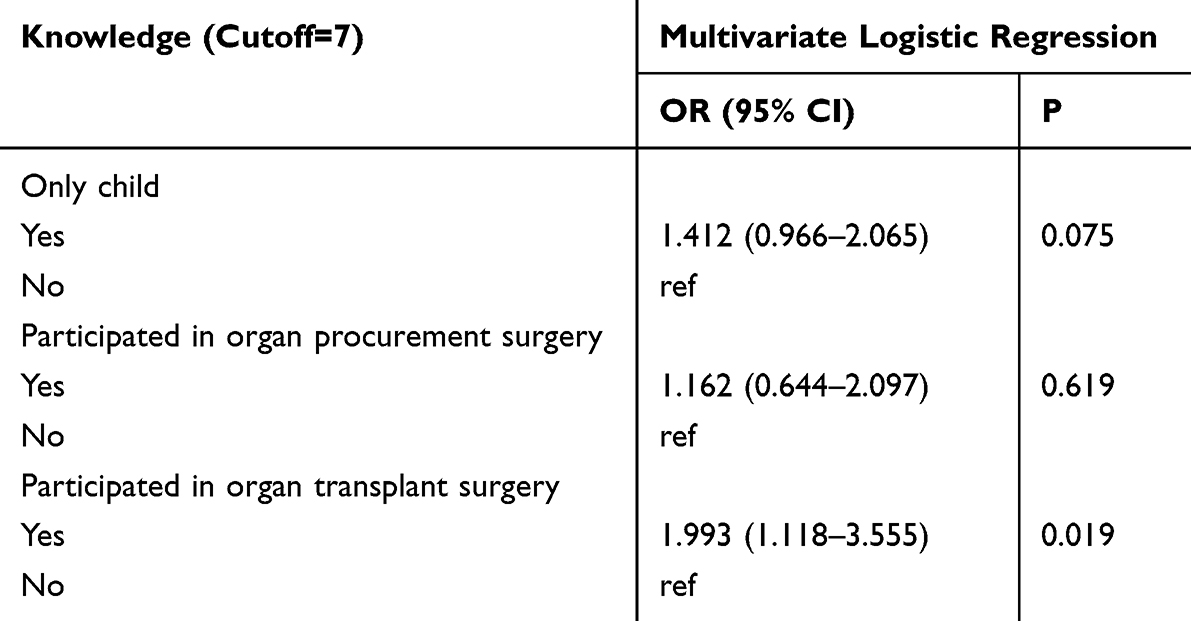 |
Table 1 Analysis of Factors Associated with Good Knowledge |
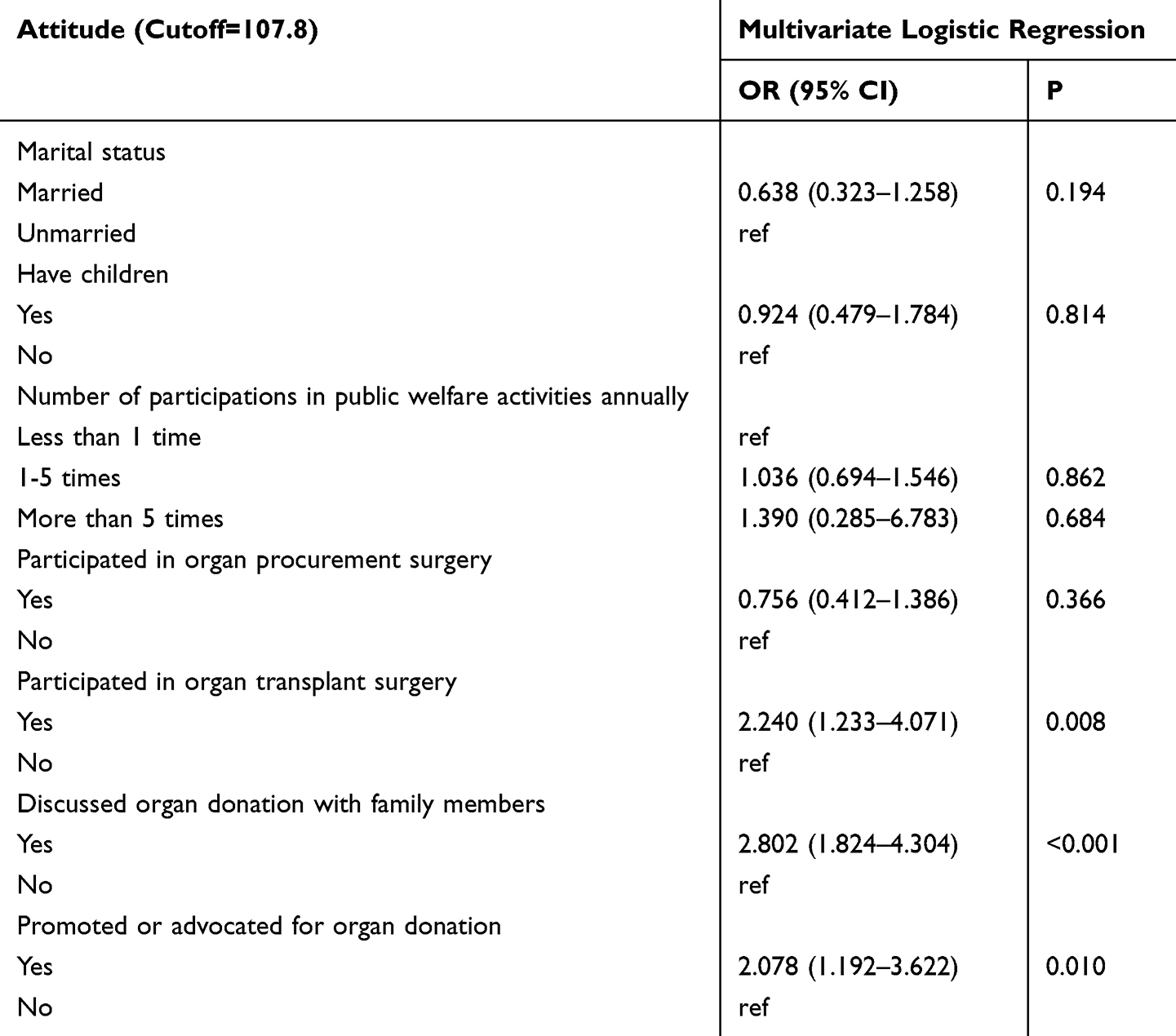 |
Table 2 Analysis of Factors Associated with Positive Attitude |
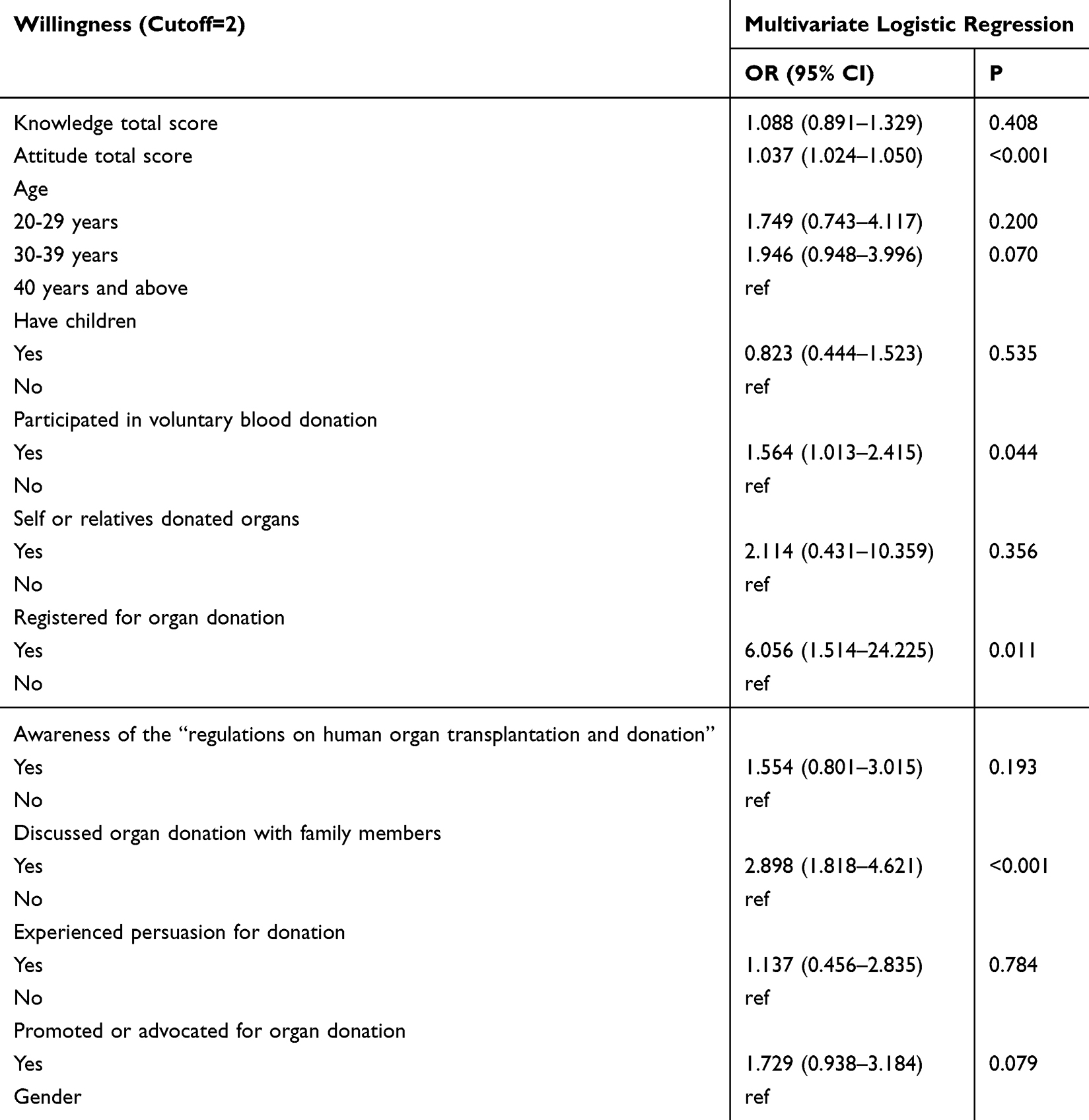 |
Table 3 Analysis of Factors Associated with Donation Willingness |
Discussion
This study uniquely focuses on operating room nurses, whose intraoperative responsibilities—such as donor management, organ retrieval coordination, and interaction with transplant teams—position them at a critical point in the organ donation process. Our findings reveal that, despite adequate knowledge, these nurses show relatively limited positive attitudes toward donation. Based on these findings, it is imperative to implement targeted interventions and educational programs for operating theatre nurses can enhance their understanding of organ donation and reduce misconceptions, which may in turn lead to improved attitudes and greater support for donation practices.
The study’s findings offer valuable insights into the knowledge, attitudes, and willingness of operating theatre nurses concerning organ donation. A noteworthy revelation is the coexistence of satisfactory knowledge levels and suboptimal attitudes among the participating nurses. While the nurses demonstrated a generally commendable knowledge base, evident in their mean knowledge score, their attitudes toward organ donation suggested room for improvement, as reflected in the mean attitude score. Consistent with findings from other studies, despite possessing ample knowledge about organ donation, healthcare professionals, including operating theatre nurses, often exhibit hesitancy or lack a positive attitude toward the actual practice of organ donation.7,12,14 The discrepancy between knowledge and attitudes towards organ donation among healthcare professionals may be related to a variety of factors. The engagement of these professionals in organ donation processes is influenced by a multifaceted array of elements. These include legislative measures, the structure of the organ donation system, cultural and religious considerations, education, public opinion, and trust in the organ donation system.
Through multivariate logistic regression analysis, essential factors independently associated with knowledge, attitudes, and willingness towards organ donation were uncovered. Notably, participation in organ transplant surgery emerged as a significant predictor of higher knowledge levels, aligning with prior research highlighting the impact of practical experience on knowledge enhancement.6,23 Additionally, active involvement in organ transplant surgeries and discussions about organ donation with family members were identified as independent predictors of a positive attitude towards organ donation. This finding sheds light on the consistent pattern observed in previous studies: stronger positive attitudes towards organ donation correlate with a greater willingness to consider donating family members’ organs.24 Furthermore, a more positive overall attitude and participation in voluntary blood donation were positively linked to a greater willingness to donate organs. These results support the view that a positive attitude towards organ donation plays an important role in determining individuals’ willingness to donate.24 Moreover, being registered as an organ donor and engaging in discussions about organ donation with family members emerged as influential factors promoting willingness to donate, underscoring the significance of family discussions and registration in enhancing donation rates.
Although this study was conducted in a single province, cultural factors are essential to understanding organ donation behavior. China’s organ donation policy is based on unified national legislation. The first national regulation, titled Regulation on Human Organ Donation and Transplantation, came into effect on May 1, 2024.25 However, the progress of local legislation varies across regions. Most provinces, including Sichuan, currently rely on the national regulation and have not enacted separate local laws. In China, family-oriented decision-making, traditional beliefs about bodily integrity after death, and limited public awareness often shape attitudes toward organ donation. In Sichuan Province, such cultural norms may influence both the willingness to donate and the role nurses play in the donation process. Although formal family discussions about organ donation are typically led by physicians, operating-room nurses often serve as informal yet influential sources of information for patients and their families. Their frequent perioperative interactions position them as accessible and trusted healthcare professionals who can shape attitudes toward donation in non-formal settings.26 This underscores the importance of culturally adapted education programs that address specific misconceptions and align with local values. Comparing the key variables identified in this study with sociocultural characteristics can help refine targeted interventions, making this study’s findings valuable not only locally but also for informing broader strategies in other regions of China.
In examining the knowledge dimension, this study aimed to assess the awareness and comprehension of potential organ donors regarding key aspects of organ donation. Notably, the respondents displayed a relatively high level of knowledge on certain aspects, such as recognizing that organ transplantation surgery can be performed after a person’s death. However, noteworthy knowledge gaps were identified, particularly in understanding aspects such as the misconception that organs cannot be removed unless the deceased had agreed in writing during their lifetime. To address these knowledge gaps, practical recommendations can be offered. Tailored educational campaigns should be designed to specifically target and correct misconceptions, including the necessity for written consent. Utilizing diverse communication channels, such as social media, healthcare providers, and community organizations, can effectively disseminate this information to a broad audience.1 Moreover, schools and colleges can play an important role in educating young individuals about organ donation, potentially leading to more informed decisions later in life.24
Turning to the attitude dimension, a significant proportion of participants expressed positive attitudes towards organ donation, particularly with statements such as “I believe organ donation can save many lives”. However, it is important to recognize that there were also concerns and reservations expressed by respondents. For example, a substantial percentage had concerns about the misuse of donated organs and uncertainty about the suitability of their own organs. Previous research has identified similar concerns, including fear of organs being transplanted into “bad” people and doubts about the allocation process.27,28 These concerns can be attributed to various factors, including lack of trust in the system, fear of posthumous body integrity, and religious beliefs. In the context of operating rooms, nurses may also experience ethical dilemmas, emotional burden, or limited involvement in donation decision-making, which could contribute to hesitancy. These role-specific stressors warrant further qualitative investigation. In light of these findings, practical recommendations can be proposed. To address concerns about the misuse of organs, it is essential to enhance transparency and accountability in the organ allocation process. Healthcare institutions should actively communicate their commitment to ethical and fair allocation practices to build trust among potential donors.29,30 Furthermore, educational campaigns should focus on dispelling myths and providing accurate information about organ allocation to address uncertainties and reservations.31,32
Finally, the willingness dimension explores the readiness of individuals to donate their organs. The study revealed that a majority of respondents had considered organ donation, and a significant portion had discussed their willingness with family members. While these findings indicate a positive inclination towards organ donation within the surveyed population, it is essential to recognize that a notable percentage remained undecided or unwilling to donate their organs. The decision to donate organs is a complex one influenced by personal beliefs, cultural factors, and social support systems.33 In light of these findings, recommendations should aim to address the concerns of potential donors and foster a supportive environment for organ donation. Public awareness campaigns should include personal narratives and testimonials from both donors and recipients to humanize the process and highlight the positive impact of organ donation.5 Additionally, healthcare providers should engage in open and empathetic conversations with potential donors, addressing their concerns and providing reassurance about the allocation process. For OR nurses specifically, targeted interventions such as simulation-based workshops, interdisciplinary donation training, and family-inclusive education programs may enhance confidence and address attitudinal barriers in the clinical setting. Finally, families and friends should be actively involved in discussions about organ donation to provide emotional support and address any reservations.
This study had some limitations. Firstly, the research was conducted exclusively in Sichuan Province and focused solely on operating theatre nurses, which may restrict the generalizability of the results to broader healthcare settings or regions with distinct demographics and healthcare practices. Additionally, as the data were self-reported, reporting bias or social desirability bias may have influenced responses. Future studies may consider incorporating qualitative interviews to explore participants’ underlying motivations and beliefs more deeply. Secondly, reliance on self-administered questionnaires for data collection introduces the potential for response bias, as self-reported information may not always accurately reflect the participants’ true attitudes and behaviors. Lastly, the use of snowball sampling may have introduced selection bias, as participants were recruited through peer referral, potentially limiting the representativeness of the sample. Moreover, the cross-sectional design provides only a snapshot of KAW at a single point in time and does not allow for causal inferences. Future research could benefit from mixed-methods approaches combining quantitative surveys with in-depth qualitative interviews to better understand the underlying factors influencing OR nurses’ perspectives.
Conclusions
In conclusion, operating theatre nurses had adequate knowledge and suboptimal attitudes towards organ donation. In light of these results, it is important to develop targeted educational interventions, such as in-service workshops, scenario-based simulations, or peer-led discussions, that enhance understanding and reduce common misconceptions. In some hospital departments, such as intensive care units, interprofessional training programs on ethical donation practices have shown success in improving both awareness and confidence in discussing organ donation. Similar culturally adapted strategies could be piloted in operating rooms to address specific attitudinal barriers and awareness programs aimed at improving the attitudes of operating theatre nurses towards organ donation, which may ultimately contribute to increased organ donation rates in healthcare settings.
Data Sharing Statement
All data generated or analyzed during this study are included in this article and supplementary information files.
Ethics Approval and Consent to Participate
This work has been carried out in accordance with the Declaration of Helsinki (2000) of the World Medical Association. This study was approved by the Ethics Committee of the West China Hospital of Sichuan University No.2024 Review (504), and all participants provided informed consent.
Author Contributions
All authors made a significant contribution to the work reported, whether that is in the conception, study design, execution, acquisition of data, analysis and interpretation, or in all these areas; took part in drafting, revising or critically reviewing the article; gave final approval of the version to be published; have agreed on the journal to which the article has been submitted; and agree to be accountable for all aspects of the work.
Disclosure
The authors declare that they have no competing interests in this work.
References
1. Shi J, Salmon CT. Identifying opinion leaders to promote organ donation on social media: network study. J Med Internet Res. 2018;20(1):e7. doi:10.2196/jmir.7643
2. Isidan A, Chen AM, Saglam K, et al. Differences in platelet aggregometers to study platelet function and coagulation dysregulation in xenotransplantation. Xenotransplantation. 2021;28(1):e12645. doi:10.1111/xen.12645
3. Mikla M, Cybulska AM, Schneider-Matyka D, et al. A multicentre study of the attitude of medical students towards organ donation and transplantation in poland. Int J Environ Res Public Health. 2023;20(4). doi:10.3390/ijerph20043711
4. Mistry U, Dargan PI, Wood DM. Pesticide-poisoned patients: can they be used as potential organ donors? J Med Toxicol. 2018;14(4):278–282. doi:10.1007/s13181-018-0673-5
5. Squires JE, Aloisio LD, Santos WJ, et al. Impact of donation physicians on deceased organ donation: a systematic review. Can J Kidney Health Dis. 2022;9:20543581221107751. doi:10.1177/20543581221107751
6. Rey JW, Grass V, Galle PR, et al. Education in organ donation among students in Germany - results of an intervention study. Ann Transplant. 2013;18:23–30. doi:10.12659/AOT.883794
7. Ashraf Jahangeer SM, Rani A, Rehman MA, et al. An assessment of knowledge, attitude, and practice regarding organ donation among students and physicians. J Pak Med Assoc. 2023;73(3):480–486. doi:10.47391/JPMA.5123
8. Babaie M, Hosseini M, Hamissi J, Hamissi Z. Knowledge, attitude and practice of nurses regarding organ donation. Glob J Health Sci. 2015;7(6):129–137. doi:10.5539/gjhs.v7n6p129
9. Bharambe VK, Arole VU, Puranam V, Kulkarni PP, Kulkarni PS. Knowledge and attitude toward organ donation among health-care professionals in a rural town in India. Saudi J Kidney Dis Transpl. 2018;29(3):671–679. doi:10.4103/1319-2442.235176
10. Tan J, Luo L, Zhang M, et al. A Chinese and Western medication adherence scale in patients with chronic kidney disease. Patient Preference Adherence. 2019;13:1487–1495. doi:10.2147/PPA.S207693
11. Khalid A, Haque S, Alvi S, et al. Promoting health literacy about cancer screening among Muslim immigrants in Canada: perspectives of imams on the role they can play in community. J Primary Care Commun Health. 2022;13:21501319211063051. doi:10.1177/21501319211063051
12. Chu ST, Chung PPW, Hui YL, et al. Knowledge and attitude regarding organ donation among medical students in Hong Kong: a cross-sectional study. Postgrad Med J. 2023;99(1173):744–752. doi:10.1136/pmj-2022-141781
13. AbuAlhommos AK, AlSaeed AA, AlMutayib M, Althuwaini RF, Alshehab SS, Alsuwailem NS. Assessment of community knowledge of and attitude toward organ donation in Saudi Arabia. Transplant Proc. 2023;55(1):7–12. doi:10.1016/j.transproceed.2022.09.036
14. El Hennawy HM, Safar O, Thamer A, et al. Knowledge, attitude, and barriers toward deceased organ donation among health care professionals and medical students in Southern Saudi Arabia: a cross-sectional study. Exp Clin Transplant. 2023;21(9):772–778. doi:10.6002/ect.2023.0166
15. Araujo CAS, Siqueira MM. The effect of educational initiatives on the attitude and knowledge of health care professionals regarding organ donation and transplantation: an integrative literature review. Transplant Proc. 2023;55(1):13–21. doi:10.1016/j.transproceed.2022.09.037
16. Flynn F, Dobrescu MA, Richard G, et al. Self-perceived role and knowledge of community pharmacists in organ donation. Int J Clin Pharm. 2023;45(3):748–757. doi:10.1007/s11096-023-01570-4
17. Shi L, Zeng M, Chen Q, Zhou S, Xu L, Cjcgn C. Establishment of reliability and validity of organ donation scale. Chang Geng Nurs. 1998;9:11–19.
18. Hart JL, Kohn R, Halpern SD. Perceptions of organ donation after circulatory determination of death among critical care physicians and nurses: a national survey. Crit Care Med. 2012;40(9):2595–2600. doi:10.1097/CCM.0b013e3182590098
19. Srivastava S, Verma N. Awareness, knowledge and attitudes about organ donation among operating room and kidney transplant unit nurses. Indian J Transplant. 2016;4(10):108. doi:10.1016/j.ijt.2016.09.069
20. Weng L-C, Chiang Y-J, Huang H-L, et al. Factors associated with registration for organ donation among clinical nurses. PLoS One. 2021;16(2):e0247424. doi:10.1371/journal.pone.0247424
21. Lee F, Suryohusodo AA. Knowledge, attitude, and practice assessment toward COVID-19 among communities in East Nusa Tenggara, Indonesia: a cross-sectional study. Front Public Health. 2022;10:957630. doi:10.3389/fpubh.2022.957630
22. Xu W, Li Q, Mao Y, He Y. Knowledge, attitude, and practice toward interstitial lung disease among patients: a cross-sectional study. Front Med. 2024;11:1397659. doi:10.3389/fmed.2024.1397659
23. Potter JE, Elliott RM, Kelly MA, Perry L. Education and training methods for healthcare professionals to lead conversations concerning deceased organ donation: an integrative review. Patient Educ Couns. 2021;104(11):2650–2660. doi:10.1016/j.pec.2021.03.019
24. Chen YC, Fang CS, Tsai CL. Willingness of intensive care unit patients’ family members to donate organs: a cross-sectional study. Medicine. 2023;102(1):e32601. doi:10.1097/MD.0000000000032601
25. NHCotPsRo C. Regulation on human organ donation and transplantation. 2024. Available from: https://www.nhc.gov.cn/ylyjs/zcwj/202404/1a267056543c4619ba6fc4b7a6a97b96.shtml.
26. Li MT, Hillyer GC, Husain SA, Mohan S. Cultural barriers to organ donation among Chinese and Korean individuals in the United States: a systematic review. Transplant Inter. 2019;32(10):1001–1018. doi:10.1111/tri.13439
27. Bahador RS, Farokhzadian J, Mangolian P, Nouhi E. Concerns and Challenges of living donors when making decisions on organ donation: a qualitative study. Iran J Nurs Midwifery Res. 2022;27(2):149–156. doi:10.4103/ijnmr.ijnmr_158_21
28. Miller J, Currie S, McGregor LM, O’Carroll RE. ‘It’s like being conscripted, one volunteer is better than 10 pressed men’: a qualitative study into the views of people who plan to opt-out of organ donation. Br J Health Psychol. 2020;25(2):257–274. doi:10.1111/bjhp.12406
29. Portable normothermic cardiac perfusion system in donation after cardiocirculatory death: a health technology assessment. Ont Health Technol Assess Ser. 2020;20(3):1–90.
30. Stadlbauer V, Zink C, Likar P, Zink M. Family discussions and demographic factors influence adolescent’s knowledge and attitude towards organ donation after brain death: a questionnaire study. BMC Med Ethics. 2020;21(1):57. doi:10.1186/s12910-020-00499-x
31. Al Moweshy AA, Fabella EL, Al-Hassan YT, et al. Association between organ donation awareness and willingness among Saudi university students. J Public Health Res. 2022;11(2). doi:10.4081/jphr.2022.2685
32. Boadu P, McLaughlin L, Al-Haboubi M, et al. A machine-learning approach to estimating public intentions to become a living kidney donor in England: evidence from repeated cross-sectional survey data. Front Public Health. 2022;10:1052338. doi:10.3389/fpubh.2022.1052338
33. Saxena D, Trivedi P, Bhavsar P, et al. Challenges and motivators to organ donation: a qualitative exploratory study in Gujarat, India. Int J Gen Med. 2023;16:151–159. doi:10.2147/IJGM.S393240
 © 2025 The Author(s). This work is published and licensed by Dove Medical Press Limited. The
full terms of this license are available at https://www.dovepress.com/terms
and incorporate the Creative Commons Attribution
- Non Commercial (unported, 4.0) License.
By accessing the work you hereby accept the Terms. Non-commercial uses of the work are permitted
without any further permission from Dove Medical Press Limited, provided the work is properly
attributed. For permission for commercial use of this work, please see paragraphs 4.2 and 5 of our Terms.
© 2025 The Author(s). This work is published and licensed by Dove Medical Press Limited. The
full terms of this license are available at https://www.dovepress.com/terms
and incorporate the Creative Commons Attribution
- Non Commercial (unported, 4.0) License.
By accessing the work you hereby accept the Terms. Non-commercial uses of the work are permitted
without any further permission from Dove Medical Press Limited, provided the work is properly
attributed. For permission for commercial use of this work, please see paragraphs 4.2 and 5 of our Terms.
Recommended articles

Improving Nurses’ Knowledge on Sepsis Identification and Management at Mulago National Referral Hospital: A Quasi Experimental Study
Nakiganda C, Atukwatse J, Turyasingura J, Niyonzima V
Nursing: Research and Reviews 2022, 12:169-176
Published Date: 14 September 2022
Psychiatric Nurses’ Knowledge, Attitudes, and Practice Regarding Physical Restraint in China: A Multicentre Cross-Sectional Study
Chong Y, Wang C, Zhi T, Fang S, Min H, Zhang L, Wu X, Wang Y
Journal of Multidisciplinary Healthcare 2023, 16:1475-1489
Published Date: 29 May 2023
Public Knowledge, Attitudes, and Practices Regarding the Use of Over-The-Counter (OTC) Analgesics in Indonesia: A Cross-Sectional Study
Sinuraya RK, Wulandari C, Amalia R, Puspitasari IM
Patient Preference and Adherence 2023, 17:2569-2578
Published Date: 17 October 2023
Applying Learning Principles Within Parent Education: Exploring Nurses’ Practice and Parents’ Experiences
Thompson DL, May EJ, Leach MJ, Smith CP, Fereday JA
Patient Preference and Adherence 2023, 17:2949-2970
Published Date: 14 November 2023
Oral Health Knowledge, Attitude, and Behavior Among Health Professions’ Students at Kabul University of Medical Sciences
Ehsan H, Ahmadzai N, Orfani Z, Rezayee BM, Wally M, Daftani S
Clinical, Cosmetic and Investigational Dentistry 2023, 15:349-358
Published Date: 13 December 2023