
Back to Journals » International Journal of General Medicine » Volume 19
Integrating the Wei–Qi–Ying–Blood Theory with Modern Pathophysiology: A Multitarget Translational Framework for Dengue Management
Authors Wang T, Li X, Wang X, Li Q
Received 20 April 2026
Accepted for publication 26 June 2026
Published 22 July 2026 Volume 2026:19 618593
DOI https://doi.org/10.2147/IJGM.S618593
Checked for plagiarism Yes
Review by Single anonymous peer review
Peer reviewer comments 2
Editor who approved publication: Prof. Dr. Héctor Mora-Montes
Tingni Wang,1 Xiqiao Li,1 Xiaoying Wang,2 Qin Li1
1School of Basic Medical Sciences, Yunnan University of Chinese Medicine, Kunming, People’s Republic of China; 2Research Management Section, Kunming Municipal Hospital of Traditional Chinese Medicine, Kunming, People’s Republic of China
Correspondence: Qin Li, School of Basic Medical Sciences, Yunnan University of Chinese Medicine, Kunming, People’s Republic of China, Email [email protected]
Abstract: Despite the substantial global burden of dengue, clinical management remains largely supportive. Severe disease involves viral replication, dysregulated inflammation, endothelial injury, plasma leakage, thrombocytopenia, and coagulation abnormalities. In this review, we link the traditional Chinese medicine Wei–Qi–Ying–Blood theory with stage-specific dengue pathophysiology and biomarker-guided risk assessment. We also summarize representative formulas and bioactive compounds in terms of their potential antiviral, anti-inflammatory, endothelial-protective, and hematological effects. Computational studies predict relevant targets and pathways, while preclinical studies suggest effects on viral replication, inflammation, vascular integrity, and coagulation. Limited clinical studies have reported shorter fever duration, reduced hospital stay, and improved hematological recovery, although these findings require further validation. Several proposed mechanisms are extrapolated from non-dengue models. The proposed framework is therefore intended to generate hypotheses rather than serve as a validated treatment algorithm. Future studies should focus on standardized preparations, safety assessment, mechanistic validation, and adequately powered multicenter trials.
Keywords: traditional Chinese medicine, biomarkers, syndrome differentiation, endothelial dysfunction, coagulation disorders, translational medicine
Introduction
Dengue is a mosquito-borne viral disease caused by four distinct dengue virus serotypes (DENV-1 to DENV-4) and is an increasingly important global public health problem.1,2 Climate-driven vector expansion and greater human mobility continue to extend the geographic range of DENV transmission, including into Europe and the Eastern Mediterranean.1,2 The World Health Organization (WHO) reported more than 4 million reported cases and 3000 deaths in the first half of 2025 alone, underscoring the need for effective interventions.2
Clinical management remains largely supportive despite this growing burden. Fluid therapy during the critical phase requires careful balance: inadequate replacement can lead to hypovolemic shock, whereas excessive administration can cause life-threatening respiratory distress.3,4 Achieving this balance is especially difficult in resource-limited settings.3 Prevention is also limited by safety concerns about the CYD-TDV vaccine in individuals who are seronegative at baseline.5
Targeted therapies are difficult to develop because the main processes involved in dengue pathogenesis are closely connected.6,7 Severe disease develops through a dynamic cascade of viral replication, dysregulated inflammation, endothelial dysfunction, plasma leakage, thrombocytopenia, and coagulation abnormalities.6–9 These processes interact rather than occur separately, so single-target interventions may be insufficient. Host-directed multitarget strategies have therefore received increasing attention.3,7,8
Against this background, TCM offers pharmacological and theoretical resources for studying stage-specific, multitarget interventions.10,11 TCM formulations have long been used for acute febrile infectious diseases and are intended to regulate multiple physiological networks.10,11 From a systems-biology perspective, the Wei–Qi–Ying–Blood theory may help connect traditional pattern differentiation with modern dengue staging. This review examines the links between Wei–Qi–Ying–Blood patterns, stage-specific dengue pathophysiology, and biomarkers, together with the available evidence, current limitations, and future directions for TCM-based dengue management. Figure 1 shows the overall pathological cascade and possible intervention points.
 |
Figure 1 Pathological cascade of the virus–inflammation–vascular–coagulation axis in dengue and corresponding intervention points. The upper arrow indicates pathological progression. The yellow, blue, green, and purple boxes represent antiviral, anti-inflammatory/immunomodulatory, endothelial-protective, and coagulation-stabilizing/platelet-recovery interventions, respectively. Arrows from the boxes indicate the principal intervention points. Abbreviations: DENV, dengue virus; E protein, envelope protein; NS5, nonstructural protein 5; RNA, ribonucleic acid; TNF-α, tumor necrosis factor-alpha; IL-6, interleukin-6; IFN-γ, interferon-gamma. |
Theoretical Bridging: From the Wei–Qi–Ying–Blood Theory to Modern Pathophysiological Staging
A Quantifiable Correspondence Framework Between TCM Patterns and Modern Pathophysiology
In traditional Chinese medicine (TCM), dengue has historically been classified as wenbing yidu (epidemic warm-toxic disease).12,13 Traditional pathophysiology describes its progression in terms of accumulating “dampness” (fluid dysregulation and edema), “heat” (fever and hyperinflammation), and “toxic pathogens” (viral burden).12,13 Although metaphorical, these terms broadly parallel the modern clinical course of dengue.7,14,15 More specifically, progression from the Wei–Qi co-involvement pattern to the Qi–Ying blazing pattern resembles the shift from the acute febrile phase to the critical phase, when severe endothelial barrier disruption, plasma leakage, and progressive coagulopathy may occur.7,14,15
To make this empirical knowledge more usable, we relate TCM pathodynamic terms to modern pathological processes and measurable biological indicators, providing a shared interdisciplinary language (Table 1). This is not meant to be a simple translation of terminology. Rather, it links traditional pattern manifestations with specific pathological biomarkers.7,13,15 Grounding these concepts in association analyses may help bridge TCM and contemporary biomedicine and provide a testable, mechanism-based approach to identifying and validating multitarget TCM interventions.13–15 In resource-limited settings, the approach can rely on clinical warning signs and routine tests; advanced biomarkers remain supplementary rather than essential.16–18
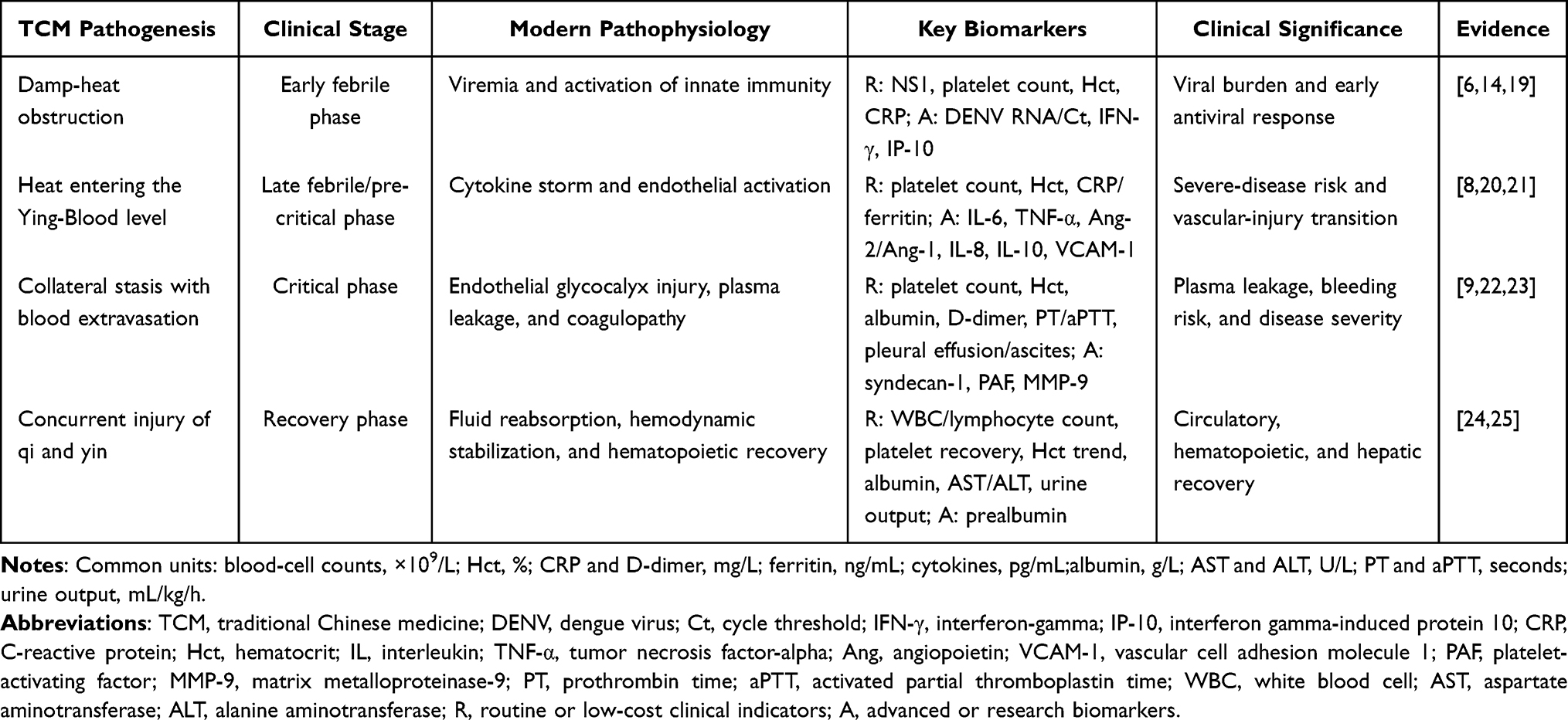 |
Table 1 TCM Pathogenesis, Clinical Stage, and Biomarker Framework in Dengue |
Dynamic Correspondence Between Stage-Based Treatment and Core Pathophysiological Processes
Dengue usually progresses through three clinical stages: febrile, critical, and recovery, each with its own pathophysiological features and clinical risks.16–18 Based on the Wei–Qi–Ying–Blood theory, we propose a matching model that aligns each stage with TCM patterns, underlying mechanisms, measurable indicators, and representative herbal formulations (Table 2).18,26 In this way, traditional pattern identification is considered together with modern clinical risk stratification across the disease course.18,27
 |
Table 2 Stage-Specific TCM Patterns, Pathological Focus, Representative Formulas, and References in Dengue |
The model is not a fixed step-by-step treatment pathway. Patients may first present at any stage, including the late febrile or critical phase. Initial treatment should be chosen according to the stage at presentation, warning signs, hemodynamic status, organ involvement, and readily available laboratory findings, including platelet count, hematocrit trend, coagulation parameters, liver function, and evidence of plasma leakage. Treatment should be reassessed and adjusted as the clinical picture changes.16–18
This model may also help guide target discovery and pharmacological research. Multicomponent TCM formulations are chemically complex, and conventional single-compound models may not be sufficient. Combining chemical profiling, network pharmacology, target prediction, molecular docking, and multi-omics analysis may help identify candidate active constituents and pathway interactions.35,36 These computational findings should be treated as hypotheses and tested in DENV-specific experimental models and well-designed clinical studies. Figure 2 shows the stage-based model.
 |
Figure 2 Stage-based management framework integrating dengue phase, TCM pattern, clinical risk, and Western supportive and TCM management strategies. The horizontal arrow indicates progression from the febrile phase through the critical phase to the recovery phase. The yellow, blue, and purple panels distinguish the three phases, respectively. Abbreviations: TCM, traditional Chinese medicine; WBC, white blood cell count; PLT, platelet count; Hct, hematocrit. Symbols: ↑, increase; ↓, decrease; ↓↓, marked decrease. |
Pharmacological Mechanisms: Molecular Basis of Pleiotropic Regulation
Figure 3 brings together the multitarget pharmacological network proposed for representative TCM interventions against DENV. Some host-directed mechanisms, particularly endothelial barrier protection, are extrapolated from non-dengue models and should be regarded as hypothesis-generating evidence.
 |
Figure 3 Multitarget mechanistic network of representative natural products and TCM-related interventions against DENV infection. The blue, pink, green, and yellow sectors represent direct antiviral activity, attenuation of hyperinflammation, endothelial barrier protection, and modulation of thrombocytopenia, respectively. Arrows indicate activation or positive regulation, blunt-ended lines indicate inhibition, and dashed boxes group related mechanisms or outcomes. Symbols: ↑, increase; ↓, decrease. Abbreviations: TCM, traditional Chinese medicine; DENV, dengue virus; E protein, envelope protein; NS2B–NS3, nonstructural protein 2B–nonstructural protein 3 protease; RM-1, Rhododendron mariae extract; MTase, methyltransferase; SAM, S-adenosylmethionine; RdRp, RNA-dependent RNA polymerase; RNA, ribonucleic acid; PN-1, a dammarane-type triterpenoid saponin from Panax notoginseng; TNF-α, tumor necrosis factor-alpha; IL-6, interleukin-6; CXCL10, C-X-C motif chemokine ligand 10; ALOX12, arachidonate 12-lipoxygenase; 12-HETE, 12-hydroxyeicosatetraenoic acid; Syndecan-1, syndecan-1; TEER, transepithelial electrical resistance; ZO-1, zonula occludens-1. |
Direct Antiviral Strategies Targeting the Viral Life Cycle
Natural products may act at several points in the DENV life cycle.37 At the entry stage, several botanical extracts interfere with binding between the viral envelope (E) protein and host receptors.37 Extracts from Glycyrrhiza uralensis, Rhododendron mariae (designated RM-1), and Ampelopsis japonica, for example, have shown early-stage inhibitory activity against multiple DENV serotypes by targeting E protein domain III or blocking viral adsorption.38–40
During viral replication, the highly conserved NS2B–NS3 protease and NS5 proteins are major therapeutic targets, as shown in Figure 3.37,41 Myricetin and quercetin have been reported to inhibit the NS2B–NS3 protease complex at micromolar concentrations.42,43 The quercetin findings, however, need cautious interpretation. Quercetin is prone to aggregation and may produce nonspecific or false-positive signals in biochemical assays.44,45 Its apparent antiviral activity should therefore be confirmed with aggregation controls, orthogonal assays, and cellular target-engagement studies. Translation to clinical use is also limited by poor aqueous solubility, low and variable oral bioavailability, and extensive first-pass metabolism.46 Liposomes, lipid nanoparticles, polymeric nanoparticles, micelles, and nanoemulsions may improve quercetin stability and systemic exposure.46 Even so, their pharmacokinetics, cytotoxicity, target specificity, and anti-DENV efficacy still require validation in DENV-specific experimental models.
NS5 is another important target for natural compounds because it has both methyltransferase (MTase) and RNA-dependent RNA polymerase (RdRp) activities.41,47,48 PN-1, a dammarane-type triterpenoid saponin from Panax notoginseng, acts as a non-nucleoside RdRp inhibitor and has shown in vivo efficacy in AG129 mouse models.47 Computational and in vitro findings also suggest that isoquercitrin may target the S-adenosylmethionine-binding and RNA-capping sites of the NS5 MTase.48 These compounds provide preliminary structural scaffolds for anti-DENV drug development, although further pharmacological optimization and clinical validation are still needed.47,48
Attenuation of the Hyperinflammatory Cascade
The hyperinflammatory response triggered by DENV, often described as a cytokine storm, is a primary driver of severe disease.8 Higher serum levels of interleukin-6 (IL-6), tumor necrosis factor-alpha (TNF-α), and C-X-C motif chemokine ligand 10 (CXCL10) are strongly associated with more severe vascular leakage, organ failure, and adverse clinical outcomes.8,49 Bioactive TCM constituents may reduce this abnormal immune response by regulating key inflammatory mediators, as illustrated in Figure 3.50–52 In murine models, quercetin and the alkaloid sinococuline reduce viral burden and markedly downregulate TNF-α and IL-6 expression, thereby mitigating vascular leakage.50,51 A randomized, double-blind, placebo-controlled trial in patients with dengue hemorrhagic fever also found that Propoelix accelerated platelet recovery, shortened hospitalization, and reduced serum TNF-α levels.52 Two mechanisms may be involved and are not mutually exclusive: direct antiviral activity together with independent modulation of host inflammatory pathways, and an indirect anti-inflammatory effect caused by lower viral burden and reduced antigen-driven immune activation. Current clinical evidence does not clearly separate their relative contributions. Future studies should therefore measure viral kinetics and inflammatory biomarkers together to determine whether the anti-inflammatory effects are independent of viral-load reduction.50–52
Endothelial Stabilization and Barrier Protection
Disruption of the vascular endothelial barrier is a pathological hallmark of severe dengue. It is driven largely by DENV nonstructural protein 1 (NS1)-mediated degradation of the endothelial glycocalyx and tight junctions.9,22 Clinically, shedding of syndecan-1, a core glycocalyx component, is a robust biomarker of plasma leakage severity.9
Some TCM-derived compounds appear to have broad barrier-stabilizing properties. In several vascular injury models, ginsenoside Rg1 and astragaloside IV preserve glycocalyx structure by inhibiting heparanase expression and upregulating syndecan-1.53,54 Under inflammatory stress, berberine and puerarin can also restore transepithelial electrical resistance (TEER) and the expression of tight junction proteins, including ZO-1, occludin, and claudin-1.55,56 Most of these barrier-protective effects were reported in non-dengue models, so their relevance to dengue remains inferential and requires confirmation in DENV NS1-specific endothelial models.22,53,55
Systemic Modulation of Dengue-Associated Thrombocytopenia
Thrombocytopenia is common in DENV infection and results from both suppression of bone marrow megakaryopoiesis and accelerated peripheral platelet clearance.57 Because prophylactic platelet transfusion does not improve outcomes and may increase the risk of fluid overload, promoting endogenous thrombopoiesis pharmacologically is important.58
Carica papaya leaf extracts have emerged as a clinically validated intervention.59–61 Papaya extract strongly upregulates ALOX12 expression and enhances megakaryopoiesis through 12-HETE-related pathways.59 A multicenter randomized controlled trial confirmed that papaya leaf extract significantly accelerated platelet recovery and shortened the critical phase in patients with severe dengue compared with placebo.60,61 Euphorbia hirta has also shown viral inhibition and hematological restoration.62 Clinical observations indicate that it rapidly increases platelet and leukocyte counts.26 The effect of TCM on thrombocytopenia may therefore extend beyond simply raising platelet counts and may involve coordinated regulation of viral replication, bone marrow hematopoiesis, and immune-mediated clearance. This provides a modern pharmacological basis for its clinical use.57,59
Pattern Identification and Stage-Based Treatment of Dengue
TCM management of dengue generally follows a stage-based approach, with treatment adjusted to the changing pathophysiological features of the disease.26,28
Febrile Phase: Early Viral Control and Inflammation Modulation
During the acute febrile phase, treatment mainly aims to limit viral replication and excessive early immune activation. In TCM, this is described as “clearing heat, resolving dampness, and detoxifying”. Representative formulations include modified Ganlu Xiaodu Dan and Shufeng Jiedu Capsules. In a clinical observation of patients with dengue, Shufeng Jiedu Capsules were associated with faster defervescence, shorter hospitalization, and fewer early hemorrhagic manifestations.63
Evidence from influenza A and SARS-CoV-2 models may help explain the potential host-directed effects of these formulations. Modified Ganlu Xiaodu Dan has been reported to regulate PI3K/Akt signaling in an influenza A model, while Lianhua Qingwen Capsules showed antiviral and anti-inflammatory activity against SARS-CoV-2.64–66 Because these viruses differ substantially from DENV in their biology, tissue tropism, and clinical features, the findings should be interpreted cautiously and confirmed in DENV-specific models.
Critical Phase: Rescuing the Cytokine Storm and Coagulopathy
The critical phase of severe dengue is marked by a life-threatening triad of cytokine storm, plasma leakage, and coagulation dysfunction.8 In TCM, this severe systemic decompensation is described as the Qi–Ying blazing pattern with toxin accumulation and blood stasis. Treatment therefore shifts toward systemic rescue through “cooling the blood, detoxifying, and resolving blood stasis”. Modified Qingwen Baidu Decoction is a representative intervention for severe inflammatory states. Evidence from LPS-induced acute lung injury and sepsis models suggests that it may reduce systemic inflammation and preserve barrier integrity, as indicated by improved pulmonary oxygenation, reduced alveolar permeability, and lower inflammatory mediator levels.67,68 Alveolar barrier injury is not the same as the systemic vascular endothelial dysfunction seen in severe dengue, although both involve inflammation-related barrier disruption and increased vascular permeability. The findings therefore offer indirect mechanistic support for possible effects on inflammation and vascular barrier dysfunction, not direct evidence of efficacy in DENV infection.
In patients with sepsis-associated coagulation dysfunction, adding modified Qingwen Baidu Decoction to standard therapy was reported to improve platelet counts and D-dimer levels and reduce Acute Physiology and Chronic Health Evaluation II scores.69 Because these findings were obtained outside dengue, they require confirmation in DENV-specific endothelial, hepatic, and clinical studies.
Some critical complications require targeted formulations. Jiedu Huayu Granules mitigate vascular endothelial inflammation and hepatic injury by suppressing chemokines such as monocyte chemoattractant protein-1 (MCP-1) and adhesion molecules such as soluble vascular cell adhesion molecule-1 (sVCAM-1).70,71 In patients with severe central nervous system involvement, such as encephalopathy or seizures, traditional emergency remedies including Angong Niuhuang Pill and Zixue Powder show marked neuroprotective and anticonvulsant effects.72,73 Mechanistic studies indicate that these effects involve modulation of cerebral calcium influx, reduction of nitric oxide, and rebalancing of glutamate/GABA neurotransmission, thereby significantly prolonging seizure latency and improving neurological outcomes.72,73
Recovery Phase: Tissue Repair and Immune Homeostasis
In the recovery phase, attention shifts to residual inflammation, tissue repair, and post-viral fatigue. In TCM, this corresponds to the Qi–Yin deficiency pattern.
Modified Zhuye Shigao Decoction and Shengmai Drink are used to clear residual heat, nourish Qi and Yin, and restore homeostasis.74 Modified Zhuye Shigao Decoction is classically used to clear residual heat. Its relevance to dengue remains indirect because the available mechanistic evidence mainly comes from non-DENV models, including radiation esophagitis, gouty arthritis, and COPD. These studies suggest that the formula may inhibit TLR/NF-κB and IL-6/JAK/STAT3 signaling and strengthen antioxidant defenses, thereby reducing inflammatory and oxidative tissue injury.75,76 The findings provide a mechanistic rationale for its use in the recovery phase but do not constitute direct dengue-specific evidence. A dengue-specific clinical reference comes from Propoelix™, a standardized propolis extract. In a randomized, double-blind, placebo-controlled trial of patients with dengue hemorrhagic fever, Propoelix™ reduced serum TNF-α levels, accelerated platelet recovery, and shortened hospitalization.52 This supports inflammatory modulation as a relevant therapeutic direction during dengue recovery and highlights the need for direct validation of modified Zhuye Shigao Decoction in DENV infection.
Shengmai Drink also acts as a broad modulator of the host response. Transcriptomic analysis in DENV-infected cellular models shows widespread changes in gene networks related to the cell cycle, DNA replication, and PI3K-Akt/FoxO signaling.74 By combining low-toxicity viral clearance with restoration of immune and metabolic homeostasis, these recovery-phase interventions provide a broad pharmacological approach to promoting functional recovery and reducing post-dengue sequelae.74,77
Representative Clinical Preparations and Intravenous Therapeutics
Clinical Evidence for Institutional Formulations
Several institutional TCM formulations were developed empirically during major regional dengue outbreaks and were subsequently evaluated in clinical practice. Chaishi Jiedu Granules have mainly been assessed in a real-world observational study, whereas Dengue Formula No. 1 was evaluated in a small clinical study involving 41 patients.28,78 The reported herbal compositions of Chaishi Jiedu Granules and Dengue Formula No. 1 are summarized in Table 3. These findings should therefore be regarded as preliminary clinical evidence rather than confirmation from large, rigorously designed randomized controlled trials.
 |
Table 3 Reported Raw Herbal Components of Chaishi Jiedu Granules and Dengue Formula No. 1 |
Preclinical evidence is available for Chaishi Jiedu Granules. In an interferon-receptor-blockaded C57BL/6 mouse model, the formulation was reported to limit early viremia, reduce the expression of the pro-inflammatory cytokines TNF-α and IL-6, and lessen virus-associated cerebral and renal injury.79
Across the available clinical reports, adding these formulations to standard supportive care was associated with faster defervescence, relief of symptoms such as headache, myalgia, and rash, and recovery of leukocyte, lymphocyte, and platelet counts.28,78 Because one study was observational and the other involved a small clinical sample, these findings do not establish causal efficacy. Standard supportive care included appropriate oral or intravenous fluid therapy, acetaminophen/paracetamol-based management of fever and pain, serial clinical and hematological monitoring, and additional rescue measures when clinically indicated.18,80 Larger, multicenter, rigorously designed randomized controlled trials are required to confirm the efficacy and safety of these formulations.
Intravenous Therapeutics for Acute and Severe Intervention
In integrative clinical practice, Reduning Injection, Xiyanping Injection, and Tanreqing Injection have been used as intravenous TCM treatments for dengue. The Diagnosis and Treatment Protocol for Dengue (2024 Edition) lists them among the recommended TCM patent medicines for the febrile and critical stages.18 The following sections summarize their clinical effects, safety profiles, and possible mechanisms based on relevant clinical and experimental studies.
The intravenous route makes safety and tolerability especially important. Post-marketing and clinical safety data indicate that Reduning Injection generally has a low incidence of adverse drug reactions, whereas Xiyanping Injection and Tanreqing Injection are mainly associated with infusion-related or hypersensitivity reactions, including rash, pruritus, fever, and, rarely, anaphylaxis.81–83 These agents should therefore be used according to approved indications and dosing instructions. Inappropriate drug combinations and rapid infusion should be avoided, and patients should be monitored closely during and shortly after administration, especially those with a history of allergy, hepatic or renal dysfunction, or other high-risk conditions.
Clinical trials show that adding Reduning Injection to standard therapy markedly shortens fever duration, accelerates normalization of hematological parameters, and improves overall clinical recovery rates.84 Standard therapy included fluid replacement, symptomatic antipyretic treatment, routine clinical and hematological monitoring, and other supportive measures.84 Network pharmacology suggests that Reduning may act on multiple targets through regulation of hypoxia-inducible factor-1 (HIF-1) and NF-κB signaling, with possible involvement of leukocyte transendothelial migration and apoptosis-related processes.85
Xiyanping Injection contains andrographolide sulfonate as its main active pharmaceutical ingredient and has potent direct antiviral activity.86,87 In severe infection models, including SCID-HepG2 xenograft mice, it significantly reduces viral genome replication and the proportion of virus-positive cells in the spleen, liver, and serum. These effects are accompanied by markedly longer survival and higher overall survival rates.86
Tanreqing Injection has also shown marked anti-inflammatory and endothelial-protective effects.88–90 In vitro and in vivo studies show that it inhibits progeny virion release and strongly suppresses the hyperinflammatory cascade.88,89 It also inhibits activation of the NOD-like receptor family pyrin domain containing 3 (NLRP3) inflammasome, markedly reduces IL-1β cleavage, and attenuates leukocyte transendothelial migration by downregulating the ICAM-1/VCAM-1 axis.88,89 In AG129 mouse models, these effects are associated with reduced multiorgan injury and prolonged survival.88
Available clinical studies suggest that selected intravenous TCM preparations may improve fever control and hematological recovery.84,90 Experimental and computational studies point to possible mechanisms involving antiviral activity, inflammasome suppression, and endothelial protection.85,86,88,89
Challenges and Future Directions of Traditional Chinese Medicine in Dengue Treatment
Major Limitations and Strategic Perspectives
Traditional Chinese medicine (TCM) has an established theoretical basis for dengue treatment, but the field is still moving from experience-based practice toward rigorous evidence-based medicine (EBM).10,11 The main limitation is the shortage of high-quality clinical data. Many available studies have small sample sizes (typically n < 72), single-center designs, and limited randomization or blinding.28,71,78,84,90 Several TCM interventions have been evaluated clinically, but the evidence remains limited. For this reason, this review distinguishes clinical findings from preclinical and computational mechanistic support. There is also a gap between the traditional Wei–Qi–Ying–Blood theory and modern clinical staging. Given the rapid 19- to 37-hour critical window of dengue progression, subjective traditional pattern identification (“Zheng”) should be combined with a three-part dynamic monitoring model.16–18,91 Such a model should integrate traditional pattern assessment with objective biomarkers, particularly DENV RNA, NS1, IL-6, and the Ang-2/Ang-1 ratio, to improve risk stratification.15,20,92 Mechanistic research remains fragmented, and in vitro studies of isolated compounds often progress faster than in vivo evaluation of complex formulas. Correlative findings therefore often come before clear causal evidence.35,37,93,94 The pharmacological “material basis” of these multi-herb interventions, especially synergistic or antagonistic interactions among constituents, still needs to be defined across viral replication, systemic inflammation, and endothelial protection.36,93 Current animal models, including AG129 mice and SCID-HepG2 xenograft systems, do not fully reproduce human-specific features such as antibody-dependent enhancement (ADE) and plasma leakage.95,96 This limits clinical translatability.95,96 International adoption is also hindered by the lack of standardized manufacturing and quality control for empirical formulas and in-hospital preparations.36 Multicenter trials and standardized pharmacological evaluation are needed to define the role of TCM, especially injectable formulations, alongside modern supportive care in global dengue management.11,36
Future Research Directions
Structure-based studies of highly conserved dengue proteins, including the NS2B-NS3 protease and NS5 polymerase, are important for drug development.93,94 Co-crystal studies are needed to define binding modes and structure-activity relationships and support the design of anti-dengue therapeutics with high affinity and selectivity.94 It is also important to examine whether multiple formula components bind cooperatively to viral or host targets. This approach may help clarify the scientific basis of molecular interactions and multicomponent synergy.
A rigorous safety framework is also needed when TCM is combined with Western medicine.80,97,98 Prospective and retrospective studies should monitor drug-drug interactions and adverse events when TCM is used with antiviral agents, analgesics, or fluid therapy.80,98 Real-world data platforms can support systematic collection of safety information across different populations.81–83 Particular attention should be given to children, pregnant women, older adults, patients with chronic comorbidities, and those with hepatic or renal insufficiency.80 This work can provide the evidence base needed for standardized integrative treatment protocols.36,80,98
International validation also depends on a full-chain quality-control system covering botanical authentication, chemical fingerprinting, and pharmacodynamic consistency.36 Multinational trials should be conducted in endemic regions, including Southeast Asia and South America, to evaluate formulations such as Chaishi Jiedu Granules across different ethnic populations and DENV serotypes. Nanodelivery systems and liposomal formulations should also be studied as ways to improve the bioavailability of compounds such as quercetin and berberine. Because these approaches alter pharmacokinetic profiles, cytotoxicity, dose-dependent toxicity, biodistribution, and safety limits should be evaluated alongside antiviral efficacy.46,99 Progress in standardization and modernization could support the integration of TCM into the global framework for dengue prevention and treatment.36
Conclusion
This review links the Wei–Qi–Ying–Blood theory and pattern identification with contemporary dengue staging and proposes a dynamic framework for stage-specific intervention. Current evidence suggests that TCM formulations and bioactive compounds, including Chaishi Jiedu Granules and Reduning Injection, have potential translational applications based on their proposed effects on viral replication, inflammation, vascular dysfunction, and coagulation abnormalities. Clinical use remains limited, however, by the lack of large, high-quality randomized controlled trials, insufficient systems-level mechanistic validation, and the absence of standardized manufacturing and quality-control frameworks. Future research should prioritize DENV-specific mechanistic validation, standardized quality control of TCM preparations, and adequately powered multicenter randomized controlled trials with clinically meaningful endpoints. Network pharmacology, multi-omics analysis, and chemical fingerprinting may help address current gaps in mechanism and standardization. This work could improve the reproducibility of TCM-based interventions, support international evaluation and wider scientific communication, and contribute to a modern interpretation of classical theory in dengue management.
Ethics Approval
Not applicable. This article does not describe any original research involving human participants, human data, or animal experiments. All data are derived from previously published studies cited in the references.
Funding
This work was supported by the Key Research and Development Project of the Yunnan Provincial Department of Science and Technology (grant number 202103AC100005), the Traditional Chinese Medicine Joint Special Project of the Yunnan Provincial Department of Science and Technology—General Program (grant number 202101AZ070001-020), the Joint University-Institute Fund of Yunnan University of Chinese Medicine for the Diannan School of Medicine (grant number XYLH202329), and the Innovative Scientific Research Fund for First-Class Disciplines of Chinese Medicine in Yunnan Province (grant number ZYXZD202401).
Disclosure
The authors report no conflicts of interest in this work.
References
1. Zhang WX, Zhao TY, Wang CC, et al. Assessing the global dengue burden: incidence, mortality, and disability trends over three decades. PLoS Negl Trop Dis. 2025;19(3):e0012932. doi:10.1371/journal.pntd.0012932
2. World Health Organization. Dengue. 2025. https://www.who.int/news-room/fact-sheets/detail/dengue-and-severe-dengue.
3. Kala MP, St John AL, Rathore APS. Dengue: update on clinically relevant therapeutic strategies and vaccines. Curr Treat Options Infect Dis. 2023;15(2):27–14. doi:10.1007/s40506-023-00263-w
4. Singh RK, Tiwari A, Satone PD, et al. Updates in the management of dengue shock syndrome: a comprehensive review. Cureus. 2023;15(10):e46713. doi:10.7759/cureus.46713
5. Wilder-Smith A. Dengue vaccine development: status and future. Bundesgesundheitsblatt Gesundheitsforschung Gesundheitsschutz. 2020;63(1):40–44. doi:10.1007/s00103-019-03060-3
6. Vuong NL, Le Duyen HT, Lam PK, et al. Higher plasma viremia in the febrile phase is associated with adverse dengue outcomes irrespective of infecting serotype or host immune status: an analysis of 5642 Vietnamese cases. Clin Infect Dis. 2021;72(12):e1074–e1083. doi:10.1093/cid/ciaa1840
7. Malavige GN, Ogg GS. Pathogenesis of vascular leak in dengue virus infection. Immunology. 2017;151(3):261–269. doi:10.1111/imm.12748
8. Srikiatkhachorn A, Mathew A, Rothman AL. Immune-mediated cytokine storm and its role in severe dengue. Semin Immunopathol. 2017;39(5):563–574. doi:10.1007/s00281-017-0625-1
9. Suwarto S, Sasmono RT, Sinto R, Ibrahim E, Suryamin M. Association of endothelial glycocalyx and tight and adherens junctions with severity of plasma leakage in dengue infection. J Infect Dis. 2017;215(6):992–999. doi:10.1093/infdis/jix041
10. Ma Y, Chen M, Guo Y, et al. Prevention and treatment of infectious diseases by traditional Chinese medicine: a commentary. APMIS. 2019;127(5):372–384. doi:10.1111/apm.12928
11. Luo X, Zhang Y, Li H, et al. Clinical evidence on the use of Chinese herbal medicine for acute infectious diseases: an overview of systematic reviews. Front Pharmacol. 2022;13:752978. doi:10.3389/fphar.2022.752978
12. He J, Hou XY. The potential contributions of traditional Chinese medicine to emergency medicine. World J Emerg Med. 2013;4(2):92–97. doi:10.5847/wjem.j.issn.1920-8642.2013.02.002
13. Li Z, Li Y. Distinguishing the “Wei Qi Ying Xue” syndrome differentiation from the “three certificates and three methods” to the diagnosis of sepsis. Zhonghua Wei Zhong Bing Ji Jiu Yi Xue. 2019;31(2):135–138. doi:10.3760/cma.j.issn.2095-4352.2019.02.002.
14. John DV, Lin YS, Perng GC. Biomarkers of severe dengue disease - a review. J Biomed Sci. 2015;22:83. doi:10.1186/s12929-015-0191-6
15. Moallemi S, Lloyd AR, Rodrigo C. Early biomarkers for prediction of severe manifestations of dengue fever: a systematic review and a meta-analysis. Sci Rep. 2023;13(1):17485. doi:10.1038/s41598-023-44559-9
16. Witte P, Venturini S, Meyer H, et al. Dengue fever-diagnosis, risk stratification, and treatment. Dtsch Arztebl Int. 2024;121(23):773–778. doi:10.3238/arztebl.m2024.0175
17. Simmons CP, Farrar JJ, Nguyen VV, Wills B. Dengue. N Engl J Med. 2012;366(15):1423–1432. doi:10.1056/NEJMra1110265
18. National Health Commission of the People’s Republic of China. National Administration of Traditional Chinese Medicine. Diagnosis and treatment guidelines for dengue fever (2024 edition). Electron J Emerg Infect Dis. 2024;9(5):89–93. doi:10.19871/j.cnki.xfcrbzz.2024.05.017.
19. Vuong NL, Lam PK, Ming DKY, et al. Combination of inflammatory and vascular markers in the febrile phase of dengue is associated with more severe outcomes. Elife. 2021;10:e67460. doi:10.7554/eLife.67460
20. McBride A, Duyen HTL, Vuong NL, et al. Endothelial and inflammatory pathophysiology in dengue shock: new insights from a prospective cohort study in Vietnam. PLoS Negl Trop Dis. 2024;18(3):e0012071. doi:10.1371/journal.pntd.0012071
21. Michels M, van der Ven AJAM, Djamiatun K, et al. Imbalance of angiopoietin-1 and angiopoietin-2 in severe dengue; relationship with thrombocytopenia, endothelial activation and vascular stability. Am J Trop Med Hyg. 2012;87(5):943–946. doi:10.4269/ajtmh.2012.12-0020
22. Puerta-Guardo H, Glasner DR, Harris E. Dengue virus NS1 disrupts the endothelial glycocalyx, leading to hyperpermeability. PLoS Pathog. 2016;12(7):e1005738. doi:10.1371/journal.ppat.1005738
23. Jeewandara C, Gomes L, Wickramasinghe N, et al. Platelet activating factor contributes to vascular leak in acute dengue infection. PLoS Negl Trop Dis. 2015;9(2):e0003459. doi:10.1371/journal.pntd.0003459
24. Vasey B, Shankar AH, Herrera BB, et al. Multivariate time-series analysis of biomarkers from a dengue cohort offers new approaches for diagnosis and prognosis. PLoS Negl Trop Dis. 2020;14(6):e0008199. doi:10.1371/journal.pntd.0008199
25. Trung DT, Thao LTT, Hien TT, et al. Liver involvement associated with dengue infection in adults in Vietnam. Am J Trop Med Hyg. 2010;83(4):774–780. doi:10.4269/ajtmh.2010.10-0090
26. Chen YP, Ho TS, Lee PC, et al. Effects of Chinese and Western medicine on patients with dengue fever. Am J Chin Med. 2020;48(2):329–340. doi:10.1142/S0192415X20500160
27. Huang Z, Miao J, Chen J, et al. A traditional Chinese medicine syndrome classification model based on cross-feature generation by convolution neural network: model development and validation. JMIR Med Inform. 2022;10(4):e29290. doi:10.2196/29290
28. Yang H, Ma D, Li Q, et al. Real-world study on Chai-Shi-Jie-Du granules for the treatment of dengue fever and the possible mechanisms based on network pharmacology. Evid Based Complement Alternat Med. 2023;2023:9942842. doi:10.1155/2023/9942842
29. Su WY, Lo HH, Wen YL, et al. Assessing traditional Chinese medicines for anti-dengue using a national health insurance research database and bioassays. Food Sci Nutr. 2025;13(3):e70009. doi:10.1002/fsn3.70009
30. Huy BV, Toan NV. Prognostic indicators associated with progresses of severe dengue diseases in children: a systematic review and meta-analysis. PLoS One. 2022;17(1):e0262096. doi:10.1371/journal.pone.0262096
31. Wen J, Wang R, Liu H, et al. Potential therapeutic effect of Qingwen Baidu Decoction against Corona Virus Disease 2019: a mini review. Chin Med. 2020;15:48. doi:10.1186/s13020-020-00332-y
32. Deng D, Zhao M, Liu H, et al. Xijiao Dihuang Decoction combined with Yinqiao Powder promotes autophagy-dependent ROS decrease to inhibit ROS/NLRP3/pyroptosis regulation axis in influenza virus infection. Phytomedicine. 2024;128:155446. doi:10.1016/j.phymed.2024.155446
33. Chen Y, Zhang W. Zhuye Shigao Decoction combined with Qingqi Huatan Pills in alleviating the acute exacerbation of chronic obstructive pulmonary disease (phlegm-heat stagnating in the lungs) via the IL-6-mediated JAK1/STAT3 signaling pathway. Evid Based Complement Alternat Med. 2022;2022:7942623. doi:10.1155/2022/7942623
34. Zhang BR, Liu XH, Ling YT, et al. Effectiveness and safety of Shengmai San for viral myocarditis: a systematic review and meta-analysis of randomized controlled trials. Cardiovasc Ther. 2024;2024:2127018. doi:10.1155/2024/2127018
35. Li C, Lin L, Tang Y, et al. Molecular mechanism of ChaiShi JieDu granule in treating dengue based on network pharmacology and molecular docking: a review. Medicine. 2023;102(52):e36773.
36. Liang Y-Z, Xie P-S, Chan K. Perspective of Chemical Fingerprinting of Chinese Herbs. Planta Med. 2010;76(17):1997–2003. doi:10.1055/s-0030-1250541
37. Saqallah FG, Abbas MA, Wahab HA. Recent advances in natural products as potential inhibitors of dengue virus with a special emphasis on NS2b/NS3 protease. Phytochemistry. 2022;202:113362. doi:10.1016/j.phytochem.2022.113362
38. Shi LZ, Chen X, Cao HH, et al. N-butanol extract of Glycyrrhizae radix et rhizoma inhibits dengue virus through targeting envelope protein. Pharmaceuticals. 2023;16(2):263. doi:10.3390/ph16020263
39. Tian C, Zheng Y, Tang D, et al. Identification of Rhododendron mariae extraction as a new attachment inhibitor against dengue virus by targeting the envelope protein domain III. Front Immunol. 2025;16:1663878. doi:10.3389/fimmu.2025.1663878
40. Tian C, Huang H, Zheng Y, et al. Identification of an effective fraction from Ampelopsis radix with anti-dengue virus activities in vitro and in vivo. J Ethnopharmacol. 2023;309:116339. doi:10.1016/j.jep.2023.116339
41. Klema VJ, Ye M, Hindupur A, et al. Dengue virus nonstructural protein 5 (NS5) assembles into a dimer with a unique methyltransferase and polymerase interface. PLoS Pathog. 2016;12(2):e1005451. doi:10.1371/journal.ppat.1005451
42. Dang M, Lim L, Elicio-Maldonado D, et al. Myricetin allosterically inhibits the dengue NS2B-NS3 protease by disrupting the active and locking the inactive conformations. ACS Omega. 2022;7(3):2798–2808. doi:10.1021/acsomega.1c05569
43. de Sousa LRF, Wu H, Nebo L, et al. Flavonoids as noncompetitive inhibitors of dengue virus NS2B-NS3 protease: inhibition kinetics and docking studies. Bioorg Med Chem. 2015;23(3):466–470. doi:10.1016/j.bmc.2014.12.015
44. Gu C, Stashko MA, Puhl-Rubio AC, et al. Inhibition of inositol polyphosphate kinases by quercetin and related flavonoids: a structure-activity analysis. J Med Chem. 2019;62(3):1443–1454. doi:10.1021/acs.jmedchem.8b01593
45. Sassano MF, Doak AK, Roth BL, Shoichet BK. Colloidal aggregation causes inhibition of G protein-coupled receptors. J Med Chem. 2013;56(6):2406–2414. doi:10.1021/jm301749y
46. Tomou E-M, Papakyriakopoulou P, Saitani E-M, Valsami G, Pippa N, Skaltsa H. Recent Advances in Nanoformulations for Quercetin Delivery. Pharmaceutics. 2023;15(6):1656. doi:10.3390/pharmaceutics15061656
47. He XM, Zou LF, Yu JT, et al. Discovery of a novel non-nucleoside inhibitor of RNA-dependent RNA polymerase against dengue virus. MedComm. 2025;6(12):e70514. doi:10.1002/mco2.70514
48. Jarerattanachat V, Boonarkart C, Hannongbua S, et al. In silico and in vitro studies of potential inhibitors against Dengue viral protein NS5 methyl transferase from Ginseng and Notoginseng. J Tradit Complement Med. 2023;13(1):1–10. doi:10.1016/j.jtcme.2022.12.002
49. Masood KI, Jamil B, Rahim M, Islam M, Farhan M, Hasan Z. Role of TNF α, IL-6 and CXCL10 in dengue disease severity. Iran J Microbiol. 2018;10(3):202–207.
50. Mukherjee S, Tripathi A. Role of quercetin as a promising antiviral, therapeutic and immunomodulatory mediator against dengue virus induced robust infection in in-vivo Balb/C mice model. Eur J Med Chem. 2025;290:117536. doi:10.1016/j.ejmech.2025.117536
51. Shukla R, Ahuja R, Beesetti H, et al. Sinococuline, a bioactive compound of Cocculus hirsutus has potent anti-dengue activity. Sci Rep. 2023;13(1):1026. doi:10.1038/s41598-023-27927-3
52. Soroy L, Bagus S, Yongkie IP, Djoko W. The effect of a unique propolis compound (Propoelix™) on clinical outcomes in patients with dengue hemorrhagic fever. Infect Drug Resist. 2014;7:323–329. doi:10.2147/IDR.S71505
53. Zhu T, Wang H, Wang L, et al. Ginsenoside Rg1 attenuates high glucose-induced endothelial barrier dysfunction in human umbilical vein endothelial cells by protecting the endothelial glycocalyx. Exp Ther Med. 2019;17(5):3727–3733. doi:10.3892/etm.2019.7378
54. Li G, Yang Q, Luo K, et al. Astragaloside IV protects against shear stress-induced glycocalyx damage and alleviates abdominal aortic aneurysm by regulating miR-17-3p/Syndecan-1. Anal Cell Pathol. 2024;2024:2348336. doi:10.1155/2024/2348336
55. Li N, Gu L, Qu L, Gong J, Li Q, Zhu W. Berberine attenuates pro-inflammatory cytokine-induced tight junction disruption in an in vitro model of intestinal epithelial cells. Eur J Pharm Sci. 2010;40(1):1–8. doi:10.1016/j.ejps.2010.01.016
56. Che SY, Yuan JW, Zhang L, Ruan Z, Sun XM, Lu H. Puerarin prevents epithelial tight junction dysfunction induced by ethanol in Caco-2 cell model. J Funct Foods. 2020;73:104079. doi:10.1016/j.jff.2020.104079
57. Sridharan A, Chen Q, Tang KF, Ooi EE, Hibberd ML, Chen J. Inhibition of megakaryocyte development in the bone marrow underlies dengue virus-induced thrombocytopenia in humanized mice. J Virol. 2013;87(21):11648–11658. doi:10.1128/JVI.01016-13
58. Lye DC, Archuleta S, Syed-Omar SF, et al. Prophylactic platelet transfusion plus supportive care versus supportive care alone in adults with dengue and thrombocytopenia: a multicentre, open-label, randomised, superiority trial. Lancet. 2017;389(10079):1611–1618. doi:10.1016/S0140-6736(17)30262-6
59. Subenthiran S, Choon TC, Cheong KC, et al. Carica papaya leaves juice significantly accelerates the rate of increase in platelet count among patients with dengue fever and dengue haemorrhagic fever. Evid Based Complement Alternat Med. 2013;2013:616737. doi:10.1155/2013/616737
60. Kasture PN, Nagabhushan KH, Kumar A. A multi-centric, double-blind, placebo-controlled, randomized, prospective study to evaluate the efficacy and safety of carica papaya leaf extract, as empirical therapy for thrombocytopenia associated with dengue fever. J Assoc Physicians India. 2016;64(6):15–20.
61. Sathyapalan DT, Padmanabhan A, Moni M, et al. Efficacy & safety of Carica papaya leaf extract (CPLE) in severe thrombocytopenia (≤30,000/μL) in adult dengue – results of a pilot study. PLoS One. 2020;15(2):e0228699. doi:10.1371/journal.pone.0228699
62. Perera SD, Jayawardena UA, Jayasinghe CD. Potential use of euphorbia hirta for dengue: a systematic review of scientific evidence. J Trop Med. 2018;2018:2048530. doi:10.1155/2018/2048530
63. Hao JZ, Ye ZB, Ding ZM, et al. Shufeng Jiedu capsule in the treatment of 200 cases of dengue fever: a clinical observation. J Emerg Tradit Chin Med. 2015;24(12):2261–2263. doi:10.3969/j.issn.1004-745X.2015.12.070
64. Huang TX, Guo SS, Zhao RH, et al. Mechanism of Ganlu Xiaodu Dan’s intervention in influenza A virus infection by regulating PI3K/Akt signaling pathway. Beijing J Tradit Chin Med. 2024;43(8):871–879.
65. Li R, Hou Y, Huang J, et al. Lianhuaqingwen exerts anti-viral and anti-inflammatory activity against novel coronavirus (SARS-CoV-2). Pharmacol Res. 2020;156:104761.
66. da Silva Santos FR, DF Valadao, JL Bambirra, et al. Targeting PI3Kγ pathway for treating dengue virus infection. Microb Pathog. 2024;197:107060.
67. Zhang Q, Lei HM, Wang PL, et al. Bioactive components from qingwen baidu decoction against LPS-induced acute lung injury in rats. Molecules. 2017;22(5):692.
68. Yu ZM, Liu ZH, Chen J, et al. Anti-inflammatory effect of Qingwen Baidu Decoction in sepsis rats. Chin J Integr Med. 2014;20(12):934–943.
69. Gao H, Yang J, Hu Y, et al. Effect of Qingwen Baidu Decoction on coagulation indexes and prognosis in patients with sepsis-induced coagulation dysfunction [Chinese]. Jiangsu J Trad Chin Med. 2019;51(5):25–27. doi:10.3969/j.issn.1672-397X.2019.05.009
70. Wang MG, Mao DW, Li HM, et al. Chinese medicine Jiedu Huayu granules reduce liver injury in rats by regulating t-cell immunity. Evid Based Complement Alternat Med. 2019;2019:1873541.
71. Lin LP, Liu LD, Liu J, et al. Clinical effect of Jiedu-Huayu granule for the dengue fever. Int J Trad Chin Med. 2017;39(5):402–407. doi:10.3760/cma.j.issn.1673-4246.2017.05.005
72. Guo Y, Yan S, Xu L, et al. Use of angong niuhuang in treating central nervous system diseases and related research. Evid Based Complement Alternat Med. 2014;2014:346918.
73. Zhang H, Hu J, Han X, et al. Anticonvulsant effect of different processes of Zixue Powder in mice and its mechanism. Drug Eval Res. 2022;45(1):84–89.
74. Chen J, Zhang QH, Qin ZR, et al. Transcriptomics-based study on the mechanism of Shengmaiyin against Dengue virus type 1. J Pathog Biol. 2024;19(9):1025–1030. doi:10.13350/j.cjpb.240907
75. Wang LJ, Lu JZ, Cai BN, Li MW, Qu BL. Effect of compound Zhuye Shigao Granule on acute radiation-induced esophagitis in cancer patients: a randomized controlled trial. Chin J Integr Med. 2017;23(2):98–104. doi:10.1007/s11655-016-2652-5
76. Xu XF, Fang L, Lu Y, Zou YY, Li JJ. Mechanism study on anti-inflammatory effects of Jiawei Zhuye Shigao Decoction on Toll-like receptors in rats with acute gouty arthritis. Zhejiang J Tradit Chin Med. 2019;54(6):401–403.
77. Sigera PC, Rajapakse S, Weeratunga P, et al. Dengue and post-infection fatigue: findings from a prospective cohort: the Colombo Dengue Study. Trans R Soc Trop Med Hyg. 2021;115(6):669–676.
78. Zhou W, Li Q, Guan SC, et al. Clinical observation on 41 dengue fever patients treated by Dengue I Formula combined with Western medicine. J Trad Chin Med. 2020;61(16):1431–1434. doi:10.13288/j.11-2166/r.2020.16.013
79. Qin ZR, Liu XL, Cai WN, et al. Study on the therapeutic effect of Chaishi Jiedu Granules on type 1 interferon receptor blockade mice infected with dengue virus type 2. China J Tradit Chin Med Pharm. 2022;37(2):1002–1007.
80. World Health Organization. WHO guidelines for clinical management of arboviral diseases: dengue, chikungunya, Zika and yellow fever. World Health Organization; 2025.
81. Wang LX, Yang S, Wang MM, et al. Prospective, multi-center, and large-scale hospital centralized monitoring of clinical safety of Reduning Injection in 100249 children cases. Zhongguo Zhong Yao Za Zhi. 2024;49(12):3396–3403. doi:10.19540/j.cnki.cjcmm.20240306.501
82. Chen S, Kwong JSW, Zheng R, Wang Y, Shang H. Normative application of Xiyanping Injection: a systematic review of adverse case reports. Evid Based Complement Alternat Med. 2018;2018:4013912. doi:10.1155/2018/4013912
83. Li XX, Zhuo L, Zhang Y, et al. The incidence and risk factors for adverse drug reactions related to Tanreqing Injection: a large population-based study in China. Front Pharmacol. 2020;10:1523. doi:10.3389/fphar.2019.01523
84. Yang ZQ, Xian SX, Liu N, et al. Clinical study on efficacy and safety of Reduning Injection in treating common dengue fever. Trad Chin Drug Res Clin Pharmacol. 2016;27(1):135–138. doi:10.3969/j.issn.1003-9783.2016.01.029
85. Wu P, Jiang Y, Zheng WJ, et al. Exploration of molecular mechanism of Reduning injection in the treatment of dengue fever based on network pharmacology. J Guangzhou Univ Tradit Chin Med. 2022;39(1):143–151. doi:10.13359/j.cnki.gzxbtcm.2022.01.025
86. Fan DY, Gao N, Jiang CH, Wu N. Antivirus activity of Xiyanping Injection against Dengue virus serotype 2 in vitro and in vivo. China Trop Med. 2020;20(12):1142–1148. doi:10.13604/j.cnki.46-1064/r.2020.12.05
87. Panraksa P, Ramphan S, Khongwichit S, Smith DR. Activity of andrographolide against dengue virus. Antiviral Res. 2017;139:69–78. doi:10.1016/j.antiviral.2016.12.014
88. Yang J, Chen X, He X, et al. Tanreqing injection demonstrates anti-dengue activity through the regulation of the NF-κB-ICAM-1/VCAM-1 axis. Phytomedicine. 2024;130:155764. doi:10.1016/j.phymed.2024.155764
89. Huang H, He X, Shi L, et al. Tanreqing injection inhibits dengue virus encephalitis by suppressing the activation of NLRP3 inflammasome. Chin Med. 2024;19(1):24. doi:10.1186/s13020-024-00893-2
90. Jiang ZB, Chen MY, Deng YP, Fu QH, Yang S. Analysis of the therapeutic effect of Tanreqing on 40 cases of imported dengue fever. Drug Eval. 2021;18(13):818–821. doi:10.19939/j.cnki.1672-2809.2021.13.15.
91. Rodrigo C, Sigera C, Fernando D, Rajapakse S. Plasma leakage in dengue: a systematic review of prospective observational studies. BMC Infect Dis. 2021;21:1082. doi:10.1186/s12879-021-06793-2
92. Paranavitane SA, Gomes L, Kamaladasa A, et al. Dengue NS1 antigen as a marker of severe clinical disease. BMC Infect Dis. 2014;14:570. doi:10.1186/s12879-014-0570-8
93. Harun N, Leow CH, Kamarulzaman EE, et al. Assessing the potential of NS2B/NS3 protease inhibitors biomarker in curbing dengue virus infections: in silico vs In vitro approach. Front Cell Infect Microbiol. 2023;13:1061937. doi:10.3389/fcimb.2023.1061937
94. Arora R, Liew CW, Soh TS, et al. Two RNA tunnel inhibitors bind in highly conserved sites in dengue virus NS5 polymerase: structural and functional studies. J Virol. 2020;94(20):e01130–20. doi:10.1128/JVI.01130-20
95. Chen RE, Diamond MS. Dengue mouse models for evaluating pathogenesis and countermeasures. Curr Opin Virol. 2020;43:50–58. doi:10.1016/j.coviro.2020.09.001
96. An J, Kimura-Kuroda J, Hirabayashi Y, Yasui K. Development of a novel mouse model for dengue virus infection. Virology. 1999;263:70–77. doi:10.1006/viro.1999.9887
97. Vasikasin V, Rojdumrongrattana T, Chuerboonchai W, et al. Effect of standard dose paracetamol versus placebo as antipyretic therapy on liver injury in adult dengue infection: a multicentre randomised controlled trial. Lancet Glob Health. 2019;7(5):e664–e670. doi:10.1016/S2214-109X(19)30032-4
98. Posadzki P, Watson LK, Ernst E. Herb-drug interactions: an overview of systematic reviews. Br J Clin Pharmacol. 2013;75(3):603–618. doi:10.1111/j.1365-2125.2012.04350.x
99. Duong TT, Isomäki A, Paaver U, et al. Nanoformulation and evaluation of oral berberine-loaded liposomes. Molecules. 2021;26(9):2591. doi:10.3390/molecules26092591
 © 2026 The Author(s). This work is published and licensed by Dove Medical Press Limited. The
full terms of this license are available at https://www.dovepress.com/terms
and incorporate the Creative Commons Attribution
- Non Commercial (unported, 4.0) License.
By accessing the work you hereby accept the Terms. Non-commercial uses of the work are permitted
without any further permission from Dove Medical Press Limited, provided the work is properly
attributed. For permission for commercial use of this work, please see paragraphs 4.2 and 5 of our Terms.
© 2026 The Author(s). This work is published and licensed by Dove Medical Press Limited. The
full terms of this license are available at https://www.dovepress.com/terms
and incorporate the Creative Commons Attribution
- Non Commercial (unported, 4.0) License.
By accessing the work you hereby accept the Terms. Non-commercial uses of the work are permitted
without any further permission from Dove Medical Press Limited, provided the work is properly
attributed. For permission for commercial use of this work, please see paragraphs 4.2 and 5 of our Terms.
Recommended articles
A Delphi Study on the Development of a Traditional Chinese Medicine Syndrome–Differentiation Nursing Framework for Patients with Cirrhotic Ascites
Huang S, Zhang L, Yang S, Zheng F, Tan S, Huang D
Journal of Multidisciplinary Healthcare 2026, 19:587935
Published Date: 15 June 2026