
Back to Journals » Journal of Multidisciplinary Healthcare » Volume 19
A Delphi Study on the Development of a Traditional Chinese Medicine Syndrome–Differentiation Nursing Framework for Patients with Cirrhotic Ascites
Authors Huang S, Zhang L, Yang S, Zheng F, Tan S, Huang D
Received 10 December 2025
Accepted for publication 19 May 2026
Published 15 June 2026 Volume 2026:19 587935
DOI https://doi.org/10.2147/JMDH.S587935
Checked for plagiarism Yes
Review by Single anonymous peer review
Peer reviewer comments 2
Editor who approved publication: Dr Pavani Rangachari
Suling Huang,1 Linmei Zhang,1 Sun Yang,2 Fei Zheng,1 Sheng Tan,2 Danping Huang1
1Department of Hepatobiliary and Pancreatic Surgery, The First Affiliated Hospital of Gannan Medical University, Ganzhou, 341000, People’s Republic of China; 2The First Clinical Medical College of Gannan Medical University, Ganzhou, 341000, People’s Republic of China
Correspondence: Danping Huang, Department of Hepatobiliary and Pancreatic Surgery, The First Affiliated Hospital of Gannan Medical University, No. 128 Jinling Road, Development Zone, Ganzhou, Jiangxi, People’s Republic of China, Tel +86- 13479903000, Email [email protected]
Aim: To develop a scientifically grounded, consensus-based Traditional Chinese Medicine (TCM) syndrome–differentiation nursing framework for patients with cirrhotic ascites, thereby integrating TCM theoretical principles with modern nursing science to enhance individualized, holistic, and evidence-informed care.
Methods: A modified classical Delphi method was employed between January 2022 and January 2025. Eighteen multidisciplinary experts in TCM, hepatology, and nursing participated in three iterative rounds of anonymous consultation. The preliminary framework—derived from systematic literature review and semi-structured interviews—was refined using 5-point Likert ratings and open-ended feedback. Consensus was defined as ≥ 80% of ratings ≥ 4 and coefficient of variation (CV) < 0.50. Reliability was examined using intraclass correlation coefficients (ICC) and Kendall’s W; content validity was evaluated via the item- and scale-level content validity indices (I-CVI, S-CVI/Ave); and thematic analysis was used to synthesize qualitative feedback.
Results: The final framework comprised four domains and 48 items: (1) syndrome classification, (2) nursing assessment, (3) intervention principles, and (4) outcome evaluation. Consensus rates ranged from 89.6% to 97.8% with CV = 0.22– 0.33. “Tonify Spleen and Kidney” achieved the highest rating (4.95 ± 0.10, 100% agreement). ICC values (0.89– 0.97) and increasing Kendall’s W (0.60→ 0.86, p < 0.001) confirmed strong reliability and convergence. Qualitative synthesis identified three meta-themes—integration, personalization, and standardization—reflecting the dual need for individualized care and measurable practice standards.
Conclusion: This Delphi-derived framework provides a validated and clinically applicable structure for implementing syndrome-based nursing care in patients with cirrhotic ascites. By integrating TCM syndrome differentiation into routine nursing assessment, individualized intervention planning, and standardized outcome evaluation, it offers a practical guide for bedside care and follow-up management in real-world clinical settings. The framework is expected to improve the consistency and individualization of nursing care, and its effectiveness can be further evaluated through measurable outcomes such as symptom relief, ascites control, patient quality of life, nursing adherence, and inter-rater reliability.
Keywords: Delphi method, traditional Chinese medicine, syndrome differentiation, cirrhotic ascites, nursing framework
Introduction
Cirrhosis is a progressive and chronic liver disease that presents itself with diffuse fibrosis, nodular regeneration and changes in the hepatic structure.1 Ascites is the most frequent and the most clinically significant presentation among the host of its complications, where almost 60% of instances of decompensation occur in cirrhotic patients.2 Ascites formation does not only herald in a disease progression changing point, but it also heightens the chances of spontaneous bacterial peritonitis, hepatorenal syndrome and death.3 Pharmacological therapy, though improved to include the use of diuretics, albumin infusion therapy and transjugular intrahepatic portosystemic shunts, the prognosis is still poor with a one-year survival of about 50%.4,5 These problems highlight the need to take an extensive and specific approach to nursing in order to support medical care and enhance patient outcomes.
Over the past several decades, nursing science has experienced the paradigmatic change towards holistic, evidence-based and patient-centered models.6,7 Specifically, nursing care in chronic liver disease covers more than the biomedical management of this condition and includes psychological interventions, nutritional counseling, and fluid balance and self-care education.8,9 In this context, structured and patient-centered care models have become increasingly important because they help translate complex clinical needs into actionable nursing assessment, intervention, and evaluation processes. However, in patients with cirrhotic ascites, currently used nursing approaches remain largely based on general hepatology care and symptom management, with limited incorporation of culturally grounded, syndrome-oriented, and individualized care pathways. More importantly, there is still no clearly defined nursing framework that systematically integrates assessment, intervention principles, and outcome evaluation for this population from an integrative perspective. This conceptual and practical gap has led to growing interest in applying Traditional Chinese Medicine (TCM) theory to contemporary nursing practice as a way to improve comprehensiveness, individualization, and cultural relevance.
Existence of objects of pathogenesis of cirrhotic ascites in TCM is considered to be dynamic with deficiencies of spleen and kidney, liver Qi stagnation, and dampness and phlegm retention.10 The TCM is based on the concept of syndrome differentiation (bianzheng lunzhi), which insists on whole-person observation and personal care course grounded on the changing syndrome pattern (not just disease only) in each patient.11,12 This kind of approach offers a conceptual foundation towards nursing interventions based on both physical and emotional aspects of illness. Research activities have revealed that the TCM-based nursing interventions, which are acupressure, moxibustion, herbal compress, and dietary changes, are capable of controlling the symptoms, decreasing the recurrence of ascites, and enhancing the quality of life experienced by a patient.13 Nevertheless, the available literature is still disjointed, and a unified, scientifically acceptable nursing model with references to the syndrome differentiation of TCM is not yet achieved. Existing reports mainly describe individual interventions or theoretical principles, but they rarely provide a structured and consensus-based framework that can guide bedside nursing assessment, syndrome-based decision-making, and standardized outcome evaluation. Therefore, although TCM theory offers a strong conceptual basis, its translation into an operational nursing framework for cirrhotic ascites remains insufficiently developed.
When creating such a model, a tradeoff between the conventional theory and the modern-day nursing science must be established. The Delphi technique of a more or less recognized method to arrive at expert agreement as a structured series of questionnaire rounds has been considered a valuable resource to creating clinical guidelines, frameworks of competencies, and decision-support system within healthcare.14 The fact that it is anonymous, has a controlled feedback and that it can statistically aggregate the expert opinions of TCM practitioners with current nursing practices render it well adapted in synthesizing empirical wisdom of modern nursing practices. Using the Delphi methods to the development of a TCM-based nursing framework may provide the methodological rigor, interprofessional agreement, and relevance. In the present study, the intended product is not a formal clinical guideline, but a consensus-based conceptual framework with practical clinical applicability. At the same time, it is designed to serve as a prototype clinical tool for syndrome-based nursing practice and as a potential precursor for future guideline development and outcome validation.
It is against this backdrop that this research will come up with a Traditional Chinese Medicine Syndrome-Differentiation Nursing Framework on patients with cirrhotic ascites through the Delphi approach. In particular, it attempts to: (1) locate the most important types of syndrome differentiation that are applicable to cirrhotic ascites, (2) define relevant nursing objectives, evaluation scales and interventions, and (3) design consensus-based evidence-based framework combining the TCM theory with the current nursing benchmarks. This research attempts to contribute to the scientific basis of TCM nursing, advance inter-disciplinary integration and offer a well-organized paradigm to enhance the quality and efficacy of care in cirrhotic patients with ascetic cases. More specifically, this study aims to develop a structured framework that can support real-world nursing assessment, individualized intervention planning, and standardized evaluation in patients with cirrhotic ascites, thereby laying the foundation for future clinical implementation and guideline-oriented refinement.
Methods
Study Design
Development of Initial Framework
The initial framework of the Traditional Chinese Medicine (TCM) syndrome-differentiation nursing model to patients with cirrhotic ascites was developed in two stages of an evidence-based procedure that combined literature review and expert opinion. This practice made sure that the framework is conceptually sound and clinically based. To start with, a systematic literature review was conducted in PubMed, CNKI, WanFang, and CQVIP databases to obtain evidence concerning TCM syndromes, nursing measures, and outcome measurements of the cirrhotic ascites problem. Literature was searched through the terms that included literatures that were published until December 2021, like cirrhotic ascites, TCM syndrome differentiation, and nursing intervention. Guidelines, textbooks and grey literature were also reviewed that were relevant. The abstracted data were divided into preliminary domains, which included syndrome classification, nursing assessments, intervention principles and outcome measures. This kind of process created a starting pool of 68 framework items. In the following step, five TCM senior physicians and three hepatology nurses were interviewed semi-structured in January–March 2022. The interviews were aimed at understanding the clinical relevance, clarity of the proposed items, and their feasibility. Transcripts were analyzed in themes, to refreeze definitions of items, combine similar ideas, and add experience, as reflected in practice. By means of synthesis, redundant items were eliminated and important aspects reinforced, thus, a polished form with four domains and 56 items was obtained. The resulting draft was a reasonable combination of empirical data and professional knowledge that presented a systematic basis of the further Delphi sessions that should have been used with the purpose to reach expert consensus.
Expert Panel Selection
A purposive, criterion-based sampling strategy was used to recruit a multidisciplinary panel of experts in Traditional Chinese Medicine (TCM), hepatology, and clinical nursing to ensure that the framework was informed by both theoretical expertise and practical clinical experience. Eligible participants were required to meet at least one of the following criteria: (1) senior clinician with at least 10 years of experience in TCM internal medicine or hepatology nursing; (2) academic researcher with expertise in TCM syndrome differentiation, cirrhotic complications, or integrative nursing care; or (3) certified TCM physician with relevant expertise in gastroenterology. All experts were required to hold at least a bachelor’s degree, be actively engaged in clinical or academic practice, and be willing to participate in multiple Delphi rounds. Expert recruitment was conducted between February and May 2022 through professional associations, tertiary hospitals, and universities. Invitation letters describing the study purpose, procedures, and confidentiality arrangements were distributed by email, and experts who agreed to participate provided written informed consent. In line with methodological recommendations for Delphi studies, a panel size of 15–20 was considered appropriate and manageable; ultimately, 18 experts were enrolled, including specialists from TCM, hepatology, and nursing. To reduce hierarchical influence and social conformity, the Delphi process was conducted anonymously and independently, with participants assigned individual identifiers and only aggregated feedback provided between rounds. This study was based solely on expert consultation and did not involve patients, patient records, or patient-level datasets; therefore, the ethical considerations were limited to expert consent, voluntary participation, and confidentiality protection.
Data Analysis
Quantitative data were analyzed using IBM SPSS Statistics 26.0. Consistent with the purpose of a Delphi study, the analysis focused on describing expert ratings and evaluating the degree of consensus across rounds rather than performing complex psychometric modeling. For each item, the mean, standard deviation (SD), percentage agreement, and coefficient of variation (CV) were calculated. Consensus was defined a priori as at least 80% of experts rating an item as 4 or 5, together with a CV < 0.50, in line with commonly used criteria in Delphi studies.15 To evaluate the overall level of agreement among experts across rounds, Kendall’s coefficient of concordance (W) was calculated. Intraclass correlation coefficients (ICC) were also used as descriptive indicators of rating stability across domains. Changes in item ratings between rounds were reviewed descriptively to support item retention, revision, merging, or deletion. Open-ended comments were analyzed thematically and used to refine the wording, content, and structure of the framework. Given the consensus-oriented aim of the study and the relatively small expert panel (n = 18), more complex analyses such as factor analysis, Analytic Hierarchy Process weighting, inter-domain correlation analysis, and subgroup inferential testing were not undertaken, in order to avoid overinterpretation and to improve methodological transparency and reproducibility.
Ethical Considerations
Ethical approval was obtained from the Institutional Review Board of The First Affiliated Hospital of Gannan Medical University. All experts provided written informed consent prior to participation. Data were anonymized and stored securely to maintain confidentiality. All the methods were carried out in accordance with the Declaration of Helsinki.
Results
Professional Characteristics of the Expert Panel
The panel consisted of 7 males (38.9%) and 11 females (61.1%) with a mean age of 44.50 ± 7.66 years. Most experts held master’s (44.4%) or doctoral (33.3%) degrees and had an average of 17.94 ± 6.24 years of professional experience. Participants represented diverse regions of China—Northern (33.3%), Eastern (38.9%), and Southern (27.8%)—ensuring broad geographical coverage. In terms of professional rank, 38.9% were intermediate/attending, 33.3% senior/associate professors, and 16.7% principal professors (Table 1). Overall, the panel demonstrated high academic qualifications, extensive clinical experience, and disciplinary diversity, providing a strong foundation for consensus building.
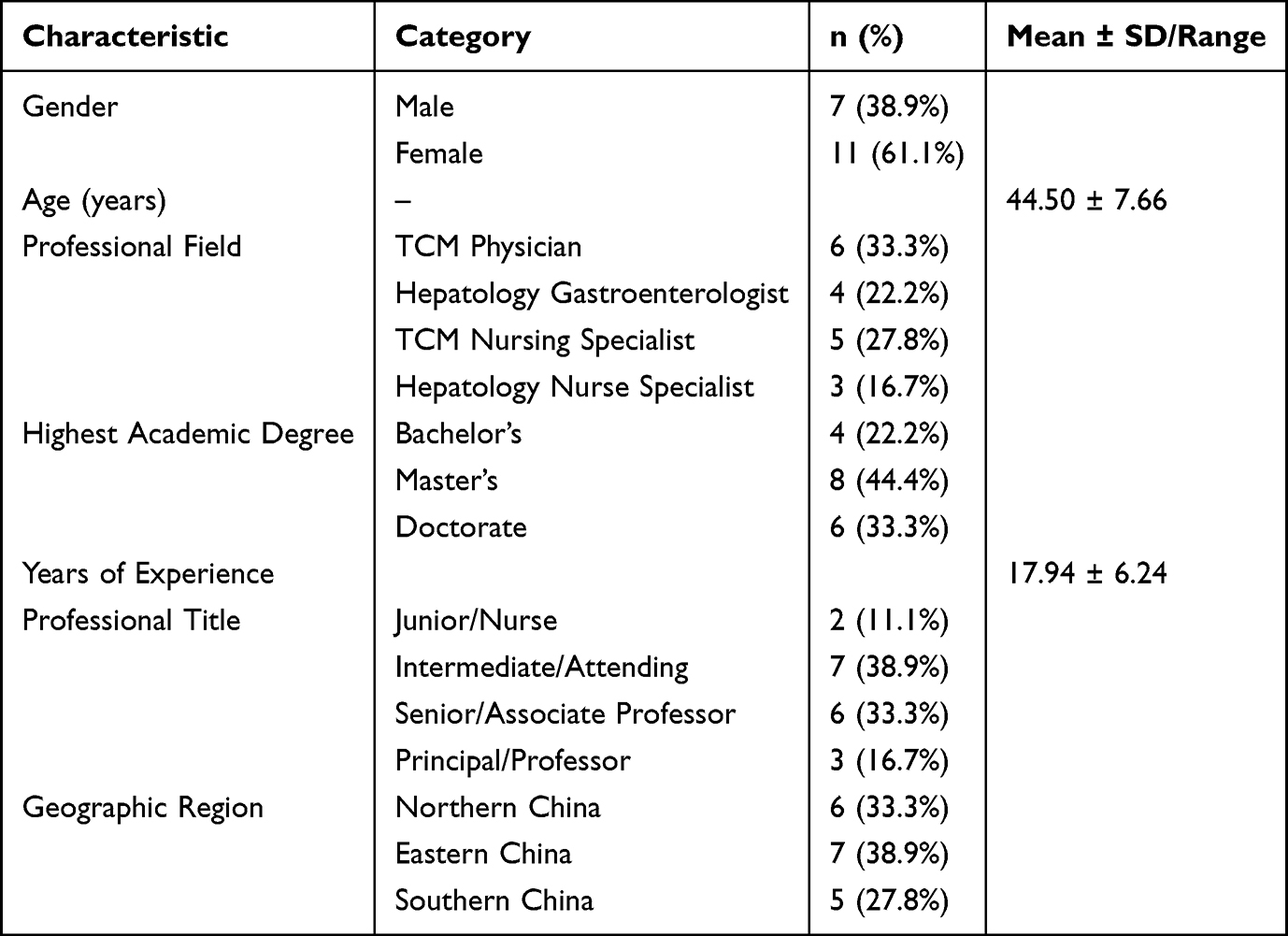 |
Table 1 Demographic and Professional Characteristics of the Expert Panel (N=18) |
Consensus Ratings on TCM Syndrome Classification
Spleen–Kidney Yang Deficiency received the highest mean rating (4.72 ± 0.83) and full agreement (100%), identifying it as the dominant syndrome pattern. Damp-Heat Accumulation (4.44 ± 1.20, 94.4%) was linked to early-stage ascites, while Liver Stagnation–Spleen Deficiency (4.33 ± 0.97, 92.3%) was associated with emotional comorbidity. Qi–Blood Stasis (4.56 ± 0.51, 88.9%) was recognized as typical in chronic or refractory cases (Table 2). All syndromes demonstrated coefficient of variation (CV) values below 0.30, indicating high rating stability and strong expert consensus.
 |
Table 2 Consensus Ratings on TCM Syndrome Classification |
Domain-Level Consensus Rates and Stability Indicators
The mean scores ranged from 4.67 to 4.83, with coefficients of variation (CV) between 0.22 and 0.33, indicating strong internal consistency and stability (ΔCV ≤ 0.08). Among the domains, Intervention Principles received the highest rating (4.83 ± 0.83; 97.8% agreement), reflecting strong expert endorsement of its clinical applicability. Syndrome Classification (4.72 ± 0.46; 94.4%) and Nursing Assessment (4.78 ± 0.43; 92.3%) also demonstrated high consensus, underscoring their perceived importance in guiding individualized nursing care. Outcome Evaluation showed slightly lower agreement (4.67 ± 0.49; 89.6%) but remained within acceptable consensus thresholds (Table 3). Overall, the low variation and high stability across domains confirmed the robustness and reliability of the finalized framework.
 |
Table 3 Consensus Ratings Across Framework Domains |
Delphi Ratings for TCM Nursing Intervention Principles
Experts reached strong consensus on four TCM nursing principles for cirrhotic ascites (means 4.22–4.56/5; agreement 92.3%–100%; CV 0.12–0.21). “Tonify Spleen and Kidney” ranked first (4.28 ± 1.32; CV = 0.12) with unanimous agreement (100.0%), endorsing warm care and dietary modification to support Qi and fluid metabolism. “Promote Qi Flow” followed (4.56 ± 0.98; CV = 0.16; 97.8% agreement), prioritizing breathing exercises and acupressure to relieve distension. “Resolve Dampness” showed substantial consensus (4.44 ± 0.98; CV = 0.18; 94.4%), emphasizing fluid-intake management to enhance water metabolism. “Regulate Emotion”, while slightly less prioritized, remained highly rated (4.22 ± 1.40; CV = 0.21; 92.3%) (Table 4), highlighting psychosocial support as integral to holistic care. Collectively, the uniformly high ratings and low dispersion indicate a coherent, clinically actionable framework suitable for integration into syndrome-differentiation nursing pathways.
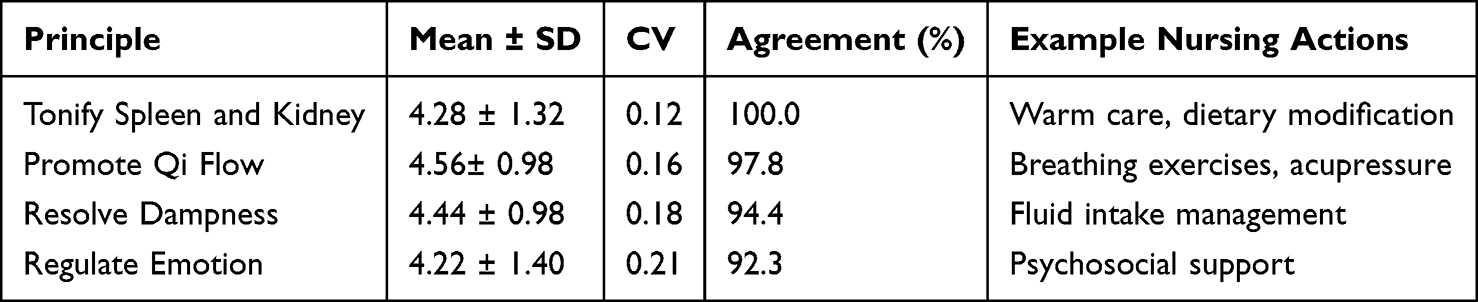 |
Table 4 Delphi Ratings for TCM Nursing Intervention Principles |
Reliability of Delphi Ratings Across Domains
The intraclass correlation coefficients (ICC) ranged from 0.89 to 0.97, indicating high internal reliability. The highest consistency was observed for Intervention Principles (ICC = 0.97, 95% CI 0.94–0.99), followed by Syndrome Classification (ICC = 0.93, 95% CI 0.88–0.97) and Nursing Assessment (ICC = 0.91, 95% CI 0.86–0.95). Outcome Evaluation also showed acceptable reliability (ICC = 0.89, 95% CI 0.82–0.93). Correspondingly, Kendall’s W coefficients increased markedly from Round 1 (0.60–0.70) to Round 3 (0.78–0.86), all with p < 0.001 (Figure 1), reflecting progressive expert convergence through the Delphi rounds. These results confirm the robust stability and reproducibility of expert judgments, supporting the methodological rigor of the established TCM syndrome–differentiation nursing framework.
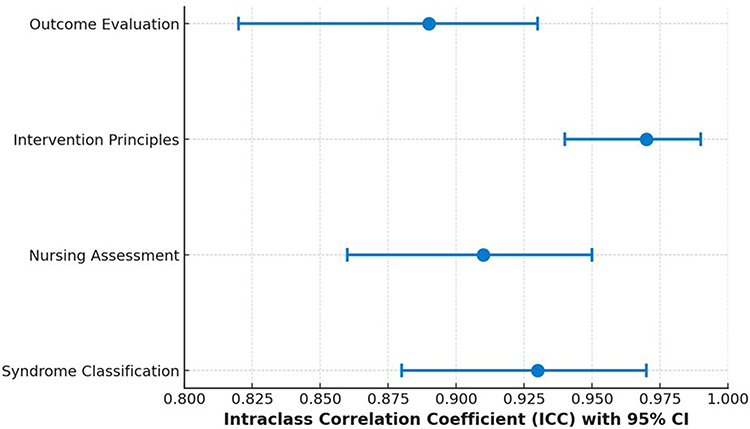 |
Figure 1 Reliability of Delphi Ratings Across Domains. |
Summary of Qualitative Themes and Representative Quotations
Qualitative synthesis of expert feedback revealed three overarching themes underpinning the development of the TCM syndrome–differentiation nursing framework: integration, personalization, and standardization. The theme of Integration of TCM and Nursing reflected a holistic care perspective, emphasizing that “nursing based on TCM differentiation allows individualized regulation rather than uniform procedures”. Personalization centered on dynamic syndrome recognition, highlighting that “patients’ syndromes evolve; nursing care must adapt accordingly”. Meanwhile, standardization emphasized measurement and documentation, as experts noted that “outcome indicators must be operationalized for real-world nursing practice”. Collectively, these themes demonstrate that while TCM-based nursing must adapt to patients’ individual and evolving syndromes, it simultaneously requires standardized assessment and outcome measures to ensure clinical rigor and reproducibility (Table 5).
 |
Table 5 Summary of Qualitative Themes and Representative Quotations |
Temporal Dynamics of Expert Agreement Across Rounds
Mean agreement increased from 81.2% in Round 1 to 91.1% in Round 2 and 94.9% in Round 3, reflecting enhanced consistency and validation of the framework elements. The domain of Intervention Principles achieved the highest agreement by Round 3 (97.5%), while Outcome Evaluation showed the largest overall gain (+14.1%) (Figure 2). Concurrently, the coefficients of variation declined across all domains, signifying reduced dispersion and stronger consensus stability. These temporal dynamics confirm the methodological rigor of the Delphi process and underscore the collective endorsement of the framework’s clinical relevance and internal coherence.
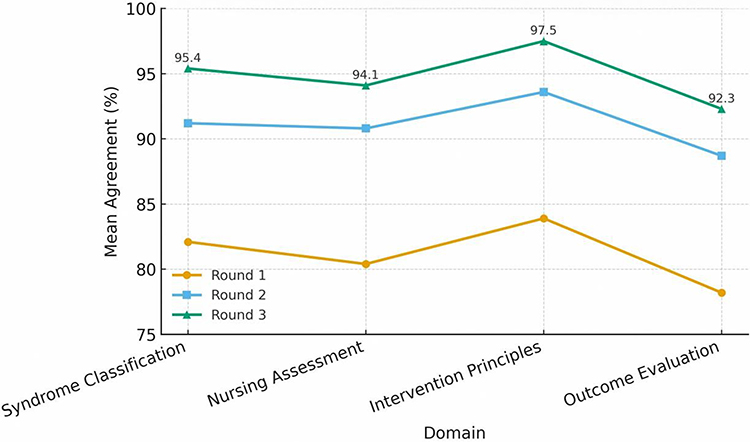 |
Figure 2 Temporal Dynamics of Expert Agreement Across Rounds. |
Discussion
The current Delphi research was the first to determine the existence of a consensus-based Traditional Chinese Medicine (TCM) syndrome-differentiation framework of nursing when applied to patients with cirrhotic ascites. The study has high consensus levels on all domains (syndrome classification, nursing assessment, intervention principles, and leading outcome evaluation) through a rigorous three-round, Delphi process (constituting a total of 18 multidisciplinary experts) with excellent levels of reliability and content validity. The framework incorporates TCM theoretical rationale and evidence-based nursing practice to provide a new model, which will help in bridging the very-ancient diagnostic wisdom plus the modern clinical nursing care. It is unique in its operationalization of syndrome differentiation as a systematic nursing event and thus offers a scientifically based intervention in individualized and holistic care of this problematic patient group.
The results confirm that the pattern of pre-eminent syndromes in cirrhotic ascites as is as per the classical TCM theory and other clinical findings in the recent past.16 Nonetheless, through determining a quantitative agreement on this classification, the present study goes past all the descriptive syndrome recognition and offers an approachable diagnostic base of nursing evaluation and analysis. The high level of consensus in the experts corresponds to the convergence of historical pathophysiology beliefs, which are based on the spleen-kidney malfunction, and the current knowledge of hypoalbuminemia, portal hypertension, and the fluid imbalance. This correspondence supports the idea that the pathomechanism of the so-called Yang deficiency in TCM is tightly matched with the poor metabolic and circulatory control, which important supports the scientificity of the syndrome-based nursing assessment.17
The excellent agreement and reliability within Intervention Principles domain indicate clinical significance of syndrome-based care strategy. In the literature, past research on integrated hepatology nursing focused on the symptomatic treatment but without a TCM rationale framework.18,19 Conversely, the paper ranked four interventions on the basis of principles tonifying the spleen and kidney, enhancing qi circulation, clearing dampness and balancing emotion systematically. The fact that the ICC was extremely high (0.97), and that the experts agreed fully (100%) on the principle of tonifying the Spleen and Kidney shows that the respondents view holistic tonification and warm-care interventions as the core of ascites management. The efficacy of such practices is aligned with their mechanism of enhancement of physiological optimization of renal filtration and lymphatic circulation. This result warns against the excessively disintegrated or symptom-based strategies, and promotes restoring order in the system as a nursing goal.
The domains of Nursing Assessment and Outcome Evaluation were slightly lower in the degree of agreement and showed high levels of validity, as the application of quantifying TCM-directed pointers in nursing situations is practically level. The same issue has been mentioned in preceding Delphi studies on TCM syndrome assessment.20,21 That the standard deviation in CVs is moderate probably reflects the subjectivity in evaluating the look of the tongue, the nature of pulses, and the change of mood—factors that cannot be judged objectively. However, the use of firm agreement on key considerations of combining physical, psychological, and lifestyle tendencies on a single-nursing claim in support of multidimensional nature of TCM-based nursing. Notably, this research adds a standard template towards operationalization of such forms of assessment, which will be reproducible and clinically audit as part of the contemporary hospital systems.
The findings indicated an impressive interdisciplinary intersection in TCM physicians, hepatologists and nurses. No considerable differences between the subgroups were observed, and that suggests the conceptual grasp of the TCM-guided care across the various professional backgrounds. This harmonization is in contrast to the previous literature that documented an aspect of disciplinary fragmentation between the TCM and biomedical practitioners.22 The converging tendency can be explained by the increasing interdisciplinary cooperation and the incorporation of TCM into the medical education to-day. The clinical perspective of such cross-disciplinary alignment is paramount to the application of syndrome-differentiation nursing, which can be implemented in multi-specialty care environments to provide continuity and unity throughout treatment teams.
The qualitative evidence indicated three intersecting themes, namely integration, personalization, and standardization, that convey the theoretical and practical experience of the framework. The integration theme correlates with the holistic nursing philosophy that underlines the care that is comprehensive and based on body-mind unity.23 Personalization is something that echoes the TCM doctrine of treatment according to syndrome differentiation that states that patient-centered flexibility is not a weakness but an asset of the traditional practice. Standardization, however, brings in a new imperative: of converting tacit knowledge of TCM into measurable and auditable processes. Such triangulation of themes crosses cultural and methodological paradigms by providing a repeatable course of translating the TCM nursing concept to universal evidence-based practice.
The progressive ratification and refinement of the expert views are represented in the temporal dynamics of agreement that point to the increase in the consensus of 81.2% to 94.9% per round. The convergence of this nature is classifying the processes of mature Delphi and is indicative of cognitive stabilization attained via feedback. The highest rate of improvement was noted in the Outcome Evaluation arena (+14.1) indicating structured feedback might have been effective in balancing the conflicting understandings of success indicators by the experts. This substantiates the theoretical belief that expert consensus that is arbitred out with structural anonymity and statistical iteration does not merely gauge concurrence but actually takes part in creating collective cognizance, a result that is concurrent with Delphi theory in health research.24
Despite these strengths, several important limitations should be acknowledged. First, the expert panel included only 18 participants; although this size is acceptable for a Delphi study in a highly specialized field, it inevitably limits the breadth of perspectives captured and the statistical generalizability of the findings. Second, all experts were recruited from China. While this was appropriate for developing a framework grounded in the clinical and cultural context of TCM syndrome–differentiation nursing, it may also introduce cultural and practice-pattern bias and may limit transferability to other healthcare systems or international nursing settings. Third, the proposed framework has not yet undergone external validation in independent expert panels or multicenter practice environments, and its broader applicability therefore remains to be confirmed. Fourth, because this study was designed to establish expert consensus rather than test clinical effectiveness, no patient-level outcome data were collected; accordingly, the framework should not yet be interpreted as evidence of improved patient outcomes. Future studies should therefore focus on external validation, multicenter implementation, and prospective evaluation of patient outcomes, nursing performance, and inter-rater reliability in real-world clinical settings.
In conclusion, this study developed a preliminary, consensus-based Traditional Chinese Medicine (TCM) syndrome–differentiation nursing framework for patients with cirrhotic ascites through a three-round Delphi process. The findings indicate good expert agreement and framework stability across the four domains of syndrome classification, nursing assessment, intervention principles, and outcome evaluation. However, the framework should be interpreted as a structured conceptual guide derived from expert consensus rather than as evidence of clinical effectiveness or implementation readiness. Given the relatively small panel size, the single-country expert composition, and the absence of external or outcome-based validation, its broader applicability remains to be established. Future research should focus on prospective validation, multicenter implementation studies, and evaluation of patient- and practice-level outcomes to determine the framework’s clinical utility and generalizability.
Funding
This work was funded by the Jiangxi Provincial Administration of Traditional Chinese Medicine Science and Technology Project(Project Number: 2024130520).
Disclosure
The authors report no conflicts of interest in this work.
References
1. Lee MJ. A review of liver fibrosis and cirrhosis regression. J Pathol Transl Med. 2023;57(4):189–10. doi:10.4132/jptm.2023.05.24
2. Balcar L, Tonon M, Semmler G, et al. Risk of further decompensation/mortality in patients with cirrhosis and ascites as the first single decompensation event. JHEP Rep. 2022;4(8):100513. doi:10.1016/j.jhepr.2022.100513
3. Biggins SW, Angeli P, Garcia-Tsao G, et al. Diagnosis, evaluation, and management of ascites, spontaneous bacterial peritonitis and hepatorenal syndrome: 2021 practice guidance by the American association for the study of liver diseases. Hepatology. 2021;74(2):1014–1048. doi:10.1002/hep.31884
4. Trifan A, Minea H, Rotaru A, et al. Predictive factors for the prognosis of alcoholic liver cirrhosis. Medicina. 2022;58(12):1–12.
5. Yan C, Zhang W, Xiao Y, et al. The predictive role of the platelet-to-lymphocyte ratio for the risk of non-alcoholic fatty liver disease and cirrhosis: a nationwide cross-sectional study. Front Endocrinol. 2024;15:1376894. doi:10.3389/fendo.2024.1376894
6. Desideri G, Montano N, Sesti G. Patient centered care: a multidisciplinary and holistic approach. Eur J Intern Med. 2024;122:119–120. doi:10.1016/j.ejim.2024.02.018
7. Bourgault AM. Task-oriented nursing care through a positive lens. Crit Care Nurse. 2023;43(3):7–9.
8. Verma M, Brahmania M, Fortune BE, et al. Patient-centered care: key elements applicable to chronic liver disease. Hepatology. 2023;78(1):307–318. doi:10.1002/hep.32618
9. Romeo M, Dallio M, Cipullo M, et al. Nutritional and psychological support as a multidisciplinary coordinated approach in the management of chronic liver disease: a scoping review. Nutr Rev. 2025;83(7):1327–1343. doi:10.1093/nutrit/nuaf001
10. Li Z, Zhu J, Ouyang H. Recent insights into contributing factors in the pathogenesis of cirrhotic ascites. Front Med Lausanne. 2024;11:1376217. doi:10.3389/fmed.2024.1376217
11. Conroy SF, Hastings-Tolsma M, Voreis K, et al. Traditional Chinese medicine: a qualitative study for reconsidering nursing care in the United States. J Holist Nurs. 2020;38(4):336–349. doi:10.1177/0898010120903167
12. Yao CL, Zhang JQ, Li JY, et al. Traditional Chinese medicine (TCM) as a source of new anticancer drugs. Nat Prod Rep. 2021;38(9):1618–1633. doi:10.1039/D0NP00057D
13. Ye Z, Lai H, Ning J, et al. Traditional Chinese medicine for insomnia: recommendation mapping of the global clinical guidelines. J Ethnopharmacol. 2024;322:117601. doi:10.1016/j.jep.2023.117601
14. Spranger J, Homberg A, Sonnberger M, et al. Reporting guidelines for delphi techniques in health sciences: a methodological review. Z Evid Fortbild Qual Gesundhwes. 2022;172:1–11. doi:10.1016/j.zefq.2022.04.025
15. Grant S, Armstrong C, Khodyakov D. Online modified-delphi: a potential method for continuous patient engagement across stages of clinical practice guideline development. J Gen Intern Med. 2021;36(6):1746–1750. doi:10.1007/s11606-020-06514-6
16. Zheng S, Xue C, Li S, et al. Liver cirrhosis: current status and treatment options using western or traditional Chinese medicine. Front Pharmacol. 2024;15:1381476. doi:10.3389/fphar.2024.1381476
17. Zhao M, Zhou H, Wang J, et al. A new method for identification of traditional Chinese medicine constitution based on tongue features with machine learning. Technol Health Care. 2024;32(5):3393–3408. doi:10.3233/THC-240128
18. Vinten CE, Cobb KA, Freeman SL, et al. An investigation into the clinical reasoning development of veterinary students. J Vet Med Educ. 2016;43(4):398–405. doi:10.3138/jvme.0815-130R1
19. Wei J, Yan H, Xiang Y, et al. The effectiveness of symptom management theory in guiding clinical practice-a systematic review. Altern Ther Health Med. 2024;30(8):108–114.
20. Shi X, He X, Liu Q, et al. Conducting and reporting the delphi method in traditional Chinese medicine syndrome diagnosis research: a cross-sectional analysis. Heliyon. 2024;10(3):e25162. doi:10.1016/j.heliyon.2024.e25162
21. Yun HE, Jing HE, Xiangru XU, et al. Consensus on diagnostic criteria for deficiency syndrome in hypertension: a modified Delphi study. J Tradit Chin Med. 2023;43(1):181–187. doi:10.19852/j.cnki.jtcm.20220719.002
22. Chang L, Lim JCJ. Traditional Chinese medicine physicians’ insights into interprofessional tensions between traditional Chinese medicine and biomedicine: a critical perspective. Health Commun. 2019;34(2):238–247. doi:10.1080/10410236.2017.1405478
23. Colldén C, Hellström A, Gremyr I. Value configurations for balancing standardization and customization in chronic care: a qualitative study. BMC Health Serv Res. 2021;21(1):845. doi:10.1186/s12913-021-06844-z
24. Bucyibaruta JB, Doriccah M, Bamford L, et al. Building consensus in defining and conceptualizing acceptability of healthcare: a delphi study. Public Health Nurs. 2023;40(2):273–282. doi:10.1111/phn.13153
 © 2026 The Author(s). This work is published and licensed by Dove Medical Press Limited. The
full terms of this license are available at https://www.dovepress.com/terms
and incorporate the Creative Commons Attribution
- Non Commercial (unported, 4.0) License.
By accessing the work you hereby accept the Terms. Non-commercial uses of the work are permitted
without any further permission from Dove Medical Press Limited, provided the work is properly
attributed. For permission for commercial use of this work, please see paragraphs 4.2 and 5 of our Terms.
© 2026 The Author(s). This work is published and licensed by Dove Medical Press Limited. The
full terms of this license are available at https://www.dovepress.com/terms
and incorporate the Creative Commons Attribution
- Non Commercial (unported, 4.0) License.
By accessing the work you hereby accept the Terms. Non-commercial uses of the work are permitted
without any further permission from Dove Medical Press Limited, provided the work is properly
attributed. For permission for commercial use of this work, please see paragraphs 4.2 and 5 of our Terms.
Recommended articles
Integrating the Wei–Qi–Ying–Blood Theory with Modern Pathophysiology: A Multitarget Translational Framework for Dengue Management
Wang T, Li X, Wang X, Li Q
International Journal of General Medicine 2026, 19:618593
Published Date: 22 July 2026