
Back to Journals » Advances in Medical Education and Practice » Volume 17

Integrating an Undergraduate Longitudinal POCUS Curriculum to Enhance Anatomy Learning: A Short Report
Authors Goulet G  , Dallaire G, Hadj-Mimoune S , Trépanier G
Received 25 March 2026
Accepted for publication 15 May 2026
Published 29 May 2026 Volume 2026:17 610429
DOI https://doi.org/10.2147/AMEP.S610429
Checked for plagiarism Yes
Review by Single anonymous peer review
Peer reviewer comments 2
Editor who approved publication: Dr Md Anwarul Azim Majumder
Geneviève Goulet,1 Geneviève Dallaire,1 Sarah Hadj-Mimoune,2 Gabrielle Trépanier1
1Department of Family Medicine and Emergency Medicine, Faculty of Medicine and Health Sciences, Université de Sherbrooke, Sherbrooke, QC, Canada; 2Department of Diagnostic Radiology, Centre Hospitalier Universitaire de Sherbrooke (CHUS), Sherbrooke, QC, Canada
Correspondence: Geneviève Goulet, Department of Family Medicine and Emergency Medicine, Faculty of Medicine and Health Sciences, Université de Sherbrooke, 3001 12th Avenue North, Sherbrooke, QC, J1H 5N4, Canada, Tel +1 819 821 8000 ext. 74274, Email [email protected]
Context: With the increasing role of Point-of-Care Ultrasound (POCUS) in clinical practice, its integration as a teaching tool in undergraduate medical programs is rapidly expanding. In 2017, the Université de Sherbrooke implemented a 4-year longitudinal POCUS curriculum integrated into its anatomy teaching using a flipped classroom model. Evidence regarding the educational outcomes of such curricula, particularly knowledge-retention over time, remains limited.
Intervention: This short report describes the evaluation of our longitudinal undergraduate POCUS curriculum several years after its implementation. Two questionnaires were administered anonymously to the 190 students of the 2023 graduating cohort to assess perceived educational impact and anatomical knowledge using Likert-type questions and multiple-choice questions (MCQ), respectively.
Results: The response rate was 54%. Among respondents, 98.1% agreed or strongly agreed that POCUS sessions helped consolidate anatomical knowledge, and all respondents reported improved integration of anatomical concepts into clinical contexts. Near the end of medical training, and without prior notification or preparation, students achieved a mean score of 90.7% on the MCQ knowledge-retention assessment.
Discussion: These findings suggest that the curriculum may contribute to the retention of anatomical knowledge and to the integration of anatomical and pathophysiological concepts. The involvement of residents as instructors emerged as a perceived strength of the program.
Conclusion: This program evaluation suggests that a longitudinal POCUS curriculum may contribute to anatomy learning in undergraduate medical education. The observed outcomes and the feasibility of implementation across a multi-campus program support its potential relevance as a pedagogical tool in undergraduate medical curricula.
Keywords: ultrasound, medical education, knowledge retention, educational outcomes, flipped classroom
Background
Point-of-Care Ultrasound (POCUS) has been shown to be a valuable clinical tool, enabling dynamic bedside assessment, supporting diagnosis, and guiding procedures, thereby optimizing patient management. Ultrasound was first introduced as an undergraduate anatomy teaching aid in European medical school education programs around the early nineties.1,2 Since then, its use in undergraduate medical education has steadily increased. According to a recent national survey, two-thirds of medical schools in the United States now report having an approved POCUS curriculum.3 The published literature consistently highlights strong student engagement with ultrasound-based teaching. A recent review of 128 articles reported that medical students are generally highly motivated and perceive ultrasound sessions as valuable for their future clinical practice.4 However, while international2 and national5 expert consensus groups have outlined recommended learning objectives and broad curricular principles, there remains limited empirical support to guide evidence-based educational approaches and assessment strategies.4,6 Importantly, assessments of knowledge retention remain uncommon in the existing literature.6 While several programs have described successful curricular integration and positive learner perceptions, many evaluations rely primarily on self-reported outcomes or short-term testing. Furthermore, despite the growing prevalence of ultrasound curricula, formal and standardized assessment of student competency remains inconsistent across institutions.
This study aimed to evaluate the impact of a newly implemented longitudinal undergraduate POCUS curriculum on both students’ perceived learning and retention of anatomical knowledge near the end of medical training. Informed by gaps identified in the literature, this evaluation was conducted at a time point removed from teaching sessions and combined perception and knowledge outcomes, providing insight into longer-term retention.
Description of the Curriculum
A complete overhaul of the medical doctorate program occurred in 2017 at the Université de Sherbrooke, where it is delivered across multiple campuses, including regional and remote training sites. At that time, eleven POCUS sessions were added to the 4-year undergraduate curriculum (Box 1). Sessions in the first 2 years acted as a support to anatomy learning, whereas sessions in the final 2 years provided added pathophysiological integration and clinical contextualization. These supervised POCUS sessions last from 1–2 h, and teaching is performed in small groups of 8–10 students in a flipped classroom format. POCUS models are either standardized patients or students practicing on each other, based on predefined session objectives and anatomical regions addressed, with standardized patients used for sessions involving more sensitive examination like the groin and pelvic area. Sessions typically begin with a live ultrasound demonstration performed by the instructor, first without and then with real-time explanations regarding image acquisition and interpretation. Students subsequently practice scanning, taking turns performing image acquisition while peers observe and provide feedback supplemented by the instructor. A second ultrasound device is also available to allow parallel hands-on practice. Sessions conclude with a review of key learning points and commonly encountered difficulties. A formal competency assessment is not presently included in the curriculum.
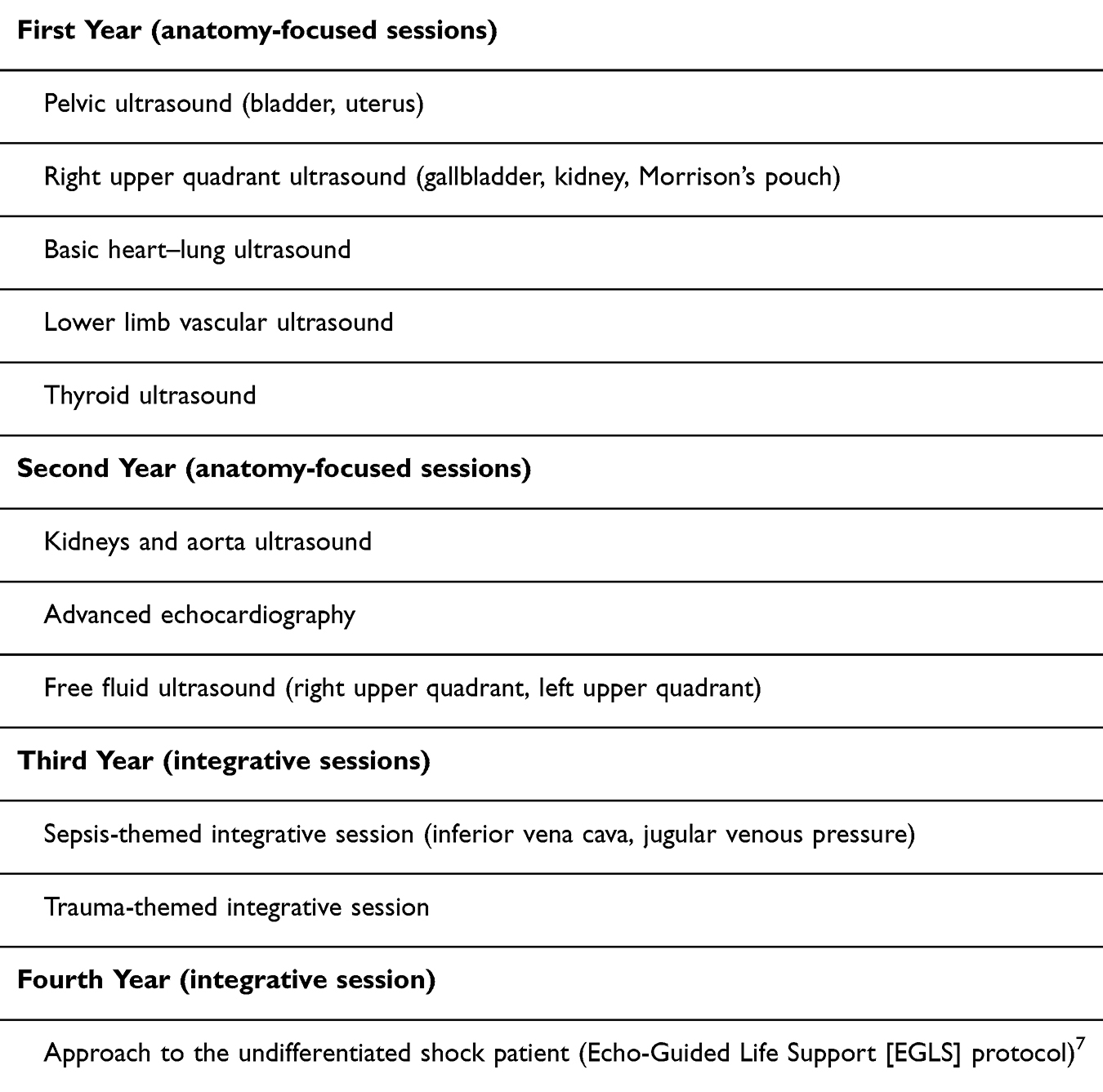 |
Box 1 Point‑of‑Care Ultrasound (POCUS) Sessions Integrated into the 4‑Year Doctorate Program |
Evaluation
A graduating cohort of students was surveyed to evaluate the impact of implementing our new curriculum. We therefore assessed its perceived and demonstrated repercussions on anatomy learning via a survey conducted in April 2023. All 190 students of the 2023 graduating cohort across the program’s multiple campuses were invited to participate during a scheduled in-person academic activity. Two short questionnaires were administered electronically and anonymously using an online platform. Participation was voluntary, which may introduce a response bias. The first measured students’ appreciation and perceived impact of the POCUS curriculum via Likert-type questions, whereas the second was a multiple-choice question (MCQ) quiz on ultrasound still image interpretation and anatomical labeling (see Supplementary Figure 1). The questionnaires were developed by a member of the research team based on the curriculum content and learning objectives and were reviewed by co-authors for clarity and content relevance. No formal validation process was conducted. For Likert-type questions, responses are reported as the proportion of respondents who selected “agree” or “strongly agree”. Data analysis was primarily descriptive, in keeping with the exploratory nature of this program evaluation.
Results
We obtained a 54% response rate (102/190), with a higher participation observed at distant campuses (91.7% and 87.5%) compared to the main campus (35.8%).
Among respondents, 98.1% agreed or strongly agreed that the POCUS sessions helped them consolidate anatomical knowledge learned in other classes. All respondents believed the sessions helped them correlate the studied anatomical notions to different clinical presentations and that the integrative sessions increased their appreciation of the new pathophysiological entities they studied. Moreover, 95.9% of the surveyed students predicted they would use POCUS during their residency training. A majority of the studied cohort also expressed interest in some form of written formative assessment throughout the curriculum (67.0%) or at its conclusion (74.0%). The most common suggestion highlighted a desire for increased opportunities to practice POCUS outside of the scheduled sessions. Another area surveyed was the level of appreciation for the involvement of residents from radiology and emergency medicine programs as teachers for the medical students. All the answers and comments obtained regarding this innovation were extremely favorable to the pedagogical integration of more advanced learners as teachers. Responses to perception-based questions were consistent across intended residency programs, with no statistically significant differences observed (Chi-square or Fisher’s exact test, as appropriate).
Finally, without any prior preparation or advance notification, students obtained an average grade of 90.7% (mean score 25.4/28, SD 3.0) on the MCQ knowledge quiz assessing ultrasound image interpretation and anatomical labeling.
Discussion
This evaluation was not designed to measure causal educational effects but to document outcomes from real-world curriculum implementation. The results suggest that the current program format may support retention of anatomical knowledge, although this interpretation should be made with caution given the absence of baseline or comparator data. POCUS seems to be an appreciated pedagogical tool that meets students’ interests and needs, which is consistent with previous literature.4,8 Although respondents were unaware that a knowledge quiz would be administered and therefore had no opportunity to prepare, the mean score of 90.7% suggests that some retention of anatomical notions was present at the time of assessment. Furthermore, the observed learning benefits, including the integration of anatomical and pathophysiological notions, are primarily based on self-reported perceptions and should therefore be interpreted as suggestive rather than confirmatory. In addition, the assessment tools were locally developed and not formally validated, which may limit the strength of the conclusions.
Based on students’ feedback, curricular adaptations were introduced after the 2023 evaluation, including formative pre- and post-assessments for integrative sessions using clinical vignettes with POCUS stills and videos to support self-learning and knowledge retention and promote teaching points consistency across groups of learners.
Additional supervised free practice sessions were also added to the curriculum to answer one of the students’ requests brought to light by the survey but were subsequently suspended due to budget cuts in the Quebec higher education system.
An important strength of the program highlighted by the survey was the involvement of residents as instructors. While peer-assisted learning is frequently described in the literature, it most often involves senior medical students rather than residents.8–10 Resident-led teaching may represent a valuable and underexplored model that simultaneously supports learner engagement and addresses commonly reported faculty availability challenges. This model was highly appreciated by students and could be further leveraged in supervised practice sessions.
Finally, voluntary participation and the relatively lower response rate at the main campus raise the possibility of response bias. Students with a preexisting enthusiasm for POCUS may have been more likely to participate, which could have influence both perception-based responses and knowledge assessment outcomes.
Conclusion
The longitudinal POCUS curriculum implemented in the Université de Sherbrooke undergraduate medical program may contribute to anatomy learning. Student perceptions and knowledge assessment outcomes measured near the end of medical training suggest the presence of retained knowledge and perceived learning benefits. The feasibility of this curriculum, including its integration into a multi-campus program and the involvement of residents as instructors, supports its potential relevance for other undergraduate medical education contexts.
Use of Generative AI
The authors used Microsoft M365 Copilot (GPT‑5 chat model) and ChatGPT (OpenAI, GPT-5.3) to assist with language editing, clarity of expression, and formatting suggestions during manuscript preparation. The tool was used to refine phrasing and improve readability of the manuscript, not to generate scientific content, interpret data, or create original results. All AI‑assisted outputs were reviewed, verified, and edited by the authors to ensure accuracy and alignment with the study’s findings. No confidential or non‑anonymized data were entered into the tool.
Data Sharing Statement
The datasets analyzed during the current study are available from the corresponding author on request.
Ethics Approval and Consent
This project was submitted to the Comité d’éthique de la recherche – Éducation et sciences sociales de l’Université de Sherbrooke, and the requirement for formal ethics approval was waived following committee evaluation.
Acknowledgments
The authors would like to thank Mrs. Julie Mayrand (M.S.I.), research librarian who guided our team through the process of reviewing the literature. The authors would also like to thank Anya Bussière-Filion, a medical student who also contributed to the literature review during a summer elective.
Author Contributions
All authors made a significant contribution to the work reported, whether that is in the conception, study design, execution, acquisition of data, analysis and interpretation, or in all these areas; took part in drafting, revising or critically reviewing the article; gave final approval of the version to be published; have agreed on the journal to which the article has been submitted; and agree to be accountable for all aspects of the work.
Funding
This study was funded by the Fonds de développement pédagogique de la Société des médecins de l'Université de Sherbrooke (SMUS) and by the Fonds de recherche, d’innovation et de promotion du savoir (FRIPS) from the Department of Family Medicine and Emergency Medicine, Faculty of Medicine and Health Sciences, Université de Sherbrooke.
Disclosure
GG and SH declare that they have no conflict of interest in this work. GD serves as an instructor for bedside teaching in EDE Bootcamp courses. GD has been an invited speaker twice at Mtl‑Sono. GD performed English‑to‑French translation of a medical questionnaire for the University of Saskatchewan. GD is the Resus‑TEE‑IP Bootcamp Course Director. GD is the Acute Care MSK and Resus TEE Lead and curriculum author for the Canadian Point of Care Ultrasound Society (CPOCUS). GD and GT serve as unpaid Board Directors for CPOCUS. The views expressed in this article are those of the authors and do not represent official positions of their institutions or funders.
References
1. Teichgraber UK, Meyer JM, Poulsen Nautrup C, von Rautenfeld D. Ultrasound anatomy: a practical teaching system in human gross anatomy. Med Educ. 1996;30(4):296–5. doi:10.1111/j.1365-2923.1996.tb00832.x
2. Hoppmann RA, Mladenovic J, Melniker L, et al. International consensus conference recommendations on ultrasound education for undergraduate medical students. Ultrasound J. 2022;14(1):31. doi:10.1186/s13089-022-00279-1
3. Russell FM, Park R, Campbell M, Lemen L. Point-of-care ultrasound in undergraduate medical education: a national survey. J Ultrasound Med. 2025;44(12):2335–2340. doi:10.1002/jum.70021
4. Brunel M, Schafer VS, Recker F. Bringing anatomy to life: the role of clinical ultrasound in undergraduate medical education - a systematic review. Ultrasound J. 2025;17(1):39. doi:10.1186/s13089-025-00443-3
5. Ma IWY, Steinmetz P, Weerdenburg K, et al. The Canadian medical student ultrasound curriculum: a statement from the Canadian ultrasound consensus for undergraduate medical education group. J Ultrasound Med. 2020;39(7):1279–1287. doi:10.1002/jum.15218
6. Tarique U, Tang B, Singh M, Kulasegaram KM, Ailon J. Ultrasound curricula in undergraduate medical education: a scoping review. J Ultrasound Med. 2018;37(1):69–82. doi:10.1002/jum.14333
7. Lanctôt J-F, Valois M, Beaulieu Y. EGLS: echo-guided life support. Crit Ultrasound J. 2011;3(3):123–129. doi:10.1007/s13089-011-0083-2
8. Glass C, Sarwal A, Zavitz J, et al. Scoping review of implementing a longitudinal curriculum in undergraduate medical education: the wake forest experience. Ultrasound J. 2021;13(1). doi:10.1186/s13089-021-00206-w
9. Boivin Z, Carpenter S, Lee G, et al. Evaluation of a required vertical point-of-care ultrasound curriculum for undergraduate medical students. Cureus. 2022;14(10):e30002. doi:10.7759/cureus.30002
10. Oberoi MK, Perera NC, Reynaga J, et al. Students teaching students: student-led ultrasound curriculum in medical school education. Cureus. 2021;13(11):e19332. doi:10.7759/cureus.19332
 © 2026 The Author(s). This work is published and licensed by Dove Medical Press Limited. The
full terms of this license are available at https://www.dovepress.com/terms
and incorporate the Creative Commons Attribution
- Non Commercial (unported, 4.0) License.
By accessing the work you hereby accept the Terms. Non-commercial uses of the work are permitted
without any further permission from Dove Medical Press Limited, provided the work is properly
attributed. For permission for commercial use of this work, please see paragraphs 4.2 and 5 of our Terms.
© 2026 The Author(s). This work is published and licensed by Dove Medical Press Limited. The
full terms of this license are available at https://www.dovepress.com/terms
and incorporate the Creative Commons Attribution
- Non Commercial (unported, 4.0) License.
By accessing the work you hereby accept the Terms. Non-commercial uses of the work are permitted
without any further permission from Dove Medical Press Limited, provided the work is properly
attributed. For permission for commercial use of this work, please see paragraphs 4.2 and 5 of our Terms.
Recommended articles
Student Perceptions and Effectiveness of Video-Based Flipped Classroom for Improving Medical Physiology Teaching at AUSOM
Kottath Veetil P, Kollukkad Mani M, Arja SB, Paramban S, Kattambally PA, Fatteh R, Arja SB
Advances in Medical Education and Practice 2025, 16:1159-1167
Published Date: 3 July 2025
Teaching Jugular Venous Pressure (JVP) Ultrasound: Methods That Improved Medical Students’ Knowledge and Confidence in Performing JVP Assessment
Patel B, Montgomery MW, Callahan DG, Chen HX, Osman NY, Engel-Rebitzer E, Pelletier SR, Shields HM
Advances in Medical Education and Practice 2026, 17:599200
Published Date: 8 May 2026
A Comparative Educational Intervention Study of Peer Teaching and Flipped Classroom Models in Pediatric Intensive Care Rotation
Wu S, Ma J, Zhou L, Huang S, Dong X, Li Y, Huang J, Bai Z
Advances in Medical Education and Practice 2026, 17:603790
Published Date: 29 May 2026